




Abstract
Associative anaphora refers to a discourse operation that links a definite determiner phrase (DP) to an antecedent that acts as an indirect referent of the definite DP. For example, in the sequence ‘I bought a laptop. The keyboard was black’, the definite DP ‘the keyboard’ is linked to ‘a laptop’, meaning ‘the keyboard of the laptop’. The development of children’s knowledge of associative anaphora has long been investigated in child language research, as it provides a unique window into the interaction between linguistic and nonlinguistic cognitive abilities. However, most prior research focused on Indo-European languages without looking at typologically distinct languages. To fill the gap, this study investigated children’s knowledge of associative anaphora in Mandarin Chinese, a typologically distinct language, thus allowing for a better cross-linguistic understanding of the phenomenon. Ninety-one 3- to 5-year-olds were investigated using a truth-value judgment task. The findings were that Mandarin-speaking children exhibited a similar developmental trajectory and were impacted by the same cognitive factors as observed in children speaking Indo-European languages. The implications of the findings were then discussed in relation to the role of processing factors and language-specific properties.
Keywords
Introduction
Associative anaphora refers to a discourse operation that links a definite determiner phrase (DP) to an antecedent that acts as an indirect referent of the definite DP (Hawkins, 1978). For example, in the sequence ‘I bought a laptop. The keyboard was black’, the definite DP ‘the keyboard’ refers to ‘the keyboard of the laptop’ wherein it is linked to the previously mentioned entity ‘a laptop’. To successfully build such a connection, the speaker and the hearer need both linguistic knowledge and nonlinguistic cognitive skills. The required linguistic knowledge includes the morphosyntactic and lexical features of the words and phrases in the sequences, such as the lexical meanings of laptop and keyboard and their semantic connections, the use of functional categories of ‘the’, ‘a’, and so on. The nonlinguistic cognitive skills in this case mainly refer to their processing resources, such as sufficient working memory capacity that is required to store the antecedent ‘a laptop’ temporarily and then retrieve it to bridge the semantic gap between keyboard and laptop. 1
The development of children’s knowledge of associative anaphora has long been investigated in child language research (Avrutin & Coopmans, 2000; Chondrogianni et al., 2015; De Cat, 2013; Rozendaal & Baker, 2008; Van Hout et al., 2007). For example, Avrutin and Coopmans (2000) examined whether 3- to 6-year-old Dutch-, 3- to 5-year-old Russian- and 2- to 4-year-old English-speaking children could successfully build a connection between a definite DP and its antecedent using a truth-value judgment task. The test sentences they used to test Dutch-speaking children are as in (1a) and (1b).
(1a) Er is een jongen aan het eten. De broek is rood. There is a boy to the eating. The pant is red. ‘There is a boy eating. The pants are red’. (1b) Een jongen is aan het eten. De broek is rood. A boy is to the eating The pant is red. ‘A boy is eating. The pants are red’.
In both sentences, the definite DP de broek ‘the pants’ and its antecedent een jongen ‘a boy’ have the same semantic association. But according to Avrutin and Coopmans (2000), the antecedent een jongen ‘a boy’ in (1a) is less salient than in (1b) in discourse context, as een jongen ‘a boy’ can function as a topic in (1b), but cannot do so in (1a). Avrutin and Coopmans found that the 3-year-old Dutch-speaking children were not as successful as the older ones in building the connection between a definite DP and its antecedent when processing sentences like (1a); but their performance was significantly improved when the antecedent becomes more salient as in (1b). On the account by Avrutin and Coopmans, the establishment of associative anaphora in the less-salient antecedent condition required more processing resources than in the more-salient antecedent condition, but younger children were much more limited than the older children in their processing resources, thus leading to their unsuccessful implementation of linguistic knowledge. In addition, Avrutin and Coopmans compared Dutch-speaking children’s performance in the ‘true’ condition versus in the ‘false’ condition. Note that in a truth-value judgment task, ‘true’ indicates that the test constructions were true descriptions of the corresponding stories (e.g. in the stories corresponding to (1a) and (1b), the boy is wearing red pants), and ‘false’ indicates that the test constructions were false descriptions of the corresponding stories (e.g. in the corresponding stories, the boy is wearing green pants instead of red pants). The findings were that all the age-groups performed significantly better in the ‘true’ condition than in the ‘false’ condition, which was again attributed to children’s lack of processing resources. According to Avrutin and Coopmans, children should have performed equally poor in both conditions if they had not acquired the relevant linguistic knowledge, but they performed better in the ‘true’ condition than in the ‘false’ condition, because the ‘false’ condition involves more difficult operations, that is, children need to find the appropriate source of the reference and at the same time reject the inappropriate one. Such operations might have exhausted children’s limited processing resources.
(2a) Plyvjot korablik po reke. Flag krasnyj. Sails boat on river. Flag red. ‘There sails a boat on the river. The flag is red. ’ (2b) Plyvjot korablik po reke. Flag sinij. Sails boat on river. Flag blue. ‘There sails a boat on the river. The flag is blue’.
Avrutin and Coopmans tested 3- to 5-year-old Russian-speaking children using sentences as in (2a) and (2b). Note that Russian is an Indo-European language that does not have overt determiners, and it relies on word order to mark the definiteness of DPs. Subject DPs in Russian can have strong salient status only when they occur in sentence-initial position (King, 1993; Avrutin & Coopmans, 2000; Bailyn, 1995), but Avrutin & Coopmans did not use test constructions containing subject DPs in sentence-initial position, but rather sentences with a verb-subject (i.e. sail-boat) word order as in (2a) and (2b), where the antecedent was a less salient discourse entity. The findings were that like Dutch-speaking children, Russian-speaking children also did better in the ‘true’ condition (2a) where the flag of the boat is indeed red than in the ‘false’ condition (2b) where the flag of the boat is green rather than blue. In addition, the developmental path of the knowledge of associative anaphora in Russian-speaking children was also similar to their Dutch-speaking peers, with 3-year-olds being less successful than the older ones in the establishment of associative anaphora. Avrutin and Coopmans also tested English-speaking children and observed a similar developmental pattern as their Dutch- and Russian-speaking counterparts. These findings led Avrutin and Coopmans to conclude that children’s developmental pattern of the knowledge of associative anaphora holds cross-linguistically without relying on the presence or absence of overt determiners.
In addition to the studies by Avrutin and Coopmans (2000), Van Hout et al. (2007) tested 4- to 6-year-old Dutch-speaking children’s knowledge of associative anaphora using the same method, and they observed that children tended to mistakenly associate a definite DP with an antecedent that was not mentioned in the previous discourse. For example, in one of the test pictures, there were a rabbit and a cat. The rabbit had a short tail and was eating a carrot. The cat had a long tail and was doing nothing. The English translation of the test sentence is ‘A rabbit is eating a carrot and the tail is long’. In response to this sentence, Dutch-speaking children tended to connect ‘the tail’ to the antecedent ‘the cat’, which was not mentioned in the test sentence. Van Hout et al. attributed this tendency to children’s inability to appreciate the addressee’s perspective. More specifically, they argued that children’s comprehension system is unidirectional in that they tend to comprehend definite DPs from their own perspective and thus tend to interpret them independently of whether they have been mentioned previously. In a thorough review on Indo-European children’s knowledge of definite DPs including associative anaphora, De Cat (2013) argued that 3- to 6-year-old children’s tendency to misinterpret definite DPs was presumably due to their processing limitations, namely, they were unable to correctly evaluate the information status of definite DPs, because definite DPs are cognitive markers with a very high amount of information that young children are incapable of dealing with. Note that most of these prior studies emphasized the role of cognitive factors in children’s comprehension of associative anaphora.
However, most of these prior studies focused on Indo-European languages without looking at typologically distinct languages. Cross-linguistic variations might lead to interesting questions regarding the comprehension of associative anaphora. Thus, this study investigated children’s knowledge of associative anaphora in Mandarin Chinese, a typologically distinct language. To our knowledge, this study is the first to explore how Mandarin-speaking preschool children comprehend associative anaphora. Note that definite DPs in most of the Indo-European languages have overt markers, such as ‘the’ in English, de and het in Dutch. Unlike these Indo-European languages, definite DPs in Mandarin do not have overt morphosyntactic markers, and their definiteness mainly relies on word order and phrase structures (Chao, 1968; Cheng et al., 2017; Cheng & Sybesma, 1999; Xu, 1995), as well as contextual/discourse information (Chen, 1987; Zhou, 2020). In addition, it is worth noting that although definite DPs in Russian (an Indo-European language) also lack overt morphosyntactic markers and their definiteness also relies on word order and contextual information, the definite or indefinite interpretation of a DP in some constructions in Russian is further related to the case marking system whereas the corresponding Mandarin DPs do not have the overt case markings (Cho & Slabakova, 2014). Definite DPs in Mandarin often come in bare form and exhibit a tendency to occur in preverbal position and indefinite DPs in Mandarin can either be bare or not bare, and they usually occur in postverbal position (Chao, 1968; Xu, 1995). Consider the examples in (3) and (4). In (3), the bare noun keren ‘guest(s)’ appears in preverbal position and functions as a definite DP, meaning ‘the guest(s)’. In (4), the same bare noun keren ‘guest(s)’ occurs in postverbal position and functions as an indefinite DP, meaning ‘a guest/guests’. Note that bare nouns in Mandarin can either be interpreted as singular or plural. These two examples show that the definite or indefinite interpretation of a Mandarin DP relies heavily on word order.
(3) Keren lai le. guest come ASP ‘The guest(s) is/are coming’. (4) Lai le keren. come ASP guest ‘A guest/Guests is/are coming’.
This cross-linguistic variation between Mandarin and the aforementioned Indo-European languages invites us to think about how Mandarin-speaking children compare to children speaking those Indo-European languages when acquiring associative anaphora, and whether this cross-linguistic difference leads to different acquisition patterns. This study sought to address these questions by investigating how Mandarin-speaking preschoolers build a connection between a definite DP and its antecedent. More specifically, we designed an experimental study, first, to chart the developmental trajectory of Mandarin-speaking children’s comprehension of associative anaphora, and second, to tap into the interaction between linguistic and nonlinguistic cognitive abilities in children’s establishment of associative anaphora.
Methods
Participants
Ninety-one monolingual Mandarin-speaking 3- to 5-year-old children participated in the experiment (Mage = 4;6, SDage = 0.84, 48 girls). They were all recruited from the Zixing Kindergarten in Hunan Province, and had no reported history of speech, hearing, or language disorders. The 91 participants were further divided into three age groups: 3-year-olds (N = 30, Mage = 3;6, SDage = 0.20, 17 girls), 4-year-olds (N = 30, Mage = 4;5, SDage = 0.23, 15 girls), and 5-year-olds (N = 31, Mage = 5;6, SDage = 0.32, 16 girls). The study was approved by the ethics committee of the School of Medicine, Tsinghua University, 20210070. Written informed consent has been obtained from each child participant’s parents.
Task and procedure
The participants were tested using a truth-value judgment task (Crain & Thornton, 1998). This research technique is designed to investigate which meanings children can and cannot assign to sentences. The task involved two experimenters. One experimenter told stories using electronic pictures presented on the laptop computer screen and the other played the role of a puppet (the puppet’s name: Pangpang) who listened to the stories alongside the participant. The participant sat next to the story-telling experimenter and looked at the electronic pictures presented on a laptop computer screen. The experimenter who played the role of the puppet sat opposite the story-telling experimenter and the participant, to make it appear that she could not see the pictures on the computer. This maneuver was to set up the felicity condition for a guessing game. The story-telling experimenter told a set of stories to the participant, aided by electronic pictures; and at the end of each story, the story-telling experimenter asked the puppet to guess what they could see in the picture. The puppet attempted to answer the question using a test construction. The participant’s task was to judge whether or not the puppet had answered the question correctly. The participants were individually introduced to the task and tested. They were given three practice trials before the actual test, one in which the puppet provided a correct answer, and two in which the puppet provided a wrong answer, so that the participants knew that the puppet could say something wrong. For example, on one practice trial, the story-telling experimenter told a story about a bunny and a cow using an electronic picture where the bunny is jumping a rope while the cow is sleeping. After the story, the story-telling experimenter asked the puppet: ‘Pangpang, can you guess what we can see in the picture?’ The puppet answered the question using a simple statement in Mandarin Xiaotuzi zai shuijiao ‘The little bunny is sleeping’, which was a false description of the picture. The participant was then invited to judge whether the puppet was right or wrong. These practice trials were also used to familiarize the participants with the task. Only those who correctly accepted the true answers and rejected the false answers were included in the actual test.
Materials and design
A total of 16 test trials were constructed, with each consisting of a story and a corresponding test construction. Two types of test constructions were created, one with a nonspecific antecedent and one with a specific antecedent. The terms nonspecific and specific are adopted from Ionin (2006)’s term specificity, referring to the noteworthy property of the nominal phrases. Specificity of the antecedents was manipulated so as to change the salience status of the antecedent in discourse context. This maneuver was to see how cognitive factors come into play in children’s comprehension of associative anaphora. As discussed, the salience of the antecedent relates to the demands on processing resources, namely, the establishment of associative anaphora in constructions with a less-salient antecedent requires more processing resources than in constructions with a more-salient antecedent. The example test constructions in (5a) and (5b) are used to illustrate.
(5a) Nonspecific antecedent You liang zixingche zai caochang shang. Have CL bike at playground on. Wheel is green SFP ‘There is a bike on the playground. The wheels are green’. (5b) Specific antecedent You _zheyang yi-liang zixingche zai caodi shang. Have this one-CL bike at grassland on. Wheel is blue SFP ‘There is this bike on the grassland. The wheels are blue’.
In (5a), the associative anaphora is established between the definite DP luntai ‘wheels’ and a nonspecific antecedent (yi)-liang zixingche ‘a bike’. In (5b), the associative anaphora is established between the same definite DP luntai ‘wheels’ and a specific antecedent zheyang yi-liang zixingche ‘this bike’. The difference between the two antecedents in specificity leads to different salience status. According to Ionin (2006), the antecedent zheyang yi-liang zixingche ‘this bike’ in (5b) is more salient than the antecedent (yi)-liang zixingche ‘a bike’ in (5a), because zixingche ‘bike’ in (5b) is modified by zheyang ‘this’ that denotes the noteworthy property of entities (Ionin, 2006). So, the idea is that if cognitive factors play a role in Mandarin-speaking children’s establishment of associative anaphora, they should perform better in (5b) than in (5a), because the two constructions share the same linguistic factors (i.e. the morphosyntactic and lexical meanings of luntai ‘wheels’ and zixingche ‘bike’), but differ in the salience status of their antecedents, posing different levels of processing demands on the successful establishment of associative anaphora.
Half of the 16 test constructions, including four constructions with nonspecific antecedents and four with specific antecedents, were true descriptions of the corresponding stories, and half were false descriptions of the corresponding stories, again including four with nonspecific antecedents and four with specific antecedents. So, of the 16 test constructions, 8 contain nonspecific antecedents as in (5a) and 8 contain specific antecedents as in (5b). All the stories were presented using electronic pictures. Two example story pictures are provided in Figures 1 and 2, which correspond to (5a) and (5b), respectively.

Example story picture corresponding to (5a).

Example story picture corresponding to (5b).
For instance, while presenting the picture in Figure 1 where the wheels of the bike are green and the wheels of the truck are yellow, the story-telling experimenter said ‘Look, this is a playground. On the playground there is a truck and a bike. Pangpang, can you guess what we can see on the playground?’ The puppet answered the question using the test construction in (5a) ‘Let me see. Bike, truck . . . hmm . . . There is a bike on the playground. The wheels are green’. After the puppet responded, the experimenter prompted the participant to judge whether the puppet had provided a correct response by asking ‘Is Pangpang right or wrong?’ The stories were originally presented in Mandarin, but for the ease of explanation, we use the English translations to illustrate. Note that in Figure 1, the wheels of the bike are green, so (5a) is a true description of the story picture.
In Figure 2, the wheels of the bike are yellow. Thus, (5b) ‘There is this bike on the grassland. The wheels are blue’ is a false description of the story picture. In addition to the 16 test trials, there were 8 filler trials each containing a story and a corresponding filler construction. The filler constructions were simple structures with a reflexive like Xiaogou qingqingde pai-le ziji ‘The little dog patted himself gently’. Four filler constructions were true descriptions of the corresponding picture stories, and four were false descriptions of the corresponding picture stories.
Note that the semantic connections between the definite DPs and their antecedents were similar in the specific and nonspecific conditions, which might lead to potential carry-over effect whereby children’s performance in one condition might be carried over to a second similar condition. To avoid this potential carry-over effect, the experiment was divided into two sessions, one in which the participants were presented with eight test constructions containing nonspecific antecedents and four filler constructions, and the other in which they were presented with eight test constructions containing specific antecedents and the other four filler constructions. In each session, the test and filler trials were presented to the participants in a random order. Each session lasted for about 10 minutes.
Predictions
If children had knowledge of associative anaphora, they should correctly accept or reject the puppet’s statements containing the test constructions. In addition, if there is an effect of condition (true/false), children would be expected to perform better in the ‘true’ condition than in the ‘false’ condition, because, as discussed, the ‘false’ condition involves more difficult operations than the ‘true’ condition. If there is an effect of specificity (specific/nonspecific), children should perform better for the test constructions with a specific antecedent than for those with a nonspecific antecedent. We might also expect to observe an interaction between specificity and condition wherein specificity should greatly enhance children’s performance in the ‘false’ condition when the task is more challenging.
Results
Overall performance
For each participant on each trial, we coded the response as 1 if the participant correctly accepted or rejected the puppet’s answers, and other responses were coded as 0. We then calculated the accuracy rates of each participant group. Table 1 shows the accuracy rates of the participants for the two types of test constructions. For each group, the accuracy rate in each condition was calculated by dividing the total number of correct responses by the total number of responses in that condition. For example, the 3-year-olds’ accuracy rate for the ‘true’ constructions containing a nonspecific antecedent was 75.83%, which was calculated by dividing the 91 correct responses by the total of 120 responses of the group. As shown in Table 1, the 4-year-olds and the 5-year-olds demonstrated very high accuracy rates in all the conditions (all > 80%), but the 3-year-olds exhibited relatively low accuracy rates in all the conditions (all < 80%). To assess these response patterns statistically, generalized linear mixed models (GLMMs) were applied, which we discuss below.
Accuracy rates of the child participants in response to the constructions with a nonspecific antecedent and to the constructions with a specific antecedent. a
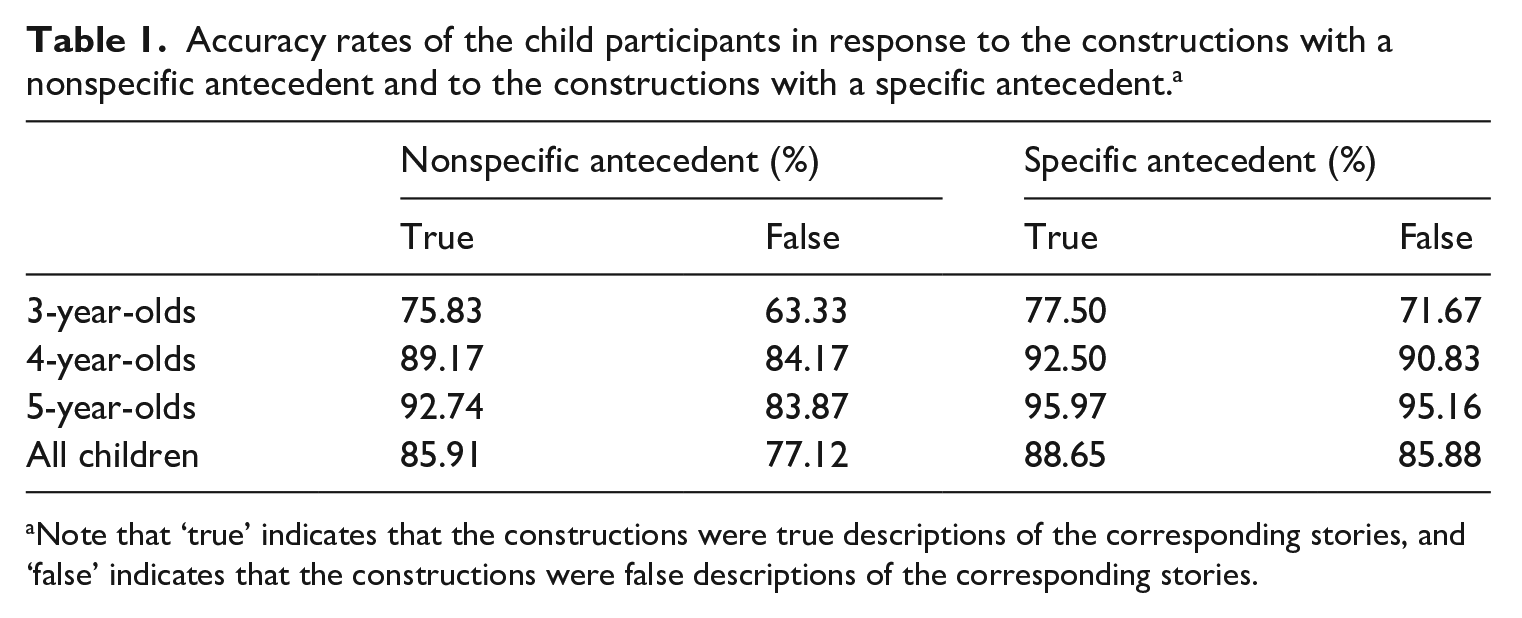
Note that ‘true’ indicates that the constructions were true descriptions of the corresponding stories, and ‘false’ indicates that the constructions were false descriptions of the corresponding stories.
Effects of specificity, agegroup, and condition
GLMMs were applied to analyze the participants’ original responses that were coded as 1 or 0. The models include three fixed effects and two random terms. The three fixed effects are agegroup (3-/4-/5-year-olds), specificity (nonspecific antecedent/specific antecedent), and condition (true/false). The two random terms are trial and participant. The random effects of the models include both the intercept and the slope of the fixed effects with respect to the two random terms. The model fitting processes were realized with the glmer function in the lme4 package (v1.1.30; Bates et al., 2015) under the R (v4.2.3) software environment. In order to keep only the variables that can significantly predict the variation in the dependent measure, a model search process was conducted using a likelihood-ratio test, whereby a model comparison procedure was performed to see whether or not there was a significant improvement of the model-fit to the data by adding these variables. The model search results are presented in Table 2.
Models predicting children’s performance in the experiment.
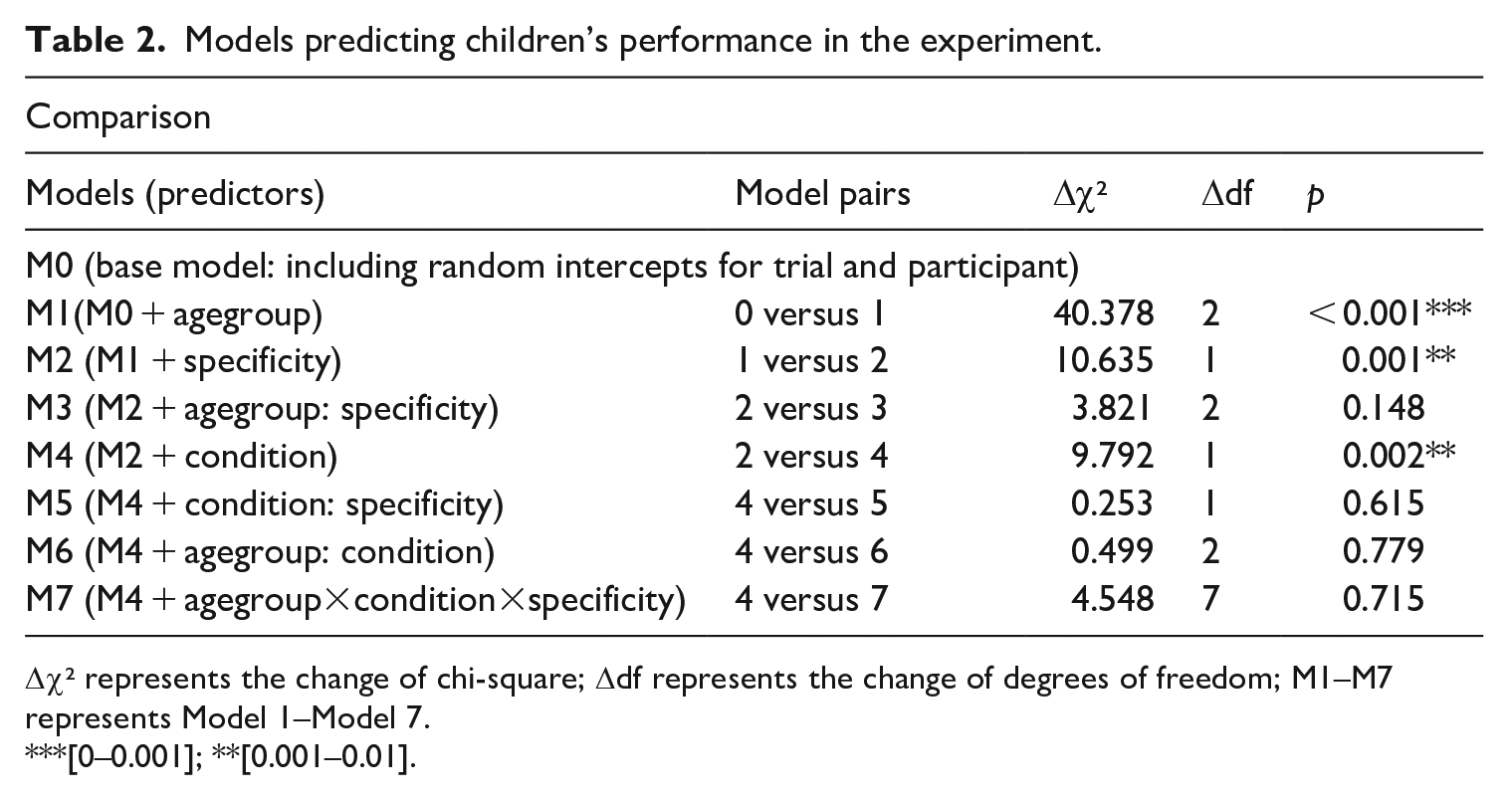
Δχ² represents the change of chi-square; Δdf represents the change of degrees of freedom; M1–M7 represents Model 1–Model 7.
[0–0.001]; **[0.001–0.01].
As indicated in Table 2, adding the variables agegroup (χ² = 40.378, p < 0.001), specificity (χ²= 10.635, p = 0.001), and condition (χ² = 9.792, p = 0.002) significantly contributes to the model fit, but the two-way interactions (i.e. specificity×condition, agegroup×specificity, condition×agegroup) or the three-way interactions (i.e. specificity× agegroup×condition) among these variables do not improve the model fit. According to these results, the best model is M4. Table 3 gives the parameter estimates of M4.
Estimated parameters of fixed and random effects of M4.
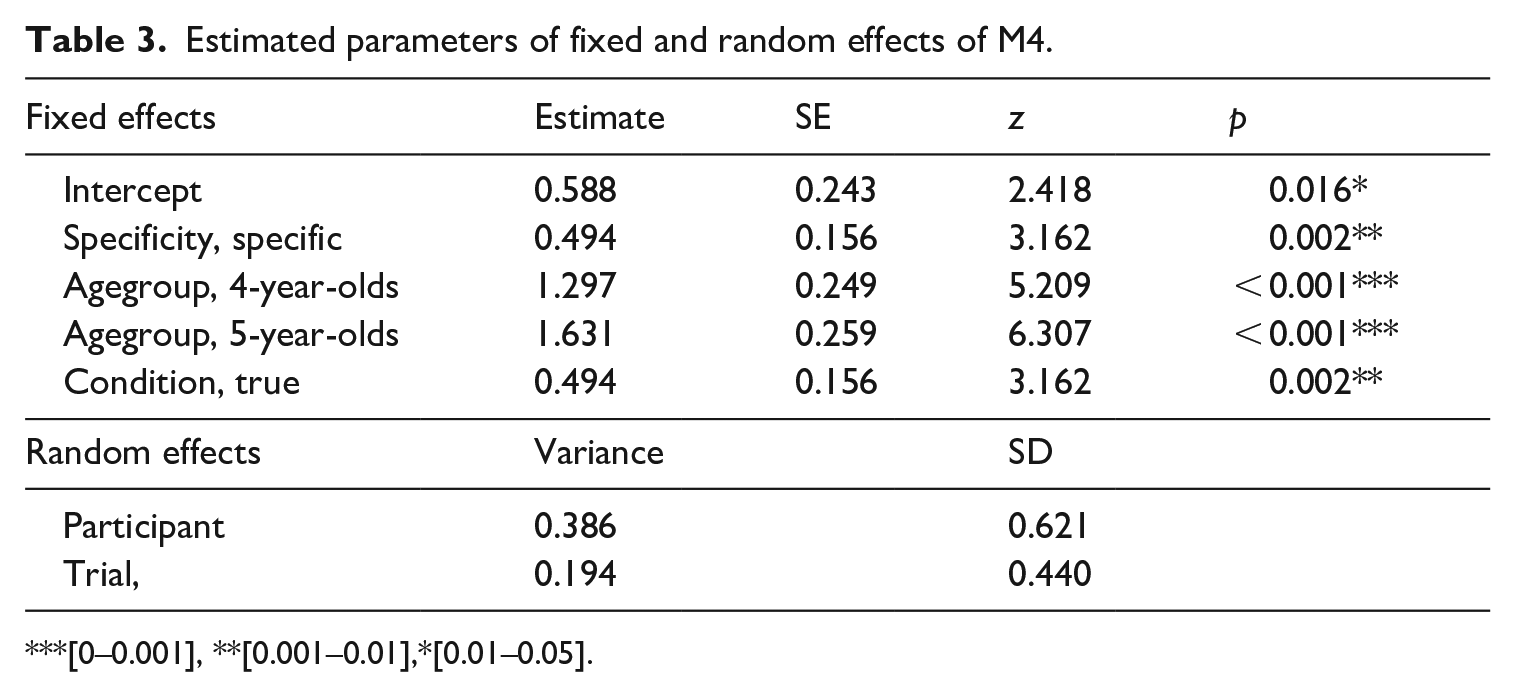
[0–0.001], **[0.001–0.01],*[0.01–0.05].
As shown in Table 3, a significant difference was observed in the participants’ responses to the constructions with a nonspecific antecedent versus those with a specific antecedent (p = 0.002). In addition, the difference between the 4-year-olds and the 3-year-olds reached statistical significance (p < 0.001), and so did the difference between the 5-year-olds and the 3-year-olds (p < 0.001). A further post hoc analysis of agegroup was conducted using the glht function in the multcomp package (v1.4.23; Hothorn et al., 2008) and the results show that there was no significant difference between the 4-year-olds and the 5-year-olds (p = 0.45). The participants’ performance in the ‘true’ condition significantly differed from that in the ‘false’ condition (p = 0.002). The effects of specificity, group, and condition are presented in Figures 3(a) to (c).

(a) Effect of specificity. (b) Effect of condition. (c) Effect of agegroup.
Figure 3(a) shows the predicted probability of correct responses for the constructions with a nonspecific antecedent and those with a specific antecedent, indicating that the participants performed significantly better for the latter (95% confidence interval (CI): [0.868, 939]) than for the former (95% CI: [0.804, 0.901]). Figure 3(b) displays the predicted probability of correct responses in the ‘true’ and ‘false’ conditions, suggesting that the participants performed significantly better in the true condition (95% CI: [0.868, 0.939]) than in the false condition (95% CI: [0.804, 0.901]). Figure 3(c) gives the predicted probability of correct responses for the three age groups: the 3-year-olds (95% CI: [0.656, 0.820]), the 4-year-olds (95% CI: [0.868, 0.947]), and the 5-year-olds (95% CI: [0.900, 0.962]), showing that children’s ability to establish associative anaphora was greatly enhanced from 3 years of age to 4 years of age, but this ability remained steady from 4 years of age to 5 years of age. Note that the predicted probabilities of correct responses in all the three figures were significantly above chance [0.50], indicating that even the 3-year-olds had the ability to successfully build a connection between a definite DP and its antecedent.
Discussion
This study sought to chart the developmental trajectory of 3- to 5-year-old Mandarin-speaking children’s comprehension of associative anaphora. The results showed that children’s performance was significantly better for the constructions with a specific antecedent (more salient) than for those with a nonspecific antecedent (less salient), and their performance was significantly better in the ‘true’ condition than in the ‘false’ condition. These results are in line with the findings by Avrutin and Coopmans (2000) showing that salience status of the antecedent and truth conditions of test sentences played a role in children’s comprehension of associative anaphora. Like Dutch-, Russian-, and English-speaking children, Mandarin-speaking children’s comprehension of associative anaphora was influenced by the same factors. In addition, similar developmental trajectories were observed in Mandarin-speaking children and in children speaking the aforementioned three Indo-European languages, wherein a significant improvement was witnessed from 3 years of age to 4 years of age. In the following, we discuss in detail how the current findings can inform us about the interaction between linguistic and nonlinguistic cognitive abilities in children’s comprehension of associative anaphora.
As discussed, the establishment of associative anaphora requires both linguistic knowledge and nonlinguistic processing resources. Mandarin-speaking children performed significantly better for the constructions with a specific antecedent than for those with a nonspecific antecedent, indicating that their performance correlates with their linguistic knowledge, nonlinguistic processing resources, and the interaction of the two. Note that the two types of test constructions share similar linguistic elements but differ in the salience status. For example, the semantic connection between the definite DP and its antecedent in (5a) and (5b) are the same, both showing a relation of luntai-zixingche ‘wheel-bike’. The difference between (5a) and (5b) lies only in the salience status of the antecedent zixingche ‘bike’, one is liang zixingche ‘a bike’ and the other is zheyang yi-liang zixingche ‘this bike’. First, the specific antecedent in (5b) (i.e. zheyang yi-liang zixingche ‘this bike’) and the nonspecific antecedent in (5a) (i.e. liang zixingche ‘a bike’) differ in length, with the former being longer than the latter. The longer specific antecedent contains the demonstrative zheyang ‘this’ that denotes the noteworthy property of the entities (Ionin, 2006), and the numeral yi ‘one’ that has the discourse function of indexing the salience of the entity as a salient participant (Biq, 2004), thus leading to a much stronger salience status than the shorter nonspecific antecedent. In addition, according to Von Heusinger and Schumacher (2019), referents of specific expressions are more likely to be mentioned in next discourse than nonspecific ones. This is particularly true in Mandarin, because the specific antecedent zheyang yi-liang zixingche ‘this bike’ in (5b) is the topic of the discourse, and the anaphoric bare definite DP luntai ‘the wheels’ in the following discourse can function as a continuing topic of the previous discourse (Jenks, 2018). In contrast, the nonspecific antecedent in (5a) liang zixingche ‘a bike’ is not the topic of the discourse, so luntai ‘the wheels’ in the following discourse cannot function as a continuing topic. Again, this shows that the continuing topic feature adds to the salience status of the specific antecedent. Salience status, according to Avrutin and Coopmans (2000), is relevant to processing demands with less-salient conditions requiring more processing resources than more-salient conditions. In other words, the linguistic properties including discourse properties have a role to play in children’s acquisition of associative anaphora, but such an influence is exerted through its interaction with non-linguistic cognitive factors, such as processing resources.
Avrutin and Coopmans (2000) proposed the connection between salience status of antecedents and processing resources in children’s comprehension of associative anaphora, but they did not discuss what exactly the processing resources were and how the processing resources were involved in the establishment of associative anaphora. We propose that one of the processing resources involved in the establishment of associative anaphora is working memory (Anderson, 2009; Baddeley, 1986) and the way that working memory gets involved relates to depth of processing (Craik & Lockhart, 1972). Working memory is a cognitive system responsible for temporary storage of information and for information manipulation (Anderson, 2009; Baddeley, 1986). According to Craik and Lockhart (1972), processing levels are hierarchical, and ‘greater depth implies a greater degree of semantic or cognitive analysis’ (Craik and Lockhart, 1972). Processing an antecedent that is more salient 2 involves a greater degree of semantic and cognitive analysis than less-salient ones and will therefore undergo a deeper level of processing, leaving stronger memory trace 3 and making it more accessible in working memory and thus facilitating the establishment of associative anaphora.
We argue that the finding that Mandarin-speaking children performed significantly better in the ‘true’ condition than in the ‘false’ condition also shows the influence of depth of processing of the ‘true’ versus ‘false’ proposition. If children did not have the relevant linguistic knowledge, then they should have performed equally poor in both the ‘true’ and ‘false’ conditions. But rather, their performance was much better in the ‘true’ condition than in the ‘false’ condition. Note that to correctly reject the test constructions in the ‘false’ condition requires children to find the appropriate source of the reference and at the same time to reject the inappropriate one. Consider the example trial in (5b) and Figure 2. The test construction in (5b) ‘There is this bike on the grassland. The wheels are blue’ is a false description of the picture story in Figure 2, where in fact the wheels of the bike are yellow. To reject (5b), children needed to first link ‘the wheels’ to a previously mentioned antecedent ‘this bike’ and then to reject the connection between ‘the wheels’ and the deictic source of the reference ‘this truck’. Such a computational process is harder to implement, because the processing of the false proposition is less deep than the processing of the true proposition, so that the elements (i.e. definite DPs, antecedents) in the sentence can only form weak memory traces, leading to low accessibilities in working memory. It should be noted that no interaction effect between specificity and condition was observed. But to explore the trend of how specificity interacts with condition, 4 we plotted M5, a statistical model discussed in Table 2. The graph shows that regardless of whether the condition was true or false, children’s performance in the specific construction was always better than their performance in the nonspecific construction and that their improvement in the performance from the nonspecific to the specific construction was much greater in the false condition than in the true condition. This indicates that the impact of specificity on children’s performance was more pronounced in the false condition than in the true condition, presumably because it is in general harder to reject an answer than to accept one. Although the graph illustrates this trend, this interaction did not reach statistical significance. We speculate that this lack of significant effect might be due to the relatively small sample size of the study.
The observed developmental trajectory of Mandarin-speaking children’s comprehension of associative anaphora might also show the influence of working memory capacity. Although the three age groups of children were all able to build a connection between a definite DP and its antecedent, the 3-year-olds were significantly worse than the 4-year-olds and the 5-year-olds. As discussed, to successfully build the connection between the definite DP and its antecedent, one has to hold the antecedent in working memory and then retrieve it to build its connection with the definite DP. Note that the antecedent and the definite DP occur in separate clauses in the test constructions, thus the relatively long linear distance between them might have posed difficulties for the 3-year-olds to establish their connection, because they have limited working memory capacity (Hitch & Halliday, 1983; Zhou et al., 2021). In this study, the difference between the 3-year-olds and the 4- and 5-year-olds might reflect a difference in their working memory capacity. Compared with the older children, the 3-year-olds may not have sufficient working memory capacity to hold the antecedent long enough, so that it can then be retrieved and manipulated effectively after hearing the definite DP to establish their connection (see Just & Carpenter, 1992, for discussions on working memory mechanisms).
We also wish to acknowledge one limitation of this study. This study did not measure the participants’ working memory capacity, because we assume that 3-year-olds have more limited working memory capacity than 4-year-olds and 5-year-olds. This was based on the general consensus in prior research that younger children have more limited working memory capacity than older children and adults (Alloway et al., 2004; Gathercole et al., 2004; Lehmann et al., 2014; Marcovitch et al., 2010; Roman et al., 2014; Simmering, 2012). Future research is required to directly test the connection between children’s comprehension of associative anaphora and their working memory capacity using methods that are suitable for preschool children, such as the Missing Scan Task (Renner et al., 2021; Roman et al., 2014), the Wechsler Preschool and Primary Scale of IntelligenceTM-IV (CN) (Li & Zhu, 2014), and a response time analysis that measures the response duration between the offset of the test constructions and the onset of the participants’ responses (Cowan et al., 2003).
Another interesting point worth exploring here is the influence of cross-linguistic variations on children’s acquisition of associative anaphora. As discussed, definite DPs in most Indo-European languages have overt morphosyntactic markers. Mandarin, however, does not have such overt markers. A definite DP in Mandarin usually occurs in the preverbal position with a bare form. This cross-linguistic variation led us to explore whether different acquisition patterns would be observed in Mandarin as compared with Indo-European languages such as Dutch, Russian, and English. Interestingly, our findings show that Mandarin-speaking children exhibit a similar developmental trajectory as Dutch- and English-speaking children; in addition, like their counterparts speaking these Indo-European languages, Mandarin-speaking children’s comprehension of associative anaphora is also constrained by the same factors, for example, the salience status of the antecedent, the truth condition of the test constructions. The findings seem to suggest a universal pattern of acquisition wherein language-specific properties do not directly impact how children acquire associative anaphora, but rather through its interaction with non-linguistic cognitive factors. In this study, the interaction of language-specific properties and non-linguistic cognitive factors is reflected in the realization of the salience of the antecedent. The salience of the antecedent in Mandarin is realized through specificity encoded by the lexical device, such as the numeral yi, and by the discourse function of continuing topics (i.e. a bare definite DP that occurs in preverbal position), whereas it is realized either through the lexical device as in Dutch and English or through word order as in Russian. Regardless of the different realizations of salience using language-specific properties, children from different language backgrounds exhibit similar developmental patterns and are constrained by the same cognitive factors, such as working memory, and so on. In other words, language-specific properties do not impact the establishment of associative anaphora directly, but through their interactions with non-linguistic cognitive factors, for example, the salience of the antecedent relates to how accessible the antecedent is in working memory. These findings provide an interesting window into the interaction between linguistic and nonlinguistic cognitive abilities in children’s comprehension of associative anaphora.
Footnotes
Acknowledgements
The authors would like to thank the children, the parents, and the teachers at the Zixing Kindergarten in Hunan province, for their assistance and support in running the study. The authors are also grateful to Sergey Avrutin and Peter Coopmans for their helpful suggestions on the experiment design, and to Kirsten Schutter and Piet van Tuijl for their valuable advice on statistical analyses.
Author contributions
Data availability statement

Declaration of conflicting interests
The author(s) declared no potential conflicts of interest with respect to the research, authorship, and/or publication of this article.
Ethics approval statement
The research was approved by the Ethics Committee of the School of Medicine, Tsinghua University, 20210070. Written informed consent has been obtained from each child participant’s parents.
Funding
The author(s) disclosed receipt of the following financial support for the research, authorship, and/or publication of this article: This research was supported by the Fundamental Research Funds for the Central Universities to Peng Zhou.