




Abstract
This study aimed to adapt and validate the Word Complexity Measure (WCM) for Persian-speaking toddlers. The WCM is a tool for assessing phonological complexity, originally proposed by Stoel-Gammon. The study was conducted in two phases: (1) adapting the WCM parameters to the Persian language and (2) conducting a validation study with 60 monolingual Persian-speaking toddlers aged 18–35 months. The toddlers’ language productions were collected through a picture-naming task, and the researchers derived the Proportion of Word Complexity Measure-Persian (PWCM-P) and Proportion of Consonant Correct (PCC) scores. Parents completed the Persian adapted version of the MacArthur-Bates Communication Development Inventories-II (CDI-II) to obtain receptive and expressive vocabulary scores for each child. Statistical analyses showed a significant difference in PWCM-P scores between age groups, with younger children producing fewer phonologically complex words. In addition, PWCM-P scores were positively and significantly correlated with PCC scores, receptive and expressive vocabulary size. Overall, the successful adaptation and validation of the WCM for Persian provides a reliable tool for assessing phonological development in young children and sheds light on the importance of phonological complexity in vocabulary acquisition. This research can further deepen our understanding of phonological development during early childhood and its implications for language learning.
Keywords
Introduction
Exploring the sound patterns of children’s speech is an important consideration for both language development research and clinical diagnosis (Marklund et al., 2018; Saaristo-Helin, 2009). Researchers aim to gain a comprehensive understanding of the rate and sequence of phonological development, as well as establishing developmental norms. Clinicians rely heavily on empirical studies to inform their work, as they directly evaluate children’s phonological development using various methods (Saaristo-Helin, 2009).
Various factors can influence phonological development in young children, and vocabulary growth is considered one such factor (Stoel-Gammon, 2011). The relationship between phonological and lexical development has been a subject of interest in theories of linguistics and of language processing. The lexical restructuring model (Metsala & Walley, 2013) focuses on the influence of lexical features on the refinement of phonological representations. It proposes that as a child’s vocabulary grows, holistic mental representations of words become more detailed. This, in turn, helps the child distinguish similar words from one another.
Several methods and indexes have been developed to document children’s phonological development at the whole-word production level. These include the Phonological Mean Length of Utterance (PMLU), which measures a child’s word length and the number of correct consonants. Another measure is the Proportion of Whole-Word Proximity (PWP), which is calculated by dividing the child’s PMLU score by the PMLU score of the target word in its adult form. The Proportion of Whole-Word Correctness (PWC) calculates the percentage of words that a child produces correctly, taking into account all of the phonemes in the word. The Proportion of Whole-Word Variability (PWV) measures the proportion of words in a given sample that can be produced in more than one way (Ingram, 2002). Finally, the Word Complexity Measure (WCM) was developed by Stoel-Gammon (2010) to evaluate expressive phonology development, including the early vocalizations of children and the speech of children with speech sound disorders.
Understanding the nature of WCM requires taking into account linguistic theories, especially optimality theory (OT). OT was initially introduced by Prince and Smolensky (2004) and has since been expanded by other linguists (McCarthy, 2002, p. 1). It serves as a linguistic framework that offers insights into the acquisition of phonological systems in children and the variations observed across languages (Prince & Smolensky, 2004). This theory focuses on input–output mapping, which reflects the process of language acquisition as children process input data to generate surface forms. OT posits markedness and faithfulness constraints. Markedness constraints evaluate output representations at different levels and penalize specific configurations, reflecting universal language tendencies. On the other hand, faithfulness constraints require similarity between input and output representations and are more language-specific. Children are hypothesized to be born with these universal constraints, and language acquisition involves ranking them based on the ambient language. This ranking is often guided by articulatory or perceptual abilities and limitations (Kager, 1999).
The interplay between markedness and faithfulness constraints plays a crucial role in shaping phonological development. Research suggests that, initially, markedness constraints are ranked higher but gradually become less important compared to faithfulness constraints as children are exposed to adult input. This ranking determines the speed with which children acquire phonological skills. When markedness alone cannot determine the order, structures that occur more frequently are acquired earlier. Overall, OT provides a comprehensive framework for understanding the complex processes involved in the acquisition and development of phonological systems. Therefore, the acquisition of phonology follows a step-by-step process that involves revising the priority of conflicting constraints at different levels, including segmental, syllabic, and prosodic well-formedness constraints (Stoel-Gammon & Bernhardt, 2013).
In the WCM, the complexity score is determined by eight parameters organized into three domains. Each parameter, such as the presence of fricatives or affricates within a word, contributes to the overall complexity score. The WCM prioritizes complexity over accuracy and allows its adaptable parameters to be tailored to the phonological characteristics of various languages. So far, parameters have been adapted for languages such as Swedish (Marklund et al., 2018) and Mandarin (Chen & Liu, 2015). One advantage of the WCM is its ability to score unintelligible productions and even proto-words, which are common in the early stages of vocabulary acquisition. In addition, this measurement can assess children with limited vocabularies, including those with delayed or disordered language (Chen & Liu, 2015). The WCM could be a valuable measure for clinical assessments and tracking phonological changes over time (Chen & Liu, 2015). It can be used for independent analysis, which involves evaluating the complexity score of a child’s productions, as well as relational analysis, which involves comparing the child’s productions to the target words or utterances.
The complexity measures have been utilized in developing standardized assessments for productive phonology, such as Profiles of Early Expressive Phonological Skills (PEEPS) (Stoel-Gammon & Williams, 2013; Williams & Stoel-Gammon, 2023) and the Persian version of the Profile of Early Expressive Phonological Skills (PEEPS-P) (Sakhai et al., 2024). These measures have been used not only to create formal tests for productive phonology but also to enable comparisons between different phonological assessments, as demonstrated in Macrae’s (2017) study.
Indeed, the existence of these parameters predominantly stems from biological and mechanical constraints during the early phases of development, which are universally observed across various languages. However, it is worth noting that language-specific phonological patterns also play a role in shaping these parameters. Persian 1 – the language of the current study – exhibits distinct phonological characteristics when compared to English (i.e. the language for which the WCM was originally developed). For instance, Persian vocabulary consists predominantly of derived and inflected words, which often result in the presence of polysyllabic words (Eslami et al., 2013). Persian also differs from English in terms of stress pattern, syllable structures, and phonemic inventories. As a result, it is necessary to examine each parameter and its developmental evidence specifically in the context of the Persian language in order to fully understand these differences. Therefore, this study was carried out in two phases. Originally, the WCM was developed to evaluate the phonological abilities of children who speak English. The first phase of the study focuses on adapting the WCM to Persian (WCM-P) and justifies the selection of parameters based on Persian language properties and the findings from cross-sectional and longitudinal developmental studies. In the second phase, we aim to validate the WCM-P by investigating its relationship with consonant accuracy and vocabulary measures.
Materials and methods
Phase 1: adaptation of WCM to Persian
The objective of this phase was to determine and confirm which parameters of phonological complexity are valid in the Persian language. Familiarity with the distinctive characteristics of Persian phonology is crucial for examining and understanding its linguistic intricacies. Therefore, the following section presents an overview of the Persian phonological system in comparison to that of English, in order to justify the decisions that were made in adapting the WCM from English to Persian.
Unique phonological characteristics of Persian
Persian is spoken by approximately 110 million people worldwide (Sims-Williams, 2003). It belongs to the Indo-European language family (Anvari & Givi, 1996), with numerous dialects that have emerged over time, differing from the standard Persian language. Persian is the official language in Iran, Afghanistan, and Tajikistan, with many speakers across Central and South Asia (Spooner, 2012). The Tehrani Persian dialect, which is the focus here, has been accepted as the standard form. In terms of phonemic inventories, Persian is considered to have a greater number of consonants but fewer vowels compared to English. It has 23 consonant phonemes /p, b, t, d, k, g, f, v, s, z, ʃ, ʒ, tʃ, dʒ, h, ʔ, q, χ, m, n, r, l, j/ and 6 vowels /i, e, æ, a, o, u/. Table 1 displays the phonetic features and IPA symbols for all Persian phonemes. Persian words follow specific syllable structure rules, appearing as CVCC, CVC, or CV. In terms of syllable structures, Persian, like English, has a mix of both open and closed syllables, but Persian favors open syllables (Eslami et al., 2013). These languages also differ in their requirements for consonant clusters. Persian allows only two-consonant clusters in medial and final positions within words, but tends to prefer word-final placement for these clusters. Three-consonant clusters are not permitted in Persian words. In addition, consonant clusters cannot appear at the beginning of words. Persian syllable structure is relatively simple, with CV being the most common in monosyllabic words, while CVCC has the lowest frequency (Eslami et al., 2013). Since Persian does not allow two vowels to appear in the same syllable, the number of syllables in each phonetic phrase can be determined by counting the number of vowels. Although Persian consonants and vowels can combine into various permissible syllable shapes, only around 4000 syllables actually occur in Persian words. The phonotactic rules of Persian restrict which sequences are allowed. Persian is a syllable-timed language with fixed stress rules. Stress consistently falls on the final syllable of nouns, adjectives, most adverbs, and grammaticalized verbs, regardless of syllable or morphological structure. Overall, Persian has a relatively simple phonological system, favoring open CV syllable types and final syllable stress.
Phonetic features and IPA symbols of all phonemes of Persian.
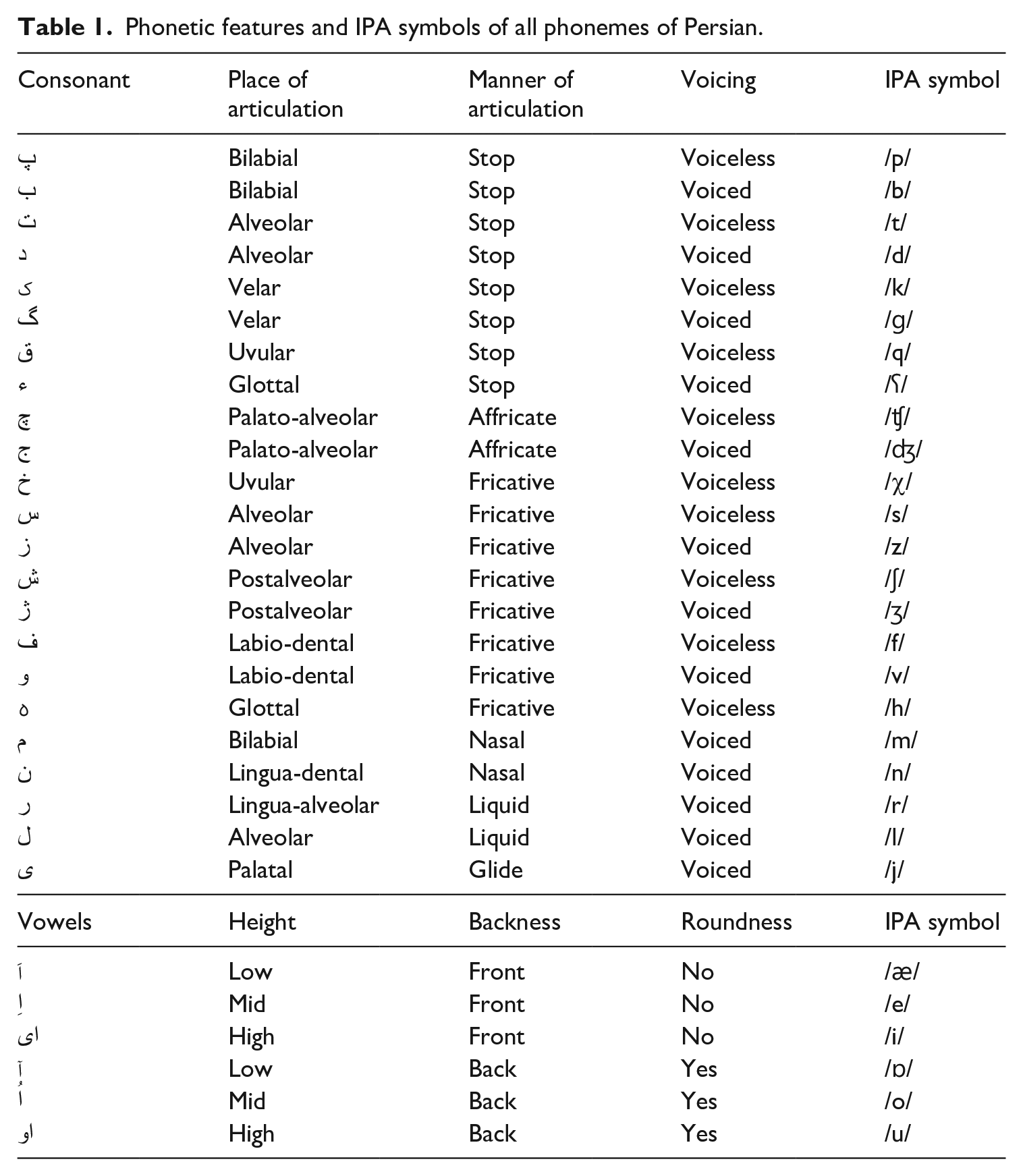
In this phase, our research question focused on whether the phonetic/phonological complexity parameters of the original version of the WCM apply to Persian. To provide a comprehensive understanding of children’s word productions, we aimed to incorporate both perceptual and articulatory factors in explaining the rationale for each parameter. This approach aimed to address the nuanced aspects that influence children’s language development.
Furthermore, early language acquisition in children is influenced by unmarked structures (Pater, 1997). By exploring both typical and atypical acquisition data, we can gain valuable insights to test assumptions of markedness theory and understand the mechanisms underlying phonological acquisition and disorders, with a focus on OT (Miyakoda, 2012). Therefore, explanations from both typical and atypical acquisition data are provided where available to determine if each complexity parameter exists in Persian. Perceptual difficulties arise from the contrasts between sounds in a language, rather than from any inherent taxing of the auditory system. Therefore, perceptual markedness constraints on sounds cannot be determined independently of the contrastive sound system of a language. Articulatory difficulty refers to the physical effort involved in producing a sound in a given context and is a property of individual sounds (Flemming, 2004).
Words exceeding two syllables in length
Children who are learning different languages tend to initially produce shorter and less complex words. This is because monosyllabic and disyllabic words with first-syllable stress align with their early language production abilities. Research has shown that the number of syllables in words interacts with the constraints on language acquisition. Polysyllabic words are more challenging and are typically acquired after monosyllables (Miyakoda, 2012).
There are several proposed reasons why children tend to acquire monosyllabic and disyllabic words earlier than polysyllabic words. One reason is the limitation in perceiving and remembering less prominent syllables (Kehoe & Stoel-Gammon, 1997; Slobin, 1973). Another reason is the difficulty in coordinating longer sequences of articulation (Kehoe & Stoel-Gammon, 1997). Simplified motor templates may also play a role (Gerken, 1994). In addition, segmental speech sound effects have been found to result in different rates of omission for words with the same number of syllables and stress pattern (Kehoe, 1994, May 20-21). For example, young learners may struggle to encode less acoustically prominent syllables due to attention and memory constraints. Similarly, coordinating movements of the lips, tongue, and jaw become more demanding when dealing with longer strings of speech (Marklund et al., 2018). These perceptual biases and articulatory difficulties help explain young children’s tendency to use short words.
The expressive vocabulary of Persian-speaking children below 23 months typically consists of one- or two-syllable words (Jalilevand, 2015). While some two-syllable words undergo syllable deletion, this is uncommon (Jalilevand et al., 2012). Studies of early lexicons and case studies show children predominantly produce one- and two-syllable words before the age of 2 (Mehdipour et al., 2014; Zarei Mahmood Abadi & Zarifian, 2018). Three- or four-syllable words commonly exist in Persian due to inflection and derivation, whereas monosyllables are the least frequent (Eslami et al., 2013).
The young children may apply syllable reduction as a phonological process, omitting syllables in polysyllabic words (Echols, 1993; Gerken, 1996). In Persian, syllable deletion occurs in words with three to five syllables (Abbasi et al., 2023; Golmohamadi et al., 2014; Zarifian et al., 2015). For example, the four-syllable /hævapeyma/ (airplane) may reduce to the three-syllable /hæpema/ (Golmohamadi et al., 2014). OT’s constraint on word length of early vocabulary explains this tendency to shorten words (Lleó, 2002). While syllable deletion is observed in Persian-speaking children until the age of 3, it disappears after that (Zarifian & Fotuhi, 2020), which is earlier than in English (Dodd et al., 2003). Given the increased complexity of polysyllabic words, the number of syllables can indicate word complexity, with more than two syllables adding one point in the WCM-P.
Words with stress on syllables other than the initial one
Children have a natural ability to learn stress patterns in language, starting with simpler patterns and progressing to more complex ones (Gerken, 1994). Research demonstrates that children have an innate tendency to acquire words with trochaic (stressed–unstressed) stress patterns earlier than words with iambic (unstressed–stressed) patterns (Lin et al., 2018; McGregor & Johnson, 1997; Redford & Oh, 2016).
Allen and Hawkins (1980) proposed that this trochaic bias is a universal developmental constraint, with trochees being easier to perceive and articulate. Stressed syllables have greater duration, intensity, and more dynamic pitch contours, which increase perceptual salience (Chrabaszcz et al., 2014). This heightened acoustic prominence can help in the perceptual processing of the word, making it easier to distinguish. Trochees optimize processing by placing salient syllables at the beginning (Hay & Diehl, 2007). The trochaic bias also reflects an early preference for articulatory less demanding stress patterns in English (Redford & Oh, 2016). Producing speech with short durations and rising intensity requires considerable physiological effort. This explains why young children have difficulty producing words with iambic stress pattern (Ballard et al., 2012). In addition, in an iambic pattern, there is generally greater strength in pitch and vowel quality compared to a trochaic pattern. This suggests that trochaic words may require less precise control of sub-glottal pressure and vocal fold tension.
In line with this bias, young English-learning children are more likely to delete weak syllables that occur before strong syllables (Redford & Oh, 2016). Children are initially biased toward trochaic patterns but must adjust their constraints based on the language they are exposed to during acquisition. Unlike English, which has variable lexical stress, Persian has a highly regular final syllable stress rule (Eslami, 2005). This means that Persian words do not have marked stressed syllables that need to be learned, because stress placement is predictable (Masoumi & Modarresi Ghavami, 2023). In addition, English has strong stress cues to indicate variable stress locations, while Persian only requires subtle cues like duration for its invariable final stress. As a result, Persian speakers are not as sensitive to stress location. Therefore, the non-initial stress constraint does not apply to Persian word acquisition patterns.
Weak syllables in longer words are more likely to be deleted due to their lower perceptual salience (Gerken, 1994), especially when the stressed syllable is not the first one (Gerken, 1994; Wijnen et al., 1994). Evidence also comes from children’s tendency to preserve strong over weak syllables (Allen & Hawkins, 1980; Gerken, 1994; Schwartz & Goffman, 1995). This metrical constraint is known as weak syllable deletion (Gerken, 1994). Various languages show children omitting unstressed initial syllables in iambic words while retaining trochaic patterns (Al Huneety et al., 2023; Gerken, 1994). However, Persian lacks stress-driven phonological processes, and factors such as memory and attention in encoding of syllables should be considered. These factors are likely to affect Persian children’s syllable deletion in the early production of polysyllabic words. The rationale is that words violating the trochaic bias are more complex for children. This led to the original WCM assigning complexity points to words with non-initial stress. However, the WCM-P does not include stress on non-initial syllables, as it does not seem to apply to Persian words.
Productions with a word–final consonant
While languages allow syllable types of varying complexity, all languages have CV (consonant-vowel) syllables in common. The proponents of markedness theory argue that the universal presence of simple CV syllables across languages reflects the fact that CV is the unmarked or basic syllable type (Levelt & Van de Vijver, 2004).
Final consonant sounds are less perceptually salient, making them more challenging for young children to perceive and produce accurately (McLeod & Crowe, 2018). The lexical restructuring model posits that a word’s representation in the mental lexicon changes from a relatively holistic form to a more detailed one as vocabulary grows, and this may also play a role in the development of final consonant deletion. As a child’s vocabulary grows, the mental representations of words become more detailed, potentially influencing the phonological process of final consonant deletion. From an articulatory perspective, children may also simplify words to ease pronunciation or align with the speech patterns of those around them. Final consonant deletion is a frequently observed phonological process during the development of children’s speech and it usually disappears as children mature. The simplification of words by omitting final consonants allows young children to communicate their needs without overtaxing their speech systems. This phenomenon is considered typical in early language development, as children simplify words in predictable ways until they acquire the skills to produce them clearly. However, after a certain age, typically around 3 years old, the persistence of final consonant deletion may indicate a need for speech therapy to address this pattern. However, in English-learning children, this pattern can persist beyond the age of 3 (Grunwell, 1981). In Persian, children may continue to delete the final consonant until around the age of 5 (Zarifian & Fotuhi, 2020).
Therefore, the final consonant deletion in speech can be influenced by both perceptual salience and articulatory factors, and it is intricately linked with the lexical restructuring model in the context of phonological development and vocabulary growth. Consequently, the scoring system includes this complexity parameter without modifications, assigning one point to words with a final consonant.
Productions with a consonant cluster
The development of consonant clusters is an important aspect of child phonology, often considered more complex and protracted compared to single consonants in most languages (Storkel, 2018). Research shows that the developmental acquisition of consonant clusters follows a similar progression to that of individual consonants, with simpler clusters requiring less complex motor skills being acquired earlier by young children. In contrast, more complex consonant clusters that necessitate greater coordination tend to develop later (McLeod et al., 2001). In the context of consonant cluster acquisition, markedness constraints represent the tendency for languages to avoid complex marked structures in favor of simpler ones. Consonant clusters pose acoustic challenges for listeners, reducing perceptual cues. Precise auditory discrimination skills are needed to distinguish tightly clustered sound patterns (McLeod et al., 2001). In addition, coarticulation between adjacent consonants can obscure place and manner distinctions (Recasens & Pallarès, 2001). Transient identification cues such as short-duration bursts and formant patterns are lost when coarticulation inhibits target configurations (Recasens, 2018; Wright, 2004). These acoustic-perceptual factors create listener confusion and issues with decoding intended sound sequences. On the articulatory side, the lack of intervening vowels in clusters also creates coordination challenges for timing rapid speech gestures precisely (McLeod et al., 2001; Miyakoda, 2012). Facing these perceptual and articulatory difficulties with clusters, children develop systematic reduction strategies like consonant deletion and epenthesis to eliminate tricky articulatory targets (Côté, 2000). The array of acoustic-perceptual and articulatory factors explains children’s prolonged process of mastering consonant clusters across languages.
Research has shown cluster reduction to be the most common and longest-lasting phonological simplification process used by children during cluster acquisition, serving as an interim stage that eventually leads to accurate productions (McLeod et al., 2001). Although Persian-speaking children attempt consonant cluster production before 30 months of age, these early attempts often do not meet the 75% accuracy criterion for acquisition until after this age (Jalilevand et al., 2014). By the age of 3, children can correctly produce some clusters according to the 75% criterion, with the number and variety increasing with age. Nevertheless, cluster reduction is common in Persian until the age of 4 (Zarifian & Fotuhi, 2020), and there are reports of it persisting until 6 years old (Jalilevand et al., 2011). Consequently, the production of consonant clusters is considered a complexity parameter in the WCM-P, with each cluster in a word assigned one point.
Velar consonants
Children reach a crucial stage in their speech development when they can accurately produce all the necessary consonant sounds for their language (Cleland & Scobbie, 2021). A specific and significant milestone in this process is the acquisition of velar consonants (Cleland & Scobbie, 2021; Stoel-Gammon, 1996). Velar sounds, such as /k/, /g/, and /ŋ/, are produced by raising the back of the tongue to the velum. Compared to labials and alveolars, velars pose perceptual and motor challenges and are acquired later, especially in English (Stoel-Gammon, 1996).
Velar stops are often mistaken for alveolar stops in listener confusion studies, indicating a difficulty in their perception (Plauche, 2001). Ohde and Haley (1997) discovered that both 3- and 4-year-old children struggled to identify velar stop consonants, like /g/, in certain vowel contexts. These young children struggle to perceive velar stops due to variations in auditory sensitivity to acoustic cues, resulting in poorer identification compared to adults. The presence or absence of bursts and the manner of transition (moving or straight) can also impact the perception of place of articulation for velar stops. Removing the burst in velar stops can significantly reduce the perception of their place of articulation for certain age groups. In general, the difficulty children have in perceiving velar stops may be due to a combination of auditory sensitivity and the specific acoustic cues involved in perception of articulation place (Ohde et al., 1995). The perception of velar stop consonants was particularly challenging for children when presented with straight transition stimuli compared to moving transition stimuli.
The complexity also arises from the need for a more intricate tongue posture and greater coordination of the tongue body to contact the soft palate/velum, making velars articulatory challenging for young children. In addition, velars are produced further back in the vocal tract and lack the clear lip and tongue tip gestures of labials (/p/, /b/) and alveolars (/t/, /d/), making them harder to see and model mouth movements (Stoel-Gammon & Dunn, 1991). Children face difficulty in executing the precise tongue gestures for velar stops due to limitations in independent tongue control, leading to undifferentiated linguopalatal contact during velar stop attempts. Articulatory drift then determines whether the perceived place is coronal or velar. These perceptual and articulatory challenges make velars marked compared to other early-developing consonants, contributing to their later acquisition (Byun, 2012).
A common speech error pattern as children attempt to produce velars is fronting, where velars are substituted with easier alveolar or dental articulations engaging the front of the mouth (Dodd et al., 2002; McLeod & Baker, 2017). This demonstrates a developmental simplification strategy. Velars also participate in other phonological processes like consonant harmony (Inkelas & Rose, 2007; Pater, 2002), where their pronunciation is influenced by the surrounding phonetic environment (Byun, 2012; Inkelas & Rose, 2007).
In Persian, the velars consonants /k, g/ occur less frequently in words compared to alveolar consonants like /t/ and /d/. When acquiring Persian phonology, children tend to produce velars later than alveolar consonants. By around 5.5 years old, 90% of Persian-speaking children have mastered velars, but some fronting errors may still occur (Zarifian & Fotuhi, 2020). This late development pattern suggests that velars are more complex sounds. Therefore, it is recommended to include velar sounds in the WCM-P, with each occurrence of a velar in a word assigned a score.
Liquid, syllabic liquid, or a rhotic vowel
In English, syllabic liquid consonants, like /l/ and /r/, can serve as syllable nuclei without a vowel sound when emphasized, as in the word ‘bottle’ (Anderson, 2018). English rhotic vowels also pose a challenge, as they require specific tongue gestures for the /r/ sound during the vowel (Clark & Yallop, 1990; Laver, 1994). Liquid consonants, such as /l/ and /r/, are considered late-developing sounds in speech production. In addition, rhotic vowels are known to be difficult for children to learn (Chung et al., 2019; Smit, 1993; Smit et al., 1990).
This delayed acquisition can be attributed to several factors. Liquids have strong coarticulatory effects on surrounding vowels, making it difficult for children to independently perceive and produce these sounds. They must coordinate them with the vowels (Denny & McGowan, 2012; Howson & Redford, 2021; McGowan et al., 2004). In addition, the articulatory complexity of liquids poses a challenge, requiring precise coordination between the tongue’s body and root gesture with the tongue tip gesture. The delayed acquisition of liquids is also linked to the general difficulty children have in forming multiple simultaneous constrictions. This limits children’s ability to coordinate articulation with surrounding speech sounds (Green et al., 2000; Studdert-Kennedy & Goldstein, 2003).
Persian liquid consonants include the lateral /l/ and rhotic /r/. Persian has a single rhotic phoneme with allophonic variation depending on word position (Rafat, 2010). While the /r/ consonant is common in Persian, it is considered one of the most complex and later developing sounds (Jalilevand et al., 2011). Persian-speaking children often glide or omit liquid consonants, and the /r/ sound typically emerges after 19 months, being the most difficult to pronounce up to 42 months. However, it is important to note that syllabic liquids and rhotic vowels are not represented in the Persian phoneme inventory (Jalilevand et al., 2011). Therefore, these parameters have been removed from the WCM since they are not applicable to Persian. Instead, each occurrence of a liquid consonant (/l/ and /r/) in a word is given a single point.
Voiced and voiceless fricative and affricative consonants
Typically developing children acquire fricatives and affricates after mastering stops, nasals, and glides. The acquisition of fricatives and affricates is delayed compared to stops due to both perceptual challenges (Koenig et al., 2008) and articulatory complexity (Song et al., 2013). This leads to fricatives and affricates being classified as more marked sounds (Storkel, 2018).
The perception of fricatives and affricates relies on multiple acoustic cues, making them more difficult to perceive, especially in noisy environments (Li & Loizou, 2008). This increased perceptual difficulty also contributes to their markedness compared to stops. Acoustic properties, such as subtle turbulent airflow, make fricatives and affricates perceptually challenging compared to stops and nasals (Gordon et al., 2002). Fricatives and affricates have a more complex vocal tract constriction compared to stops (Anderson, 2018). Achieving a stable noise source for fricatives involves balancing the pressure drop over the vocal tract constriction, demanding precise control over the respiratory system and articulatory muscles. Failure to maintain this balance can lead to the production of alternative sounds. Voiced fricatives pose additional complexity, requiring sustained vocal fold vibration and adequate pressure control (Marklund et al., 2018; Storkel, 2018). Ferguson (1978) proposed that these articulation and perception challenges hinder young children’s ability to produce fricatives, contributing to their delayed development.
Similar to English, Persian has two affricate phonemes, /ʧ/ and /ʤ/, but it has eight fricative phonemes represented in the IPA, namely /f/, /v/, /h/, /χ/, /s/, /z/, /ʃ/, and /Ʒ/ in comparison to English’s nine (Samareh, 1995). In addition, sounds that appear more frequently in a child’s early expressive vocabulary are typically acquired earlier (Pye et al., 2021). In Persian, the fricative /Ʒ/ and the affricate /ʧ/ have the lowest frequency in words (Nejad & Qaracholloo, 2013). Longitudinal studies in Persian-speaking children have shown that fricatives appear after 19 months, making them among the later-acquired sounds (Zarei Mahmood Abadi & Zarifian, 2018). Persian-speaking children usually find /s/, /z/, and /Ʒ/ particularly challenging, with mastery achieved after 3;6 (Zarifian & Fotuhi, 2020). Deaffrication and stopping are two common processes observed until the age of 4, and devoicing in the initial or final position is also present in the speech of Persian-speaking children until the age of 4 (Zarifian & Fotuhi, 2020). However, the occurrence of devoicing in specific sound classes has not been extensively investigated in Persian.
The voiceless fricative /χ/ is added, and the interdentals /θ/ and /ð/ are deleted, in the Persian adaptation. Considering the typical development of fricatives and affricatives in Persian-speaking children, the WCM-P incorporates them as complexity parameters. To maintain consistency with the original version of WCM, we treat fricatives and voiced affricates as separate parameters, supported by phonetic rationale for this additive scoring approach in this specific context. Table 2 lists the WCM parameters for the original and adapted Persian version.
Complexity parameters in the WCM and WCM-P, sorted by domain.

Only liquids /l/ and /r/.
We also include practical examples to demonstrate the scoring process for each type of word. Table 3 presents example words and shows how they are scored based on the complexity criteria.
Examples of calculating the WCM-P score of Persian words.

1: more than two syllables; 2: word-final consonant; 3: consonant cluster; 4: velar consonant; 5: liquid/rhotic; 6: fricative/affricate; 7: voiced fricative/affricate.
Phase 2: validation
Phase 2 aims to explore the phonological complexity of words produced by Persian-speaking toddlers aged 18–35 months through relational analysis and to provide data on the validity of WCM-P. The current study addresses three research questions: (1) Do children’s Proportion of Word Complexity Measure-Persian (PWCM-P) scores demonstrate developmental change across 18–35 months? (2) Do children’s Proportion of Consonant Correct (PCC) and PWCM-P scores correlate within this sample? (3) Do children’s PWCM-P and the size of their receptive and expressive vocabulary correlate within this sample? Building upon previous studies, our hypothesis was that the phonological complexity of children’s early productions would increase with age. In addition, we hypothesized that children’s PWCM-P would show moderate to strong correlations with PCC scores and vocabulary measures.
Participants
Participants were recruited through consecutive sampling from three healthcare centers. Parents who consented to take part in the study were requested to bring their children to the healthcare center for assessment.
All toddlers included in the study met specific inclusion criteria, as reported by their parents. These criteria were as follows: (a) the child had not undergone treatment for an ear infection more than once within the preceding 3 months; (b) the child was monolingual; (c) Persian served as the primary language to which the child was exposed for a minimum of 10 hours each day; (d) the parents did not express concerns regarding the child’s development; and (e) the child had a normal developmental history according to the Persian version of the Ages and Phases Questionnaire (Vameghi et al., 2013).
Initially, parents of 84 toddlers were contacted. Twenty-four participants were excluded for various reasons, such as failure to meet the entry criteria or incomplete data. Finally, 60 Persian-speaking, monolingual, typically developing toddlers aged between 18 and 35 months were included in the study. This study received approval from the Ethics Committee of the Semnan University of Medical sciences and Health Services, Semnan, Iran (IR.SEMUMS.REC.1400.316). The parents of the toddlers provided written consent for their participation.
Materials
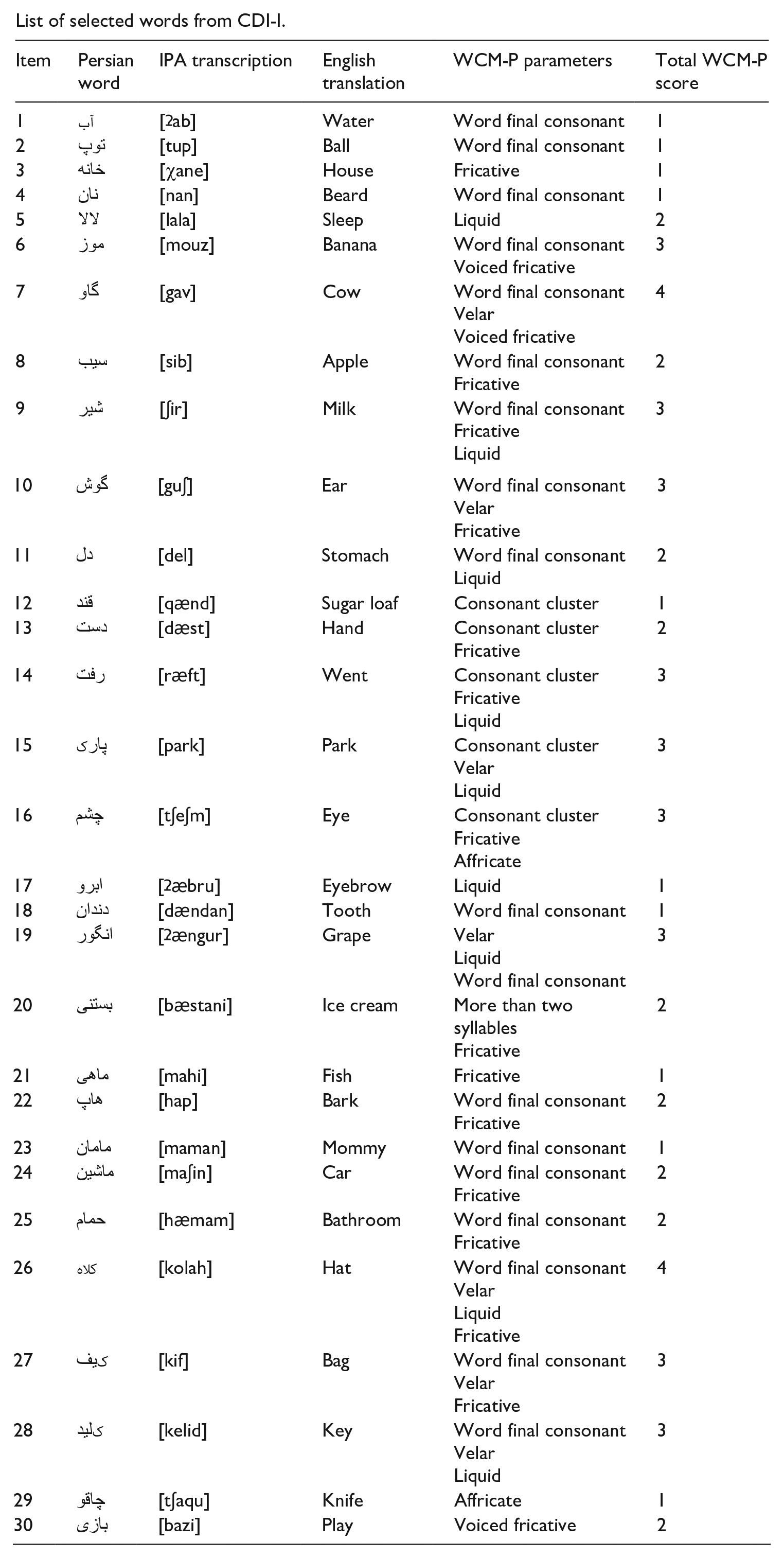
To investigate the effect of age on the phonological complexity of expressive vocabulary, we used a set of 30 words selected for inclusion in PWCM-P and PCC analyses. The word list was derived from the adapted Persian version of the MacArthur-Bates Communicative Development Inventories-I (CDI-I) (Kazemi et al., 2008). To ensure age-appropriateness, we carefully selected words typically acquired during early childhood, guided by previous research on vocabulary acquisition in Persian-speaking toddlers (Jalilevand, 2015). Our selection emphasized comprehension and expressive abilities measured by the CDI-I. The 30 words selected had a mean WCM-P of 2.13 (range, 1–4; Appendix 1).
The primary method used to elicit words from the participants was picture naming or the use of toys. A secondary approach involved sentence completion, and imitation was used as the final method. Instances where participants failed to provide an answer were also recorded. The participants’ productions were recorded using a digital voice recorder (Sony ICD-PX470).
In addition to the word elicitation task, the parents completed the Persian adapted version of the MacArthur-Bates Communication Development Inventories-II (CDI-II) word form to assess their child’s receptive and expressive skills (Mahmoudi Bakhtiyari et al., 2012). This form was modified to include an option for parents to indicate whether their child understands a specific word, allowing for an assessment of their receptive vocabulary skills. Parents completed this modified form in a similar manner to filling out the CDI-I word form, indicating the words their child comprehends.
Furthermore, each parent or caregiver was given a demographic form to document essential information about the child, such as their name, date of birth, gender, developmental history (including hearing and speech milestones), languages spoken at home, education level of parents or caregivers, and languages spoken by the child.
Procedure
At the beginning of each session, the examiner engaged in 10 minutes of warm-up activities by playing with the child. This was done to establish rapport and create a comfortable environment. Subsequently, the assessment process took place in a quiet room at the healthcare center.
For the assessment of the child’s receptive and expressive vocabulary, an electronic version of the CDI-II was used. The CDI-II was designed and made accessible on the Porsline website (https://survey.porsline.ir/), which serves as an online survey platform in Iran. The link to the electronic questionnaire was then provided to the parents. They were instructed to complete the questionnaire within a week from the date they received the link.
Data analysis
The first author phonemically transcribed the toddlers’ productions of the target words, using broad transcription of the International Phonetic Alphabet. Afterward, the WCM-P and PCC (Shriberg et al., 1997) scores were calculated for each participant. The PWCM-P scores were specifically calculated based on the modified Persian version.
To ensure scoring consistency, the first and second authors reached a consensus by assigning points to the children’s word productions based on predetermined parameters. Each word was then given a total score that reflected its level of phonological complexity. Higher scores indicated the presence of complex phonological parameters or later-acquired phonological features.
For the calculation of PWCM-P, the total WCM-P scores of the child’s word productions were divided by the total WCM-P scores of the adult’s target word across all elicited words. The PCC was calculated by dividing the number of correctly pronounced consonants by the total number of elicited consonants.
Statistical analysis
The data were subjected to statistical analysis using version 24.0 of SPSS (IBM SPSS Statistics 2016). Descriptive statistics, including mean, median, standard deviation, and range (min–max), were used to summarize the data. Due to the small group sizes (fewer than 30) and skewed data distributions, nonparametric statistics were chosen for the analysis. To compare the mean scores of PWCM-P across different age groups, the Kruskal–Wallis test was employed, followed by post hoc analysis using the Dunn’s test with Bonferroni correction. The significance level (p-value) was set at 0.05. The relationship between phonological complexity (measured by PWCM-P) and consonant accuracy (measured by PCC), as well as the size of receptive and expressive vocabulary (measured by CDI-II), was investigated using the Spearman correlation coefficient.
The correlation outcomes were categorized based on Cohen’s (1988) guidelines for correlations: a small correlation (ranging from 0.10 to 0.29), a medium correlation (ranging from 0.30 to 0.49), and a large correlation (ranging from 0.50 to 1.0).
Results
Sample characteristics
The sample consisted of 60 toddlers aged 18–35 months (25 boys). All of these toddlers were monolingual Persian speakers and Persian was also the predominant language spoken at home. The parents’ education level was as follows: less than high school (10 %), high school (23.33%), some college (5%), and college degree (61.67%).
Data analysis
The analysis presented in Table 4 clearly indicates a noticeable developmental pattern in relation to the PWCM-P scores, particularly in the second and third age groups compared to the first group. The statistical analysis further confirms the significance of this pattern, revealing a significant difference in PWCM-P scores among all the age groups (p < 0.05). These findings are visually represented in Figure 1.
Comparison of PWCM-P across age groups.
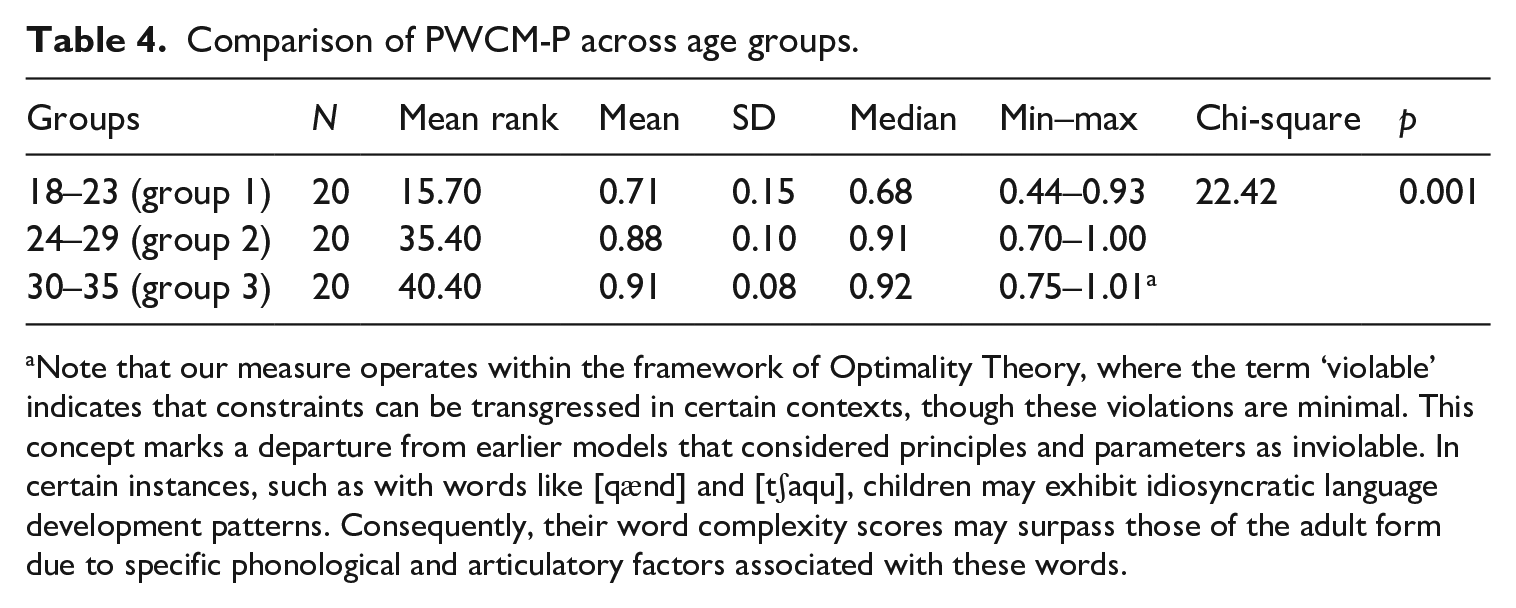
Note that our measure operates within the framework of Optimality Theory, where the term ‘violable’ indicates that constraints can be transgressed in certain contexts, though these violations are minimal. This concept marks a departure from earlier models that considered principles and parameters as inviolable. In certain instances, such as with words like [qӕnd] and [tʃaqu], children may exhibit idiosyncratic language development patterns. Consequently, their word complexity scores may surpass those of the adult form due to specific phonological and articulatory factors associated with these words.
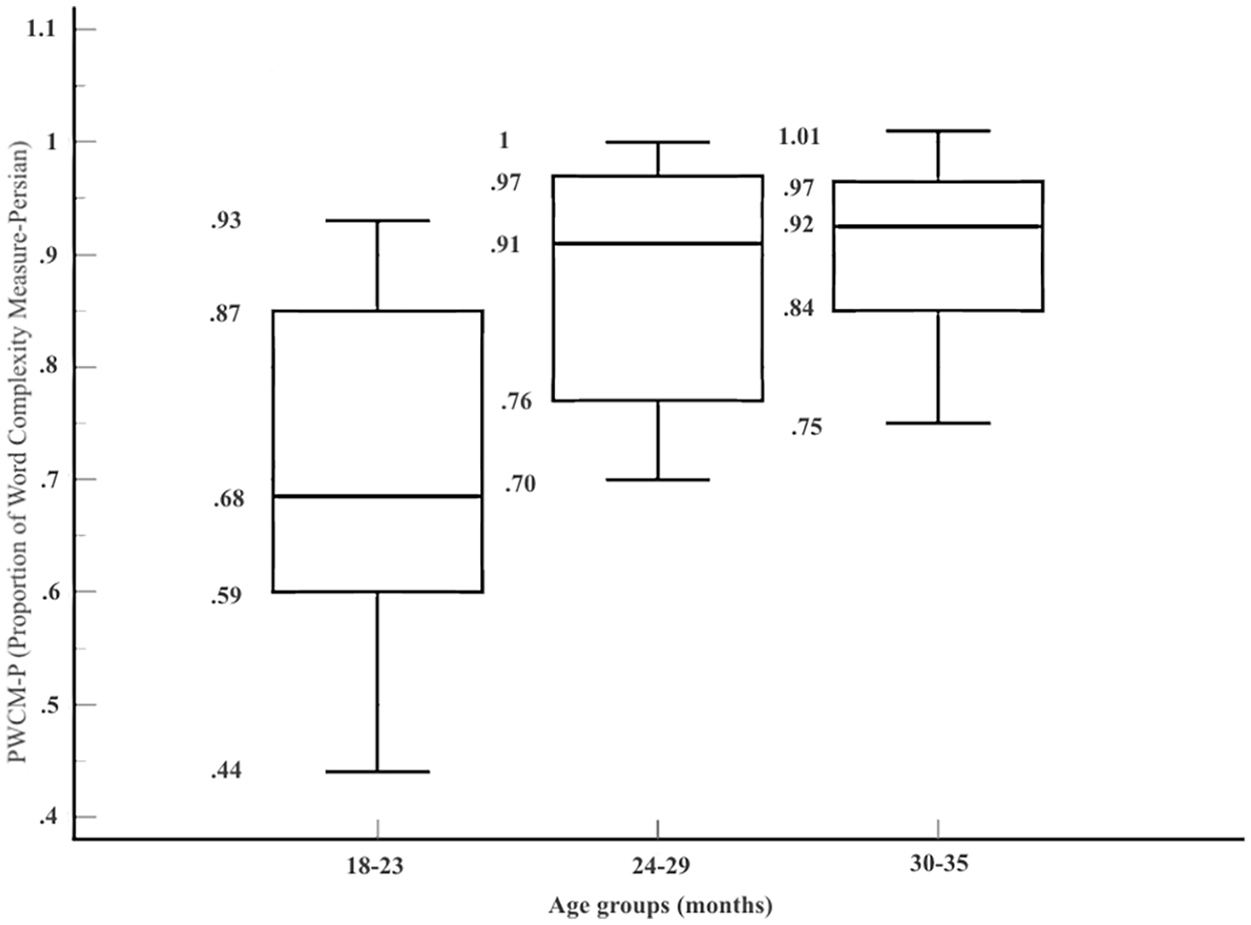
Minimum Score, First (Lower) Quartile, Median, Third (Upper) Quartile, and Maximum Score of PWCM-P Across Age Groups.
The Mann–Whitney U analysis was conducted to compare the age groups. The results showed that toddlers’ PWCM-P scores in age group 1 were significantly lower than both age group 2 (U = −64.50; p < 0.05) and age group 3 (U = 39.50; p < 0.05). There was no significant difference between PWCM-P scores in age group 2 and 3 (U = 162.50; p > 0.05).
The correlations between PWCM-P and PCC, as well as the size of receptive and expressive vocabulary, were found to be (r = 0.91; p = 0.001), (r = 0.62; p = 0.001), and (r = 0.70; p = 0.001), respectively. These results indicate a significant and large correlation between PWCM-P and PCC, as well as with receptive and expressive vocabulary.
Discussion
In the current study, the primary aim was to adapt the WCM for the Persian language, resulting in the creation of WCM-P. WCM-P was then used to investigate phonologically a group of 60 typically developing Iranian toddlers. In addition, we aimed to establish the concurrent validity of WCM-P by examining its correlation between PWCM-P scores with PCC and vocabulary measures.
In creating the WCM-P, we modified the complexity parameters to suit the Persian phonological system. Some parameters, such as word stress pattern and rhotic vowels, are not applicable in the Persian version and were therefore excluded. Similarly, specific fricative consonants were deleted, and /χ/ was included in relevant parameters related to fricative and affricative sounds. These adjustments were made to ensure the tool’s relevance and compatibility with Persian. Minor changes were also made to the complexity parameters, taking into account Persian segmental and supra-segmental phonology, similar to adaptations into Swedish (Marklund et al., 2018) and Chinese (Chen & Liu, 2015). The WCM-P follows a similar approach to the original measure, assigning scores to various complexity parameters and aggregating them for a total score per word or utterance. These complexity parameters consider articulatory-perceptual constraints and contribute to a language-universal perspective on assessing phonological complexity in expressive phonology.
However, certain issues have been observed in the calculation of complexity scores for specific words. In some cases, words with varying levels of phonological complexity based on clinical experience were given equal scores. Specifically, certain words that are typically more challenging for children with normal development and children with speech and language impairments received the same complexity rating, even though clinical knowledge indicates they represent different levels of difficulty. To address this, it is suggested that higher scores be assigned to syllable length parameters in order to better reflect the differences in complexity among words. In conclusion, the WCM-P provides valuable information regarding the complexity of children’s word productions. Further studies should explore the weighting of each parameter in the total word complexity score by examining these two scores across different words. This would result in a more comprehensive understanding of phonological complexity in Persian-speaking toddlers and would enhance the accuracy of the assessment tool.
The results of the study revealed significant age differences in the phonological complexity of toddler’s productions. Similar findings were reported by Saaristo-Helin (2009), who used a different measure called pMLU. This measure also demonstrated sensitivity to developmental changes in children below 36 months of age. Chen and Liu (2015) investigated Mandarin-learning children’s intelligible words and unintelligible utterances using the Chinese version of the WCM. They also observed developmental trends in both classes of productions. These findings indicate that as children get older, their ability to pronounce words accurately improves. Their mastery of more complex phonological structures, such as multi-syllabic words and consonant clusters, also develops with age. It takes a long time for children to fully master the sound system of the language they are exposed to. This is because their vocal tract develops gradually and they gain the necessary neuromuscular control to produce adult-like sounds (Green et al., 2002; Kent & Murray, 1982; Stoel-Gammon & Sosa, 2007).
The findings of the study also revealed that there was a correlation between phonological complexity in toddlers’ productions and the size of their receptive and expressive vocabulary. This correlation between phonological and lexical development aligns with previous research (Kehoe et al., 2018; Kehoe & Patrucco-Nanchen, 2017; Kern, 2018; Kern & dos Santos, 2018; Stoel-Gammon, 2011). As children acquire new vocabulary, they are exposed to a wider range of sound patterns and phonological structures, refining their phonological representations and improving their ability to accurately perceive and produce the language’s sounds. This suggests a developmental progression where phonological complexity and expressive vocabulary expand together, indicating a two-way relationship between vocabulary acquisition and the refinement of phonological skills.
The large correlation observed in the current study between phonological complexity and PCC could be attributed to both measures providing a straightforward way to assess the overall accuracy of a child’s speech productions. By combining these measures, a comprehensive assessment of both accuracy and complexity in a child’s word productions can be obtained.
In future research, longitudinal studies have the potential to track and document changes in children’s phonological complexity over time. A comprehensive measure of complexity should include parameters at the word, syllable, and phoneme levels, with appropriate weighting to ensure a thorough assessment of complexity and its impact on speech production. Researchers and therapists should consider the level of phonological complexity in individual words to provide a more accurate evaluation of phonology. By using this measure, future research can investigate the complexity of speech productions in both monolingual and bilingual children. Furthermore, further studies using this measure are necessary to analyze spontaneous speech samples.
Finally, the study presents the WCM-P as an innovative assessment tool that incorporates modifications reflecting Persian phonemic classes, phonological development patterns, and phonetic-articulatory constraints. This tool is used to evaluate the early expressive phonology development in Persian-speaking children. By shifting the focus away from segment-based measures such as PCC and utilizing measures like WCM, there is a potential to uncover aspects of phonological acquisition that may have been previously overlooked. The inclusion of whole-word measurements like WCM-P in routine assessments is justified due to their ease and speed of administration. This is especially true when normative data is accessible to aid in the interpretation of results.
Footnotes
Appendix 1
List of selected words from CDI-I.
| Item | Persian word | IPA transcription | English translation | WCM-P parameters | Total WCM-P score |
|---|---|---|---|---|---|
| 1 | آب | [ɂab] | Water | Word final consonant | 1 |
| 2 | توپ | [tup] | Ball | Word final consonant | 1 |
| 3 | خانه | [χane] | House | Fricative | 1 |
| 4 | نان | [nan] | Beard | Word final consonant | 1 |
| 5 | لالا | [lala] | Sleep | Liquid | 2 |
| 6 | موز | [mouz] | Banana | Word final consonant Voiced fricative |
3 |
| 7 | گاو | [gav] | Cow | Word final consonant Velar Voiced fricative |
4 |
| 8 | سیب | [sib] | Apple | Word final consonant Fricative |
2 |
| 9 | شیر | [ʃir] | Milk | Word final consonant Fricative Liquid |
3 |
| 10 | گوش | [guʃ] | Ear | Word final consonant Velar Fricative |
3 |
| 11 | دل | [del] | Stomach | Word final consonant Liquid |
2 |
| 12 | قند | [qӕnd] | Sugar loaf | Consonant cluster | 1 |
| 13 | دست | [dӕst] | Hand | Consonant cluster Fricative |
2 |
| 14 | رفت | [rӕft] | Went | Consonant cluster Fricative Liquid |
3 |
| 15 | پارک | [park] | Park | Consonant cluster Velar Liquid |
3 |
| 16 | چشم | [tʃeʃm] | Eye | Consonant cluster Fricative Affricate |
3 |
| 17 | ابرو | [ɂӕbru] | Eyebrow | Liquid | 1 |
| 18 | دندان | [dӕndan] | Tooth | Word final consonant | 1 |
| 19 | انگور | [ɂӕngur] | Grape | Velar Liquid Word final consonant |
3 |
| 20 | بستنی | [bӕstani] | Ice cream | More than two syllables Fricative |
2 |
| 21 | ماهی | [mahi] | Fish | Fricative | 1 |
| 22 | هاپ | [hap] | Bark | Word final consonant Fricative |
2 |
| 23 | مامان | [maman] | Mommy | Word final consonant | 1 |
| 24 | ماشین | [maʃin] | Car | Word final consonant Fricative |
2 |
| 25 | حمام | [hӕmam] | Bathroom | Word final consonant Fricative |
2 |
| 26 | کلاه | [kolah] | Hat | Word final consonant Velar Liquid Fricative |
4 |
| 27 | کیف | [kif] | Bag | Word final consonant Velar Fricative |
3 |
| 28 | کلید | [kelid] | Key | Word final consonant Velar Liquid |
3 |
| 29 | چاقو | [tʃaqu] | Knife | Affricate | 1 |
| 30 | بازی | [bazi] | Play | Voiced fricative | 2 |
Acknowledgements
We would like to express our appreciation to the children and their parents who generously agreed to participate in this study.
Author Contributions
Funding
The author(s) disclosed receipt of the following financial support for the research, authorship, and/or publication of this article: This research was supported by the Semnan University of Medical Sciences and health Sciences. We wish to express our appreciation to the children and their parents who generously agreed to take part in this study. In addition, we would like to thank the staff at the healthcare centers for their cooperation.
