




Abstract
The institutional order of organizing in working life is very different in Scandinavia and China. When Scandinavian and Chinese managers and employees meet in concrete work relations they not only work together on a product they also become engaged in institutional work dealing with the inconsistencies between the institutional orders of organizing. This in turn may affect the institutional orders by maintaining or transforming them. We don’t know what is going to happen as it depends on the awareness, skill and reflexivity of Scandinavian and Chinese institutional actors in the sense that these actors are able to work with institutionally defined orders.
Keywords
Introduction: Do we have a specific way of organizing in Scandinavia?
At the recent Nordic Sociological Congress (August 2011), I was invited to talk about whether or not the Scandinavian model of organizing is under pressure. After accepting the invitation the first question which came to my mind was: ‘Do we have a specific way of organizing in Scandinavia?’
To answer the question I would like to go back in time. Industrialization came relatively late to the Scandinavian countries, coincidentally with a general democratization of political systems in Western Europe. It is reasonable to assume that a consequence of Scandinavia’s late industrialization was an avoidance of its most negative effects, such as child labour, large slum areas, underpaid wages, as well as pronounced resistance among employers to the unionization of workers (Bjørnstad, 1987). However, this situation should not lead us to romanticize the beginning of industrialization in Scandinavia, for, as in the rest of Europe, strikes and struggles for better wages and living conditions characterized the period. As a consequence of these struggles, workers were organized into unions and employers into employers’ associations by the end of the 19th century, and have since then recognized each other as legitimate bargainers in labour market affairs.
During the 20th century, a growing number of workers in the private and the public sectors became unionized, giving the Scandinavian countries the highest rate of unionization in the western world, and ensured that the institutionalized bargaining system between the two sides of industry occupies a strong position. In the first part of the 20th century, bargaining was primarily conducted between the top representatives of the unions and employers’ associations. In their understanding of where bargaining could take place, the phenomenon of ‘the company’ as an organizational unit was irrelevant. This understanding emerged only after the Second World War, at which time bargaining became increasingly decentralized, resulting in greater direct contact between managers and shop stewards. During the process, the company was constructed as a political system and questions of power and of the humanization of working life have been topics of debate in Scandinavia ever since. This has lead to different ways of involving the employees in the decisions within the companies such as shop stewards, members of autonomous work groups and skilled employees as strategic company actors and members of the board of directors (Westenholz, 2003).
In parallel with this process, the social democratic parties held a strong position in the Scandinavian countries and placed the development of the welfare state on the agenda. Particularly since the Second World War, social democratic politics have supported the understanding of the company as a political system in which employees should be ensured influence. We may call this a micro democracy, as opposed to a macro democracy, which embraces the entire nation. Under the social democrats, unions have, to a certain extent, enjoyed the freedom to negotiate agreements with employers’ associations, but the parliamentary system has also intervened by legislation. This, among other things, happened in the early 1970s, when employees in the Scandinavian countries were guaranteed the right to elect members for the boards of directors. Christensen and Westenholz (1999) even go as far as talking about ‘citizens in the companies’ as a metaphor for the identity of these employees.
To summarize, the way of organizing in Scandinavia may be characterized as follows:
High rate of unionization among employees;
Collective bargaining on the societal level as well as in the companies;
Informal and formal participation by employees in decision-making within companies;
Government regulation of labour market conflicts in collaboration with capital and labour;
State, capital and labour collaborate on economic policy.
This way of organizing in Scandinavia is distinct from two other ways of organizing within capitalism. It is different compared to the way of organizing in liberal capitalism, characterized by low labour union membership, low formal participation in decision-making within companies and low regulation of labour market conflicts, which is the situation in the US, UK, Canada, Australia and New Zealand. And it is different from the way of organizing in capitalistic dirigisme, where the state controls and owns shares in many core businesses, where the labour union membership is low and where the government is eager to arbitrate the relationship between firms and workers. This is the situation in France.
Other countries, both industrialized and developing, have experimented with elements of organizational democracy, but the Scandinavian countries are unique in their introduction of various forms of employee participation in decision-making in both private and public organizations. Thus, I argue for the existence of a Scandinavian way of organizing; though I do admit, first, that a few other countries in Europe share some of the same characteristics, and second, that there are considerable differences between the Scandinavian countries. In this presentation I only focus on the similarities between the Scandinavian countries and ask what challenges we face in a Scandinavian way of organizing.
Globalization as a challenge to the Scandinavian way of organizing
I see two main challenges to the Scandinavian way of organizing by involving employees in participating in decision-making in the companies:
One is a tendency to organize by an increasing number of ‘mobile individuals’ moving in and out of the companies blurring the boundaries of the companies. This trend may question the concept of looking upon the companies as partly ‘micro democracies’.
The second challenge is about the globalization of the economy.
In this article, I focus on the second challenge, the globalization of the economy, and ask: How do we study the impact of globalization on the Scandinavian way of organizing?
Some scholars consider globalization to be a macro phenomenon. I like to argue otherwise. The impact of globalization has to be studied as a nested macro and micro process in which institutional actors meet in local contexts and negotiate the institutional order of organizing in concrete practices. Thus in studying globalization we have to identify new types of meetings between institutional actors from Scandinavian companies and institutional actors from foreign countries and companies.
The argument illustrated in Figure 1 is that when actors embedded in different institutional orders meet they often engage in institutional work, which in turn affects the institutional orders. Institutional orders are more than strategies of logics of actions as they are sources of legitimacy and provide a sense of ontological security (Thornton and Ocasio, 2008), and institutional work refers to the purposive action of individuals and organizations aiming at creating, maintaining and disrupting institutional orders (Lawrence and Suddaby, 2006; Lawrence et al., 2008).

A nested level of analysis combining macro and micro levels.
Chinese and Scandinavian ways of organizing
As ‘globalization’ is a pretty big issue I have decided to take a closer look at the development in China and its possible impact on the Scandinavian way of organizing.
China is one of the world’s fastest growing economies and I don’t think it will go away in the coming years. Scandinavian companies are increasingly locating themselves in China, and Chinese companies are doing the same: they are locating themselves in the Scandinavian countries either by buying Scandinavian companies (e.g. Volvo) or locating Chinese subdivisions or subsidiaries in the Scandinavian countries (e.g. Huawei – one of the world’s largest telecommunications company).
One may now ask if there is such a thing as a Chinese way of organizing. And if there is such a phenomenon, how do we study and understand a meeting between institutional actors embedded in a Scandinavian way and a Chinese way of organizing?
China is developing very rapidly and one may argue that it is not possible today to identify a specific way of organizing in China. Some scholars are focusing on the growth in the privately owned companies arguing that China is going in the direction of a liberal economy – or that China should go down that road. Others are focusing more on the positive role of the state and the government in nurturing the Chinese economy and they argue that the Chinese state should continue to pick the winners and losers (Wang, 2009). A third group of scholars are focusing on the role of social networks – guanxi – as a mechanism which helps companies in a time of poor legal infrastructure and high institutional uncertainty (Bjørn and Worm, 2008; Guo and Miller, 2010). Thus when we look at China today we may find private companies, state companies, state interventions and different types of networking between private and public actors. We may also find companies which are owned by the employees. The private telecommunications company mentioned above – Huawei – is owned by the employees, and about 65,000 employees out of about 100,000 are participating in an employee shareholder scheme. So how do we make a pattern out of these differences?
Fligstein and Zhang (2011) try to give a preliminary answer to this question. The two scholars argue that although the role of the government has changed dramatically within the last 30 years, it still remains enormously influential and they reject the idea that China’s economic transition is about removal of government and state from markets. Thus China is not going in the direction of liberal capitalism. Second, China is not moving in the direction of a Scandinavian way of organizing as Chinese labour is relatively disorganized, independent unions are not allowed and the management system is rather authoritarian or paternalistic. At the same time, Chinese workers have lost their right to lifetime employment and they can be fired with little retribution. If China is not moving in the direction of a liberal economy as we know it from the Anglo-American countries and it is not moving in the direction of a more organized economy as we know it from the Scandinavian countries, in what direction or directions is it then moving? Fligstein and Zhang suggest that we take a closer look at French dirigisme, where the state controls and owns shares in many core businesses, where the labour union membership is low and where the French government is eager to arbitrate the relationship between firms and workers. They argue that the French dirigisme of capitalism is closer to what is happening in China today, where government control is high, state ownership of firms remains central to the economy, workers are less organized and a private sector is emerging but in the shadow of the state. There are also differences between the French and the Chinese dirigisme, as France is a democratic country involved in the economy towards social welfare and redistribution and the workers can bargain with the state. In China, workers can wait for the paternalistic state to take care of their interests. Thus I argue that we may talk of different versions of dirigisme – and that China may be moving in a direction towards a special Chinese dirigisme.
We do need a lot more research to know if China is moving in the direction I just described, but if we for a moment take for granted that it is a reasonable way of understanding what is going on in China, how can we then use that knowledge to understand the potential impact of Chinese economic development on the Scandinavian way of organizing?
The institutional order of organizing is different in Scandinavia and China. In Scandinavia we have high degree of employee participation and participative leadership, whereas in China they have a much more authoritarian or paternalistic leadership (Cheng et al., 2004). In Scandinavia there is a high degree of union membership, whereas union membership is scattered in China and the power of independent unions is limited (Cheng et al., 2011; He and Xie, 2011). In Scandinavia there is moderate state intervention in work relations, whereas the state in China intervenes much more in work relations. When Scandinavian and Chinese managers and employees meet in concrete work relations they not only work together on a product they also become engaged in institutional work dealing with the inconsistencies between the institutional orders of organizing.
I may specify the issue and look for instance at the way ‘creativity’ or ‘innovation’ is dealt with within the two institutional orders (Figure 2).
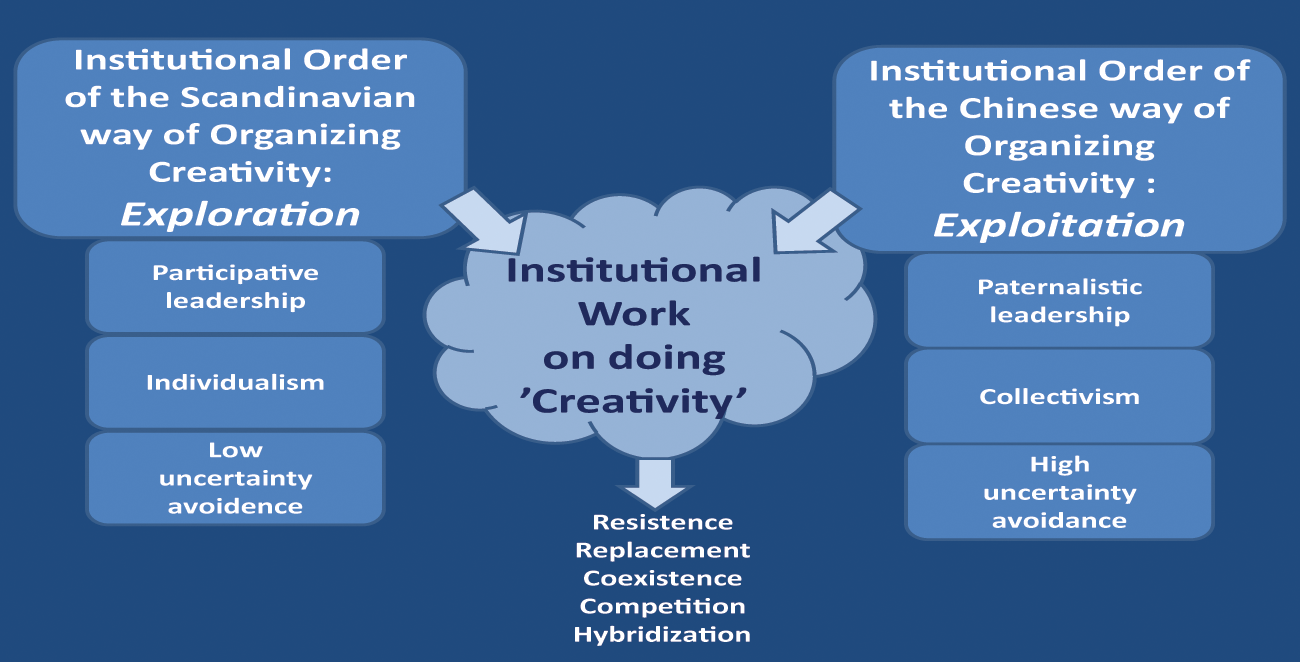
‘Creativity’ as an example.
The institutional orders in Scandinavia and China may lead to a differential focus on creativity. In the Scandinavian way of organizing employees are socially constructed as ‘participating individuals’ with a rather low degree of uncertainty avoidance and they focus on exploration of novel ideas. In the Chinese way of organizing employees appear to be different, with a greater emphasis on control and following instructions, avoiding expressing one’s unique ideas in order to avoid sanctions on deviation from norms. The Chinese employees are focusing on the usefulness and appropriateness of ideas. They exploit their known knowledge more than they focus on the exploration of novel ideas (Erez and Nouri, 2010).
When these two institutional orders are brought together in an organization some institutional work may take place involving both managers and employees trying to maintain or transform the institutional orders. The result may be resistance to bringing in another contradictory institutional order, replacement of an institutional order with another, coexistence of both institutional orders in the organization, competition between them, or the development of a hybridized way of organizing (Westenholz, 2011).
Conclusion
We don’t know which of these possible outcomes is going to happen as it depends on the institutional work done by the Scandinavian and Chinese institutional actors. And this is where we need at lot more research in organizations where Scandinavian and Chinese managers and employees work together either in China or in Scandinavia. These studies of institutional work should first highlight the awareness, skill and reflexivity of actors in the sense that these actors are able to work with institutionally defined orders. Second, the studies of institutional work should be located in a set of practices people engage in when they produce something together. Third, although we can’t step outside of action as practice – even action which is aiming at changing the institutional order – we must understand these processes as occurring within sets of institutionalized rules (Lawrence and Suddaby, 2006).
Coming to an end and answering the question: is the Scandinavian way of organizing under pressure? – my answer is that I do not know if it is under pressure necessarily (as this is a rather normative concept), but it is definitely up for negotiation and the outcome of these negotiations are dependent on the institutional work being done by Scandinavian and foreign managers and employees as they get to work together in new formations of globalized companies.
Footnotes
Funding
This research received no specific grant from any funding agency in the public, commercial, or not-for-profit sectors.