



Abstract
The combination of the changes in the US hospital industry and resulting pressures on the workforce with the relative immobility of hospitals has led to the growth of unions in this industry while unions are losing members in most other industries. Drawing on theoretical work that places changing work experience as a major factor in pro-union behaviour, the article examines how the rise of competition among private hospital systems has led hospital managements to adopt ‘lean production’ methods borrowed from manufacturing. The consequent pressures on the workforce have encouraged workers to join unions. These same forces have shaped the content of collective bargaining and divergent styles of unionism. As the transformation of hospitals are a piece of the broader neoliberal era in which they occur, this analysis should be applicable to certain other industries as well.
Introduction
Decline in trade union membership and density, punctuated by only occasional spurts of growth, has been the most notorious fact of private sector employment relations in the United States for decades. Yet America’s hospitals stand out as a major exception as health professionals, technicians and support workers join unions in growing numbers. Union membership in the private sector fell from 9.2 million in 2000 to 7.1 million in 2010, while density dropped from 9.1% to 6.9% in that period (US Bureau of Labor Statistics, 2001, 2011). In the same period, however, union membership in US. hospitals grew from 689,416 to 889,006, while density rose from 13.8% to 14.3% in those same years (Hirsch and Macpherson, 2011). Although the growth in density might seem modest, it was nonetheless significant as union density in hospitals was twice that for the private sector workforce as a whole. 2
This article will examine the transformation of the hospital industry in order to provide a context for analysing recent developments in unionization and collective bargaining across this industry. It will draw on both theoretical and empirical studies to examine the changing objective and subjective conditions that lead many hospital workers to chose unions as a means to dealing with these conditions.
In order to construct an overview of the development of unionism in hospitals, this article draws upon a wide range of secondary data sources. These comprise National Labor Relations Board (NLRB) reports, the US Department of Labor file of collective bargaining agreements for the industry/sector as well as coverage by the specialist independent publication Labor Notes. In turn, these were supplemented by union and industry sources, material from the Bureau of National Affairs, the major agency compiling detailed data on collective bargaining, previous opinion surveys and coverage by the daily press revealed through a LexisNexis search. The main strength of deploying these secondary sources is their breath of coverage of developments across a sector comprising 4000 private profit and non-profit hospitals employing around 4 million non-supervisory staff across the 50 states of the US. The main weakness of using such sources and materials is that the questions, issues and approaches underpinning them were not determined by the researcher as would be the case where primary data were generated specifically for the purpose of analysis. That said, the extent and variety of sources deployed from union, industry, government and policy groups lessened the significance of this weakness to some degree.
Theoretical framework
Since the end of the Second World War until recently, union growth was achieved primarily through representation elections held under the terms of the National Labor Relations Act (NLRA) and administered by the National Labor Relations Board (NLRB). Under the NLRA, unions in the private sector (other than railways and airlines) are granted exclusive representation for purposes of collective bargaining in those units in which they are recognized. Hence the importance of NLRB elections. Consequently much of the research about union growth has been based on the results of these elections, on the one hand, and attitudinal surveys that provided a basis for predicting who would vote for the union, on the other hand. From the 1970s onward a debate flourished around the work of Getman et al. (1976) and their critics concerning what sort of opinions determined how workers voted in NLRB elections (see Heneman and Sandver, 1983). As useful as these studies are, they tend to overlook the impact of changes in work on the willingness to vote for and join a union, treating job satisfaction as a static opinion. More recently, the debate among academics and practitioners has centred on the resistance of employers and union tactics to ‘inoculate’ members to management’s message and neutralize such opposition through mobilization (Bronfenbrenner, 2000; Bronfenbrenner et al., 1998). These, too, are valuable in understanding the evolving tactics of both sides in this perennial conflict, but still say little about the underlying dynamics that determine the decisions and actions of workers, unions and management.
A more dynamic look at work and changes in work as a factor in motivating workers to vote for a union was taken up by Wheeler (1985) in what he termed an ‘Integrative’ theory. In this theory a worker’s decision on whether or not to support a union was shaped by a number of factors, including: deprivation of pay or other conditions including respect; ‘recent decrease’ or the threat of a decrease in conditions; lack of ‘voice’ in remedying deprivation or decrease; and the ‘calculation’ that the benefits of unionization outweighed the costs, which are all ‘positively related to a pro-union vote or action’ (Weikle et al., 1998: 197–212). More recently, Clark (2009) applied a survey-based ‘model’ using three factors including: job dissatisfaction, dissatisfaction with management and attitudes towards unions as determinants in how workers would vote in an NLRB election. Clark writes, ‘the study found that it was dissatisfaction with working conditions, rather than the nature of the work itself, that led to an interest in unionization’ (2009: 33). This is an important distinction that applies to nurses in particular.
Refining this sort of approach further with a focus specifically on hospital-based nurses, Clark et al. (1999: 61–67; 2001: 133–148) examined the impact of the changes in healthcare work driven by ‘market reforms’ that accelerated in the 1980s. Their ‘partial model’ saw the shaping of pro-union sentiment in the process of market-driven work reorganization and the impact it had on the ‘climate for patient care’, arguing ‘the more negative the perception of the climate, the more likely the nurse would vote for a union’ (Clark et al., 1999: 63). Indeed, their survey of 483 nurses in Pennsylvania revealed a very high correlation between those who expressed dissatisfaction with the ‘climate of patient care’ and those who said they would vote for a union. Further support is found in Jarley and Fiorito (1991: 223–229) who showed that non-economic issues such as autonomy and the content of work played a growing role in workers’ assessments of unions. Space prevents a thorough discussion of the role of gender in hospital unionization. But it is important to bear in mind that women have made up the majority of all new union members in the US for over two decades (Bronfenbrenner, 2005: 2). They have risen from 37% of union members in 1991 to 46% in 2010 (Schur and Kruse, 1992; US Bureau of Labor Statistics, 2011). Some 88% of healthcare support workers are women, as are 93% of registered nurses, while unions with large female memberships have higher than average NLRB win rates (Bronfenbrenner, 2005: 13–14; US Census Bureau, 2010: 387). Thus, if the past two decades or more are any indication, unionization benefits from the predominant role of women in hospital work. It should also be noted, however, that as the number of NLRB elections has declined both generally and in hospitals, the success rate has risen across the board. This increased success may well indicate a more planned and strategic approach to representation elections, as Bronfenbrenner and Juravich (1998) have argued.
The analysis in this article will draw on the dynamics of changing work as a factor in the above average growth of unions in hospitals in the past decade. It will accord with Clark et al. (1999) that these changes are the result of market-driven forces. It will go a step or two further in analysing both the roots and impact of increased competition in the political economy of the US hospital industry. The study will first look at the changes in the healthcare market that began in the 1970s and the impact this had on hospitals as organized businesses. It will then examine the major consequences of increased competition and consolidation as hospital managers turned towards capital-intensive strategies, the introduction of new technology, cost-cutting and work reorganization. Employing the more dynamic aspects of the theories examined above, it will then make the link between these changes and the growth of unionism in hospitals. Following this it will discuss the nature of collective bargaining as it has evolved under these circumstances and the varying types of unionism that have emerged. Finally, although space precludes a discussion of the broader economic and political circumstances in which these developments unfold, it should be noted that the transformation of the US hospital industry occurs in the context of the neoliberal era, with its continuous economic restructuring and work reorganization. Partly due to this, the article will suggest that the approach of this study, with its emphasis on changing conditions of work, may well apply to other industries and unions.
Growth, competition and consolidation
Following the final defeat of national health insurance legislation in the US in 1947, unions turned to negotiating employer-provided health insurance for their members. The number of workers with health insurance as part of their collective agreement rose from 1 million in 1946 to 12 million by 1957 (Berkowitz, 2008: 84; Gottschalk, 2000: 43). Private health insurance expenditures grew from $6 billion in 1960 to $15 billion in 1970. This was followed by the growth of government spending in healthcare, boosted after 1965 by Medicare and Medicaid payments, from $28 billion in 1970 to $256 billion by the end of the 1980s. In a matter of two decades a massive market for healthcare of all kinds was created with expenditures for hospital care growing by two-and-a-half times in the 1970s and one-and-a-quarter times in the 1980s before levelling off in the 1990s and 2000s (US Census Bureau, 2009: 95). As Stevens (1989: 284–300) argues in her economic history of American hospitals, it was these new sources of government money that drove competition among the privately owned hospitals that dominate US healthcare and accelerated new construction, which, in turn, shifted the financial dependence of not-for-profit hospitals from philanthropy and the ‘community’ to the bond market and profitability.
As managed care, prepaid insurance with stringent cost controls, replaced fee-for-service payments beginning in the 1980s it put pressure on revenues, further accelerating competition, cost-cutting and consolidation in the industry as hospitals sought to increase revenue by trimming costs and increasing market share through expansion or acquisition. As one of the pioneers of managed care, Paul Ellwood, wrote, managed care would bring aspects of the industrial revolution, in particular, ‘conversion to larger units of production, technological innovation, division of labour, substitution of capital for labour, vigorous competition, and profitability as the mandatory condition of survival’ (cited in Gordon, 2005: 236–237). This is substantially what happened, as Health Maintenance Organization (HMO) coverage, the most common form of managed care, accelerated from 33 million people to 81 million in 2000. Managed care helped intensify cost-cutting and competition, but it became a fixture of the industry by 2000 (MCOL, 2011: 1; US Census Bureau, 2009: 104), with competition becoming the dynamic factor in change.
Competition between hospitals and hospital systems tends to be specific. As one study put it, ‘Hospitals compete with each other not for the entire clinical continuum but for each service separately’ (Robinson and Dratler, 2006: 139). While competition occurs between all systems in a given geographic area, the entrance and proliferation of for-profit hospitals specializing in specific types of surgery, the so-called ‘focused factory’ model, has intensified competition even further, particularly in large urban areas. As Kumar (2010: 100) argues, ‘Since general hospital managers often subsidize less profitable departments using profits from surgery, they complain that specialty hospitals represent a threat to their viability.’
Competition has been most intense in major urban markets where the majority of large hospitals are located. Brooks and Jones (1997: 701–702) describe the transition: The landscape of hospital ownership and affiliation before the 1980s stands in sharp contrast to that of the early 1990s. In the pre-1980s era, the terrain was marked by large numbers of freestanding hospitals, independent of but coexisting with other hospitals. By the early 1990s, many of these hospitals had merged with others, had rationalized operations, and had entered into networks of hospitals, insurers, and physician groups.
By 2009 three-quarters of private hospitals were consolidated in mostly urban-based corporate systems (American Hospital Association, 2011: 12).
The consequences of competition
Increased competition brought about four major interrelated changes in the structure and functioning of the industry: the consolidation of formerly free-standing hospitals into privately owned corporate systems discussed above; the rising importance of profits for all private hospitals; the increased capital intensity of the industry; and the introduction of work reorganization and ‘lean production’ norms in hospital work.
In this increasingly competitive atmosphere, the ‘not-for-profit’ classification has become little more than an official tax-free status, albeit with a requirement to provide some ‘community benefits’ (Internal Revenue Service, 2010). Much like their for-profit rivals, these once-upon-a-time charities calculate their profits as profit margins and return on assets or capital (Das, 2009: 13–21). Indicating the general shift among hospital executives towards a more business-like mentality, a survey of the priorities of hospital executives published in 2008 showed that the highest mean score (4.58 out of 5) on a Likert scale was for ‘Operating Profit Margin’ (Love et al., 2008: 22). Also like their for-profit competitors, the ‘not-for-profits’ are run by CEOs on a business model. Compensation for these CEOs, while more modest than those of for-profit chain CEOs, can run from six-figures to the $8 million received by Kaiser’s CEO in 2009 (Internal Revenue Service, 2010: 124, 143; National Union of Healthcare Workers, 2011). Even the juridical distinction between for-profit and not-for-profit hospitals is often rendered meaningless by overlap. All physician services for Kaiser Permanente, the nation’s largest ‘not-for-profit’ HMO (health maintenance organization), for example, are supplied by affiliated for-profit Permanente Medical Groups (Kochan et al., 2009: 27–28).
In taking on the competition, consolidation has been matched by accelerating capital intensity. Measured in real, inflation adjusted terms the value of the net stock of fixed private assets in US hospitals rose by 40% from 2000 to 2009, compared to 21.5% for the US economy as a whole. The real net stock of private equipment and software, an indication of increased application of new technology, rose by an extraordinary 92% compared to 28% for the economy as a whole in those years (Bureau of Economic Affairs, 2010d). Much of this was due to the need to provide advanced equipment within each hospital in a given market. This has led US hospitals to have a much greater frequency of MRI units and CT scanners used to detect internal medical problems than hospitals in other countries: 25.9 MRI units per 1000 population in the US compared to 11 for OECD countries; and 34.3 CT scanners per 1000 compared to 22.8 (Pearson, 2009: 14). In fact, 91% of US community hospitals have CT scanners and 68% have MRI scanners (American Hospital Association, 2010: 161). As a consequence, the real net stock of assets per worker in hospitals grew from $28,056 in 1980 to $32,863 in 1990, $53,878 in 2000 and $81,290 in 2009. While this ratio grew by an annual average of 1.7% in the 1980s, in the 1990s, as competition accelerated, it grew by an average of 6.4% a year. It levelled off at about 5% a year in the 2000s, due in part to the recession (American Hospital Association, 2009: 16–19; Bureau of Economic Affairs, 2010d).
The pressures of competition and the expense of capital investment also led a growing number of hospitals to attempt cost-cutting through work reorganization. Among other things, this has meant the adoption of ‘lean production’ and ‘operations management’ techniques borrowed from manufacturing. Some hospitals, like the Seattle Children’s Hospital, have been quite explicit that what they were imitating was the Toyota Production System (TPS), with its ‘checklists, standardization and nonstop brainstorming’ (Weed, 2010). The trend, however, has come to cover much of the industry. Kumar (2010: 95) summarizes the trend, ‘Over the years, they have adapted Lean Manufacturing, Sigma Six and supply chain strategies in order to become more efficient as well as improving patient care and satisfaction.’
Much of lean production as applied to hospitals involves work flows, but just as in a factory it usually means more output with the same or fewer people. For example, a 2010 article in the Boston Globe (Allen, 2009) reported, ‘Cincinnati Children’s Hospital estimates efficiency measures will allow the hospital to generate an additional $137 million in revenue this year from treating more children with the same staffing levels in surgery and other departments.’ While some of these measures do contribute to greater efficiency, they also tend to increase the workload and effort. One aspect of lean production related to this is outsourcing, that is ‘supply chain strategies’, which has been done extensively, not only with ancillary services, but even with nursing staff. While lean measures apply to the entire workforce, the use of temporary and part-time nurses has increased, playing havoc with nurse–patient ratios, which have become a central issue in collective bargaining (Kocakulah et al., 2009: 80–82).
Lean production or operations management relies on standardization and this has been accelerated by the application of digital technology that also serves as workforce surveillance. Nurses and other workers in some US hospitals must now wear badges containing GPS tracking devises (Gaus, 2009: 1). Electronic health records (EHR) clearly improve clinical performance, but they also have negative side effects on the work of registered nurses. In particular ‘the standardization required by computer technology deprives caregivers of the opportunity to tailor treatment to the needs of their patients’ (Lipsky et al., 2009: 74). In addition EHR can include a nurse schedule function that automatically sets staffing patterns, which has meant the increased use of ‘nurse-extenders’ who are less trained than registered nurses (Eastaugh, 2010: 27–30). Another innovation that affects treatment and threatens skill is the Clinical Decision Support System (CDSS), derived from critical path analysis used in manufacturing. CDSS recommends standard treatments on the basis of studies that ‘systematically exclude women and minorities’, according to one union-backed study (Institute for Health and Socio-Economic Policy, 2009: 4–7). By 2009, the study reported, CDSS was in use in 68% of US hospitals. All of this has decreased nurse autonomy and increased pressure on the entire hospital workforce, altering the ‘climate of patient care’ substantially.
The impact of President Obama’s Patient Protection and Affordable Care Act of 2010 is likely to be complex, but what is certain is that by providing billions of dollars and millions of newly insured patients, it will increase competition for these funds. At the same time, it will introduce reductions in Medicare payments and require hospitals to make cost-cutting and efficiency gains that will be difficult to meet (Centers for Medicare and Medicaid Services, 2010: 1–10).
From impact to action
That there is a strong link between the enormous pressures on the workforce and changing working conditions, on the one hand, and the willingness to join a union, on the other, is indicated, for one thing, by the much higher percentage of union win rates in NLRB elections in hospitals. Union win rates from 2001 through 2009 averaged 60% for all industries, but 68% for hospitals. By 2009 they had risen more or less steadily to 80% compared to 69% for all industries (National Labor Relations Board, 2000–2010). Furthermore, a study by Clark et al. (2001: 144–145) found that nurses who had experienced job reorganization had a more negative attitude towards work, were more concerned with ‘voice’ and administrative support (or lack of it), and, as a result, were more likely to see unions as effective and vote for them.
Further survey data show that during the 1990s the perception was that working conditions had degenerated. A survey by the polling company Peter D Hart Research Associates (2001) showed that 63% of current nurses and 78% of those who had left their jobs believed ‘the situation facing RNs has been getting worse’. Sixty-six percent of current nurses believed patient load was a problem, while 79% reported that the acuity of patients was more severe. Understaffing, stress and the physical demands of the job rated high as problems, while concern with pay was very low. In identifying the causes of degenerating conditions 69% of current nurses saw managed care as the major cause (Hart, 2001: 11, 17, 18, 19). More recently a 2006 survey of over 22,000 nurses in California, New Jersey and Pennsylvania revealed that many nurses still felt that staffing was too low. When asked if there was ‘enough staff to get work done’ only 40% in New Jersey, 44% in Pennsylvania and 56% in California said yes. California’s higher yes rate was due to the state mandated nurse–patient ratios won in 2004 through the efforts of the CNA (Aiken et al., 2010: 9). As Table 1 shows these views are consistent with the findings of Clark (2009) and Clark et al. (1999, 2001) linking working conditions and reorganization with the ‘climate of patient care’ and pro-union attitudes.
Climate for patient care and inclination to vote for a union.
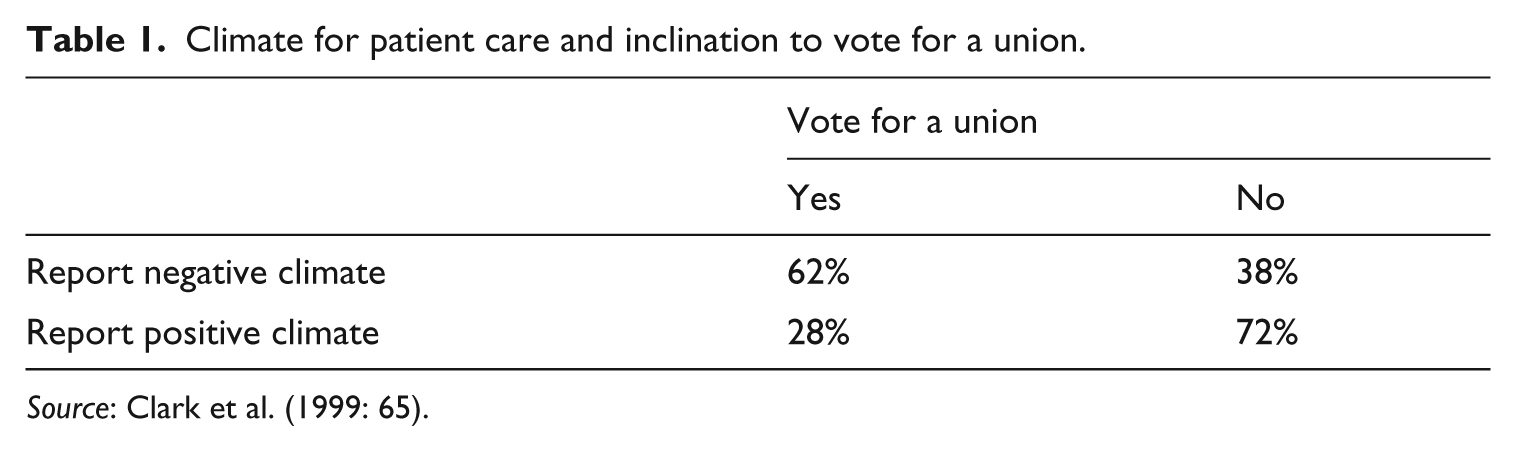
Source: Clark et al. (1999: 65).
The link with pro-union attitudes and patient care is further confirmed by experienced observers. National Nurses United (NNU) Organizing Director David Johnson says of the union’s effect on work standards, safety and patient advocacy, ‘NNU’s track record in achieving gains in all these areas is a reason for our explosive growth’ (National Nurses United, 2010a). As Benson (2010: 303) summarizes it in his survey of nurse unionization ‘They are won over to unionism as a curb on the authority of imperious management.’
While hospital managements do resist unionization, they seldom have the threat of workplace closure to intimidate the workforce as a credible tool (Bronfenbrenner, 2009: 1–14). In an earlier study, Bronfenbrenner (2000: 8–19) noted that while the frequency of plant closure threats went as high as 75% in many manufacturing, communications and utility organizing efforts, in healthcare it was 31%. This figure includes several healthcare industries as well as hospitals and it is likely that today’s hospitals with their far greater intensity of ‘sunk capital’ than nursing homes, are even more immune to plant closure threats during representation elections.
More credible from management’s point of view is the argument that unions imply a self-interest that may conflict with professionalism and patient care. The unions counter that it is, in fact, management that is attacking the quality of care through cuts in staff, ‘gag’ rules and technology that limits the personalization of care. The question of the interests of nurses versus patients is, of course, more difficult when the question of strikes arises. One study of the impact of nurses’ strikes in New York State did, indeed, find an increase in in-hospital mortality during strikes (Gruber and Kleiner, 2010). The NNU answered this study with one of their own conducted by University of Pennsylvania researchers who surveyed 22,000 nurses in California, Pennsylvania and New Jersey. The results showed that California nurses who have the highest nurse–patient ratio at an average of 1:5 have more time with patients than those with lower ratios. It also estimated that New Jersey hospitals would have 14% and Pennsylvania 11% fewer deaths if they had the California ratio (National Nurses United, 2010b).
In other words, it is the fight for improved ratios and other patient-related union goals that saves lives. As one representative of the Minnesota Nurses Association commented, ‘Our nurses said it was the most difficult decision of their lives to authorize this op-ended strike vote. But they truly feel that the unsafe staffing issue is that important, and if they don’t stand up for their patients now, who will?’ (Star Tribune, 2010). In any event, the unions’ consistent advocacy of improved patient care has been sufficient to counter the management case more often than not.
Although space prevents a full discussion of the other more traditional factors in union success or failure, most point to a positive organizing environment in US hospitals. High rates of union success are associated with an urban setting, with 92% of hospitals with 200 or more beds located in urban areas (American Hospital Association, 2011: 12–29; Delaney, 1981). Small bargaining unit size is another well-known factor in union success and the 1991 NLRB decision to divide hospitals into eight bargaining units has provided this advantage (Clark, 2002: 110; Delaney, 1981: 152–153; Farber, 1999: 1–6). Finally, workplaces with high injury and illness rates have been shown to be sites of union success (Robinson, 1988). The injury and illness rate for hospitals is one of the highest at 7.7 per 100 full-time workers, higher even than construction or mining at 5.4 and 5.2 respectively (US Census Bureau, 2010: 419). Finally, as mentioned earlier, the dominant role of women in hospital work has been a distinct advantage in organizing as, going by the results of the past two decades, unions with a high proportion of women members tend to have a higher win rate than others in NLRB elections (Bronfenbrenner, 2005: 14).
It can reasonably be asked then, if hospitals and their workers betray all the aspects of pro-union success why are 85% of these employees still non-union? As argued above, while management resistance undoubtedly affects some workers’ choices, the largely immobile nature of hospitals denies management the opportunity to threaten closure or relocation. Management, of course, does try to appeal to the professionalism of nurses in particular. Again, however, this runs up against the fact that even the major professional association, the American Nurses Association, has engaged in collective bargaining and even industrial action for decades (Benson, 2010: 302). Furthermore, the nurses’ unions have themselves captured the mantle of professionalism with their embrace of patient advocacy (Clark and Clark, 2009: 22–23). A 2009 ‘global’ survey of 11 countries found that 72% of US nurses surveyed thought unions were supportive of nurses and their concerns, exactly the ‘global’ average (International Council of Nurses, 2009).
A more plausible explanation for the 85% still not represented by unions lies in the ‘fight or flight’ dilemma. Staff turnover is extraordinarily high in US hospitals. One study found that turnover among support staff of a major urban hospital was 47%, while that for ‘allied health personnel’, notably nurses, was 49% (Waldman et al., 2004: 4–6). Another calculates the turnover rate for support workers as high as 100% in some hospitals, while rates in excess of 50% are common (Kochan et al., 2009: 13). In addition, there are at least a quarter of a million qualified nurses who are not practising their profession due to poor staff–patient ratios, lack of voice and overwork (Lafer, 2005: 30–39). Along with the surveys cited above, these studies show that the reasons for leaving the job are substantially the same as those for joining a union. It does seem clear that large numbers of nurses and support workers chose ‘flight’ as the most practical course in many circumstances. The choice of flight over fight, however, is due in part to the limited ability of unions to reach the nation’s 4 million non-supervisory hospital workers.
A credible, if still partial, explanation for the level of ‘flight’ and the unorganized 85% lies, therefore, in the limited, often dwindling resources of American unions. Most US unions are financially strapped and face rising real staff costs. They spend more than they receive in membership dues. In 2009, for example, the Service Employee International Union (SEIU), a major player in healthcare, drew only 83% of its revenue from member dues (Moody, 2009: 685–689). Partly for financial reasons the SEIU has chosen the more cost-effective route of organizing public sector home healthcare and childcare workers largely through political deals with state governors (Early, 2011: 68–71; Kaplan, 2008). Like the SEIU, other unions that organize hospital workers, such as the American Federation of Teachers, have other jurisdictions that often take precedence. The new nurses’ unions, although aggressive organizers, are as yet small. The fact is, the number of NLRB elections in hospitals has fallen in the last decade from an average of 166 a year from 2000 to 2003 to a little over 100 a year in 2007–2009 despite very high rates of success (NLRB, 2000–2003, 2007–2009). It will take a much greater focus and effort to realize the full potential for unionization as an alternative to ‘flight’. At this point, it is appropriate to look at the state of unionism in recent years.
Hospital unionism in the early twenty-first century
About a dozen unions claim a significant number of members in US hospitals. The large number of unions is explained in part by the 1991 NLRB decision to split hospitals into eight bargaining units, three for professionals and five for non-professionals, the latter of which include maintenance workers, housekeeping staff, clerical workers and laboratory technicians (Clark, 2002: 110). Thus, the presence of professional and technical engineers, office employees and professionals, teamsters and operating engineers reflects unionization of the different professional and non-professional units. By far the largest unions in the private sector of the industry are the SEIU with 400,000–450,000 members in hospitals, and the recently formed National Nurses United (NNU), formed in 2009 through the merger of the California Nurse Association (CNA), the Minnesota Nurses Association (MNA) and the United American Nurses (UAN), claiming 160,000 members (Benson, 2010: 297; National Nurses United, 2010a; UNITE-HERE, 2009). The American Federation of Teachers (AFT) claims 70,000 members, the ‘majority’ of whom work in hospitals (American Federation of Teachers, 2010). The National Federation of Nurses (NFN), a loose confederation of eight state associations formed in 2007, claims 70,000 members (Benson, 2010: 298–299; National Federation of Nurses, 2009). The United Food and Commercial Workers (UFCW) and the United Steelworkers (USW) also claim healthcare members, but offer no breakdown of hospital members (United Food and Commercial Workers, 2010; United Steelworkers, 2007: 3). Various state affiliates of the American Nurses Association (ANA) also engage in collective bargaining (American Nurses Association, 2011).
A final union must be included despite its currently small size. This is the National Union of Healthcare Workers (NUHW), which was founded in 2009 after the leaders and thousands of members of Service Employees International Union-United Healthcare West (SEIU-UHW) left SEIU when SEIU president Andy Stern put that local into trusteeship. As SEIU-UHW members were formally under contract with the SEIU, under US labour law the NHUW could not automatically take UHW’s 150,000 members with them, despite the fact that about 100,000 UHW members signed petitions supporting the NUHW (Krehbiel, 2009). Although the NUHW signed up a majority of Kaiser’s 44,000 workers in 2009, it was defeated in a 2010 NLRB election contest with the SEIU, at great expense to the SEIU and some say with a good deal of help from Kaiser management. Nevertheless, the NUHW has succeeded in winning a number of bargaining units in Kaiser, Sutter and elsewhere in California bringing it close to 10,000 dues-paying members in 2010 (Brenner, 2010: 3; Early, 2011: 294–302, 329–331; Winslow, 2011).
The 93 collective bargaining agreements concluded in hospitals in 2009 and the first three-quarters of 2010 reported by the Bureau of National Affairs (2010) provide a picture of the ranking of unions in hospital collective bargaining. The SEIU comes in first with 45 contracts, or nearly half of the total. The NNU is next with 18 contracts or just under 20%. The AFT, which includes some nurses’ agreements, had 13 in this period or 14%, and the UFCW 8 or 9%. The remaining 8% was divided among the three independent nurses unions, the Teamsters with two, and one each for the Office and Professionals International Union (OPEIU), the USW, the Communications Workers of America (CWA) and the American Federation of State, County and Municipal Employees (AFSCME). Occupationally, 42 contracts represented nurses alone, 45 technical and support staff, sometimes including nurses, while six covered doctors. As Table 2 shows, efforts at new organizing through NLRB elections showed a similar distribution with the SEIU holding 42 elections, nurses’ unions (listed as independent unions by the NLRB) 8, the AFT 7, IUOE 6, the UFCW 3 and the remaining 28 held by a broad variety of unions. The NLRB figures in Table 2 also show the concentration of hospital unions in coastal states.
Distribution of NLRB elections, hospitals (622) 2010 by union and region.

Source: NLRB (2010).
According to the Current Population Survey figures cited at the beginning of this article, union membership in hospitals grew by 199,590 from 2000 through 2010 (Hirsch and Macpherson, 2011). The total number of hospital workers who gained representation rights through NLRB elections in this period was 149,110 (NLRB, 2000–2009; NLRB, 2010). Some of these units may have faced later decertifications, while not all those in these units, particularly in right-to-work states, necessarily became union members. The remaining 50,000 to perhaps 70,000 are most likely explained by ‘organic’ growth, on the one hand, and organizing by means other than traditional NLRB elections, on the other. Organic growth refers to the growth of facilities or systems already organized. The rest may have organized through ‘neutrality’ agreements such as the SEIU has with Kaiser, Catholic Healthcare West and Tenet (Kochan et al., 2009: 1, 31–32, 41–42, 53–54; Early, 2011: 65).
Collective bargaining trends
The recent state of collective bargaining in hospitals reflects the pressures on the workforce resulting from the industrial restructuring and work reorganization described above. The first thing that stands out in this regard is the comparatively high number of strikes in recent years, a fact that not only indicates that intensified pressures on the workforce are a major factor in union growth, but also implies increased militancy among union members. A LexisNexis search (2010) for 2009 and 2010 revealed 30 strike threats and 10 actual work stoppages out of the approximately 100 contracts negotiated in those years. This is a rate of 10%, compared to 0.06% for all strikes and contract negotiations reported by the Federal Mediation and Conciliation Service for those years (2009: 6–7; 2010: 7–8). Three of the hospital strikes were conducted by SEIU locals and seven by nurses unions, mostly affiliates of the new National Nurses United (NNU). Most of these strikes were not primarily over wages, but over issues related to the ‘climate of patient care’, which will be discussed below.
Overall real wage growth in hospitals has run a little ahead of those for the economy as a whole, 7.2% from 2005 to 2009, compared to 5.1%, or 1.4% and 1% annually (US Bureau of Labor Statistics, 2011: 144; US Census Bureau, 2009: 402). In terms of collective bargaining, hospital-based unions did better than the hospital industry averages and slightly better for all industries in the US in 2009 and 2010 when measured by first year increases, according to the Bureau of National Affairs (BNA) reports (2010a, 2010b, 2010c). In 2009, the average first year wage increase rose by 2.4% for hospital unions compared to 2.3% for the US as a whole. For the first three quarters of 2010, first year increases in hospitals averaged 2.1%, compared to 1.7% across all agreements. In 2009, 14% of hospital contracts had no increase in the first year compared to 24% for all industries, while in 2010 the gap narrowed with hospitals seeing no first year increase in 30% of all new contracts compared to 35% for all settlements reported by the BNA. There was, however, a considerable range of first year increases. The average for NNU affiliates was 3.6%, that for the SEIU was 2.5%, with AFT hospital locals averaging 0.6%. The increases also varied by occupation. In 2009–2010 combined, average first year increases covering nurses were slightly below those for all hospital workers, 1.92% compared to 2.25%, largely because of the low increases for AFT hospital locals. Not surprisingly, these recession period wage increases are significantly smaller than some of the major collective agreements signed earlier in the decade at some of the trend-setting hospitals, which averaged 3.4% (US Department of Labor, 2010).
Like virtually all unionized workers in the US, hospital workers have faced concessionary demands on pensions, medical benefits and working conditions. Modern Healthcare (Evans, 2010) reported that some hospitals and hospital chains were freezing pension benefits as the recession hit their pension funds. This was an issue at the 14 Minneapolis hospitals struck in 2010 by the Minnesota affiliate of the NNU (Olson, 2010). Healthcare benefits were also an issue in disputes in Massachusetts, Maine, Pennsylvania, Minnesota and New York in early 2011 (Labor Notes, 2011: 4). These were also among the major issues in the strike of 21,000 members of the NUHW and CNA in September 2011 (Brenner and Gaus, 2011).
The most critical issues, above all for nurses, however, involved staffing levels, nurse–patient ratios, mandatory overtime and ‘floating’, all issues associated with ‘the climate of patient care’. All of these issues have been enabled to one degree or another by the new technology and ‘lean’ practices discussed above. The conditions faced by support workers necessarily follow those of nurses, only at much lower wages. As a result, turnover rates for these occupations often run over 50% to 100%, as reported earlier (Kochan et al., 2009: 13).
Not surprisingly, as the findings of Clark (2009) and Clark et al. (1999, 2001) would predict, a major goal of nursing unions has been the ‘climate of patient care’. For over a decade, nurses’ unions have sought to negotiate contract language on staffing levels and patient ratios with some success. Examples of specific nurse–patient ratios are found in the agreements negotiated by the New York State Nurses Association (NYSNA) with New York’s Voluntary Hospitals and the AFT-affiliated Health Professionals and Allied Employees at New Jersey hospitals in 2004. The CNA, MNA, SEIU and other unions representing nurses have dealt with staffing issues through joint committees to oversee staffing matters and patient care in general (Clark and Clark 2006: 60; 2009: 24–25; US Department of Labor, 2010). All of the 2009 and 2010 strikes by nurses involved staffing issues and most won contract language giving them some control over this (LexisNexis, 2010, 2011).
Another key issue related to staffing is mandatory overtime. Here NNU affiliates and SEIU locals have succeeded in negotiating contract language that limits this. The MNA won contract language stating ‘no nurse shall be disciplined for refusal to work overtime’ in 2004 and again in 2007 (Clark and Clark, 2009: 25; US Department of Labor, 2010). The NYSNA version reads, ‘Employees will not be required to work involuntary overtime except in a disaster/emergency’ with emergency clearly defined (US Department of Labor, 2010). The SEIU has also won limits on forced overtime in Miami and Boston (Clark and Clark, 2009: 25).
‘Floating’ or the allocation of nurses out of their usual unit and specialty is another important staffing issue. Seeking greater ‘flexibility’ to cut costs, hospital managers tend to fill vacancies without hiring more personnel by simply moving nurses around. It often means that nurses must work in areas they are not familiar with and that overall staff shortages remain unaddressed. It is a relatively new practice, creating ‘just-in-time’ nursing (Gordon, 2005: 278–279). Nurses’ unions have attempted to negotiate contract language to limit the practice. The NYSNA language at Mount Sinai, for example, reads, ‘An RN shall not be floated inside or outside her/his area of clinical practice … unless the RN has appropriate orientation’ (US Department of Labor, 2010). All of these staffing issues affect working conditions for nurses and those technical and support workers working with them, as well as challenging management prerogatives on workforce deployment. But they also affect the quality of healthcare. Thus, staffing concerns have become one of the important aspects of the NNU’s ‘patient advocacy’ approach to collective bargaining.
Divergent directions of hospital unionism
In the last decade or so, there has been an increasing divergence in the practices and structures of unionism most clearly articulated between CNA/NNU, on the one hand, and the mainstream of the SEIU’s leadership, on the other. The pressures of the hospital industry on its workforce and the response of many of the unions have both given rise to changes that are, perhaps, clearest and most thorough in many of the nurses’ unions. The change of nurse organization from management-dominated associations to more assertive and oppositional unions has been a long one, but it has accelerated in the last decade or so (Benson, 2010: 302–303). The NNU and others have adopted a modern-day version of ‘social unionism’, a term NNU director Rose Ann DeMoro uses to mean patient advocacy as a central theme of unionism (Kaplan, 2008). The 2010 28-day strike of 1200 nurses and technicians against Temple University Hospital in Philadelphia not only sought action over staffing issues, but successfully rejected company demands for a ‘gag rule’ that would prevent nurses from criticizing hospital practice even where it was endangering nurses and patients (Harrison, 2010). In a similar vein, the CNA rejected participation in the labour–management cooperation programme at Kaiser Permanente on the grounds that one of the requirements was confidentiality, meaning the union could not publicly criticize Kaiser (Clark and Clark, 2009: 27).
SEIU president Andy Stern, on the other hand, was a strong advocate of labour–management partnerships, or what he called ‘value-added employer relationships’ (Stern, 2006: 105). The SEIU not only has its Labor–Management Partnership (LMP) with Kaiser Permanente, but a similar arrangement is in place between the SEIU-United Healthcare East and the League of Voluntary Hospitals in New York City (Kochan et al., 2009: 13). The CNA and NNU reject such cooperation in favour of a more independent and adversarial approach to unionism. Indeed, the CNA was one of the only unions to remain outside of the Kaiser Permanente Labor–Management Partnership (Clark and Clark, 2009: 27; Kochan et al., 2009: 43–44). In the late 1990s the Minnesota Nurses Association, one of the founders of NNU, left a labour–management cooperation scheme that had begun in the mid-1980s and covered more than a dozen hospitals in Minneapolis/St. Paul (Preuss and Frost, 2003: 86, 91–96).
Equally, if not more important, are the trajectories of the two unions on matters of workplace organization and power. The SEIU, though its locals still possess workplace organization and shop stewards, has moved away from face-to-face organization on the ground towards the introduction of Member Resource Centres (MRCs); that is, call centres meant to handle workplace problems at a distance. Stern described this approach as ‘a new model less focused on individual grievances, more focused on industry needs’ (Early, 2011: 109–117). The approach to grievances implied by the MRCs was controversial within the SEIU. SEIU-United Healthcare West delegates to the 2008 convention criticized the call centre approach. One argued, ‘A union is not about long-distance representation from someone who’s never set foot in your work-place, who doesn’t know you or your manager, and who doesn’t have any understanding of what goes on where you work.’ For nurses’ unions focused on patient care, staffing matters and work organization generally, such a new ‘model’ was unlikely to be attractive. While the SEIU and CNA agreed to end their feud in 2009, and the aggressive Andy Stern was replaced as president of the SEIU by the ‘more collegial’ Mary Kay Henry in 2010, the differences in orientation remain (Early, 2011: 289–294).
The differences in outlook and practice that emerged in the 1990s and 2000s did not exist only between the SEIU and CNA/NNU, but within the SEIU as well. California SEIU affiliate United Healthcare West (UHW) became a severe critic of the Stern leadership in the 2000s primarily due to what UHW leaders saw as the evolution of Stern’s increasing accommodation to employers and his top-down internal regime. The UHW was part of the Kaiser LMP, but saw things differently. As the then UHW president Sal Roselli put it, referring to the strikes of the 1980s and 1990s that led to the LMP, ‘The Kaiser “partnership” – and the Kaiser contract – exists because of struggle, not because Kaiser is some benevolent employer’ (Early, 2011: 63). The UHW had fought hard to produce some of the best labour agreements in the industry. In matters of workplace organization and power it shared views more like those of the CNA than the SEIU leadership. That is, despite its state-wide structure it maintained a democratic chapter structure and a very strong stewards’ organization. As one pro-NUHW study (Winslow, 2010: 25) described the UHW before it left the SEIU: UHW was democratic, certainly by trade union standards. There were elections at every single level. Its structure was egalitarian – from its universal system of elected shop stewards, stewards’ councils, and divisional bodies to its elected executive committee.
The UHW leadership, with support from much of the membership, left the SEIU in 2009 to form the independent NUHW after a long and bitter fight with the national leadership culminating in the trusteeship of UHW (Winslow, 2010: passim). They took with them the democratic tradition of the UHW along with its advocacy of strong workplace organization and a willingness to combat management prerogatives on questions of staffing and work organization. In March 2011, for example, the new NUHW led a strike of 1000 Kaiser nurses in Los Angeles over the issue of staffing levels (Brenner, 2011). Although it is beyond the scope of this study, there are differences in approaches to political influence. For example, the NNU and NUHW are committed to fighting for a single-payer healthcare system, which the SEIU leadership has opposed.
Despite these divergent approaches to unionism, the one thing the NNU, NUHW and SEIU, have in common is that they are aggressive organizers. The SEIU has a reputation as an ‘organizing union’ and has grown from 981,331 members in 1995, just before Stern took the helm, to 1.9 million in 2009 (US Department of Labor, 1995, 2009). A good portion of its growth among hospital workers is explained by the absorption of some 125,000 members of Local 1199 in 1998. The SEIU, however, grew by about 65,000 in California and has had a number of successful recent hospital organizing drives. In 2009, it brought in nearly 8000 hospital workers through NLRB elections alone (NLRB, 2010). CNA’s membership grew from 35,000 in the 1990s to 85,000 in 2006 when it affiliated with the AFL-CIO (US Department of Labor, 2006, 2011). It then led the formation of the NNU, which immediately began organizing nationally. Even the as yet small NUHW has shown organizing ability, not only in its UHW past, but since its independence, growing to about 10,000 members in little over a year (Winslow, 2011). The unknown piece of the future puzzle is the degree to which the more workplace-based organization and democratic style of the NNU and NUHW will affect the locals of the SEIU. In any case, union growth in this industry seems a certainty.
Applicability to other industries and its limits
The findings of this study certainly have applicability to other sections of the US health industry partly, as noted towards the beginning, because it is an example of the sort of restructuring typical of the neoliberal era in which it takes place. More specifically this analysis is of direct relevance to work in nursing care facilities where many of the same conditions, economic pressures and unions are at work. These facilities employ 1.7 million workers, but union density remains a low 8% (Eaton, 1999: 75–81; Hirsch and Macpherson, 2011). The hotel industry is another one that exemplifies the relationship between change in the industry, work reorganization, the potential for unionization and what this says for the union’s message. The full-service hotel sector is a primarily urban industry that has faced sharp competition and consolidation into large chains, and its demographics are similar to that among hospital support workers. Its high turnover of 152% reflects a ‘flight’ response to work intensification and ‘flexibility’ similar to that in hospitals (Cobble and Merrill, 1994: 447–489; Waddoups and Eade, 2002: 137–177). An obvious difference is that hotels lack the large professional workforce represented by nurses, the emotional content of the work and the likely differences in the implementation of lean production norms. Nevertheless, the pressures on the workforce have been substantial. Additionally, the major union in the industry, UNITE-HERE, is an aggressive organizer with a style and outlook similar to that of the NUHW and the NNU that has turned around a slumping union density in the 1980s to achieve a national density of 19% in the full-service hotel sector, with much higher levels in many major cities (Getman, 2010). Finally, all of these industries have a high proportion of female workers, a positive factor in unionization for over two decades. Further research following this approach may find application in other service industries as well.
Conclusion
The dramatic changes in the hospital industry and the enormous workplace pressures on its workforce have been a major factor in the growth of hospital unionism in the past decade, while the relative immobility of hospitals has undoubtedly enabled the process. The leading force has been among the nurses’ unions, with the NNU now forming something like a vanguard. The major gains of the last decade have been less in wages than in contract language that has challenged management prerogatives on important issues. Two distinct approaches to unionism have taken shape in the course of the struggles for these gains and the growth of these unions. Though the terrain of unionism in America’s profit-seeking hospitals is a patchwork of rivalry and cooperation, organizing competition between differing approaches may boost the growth of unionism in this industry as it once did in basic industry in the 1930s. The continuation or even acceleration of the pressures on the workforce will almost certainly spur more hospital workers to seek union protection. Furthermore, the theory that work reorganization brought on by increased competition and industrial restructuring particularly in an urban setting offers the potential for union growth as the ‘fight’ alternative’ to ‘flight’ may well have an application beyond the nation’s hospitals in this neoliberal world.
Footnotes
Funding
This research received no specific grant from any funding agency in the public, commercial, or not-for-profit sectors.
1.
US private hospitals are market-based, profit-seeking firms that compose an industry like other service industries. Their NAICS industry code is 633.