



Abstract
This study aims to examine how contract type, perceived mobility and optimism are linked to perceived employability (PE). The pattern of results was investigated first cross-sectionally (n = 1379, Time 1) and then longitudinally with a one-year time lag (n = 803, Time 2) with a sample of Finnish university researchers and teachers. Moderated hierarchical regression analyses showed that perceived mobility was positively associated with PE among permanent workers but not among temporary workers, whereas optimism was positively related to PE among all the workers at both Time 1 and Time 2. In light of these results, it seems that permanent employees especially benefit from perceived mobility in terms of higher PE, whereas optimism is beneficial for all employees’ PE.
Introduction
In recent decades, demands for cost-effectiveness, restructuring and flattening hierarchies have changed working life. As a result, employees nowadays carry more responsibility for their careers, allowing them to choose multidirectional career paths instead of linear ones (Baruch, 2004). At the same time, job security is threatened because organizations need to adapt flexibly to the turbulence on the labour market, for example, by employing temporary workers. Therefore perceived employability (PE), i.e. an employee’s perception of how easy it is to find new employment (Berntson, 2008; Rothwell and Arnold, 2007; Wittekind et al., 2010), may be a critical resource when managing one’s career or facing job insecurity (Fugate et al., 2004).
The body of empirical research on PE has grown in recent years but the antecedents of PE have received relatively little attention. Researchers have instead focused on the consequences of PE for jobs, organizations, careers and health (e.g. Berntson and Marklund, 2007; De Cuyper et al., 2008, 2011; Kinnunen et al., 2011), and on PE as a buffer between subjective job insecurity and health and work-related attitudes (Berntson et al., 2010; De Cuyper et al., 2009a; Kirves et al., 2011). As these earlier studies have shown that PE is overall beneficial (Berntson and Marklund, 2007; De Cuyper et al., 2011; Kinnunen et al., 2011; Kirves et al., 2011), it is important to identify factors that may help to enhance PE.
The few existing studies on the antecedents of PE are mainly based on human capital theory with a focus on education, competence and training (e.g. Van der Heijden et al., 2009; Wittekind et al., 2010). Other individual resources such as personality disposition have so far been neglected (for an exception see Berntson et al., 2006). Researchers (e.g. Berntson, 2008; Forrier et al., 2009) furthermore assume that PE is influenced by both situational factors (e.g. labour market opportunities) and individual resources (e.g. human capital and personality factors), and by factors that have both a situational and an individual component (e.g. willingness to change jobs). The interaction between different antecedents has also been highlighted: for example, individuals’ perceptions in certain contexts (e.g. PE) are formed through their personality (Berntson, 2008; McQuaid and Lindsay, 2005), that is, people in the same objective situation may perceive the situation differently.
The aim in this study is to address this issue of interaction between different antecedents; an issue which, to the best of our knowledge, has not yet been examined. We see the different antecedents of PE along a continuum going from situational factors to individual factors, also covering factors with both situational and individual elements. More specifically, we investigate three antecedents of PE and their interaction, namely temporary employment as a situational factor, perceived mobility (i.e. the employees’ perceived ability to move to another place because of a new job) as a factor based on both situational and individual elements, and optimism as an individual resource. We used a sample of Finnish university researchers and teachers both cross-sectionally and longitudinally with a one-year time lag. The longitudinal perspective allowed us to test whether the cross-sectional results found in a larger sample could be replicated after a year in a smaller sample of the same respondents.
From the viewpoint of theory construction, the findings of our study may add valuable insights as to how different combinations of individual and situational factors interact in relation to PE. From a practical point of view, our study sheds light on how to enhance PE, and whether a diversified strategy for temporary and permanent work is needed.
The concept of perceived employability
In our study, PE refers to a worker’s beliefs about how easy it is to find new employment with another employer (i.e. on the external labour market; De Cuyper and De Witte, 2010; Rothwell and Arnold, 2007). Three aspects in this definition are important.
First, PE concerns the worker’s beliefs. This means that the worker’s perception is the critical factor: it is the perception of reality – rather than reality itself – that affects behaviour, feelings and thoughts (Katz and Kahn, 1978; Lazarus and Folkman, 1984). Second, our definition of PE focuses on employed persons. According to Hillage and Pollard (1998), PE is relevant in three different phases of the career: (1) when moving from education to work, (2) when applying for a job while unemployed and (3) when seeking a new job while employed. We focused on individuals in the last phase, when employed, because the perception of being employable is nowadays important not only for graduates and unemployed people but also for workers in the current labour market which is characterized by turbulence and insecurity. Third, our definition focuses on jobs outside the current organization rather than within the current organization. This distinction between external PE and internal PE has been made earlier (De Cuyper and De Witte, 2010; Rothwell and Arnold, 2007). Most studies to date, however, concern external PE. This may be because external PE, unlike internal PE, is unrelated to the structure of the current organization and therefore the results are more generalizable across organizations. By investigating external PE we continued this tradition but with the focus on antecedents of PE.
Antecedents of perceived employability
Many authors state that both individual and situational factors affect PE (Berntson, 2008; Forrier et al., 2009; McQuaid and Lindsay, 2005). By situational factors we mean contextual factors that are beyond an individual’s control and can be objectively measured. The global economic situation, the number of jobs available and the type of job contract are examples of these (Berntson, 2008; Forrier et al., 2009). By individual factors, in contrast, we mean such personal factors as dispositions, attitudes and knowledge, that is, factors that are tied to an individual (Berntson, 2008; Forrier et al., 2009).
However, many of the antecedents of PE proposed in earlier studies (see Berntson, 2008; Forrier et al., 2009; Fugate et al., 2004; Griffeth et al., 2005; Wittekind et al., 2010) fall in between these two categories: they have elements of both situational and individual factors. Perceived willingness to change jobs or tasks is an example. Willingness to change jobs is an antecedent of PE because those willing to change jobs upon organizational change will have a broader range of opportunities (Wittekind et al., 2010). Moreover, willingness to change jobs is formed through both situational (e.g. economic conditions, wage setting, family situation) and individual (e.g. self-awareness, openness to change) factors (Forrier et al., 2009). Someone who is open to changes is more likely to be willing to change jobs, though perhaps less so if an organization implements a pay structure based on tenure. As a result, the antecedents of PE can be seen as forming a continuum from situational factors to individual factors. In the present study, contract type, perceived mobility and optimism were selected as the antecedents of PE reflecting the full range of factors contributing to PE.
Contract type
As noted earlier, PE matters in situations of insecurity. Insecurity may be inherent to the employee’s specific contract type: temporary employment (i.e. employment of limited duration; OECD, 2002) is by definition insecure, as has been demonstrated quite extensively (e.g. De Cuyper and De Witte, 2005, 2007; De Witte and Näswall, 2003). Surprisingly, contract type has received less attention in the context of employability (for exceptions see De Cuyper and De Witte, 2010; De Cuyper et al., 2009b; Kinnunen et al., 2011). We see contract type as a situational factor influencing PE as described in Berntson (2008).
However, there are conflicting views on how contract type is related to PE. On the one hand, university temporary workers may perceive themselves to be more employable than permanent workers. The careers of highly educated temporary workers have characteristics of boundaryless careers (Marler et al., 2002). The boundaryless career model suggests that the employee is willing to work on a temporary basis because the employer offers challenging tasks that enhance competencies and skills of the employee. This, in turn, is positively related to the employee’s employability and allows him or her move more flexibly in the labour market. Additionally, temporary workers are accustomed to continuously searching for a new job, following the labour market and matching their skills to the needs of the employers, which also enhances their perception of their own employability. On the other hand, permanent workers are considered as the core labour force (see Atkinson, 1984): this brings along good working conditions, employment stability and chances of advancement, which are all factors that may strengthen their profiles and labour market position. In contrast, temporary workers are often situated at the periphery of the labour market, and they are in a weak position vis-a-vis future employers. In this study, we aim to probe the relationship between contract type and PE along these conflicting views.
Perceived mobility
In the present study, we were interested in opportunities for residential mobility, by which we mean the opportunities an individual has to move to another place because of a new job (on residential mobility, see e.g. Böheim and Taylor, 2002; Van Ommeren et al., 2000). We consider that having (opportunities for residential) mobility is important for the level of PE because it broadens the labour market and thus the vacancies available to a person.
More specifically, we studied workers’ own perceptions of their opportunities to be mobile, i.e. perceived mobility. On the one hand, this perception is based on situational circumstances: physical (e.g. geographic distances), family (e.g. children, spouse in permanent employment), financial (e.g. mortgages) and other (e.g. community participation) factors. On the other hand, individual tendencies may also have an effect. For example, those with an open attitude or those who are extremely ambitious may perceive their perceived mobility to be high despite the situational barriers. Perceived mobility sets the boundaries against which PE is evaluated. If the perception of one’s own mobility is poor, then the field of potential job alternatives shrinks accordingly (Griffeth et al., 2005). According to Griffeth et al. (2005), perceived mobility was positively associated with PE. This supports the idea that perceived mobility increases employment opportunities:
Hypothesis 1: Perceived mobility at Time 1 is positively related to PE at Time 1 (H1a) and Time 2 (H1b).
Optimism
Personality dispositions may be especially significant when studying employed persons’ PE as in the present study. This is because employees are probably not generally actively seeking new jobs; therefore human capital factors may play a minor role in their PE evaluations. Instead, in this situation the PE evaluations may be based on the general tendency of perceiving situations, that is, personality factors. Researchers have linked PE, for example, to optimism, openness to change and new experiences, internal locus of control, self-efficacy and self-esteem (Berntson, 2008; Fugate et al., 2004). All these personality dispositions are related to the way an individual orientates to the future events and handles changes and challenges, therefore reflecting adaptability, which enables and motivates an individual to adapt his or her skills and knowledge to new circumstances (Forrier et al., 2009).
Of these dispositions we focused on optimism, which has not been examined in relation to PE thus far. We made this selection because it has been shown that although the basis for an optimistic life orientation is developed in childhood, it can be further developed in adulthood (Feldt et al., 2006). In other words, optimism is amenable to changes and therefore has resonance as an antecedent of PE. Optimism defined as generalized outcome expectancies is a tendency to believe that good instead of bad outcomes will occur in one’s life (Scheier and Carver, 1985, 1992). This means that an optimistic person generally perceives daily events in a positive way and trusts that problems will be solved in a favourable manner (Scheier and Carver, 1985). Instead, a pessimistic person perceives situations more negatively and anticipates more negative outcomes.
Optimism has been positively related to respondents’ confidence of securing an equally attractive job in two years from the time of the study (Knau and Knardahl, 2008). The argument is that individuals’ actions are influenced by their anticipation regarding the outcomes of their action. Accordingly, optimism is part of the self-regulation of behaviour and adaptability (Fugate et al., 2004; Scheier and Carver, 1992) because individuals’ expectations of the results determine whether they continue to strive or instead give up (Scheier and Carver, 1992). Furthermore, optimistic individuals have the tendency to perceive their goals to be attainable and hence continue to pursue them even in the face of adversity (Scheier and Carver, 1985, 1992). In addition, optimistic individuals may perceive changes of workplace or in the career as challenges (Fugate et al., 2004). All the features above support an active and adaptive career orientation, which, in turn, fosters PE (Forrier et al., 2009; Fugate et al., 2004):
Hypothesis 2: Optimism at Time 1 is positively related to PE at Time 1 (H2a) and Time 2 (H2b).
Interactions
We ground our view of PE in the interactionist perspective, which claims that an individual’s perception is determined by the interplay between different situational and individual factors (Berntson, 2008; Forrier et al., 2009; McQuaid and Lindsay, 2005). This perspective means, for example, that when good times prevail on the labour market, individuals may perceive themselves as educated and competent enough to be employed (high PE) but in a time of recession these same individuals no longer believe in their chances of securing a new job because of tough competition (low PE). Despite the prior studies of employability, our study is the first to investigate the interaction of the three antecedents introduced.
We earlier assumed that perceived mobility is positively related to PE. Nevertheless we assume that this relationship might be different among permanent and temporary workers, i.e. it depends on contract type. Permanent and temporary workers differ regarding the kind of jobs they consider when assessing their employability. Permanent workers are likely to consider only permanent jobs, as permanent employment is highly valued in Finland (Lehto and Sutela, 2008) and temporary employment may signal a loss which is not compatible with PE. Temporary workers, by contrast, may consider both temporary and permanent vacancies. Moreover, temporary workers are used to changing jobs; they are more experienced in writing applications, and they are both less critical and more proactive when seeking a new job. Thus temporary workers may have more opportunities than permanent workers regardless of how mobile they are.
Because of these limited chances, perceived mobility may play a greater role for permanent workers. This is because moving is more likely to be the only way for permanent workers to find new jobs, whereas for temporary workers the immediate surroundings may offer more suitable alternatives. Perceived mobility may consequently be more strongly associated with PE among permanent than among temporary workers:
Hypothesis 3: The association between perceived mobility and PE is stronger among permanent than among temporary workers (interaction Perceived mobility × Contract type) at Time 1 (H3a) and Time 2 (H3b).
We furthermore argue that optimism enhances PE especially among temporary workers. This is because temporary workers are constantly in a situation of future employment uncertainty after the current job contract expires. They therefore probably need to have an optimistic life orientation in order to believe in their own employability. Additionally, it is assumed that personality factors play an important role when job insecurity (subjective or objective) is prolonged (Roskies and Louis-Guerin, 1990), which is the case among temporary workers. Permanent workers, instead, are in a more secure situation and the need for optimistic views on employability may only emerge when other resources are threatened or lost. Consequently optimism may play a more significant role in maintaining PE among temporary than permanent workers:
Hypothesis 4: The association between optimism and PE is stronger among temporary than among permanent workers (interaction Optimism × Contract type) at Time 1 (H4a) and Time 2 (H4b).
When thinking about the interaction between perceived mobility and optimism, it is plausible to argue that in a situation where one’s opportunities to move to another city are few, high optimistic life orientation becomes important to maintain PE as high. Said differently, when possibilities for relocating are not perceived as favourable, individuals probably need to have a tendency to believe that good things will happen in order to sustain their level of PE. In contrast, when perceived mobility is high then optimism does not play such an important role in relation to PE. Thus good opportunities to move to another place after a job yield more job opportunities in objective terms, which, in turn, means that optimism is not needed to maintain high PE in this more favourable situation:
Hypothesis 5: Optimism is more strongly related to PE when perceived mobility is low (interaction Perceived mobility × Optimism) at Time 1 (H5a) and Time 2 (H5b).
However, it should be noted that optimism cannot buffer against the effect of low perceived mobility on PE if the effect of mobility on PE does not exist at all or is too weak. Earlier we expected that perceived mobility would prove to be more strongly associated with PE among permanent workers and, consequently, we expect that the buffering effect of optimism is also stronger among them:
Hypothesis 6: Interaction of perceived mobility and optimism is stronger among permanent than among temporary workers (interaction Perceived mobility × Optimism × Contract type) at Time 1 (H6a) and Time 2 (H6b).
Method
Data collection procedure
The data used in this study were gathered as a part of a larger research project entitled ‘Are Temporary Workers a Disadvantaged Group?’ aiming to shed new light on the question of temporary employment and its consequences for well-being, job and organizational attitudes and work-related behaviour (see De Cuyper et al., 2012; Mäkikangas et al., 2012).
Data were collected from two multidisciplinary Finnish universities (referred here as university A and B) in autumn 2008 (Time 1) and one year later, in autumn 2009 (Time 2). Although an optimal follow-up period is difficult to define theoretically (Zapf et al., 1996), the one-year time lag is considered to be sufficient to reveal the effects of optimism and perceived mobility on PE based on a previous study on cross-lagged relationships between self-efficacy and PE (Berntson and Marklund, 2007). Universities were selected as the targets of the study because the percentage of temporary (i.e. fixed-term) contracts is high among university staff: in the participating universities 53% of the personnel were employed on a temporary basis. Additionally, temporary contracts are relatively long, enabling a longitudinal study with a one-year interval without a substantial drop-out caused by naturally expiring contracts. In the present sample, the median length for temporary contracts was two years (SD = 2.47).
At Time 1 all employees working at least 20 hours per week were invited (N = 4508) to complete an electronic questionnaire. Altogether 2137 employees provided usable answers, resulting in a response rate of 47.4%. This sample represented the whole university staff well in terms of employee groups (i.e. teachers, researchers, administrative staff), but women (66% vs 61%, p < .001) and temporary workers (57% vs 53%, p < .001) were over-represented among the participants. The sample was restricted to include only teachers (n = 720) and researchers (n = 682), because temporary employment is concentrated on these employee groups. After listwise deletion, the effective sample size of the cross-sectional sample was 1379 respondents.
At Time 2, an invitation to complete the follow-up questionnaire was sent to those university employees who participated at Time 1 and were still working in the same university (N = 2020). The follow-up questionnaire was completed by 1314 employees. The response rate relative to Time 1 was 65.0% and over time 29.1%. Of these respondents, only teachers (n = 446) and researchers (n = 406) were selected. An additional restriction was also imposed by selecting only those teachers and researchers who had either a temporary or a permanent contract at both Times 1 and 2. Hence those respondents who transitioned from temporary to permanent employment (n = 26) or from permanent to temporary employment (n = 11) were excluded from the analyses. This was done in order to control for the possibility that such transitions might affect workers’ perception of their employability (De Cuyper et al., 2009a). After listwise deletion, the effective sample size of the longitudinal sample was 803 respondents.
Participants and attrition analysis
Cross-sectional sample
Of the respondents at Time 1 (n = 1379), 56.6% were working at University A, 61.3% were women, and the average age was 41.9 years (SD = 11.2). Of these 27.8% had managerial tasks and 65.3% were temporary workers.
Longitudinal sample
Of the follow-up participants (n = 803), at Time 2 50.5% were working at University A, 62.4% were women, and the average age was 42.3 years (SD = 11.0). Of the respondents, 27.5% had managerial tasks and 61.6% were temporarily employed.
Sample attrition analyses revealed that the follow-up participants were more often permanent workers (χ2(1, N = 1379) = 11.12, p = .001) than those who dropped out (n = 576). University B employees were moreover over-represented at Time 2 (χ2(1, N = 1379) = 30.08, p < .001). No differences were found concerning gender (χ2(1, N = 1379) = 0.88, p = .348), age (t(1377) = −1.40, p = .163), having managerial tasks (χ2(1, N = 1379) = .10, p = .751), optimism (t(1377) = –.79, p = .431), perceived mobility (t(1377) = .90, p =. 367) or perceived employability (t(1377) = .44, p = .663) (see also De Cuyper et al., 2012; Kirves et al., 2011; Mäkikangas et al., 2012).
Measures
Contract type
Contract type was dummy coded with 0 for permanent workers and 1 for temporary workers.
Perceived mobility
Perceived mobility was assessed using two items (‘I am able to move to another place of residence now if a better job comes’ and ‘There are factors in my personal life [e.g. school age children, relatives, etc.] which make it very difficult for me to move in the near future’ [reversed]) developed by Griffeth et al. (2005). The response scale ranged from 1 (totally disagree) to 7 (totally agree). One of the original perceived mobility items was dropped because it concerned only those in a pair relationship and hence would not have been suitable for singles. The correlation between the two perceived mobility items was .73 (p < .001) at Time 1.
Optimism
Optimism was measured with three items (‘In uncertain times, I usually expect the best’, ‘I’m always optimistic about my future’, ‘Overall, I expect more good things to happen to me than bad’) based on the Life Orientation Test-Revised (LOT-R; Scheier et al., 1994). Respondents noted their degree of agreement on a scale ranging from 1 (totally disagree) to 7 (totally agree). The Cronbach’s alpha was .75 at Time 1. The original measure includes six items but those three items which had a positive wording were chosen because factor analyses have showed that these three items reflect optimism, whereas three negative worded items indicate pessimism (Kubzansky et al., 2004; Marshall et al., 1992; Robinson-Whelen et al., 1997). Additionally, a similar measure of optimism has been used in the study by Kronström et al. (2011) for example.
Perceived employability
Because a widely accepted measure of PE is still lacking, in the present study PE was assessed at Time 1 and 2 with four items adapted from two earlier studies: ‘Given my qualifications and experience, getting a new job would not be very hard at all’, ‘I can think of a number of organizations that would probably offer me a job if I was looking’, ‘My experience is in demand on the labour market’ and ‘It would not be very difficult for me to get an equivalent job in a different organization’. The first two items were adapted from Griffeth et al. (2005) and the last two from Berntson and Marklund (2007). The responses were given on a scale from 1 (totally disagree) to 7 (totally agree). The reliability was .89 at Time 1 and .87 at Time 2. These four items were selected because they have shown discriminant validity in earlier studies and they reflect important factors when perceiving one’s own employability, i.e. skills, experience and knowledge in current labour market. Additionally, this measure has been used in a study by De Cuyper et al. (2011).
Control variables
Four control variables were considered: gender (0 = female, 1 = male) and age (in years) at Time 1 as demographics, and managerial tasks (0 = no, 1 = yes) and organization (0 = University A, 1 = University B) at Time 1 as work-related control variables. By including these control variables in the model, the intent was to determine the incremental contribution that perceived mobility, optimism, contract type and their interactions make to the prediction of PE after these control variables have been taken into account. The universities are situated in cities that differ in size and distance from the metropolitan area and hence career opportunities likely differ between employees of University A and University B. Furthermore, earlier studies have reported that men (Berntson and Marklund, 2008), younger workers (Van der Heijden, 2002; Wittekind et al., 2010), those having managerial tasks (Rothwell and Arnold, 2007; Wittekind et al., 2010) and living in an area with more career opportunities (Berntson et al., 2006; Wittekind et al., 2010) have higher PE.
Analyses
First, to ensure that the concepts in this study were separate, confirmatory factor analyses were conducted using the Mplus statistical package (Version 5.2; Muthén and Muthén, 1998–2007) with maximum likelihood estimation (ML). A one-factor model in which all items loaded on the same factor was compared to a two-factor model in which the items of PE and perceived mobility loaded on one factor and the items of optimism on the second factor. Then the expected three-factor model (items of PE, perceived mobility, optimism load each on separate factors) was compared to a two-factor model. The latent factors were allowed to correlate. The models were compared using the χ2-difference test. Additionally, the fit of the model was evaluated using CFI (comparative fit index; Bentler, 1990), TLI (Tucker–Lewis index; Tucker and Lewis, 1973), RMSEA (root mean square error of approximation) and SRMR (standardized root mean square residual). Acceptable threshold levels for these fit indices are as follows: CFI and TLI > .95 (Schermelleh-Englel et al., 2003), RMSEA < .07 (Steiger, 1990) and SRMR < .08 (Hu and Bentler, 1999).
Second, the hypotheses were tested with moderated hierarchical regression analysis (Cohen et al., 2003). PE at Time 1 was regressed on contract type, perceived mobility and optimism in step 1. In step 2, we entered the two-way interaction terms namely Perceived mobility × Contract type, Optimism × Contract type and Perceived mobility × Optimism. In step 3, the three-way interaction term, namely Perceived mobility × Optimism × Contract type, was introduced. In calculating the interaction terms, orthogonalized product terms (Little et al., 2006) were used in order to avoid multicollinearity. When predicting PE at Time 2, PE measured at Time 1 (step 4) was additionally entered to control for its effect. Entering the baseline of PE in the last step makes it possible to compare first the longitudinal relationships with the cross-sectional ones and then investigate the longitudinal effects with the baseline controlled for. Statistically significant interactions were plotted and simple slopes calculated. Analyses were conducted with and without the control variables (gender, age, managerial tasks and organization). Because the results were essentially identical, only the results without controls are presented here following the recommendation by Becker (2005), Spector and Brannick (2011) and Carlson and Wu (2012).
Results
Discriminant validity of the constructs: Confirmatory factor analyses
The CFAs showed that the two-factor model, χ2(26) = 1195.87, p < .001, CFI = .772, TLI = .684, RMSEA = .179 [.171–.188], SRMR = .101, had a better fit than the one-factor model, χ2(27) = 2053.08, p < .001, CFI = .605, TLI = .474, RMSEA = .231 [.223–.240], SRMR = .138, Δχ2(1) = 857.21, p < .001. Furthermore, the expected three-factor model (PE, perceived mobility, optimism), χ2(25) = 124.36, p < .001, CFI = .981, TLI = .972, RMSEA = .053 [.044–.063], SRMR = .025, showed a better fit than the two-factor model, Δχ2(1) = 1071.51, p < .001. All the item loadings were statistically significant, ranging from .59 to .89. Accordingly perceived mobility, optimism and PE were all distinct concepts. 1
Descriptive results
As can be seen from Table 1, temporary workers were more often women, younger, without managerial tasks and they rated their perceived mobility as higher, optimism as lower,and PE as lower than permanent workers. In addition, the level of PE was the same after a year in both employee groups.
Characteristics of the permanent and temporary workers.
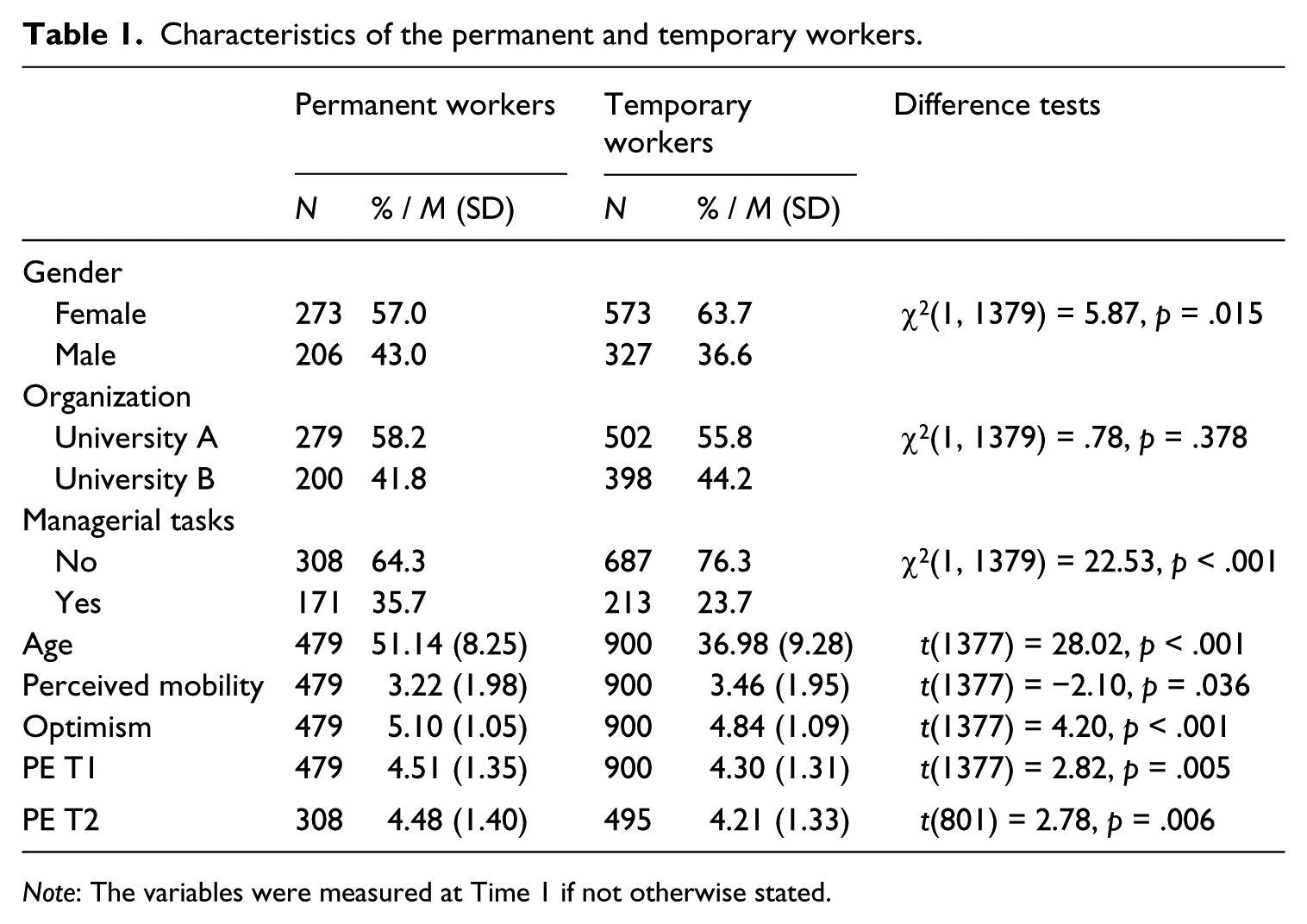
Note: The variables were measured at Time 1 if not otherwise stated.
The pattern of correlations (Table 2) is quite similar at Times 1 and 2. Only two of the significant correlations in the cross-sectional sample did not reach statistical significance in the longitudinal sample due to the smaller sample size. Optimism and perceived mobility were not related to each other but both correlated positively with PE at Time 1 and at Time 2. The correlation between PE at Time 1 and Time 2 was high.
Correlations between the study variables for Time 1 (N = 1379; above diagonal) and Time 2 (N = 803; below diagonal).
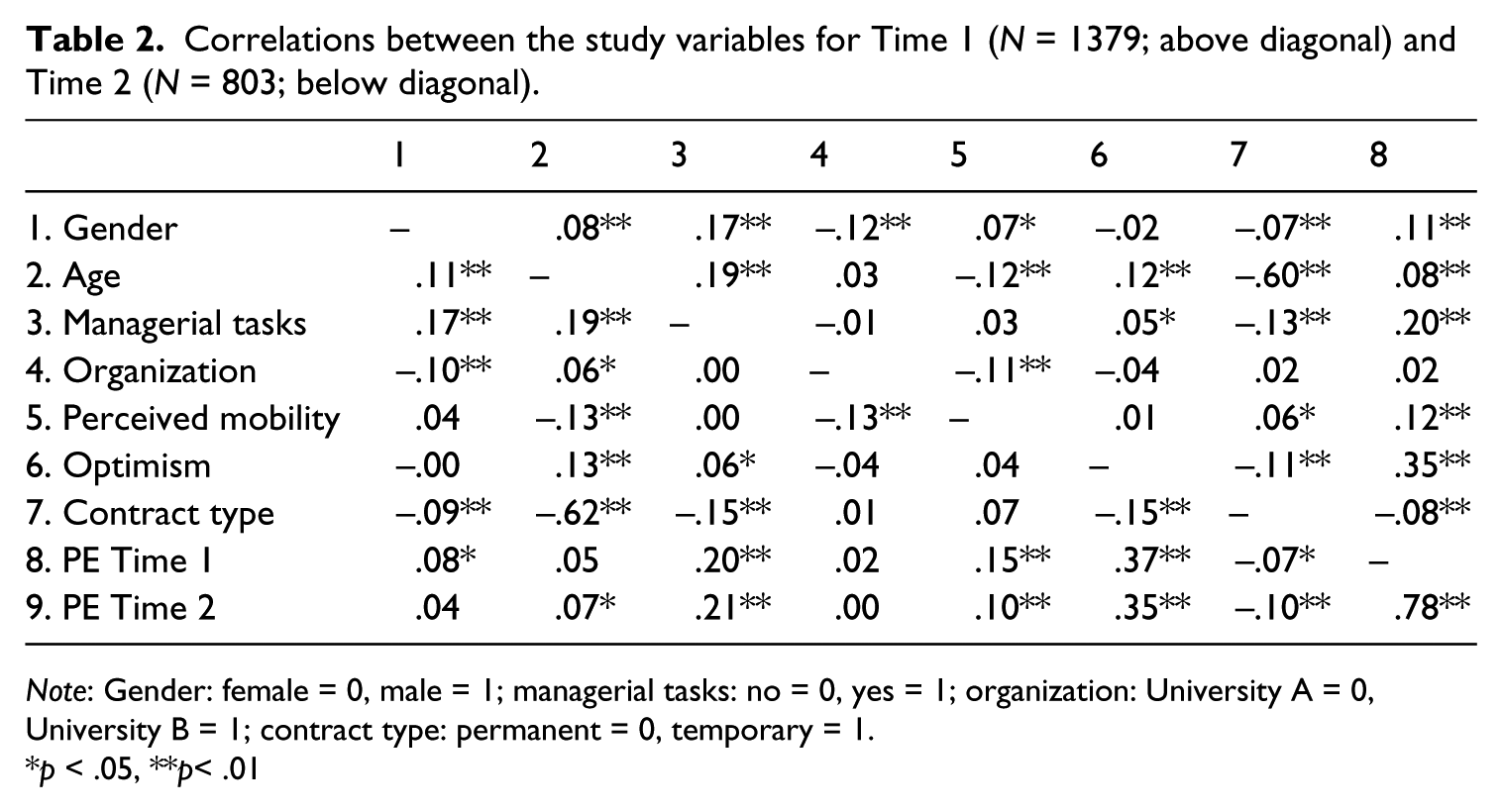
Note: Gender: female = 0, male = 1; managerial tasks: no = 0, yes = 1; organization: University A = 0, University B = 1; contract type: permanent = 0, temporary = 1.
p < .05, **p< .01
Test of hypotheses
The patterns of results for predicting PE at Time 1 and Time 2 are shown in Table 3 (cross-sectional sample results on the left side and longitudinal sample results on the right side).
Hierarchical moderated regression analysis for PE at Time 1 and Time 2.
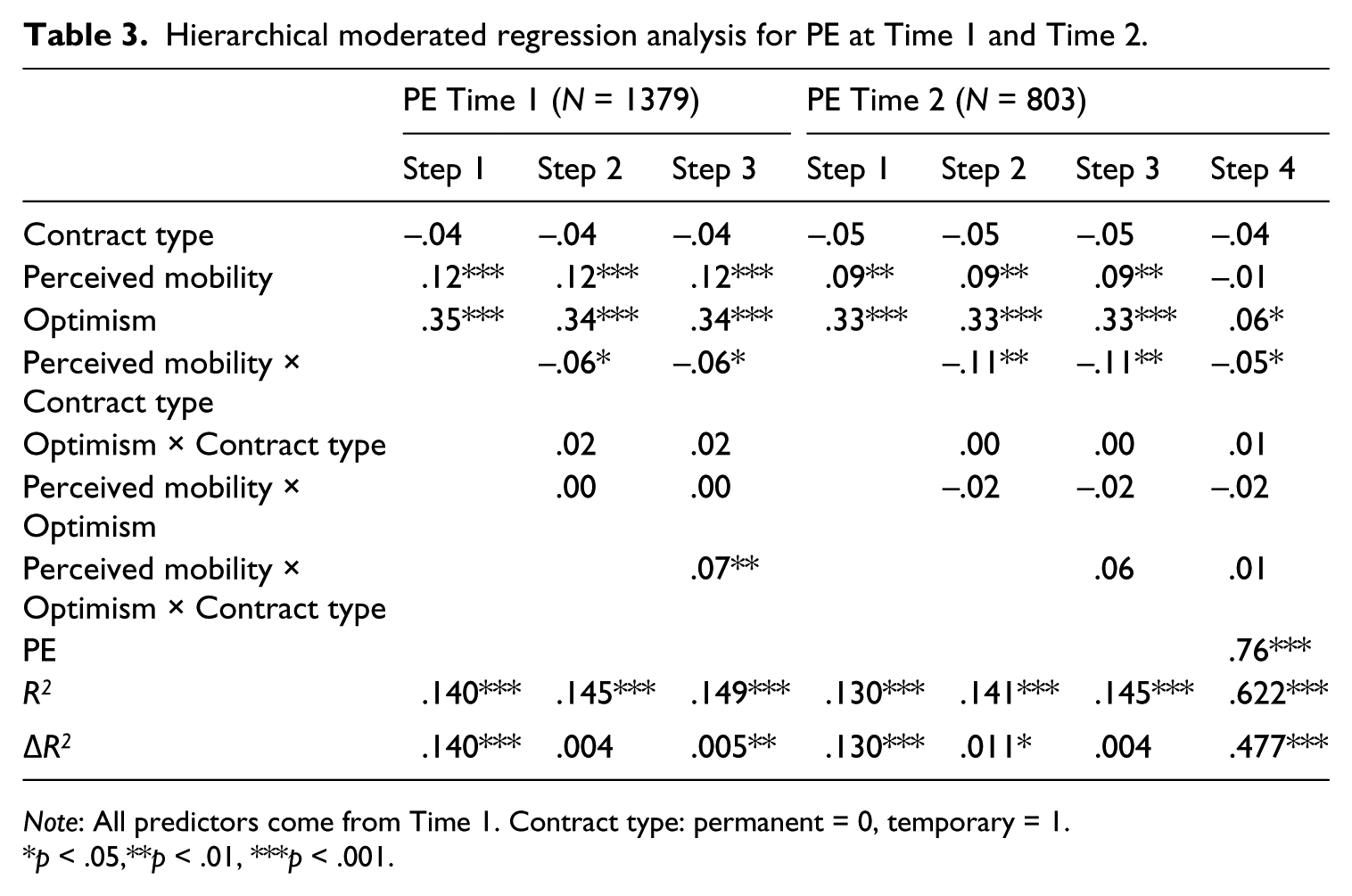
Note: All predictors come from Time 1. Contract type: permanent = 0, temporary = 1.
p < .05,**p < .01, ***p < .001.
Cross-sectional results
In step 1, contract type was not related to PE. Perceived mobility and optimism were positively associated with PE supporting hypotheses 1a and 2a respectively. Step 2 introduced the two-way interactions (hypotheses 3–5a). The interaction term Perceived mobility × Contract type was significantly related to PE. The simple slope analysis showed that the positive relationship between perceived mobility and PE was stronger among permanent (β = .23, p < .001) than among temporary (β = .08, p = .024) workers (Figure 1). Accordingly hypothesis 3a gained support, whereas hypotheses 4a and 5a did not.
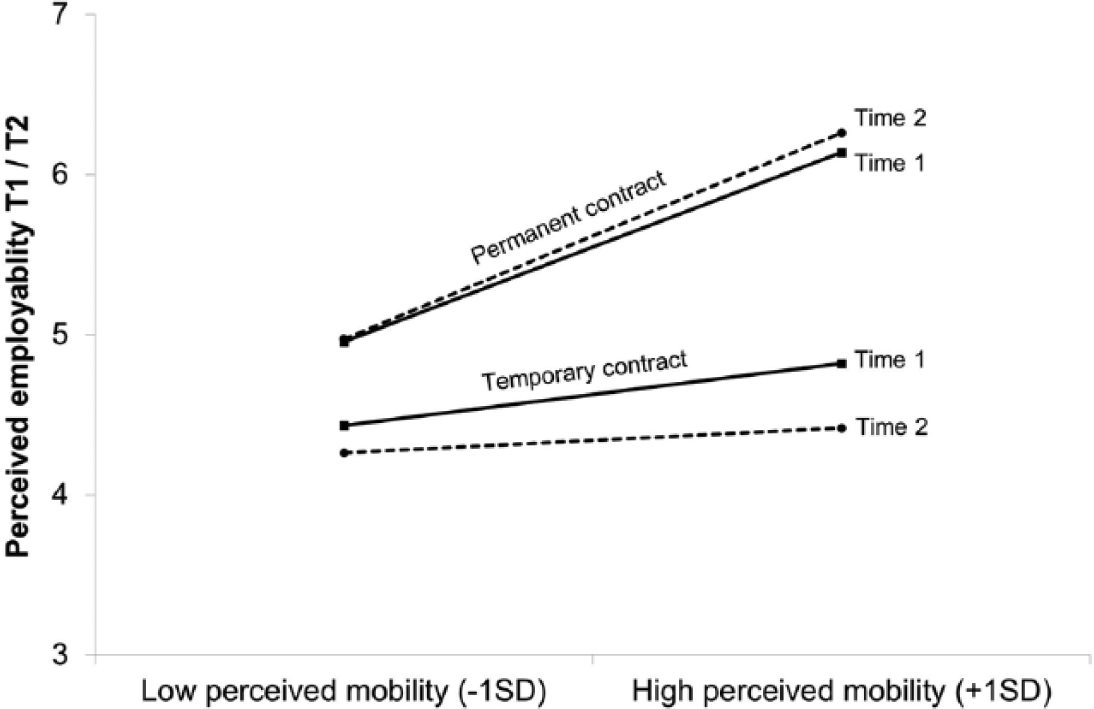
Interaction of perceived mobility and contract type at Time 1 (solid line) and at Time 2 (dotted line).
The three-way interaction term introduced in step 3 was also statistically significant. Permanent workers with low perceived opportunities to move to another place perceived their employability to be higher when they were optimistic (β = .39, p < .001). Instead, if moving opportunities were estimated to be high, optimism did not play as an important role (β = .20, p = .001; difference p = .031). Hence optimism seemed to be related to permanent workers’ PE especially in a low perceived mobility situation. In contrast, among temporary workers high optimism was positively related to PE when perceived mobility was low (β = .32, p < .001) and also when perceived mobility was high (β = .41, p < .001; difference p = .106). Hypothesis 6a was supported.
Longitudinal results
When explaining PE after a year, the pattern of results was somewhat similar to the pattern reported above. Contract type was not significantly associated with PE at Time 2. Hypothesis 1b was partially and 2b fully supported: perceived mobility and optimism were positively related to PE at Time 2. However, the relationship between perceived mobility and PE failed to retain its significance when PE at Time 1 was controlled for. Additionally, only the interaction Perceived mobility × Contract type was significantly related to PE in the longitudinal sample and showed the same pattern (Figure 1) as in the cross-sectional analysis. The positive relationship between perceived mobility and PE was found only among permanent (β = .24, p = .001) and not among temporary (β = .03, p = .507) workers. Thus hypothesis 3b was supported while 4b and 5b were not. Nevertheless, the longitudinal results did not replicate all the cross-sectional results: the three-way interaction Perceived mobility × Optimism × Contract type was not significantly related to PE (no support for hypothesis 6b).
Discussion
This study aimed to contribute to the employability literature by investigating three antecedents of PE. The same moderated hierarchical regression analysis model was tested both cross-sectionally and longitudinally with a one-year time lag. This allowed us to use first a larger sample with no attrition problems and then test if the findings also held a year later and with a smaller sample of the same respondents. As an overall conclusion, the results were mainly unchanged and highlighted the importance of different combinations of antecedents in predicting PE.
Of the three antecedents, contract type was not directly related to PE at Time 1 or at Time 2. While perceived mobility (H1) was positively associated with PE only at Time 1, optimism (H2) was positively related to PE at both times. However, perceived mobility was more strongly and positively associated with PE among permanent workers both in the cross-sectional and in the longitudinal sample as we expected (H3). In other words, perceiving oneself to be able to move to another place because of a new job is likely to be positively related to permanent workers’ PE. Permanent workers are likely to focus on permanent jobs and to exclude temporary jobs: accordingly, they need to have a larger geographical field for job search. If in such circumstances they evaluate their mobility to be high, their PE is also high. Our results also indicate that the positive effect of perceived mobility was seen to persist for over a year among permanent workers. Perceived mobility was not important for PE among temporary workers. Consequently it is crucial to enhance perceptions of mobility among permanent university workers to optimize their PE. Becoming aware of the importance of mobility could be a first step in that direction.
Third, optimism was positively and equally strongly associated with PE among permanent and temporary workers in both data sets and contrary to our assumptions. We expected (H4) that optimism would be needed to maintain PE especially among temporary workers. It is possible that the changes in the legislation in the Finnish universities, which occurred during the period of the study, have made permanent workers also insecure about their futures. The new Universities Act (558/2009) increased the autonomy of the universities, but simultaneously made the employment relation of the university personnel more insecure. They therefore seemed to need optimism as much as temporary workers to maintain their level of PE. Optimistic life orientation can be acquired and fostered through cognitive training techniques when learning to overcome self-defeating beliefs (Schulman, 1999).
Finally, the interaction effect between optimism and perceived mobility was not statistically significant in the total sample (H5), probably because further analyses revealed that this interaction was significant among permanent but not among temporary workers (H6). Among permanent workers, optimism was positively related to PE even more strongly under the condition of low perceived mobility: despite the low perceived opportunities to move to another city for a new job, optimistic workers had the same level of PE as workers with high perceived mobility. By contrast, among temporary workers optimism enhanced PE despite the level of perceived mobility. These results reflect the different significance of perceived mobility for permanent and temporary workers: permanent workers need to be more mobile in order to see equivalent employment opportunities while perceived mobility does not play a role among temporary workers even if their optimism is low. The three-way interaction effect was not seen in the longitudinal sample when explaining PE at Time 2, however. This may be due to the smaller sample size, as we know that interaction effects are more easily found in large samples (McClelland and Judd, 1993).
Limitations and suggestions for future research
Like all research, this study has some limitations. First, our study concentrated on university workers, namely researchers and teachers. Although this restriction was appropriate for the aims of the study, it also limits possible generalization of the results. University researchers and teachers are highly educated specialists and hence their employment opportunities are limited. This means that our results may be generalizable only to highly educated university workers and to specialists. Future research is needed to investigate other occupational groups, e.g. blue-collar workers.
Second, we also used a longitudinal sample in order to verify the results of the cross-sectional sample which cannot reveal causal effects. Nevertheless, the longitudinal sample raises the question of attrition of participants. Our analyses did reveal a systematic drop-out of temporary workers and University A workers from Time 1 to Time 2. The reason for the former is short fixed-term contracts which had expired before Time 2 data collection. The latter attrition is related to the problems with the updating of the email system at University A in autumn 2009. However, there was no systematic drop-out in relation to the core study variables; and we therefore believe that drop-outs did not affect our longitudinal results. A further concern with this two-wave data set relates to identification of participants and issues related to confidentiality: as is common with longitudinal data, we invited workers who participated at Time 1 to participate also at Time 2. However, we informed the respondents that identification would only be used for reasons of contact and for matching the questionnaires. We furthermore strictly followed a procedure where only one researcher had access to the data set including identification.
Third, we used self-reports in order to test our research questions. It is possible that the relationships found were inflated due to common method variance. However, we feel confident that the risk of inflated relationships does not account for the interaction results obtained in our study because it has been shown that common method variance is likely to attenuate rather than inflate the interaction effects (Evans, 1985) and the pattern of the results was similar in the longitudinal sample.
Fourth, the effects of the interactions were rather small. However, when interpreting moderator effects it should be noted that they are difficult to detect in non-experimental field studies because researchers are unable to control the study setting in the same way as in experimental studies (McClelland and Judd, 1993). Therefore the importance of the interaction effects cannot be judged solely by their effect size but the meaningfulness of the interaction should also be taken into account.
Conclusions
Our study demonstrated that the antecedents of PE were partly dependent on contract type. First, perceived mobility enhanced PE among permanent but not among temporary workers. Second, among permanent university workers high optimism enhanced PE under conditions of low perceived mobility while temporary workers benefited from strong optimism despite the level of perceived mobility. The results obtained in our study are particularly interesting from the employability literature perspective due to consideration of the interaction design and contract type. In addition, from the perspective of temporary employment literature, our study demonstrated that temporary vs permanent employment may be an important consideration in the debate. The interaction perspective on the antecedents of PE deserves more research in the future. Furthermore, the results are also relevant from the human resources management (HRM) perspective, in that they may help to target PE enhancement strategies more efficiently when the antecedents are known for the respective worker groups.
Footnotes
Declaration of conflicting interests
The author declares that there is no conflict of interest.
Funding
This work was supported by the Academy of Finland (grant number 124278); and the contribution by Nele De Cuyper was supported by a grant from Fonds Wetenschappelijk Onderzoek (grant number G.0987.12).