




Abstract
This article employs Labour Force Survey data, using logistic regression modelling, to help rectify the lack of systematic analyses specifically into socioeconomic correlates of migrant workers’ unionisation in Britain. The results provide evidence to assist the development of comprehensive explanations for the obstacles behind migrant workers’ unionisation. The impediments analysed can be considered within what one might call a triple-challenge model comprising of (1) encounter inputs: demographic factors brought into the host society and citizenry rights offered by the host society to migrant workers; (2) accentuated structural factors: workplace characteristics, flexible work and migrant workers’ disproportionate location in less unionised companies with flexible contracts; and (3) knock-on effects: educational and occupational influences along with the impacts of encounter inputs and accentuated structural factors on such influences.
Introduction
Employers tend to celebrate migrant workers’ self-discipline and commitment, but there are concerns that congratulatory rhetorics occasionally indicate managerial opportunism (MacKenzie and Forde, 2009; Meardi, 2012). Accordingly, union membership is considered crucial for the protection of migrant workers’ rights (Fitzgerald and Hardy, 2010; MacKenzie and Forde, 2009; Mustchin, 2012). Trade unions have also been long campaigning to organise migrant workers (Heyes, 2009; TUC, 2004). However, they overwhelmingly remain outside the unions, and the current economic downturn particularly exacerbates the situation. The proportion of non-unionised migrant workers in Britain increased, for example, from 78% in 2006 to 82% in 2010 – while the figure averaged around 73% for the rest of the workforce (LFS, 2006, 2010).
Over the last couple of decades, a substantial amount of academic work in both theoretical and empirical terms has been devoted to identifying the obstacles behind unionisation. The proponents of rational choice theories have, for example, argued that membership decisions were driven by its economic benefits (Ebbinghaus and Visser, 1999). Various discussants, on the other hand, contested that individuals’ attitudes are affected by a multitude of demographic and work-related factors, as discussed below. Even so, systematic and comprehensive analyses specifically about the challenges to the unionisation of migrant workers are limited in Britain, despite some calls for investigations (McGovern, 2007). The present article aims to help fill this gap.
To explore impedimentary factors on migrant workers’ unionisation, we suggest a triple-challenge model. What follows stipulates encounter inputs, accentuated structural factors and knock-on effects as the main components of our model. Encounter inputs are comprised of ‘brought-in factors’ and ‘the legal/citizenry rights on offer’, in addition to the years spent in the receiving society. Accentuated structural factors include various characteristics of work-settings (public/private sectors, establishment size, industries and flexible work) with a further reference to migrant workers’ disproportionate location in the work-settings which are less favourable for unionisation. Finally, knock-on effects conflate educational and occupational influences together with the impacts of encounter inputs and accentuated structural factors on such influences.
Encounter inputs
To start with, we first consider the two sets of potential challenges to the unionisation of migrant workers encompassed within the encounter inputs, ‘brought-in factors’ and ‘the citizenry status on offer’. The former covers demographic characteristics brought into the host society by migrant workers. Research has demonstrated that age, marital status and gender were among the key indicators for the demographic profiles of non-unionised British workers in general. In conjunction with the ‘free-rider’ approach, younger (Blanden and Machin, 2003) and single workers (Bryson and Gomez, 2005) were reported to have had little interest in unions. Historically, feminist accounts had also pointed to a mutual hesitation between unions and women as an explanatory factor for non-membership (Sayce et al., 2006). In recent years, however, the gender gap has been reversed (Brownlie, 2011). Over 80% of men in employment were non-unionised in 2010, compared to 72% of women (LFS, 2010).
Although there is no systematic research into the age, marital status or gender profiles of non-unionised migrant workers in the UK, a clear gender difference is evident. Approximately 78% of women migrant workers were non-unionised in 2010, compared to 85% of men (LFS, 2010). The gender gap has been marginally contributed to by the recession. In 2006, for example, these figures were 76% and 81%, respectively (LFS, 2006).
In resonance with the intersectional theories, the countries/regions of origin were mentioned as a challenge in terms of the unionisation of migrant workers. In Britain, for example, Fitzgerald and Hardy (2010) stressed the past socialist experiences of Polish migrant workers. The role of the time spent in host societies was also emphasised with regard to social and cultural integration with the mainstream populations. Bell and Jarman (2004) argued that it would take years for migrant workers to establish themselves within new social environments.
As for ‘the citizenry status on offer’, scholars emphasised that exaggerating the role of migrant workers’ demographic characteristics would obscure a fuller understanding of the challenges to their unionisation (McGovern, 2007; Milkman, 2007). It would also risk nurturing the ‘migrant mentality’ stereotypes (Pantoja and Gershon, 2006). From an institutionalist point of view, instead, particular importance was attached to what the host society offers to migrant workers in relation to legal and citizenry prerogatives or disadvantages (Figueroa, 1998; Milkman, 2007). An investigation into Mexican-born migrant workers in the US, for example, documented that criminalising many Latinos as ‘illegal aliens’ hampered their chances to become unionised (Milkman, 2007). Drawing attention to the British case, Anderson (2010) furthered that work permit regulations arbitrarily make the existence of non-EU migrants dependent on employers’ will. ‘The citizenry status on offer’, however, is yet to be related to unionisation in the UK.
Accentuated structural factors
Accentuated structural factors, first of all, include two structural issues: workplace characteristics and work contracts. Workplace characteristics regarding industrial variations (Bacon, 1999; Broughton, 2001), public/private sectors (Edwards, 2009; Prowse and Prowse, 2006) and establishment size (Sayce et al., 2006) were related to non-membership among the British workforce by and large. For example, low-pay industries such as hotels and restaurants were reported to have employed greater proportions of non-unionised workers (McKie et al., 2009). Likewise, small and medium-sized companies have been referred to for managerial reservations about trade unions (Fenn and Ashby, 2004). High levels of non-membership have also been observed in the private sector in general (Edwards, 2009). The impacts of workplace characteristics specifically on the employment of non-unionised migrant workers, however, remain unexplored – with the exception of Holgate’s (2005) investigation into managerial barriers that migrant workers face in London’s food industry.
The second structural issue, work contracts, was addressed by the flexible employment theories on part-time and temporary jobs because of their detrimental implications for unionisation (Heery and Simms, 2008; Pollert and Charlwood, 2009). In particular, the precarities debate flagged up flexible terms in agency and low pay work as part of precarious settings for non-unionised employees (Kalleberg, 2009; Pape, 2008). Even so, systematic research specifically into the relation of flexible jobs to non-unionised migrant workers is missing from the debate.
Structural factors can plausibly be expected to exhibit an accentuated appearance in the case of migrant workers. One reason for this is because encounter inputs may intensify the impact of structural factors. In other words, holding a non-EU citizenship, for example, may add to the likelihood of non-membership among migrant workers in flexible jobs or smaller companies (in view of the need for employers’ approval for work permits). However, structural factors may also be accentuated by a disproportionate location of migrant workers in the work-settings which are less favourable for unionisation (due to disadvantageous workplaces and contracts).
Knock-on effects
Occupational and educational levels, as two strong indicators of work status (Brown et al., 2004), have a considerable influence on unionisation. Certain occupations with higher positions are more likely to be unionised in general. Professional/IT occupations, for example, have long been cited for their high tendency towards unionisation (Snape and Bamber, 1989). However, managers and senior officials at the top of the occupational hierarchy show a limited propensity towards unionisation (Hodson, 2005). Likewise, lower-ranking occupations were associated with higher levels of non-membership. Research findings suggest that low skill jobs discourage workers from joining unions, especially by undermining the sense of job security (Pollert and Charlwood, 2009).
A few references have been made to the implications of lower occupational spectrums for non-unionised migrant workers in terms of managerial reservations (Fitzgerald and Hardy, 2010; Holgate, 2005; Wills, 2004). Even so, there is a lack of systematic research to develop a comprehensive understanding of the dynamics behind the non-membership incidence among migrant workers in these sorts of jobs. Nor do we know much about the impediments for the unionisation of those who hold high occupational positions. One possible reason for this is because migrant workers have been widely heralded as ‘the men of unwanted jobs’ (Castles and Miller, 1993).
Education displays a negative correlation with non-membership in general (Hundley, 1988). However, the impact of educational attainments specifically on non-unionised migrant workers has not been systematically investigated either. This may be again related to the fact that migrant workers have been uniformly assumed to possess lower educational qualifications (Castles and Miller, 1993).
Nonetheless, an homogeneous characterisation of migrant workers regarding educational and occupational levels should be treated with caution. An important reason for this is because we have no systematic evidence about the implications of some recent developments, inter alia, for the socioeconomic and demographic profiles of migrant workers. These include a marked rise in the proportions of well-educated EU migrants (Fitzgerald and Hardy, 2010) as well as the introduction of the ‘Highly Skilled Migrant Workers Scheme’ in 2003 and a points-based visa policy in 2007 in order to prioritise professional newcomers from non-EU countries (Anderson, 2010).
In particular, encounter inputs and accentuated structural factors arguably have knock-on effects on the impact of education and occupation on unionisation. For example, the positive role of higher occupational and educational levels in unionisation may be reduced in the case of migrant workers because of their previous experiences with trade unions in their home countries or their disproportionate location in temporary jobs.
Broadly speaking, we hope to unwrap impedimentary factors on migrant workers’ unionisation through the triple-challenge model. For this, we first examine the role of encounter inputs with ‘brought-in factors’ (origin, age and marital status) and ‘the citizenry status on offer’ as well as the time spent in the UK. Then, we will bring in accentuated structural factors predicated by variations in work-settings (workplace characteristics and flexible jobs) in addition to migrant workers’ disproportionate location in less favourable work-settings for unionisation. Lastly, we will include the knock-on effects to appraise educational and occupational influences along with their recalibration by encounter inputs and accentuated structural factors. We will develop both separate and joint models for men and women after a general review of their position in the British labour market combined with some comparisons to the rest of the workforce.
Methods
Data
Data are drawn from the UK Labour Force Survey (LFS), a large household-based study conducted by the Office for National Statistics (ONS). We used the data from the final quarter (between October and December) of 2010 since the question concerning trade union membership is asked only in the final quarter.
The LFS deploys a multi-stage sampling design to achieve a probability sample of households and individuals in Britain for the exploration of employees’ labour market status (ONS, 2010). The major data collection instruments were face-to-face and telephone interviews with a small amount of postal surveys. A total of 106,886 questionnaires were filled out.
The LFS typically achieves a response rate in the region of 85% due to the burden of questionnaire completion (ONS, 2010). However, previous studies have established that non-responders in surveys cannot be identified according to any sociodemographic factor, indicating that any biases introduced by non-response are not strongly related to commonly used explanatory variables (Chatzitheochari and Arber, 2009). We analysed 4866 male and 5733 female migrant workers in total.
Dependent variable
The dependent variable, non-unionised migrant workers, was produced by combining two separate questions about the country of origin (migrant workers) and union membership. The former excludes second generation ‘immigrants’ (Castles and Miller, 1993). However, our analyses are not limited to a certain arrival year in Britain, although various scholars use different cut-off points (Bell and Jarman, 2004). The reason for this is because we will explicitly control the impact of arrival years.
With regard to the question of trade union membership, two caveats should be borne in mind. First, because the question is asked only in the final quarter of each year, it is not possible to measure quarterly changes in responses. Second, the wording of this question refers to membership of both trade unions and staff associations, although interviewers actually aim to find out about trade union membership (Brook, 2002).
Independent variables
In broader terms, the models developed in this study control the relation of non-membership among migrant workers to the four categories hitherto highlighted: demographic profiles, workplace characteristics, flexible work and work-status nominators.
Among the demographic variables, ‘the region of origin’ is produced by collapsing the countries of origin into a widely used classification (Black and Skeldon, 2009): new members of the EU, Western Europe, other developed countries, Eastern Europe and ex-USSR, Latin and Central Americas, Afro-Caribbean, Middle East, Indian sub-continent and Southeast Asia.
The second demographic variable, age, is measured by recoding working age population (from 16 to 65 years old) into four groups in line with common practice (Blanden and Machin, 2003), whilst excluding those over 65 years old due to a smaller cell size than the threshold advised by the LFS, 25 before or 10,000 after grossing out (ONS, 2010: 42).
The third demographic variable, marital status, consists of never married singles, couples and the separated. The fourth demographic variable, the year of arrival, is recoded into six bands in order to control the impact of time spent in the UK as specifically as possible: 2010–2007, 2006–2004, 2003–2000, 1999–1990, 1989–1980 and before 1980. In particular, the year 2004 marks the beginning of arrivals from the new EU countries as well as coinciding with a five-year threshold to apply for indefinite leave. The fifth demographic variable splits migrant workers into two categories in terms of their citizenry status in Britain, citizens and non-citizens.
Workplace characteristics (as well as all other work-related correlates used in this article) refer to employees’ main jobs. The industry variable is based on the standard international classification of industries, SIC-2010, at two-digit level (i.e. Industry Sectors). Within ‘energy and construction’ is included mining and quarrying, and electricity, gas and water supply. Due to the small sample size, we excluded agriculture, fishing, forestry, information, communication, finance and real estate from the analyses whilst removing energy, construction, transport and storage from the models for women. The second variable within workplace characteristics is a dichotomous variable of respondents’ self-report as to whether they work in the public or private sector.
The third workplace characteristic, establishment size, refers to the number of co-workers reported by respondents, and it is collapsed into five bands in order to control the impact of establishment sizes as specifically as possible: below 20, 20–49, 50–249, 250–499 and 500 or more (Forth et al., 2006). In particular, this grouping enabled us to evaluate the implications of the absence of statutory union recognition for our smallest category (Edwards and Ram, 2006).
Flexible work variables are produced by breaking down respondents into part-time/full-time and temporary/permanent employment. The LFS specifies four different types of temporary jobs: agency work, fixed-term contract, casual hiring and seasonal recruitments in addition to ‘others’, but we collapsed the last three groups to reach a reliable sample size. Because part-time and temporary jobs are defined by the participants, there is no consistency across the sample.
Among work-status nominators, occupations are derived from the standard international classification of occupations, SOC-2010 at one-digit major level. Skilled trade occupations as well as process, plant and machinery operatives, however, are excluded from the analyses for women owing to small sample size.
We used education levels as an indicator of work-status in order to shed more light on the implications of migrant workers’ positions at work for non-membership. Even so, because education is part of demographic characteristics, we first ran the statistical analyses taking it within the demographic factors specified above. However, the results were not significantly different from the ones presented in this article. The education variable is based on the highest qualification obtained, with five main categories from ‘no qualification’ to ‘degree or equivalent’.
Analytical technique
The analysis uses logistic regression, which is widely employed when modelling binary outcomes and for predicting the probability of an event. The dependent dichotomous variable is whether or not the respondent is a trade union member. The binary response is yes/no. The logistic models predict the probability of being a non-member.
Separate and joint logistic regression models are stipulated for male and female migrant workers in order to examine the differential effects of demographic and work-related circumstances on their unionisation. In logistic models, independent variables are successively added to the model in sequential blocks, which allows the observation of changes in the predictors’ relationship to the outcome variable and assessment of the relative importance of each predictor in the model. These blocks are made up of the four broader categories of independent variables: demographic profiles (region of origin, age, marital status, the year of arrival and citizenship); workplace characteristics (establishment size, public/private sector and industry); flexible work (part-time/full-time and temporary/permanent jobs); and finally work-status variables (educational attainment and occupation).
Neither the order of variables within the blocks nor that of blocks within the models makes substantial difference to the results in general. However, using demographic variables for Model 1 and then adding workplace characteristics in Model 2 proved better than other combinations for the goodness of fit.
Results
Descriptives
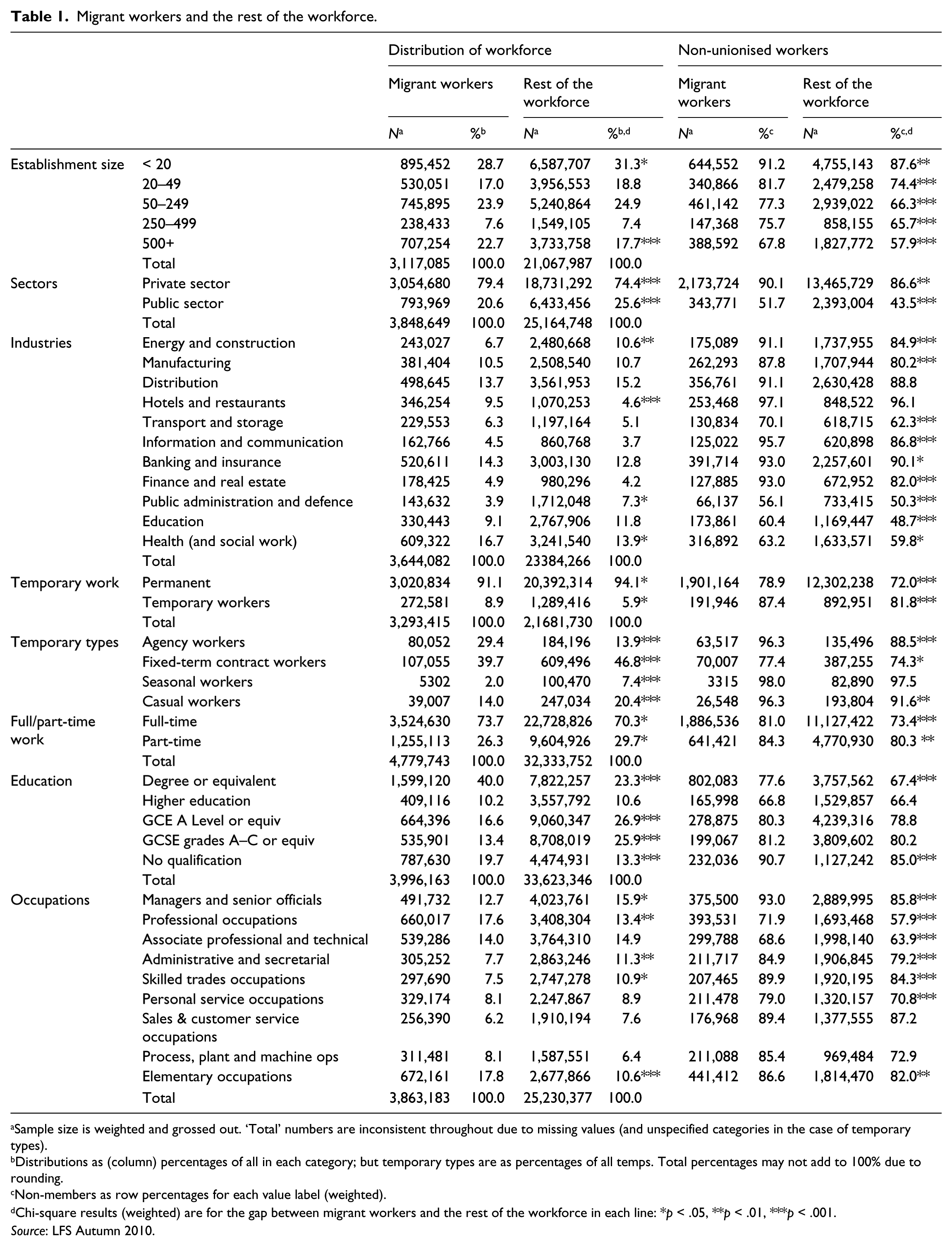
Mapping out the locations of migrant workers, along with comparisons to the rest of the workforce, Table 1 demonstrates that a substantial proportion of them (29%) work in small establishments (with fewer than 20 employees), but they are more likely to work (23%) in larger establishments (with 500 or more employees) than the rest of the workforce, 18%.
Migrant workers and the rest of the workforce.
Sample size is weighted and grossed out. ‘Total’ numbers are inconsistent throughout due to missing values (and unspecified categories in the case of temporary types).
Distributions as (column) percentages of all in each category; but temporary types are as percentages of all temps. Total percentages may not add to 100% due to rounding.
Non-members as row percentages for each value label (weighted).
Chi-square results (weighted) are for the gap between migrant workers and the rest of the workforce in each line: *p < .05, **p < .01, ***p < .001.
Source: LFS Autumn 2010.
Migrant workers are mainly employed in the private sector (80%), compared to 75% of the rest of the workforce. Even so, they are scattered across the industries, with a more visible presence in health (17%), banking and insurance (14%) and distribution (14%), whilst differing from the rest mostly in hotels and restaurants, 10% and 5%, respectively. One in 10 migrant workers and 6% of others are hired temporarily. Agency employment in the former group (30%) is twice as high as it is in the latter. Over a quarter of migrant workers are in part-time jobs (26%), compared to 30% of the rest of the workforce.
Many migrant workers (40%) hold a degree, although the figure is 23% among the rest. Nevertheless, 20% of them have no qualification, compared to 13% of others. A similar norm repeats itself in occupations since professional jobs account for 18% of migrant workers and 13% of the rest of the workforce, as do the elementary occupations.
Across the benchmarks used in the table, migrant workers tend to be more non-unionised than the rest. The largest gaps between the two groups occur in establishments with 250–499 employees (75% and 65%, respectively); information and communication industries (96% and 86%, respectively); and personal service occupations (79% and 70%, respectively). Differences are insignificant only for a few exceptions, such as hotels, restaurants, sales and customer services.
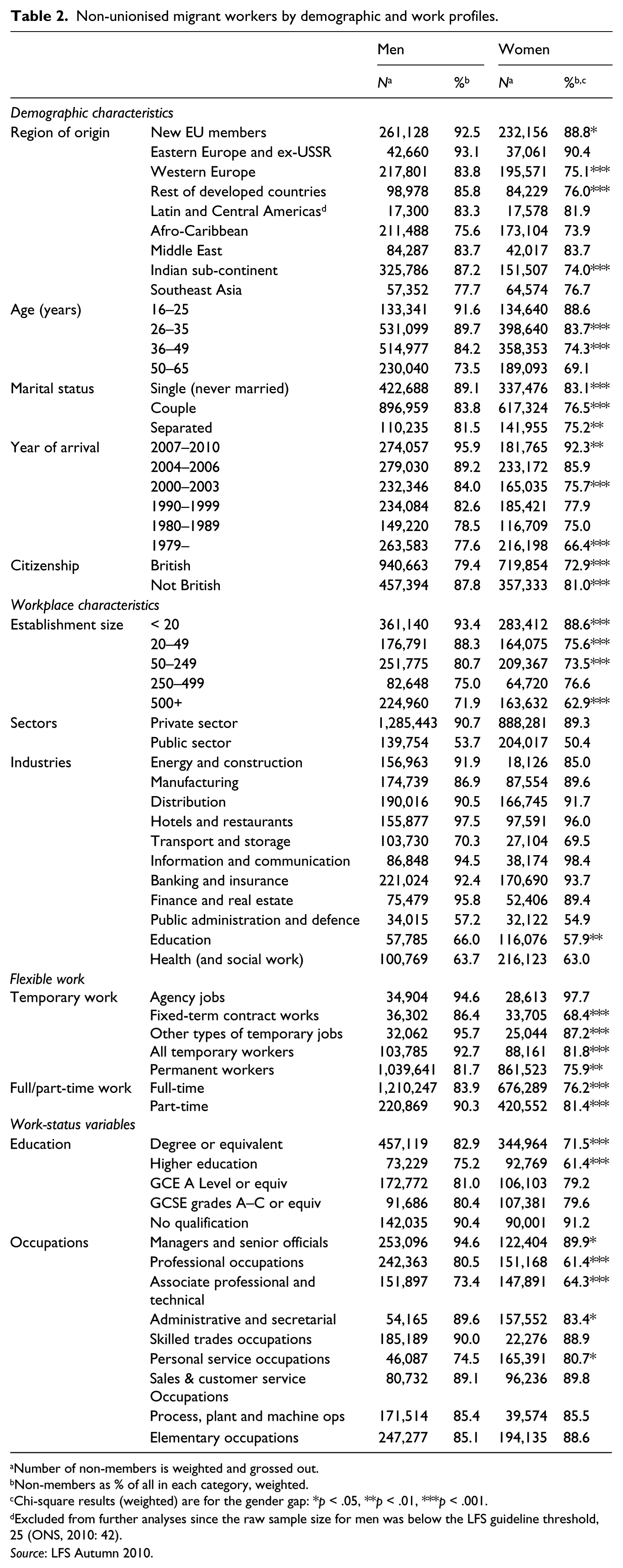
A specific review of non-unionised migrant workers is provided in Table 2 along with demographic variations as well as workplace characteristics, flexible work and work-status indicators. Female migrant workers from Western Europe and other developed countries are less likely to become non-unionised compared to men (circa 75% and 85% on average, respectively). A similar situation is also the case among those originating from the Indian sub-continent.
Non-unionised migrant workers by demographic and work profiles.
Number of non-members is weighted and grossed out.
Non-members as % of all in each category, weighted.
Chi-square results (weighted) are for the gender gap: *p < .05, **p < .01, ***p < .001.
Excluded from further analyses since the raw sample size for men was below the LFS guideline threshold, 25 (ONS, 2010: 42).
Source: LFS Autumn 2010.
Although age is inversely related to non-membership in general, gender differences emerge in the middle age categories specified in Table 2. More than 83% of the women aged from 26 to 35 years old, for example, are non-unionised, but the proportion is nearly 90% for their male counterparts. The gender gap diminishes at later ages as the figures among those aged from 50 to 65 years old drop to 69% and 73%, respectively.
Marital status of respondents hardly alters the gender gap whilst affecting the levels of non-membership. Among (never married) single migrant workers, roughly 90% of men and 83% of women are non-unionised, compared to the proportions of 84% of men and 75% of women who have separated.
Recently arrived migrant workers in the UK do not present a strong gender difference since they are less likely to become unionised in general: Table 2 shows that more than 95% of the most recently arrived men, between 2007 and 2010, are non-unionised, compared to 92% of women. However, the gender difference becomes clearer with the length of time spent in Britain: around 75% of the women who came to Britain in the first three years of the new millennium, for instance, are non-unionised compared to 84% of the men in the same situation.
Because both male and female migrant workers who are British citizens have a relatively higher propensity towards unionisation, gender differences do not seem to be much affected by citizenship: among citizen migrant workers, fewer than 80% of men and 73% of women are non-unionised, compared to 88% of non-citizen men and 80% of women.
As for workplace characteristics, smaller establishments reveal higher proportions of non-unionised migrant workers. However, this is particularly evident among male respondents: 93% of them, for example, are non-unionised in the establishments with fewer than 20 employees, compared to 88% for women. The gender disparity becomes more conspicuous in large establishments (with 500 or more employees), notwithstanding a fall in both male and female non-membership to 72% and 62%, respectively.
There is no significant gender gap either in the private or public sector, although the proportions of non-unionised male and female workers equally drop from nine in ten in the private sector to one in two in the public sector. Likewise, there is little variation between men and women in specific industries, despite some fluctuations in overall union density from one industry to another. The gender gap is most salient in education, as the proportion of non-unionised female migrant workers turns out to be at a very low level, below 58%, compared to 66% for men.
The type of temporary work denotes gender differences. Almost 98% of female agency workers are non-unionised, compared to 95% of men, whereas the remainder of temporary jobs sustains a clear gender gap as the figures go down, for example, to 68% and 86% in fixed-term contract jobs, respectively. In permanent jobs, the gender imbalance is slightly less pronounced with 76% of women and 82% of men. Higher proportions of non-unionised male (90%) and female (81%) migrant workers in part-time jobs, on the other hand, decrease relatively evenly in full-time jobs –down to 84% and 76%, respectively.
Finally, we can have a look at the gender gap by work-status variables, educational attainment and occupational categories. Around 72% of female migrant workers with a university degree are non-unionised, but the proportion for men is almost 83%. The gap tends to disappear at lower educational attainments because of a rise in the proportion of non-unionised migrant workers in general – to an overall average of 90%, for example, among those without any qualification.
A similar pattern applies to occupational ranks as well: circa 62% of female migrant workers in professional occupations, for instance, are non-unionised whereas the proportion is above 80% for men. The gender discrepancy becomes less noticeable in lower occupational categories as non-membership increases to 88% among female migrant workers in elementary jobs, compared to 85% for their male counterparts.
Overall, with a varying degree of influence, male migrant workers present a significantly higher disposition towards non-membership compared to women across almost all demographic and work-related benchmarks used in Table 2.
Logistic regression models
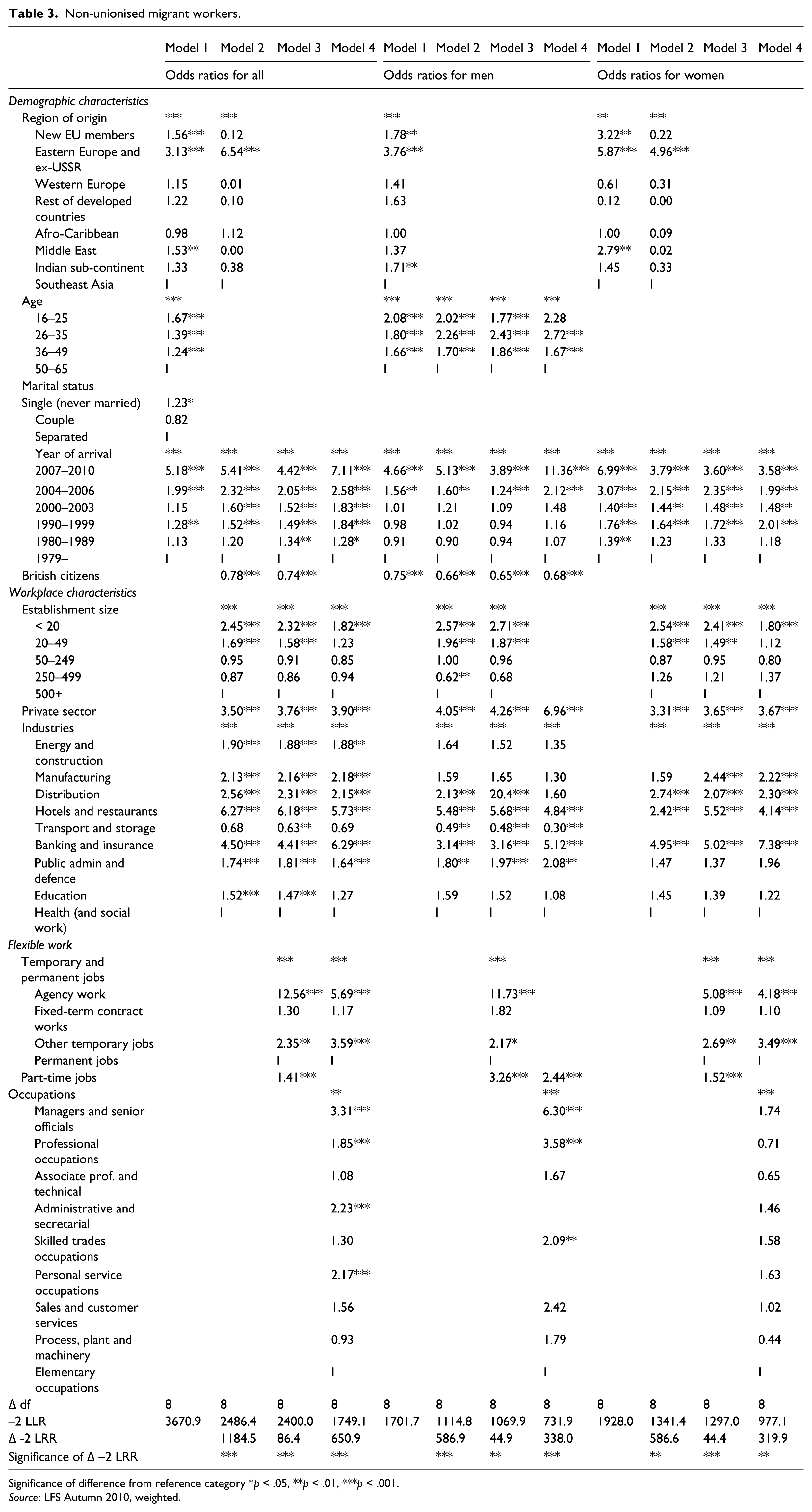
Both separate and joint logistic regression models to examine the differential effects of demographic and work-related circumstances on male and female migrant workers’ non-membership are provided in Table 3. For each predictor variable, the last category in the bivariate analyses is defined as the reference category (I).
Non-unionised migrant workers.
Significance of difference from reference category *p < .05, **p < .01, ***p < .001.
Source: LFS Autumn 2010, weighted.
Model 1 includes demographic profiles in terms of the region of origin, age, marital status, the year of arrival and citizenship. Region of origin has a significant effect on migrant workers’ non-membership (p < .001). Women migrant workers from the Middle East (OR = 1.53, p < .01) show a higher inclination towards non-membership, compared to those from Southeast Asia – the reference category (Table 3). However, migrant workers from the new EU countries as well as Eastern Europe and ex-USSR are more likely to be non-unionised.
Age is also an important factor in migrant workers’ non-membership (p < .001), although this is essentially because of a negative correlation between age and non-membership among men, rather than women. Marital status further influences the unionisation of migrant workers, but this occurs in a limited way since only never-married singles display a relatively high non-membership (OR = 1.23, p < .05).
The year of arrival in Britain is a strong predictor of non-membership as the recent arrivals are more likely to be non-unionised (p < .001). Non-membership among those who came between 2007 and 2010 (OR = 5.18, p < .001), for example, is more than five times higher compared to those who had arrived before 1980. The impact of the time spent in Britain, however, disappears among the male migrant workers who arrived before 2004, although such an effect lasts longer among their female counterparts. Women’s unionisation does not seem to be affected by their citizenry status either, whereas men are less likely to remain non-unionised after acquiring British citizenship (OR = 0.75, p < .001).
Bringing in three aspects of workplace characteristics, establishment size, public/private sectors and industry, Model 2 illustrates that such characteristics have significant effects on migrant workers’ unionisation. To start with, establishment size strongly predicts the likelihood of non-membership regardless of gender (p < .001). In the establishments with fewer than 20 employees, for example, the likelihood of female (OR = 2.54, p < .001) and male (OR = 2.57, p < .001) migrant workers’ non-membership is two and a half times higher, compared to large establishments (with 500 or more employees). Besides, the gap between public and private sector companies is more than three times for women (OR = 3.31, p < .001) and four times for men (OR = 4.05, p < .001).
Industries have marked implications for migrant workers’ unionisation (p < .001) as well. In banking and insurance, for example, the likelihood of migrant workers’ non-membership is more than four times higher compared to health (OR = 4.50, p < .001). Education (OR = 1.74, p < .001), public administration and defence (OR = 1.76, p < .001) also predict significantly higher likelihoods of non-membership. Industrial variations have a gendered effect. The impact of public administration and defence, for example, largely echoes a higher level of non-membership among male, rather than female, migrant workers. This helps explain the gender gap in terms of unionisation in general.
The significant role of country/region for men as a whole and that of coming from the Middle Eastern and new EU countries for women in addition to the overall impact of being single and younger disappear in Model 2. In other words, their apparent contribution to non-membership largely reflects workplace characteristics (such as private, smaller and low-pay establishments). Nevertheless, the model boosted the significance of arrival years (see the change in log-likelihood ratio in Table 3).
Model 3 gauges the relation of flexible works to the unionisation of migrant workers. Compared to permanent jobs, agency work predicts much higher levels of non-membership among both male (OR = 11.73, p < .001) and female (OR = 5.08, p < .001) migrant workers. Similarly, part-time jobs increase the likelihood of non-membership for men (OR = 3.26, p < .001) and women (OR = 1.52, p < .001). In particular, whilst curtailing the significance of arrival years, the inclusion of flexible jobs in Model 3 eradicated that of larger establishments among men and the country/region of origin among women.
Model 4 aimed to examine how the constraints stemming from work-status indicators, educational attainments and occupations, impinge upon the likelihood of migrant workers to become unionised. Putting all independent variables into the analysis, the model illustrates that occupations are highly explanatory factors (p < .001).
The model suggests that when migrant workers gain access to high-rank occupations, the likelihood of non-membership becomes greater. Migrant workers in managerial and senior positions, for example, are three and a half times more likely to be non-unionised compared to those in elementary occupations (OR = 3.31, p < .001). To a lesser extent, the same can also be said of different occupations, including professional jobs (OR = 1.85, p < .001).
However, the inverse correlation between occupational levels and unionisation largely reflects the results for men, since the model only demonstrates a limited impact on women. Therefore, occupational variations between male and female migrant workers’ non-membership emerge as another component of the gender gap.
Model 4 failed to detect a significant educational influence for either men or women. For that reason, the education variable was removed from Table 3. Finally, the inclusion of occupations in Model 4 negated the significant impact of younger ages and smaller establishments on men as well as that of part-time jobs on women.
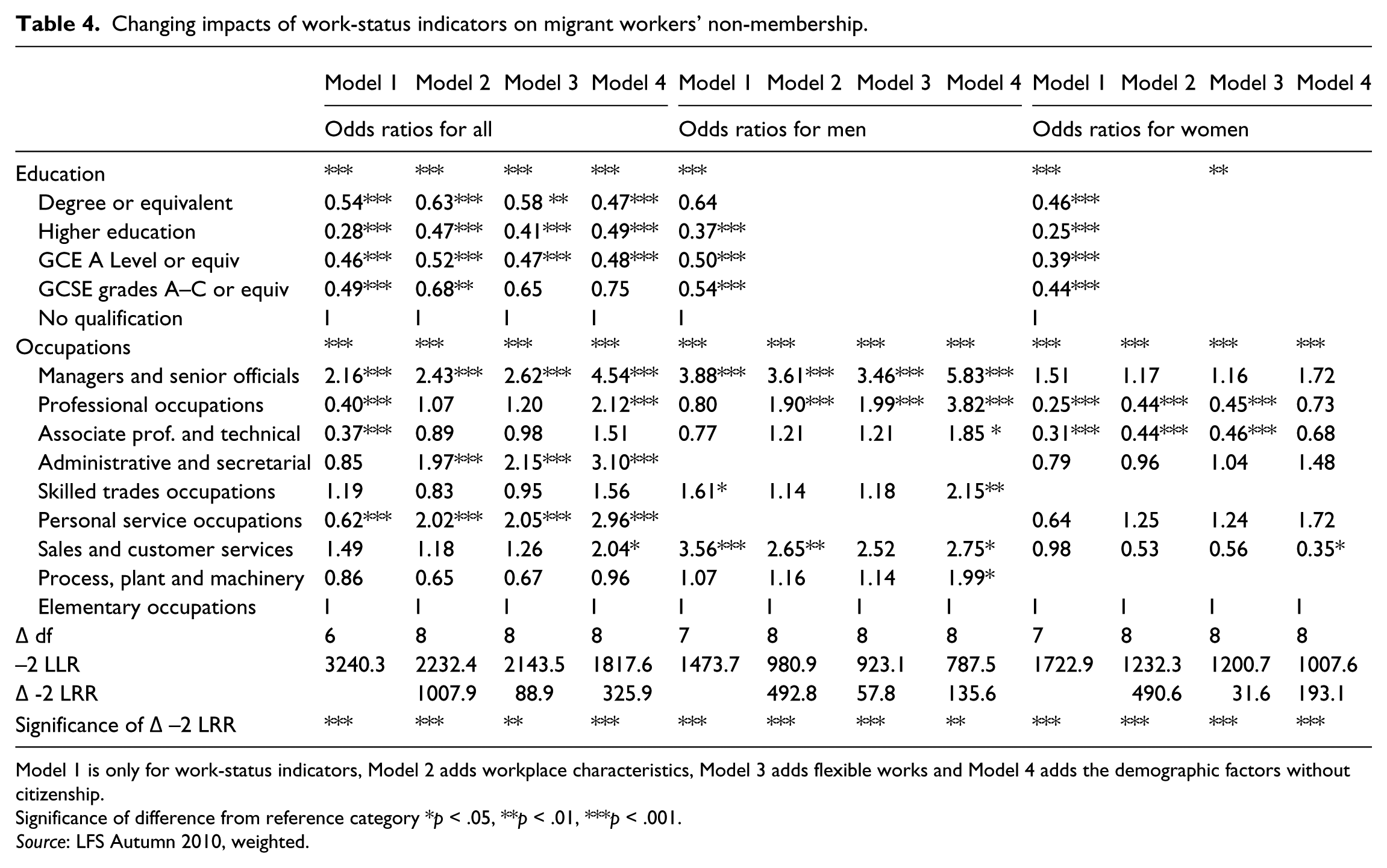
Thus, each new model added into the analyses in Table 3 changed the results significantly. Considering this, miscellaneous combinations were tried, as noted earlier, in order to see whether or not the outcomes would differ. Although the results barely changed, one exception emerged after swapping the work-status and demographic variables (Table 4). The likelihood of non-membership in professional (OR = 0.40, p < .001), associate professional/technical (OR = 0.37, p < .001) and personal service occupations (OR = 0.62, p < .001) turned out to be reversed (i.e. it became smaller compared to elementary occupations). Even so, the likelihood went back to the opposite state in the second model. That is to say, it is the workplace characteristics which determine whether higher occupations would have positive or negative implications for membership.
Changing impacts of work-status indicators on migrant workers’ non-membership.
Model 1 is only for work-status indicators, Model 2 adds workplace characteristics, Model 3 adds flexible works and Model 4 adds the demographic factors without citizenship.
Significance of difference from reference category *p < .05, **p < .01, ***p < .001.
Source: LFS Autumn 2010, weighted.
After swapping the demographic and work-status variables, education has also proved to enhance membership (and further reshufflings revealed that such an impact persists unless the citizenship variable is appended to the last model).
Conclusions
To rectify the lack of systematic research in Britain, we explored socioeconomic challenges to the unionisation of migrant workers. An important finding is related to the gender gap since migrant women are less likely to be non-unionised than men. This is consistent with the reversal of women’s historically lower membership in recent years (Brownlie, 2011; Sayce et al., 2006). Even so, both male and female migrant workers’ non-membership is significantly affected by the range of correlates analysed. Accordingly, the findings reported in the present article provide evidence to help explain non-membership in general.
From a theoretical point of view, the results support the triple-challenge model comprising of encounter inputs, accentuated structural factors and knock-on effects. In terms of encounter inputs, the evidence confirms that ‘brought-in factors’ to the host society inform non-membership among migrant workers in line with the research findings on the relation of overall unionisation to, for example, age (Blanden and Machin, 2003) and marital status (Bryson and Gomez, 2005). Region of origin can also be added to these factors, especially for women (Castles and Miller, 1993; Fitzgerald and Hardy, 2010). In particular, migration from the former socialist countries is among the significant predictors of low unionisation regardless of EU membership.
However, the strength of demographic characteristics weakens over time (Milkman, 2007) as the evidence introduced in this study points to the importance of time spent in Britain (Bell and Jarman, 2004). Moreover, the influence of demographic characteristics as well as the time spent in Britain should be put against ‘the citizenry status on offer’ for migrant workers as the acquisition of citizenry rights enhances union membership. Dependency on employers’ will for the work permit visa, on the other hand, appears to discourage non-EU migrants from joining unions (Anderson, 2010). Consequently, taking ‘brought-in factors’ together with ‘the citizenry status on offer’ under the broader frame of encounter inputs would help fend off reductionist attempts to explain the low level of unionisation among migrant workers with the ‘migrant mentality’ stereotypes (Pantoja and Gershon, 2006). Even so, our further analyses also ascertained that demographic influences mostly reflect the structural challenges of workplaces and contracts.
The power of structural challenges is all-pervading. As in the case of overall unionisation (Fenn and Ashby, 2004; Sayce et al., 2006) migrant workers’ unionisation is rather limited in smaller establishments. This is essentially because the government refuses statutory recognition of trade unions in establishments with fewer than 20 employees, citing financial constraints on such businesses owing to their spatial dependency on local trade (Edwards and Ram, 2006). Low union density is also a common feature in private (Edwards, 2009; Prowse and Prowse, 2006) and low-pay companies in general (Bacon, 1999; Broughton, 2001; McKie et al., 2009). Nor are migrant workers an exception when it comes to detrimental impacts of part-time and temporary contracts on unionisation as particularly demonstrated by agency employment. An important reason why temporary (Cam et al., 2003) and part-time jobs (Green, 1991; Millar et al., 2006) are less conducive to unionisation is because they predicate a limited protection against unfair dismissals due to, for example, long qualification periods to make claims and low compensation rates (O’Grady, 2013).
However, the present study has also unveiled that structural challenges have an accentuated impact on migrant workers. Their unionisation is distinctively moderate compared to the rest of the workforce across various establishment sizes, public/private sectors and industries. This can be associated with the encounter inputs as the (lack of) ‘citizenry status on offer’, for example, impedes unionisation after the insertion of structural factors into logistic analyses. Nevertheless, to understand the accentuated effect of structural factors on the aggregated union density, another factor should also be taken on board. Migrant workers are disproportionately located in unfavourable work settings for unionisation such as private sector, temporary jobs and low-pay industries including hotels and restaurants. To exemplify the composite effect of such disparities, it would be useful to note that 73% of migrant workers are employed by the companies where there are no unions, compared to 65% of the rest of the workforce (LFS, 2010). In theoretical terms, the findings on accentuated structural factors in general, as well as the ones on encounter inputs, further challenge the parochialism of rational choice approaches to the issue of unionisation in the specific case of migrant workers (Ebbinghaus and Visser, 1999).
Finally, our analyses regarding the knock-on effects highlighted that work-status indicators, educational and occupational levels, positively correlate with unionisation among both male and female migrant workers, with the exception of top managers and senior officials. Such results reinforce previous research findings on the implications of education (Hundley, 1988) and occupations (Hodson, 2005; Snape and Bamber, 1989) for unionisation in general.
However, the evidence conveyed in this article also suggests that the effects of work-status indicators on the unionisation of migrant workers are lessened, eradicated or even reversed by encounter inputs and accentuated structural factors. Positive impacts of higher occupations, for example, are reversed by less favourable workplaces for unionisation such as private and low-pay companies. Benign effects of education on unionisation are also undermined by additional hindrances: once the pressure of flexible contracts is appended to logistic models, the positive impact of GCSE grades A–C (or equivalent) is negated. Likewise, when these impediments are topped up by the absence of citizenry rights among the recently arrived migrant workers from non-EU countries, for example, the higher likelihood of unionisation for the better educated vanishes in general.
Broadly speaking, the triple-challenge model along with its three components, encounter inputs, accentuated structural factors and knock-on effects offers a well-fitting frame for the examined obstacles to migrant workers’ unionisation. Even so, our analyses attributed a greater role to accentuated structural challenges and the absence of citizenry rights, compared to demographic components of the encounter inputs. It is also important to underline that the triple-challenge model turns out to be a general pattern, rather than a cyclical effect. When we run the same analysis with the LFS data from 2006, for example, the model remained intact by and large (LFS, 2006L).
Since the beginning of the current economic downturn, there has been an increase in the proportion of non-unionised migrant workers, especially in the private service sector companies characterised by low pay and low unionisation. In addition, recent government initiatives to toughen visa controls are likely to heighten the proportions of non-unionised workers among non-EU citizens by giving greater discretion to individual employers on work permits (Anderson, 2010). If migrant workers are to be deployed sustainably in combating the macro-economic hardships, then it would prove useful to devise more flexible visa policies for such migrants. So would encouraging managers to cooperate with trade unions in general (Butler, 2009). Union renewal efforts, on the other hand, should further engage with wider debates on alternative organising strategies such as activist-led, rather than overly bureaucratised, campaigns (Simms and Holgate, 2010).
The relation of the triple-challenge model to flexible jobs and lower work status in general renders it a useful frame for the students of precarious employment both empirically and conceptually (Kalleberg, 2009; Pape, 2008). There is also a need for specific analyses to examine the relationship between migrant workers’ unionisation and some potentially important issues which are not included in this study such as job satisfaction, the selection of union representatives (Charlwood, 2004) and the tensions within union memberships over the allocation of resources (Mustchin, 2012). Further, it would be useful to conduct qualitative research for an in-depth understanding of the ways in which variations in unionisation are informed by, for instance, limited commitment to organising from the union leadership (Heery and Simms, 2008; Meardi, 2012).
Footnotes
Funding
This research received no specific grant from any funding agency in the public, commercial, or not-for-profit sectors.