




Abstract
This study combines two recognized theoretical frameworks in the (un)employment literature – the latent deprivation model and the vitamin model – and aims to better understand the relations between the perceived quality of the psychosocial environment and psychological well-being in older adults. The sample comprised 300 Portuguese adults (aged between 40 and 65), grouped as employed, unemployed engaged in training and unemployed not in training. The employed reported better well-being than the other groups, and the unemployed in training showed lower distress than those who were not. Additionally, features from both frameworks were found to be related to well-being. These findings highlight the merit of taking both theories into account to better understand the well-being of older individuals, and may be useful for the design of interventions aiming to enhance well-being and overcome some of the negative aspects of unemployment.
Introduction
In the present turbulent times, many countries are experiencing unprecedented financial and economic crises that have increased the unemployment rates to levels hardly seen before and will have unpredictable long-term effects on the labour market. Research has consistently shown that unemployment is negatively related to psychological well-being (for recent meta-analyses, see McKee-Ryan et al., 2005; Paul and Moser, 2009). An overall effect size of d = .51 on mental health was found for unemployment in Paul and Moser’s analyses, with unemployed people reporting higher levels of psychological distress than the employed. Furthermore, obtaining employment has been associated with a significant reduction in psychological distress in several longitudinal studies. For example, Krueger and Mueller (2011) found that whilst unemployment was related to psychological distress, gaining a job was associated with an improvement in several well-being indicators even when controlling for other factors.
Among the theoretical frameworks that have been proposed to explain the negative impact of unemployment, two situation-centred models have often been referred to in the literature: the latent deprivation model (Jahoda, 1979, 1981, 1982), and the vitamin model (Warr, 1987, 2007). However, as noted by Paul et al. (2009), although these approaches have been widely used in unemployment research (in particular Jahoda’s model), no study appears to have simultaneously considered both of them.
When jobs are scarce, older workers may be more likely to face employment challenges. However, they have rarely been the focus of unemployment research (Paul and Moser, 2009). In recent years, this group has become more vulnerable to job loss during organizational restructuring (Centeno [2000] refers to a ‘first in–first out’ criterion) and, once unemployed, they typically experience serious barriers to re-employment (Pestana, 2003), often remaining in unemployment longer than their younger counterparts. Pestana (2003) found that 20% of the companies surveyed in his study identified 40 years to be the age from which a person may be considered ‘old’ in a recruitment process. Data from Eurostat relative to 2011 1 show that among the European Union countries, the long-term unemployment (12 months or more), as a percentage of the total unemployment, rises from about 37% for the 15–39 age group to about 52% and 55% for the 40–64 and 50–64 age groups, respectively. It seems, then, that as early as at the age of 40, chronological age is an increasing obstacle that may threaten the continuity of an individual in the workforce. It should also be noted that the official figures regarding older unemployed individuals, according to Centeno (2000), may be underestimated by about 20%, since a large number of individuals become discouraged and stop actively looking for employment, which results in their unemployed status not entering the statistics.
This complicated relation between older workers and the labour market seems to be mainly related to age discrimination and to their qualifications in many cases being unsuitable for the current labour market demands (Pestana, 2003). Because of this, vocational training programmes seem to be of great importance for older workers, by improving their employability, through the development or update of educational and vocational skills. Furthermore, several studies have suggested that participating in training can have positive consequences for the well-being of unemployed individuals (e.g. Creed et al., 1999; Vinokur et al., 1991). Although a few studies have investigated the psychosocial effects of engaging in full-time long-term vocational training programmes, none of them have focused on older unemployed individuals – despite the demand for such studies, especially those concerning the psychosocial experiences of the employed and unemployed (e.g. Jackson, 1999).
The present study investigates the relation between the perceived quality of the psychosocial environment – in terms of access to certain features proposed by the latent deprivation model (Jahoda, 1979, 1981, 1982) and the vitamin model (Warr, 1987, 2007) – and well-being among older adults (employed, unemployed attending a full-time long-term vocational training programme and unemployed not in training). In so doing, the relative contribution of each model to the prediction of well-being and the potentially increased contribution of combining both is examined. A greater knowledge of the psychosocial environmental features that are related to the well-being of older adults may be useful for the development of policies and interventions which aim to enhance the well-being of older individuals and, more specifically, those which are designed to mitigate the negative aspects of unemployment.
The latent deprivation model
In her latent deprivation model, Jahoda (1979, 1981, 1982) argues that employment not only provides a regular income (its manifest benefit) but also provides automatic access to five latent benefits (collective purpose, time structure, social contact, enforced activity and status/identity), through which people fulfil certain enduring psychological needs. According to Jahoda (1982), collective purpose is related to the opportunity for employed individuals to connect to goals and purposes of a community that transcend their own. Time structure refers to a daily and weekly routine that is organized around time commitments imposed by employment. Social contact refers to the opportunity offered by employment for regularly meeting other people and sharing experiences with a social network outside the nuclear family. Employment also typically enforces some kind of regular and intentional activity and finally, Jahoda (1982) argues that it is largely through employment that a person derives a sense of social status and identity. Jahoda claims that it is these latent benefits of employment that ‘help us to understand the motivation to work beyond earning a living; to understand why work is psychologically supportive even when conditions are bad’ (1979: 494); inversely, after job loss, it is the resulting deprivation of these benefits which is psychologically harmful (Jahoda, 1981).
Jahoda (1979, 1981) acknowledges that leisure activities, studying and voluntary work can be a positive complement to employment and may provide access to one or more of the latent benefits of employment. However, she claims that such activities cannot be considered functional alternatives to employment, as they lack its financial rewards. Moreover, Jahoda (1979) points out that an enormous psychological effort is required for the unemployed to take the initiative in terms of time structuring, establishing social contacts and having a sense of collective purpose. In her opinion, then, employment represents the only social institution that can combine all the latent benefits and the means of earning one’s living. Although she assumes that employment is always preferable to unemployment, Jahoda (1982) recognizes that some job settings may also be psychologically damaging.
The latent benefits model has stimulated a large amount of research, and most studies have shown that not having adequate access to the latent benefits is associated with lower psychological well-being (e.g. Creed and Reynolds, 2001; Paul and Batinic, 2010; Selenko et al., 2011). The literature is also consistent in showing that unemployed people report having less access to the latent benefits compared to those who are employed (e.g. Paul and Batinic, 2010; Waters and Moore, 2002a).
Additionally, people outside of the labour force – such as retirees, homemakers and students, as well as those in training – have also been compared with employed and unemployed people in terms of their access to the latent benefits of employment. In Paul and Batinic’s (2010) study, the participants who were outside the labour force were found to have less access to all the latent benefits, except status, compared to those who were employed. This is one of the two studies to have investigated the access to latent benefits of individuals in training, to our knowledge, and the only one to compare this type of labour market status with both the employed and unemployed. When those in training (n = 27) were compared to the unemployed participants (n = 73), the former reported more access to the latent benefits of time structure, social contact, collective purpose and status. No differences were found between the participants who were employed full-time and those who were in training for any of the variables in the study. Nevertheless, the authors warned that these comparisons could have been hampered by the trainees’ small sample size. In a longitudinal study, Coutts (2005) studied a group of 62 British single parents participating in a five-month training programme. The study assessed the impact that changes in their psychosocial environment had on well-being using a scale that measured the latent and manifest benefits of employment (LAMB Scales: Muller et al., 2005). The participants in training showed immediate improvements in their psychological well-being, and strong associations were found between the measures of social contact, collective purpose and social identity and that of psychological health.
Other authors have adopted Jahoda’s (1979, 1981, 1982) approach when discussing their research findings on the effects of participating in training on well-being (e.g. Creed et al., 1998, 1999). These authors have suggested that the training environment could be providing at least some of the latent benefits of employment (e.g. engaging in organized activities and sharing common goals) and that this could explain the immediate well-being gains experienced by the participants. However, since latent benefits were not directly assessed in these studies, conclusions should not be made about which of them might have been promoted through the attendance of training.
The vitamin model
Warr (1987) proposes a model of work, unemployment and mental health, where he defines nine aspects that can characterize any environment and that are related to psychological well-being in the same way that vitamins are related to physical health. These environmental vitamins are the availability of money, opportunity for interpersonal contacts, opportunity for skill use, opportunity for personal control, variety, environmental clarity, externally generated goals, physical security and valued social position. Later, Warr (2007) added three aspects that apply specifically to job settings (supportive supervision, career outlook and equity). Warr (1987) states that it is the degree to which each of these vitamins is present or absent in the context that explains the difference between ‘good and bad jobs’ as well as between ‘good and bad unemployment’. In contrast to Jahoda (1979), he does not assume that employment is always preferable to unemployment, and places more emphasis on the environment, irrespective of the labour market status the person holds.
In the present study, six of the environmental vitamins proposed by Warr (2007) are examined. Besides the three aspects that relate only to employment settings not being taken into account, physical security is also not considered because of the different meanings it may have for the employed and unemployed. The vitamins which overlap with Jahoda’s (1982) latent benefits of employment (externally generated goals and valued social position) are redundant and also not used since both approaches are combined in this study.
Availability of money relates to the manifest benefit of employment in Jahoda’s model. This factor is included among the vitamins because Warr (1987) integrates this feature along with the other vitamins, in contrast to Jahoda, who makes a clear distinction between the manifest and the latent benefits. Opportunity for interpersonal contact partially overlaps with the latent benefit ‘social contact’ in Jahoda’s model. However, Warr seems to extend it, discriminating between the quantity and the quality of social interaction that is provided by the environment. The former relates to the amount of social contact that is available to the person, and in this study it is included among the latent benefits. The latter refers to the provision of emotional, instrumental, or motivational support from others. In this study it is operationalized as social support and considered together with the other vitamins. Warr (1987) defines opportunity for skills use as the degree to which a person has the possibility to use his or her current skills and to develop new ones, and opportunity for personal control as the opportunities provided by the environment for a person to decide and act autonomously. Variety refers to the extent of novelty or modifications the person can experience in the physical, social or institutional environment, and environmental clarity is defined as the degree to which a person perceives the environment to be unambiguous, in terms of future predictability, role requirements, expectations about one’s behaviour and availability of feedback (Warr, 1987).
Research evidence on the impact of each of the environmental vitamins on mental health appears to be much more extensive for employment than for unemployment settings (for a recent review, see Warr, 2007), and most of the studies have investigated either just one or a few vitamins simultaneously. For example, Jackson (1999), in a sample of younger individuals, compared those who were employed, unemployed and students with respect to their perceived access to selected features of Warr’s vitamin model, and found that the unemployed reported fewer opportunities for skills use, lower task variety and lower social support than the groups of employed individuals and students, who did not differ in their perceived access to those vitamins. The unemployed participants also showed lower availability of money than the employed. Warr et al. (2004), in a sample of older British adults comprising three types of employment status (employed, unemployed and retired), examined the overall impact of the nine environmental vitamins on subjective well-being. It was found that among the participants who were below the conventional retirement age in the UK (age 65 for men and 60 for women, at the time of the study), the unemployed individuals reported having less access than the employed to all the vitamins with the exception of opportunity for personal control, as well as having less access than the retired participants to all vitamins with the exception of externally generated goals. For the total sample (ranging from 50 to 74 years old), opportunity for personal control, variety, environmental clarity, physical security and valued social position predicted both affective well-being and satisfaction with life; externally generated goals predicted only affective well-being; and availability of money and social support acted as predictors for only satisfaction with life.
Research aims and hypotheses
The overall aim of this study was to investigate the relation between the perceived quality of the psychosocial environment and well-being among older adults by examining the relative contribution of the latent deprivation model (Jahoda, 1979, 1981, 1982) and the vitamin model (Warr, 1987, 2007) as well as the potential added benefit of combining both theoretical frameworks.
More specifically, the first aim was to investigate differences between three groups of older adults – the employed, the unemployed engaged in a full-time long-term training programme and the unemployed not participating in any kind of course – with regard to well-being and their access to the latent benefits of employment, as proposed by the latent deprivation model (collective purpose, time structure, social contact, activity and status), and to the complementary environmental vitamins, as presented in the vitamin model (availability of money, social support, opportunity for skills use, opportunity for personal control, variety and environmental clarity):
Hypothesis 1: (a) Psychological well-being, (b) access to the latent benefits and (c) access to environmental vitamins are higher among employed individuals than the unemployed in training, who show higher levels in those aspects than the unemployed not in training.
The second aim was to investigate how the perceived access to the latent benefits and environmental vitamins (considered both separately and together) relate to the well-being of older adults:
Hypothesis 2: (a) Access to latent benefits and (b) environmental vitamins are negatively related to psychological distress and positively related to satisfaction with life.
Method
This study has a cross-sectional design. As part of a larger project on the unemployment experiences of older Portuguese adults, data were collected in 2006 in the Porto metropolitan area, which is located in the north of Portugal and has around 1,600,000 inhabitants. The sample comprises three groups (employed, unemployed participating in training and unemployed not in training).
Research setting
Unemployment rate
According to the Eurostat figures, the unemployment rate in the European Union was 7.6% in December 2006 and 9.9% in December 2011 (Eurostat, 2002, 2012). In the same time interval, the unemployment rate in Portugal increased from 7.1% to 13.6% when all age groups are considered and from 6.5% to 10.9% when only the workforce aged 40–64 is the focus. 2 This major increase in the Portuguese unemployment rate indicates how critical the study of unemployment in Portugal is at this time. According to the Portuguese National Statistical Office (Instituto Nacional de Estatística), unemployed people aged 40–64 comprised 38% and 41% of the total unemployed population in 2006 and 2011, respectively. 3 While in 2011 4 the long-term unemployment (12 months or more) as a percentage of the total unemployment was 53% for the total unemployed population, it was 59% and 68% for those unemployed adults aged 40–49 and 50–64 respectively.
The vocational training programme
The vocational training programmes in which one group of participants in this study was enrolled were offered through a network of centres that were managed by the Portuguese National Agency for Employment and Training (Instituto do Emprego e Formação Profissional) and sponsored by the government and the European Social Fund. Participation in these programmes was arranged by a personal career counsellor from a job centre when it was considered an important step in the individual employment plan, and was open to anyone unemployed aged 18 years or older (as long as the individual was not retired). Attendees could keep their unemployment benefit if they were receiving it or, if not, they were entitled to a monthly allowance of around €500. The courses enabled the participants to obtain a vocational qualification (reference levels 2 or 4 of the European Qualifications Framework). They were run on a full-time basis and lasted, on average, 13 months, of which around 10 months were spent at a training centre and around three months spent with on-the-job training. A wide range of areas were available, such as gardening, gerontology care, child care, cooking, accounting, multimedia, mechanics, electricity and electronics.
Sample and procedure
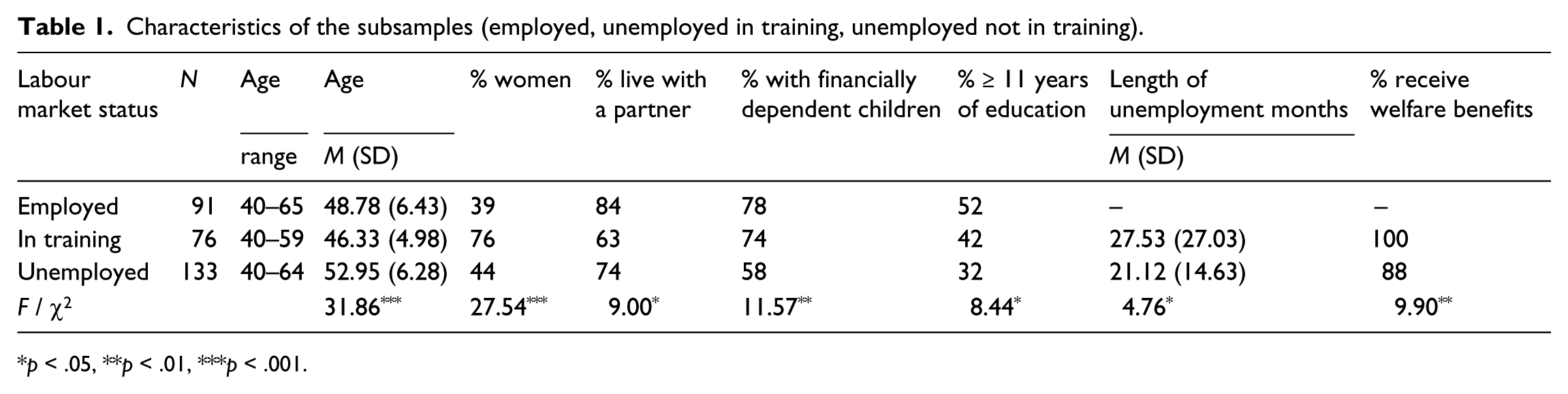
Participants were part of a convenience sample of 311 individuals (aged 40 +), who were categorized into three groups according to their labour market status (employed full-time, unemployed attending a full-time training course or unemployed not engaged in training). Four participants (two employed and two unemployed not in training) were excluded by listwise deletion for not having completed the full questionnaire. Since the present study is only interested in voluntary training participation, seven participants who reported that their course attendance was made mandatory by the job centre were also excluded from the sample. The final sample consisted of 300 participants (see Table 1 for sample description).
Characteristics of the subsamples (employed, unemployed in training, unemployed not in training).
p < .05, **p < .01, ***p < .001.
Employed participants had been invited to participate in the study via their employers at their workplace (two large-sized and four small-sized companies) or were invited directly by the first author. Together with the questionnaire, they received a pre-paid envelope addressed to the research centre that was conducting the study. There were 350 questionnaires provided for distribution, but since the participation of most of the individuals was not requested directly, the response rate cannot be calculated, as it is not certain how many questionnaires were actually delivered to the potential participants of this study.
Unemployed participants in training completed the questionnaires on site. The visits to the two training centres that participated in the study were booked in advance with the course coordinators to avoid disturbing the normal functioning of the programmes, and six of the individuals who had been personally invited by the first author refused to participate in the study.
Unemployed participants not in training were invited to participate while they were attending general information sessions at the job centre where they were registered, and questionnaires were completed on-site. Five job centres run by the Portuguese National Agency for Employment and Training participated in the study. Around 200 unemployed individuals aged 40 + had been invited to participate, 135 of whom filled out the questionnaire, which yielded an approximate response rate of 67%.
Preliminary analyses show that the three groups of employed, unemployed in training and unemployed not in training differed significantly in terms of age, gender, civil status, parental status and educational level. Between the two groups of unemployed participants there were also significant differences in the proportion of welfare recipients and length of unemployment.
Measures
The measures were, when needed, translated into Portuguese and were initially pilot tested on a group of older unemployed individuals in order to check for language use and clarity. Slight modifications were made when necessary. Bivariate correlations for the total sample and each subsample are reported in Table 2.
Bivariate intercorrelations between sociodemographic variables, well-being, latent benefits and vitamins for the total sample, and for the employed, unemployed in training and unemployed not in training.

Note: The scales ranged from 1 to 7 except psychological distress (which ranged from 0 to 3).
Age ranged from 40 to 65 for the total sample and the employed, from 40 to 59 for the unemployed in training, and from 40 to 64 for the unemployed not in training.
0 = male, 1 = female.
Financially dependent children: 0 = no, 1= yes.
Married/cohabiting: 0 = no, 1 = yes.
0 = 4–10 years of education, 1 = ≥ 11 years of education.
p < .05.
Demographics and labour market-related questions
Participants were asked about their labour market status (1 = employed; 2 = unemployed in training; 3 = unemployed not in training), age (in years), gender (male = 0; female = 1), civil status (married/cohabiting, 0 = no; 1 = yes), parental status (financially dependent children, 0 = no; 1 = yes), educational level (0 = 4–10 years of education; 1 = ≥ 11 years of education), length of unemployment (in both unemployed groups, scored in months), length of training participation (for the unemployed enrolled in training, scored in months) and welfare benefits (for both unemployed groups, existence of benefit: 0 = no; 1 = yes).
Well-being
The 12-item version of the General Health Questionnaire (GHQ; Goldberg, 1972) was used as a global measure of psychological distress. According to Warr (2007), the GHQ assesses the global affect component of context-free subjective well-being. Items are measured on a four-point scale from 0 to 3, with higher scores indicating more psychological distress. The internal reliability coefficient for the total sample in this study was 0.90. Satisfaction with life was assessed using the Portuguese adaptation of the Satisfaction with Life Scale (SWLS: Diener et al., 1985; Neto, 1993), the cognitive component of context-free subjective well-being in Warr’s (2007) typology of mental health. It is a five-item scale, and each item is scored on a seven-point Likert-type scale with higher scores indicating more satisfaction with life. The Cronbach’s alpha for this scale in the total sample was .83.
Latent benefits of employment
Access to the latent benefits of employment was measured with five subscales (collective purpose, time structure, social contact, enforced activity and status) of the Latent and Manifest Benefits (LAMB) scales (Muller et al., 2005). Each subscale contains six bipolar items, measured on a seven-point response scale. When needed, items were recoded so higher scores for each measure would indicate greater access to each feature.
The exploratory factor analysis conducted as part of this study showed a five-factor solution, and 24 items were retained (two items from the collective purpose scale, three items from the enforced activity scale and one item from the status scale were dropped due to low and/or cross-loadings). The reliabilities for the total sample in this study were .81, .80, .81, .70 and .82 for collective purpose (four items), time structure (six items), social contact (six items), enforced activity (three items) and status (five items), respectively.
Environmental vitamins
Availability of money was assessed with the six bipolar items from the ‘Financial Strain’ subscale of the LAMB Scales (Muller et al., 2005). The Cronbach’s alpha for this scale in the total sample was .90. The remaining vitamins were assessed using the same type of bipolar response scales as in the LAMB scales. Social support was measured with a modified version of the six-item Social Support Index (Abbey et al., 1985), which assessed three elements of social support (affect, affirmation and aid). The items were refashioned into five bipolar items in our version, which were used to assess the perception of the amount of support received from ‘someone from the personal network’. The internal reliability coefficient for this scale was .78. A four-item bipolar scale was developed by the present authors to assess opportunity for skills use. The reliability for this scale in the total sample was .70. Following Warr’s (1987) definitions of opportunity for personal control, variety and environmental clarity, a two-item index was developed for each of these vitamins.
Results
Differences between groups
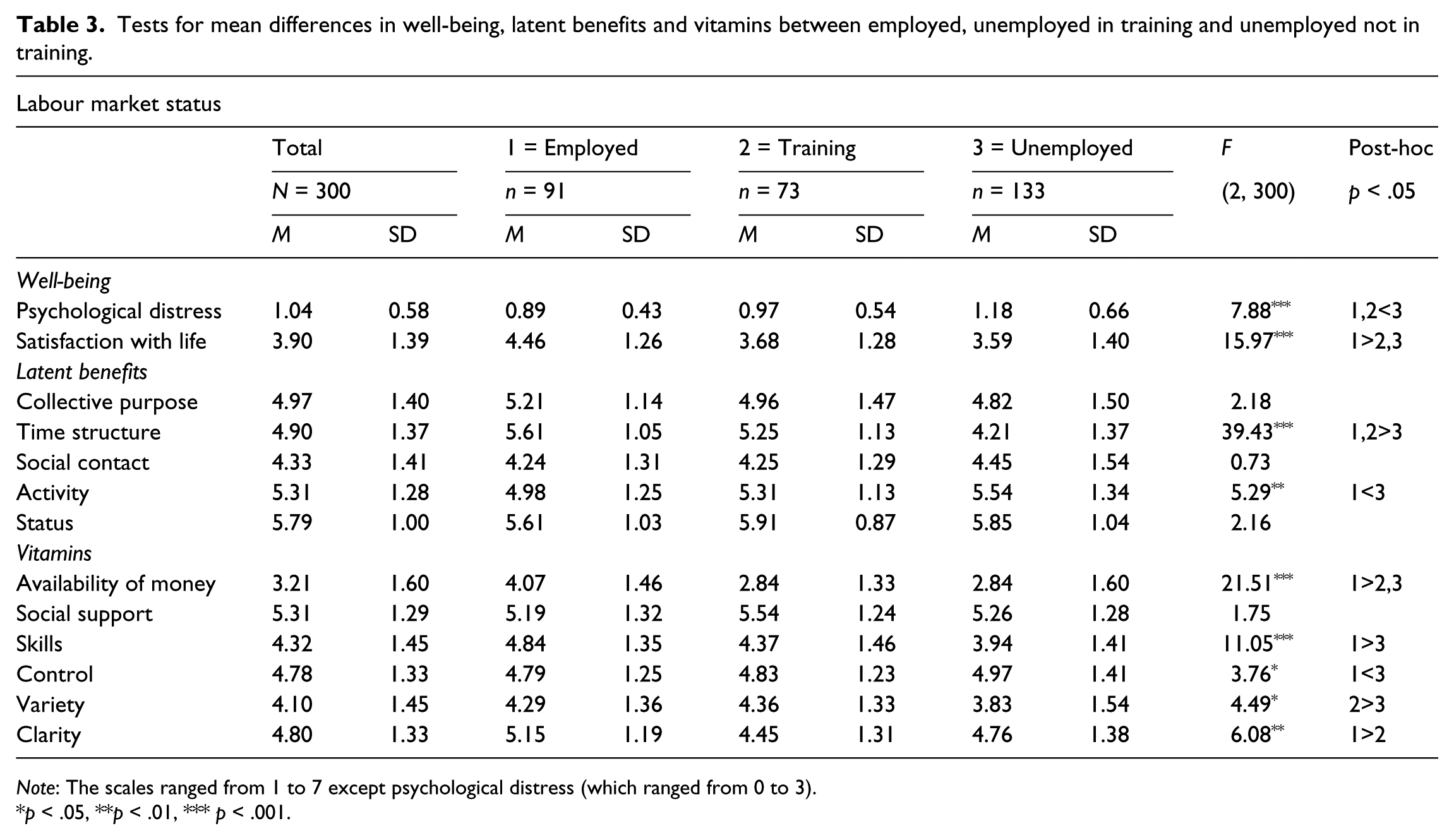
To examine the effects of labour market status on well-being and access to the latent benefits of employment and environmental vitamins, a multivariate analysis of variance (MANOVA) was conducted. The independent factor was labour market status and the dependent variables were psychological distress, satisfaction with life, the latent benefits and the environmental vitamins. Two analyses were run, one without covariates, and one with gender, parental status, civil status and education as covariates. As there were no differences between the two analyses, only the results for the MANOVA are reported in Table 3.
Tests for mean differences in well-being, latent benefits and vitamins between employed, unemployed in training and unemployed not in training.
Note: The scales ranged from 1 to 7 except psychological distress (which ranged from 0 to 3).
p < .05, **p < .01, *** p < .001.
A multivariate effect was found for labour market status, Pillai’s Trace F(26, 572) = 6.74, p = .000. Significant univariate effects were identified for psychological distress, satisfaction with life, time structure, activity, availability of money, opportunity for skills use, variety, opportunity for control and environmental clarity.
Scheffé’s post-hoc tests showed that Hypothesis 1 was partially confirmed. When compared with the unemployed not in training, the employed participants reported significantly lower psychological distress and higher levels of satisfaction with life, time structure, availability of money and opportunity for skills use. However, contrary to what was hypothesized, the employed showed lower access to activity and less opportunity for control, and no significant differences were found between these two groups for any of the other variables. The employed reported significantly higher satisfaction with life, availability of money and environmental clarity than did the unemployed in training, but no other significant differences were found. Finally, the unemployed in training reported significantly lower psychological distress, and higher time structure and variety than the unemployed not participating in training.
Latent benefits, environmental vitamins and psychological well-being
To investigate the second hypothesis, hierarchical multiple regression analyses were conducted to examine the contribution of each latent benefit and environmental vitamin to the prediction of psychological distress and satisfaction with life. Since the subsamples were relatively small, and given the number of predictors, the analyses were calculated using the total sample.
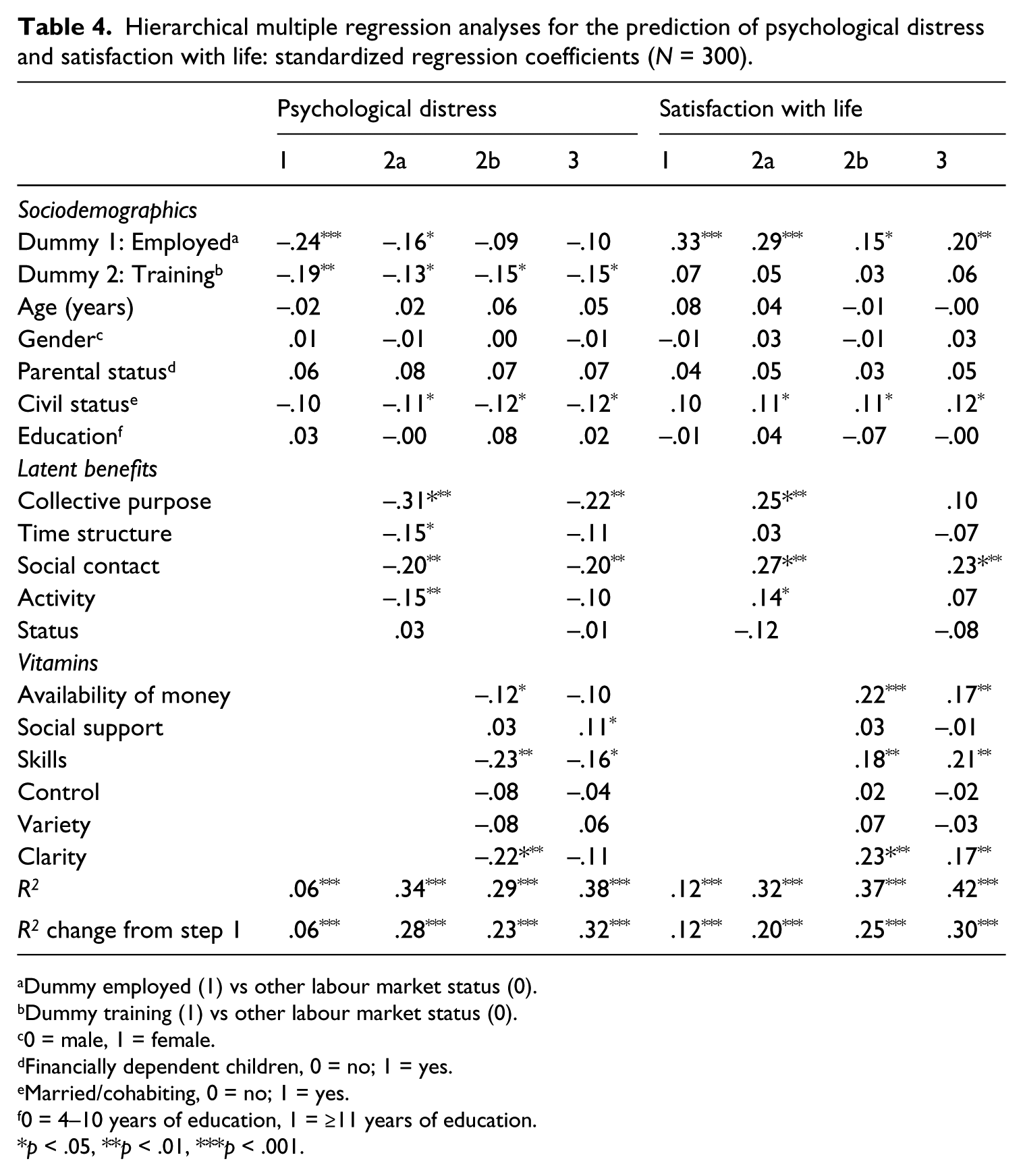
Sociodemographic variables (labour market status, age, gender, parental status, civil status and education) were entered in the first step in order to control for possible effects on well-being. Dummy variables were created for labour market status (baseline = unemployed). The latent benefits and the environmental vitamins were included in two different steps (2a and 2b) to enable an analysis of the individual contributions of Jahoda’s and Warr’s approaches to the prediction of subjective well-being. Step 3 then included both groups of variables, after controlling for sociodemographics. Table 4 presents a summary of these analyses.
Hierarchical multiple regression analyses for the prediction of psychological distress and satisfaction with life: standardized regression coefficients (N = 300).
Dummy employed (1) vs other labour market status (0).
Dummy training (1) vs other labour market status (0).
0 = male, 1 = female.
Financially dependent children, 0 = no; 1 = yes.
Married/cohabiting, 0 = no; 1 = yes.
0 = 4–10 years of education, 1 = ≥11 years of education.
p < .05, **p < .01, ***p < .001.
Hypothesis 2a was partially supported. Perceived access to the latent benefits as a whole accounted for an additional 28% of the total variance in psychological distress, after controlling for sociodemographics (step 2a), and only status was unrelated to this well-being variable. Regarding satisfaction with life, latent benefits accounted for an extra 20% of the total variance when controlling for the effects of the sociodemographic variables (step 2a), and the individual positive predictors among the latent benefits were social contact, collective purpose and activity.
Hypothesis 2b was also partially supported. Among the environmental vitamins, availability of money, opportunity for skills use and environmental clarity negatively predicted psychological distress (step 2b). In this model, the vitamins accounted for an additional 23% of the total variance in the outcome variable as compared to step 1. The vitamins also contributed to 25% of the total variance in satisfaction with life (step 2b). Opportunity for skills use, environmental clarity and availability of money were the individual positive predictors of this well-being variable.
In step 3 of both equations, all of the features were considered simultaneously. After controlling for sociodemographics, the individual negative predictors of psychological distress were collective purpose, social contact and opportunity for skills use. Time structure and activity were non-significant in the presence of the vitamins, and availability of money and environmental clarity did not predict distress. In this model, social support seemed to be acting as a positive net suppressor variable (Krus and Wilkinson, 1986), since the sign of the beta coefficient in the regression analysis was the opposite of that in the correlation analysis with psychological distress. Nonetheless, supplementary analyses showed that social support did not contribute itself to an increase in explained variance. 5 In total, the full model accounted for 38% of the variance in the outcome. Regarding satisfaction with life, among the latent benefits only social contact appeared as a positive predictor, while the environmental vitamins opportunity for skills use, environmental clarity and availability of money continued as positive predictors of this well-being variable. The complete model accounted for 42% of the variance in satisfaction with life.
Discussion
This study aimed to increase our understanding of the relation between the perceived quality of the psychosocial environment and well-being in older adults by utilizing two theoretical frameworks: the latent deprivation model (Jahoda, 1979, 1981, 1982) and the vitamin model (Warr, 1987, 2007). Three groups – the employed, the unemployed in training and the unemployed not enrolled in any course – were compared with regard to two aspects of well-being and their perceived access to the latent benefits of employment and environmental vitamins. The relative individual contributions of both models and the potentially increased contribution of combining both for the prediction of well-being were also analysed, which, to our knowledge, has not been done in previous research.
Differences between groups
As predicted in Hypothesis 1a, the employed participants reported less psychological distress and higher satisfaction with life than both of the unemployed groups. This finding is consistent with previous research (e.g. Paul and Batinic, 2010; Warr et al., 2004) and in line with the general claim that unemployment is psychologically harmful (e.g. Jahoda, 1979, 1981, 1982). Also as expected, the unemployed in training reported less psychological distress than the unemployed who were not attending any course. However, there were no significant differences between these two groups in relation to satisfaction with life. This result suggests that participating in training may be more beneficial to enhancing the affective component of subjective well-being and of less importance for the cognitive component.
There may be other reasons contributing to the differences in well-being found between both groups of unemployed participants. In line with the human capital theory’s assumption that older workers are less likely to be involved in training than their younger counterparts (e.g. Fouarge and Schils, 2009), in this study the unemployed participants who were attending a course were significantly younger than the other group of unemployed participants. Furthermore, in the absence of data regarding well-being baseline levels one cannot exclude the possibility that those unemployed with lower levels of psychological distress could be more apt to voluntarily engage in training. A clear pattern in the association between age and well-being during unemployment is not found in the literature (e.g. McKee-Ryan et al., 2005) and the possibility of age to act as a moderator should be considered here. Future research could investigate potential interaction effects between age and labour market status on well-being and also on the perception of the perceived quality of the psychosocial environment.
In regard to the latent benefits, the results provided only weak support for Hypothesis 1b. As in previous research (e.g. Selenko et al., 2011), the employed perceived their time to be more structured than did the unemployed not in training. However, no significant differences were detected with regard to collective purpose, social contact and status, which is contrary to what has been found in previous studies (e.g. Paul and Batinic, 2010) where the employed reported having more access to all or most of the latent benefits as compared to the unemployed.
Even more unexpectedly, in the present study, the unemployed not in training reported more access to enforced activity than did the employed. A possible explanation for this finding may be related to the content of the items being differently interpreted in their Portuguese version than they are in other languages and societies, and in Portugal not effectively tapping Jahoda’s latent benefit of employment that relates to the requirements of regular activity. In fact, contrary to this study, previous research in for example Australia (Creed and Muller, 2006) and Germany (Selenko et al., 2011) has found that the employed reported higher access to this latent benefit than the unemployed. Cultural differences may then underlie these inconsistent findings. On the other hand, the Portuguese employed participants may have felt that it was more difficult to organize their daily life in a way that fulfilled all the demands they were facing, in contrast to the unemployed, who may have found it effortless.
It should also be noted that the unemployed in training, as predicted in Hypothesis 1b, reported having more access to time structure than did the other unemployed group, while no significant differences were found between those in training and the employed participants, which suggests that attending a training programme may facilitate time structuring. In addition, no differences were detected between the two groups of unemployed with regard to their perceived access to other latent benefits. These results suggest that unemployed individuals, despite being out of the labour market, may find other environmentally based opportunities to access the latent benefits that Jahoda (1979, 1981, 1982) considers to be much more available to the employed.
When it comes to the environmental vitamins, the results provided partial support for Hypothesis 1c. In accordance with this hypothesis, and consistent with previous findings (e.g. Paul et al., 2009), the employed perceived a greater availability of money than the two unemployed groups. Receiving unemployment or training benefits does not seem to protect older unemployed individuals from financial deprivation. Also in line with this hypothesis was the finding that, compared to the unemployed who were not in training, the employed reported having more opportunities for using their skills, which is in agreement with Warr et al. (2004). However, no significant difference was found between the two unemployed groups, with regard to this vitamin. One reason for this finding may be that the rather short length of the training participation (< 3 months on average), considering the total duration of the programme (13 months), may not be long enough for those in training to perceive, to any substantial degree, that there are more opportunities available for using and developing their skills – as compared to the unemployed not enrolled in any course. The relatively short length of training participation may also explain why the unemployed in training were the group that perceived their environment to be less clear, as they showed significant differences with regard to this vitamin when compared to the employed. Most of the older unemployed individuals had not been in an educational setting for decades and entering such an unknown environment, with new tasks to be completed and new challenges to face, could have exacerbated their feelings of uncertainty about the future – feelings that might attenuate over time.
As expected, the unemployed participants who were in training perceived that their context was more varied than the other unemployed group. Given that no significant differences were found between those in training and the employed participants in regard to this vitamin, attending the training may have increased their perceptions of novelties in the environment to levels similar to those of the employed. Nevertheless, no other significant differences were detected between the two groups of unemployed individuals for any of the other environmental vitamins.
The finding that the employed reported having lower personal control than did the unemployed not in training was unexpected and deserves commentary. This result suggests that many employed participants did not perceive that their working environment promoted opportunities for autonomous decisions and actions. Moreover, it is not entirely clear why the unemployed reported experiencing greater freedom in their decision-making and actions, considering that the statutory obligations imposed on registered unemployed individuals, such as increasing active job searching requirements, would be expected to carry with them less autonomy. It might be that opportunities for personal control take on a different meaning among the employed (referring to discretion at work) than among the unemployed (where it may reflect a more general sense of autonomy to do what one prefers), and that the measure used is not sensitive to such differences. However, Warr et al. (2004), for example, using a different measure, found no significant differences regarding opportunity for personal control between older employed who were below the conventional retirement age and their unemployed counterparts.
Latent benefits and environmental vitamins as predictors of well-being
The present findings are consistent with Hypothesis 2 and give support to both Jahoda’s (1979, 1981, 1982) latent deprivation model, according to which the deprivation of latent benefits is detrimental to well-being, and to the vitamin model (Warr, 1987, 2007), which proposes a negative relation between the reduced opportunities in the access to certain environmental features and well-being.
All of the latent benefits, with the exception of status, were found to be negatively related to psychological distress, and social contact, collective purpose and activity were positively associated with satisfaction with life. These findings are in line with previous research that has also found the latent benefits to be of importance for psychological well-being (e.g. Creed and Reynolds, 2001; Paul and Batinic, 2010).
Some of the complementary environmental features proposed by Warr (1987, 2007) also contributed to the prediction of both well-being variables. The most important predictors were opportunity for skills use, environmental clarity and availability of money. These findings are only partially in line with Warr et al. (2004), one of the few studies found in the literature that have examined the associations between environmental vitamins and well-being among unemployed adults. However, the measures used in the Warr et al. (2004) study were different from the ones used in the present study, which prevents accurate comparisons.
The relative contribution of the latent benefits and vitamins for the prediction of well-being was examined by considering the two blocks of variables simultaneously in the same step after controlling for sociodemographics. Among the latent benefits, collective purpose and social contact acted as predictors of psychological distress, whereas only the latter was related to satisfaction with life. Among the vitamins, opportunity for skills use was the only predictor of psychological distress, and it was also significantly related to satisfaction with life. The vitamins of availability of money and environmental clarity also predicted this latter well-being indicator. These results suggest that when both models are combined, the latent deprivation model may to a greater extent account for the prediction of psychological distress, whereas, in line with Warr et al.’s (2004) findings, the complementary environmental features proposed in the vitamin model may be better predictors of satisfaction with life. The fact that the latent benefits and environmental vitamins were found to have somewhat differing relations to psychological distress and satisfaction with life, reinforces the merit of considering the two forms of well-being, which is in line with Pavot and Diener (1993: 164), who stated that ‘the two components are somewhat distinctive and can provide complementary information when assessed separately’.
With regard to labour market status, being employed or attending a training programme served as control variables in the regression analyses, with full-time unemployment as the reference group. Both employment and involvement in training were negatively associated with psychological distress, in line with what was found in the MANOVA, where the unemployed who were not attending a training programme showed the greatest psychological distress. However, being employed was only related to this well-being variable in the absence of the vitamins, suggesting that this labour market status is more strongly related to the environmental vitamins than to the latent benefits in the prediction of psychological distress. Being employed also appeared to be more related to the vitamins in the prediction of satisfaction with life as, in the presence of the vitamins, its regression coefficient, while remaining significant, decreased to nearly half of its absolute value, compared with when only the latent benefits were included in the equation. When it comes to the remaining sociodemographic variables, which were included as controls in the regression equations, only civil status was found to be related to well-being, with the single persons showing the most psychological distress and the least satisfaction with life.
Limitations of the study
This study has some limitations that should be noted and that future research can overcome.
First, its cross-sectional nature does not allow for causal inferences, which have however received empirical support in the literature, as is the case of the relation between labour market status and well-being. In fact, as Paul and Moser (2009) point out, the social causation hypothesis (Dooley et al., 1992), according to which unemployment causes a decline in psychological well-being, has received more support than the drift hypotheses (Dooley et al., 1992), which states that those with poorer mental health are more prone to job loss. In addition, the hypothesis that the perceived quality of the psychosocial environment influences well-being has been examined in longitudinal studies that have found that gaining employment reduced latent deprivation (e.g. Hoare and Machin, 2010; Waters and Moore, 2002b). These findings suggest that the associations between environmental features and well-being are not (just) a consequence of people with better well-being evaluating their psychosocial environment in a more positive way. While the use of longitudinal data that followed older adults as they transitioned through different labour market statuses would provide a better understanding of the relations between latent benefits, environmental vitamins and well-being, the present cross-sectional study nonetheless provides valuable insights, especially considering that very little research has investigated the differences between the employed, the unemployed and the unemployed involved in training.
Second, the results should be interpreted with caution, as their generalizability to the older population in general may be hampered by our use of a convenience sample, which raises potential issues related to participant self-selection. Comparing the characteristics of the samples of this study with national data relative to 2006 from the Portuguese National Statistical Office and the Portuguese National Agency for Employment and Training, the employed and unemployed populations aged 40 + appear less educated (about 17% and 14%, respectively, have 11 years or more of education) and with a higher proportion of women (around 47% and 50%, respectively) than the employed and unemployed samples of the present study. Considering the group of unemployed individuals (all ages considered as no disaggregated data are available) that have attended the same type of courses as the training sample of this study it may be observed that this group has a lower proportion of women (67%) and is less educated (25% have 11 years or more of education) than the sample that comprises unemployed individuals in training. Future research could then benefit from making use of nationally representative and larger samples, a different sampling method, and collect sociodemographic data related to the non-respondents. Perhaps the relations between the variables in the present study were influenced by the setting (Portugal) and the time when the data were collected (2006). It would thus be pertinent to analyse the generalizability of the findings to different welfare systems and socioeconomical-cultural contexts. Also, it would be interesting to replicate this study in Portugal, given the dramatic changes that have occurred in the Portuguese labour market since the time of data collection – specifically the increase in the unemployment rate, the new requirements for unemployment and training benefit recipients, and the amounts received from these kinds of financial support, which have been substantially decreased.
Third, it would have been interesting to investigate the role that the access to latent benefits and environmental vitamins may play in the well-being of individuals with different labour market status. These analyses were not performed in the present study due to the relatively small sizes of the subsamples.
Finally, this research used exclusively self-report data, which could bring common-method variance into question (Podsakoff et al., 2003; Spector, 2006). However, since the focus of this study was on the perceived access to psychosocial features and its relation to subjective well-being, the participants’ assessments must be subjective. The use of self-reported data is also well established in this type of research. Nevertheless, future research could strengthen the validity of the present findings by considering responses from different sources concerning the predictor and criterion variables (see Podsakoff et al., 2003).
Conclusions
Despite the aforementioned limitations, this study has the potential to contribute to the literature, as it focuses on older adults, a group that has rarely been the focus of research in employment, training and unemployment settings. The results have shown the merit in considering both Jahoda’s (1979, 1981, 1982) and Warr’s (1987, 2007) approaches when studying the impact that psychosocial environmental features may have on the well-being of older adults and suggest that the two models are complementary. Both Jahoda’s latent benefits of employment (primarily collective purpose and social contact) and Warr’s environmental vitamins (most notably opportunity for skills use, availability of money and environmental clarity) played a role in the prediction of psychological distress and satisfaction with life, regardless of the labour market status held by the participants. The present findings may contribute to a greater awareness of the importance of environmental features for the well-being of older individuals, which could be of benefit to counsellors working in employment and unemployment contexts, and to the design of social policies for the ageing population. For instance, the development of an effective and structured national plan for senior volunteering could facilitate the availability of opportunities for older people, especially those who are unemployed and cannot find a new job, to have a sense of collective purpose, to extend their social contacts outside the family, and to use their current skills and acquire new ones. The availability of open and free access to learning for all older individuals is also of major importance. Participating in occupational programmes could not only enable older unemployed individuals to return to work for a limited period and potentially increase their benefits but also lead to improved access to at least some of the environmental features studied. With the current global socioeconomic crisis, the financial situation of older unemployed individuals should constitute a major concern to national governments. Many older individuals are at a high risk for long-term unemployment (or ever finding a new job) and in most countries unemployment benefits stop after a certain period, leaving those who cannot find a job in an extremely difficult situation.
In addition to focusing on differences in the access to the latent benefits of employment and the environmental vitamins across labour market status, future research should continue to investigate the possible relations between these psychosocial features and the extent to which they can be provided by different employment, training, unemployment and retirement contexts. It is also crucially important to examine if the perceived access to latent benefits and environmental vitamins can explain intra-labour market group differences concerning context-free well-being and domain-specific well-being (differentiation proposed by Warr, 1987, 2007), using other outcomes such as job, training, unemployment or retirement satisfaction.
Footnotes
Funding
This study is part of a larger research project that was supported by the Fundação para a Ciência e Tecnologia/MES (grant numbers 17516, 79085).