




Abstract
In the last decades, research on the relationship between contract type, job insecurity and outcomes has been constantly increasing. Previous evidence indicated that job insecurity moderates the impact of contract type (permanent vs temporary) on job satisfaction. The present study aims to investigate these relationships considering two facets (intrinsic and extrinsic) of job satisfaction and psychological contract violation as mediator, in the mediated moderation model. Participants were 638 employees of different Italian organizations, with open-ended or fixed-term contract. As hypothesized, results indicated that job insecurity moderates the relationship between contract type and intrinsic and extrinsic job satisfaction differently for contract type. The job insecurity effects were more negative for permanent workers regarding intrinsic job satisfaction and more negative for temporary workers regarding extrinsic job satisfaction. The mediated moderation analyses supported the study’s main hypothesis, pointing out that psychological contract violation negatively mediated the interaction effects.
Keywords
For several years, the labour market has been profoundly modified and characterized by constant and rapid changes (e.g. Kompier, 2006; Martínez et al., 2010) that have directly involved both the workers and the organizations. Furthermore, global competition (Marković, 2008) has led many organizations to choose more non-standard contracts resulting in a reduced number of permanent workers and increased spread of temporary workers (De Cuyper et al., 2008; Kalleberg, 2000). The European data on the labour market have revealed that numbers of temporary workers are constantly growing (Ciett, 2009; European Commission, 2006; ILO, 2012) with some significant differences within the countries of the European Union (e.g. Wagenaar et al., 2012). Temporary workers represent a very important segment of the European workforce and they will continue to play a key role within organizations. In Italy, during the first six months of 2012, 5 million employment contracts were activated, of which 81% were non-standard contracts and only 19% were permanent contracts (ISTAT, 2012).
Within the last decade, the scientific interest in the role of contract type on individual outcomes has gained huge popularity. However, empirical research has not clearly established a link between contract type and some outcomes (Casey and Alach, 2004; Connelly and Gallagher, 2004), such as job attitudes and behaviours.
Among these attitudes, job satisfaction has been the most investigated outcome in relation to contract type, but researchers have not found consistent and conclusive results. Three different patterns of results have emerged: some studies found permanent workers scored lower on job satisfaction than temporary workers (e.g. Benach et al., 2002a); other studies did not find significant contract-based differences on job satisfaction (e.g. De Witte and Näswall, 2003); yet others found permanent workers to be more satisfied with their job as compared to temporary workers (e.g. Galup et al., 1997; Guest and Conway, 1997; McDonald and Makin, 2000). A possible reason for these different results may be that previous research used an overall measure of job satisfaction. The first aim of the present study was to clarify the relationship between contract type and job satisfaction distinguishing between intrinsic and extrinsic factors. This inconsistent relationship has led researchers to hypothesize that some variables, such as job insecurity and psychological contract, could play a key role. In particular, De Cuyper and De Witte (2005) showed that job insecurity was a moderator, while few studies examined psychological contract as a mediator (De Cuyper and De Witte, 2006, 2007). The influence of job insecurity and psychological contract on the relationship between contract type and outcomes has been separately tested in previous studies. A second aim of the current study was to investigate, for the first time, the moderating role of job insecurity and the mediating role of psychological contract violation simultaneously using a mediated moderation model. Moreover, this study considered two distinct components of job satisfaction that can be related in different ways for permanent and temporary workers as well as for job insecurity and psychological contract.
Contract type and job satisfaction
In advanced economies, contract type concerns standard and non-standard jobs; the latter include part-time jobs, self-employed workers and temporary employment (ILO, 2012). In this study, we understand temporary employment, according to the definition of the Organization for Economic Co-operation and Development (OECD, 2002: 170), as ‘dependent employment of limited duration’ and permanent employment as all other jobs with open-ended contracts.
In this scenario, a possible worker profile, in line with the dual labour market theory (Reich et al., 1973), identified their position within organizations as belonging to one of two groups: the core group composed of ‘standard’ or permanent workers and the peripheral group composed of ‘non-standard’ including temporary workers (Wagenaar et al., 2012). These groups of workers have different job characteristics including working conditions, skill level, stability and security. The workers in the core group are considered crucial to the organization’s functioning and can rely on continuity of employment, job security, relationship with employers and also benefits and insurance in some countries (Martínez et al., 2010). Conversely, workers in the peripheral group are mostly hired on an as-needed basis by the organization and differ from the other group in some aspects, such as working hours, terms of contract, access to fringe benefits, supervision received, lower earnings and security (De Cuyper et al., 2009; Hudson, 2007). Considering this theoretical framework, a possible suggestion was that workers in the peripheral group may feel at a disadvantage in the quality of working life compared to their colleagues belonging to the core group. These feelings could lead to negative consequences, including lower job satisfaction (Beard and Edwards, 1995).
Although the dual labour market theory considers that temporary workers experience unfavourable job characteristics and attitudes (e.g. Benach et al., 2002b; Callea et al., 2012; OECD, 2002; Saloniemi et al., 2004), some research has focused on possible differences in job attitudes between permanent and temporary workers (see Thorsteinson, 2003, for a meta-analysis). As pointed out by De Cuyper and De Witte (2006), temporary employment may be perceived as different from but not inferior to permanent employment; consequently the common predictions for the disadvantageous outcomes including lower job satisfaction among temporary workers may not be supported.
To investigate job satisfaction, previous research has used an overall measure; however considering different facets of job satisfaction would be an advantage, because specific differences between permanent workers and temporary workers could emerge. One of the most popular facet measures in job satisfaction research (Spector, 1997) identified two distinct dimensions: intrinsic job satisfaction and extrinsic job satisfaction. Intrinsic job satisfaction referred to those aspects of the job that are peculiar to the nature of one’s work that are primarily internally experienced by the worker (e.g. sense of challenge, sense of achievement and level of independence) while extrinsic job satisfaction included aspects of the job that are not peculiar to the nature of one’s work and are primarily under the control of one’s employer (e.g. wage, job security, working conditions and chances for advancement) (Eggerth, 2008). In other words, intrinsic job satisfaction reflected how people feel about the nature of the job tasks themselves and extrinsic job satisfaction reflected how people feel about aspects of the work situation that are external to the job tasks or work itself (Fields, 2002; Hirschfeld, 2000).
Moreover, in support of the difference between these components, empirical evidence has suggested that intrinsic job satisfaction, as compared to extrinsic, is a stable variable and deeply embedded with a genetic basis and temporal stability regardless of the work environment (e.g. Arvey et al., 1989; Gerhart, 1987; Staw et al., 1986).
The advantage of a multidimensional measure provides a more complete scenario of the construct and allows one to establish a relationship with other variables, contributing to the widening of theoretical and practical implications in this research field (Hirschfeld, 2000). Furthermore, a multidimensional measure of job satisfaction allows one to analyse different constituent parts of the job setting in which an individual may feel more or less satisfied (Peiró et al., 2010). In other words, the aim in using the two components of job satisfaction is to detect the relationships between variables that otherwise would not arise if a global dimension was examined. For example, permanent workers could report higher intrinsic job satisfaction than temporary workers because their contract type enables them to feel satisfaction related to specific features, including a higher feeling of achievement. Moreover, in order to clarify the relationship between contract type and job satisfaction, De Witte and Näswall (2003) proposed, for the first time, using job insecurity as a moderator variable.
Job insecurity as a moderator in the relationship between contract type and outcomes
Since the late 1990s, more widespread international attention has been given to job insecurity (Sverke et al., 2010) as a result of radical changes in the employment arrangements of the labour market of most western countries.
Job insecurity can be defined as the ‘subjectively perceived likelihood of involuntary job loss’ (Sverke et al., 2002: 243). Basically, employees feel a sense of job insecurity when they perceive the threat of losing their job in the future. Employees with high levels of job insecurity experience a stressful life both at home and at work (Hartley et al., 1991) with obvious disadvantages (for a review, see Cheng and Chan, 2008; Sverke et al., 2002).
According to some authors (e.g. Hellgren et al., 1999), two different dimensions of job insecurity can be distinguished: quantitative job insecurity, which means the loss of the job itself, and qualitative job insecurity, which means the loss of important job features. These two different aspects refer to a future stressful event. Specifically, quantitative job insecurity is related to the global conceptualization of the construct, whereas qualitative job insecurity refers to perceptions of potential loss in the employment relationships, such as worsening of working conditions, lack of career opportunities and decreasing salary development (Hellgren et al., 1999).
A further distinction is between subjective and objective job insecurity (De Witte and Näswall, 2003; Klandermans and Van Vuuren, 1999). The former refers to an employees’ subjective perception and feelings of worry arising from the work environment about their job being at risk. Objective job insecurity concerns a real risk situation such as the threat of job loss emerging from the temporary nature of the job or from the organization facing a merger, a downsize or a reorganization.
From a psychological point of view, job insecurity can be considered a subjective phenomenon independent from the objective situation. Notwithstanding, it is clear that some objective threats, such as a temporary contract that has a limited time by definition, lead to subjective job insecurity (Pearce, 1998). According to this approach, temporary workers should have higher levels of job insecurity than permanent workers and more uncertainty about the future of their job (Sverke et al., 2000).
The association between contract type and job insecurity, however, is not completely clear. In fact, some empirical evidence has suggested how different workers in the same situation have different levels of job insecurity (Klandermans and Van Vuuren, 1999). Furthermore, subjective job insecurity is consistently linked to lower scores of job satisfaction while objective job insecurity is not always associated with it. Therefore, it is necessary to consider the interaction term between contract type and job insecurity in order to explain these relationships.
Previous research has suggested that job insecurity acts as a moderator in the relationship between contract type and outcomes (De Cuyper and De Witte, 2005; De Witte and Näswall, 2003). In particular, when job insecurity is added as a moderator, job satisfaction showed significant differences among permanent workers as compared to temporary workers (Guest and Conway, 2000; Mauno et al., 2005). Therefore, when job insecurity was high, overall job satisfaction decreased more for permanent workers than for temporary workers. Considering the distinction between intrinsic and extrinsic job satisfaction, we expect higher levels of intrinsic job satisfaction among permanent workers, due to the open-ended contract, and higher levels of extrinsic job satisfaction for temporary workers, due to external praise for their own job (for example the colleagues may praise temporary workers because they recognize their working pledge and effort in order to increase the chances to get a contract renewal).
In line with previous considerations, we hypothesize:
H1a: Job insecurity moderates the negative relationship between contract type and intrinsic job satisfaction.
H1b: Job insecurity moderates the positive relationship between contract type and extrinsic job satisfaction.
Psychological contract violation as a mediator in the relationship between job insecurity and outcomes
With the increasing literature over the last few decades, the employment relationship is conceptualized in terms of a psychological contract that can be defined by a set of mutual and dynamic individual beliefs or perceptions regarding reciprocal obligations between the employee and the organization (Morrison and Robinson, 1997; Robinson et al., 1994; Rousseau, 1989). Thus, the psychological contract differs from a formal employment contract because it is implicit, informal and subjective (e.g. Bal et al., 2013). It represents a powerful signal for employees about the state of their relationship with the organization. As it is subjective, the employee’s understanding of this relationship may be different from that of the organization (Morrison and Robinson, 1997; Robinson and Morrison, 2000).
Some authors (e.g. Millward and Brewerton, 2000; Rousseau, 1995) suggested a distinction between transactional and relational psychological contracts. The transactional psychological contract focuses on the tangible and task-oriented components of the employment relationship (i.e. economic inducements) with a short-term low emotional investment by both the worker and the organization (Rousseau, 1995). Conversely, the relational psychological contract focuses on non-tangible components (i.e. career growth and a harmonious work environment) with long-term and socio-emotional elements in the employment relationship (Robinson and Rousseau, 1994). A key concept in the psychological contract concerns the employee’s belief that the organization will live up to its promises and obligations. When an employee feels that the organization has failed to fulfil these features, an imbalance can arise that could lead to a psychological contract breach.
For the psychological contract, Morrison and Robinson (1997) distinguished between a breach, which concerns the cognitive evaluation that one’s organization has failed to fulfil its obligations, and a violation, which concerns the emotional and affective state which may be consequences of the latter. Thus, a psychological contract violation entails a person’s emotional responses which follow a breach of contract, including a variety of negative emotions such as anger and frustration (Morrison and Robinson, 1997; Zhao et al., 2007). In the present study, we followed this distinction and examined violation defined as ‘the emotional and affective state that may, under certain conditions, follow from the belief that one’s organization has failed to adequately maintain the psychological contract’ (Morrison and Robinson, 1997: 230).
The psychological contract violation has serious organizational and individual implications involving emotional responses (Beynon et al., 2012; Robinson and Morrison, 1995). As a consequence, emotional responses can lead to various unfavourable organizational attitudes and it can also have a negative impact on some individual outcomes, including job satisfaction (Robinson and Rousseau, 1994).
Therefore, we hypothesize:
H2a: Psychological contract violation is negatively related to intrinsic job satisfaction.
H2b: Psychological contract violation is negatively related to extrinsic job satisfaction.
An important element which defines the zone of negotiability of a psychological contract is the type of contract (Rousseau and Shalk, 2000), according to the psychological contract perspective whereby temporary and permanent workers have different expectations with regard to their employment. In fact, empirical studies have supported these differences in psychological contracts (Coyle-Shapiro and Kessler, 2000; Millward and Brewerton, 1999; Millward and Hopkins, 1998). As suggested by McLean Parks et al. (1998), a transactional psychological contract can be more easily perceived by temporary workers, as it focuses on short-term and tangible elements, whereas a relational psychological contract is thought to be more influential for permanent workers, as it focuses on long-term and intangible elements (Kalleberg and Rognes, 2000; McDonald and Makin, 2000). Nevertheless, most recent empirical evidence from the layered model of the psychological contract (Isaksson et al., 2010) have suggested that relational and transactional entitlements and obligations are shared by both workers. In other words, workers with different contract types had different layers of psychological contracts instead of distinct types.
According to the psychological contract perspective, the peculiar set of expectations of permanent workers and temporary workers should be examined in order to understand how contract type affects psychological outcomes, including job insecurity. The relationship between contract type, job insecurity and psychological contract is narrow. More specifically, under the condition of high job insecurity, permanent workers may have negative individual outcomes as they are compelled to change their relational psychological contract (De Cuyper and De Witte, 2006).
The psychological contract perspective suggested using the psychological contract as a mediator in the relationship between job insecurity and outcomes. In this regard, previous research (De Cuyper and De Witte, 2006, 2007) investigated the mediating role of relational and transactional psychological contract, showing that only the former mediated the relationship between job insecurity and job satisfaction; no significant mediation has been found for transactional psychological contract.
To the best of our knowledge, there is a lack of research on psychological contract violation as a mediator between job insecurity and job satisfaction. As psychological contract violation and the relational psychological contract share emotional and affective elements (Robinson and Rousseau, 1994), we expected that psychological contract violation could mediate the relationship between job insecurity and job satisfaction. In particular, because violation depends on a negative perception of an external broken obligation, the relationship between psychological contract violation and extrinsic job satisfaction should be stronger.
Therefore, we hypothesize:
H3a: Psychological contract violation mediates the relationship between job insecurity and intrinsic job satisfaction.
H3b: Psychological contract violation mediates the relationship between job insecurity and extrinsic job satisfaction.
A graphic representation of the hypothesized model is presented in Figure 1.
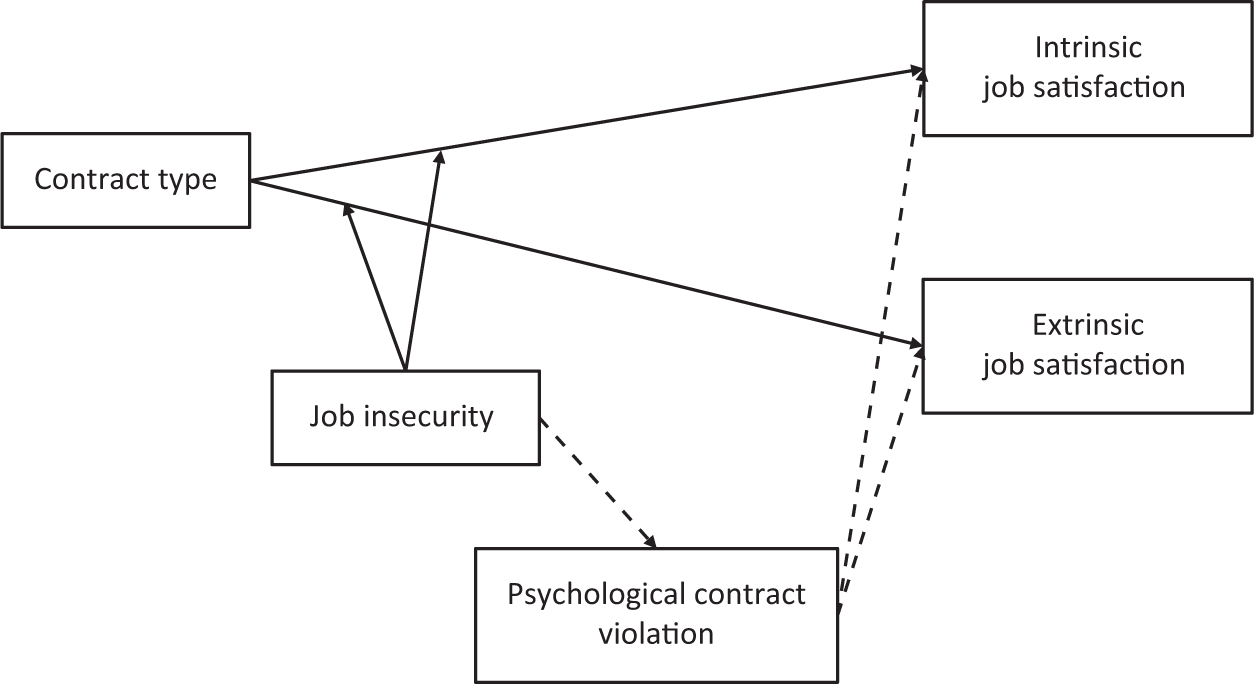
Hypothesized mediated moderation model.
Therefore, the study aims to contribute to previous research in a number of ways. First, it analyses the effect of contract type on intrinsic and extrinsic job satisfaction, which has not yet been investigated. Second, it intends to develop knowledge on the relationship between contract type, job insecurity, psychological contract and job satisfaction, with specific attention to the reasons why these variables are linked. Finally, it seeks to provide further support for the role of psychological contract violation as a mediator in the relationship between job insecurity and job satisfaction.
In summary, the present study investigates a mediated moderation model because it simultaneously tests the moderation effect of job insecurity between contract type and job satisfaction and the mediation effect of psychological contract violation between job insecurity and job satisfaction.
The mediated moderation hypotheses derive from the literature analysis. Previous research (De Cuyper and De Witte, 2005; De Witte and Näswall, 2003), in fact, suggested that job insecurity moderates the relationship between contract type and job satisfaction; in other words, subjective job insecurity acts as a moderator between objective job insecurity (contract type) and outcomes. Other research separately showed that the relationship between job insecurity and job satisfaction was mediated from the relational psychological contract (e.g. De Cuyper and De Witte, 2006, 2007).
Therefore, the rationale underlying our expectations that the interaction effect of contract type and job insecurity on job satisfaction would be mediated by psychological contract violation is as follows. Permanent workers are less satisfied with their job than temporary workers if they perceive a high job insecurity. Why? It is plausible to suggest that this effect would occur possibly because permanent workers feel that a psychological contract violation has happened (i.e. expectations of secure job). This would be due to the different contract nature between permanent and temporary workers. Permanent workers can perceive a psychological contract violation as a threat of losing their job in the future, i.e. they can react with high job insecurity. Conversely, temporary workers are already sure that own contract will expire in the future, therefore for them a psychological contract violation could have fewer negative consequences than for permanent workers.
Method
Sample and procedure
Data were collected in 2011 and in 2012 from 638 employees in Italian organizations. For participation in the study, we selected employees with permanent (71.5%) or temporary (28.5%) contracts. The participants were employees at 18 profit (including TLC industries, banking institutes, private health services and small firms) and seven public organizations (including national health services, municipal services and Italian educational bodies). Participants completed the questionnaire in paper format (69.5%) or via computer-assisted web interviewing (30.5%). All participants were unpaid volunteers; informed consent was requested and privacy was guaranteed.
Regarding permanent workers, they were equally distributed by gender (50.7% women and 49.3% men). With respect to marital status, 21.9% of permanent workers were single, 55.9% were married or cohabiting, 20.3% were separated or divorced and 1.9% were widowed. Regarding education, 14.4% of permanent workers held a lower qualification than a high school diploma, 21.2% had earned a high school diploma and 64.4% had university education. Finally, regarding organizational sector, 51.4% worked in health services organizations and 48.6% worked in non-health services organizations. With respect to health services organizations, 28.1% were nurses, 12.4% were physicians and 59.5% were white-collars; with respect to non-health services organizations, 11.9% were blue-collars and 88.1% were white-collars.
Regarding temporary workers, all had fixed-term contracts, 66.5% were women and 33.5% were men. The majority of temporary workers were single (69.2%), 12.2% married or cohabiting, 18% separated or divorced and 0.6% widowed. Only 7.0% of temporary workers had a lower qualification than a high school diploma, 11.0% held a high school diploma and 82.0% had university education. Finally, regarding organizational sector, 31.4% worked in health services organizations and 68.6% worked in non-health services organizations. With respect to health services organizations, 21% were nurses, 13.6% were physicians and 65.4% were white-collars; with respect to non-health services organizations, 17.1% were blue-collars and 82.9% were white-collars.
In line with Italian population trends reported by ISTAT (2012), temporary workers were younger (M = 32 years old; SD = 6.12) than the permanent workers (M = 46 years old; SD = 9.85; t(593) = 17.63, p < .01); moreover there were differences with respect to occupational status (χ2(1) = 17.5, p < .01) and education (χ2(1) = 21.6, p < .01).
Measures
Contract type
The contract type measured the typology of the employment contract of workers; permanent (open-ended) employment was coded as 0, temporary (fixed-term) employment as 1.
Job insecurity
We measured job insecurity using five items from Sverke et al. (2004) on a five-point Likert scale from 1 (strongly disagree) to 5 (strongly agree). The scale assesses quantitative job insecurity, i.e. the workers’ perception and uncertainties about whether they would be able to keep their current job (sample item: ‘I fear I will lose my job’). The scale is unidimensional and high scores indicate higher levels of worry and fear of job loss. This scale has been validated in Belgium, Italy, the Netherlands and Sweden and has been successfully applied in previous research with good reliability (e.g. Chirumbolo and Areni, 2010; Chirumbolo and Hellgren, 2003; Sverke et al., 2004). In the present study, the scale’s reliability was high (Cronbach’s alpha = .83).
Psychological contract violation
This was measured by two items from Robinson and Morrison (2000) on a seven-point Likert scale from 1 (strongly disagree) to 7 (strongly agree). The items are: ‘I feel that my organization has violated the contract between us’, and ‘I feel extremely frustrated by how I have been treated by my organization’. The scale assesses the emotional reactions of anger and betrayal perceived by employees towards their organization. A high score indicates a high level of perceived violation (Robinson and Morrison, 2000). The scale was sufficiently reliable (inter-item correlation = .76).
Job satisfaction
We measured job satisfaction using 20 items from the Italian short-form version of the Minnesota Satisfaction Questionnaire (MSQ) (Barbaranelli et al., 2010) from Weiss et al. (1967). The scale asks participants what they think about various aspects of their jobs ranging from 1 (very dissatisfied) to 5 (very satisfied). The scale measures two components: intrinsic job satisfaction (12 items; sample item: ‘The feeling of accomplishment I get from the job’) and extrinsic job satisfaction (8 items; sample item: ‘My pay and the amount of work I do’). Previous research (Barbaranelli et al., 2010) showed strong psychometric properties of the MSQ, with excellent coefficients of internal consistency reliability. In this study, the reliability of intrinsic and extrinsic job satisfaction was good (Cronbach’s alpha = .84 and .82, respectively).
Control variables
Despite widespread use in organizational research, the inclusion of control variables does not automatically guarantee the exclusion of distortions between independent and dependent variables in the hierarchical regression analysis (Carlson and Wu, 2012). As suggested by Spector and Brannick (2011) researchers should be explicit rather than implicit regarding the role of control variables. In the present study gender, age and educational level have been used as control variables in the mediated moderation analyses. Regarding gender, empirical literature has pointed out that this variable may have a bearing on intrinsic and extrinsic job satisfaction (Parasuraman and Simmers, 2001); in particular, we expect that women have higher job satisfaction than men because the job experience of women is greater than their expectations, while men focus more on their career path (Donohue and Heywood, 2004). The choice of age and educational level was based on the difference between permanent and temporary worker samples, in line with ISTAT (2012) data. It seems plausible to expect that workers could have different levels of intrinsic and extrinsic job satisfaction with respect to age (high age should be associated to more job satisfaction because job experience increases) and educational level (high education should be associated to less job satisfaction because in Italy there are not many correspondences between qualification degree and job). Age is a continuous variable, while gender (with 0 = men and 1 = women) and educational level (low education = 0; high education = 1) are dummy variables.
Results
Table 1 presents means, standard deviations, correlation coefficients and Cronbach’s alpha coefficients (the inter-item correlation value is reported for psychological contract violation) for intrinsic job satisfaction, extrinsic job satisfaction, job insecurity, psychological contract violation and control variables.
Means, standard deviations, correlations and Cronbach’s alpha coefficients.
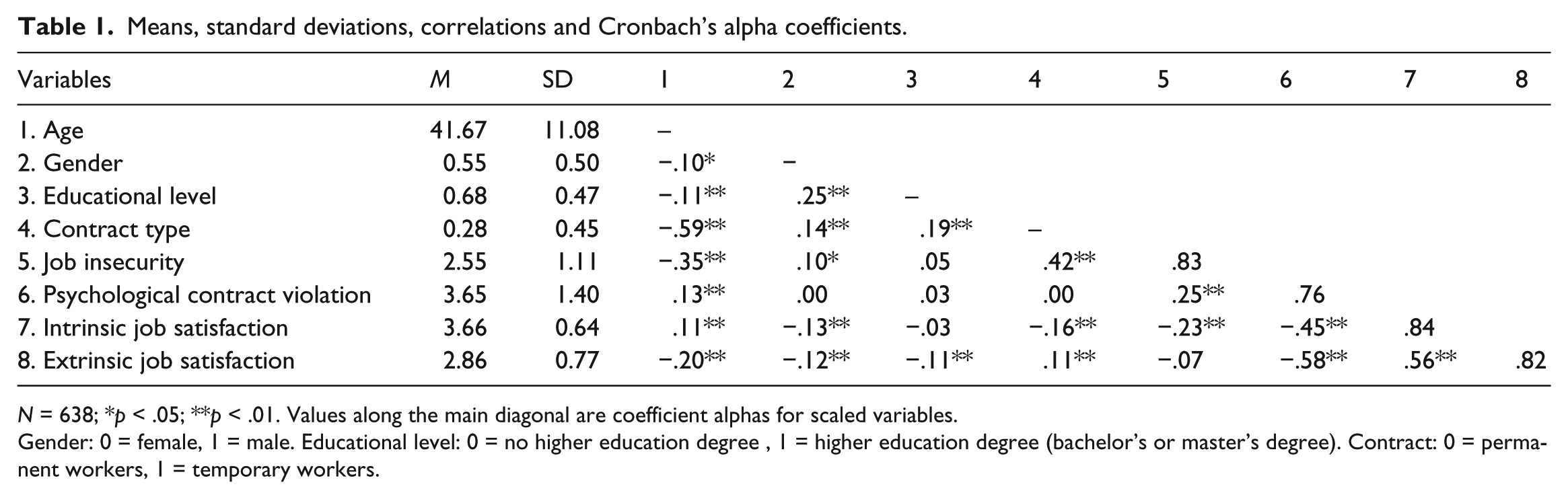
N = 638; *p < .05; **p < .01. Values along the main diagonal are coefficient alphas for scaled variables.
Gender: 0 = female, 1 = male. Educational level: 0 = no higher education degree, 1 = higher education degree (bachelor’s or master’s degree). Contract: 0 = permanent workers, 1 = temporary workers.
In order to test hypothesis 1, moderated hierarchical regression analyses were performed (Aiken and West, 1991). Intrinsic job satisfaction was considered the dependent variable in the first model and extrinsic job satisfaction was the dependent variable in the second model. We standardized the quantitative variables because they were measured on different scales. The moderation analyses were carried out in two steps (see Table 2): Step I included gender, age and educational level as control variables; Step II included contract type, as an independent variable, job insecurity, as a moderator, and the interaction term calculated on the basis of standardized variables.
Mediated moderation hierarchical regression analyses.
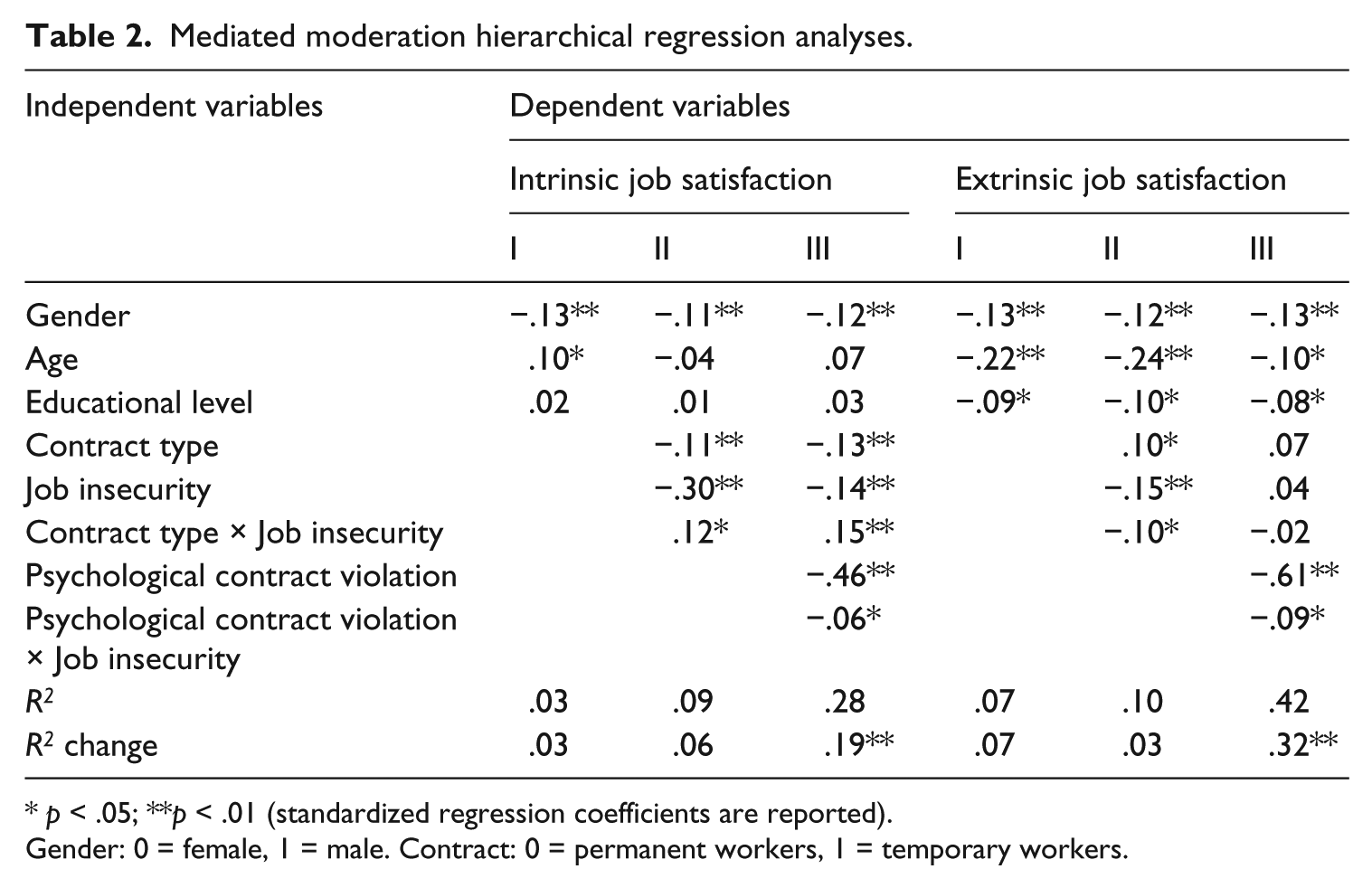
p < .05; **p < .01 (standardized regression coefficients are reported).
Gender: 0 = female, 1 = male. Contract: 0 = permanent workers, 1 = temporary workers.
Hypothesis 1 predicted that job insecurity moderates both the negative relationship between contract type and intrinsic job satisfaction (H1a) and the positive relationship between contract type and extrinsic job satisfaction (H1b). Table 2 presents the results revealing in Step II that contract type was negatively related to intrinsic job satisfaction (β = −.11, p < .05) and positively related to extrinsic job satisfaction (β = −.10, p < .05) and that job insecurity was negatively related both to intrinsic (β = −.30, p < .01) and extrinsic (β = −.15, p < .01) job satisfaction. Furthermore, the interaction terms were significant for both intrinsic (β = .12, p < .05) and extrinsic (β = −.10, p < .05) job satisfaction.
Figure 2 shows the interaction effect between contract type and job insecurity on intrinsic job satisfaction. Under low levels of job insecurity (−1 SD below the sample mean), intrinsic job satisfaction was high for permanent workers and low for temporary workers, while, under high levels of job insecurity (+1 SD above the sample mean), intrinsic job satisfaction decreased significantly for the permanent workers. A simple slope test indicated that the interaction term altered the relationship between contract type and intrinsic job satisfaction, suggesting that the job insecurity effects on intrinsic job satisfaction were more negative for permanent workers (t(165) = 4.31; p < .01).
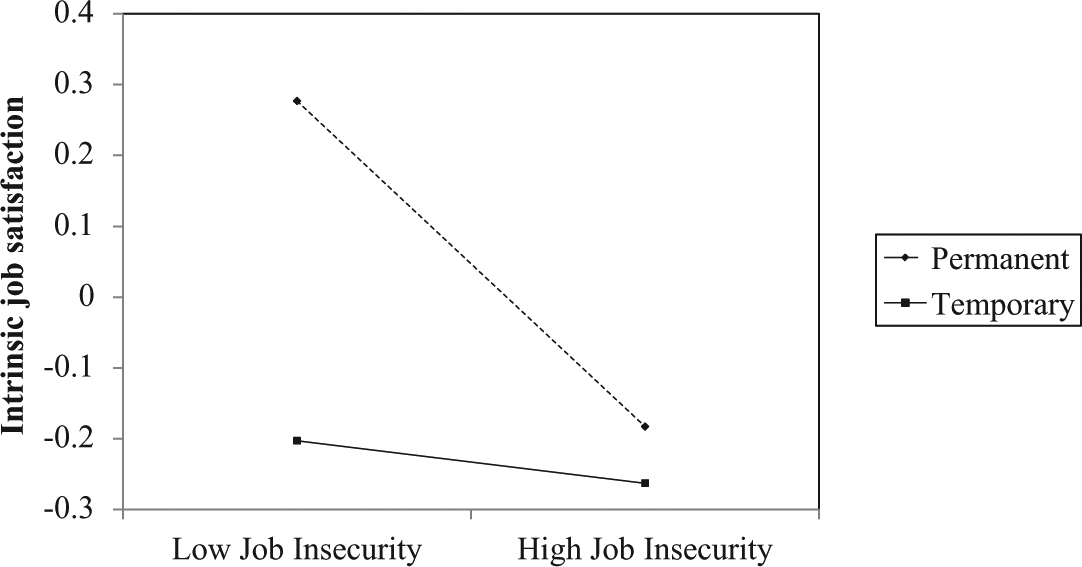
The moderating effect of job insecurity on the relationship between contract type and intrinsic job satisfaction.
Figure 3 shows the interaction effect between contract type and job insecurity on extrinsic job satisfaction. Under low levels of job insecurity (−1 SD below the sample mean), temporary workers had higher scores of extrinsic job satisfaction than permanent workers, while, under high levels of job insecurity (+1 SD above the sample mean), extrinsic job satisfaction decreased significantly for the temporary workers. A simple slope test indicated that the effect of job insecurity on extrinsic job satisfaction was more negative for temporary workers (t(60) = 2.06; p < .05). The results of Step II supported hypotheses 1a and 1b.

The moderating effect of job insecurity on the relationship between contract type and extrinsic job satisfaction.
In order to test mediated moderation, we followed the procedure described by Muller et al. (2005). First, we tested the regression of independent variable, moderator and their interaction on the mediator.
All coefficients were significant (Table 3) and in particular contract type was negatively related to psychological contract violation (β = −.16, p < .01), while job insecurity (β = .26, p < .01) and the interaction term (β = .10, p < .05) were positively related to psychological contract violation. These results allowed us to test mediated moderation models.
Regression of independent variable, moderator and their interaction on the mediator.

p < .05; **p < .01 (standardized regression coefficients are reported).
In Step III of the hierarchical regression analyses (see Table 2), psychological contract violation (mediator) and its product with job insecurity (moderator) were entered. If the presence of this product reduced the effects of the independent variables or the interactions were non-significant, then there was evidence of full mediation. If the independent variables and the interaction remained significant but decreased in magnitude, then partial mediation has occurred.
Step III (see Table 2) reveals that psychological contract violation was negatively related to intrinsic (β = −.46, p < .01) and mostly to extrinsic (β = −.61, p < .01) job satisfaction, supporting hypotheses 2a and 2b. The product of the mediated moderation was also significant for both intrinsic (β = −.06, p < .05) and extrinsic (β = −.09, p < .05) job satisfaction. In particular, when the product of mediated moderation was added to the intrinsic job satisfaction model, the interaction and principal effects remained significant, indicating a partial mediation. Conversely, when the product term was added to the extrinsic job satisfaction model, the results revealed full mediation because both interaction and principal effects were non-significant. The results of Step III supported hypotheses 3a and 3b.
Discussion
Contract type and its outcomes are an issue for organizations and their human resources management practices. The present study sought to clarify the relationship between contract type and outcomes and to expand previous research by developing and testing a mediated moderation model on intrinsic and extrinsic job satisfaction. In particular, this study investigated the moderating role of job insecurity on the relationship between contract type and outcomes and the mediating effects of psychological contract violation in the relationship between job insecurity and outcomes.
The use of a multidimensional measure of job satisfaction clarified the relationship between contract type, job insecurity and job satisfaction. The results of the moderation analyses, in fact, indicated that the job insecurity effects were more negative for permanent workers regarding intrinsic job satisfaction and more negative for temporary workers regarding extrinsic job satisfaction. Even if permanent workers have an open-ended employment contract and a long-term plan, in situations of high level job insecurity, workers lose confidence with a consequent decrease in intrinsic job satisfaction. In other words, job insecurity reduces job satisfaction of permanent workers in some important facets such as being steadily employed, being ‘somebody’ in the community and feeling accomplishment. Temporary workers, being conscious of the fixed-term employment contract, already have a lower level of intrinsic job satisfaction in situations of low job insecurity; the former is further reduced under high job insecurity. Whereas for extrinsic job satisfaction the situation is reversed, in fact it decreases more evidently for temporary workers under high job insecurity. Temporary workers, thus, are less satisfied when they perceive potential losses: pay, chance for career advancement and praise from colleagues and supervisors. The extrinsic job satisfaction decreases for permanent workers too, but less drastically. Therefore, results reveal that contract type acts differently on intrinsic and extrinsic job satisfaction for permanent and temporary workers in relation to different job insecurity levels.
Regarding the mediation hypotheses, psychological contract violation was significantly and negatively related to intrinsic and extrinsic job satisfaction. These results suggested that job satisfaction decreases when workers perceive that their psychological contract has been violated. Furthermore, psychological contract violation negatively mediated the relationship between job insecurity and outcomes. This finding provides an explanation about the underlying process through which job insecurity negatively contributes to intrinsic and extrinsic job satisfaction. In line with De Cuyper and De Witte (2007), we argue that job insecurity can lead to the development of a sense of psychological contract violation. Thus, workers with high levels of job insecurity may perceive a psychological contract violation resulting in low levels of intrinsic and extrinsic job satisfaction. As hypothesized, the psychological contract violation is more related to extrinsic job satisfaction because the former is a negative attribution of external obligation and the latter is an individual perception of external aspects to the nature of one’s work.
These results raise a question about the contract type of employees. As permanent workers have less job insecurity and tend to invest in a long-term psychological contract compared to temporary workers, it seems reasonable to assume that permanent workers will experience more negative effects of job satisfaction in uncertain conditions.
Limitations and future research
There are some limitations to the study which must be mentioned. First, the cross-sectional nature of the study limited the possibility to assess causal relationships between the variables. Although we hypothesized, on the basis of previous research (e.g. De Cuyper and De Witte, 2005, 2006, 2007), that job insecurity and psychological contract violation negatively contribute to job satisfaction, these variables are reciprocally related. Longitudinal studies are necessary to investigate and clarify the relationships between the variables over time.
Moreover, the self-reported data were another limitation because people may not perceive themselves accurately. A possible solution may be to gather data from co-workers, supervisors or peers (Aziz and Cunninghan, 2008); however within this study, we aimed to understand how people perceive their work, so the use of self-report measures seemed appropriate.
A further limitation was not accounting for the contextual differences in the study design. The present study was conducted among employees of several organizations. In line with Italian worker data, some organizational sectors can be characterized by specific typologies of employees (ISTAT, 2012); for example the majority of employees of public organizations are permanent workers with low levels of job insecurity and psychological contract violation, while employees of private organizations are very different. Further studies could investigate whether the replication of the study in specific organizational sectors provides different results.
Finally, the present study considered two groups, permanent and temporary workers, existing in nature; but there may be other differences (e.g. branch of education, union membership, salary) between permanent and temporary workers more than the contract type. These differences might be possible confounding variables in the relationship between independent and dependent variables. Further studies could consider these variables and establish methodological strategies (e.g. propensity score analysis) in order to tackle this problem.
Despite these limitations, it is possible to generalize the results for temporary and permanent workers of public and private organizations because the sample size was large. Furthermore, the socio-demographic characteristics of our sample were very similar to those of the Italian labour market; therefore our sample of permanent and temporary workers is representative of the Italian labour market and the results can be considered valid. Further research may replicate the study in other countries with different labour markets, including other typologies of temporary workers too, in order to increase the generalizability of the results.
Theoretical and practical implications
The current study presents some original aspects that contribute to previous research in a number of ways. First, for the first time, two specific aspects of job satisfaction in the research on contract type and job insecurity are considered. The study suggests that the use of intrinsic and extrinsic job satisfaction can be an advantage because temporary and permanent workers differ on these two specific aspects. These results would not emerge with an overall job satisfaction measure.
Second, the present study considers the role of psychological contract violation in the relationship between job insecurity and job satisfaction. Therefore, for the first time, emotional and affective aspects of psychological contract rather than the distinction between transactional and relational psychological contract are considered.
Finally, the current study, for the first time, simultaneously investigated the moderating role of job insecurity and the mediating role of psychological contract violation through a mediated moderation model. This contribution to previous research is significant because the relationship between contract type and job satisfaction is clearer when job insecurity and psychological contract violation are added to the model. The present study contributes to the knowledge base concerning the outcomes of contract type, highlighting the fact that both intrinsic and extrinsic job satisfaction significantly decrease when high levels of job insecurity are coupled with high levels of psychological contract violation.
Finally, the results provide practical implications for management. In particular, people with different contract types need to be managed in different ways. Human resource departments will therefore have to follow specific strategies in order to increase intrinsic job satisfaction of temporary workers and extrinsic job satisfaction of permanent workers.
With respect to intrinsic job satisfaction, human resource departments could help temporary workers to utilize their skills and ability through training courses. Being conscious of their contributions, temporary workers will consider their work important, improving their sense of achievement and intrinsic job satisfaction. With respect to extrinsic job satisfaction, human resource departments could develop specific career plans and adequate reward systems for permanent workers. By monitoring and objectively assessing each worker, permanent workers will be motivated to work in order to achieve career advancements. These interventions are low cost and can effectively improve the intrinsic and extrinsic job satisfaction, while at the same time increasing organizational well-being.
Conclusions
The present study focused on outcomes of contract type, which is an important topic both at the social and research level. The growing number of temporary workers in Italy and in many other European countries has led many researchers to study this phenomenon. This study sought to provide new knowledge on the relationship between contract type and intrinsic and extrinsic job satisfaction. In particular, it tested the moderating role of job insecurity on the relationship between contract type and job satisfaction and the mediating role of psychological contract violation on the interaction term.
The results suggested that intrinsic and extrinsic job satisfaction of temporary and permanent workers depended on job insecurity level. In addition to previous research which used an overall job satisfaction measure, the current study also suggested that the effects of job insecurity are worse for temporary workers regarding intrinsic job satisfaction and worse for permanent workers regarding extrinsic job satisfaction. Furthermore, the negative effect of job insecurity on intrinsic and extrinsic job satisfaction was exacerbated by high levels of psychological contract violation for both types of workers.
The present study expands our knowledge on outcomes of contract type, highlighting some differences between temporary and permanent workers with respect to job insecurity, psychological contract violation and intrinsic and extrinsic job satisfaction.
In summary, it has not been possible to establish whether more negative individual outcomes were related to temporary or permanent workers. In line with De Cuyper and De Witte (2006) and conversely with the dual labour market theory, we observed that temporary workers have different, but not worse, outcomes as compared to permanent workers.
Footnotes
Funding
This research received no specific grant from any funding agency in the public, commercial, or not-for-profit sectors.