



Abstract
This article focuses on profit-sharing and employee share ownership practices, with the aim of analysing the effect of company size and industry on financial participation, as well as the substitution or complementary effect of other direct and indirect participation methods adopted in Estonian private companies. The article uses survey data from more than 900 Estonian companies obtained via telephone interviews in 2011. The results indicate that share ownership is more common in micro enterprises, but contrary to expectations the incidence of employee financial participation is no higher in knowledge intensive sectors. The results also show that financial participation has different complementarities depending on the scheme. It seems that profit-sharing is part of the ‘package’ of employee participation, but this does not apply to employee share ownership. The article challenges the common understanding that certain innovative service sectors and bigger companies are more inclined to adopt employee financial participation; and raises doubts about the presumed development towards a higher degree of financial participation in Eastern European countries.
Introduction
Employee financial participation has almost a century-long history under the label of economic democracy at the workplace (Deutsch, 2005). There has been an increase in the usage of various schemes in Europe (Stracke, 2008); still, the practices vary greatly between countries depending on national (legislative) context and locally accepted human resources management (HRM) strategies (Croucher et al., 2010; Kabst et al., 2006; Pendleton et al., 2002; PEPPER, 2009; Poutsma et al., 2012; Vaughan-Whitehead, 1995).
In the strategic HRM literature (or high performance workplace practices literature) employee financial participation is one practice among many (see e.g. Posthuma et al., 2013 for a taxonomy). It is not self-evident, though, whether these HRM practices are complementary to or substitutes for financial participation in the organisation (Kaarsemaker and Poutsma, 2006: 670; McHugh et al., 1999: 536; Pendleton and Robinson, 2011: 452).
It can be argued that having financial stake in the employing organisation makes employees work more productively with a lower propensity to quit (Pendleton and Robinson, 2011) and the employer has thus fewer motives to invest in other (costly) high commitment HRM schemes. This view is supported by the degeneration thesis (Cathcart, 2013; Cornforth, 1995), which states that in the long run democratic workplace practices without constant vigilance conform to traditional capitalist enterprises.
On the other hand, there are views that the effects of financial participation may only be realised in the presence of other participative methods. For instance, Dube and Freeman (2010: 170) state: ‘Firms that give workers financial incentives but that do not empower them to make decisions are unlikely to benefit from the incentive system.’ Of course, the opposite may also hold – as an example, the long-term benefits of employer-provided training are more likely realised if share ownership plans help to lock employees in (Pendleton and Robinson, 2011). In short, some kind of synergetic effect is assumed between financial participation and other participative mechanisms (Summers and Hyman, 2005).
While there have been more findings which support the view that financial participation is implemented together with other participation methods, there are also different results (Poutsma et al., 2006). All in all, the issue is far from being resolved as empirical findings tend to be weak (Kaarsemaker and Poutsma, 2006). It is also suggested that the ‘package’ of participation practices might differ cross-nationally (Pérotin and Robinson, 2003) as well as that these may differ according to the different financial participation types (Poutsma et al., 2006).
When it comes to transition countries, the evidence for financial participation is particularly scarce (Jones and Klinedinst, 2012), but it is safe to say that Eastern European countries and the Baltic States in particular do not share similar path to Western countries’ development towards higher workplace democracy (PEPPER, 2009; Stracke, 2008). During the early 1990s massive privatisation to the benefit of insiders took place in transition countries and it appeared to be as efficient as other forms of ownership (e.g. Crowley and Stanojevic, 2011 for Slovenia; Jones and Klinedinst, 2012 for Bulgaria; Jones and Mygind, 2002 and Jones et al., 2005 for Estonia; Tseo et al., 2004 for China), yet surveys have revealed that employee financial participation in Eastern European countries is generally declining (Mygind, 2012). The aim of this article is to analyse which organisational characteristics and participation methods are associated with the usage of financial participation in Estonian private companies.
The case of Estonia is particularly interesting because it is a country where the incidence of employee financial participation is low and the economic crisis has imposed quick and severe restructuring; moreover, political, institutional and mental support for employee financial participation is almost entirely lacking (Eamets et al., 2008; Mygind, 2012). Thus, the phenomenon is observed in most adversarial circumstances. Conditionally, the article builds on previous studies analysing the determinants and developments of financial participation in Estonia (e.g. Eamets et al., 2008; Jones and Mygind, 1999, 2002; Jones et al., 2005; Kalmi, 2004). However, the more innovative aspects of the study include more recent data and the largest representative sample used so far, as well as incorporating information on direct and indirect participation of employees.
The article is organised so as to first provide a literature overview of the effect of industry, organisation size and other participative methods. Thereafter, the research methodology and results are discussed followed by concluding remarks.
Organisational level determinants of financial participation
The term ‘financial participation’ captures two forms of shared capitalism: profit-sharing with and share ownership by rank-and-file employees on a collective basis (as opposed to exclusive deals with managing executives). Individual or team-based incentive such as pay-for-performance, which is typically stipulated in the employment contract (Croucher et al., 2010) is not the subject of the current study.
‘Employee participation’ encompasses direct and indirect forms: information dissemination, consultation and co-determination as direct forms and having a collective agreement and/or employee union or non-union representative as indirect forms.
The effect of industry
There are four structural variables that play a role with regard to financial participation: human capital, capital intensity, need for cooperation inside the organisation and intensity of competition.
First, the reasoning for an industry having an effect on financial participation stems from human capital theory (Becker, 1964) by which investments into employee development are made only if some kind of a scheme that enables to reap the resulting benefit is established. Share ownership and profit-sharing offer such ‘insurance’ for both parties and thus financial participation is associated with knowledge intensive sectors, where the quality of human capital is a key to success. Indeed, the importance of human capital and better education of employees in firms that use financial participation is reported by Core and Guay (2001) and Dube and Freeman (2010). This relationship is reciprocal and Pendleton and Robinson (2011) found that share ownership in turn contributes to the development of employee capabilities and competencies as more training was provided in the companies where employees were able to have company shares. Jones et al. (2012) also established that workplace training and computer use were positively and significantly associated with financial participation even though they only focused on a single industry. In line with these arguments, Mygind (2012) pointed out that employee ownership in Eastern Europe during transition was more characteristic of companies with a homogeneous labour force and knowledge intensive production.
The role of a second structural variable, need for capital, is much debated. There is evidence that capital intensive companies are more prone to adopt financial participation (Kroumova and Sesil, 2006), but also that it does not matter (Lavelle et al., 2012). Mygind (2012) proposed that in Eastern European countries employee ownership was initially determined by low capital inputs per employee and when restructuring and modernisation of production was needed – requiring capital that employees did not have at the time – managerial or external buyouts followed. To a certain extent this holds true in the case of Estonia – capital intensity was indeed negatively related to employee ownership in 1995 and 1997 (Jones and Mygind, 1999; Jones et al., 2005) stressing the wealth constraint of employees to become owners; but the picture had changed by 1999 (Jones et al., 2005).
Third, as profit-sharing is a collective compensation mechanism the free riding problem may emerge (Freeman et al., 2004). Therefore, financial participation can be expected in the sectors where peer supervision and close cooperation among employees are naturally embedded in work processes (Pérotin and Robinson, 2003) or where encouraging cooperative behaviour is vital for success (Poutsma et al., 2003). Empirical evidence supports this, with some reservations: for example, Freeman et al. (2004) confirmed that employees were more likely to take action against shirking when financial participation was in place, but only if employee–management relations were viewed positively, and Heywood et al. (2005) showed that profit-sharing significantly increased cooperation only for non-supervisory male employees.
Finally, financial participation has been associated with the intensity of competition in the industry, the reasoning being that innovative HRM practices such as financial participation are applied in order to attract and retain good employees; or more generally, competition in the industry is associated with a better management quality (Bloom et al., 2012). This becomes an issue only if employees have competing employers to choose between (Poutsma et al., 2003). Yet, empirical studies offer mixed results. Pendleton (1997) demonstrated that companies facing less intensive competition were more enthusiastically using both profit-sharing and share ownership. In contrast, Poutsma et al. (2003) found that profit-sharing was more likely when competition was high, whereas share ownership did not depend on competition. If we account sales volatility and profitability as proxies for competition intensity, then Jones et al. (2005) found based on Estonian data that employee ownership was more to be found in stable and profitable companies, referring to modest competition.
There are some studies suggesting that by and large industry does not matter (Black and Lynch, 2005; Croucher et al., 2010; Poutsma et al., 2003). Among studies where differences have been found, the leading industry using financial participation is the financial sector (Dube and Freeman, 2010; Gevers and Cludts, 2002; Pendleton et al., 2002; Welz and Fernandez-Macias, 2008), but it does not apply to the service sector in general. For instance, in retail, hotels and restaurants financial participation is relatively rare (Welz and Fernandez-Macias, 2008). Manufacturing typically rates high in the incidence of financial participation (Dube and Freeman, 2010; Welz and Fernandez-Macias, 2008) and in Canada even higher than services in general (Konrad, 2006). In agriculture financial participation is less widespread (Welz and Fernandez-Macias, 2008), which is in contrast to transition countries where employee ownership during the first stages of privatisation was more supported in agriculture (Eamets et al., 2008). For example, as many as 78% of enterprises in agriculture had employee ownership in 1995 in Estonia (Eamets et al., 2008) and data from 1999 showed that employee ownership had still been most resilient in collective farms operating in rural areas (Jones et al., 2005). However, by 2005 the effect of industry in Eastern Europe generally seemed to have disappeared (PEPPER, 2009). To conclude, financial participation is generally related to knowledge intensive and manufacturing sectors, but there is no evidence for this to be true for a transition country.
The effect of the organisation size
The size of the organisation affecting the use of financial participation has been the subject of analysis in many studies. The evidence tends to support the view that the bigger the company the more likely it is that profit-sharing or share ownership is enabled for employees (Croucher et al., 2010; Festing et al., 1999; Gevers and Cludts, 2002; Jones et al., 2012). The study by Welz and Fernandez-Macias (2008) covering 27 EU countries revealed that in bigger companies the likelihood of the incidence of financial participation was as much as four times higher compared to smaller companies. US data covering the years 1994–1995 showed that employees who reported having financial participation were twice as likely to work in firms with over 1000 employees compared to respondents without any of these programmes (Dube and Freeman, 2010). This is in line with principal-agent theory where financial participation is a means to align the interests of managers and employees and it is all the more crucial with the increase in employee numbers when direct control is difficult to apply. Also, economies of scale in setting up the financial participation scheme and administrating it favour bigger companies (Poutsma et al., 2006).
However, when specific schemes are focused on the picture becomes blurred. While Black and Lynch (2005), Poutsma et al. (2006) and Welz and Fernandez-Macias (2008) found positive correlation between profit-sharing and company size, Lavelle et al. (2012), Poutsma et al. (2003) and Pendleton et al. (2002) concluded that there was no significant relationship between the two variables. Interestingly, Kato (2000) highlighted a Japanese peculiarity, where explicit profit-sharing schemes were more common in smaller firms.
Employee share ownership has shown ambiguous results as well. Pendleton (1997), Pendleton et al. (2002) and Poutsma et al. (2003) have confirmed a positive relationship with company size, whereas if only publicly listed, i.e. relatively big companies were analysed, size was negatively related with employee share ownership (Poutsma et al., 2006). Similarly to profit-sharing Lavelle et al. (2012) found no clear pattern between the number of employees and share ownership in the case of multinationals in Ireland. In the context of Eastern European countries Mygind (2012) and Eamets et al. (2008) conjectured that the likelihood of employee ownership as well as its sustainability was higher in relatively small firms as larger firms appeared to be attractive to foreign investors and remain under their control (Jones and Mygind, 1999). Still, Jones et al. (2005) claimed the opposite and the PEPPER (2009) survey for Estonia found a clear correlation between financial participation and company size. In conclusion, size of the organisation seems to positively influence financial participation in general, but with regard to profit-sharing and share ownership the results are less convincing, especially when a non-Western European country is of interest.
The effect of other participation schemes
As the introduction already outlined, the debate about the coexistence of financial participation with other participation mechanisms, i.e. the question of complementarity, is heated and not much extant research is available on this topic. Broadly speaking, there is no substitution effect for financial and direct participation as empirical studies show either positive (Dube and Freeman, 2010; Freeman et al., 2000; Kaarsemaker and Poutsma, 2006; Pendleton, 1997) or insignificant (Jones et al., 2012; Tseo et al., 2004 for employee ownership; Poutsma et al., 2003 for profit-sharing) relationships. Pérotin and Robinson (2003) offer a review of studies for the US, Canada, the UK, Germany, Japan and Australia, and conclude that firms with financial participation schemes tend to see the schemes as part of a package of participatory measures. However, the recent case study by Cathcart (2013) demonstrates, in line with the degeneration thesis, that in the UK company John Lewis Partnership, with both financial participation and highly participative decision-making, the latter was eroding. Formerly present negotiation and co-determination were replaced by information and consultation; i.e. financial participation did not hinder the regression of participative decision-making, which suggests that synergy was not big enough to sustain higher levels of employee involvement. Mygind (2012) concludes that employee ownership decline was slower in those Eastern European countries that had a culture of labour participation, thus at least on a macro level weak complementarity is present. However, there is no evidence based on Estonian micro-data, which some authors have explicitly regretted (e.g. Jones and Mygind, 1999: 425, 430).
Financial participation has also been associated with the presence of a collective agreement in the organisation, but there is no clear pattern. Positive relationships with profit-sharing and share ownership (Kraft and Ugarkovic, 2006; Pendleton, 1997, respectively), negative (Poutsma et al., 2003) as well as insignificant (Croucher et al., 2010) relationships have been found.
Another complementarity relates to employee representation. For example, authors stress the importance of effective conflict resolution through mediation (Kaarsemaker and Poutsma, 2006; Pendleton, 1997) as employee ownership schemes may generate conflicts of interest. Also Cathcart (2013) noted that ‘true’ employee representation to conduct consultation remained necessary despite overall employee involvement lessening in the employee-owned case study company. Positive relationships between profit-sharing and existence of some consultation body, e.g. works council, has been detected (Croucher et al., 2010; Kraft and Ugarkovic, 2006). While Croucher et al. (2010) concluded that the existence of a consultation committee increased chances of profit-sharing they stated the opposite effect on share ownership.
The above does not, however, mean that financial participation and trade union presence go hand in hand. The relationship between financial participation and trade unions is a complex one (McHugh et al., 1999; Poutsma et al., 2003). Unions stand for higher employee incomes, but as profit-sharing might partially be instilled as a substitute for a higher base wage, the arrangement may be opposed rather than supported by unions. Concerning share ownership unions may fear that it substitutes their role as securing employee voice and undermines their reputation. The presence of trade unions has been associated with both an increasing and a decreasing chance of firms having financial participation, depending on the case (Pérotin and Robinson, 2003). In some studies, unionised companies reported significantly less likely the presence of profit-sharing and share ownership schemes compared with those that do not recognise trade unions (Festing et al., 1999; Lavelle et al., 2012). Similarly, Kabst et al. (2006) analysing financial participation in French, German and UK companies found a negative association between trade union density and profit-sharing with white-collar employees (in the case of blue-collar employees it was not significant), but share ownership differed among blue-collar and white-collar employees. Namely, in the case of blue-collar employees union density had a positive relationship with employee stock option schemes. The same result was earlier reached by Pendleton (1997), who reported a higher share of unionised employees in companies enabling employee share ownership compared to those not allowing it. Poutsma et al. (2006) report a negative association between share ownership and representative participation. To summarise those contradictory results, Jones et al. (2012) concluded based on Finnish manufacturing companies that most of the industrial relations variables, including union density, employee board representation and joint committees, were statistically insignificant predictors of financial participation.
In conclusion to the literature review, it must be noted that in none of the aspects discussed are there unequivocal views about their impact on financial participation. And to complicate the matter further, practices in Eastern European countries and Estonia in particular may challenge even the lowest common denominators established so far.
Data and study context
Data were collected in 2011 among 1000 private organisations in Estonia having at least five employees. Financial participation was a narrow aspect of an extensive survey, which aimed to answer various policy-relevant questions in the broad area of industrial relations. We limit the sample in further analysis to business organisations and leave aside 64 non-profit organisations and foundations. Stratified random sampling was applied and data were obtained via telephone interviews with the CEO, HR manager or someone else well versed in the participative practices of the organisation. For the purpose of obtaining truthful information, respondents were promised anonymity. The interview first specified organisational characteristics followed by questions on employee participation. Financial participation was operationalised via two questions: ‘Is there a predefined system for profit-sharing in your organisation that applies to all employees?’ and ‘Is there a system for share ownership in your organisation that applies to all employees?’ – hence, responses were ‘yes’ or ‘no’.
Estonia has been identified as a particularly interesting case in the area of employee financial participation, especially regarding employee ownership issues (Jones and Mygind, 1999). First, the country can be characterised by rapid and radical liberalisation after the collapse of the Soviet Union with massive employee ownership emerging at the early stage of privatisation. Yet, later on external capital was favoured in privatising medium sized and large firms and while legislation gave managers the opportunity to lease the enterprise, they were given no incentive to involve the rest of the employees. Those firms that started as employee-owned after privatisation were soon either taken over by management who had (an access to) the needed capital in order to invest in modernisation and restructuring, or external (foreign) investors (Mygind, 2012). Due to the lack of a supportive institutional framework and promotion of the idea of employee financial participation in the Estonian political arena (Eamets et al., 2008), new incoming employees were excluded from the ownership and therefore employee ownership has since been in a constant and rapid decline (Eamets et al., 2008; Jones et al., 2005; Kalmi, 2004). It has been demonstrated that ownership changes were more likely in firms with initial employee ownership (Jones and Mygind, 1999) and that new firms were more attractive to foreign owners and managers rather than to employees (Jones et al., 2005). A minor step in Estonian legislation towards involvement of employees as owners was taken only in 2011, when employee stock options became exempt from fringe benefit tax given that certain conditions 1 are fulfilled. Regarding profit-sharing no specific incentives by the government have been introduced.
It can be seen that profit-sharing with employees is more common than employee ownership, which exists in only about 7% of the organisations (see Table 1).
Description of the sample.
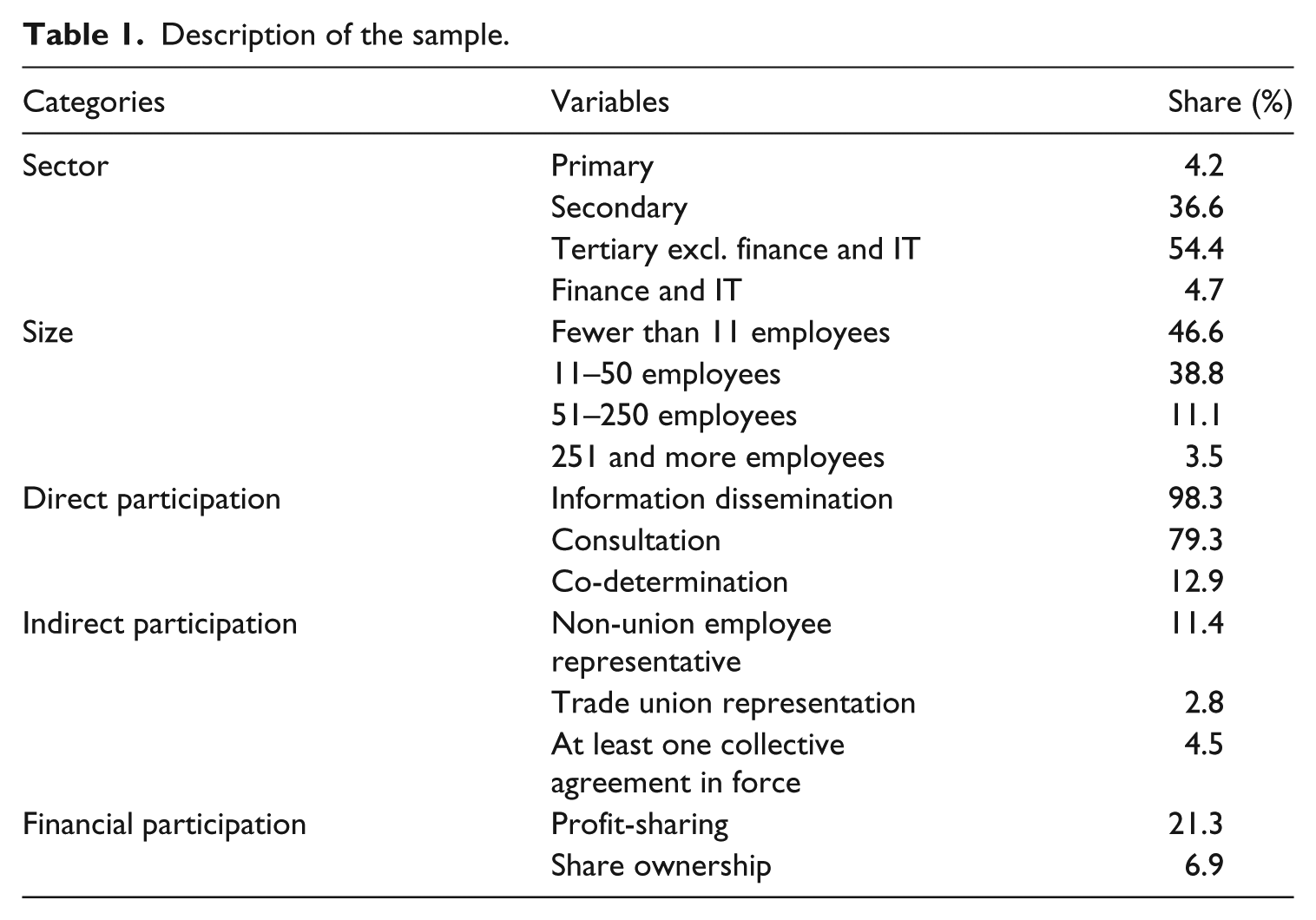
Such proportions are in line with some earlier studies (Jones et al., 2012; Welz and Fernandez-Macias, 2008), but the figure for employee ownership is almost three times lower than earlier results for Estonia, e.g. 22% of the surveyed companies had employee ownership in 2005 according to Eamets et al. (2008). This divergence can be explained by the formulation of the question in our study: we were not interested in the status of owners, but rather whether organisations actively and continuously use a broad-based employee ownership policy. In this vein, our result is consistent with the findings that previously active share ownership schemes were later closed in Estonia (Kalmi, 2004). The other result concerns profit-sharing, as previous studies have estimated it to be present in around 11% of Estonian companies (PEPPER, 2009). On the one hand, the difference probably stems from the sample as in our study representativeness of companies meant that most companies in the sample were small ones, 2 whereas the CRANET project, for instance, excludes companies with fewer than 200 employees. On the other hand, the time difference is indeed relevant: surveys reported in PEPPER (2009) were conducted in 2005 and earlier, while the Estonian economy was on the brink of rapid growth; our survey, however, took place right after the harsh economic crisis hit, when employers had revised their remuneration policies. Indeed, targeting profits together with employees could be much more attractive in a stagnating economic environment.
Concerning the motivation to adopt financial participation, the classic principal-agent theory fits according to which financial participation offers a way to align the interests of employees and owners/managers. When we asked respondents who reported profit-sharing or employee share ownership in their firms why financial participation was used, employee satisfaction and alignment of goals between employees and management were the two most frequently mentioned very important reasons (more than 50% of the respondents agreed to it). In the next section, the features of organisations with respect to financial participation are examined in more detail.
From Table 1 one can see that information dissemination is a standard participation tool and consultation is relatively widespread as well. Still, co-determination is rare. It is clear that different participation variables are implemented in a sequential manner. If there is co-determination present, consultation is also introduced. If consultation is present employees are also informed. Similarly, the variables of indirect participation are correlated (see Table 2).
Correlation matrix of the participation variables.
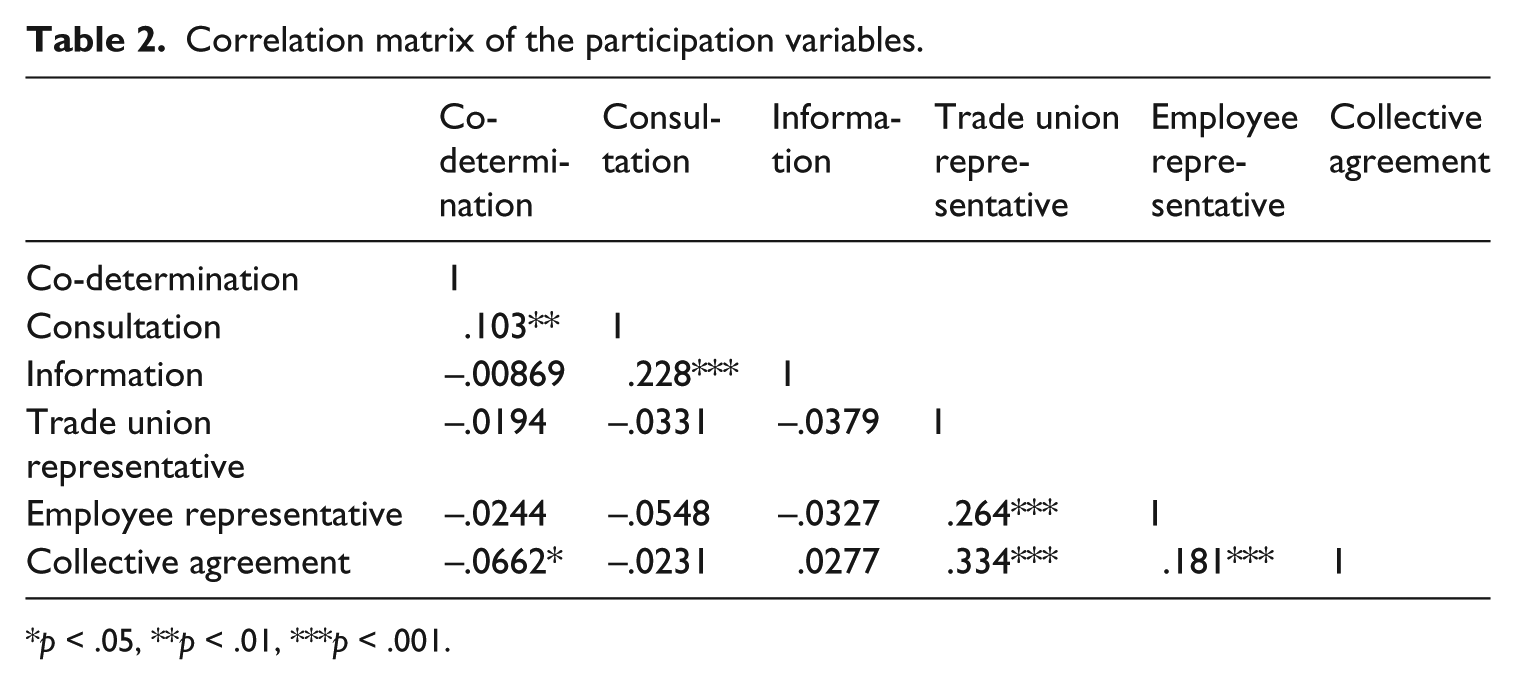
p < .05, **p < .01, ***p < .001.
In order to avoid a multicollinearity problem we combined the variables so that there would be one variable showing the presence of indirect participation with at least one of the following being present: trade union, non-union representative or collective agreement. For the direct participation there are four variables generated, which are mutually exclusive and indicate the intensity of participation. First, there is a situation where no participation takes place, followed by information dissemination only; third, there is an indicator for the situation where there are consultation and information of employees without co-determination. The fourth indicator denotes a situation where all three forms of participation are present (see study variables in Table 3).
Study variables.

Note: *denotes that employees are informed/consulted about either planned decisions affecting organisational structure and/or employment or about planned changes in work organisation; **denotes that employees have at least one of the following rights: (a) the right to suggest candidates to the executive or supervisory board; (b) the right to vote in the member elections to the executive or supervisory board; (c) the right to veto the assignment of a member to the executive or supervisory board; ***a collective agreement is considered to be present when there is a sector level agreement which regulates working conditions in the company, or there is an organisation level agreement present.
Results
In order to determine which organisational characteristics play a role in employee financial participation logistic regressions were run. Table 4 gives an overview of the distribution of the organisations depending on the use of financial participation (respondents, who ‘did not know’ whether they had financial participation or refused to answer were excluded from the sample) and Table 5 shows the results of logit regressions.
Distribution of organisations using profit-sharing or share ownership.

Logistical regression results for profit-sharing and share ownership, marginal effects.
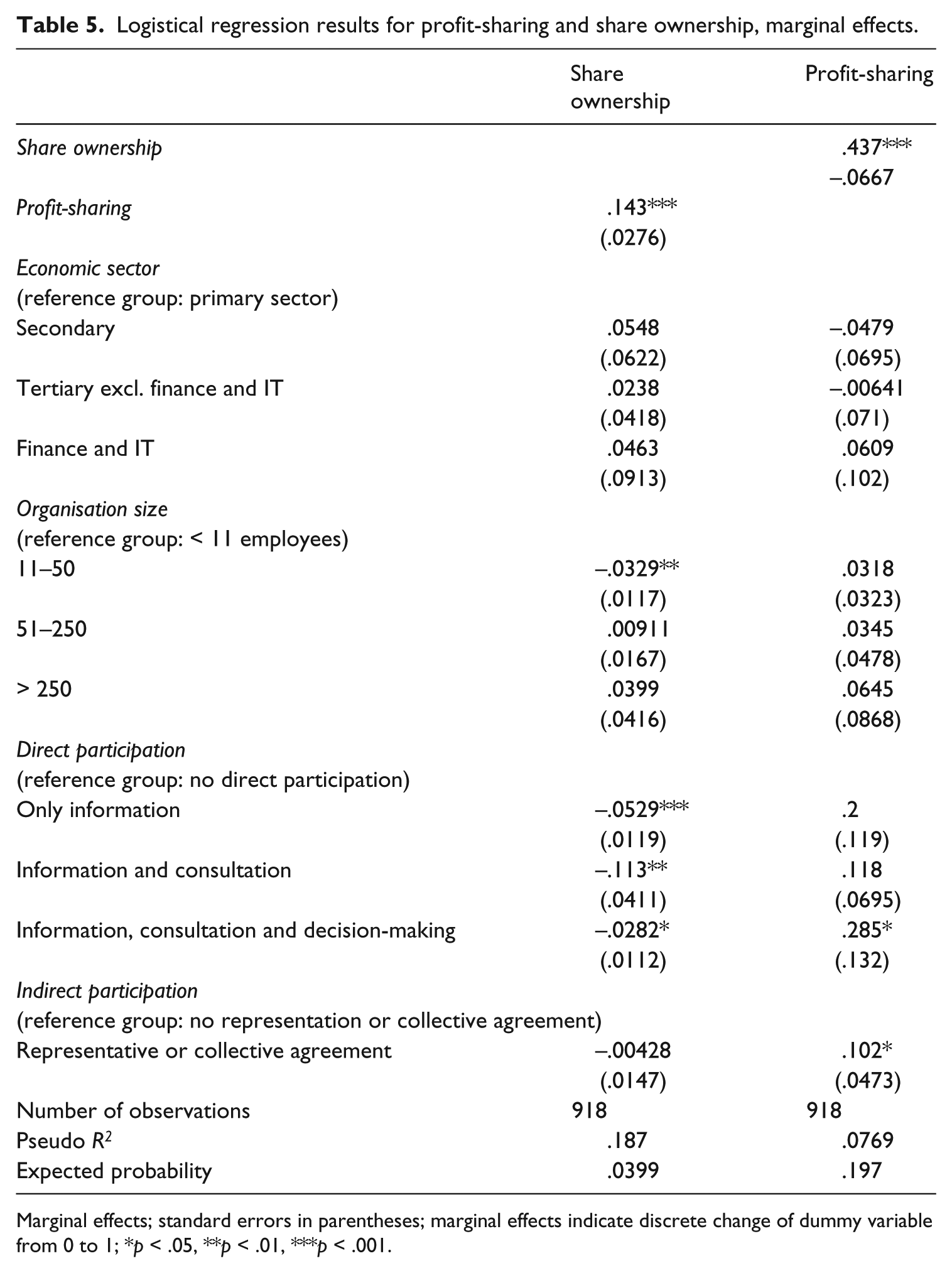
Marginal effects; standard errors in parentheses; marginal effects indicate discrete change of dummy variable from 0 to 1; *p < .05, **p < .01, ***p < .001.
The results confirm that employee financial participation in Estonian organisations is not statistically significantly related to the sector. Nor do the views that capital intensity is a negative predictor of employee ownership or that agricultural or knowledge intensive sectors are pioneering find any support. Profit-sharing demonstrates random distribution with regard to sector too, although Table 4 reveals the expected dynamics with regard to profit-sharing and the financial and IT sector. Adopting an innovative HRM practice like financial participation might be expected to characterise the companies in the financial services or IT sector, which are regularly at the top of the list of best employers. Yet, this is not the case and we can only add based on in-depth interviews and media observations that these companies invest a lot in the physical and psychological work environment and employee development, but performance-related monetary incentives are not so popular in these organisations. What these organisations seem to facilitate is employee intrinsic motivation and creativity rather than induce it by extrinsic rewards.
Furthermore, the Estonian financial sector almost entirely belongs to international corporations and HRM practices are designed in headquarters rather than locally. As the Estonian banking sector is controlled by the Nordic countries, where financial participation is much more deeply rooted in the culture (Jones et al., 2012; Welz and Fernandez-Macias, 2008), we could have assumed the spread of management philosophy from home country to subsidiaries in other countries. However, Lavelle et al. (2012), for example, reached the conclusion that despite a home country business system that supports financial participation schemes, foreign-owned multinationals operating in Ireland did not transfer these schemes to their foreign subsidiaries. It might be that similar tendencies take place in Estonia, too. A centralised HR function does not necessarily translate into similar HR policies across countries; moreover, there may be systematic biases. Borrowing the argument from a remotely related topic, Surroca et al. (2013) empirically demonstrated that demands by stakeholders in the multinational’s home country for greater corporate social responsibility (CSR) can serve as a stimulus for non-compliant behaviours in subsidiaries, especially if the latter are relatively autonomous. This kind of transfer was more likely if a multinational experienced financial strain and it operated in a more technologically intensive sector (both very true for the banking sector during the economic crisis in our sample). This is not to say that employee financial participation should be viewed as part of corporate social responsibility, but similarly to CSR the practices of employee financial participation may be distributed unequally throughout multinationals.
Regarding the size of organisations, the two regression analyses show different results. While profit-sharing is independent of the size and adds to the earlier results of Lavelle et al. (2012), Poutsma et al. (2003) and Pendleton et al. (2002), employee share ownership is more characteristic to micro enterprises with up to 10 employees compared to small companies of up to 50 employees. It might be speculated that in micro enterprises the founders are probably working themselves and as these firms are in constant shortage of capital, part of company’s equity is given to employees to attract qualified staff. This result is not surprising in the context of earlier studies for Estonia: Jones and Mygind (1999), Eamets et al. (2008) and Mygind (2012) all concluded that it was the smaller firms that retained employee ownership. It is also in line with anecdotal evidence that start-ups which certainly have fewer than 10 employees use employee share ownership and a promise of future profits as a substitute for salaries they are unable to regularly pay out.
Turning to participative decision-making, financial participation behaves differently depending on the scheme. Compared to the situation where there is no employee participation whatsoever, consultation and co-determination do marginally increase the chance for profit-sharing. This may indicate what Poutsma et al. (2006) stressed in their study: profit-sharing alone cannot fulfil the aims of employee higher productivity and motivation. Complementarity goes for indirect participation as well: if a company has an employee representative or trade union representative (or both) the likelihood of profit-sharing is higher compared to the situation where no indirect participation is in place. A positive relationship between profit-sharing and employee representation is in line with some previous studies (Croucher et al., 2010; Kraft and Ugarkovic, 2006; Poutsma et al., 2006), but the explanation for it is not so straightforward, given the adversarial relationship between trade unions and management in Estonia (Kallaste et al., 2008) and previous studies demonstrating trade unions’ negative impact on financial participation. Here one has to take into account that only 2.8% of organisations in our sample had trade unions, 3 more often than not we are talking about an employee representative, who may but need not be a true representative of employees (Kallaste et al., 2008). In the Estonian context, having a non-union employee representative often refers to an employer initiative to have a consultation partner on the employees’ side (Kallaste et al., 2008) and as such, it is a reflection of relatively good employee–management relations in general. Against this background, the joint emergence of profit-sharing and employee representatives may be better explained.
But in this light it is intriguing that our study did not find complementarity between share ownership and the need for representation. It might be speculated that employee ownership in Estonian organisations has ameliorated conflicts of interest or, more likely, these conflicts are handled through different channels, e.g. the HR department or (in)formal meetings. Given the fact that share ownership concerns mainly micro enterprises, the latter is more likely.
When it comes to direct participation more information dissemination or consultation is even detrimental to share ownership. Curiously enough, it appears that in companies where employees were able to buy company shares managers tended to respond negatively to all aspects of the questions regarding direct participation. This may indicate that once employees become partners in the micro enterprise they work for, the manager does not deem it necessary to inform and consult them top-down any longer, as the whole relationship has transformed. In addition, information and consultation topics as defined in law are quite technocratic: e.g. the structure of the employer, the staff, and planned decisions which significantly affect those – these issues may be irrelevant since they are dealt with organically in day-to-day operations.
But outside the context of micro firms this result can be interpreted such that employees are passive owners whose rights are limited to nominating and voting for the members in executive bodies and receiving dividends if there is a profit, but other than that their participation in strategic decision-making is even smaller than in a regular company. This implies that there is a management-dominated culture not only in general (Mygind, 2012), but also in those organisations where employees are shareholders, minor or major. Poutsma et al. (2006) found a negative relationship between participation and stock options and suggest that broad-based stock options serve different purposes than employee involvement, such as providing rewards where there are liquidity constraints on the firm. We add that the position of a shareholder gives somewhat better access to strategic information and knowledge if it now becomes an employee’s responsibility.
Finally, the strong link between share ownership and profit-sharing itself calls for attention. On the one hand, ownership and profit-sharing are of course intrinsically linked and this has been found in previous studies (Kaarsemaker and Poutsma, 2006; Poutsma et al., 2006). On the other hand, one should also note that this relationship indicates that profit-sharing as an autonomous HRM practice is sparse. Only in 17% of companies is the profit-sharing autonomously present, not taking into account the companies where both profit-sharing and equity ownership exist. Although this figure is much higher compared to companies with share ownership, it is still far lower than in some other developed countries. For comparison, in the neighbouring country Finland, cash-based profit-sharing amounted to 39% of all observations in the manufacturing sector in 2005 (Jones et al., 2012: 1579). In the US, the share of companies offering some profit-sharing was 33–40% between 1993 and 1998 (Dube and Freeman, 2010: 190).
When our respondents with no financial participation were asked why they did not use it, 30% reckoned that employees had no right to the capital stock or profits, while 17% said that they had simply never thought about this option. The role of socio-economic reasons behind these gloomy figures deserves further analysis: we suggest that two decades of capitalism with extremely volatile economic growth rates has not been a fertile ground for the emergence of employee financial participation. Instability may have shaped the attitude that periods of profit are necessary and entitled to be kept among owners in order to overcome steep decline. Also, there seems to be a lack of interest on the employees’ side and that said, employee financial participation may not be an appropriate and desirable HR policy for post-communist Eastern European countries to begin with. At the same time we agree with Blasi and Kruse (2012), who claim that existing public policies and tax incentive regimes favouring concentration of capital ownership and capital income are the biggest barriers to employee financial participation. To date the development of social dialogue in Estonia faces stumbling blocks on both socio-economic and political fronts, never mind the efforts by the European Commission or International Labour Organisation.
Summary and conclusions
This study was undertaken to explore organisational determinants of financial participation in a context which diverges substantially from Western European countries in terms of social partners’ support for employee participation in general and financial participation in particular. Poutsma et al. (2012) claim that decentralisation and deregulation facilitate employee financial participation to gain competitiveness, but while these processes have been drastic in Estonia, financial participation has remained a peripheral phenomenon. This led us to study if organisations that use financial participation have any specific features.
The results revealed that, overall, financial participation was largely independent of size and sector with one reservation – micro enterprises are more likely to offer employee share ownership than small firms in general. The most compelling relationship emerged between the forms of financial participation themselves – profit-sharing can be found in organisations with employee share ownership, and employee ownership leads to profit-sharing. Just as Estonia has no historical tradition regarding profit-sharing except for company bonuses administered by trade unions during Soviet times, this has not gained remarkable momentum within the transition period, even though some progress compared to the year 2005 can be pointed to. In contrast, employee share ownership should be a more familiar practice as during early privatisation many employees, especially in agriculture and small firms, became owners of their organisations. Unfortunately, stock options are available for employees in even fewer companies.
The second research motivation was to address the question of complementarity of financial participation and participation in decision-making as it is suggested that financial participation is often part of the ‘package’ (Pérotin and Robinson, 2003). In our study, some evidence for complementarity was there for profit-sharing, but not for share ownership, which corresponds to what Poutsma et al. (2006) and Croucher et al. (2010) have found. In those companies where profit-sharing was introduced, employees were more often informed and consulted on strategic issues such as prospective decisions on organisational structure or work organisation. As for indirect participation, profit-sharing was more common in organisations having union or employee representation (or both). Share ownership demonstrated negative relationships with direct participation, which can in part be accounted for by the contents of consultation stipulated by law (e.g. the structure of the company) that are not relevant for small businesses per se. Also, managers may view stock-holding employees as equal partners. In larger companies, on the other hand, employees’ improved access to information may lessen the need for information/consultation initiatives by the management. Hence, in the case of Estonia there is some evidence of complementarity between profit-sharing and participative decision-making, but overall the effect is rather limited.
Regardless of the fact that in most Eastern European countries financial participation has not shown any sign of an increase, there are authors who remain optimistic, for example Mygind (2012) believes that with an increase in income levels, advanced production and relevance of human capital employee financial participation will gain greater importance in the future. For now, these predictions are subject to cautious reservation, at least in the Estonian context.
The current study bears some clear limitations. For one, regardless of the wording of questions during the interview we cannot be sure that respondents had in mind genuinely ‘broad-based’ profit-sharing and/or share ownership. Therefore, we believe our data on financial participation are over- rather than underestimated. Second, many potentially relevant variables are omitted from the analysis as the establishment of the anonymity of participating companies restricted our data collection, i.e. we could not link business register or any other secondary data with the respondents. Thus, we could not control for actual company ownership (domestic vs foreign), financial statements reflecting company performance, capital intensity, age, etc. All these variables may affect the relationships studied and their inclusion should be a part of the future research agenda.
Footnotes
Acknowledgements
The authors are indebted to the anonymous reviewer of Economic and Industrial Democracy, the participants at the Estonian Economic Association Annual Conference in January 2014 and Kristi Raudsepp for her excellent research assistance. The research was undertaken under the Project IUT20-49 ‘Structural Change as the Factor of Productivity Growth in the Case of Catching up Economies’.
Funding
This work was supported by the European Social Fund. The data were collected in the framework of industrial relations research for ‘Mapping Industrial Relations and the Problems of Social Dialogue’ financed by the ESF programme for the improvement of the quality of working life 2009–2014.