




Abstract
The article presents the debates on youth unemployment developed in Greece and Ireland by the social actors before and after the outbreak of the economic crisis. The article examines policies of actors (employers, unions, policy bodies) and analyses whether their responses fit within neoliberal, flexicurity or social Europe discourses. It looks at how youth unemployment debates are framed in two different national settings and whether institutional differences affect the convergence towards or divergence from the neoliberal discourse. The article establishes that discourses of Greek social actors are more conflictual than those in Ireland where the history of social partnership is still evident. There is also evidence of changes in policies and discourses pre- and post-crisis.
Introduction
The article looks at the relationship between the Greek and Irish national debates on youth unemployment with the institutional settings of those two countries. The objective is to identify the discourses of the Greek and Irish social actors in Greece and Ireland and examine the differences and similarities between them. The comparison of Greece and Ireland has been chosen because they belong to different institutional and socio-economic settings and therefore their youth unemployment debates are expected to incorporate different sets of ideas. The material analysed in the article provides original research findings on how youth unemployment has been framed in Greece and Ireland and what the influence of the crisis has been to this formation. Therefore the time frame of the article includes the period from 2007 (pre-crisis) until 2012 (post-crisis). By comparing two countries that have been severely affected by the economic crisis and at the same time have different path dependencies, the article contributes to the convergence–divergence debate in a period where national states are under pressure to adopt the dominant neoliberal paradigm (Centeno and Cohen, 2012: 332).
The article is divided into eight main sections. The first offers a brief introduction to the context of the research while the second presents the competing sets of ideas framing the different neoliberal, social Europe (democratic) and flexicurity discourses. The third introduces the main institutional theories that underpin the contrasting comparison of Greece and Ireland and recent debates on the impact of the crisis on convergence–divergence. The fourth section presents the research assumptions of the article. The fifth section includes the research methods. The sixth section presents the empirical findings on youth unemployment in Greece and Ireland. The next section examines the implications of the findings for the research hypotheses of the article. The last section concludes with the main research findings and some policy ‘lessons’ drawn from this study.
Context: Youth employment during the crisis
The eruption of the economic crisis in 2008 has caused a severe unemployment crisis as many employees have been made redundant and at the same time the possibilities of finding a new job have been seriously undermined by the extended period of crisis (Eurostat, 2012). Although the crisis has widespread effects on labour market, some segments such as young people have been especially hard hit as their unemployment rates have increased dramatically and their labour market position has deteriorated across socio-economic settings (Dietrich, 2013: 306). Evidence provided by Eurostat (2012) has shown that young people’s unemployment rates have increased more than those of their adult counterparts. In many countries young people have been particularly hit by the economic crisis as jobs for new labour market entrants have been reduced and job destruction disproportionately affects young workers due to their employment status, particularly the predominance of temporary contracts for this group (Bieling, 2012: 266).
Despite the deterioration of youth employment across the European Union, some countries such as Greece and Ireland have been particularly hard hit due to the severity of the economic crisis (Eurostat, 2012). As shown in Figure 1, youth unemployment has dramatically increased in both countries since the crisis and currently stands at almost fifty percent for Greece and thirty percent for Ireland. In addition, and most crucially, Greece and Ireland were the first members of the EU to be rescued through bail-out agreements and to lose part of their state sovereignty through the commitment to implement particular economic and labour market reforms imposed by the Troika; European Central Bank (ECB), International Monetary Fund (IMF) and European Union (EU). The effects of the labour and economic reforms implemented under the Memorandum Agreements signed between each of the two countries and the Troika have brought about unprecedented changes in the employment systems and industrial relations which have put further pressure on the employment prospects of young people.
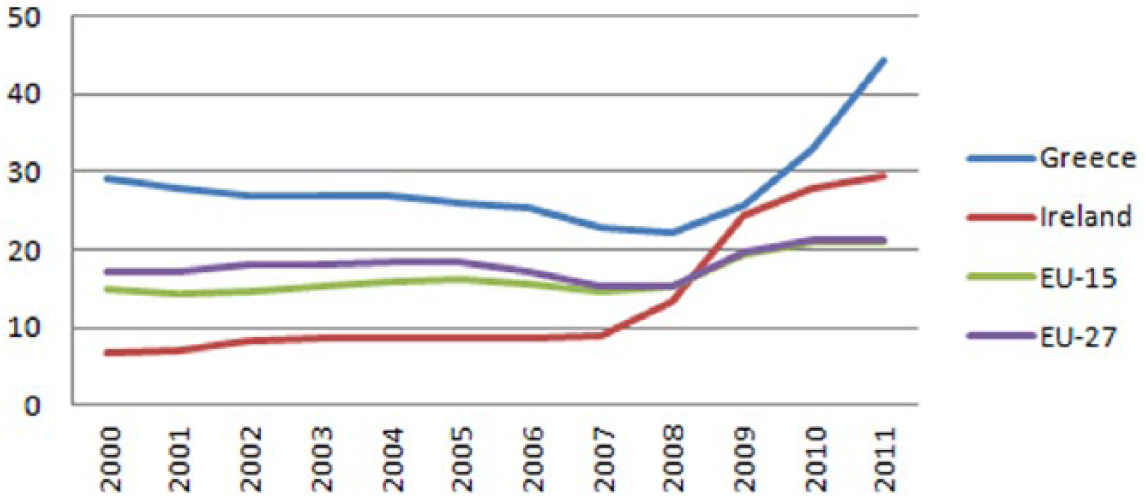
Youth unemployment in Ireland, Greece, EU-15 and EU-27, 2000–2011.
In Greece, young people have traditionally faced high levels of unemployment mainly due to the significant gap between the amount of higher and technical education graduates and the demand for highly skilled workers created by the Greek economy (Karamessini, 2008b). Despite high wage flexibility (Livanos, 2010), the labour market reforms implemented as part of the Memorandum have targeted specific areas of employment relations such as overtime costs, minimum wages for young people, redundancies, flexibility in the labour market and compensations. The new law (Law 4046/2012), derived from the Memorandum 2, requires the general reduction of minimum wages by 22% for all and by 32% for all workers under 25 regardless of their occupation and sectoral agreement coverage (Ministry of Labour and Social Insurance, 2012). These Acts, in combination with the severe austerity policies such as high direct and indirect taxation, drastic reduction of social expenditure and public sector reforms (wages cuts and dismissals), have led to an overall deterioration of living standards, steep increases in unemployment and continuous recession (Koukiadaki and Kretsos, 2012: 302).
In Ireland the austerity measures implemented as part of the bail-out agreements have included higher taxes, lower public spending, significant wage and social welfare reductions and public sector cuts. Specifically, the labour market reforms introduced by the Irish government as part of the National Recovery Plan included the review and prospective weakening of the wage-setting mechanisms such as Registered Employment Agreements and Employment Regulation Orders established before the crisis, and significant reform of the welfare system through cuts in the levels and duration of benefits. Also, the introduction of tougher activation policies and the significant reduction of replacement rates were primary elements of the attempt of government to reduce the welfare expenditure and increase employment participation (IMF, 2012). In relation to young people, in 2010 the Irish government introduced cuts of €100 and €150 per week to the Jobseekers Allowance benefits for those under 25. Since the outbreak of the crisis and the implementation of the austerity measures, Ireland has experienced one of the highest increases in national debt and a significant drop in the household income (Kinsella, 2012).
Three discourses on youth unemployment: Neoliberal, social Europe and flexicurity
The article draws on three discourses (neoliberal, social Europe and flexicurity) on youth unemployment. These discourses constitute competing paradigms which view the origins of youth unemployment and policy actions required to solve it differently. Furthermore, these discourses have been dominant in the formulation of youth employment policies at both European and national level while at the same time leading political and social actors (political parties, trade unions and employers’ associations) have employed them frequently in the last three years when they have responded to labour market problems.
The first paradigm is the supply-side discourse, which considers youth unemployment to be the result of constraints imposed by institutions on the supply-side of the labour market (Russell and O’Connell, 2001: 12). The advocates of this perspective argue that ‘rigid’ labour market arrangements such as employment protection, minimum wages for young workers, social support for the unemployed and trade union intervention impede the integration of young people into the labour market, increasing unemployment and creating an insider–outsider divide (Gregg and Manning, 1997). The solution put forward within this discourse is the reduction or abolition of the labour market restrictions (rigid wage costs) so that the wages of young workers are determined by their skills and qualifications rather than by ‘rigid’ and ‘ineffective’ political arrangements (OECD, 1994). This discourse also contends that youth unemployment originates from a mismatch between labour market supply and demand stemming from the incapacity of the labour market to generate the skills and qualifications required. The advocates of the supply-side discourse also argue that welfare provision should become conditional on participation in the labour market through workfare programmes and sanctions-driven social policies otherwise it deters the entrance of young people into the labour market (Scarpetta et al., 2010).
The arguments advanced by neoliberals have been disputed by accounts that point to the ineffectiveness of supply-side theories to understand and solve youth unemployment (Heyes et al., 2012). For the purposes of this article this discourse is called ‘social Europe’ and is informed by social-democratic ideas. From this perspective, youth unemployment is positively correlated with macro-economic conditions such as labour market demand, existence or not of job opportunities, and applied economic policies (Müller, 2005). The same accounts reject the argument that unemployment is due to individual skills shortages or labour market rigidities, claiming that youth unemployment has increased in countries with unregulated as well as regulated labour markets (Sukarieh and Tannock, 2008). Instead, advocates of this discourse have regarded the contemporary labour market problems facing young people such as low quality and paid jobs or/and cyclical unemployment spells as the results of the economic policies and business strategies and not the outcome of individuals’ skills shortages or high youth wages (MacDonald and Marsh, 2001). According to the social Europe discourse, job creation policies, job protection, quality jobs and social assistance for young unemployed are substantial components for regenerating the economy and resolving youth unemployment (Heyes, 2011: 654–655). Another distinctive feature of the social Europe discourse is the idea that the provision of welfare is a collective responsibility carried out by state mechanisms and Keynesian-inspired economic and social policies (Roper et al., 2010: 663).
The third discourse which has informed academic analyses and political intervention on youth unemployment is that of flexicurity. At the political level, flexicurity came to prominence due to the initiatives undertaken by EU institutions in the field of employment relations. The first active intervention of the EU was the introduction of the European Employment Strategy in 1997, which aimed to provide employment guidelines to member states in order to increase employment growth and quality jobs in the EU by providing both labour market flexibility (the right to hire and fire) with strong social security provisions and retraining opportunities to protect workers if they are made redundant. Securing the labour market position of young workers has been portrayed as one of the positive aspects of flexicurity in the light of the increasing deregulation pressures on member states (Van Lieshout and Withagen, 2002). The difficulty experienced by most EU countries to achieve this objective led European Union leaders to focus on new labour market policies capable of facilitating economic growth and competitiveness while also providing security to employees. Flexicurity has since taken a central position in the European employment discourse and has also attracted considerable academic interest (European Commission, 2007). However, the economic crisis has exerted considerable pressure on flexicurity as both neoliberal and social-democratic discourses highlight the limited resources available for flexicurity policies. At the same time, Meardi (2011) points to the irrelevance of flexicurity discourse in light of labour market deregulation and reduces social security. The use of the flexicurity discourse by the European Commission has therefore been rather limited since the crisis as the emphasis on supply-side measures has prevailed in the EU recommendations to the member states.
Despite the proclaimed objective of flexicurity to strike a balance between protection and flexibility, a series of social Europe accounts have criticized the supply-side and individualized orientation of the concept (employability and activation) for depoliticizing unemployment and throwing the blame and responsibility onto people’s actions and motivations (Hyman, 2010). The difference between the flexicurity discourse and the neoliberal, on the other hand, is that the former recognizes the dangers of social insecurity during unemployment and job-to-job transitions and proposes the introduction of social security support throughout young people’s transitions into the labour market (Burroni and Keune, 2011: 84).
Continuity or change? Convergence or divergence?
One of the most persistent questions posed by many commentators is whether the increasing economic pressures produced by the internationalization of the economy have led to convergence towards the neoliberal model (Baccaro and Howell, 2011) or whether the diversity of national institutional regimes means these common pressures are filtered and lead to continued divergence (Jackson and Deeg, 2012). Although the debate is continuous and unresolved, this article endeavours to shed some light on whether the institutional diversity has produced different responses to pressures for liberalization and neoliberal restructuring under conditions of ‘economic crisis’. In doing so, the article draws on a body of literature that explores whether different countries will adopt different set of ideas and policies to deal with similar problems due to their disparate institutional and social-economic arrangements (Gourevitch, 1986; Sacchi et al., 2011). The latter are argued to create path dependencies and past trajectories through which the policies and ideas of governments and social actors are filtered (Teague, 2009: 502).
However, the premises upon which institutional theories have been built have been criticized for not taking into account institutional change and path breaks. Pierson (2004: 134) argues that even though path dependence is strikingly enduring, shifts in the environmental conditions, changes in power relations and unexpected institutional effects can generate institutional change. This observation is very valuable for this article as it helps to operationalize the role of external factors such as the current economic crisis, and its potential effect on path breaking. However, despite the potential capability of external (crisis) or internal (power distribution) influences in institutional change or revision, Pierson notices that, even in cases of change, social actors continue to make decisions which are bound to institutional factors and ideas prevalent before the change (Pierson, 2004: 52). Three main theories are therefore drawn on to generate hypotheses concerning the differences and similarities between Greece and Ireland. These are the Varieties of Capitalism (VoC), the welfare state typology and the political ideologies-legacies theory (Esping-Andersen, 1990; Hall and Soskice, 2001; Hyman, 2001).
In a nutshell, the VoC argues that the coordination of economic and social relations in different countries takes place through diverse paths. The widely known distinction drawn by VoC theorists is between Liberal Market Economies (LMEs) and Coordinated Market Economies (CMEs) where in the former coordination is streamlined through market mechanisms, whereas in the latter coordination takes place through non-market mechanisms (Hall and Soskice, 2001). Many academic accounts have conceptualized Ireland as a typical LME country where market mechanisms play the predominant role in coordinating the economic and social relationships of the system (Hall and Gingerich, 2009: 453). Features of the Irish economy include a flexible labour market system and the incorporation of neoliberal policies (Crouch, 2005). Research by Hardiman (2009) has showed that Irish economic policy verifies the generic postulates and expectations of the VoC theory as the general skills development and the complementary usage of conditional and targeted welfare policies are both in line with LMEs’ complementarities. Although in the initial writings around VoC Greece was not clustered as either a CME or an LME, subsequent work has developed new categories or clusters of countries (Molina and Rhodes, 2006). According to these authors the socio-economic characteristics of the Mediterranean countries such as extensive state regulation, familistic welfare support and high employment legislation have created a new cluster or a variety of capitalism known as ‘Mediterranean’ (Featherstone, 2008).
In a similar vein, the welfare state literature has assumed that different countries possess diverse social policy configurations which give rise to distinctive types of capitalism, or in the words of Esping-Andersen (1990), different types of welfare capitalism. In the academic literature, the first attempt to conceptualize the welfare type of Greece came from Ferrera (1996), who categorized it as a Southern European welfare model of capitalism, the so-called ‘Mediterranean welfare state model’. Among the qualities attributed to this type of welfare state the following are included: a highly fragmented system of income maintenance, high labour market regulation, a low degree of social provision, selective distribution of benefits and privileges (clientelism) and a strong role of the family in the provision of support (Ferrera, 1996). On the other hand, many academic accounts have classified Ireland as typical example of the Liberal or Anglo-Saxon type of welfare state characterized by low decommodification, the primacy of the market, high spending in active labour market policies, minimum social benefits, little redistribution, private provision of social needs and strict entitlement criteria (Arts and Gelissen, 2002; Esping-Anderson, 1990; Leibfried and Pierson, 1992).
A third strand of path dependency theories which has been used to explain divergence between national states is that of the political ideologies-political legacies theories (Dyson, 2000). This broad category involves diverse theoretical accounts of political culture and ideology centred on the following three themes: trade union identities, structures of representation and nature of political ideologies. These three are argued to contribute to the creation of legacies or path dependencies which, in turn, condition the choices and ideas available to the social actors (Gunther et al., 1995). In the literature, Greece and Ireland have been conceptualized as different cases in relation to their representation structures, their ‘political traditions’ and their trade union politics (O’Regan, 2010). The industrial relations traditions of Greece and Ireland belong to different models of representation. In Ireland the social partnership tradition flourished for approximately 20 years, whereas in Greece social concertation never reached an analogous level and the interest representation structures are fragmented and particularistic, resembling an underdeveloped type of corporatism (Antoniades, 2007: 325). As many strands in the literature have pointed out, there is a tendency for less cooperation in Greek industrial relations due to the propensity of governments to legislate rather than negotiate reforms and the significant organizational capacity of unions in particular sectors (Kelly et al., 2013; Matsaganis, 2007).
In relation to the ‘political tradition-culture’ strand, the two countries differ significantly as in Ireland the historical legacy of past conflicts inhibited the polarization of the Irish society along class lines (D’Art and Turner, 2011). Instead, due to the national war, the political culture of unity, community and uniqueness strengthened and the creation of a politicized class-based discourse was deemed disastrous to the peaceful growth of the society (Mair, 1992: 407). On the other hand, in Greece the adversarial and conflict-driven nature of the political culture has its origins in the development of social and political resistance movements against the authoritarian and repressive political regime (dictatorship) and the employers’ anti-unionism emerged under this regime (Karamessini, 2008a).
Finally, trade unions politics are different in the two countries. In Ireland the tradition of social partnership weakened the development of class-informed discourses and influenced the identities of the unions and their relations with employers and the state. To understand the reasons behind the differences between the trade unions’ responses in Greece and Ireland, Hyman’s (2001) ‘geometry of trade unionism’ is helpful (see Figure 2). The Irish trade union movement has been marked by the experience of social partnership which was initiated in 1987 and lasted for nearly 22 years, until 2009. The focal point of trade union activity shifted from voluntary collective bargaining to that of negotiation and consultation in the planning and implementation of the national economic and social agenda, including the modernization of welfare state and labour market reforms (Roche, 2007). Being in line with the typical elements of the civil society unionism identified by Hyman, social partnership can be placed in the society identity of Hyman’s triangle (Hyman, 2001). The specific type of unionism accepts the existing capitalist order and its structural elements (wage system and property relations) and attempts to increase workers’ benefits through collective bargaining (Hyman, 2001). Thus, the Irish unions have been interplaying between the society and business unionism identities of the Hyman’s triangle.

Hyman’s triangle.
The interplay between social-democratic (political) and radical-socialist (class) unionism has defined the development of the Greek trade union movement. The strong ideological divisions within the trade union movement in Greece and the presence of communist forces have facilitated the coexistence between ‘accommodating’ and ‘contention’ union identities. Specifically, the General Confederation of Greek Workers’ (GSEE) official strategy supports the collaboration of trade unions with employers and the state through institutionalized social dialogue and consensus collective bargaining agreements. By contrast, the communist-backed trade union, PAME (All-Workers Militant Front), has supported a radical political and economic discourse rooted in Marxist-inspired ideology. The radicalization and politicization of workers’ struggles through mobilizations and political struggles against employers and the government has been proposed by PAME as the best strategy for protecting workers’ rights and advancing their interests. Thus, in line with some of the features of radical political unionism outlined by several authors (Connolly and Darlington, 2012; Upchurch et al., 2009), PAME adopts an anti-capitalist rhetoric, a confrontational repertoire of action and a class-based approach while it considers the consensus agreements and the social dialogue processes adopted by GSEE as a betrayal of the interests of the working people and the needs of the trade union movement. The relationship between the two, therefore, is characterized by continuous conflict and disagreement over the direction of the Greek labour movement and the specific strategies through which workers’ interests can be protected. Going back to Hyman’s conceptual framework (2001), GSEE falls into the political economism and business unionism identity whereas that of PAME falls into the class identity.
Research hypotheses
Drawing on the theoretical assumptions developed above, the following research hypotheses have been developed in order to evaluate the extent to which the institutional settings and political tradition-culture of the two countries produce different youth unemployment debates. First, the VoC and welfare state theories lead to the following emerging assumptions. In particular, it is assumed that the Greek institutional characteristics will prevent the adoption of neoliberal and flexicurity ideas and they will give rise to a youth employment policy centred on the notions of job protection, social regulation and state intervention. The Irish institutional features, on the other hand, are assumed to create an institutional environment where the ideational frameworks used to comprehend labour market problems will be more susceptible to neoliberal and flexicurity ideas. The research hypothesis derived from the political ideology-political legacy features of the two countries is that the Greek youth unemployment debate will be highly polarized and contested reflecting the political culture, trade union identities and the structure of representation of the Greek system. By contrast, in Ireland youth unemployment debates will be characterized by more consensus and less radicalism reflecting the tradition of social partnership, the unity-based political culture and the unions’ identities.
Methods
The article explores how youth unemployment has been manifested and dealt with in different institutional and politico-economic environments under economic crisis conditions. In this research design, the cases are selected due to their different historical, institutional and economic structures and also due to fact that significant external pressures (economic crisis, youth unemployment, European employment policies) have been exercised on both. Therefore, the primary device for conducting this research is an analysis of whether, and if so how, the crisis has contributed to a process of convergence towards the same policy framework or if certain elements of path dependency of Greece and Ireland facilitate the prevention of such a convergence trend. The inclusion of the crisis as an important factor in defining and redefining the interests and ideas of the social actors helps to reveal the role of the political and economic changes (economic crisis) in the construction of convergence or divergence trends.
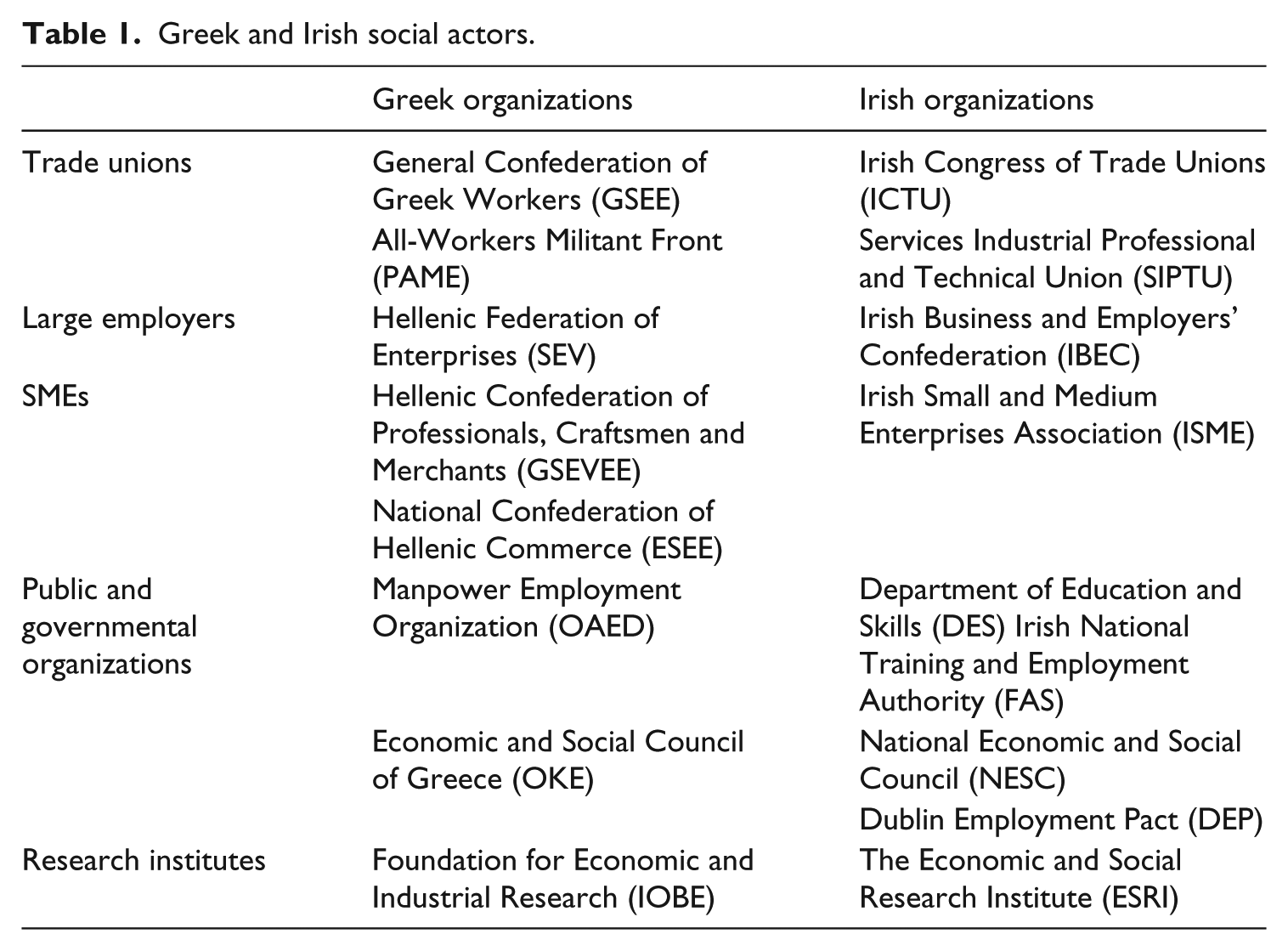
Twenty-five semi-structured interviews were used as the primary source of data. Conducting interviews using a semi-structured form enabled the research to draw rich accounts and deeper understandings of interviewees on the topic. The interviews were conducted between May 2010 and September 2011. The interviewees consisted of senior actors such as directors from the Greek Foundation of Economic and Industrial Research (IOVE), the National Confederation of Hellenic Commerce (ESEE), the Irish Economic and Social Research Institute (ESRI) and the Irish Small and Medium Enterprises Association (ISME); vice-presidents from the Dublin Employment Pact (DEP), the Hellenic Confederation of Professionals, Craftsmen and Merchants (GSEVEE), the Economic and Social Council of Greece (OKE); secretaries for youth from PAME and GSEE; and directors of youth programmes in their organizations from the Irish National Training and Employment Authority (FAS), the Manpower Employment Organization of Greece (OAED), the Irish Department of Education and Skills (DES) and the largest Irish trade union, SIPTU. The selection of social actors (see Table 1) was based on their participation in the institutional forms of social dialogue and their political-social influence in their national context. Although some of the actors included in the research do not officially participate in institutionalized forms of social dialogue, nevertheless their influence is manifested through other forms of action such as industrial action. Second, the selection of social actors and organizations was based on their involvement in issues directly or indirectly related to youth employment. The selection of the specific interviewees within the organizations was based on the following criteria. First the researcher approached key gatekeepers in both Greece and Ireland and conducted thorough discussions with them in relation to the actors within organizations who are responsible for youth unemployment within the specific organizations. The gatekeepers directed the researcher to specific people whose responsibility within their organization was to deal with issues related to youth unemployment, labour market and social welfare for young people or issues related to young people in general. The interview questions were related with certain thematic categories associated with the three discourses as they attempted to disclose the discourses of the social actors in relation to youth unemployment issues. Questions on labour market flexibility, welfare state provision for young workers, the role of the state in the provision of benefits, appropriate state policies for tackling youth unemployment, regulation–deregulation of the labour market, the role of the social partners and the balance between flexibility and security were directly linked to themes and issues identified in the literature review. The collection of documents, reports, newspaper articles, press releases, statements and leaders’ speeches were also employed as important material for identifying general trends in youth unemployment debates. Both documentary data and interviews were constructed in such a way that the study of youth unemployment discourses could take into consideration the comparison between pre-crisis and the period since the crisis.
Greek and Irish social actors.
Where interviews were given in Greek, these were translated by the researcher into English. The analysis of the data was mainly undertaken using Nvivo software. This article applies some of the methodological assumptions of previous research such as that Nvivo enables the discovery of similarities and differences between organizations and therefore assists in understanding and mapping the meaning and interpretations behind certain opinions or discourses (Holgate, 2013: 10–11). In this research, Nvivo enabled the analysis of how the three discourses materialized within the specific national contexts and to categorize them into thematic categories or, in Nvivo’s language, ‘nodes’ (Dibben and Nadin, 2011: 60). The coding phase included a systematic tagging of the text with pre-existing codes through questions about the data and development of new codes or thematic categories. This process assisted in linking the main pre-existing themes or emerging ones with the data and provided answers to the question regarding the use of those themes by the social actors. The use of memos was a crucial part of the analysis process as it included the thoughts of the researcher in relation to which discourse or node appears to be more dominant for each category of actors.
The discourses of social actors before the crisis
This section presents the main discourses on youth unemployment employed by the Greek and Irish social actors in the period before the crisis. The findings are presented for each social actor of both countries so that the differences and similarities between the two cases can be traced.
Trade unions
Before the outbreak of the crisis the Irish trade union organizations, the Irish Congress of Trade Unions (ICTU) and the Services Industrial Professional and Technical Union (SIPTU), as the largest affiliate of ICTU, agreed with basic features of the Irish neoliberal model such as attraction of foreign direct investment through low corporate taxes, flexible labour market, sub-wages for young people, low social expenditure and the need for filling in labour shortages through training programmes. On the other hand, despite their adherence to the liberal flexible employment regime, the trade unions accepted the flexicurity idea according to which more protection within (contractual arrangements for vulnerable workers) and outside (social security) the labour market could enhance the employment prospects of young people. By contrast, the Greek trade union organizations addressed the increasing flexibility and low protection for young workers and in line with the social Europe discourse, focused on the need to improve employment protection and reject liberal labour market reforms. Differences also emerged between the two organizations as the General Confederation of Greek Workers (GSEE) supported the initiation of active labour market policies (ALMPs) for tackling youth unemployment, while the All-Workers Militant Front (PAME) considered ALMPs as a means to support cheap labour.
Employers’ associations
The pre-crisis position of the Irish employers’ organization focused on the need to maintain flexible employment arrangements and low labour market regulation. The Irish Business and Employers’ Confederation (IBEC) supported the introduction of sub-wages for young people and highlighted the need to maintain and strengthen wage flexibility. In the Greek case, the Hellenic Federation of Enterprises (SEV) urged the government to ease the high employment protection legislation and reform the educational system in order to accommodate the entrance of more people into the labour market. SEV stressed the need for minimum wage reduction in areas with high unemployment or companies facing financial problems but it also remained committed to collective bargaining agreements and the principle of a minimum wage.
In line with SEV, the National Confederation of Hellenic Commerce (ESEE) pre-crisis position focused on the supply-side of the labour market, the need to provide greater labour market flexibility and to strengthen links between education and labour market. The main policy proposition generated by ESEE was that structural reform of the educational and vocational training system was required in order to address labour market needs and prepare young people for work. Similarly, the Hellenic Confederation of Professionals, Craftsmen and Merchants (GSEVEE) pre-crisis discourse was characterized by a supply-side orientation centred on systematic connections between education and labour market needs. Before the crisis the Irish Small and Medium Enterprises Association (ISME) supported a predominantly neoliberal discourse which centred on the necessity of maintaining a flexible employment regime coupled with conditional welfare state provision and low corporate taxation.
Public and governmental organizations
The public and governmental organizations (PAGOs) in Ireland have supported the neoliberal economic and labour market policies whereas the Greek PAGOs have developed critical accounts regarding the neoliberal policies. In particular, as predicted by the research hypotheses, the Irish PAGOs have embraced the principles of the neoliberal discourse such as the free operation of the market and the deregulation of the labour market. These discourses have been embedded in Irish public discourse and have been taken for granted by the public and governmental institutions. By contrast, the Greek PAGOs have not entirely subscribed to the neoliberal discourse and have instead supported a discourse centred on regulation, employment protection and equal rights for young people. The following quote from the representative of the Economic and Social Council of Greece (OKE) indicates the above position: ‘Our view is that radical labour market reforms lead to recession and not to growth. How can the market keep on functioning without money and employment?’ (translation by the author).
Research institutes
Both the Irish Economic and Social Research Institute (ESRI) and the Greek Foundation for Economic and Industrial Research (IOBE) have subscribed to the neoliberal youth unemployment discourse. The research institutes have backed the reduction of social expenditure, the public sector reforms and the broadening of the tax base. Both Irish and Greek organizations placed the focus on the supply-side aspect of job creation, advocating the stronger connection between skills and labour market needs (Greek case) or the implementation of sanctions and compulsory active labour market policies in order to reduce unemployment (Irish case).
Post-crisis social actors’ discourses
This section presents the discourses on youth unemployment developed by the Greek and Irish social actors in the period since the onset of the crisis. The section attempts to pinpoint the development of the social actors’ discourses and the similarities and differences between the pre-crisis period with the period since the crisis.
Trade unions
The pre-crisis positions and policy ideas of the Irish trade unions have been significantly altered since the onset of the crisis, affecting both the positioning of the Irish trade unions in the ideological map of this research and the relations between the Greek and the Irish trade unions. Since the crisis, both trade union organizations have developed a critique of the unregulated type of capitalism that dominates western countries and caused the financial crisis. In both countries the trade union organizations have advocated that the economic crisis cannot be solved through austerity measures and neoliberal policies but instead through a mix of state-led policies inspired by Keynesian and social Europe ideas. But despite the convergence on those issues, the trade unions in Greece and Ireland have adopted contrasting views on reduced wages for young people and welfare support. On one hand, the Irish trade union organizations (ICTU and SIPTU) regard reduced wages for young people as a policy for forcing young people out of the labour market and at the same time they accepted the argument that welfare support has to be conditional on the young people’s participation in the labour market. The Greek trade unions have strongly opposed the reduction of wages for young people while they proposed passive labour market policies for dealing with the increasing unemployment among young people.
Employers’ associations
Since the outbreak of the crisis, both large employers’ organizations supported overall wage and minimum wage reductions and restructuring or abolition of wage-setting mechanisms but some divergence emerged in relation to young people’s wages. SEV has adopted a less straightforward view in relation to minimum wage cuts for young people, as it called for the restoration of minimum wages for young people at the levels set in 2010 in exchange for reductions in the non-wage and overall wage costs (SEV, 2012). However, SEV has reiterated its view that the provisions included in the Memorandum agreements, including labour market reforms such as sub-wages for young people and decentralization of employment relations should be implemented by the government with the aim of reducing the overall wage cost. In Ireland IBEC has called for the abolition of the wage-setting mechanisms such as the employment regulation orders and the extensive reform of the registered employment agreements (IBEC, 2011).
The SMEs in Ireland have adopted a neoliberal youth unemployment discourse converging with the large employers, while the Greek SMEs have rejected many elements of the neoliberal discourse and their affiliation with large employers has been significantly diminished since the crisis. The Greek SMEs opposed the deregulation of the labour market and called for the state to secure the continuation of the labour market arrangements (free collective agreements and minimum wages) prevalent in Greece before the crisis (GSEVEE, 2010). As the director of the GSEVEE stated, ‘the reduction of minimum wages is a violation of the constitution and given that the realization of that measure coincided with the outbreak of the crisis, employers are not interested any more in hiring people no matter how cheap they are’. On the other hand, the reduction of wage costs and the determination of wages through decentralized wage agreements were considered by the Irish SMEs (ISME) as necessary adjustments for tackling the consequences of the crisis and preserving jobs. The ISME respondent stated that the reduction of wages for young people ‘helps the company to actually ease into the workplace and also assist young workers to actually get employment within the labour market’.
Public and governmental organizations
The PAGOs in Ireland have supported the neoliberal economic and labour market policies whereas the Greek PAGOs have developed critical accounts regarding the neoliberal policies. The Irish PAGOs have embraced the principles of the neoliberal discourse such as implementation of austerity measures, the deregulation of the labour market and the supply-side youth employment policies. By contrast, the Greek PAGOs have supported a discourse centred on regulation, employment protection and equal rights for young people. The Greek PAGOs have opposed the neoliberal youth unemployment policies such as the reduction of wages for young people, raising concerns about the deterioration of young people’s lives and the violation of their rights.
Research institutes
Since the crisis, the Greek and Irish research institutes have embraced the neoliberal discourse and supported the austerity measures. Similarly to the large employers’ organizations, the research institutes adopted a more radical neoliberal discourse in relation to welfare benefits (Ireland), wage-setting mechanisms and minimum wages (Greece), and social spending cuts and public sector reforms (both countries).
Testing the hypotheses
Table 2 shows that the discourses of Irish social actors around youth unemployment were significantly influenced by the neoliberal discourse, whereas in the Greek case the social actors displayed fewer tendencies towards the neoliberal discourse. In particular, as the research hypothesis predicted, the Irish youth unemployment debate in the pre-crisis period was dominated by neoliberal labour market ideas such as the lower wages for young people, the conditionality of welfare benefits and a supply-side explanation of youth unemployment. The means-tested, activation-oriented and market integration-based social protection structures of the Irish state have facilitated the dominance of neoliberal elements of discourse among the majority of the social actors. The Irish social actors, with some exceptions, have taken for granted that conditionality and sanctions-driven social provision are necessary elements of the social protection system for young people. Their discourses reflect the liberal character of the Irish welfare state system according to which the provision of social protection by the state has to be kept to a minimum so that it does not create work disincentives for young people. Within this framework the production of neoliberal discourse was the ‘natural’ consequence of a welfare system built on individualized and supply-side social policy ideas. More crucially, many social actors (large employers, SMEs, PAGO and research institutes) in Ireland agreed with the reduction of welfare benefits for young people, perceiving the specific policy as ‘rational’ given that many young people live with their parents and have fewer responsibilities than their adult counterparts.
Research hypotheses.
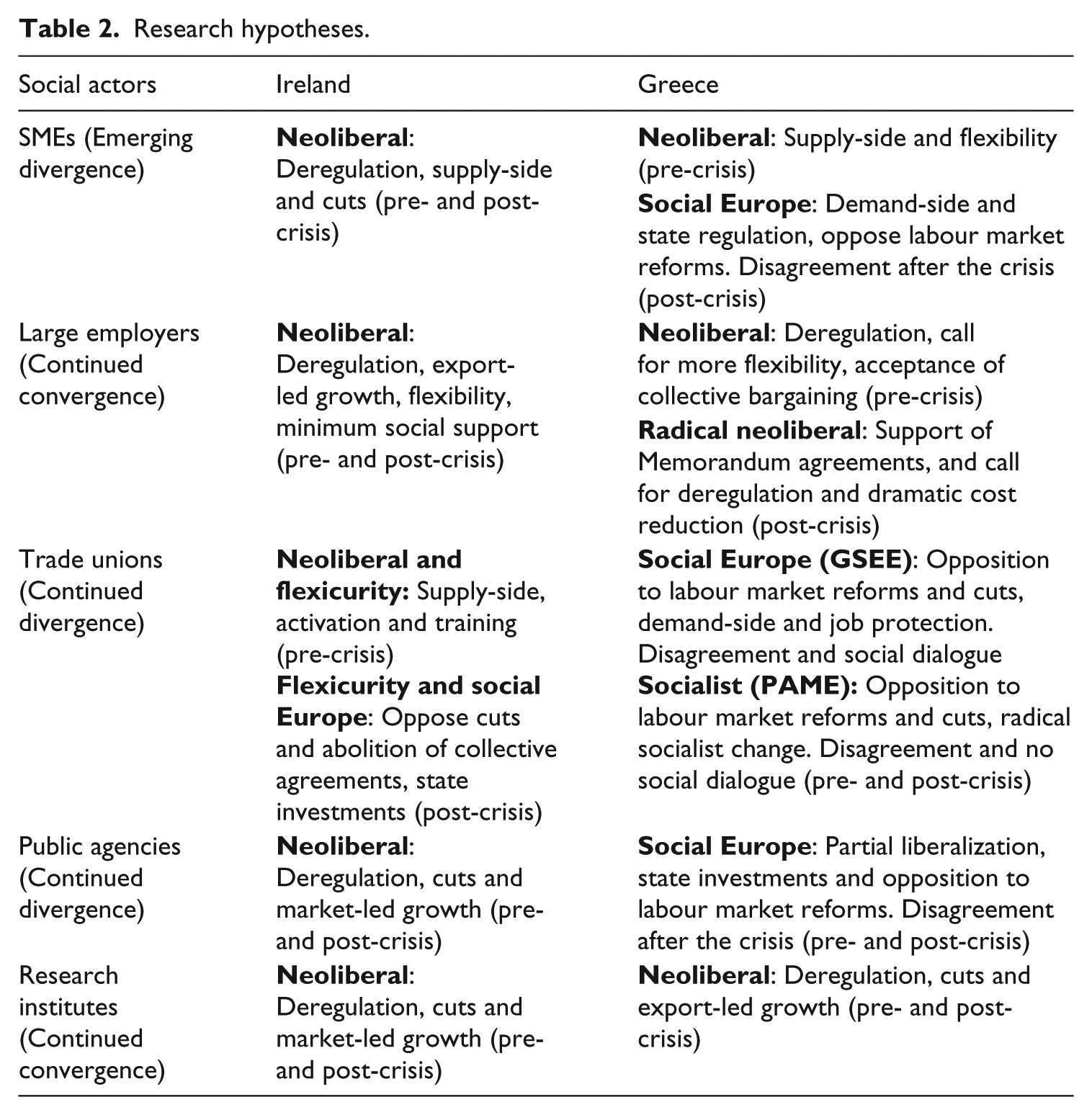
The Greek youth unemployment debate also supported the research hypothesis as it was less favourable to the idea of lower wages for youth while the emphasis among the social actors was placed more on the demand-side of youth unemployment and protecting them inside the labour market (job protection). The Greek Mediterranean welfare state characteristics allowed for the generation of ideas centred on the protection of young unemployed workers through non-market mechanisms. Several social actors in Greece (except among large employers and the research institutes) refused to accept the neoliberal supply-side discourse on social protection and suggested that the state should provide protection to young people. The prominent idea among these actors was that the state has the responsibility to protect young people through job protection and/or social support, subscribing to core ideas of the social Europe discourse.
The welfare characteristics of the Irish and Greek systems also facilitated or inhibited the production of other youth unemployment discourses such as flexicurity especially in the pre-crisis period. Specifically, in Ireland the activation and means-tested ‘logic’ of the welfare system, together with the flexibility in the labour market, have facilitated an easier understanding and agreement over the flexicurity discourse. In contrast, in Greece the very low expenditure on activation policies, the low or absent social support for unemployed workers and the high degree of flexibility in the labour market through informal routes into work, have constrained the development of flexicurity (Kwiatkiewicz, 2011). All the Greek social actors have rejected the idea of flexicurity and despite ‘rhetorical commitments’ (Tsarouhas, 2008) and peer pressure by the European Commission through employment recommendations, no concrete policy actions towards flexicurity were undertaken.
The above supports the hypothesis that the institutionalized features of the Greek variety of capitalism and welfare state are reflected in youth unemployment debates through the production of discourses centred on job protection and regulation especially in light of support for unemployed. On the other hand, in Ireland the high degree of flexibility in the labour market, the resolution of labour market problems through the market and the reliance on active labour market policies have facilitated the incorporation of a youth unemployment debate centred on the market, the mobility of young workers inside the market and protection through better training.
As shown in Table 2 the hypothesis that the different political legacies and industrial relations systems affect the production of the youth unemployment discourses in the two countries has been supported by the evidence. In particular, in the period before the crisis the youth unemployment discourses in Greece are far more politicized and class-oriented than those in Ireland, supporting the hypothesis that the absence of a cooperation climate in Greece impedes the generation of consensus youth unemployment discourses. The Greek social actors developed more politicized and confrontational-based discourses criticizing the other social actors for their strategies and ideas in relation to youth unemployment. The Greek social actors did not encompass notions of national unity or prosperity but rather their discourses were focused on the protection of the material interests of their members and the confrontation of those interests with the interests of other organizations or with the government itself. Reflecting the adversarial tradition of industrial relations and the development of social dialogue since 2000, youth unemployment discourse in Greece has been characterized by an interplay of conflict and cooperation. But in the period since the crisis, the cooperation between the social partners has been under increased strain even though trade unions and employers have reached agreements on several issues such as sectoral agreements, maintenance of the minimum wage and reduction of employers’ social contributions. At the same time, the tensions have increased among employers’ organizations and within the trade union movement, for example, between GSEE and PAME. As a respondent from (ESEE) stated, ‘the employment proposals of the large employers’ organisations are an offensive against employees’ rights with the objective of supporting the interests of “big capital” ’.
Despite the shift in the Irish trade unions’ discourses and their increased opposition towards neoliberalism due to the collapse of social partnership, several of their positions on youth unemployment continue to converge with those of the other social actors, supporting the hypothesis that more cooperation is expected in the Irish case. The agreement of the Irish social actors on activation, conditionality, apprenticeships and reduced wages for young workers is indicative of that tendency. Economic proposals such as the use of private pension funds for investments or public sector reforms have been embraced by all the social actors despite some disagreements. In addition, evidence from the interviews strongly suggests that the conflict or contestation discourses expressed by the social actors were directed towards the government’s policy choices and less towards the other social actors. For instance, explicit questioning in interviews revealed very few examples of confrontation between trade unions and employers as both organizations expressed their willingness to cooperate with each other even where that was outside the institutionalized social partnership framework. These examples support the argument that the historical legacy of national unity and the tradition of social partnership together with the lack of dominant class-based strategies serve to direct the Irish youth unemployment debate along a consensus-based trajectory.
Before any final conclusion can be drawn concerning the research hypotheses, however, some additional observations must be added regarding the countervailing trends. First, the economic crisis has had the effect of shifting the youth unemployment discourses of the social actors. In the Greek case, the SMEs have shifted their positions towards a less neoliberal trajectory, as their main concerns are focused on the survival of their businesses and the support of consumer spending. In the Irish case, the unions have rejected many of the pre-crisis ‘taken for granted’ neoliberal ideas (especially regarding the importance of a low tax regime), advocating more social regulation discourses since the crisis. At the same time, as indicated previously, certain neoliberal ideas still emerge in their discourses, supporting the hypothesis that neoliberal discourses are easier to incorporate into social actors’ positions in LMEs. In both cases the unprecedented deterioration of the economic and employment prospects prompted by the economic crisis has been the turning point for the shift in the social actors’ discourses.
In the case of large employers, the research findings have partly supported the hypothesis as large employers in Greece have rejected some neoliberal proposals (specifically, the reduction of the minimum wages and collective agreements) in the pre-crisis period. However, unlike the assumptions of the research hypotheses, the large employers’ organizations in Greece have adopted the neoliberal-informed employment, economic and social policy discourses since the onset of the crisis (SEV, 2012: 9). In both countries large employers’ organizations have shifted to more radical neoliberal positions than they had adopted prior to the influence of the crisis, supporting the argument that overcoming the capitalist crisis and securing continuous capital accumulation and profitability are concerns shared by employers across different institutional arrangements (Heyes et al., 2012).
Conclusions
The article has provided some insights into the convergence–divergence debate by examining the extent to which the two processes play out in two countries with different path dependencies but subject to similar external pressures and labour market problems. The article has shown that the dominance of certain youth unemployment discourses in Greece and Ireland is linked with the institutional and political-economy characteristics prevalent in the two countries. The Irish institutional characteristics have supported the incorporation of neoliberal youth unemployment discourses as many elements of the Irish model have been embodied in the Irish ideational framework employed by the social actors. By contrast, the Greek institutional characteristics have not supported the production of neoliberal policies and social Europe discourses have prevailed in the positions of several social actors. In a similar vein, the political ideology and industrial relations systems of the two countries have underpinned the construction of different discourses. In Ireland the youth unemployment debate has been characterized mostly by cooperation and agreement, whereas in Greece disagreements and conflicts were the dominant characteristics. The prevalence of notions of exploitation, inequalities and capital–labour opposition was much more prominent in Greece, mainly due to the radical political discourse developed by PAME. The influence of PAME supports the assumption of the article that opposition to the neoliberal discourse will be more extensive in national settings where trade unions possess radical identities and mobilization capabilities, as in the case of PAME. In Ireland, the youth unemployment debate was not politicized in the same way, as class references or analyses were not dominant due to the lack of such an ideological direction inside the Irish trade unions.
In addition, the youth unemployment debates in the two countries have differed significantly in the periods before and after the economic crisis, indicating that the political and economic developments of the post-crisis period have affected the discourses of the social actors. This supports the argument that path dependency and historical institutionalism have to take into account ‘exogenous drivers of policy change’; in this case, the economic crisis (Peters et al., 2005: 1297). Therefore, the article has contributed to the debate about the interconnections between exogenous factors and institutional settings and has shown that public debates are not only functions of institutional contexts (Wueest, 2012), but also the outcomes of specific historical and economic moments which force a shift in actors’ discourses. Therefore, although institutions matter, this article has shown that the understanding of discourse formation requires consideration of broader economic and political dynamics taking place in specific time periods supporting the assumption that crisis is an influential factor. The parallel existence of convergence and divergence trends since the economic crisis supports the view that instead of a ‘path dependency break’ or ‘final convergence’ there is a tendency towards some ‘contingent convergence’ embedded in the path dependencies of the two countries (Hay, 2004). The specific observation provides support to the claim that ideological debates are not moving to either one model (Liberal) or another (Coordinated) but they are affected equally by both path dependencies and external (economic) pressures.
In addition to theoretical and empirical insights into the processes through which youth unemployment discourse are formed, there are implications for policy makers and practitioners. One policy lesson is that the labour market reforms taken by the governments of both countries (and especially Greece) have not had the support of significant social actors, including some of those traditionally supporting neoliberal policies. In tandem, the lack of available resources for policy interventions and the commitment of governments to austerity measures are expected to accelerate the emergence of disagreement between the social actors and the deterioration of the employment prospects for young people.
Footnotes
Acknowledgements
The article has greatly benefited from comments by Guglielmo Meardi and Paul Marginson as well as the two anonymous reviewers. I would also like to thank Melanie Simms for her valuable help and support throughout the writing process.
Funding
This research received no specific grant from any funding agency in the public, commercial, or not-for-profit sectors.