



Abstract
While most previous studies focus on the monopoly aspect of works council introductions, this article explores the collective voice face of introductions and investigates workers’ decision as an exit–voice consideration. Using a large linked employer–employee dataset from Germany, the present study finds that council introductions are more likely if workers have high plant-specific human capital or earn high wages. These results are consistent with exit–voice considerations as well as with attempts to protect an existing distribution of rents. Redoing the analysis for plants in which the protection of rents against management decisions is less relevant yields similar results supporting a voice interpretation.
Introduction
German works councils have attracted substantial attention from researchers as an institution of industrial democracy that potentially improves wages and working conditions as well as efficiency. Studies on works councils hence investigate their effects on a variety of outcomes such as productivity (e.g. Mueller, 2012; Mueller and Stegmaier, 2014), wages (Addison et al., 2010), profits (Mueller, 2011), employment growth (Jirjahn, 2010), employment stability (Hirsch et al., 2010; Pfeifer, 2011a), apprenticeship training (Kriechel et al., 2014), job satisfaction (Grund and Schmitt, 2013), or look at several of these outcomes within one study (Addison et al., 2001; Hübler and Jirjahn, 2003; Jirjahn, 2014; Pfeifer, 2011b; Wigboldus et al., 2014). 1 Compared with this vast literature on existing councils (for surveys see Addison, 2009; Jirjahn, 2011), relatively few studies explicitly look at workers’ decision and motives to introduce a works council, which is the focus of the present investigation.
Works councils have substantial power via extensive co-determination rights, which workers can use in two, not mutually exclusive ways. They can influence the distribution of an existing surplus between workers and owners or they can increase the total surplus of the firm. In a different context, Freeman and Medoff (1979) labelled this the two faces of unionism: monopoly and collective voice. While the first description implies that unions, and works councils, focus on the redistribution of rents, the second takes a more positive stance as it implies that they increase efficiency, for example by improving communication between workers and management as modelled by Freeman and Lazear (1995), and that they might even benefit owners.
While the literature on existing works councils pays similar attention to both of these two faces, previous studies on the workers’ decision to introduce a council place greater emphasis on the monopoly face. More specifically, studies on works council introductions often focus on the relationship between a plant’s economic situation and the likelihood of an introduction. Introductions in good times are then interpreted as offensive, i.e. attempts to change the distribution of rents in the workers’ favour, whereas introductions in bad times are interpreted as defensive, i.e. attempts to preserve an existing distribution of rents.
This article takes a different starting point and asks whether works council introductions reflect workers’ voice. I look at workers’ decision regarding whether or not to introduce a council as an exit–voice consideration along Hirschman’s (1970) reasoning, where introducing a council is a form of voice and quitting is a form of exit. Using a large linked employer–employee dataset, I provide empirical evidence on the role of workers’ wages, tenure, as well as the local labour market situation as determinants of works council introductions. While previous studies largely neglect these factors, I document that workers with high tenure and workers earning high wages are more likely to introduce a council. These findings are consistent with an underlying exit–voice trade-off.
The structure of the article is as follows. First, I briefly describe the institutional background and review the previous literature on works council introductions. Second, I consider workers’ decisions as an exit–voice consideration to derive testable hypotheses that should hold when workers trade off introducing a council against leaving their employer. Next, I present my empirical analysis. The final section concludes.
Institutional background and previous literature on works council introductions
The parallel existence of several forms of worker representation is a major characteristic of Germany’s system of industrial relations. While unions represent workers at the sector level and firms can choose whether to bargain with them, works councils represent workers at the plant level, and a council is mandatory if workers decide to introduce one. To give some numbers, Ellguth and Kohaut (2011) report that 10% of all eligible plants had a council in 2010. The legal basis of works councils is set in the Works Constitution Act (WCA), the latest major revision of which came into force in July 2001. A more detailed account of the institutional framework can be found in Addison (2009).
Workers are entitled to introduce a works council in plants with at least five permanent workers with voting rights, three of whom must be eligible to run for office. Workers have voting rights if they are at least 18 years old, and they can run for office if they have additionally been employed in the plant for at least six months. The WCA aims to provide a simple procedure and to prevent any influences from the management. Council introductions run as follows. First, at least three workers (or a union represented in the plant) have to call a meeting of the workforce. At this meeting an electoral board is determined by majority vote. This board calls the election, runs it and announces the results. If the meeting fails or is not held, the labour court appoints a board. For plants with at most 50 workers there is a streamlined procedure, which also can be applied in plants with 51–100 workers if workers and the employer agree to do so. Apart from that, management must not influence the introduction. Interfering with the election of a council is even punishable with up to one year in prison or a fine. As a further means of protecting initiators of councils against oppressive measures, workers who call the meeting of the workforce, are on the electoral board, or run for office enjoy special employment protection as do councillors.
On the empirical side, Schlömer-Laufen and Kay (2012) qualitatively investigate 10 successful works council introductions and give an opportunity to compare legal setting to practice. They find that it takes typically between three and six months to introduce a council, supporting that introducing a council is simple. Looking at management behaviour, councillors in no case report that management tried to prevent the introduction, though management was critical in some plants. Occasionally, management even seems to support council introductions, which is also in line with Mohrenweiser et al. (2012). However, the picture is somewhat flawed as both studies can only look at successful introductions and there is no systematic evidence on failed attempts to introduce councils. 2
To sum up, the legal framework aims to enable workers to introduce a council when they wish to do so and to protect them from adverse consequences. And, the empirical evidence indicates that these protective measures are successful in enabling workers to introduce works councils. Therefore, council introductions are an opportunity to learn about workers’ motives when introducing a council. This has drawn some attention to the workers’ decision to introduce councils.
Table 1 displays the empirical results on the determinants of works council introductions. 3 While the results on plant size, collective bargaining status and the legal form of plants are quite consistent, the results regarding plants’ economic circumstances are less clear cut. The existing evidence on plants’ profits probably favours a defensive interpretation, though the evidence is mixed and limited. Furthermore, there is some evidence of a positive relationship between organizational changes and council introductions, though this relationship is not found in all studies. Similarly, the results regarding employment growth are ambiguous. Finally, workforce characteristics are mostly included as control variables and, again, no clear picture emerges from the previous results.
Previous literature on the determinants of works council introductions.
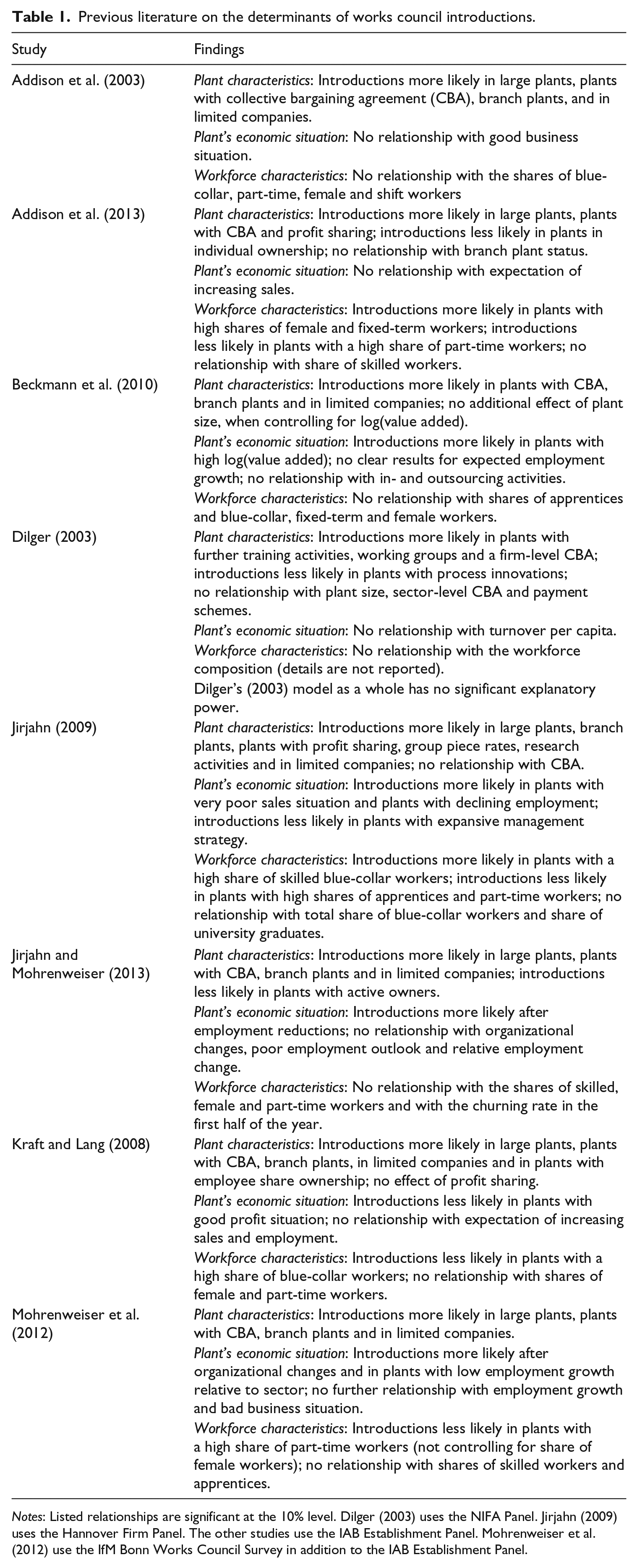
Notes: Listed relationships are significant at the 10% level. Dilger (2003) uses the NIFA Panel. Jirjahn (2009) uses the Hannover Firm Panel. The other studies use the IAB Establishment Panel. Mohrenweiser et al. (2012) use the IfM Bonn Works Council Survey in addition to the IAB Establishment Panel.
Works council introductions as an exit–voice consideration
According to Hirschman (1970), members of an organization trade off voice against exit in declining organizations, read when they are dissatisfied with their situation. If workers differ in their mobility, as argued by Freeman and Medoff (1984), less mobile workers will be more inclined to opt for voice, here introduce a works council. Previous research for West Germany shows marked mobility differences between demographic groups. For instance, Boockmann and Steffes (2010) document that employment of older workers is more stable and that workers with a higher qualification level are more likely to change employers, but less likely to go into non-employment. Hirsch and Schnabel (2012) further document that women are less likely to change employer than men, but more likely to go into non-employment.
These differences suggest differences in workers’ demand for a voice mechanism, and hence the workforce composition could affect the likelihood of works council introductions. For example, highly qualified workers should be less likely to introduce a council as they are more mobile. However, they might also be able to make better use of such an institution and might find the administrative burdens less demanding, which would work in the opposite direction, and we therefore do not obtain a clear prediction. For other groups, the interplay of incentives, mobility and institutions blurs predictions. For instance, women are typically less attached to the labour force than men, which also should make them less inclined to introduce a works council. Still, works councils have strong rights with regard to social matters and working time arrangements, which could be more important for women as they typically take on more responsibilities in their families.
Therefore, I do not focus on demographic characteristics in the empirical analysis, though it will be important to control for such differences as the composition of the workforce may influence the likelihood of works council introductions. Rather, I use Hirschman’s (1970) exit–voice reasoning to generate hypotheses that relate workers’ decision to introduce a council with their plant-specific human capital, the labour market situation and the wage level. These hypotheses should hold if workers’ decision is based on an exit–voice trade-off and introductions reflect workers’ voice. First, workers lose their plant-specific human capital if they quit. Hence, I hypothesize that workers with high plant-specific human capital will be more likely to introduce a council, as quitting is more costly for them. To measure specific human capital, I use the median of the workers’ tenure, which gives the time over which workers have accumulated such capital.
Topel (1991) points out several caveats about using tenure to proxy specific human capital at the individual level. He argues that high tenure in a cross-sectional setting may rather reflect a high, time-constant match or job quality than specific capital. In a setting with on-the-job search, high job quality would make it unlikely that workers receive a superior job offer, and tenure, in such a setting, would at least partly reflect job quality. Topel (1991) shows that using within-match variation in tenure to estimate the effect of tenure mitigates such concerns. Paralleling this, I will present specifications that identify the effect of tenure on the likelihood of works council introductions from within-plant variation in tenure. Further, Topel (1991) argues that tenure captures both work experience in general as well as experience in a specific plant. To alleviate such concerns, I control for workers’ age, which captures workers’ potential general work experience since I also control for workers’ education. Taking these concerns into account, Farber (1999: 2470) concludes that tenure is still an attractive measure of specific capital, as ‘[w]orkers with more tenure are likely to have more specific capital than workers with less tenure’. In the empirical analysis, I will however use information on plant-specific training, which is rather limited in the data, as an alternative measure of specific human capital.
From a monopoly perspective, high tenure could reflect that workers are for some reason in a relatively beneficial position, which would rather point towards defensive introductions. Further, if long tenure is driven by a lack of (better) outside offers, this could also indicate that workers are in a relatively weak bargaining position. However, specific capital could also foster offensive introductions. The investments to build up such capital, say training costs, are sunk creating a rent, which is to be distributed. From this perspective, council introductions could be an attempt by workers to obtain a larger share of these rents. Therefore, the results on specific human capital are not informative on the question of rent-seeking versus rent-protection.
Second, quitting is less feasible if there are few job market alternatives. Thus, workers with fewer alternatives should be more inclined to introduce a council. To measure workers’ job market alternatives, I use the unemployment rate in the plant’s district assuming that workers are regionally immobile. As an alternative measure, I use occupational unemployment rates assuming that workers are immobile in this dimension. From a monopoly point of view, one would expect offensive introductions in times of low unemployment and defensive introductions in times of high unemployment.
Third, a new job should yield a similar or higher wage. If the wage level at a plant is high, such a job is more difficult to find. Therefore, workers in plants with high wage levels should introduce a council with higher probability. To measure the wage level, I use the median of the full-time workers’ wages when controlling for the occupation and education structure as well as for other wage-related characteristics. From a monopoly perspective, high wages should lead to more defensive introductions, but not foster offensive introductions unless one assumes that ceteris paribus higher rents remain available in plants already paying high wages than in those paying low wages.
None of these hypotheses has been tested before, though some studies touch upon them. Kraft and Lang (2008) match introducing and not-introducing plants and observe higher wages and fewer quits in introducing plants, but they do not match on workers’ qualifications. Mohrenweiser et al. (2012) include wages above the level specified in collective bargaining agreements as a control variable, a rather vague measure for the wage level, and do not find a significant association with council introductions. Gralla and Kraft (2012) observe that the share of dismissals is on average lower in plants that will introduce a works council than in plants that will not do so. Importantly, none of these studies accounts for workforce characteristics in detail since they do not have direct information on workers. To give an example, none of the studies takes into account differences in workers’ education as well as age and sex. Using a linked employer–employee dataset allows me to overcome this and control in much more detail for worker characteristics and test the three hypotheses more directly and more thoroughly.
The three hypotheses derived from workers’ exit–voice trade-off are also in line with defensive works council introductions. When we observe these patterns one hence may ask whether this reflects rent-protection or workers’ voice. To investigate this more closely, I will also look at plants in which it is less relevant for workers to protect themselves against management, which promises some insights into which plants drive the results. Finding the same results for the restricted sample would support an underlying exit–voice trade-off since such a pattern shows that the results are not driven by the plants in which rent-protection is most relevant. If the hypotheses are, in contrast, confirmed in the complete sample, but not when restricting the sample, this would point towards a defensive interpretation. I will therefore report results for subsamples based on the likely relevance of wage reductions, layoffs and the profit situation.
Concerning wage cuts, the German regime of industrial relations provides an opportunity to get some additional insights. Collective bargaining agreements provide minimum working conditions, while firms may voluntarily offer better conditions, e.g. pay higher wages, as studied by Jung and Schnabel (2011). Compared to plants that are either not subject to a collective agreement or pay wages above the level specified in an agreement, it is more difficult to reduce wages in plants that strictly pay wages specified in a binding agreement. Thus, the rent-protection argument is less relevant in this sample of plants. 4
Looking at workers’ perceived employment security is more difficult since no direct measure is available. Still, workers should obviously be concerned about employment security when managers expect employment reductions and I will therefore use managers’ expectations on employment changes to identify plants in which workers should have particularly strong concerns regarding layoffs. While we cannot be sure that workers do not worry about individual dismissals in other plants, the rent-protection argument is still less relevant for the remaining plants than for the complete sample. Using managers’ expectations, I create three subsamples. First, I drop observations from plants that expect decreasing employment in the next year. Second, I drop all observations from plants that ever expect decreasing employment in the next year. Third, I take a more long-run perspective and drop all plants that ever expect lower employment in five years’ time.
More generally speaking, rent-protection should be most relevant in plants that are economically in trouble. Therefore, I also use the available information on the plants’ business situation to identify plants in which rent-protection should be less relevant. First, I drop plants that ever had an unsatisfactory profit situation in the previous year during the sample period. Second, I drop plants that ever expect business volume to decrease.
Data and descriptive evidence
In the empirical analysis, I use the cross-sectional model of the LIAB for the years 2001 to 2010, i.e. the Linked Employer–Employee Dataset of the Institute for Employment Research (IAB) of the German Federal Employment Agency (Alda et al., 2005 provide further details). The dataset links administrative data on workers with the IAB Establishment Panel, of which I additionally use earlier and later waves. This allows me to control in detail for both worker and plant characteristics.
Looking at the plant side, the IAB Establishment Panel is a random sample of about 16,000 German plants. The sample is drawn according to the principles of optimal stratification from the administrative register of plants that employ at least one worker liable to social security. Strata are defined over plant sizes and industries and large plants are oversampled. The response rates of plants that are repeatedly interviewed exceed 80%, making the dataset well suited to follow plants over time. The survey provides information on the plant’s works council status, the number of workers, its collective bargaining status, profit situation and industry affiliation, among others. Using this information, I drop all observations that cannot introduce a council since they already have one or have fewer than five workers. I also exclude not-for-profit plants from the analysis, i.e. plants from administrative sectors, plants in public ownership and plants measuring their business volume by budget.
On the worker side, the dataset is based on the Employee History, which is drawn from the integrated notification procedure for health, pension and unemployment insurances. The notification procedure requires employers to report information on all workers covered by the social security system. These notifications are compulsory and misreporting is prohibited. As a consequence, information is available for all workers liable to social security in plants that are covered by the Establishment Panel. Although, among others, civil servants and family workers are not included, about 80% of all employed individuals are part of the Employee History. The data include information on workers’ daily wage, tenure, age, sex, occupation and education. 5
To reduce measurement error in works council introductions and ensure that I observe actual introductions of new councils, I identify a plant as introducing a council in t if it neither has a council in t-1 nor in t, but reports having a council in t+1 and t+2. Unless plants misreport twice in a row, this coding avoids measurement error in the introduction variable. Paralleling, I identify a plant as not introducing a council in t if it reports having no council from t-1 through t+1 and is also observed in t+2 ensuring that the minimum observation period is equally long for both groups. This procedure leaves me with 29,190 observations of 7,598 plants, 237 of which reflect council introductions between 2001 and 2011. The numbers imply that the average probability of an introduction is 0.8%. The dataset is not only unbalanced by missing information and panel attrition, but also by the construction of the dependent variable since a plant cannot be in the sample directly after an introduction.
Table 2 presents some descriptive statistics. According to the human capital hypothesis, one would expect that workers of introducing plants have longer tenure. However, the data show that the average median tenure is 0.5 years higher in plants without introduction. Turning to the labour market situation, the unemployment rate is on average 0.5 percentage points lower for introducing plants, again not supporting the hypothesis. This difference is however insignificant. In contrast, the evidence on the wage level is in line with the hypothesis as median real wages are on average 23 log points, or €15.5 per day, higher in introducing plants. However, both types of plants differ substantially and also significantly in many other dimensions. For example, introducing plants are larger, 17% have at least 200 workers compared to 3% of the not-introducing plants, and they are also more often subject to a collective agreement, 59% compared to 38%.
Descriptive statistics.

Notes: The unemployment rate is measured at the district level. The median wage refers to full-time workers only. (d) denotes dummy variables and employment growth is relative to employment in the previous year. Highly qualified workers have obtained a college or university degree, qualified workers have completed Abitur and/or an apprenticeship, the remaining, low qualified workers are used as reference group. Occupational structure is measured with an aggregated form of Blossfeld (1985) and service occupations are the reference group. Organizational shocks encompass the closure, relocation or separation of a plant or parts of it or the integration of a plant or a plant unit. The dataset used is the LIAB, cross-sectional model, 2001–2010.
Econometric analysis
To investigate the determinants of works council introductions, I fit binary response models, where an introduction is coded as a success. Given the low average probability of introductions, I consider them as rare events and thus use complementary log-log models throughout the analysis (for a brief overview see Cameron and Trivedi, 2005: 466–467). To begin with, I investigate only the hypotheses about plant-specific human capital and the labour market situation, but leave out the wage hypothesis since wages are potentially affected by both. Next, I turn to the wage hypothesis. Afterwards, I report the results when using alternative measures of specific human capital and workers’ labour market alternatives, when restricting the sample to plants in which rent-protection is less relevant and from the robustness checks.
As a starting point, I use a pooled maximum likelihood approach. I regress council introductions between t and t+1 on workers’ median tenure (tenureit), the unemployment rate at the plant’s district as of 30 June of t (URit), the workforce composition and the plant’s business situation (xit) as well as further control variables (zit). Thus, the model is:

where
Since we have seen above that the composition of the workforce may affect the likelihood of council introductions, it will be important to control for such differences in the econometric analysis. Therefore, xit encompasses the workers’ median age, the shares of part-time workers, female workers, apprentices, qualified and highly qualified workers as well as workers in manual and business occupations. To capture the plant’s economic situation, which according to the previous literature also affects the likelihood of council introductions, xit furthermore includes a dummy variable indicating a good or very good profit situation in the previous business year and the employment growth in the previous year. Since the institutional setting and previous studies suggest a higher likelihood of council introductions in plants with a collective agreement and in large plants, zit includes dummy variables for collective bargaining agreements at the firm and at the sector level and three plant size dummies. Further, zit contains dummies for plants with limited liability, subsidiary plants and organizational shocks at a plant, which have previously been found to relate to works council introductions. Finally, zit includes dummies for plants in foreign ownership, five plant age groups, nine industries, location in East Germany and in rural areas as well as year dummies to control for plant heterogeneity and possible time trends. 7
Given the vast evidence on the effect of works councils on variables like workers’ tenure, the profit situation or wages for that matter, one may wonder how the effect of councils on these variables affects the estimation. Importantly, introductions take place between t and t+1, while all explanatory variables are measured as of t or earlier. Hence, the covariates are measured before a works council is present. As long as councils do not have substantial effects before their introduction, later effects of council are unproblematic as the plants are no longer in the sample when these effects come into play. Taking this into account, re-introductions of works councils remain potentially problematic as in such cases characteristics before the introduction of a new council could be affected by the previously existing council. To address this, I will exclude from the analysis plants that ever reported having a works council before as a robustness check.
The first column of Table 3 presents the average partial effects (APE) using this specification. Council introductions are 0.7 percentage points more likely in plants that are covered by a collective agreement at the sector level than in plants not covered by a collective agreement, ceteris paribus. Looking at agreements at the firm level, the estimated effect is somewhat larger, but estimated imprecisely. Furthermore, the likelihood of introductions is between 0.5 (for plants with 21–100 workers) and 3.4 percentage points (plants with 200 or more workers) higher in larger plants than in plants with at most 20 workers. Further, workers in branch plants and in plants with limited liability are more inclined to introduce councils. These results are in line with the institutional framework and the previous literature. The coefficients of all of these variables are statistically significant at the 1% level.
Average partial effects on the probability of a works council introduction.

Notes: Complementary log-log models are fitted and the dependent variable is an indicator that takes the value of 1 if a council is introduced in the next year. Five plant age, nine industry and nine year dummies are further control variables. The plant age dummies are coded in five year steps with one final category capturing an age of 25 years or higher. Plants aged less than five years are used as reference group. The correlated random effects model includes the plant averages of workers’ median tenure and the other workforce characteristics, the unemployment rate, the profit situation and the employment growth. Standard errors of average partial effects are calculated using the delta method. The dataset used is the LIAB, cross-sectional model, 2001–2010. */**/*** denote statistical significance of the estimated coefficient at the 10%/5%/1% level using standard errors clustered at the plant level.
Turning to the hypotheses to be tested, I find that the probability of a council introduction is 0.05 percentage points higher if the median of the workers’ tenure is one year higher. Thus, a one standard deviation rise in workers’ tenure raises the likelihood of an introduction by about one-quarter of the average probability. The coefficient is also statistically significant at the 5% level. Further, the results show no relationship between the local unemployment rate and the likelihood of works council introductions. However, these results are obtained relying on variation within as well as between plants and may hence reflect unobserved heterogeneity.
To address time-invariant unobserved heterogeneity, I apply a correlated random effects approach and include the plant-level averages of the main variables of interest and other characteristics that have substantial variation within plants,

and the estimated parameters can be used to compute average partial effects. One can investigate the presence of unobserved heterogeneity of the described form by testing the significance of
The second column of Table 3 presents the results from this correlated random effects model. 9 The estimated effect of an increase in the median tenure is larger and amounts to a 0.14 percentage point increase of the likelihood of council introductions in response to a one year increase of the median tenure within a plant and is statistically significant at the 1% level. As before, the local unemployment rate is not related to works council introductions.
Regarding the plant’s economic situation, I find that workers are 0.6 percentage points more likely to introduce a works council after organizational shocks, which is significant at the 5% level. Further, I find weak evidence that the probability of a council introduction is higher when the profit situation is good, controlling for the average situation of the plant, though this relation is only significant at the 10% level. Employment growth appears to have no effect on the likelihood of works council introductions.
I further find that the workforce composition influences the likelihood of council introductions, again based on within-plant variation. Council introductions are more likely when the shares of qualified and highly qualified workers are large. Further, workers are more likely to introduce a council when the share of apprentices is high. While these results are significant at least at the 5% level, the positive relationships of introductions with workers’ median age and the shares of part-time workers and workers in manual occupations are only significant at the 10% level.
As the coefficients
Average partial effects on the probability of a works council introduction, controlling for the wage level.

Notes: See Table 3.
While the wage effect is identified by variation between plants and within plants in the first column of Table 4, I additionally include the average wage as an explanatory variable in the second column to address unobserved plant heterogeneity that is correlated with the average wage level. Thereby, the wage effect is now identified only by within-plant changes. Relying only on within-plant variation, the effect of wages is statistically insignificant and the point estimate is even negative, though it is practically zero. Hence, between-plant differences in wages drive the positive relation between wages and the likelihood of works council introductions. The coefficients
Table 5 reports the results using a dummy variable for plant-specific training and occupational unemployment rates as alternative measures of workers’ plant-specific human capital and their labour market alternatives. 11 According to Panel A, the probability of an introduction is about 0.2 percentage points higher in plants that provide specific training, supporting a positive relationship between specific capital and council introductions. However, the relationship is only significant at the 10% level. In Panel B, I replace the local unemployment rate by occupational unemployment rates. Using this alternative measure, I again do not find a link between workers’ labour market alternatives and the likelihood of council introductions.
Alternative measures of workers’ specific human capital and labour market alternatives.

Notes: The specifications used are the correlated random effects models with and without average wages as in Table 4. In Panel A, I additionally include a dummy for plants which provided specific training the last time this item was asked. In Panel B, the local unemployment rate is replaced by an occupational unemployment rate. Further, see Table 3.
So far, we have found that workers with high tenure and workers earning high wages are more likely to introduce a works council, where the relationship with wages is driven by differences between plants and not by changes within plants. This is compatible with underlying exit–voice considerations since wage differences between employers should determine the attractiveness of workers’ outside options. Controlling for the average wage level removes such inter-plant differences from the wage effect. Finally, no link shows up between workers’ labour market alternatives and council introductions.
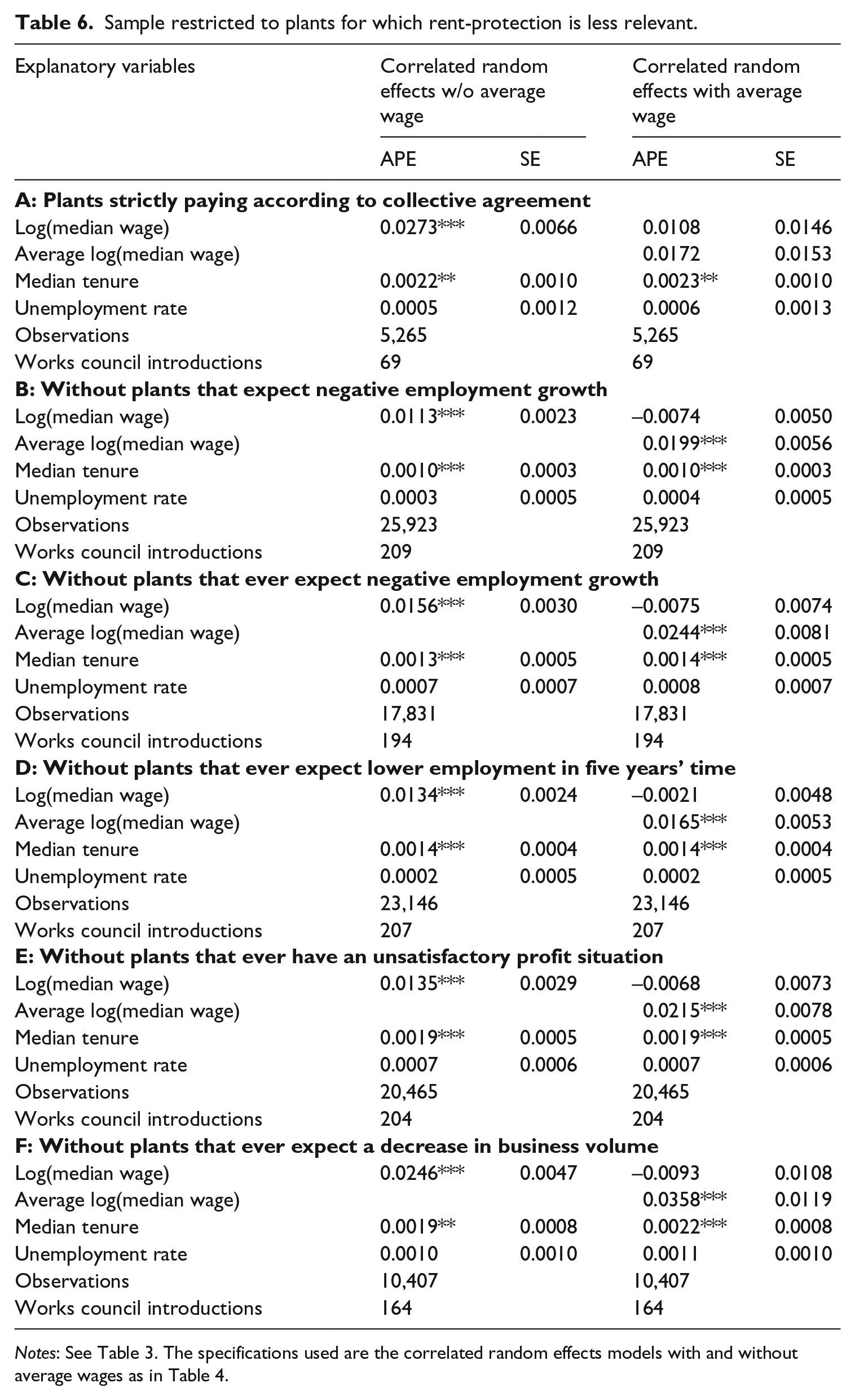
As outlined above, the tested hypotheses are consistent with an exit–voice reasoning as well as with rent-protection. Therefore, I will next turn to the restricted samples of plants in which defensive introductions are less relevant. 12 Table 6 reports the results from the analysis, replicating Table 4. For all subsamples the main findings are confirmed showing that the results are not driven by the plants in which rent-protection is most relevant. This makes it unlikely that the results are only driven by attempts to influence the distribution of rents. Rather, it suggests an exit–voice trade-off underlying workers’ decision whether or not to introduce a works council.
Sample restricted to plants for which rent-protection is less relevant.
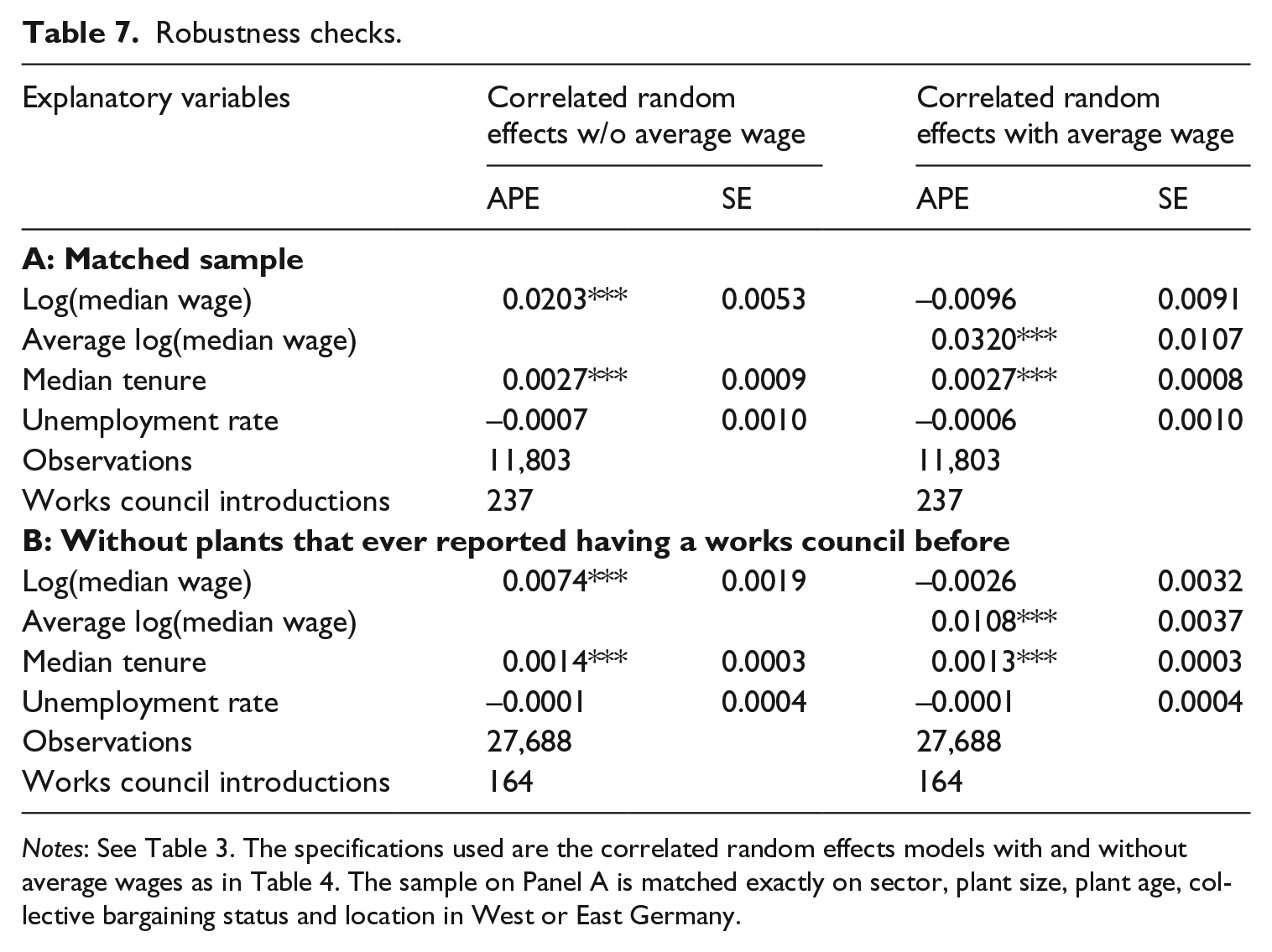
To check the robustness of the results, I address two possible objections to the validity of the empirical analysis. First, the descriptive statistics show substantial and significant differences between plants with council introductions and plants without council introductions in many dimensions and one could argue that a simple regression approach is insufficient to address this. To deal with this, I redo the analysis with a more homogeneous sample and match exactly on sector, plant size, plant age, collective bargaining status and location in West or East Germany. Second, works councils are a dynamic phenomenon and introducing plants might have had a works council before. In such plants high tenure and wages could rather be consequences of a previously existing council than causes of an introduction. Thus, I exclude all plants from the sample that have ever reported having a council using all available data back until 1993. Table 7 gives the average partial effects from these robustness checks confirming the previous findings. While the size of the partial effects differs somewhat across the subsamples and in comparison with the main specification, the results are quite similar when considering the effects relative to the average probabilities of council introductions.
Robustness checks.
Conclusions
This study explores the collective voice face of works council introductions by investigating workers’ decision to introduce a council as an exit–voice consideration. If workers trade off introducing a council against quitting, they should be more inclined to introduce a council if they have high plant-specific human capital, have few labour market alternatives or earn high wages. In the main analysis, I use workers’ median tenure, the local unemployment rate and the median wage at the plant to measure these characteristics. While I do not find any relationship between the labour market situation and council introductions, the results show that workers with high plant-specific human capital and workers earning high wages are more likely to introduce a works council. These results also hold when defining labour markets by occupations and when using information on plant-specific training to measure workers’ specific human capital. The wage result however only holds when looking at differences between plants, but not when focusing on wage changes within plants.
The findings on workers’ tenure and wages are consistent with an exit–voice consideration as well as with the notion that workers introduce a council to protect an existing distribution of rents. Therefore, I separately look at plants in which rent-protection is less relevant. The patterns in these plants are very similar, suggesting that council introductions do reflect workers trading off introducing a council against quitting. Notwithstanding, the support of an exit–voice consideration underlying the introduction of works councils is of an indirect nature and the results do not rule out that workers in some cases elect a council for other reasons. Therefore, this study rather adds an additional perspective on works council introductions than it rules out other explanations.
Contrasting the results with previous research on works council introductions, the estimates confirm findings on plant size, collective bargaining, legal form and branch plant status. The results on the economic situation are similar to Mohrenweiser et al. (2012), who also observe a positive relationship between organizational shocks and introductions, though I find weak evidence that workers are more likely to introduce a works council when a plant’s profit situation is better than on average in that plant.
Looking at the research on existing councils, it is interesting to see that two aspects that are often seen as effects of works councils already show up before their introduction: higher wages and longer tenure (see the surveys in Addison, 2009; Jirjahn, 2011). From the monopoly point of view, this supports the notion that councils rather act defensively than offensively. This is also in line with the possible defensive interpretation of this study’s results. However, it may well be that older councils were introduced with different intentions or that councils change their behaviour over time and it hence remains unclear whether such a generalization is valid. Furthermore, finding that councils are more likely to be introduced where workers already earn high wages and have long tenure once again highlights the importance of accounting for selectivity of works council coverage and unobserved heterogeneity when studying the effects of works councils.
As more data become available, it will be interesting to take a look at the further developments at plants after works council introductions. Tracking those plants can yield insights in the ways workers actually use power and whether this changes as councils mature. For instance, power that is initially seized without such intentions may later on still be used to increase wages at the expense of the owners. Following these plants over time promises more detailed insights into such processes than cross-sectional analyses, such as Jirjahn et al. (2011). What is more, we can learn about management’s responses to an increase in the workers’ influence by looking at plants that introduce a council. This may improve our understanding of potential effects of changes in industrial relations systems and thus provide valuable guidance for policy makers.
Footnotes
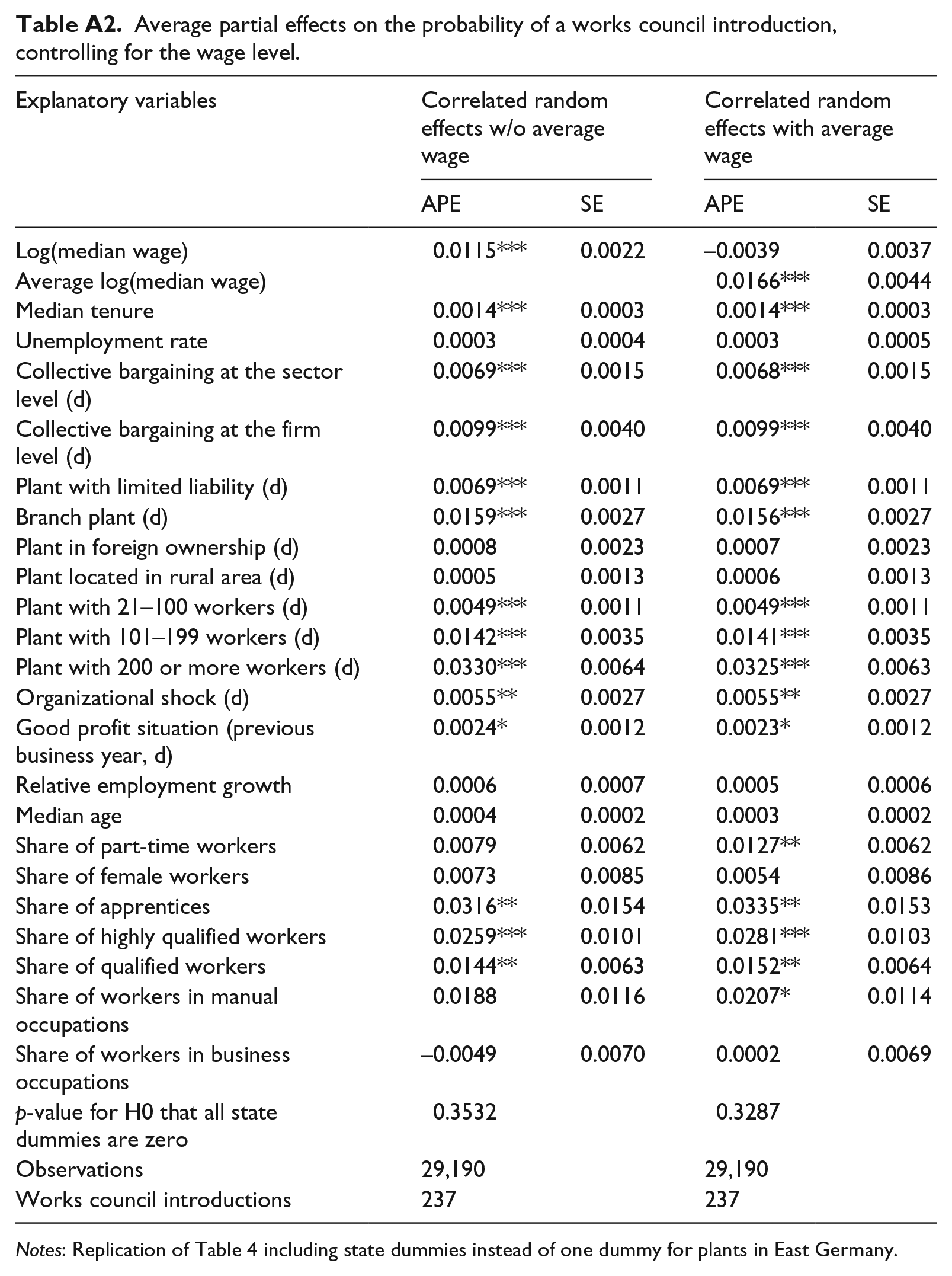
Appendix: Results using a stronger regional disaggregation
Average partial effects on the probability of a works council introduction, controlling for the wage level.
| Explanatory variables | Correlated random effects w/o average wage |
Correlated random effects with average wage |
||
|---|---|---|---|---|
| APE | SE | APE | SE | |
| Log(median wage) | 0.0115*** | 0.0022 | −0.0039 | 0.0037 |
| Average log(median wage) | 0.0166*** | 0.0044 | ||
| Median tenure | 0.0014*** | 0.0003 | 0.0014*** | 0.0003 |
| Unemployment rate | 0.0003 | 0.0004 | 0.0003 | 0.0005 |
| Collective bargaining at the sector level (d) | 0.0069*** | 0.0015 | 0.0068*** | 0.0015 |
| Collective bargaining at the firm level (d) | 0.0099*** | 0.0040 | 0.0099*** | 0.0040 |
| Plant with limited liability (d) | 0.0069*** | 0.0011 | 0.0069*** | 0.0011 |
| Branch plant (d) | 0.0159*** | 0.0027 | 0.0156*** | 0.0027 |
| Plant in foreign ownership (d) | 0.0008 | 0.0023 | 0.0007 | 0.0023 |
| Plant located in rural area (d) | 0.0005 | 0.0013 | 0.0006 | 0.0013 |
| Plant with 21–100 workers (d) | 0.0049*** | 0.0011 | 0.0049*** | 0.0011 |
| Plant with 101–199 workers (d) | 0.0142*** | 0.0035 | 0.0141*** | 0.0035 |
| Plant with 200 or more workers (d) | 0.0330*** | 0.0064 | 0.0325*** | 0.0063 |
| Organizational shock (d) | 0.0055** | 0.0027 | 0.0055** | 0.0027 |
| Good profit situation (previous business year, d) | 0.0024* | 0.0012 | 0.0023* | 0.0012 |
| Relative employment growth | 0.0006 | 0.0007 | 0.0005 | 0.0006 |
| Median age | 0.0004 | 0.0002 | 0.0003 | 0.0002 |
| Share of part-time workers | 0.0079 | 0.0062 | 0.0127** | 0.0062 |
| Share of female workers | 0.0073 | 0.0085 | 0.0054 | 0.0086 |
| Share of apprentices | 0.0316** | 0.0154 | 0.0335** | 0.0153 |
| Share of highly qualified workers | 0.0259*** | 0.0101 | 0.0281*** | 0.0103 |
| Share of qualified workers | 0.0144** | 0.0063 | 0.0152** | 0.0064 |
| Share of workers in manual occupations | 0.0188 | 0.0116 | 0.0207* | 0.0114 |
| Share of workers in business occupations | −0.0049 | 0.0070 | 0.0002 | 0.0069 |
| p-value for H0 that all state dummies are zero | 0.3532 | 0.3287 | ||
| Observations | 29,190 | 29,190 | ||
| Works council introductions | 237 | 237 | ||
Notes: Replication of Table 4 including state dummies instead of one dummy for plants in East Germany.
Acknowledgements
I am indebted to Claus Schnabel for his guidance throughout this project. I am grateful to Thomas Zwick for insightful conversations and advice. I also thank Tobias Brändle, Boris Hirsch, Steffen Müller, Robin Naylor and two anonymous referees for helpful comments. I benefited from comments received at the 14th BGPE Workshop, the IAB Establishment Panel Survey User Conference, the 2013 Workshop on Personnel Economics and Economics of Education of the University of Zurich and the 2013 Annual Conference of the Scottish Economic Society. Any remaining mistakes are my responsibility, of course. I visited University of Warwick during the work on this article, and I am thankful for their hospitality.
Declaration of Conflicting Interests
The author(s) declared no potential conflicts of interest with respect to the research, authorship, and/or publication of this article.
Funding
Writing of this article has been partially supported by the Bavarian Graduate Programme in Economics.