



Abstract
This article investigates unemployed adolescents’ success in re-employment programmes. It proposes that not being in employment, education, or training indicates a setback in the achievement of important life goals, which affects mental health and success in re-employment programmes. Adolescents who are more affected by the experience of unemployment will be even less likely to succeed. An analysis of longitudinal archival records of 300 adolescents in a Youth Guarantee apprenticeship scheme confirms the expectations. Adolescents who were more vulnerable during unemployment and who had a worse relationship with their parents when starting the apprenticeship were more likely to drop out within the first year. The effect of age was moderated by relationship quality. The results show that taking the prior experience of not being in employment, education and training into account can offer a new understanding for the success of re-employment programmes. Theoretical and practical implications of the findings are discussed.
Youth unemployment is of serious concern to European societies today, as young people have been particularly badly affected by the economic recession (Papadopoulos, 2014). According to recent estimates, employment rates for young Europeans under the age of 25 fell four times as much as for the adult population. By August 2014, 7.5 million young Europeans were unemployed, not in education or training (European Commission, 2014a). Being not in employment, education or training (NEET) has a variety of severe effects on individuals, societies and the economy. Unemployment creates significant psychological and physiological distress for the individual concerned, which also has been found to have significant effects on later career success and earnings (Mroz and Savage, 2006). Also, the societal costs of young persons who are NEET are large: reduced trust in democratic institutions, less political engagement and lower social and civic participation are just some of the presumed long-term effects. In 2011, economists estimated the costs of young people disengaging from the labour market at a staggering €153 billion for the European Community (Eurofound, 2012a).
From a humanistic, societal and public policy perspective, it is hence of vital importance to keep young people in education and training – in order to curb present youth unemployment and also to heighten young people’s future chances on the job market (e.g. Rumberger and Lamb, 2003). Recently, the European Union member states have adopted a so-called Youth Guarantee scheme (European Commission, 2014a), which entails various national and EU funded measures, that offer high quality training, education, or apprenticeships to all young people under 25 who are not in education, employment and training.
What predicts the effectiveness of these programmes? The present study takes an individual-level approach to this issue. Various perspectives are possible – literature on educational dropouts would suggest to focus on individual cognitive factors (e.g. De Witte et al., 2013). Unemployment socialization literature would suggest to concentrate on the parental employment situation, as this might predict young people’s aspirations (e.g. McLoyd, 1989). In contrast to these perspectives, the present article argues that being NEET will have after-effects which will affect an individual’s success in a Youth Guarantee programme. By drawing on life-span theory and the developmental goal perspective (Heckhausen et al., 2010), it is suggested that not being in education, employment or training would be experienced as a setback in achieving certain developmental goals. Failing to achieve a life goal has been linked to various forms of low mental health and different ways of coping (Heckhausen et al., 2010), which affect the chances of succeeding in education or training as offered by a Youth Guarantee scheme.
Furthermore, in line with unemployment and job search research (McKee-Ryan et al., 2005; Wanberg et al., 2010) it is proposed that not finding a first job and being unemployed will be experienced differently by different people. Those who are more negatively affected by this period of unemployment and unsuccessful job search will have even fewer chances to succeed on a Youth Guarantee scheme. To provide a test of this perspective this study analyses archived data of participants in a specific form of a Youth Guarantee programme, who entered an apprenticeship programme after a four-month period of being not in employment, education or training. Individual background information was recorded at the onset of the programme, and after a year on the Youth Guarantee programme a note on the individual success was made. This dataset thereby allows for an analysis of the individual-level predictors of success in this specific kind of programme.
The contributions of this study are manifold. First of all, this study applies a life-span development theory perspective and combines it with findings from unemployment research, to offer a theoretically guided perspective on people who are NEET and the factors responsible for adolescents’ success on Youth Guarantee programmes. So far, most research on people who are NEET has concentrated on establishing different profiles of people to enable a personalized service delivery (e.g. Eurofound, 2012a). This article takes a different view by focusing on the underlying commonalities of being NEET and viewing this experience as one marked by setbacks in achieving developmental goals. There is substantial research available on how people cope with setbacks in the achievement of important goals (see e.g. Heckhausen et al., 2010) which can be applied for a better understanding of the NEET experience and its consequences.
Second, by suggesting that the factors that increase adolescents’ vulnerability during a period of being not in education, training or employment, also affect their success in Youth Guarantee schemes, this study allows the identification of certain risk profiles of people who might be more likely to drop out of these programmes.
Lastly, by evaluating an existing Youth Guarantee programme, and investigating the factors that contribute to an individual’s success on it, the findings of this study might be utilized in designing a more effective service delivery of these schemes.
The after-effects of not being in employment, education or training
Youth Guarantee programmes are new measures currently initiated in EU member states which offer employment, apprenticeships, or continued education to people under the age of 25, within four months of them leaving school or losing a job (European Commission, 2014a). These programmes provide an opportunity for young people who are NEET to find a way ‘back in’ to the labour market. Still, having gone through a period without employment, education or training is likely to have after-effects on young people (e.g. Mroz and Savage, 2006), which will affect their future ability to succeed in any type of programme that is as offered as part of a Youth Guarantee scheme.
There are manifold explanations for this scarring effect. Seen from a life-span development perspective, persons who were in a period of being NEET (and are hence eligible for Youth Guarantee programmes) experienced obstacles in achieving one or more important developmental goal (finding a job, an apprenticeship or finishing education) on their own. According to the theory of life-span development, people’s life course is marked by a set of developmental challenges or goals, which reflect cultural norms for age-appropriate achievements and whose opportunities for accomplishments wax and wane over time (Heckhausen and Schulz, 1995; Heckhausen et al., 2010). Finishing an educational course or a training programme, and finding employment are examples of such goals. Seen in that way, although people can be not in education, employment or training for a great variety of reasons (Eurofound, 2012a), most of them will have experienced some kind of obstacle in achieving an important, age-normative life goal. For example, early school leavers might have failed to achieve the developmental goal of finishing their education. People who were unable to gain employment or a traineeship would experience obstacles in the life goal of finding a first job. Adolescents who became unemployed and could not find re-employment would experience setbacks in the life goal of becoming established in a career. Although the developmental deadline to compensate and still achieve these goals might not yet have passed, experiencing obstacles is likely to be perceived as stressful. People need to employ certain coping strategies to stay committed and to deal with negative side effects, such as negative affect, depression and an associated sense of reduced mastery and low regulatory control (Heckhausen et al., 2010). In sum, this puts people in a worse starting position for achieving future goals – they need to show regulatory control to cope with and compensate for the setback. In addition, due to being NEET they cannot practise the skills, knowledge and abilities needed to succeed later in life.
In this way, setbacks in the achievement of developmental goals are affecting the mental health and associated motivational and regulatory resources on which young people rely. People can cope with setbacks in the achievement of developmental goals in a variety of ways while remaining engaged with these goals (Heckhausen et al., 2010). They could invest additional effort and persistence in the achievement of these goals, they could to engage in self-regulatory actions to stay committed to the goal (e.g. avoid distractions; remain optimistic) or they could seek out help to compensate for the setbacks. However, people who are NEET could also attribute the setbacks to external and uncontrollable events, devalue the goal of finding employment and finishing their education, and engage in overly self-protective thoughts and behaviour, which would lead to a disengagement from these goals.
Both withdrawal and enhanced effort might exhaust future coping resources and lead to even worse mental health (e.g. Wanberg et al., 2010). Mental health is understood to be a multidimensional construct, consisting of affective components (positive and negative affect, arousal) and behavioural components, which include a person’s competence to deal with difficulties and a person’s interest in engaging with the environment (Warr, 1990: 197). Accordingly, a good state of mental health is needed not only to cope with the adversity of being NEET but also to accomplish in a job, re-employment programme or training that follow upon the period of being NEET. In order to successfully master a job or an education or re-employment programme, people need to select, engage and disengage with different goals. They need to persistently invest energy, keep themselves interested and motivated and regulate their concentration, by exerting control over their external environment as well as over their own behaviours and resources (Heckhausen et al., 2010). Persons in a state of low mental health which accompanies the setback in life goals, tend to be in a dysphoric depressive mood, have a low sense of competence and low aspirations and are consequently less able to successfully master Youth Guarantee programmes.
Low age, socioeconomic status and relationship quality with the parents as risk factors
While experiencing setbacks in the achievement of developmental goals, and a period of unemployment 1 and job search is going to put probably every young person’s regulatory abilities and mental health under strain, individuals who are disproportionally affected during that period are likely to be even worse off.
Not everyone is equally affected by unemployment. According to meta-analytical results from unemployment research (McKee-Ryan et al., 2005; Paul and Moser, 2009) there are certain risk factors that can enhance the negative effect of unemployment on individuals. Particularly, young age, financial resources and social support matter significantly for the experience of being not employed, in education or in training.
Up until midlife, age is positively related with well-being among unemployed persons: younger unemployed persons report less well-being than middle-aged persons (Paul and Moser, 2009). Consequently, younger adolescents will probably be more affected than older adolescents when they are not employed and searching for a job. Younger people might also possess fewer regulatory abilities to start with, as those are partly determined by age (e.g. Heckhausen and Schulz, 1995). If chronological age is used as a rough estimator of an adolescent’s development, younger adolescents might have less experience with coping with stressful events and hence possess fewer varied coping responses (e.g. Compas et al., 2001). In sum, this puts younger adolescents at a greater risk during a period of being not employed, which will consequentially reduce their abilities to perform well on a Youth Guarantee programme. Hypothesis 1 hence states: Persons who are younger at the onset of the Youth Guarantee programme are more likely to drop out (H1).
Also, people who experience financial hardship report worse well-being during unemployment and are more affected by setbacks in the job search process (McKee-Ryan et al., 2005; Wanberg et al., 2010). Transferred to the present analysis this suggests that young persons who are socioeconomically worse off will be more affected by being not employed and searching for jobs, which will leave them more exhausted and consequently reduce their chances to succeed on a Youth Guarantee programme. Socioeconomic status of young people is often operationalized by their parents’ occupational status, education and employment status (De Witte et al., 2013). Young people whose parents are unemployed while they themselves are not in employment and searching for a job, are probably experiencing more financial hardship, which could aggravate the effect of their own NEET spell. This is likely to leave them more exhausted and with lower chances to succeed in a re-employment programme. Hypothesis 2 hence proposes that persons who come from lower socioeconomic backgrounds will be more likely to drop out from a Youth Guarantee programme (H2).
There is a plethora of evidence showing that having enough instrumental and emotional support through social interactions has a positive effect on well-being during unemployment (see McKee-Ryan et al., 2005 for an overview). One of the most central sources of social support for young people is their parents. There is multinational evidence on youth unemployment that shows that young people are less negatively affected by unemployment if they can count on emotional support from their parents (Bjarnason and Sigurdardottir, 2003). Consequently, young people will handle a period of being NEET better if they have a good relationship with their parents. A good relationship with the parents, especially in the form of receiving warmth and appreciation, also matters for educational attainment (Blondal and Adalbjarnardottir, 2009; Dietrich and Salmela-Aro, 2013) and has even been labelled the ‘single most significant family factor scholars agreed upon’ in that regard (De Witte et al., 2013: 21). In short, having a better quality relationship with the parents is likely to leave people less mentally exhausted and with better regulatory abilities after a NEET spell. Consequently, Hypothesis 3 states: Persons who report a better quality relationship with their parents at the onset of a Youth Guarantee programme will be less likely to drop out (H3).
The moderating effect of having a good relationship with the parents
The relationship young people have with their parents is likely to not only influence their well-being and associated regulatory abilities during their NEET spell, but it might also alleviate the impact of other risk factors. In comparison to other social institutions (e.g. peers and friends), parents act as the most significant source of support during adolescence. Social support from parents in times of being NEET could ease the emotional strain of failing to achieve a life goal, as well as assist with the development of alternative coping strategies. Also, having a dissatisfactory relationship with their parents is considered to be the best indicator for emotional problems among adolescents (Helsen et al., 2000). Having a good relationship with parents might hence moderate the impact of young age and low socioeconomic status on the experience of unemployment and job search. This has been found by Bjarnason and Sigurdardottir (2003), who report that a warm relationship with parents can buffer the negative effect of financial deprivation during unemployment. Consequently, a good relationship with parents would limit the impact of other risk factors on dropout from Youth Guarantee programmes. This leads to the following hypothesis: The quality of the relationship with their parents will reduce the effect of age and socioeconomic status on dropout. Younger persons and persons from lower socioeconomic background will drop out less frequently from a Youth Guarantee programme if they have a better relationship with their parents, than if they have a worse relationship with their parents (H4). Figure 1 illustrates the model investigated in the present study as well as the proposed conceptual mechanisms. It is important to note that this study focuses on the factors affecting a young person’s mental health at the start of a Youth Guarantee programme and dropout a year later only. Environmental and training related factors within the first year of Youth Guarantee that contribute to the likelihood of dropout are not included.
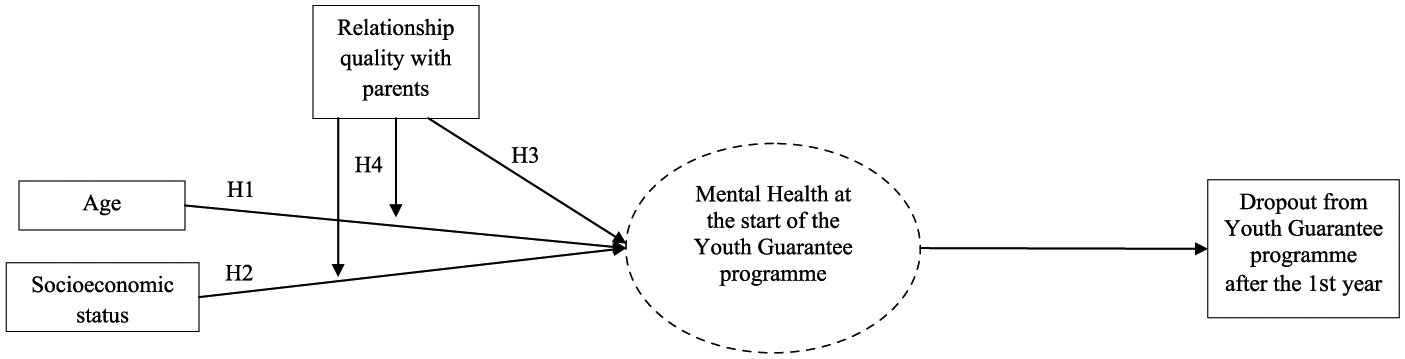
Hypothesized model of the effect of aggravating factors (young age, low socioeconomic status) and alleviating factors (relationship with parents) during a period of being NEET on dropout from a Youth Guarantee programme a year later.
The present study
The present study analysed archival data from a particular form of Youth Guarantee programme (‘Training Guarantee’), initiated by the Austrian state. Participants in these programmes are adolescents who have finished compulsory education, but have not managed to either continue into higher education or land an apprenticeship on their own within four months following their ending schooling. Hence, they had experienced a four-month period of being NEET. In Austria, Youth Guarantee programmes are arranged by state-funded vocational institutions which organize apprenticeships in supra-company workshops, or within a wider network of companies. Youth Guarantee apprenticeships and the educational degree they provide are equal to company-based apprenticeships (see Austrian Federal Ministry of Labour, Social Affairs and Consumer Protection, 2014; European Commission, 2014b). At the onset of the Youth Guarantee programme, an elaborate intake interview is conducted and a personal record is created for each participant. This record includes an assessment of the person’s personal background, their family situation and their cognitive abilities and skills, and is updated each year with information on the participant’s progress in the programme. These records were used for analysis in the present study. Most dropouts occur in the first year of the two-year programme, which is why this research focused on the first year outcomes only.
Programmes like the one described have been in place in Austria and Finland for a couple of years (at the time of writing) and are regarded as being highly successful in curbing youth unemployment (e.g. Eurofound, 2012b). They have acted as models that have informed the EU’s Youth Guarantee initiative, to which all EU member states have recently committed (European Commission, 2014c; European Union, 2013). Despite their positive image, systematic results on the success rate of these programmes are not yet available. A recent review by Eurofound reveals that although Youth Guarantee programmes manage to re-engage most of their participants with the labour market, dropout rates can still be as high as 30% (Eurofound, 2012a). There are no studies available to our knowledge that look at the background and experiences of the individual participants in these programmes and the factors that predict whether they will succeed. European-wide evaluations of the Youth Guarantee have been planned for December 2015 and 2018, but are not publicly available at the time of writing (European Commission, 2015). The present study highlights some of the factors that contribute to dropout from Youth Guarantee programmes, which could help with the planning of future evaluations.
Method
Procedure and background
The second author was granted access to the personal records of participants in a state-funded apprenticeship programme from an Austrian vocational institution. For this study, 300 reports were randomly selected from the archive, of participants who started the programme between the years 2007 and 2011. The only selection criterion was a quota sampling on gender (50%). All reports were anonymized before being coded into an SPSS data file.
Sample description and measures
The selected reports were of people who were on average 16.67 years of age (SD = 1.14) at that time. Most of them (64%) were migrants but had spent the largest part of their lives in Austria (M = 11.95, SD = 5.89 years). As for schooling, 18% had finished a special school, 81% had finished a secondary modern school and 3 persons attended a high school before entering the programme. Of those who attended the latter two schools, 25% had failed their final exams. The records also provided information regarding where the apprentices lived. The majority (74.7%) lived with two parents, 19.3% lived in a single parent household, 4% lived outside home (either on their own or in a state-care foster home), 6 persons indicated ‘elsewhere’ as their living situation (and were hence excluded from further analysis). On average, participants had 2.32 siblings (SD = 1.44). The records also included a measurement of cognitive abilities measured by a short version of the German ‘Wilde intelligence test’ (Kersting et al., 2008). We decided to include this variable as a control factor into our analysis, as cognitive abilities are regarded as an established predictor of vocational achievement (Park et al., 2007) and individual training motivation and training outcomes in a wide variety of studies (Colquitt et al., 2000). The Wilde intelligence test contains six sub-dimensions: verbal, mathematical, logical and spatial abilities, perception speed and precision, and memory. The respondents’ scores on each of these sub-dimensions were categorized on a seven-point scale (1 = far below average, 7 = far above average) by the administrating psychologist of the institution. An exploratory factor analysis across these six sub-dimensions with an Eigenvalue extraction > 1 revealed a single factor solution that accounted for 48.37% of all variance. Taking these six sub-scales together revealed an internal consistency of Cronbach alpha = .77. There were a couple of missing values on these scales, further reducing the sample to be used for analysis to N = 255.
Socioeconomic status
In research on early school leavers, socioeconomic status is often operationalized via the employment status of the parents (De Witte et al., 2013). Of those records where employment data of the parents was available, most (82.6%) of all fathers were employed, as compared to 59.6% of all mothers. There appeared to be a lot (25.9%) of missing data on the employment status of the parents, which necessitated a closer look. Maybe unsurprisingly, the missing data were associated with the living situation of the apprentice: if a person lived in a single parent household missing values of the employment status of their other parent were more common; if they lived in foster care homes often the employment status of both of their parents was missing. In order to not lose these respondents from the analysis, missing data on the employment status variable were dummy-coded and included in the analysis.
The perceived relationship quality with the parents was measured at the second or third meeting of the intake period, as soon as there was enough trust established between the personal advisor and the apprentice to have an open conversation about this topic. Participants were asked to reflect on what the situation at home was like for them and how well they got along with their parents. The conversation ended with asking the apprentices to rate their relationship with their parents according to school-grades (1 = very good, 5 = fail). For the present analysis these scores were recoded so that high numbers represent a good relationship quality.
Dropout
At the end of the first year, the personal advisor made a comment on the participants’ continuation in the apprenticeship. Participants could drop out of the programme for various reasons: they could be suspended from the course (e.g. due to insufficient attendance or behavioural issues) (23.6%) or they might exit voluntarily (15.2%). People could also end the programme for positive reasons, because they managed to find an apprenticeship outside the Youth Guarantee programme (23.0%) or because they found employment in a low-level job (6.1%). Of these participants 23.6% finished the programme and continued on to the next year, 8.4% joined another course. Since this study was interested in premature unsuccessful termination of these apprenticeships all those persons who were either suspended or who quit voluntarily were coded as dropouts (38.85%) while all the others were coded as successful cases.
Results
A Pearson correlation of the variables of interest showed that younger people, people of foreign nationality and those who reported a lower relationship quality with their parents also dropped out more frequently. None of the other demographic variables or the socioeconomic status (as indicated by the employment status of the parents) correlated with dropout after the first year (see Table 1 for details).
Pearson correlation of dropout with age, cognitive ability and relationship quality (N = 255).
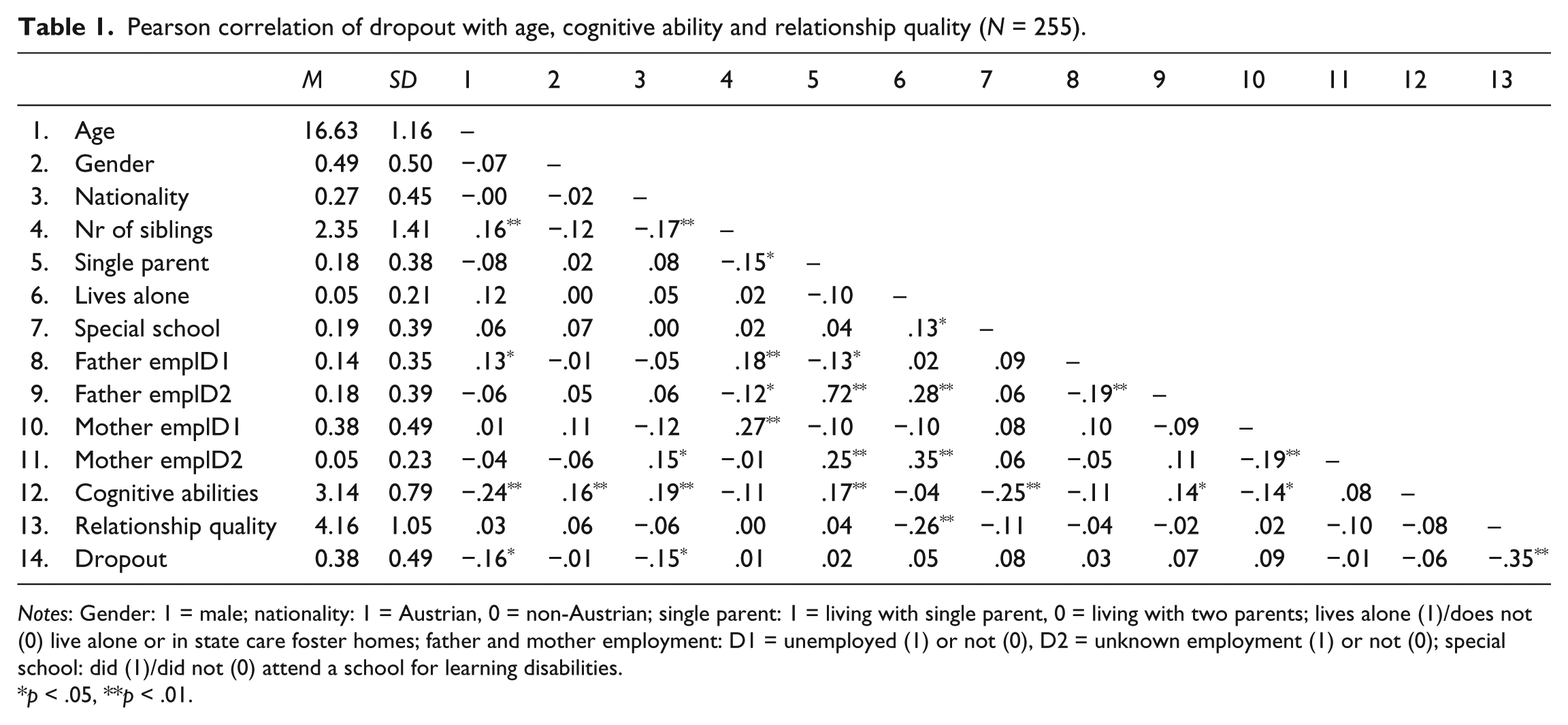
Notes: Gender: 1 = male; nationality: 1 = Austrian, 0 = non-Austrian; single parent: 1 = living with single parent, 0 = living with two parents; lives alone (1)/does not (0) live alone or in state care foster homes; father and mother employment: D1 = unemployed (1) or not (0), D2 = unknown employment (1) or not (0); special school: did (1)/did not (0) attend a school for learning disabilities.
p < .05, **p < .01.
To test the hypotheses and investigate the independent impact of age, socioeconomic status and relationship quality, a hierarchical logistic regression analysis was carried out, following the suggestions by Jaccard (2001). All continuous variables were z-standardized before entering the analysis; interaction terms were calculated on the basis of z-standardized values.
First, the control variables gender, nationality, cognitive abilities, number of siblings, living in a single parent household, living alone and school type were entered. None of these variables significantly added to the explanation of dropout, χ2 (7) = 8.50, p = .291.
Next, age, socioeconomic status (as indicated by the employment status of the parents) and relationship quality were added to the prediction. This increased the explained variance of dropout to 26%, Nagelkerke R2 = .262, Δχ2 (6) = 45.98, p < .001. Age and relationship quality had a significant impact as expected, people who were younger at the onset of the programme and people who reported a worse relationship quality with their parents were more likely to drop out, which supports Hypotheses 1 and 3 (see Table 2). Employment status of the parents did not add to the prediction of dropout, thus not supporting Hypothesis 2.
Logistic regression analysis results for the prediction of dropout by control variables, age, socioeconomic status and relationship with parents (N = 255).
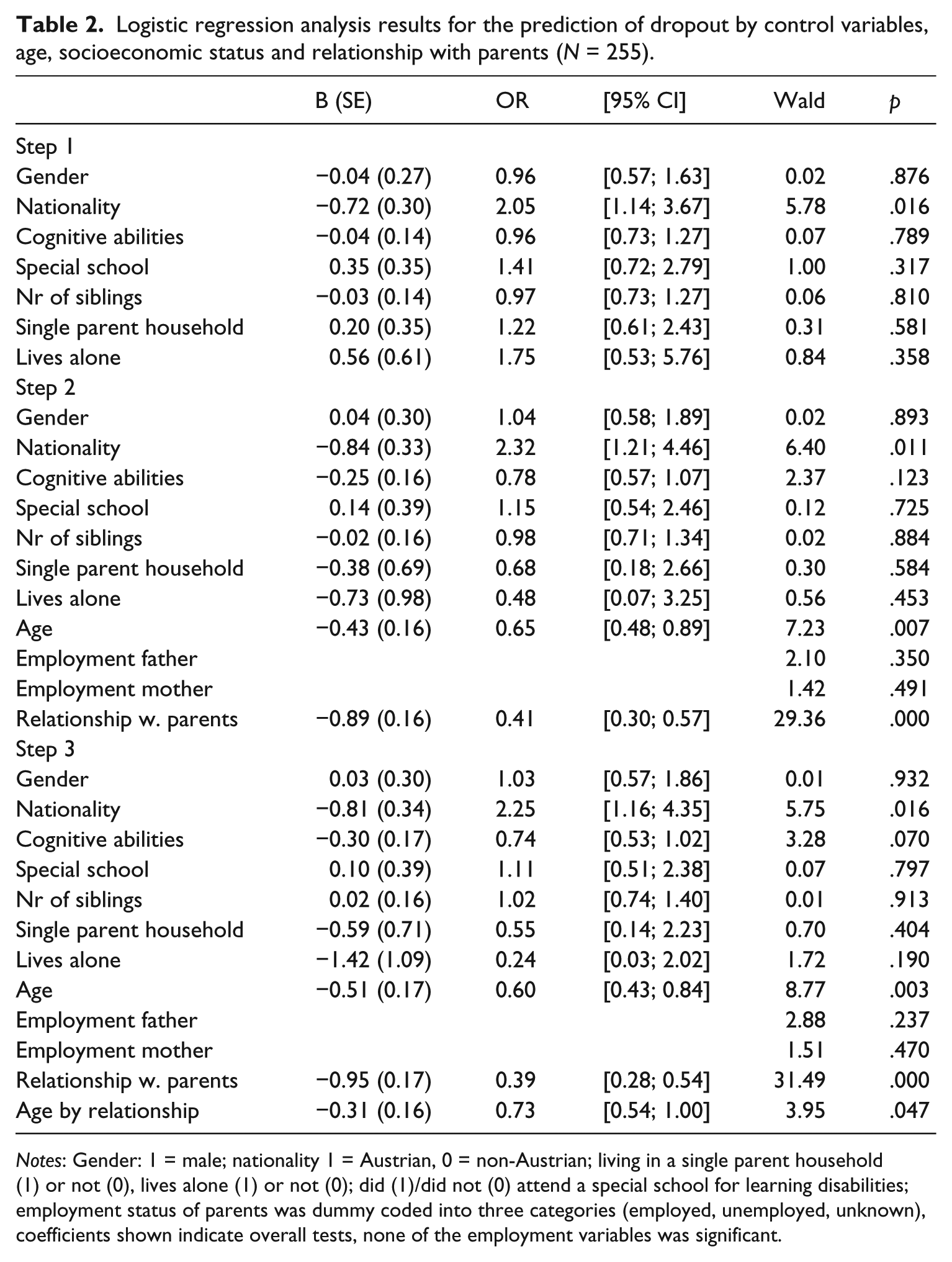
Notes: Gender: 1 = male; nationality 1 = Austrian, 0 = non-Austrian; living in a single parent household (1) or not (0), lives alone (1) or not (0); did (1)/did not (0) attend a special school for learning disabilities; employment status of parents was dummy coded into three categories (employed, unemployed, unknown), coefficients shown indicate overall tests, none of the employment variables was significant.
The third step tested for the moderation effect of relationship quality on the effect of age and employment status. Since employment status did not have an independent effect on its own, this interaction effect was not estimated. Instead, only the interaction term that tests the moderating effect of relationship quality on the effect of age was included. This increased the explanation of dropout to 27.9%, Δχ2 (1) = 4.07, p = .044.
Plotting the two-way interaction onto the probability to drop out shows that age only matters for dropout if the relationship quality is high; in this case people tend to drop out less when they get older (see Figure 2). If the relationship quality is low, people drop out more, relatively independently of their age. This is slightly different to what was expected. Hypothesis 4 presumed that relationship quality would reduce the negative effect of low age, which is the opposite of what was found.
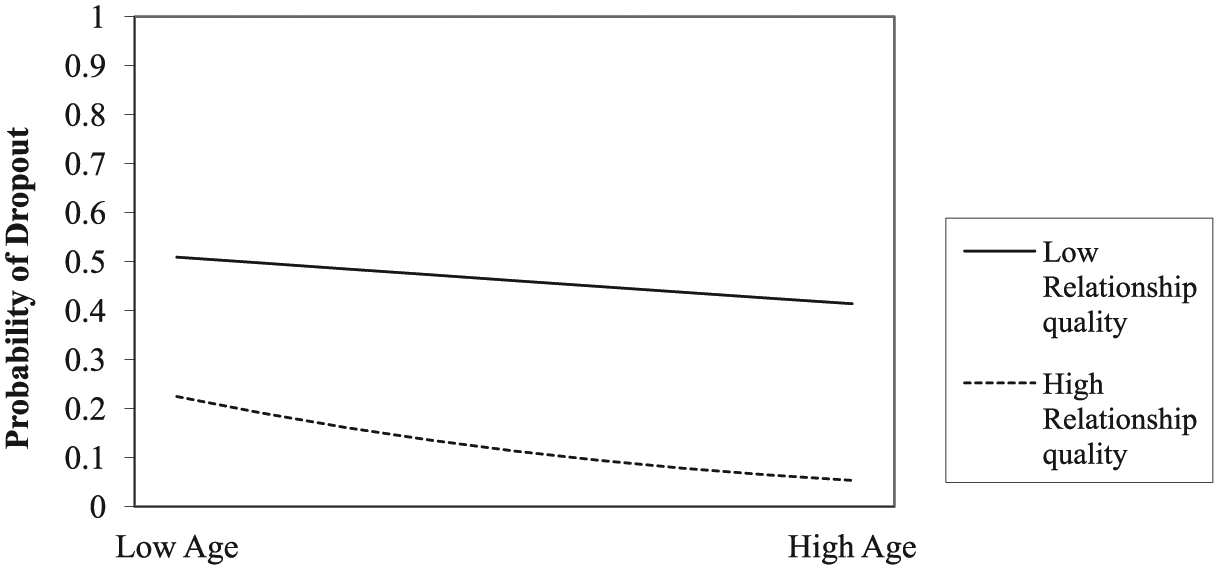
Illustration of the interaction effect of relationship quality and age on dropout.
It needs to be noted that dropout in this study was defined as occurring when someone either got suspended or quit voluntarily. ‘Not dropping out’ consisted of behaviours as varied as either finishing the first year of the course, getting onto another course, finding an apprenticeship outside the Youth Guarantee institution, or finding employment in a low-level job. These are rather different kinds of outcomes and it is likely that by re-categorizing them into a single category (‘not dropping out’), a considerable amount of variance was lost. To test for the robustness of our findings and explore whether different variables would be differently responsible for the six possible outcomes of the programme, one-way ANOVAs and χ2 tests were carried out, each using exit reasons as an independent variable (see Table 3 for a comparison of means and probabilities). There were significant differences between the groups on age, F(5,295) = 3.11, p = .009, relationship quality, F(5,295) = 10.67, p < .001, number of siblings, F(5,295) = 2.45, p = .050, and on nationality, χ2 (5) = 16.36, p = .006. All other variables (cognitive ability, gender, living alone, going to a special school, living in a single parent household, all parental employment categories) did not make a difference for the individual exit reason.
Differences of means and distribution of demographic characteristics by different programme outcomes.

p = .05, **p < .01.
Note.Father’s employment ‘unknown’ and mother’s employment ‘unknown’ is not shown in the table.
A post-hoc comparison of the individual five groups showed that people who were suspended had a significantly lower relationship quality with their parents than all other groups (except for those who quit voluntarily) and were significantly younger than those who quit voluntarily and those who changed onto another course programme. People who finished the programme successfully had the smallest number of siblings and were more likely to be Austrian nationals than others (except for those who found an apprenticeship on their own).
These two additional factors – number of siblings (which could be seen as a proxy for socioeconomic status) and minority status – are also established moderators of the unemployment experience (Paul and Moser, 2009). Therefore this indicates additional support for the assumption that factors that influence adolescents’ vulnerability during unemployment also affect their chances in Youth Guarantee programmes. What follows from these findings will be explored in detail in the next section.
Discussion
This study aimed to predict adolescents’ chances of succeeding on an apprenticeship programme after having gone through a period of being NEET. Embedded in a life-span theory perspective (Heckhausen et al., 2010) and by drawing on results from unemployment research (McKee-Ryan et al., 2005; Paul and Moser, 2009; Wanberg et al., 2010), it was proposed that the experience of being not in employment, education or training is likely to have affected young people’s affective and behavioural resources needed for future educational attainment. It was further proposed that younger people, people from lower socioeconomic backgrounds and those who had a worse relationship with their parents would have an even more negative experience while being NEET, resulting in a lower likelihood of finishing a Youth Guarantee programme. Furthermore, it was assumed that a good relationship with the parents could act as an extra safety net, if people were of higher risk because of young age or low socioeconomic status.
Our findings are largely supportive of this perspective. Age was found to be an important predictor for finishing an apprenticeship in a Youth Guarantee scheme. Younger people were significantly more likely to drop out of the apprenticeship programme, compared to people who finished the apprenticeship, found a job, found an apprenticeship outside the programme, or continued onto another programme. Given that age is positively related to well-being among young unemployed people (e.g. Paul and Moser, 2009), this could indicate that younger people were more affected by being NEET in their mental health and consequently less able to self-regulate and cope with the demands of an apprenticeship (Heckhausen et al., 2010). There was also a strong effect of relationship quality, people who reported a worse relationship quality with their parents at the onset of the programme, were less likely to finish it. This is in line with previous studies which illustrate the importance of social support for young people’s coping with unemployment (e.g. Bjarnason and Sigurdardottir, 2003; McKee-Ryan et al., 2005). It is also reflected in studies on the role of parental support for academic aspirations (e.g. Duchesne and Larose, 2007; Tynkkynen et al., 2010) and the role of parental warmth in particular (Dietrich and Salmela-Aro, 2013).
Relationship quality also moderated the effect of age, but this effect was rather small and in a different manner than expected. Young people had a slightly higher chance for dropout than older people, but only if the relationship quality was high. If the relationship quality was low, age did not matter anymore for dropout. Apparently, the effect of relationship quality over-shadowed the effect of age – if the relationship quality was good then there was a relationship between age and dropout, if it was bad, then there was none. Most people in this sample reported a good relationship with their parents, which might also explain why on average there was a significant effect of age.
The findings regarding socioeconomic background are less clear. If only the parental employment situation is regarded as an indicator for socioeconomic status, then there was no relationship with dropout. Probably though, as a sole indicator, employment status of the parents might have been too narrow. There is no unified definition of socioeconomic status, but authors typically agree that it is captured by combining multiple indicators together (occupation but also education, income, etc.) (Bradley and Corwyn, 2002). If, for example, also ‘number of siblings’ is included as an indicator of poverty and low socioeconomic status, then there would be some support for this hypothesis, as people with more siblings were less likely to succeed on the programme. Future research would certainly need to include more measures of socioeconomic status to allow for a better test of this influence. If supported, the non-significant influence might even convey a kind of hopeful message – while socioeconomic background might be a risk factor to fall into a NEET spell (e.g. Bynner and Parsons, 2002), it does not necessarily affect young people’s future likelihood of escaping this situation.
In sum, the effects found in this study fit well within the developmental goal and mental health perspective. The same factors that influence vulnerable adolescents’ mental health during a period of setbacks in the achievement of life goals also affect their likelihood to succeed on a Youth Guarantee programme. Presumably, young people who are more strongly affected by being NEET, experience even more depressive mood, less self-efficacy and less self-esteem than their peers. They might lose their interest in further education and their competence in dealing with education and daily difficulties. This, eventually, will put them on a worse starting position on a Youth Guarantee programme. Also, the unexpected effect of nationality can be explained in that way: minority status has been related to poorer well-being among unemployed persons (Paul and Moser, 2009), as it is assumed to contribute to an accumulation of stress factors. Similarly, young people who come from a minority background and are NEET might be more affected than their peers who are from the majority, and could have exhausted their coping abilities which they later need for handling the demands of Youth Guarantee programmes.
More support for the assumption that it is the NEET experience which puts adolescents at risk for their future educational success can also be seen in the non-significant role of other predictors. Cognitive abilities, for example, which would be a typical predictor of school dropout (e.g. De Witte et al., 2013), or the unemployment status of the parents, which would play a role according to a socialization perspective (e.g. McLoyd, 1989), did not matter here. This indicates that the factors predicting dropout from a Youth Guarantee programme differ slightly from those predicting dropout from general education. Instead, factors that are moderators of the unemployment experience played a role. This might indicate fundamental differences between school dropout and Youth Guarantee programme dropout. More knowledge on apprenticeship dropout, or dropout from institutions other than schools would be needed to explore this issue.
Certainly, this study does not come without limitations as it illuminates only the cornerstones of a process wherein multiple factors play a role. One of the drawbacks is the absence of evidence on well-being, depressed mood or competence in this data collection. In that way, we cannot be fully certain that it is reduced mental health that connects vulnerable NEET groups with dropout, although the literature strongly suggests it is. Future research could include measures of mental health, as well as information on the experience of the NEET period to allow for a test of the explanatory potential and limits of the proposed model. Second, our explanation focuses on the unemployment experience of adolescents before they enter the Youth Guarantee programme and takes that as an explanation for later dropout. It does not attend to the great variety of experiences young people have while on the programme, which play an essential role and link the starting position adolescents have to later dropout. Also, our analysis did not include structural and social aspects that could be of relevance (e.g. institutional support). Lastly, despite the empirical and theoretical support for the suggested framework, alternative explanations cannot be ruled out. For instance, younger age and lower relationship quality with the parents might both be a third factor. Both could indicate an as yet incomplete development of social skills or coping abilities, which is essential for academic achievement (e.g. Compas et al., 2001; Malecki and Elliott, 2002; McClelland et al., 2000). Not having sufficient social skills might affect the relationship with the parents at home as well as the behaviour at the apprenticeship training institution (reflected in people getting suspended or quitting more easily). To confirm the causality of the proposed effects, longitudinal replication studies, which control for measures of social skills, would be needed.
In sum, we believe that the dynamic perspective provided by including the affective and behavioural consequences of being NEET into the framework offers a unique empirical and theoretical contribution to the literature on youth unemployment and re-employment. Most studies so far have provided a rather static view by looking at the attributes of individual job seekers, their social environment or the structural and labour market measures in place. Theoretically driven explorations in the field are rare and so are studies that acknowledge the interdependence of the experiences (and go beyond using ‘unemployment duration’ as a control). The results of this study show that moderators of failed goal achievement (in the form of previous experience of unemployment and unsuccessful job search) are likely to influence future achievements as well: all aspects that predicted dropout from the programme under study are also well-established influences of the mental health, well-being and regulatory abilities of unemployed people. This perspective on youth re-employment can assist future research (1) in systematically investigating the role of moderators of the unemployment experience as predictors of dropout from re-employment programmes, (2) in exploring whether factors beneficial to the affective and behavioural components of mental health might increase the chance to finish a Youth Guarantee programme and (3) in identifying people at particular risk from being more affected by NEET spells than others.
Aside from their theoretical implications, the findings of the present study might also be of interest to practitioners and youth councillors offering training under the recently ratified Youth Guarantee scheme. Our study shows that being out of employment, education and training is very likely to ‘leave scars’. It seems that people who are likely to have suffered more while they were NEET, might need an extra boost to their well-being and regulatory abilities, in order to be able to succeed on re-employment programmes. Fostering young people’s resources of social support, for example by improving their private relationship with their parents, might be one way to achieve that. Counselling them for depressive affect might be another. Also, policy makers and public funding institutions might benefit from the findings of this study, when deciding which particular Youth Guarantee scheme to implement and support. We cautiously conclude that programmes that pay attention to young people’s previous NEET experience and their private situation at home might be more effective than others.
Footnotes
Declaration of Conflicting Interests
The author(s) declared no potential conflicts of interest with respect to the research, authorship, and/or publication of this article.
Funding
The author(s) received no financial support for the research, authorship, and/or publication of this article.