




Abstract
Based on an empirical study conducted with union representatives working in the private sector in Quebec (Canada), this article analyses how union representatives perceive strikes. The analysis of the interviews primarily shows that union representatives have strongly integrated the current constraints related to striking, whether they be of an economic, institutional or organizational nature or relating to the dynamics of mobilization involved therein. Second, it emphasizes that, in spite of the union representatives’ more ambiguous relationship with striking, strikes are still an important tool in the repertoire of union action. Lastly, it highlights the various changes in the way this union practice is implemented.
This article is based on a fundamental observation, namely, the downward trend in strike activity since the early 1970s and 1980s in most industrialized countries and the relative stability of this low level of strikes in recent years. This observation is based on a vast literature that has analysed the available statistics on strikes in numerous regional and national contexts 1 (Gall, 2012; Godard, 2011; Lyddon, 2015; Vandaele, 2011). Faced with this widespread phenomenon, many experts have investigated the reasons behind the decline in strike activity (Brandl and Traxler, 2010; Kelly, 2015; Scheuer, 2006; Van der Velden et al., 2007). These studies have noted a combination of factors related to the economic, political, institutional and organizational environment of trade unions as well as the collective mobilization processes that underlie the decision to take industrial action. Although these studies provide useful explanations, in particular regarding the restrictive effects of economic and environmental changes on striking, few studies to date have examined how union actors and employees perceive this pressure tactic and its implementation in the current context.
Thus, this article aims to capture how the changes occurring in the environment of union organizations in recent years have transformed union representatives’ view of and relationship with strikes. More specifically, it is based on structured research using two analytical perspectives. The first focuses on the way new constraints on strike activity are perceived by union representatives and influence the way the latter view strikes. The second addresses the role of strikes today in the repertoire of union action.
The article is divided into five parts. The first part provides the background for this research by briefly reviewing the explanatory factors for strike actions suggested by the main theories structuring the field of industrial relations. The second and third parts relate the research issue to the specific context of the Canadian and Quebec industrial relations systems and present the methodological approach used as well as the fieldwork conducted with union representatives working in the private sector. The fourth part presents the research results and highlights how union representatives perceive strikes and their capacity to implement them. The fifth concludes with the main findings emerging from this study.
Strike activity through the prism of theoretical approaches
Labour economists were the first to conduct studies aimed at understanding strikes and to propose explanatory theoretical models (Hicks, 1963; Rees, 1952). These groundbreaking studies and those that were subsequently drawn from them put forward two major frameworks for interpreting fluctuations in strike activity (Giraud, 2009). The first conceptualizes strikes as the result of ‘skewed negotiations’. This interpretative framework maintains that strikes entail risks and costs that rational actors should normally manage to avoid. Consequently, the inability to reconcile viewpoints during a collective negotiation and the outbreak of a labour conflict appear to be the result of actors’ limited rationality and information asymmetry, the latter most often being unfavourable to union representatives. 2 The second interpretative framework stemming from the economic approach suggests that fluctuations in the number of strikes are associated with fluctuating economic conditions (Card, 1990; Cramton and Tracy, 2003; Devereux and Hart, 2011). Indeed, several authors have sought to associate changes in levels of strike action with changes in economic indicators, the most common of which are inflation and the unemployment rate. Although the results of such research are not unequivocal (Gramm, 1986; Paldam and Pedersen, 1982), the main hypothesis is that workers are less inclined to go on strike when the economy shows signs of slowing down or when their financial situation becomes precarious (Kaufman, 1982; Schor and Bowles, 1987).
However, studies drawing on the economic approach have been widely criticized, in particular for presuming that decisions to strike are simply a composite of individual worker attitudes, without taking into account that it is not only workers themselves who determine whether a strike will occur. Many authors have also pointed out the ambiguity of several of the studies conducted to confirm the main interpretative frameworks of such an approach (Cohn and Eaton, 1989; Snyder, 1977). To address the limitations of these studies, additional studies relating to a variety of social science disciplines gradually appeared. More specifically, from the 1960s onwards, in a context marked by an intensification of strike activity in most industrialized countries, this phenomenon was explored by other disciplines, including industrial relations (Edwards, 1981; Hyman, 1972), sociology (Aminzade, 1984; Korpi and Shalev, 1979) and political science (Pizzorno, 1978; Shorter and Tilly, 1974). These studies most often aimed to explain recent trends and fluctuations in strike activity, drawing on the theoretical approaches stemming from these various disciplines. Thus, the following subsections briefly review the possible explanations deriving from studies related more particularly to the pluralist, materialist and sociological approaches that structure the field of industrial relations (Scheuer, 2016).
Contribution of pluralist and social regulation approaches
Pluralism in industrial relations (Clegg, 1970; Kerr, 1954) and the various theories associated with it, such as system theory 3 (Dunlop, 1984) and social regulation theory (Reynaud, 1977), emerged out of a desire to better understand social phenomena and the diversity of social practices, including strikes. In contrast with a unitary perspective of organizations and society, the pluralist perspective challenges the idea that a conflict can be controlled through appropriate managerial actions and reflects a less restrictive conceptualization of industrial relations, recognizing the sometimes divergent interests of the various stakeholders and interest groups that are an integral part of organizational and social life (Audet and Larouche, 1988).
Viewed from this theoretical perspective, the analysis of strikes should focus less on economic constraints and more on the rules and institutions that regulate labour relations and define the leeway given to actors. Based on the postulate that labour conflicts are an inherent part of labour relations, these theories suggest that strikes should be analysed from the perspective of trade unions’ participation in institutional bodies, whether at the national, sectoral or workplace level, and the mechanisms for regulating labour relations specific to each regional or national context (Dunlop, 1984; Reynaud, 1977). A strike must thus be understood in light of the possibilities that union representatives have to use it, in accordance with the regulations governing the right to strike and collective bargaining specific to each industrial relations system. In this regard, several studies have noted the extent to which the provisions on the right to strike – which differ according to the national context – have tightened in recent decades (Aavaag Stokke and Thörnqvist, 2001; Basset, 1986).
Other studies inspired by this approach have also shown that increasing state intervention in the labour relations sphere and an increase in the formalization of collective bargaining have led to an institutionalization of labour conflicts (Clegg, 1970; Kerr, 1954). One of the major hypotheses of these studies suggests that the process of institutionalizing labour conflicts appears to encourage trade unionists to concentrate on appropriating the available institutional resources at the expense of developing militant practices and using strikes more frequently. The implementation of several institutional reforms and the experimentation with new practices centred on cooperation between employers and trade unions confirm this hypothesis 4 (Bordogna and Primo Cella, 2002; Welz and Kauppinen, 2005).
Moreover, several studies have sought to situate labour conflicts within a political balance of power, of which union action is part (Franzosi, 1995; Korpi and Shalev, 1979). The hypothesis underlying these studies suggests that a political context that is receptive to union demands can have a moderating effect on strike activity. Although this hypothesis does not constitute a universal rule (Shorter and Tilly, 1974), Hamann et al. (2012) have nevertheless observed that strike activity has effectively tended to decrease when trade unions have participated in implementing government reforms, or have had affinities with the political party in power.
Contribution of Marxist and materialist approaches
Despite the prevalence of the pluralist approach in the field of industrial relations, the emergence of new forms of social and economic instability in the early 1970s prompted some scholars to criticize the underlying postulates of this approach, which resonated with similar Marxist criticisms (Audet and Larouche, 1988). In particular, the pluralist perspective was criticized for overestimating the positive impact of conflicts and idealizing the role of the state in industrial relations by regarding the latter as an ‘impartial arbiter’ guaranteeing the balance of power between actors at the societal level (Fox, 1974). Some authors also argued that the integration of trade unions into regulated institutional spaces does not necessarily involve their conversion to a more collaborative mode of interaction with employers (Giraud, 2009). Moreover, although the legal rules regulating the exercise of the right to strike and the institutional mechanisms aimed at averting strikes are effective, it nevertheless cannot be concluded that these rules have the power to alleviate the tensions between the parties and prevent new conflicts from emerging.
Thus, in order to move beyond the functionalist dogmatism specific to the pluralist approach and explain society in terms of conflicts, domination and structural changes, studies drawing on Marxist and materialist theories emerged in the 1970s, putting forward new dimensions in the analysis of labour conflicts (Braverman, 1974; Edwards, 1992; Hyman, 1972). Moreover, in recent decades, the advent, in some societies, of an increased concentration of corporate ownership and stronger financial power has confirmed the continuing relevance of a materialist interpretation of social dynamics, particularly in the field of industrial relations and labour conflicts (Godard, 2011; Müller-Jentsch, 1998). Studies using these approaches have highlighted the complexity of the links that exist between economic production, class struggle and political power, and have been critical of attempts to bring workers and employers closer and of trade unions’ participation in social regulation bodies (Giles and Murray, 1997). According to this perspective, conflict is unavoidable because it is rooted in the very structure of the ownership of the means of production and the uneven distribution of power (Edwards, 1981; Hyman, 1989).
Although all Marxists are materialist, the opposite is not necessarily true and differences exist between these two major approaches, mainly on the question of conflicts developing into class struggles and the programmed transformation of capitalism into a more equal society (Edwards, 1986). By focusing on societal structures while recognizing the role played by actors in determining their own behaviour, the materialist approach thus moves away from Marxist determinism, which conditions the action of individuals based on the position they hold in the production system. Studies based on the materialist approach have also demonstrated that while union organizations are conditioned by their respective histories, employer strategies and state policies, they nevertheless remain independent from public authorities and relatively autonomous in their choice of strategies, in particular with regard to the negotiations in which they participate (Giles and Murray, 1997).
More recently, studies based on these approaches have shown how new phenomena associated, in particular, with globalization have reshaped the balance of power within companies (Fleming and Spicer, 2007). For example, the multinationalization of corporations and the division of work within global value chains are factors that have disrupted the traditional frameworks of collective bargaining and affected the influence that workers and their representatives can exert on companies (Murray, 2010). Whether it is through practices implemented for the purpose of comparing productivity and/or profitability levels between establishments or threats of offshoring, establishments and production units, while belonging to the same organizational entity, now compete with one another, at both the national and international levels.
This context has evidently affected union action and striking. Forcing production units within the same company to compete with one another can isolate some employee groups, discourage the expression of conflict, and compromise collective mobilization (Lévesque and Murray, 2010). Defending workers’ interests becomes even more problematic when the outsourcing of production and subcontracting reconfigure the balance of power to the detriment of the capacity of trade unions to mobilize employees around common goals (Glyn, 2010; Peters, 2010). Collective mobilization is also restrained when companies require greater flexibility from employees, increase the number of temporary workers, and use employment agencies. Although some recent studies have qualified the effects of job flexibility and job insecurity on the propensity of workers to strike (Jansen et al., 2014), these labour management methods are nevertheless seen as destabilizing work teams, making it more difficult for them to voice their interests (Weil, 2014). Lastly, union action is sometimes hampered when employers require subjective employee involvement and establish individualized human resource management practices that weaken cohesion among professional groups and their capacity for collective mobilization (Fiorito, 2001; Machin and Wood, 2005).
Contribution of sociology of action and mobilization
Although the approaches mentioned so far mainly deal with the external determinants of strikes, namely those associated with the economic, institutional, political and organizational environment of companies and trade unions, the analysis of strikes would not be complete without addressing their internal dynamics. This analytical perspective has been used by studies based on the sociology of mobilization and collective action as a frame of reference (Heery, 2002; McAdam et al., 2001). The central hypothesis of these studies suggests that discontent, even generalized discontent among employees, does not automatically lead to collective mobilization. Workers’ mobilization faces many constraints, and their involvement in a labour conflict implies that several conditions have to be met.
Various studies have in fact highlighted the influence of the prior degree of organization of employees on their motivation to take strike action. Observations made in different national contexts are consistent in this regard and reveal the predominant role of union resources when it comes to triggering labour conflicts (Morris, 2003; Rubin, 1986). It has also been demonstrated that a sense of injustice combined with a positive perception of resources and the union leadership are key factors in employees’ support for strike action (Buttigieg et al., 2008). On the other hand, excessive institutionalization and bureaucratization of union organizations have the effect of distancing leaders from their members’ concerns, making members less combative and undermining their confidence in these leaders (Terry, 2003). In short, the decision to take industrial action results from a process involving awareness raising among members, anchoring demands and organizing and mobilizing resources, which must precede the strike action itself.
Studies drawing on the sociology of collective mobilization (Korpi, 1983; Shorter and Tilly, 1974) are also based on the hypothesis that collective action rests on a cost–benefit analysis by the individual and collective actors involved, leading them to balance the potential risks and gains associated with going on strike. From this theoretical perspective, strike action can thus be viewed as a ‘strategic choice’ based on a prospective analysis of the gains or losses that may result from a strike for the actors involved (Brandl and Traxler, 2010). In this sense, the way employees and their representatives perceive their economic, political and organizational environment is critical to their assessment of the possibility of achieving their goals and, in turn, their decision to go on strike. The Thomas theorem of sociology (Thomas and Thomas, 1928), which states that individuals’ behaviours can be explained by their perception of reality (rather than the reality itself), suggests, moreover, that these perceptions, whether true or wrong, complete or partial, have real consequences on the decisions made on collective action. In this respect, several studies suggest that public opinion has become a decisive factor in union action, and is even perceived as a barometer for gauging the legitimacy of pressure tactics (Boris, 2012).
Thus, a number of explanatory sources for strikes have emerged from these theoretical approaches. After presenting the specific context of this research and the different stages of data collection and analysis, we will attempt to compare these possible explanations with union representatives’ perceptions of strikes.
Context of the research
Although the industrial relations system in Canada may appear to be a relatively homogeneous entity – based on the Wagner Act model of union certification 5 and voluntarism between labour and management through a decentralized regime of collective bargaining – there are significant differences between the Canadian provinces (Frangi and Hennebert, 2015). In this regard, Quebec is undoubtedly the province that most stands out. Quebec is distinctive not only in terms of its history, culture and official language, but also in terms of its institutional, political and social structures, which give it an ‘unquestioned identity as a region’ within Canada (Thompson et al., 2003: 5).
In the area of industrial relations, Quebec has numerous distinctive features. Quebec is the most unionized region in North America, with a relatively high unionization rate, hovering around 40%. Quebec is also the only region in Canada that is characterized by a plurality of peak multi-sector union organizations, which, moreover, compete with one another. Of the four major labour confederations in this province – i.e. Fédération des travailleurs et travailleuses du Québec (FTQ), Confédération des syndicats nationaux (CSN), Centrale des syndicats du Québec (CSQ) and Congress of Democratic Trade Unions (CSD) – three are exclusive to Quebec. Furthermore, the decentralization of collective bargaining is in line with an industrial relations system that leaves room for macro-social consultation practices. These consultation mechanisms give the Quebec labour relations system a ‘hybrid’ character, situating it between the ‘North American system and some European industrial relations systems’ (Laroche and Barré, 2012: 67–68; our translation). In addition, the laws regulating collective labour relations in Quebec differ from those in most other provinces in several respects. These laws include, in particular, an automatic union certification system following the signing of membership cards, strike regulations that limit the right to vote for strike action to card-carrying union members and a law prohibiting employers from using strikebreakers.
In Quebec, the legal framework for the right to strike is set out in the Labour Code, which explicitly recognizes this right for all employees, excluding municipal police and firefighters. Only one duly certified employee association, i.e. forming a trade union, can legally take strike action, on approval of the majority of its members, thus making the right to strike a collective one. However, no other type of worker association can do so. Moreover, the right to strike cannot be exercised while the collective agreement is in force. In fact, strike action can be taken only when the collective agreement is being renewed and according to the specific temporal provisions stipulated by law. Exercising the right to strike also implies that a negotiation has been conducted in ‘good faith’ by the parties. Besides procedures requiring, in particular, trade unions to hold a strike vote in order to obtain majority support, the purpose of the strike must be to negotiate working conditions (Trudeau, 2004). Any strike that pursues other goals, such as union recognition or for political purposes, is prohibited.
While the legal framework regulating the exercise of the right to strike in Quebec has remained stable in recent decades, many authors nevertheless believe that, in some sectoral contexts, strike action is currently facing significant constraints because of the obsolescence of certain aspects of this legal framework and a number of legislative reforms which, while not strictly redefining strike rules, have nevertheless affected the capacity of actors to exercise this right. Illustrations of this include the obsolescence of some standards protecting the right to strike (e.g. prohibition to use strikebreakers) with regard to the new realities of work (Trudeau, 2004) or the gradual strengthening of laws on essential services restricting the possibility for certain employees working in public services to strike (Fontaine, 2008).
To complete this portrait of the legal framework and the situation of labour conflicts in Quebec, it should be noted that, as in most industrialized countries, the number of labour conflicts 6 has considerably decreased in this region over the last 30 years, dropping from an annual average of 320 during the decade between 1976 and 1985 to 77 during the years from 2006 to 2014 (see Figure 1). A comparison of the 1981–1990 period with the 2001–2010 period shows that the average annual number of workers affected by a labour conflict decreased from 136,012 to 31,060, whereas the average person-days lost per year decreased from slightly over 1.5 million to 572,763 (Labrosse and Larente, 2012).
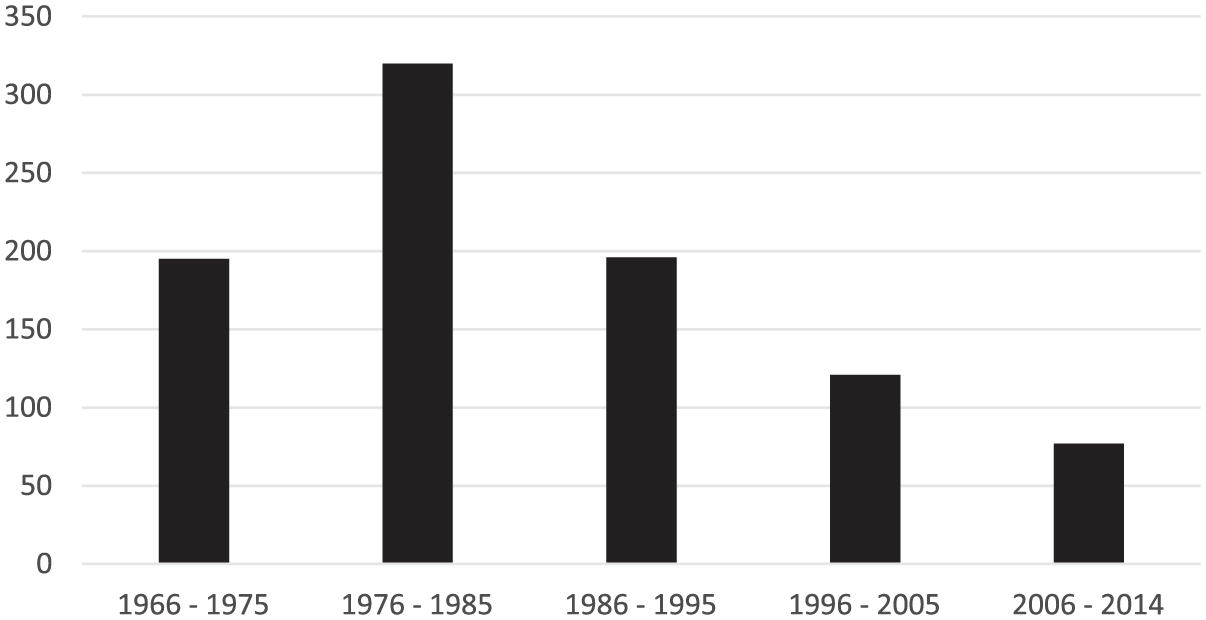
Average annual number of labour conflicts in Quebec.
Participants
This research was based on an empirical study conducted with union representatives from a major Quebec trade union federation. This federation and these union representatives were chosen for two reasons. First, the federation is active in the private sector and local trade unions operating in all spheres of the Quebec private sector are affiliated with it. Second, our intention was to interview union representatives who had been actively involved in collective bargaining processes, ideally for several years, and had exerted considerable influence on the decisions to adopt and carry out a strike mandate.
The type of union representatives surveyed in this research, sometimes also called union advisors or union staff representatives, represented a perfect fit for the profile we sought. They are assigned to different local unions by the trade union federation that employs them (see Box 1). Their position is not elective and in addition to ensuring compliance with labour laws, they assist local trade unions in managing employees’ demands. In this capacity, they can be called upon to intervene at general meetings and when a strike vote is held. They are also professional negotiators. Although their role at the bargaining table may vary from one company to another, they usually play an important role in the company, acting as the main spokespersons for labour. Since they hold a key position in the collective bargaining process, they must know how to deal with corporate expectations and local union goals. Their position also allows them access to privileged information, through both their participation in the bargaining sessions and access to data deriving from various mechanisms for consulting members of the union. They are thus at the centre of the dynamic of labour relations, a position that allows them to exert a real influence on employees’ choice of bargaining strategies and means of action.
Structure of union representation at the local level in the private sector in Quebec.

Moreover, acting as a relay between the local union and the parent organization, these union representatives are immersed in union life. They are responsible for communicating their federation’s policies and orientations relating to the bargaining issues (duration of agreements, prioritization of demands, acceptability of certain concessions, etc.). Given that they assist several trade unions that most often operate within the same industry or in related industries, they possess sector-based expertise that can be made available to local trade unions.
Study sample, data collection and analysis
The results came from an empirical study conducted between April 2013 and June 2015. Forty-five (45) semi-structured interviews were conducted with the same number of union representatives. The latter were selected mainly because they belonged to three union entities that were particularly active in the private sector. Our respondents, 11 women and 34 men, had been acting as union representatives for an average of 11.5 years. They represented union members working in companies of all sizes and in industry sectors deployed in all regions of Quebec, such as retail trade, agrifood, the media and communications, professional and financial services, hotel trade, restaurant trade and the metal and forestry industries. The union representatives interviewed were responsible for 7 to 15 local unions and 26 of them had participated in one or more strikes.
The interview questionnaire used was constructed by the lead author and was validated, first, by four university colleagues who were experts in the field of industrial relations and collective bargaining. This first consultation showed that the field of investigation needed to be broadened, which led to new questions being added. Thus, in addition to the questions on striking, the interview questionnaire addressed other dimensions of union representation and collective bargaining, including defining the choice of bargaining strategies, developing bargaining issues and relations with the represented members. Second, the interview questionnaire was validated with four union representatives. This second consultation helped to confirm the relevance of the questions asked and to clarify the meaning of some of the questions in order to ensure a clear response from the community under study.
Each interview, lasting from 90 to 120 minutes, was recorded and retranscribed in full. The content of the interviews was then analysed using ATLAS.ti software and coded on three levels. First-level codes were established using the meaning condensation method proposed by Kvale (1996), in which the first step consisted in identifying ‘natural meanings units’ expressed by the respondents. The statements dealing with the constraints related to strike activity were grouped together first, then those describing the union representatives’ attitude toward strikes, and lastly those relating to the implementation of this pressure tactic. Second-level codes were then defined within these three datasets. For example, the strike-related constraints perceived by the union representatives were divided according to their economic and structural, organizational, or political and institutional nature. In some cases, third-level codes were established in order to refine the analysis. This third level of coding was needed to differentiate between the specific constraints referred to by the union representatives, or to take into account divided opinions, as was the case for assessing the effectiveness of strikes as a pressure tactic.
Results
The data gathered for this study were used to examine how the union representatives viewed their environment and how their relationship with strikes and the implementation of strikes had evolved. The following subsections describe the results of these analyses.
Factors structuring the use of strikes
A first finding that emerged from the data analysis suggests that the union representatives’ view of strikes was heavily influenced by the multiple constraints they faced in implementing them. Indeed, the data brought out the particular influence of specific economic, organizational and institutional factors.
Economic and structural factors
Many respondents first recognized that the decision to go on strike was a ‘strategic choice’ dictated by several variables including the particularly important variable of their economic environment. Thus, for these respondents, it was important to analyse the economic conditions and, in particular, the conditions of the industry sector involved, and to thoroughly understand the state of the labour market before even considering going on strike as a rational choice of action. At this stage, the company’s financial situation appears to have been the most important variable to consider in making an informed decision.
However, the respondents’ comments revealed a paradoxical argument. In fact, in order for a strike to be effective, it must have ‘serious financial consequences for the employer’, that is, it must ‘hurt the company’, but without undermining its survival. One union representative underlined the importance of seeking such a balance:
… if I want to go on strike, or even if I want to put pressure on the employer, if I undermine the work of my members and the company, I have nothing to gain by it. So, the decision to go on strike must be taken in light of the company’s situation … I will be in a better position if the economic situation of the company is positive.
Although the analysis of the company’s financial situation is not a new step in the decisional process leading to a strike, according to our interviewees, it nevertheless appears to be more complex than in the past because of the changing corporate structures of companies and the increasing blurring of their organizational boundaries. Identifying ‘the real corporate entity’ involved in the negotiation, knowing who ‘the real employer’ is, or ‘simply determining the real corporate profitability level’, have become increasingly difficult tasks. These tasks become even more complex when management teams refuse to be transparent about their financial information. One of our interlocutors summed up these difficulties as follows:
Some data can be found on the Internet. In our union organization, there are economists who evaluate a sector or an employer. But if the employer does not collaborate, it’s more complicated. It’s also important to look at the situation over the last three years; I never rely on the data for the last six months. When the employer tells us that it’s not going well and I don’t have access to the figures, I turn to other indicators: new hires, advertising revenues, contracts with customers, and so on.
The globalization of competition and the opening of markets make evaluating the risks associated with striking even more challenging:
With tariff barriers that are disappearing, we no longer have the information we had in the past when the competitor was close by. We used to know when production fell – people knew each other. Today, the competitor is in Asia, Brazil, or anywhere in the world. It’s harder to find out what’s going on …
The current context thus forces union negotiators to better understand the economic environment of companies and make up for the information asymmetry they face. Consequently, they must spend more time analysing the situation of companies and the financial repercussions of a possible strike. One union representative had this to say:
There is always asymmetric information between the union and the employer. The employer always has more information than us on its financial situation and the state of the markets in which they operate. The difference today is that access to this information is crucial, in particular for establishing the bargaining strategies and evaluating the relevance of going on strike.
Moreover, many trade unions use outside experts (accountants, tax specialists, economists, actuaries, etc.) to conduct in-depth analyses. According to the respondents, this practice contrasts with the old way of doing things whereby the decision to go on strike was made in a ‘more instinctive’, ‘less cerebral’ way, and was based mainly on the members’ willingness to go on strike without focusing as much on ‘the economic considerations as is the case today’.
Furthermore, the weak job market in a number of regions and industry sectors was cited as an important constraint to striking. For example, some union representatives described the particular situation of seasonal, temporary and casual workers, for whom the number of hours worked determines their eligibility for unemployment insurance benefits. In these cases, the possibility of going on strike becomes problematic, as stated by this union representative:
If they go on strike, they will lack hours of work to be eligible for unemployment insurance benefits for the following winter. These workers’ right to strike is sort of symbolic, even though it is enshrined in our labour laws.
The imbalance between job supply and demand in some regions or industry sectors has also reduced employees’ expectations, prompting them to accept working conditions with the knowledge that they are relatively well off compared to others in their region. As one union representative explained, ‘There are fewer and fewer quality jobs. This creates pressure on people who have them, and the employer knows this. So, it becomes harder to go on strike.’
The most consensual finding among the respondents, however, relates to the debt level of employees and its impact on their motivation to strike. Although striking has always entailed financial repercussions for workers who choose to go on strike, a gradual increase in the debt level of workers appears to have lowered their capacity to support a decrease in their incomes, even for a short period. There were numerous comments to this effect:
Today, the debt level of employees is very high. Everybody has mortgages to pay. When it comes to voting on a strike, the members assess whether they will be able to meet their obligations. People can’t afford to do without one pay cheque. So, we have no leeway.
Certainly, union resources and, in particular, strike funds, can make up for part of the drop in income that triggering a labour conflict may entail. However, for the union representatives interviewed, these funds, which only rarely cover all the lost income of striking employees, are not enough to convince the members to vote in favour of a work stoppage. As vividly put by one union representative, ‘workers no longer seem to have the means to go on strike’.
Organizational factors
Given the more constraining economic context and increasingly strong competitive pressures, many of the union representatives interviewed pointed out the structuring effect of economic uncertainty and the reduced leeway enjoyed by local companies. These fears are reflected in the more aggressive attitude of employers when it comes time to renew collective agreements. Uncertainty regarding the stability of jobs – whether or not this uncertainty is strategically fostered by management – and more frequent threats of lockout have curbed employees’ enthusiasm for the possible use of pressure tactics. The following comments illustrate the potentially demobilizing effect of these threats:
The employer representatives told us that they did not want a strike and that if we went on strike, they would sell the company. This threat made its way into our members’ minds and had its effect. The members go along with me but there is a limit: they shouldn’t lose money and there shouldn’t be a lockout. If there is a lockout threat, they will be crushed … I haven’t held a strike vote for years because of the members’ fear and because such a vote would lead to an employer lockout.
This uncertainty weighs most heavily on the establishments that are exposed to global competition or belong to multinational corporations, within which the balance of power between the parties appears to have ‘completely transformed’. The threat of offshoring, the development of benchmarking between establishments of the same company and the implementation of rationalizing processes have made employees feel highly insecure. This new context and its effects on striking were clear for the union representatives interviewed:
Multinational corporations have always existed, but the rules of the game have changed as globalization has developed. Today, these corporations have capacities that they didn’t have before, in particular through their organizational flexibility. This has changed the way we assess the effectiveness of striking.
The respondents also pointed out that the management teams in establishments pertaining to multinational corporate entities sometimes had little leeway and did not always have the latitude needed to respond to union demands. The challenge facing union actors thus consisted in anticipating the effect of a local strike on multinational corporations that were accustomed to comparing their subsidiaries on a global scale, based on criteria of productivity, performance and value creation. One union representative summed up this difficulty as follows:
It’s also important to understand what head office gives as a mandate. If the request is to reduce costs by 10%, local management has no choice but to go along with it … We can go on strike to put pressure on local management, but since local management doesn’t set the mandate, what’s the use of going on strike?
Political and institutional factors
At the institutional level, the interviews conducted showed that the union representatives had appropriated the resources made available to them to avert industrial action. In this regard, the tool that most stood out was the conciliation services offered by the Ministry of Labour. Several union representatives said that they had used these services in recent years and assessed them positively. Moreover, they mentioned that this mechanism was used for multiple strategic purposes, either to ‘encourage management to compromise’ or force it ‘to show its game’, or to encourage ‘their members to consider trade-offs that they would not have dared propose themselves’ or else to ‘show that labour was acting in good faith in the bargaining process’. Although this institutional mechanism has helped prevent labour conflicts, a downside mentioned by some union representatives was that it has discreetly established itself as an alternative to taking strike action. As stated by two union representatives:
I’ve conducted negotiations with people who had no experience whatsoever. It was very complicated. I asked for a conciliator to intervene as a mediator. This helped to avert the strike. Conciliation has made its way into our minds. I have the impression that this alternative is now considered more seriously, and is sometimes an alternative to strikes.
Several respondents also made the link between the decrease in the number of strikes and the emergence of new approaches to collective bargaining, some of which have received broad support from public authorities. The interest-based bargaining approach
7
or, as referred to by some, reasoned or cooperative bargaining, is a case in point. Although this approach was not supported by all the union representatives interviewed and did not de facto eliminate the divergent interests between the parties or union militancy, its impact on the propensity to use strikes appeared to be significant. In fact, as maintained by one union representative, the bargaining methods it advocates, centred on transparency and the search for common solutions, are incompatible with the simultaneous use of pressure tactics:
We discuss with management, and try to find common ground. With a ‘reasoned’ bargaining method, it’s hard to justify the use of pressure tactics. So, strikes disappear from our radar screen.
The political and legal environment was also cited by our respondents, but to a lesser degree, as being able to influence the viability of strikes as a means of action. Thus, although the institutional mechanisms described above appeared to have had an effect on the use of strikes by encouraging the parties to develop a culture of social dialogue at the local level, the obsolescence of some legal provisions or government intervention by means of special legislation in some labour conflicts also appeared, in certain industry sectors, to have had a deterrent effect on the use of strikes.
For example, many union representatives in industry sectors where work is dematerialized,
8
such as communications and the media, found that technological changes have made several provisions in the Labour Code rather obsolete, in particular those related to the hiring of replacement workers in the event of a strike. These anti-strikebreaker provisions prohibit replacing strikers with other workers on company site. However, they do not prevent the employer from resorting to subcontracting, or workers from performing their tasks outside the striking establishment. Although the trade unions in this sector have sought to have these provisions modernized so that the new realities of work can be taken into account, the many failures before the courts have had significant repercussions on the real possibility to strike. As explained by one union representative working in the communications sector:
When the legal decisions fell, it had an impact on all the trade unions in the sector. Overnight, our balance of power decreased and going on strike was practically excluded from our means of action. What’s the use of a strike when the employer can replace the strikers and continue to make the same profit?
The interviews conducted also revealed a new awareness among union representatives of the ‘dominant discourse’ and ‘increasingly strong reservations of public opinion’ regarding strikes. Some respondents mentioned that ‘things have changed drastically’ in recent decades and they could no longer presume to have support from their community. Quite the contrary, public opinion appeared at times to be resistant to union demands and strike action. Public perception of strikes was all the more negative when the workers in question enjoyed relatively advantageous working conditions and wages, at least compared to those generally in effect in their region. In this respect, the following comments of one union representative demonstrated that the process of public awareness raising now appears to be a prerequisite before taking strike action:
The last time I was on strike, I was soon confronted with this type of discourse: ‘You earn $36 an hour and you’re on strike? I’ll go to work in your place! You’re complaining but your belly is full.’ Our demands didn’t involve wages but rather subcontracting, and the aim was precisely to keep quality jobs in our region.
A more ambiguous relationship with strikes
The way union representatives perceived strikes shows that they were strongly aware of the constraints related to striking. Although some of these constraints are not new, all the respondents recognized that the combination of constraints in the current context has intensified the pressures limiting the use of strikes in an unprecedented way. Whether it be the multinationalization of companies and benchmarking which restricted the leeway given to local management teams, the increasingly competitive pressures and multiplication of restructuring processes which spread uncertainty among employees, the scarcity of quality jobs in some regions and the rising debt level of a growing number of employees, 9 the implementation of institutional mechanisms and the introduction of bargaining practices that were more open to collaboration, or the dominant political discourse and the more resistant public reactions to union demands, the general economic conditions depicted by our respondents appeared, to say the least, unfavourable to the use of strikes.
Moreover, several respondents confirmed that the current context had also had considerable effects on the members they represented, since the latter appeared to be more anxious about the potential repercussions of striking. For some, strikes had become so loaded with consequences that they could no longer be ‘reasonably envisaged’ and no longer represented ‘a possible option’. Many respondents thus reported a resistant attitude among members toward strikes:
We are very ‘soft’ these days: the members give mandates involving light pressure tactics while excluding a strike. Presently, nobody wants to vote for a strike. None of my unions would give me a strike mandate.
Incidentally, the union representatives’ relationship with strikes also appeared to be changing and to be much more ambiguous. In fact, the evolving social context and economic conditions and their effects on the employees caused them to be more cautious than in the past when it came to exerting pressure tactics, and even more so when it came to taking strike action. In fact, the discourse of some respondents revealed a marked departure from this pressure tactic:
Striking is not part of my toolkit. I have never entered into negotiations thinking of a strike. It shouldn’t be part of the discussions and I don’t want to be caught by this possibility in negotiations. We don’t negotiate to go on strike. We negotiate to find solutions, improve things, find common ground … Things have changed, striking is simply not an option for me.
While it could be inferred from these comments that strikes are now excluded from the repertoire of union action, the data depict a more nuanced reality. In fact, despite the constraints related to striking, most of the union representatives asserted that, in certain situations, strikes are still useful. Whether because the employer ‘drags out the negotiations’, or ‘refuses to negotiate in good faith’, ‘digs his heels in’, or ‘demands unjustified concessions’, or because of ‘accumulated dissatisfaction and resentment’, strikes are still a necessary tool, according to the majority of respondents. In line with the lessons drawn from the sociology of collective action, the main driving force behind strikes is still a sense of injustice that employees may feel at work and the feeling that they have not been treated fairly by their employer. A union representative had this to say:
During the previous negotiations, the employer managed to have a collective agreement adopted which left the members bitter: they were dissatisfied and felt unfairly treated. During the subsequent negotiations, they mobilized and gave me a strike mandate. I was recently at a union meeting where my members decided to go on strike. What’s interesting in this case is that the employer’s demands did not directly involve the working conditions of the vast majority of people present at this meeting. The employer basically wanted to change the pension plan so that it would be less advantageous for the younger employees and those who would be hired in the future. The oldest employees felt that agreeing to this demand would be profoundly unfair and they were the ones behind the mobilization.
The significance of such feelings as a motivation to go on strike evoked, for some respondents, ‘the emotional drive’ behind this pressure tactic. Several union representatives attested to this socio-psychological dimension of striking and the intense reaction of employees to an employer whose conduct seemed unfair to them:
Sometimes, it has to come to that. There is no choice but to go through with a strike … No matter what I say … the members need to vent their frustration. Frustration builds up! I understood during this union meeting that the members had to ‘get out’, they wanted to go on strike, even if I knew that it wasn’t the reasonable solution. Sometimes it’s hard for a union representative to understand, but ultimately, it’s the members who decide.
Thus, although strikes are used less frequently today than in the past, they nevertheless remain a catalyst for expressing the multiple dissatisfactions that employees may experience in their workplaces. While there are numerous constraints related to striking, they do not appear to completely prevent strikes, particularly in situations where employees feel a sense of injustice and unfairness. For the union representatives interviewed, strikes also continue to play an important role. Using a strike can give ‘the assurance that steps have been taken to improve working conditions’, that ‘everything possible has been done’, and can be a source ‘of a sense of duty accomplished’. A strike also appears to be ‘the experience of fraternity’ that employees do not always experience at work. It can thus help to ‘unite employees around joint demands’ and establish ‘new complicities’ between workers. Although a strike implies that solidarity between employees exists beforehand, some union representatives maintained that this solidarity can be nurtured and also develops when members interact with each other during a strike:
The employer decreed a lockout. At one point, he realized that instead of submitting, the members were getting mobilized … the lockout had the opposite effect. The members got together. They united and even developed a new collective dynamic. They usually only saw each other at work, and here they were seeing each other in a different way. It allowed them to develop unity … So, it was the employer who took the first steps … and the collective agreement was settled.
A changing practice?
Although, in the current context, caution prompts union members and their representatives to consider many variables before taking strike action, the interviews conducted for this study also reveal many changes in the way strikes are implemented.
The first change concerns preparations for a strike. In fact, several union representatives recognized that it is now important to use ‘light’ pressure tactics in order to create the necessary conditions for members to adopt means of action with more serious consequences. Whether it be wearing a badge or their union T-shirt, posting stickers publicizing their union’s demands, disrupting the administrative processes or preaching zealously, all these actions allow the workers ‘to appropriate their own demands’ and ‘multiply their interactions’. As asserted by a union representative, ‘We may assume that symbolic pressure tactics don’t change anything but they motivate members and unite them, tie them to something, and build mobilization.’
For the respondents, such symbolic actions constituted a step prior to striking insofar as they made it possible to assess the members’ level of mobilization and evaluate the relevance of taking the action further. As pointed out by one union representative, these actions act as a ‘sort of practice for the next steps’. Although the gradation of pressure tactics has always been a component of union strategies, several union representatives maintained that exceptions to this principle of gradation ‘are less common today than in the past’ while others stated that ‘much more than before, this important step must be taken today before envisaging a strike’.
A second aspect concerns the process for obtaining a strike mandate. While, according to the provisions of Quebec labour law, a strike mandate is compulsory to ensure that a strike is legal, the process for obtaining such a mandate appears to have undergone many changes in recent years. Obtaining this mandate is less automatic than it used to be and voting on this matter now appears to give rise to more questions and debates in union meetings than in the past. According to the union representatives interviewed, the members ‘had more questions when it came to voting for a strike mandate’, thus creating a need for the union representative ‘to be better prepared’ and to ‘know how to convince them’. In some cases, although the members were still willing to exert pressure tactics, they wanted to have the possibility to turn back or to re-evaluate their support when it came to applying the mandate:
Often, we have a strike mandate to be carried out at the appropriate time. But now, people ask us to hold another general meeting before striking. That gives you an idea: they’re ready to give you a strike mandate, but not to go on strike.
Third, our interviews with the union representatives revealed an increasing trend to abandon the model of an indefinite strike in favour of models that are less demanding in terms of union resources and collective engagement from employees. In fact, some union representatives stated that the multiple constraints related to striking had forced them ‘to review their practices’ and ‘somewhat “refine” the practice of striking’. Several respondents thus pointed out that many strike mandates today take the form of banks of limited hours to be applied at the appropriate time and often in a ‘rotating way without all employees necessarily being involved’. According to the union representatives interviewed, adopting such a strike mandate can be an effective pressure tactic because it provides greater flexibility in the way it is used. It also helps to target the most critical periods for the company while minimizing uncertainty and the impact on the income of striking employees, which can help to strengthen employee mobilization.
Lastly, some union representatives reported experiments – ranging from simulating a strike to transforming this pressure tactic into a festive event – that demonstrated the capacity of union representatives and their members to renew the practice of striking, sometimes in an original way. The following comments describe a few of these experiences:
One morning, the employees set up a picket line in front of the company. This unexpected action forced the employer to take a series of emergency measures. But, at the regular hour when the first workshift started, the employees went to their workstations as usual. The members did not go on strike in the legal sense of the term and did not lose their wages, but they managed to put some pressure on the employer. We wanted to organize a strike but in a different atmosphere than usually. Instead of demonstrating by holding up signs and setting up a picketing line, the members decided to organize a festive event in the company courtyard.
Conclusion
Complementing numerous quantitative studies analysing the available statistics on strikes, the results of this study yield several findings regarding how union representatives perceive strikes.
First, the analysis of the interviews conducted shows that the union representatives were highly aware of the constraints related to striking examined in the literature, whether they be associated with the economic, institutional and organizational environment of trade unions or the mobilization dynamics involved therein. In this sense, the respondents’ comments confirmed that it is increasingly difficult to take strike action in the private sector and corroborated the additional explanations for strikes put forward by the main theories structuring the field of industrial relations.
Second, our study shows that union representatives’ relationship with strikes has changed. In general, a strike now involves a more detailed analysis of the risks and advantages involved and is characterized by greater caution on the part of union representatives. The union representatives interviewed, however, did not represent a homogeneous group and their views on the current relevance of this pressure tactic differed. Nevertheless, based on their comments, it can be concluded that the caution displayed does not represent an abdication of strikes and that strikes are still considered to be a relevant tool in the repertoire of union action. Moreover, many of these representatives stressed that every labour conflict is unique and that although striking may be pertinent and effective in one context, this will not necessarily be the case in another context. In other words, hidden behind a strike is an entire process of assessing situations, evaluating actions and anticipating reactions, which proves to be especially important in the current context.
Third, the data collected show that the combination of multiple constraints related to striking today has gradually pushed the union actors to review their practices and, in some cases, reshape the practice of striking in an innovative way.
Fourth, this study also demonstrates that strike action is at the interface of different economic, institutional and social systems whose parameters evolve, intersect and intermingle. It also evolves based on the social relationships that develop within organizations and with the constraints that limit it. Thus, although determining the future of strike activity is a difficult endeavour, this study suggests that, for the time being, strikes are still a tool in the repertoire of union action despite a more constraining environment. However, the decline in strike activity in most industrialized countries for many years now and especially the more ambiguous relationship that some trade unionists appear to have with strikes today, raise many questions regarding how to socialize the next generations of trade unionists regarding striking and the role strikes will continue to play in union organizations.
Lastly, although this study suggests that numerous factors are currently contributing to a decrease in the frequency of strikes, it should not be assumed that these factors are necessarily leading to a reduction in all forms of conflict in workplaces. Although strike action is still the most emblematic expression of conflict at work, it is merely one form of expression. Indeed, given the decrease in the number of strikes, the hypothesis that the expression of dissatisfaction at work has been displaced toward other modes of expression of conflict has been raised (Godard, 2011). While our study does not make it possible to validate this hypothesis, it nevertheless highlights the importance of investigating it in future research.
Footnotes
Declaration of Conflicting Interests
The author(s) declared no potential conflicts of interest with respect to the research, authorship, and/or publication of this article.
Funding
The author(s) disclosed receipt of the following financial support for the research, authorship, and/or publication of this article: This research was funded by the Fonds de recherche du Québec – Société et culture (FQRSC) (grant number: 2014-SE-171439) to which the authors express their thanks.