



Abstract
This article analyses if and to what extent labour market segmentation and labour market mobility influence trade union density. Some industries and sectors have stable employment domains and employees stay to a high degree within the industry even if they change jobs. Other industries and sectors have more unstable employments domains and employees to a higher degree shift to employment in other industries and sectors when they move to another job. In this article, it is analysed how differences in segmentation and employee mobility out of an industry influence union density. The analysis is based on a statistical analysis of registry data from Denmark and contains almost 2 million employees employed in 111 different industries (NACE-coded). The analysis shows that trade union density especially in the private sector industries is significantly influenced by level of segmentation and level of mobility.
Introduction
Determinants of trade union membership are a well-analysed area within the field of industrial and employment relations. In a large number of articles, it has been researched why workers do or do not join trade unions (Bryson et al., 2011; Gumbrell-McCormick and Hyman, 2013; Visser, 2011). In this article determinants of unionization are also examined. The focus in this article, however, is on the extent to which labour market segmentation and overall labour market mobility between industries influence union density. Literature about labour market segmentation and union membership often focus on differences in density between the core labour force and the periphery labour force (Doeringer and Piore, 1985; Lindbeck and Snower, 2001; Piore, 1983) within a company or within a specific industrial domain. It is often observed that union membership is higher among the core labour force than among the periphery labour force.
In this context, we use a broader conceptualization of labour market segmentation. We look at levels of segmentation between and within industries using mobility out of a given industry as an indicator for segmentation. Labour markets consist of industries and branches characterized by more or less mobility out of a given industry in connection with job changes among the workers. Within certain industries, the workforce, in general, tends to have a low mobility out of the industry (when and if workers change job). In other industries, the workforce, in general, tends to have a high level of mobility out of the industry. We can talk about differences in the level of segmentation between industries. In some industries, the workers stay to a high degree within the industry even when they get a new job. In other industries, we can observe a high level of mobility out of the industry implying a low level of segmentation, where the workers move to a high degree out of the industry when they get a new job. In that respect we use mobility out of a given industry as an indicator for labour market segmentation.
This article analyses to what extent levels of mobility and industry segmentation influence levels of unionization. The basic research question is whether high levels of segmentation increase the likelihood that workers are (or become) a member of a trade union. Part of the literature about union membership has, on a company level, shown that companies with a high labour turnover and insecure job positions – all other things being equal – have lower levels of unionization than companies with low levels of labour turnover. Levels of labour mobility in and out of a company and insecure job positions influence levels of unionization (Checchi and Visser, 2005). A similar difference in union membership is often observed between industries and sectors. Some industries related to manufacturing often have many union members among the workers, while others like the retail sector often have low levels of union support (Bryson et al., 2011; Furåker and Bengtsson, 2013). How segmentation and worker mobility between industries influence trade union membership have however not been studied more systematically. We do that in this article.
The data used in this study come from Denmark and cover the entire Danish labour market in 2006 and 2007. It covers approximately 2 million individuals who worked full-time in Denmark in 2006 and 2007. Register data are used that have a high validity and are based on data collected by the Danish public authorities (e.g. tax authorities). The high number of individuals in the dataset makes it possible to make reliable estimations of labour mobility within and between specific industries. This is described further in the data section.
In Denmark and in the Danish system of industrial relations trade unions play an important role, especially in relation to collective bargaining with employers and employers’ associations. The overall density is generally high compared to other countries. Around two-thirds of the labour force are members of a trade union, which is similar to the level of union membership in some of the other Nordic countries (Sweden and Finland) (Due et al., 2010). The high level of membership can partly be explained with reference to the so-called Ghent model, where trade unions have the responsibility for administration of the unemployment benefit system (Ebbinghaus et al., 2011; Høgedahl, 2014). Trade unions in Denmark were originally organized along craft lines, although we increasingly can observe trends toward more industry-based lines. The Danish labour market and the Danish system of industrial relations differ from many other systems of industrial relation because of their focus on collective bargaining and because of the low level of legislative regulation of the labour market (Due and Madsen, 2008). This underlines the importance of trade unions for contributing to the governance of the Danish labour market.
The next section of this article provides a discussion of the general literature about unionization and trade union membership determinants. The third section describes the data used for the analysis of trade union membership. The fourth section presents the statistical analysis. The statistical analysis is basically a logistic regression analysis having member/non-member of a trade union as the binary dependent variable. The level of job mobility out of a given industry (using NACE-coding) is used as the primary independent variable. It is controlled for by a number of other variables.
Finally, the fifth section contains the discussion of the results of the statistical analysis and the conclusion.
Unionization, mobility and labour market segmentation
Analyses of trade union density or changes in trade union membership are often framed by two theoretical perspectives (Riley, 1997).
One perspective focuses on the individual worker and on micro levels as determinants of trade union membership (Ebbinghaus et al., 2011; Fazekas, 2011; Schnabel and Wagner, 2007). The basic analytical framework here centres on the individual worker’s decision-making process. In some parts of the literature, the worker decision-making process is often conceptualized in terms of a rational choice perspective, such that the researcher tries to explain the choice of membership versus non-membership as a result of a series of rational considerations made by the individual worker (Fazekas, 2011; Furåker and Bengtsson, 2013; Hechter, 1988). The analysis is often informed by the classical text of Mancur Olson (Olson, 1965) and his discussion of incentives, free-riding and collective versus selective goods. If the advantages of being a member of a trade union are greater than the disadvantages, then it is expected that the worker will join a trade union. Sometimes social custom theory is used. Within social custom theory it is argued that decisions about membership to a high degree are dependent on social norms and expectations (Toubøl and Jensen, 2014; Visser, 2011). Workers might develop norms about solidarity that influence their willingness to become a member of a trade union.
A second perspective is what could be called a structural perspective on the development of trade unionism in countries, industries, etc. The structural perspective focuses on analysing changes in, for example, the composition of gender (Ebbinghaus and Visser, 1999), industries, the level of globalization, collective bargaining structure (Clegg, 1976), and so forth in a given area. This perspective argues that these structural changes have led to more or less unionization (Bryson et al., 2011; Western, 1997). A classical observation is that the downsizing of the industrial sector and an increase in the size of the service sector are associated with decreasing unionization (Schmitt and Mitukiewicz, 2012). Similarly, institutional factors are often highlighted as influencing the union density. Specific institutional arrangements, like the Ghent system, which is well-known in Denmark, where trade unions are responsible for the administration of the unemployment benefits system, lead to higher union membership (Kjellberg, 2009; Lind, 2007; Van Rie et al., 2011).
An analysis of the extent to which labour market segmentation influences union membership can usefully draw on both the micro- and the macro-perspective described above. In itself, levels of segmentation in different industries can be characterized as a structural component. Industries have for a number of reasons different levels of segmentation and of annual mobility of the workforce in and out of the industry. Some industries require very specific worker qualifications, implying that only small parts of the labour force can get access to jobs here. Other industries pay low wages and have unstable employment conditions, which can imply that workers will try to move to another job in another industry if possible (Gyimah-Brempong and Olson, 1994; Wilkinson, 1981).
In this context, we will especially focus on two theoretical perspectives on the relation between industry segmentation/mobility and levels of unionization. The first perspective examines how industry segmentation and mobility can influence the single worker’s motivation for being a member of a trade union. The second perspective focuses on the trade union costs of organizing workers dependent on segmentation and mobility.
Regarding the single worker’s motivation for becoming a member of a trade union, it is useful to distinguish between instrumental and normative incentives for being (or becoming a member of a trade union) (Ebbinghaus et al., 2011). Levels of industrial segmentation/mobility can be expected to influence individual workers’ instrumental motivations to become (or not become) a member of a trade union in a number of ways. A high level of labour mobility in an industry implies that workers themselves – on average – will expect to change jobs within a rather short time horizon. Their individual interest in some of the central services (e.g. collective agreements or pension rights) provided by trade unions could, therefore, be expected to be low. They would not, for example, be affected by future collective bargaining results, or by trade unions’ efforts to influence general working conditions within the industry domain.
Similarly, we could expect that the normative attachment to other workers in the same company and to the trade union will be low if a worker only stays a short time in a job and in a given industry. There might be social customs or social pressure in a given workplace in relation to union membership, but if the individual worker stays for a short period, the effects of the norms will be smaller than if he or she expected to stay for a long period.
A segmented labour market and low mobility would on the other hand increase the awareness among the workers of belonging to a special group on the labour market. The segmented labour market supports the establishment of common norms among the workers within the industry, and ‘membership of a trade union’ can often become one of the normative expectations. This stability is expected to influence the level of unionization, due to the development of common norms among the workers in the industry. In that respect, it can be argued that worker incentives for being a member of a trade union are smaller if labour mobility is high than if labour mobility is low.
High or low levels of mobility can be expected to influence trade unions’ possibilities of organizing workers within a specific industry. First and foremost trade unions are challenged by the contingent and non-stable characteristics of the workforce in the industries which have a high level of mobility. Stable labour markets are easier and less costly to organize than labour markets with high levels of labour turnover. This has, for example, be observed by Schnabel in an analysis of differences in unionization between the public and private sector in a number of countries. The cost of organizing is lower in the public than in the private sector, due to its more transparent and homogeneous labour market (Schnabel, 2013).
Similarly, some studies of contingent labour markets have described the difficulties that trade unions have in organizing freelancers, for example, and other ‘non-stable’ groups (Heery, 2009; Wynn, 2015). The costs of organizing workers in an industry where maybe one-third of the workforce changes to another employment domain within a year are high. And the effects on membership can be high because a number of the workers will leave the trade union when they change job to another industry. It depends however to a certain extent on whether the trade union structure is based on ‘craft unionism’ or ‘industry unionism’ (Abrahamson, 1993). Craft unions are better to secure horizontal integration across industries, even if workers change job to another industry or sector. In that respect, they can expect more ‘value for money’ when they organize workers. However, it does not change the fact that, all in all, it is costly for trade unions to organize workers in industries with high labour turnover.
In the next section, we present the data and the variables that we use in the statistical analysis.
Data and variables
The data used in this study come from Statistics Denmark’s register data. The data have been sampled mainly for administrative reasons. However, the data can also be used for research purposes after application. The database (sample) used in the study contains information about the labour market active population in Denmark in 2006 and 2007. It covers all full-time employed individuals between the ages of 16 and 65, and the main focal variables used in the analysis are trade union membership (2006) and level of segmentation within the industry. The gross database contains 2,261,818 individuals (before data loss related to the statistical analysis, i.e. missing information about some of the individuals). It is a unique data sample that provides us with the opportunity to make very specific and detailed analysis of trade union membership composition at a very disaggregated level. This is especially relevant when we measure levels of job mobility in relation to industry affiliation.
The purpose of the statistical analysis is to determine if we can observe a correlation between segmentation/job mobility and union membership and if we can explain differences in levels of unionization between industries with reference to levels of segmentation on the labour market. The statistical analysis was performed using Stata 13 as the statistical tool.
Levels of labour market segmentation are measured using NACE codes as a starting point. The NACE code system is developed to identify specific industries. The NACE codes contain in principle up to 615 specific industries. In the statistical analysis, we use the NACE version from 2003 (which is most relevant to our data, from 2006 to 2007). We use an 112 industry level NACE-coding in the statistical analysis (European Commission, 2008). Labour market segmentation is measured by identifying levels of job mobility from one industry to another from 2006 to 2007. If we can observe low job mobility (compared to the average job mobility in other industries) from e.g. industry ‘A’ to other industries, we argue that industry ‘A’ has a high level of labour market segmentation. Workers in industry ‘A’ will tend to remain within this industry and will not move to other occupational domains.
The number of individuals that have changed occupation from one industry to another from 2006 to 2007 is identified for each of the 112 industries. We identify in which of the 112 industries a given person was employed in 2006 and compare their ‘location’ with their industry affiliation in 2007. If the person in 2007 is employed in another industry compared to 2006, we know that the person has changed both job and industry. This procedure is carried out for all the individuals in our sample. We are not calculating all job shifts, only those that result in a change of industrial sector.
Our analysis makes it possible to develop a variable that measures the average level of job mobility out of each of the 112 industries from 2006 to 2007. Low levels of job mobility out of a given industry are interpreted as being due to the high level of segmentation in that industry. The workers remain within the respective industry and do not change jobs to other industries as frequently as workers in other industrial fields. Using the same logic, high levels of job mobility out of a given industry are interpreted as a sign that the industry has a low level of segmentation. We term this ‘level of segmentation/mobility out of industry’.
The concrete operationalization of the variable ‘level of segmentation/mobility out of industry’ is carried out by identifying workers who had a job in one industry in 2006 and a job in another industry in 2007. Then the relative share of job-shifts out of an industry is calculated within each industry (in percentages). It is only workers who are registered as having full-time employment both in 2006 and 2007 that we use as a base for our calculation. Workers who had a job in 2006, but not in 2007 (e.g. because they retired) are not part of the calculation. Workers who entered the labour market in 2007, but who were not employed in 2006 are in the same way not part of the data used in the operationalization of the variable. This means that we are able to calculate actual job-shifts among full-time workers from one industry to another.
We have omitted industries from the analysis that have a level of mobility above 50% from 2006 to 2007. This is the case for one industry that includes ‘gas supply’. We suspect that the high level of mobility out of this industry relates to privatization within the industry (movement of companies from the public to private sector) and not to individual labour mobility. This means that the overall segmentation analysis is based on a variable including 111 industries.
Altogether, we are able to identify job and industry change from 2006 to 2007 among 17.73% of the 2,260,261 (full-time) employed persons.
The industry with the highest level of segmentation and the lowest level of out-of-industry mobility is the ‘financial sector’: 42,854 persons were employed in the industry in 2006 and 4.4% changed job to another industry from 2006 to 2007. In ‘hospitals’ and in ‘public schools’ 103,042 and 101,478 were employed, respectively. Within these sectors, respectively 7.8% and 9.3% got a new job in another industry between 2006 and 2007.
The industry with the lowest level of segmentation and the highest level of mobility was ‘gas stations’: 3785 persons were employed at gas stations in 2006, and 38.4% of them changed job to another industry in 2007. Similarly, 29,279 persons were employed in the restaurant sector in 2006, and 28.22% changed job to another industry from 2006 to 2007.
The ‘level of segmentation’ is used as the primary independent variable in the statistical analysis to explain union membership. The dependent variable, as mentioned, is membership or non-membership in a union. As this is a binary variable, the overall regression analysis is performed as a logistic regression analysis (Hosmer and Lemeshow, 2000; Rabe-Hesketh et al., 2006).
The analysis of the correlation between the primary independent variable, ‘level of segmentation’ and the dependent variable ‘trade union membership’, is supplemented by a number of control variables. These variables are expected to influence the likelihood of membership of trade unions. The control variables chosen here are rather standard and in accordance with the tradition in the literature (Blanchflower, 2007; Ebbinghaus and Visser, 1999; Schnabel, 2013). Age and gender are used as demographic control variables. It is well documented that age influences the likelihood of union membership. Middle-aged workers are more likely to be a member of a trade union than young workers. In the statistical analysis, age squared is also used as a control variable due to the possible curvilinear relationship between age and union membership (Blanchflower, 2007). That gender influences union membership is also often observed in the literature. Traditionally women are a member of a trade union to a lesser extent than men. This has however changed, especially in the Nordic countries, including in Denmark. Education is correspondingly a variable that usually influences the likelihood of unionization. Especially skilled workers tend to be more organized than unskilled workers. This is generally also the case in Denmark (Ibsen, 2012). Similarly, affiliation to the public or the private sector is observed as influencing levels of unionization. Public sector workers are to a higher extent than workers in the private sector members of a union (Schnabel and Wagner, 2007) and sector is therefore used as a control variable in the statistical analysis. The coefficient from the variable sector (public/private) can be seen as an estimation of the membership likelihood divided by private/public sector that is not explained by the primary independent variable (‘level of segmentation’).
A number of other variables could also have been useful as control variables, e.g. size of company or workplace. It is well documented in the literature on trade unions that company size influences the level of unionization. Levels of unionization are generally higher in companies with many workers than in companies with few workers (Schnabel and Wagner, 2007). We have some data about company size in the dataset, but these data are not comparable between the industries. Therefore, company size is not used as a control variable, although it probably could contribute to the statistical analysis if we had reliable data. Working time is also a variable often used in studies of unionization. However, we focus only on full-time workers in this study. Therefore working time is not used as a control variable.
That the data are from 2006–2007 could influence the result of the statistical analysis in the sense that overall mobility levels between industries correlate with different economic cycles. At an overall level positive economic cycles imply probably high labour market mobility. We are aware that 2006–2007 was a period with very high economic activity and that the crisis in 2008 changed that picture (both in Denmark and in other countries). This could imply that the rates of mobility between industries could be lower if we had made a similar study in for example 2008–2009. This could affect the concrete estimations of the correlation between segmentation/mobility and union membership. However, we do not think it would affect the overall conclusions in our study.
Statistical analysis
The statistical model used here is a logistic regression model predicting the likelihood of individuals being a member of a trade union in 2007. Logistic regression models have been used in many studies of trade union and trade union membership (Bryson et al., 2011; Ebbinghaus et al., 2011; Schnabel, 2013). The model has ‘level of segmentation’ as its primary independent variable and member/non-member of a trade union as the dependent variable. A number of variables are used as control variables (see above). These are gender (binary, categorical, reference: male); age and age squared (continuous); length of education (measured in years of education, continuous); and private/public sector affiliation (binary, categorical, reference: public).
The statistical model is presented in Table 1. The model contains a logistic regression analysis having trade union membership as the dependent variable and segmentation/mobility as the primary independent variable. The control variables are included. The model was developed by including the different control variable successively. Only the final model is reported, however.
Member of trade union dependent on level of segmentation/level of mobility out of industry, final model – logistic regression.
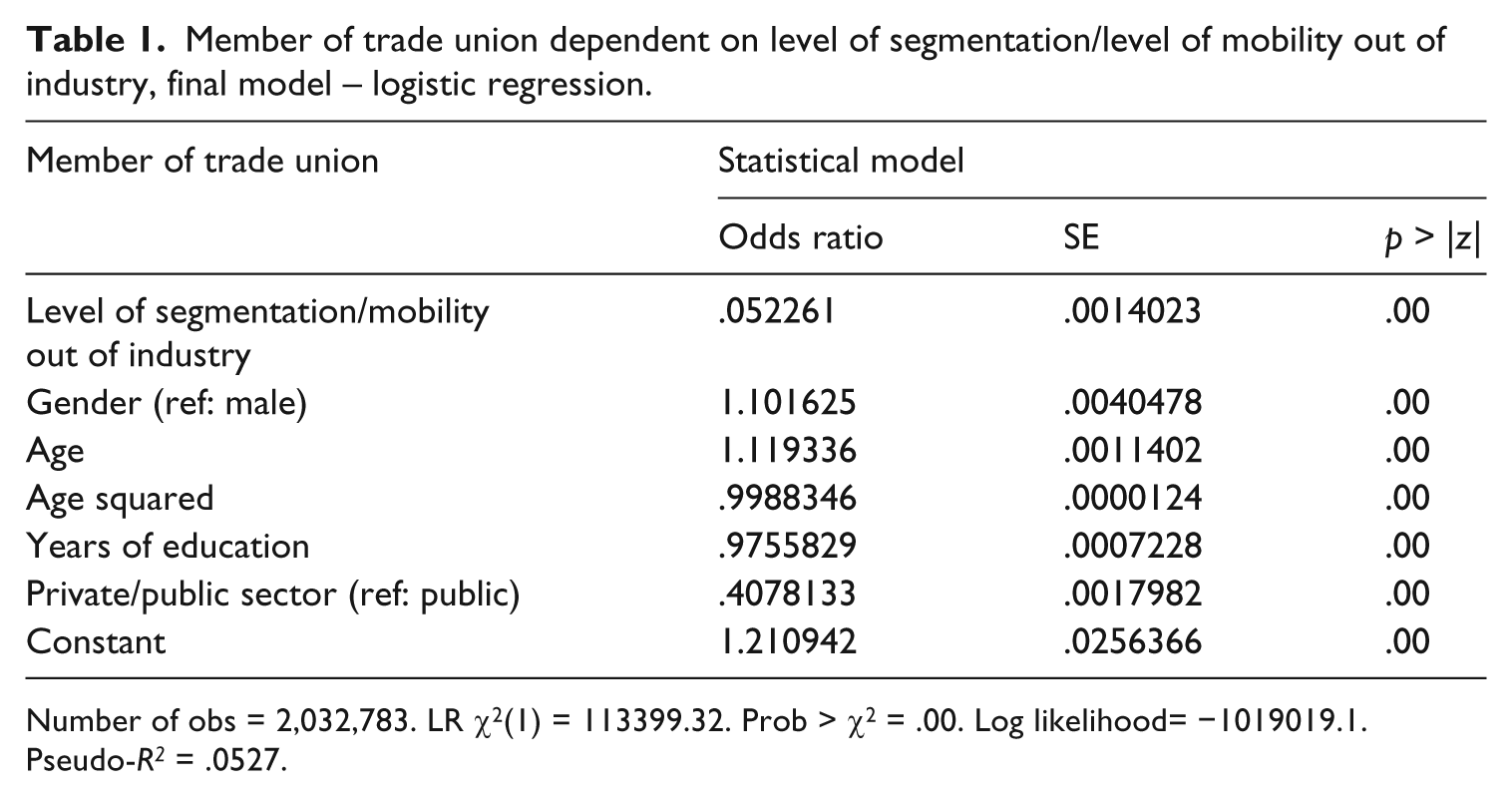
Number of obs = 2,032,783. LR χ2(1) = 113399.32. Prob > χ2 = .00. Log likelihood= −1019019.1. Pseudo-R2 = .0527.
The output is presented in odds ratio; see Table 1. An odds ratio below 1 indicates a negative correlation between the variables, while odds ratios above 1 indicate a positive correlation (Rabe-Hesketh et al., 2006).
The results in Table 1 show that levels of segmentation within an industry correlate positively with the level of unionization within the industry. A high level of segmentation leads to high levels of unionization. The lower the mobility is out of a given industry the higher we can expect the level of unionization to be. The odds ratio is .052 in the model. It indicates that there is a negative correlation between high levels of mobility and the likelihood that workers are member of a trade union. Increased mobility out of an industry implies lower levels of union membership. It can be difficult to interpret odds ratios (Szumilas, 2010), especially when the explanatory variable is a continuous variable. We therefore present some post-estimations (in Table 2) that make it easier to interpret the effects of mobility/segmentation on union membership. Margins are estimated for the statistical model. Margins identify the average likelihood that a worker working in an industry with a specific level of segmentation/mobility will be a member of a trade union. The results are shown in Table 2, where estimates are made for industries with a mobility level at 5%, 10%, 20% and 30%.
Predicted likelihood for being member of trade union, dependent on level of segmentation/level of mobility out of industry (predictive margins), control variables are included.
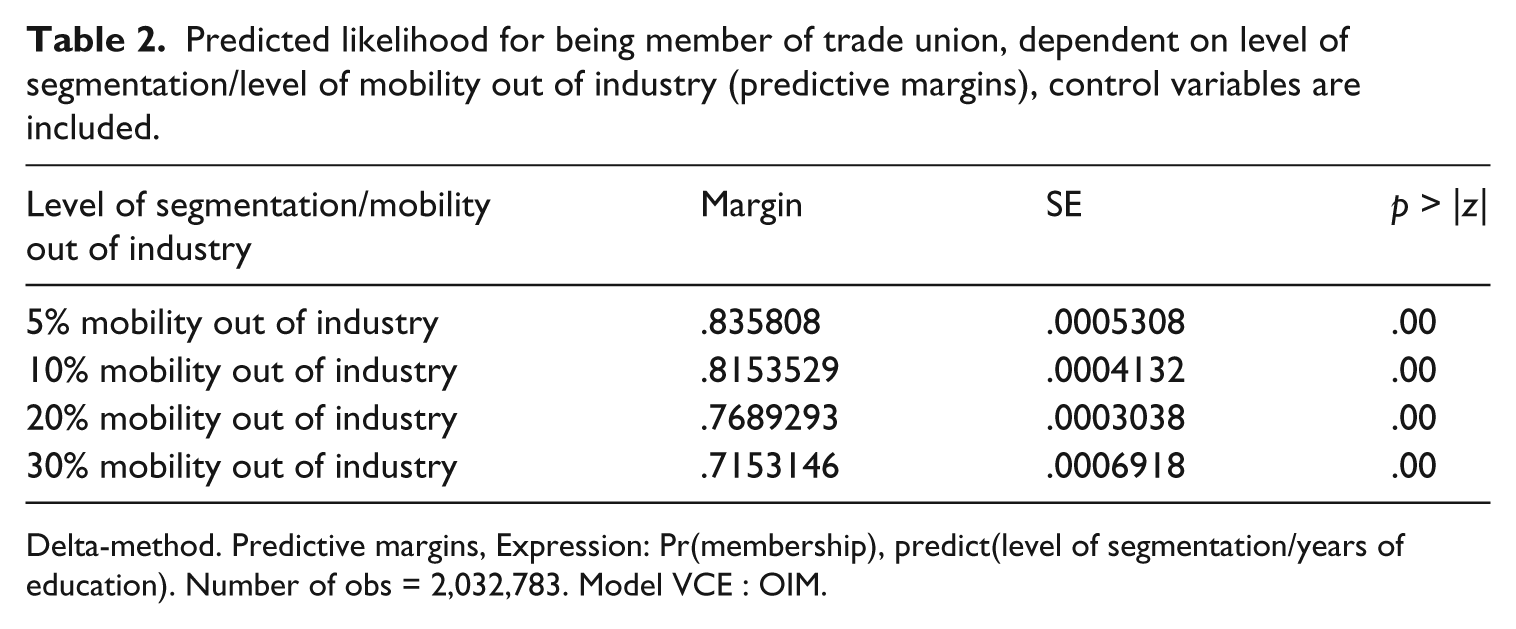
Delta-method. Predictive margins, Expression: Pr(membership), predict(level of segmentation/years of education). Number of obs = 2,032,783. Model VCE : OIM.
As shown in the table, if a worker is working within an industry with a level of out-of-industry mobility of 5% per year, then the estimated likelihood that he or she is a member of a trade union is 84%. If a worker is working within an industry with a level of out-of-industry mobility of 30% per year, then the estimated likelihood that he or she is a member of a trade union is only 72%. These observations clearly show the effects of industry segmentation/mobility on trade union membership.
The regression model also shows that being a woman increases the probability of trade union membership and that age is positively correlated with membership (Table 1). Finally, it shows that people employed in the private sector have a lower probability of being a member of a trade union (controlled for the other variables). All these observations are in line with other studies about unionization in Denmark (Ibsen, 2012).
The results are highly statistically significant. There is some data loss as the control variables are included in the statistical model. This data loss is related to missing values in some of the control variables. The pseudo-R2 increases as the control variables are included in the statistical model (not reported in Table 1). It is .0127 in the naive model (without control variables) and .0527 in the final model (with control variables). This indicates that the variance is explained better in the final model than in the naive model, although the pseudo-R2 is not a very good indicator of explanatory power in statistical analysis using logistic regression. It cannot be interpreted in the same straightforward way as the R in ordinary OLS regression analysis (Rabe-Hesketh et al., 2006). However, a log likelihood test of the naive model and the final model shows reduced levels of log likelihoods. This indicates that the final model is a better model than the naive model.
We have also analysed to what extent segmentation influences trade union membership in the public versus the private sector. The analysis is also performed as a logistic regression analysis in the same way as in Table 1. However, the data are separated for the private and for the public sector. The results of this analysis are shown in Table 3.
Member of trade union dependent on level of segmentation/level of mobility out of industry, private versus public sector – logistic regression.
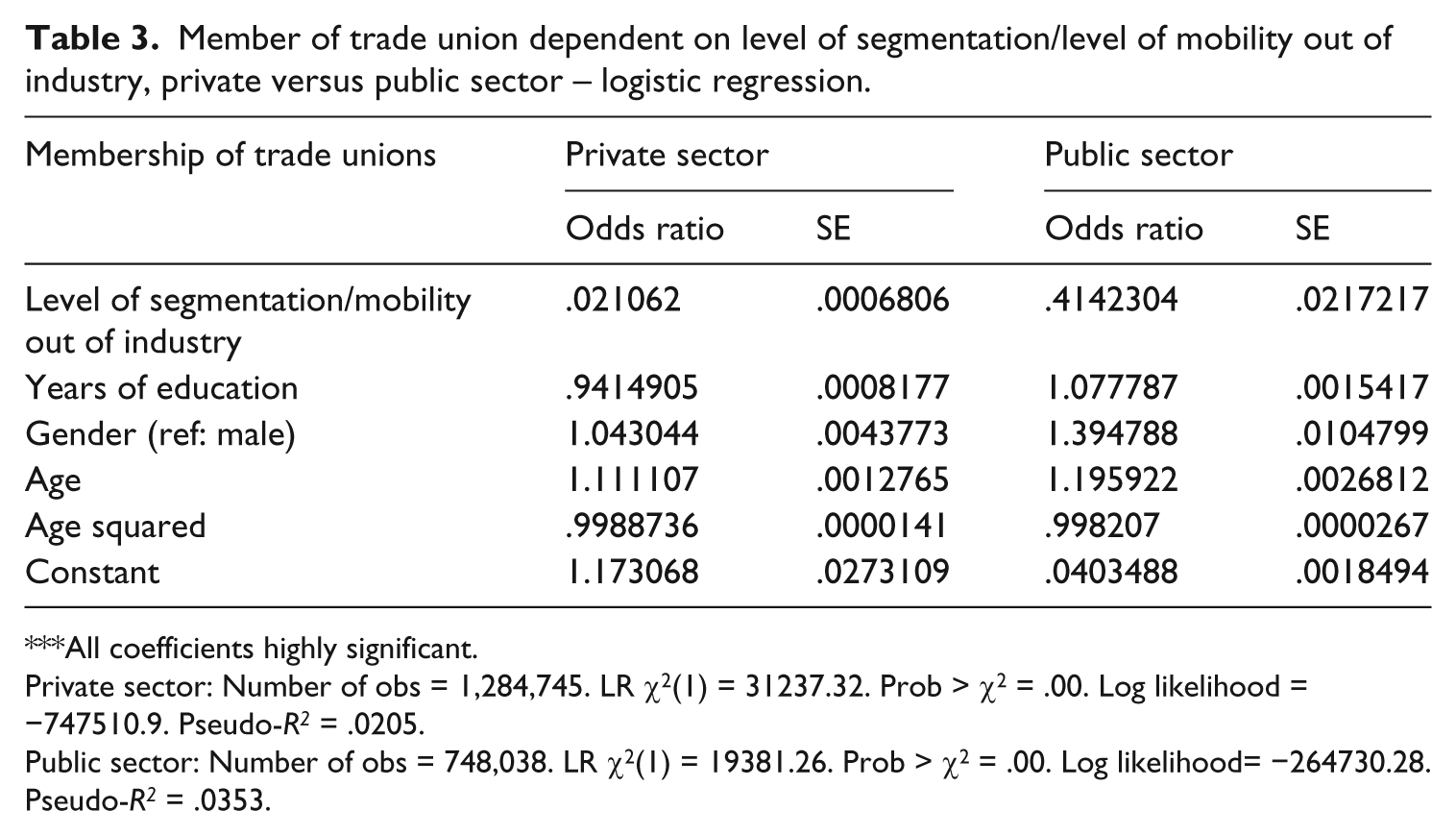
All coefficients highly significant.
Private sector: Number of obs = 1,284,745. LR χ2(1) = 31237.32. Prob > χ2 = .00. Log likelihood = −747510.9. Pseudo-R2 = .0205.
Public sector: Number of obs = 748,038. LR χ2(1) = 19381.26. Prob > χ2 = .00. Log likelihood= −264730.28. Pseudo-R2 = .0353.
In Table 3 we can observe a negative correlation between mobility and union membership in both the private and the public sector. This is in line with the observations in Table 1. However, the effects of mobility are much higher in the private sector than in the public sector. In the private sector the odds ratio is .021 indicating a strong negative correlation between mobility and union membership. In the public sector the odds ratio is .414 indicating a negative, but less strong, correlation between mobility and union membership. As in the overall model (Tables 1 and 2), margins are also presented here in order to clarify the interpretation of how much the mobility in each sector affects the probability of union membership. The probability of a private sector worker being a trade union member is 62.5% if the outgoing mobility is 30% in a given NACE private sector industry (low level of segmentation). If the outgoing mobility is only 5%, the average level of unionization is 81.2% in the private sector (high level of segmentation). This is shown in Table 4. Hence, in the private sector, high levels of out-of-industry mobility decrease the likelihood of workers being a member of a trade union. In the public sector, the difference and the effect are not at the same level. If the average outgoing mobility in a public sector NACE industry is 30%, the union probability is 86.6%; this compares to 88.9% if mobility is 5%. The effects of segmentation on union membership is much lower in the public sector than in the private sector.
Predicted likelihood for being member of trade union, dependent on level of segmentation/level of mobility out of industry (predictive margins), private versus public sector.
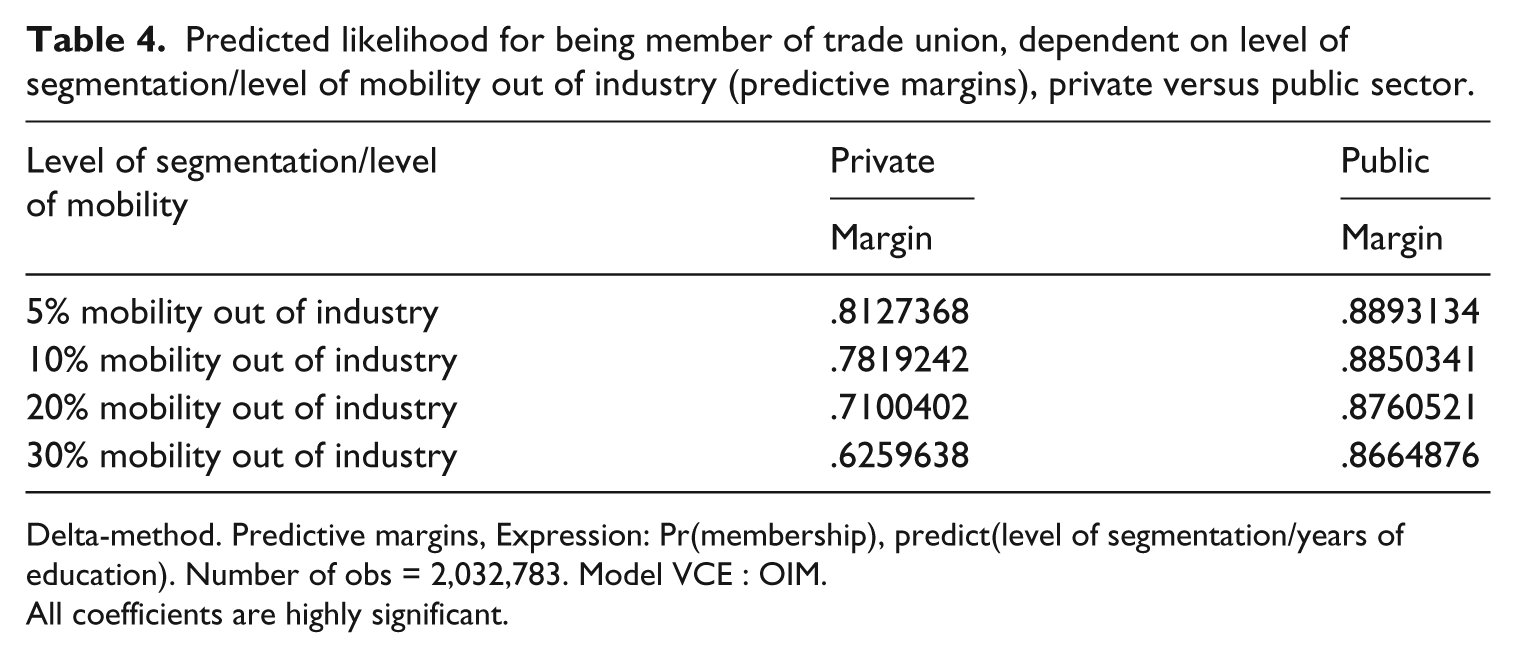
Delta-method. Predictive margins, Expression: Pr(membership), predict(level of segmentation/years of education). Number of obs = 2,032,783. Model VCE : OIM.
All coefficients are highly significant.
It should be noted that the margins are not strictly comparable between the two sectors because the statistical analysis is carried out separately for the two sectors in separate logistic regression models. This implies that the measured effects for the two separate statistical analyses are dependent upon the specific values of the other variables used. This is a general weakness related to logistic regression analysis (Karlson et al., 2012). The results from the statistical analysis will be discussed in the next section.
Discussion and conclusion
The results of the statistical analysis are clear. They show that high levels of mobility out of a given industry increase the probability of observing low levels of trade union membership in that industry. Alternatively, a high level of segmentation increases the probability of observing high levels of trade union membership. However, the statistical analysis also shows a significant variation between the effects of segmentation between the private and the public sector. The effects of segmentation and mobility are clearly highest in the private sector.
The results contribute to the existing literature in a number of ways. First they advance discussions about segmentation and trade union membership. Traditionally, segmentation and trade union membership is primarily discussed within the dual labour market frame (Doeringer and Piore, 1985). There it is observed how insiders within a specific company or industrial domain are often more likely to be members of a trade union than are outsiders to the industry. Using a broader conceptualization of segmentation we have shown how segmentation and differences in levels of union membership are not only a question about insiders and outsiders. Levels of segmentation influence levels of union membership across the entire labour market and are an important explanation for differences in union density between industries. Second, our results contribute to the analysis of how the likelihood of workers becoming a member of a trade union is influenced by the stability of their job position. As observed by Checchi and Visser (2005) unstable job positions decrease the likelihood that workers are a member of a trade union. This observation is confirmed in our analysis on a macro level.
The empirical analysis confirms some of the theoretical considerations, especially with regard to the private sector. If we recall the theoretical arguments discussed earlier in the article, then two perspectives in particular were highlighted. The first perspective relates to the individual worker’s motivation to be a member of a trade union if he or she only works in a given industry for a short period. It is argued that the motivation to join a trade union under these circumstances can be low. And it is also argued that the level of social pressure at workplace level to join a trade union is lower because the relations between the workers are unstable due to the high level of labour turnover. Similarly, it is argued that workers have less commitment to the trade union if they are only employed for a short period.
The second perspective relates to the high cost of organizing workers in industries with a high turnover of labour. It is argued that it is more costly for trade unions to organize workers in industries with high levels of labour turnover than in industries with low turnover (Schnabel, 2013). It is more difficult to identify potential members because of their relatively short periods of employment. And even if trade unions can identify those potential members and organize them, then there is a high probability that the trade unions will lose them as members when they change job and industry.
Generally, we can observe a higher level of segmentation (and lower level of mobility out of industry) in the public sector than in the private sector (Mailand, 2016). However, the differences are not so high as one might expect. On average, 18.6% of the workforce in the private sector moved to another industry between 2006 and 2007. In the public sector, it was 15.4% (figures not reported in the statistical analysis above). This indicates that the overall level of mobility is higher in the private sector than in the public sector. However, it does not explain the differences between the sectors in the effects of segmentation on trade union membership.
Three arguments could be suggested to explain these differences. First, it can be argued that union density generally is higher in the public sector than in the private sector. This is the case in Denmark, but also in most other countries in Europe (e.g. Beynon et al., 2012; Köhler and Calleja Jiménez, 2012; Schnabel, 2013). Second, it can be argued that it is generally easier for trade unions to unionize public sector workers because of the relatively transparent and homogeneous organizational structure of the sector. The cost of organizing is lower in the public than in the private sector (Schnabel, 2013). A third explanation is related to the occupational structure and occupational characteristics of the public sector and to the so-called ‘social custom theory’ that tries to explain trade union membership by referring to social customs. The social custom theory argues, as mentioned in the introduction, that membership of a trade union is not motivated solely by immediate calculations about advantages and disadvantages of membership among the single workers (Bryson et al., 2011; Visser, 2011). It is instead argued that membership considerations are embedded in a broader social context depending on factors such as the type of workplace or occupational characteristics. The basic argument is that workers consider ‘social customs’ and social norms at their workplace or within their profession when they decide whether they want to join a trade union. If we examine occupational job characteristics in public sectors (compared to private sectors) we can usually observe a high proportion of workers with professional jobs. A number of occupational groups within the public sector can be characterized as professions or semi-professions. Professions can be characterized as communities based on their common educational background and their often specialized occupations (Scheuer, 2000). This implies that the trade unions can be seen as an extension of the profession-based community. Taking a social custom theoretical point of view, it can be argued that occupational groups that have a high prevalence of professional characteristics tend to develop social norms that support the commitment to a trade union. All in all the three arguments mentioned can contribute to explaining the differences in the effects of mobility on trade union membership between the private and the public sector.
The last theme that we address is if and how the results are influenced by being based on data coming from Denmark and the Danish labour market. It is well known that the Danish system of industrial relations differs from other systems of industrial relations and that the trade union density is among the highest in the world (Due and Madsen, 2008; Ibsen et al., 2013; Jørgensen and Schulze, 2011). It is also well known that the overall level of labour market mobility and level of job shifts are high in Denmark compared to other countries. This has been extensively discussed within the flexicurity literature (Ilsøe, 2012; Jensen, 2011; Jørgensen and Madsen, 2007; Milner, 2012).
The overall level of trade union membership and mobility presented in the analysis is of course influenced by the Danish situation. On the one hand, this could imply that the effects of mobility/segmentation on unionization are higher in Denmark than in other countries. On the other hand, it can be argued that the effects of mobility on membership are lower in Denmark due to the organizing principles of trade unions. Craft unionism is still the dominating principle in Denmark and as argued above, tends to reduce the effects of job shifts on trade union membership. However, all in all, it is very likely that, if we had access to data, we could observe corresponding results in other countries as well. Mobility and levels of segmentation in industries influence to a high degree the likelihood of workers being (or becoming) a member of a trade union.
Footnotes
Declaration of conflicting interests
The author(s) declared no potential conflicts of interest with respect to the research, authorship, and/or publication of this article.
Funding
The author received no financial support for the research, authorship, and/or publication of this article.