



Abstract
This article uses a large matched employer–employee dataset to assess the outcomes of workplace partnership for British firms and workers, and the HR practices associated with ‘mutual gains’. The findings suggest that HR practices which promote employee voice and participation can deliver mutual gains for both employees and employers, but that it is the combination of direct and indirect participation which appears to be most useful in generating superior outcomes for all stakeholders. However, some practices such as high levels of job flexibility and team briefing procedures are found to be negatively associated with work-related attitudes and/or organizational performance.
Introduction
Issues of labour–management cooperation are a recurrent theme in industrial relations research, and the most recent wave of interest in many English-speaking nations has been the issue of labour–management partnership at the enterprise level (Johnstone and Wilkinson, 2016, 2017). Though notoriously difficult to define, a central idea has been the promotion of cooperative relations between unions and management (Bacon and Samuel, 2009; Bacon and Storey, 2000; Brown, 2000). However, a broader definition views workplace partnership as a particular bundle of supporting HRM policies, practices and processes, and suggests the possibility of partnership-style arrangements in both unionized and non-unionized environments (Johnstone et al., 2009; Johnstone, 2014; van Wanrooy et al., 2013). This more inclusive definition has clear parallels with related concepts such as high performance work systems (e.g. Appelbaum et al., 2000; Kochan and Osterman, 1994). A key controversy, however, is the extent to which workplace partnership can deliver mutual gains (Kochan and Osterman, 1994), and various studies have empirically assessed the risks and benefits for unions, employees and employers (Butler et al., 2011; Dobbins and Gunnigle, 2009; Geary and Trif, 2011; Guest and Peccei, 2001; Johnstone, 2010; Johnstone et al., 2010a, 2010b, 2011; Whyman and Petrescu, 2014).
Three main views are apparent in the literature. First, the so-called ‘mutual gains’ thesis (Cooke, 1990; Kochan and Osterman, 1994) suggests that all workplace stakeholders (i.e. organizations, employees and trade unions) can potentially benefit and share the growing ‘pie’. Second, the ‘pessimistic thesis’ suggests that the outcomes for unions, workers and their representatives are likely to be negative (Kelly, 2004; Upchurch et al., 2008). Somewhere in between is the ‘constrained mutuality’ thesis (Guest and Peccei, 2001), which proposes that while employees may derive some gains, the balance of advantage is likely to be skewed towards the employer. A similar point is made by Geary and Trif (2011), who suggest that the three perspectives are not necessarily mutually exclusive, and that elements of each perspective can be observed in empirical studies of partnership. The inconclusive findings of various qualitative case studies also stress the need for a more contingent view (e.g. Geary and Trif, 2011; Glover et al., 2014; Kochan et al., 2008; Upchurch et al., 2008).
Yet while partnership case studies can provide rich insights into the contextual factors associated with ‘successful’ or ‘unsuccessful’ examples of labour–management cooperation (e.g. Johnstone and Wilkinson, 2017), it is difficult to generalize about the diffusion or effectiveness of partnership at delivering ‘mutual gains’. Such questions lead themselves towards quantitative analysis, though to date there have been relatively few such studies (e.g. Valizade et al., 2016; Whyman and Petrescu, 2014). Many workplace case studies also rely most heavily upon accounts from union representatives and/or management respondents, while worker perspectives have been relatively underemphasized (Valizade et al., 2016; Glover et al., 2014; Johnstone et al., 2009). This is surprising given that mutuality ostensibly lies at the heart of partnership-style employment relationships (Boxall, 2013; Guest et al., 2008) and employees’ experiences are reliable measures for determining effectiveness of workplace partnership activities (Valizade et al., 2016). It is thus important to further explore the linkages between partnership practices and worker outcomes, and in particular the unresolved issue of whether organizations and employees both stand to gain from partnership-style arrangements.
In order to explore the outcomes of workplace partnership for employers and employees, we use a large matched employer–employee dataset (the Workplace Employment Relations Study, WERS2011). Our analysis focuses on large private sector firms (250 or more employees), and explores partnership practices and the relationship with selected worker outcomes and firm performance. We contribute to the existing literature in several ways. First, situated within social exchange theory, our analysis investigates the mutuality of partnership outcomes and includes an assessment of both employee and firm outcomes. Second, the survey-based quantitative research method enables us to make some broader generalizations about the outcomes of partnership by assessing the effectiveness of various forms of workplace partnership mechanisms (i.e. direct vs indirect employee participation) associated with the delivery of mutual gains. Third, instead of categorizing partnership outcomes as fitting neatly into one of the three main theoretical perspectives outlined above, we suggest that the gains from partnership may align with more than one of these theoretical frameworks. Much depends upon the utilization of specific forms of partnership practices in workplaces. Specifically, rather than simply focusing upon the contested but unresolved question of ‘who wins or loses from workplace partnership’, our empirical analysis also allows us to explore the types of partnership practices.
The remainder of the article is structured as follows. The next section provides a brief overview of the partnership debate, followed by a definition of partnership, as well as the main theoretical perspectives evident in the literature. We then derive the hypotheses to be tested. We continue by outlining the dataset used, and explaining how we constructed our measures. This is followed by the empirical analysis and results of our study. We then provide implications for theory and practice, and propose directions for future research.
Background
The partnership debate
Partnership has been one of the most high-profile debates in industrial relations in recent years (Bacon and Storey, 2000; Brown, 2000; Johnstone and Wilkinson, 2016). In Britain, interest in partnership surged in the 1990s, and the concept was embraced by the Blair government as a way of ‘modernizing’ employment relations as part of the Fairness at Work agenda (Johnstone, 2016). Enthusiasm for partnership was also evident from a range of policy bodies including ACAS, the Involvement and Participation Association and the TUC (ACAS, 1999; IPA, 1998; TUC, 1998). Though a commonly accepted definition remained elusive, for most trade unions and industrial relations commentators partnership was primarily concerned with improving relations between trade unions and employers. However for others, and especially those representing business interests, partnership was interpreted much more broadly as a particularly cooperative style of employment relations which is possible both with and without unions (see, for example, Emmott, 2005).
Many public and private sector employers engaged with the partnership agenda, especially in unionized organizations where partnership was often viewed as a way of recasting existing union–management relations (Oxenbridge and Brown, 2004). By 2003 the IPA listed 50 organizations which met their definition of partnership in both union and non-union contexts (IPA, 2005), while an academic review of formal union–management agreements by Bacon and Samuel (2009) suggested at least 248 such agreements had been signed.
Definitions of partnership
A key challenge has been the lack of a commonly agreed definition (Guest and Peccei, 2001; Martinez Lucio and Stuart, 2004). Some employer bodies were only willing to commit to a fairly loose unitarist interpretation, which promotes labour–management cooperation but assumes common interests and is wary of trade unions. Most partnership researchers, however, subscribed to a pluralist interpretation and viewed effective employee representation, usually involving trade unions, as a cornerstone of meaningful labour–management partnerships (Bacon and Samuel, 2009). Acknowledging the existence of non-union employee representation, others noted the possibility of developing partnership-style relations in non-union settings, and suggested that the nature of such arrangements should also be investigated empirically (Ackers et al., 2005; Johnstone et al., 2010a; Shah et al., 2016). Yet there remains a lack of agreement regarding how we identify instances of partnership or non-partnership. Is an organization a prima facie ‘partnership organization’ because they espouse partnership working with employees and their representatives? Does partnership require a formal partnership agreement or are de facto partnership relationships feasible? To what extent is partnership defined in terms of specific HR practices (such as employee voice) or simply shorthand for certain ER processes and outcomes (such as high levels of workplace cooperation)?
Based upon a review of a decade of British partnership research, Johnstone et al. (2009) suggested that a more useful definition of partnership would identify both the HR practices and employment relations processes associated with partnership. In terms of practices, employee voice is central to all definitions, and this may involve a mix of direct participation, representative participation and financial involvement. In addition to (representative) employee voice, complementary HR practices include mechanisms to support communication, flexibility and job security. Many of these HR practices are similar to those normally identified as part of a ‘high performance work system’ or ‘high commitment’ approach to HRM (Appelbaum et al., 2000; Roche, 2009).
In terms of employment relations processes, decision-making and the nature of actor relationships are also believed to be important. Decision-making processes are expected to be highly participative with extensive dialogue and consultation between management, employees and their representatives at an early stage. Actor relationships thus require high levels of trust, openness and transparency, as well as commitments to joint problem-solving and business success (Bacon and Storey, 2000; Johnstone, 2014; Johnstone et al., 2009).
In the present study, we operationalize workplace partnership to include indirect employee participation through trade union representation as well as direct employee participation mechanisms. In particular, our conceptualization of partnership practices using the WERS dataset is heavily influenced by the work of Guest and Peccei (2001) and Guest et al. (2008). Borrowing from the operational checklist of eight implicit and explicit partnership-type activities, Guest et al. (2008) provide five conceptual categories of partnership practices detected in WERS 2004, including (1) direct employee participation, including task-based decisions and direct contribution through quality improvement teams and attitude surveys; (2) representative participation in a range of issues (e.g. pay, holidays); (3) performance management, including performance appraisal and incentive payment systems; (4) employee share ownership programmes; and (5) downward communication, including information-sharing, harmonization and employment security. In total, 18 partnership practices 1 were identified. Though the set of practices may look like a combination of employee participation and high commitment work practices, they may represent the process of mutuality (Guest et al., 2008). Given that the partnership label has always been vague and controversial there are of course questions regarding the extent to which the term remains analytically relevant or useful (Oxenbridge and Brown, 2004). However the term remains influential and widely used in discussions of labour–management cooperation in both policy and academic circles. Furthermore, WERS11 includes a discussion of ‘partnership’ for the first time in the series (van Wanrooy et al., 2013).
Workplace partnership and social exchange theory
In conceptualizing partnership, social exchange theory is one of the most influential conceptual paradigms that has been adopted in understanding the employment relationship (Coyle-Shapiro and Conway, 2005). The best known exchange rule is probably reciprocity, where party one, upon receiving a favour or reward from party two, receives an obligation to reciprocate and vice versa. Molm (2000, 2003) argues that a ‘reciprocal exchange’ does not include explicit bargaining, rather it relies on interdependence between exchanging parties (one party’s actions are contingent on the other’s behaviour) that reduces risk and encourages cooperation (Molm, 1994). On the other hand, parties of exchange may also negotiate rules in the hope of reaching a beneficial arrangement (Cook and Emerson, 1978; Cook et al., 1983). Such agreements tend to be more explicit than those built upon the norm of reciprocity, and the duties and obligations exchanged are detailed and understood (Cropanzano and Mitchell, 2005). Negotiated exchanges are essentially economic transactions where individuals consider how to minimize costs and maximize rewards through a subjective cost/benefit analysis (Kinge, 2014). The general rule is that relationships will be established and maintained if the balance between costs and rewards can be achieved. Such balancing is referred to as reciprocity (Gouldner, 1960), and is formed and strengthened by creating obligations and feelings of indebtedness from one party towards another in exchange for their past positive (or beneficial) behaviour. As each party regularly reciprocates and discharges their obligations they prove themselves trustworthy. This in turn strengthens the exchange relationship.
Kinge (2014) argues that the social exchange theory provides a useful theoretical lens to capture the conditions that foster reciprocity, and explain how relations between actors contribute to a sustainable partnership or result in its collapse. Partnership relationships are conceptualized as social interactions, and a process of negotiated exchanges of both material and non-material goods between employees and their employers through either direct (Oxenbridge and Brown, 2002) or indirect (Upchurch et al., 2006) arrangements. Belanger and Edwards (2007) view partnership practices as a set of collaborative initiatives that aim to foster reconciliation of both employer and employee interests using mechanisms of social dialogues and consultative systems. Partnership mechanisms can thus be interpreted as a communication system and viewed as having a symbolic or signalling function to employees. The development and implementation of a wide range of partnership practices is valuable in strengthening the message and making it salient. Employees interpret partnership-type activities as indicative of organizational support and duty of care, and accordingly they reciprocate with positive employee attitudinal and behavioural outcomes, including organizational commitment and job satisfaction (Valizade et al., 2016; Whitener, 2001). The benefits and costs of partnership arrangements can be considered as having an extrinsic or pecuniary nature versus an intrinsic or non-pecuniary nature (Cooke, 1990). In assessing the types of worker gains (or losses), Glover et al. (2014) suggest that these may encompass both ‘hard’ and ‘soft’ gains. Roche (2009) proposes that employees are more likely to benefit from partnerships that embrace intrinsic characteristics, such as a more pleasant working environment, improved communication, a better quality of work life and better working relations between management and employees. In particular, partnership arrangements reflect a more cooperative and consultative approach to labour management, emphasizing the benefits of employee voice in decision-making processes in terms of employee commitment and positive work attitudes and behaviours.
However, the norm of reciprocity also has a negative side. Employees may believe management cannot be relied upon (e.g. hostilities, insincerity), and therefore feel more exposed and vulnerable, jeopardizing positive attitudes towards the organization (Tzafrir, 2005). This is consistent with the ‘behavioural perspective’; in other words partnership is adopted by employers primarily to control employee behaviour and improve organizational performance (e.g. Van De Voorde et al., 2012). Partnership can thus be viewed primarily as a means of reasserting managerial control over employees (Whyman and Petrescu, 2014). While such an approach might deliver benefits for organizations, it is unlikely that a highly lop-sided arrangement will benefit workers or their representatives, and where an acceptable balance of costs and rewards is not attained partnership might collapse.
The ‘pessimistic thesis’ suggests that workers and trade unions do not stand to gain much, if anything, from workplace partnership (Kelly, 2004; Upchurch et al., 2008). Adherents to this ‘win–lose’ view argue that employers typically determine which partnership practices are implemented, and employees are unlikely to derive any significant gains (Godard, 2004). Evidence of this perspective is probably most apparent in the partnership critiques by radical and labour process scholars in the British literature. In a study of matched partnership and non-partnership firms, Kelly (2004) found that while employers appeared to benefit from partnership, there were negligible gains for workers or trade unions when evaluated against criteria such as wages, hours worked, holidays or job losses. Indeed, in terms of wage levels, employment security and influence over decision-making the findings were negative. Employee gains were only found to be achieved where unions were strong, and where the firm was performing well. It is suggested that in most cases partnerships are likely to be lop-sided or ‘employer dominant’. Similar critiques have been offered by Upchurch et al. (2008) and Danford et al. (2014) in studies which doubt the potential benefits for employees or trade unions.
Finally, the ‘constrained mutuality’ thesis also suggests that employees and their representatives may well stand to benefit in some ways from partnership, but that typically the ‘balance of advantage’ will be tipped in favour of the employer (Guest and Peccei, 2001). Perhaps this is not necessarily a problem so long as all parties do benefit in some way; indeed it is difficult to imagine what a perfectly balanced arrangement would look like. Yet to be sustainable partnership cannot be completely lop-sided, as ‘positive organisational outcomes of interest to employers depend for their achievement upon the prior achievement of outcomes likely to be relevant to employees and their representatives’ (Guest and Peccei, 2001: 231). If partnership is perceived to be serving primarily or exclusively the interests of employers the potential for these gains will likely be short lived. From this perspective, while establishing a workplace partnership may be possible in certain circumstances, it is also likely to be difficult to sustain and vulnerable to collapse, especially in lightly regulated liberal market economies (Dobbins and Dundon, 2016).
Mutual gains and hypotheses derivation
Perhaps the most highly contested debate is the extent to which partnership practices and processes will lead to mutually beneficial employment relations outcomes for both firms and workers. The mutuality view is essentially reflected in the tenets of social exchange theory: the generation of valued organizational outcomes is conditional upon the influence of employer behaviour on employee beliefs, attitudes and behaviours. Employee behaviours are critical to whether desired organizational outcomes will be attained, and shaped by employee perceptions of and their cognitive and affective responses to various partnership activities (Boxall and Macky, 2007). Our first analysis of partnership outcomes at an individual level investigates the relationship between workplace partnership practices and the levels of employee job satisfaction and organizational commitment (Glover et al., 2014; Roche, 2009; Valizade et al., 2016). The second analysis at an employer level examines the relationship between partnership practices and two indicators of organizational performance: labour productivity and financial performance.
The mutual gains view or ‘optimistic perspective’ (Cooke, 1990) builds on a rational choice approach whereby partnership provides an efficient mechanism to increase the total ‘pie’ available to be shared between employers and their employees rather than an adversarial model (Geary and Trif, 2011). For gains to be accrued to all parties, the partnership principles and practices need to be established simultaneously at multiple levels within the organization, i.e. at ‘strategic level’, ‘functional human resource policy level’ and workplace level (Kochan and Osterman, 1994). In addition are participative structures and processes that emphasize the intrinsic motivation/values/rewards through which employees make contributions that directly relate to work tasks and work organizations (e.g. direct task-based participation, ‘briefing groups’ or two-way communication) (White et al., 2004), and channels for employee voice. To this end, participatory practices both in tandem and in alignment (Geary and Trif, 2011) highlight employees’ awareness of their ‘voice’ or ‘say’ in workplace decisions (Glover et al., 2014; Timming, 2015) and will foster higher levels of job satisfaction and organizational commitment. Using a national employee dataset, McGovern et al. (2007) suggest that the main influence on whether employees see themselves as having a say in changes in relation to their jobs are participation in two-way communication or in quality circles. Moreover, adequate representation and assurance of employees’ interests through dialogue with management enhance employees’ sense of organizational belonging (Wilkinson et al., 2014), which is central to organizational commitment. Similarly, where workplace partnership is perceived as a way of improving the quality of working life, we can expect a positive association with job satisfaction. Appelbaum et al.’s (2000) study of employment practices in 44 US manufacturers suggests that participatory work practices, including worker autonomy, degree of communication among frontline staff, work in self-directed teams and participation in problem-solving teams, can generate a variety of ‘win–win’ outcomes for both plants and workers, including job satisfaction and organizational commitment. Hence, we hypothesize that:
H1: Job satisfaction is higher in organizations with partnership characteristics than those without partnership characteristics.
H2: Organizational commitment is higher in organizations with partnership characteristics than those without partnership characteristics.
Social exchange theory suggests that the benefits accrued to employees in terms of increased job satisfaction and organizational commitment derived from workplace partnership will eventually also be reflected in improved firm performance. Evidence has shown that employee job satisfaction and organizational commitment are positively associated with organizational performance, including labour productivity and financial performance (Gould-Williams, 2003; Meyer et al., 2002). Committed and satisfied employees not only identify psychologically with their employers and become strongly attached to the organization, but also tend to expend discretionary effort towards achieving organizational ends (Appelbaum et al., 2000). Moreover, a satisfied and committed workforce is less likely to exhibit counterproductive behaviours, engaging in a greater amount of positive extra-role behaviours and better quality in-role behaviour. For example, Knell’s (1999) study of 15 British firms found that the introduction of partnership arrangements led to increased turnover and profits for organizations, and a higher level of job satisfaction for employees. Hence, we hypothesize that:
H3: Labour productivity is higher in organizations with partnership characteristics than those without partnership characteristics.
H4: Financial performance is higher in organizations with partnership characteristics than those without partnership characteristics.
Data and measures
Data description
We use the sixth and latest wave of WERS (WERS2011), which is based on a stratified sample of UK establishments with five or more employees operating in Sections C to S of the Standard Industrial Classification (SIC 2007) in 2011, accounting for 35% of all workplaces and 90% of all employees in the UK. The survey provides useful insights into employment relations by collecting a wide range of employment-related information from managers, employees and their representatives. In particular, it is the first time that a discussion of workplace ‘partnership’ appears in the WERS series (van Wanrooy et al., 2013). The elements of the survey used in the present study consist of face-to-face interviews with senior managers with responsibility for employment relations (see Management Questionnaire; response rate = 46%), and self-completion questionnaires distributed to a random sample of up to 25 employees in each surveyed establishment (see Employee Questionnaire; response rate = 54%). Given the distinctiveness of employment relations in private and public sector organizations, as well as the differences between HR practices in large and small firms, we focus only upon large private organizations. This is also where much of the debate regarding the efficacy of union and non-union partnership has been located. We follow the standard European definition of large organizations: only firms that employ 250 or more employees in the private sector are included. The WERS dataset includes information on the size of the workplace, but also identifies whether the workplace is a single-site or multi-site enterprise and provides information in relation to the total number of employees in the multi-site organizations, and allows us to identify large organizations with 250 or more employees.
Partnership practices
Given that no consensus has emerged on what partnership activities should be included in a comprehensive partnership checklist, the operationalization of partnership practices should be readily and independently observable (Dietz, 2004). Following Guest et al.’s (2008) five broad conceptual categorizations of workplace partnership based on the WERS2004 dataset, we identified 15 individual partnership practices in WERS2011 consisting of a mix of forms of direct and indirect employee participation in workplaces (see Table 1). Specifically, three consultation-based practices (i.e. the presence of a joint consultative committee or works council, consultation through union and worker representatives) represent indirect or union-based partnership practices. The remaining 12 partnership practices, including employee participation, communication and information-sharing, performance appraisal, contingent pay and employment security, entail the process of mutuality (Guest et al., 2008) and are viewed as direct forms of partnership working. Drawing on social exchange theory, we have hypothesized that partnership practices that offer an opportunity to engage and motivate employees, and to improve performance foster positive work-related attitudes and boost organizational performance, supporting the mutual gains perspective.
Averages/proportions of partnership practices (weighted a ).
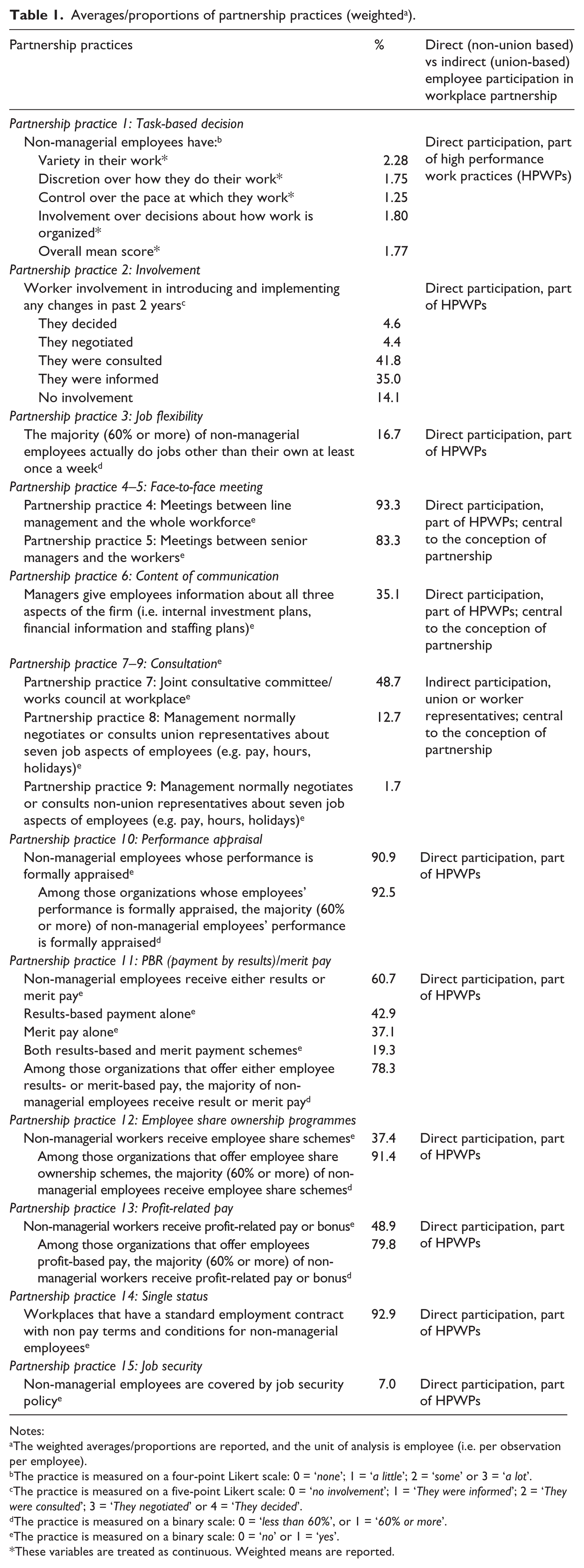
Notes:
The weighted averages/proportions are reported, and the unit of analysis is employee (i.e. per observation per employee).
The practice is measured on a four-point Likert scale: 0 = ‘none’; 1 = ‘a little’; 2 = ‘some’ or 3 = ‘a lot’.
The practice is measured on a five-point Likert scale: 0 = ‘no involvement’; 1 = ‘They were informed’; 2 = ‘They were consulted’; 3 = ‘They negotiated’ or 4 = ‘They decided’.
The practice is measured on a binary scale: 0 = ‘less than 60%’, or 1 = ‘60% or more’.
The practice is measured on a binary scale: 0 = ‘no’ or 1 = ‘yes’.
These variables are treated as continuous. Weighted means are reported.
Worker outcomes
We capture the benefits accruable to employees by exploring two of the most widely studied forms of employee attitudes: job satisfaction and organizational commitment. In WERS2011, employee respondents are asked to what extent they are satisfied with nine aspects of the job (see Kersley et al., 2006 for WERS2004). The nine items are ‘satisfaction with sense of achievement’, ‘satisfaction with scope of using own initiative’, ‘satisfaction with influence over the job’, ‘satisfaction with training’, ‘satisfaction with opportunity to develop skills’, ‘satisfaction with amount of pay’, ‘satisfaction with job security’, ‘satisfaction with involvement in decision-making’ and ‘satisfaction with the work itself’. The responses are evaluated on five-point Likert scale: 1 = ‘strongly disagree’, 2 = ‘disagree’, 3 = ‘neither agree nor disagree’, 4 = ‘agree’ or 5 = ‘strongly agree’. Regarding the organizational commitment, three statements are drawn from Employee Questionnaire (see Forth et al., 2006): (1) ‘I share many of the values of my organization’; (2) ‘I feel loyal to my organization’; and (3) ‘I am proud to tell people who I work for’. The responses are also evaluated on five-point Likert scale: 1 = ‘strongly disagree’, 2 = ‘disagree’, 3 = ‘neither agree nor disagree’, 4 = ‘agree’ or 5 = ‘strongly agree’. To proceed with the construct a composite score of job satisfaction and organizational commitment is created after computing the Cronbach’s α (α = .87 for job satisfaction, and α = .85 for organizational commitment) for both indicators of employee outcomes, respectively. The summary statistics for worker outcomes are shown in Table A1 in the Appendix.
Organizational outcomes
Two indicators of organizational performance are identified in the Management Questionnaire, which are financial performance and labour productivity. Specifically, managers are asked to provide responses to the following two questions: ‘Compared with other establishments in the same industry, how would you assess financial performance?’ and ‘Compared with other establishments in the same industry, how would you assess labour productivity?’ Responses are measured on a five-point Likert scale, and coded as follow: 1 = ‘a lot below average’, 2 = ‘below average’, 3 = ‘about average’, 4 = ‘better than average’, or 5 = ‘a lot better than average’. Here we acknowledge that using managers’ subjective perceptions of firm performance is subject to limitations. However, such perceptual measures have been widely adopted, especially in the field of HRM and organizational performance (Ferguson and Reio, 2010; Den Hartog and Verburg, 2004). 2
Controlled variables
Consistent with prior research based on the WERS dataset, we also control a wide range of employee and organizational level characteristics (see Table A2 in the Appendix). In particular, employee-level characteristics controlled include job tenure, job status, gender, age, whether the worker has academic qualifications, trade union status, supervisory responsibility, weekly wage and ethnicity. Organizational-level variables such as industry, union recognition, age, degree of market competition, the current state of market and the experience of recent recession are considered in the estimation.
Empirical results
The association between partnership practices and worker outcomes
In order to empirically investigate the relationship between partnership practices and worker/organizational outcomes in large private sector UK organizations, we perform regression estimations controlling a number of employee and organizational level characteristics. Table 2 (Panel A) presents the OLS coefficient results related to the factors associated with job satisfaction and organizational commitment. 3 The results show that a number of ‘partnership practices’ are found to be significantly related to both metrics of employee attitudes. Specifically, the measures of ‘task-based participation’, ‘direct communication between senior managers and the whole workforce’, ‘information-sharing between managers and their employees’, ‘the presence of profit-related pay for non-managerial employees’ and ‘the existence of standard employment contracts for non-managerial employees’ are all found to be positively associated with both job satisfaction and organizational commitment.
Estimation results of the relationship between partnership practices and employee/employer outcomes.
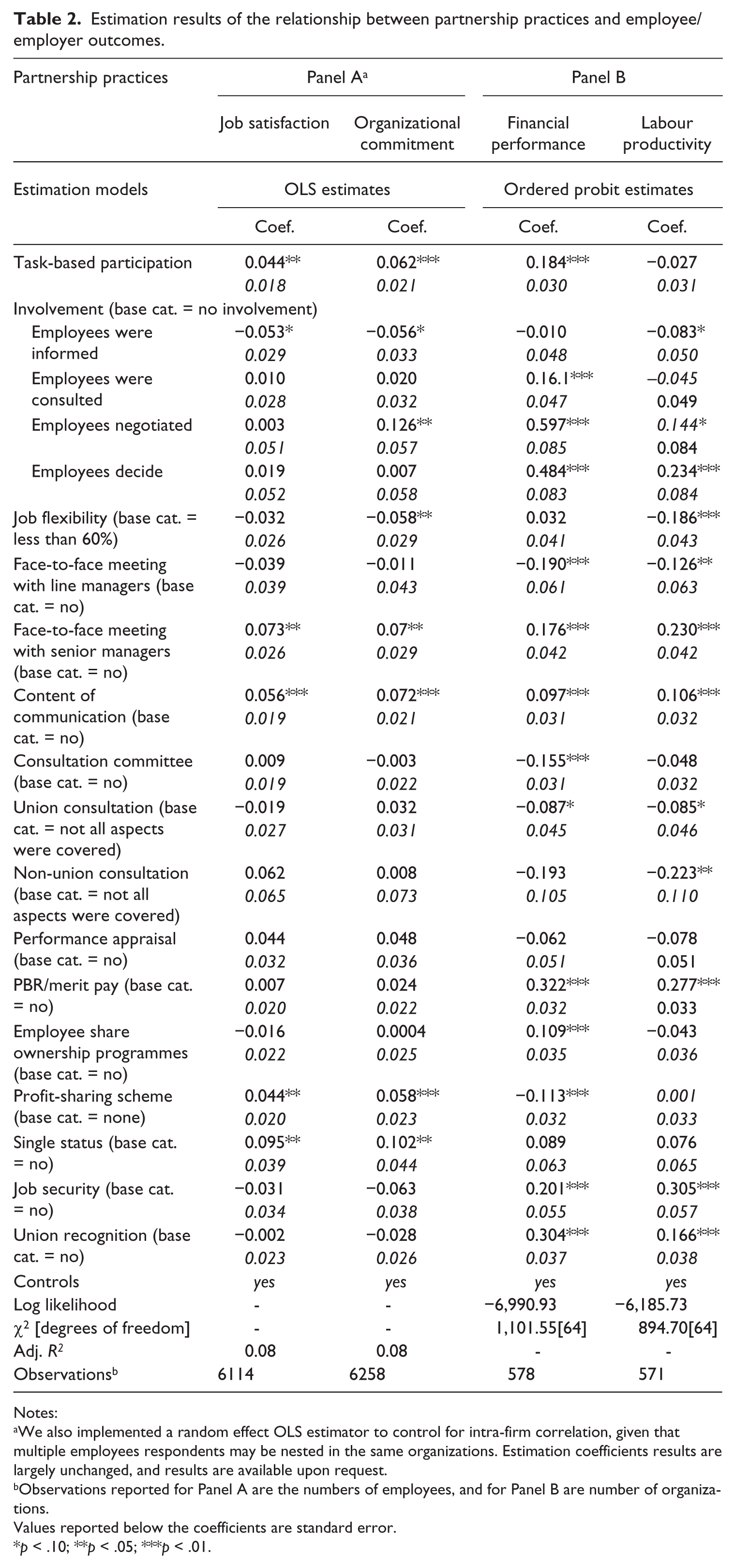
Notes:
We also implemented a random effect OLS estimator to control for intra-firm correlation, given that multiple employees respondents may be nested in the same organizations. Estimation coefficients results are largely unchanged, and results are available upon request.
Observations reported for Panel A are the numbers of employees, and for Panel B are number of organizations.
Values reported below the coefficients are standard error.
p < .10; **p < .05; ***p < .01.
Importantly, however, we find that the effect of ‘employees’ involvement’ depends on the nature of engagement. When employees are simply ‘informed’ about decisions this lowers job satisfaction and organizational commitment, whereas when decisions are ‘negotiated’ this strengthens organizational commitment. Interestingly, we also find that high levels of ‘job flexibility’ are negatively related to organizational commitment. Overall, given our findings, H1 and H2 are partly supported.
The association between partnership practices and firm performance
Table 2 (Panel B) shows the ordered coefficient results for partnership-related activities associated with firm performance. 4 The first thing to note is that the majority of partnership practices are significantly associated with financial performance but only around half are linked to labour productivity. Among these practices, the key partnership practices more likely to be associated with higher levels of financial performance and labour productivity are ‘regular face-to-face communication between senior managers and the whole workforce’, ‘information-sharing between managers and their employees’, ‘the presence of results-based pay/merit pay scheme, ‘job security policy for non-managerial employees’ and ‘employees’ active involvement in the introduction and implementation of organizational changes for past two years’ (i.e. they were ‘negotiated’, or they ‘decide’). Financial performance is more likely to be higher if ‘task-based participation’ and ‘non-managerial employee share ownership programmes’ are present in the organization.
In contrast, the ‘incidence of direct communication between line managers and the whole workforce’ (i.e. team briefing) is negatively related to both indicators of firm performance. The result is interesting given the fact that communication with senior managers has a positive effect. This might call into question the effectiveness of team briefings as a form of employee voice, compared to face-to-face meetings between the workforce and senior management, or other mechanisms which allow for employee involvement in organizational change. Potential explanations include the moderating role of line managers and the possibility that employees view such meetings as a shallow or even ineffective form of involvement. After all, the existence of an employee involvement mechanism such as team briefing can reveal little about how it is utilized in practice (Marchington et al., 1992). Interestingly, while we also find that ‘involvement of union in consultation’ reduces organizational performance, we also find that overall union recognition is associated with better organizational performance. One possible explanation is that firms engage in union consultations at times of actual or anticipated challenges in respect of organizational performance. We also find that, ‘the presence of managerial–employee consultation committee’ as well as ‘profit-sharing pay’ are more likely to be related to lower levels of financial performance. Finally, we reveal that high levels of ‘job flexibility’ reduce labour productivity. Our results therefore partly support H3 and H4.
Discussion and conclusion
There has been an intense debate regarding ‘who gains what’ from workplace partnership (Geary and Trif, 2011; Guest and Peccei, 2001), and three main perspectives are evident in the extant literature. While the ‘mutual gains’ proponents contend that both employees and employers may derive benefits from workplace partnership (e.g. Kochan and Osterman, 1994), the pessimistic perspective claims that employees experience negative outcomes (e.g. Danford et al., 2005, 2014), while the constrained mutuality perspective argues that though workers stand to benefit, potential gains are generally tipped in favour of employers (Guest and Peccei, 2001), and as such voluntary labour–management partnerships can be difficult to sustain and vulnerable to collapse (Dobbins and Dundon, 2016). It is possible to identify empirical evidence to support all three positions (Johnstone et al., 2009; Wilkinson et al., 2014).
Using a matched employee–employer dataset, the primary purpose of our study was to examine whether workplace partnership delivers ‘mutual gains’ in large private sector organizations in the UK, an area of the economy where there has been intense discussion regarding the risks and benefits of partnership approaches (Johnstone, 2015). Given partnership is concerned with reciprocity and mutuality in the employment relationship, our analysis is situated within social exchange theory. Overall, our findings appear to support the arguments of Geary and Trif (2011), that the three perspectives evident in the literature are not mutually exclusive, and that the gains from partnership can be consistent with more than one of above perspectives. Much also clearly depends upon the particular partnership practices adopted.
First, we reveal some support for the optimistic and mutuality views, especially in the incidence of non-union based workplace partnership arrangements that stress direct participatory practices and employee voice, including introducing a mixed means of task-based participation and improved direct two-way and one-way communication between managers and employees. This is an important finding given that despite an extensive literature, few studies have empirically explored the potential of non-union partnerships to deliver mutual gains, perhaps reflecting a continued suspicion of non-union employee representation in industrial relations (Gollan et al., 2014), as well as some definitions which limit workplace partnership to union–management agreements (Bacon and Samuel, 2009). We also find that partnership practices associated with upward and downward communication, namely ‘regular meetings between senior management and the workforce’ and ‘information-sharing about internal investment plans, financial information and staffing plans between managers and employees’, are associated with higher levels of job satisfaction and organizational commitment, as well as better labour productivity and financial performance. Again, this reinforces the potential value and utility of direct employee participation techniques. Our findings thus correspond with Cooke’s (1990) argument that ‘bottom-line gains’ at both macro- and micro-level could be achieved if the intrinsic motivation/benefits such as improved communication and better relations between senior management and employees were emphasized and exercised through two-way communication.
In addition, two other partnership practices, ‘task-based participation’ (i.e. ‘variety in employees’ work’, ‘discretion over how employees do their work’, ‘control over the pace at which employees work’ and ‘involvement over decisions about how work is organized’) and ‘employees’ involvement’ (i.e. ‘workers are negotiated in terms of introducing and implementing any changes in past 2 years’), are found to lend some support to the ‘win–win’ perspective. While employee voice is central to most definitions of workplace partnership there has been little agreement among policymakers and employers regarding what form voice should take. In contrast to Kelly’s (2004) findings suggesting that employees only gain from workplace partnership in the presence of a strong and powerful union voice in organizations (i.e. indirect employee participation), our findings reveal the potential utility of direct employee involvement practices including task-based participation and effective communication (i.e. meetings between employees and managers and information-sharing) in creating mutual gains for both employees and employers. This is significant given the low union density in the British private sector, where the current choice for many workers may be between non-union voice mechanisms or no voice at all (Johnstone et al., 2010a). However, we also confirm the limitation of dilute forms of employee ‘voice’ which offer employees little opportunity to express opinions or influence organizational decisions; indeed, given our finding that union recognition is associated with superior firm outcomes it seems likely a combination of direct and indirect participation is most useful in generating positive outcomes for all stakeholders (Geary and Trif, 2011: 46). Following Guest et al. (2008), the pursuit of partnership certainly pays off if it includes workers’ direct participation and autonomy. By implication, a sustainable workplace partnership that derives gains for all stakeholders may rest upon a reciprocal relationship of an intrinsic or non-pecuniary nature.
Second, to some extent our findings are in line with a ‘win–lose’ view. For example, high levels of job flexibility, often included as an ingredient of partnership working, are found to be negatively related to organizational commitment. This might suggest that while high job flexibility can be desirable for employers, employees may prefer greater stability at work. It might also reflect that while partnership theory recommends a quid pro quo between employee flexibility and job security (Kelly, 2004), this trade-off is not being achieved or perceived in practice. Indeed, a ‘job security policy’ designed for non-managerial employees means the probability of reporting better financial performance and labour productivity, but such practices exert a non-significant effect on employee attitudes. One explanation is that job security policies are normally concerned with developing policies for managing workforce reductions rather than avoiding reductions or making explicit commitments to employment stabilization policies. The impact of job security policies on employee perceptions is also complex, especially given the heterogeneity among individual workers. On the one hand they might have the desired effect of reducing employee perceptions of insecurity, while on the other it is possible that employers introduce formal policies where concerns about job security are already high. Similarly, partnership practices measuring employees’ financial involvement, i.e. ‘non-managerial employees receive results-based pay/merit pay’ and ‘non-managerial employees receive share ownership schemes’, are more likely to be associated with high levels of financial performance and labour productivity. However, they are statistically insignificant in relation to both indicators of employee outcomes. This pessimistic perception of work attitudes and firm performance as conflicting outcomes is probably due to a trade-off between employee attitudinal outcomes and organizational performance (Van De Voorde et al., 2012). That is improvement or enhancement in performance at organizational level is achieved at the expense of negative outcomes at individual level. The effects of HRM policies and practices are mediated by employees’ perception and reactions, and subsequently shape their attitudinal and behaviour responses (Purcell and Kinnie, 2007). If employees perceive significant ‘asymmetry’ regarding the balance of advantage in workplace partnership, negative outcomes may emerge in terms of work attitudes (Roche, 2009). This is particularly so in an organization achieving higher financial performance. In such circumstances partnership-type HR practices may be viewed by employees as a facade or even a controlling mechanism, and thus increase the level of work intensification and job stress (Ramsay et al., 2000), leading to job dissatisfaction and reduced employee commitment. This provides some support for the arguments advanced by the partnership critics (Danford et al., 2014; Kelly, 2004; Upchurch et al., 2008).
Lastly, we find that some results do not neatly fit into any of the three main perspectives on partnership. Two partnership practices, namely ‘profit-related pay’ and ‘the presence of a standard employment contract with non-pay terms and conditions’ for non-managerial staff, are associated with high levels of job satisfaction and organizational commitment but have no or even a negative association with indicators of (financial) firm performance. One potential explanation is the multidimensional nature of the notion of organizational performance: employee attitudes are characterized as an outcome in parallel with organizational performance (Paauwe, 2004).
Implication and limitations
The present study provides some avenues for future research. Using a representative employer and employee survey, we have conducted a preliminary analysis of any potentially direct association between various forms of individual direct (non-union based) and indirect (union-based) workplace partnership practices and worker/firm performance outcomes. The results suggest that workplace partnership practices, especially those that promote robust employee voice including non-union based mechanisms and direct participatory partnership practices, i.e. task-based participation and improved two-way communication, might enable a shift towards a ‘mutual gains enterprise’ potentially benefiting both employees and employers. This is important given that most of the extant research focuses on unionized workplaces and arrangements in non-union contexts remain relatively unexplored.
Adherents to the ‘constrained mutuality’ perspective suggest that the effects depend heavily upon context, including economic climate, union involvement, the initiatives and depth of partnership, and union density (Belanger and Edwards, 2007; Roche, 2009). Our study, however, focuses upon the analysis of direct associations between workplace partnership and employee/organizational level outcomes. However, it is important to apply the propositions in different contexts and further test and investigate the association/strength of the relationship between employee/employer outcomes and different partnership practices. It would also be useful to explore other employee outcomes in addition to those identified here, including employee wellbeing and perceptions of job quality. Further explorations of the dynamics of ‘non-union partnerships’ offer another interesting avenue for future research.
A key implication of the present study is that it highlights the importance of employee voice and participation as a cornerstone of workplace partnership (Johnstone, 2015). Perhaps the continued value of the language of workplace partnership is, in contrast to more fashionable terms such as engagement, its emphasis upon the importance of reciprocity and mutuality in the employment relationship and the acknowledgement of different stakeholders with sometimes divergent interests (Boxall, 2013; Purcell, 2013). In terms of practices, we highlight the continued significance of high performance work practices, particularly those concerned with employee involvement practices and voice. Our study confirms that employees can certainly reciprocate with positive work attitudes where employers offer a generous amount of autonomy and discretion over their work, a sense of stability, shared information and involve employees in organizational decision-making. Our evidence thus supports the arguments of Kochan and Osterman (1994) that to deliver mutual gains, partnership is not concerned with a single HR practice or simple solution. Rather, it is the combination and mutually reinforcing effect of HR policies and practices which is most likely to deliver mutual gains, and probably explains the seemingly contradictory results in the existing literature. Crucially, we confirm that arrangements which prioritize effective employee voice (union and non-union) can potentially yield benefits for both employers and employees (Johnstone and Ackers, 2015). In practice, however, HR strategies are likely to reflect a competitive strategy (Schuler and Jackson, 1987; Sisson and Storey, 2000). Partnership approaches stressing reciprocity, mutual gain and worker voice are likely to appeal more to employers competing on the basis of quality or innovation, than those prioritizing cost-reduction, where instead we might expect to find limited employer interest in worker voice or high commitment HRM strategies. This may also partly explain the limited diffusion of voluntary workplace partnerships in Britain, where cost-reducers are the most common type of firm (Marchington et al., 2016). This is not to say, however, that such firms and their employees do not stand to benefit from the potential gains which can accrue from labour–management partnership, or that all such firms use the same HR practices. While contingencies such as competitive strategy may help explain differences, in reality a combination of various factors shape HR practice.
Finally, limitations of the dataset should be borne in mind. The provenance of a matched employer–employee survey limits the range of trade union outcomes that could be investigated. However, it allows us to simultaneously analyse the effect of partnership on employee and employer outcomes, accounting for individual and organizational characteristics. A lack of consensus regarding the definition and conceptualization of partnership has resulted in problems in empirical literature, and as Guest et al. (2008) note in their study based upon an earlier WERS study, HR-based partnership practices may not ‘look like’ partnership. However, they do reflect the idea of partnership if they are accommodated within the concepts of mutuality and employee voice, which are central to all definitions of partnership.
Footnotes
Appendix
Statistics summary of demographic characteristics (weighted).
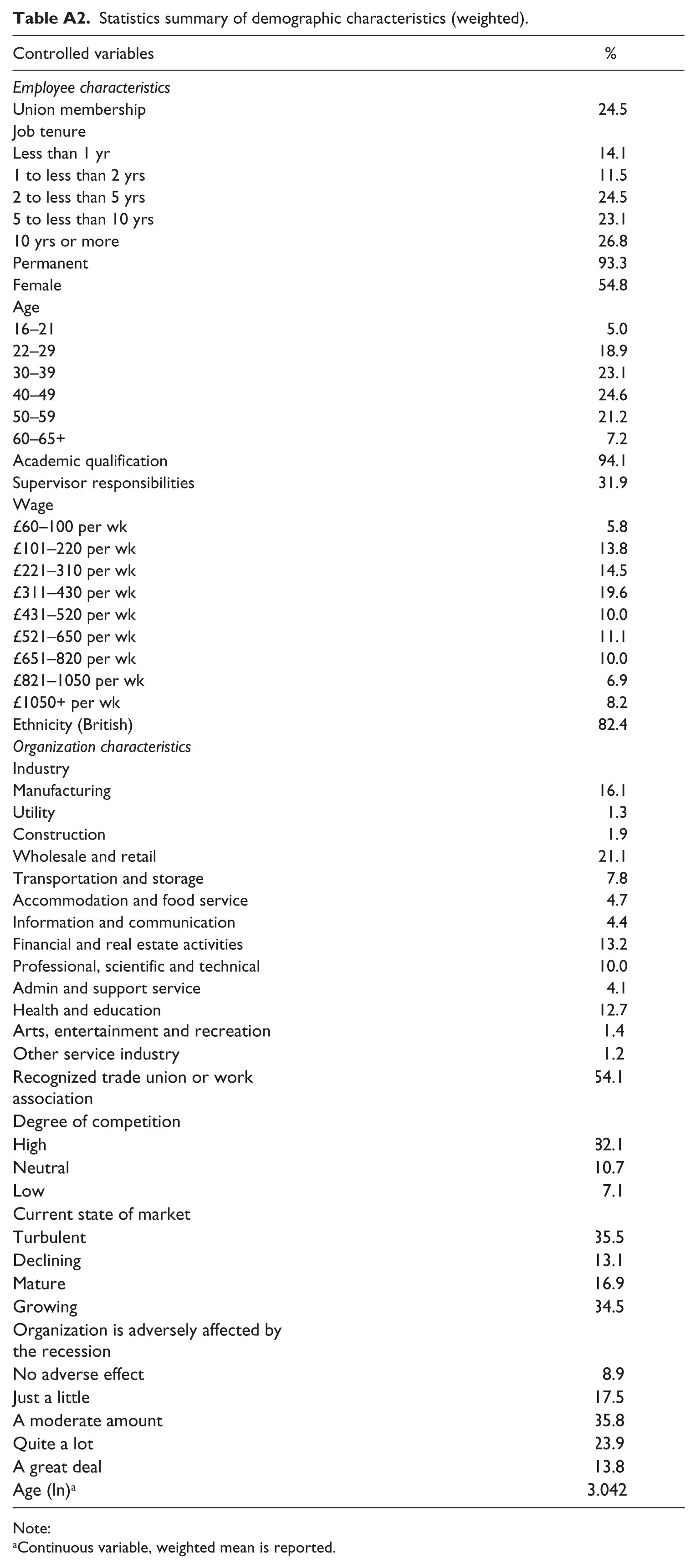
| Controlled variables | % |
|---|---|
| Employee characteristics | |
| Union membership | 24.5 |
| Job tenure | |
| Less than 1 yr | 14.1 |
| 1 to less than 2 yrs | 11.5 |
| 2 to less than 5 yrs | 24.5 |
| 5 to less than 10 yrs | 23.1 |
| 10 yrs or more | 26.8 |
| Permanent | 93.3 |
| Female | 54.8 |
| Age | |
| 16–21 | 5.0 |
| 22–29 | 18.9 |
| 30–39 | 23.1 |
| 40–49 | 24.6 |
| 50–59 | 21.2 |
| 60–65+ | 7.2 |
| Academic qualification | 94.1 |
| Supervisor responsibilities | 31.9 |
| Wage | |
| £60–100 per wk | 5.8 |
| £101–220 per wk | 13.8 |
| £221–310 per wk | 14.5 |
| £311–430 per wk | 19.6 |
| £431–520 per wk | 10.0 |
| £521–650 per wk | 11.1 |
| £651–820 per wk | 10.0 |
| £821–1050 per wk | 6.9 |
| £1050+ per wk | 8.2 |
| Ethnicity (British) | 82.4 |
| Organization characteristics | |
| Industry | |
| Manufacturing | 16.1 |
| Utility | 1.3 |
| Construction | 1.9 |
| Wholesale and retail | 21.1 |
| Transportation and storage | 7.8 |
| Accommodation and food service | 4.7 |
| Information and communication | 4.4 |
| Financial and real estate activities | 13.2 |
| Professional, scientific and technical | 10.0 |
| Admin and support service | 4.1 |
| Health and education | 12.7 |
| Arts, entertainment and recreation | 1.4 |
| Other service industry | 1.2 |
| Recognized trade union or work association | 54.1 |
| Degree of competition | |
| High | 82.1 |
| Neutral | 10.7 |
| Low | 7.1 |
| Current state of market | |
| Turbulent | 35.5 |
| Declining | 13.1 |
| Mature | 16.9 |
| Growing | 34.5 |
| Organization is adversely affected by the recession | |
| No adverse effect | 8.9 |
| Just a little | 17.5 |
| A moderate amount | 35.8 |
| Quite a lot | 23.9 |
| A great deal | 13.8 |
| Age (ln) a | 3.042 |
Note:
Continuous variable, weighted mean is reported.
Acknowledgements
We would like to thank John Godard for useful comments.
Declaration of conflicting interests
The authors declared no potential conflicts of interest with respect to the research, authorship, and/or publication of this article.
Funding
The authors received no financial support for the research, authorship, and/or publication of this article.
Notes
Author biographies
References
Supplementary Material
Please find the following supplemental material available below.
For Open Access articles published under a Creative Commons License, all supplemental material carries the same license as the article it is associated with.
For non-Open Access articles published, all supplemental material carries a non-exclusive license, and permission requests for re-use of supplemental material or any part of supplemental material shall be sent directly to the copyright owner as specified in the copyright notice associated with the article.
