



Abstract
Using structural equation modelling, this article examines the hypothesis that employees can learn about democracy through employee participation in workplace decision-making, thus resulting in more positive attitudes toward democracy in the wider political arena. The research finds that workplace democracy is strongly positively associated with increased interest in politics and wider pro-democracy affect. This result holds true even when controlling for reverse causality and the confounding influence of trade union membership. The article suggests that work can have an important effect on wider governance at the level of the community and the state.
Introduction
There is a huge literature on the nature of the relationship between organisations and wider democratic politics, but the empirical evidence is so cloudy and inconsistent that nothing can be concluded definitively in relation to causation. In spite of all the research, it is still not clear how, to what extent and in what direction the two constructs impact one another. There are two ways of looking at this relationship from the viewpoint of directionality, or causality. One is to ask how democratic politics impact organisations and the other is to ask how organisations impact democratic politics.
Some researchers have argued that democracy has a positive, albeit sometimes indirect (Helliwell, 1994), effect on organisations and organisational decision-making. For example, a wealth of evidence suggests that democracy has a positive effect on foreign direct investment (Busse and Hefeker, 2007; Guerin and Manzocchi, 2009; Jensen, 2003). The argument is often made that democracies provide organisations with a more stable context for growth (Dam, 2007; Quinn and Woolley, 2001). But others have made equally convincing arguments that non-democratic states received as much foreign direct investment as democratic states (Resnick, 2001; Yang, 2007). There is, as yet, no definitive evidence that democratic political systems are good for organisations, although the rhetoric at least seems to fall on this side of this argument.
The opposite question, i.e. whether, and to what extent, organisations can impact democratic politics, has also not been answered definitively in the literature, perhaps in part because it requires a unique marriage of human resource management and political science (Timming, 2015). It has been argued that organisations, particularly multinational corporations, can and do undermine democracies (Barley, 2007; Sklair, 2002), particularly in the developing world. But much less is known about the extent to which organisations can also serve as vehicles by which to strengthen wider democratic attitudes and to promote democratic decision-making at the level of community or national governance. Although recent work has looked at the effect of organisational democracy on political behaviours (Budd et al., 2017), the question of how employee voice initiatives impact on democratic attitudes is ripe for analysis, hence the present study.
Needless to say, this article does not pretend to settle the debate on the inter-relationship between organisations and democratic attitudes, but it does offer another important piece to an unsolved puzzle. It focuses specifically on the question of whether participation in decision-making at work can promote wider ‘pro-democracy affect’, defined as one’s personal views or attitudes toward the usefulness of democratic decision-making in governance. The hypothesised ‘mechanism’ is that employees can learn about democracy at work, which in turn has positive upward democratic ‘spillover’ to society (Elden, 1981; Karasek, 1976; Pateman, 1970). It will be argued that managerial practices centring on workplace democracy make employees more interested in wider democratic politics, thus resulting in what we call increased pro-democracy affect. In this way, societies can potentially enrich citizenship and commitment to democratic governance by promoting employee participation in organisational decision-making.
The next section reviews the previous work on the effects of employee voice and the determinants of democracy, and articulates the article’s hypotheses. After that, the research methods are described in detail. The results of the research are then reported, followed by a discussion of the article’s main contribution to the literature.
Previous work and hypotheses
The link between workplace democracy and pro-democracy affect
In the light of a heavy focus in the HRM literature on the multi-faceted ‘inward’ effects of participation in decision-making (PDM) on organisations and employees, this field is dominated by an organisationally-focused gaze, which rarely looks at the potential wider societal or political effects. Various effects of PDM at the level of the organisation have been robustly noted, such as in relation to employee commitment, trust relations, employee turnover and well-being (Boxall et al., 2011; Dundon et al., 2004; Timming, 2012), as well as on improved productivity and performance (Peccei and Rosenthal, 2001), lower levels of industrial action (Guest and Hoque, 1994) and lower absenteeism (Zhu et al., 2006). Yet, while PDM has these obvious and well-studied ‘inward’ effects on organisations and employees, its ‘outward’ or ‘upward’ effects on societies and the communities in which we live have been rarely investigated, despite Adam Smith (1976 [1776]) warning about the deleterious effects of stupefying labour on workers’ public sphere engagement. The few studies that have considered the externalities of workplace participation in terms of wider citizenship behaviour include Foley and Polanyi (2006) and, with a focus on employee rights, Budd and Zagelmeyer (2010) and Wilkinson et al. (2014). However, there is still, according to Foley and Polanyi (2006: 176), ‘little empirical support’ for these mostly theoretical arguments of the upward spillover of workplace democracy. The present study fills this empirical gap through a statistical examination of the effects of PDM on employees’ wider interest in democratic politics, or, as we call it, ‘pro-democracy affect’. We turn now to an examination of this phenomenon.
Within the wider determinants of democratic attitudes literature, the association between belonging to a form of civic association (where democratic decisions are made) and members’ wider interest in political decision-making was first proposed by de Tocqueville (2004 [1835–40]). This theme was later resurrected by Pateman (1970), who described how opportunities to participate at work (and conversely, where there was a lack of opportunity) build (or undermine) one’s wider political participatory skills. Her research can be situated alongside Almond and Verba (1963: 366), who claimed that ‘political orientations’ depend on opportunities to participate in non-political arenas, and of ‘crucial significance here are the opportunities to participate in decisions at one’s place of work’.
Karasek (1976) continued the exploration of the impact of (what he termed) ‘active jobs’ on political participation, concluding that ‘the worker who lacks discretion over the content of his daily work experience is likely to be “passive” in leisure and political participation’ (1976: 1). Later, Karasek (2004) confirmed his initial findings linking workers’ control over demanding work to their political and leisure activity. Contributing to the debate, Gardell (1976) and Gustavsen (1980) drew on Marx’s concept of alienation to suggest that lack of control at work limits workers’ human creativity, and that this alienation from the self has an adverse effect on non-work participation in political activities. While Greenberg (1981) later disputed the generalisability of Pateman’s theory, Elden (1981: 43) provided empirical support for the thesis, concluding that work democratisation ‘correlates significantly with a sense of political efficacy’, and Near et al. (1980: 416) also asserted that ‘work is highly important in society and pervades other aspects of social life’.
Putnam (1993, 2000) later extended this field of study by arguing that the norms and trust created in one participatory context can ‘spill over’ into, and create, greater interest in engagement in the macro-political arena. Conversely, lack of participative opportunities in civil society will result in poor political self-confidence and a lack of interest in wider democratic participation. A related theme is argued in Karasek and Theorell (1990), who emphasised the contribution of physiological aspects of stimulating jobs on active societal participation. In highlighting the negative affect of lack of job autonomy and participation on health, the authors were paralleling Marmot et al.’s (1984, 1997) Whitehall Studies – which identified psychophysiological connections between level of work-related decision latitude and stress-related illness.
Gaining an interest in wider political action through employee PDM (Pateman, 1970) is a necessary, but not sufficient, precondition for what we call pro-democracy affect. Pro-democracy affect, we argue, goes beyond a mere interest in politics and demonstrates a ready willingness to engage actively in pro-democratic activities such as voting and campaigning (Barro, 1999; Budd et al., 2017; Hegre et al., 2012). Such political engagement depends ultimately on the establishment of a deep-seated trust in political institutions (Mishler and Rose, 1997). Thus, the empirical question at the very heart of this supposed relationship is: to what extent can employee PDM spill over not only into a wider interest in democracy, but also into trust itself in the political institution of democracy? These questions lend themselves to our first, second and third hypotheses:
H1: PDM is positively associated with interest in politics.
H2: PDM is positively associated with wider pro-democracy affect.
H3: Interest in politics positively mediates the relationship between PDM and pro-democracy affect.
These hypotheses suggest, in short, a potential ‘learning effect’ whereby employees who are allowed to participate in decision-making at work can then carry an appreciation of the principles of democracy beyond the workplace and into the wider political and civil society.
What about reverse causality and other confounding variables?
In the light of Wright’s (1921) now classic study, it is commonplace in scientific and statistical research to note that correlation does not imply causality, and this is especially relevant for the present study. Although we are arguing that employee PDM can result in democratic spillover into the wider society, we also recognise that there are other factors that can influence one’s interest in politics and pro-democracy affect. Fortunately, the dataset we use allows us to control for these alternative explanations. Two potential confounds are discussed in this section: (1) the possibility that those with already strong pro-democracy affect may ‘self-select’ into workplaces that allow for PDM and (2) the effect of trade union membership on not only PDM, but also on wider interest in politics.
Controlling for self-selection and reverse causality
A pre-existing interest in politics may contribute to individuals self-selecting into employment that permits greater participation. For instance, research in the field of person–organisation fit suggests that job seekers often compare their needs and values with the characteristics of the firm (Judge and Bretz, 1992; Kausel and Slaughter, 2011). This is supported in research by Hallier and Summers (2011), where an interest in politics among graduating students was found to be associated with intention to seek community advocacy employment. Research on preferences (Hakim, 2002) has similar indications for personal preferences and job choice. The evidence from worker-owned organisations indicates that, while motivations to work in a workers’ cooperative are varied, including the desire for job security (Bradley and Gelb, 1980), self-accomplishment (Ng and Ng, 2009) and feelings of belonging (Jones et al., 2009), a sense of personal autonomy and political ideals remain significant motivators (Carter, 2003). To take account of the possibility of reverse causality, we introduce our fourth hypothesis:
H4: PDM is still positively associated with both interest in politics and pro-democracy affect even when controlling for reverse causality.
By incorporating an item into our model that measures the extent to which the respondent believes it is important for one to choose a job that enables one to use one’s own initiative, we can exert some statistical control on the possibility of self-selection and reverse causality.
Controlling for the confounding effect of trade union membership
Finally, we turn to the potentially confounding impact of unions. Of particular significance in this respect is the association between union presence in a workplace and correspondingly greater levels of political activism among union members. For instance, union membership is associated with increased democratic participation (Lipset, 1983), and Lamare (2010) also found that contact with a union increased voter turnout. Bryson et al. (2014) propose that this union influence operates both through peer pressure within union member networks, and by increasing employees’ ‘attachment to democratic engagement in society at large’ (p. 1). This research is supported by Gray and Caul (2000), who concluded that lower union density means workers were ‘uninterested, uninformed, and politically inactive’ (p. 1092). In the same vein, it is also of note that the decline in union density in European nations since the 1970s has been mirrored by a decline in voter turnout (Radcliff, 2001) and an increase in employee silence (Milliken et al., 2003; Timming and Johnstone, 2015; Van Dyne et al., 2003). Deriving from this body of literature are three further hypotheses:
H5a: Union membership is associated with greater PDM.
H5b: Union membership is associated with greater interest in politics.
H5c: Union membership is associated with greater pro-democracy affect.
In summary, our study is taking forward the existing, but small, literature that considers the wider democratic impact of workplace democracy by providing new and relevant empirical evidence. In particular, we are making a new contribution to the HRM field through our consideration of the wider societal and political effects of employee PDM, with a particular emphasis on how employee voice initiatives impact on attitudes toward democracy. Figure 1 illustrates the hypotheses outlined above.
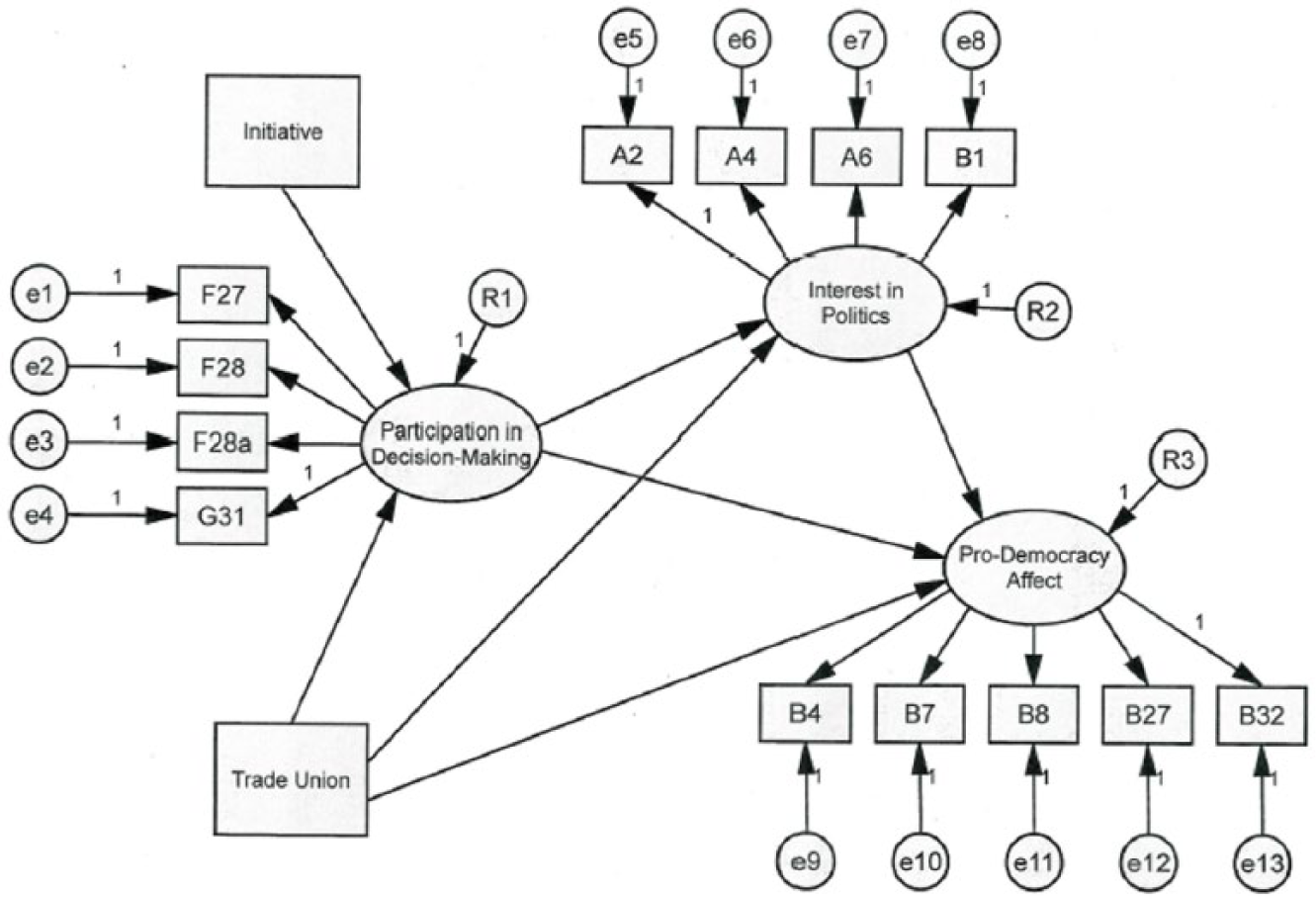
Path diagram and hypotheses.
Research methods
Sample
The 2010 European Social Survey, Round Five (hereafter ESS5 1 ) was used to evaluate the integrity of our hypotheses. Funded primarily by the European Commission and the European Science Foundation, with additional financial support coming from the national research councils involved in the project, ESS5 is among the largest social and behavioural attitudes datasets ever compiled (N = 52,458). The respondents are drawn from 27 European countries: Belgium, Bulgaria, Switzerland, Cyprus, Czech Republic, Germany, Denmark, Estonia, Spain, Finland, France, UK, Greece, Croatia, Hungary, Ireland, Israel, Lithuania, the Netherlands, Norway, Poland, Portugal, Russia, Sweden, Slovenia, Slovakia and the Ukraine. The survey instrument measured over 650 variables on basic demographics and social and behavioural attitudes. Several of the items asked specifically about respondents’ employment situation and attitudes toward democracy.
While ESS5 is often used in cross-national studies (Jowell et al., 2007), it can also serve as a singular dataset with results generalisable to Europe. The sampling universe is thus all persons aged 15 and over living in private households in the 27 European countries from which the data were drawn. According to the European Social Survey (2009: 13), this sample ‘was selected by strict random probability sampling at every stage and the respondents [were] interviewed face-to-face’. The ESS5 research team went to great lengths to minimise non-response bias (Stoop et al., 2010), resulting in an overall response rate of 60.8%. A rigorous translation strategy (European Social Survey, 2010a) was also used in order to ensure linguistic consistency across the survey instruments. In terms of the demographics of the sample, 54.6% are female, 46.0% were in paid work at the time and the average respondent age was 48.51 years (SD = 18.79).
The considerable size of the sample (N = 52,458) is notable. Like any other inference-based statistical method, structural equation modelling is sensitive to sample size. To put this study into perspective, Kline (2005: 15) defines as ‘large’ any structural model with more than 200 cases. Because of the enormous scale of the sample, it should be noted that there is an increased risk of Type I error. Though this possibility should be kept in the back of one’s mind, it would be folly to describe the large sample size as a limitation of the study. If anything, it is one of its key strengths.
Measures
Table 1 reports the variables, both observed and unobserved, used in the model. As reported in the table, as well as in Figure 1, the structural model consists of three unobserved, or latent, variables (Participation in Decision-Making, Interest in Politics and Pro-Democracy Affect) and two observed, or indicator, variables (Trade Union and Initiative). How each variable was measured in ESS5 is described briefly in this section.
Variables and indicators.

Source: European Social Survey (2010b).
Participation in Decision-Making
This is the primary exogenous (independent) variable. It is composed of four indicator variables. Respondents were asked, on a scale of 0 to 10 (where 0 implies ‘no influence’ and 10 implies ‘complete control’) to indicate how much management allows them (i) to decide how their daily work is organised, (ii) to influence policy decisions about the activities of the organisation and (iii) to choose or change the pace at which they work. Respondents were also asked to assess how true, on a scale of 1 to 4 (where 1 implies ‘not at all true’, 2 implies ‘a little true’, 3 implies ‘quite true’ and 4 implies ‘very true’), the following statement is: (iv) ‘I can decide the time I start and finish work’. Taken together, each of these indicators taps an underlying dimension of the multi-faceted construct of employee participation in decision-making (Cotton et al., 1988), reflecting an organisational culture of workplace democracy.
Interest in Politics
This latent variable serves as a mediator. It is composed of four indicator variables. Respondents were asked, on a scale of 0 to 7 (where 0 implies ‘no time at all’ and 7 implies ‘more than three hours’), to indicate how much time they spent (i) watching news or programmes about politics or current events on television, (ii) listening to news or programmes about politics or current affairs on the radio and (iii) reading about politics and current affairs in the newspapers. Respondents were also asked, on a scale of 1 to 4 (where 1 implies ‘not at all interested’, 2 implies ‘hardly interested’, 3 implies ‘quite interested’ and 4 implies ‘very interested’), to indicate (iv) how interested they are in politics. It should be noted that the response categories for this indicator were reverse coded, thus making the interpretation of the results more intuitive. Taken together, these items tap respondents’ underlying interest in politics (Prior, 2010).
Pro-Democracy Affect
This is the primary endogenous (dependent) variable. It is composed of five indicator variables. Respondents were asked, on a scale of 0 to 10 (where 0 implies ‘no trust at all’ and 10 implies ‘complete trust’), how much they personally trust their country’s (i) parliament, (ii) politicians and (iii) political parties. Respondents were also asked, on a scale of 0 to 10 (where 0 implies ‘extremely dissatisfied’ and 10 implies ‘extremely satisfied), (iv) how satisfied they were with the way democracy works in their country. Finally, respondents were asked to rate on a scale of 1 to 5 (where 1 implies ‘disagree strongly’ and 5 implies ‘agree strongly’) how much they agreed that (v) political parties that want to ‘overthrow democracy’ should be banned. The response categories of this variable, it should be noted, were also reverse coded in order to make the interpretation of the results more intuitive. Taken together, these indicators reflect the criteria that other researchers have used to measure generalised support for democracy (Canache et al., 2001; Dalton, 1999; Inglehart, 2003).
Trade Union Membership
This exogenous variable was included in the model as a simple dummy, where a code of 0 implies that the respondent is not currently a member of a trade union and 1 implies that the respondent is or has been a member of a trade union. This was the only variable in the model that underwent a substantive recode from its original form. ESS5 asked respondents if they are, or have ever been, a member of a trade union or staff association. The original response categories (1 = ‘yes, currently’, 2 = ‘yes, previously’ and 3 = ‘no’) were recoded in a manner such that categories 1 and 2 were combined in order to indicate that the respondent is or has been a member of a trade union. The rationale underlying this recode is twofold. First, by combining former and current trade union members into one category, we are still able to test for the effect of union membership, even if it is previous membership. Second, like multiple regression analysis, structural equation modelling does not technically allow for the incorporation into the model of multi-categorical nominal variables, thus rendering the original variable unusable.
Initiative
This variable was introduced into the model as a covariate in order to control for the possibility of reverse causality, as discussed above. It is a single indicator that asks respondents, on a scale of 1 to 5 (where 1 implies ‘not important at all’, 2 implies ‘not important’, 3 implies ‘neither important, nor unimportant’, 4 implies ‘important’ and 5 implies ‘very important’), how important it is for them to choose a job that enabled them to use their own initiative. By including this variable, the model is able to hedge against the possibility that individuals who already like to participate in decision-making are self-selecting into employment that allows them to participate in decision-making, and not the other way around, as is hypothesised in this article.
Analysis
In the light of the presence of unobserved latent variables in the model, structural equation modelling was used in order to test the article’s hypotheses. Although structural equation modelling, also referred to as analysis of covariance structures, is historically thought of as the method of choice for establishing causality (Shook et al., 2004: 398), such thinking is misguided. True causation can only be established via a longitudinal and experimental research design that takes account of time lags (Gollob and Reichardt, 1987, 1991; MacCallum and Austin, 2000). Cross-sectional structural equation models, like the present study, can at best ‘offer the potential for tentative causal inferences to be drawn’ (Bullock et al., 1994: 253). In other words, given the constraints of the ESS5 study design, the present study gets fairly close to the ‘black box’ of causality.
The present study assumes that people can learn about democracy at work, with positive spillover at the level of the society. The obvious weakness to this argument is the possibility of reversal causality, discussed above. That is, what if people who already feel positively about democracy actively search for jobs that allow them to participate in decision-making? Most researchers would control for this possibility by using instrumental variables in a non-recursive structural equation model design (Wong and Law, 1999), as indeed was the approach of Budd et al. (2017). But the use of instrumental variables in structural equation modelling decreases model parsimony, so they should be avoided if a more parsimonious alternative is available in the dataset. Fortunately, as described above, ESS5 contains an ideal control variable, Initiative (see Table 1). By including Initiative in the model, we can examine the effect of employee participation in decision-making on broader attitudes toward democracy, even while taking into account that some employees may have chosen jobs that allow them to participate in decision-making. In accordance with the principle of parsimony (Bollen, 1989), the model is thus linear recursive.
This model is what Joreskog (1993) calls ‘strictly confirmatory’. In other words, in the event of poor fit, we will not use modification indices to respecify the model to achieve a good fit. The main reason for this simple ‘thumbs up or thumbs down’ approach is that modification indices tend to be inflated in larger samples, so any post-hoc tinkering with the model would end up ‘[over]fitting small idiosyncratic characteristics of the sample’ (MacCallum et al., 1992: 501). Missing data, which were considerably below the conventional cut-off of 10% of total cases (Byrne, 2001: 288), were handled using standard full information maximum likelihood. After applying the necessary parameter constraints (see Figure 1), the model is over-identified with 85 degrees of freedom (based on 135 distinct sample moments and 50 that require estimation). The model is thus scientifically useful and able to be rejected. The graphical interface of AMOS 19.0 was used to design and execute the structural model.
Results
Table 2 reports the results of the structural equation model. Both standardised and unstandardised estimates (hereafter ‘weights’) are provided, along with standard errors and critical ratio values. For the benefit of non-structural equation modelling specialists, critical ratios are p-values expressed in standardised z-scores, so a conventional p-value of less than .05 is equivalent to a critical ratio value of greater than 1.96 or less than −1.96. The model fit statistics are reported at the base of the table. Looking at the bigger picture, the hypothesised model fits the data well.
Results.

Model fit: CFI = .968, TLI = .955, NFI = .968, RMSEA = .042, PRATIO = .708, PNFI = .686, PCFI = .686, Hoelter .01 = 777.
Equivalent to a significant p-value of less than .05.
For the benefit of the non-structural equation modelling specialist, it is a requirement of this method to fix some parameters at 1.00 for technical reasons. For each latent variable, a random number table was used to decide which indicator would have its parameter fixed.
The overall level of fit between the hypothesised model and sample data is, by conventional standards (Hu and Bentler, 1999), very high. Using maximum likelihood estimation, the chi-square statistic is 7986.42 (DF = 85, p = .000). The likelihood ratio method is extremely sensitive with very large sample sizes (MacCallum et al., 1996: 132). Therefore, a number of alternative goodness-of-fit indices are reported here: CFI = .968, TLI = .955, NFI = .968, RMSEA = .042, PRATIO = .708, PNFI = .686, PCFI = .686, Hoelter .01 = 777. Unlike with most other statistical methods, there are no universally agreed upon goodness-of-fit indices for structural equation modelling. But according to Byrne (2001: 79–88), the indices reported in this model are indicative, generally speaking, of a very good fit between the model and the data.
The results of the structural equation model firmly support H1. It was found that employee participation in organisational decision-making was positively associated with interest in politics (weight = .332, C.R. = 30.49). Alternatively stated, the more employees are able to participate in workplace decision-making, the more interested they are in politics.
Also strongly supported by the structural equation model is H2. It was found that employee participation in decision-making is positively associated with what we have termed pro-democracy affect (weight = .464, C.R. = 18.92). This result indicates that employees who participate in decision-making are more likely to harbour positive feelings toward wider political democracy in general.
The results of the research equally corroborate H3. It would appear that interest in politics mediates the relationship between employee participation in decision-making and pro-democracy affect inasmuch as interest in politics and pro-democracy affect are positively associated (weight = .759, C.R. = 37.56). In layperson’s terms, this finding suggests that employee participation in decision-making is directly related to pro-democracy affect, but it is also indirectly related through the mediating influence of interest in politics.
H4, which is crucial to the underlying argument, is also supported by the model. Recall that H4 posits that the above relationships will still hold water when controlling for the possibility of reverse causality. It was found that initiative was positively associated with employee participation in decision-making (weight = .145, C.R. = 44.35). This result implies that the more important it is for one to have a job that allows one to use one’s own initiative, the more likely one is to be able to participate in decision-making. Alternatively stated, it appears that people who already value the ability to participate in decision-making are seeking out jobs that allow them to participate in decision-making. However, even controlling for this effect, the relationship between participation in decision-making and pro-democracy affect still holds water, as established above. That is to say that there appears to be ‘positive upward democratic spillover’ in spite of the fact that some employees may be actively seeking employment that allows them to participate in decision-making in the first place.
Finally, the model confirms H5a, H5b and H5c. Union membership was positively associated with employee participation in decision-making (weight = .122, C.R. = 18.74), interest in politics (weight = .182, C.R. = 16.31) and pro-democracy affect (weight = .633, C.R. = 23.40), as should be expected in light of the literature reviewed above. In other words, union members enjoy a greater level of participation in organisational decision-making, are more interested in politics and harbour more positive attitudes toward the principles of democracy in general. But in spite of these significant relationships, the crucial link between PDM and pro-democracy affect still holds water.
Discussion and conclusions
This study addresses the democratic spillover effect by providing rigorous evidence that PDM does indeed exert a positive influence on the extent to which employees experience pro-democratic affect, including increased trust in political institutions and increased commitment to democracy. The path between workplace democracy and wider pro-democracy affect is clear even when controlling for reverse causality and confounding variables. PDM thus contributes to a readiness to engage with democratic governance at the societal level. The purpose of this section is to examine these results and implications of the study more closely.
The article makes a strong and unique contribution to the ongoing debate about employee participation. It is widely recognised that participation is a complex concept and, in conjunction, hypotheses 1 and 2 appear to underpin the broader idea of what might be called democratic spillover (Almond and Verba, 1963; Pateman 1970). On the one hand, the indicator variables used to measure PDM in the model represent task-based participation – the type of participation commonly used by HR management (Beardwell and Claydon, 2007) – and this is coupled with more strategic decision-making involvement. Through capturing the multiple components of participation at work, our findings provide compelling evidence that employee participation engenders pro-democracy affect even when considering mediating factors such as interest in politics (hypothesis 3) and prior inclination toward participative attitudes and beliefs (hypothesis 4). All of the results on the effects of PDM were consistent with expectations.
The findings also make important contributions to the HRM and determinants of democracy literatures, demonstrating how employees carry effects of HRM beyond and outwith the workplace. This is not to suggest that participation at work is exclusively about interest in politics or pro-democratic affect; however, these two constructs do represent significant and positive out-of-work outcomes for HR practices in the workplace. In fact, there is significant literature indicating that HR-led involvement and participation practices, such as the high performance work system, have other non-work effects, including negative spillovers in terms of job-to-home stress (Godard, 2004) and positive spillover in terms of work–life balance (Heywood et al., 2005). While our findings echo claims that PDM at work is generally a ‘good’ thing (Carter, 2006), with positive effects in the workplace, what is more novel is the finding that PDM is related to wider societal and political effects of HRM practices. Such wider spillover has received scarce scholarly attention, with the HRM literature overwhelmingly focused on ‘downward’ or ‘inward’ worker behaviour within organisations, and on benefits for organisations themselves.
Our findings are important inasmuch as they confirm a set of hypotheses about the link between workplace participation and wider societal and democratic affects, and interestingly corroborate the results of Almond and Verba (1963), Pateman (1970) and Karasek (1976) that participation at work influences attitudes toward political participation and toward politics (structures and processes). It extends this previous work on participation spillover to indicate that PDM at work influences both interest in politics and attitude toward the values of wider democracy as well as trust in political institutions. In addition, our findings extend previous work to include participation practices in the workplace, both determined at task level and at strategic level. It is worthy to note that the employment relationship and its social, economic and political context have changed in the intervening decades, to one where trade union density and reach has declined (and mirroring this we have seen the rise of individual-centred human resource management), the service and knowledge sectors have grown, the political institutions of the EU have developed, and voter turnout has generally declined. This is significant since our results suggest that PDM centred on individualised participation in decision-making results in pro-democratic affect.
In adding to what is known about the extent to which organisations and their practices serve as vehicles by which to strengthen wider democratic attitudes, the results speak to concerns about voter turnout across Europe (Blais and Rubenson, 2013), particularly poor turnout at local government elections. Increased PDM at work may, judging by our results, increase political participation and trust in political institutions, addressing the decline in voter turnout. While the link between union membership and voting activity is demonstrated by Lamare (2010), the link we have established between individualised employee participation and wider democratic outcomes is important due to the ongoing lack of reach of unions in large parts of the private sector (Purcell and Hall, 2012), especially for women and younger workers (Bryson and Forth, 2010; Vandaele, 2012). These findings thus speak to concerns about low youth participation in politics in Europe (Ayres, 2014), the most obvious implication being that organisations, and perhaps employment law, should continue to promote employee participation since the effects are demonstrably positive for a healthy democracy. This is especially pertinent for younger workers who are traditionally unreceptive to political engagement.
One last implication that deserves brief mention is that the results we have uncovered in this article appear to be robust cross-nationally, at least within Europe, but we still do not know whether they hold water outwith the EU. This is a serious limitation that calls for further research. In particular, it would be interesting to see if the use of Western HRM practices, most of which entail employee voice and worker participation schemes, poses any threat to non-Western, authoritarian governments that have no history of democratic participation. The spread of Western HR practices can thus be viewed by authoritarian regimes as a potential ‘Trojan Horse’ capable of effecting unwelcome political change. Research on this question would make a fascinating addition to a growing body of literature on the relationship between workplace democracy and wider pro-democracy affect.
Footnotes
Declaration of conflicting interests
The authors declared no potential conflicts of interest with respect to the research, authorship, and/or publication of this article.
Funding
The authors received no financial support for the research, authorship, and/or publication of this article.