



Abstract
Scholars agree that counterproductive work behavior (CWB) is instigated by psychological contract breach and feelings of violation. This article focuses on the mediating role of feelings of violation (a mixture of negative emotions) in the relationship between psychological contract breach and CWB, and assesses whether volunteers and paid employees experience a similar chain of events. The study uses Mplus 7 to estimate a moderated mediation model with bootstrapping. The results indicate that both paid employees and volunteers (1) experience feelings of violation when perceiving psychological contract breach, and (2) engage in CWB targeted to the organization (CWB-O) when experiencing feelings of violation. However, these relationships were not significantly different when comparing paid employees and volunteers. It is hence concluded that a similar chain of cognitions and emotions explains why volunteers and paid employees engage in CWB-O. In unraveling this sequence, possibilities for targeted interventions are suggested.
Keywords
Introduction
Since its seminal reconceptualization by Rousseau in 1989, the psychological contract has become a widely used concept to understand the employment relationship (Guest and Conway, 2005; Rousseau, 1989, 1995). According to Rousseau (1989, 1995) the psychological contract can be understood as the mutual obligations in an exchange agreement between an individual (i.e., an employee or volunteer) and an organization, as perceived by the individual. As the psychological contract is based on mutual promises, it can either be fulfilled, or not (Morrison and Robinson, 1997). The concept of psychological contract breach is hence viewed as an organization’s failure to keep its promises made to employees or volunteers (Rousseau, 1989). Several scholars argued that perceptions of psychological contract breach elicit feelings of anger and frustration, which consequently have deleterious effects on several attitudinal and behavioral outcomes (e.g., Conway and Briner, 2002; Coyle-Shapiro and Kessler, 2000; Robinson and Morrison, 1995; Zhao et al., 2007). One such deleterious behavioral outcome is counterproductive work behavior (CWB), defined as volitional employee behavior that violates significant organizational norms and – in doing so – is contrary to the organization’s legitimate interests and threatens the well-being of the organization, its members or both (Robinson and Bennett, 1995; Sackett, 2002; Spector et al., 2006). Bordia et al. (2008) found – in a study of paid employees in for-profit organizations – that employees’ perception of psychological contract breach was associated with higher levels of CWB. Although researchers estimate that the prevalence and costs associated with CWB vary greatly, they largely agree that CWB is harmful to organizations and its employees. For example, Geddes and Baron (1997) reported that nearly 69% of managers indicated to have been a victim of verbal aggression in response to giving a negative performance appraisal. Moreover, the estimated economic costs of CWB are substantial and lie between 17.6 (Hollinger and Langton, 2006) and 200 billion dollars (Govoni, 1992). Given this high economic cost, several researchers have sought to understand the mechanisms causing CWB by investigating several attitudinal (Judge et al., 2006) and contextual (Ambrose et al., 2002) antecedents.
In this study, we extend this line of research from paid employees in the for-profit sector to paid employees and volunteers in social enterprises. That is, although studies with paid employees in the for-profit sector clearly show that CWB is quite prevalent (Bennett and Robinson, 2000; Bordia et al., 2008) and has serious negative consequences for individuals as well as for organizations (Robinson and Bennett, 1995; Sackett, 2002; Spector et al., 2006), little is known about CWB outside of the for-profit sector. Our study addresses this omission in the literature. In particular, we examine the mediating role of violation (i.e., an emotional and affective state triggered by perceptions of psychological contract breach; Morrison and Robinson, 1997; Robinson and Morrison, 2000) in the relationship between psychological contract breach and CWB for paid employees and volunteers. Moreover, by examining whether the proposed relationships are universal for paid employees and volunteers who are doing similar work in the same sector, we are able to provide a response to the often spoken, yet never empirically tested, critique that volunteers are very different from paid employees in their responses to psychological contract breach. This comparison is (1) of practical importance for social enterprises as they often employ both volunteers and paid employees and (2) of theoretical importance to investigate if the relationship between contract fulfillment, violation and associated levels of CWB is of a universal nature for both paid employees and volunteers. In sum, our findings will inform social enterprise policy makers about the role of psychological contract breach in relation to CWB among both volunteers and paid employees.
The remainder of this introduction proceeds as follows. First, we provide a brief overview of the literature on psychological contracts and CWB, paying attention to the application of the psychological contract to volunteers. Next, we develop hypotheses describing the relationships between psychological contract breach and feelings of violation on the one hand, and feelings of violation and counterproductive work behaviors on the other.
The psychological contract
Because the psychological contract is idiosyncratic by nature, people working in the same organization may perceive a very distinct set of mutual obligations in their exchange relationship with the organization (Rousseau, 1989). Although both paid employees and volunteers have psychological contracts (e.g., Farmer and Fedor, 1999; Nichols and Ojala, 2009; O’Donohue and Nelson, 2009; Pearce, 1993; Vantilborgh et al., 2011, 2012), it could be argued that they are likely to expect and perceive different sets of obligations. Traditionally, these perceived obligations can be transactional, relational, or ideological in nature. Transactional inducements are characterized by their short-term focus on the exchange of economic or materialistic inducements (e.g., fair wage, opportunities for career advancement, job security). In contrast, relational inducements are characterized by the exchange of relationship-oriented inducements (e.g., social support, safe work environment, an approachable supervisor). More recently, Thompson and Bunderson (2003: 574) defined ideological inducements as ‘credible commitments to pursue a valued cause or principle (not limited to self-interest) that are implicitly exchanged at the nexus of the individual–organization relationship’, such as offering options to contribute to the organization’s valued cause or principle (e.g., corporate social responsibility).
It could however be argued that paid employees and volunteers are substantially different when it comes to the type of psychological contract they can hold with their organization because volunteers are often defined as individuals who are (1) performing activities out of free will, (2) without receiving remuneration, (3) in a formal organization and (4) benefiting others (Cnaan et al., 1996). However, research conducted by Liao-Troth (2001) demonstrated that volunteers and paid employees do not significantly differ in their possession of transactional and relational psychological contract types, but that there are subtle differences in the extent to which transactional and relational elements are perceived as promised by the organization. That is, the organizational promise of benefits (i.e., obligations related to promotion, salary, performance bonuses) occurs more frequently for paid employees than for volunteers but both groups similarly build psychological contracts around working conditions, intrinsic job characteristics and concepts of good faith and fair dealings. Using a similar categorization of psychological contract content, Taylor et al. (2006) compared volunteers and coordinators to examine differences in the importance of aspects of the psychological contract. While both groups commented on perceiving transactional and relational obligations, coordinators focused much more on transactional psychological contract components while volunteers valued good faith and fair dealings and intrinsic job characteristics to a much greater extent. Both groups were similarly concerned with working conditions but varied in their rankings of importance of specific inducements such as training and skills development and resources available. Finally, Bal and Vink (2011) and Krause and Moore (2017) demonstrated the importance of ideological psychological contracts for white- and blue-collar workers and management in a corporate for-profit sector. Specifically, Bal and Vink (2011) found that ideological psychological contract fulfillment explained additional variance above and beyond transactional and relational psychological contract fulfillment in relation to employee obligations in a sample of paid employees in managerial positions. Krause and Moore (2017) found that 36–44.8% of white- and blue-collar workers in a manufacturing environment expressed having an ideological currency in their psychological contract. The authors compared these numbers to those commonly reported in nonprofit workplaces and concluded that they were highly similar. In sum, these findings demonstrate that both groups integrate aspects of all types of psychological contracts into their schemas. Although there are some differences between volunteers’ and paid employees’ psychological contract in terms of content (i.e., economic inducements versus socio-emotional inducements), scholars agree that volunteers react similarly to paid employees when transactional, relational and ideological obligations are not met by the organization (e.g., Farmer and Fedor, 1999; Griep et al., 2016; Nichols, 2013; Nichols and Ojala, 2009; Vantilborgh et al., 2011, 2012, 2014).
Traditionally, such failures of the organization to meet one or more promises or obligations within the framework of the psychological contract were labeled psychological contract violation. Morrison and Robinson (1997) and Robinson and Morrison (2000) reconceptualized violation by distinguishing between the cognitive evaluations (i.e., psychological contract breach) and the affective, emotional feelings ensuing from these cognitions (i.e., feelings of violation). As such, it seems advisable to operationalize psychological contract breach as a cognitive interpretation of what an employee or volunteer has or has not received from the organization despite the inducements that were promised (Morrison and Robinson, 1997), while we conceptualize feelings of violation as the intensity of the emotional and affective reaction – characterized by a mixture of feelings like frustration, anger and outrage – that arise from perceptions of psychological contract breach (Morrison and Robinson, 1997; Robinson and Morrison, 2000).
Counterproductive work behavior: Distinguishing CWB-I from CWB-O
The above-mentioned CWB definition can be broken down into three key elements. First, CWB is volitional and motivated and as such not accidental in nature. Second, the behaviors are deviant as they violate an organization’s norms (Robinson and Bennett, 1997). Finally, some of these counterproductive behaviors are targeted at and are harmful to the organization as such (CWB-O; e.g., corporate theft, publicly criticizing the organization), while others are directed at co-workers (CWB-I; e.g., exclusion, silent treatment) (Bennett and Robinson, 2000; Robinson and Bennett, 1995). Collapsing both types of CWBs into one general measure of CWB may eliminate meaningful variance in predicting these behaviors. Moreover, not all types of CWB necessarily have the same antecedents (Spector et al., 2006). As such we distinguish both types of CWB to provide a richer insight into paid employees’ and volunteers’ responses to perceptions of psychological contract breach.
Counterproductive behavior in response to psychological contract breach
As noted previously, Morrison and Robinson (1997) distinguished psychological contract breach from violation feelings when proposing that the latter would mediate the relationship between psychological contract breach and behavioral outcomes, such as CWB-O and CWB-I. Several authors (e.g., Dulac et al., 2008; Griep et al., 2016) indeed found support for the notion that perceptions of psychological contract breach are a strong antecedent of violation feelings. In addition, Zhao et al. (2007) concluded that feelings of violation are a key mediating mechanism between psychological contract breach and employees’ attitudinal and behavioral reactions. These findings are consistent with the idea that a symmetric exchange keeps the employer–employee relationship in balance, while an unfavorable exchange relationship (i.e., psychological contract breach) leads individuals to rebalance their relationship with the employer. One action that employees or volunteers can take to rebalance this relationship is to engage in CWB-O or CWB-I (Colbert et al., 2004). According to Morrison and Robinson (1997), Robinson and Bennett (1997) and Robinson and Morrison (2000), CWB is instigated by perceptions of psychological contract breach because the latter is characterized by cognitions of disparity (i.e., a perceived mismatch between promised inducements and delivered inducements). This cognitive disparity elicits feelings of violation as an emotional and affective reaction of outrage. In order to vent and express one’s feelings of violation, individuals may choose to engage in CWB.
In the context of CWB-O and CWB-I, Jensen et al. (2010) have previously found that instances of psychological contract breach were positively associated with acts of organizational CWBs such as production deviance, sabotage and withdrawal, as well as with acts of interpersonal CWB such as abuse (e.g., making threats, comments, or ignoring co-workers or others). Similarly, Ho (2012) found that negative affect arising from relational stress, such as that experienced in a psychological contract breach, was also associated with increased engagement in organization- and person-focused CWB (i.e., CWB-O and CWB-I). In line with the negative reciprocity norm (Gouldner, 1960), we argue that when one receives unfair treatment from the organization (i.e., breach), one will repay the party judged to be responsible for the unfair treatment by engaging in acts of CWB-O. In contrast, in line with Displaced Aggression Theory, one may also retaliate towards organizational members as a substitute for one’s inability to retaliate towards the organization (Dollard et al., 1939). As such, employees may engage in CWB-I as a way to express their frustrations with a psychological contract breach when they are unable to directly target the organization (Miller, 1941). Meta-analytic findings indeed demonstrate that the more negative the environment within which the employee operates, the greater the magnitude of displaced aggression and thus the more likely the employee may engage in various forms of CWB-I (Marcus-Newhall et al., 2000).
Based on these findings, we thus expect that violation feelings mediate the relationship between psychological contract breach and both types of CWB. In addition, because several scholars (e.g., Clary and Snyder, 1991; Omoto and Snyder, 1995) contend that volunteers engage in their voluntary work to fulfill certain needs and motives that they could otherwise not fulfill, we argue that volunteers, akin to paid employees, enter in a social exchange relationship with their organization to obtain this set of expectations. Findings from Boezeman and Ellemers (2007) further support this notion when examining how volunteers’ pride and respect in their organization were significantly related to both affective and normative commitment, and their overall intent to continue to support the organization, even in the face of a psychological contract breach. Further, Vantilborgh et al. (2014) found that in some instances, such as perceptions of ideological psychological contract breach, volunteers actually increase their work effort in response to psychological contract breach rather than withdrawing from the organization. The authors argue that this effect is most likely due to the central role the voluntary work plays for these volunteers’ identity (i.e., the organization and the voluntary work is part of the volunteer’s identity). In other words, volunteers are not likely to leave the organization when being confronted with psychological contract breach. In contrast, we expect them to react in a similar way to how paid employees would react to perceptions of psychological contract breach. Therefore, we hypothesize:
Hypothesis 1: Psychological contract breach relates positively to violation feelings, which in turn relates positively to CWB-O among paid employees (H1A) and volunteers (H1B).
Hypothesis 2: Psychological contract breach relates positively to violation feelings, which in turn relates positively to CWB-I among paid employees (H2A) and volunteers (H2B).
Method
Procedure
We collected the data by means of an online survey, administered to volunteers and paid employees in seven Belgian social enterprises active in North–South collaboration. Organizations were chosen based on four factors to corroborate the economic and entrepreneurial nature of social enterprises: (1) a continuous activity producing goods and/or selling services, (2) a high degree of autonomy, (3) a significant level of economic risk and (4) a minimum amount of paid work (Borzaga and Defourny, 2001). To encapsulate the social dimensions of social enterprises, another five factors were used for inclusion: (1) an initiative launched by a group of citizens, (2) decision-making power not based on capital ownership, (3) a participatory nature, which involves the persons affected by the activity, (4) limited profit distribution and (5) an explicit aim to benefit the community (Borzaga and Defourny, 2001). All participating organizations were social enterprises active in the distribution of goods that are produced in parts of the Southern hemisphere (Latin-America, Africa and Asia) according to the principles of fair trade (i.e., a fair wage for fair labor) or active in the protection of human and civil rights. We attached a covering letter with our initial request for participation, explaining the scope and the purpose of the study and emphasizing that participation was discretionary and that respondents could participate anonymously.
Participants
In total we contacted 3070 volunteers and 365 paid employees from the seven social enterprises to participate in this study (organization A = 1385 volunteers and 104 paid employees, organization B = 496 volunteers and 44 paid employees, organization C = 98 volunteers and 13 paid employees, organization D = 152 volunteers and 64 paid employees, organization E = 67 volunteers and 20 paid employees, organization F = 287 volunteers and 46 paid employees, and organization G = 585 volunteers and 74 paid employees), of which 750 volunteers and 129 paid employees returned the survey, resulting in an overall response rate of 25.59% (response ratevolunteers = 24.43%; response ratepaid employees = 35.34%). After cleaning the data – we only retained volunteers and paid employees who completed the entire survey – our final sample contained 584 volunteers and 110 paid employees (organization A = 329 volunteers and 48 paid employees, organization B = 64 volunteers and 14 paid employees, organization C = 11 volunteers and 6 paid employees, organization D = 59 volunteers and 13 paid employees, organization E = 5 volunteers and 5 paid employees, organization F = 59 volunteers and 12 paid employees, and organization G = 57 volunteers and 12 paid employees).
Most of the volunteers (66.8%) and paid employees (62.7%) were men. Respondents’ average age was 51.40 years (SD = 13.73) among volunteers and 36.96 years (SD = 12.00) among paid employees. Of the volunteers 46.20% had obtained a higher – non-university – degree, compared to 30.90% of the paid employees. On average, volunteers had been active for their organization for 3.69 years (SD = 1.56), and were engaged in their voluntary activities for on average 11.88 hours per month. Paid employees had an average tenure of 4.29 years (SD = 5.40) with their current organization and 61.1% indicated that they worked full-time.
Respondents in organization A (mean age = 26.06), organization C (mean age = 26.50), organization D (mean age = 21.71) and organization G (mean age = 20.76) were significantly younger than respondents in organization B (mean age = 36.92), organization E (mean age = 34.63) and organization F (mean age = 35.53). Respondents in organization D and organization G were significantly younger than respondents in any other organization. However, respondents in organization A (mean tenure = 11.38) had a significantly longer organizational tenure than respondents in organization B (mean tenure = 3.47), organization C (mean tenure = 3.00), organization D (mean tenure = 3.65), organization E (mean tenure = 3.71), organization F (mean tenure = 3.50) and organization G (mean tenure = 3.58). A Pearson chi-square test moreover revealed that respondents’ age (χ2(583, N = 584) = 25.42, p ≤ .001), education (χ2(583, N = 584) = 11.08, p ≤ .001) and tenure (χ2(582, N = 583) = 9.33, p ≤ .001) differed significantly when comparing volunteers and paid employees. We will therefore control for age, education and tenure in our analysis.
Measures
Type of employment relationship
Type of employment relationship was measured by asking respondents to indicate whether they volunteered or worked as a paid employee for their current social enterprise. Responses were dummy coded (0 = paid employee and 1 = volunteer).
Psychological contract breach
Psychological contract breach was measured with two items from Rousseau’s (2000) Psychological Contract Inventory, rated on a five-point Likert scale ranging from (1) ‘Not at all’ to (5) ‘To a large extent’. An example item is: ‘In general, how well does your employer live up to its promises?’ (roverall = .91; rvolunteers = .92; rpaid employees = .82). To further support the use of a general psychological contract breach measure, we refer to previous arguments (Bordia et al., 2008) and empirical evidence (Griep et al., 2016; Vantilborgh et al., 2016) demonstrating that global psychological contract breach measures (i.e., either general psychological contract breach measures or global composite measures) are better at capturing assessments of psychological contract breach than separate psychological contract breach measures by inducement type.
Feelings of violation
Feelings of violation were measured with four items (Robinson and Morrison, 2000) rated on a five-point Likert scale ranging from (1) ‘Strongly disagree’ to (5) ‘Strongly agree’. An example item is: ‘I feel betrayed by my organization’ (αoverall = .92; αvolunteers = .92; αpaid employees = .89).
Counterproductive work behavior
CWB was measured with six items from Dalal et al. (2009). An example item is: ‘During the past six months, I did not work to the best of my ability’ (αoverall = .74; αvolunteers = .76; αpaid employees = .74). Counterproductive work behavior towards the individual was measured with nine items from Baillien et al. (2011). An example item is: ‘During the past six months, I excluded somebody from group activities’ (αoverall = .75; αvolunteers = .77; αpaid employees = .73). Response categories varied from ‘Never’ (= 1), to ‘Now and then’ (= 2), ‘Monthly’ (= 3), ‘Weekly’ (= 4) and ‘Daily’ (= 5).
Control variables
Given the expected influence of gender (Hill and Montes, 2008), age and tenure (Bal et al., 2008) on the relationship between the psychological contract breach, violation feelings and job attitudes and behaviors, and the significant differences between volunteers and paid employees in terms of age, educational level and tenure, these variables were controlled for during further analysis. Gender was dummy coded (0 = male, 1 = female). Age was measured in years on a continuous scale. Tenure was measured in years and coded in six categories ranging from ‘less than 1 year’ (scored 1) to ‘more than 20 years’ (scored 6). Educational level was assessed with a direct question (i.e., ‘what is your highest obtained degree?’) and coded in six categories ranging from ‘no degree’ (scored 1) to ‘higher university degree’ (scored 6).
Data analysis
Mplus 7 (Muthén and Muthén, 2010) was used to analyze the data. Our analysis follows the recommendations of Edwards and Lambert (2007), who proposed the simultaneous testing of moderation and mediation effects (moderated mediation; Muller et al., 2005). In the estimated path model, the first moderation effect was tested by including an interaction effect between the type of the employment relationship (paid employee or volunteer) and psychological contract breach, whereas the second moderation effect was tested by including an interaction effect between the type of the employment relationship (paid employee or volunteer) and violation feelings. The mediation effect was tested using the product-of-coefficients approach. This is the product of the regression coefficients linking the type of the employment relationship (paid employee or volunteer), psychological contract breach and their interaction term to violation feelings, and violation feelings to CWB-O and CWB-I. Because these product-of-coefficients estimates are often not normally distributed, we used bootstrapping to test for statistical significance (Preacher and Hayes, 2008; Preacher et al., 2007). In particular, 10,000 bootstrap samples were drawn to generate bias-corrected confidence intervals (CIs) – hereafter simply referred to as 95% CI – thereby exceeding the minimum of 5000 bootstrap samples suggested by Preacher and Hayes (2008).
However, because reverse relationships for the proposed moderated mediation model are possible, we estimated an alternative reversed causation model in which the first moderation effect was tested by including an interaction effect between the type of the employment relationship (paid employee or volunteer) and CWB-O and CWB-I, whereas the second moderation effect was tested by including an interaction effect between the type of the employment relationship (paid employee or volunteer) and psychological contract breach. The mediation effect was tested by linking CWB-O and CWB-I to psychological contract breach, which in turn was linked to violation feelings.
Results
Confirmatory factor analysis
Prior to presenting the results, we conducted a multi-group (i.e., volunteers and paid-employees) confirmatory factor analysis and compared competing models to the hypothesized four-factor model (i.e., psychological contract breach, feelings of violation, CWB-O and CWB-I) by relying on the χ2-difference (∆χ2) test. The hypothesized four-factor model fitted the data well, with each item loading significantly and in the expected direction onto its respective latent factor. Alternative model A (∆χ2 = 139.00, ∆df = 5, p ≤ .001), in which CWB-O and CWB-I loaded onto one latent factor, alternative model B (∆χ2 = 354.31, ∆df = 5, p ≤ .001), in which psychological contract breach and feelings of violation loaded onto one latent factor, alternative model C (∆χ2 = 493.40, ∆df = 9, p ≤ .001), in which CWB-O and CWB-I loaded onto one latent factor and psychological contract breach and violation feelings loaded onto another latent factor, and alternative model D (∆χ2 = 1089.45, ∆df = 12, p ≤ .001), in which psychological contract breach, violation feelings, CWB-O and CWB-I loaded onto one single latent factor, fitted the data significantly worse than the hypothesized four-factor model. Hence, we proceeded with the hypothesized four-factor model.
Descriptive statistics
Table 1 reports the means and standard deviations for psychological contract fulfillment, violation, CWB-O and CWB-I, as well as the correlations between these variables for both paid employees and volunteers.
Descriptive statistics for paid employees/volunteers and correlations.
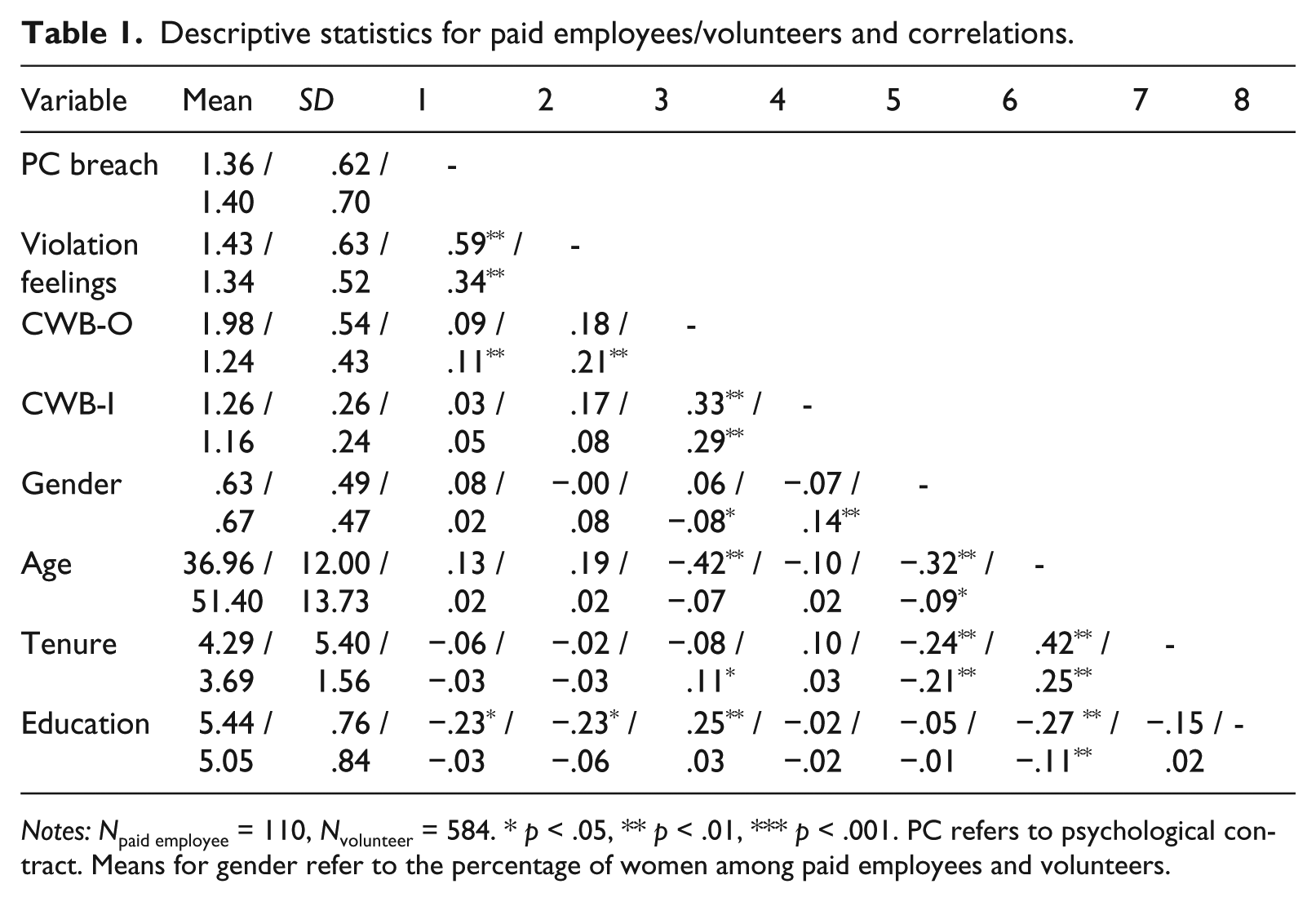
Notes: Npaid employee = 110, Nvolunteer = 584. * p < .05, ** p < .01, *** p < .001. PC refers to psychological contract. Means for gender refer to the percentage of women among paid employees and volunteers.
Inferential statistics
The estimated normal causation model
We tested a moderated mediation model in which (1) the relationship between psychological contract breach and CWB-O and CWB-I was mediated by violation feelings, (2) the relationship between psychological contract breach and violation feelings was moderated by the type of the employment relationship (0 = paid employee; 1 = volunteer), and (3) the relationship between violation feelings and CWB-O and CWB-I was moderated by the type of the employment relationship (0 = paid employee; 1 = volunteer). We commenced by estimating two separate path models to determine whether a full or a partial moderated mediation model offered the best fit to the data. When comparing the Bayesian Information Criterion (BIC), which represents the balance between the number of parameters (i.e., model complexity) and the fit of the model to the data, the BIC value identifies the fully moderated mediation model as the one that fits the data best (BIC = 20845.403) compared to the partially moderated mediated model (BIC = 20858.057) (Aiken et al., 1991). This normal causation model fit the data well (χ2(8) = 143.769; RMSEA = .014; SRMR = .934; CFI = .969; TLI = .075) (Schermelleh-Engel et al., 2003). As previously mentioned, we controlled for age, gender, tenure and educational level in all models.
Figure 1 shows the estimated paths in the fully moderated mediation model. We found that psychological contract breach was positively related to violation (β = .36, 95% CIbca [.55; .20]). In other words, respondents who reported a psychological contract breach reported higher levels of violation. This relationship was not moderated by the type of employment relationship (β = .02, 95% CIbca [−.02; .06]), implying that paid employees and volunteers experienced violation feelings to the same extent when perceiving psychological contract breach. Violation feelings were positively related to the enactment of CWB-O (β = .29, 95% CIbca [.10; .51]) and were not significantly related to the enactment of CWB-I (β = .04, 95% CIbca [−.07; .20]). The relationship between violation feelings and CWB-O (β = −.02, 95% CIbca [−.07; .02]) and CWB-I (β =.01, 95% CIbca [−.03; .03]) was not significantly moderated by the type of employment relationship, implying that paid employees and volunteers engaged in CWB-O and refrained from CWB-I to the same extent when experiencing violation feelings. The type of employment relationship was moreover not significantly related to violation feelings (β = −.08, 95% CIbca [−.30; .12]), enactment of CWB-O (β = .04, 95% CIbca [−.02; .10]) and enactment of CWB-I (β = .00, 95% CIbca [−.03; .04]). Put differently, paid employees reported similar levels of feelings of violation, CWB-O and CWB-I compared to volunteers.
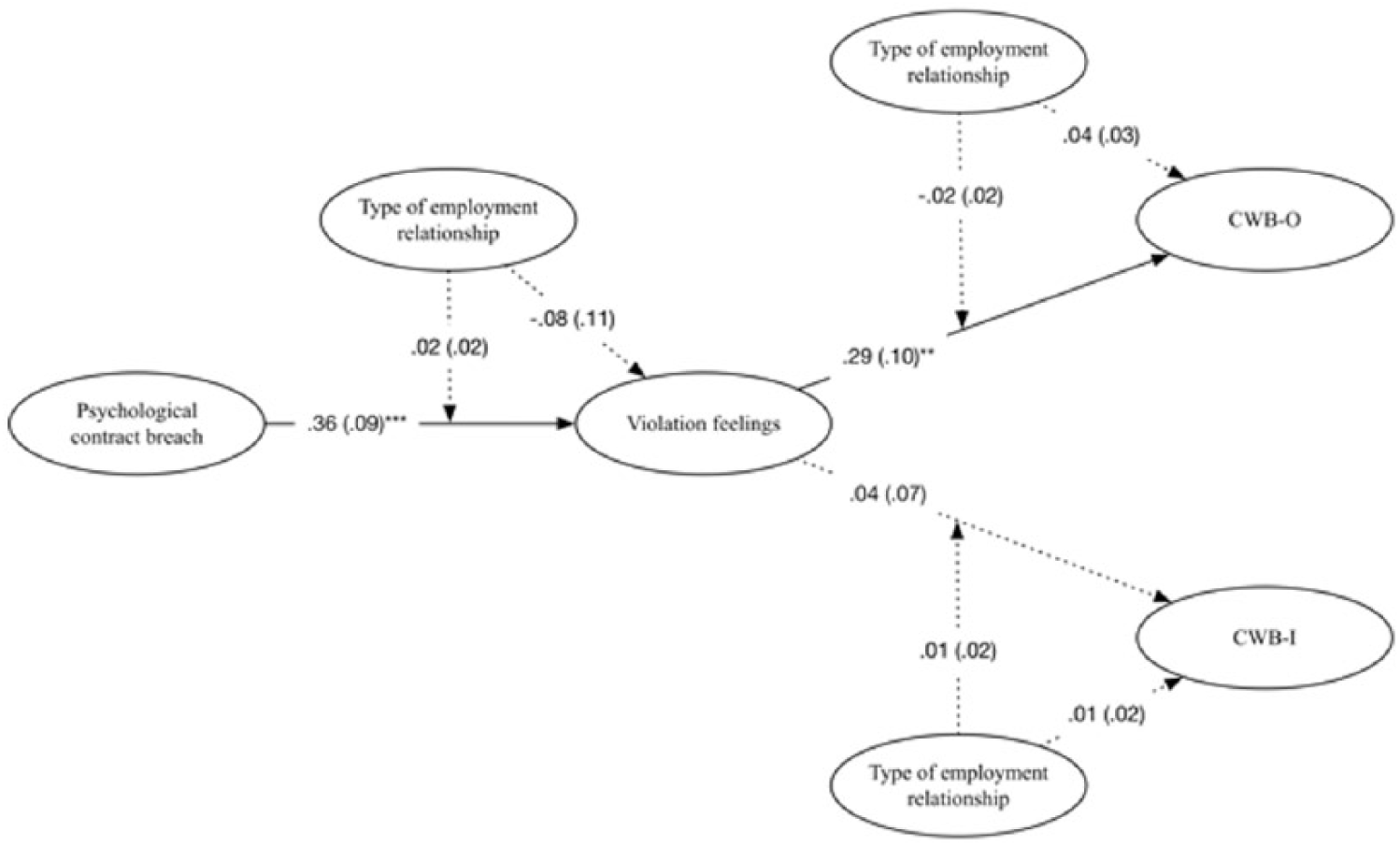
Estimated paths in moderated mediation model for volunteers and paid employees.
Finally, we examined the conditional indirect effects of psychological contract breach on CWB-O and CWB-I, through violation feelings. These indirect effects were estimated based on the product-of-coefficients approach and their significance was scrutinized by means of the bootstrapped confidence intervals (Preacher and Hayes, 2008; Preacher et al., 2007). For paid employees, there was a significant indirect effect of psychological contract breach on CWB-O (β = .10, 95% CIbca [.23; .03]) and a non-significant effect on CWB-I (β = .01, 95% CIbca [−.08; .03]). Hence, hypothesis 1A was supported while hypothesis 2A was not supported by the data. For volunteers, there was a significant indirect effect of psychological contract breach on CWB-O (β = .10, 95% CIbca [.21; .03]) and a non-significant effect on CWB-I (β = .01, 95% CIbca [−.08; .03]) according to the bootstrapped confidence intervals. Hence, hypothesis 1B was supported while hypothesis 2B was not supported by the data. Put differently, when both paid employees and volunteers report perceptions of psychological contract breach, they experience higher levels of violation feelings, which in turn were positively related to the enactment of CWB-O.
The estimated reverse causation model
Although the partially reversed moderated mediation model fits the data best (BIC = 12332.071) compared to the fully reversed moderated mediated model (BIC = 12353.85), this reverse causation model did not fit the data well (χ2(6) = 143.103; RMSEA = .181; SRMR = .075; CFI = .683; TLI = .429) (Schermelleh-Engel et al., 2003). Hence, based on the presented theoretical grounds and the fact that this reverse causation model did not fit the data, reverse causation seems unlikely. Hence, we emphasize our interpretations as presented.
Discussion
With the current study, we aimed to investigate the mediating role of violation in the relationship between psychological contract breach and CWB-O and CWB-I for both paid employees and volunteers in social enterprises. Moreover, we were interested in examining whether the proposed relationships are universal for paid employees and volunteers who are doing similar work in the same sector in order to respond to the often spoken, yet never empirically tested, critique that volunteers are very different from paid employees in their responses to psychological contract breach. Exploring factors that contribute to CWB is critical because CWB has serious negative consequences for individuals (e.g., increased absenteeism and turnover intentions) as well as for organizations (e.g., increased expenditure, tarnished reputations). Consequently, developing a more clear-cut understanding of how psychological contract breach relates to violation, which in turn relates to CWB, can be considered of critical importance for social enterprises’ policy makers when managing their paid employees and volunteers.
Our study offers some promising findings. First, we found that the type of employment relationship did not moderate the positive relationship between psychological contract breach and violation feelings. This result is of major importance for nonprofit organizations and social enterprises consisting of a combination of both volunteers and paid employees (Liao-Troth, 2005) because both paid employees and volunteers experienced violation feelings to the same extent when perceiving psychological contract breach. This finding contrasts the often-proposed argument that volunteers are not bound to the organization in which they volunteer by the usual ties of employment and therefore simply leave the organization when being confronted with psychological contract breach. In contrast, it offers support for the claim that people volunteer for an organization because they want to fulfill certain needs and motives that they could otherwise not fulfill (e.g., Clary and Snyder, 1991; Omoto and Snyder, 1995). Second, while feelings of violation were positively related to CWB-O, they were not related to the enactment of CWB-I. This relationship was once more not moderated by the type of employment relationship. These findings imply that paid employees and volunteers engaged in CWB-O to the same extent when experiencing violation feelings and thus that volunteers would not leave the organization when confronted with psychological contract breach and the resulting feelings of violation.
When explicitly testing the mediating role of an emotional and affective process in the occurrence of CWB (Griffin and Lopez, 2005; Robinson and Bennett, 1997), the conditional indirect effects of psychological contract breach on CWB-O and CWB-I indicated that both paid employees and volunteers engage in CWB-O when perceiving psychological contract breach via the experienced violation feelings. We did not obtain such indirect effect of psychological contract breach on CWB-I via violation feelings. These results are in line with the meta-analytical results of Zhao et al. (2007) and align with recent work on emotions (Judge et al., 2006), which argues that emotions mediate the relationship between workplace events (i.e., low-fulfillment) and resulting attitudes and behaviors (i.e., CWB-O and CWB-I). The fact that the conditional indirect effects of psychological contract breach on CWB-I through violation feelings were not significant can be explained by the fact that one’s colleagues are often not at the origin of a psychological contract breach. In line with the behavioral contingency argument of Heider (1958), there ought to be a direct alignment between the source of frustration and the behavioral reaction. Specifically, this implies that when individuals are confronted with unexpected events, they tend to look for several possible explanations for this event. This includes performing a cognitive evaluation to determine the origin of a psychological contract breach. As one’s colleagues are often not responsible for the psychological contract breach, they will not be held accountable for the negative outcome. Hence, it can be expected that paid employees and volunteers are less likely to vent and express their violation feelings by engaging in CWB-I. Indeed, some scholars have found support for this behavioral contingency principle (Bordia et al., 2008; Conway et al., 2014; Griep et al., 2016) when studying behavioral reactions in response to perceptions of psychological contract breach.
Limitations
Notwithstanding the insights gained from this study, a number of limitations need to be taken into account when interpreting these findings. First, and perhaps most important in light of the estimation of a moderated mediation model, the cross-sectional nature of our data limits our possibility to draw causal inferences from this study, thereby restricting the scope of our conclusions. To investigate the temporal precedence of the proposed relationships, longitudinal or repeated-measures research is needed. For the inference of causal conclusions to be possible, experimental designs are required in which psychological contract breaches are evoked and CWB reactions observed.
Second, although our sample of paid employees only numbered 110 (response rate = 30.14%) – a sample size that is remarkably smaller than the 584 volunteers (response rate = 19.02%) in our study – we wish to underline the fact that this study is conducted in social enterprises. This organizational type is characterized by a minimum of paid employees and mostly relies on volunteers to ensure their daily functioning (Borzaga and Defourny, 2001). Consequently, we believe that the relatively small sample size on the side of paid employees (versus the large sample size on the side of volunteers) does not pose a threat to the generalizability of the obtained results to other paid employees in social enterprises.
Next, as behavior has been shown to be discrete and temporally dynamic (Beal et al., 2005), CWB-O and CWB-I might exhibit large amounts of within-person variance. As a consequence, a person could engage in very different amounts of these behaviors in reaction to a specific event in time. Empirical research to date overlooked these within-person changes (Conway and Briner, 2002). Hence, we advocate the use of experience sampling designs, in which respondents are surveyed at random intervals throughout the day (Fisher and To, 2012). However, if such a design is constrained by practical issues (e.g., volunteers often work episodically at irregular intervals), we propose the use of a weekly or daily diary design to investigate these within-person reactions to psychological contract breach. In this case, it should be kept in mind that the time lag between measurements may affect the results due to recollection bias (Stone and Shiffman, 2002).
Fourth, our data were collected using self-reported measurements. This might cause socially desirable responses and common method variance (Podsakoff and Organ, 1986). Although it has often been suggested to rely on other rated measures to overcome the issue of social desirability, the concepts under study are idiosyncratic in nature (i.e., psychological contract) and, although engaged in with the intention to cause harm to the organization or its members, are often unobservable by others (i.e., CWB; Berry et al., 2012). Therefore, we relied on self-reported measurements, but aimed to minimize social desirable responses by allowing discretionary participation and by guaranteeing confidentiality. Indeed, the range in responses related to CWB behaviors indicates that individuals were willing to admit to CWB. Concerning the validity of our self-reported data, a recent meta-analytical study by Berry et al. (2012) highlighted the reliability and validity of self-reported CWB measurements. They even found that self-reported CWB measurements provide more reliable and valid assessments of CWB than other-reported measurements.
Practical implications
Our findings have practical implications for managing CWB and people’s psychological contracts in social enterprises as our study identified a chain of cognitions and emotions, offering potential explanations as to why individuals engage in CWB. By unraveling this sequence, we unveil how the management of social enterprises can target interventions. At the very beginning – to prevent the chain from initiating – it may seem self-evident that social enterprises ought to strive to fulfill the psychological contract and create a clear awareness of both parties’ expectations (Vantilborgh et al., 2011, 2012). In order to develop realistic expectations – and hence, lower the chance of psychological contract breach being perceived – Vantilborgh et al. (2011, 2012) underlined the importance that both parties effectively communicate on the mutual obligations in the organizational exchange relationship. However, it may well be realistic to assume that in the long run it is not always possible to fulfill every promise that was made (Rousseau, 1995). When this happens, it is advisable for social enterprises to provide an adequate explanation of the reasons related to the psychological contract breach, in order to reduce the violation feelings (Morrison and Robinson, 1997). Kickul et al. (2002) have shown that providing a face-to-face explanation as to why a certain promise was not fulfilled reduces employees’ negative affective reactions. In the final sequence of the chain, social enterprises should strive to prevent violation feelings leading to paid employees and volunteers seeking revenge by engaging in CWB. Revenge and retaliation can become a counterproductive way of dealing with violation feelings because it can lead to further retaliation, escalation of the conflict and pent up feelings of anger (Bradfield and Aquino, 1999). Grandey (2000) suggests providing opportunities for expressing and disclosing negative feelings to a supportive supervisor or colleague as a more constructive coping mechanism. Moreover, O’Leary-Kelly et al. (1996) suggest that a better self-regulation of emotional and cognitive reactions might cool down the development of the motivational revenge seeking process.
Future research implications
Turning towards implications for future research, our current study raises new avenues for investigating the psychological contract. First, we suggested – based on Robinson and Bennett’s (1997) model of workplace deviance – that violation will motivate deviant behavior to resolve feelings of disparity and inequity. Future research could include measures of employee (in)justice perceptions to extend this perspective (Ambrose et al., 2002). Moreover, Robinson and Bennett (1997) proposed that CWB is driven by feelings of anger, frustration and anxiety. As such, the reasons to engage in CWB may be due to increased negative affect in response to psychological contract breach. Certain personality characteristics, such as trait negative affectivity, were found to heighten individual reactions to aversive events – i.e., psychological contract breach – and hence predispose them to exert anger through the enactment of CWB (Aquino et al., 1999; Skarlicki et al., 1999). Future research could include a measure of negative affect to investigate this potential mediator. On a related matter, it may be worthwhile to examine the effects of agreeableness – as a personality factor – in the prediction of CWB, as Zhao et al. (2007) demonstrated that agreeableness served as a moderator in the relationship between psychological contract breach and abusive behavior.
Footnotes
Declaration of conflicting interests
The authors declared no potential conflicts of interest with respect to the research, authorship, and/or publication of this article.
Funding
The authors received no financial support for the research, authorship, and/or publication of this article.
