




Abstract
This article examines the attempt in a democratic South Africa to shift from an adversarial class struggle approach (with heavy racial overtones) towards a more participatory and cooperative industrial relations system based on workplace forums. The authors argue that the experiment failed because this attempt at institutional transfer from the successful system of German co-determination did not take sufficient account of the specific social and economic context of South Africa’s distinct industrial relations system. The majority of organized workers in South Africa have over the past three decades opted for engagement with employers on the basis of a union agenda and union independence in order to transform and democratize the workplace. At the centre of this strategy has been the shop steward as the instrument for worker participation at plant level. However, the ethnographic account of participation at plant level suggests that workers feel disempowered and unable to significantly shape decision-making.
Keywords
Introduction
How have South Africa’s workplaces adapted to the conflicting demands of workers, management and government since its transition to democracy over two decades ago? In this article we focus on the ideas and ideologies of workers’ participation at enterprise level. The central questions we seek to answer are how the relationships between management and labour have changed before and after apartheid. In answering the question we focus on worker–management relationships at the Volkswagen plant in the Eastern Cape province of South Africa.
We divide the article into three parts: in part one, we outline the historical development of workers’ participation in South Africa. We show how the system of shop stewards emerged as South Africa’s system of workplace participation evolved. In part two we analyse how, in post-apartheid South Africa, the new democratic government attempts to introduce a new vision of industrial relations through workplace forums. In part three, through an ethnographic case study of a Volkswagen plant, we show how the shop stewards feel disempowered by the attempts by management to establish participatory schemes, largely because management uses the committees to convey information rather than joint decision-making. The result is a contradictory response: a desire to participate in decision-making but a feeling that management is not genuine, leading to militant and hostile attitudes towards management.
Historical development of workers’ participation
The discovery of gold and diamonds in the late nineteenth century transformed South Africa’s agrarian economy into one based on extractive industry. It also entrenched racial divisions in the workplace, creating three distinct labour markets: one for whites, another for coloureds and Indians and a third for Africans. White workers became a privileged stratum – and to a lesser extent coloured and Indians – organized into craft unions that used techniques of entry restriction, apprenticeship and the closed shop to protect their monopoly of control. African workers, by contrast, entered wage labour on a weak and unorganized basis, mainly as unskilled migrant labourers. This division of labour was institutionalized by the Industrial Conciliation Act (1924).
With the emergence of manufacturing in South Africa during the 1930s and 1940s, job opportunities were opened up for African workers, thereby eroding craft-based control. The exclusion of African workers from the industrial relations system, compounded by their lack of political rights, fuelled a political trade union tradition that has a trajectory into the present.
While the reforms introduced by the Wiehahn Commission in 1979 were of major importance, their aim was limited: to incorporate African workers into the existing dualistic industrial relations system. The assumption of the Wiehahn Commission was that the existing system of industrial relations was basically sound and what was required was its extension to all of workers regardless of race. Neither government nor employers gave any serious consideration to workplace representation, as the management-dominated system of works and liaison committees had discredited workplace representation in the eyes of trade unionists.
The Labour Relations Act (section 34A(2)), as it had been amended in 1981, provided for the establishment of works councils, consisting of workers and management representatives. In practice, it seems as if very few works councils were established after 1981. Where they were created they were soon taken over by the trade union and, where this did not happen, conflict arose between the works council and the shop steward committee.
Instead of works councils, management in the 1980s and 1990s began introducing forms of ‘employee involvement’ (rather than genuine participation) such as briefing groups, communication schemes, quality circles, ‘green areas’ and suggestion schemes (Masondo, 2003). Almost all of these structures were limited to the immediate work environment and concentrated on increasing productivity (Maller, 1992). They were examples of what Pateman (1970) termed ‘pseudo-participation’, that is techniques which persuade employees to accept decisions that have already been made by management. No participation in decision-making in fact takes place (Pateman, 1970).
In contrast to these management-initiated forms of employee involvement, shop steward committees emerged in the 1980s as the central communication channel between workers and management on the shopfloor. These committees were influenced by the British model of adversarial plant-level industrial relations, which often expressed itself in an antagonistic class struggle approach. Where there was a strong shop steward presence, management tended to consult with the shop stewards committee before taking any major decisions affecting workers, if only to prevent repercussions from the union. The presence of the shop steward committee was soon codified in most unionized plants through a formal agreement that recognized the right of the union to represent workers in that plant.
Shop stewards became the pivot of the organizational structure of the union movement that emerged in the wake of the strikes in Durban in 1973. They performed an important role in recruiting new members, particularly where access for union officials was a problem. They also created a structure of workplace representation that ensured the unions remained democratic and sensitive to their members’ needs and interests. The shop stewards ensured that power was devolved within the system of industrial relations to the workplace and did not simply become a bureaucratic exercise between management and labour.
The role of the shop steward is multifaceted. First, it is to represent the interests of union members in their department and to protect their interests against management. Each department elects its own shop steward; on average, there was one shop steward to every 60 members in the early 1980s (Webster, 1985). The shop stewards collectively constitute a shop steward committee, which is instrumental in plant-level negotiations over wages and working conditions (in the absence of bargaining councils). It is also the job of the shop stewards to ensure that agreements are implemented correctly.
A second crucial function of shop stewards is that they are the key link between the union as an organization and the membership at the grassroots. Given the sheer weight of numbers for which each official is nominally responsible, and given additionally that membership is usually spread over a number of different workplaces, officials have little choice but to be heavily dependent on their shop stewards. They need shop stewards to be informed of what is happening in individual workplaces; they rely on them to settle everyday grievances at the workplace and to keep the membership informed of union actions and policies.
Shop stewards, in turn, need the union officials. The union provides them with training in negotiating skills, how to use the agreement, how to handle workers’ grievances in a department, and health and safety matters. It also provides services such as legal advice and financial and organizational help when engaged in campaigns or strikes. Above all, shop stewards need the union to represent their wider interests as workers, and not only as wage earners in a particular workplace.
An important characteristic of a shop steward is that they are not simply ‘stirring up’ trouble; they often perform a managerial function of settling grievances. Shop stewards, it has been argued, ‘manufacture compromise’ between management and labour in the workplace (Webster, 2001). Indeed, for many becoming a shop steward is a ‘stepping stone’ to a managerial position (Masondo, 2012: 126). As the Donovan Commission, set up to examine British industrial relations in the 1960s, argued, … it is often wide off the mark to describe shop-stewards as ‘trouble-makers’. Trouble is thrust upon them. … Quite commonly they are supporters of order exercising a restraining influence on their members in conditions which promote disorder. (Cited in Hyman, 1975: 28)
Both to sustain management’s goodwill, and to retain their own sanity (or at least keep their jobs manageable), shop stewards have an inevitable interest in ‘orderly’ industrial relations. The shop steward has been characterized as the ‘man in the middle’ or ‘the man with two masters’, caught between the employer who pays their salary and the members they represent. This leads to a further characteristic: they are not immune to co-optation.
Promotion is a common device for dividing shop stewards’ loyalties. In many firms it is well understood that service as a shop steward could be a prelude to promotion to supervisor, charge-hand or personnel/human resource manager. In the early 1980s any suspicion that a shop steward had been ‘bought’ was likely to lead to instant rejection by workers. Quite often workers would demand that management remove a shop steward from the workplace because he was seen as an ‘impimpi’ (an informer) (Webster, 1985: 236). As Beynon describes in his classic study of shop stewards in Liverpool, England: The promotion of the steward to the foreman’s job is one of oldest tricks in the book, and any many of the stewards would get worked up about anyone who turned coat. … Those supervisors who had once been stewards were pointed out to me like lepers. ‘Did you see that bloke in a white coat we just passed? He used to be a shop-steward … the bastard. The lads gave him hell for a bit though.’ (Beynon, 1973: 134)
Shop stewards are often elected because of their relatively higher levels of skills or education, as this will place them in a better position to represent the interests of their members to management. Although co-optation of this layer of worker leadership is not inevitable, the role contains many tensions. Stewards are faced with constituents whose expectations are greater than the stewards’ capacity to deliver, as emerged in both the 1991 and the 2012 survey of COSATU shop stewards nationwide in South Africa. Consequently, 80% of the respondents in the 1991 survey and 74% in the 2012 survey felt that they may find themselves in conflict with their constituents (Masondo et al., 2015).
This points to the ambiguous nature of the role of shop stewards: on the one hand, it involves representing their constituents’ grievances and defending their interests. On the other hand, stewards have to operate within the constraints of the industrial relations system. This involves, at times, agreeing with management rather than their members (59% in 1991 and 53% in 2012), preventing strike action (52% in 1991 and 58% in 2012) and persuading workers to accept industry-level agreements (65% in 1991 and 59% in 2012). In addition, shop stewards have to reconcile individual and sectional interests with the interests of workers as a whole (Masondo et al., 2015).
Contrary to popular stereotypes, not all shop stewards see themselves in permanent opposition to management. Some 30% of respondents in 1991 and 33% in 2012 agreed with the statement that management and workers have the same aims and objectives (Masondo et al., 2015). This is a surprising finding, given the high levels of conflict within the South African industrial relations system.
In spite of the high degree of cooperation between management and labour identified in both surveys, the idea of workers’ control of the economy is deeply entrenched among these shop stewards. Unfortunately the questions are not comparable across the surveys: in the earlier survey, respondents were asked to choose among the options of nationalization, regulation and private ownership of key sectors; and in the later one, they were asked whether they agreed or disagreed with each. In 2012, 65% agreed with nationalization, that is government owning and controlling companies in the key sectors of the economy; while yet more, 73%, favoured government regulation of the economy. However, a related question was comparable across the two surveys: the proportions of stewards feeling that workers should share in the profits of companies was 95% in 1991 and 84% in 2012 (Masondo et al., 2015).
At the core of the concept of workers’ control is the independence of the trade union and the right to strike. The majority, that is 93% of those interviewed, believed in retaining this right in the 1991 survey and 97% in 2012. Because of violence during strikes (both from the police and fellow workers) and the duration of strikes, there is a debate currently around how strikes ought to be conducted. More than half of the respondents in the 2012 survey (57%) felt that strike action yields results, and almost half (47%) felt that non-striking workers have the right to work. Relatively few respondents (24%) agreed or strongly agreed that there are times when it is necessary to use violence against non-striking workers. A far higher proportion (71%) agreed or strongly agreed that while violence is not acceptable, non-striking workers should be taught a lesson in non-violent ways. Most shop stewards (82%) felt that non-striking workers should be engaged with politically to convince them to join the strike. Only 39% agreed or strongly agreed that non-striking workers should be left alone to go to work if they so choose (Masondo et al., 2015).
Shop stewards’ responses seem to indicate a tension between their strategic need to cooperate with management in their day-to-day work and their long-term objective of establishing greater worker participation and control. Their responses leave open the form of worker participation that should be implemented. Worker control is an ambiguous concept and it is not clear whether our respondents conceive of it along the lines of the German system of co-determination, or a more thoroughgoing radical transformation of ownership, control, and indeed society.
In other words, where plant-level bargaining existed, shop stewards were engaged in collective bargaining, but they all participated in broader decisions around workers’ grievances and even joint problem-solving. Shop steward committees performed, therefore, a dual function: they engaged in collective bargaining, and participated in joint problem-solving where problems arose in production.
During the early 1990s, a number of companies began to separate these two functions institutionally by establishing joint forums with unions, within which information-sharing, consultation and, in some cases, joint decision-making occurred. In a research report written at the time, we found a number of companies that had introduced these forums, and we argued that the forums needed ‘to be separate from shop steward–management negotiating committees which dealt with wages, grievances and disputes’ (Webster et al., 1995: 230).
Issues covered by these forums included strategic business plans, investment decisions, corporate structures, product development plans, mergers and so forth. But these, we argued, were not necessarily collective bargaining issues, in fact, they may be issues that are best dealt with separately from the usual bargaining issues of wages and distributive concerns, which remained the purview of traditional collective bargaining structures. It is, we observed, the production-related issues that were being opened to information-sharing, consultation and joint decision-making. It was out of these embryonic workplace participatory structures that a new vision of a more cooperative and co-determined workplace based on workplace forums was to emerge.
The rationale for workplace forums was stated clearly in the explanatory memorandum to the Labour Relations Act No. 66 (1995) (or LRA). In the Government Gazette (Republic of Africa, 1995), it stated that ‘South Africa’s re-entry into international markets and the imperatives of a more open economy demand that we produce value-added products and improve productivity levels. To achieve this, major restructuring is required. … In those countries, such as the United Kingdom, where the adversarial industrial relations system was not supplemented by workplace-based institutions for worker representation and labour/management communication – a “second channel” of industrial relations – this process fared badly. Workplace restructuring has been most successful in those countries where participatory structures exist: for example, Japan, Germany and Sweden. If we are to have any hope of successfully restructuring our industries and economy then management and labour must finds new ways of dealing with each other’ (cited in Webster, 1996: 119).
The Act provides for workplace forums to be established by a Commission for Conciliation, Mediation and Arbitration (CCMA) on application from a representative union. As argued by Wood and Mahabir (2001), although both management and labour are expected to find workplace forums valuable, it is only trade unions that can trigger them. This is designed to reassure unions that forums will not be used, as works and liaison committees were used under apartheid, to supplant unions. Instead, they were designed to compel employers to cooperate by providing workers with statutory rights of joint decision-making in the workplace. They were designed to facilitate a shift, at the workplace level, from adversarial collective bargaining to co-determination and participation. In the words of government at the time: They are designed to perform functions that collective bargaining cannot easily achieve: the joint solution of problems and the resolution of conflicts over production. Their purpose is not to undermine collective bargaining but to supplement it. They achieve this purpose by relieving collective bargaining of functions to which it is not well suited. (Republic of South Africa, 1995)
The LRA was met with a lot of criticism and never really took root in the South African workplace, as discussed in the next section.
Workplace forums: A failed attempt at institutional transfer
The rights to workplace participation in a statutory form are subject to a collective trigger in the form of a majority union in the LRA (Anstey, 1997: 88). According to Chapter Five of the LRA, a workplace forum may be formed when there are more than 100 workers in a workplace. The purpose of the workplace forum is to promote workers’ interests by consulting and making joint decisions. Employers must provide relevant information to workplace forums. A majority trade union, that is one or more trade unions whose members are a majority of the workers employed, may start the process of establishing a workplace forum by applying to the CCMA. The functions of a workplace forum are to promote the interests of all workers in the workplace, to enhance workplace efficiency, for workers to consult with the employer and for workers to be part of decision-making.
According to the Department of Labour (2014), a workplace forum has the right to be consulted by the employer on issues such as restructuring and new work methods, partial or total plant closure, mergers and ownership transfers, retrenching workers, job grading, criteria for merits and bonuses, education and training, product development plans, export promotions and health and safety measures.
In workplaces where 1000 or more workers are employed, workplace forum members may elect one full-time member. Unless otherwise agreed in a collective agreement, an employer must consult the workplace forum before applying disciplinary codes and procedures, workplace rules of conduct, measures to monitor unfair discrimination and changes to rules of social benefit schemes. An employer must provide all the information that will allow a workplace forum to consult and make joint decisions effectively.
Workplace forums were conceived as a vehicle for the extension of industrial democracy in the South African workplace (Du Toit, 1997). However, as the research presented in Tables 1 and 2 shows, very few workplace forums have been established in the country.
State of play of CCMA applications for a workplace forum (by 1999).
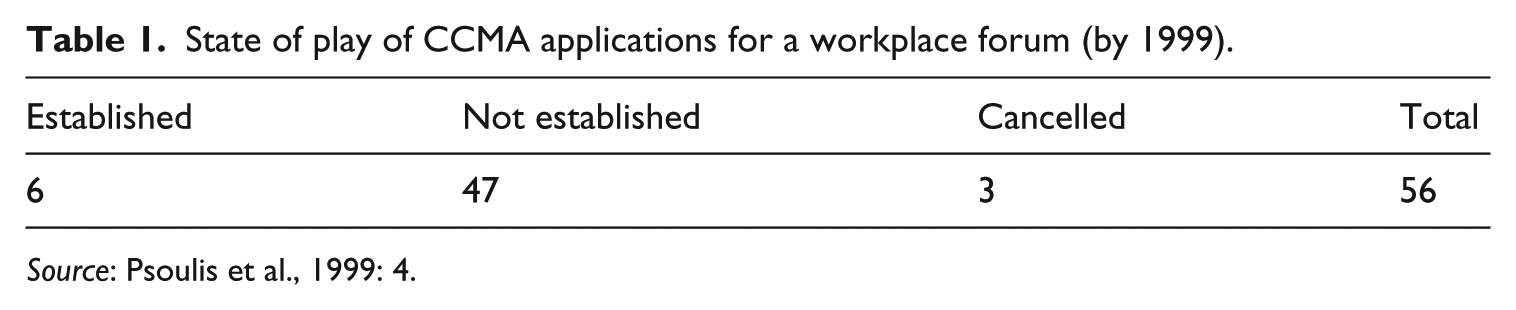
Source: Psoulis et al., 1999: 4.
Reasons why workplace forums not established (by 1999).

Source: Psoulis et al., 1999: 7.
In 1997–1999, researchers at the Sociology of Work Unit (SWOP) (currently known as Society, Work and Development Institute, SWOP) conducted a telephone survey of the applications received by the CCMA for the establishment of workplace forums. In 2014, the researchers repeated the exercise.
In 1999, the researchers found that only 11% (just 6) of the sample of workplaces had actually established a workplace forum after the union had applied to the CCMA. Forty seven workplaces did not establish a workplace forum at all (Psoulis et al., 1999: 3). This was a low rate of establishment.
Of the six workplace forums actually established by the end of 1997 in the entire country, a follow-up survey in 1998 found that only three were still functional. The functioning workplace forums had mixed results. Only in one case were management and trade unions satisfied with the workplace forum. In the others they experienced difficulty with interpreting the constitution of the forum. They also felt that they needed a defined proposal with guidelines for workplace forums to run smoothly as well as clearly defined roles for employers and employees, due to the differences in interpretation and conceptions about rights and regulations. The functional workplace forums were in the public education sector and in the furniture manufacturing sector. One of the reasons why the other three workplace forums were cancelled was because the company already had a combination of task (quality circles) and power-centred (collective bargaining) forums for participation, linked to union-based structures, that were functioning more effectively than the workplace forum.
The researchers contacted 38 of the 47 workplaces where workplace forums had not been established to determine the reasons for not setting up the workplace forum. The researchers posed the following questions to the informants: the reasons for and against the establishment of a workplace forum, previous or present alternative structures to the workplace forum, key opposition or support for workplace forums and the trade union’s position on the workplace forum. There were a number of reasons why the workplace forum has not been constituted. The first finding was that the trade union lost interest in the workplace forum or took the then COSATU position of opposing the workplace forum, so it was not established. The reason for the loss of interest on the part of the trade union was that it would not benefit the union and could undermine its support base, including shop steward structures. This represents half (50%) of the cases. This finding definitely confirmed that workplace forums are seen as undermining the authority and powers of the trade union. Workplace forums do not incur membership fees and are open to all employees. Trade unions may have not much to gain from initiating them. Existing workplace participatory structures, where employers and employees already communicate and jointly problem solve at the enterprise level, may conflict with the objectives of the workplace forum and the role of its members.
A second finding was that the applicants had failed to meet the CCMA criteria and so the CCMA ruled against the setting up of a workplace forum. This represented over a quarter (27%) of cases. A third finding was that the workplace was too small or the workforce was too dispersed to set up a meaningful workplace forum. This accounted for 11% of cases. A fourth finding was that management had opposed the establishment of the workplace forum. This was the situation in 8% of cases. A final 4% did not want to reveal the reason for the non-establishment of the workplace forum. The data are summarized in Table 2.
In 2014, the researchers contacted the CCMA for their most recent list of workplace forum applications and we repeated the exercise of calling the contact persons listed to establish whether the applications made to the CCMA had resulted in a workplace forum, or not. 1 The researchers wanted to understand if there were any further workplace forums by 2014.
The CCMA list again contains a total of 56 recorded applications, supposedly for the establishment of workplace forums. Out of the 56 applications made to the CCMA for the establishment of a workplace forum, in 37 cases telephone numbers supplied were not working. In 18 cases, the researchers made contact but the person answering the phone told the researchers that their case was about an arbitration regarding workplace conflict and not about an application for a workplace forum. In other words, they were not workplace forum applications. These results are summarized in Table 3.
State of play of CCMA applications for a workplace forum (by 2014).

Source: CCMA, 2014.
Only in one case did the researchers confirm with the respondent that the application made was about the establishment of the workplace forum. This respondent said that he had worked at a municipality six years ago and that the trade union had triggered a workplace forum. This was done so that workers could ‘engage management and make suggestions to them’. He said that what transpired was very little support for the workplace forum once it had been established and that members of the trade union (which is a public sector trade union) were mobilized to fight against the workplace forum because ‘workers would leave the union because it would be supplanted by the workplace forum’. He expressed doubt that the workplace forum still existed. The researcher called the office of the municipality in question and indeed no one at the office had knowledge of a workplace forum. One can therefore conclude that of the applications made to the CCMA by 2014 for the establishment of a workplace forum, only one was triggered but then cancelled. By September 2014 there were no existing statutory workplace forums in South Africa.
It can be argued, based on the very small number of applications made by trade unions for workplace forums, that unions have really not taken up Chapter Five of the LRA. Trade unions affiliated to the Congress of South African Trade Unions (COSATU) in particular have viewed workplace forums with great scepticism and clearly still do. COSATU stated in the September Commission Report of 1997, ‘While it is significant that this legislation institutionalizes workers’ rights to workplace democracy, workplace forums as outlined in the legislation hold many dangers for unions (and employers). We strongly support the argument that workplace forums should be union-based rather than independently elected. In other words, the powers of information, consultation and joint decision-making should be conferred directly on the shop-stewards committee; alternatively, the shop steward committee should nominate members to the workplace forum. Otherwise there is a danger that the workplace forum will either become a substitute for the shop steward committee, or will be a very weak consultative forum. A workplace forum independent from union structures will be a recipe for division. If the union would not be able to access the institutionalised rights to participation in the LRA, in such cases the unions should consider whether triggering a workplace forum may be a useful strategy for compelling management to provide information and consult the union. They should only consider triggering a forum, if at all, where shop-stewards and organisers are sure that the union is strong enough to control the forum’ (COSATU, 1997a). In the Secretariat Report to the COSATU Sixth National Congress (September 1997), it was stated, ‘We should take advantage of the new LRA to establish Workplace Forums as part of our agenda to democratise the workplace. The federation should run a pilot project based on factories identified by affiliates. In this way we will not be throwing workers to the wolves. The position of some affiliates not to establish Workplace Forums is wrong, particularly as workers engage in them without any union assistance’ (COSATU, 1997b).
It appears that COSATU remains hesitant about the trade-offs inherent in the system of statutory workplace forums. However, instead of statutory workplace forums, workplace participation takes place through shop steward committees and a range of other joint labour–management participatory structures at workplace level, as Table 4 shows.
Workplace participatory structures.

Source: National Labour and Economic Development Institute (NALEDI) Survey of Workers, 2012 (unweighted data).
The new industrial relations system introduced in 1995 failed to integrate the statutory workplace forums into existing workplace participatory structures, in particular the existing shop steward system. Hlatshwayo (2013: 17) found in his study of ArcelorMittal South Africa’s Vanderbijlpark Plant that ‘shop-stewards and office bearers manage the affairs of the union at the plant’. We turn now to an examination of the relationship between the shop stewards and management.
Worker participation for what? A case study of the Volkswagen plant, South Africa
Volkswagen South Africa (VWSA) is located in Uitenhage in the Eastern Cape Province. Its workforce is represented by the National Union of Metalworkers of South Africa (NUMSA). NUMSA was expelled from COSATU in 2014 and is now an affiliate of the newly established South African Federation of Trade Unions (SAFTU). At its Sixth National Congress in 2000, NUMSA argued that workers in the metal sector had encountered many attacks from employers as a result of work restructuring. It noted that practices such as outsourcing, new technology, productivity, realignment, restructuring, right-sizing and down-sizing had become commonplace in the sector (NUMSA, 2000). At the Seventh National NUMSA Congress in 2004, the union resolved that it should be proactive in responding to restructuring because workers had lost jobs as a result of it (NUMSA, 2004). This was a clear indication of the negative impact of work reorganization on workers.
Despite a number of existing structures for worker participation, shop stewards at the VW Uitenhage plant have little institutional space or power to influence workplace restructuring. Most shop stewards at the Uitenhage plant regard the existing worker participation structures as not only bogus but also as a tactic employed by management to gain legitimacy in their decisions. In other words, for these workers, worker participation in the plant is not real but pseudo. Workers in this plant are not opposed to workplace restructuring per se, they view it as necessary for the sustained economic viability of the plant and securing their jobs. The willingness to participate in decision-making processes on the part of the shop stewards is negated by a deep sense of disempowerment and lack of trust in the workplace (Masondo, 2010).
Worker participation structures
Through in-depth interviews and participant observation conducted at the VWSA Uitenhage plant in 2010 it was found that the plant has numerous worker participatory structures intended to give workers a voice in decision-making on a variety of issues in the plant, including workplace restructuring. These structures comprise the Joint Strategic Workshop (JSW), the plant committee, the negotiation committee, unit head meetings and weekly meetings between supervisors, and briefing groups. By November 2017, these structures remained in place – with the addition of quarterly general meetings attended by all workers in the plant (Interview 20, 27 November 2017). The JSW is a predecessor to the Joint Union–Management Executive Council (JUMEC) and it was established to deal with strategic issues in the plant. Decisions on strategic issues such as the installation of new machinery and changes in work should ideally be discussed at the JSW. The plant committee meets every first Friday of each month and comprises heads of departments (including the head of production) and all shop stewards (Masondo, 2010).
Through the plant committee all stakeholders share information and attempt to seek mutually acceptable solutions to any problem. Many of the plant committee’s decisions remain recommendations until they are ratified by management. The negotiating team deals with a whole range of company issues such as banking of hours, work time and other important shopfloor issues (Masondo, 2010). It consists of the heads of the plant’s human resources department and the human resources director, all full-time shop stewards, NUMSA office bearers at the plant and an official from the union’s regional executive committee, and industrial relations specialists or any specialists depending on the issue being discussed.
One of the shop stewards in the plant described the negotiating committee as ‘the most important committee. It is an important forum … if we disagree on anything we launch a dispute’ (Masondo, 2010: 102).
The researchers contacted VWSA in November 2017 and interviewed the Labour Relations Manager in order to update information about the worker participatory structures at the plant. In the interview the Labour Relations Manager described the negotiation committee as the most important one because ‘this is where most binding decisions are taken’.
Unit head meetings are departmental-based and are aimed at allowing managers and shop stewards in different departments to discuss ‘strictly production issues’ (Masondo, 2010). Weekly meetings between supervisors and briefing groups – also called team talks – are convened before the start of weekly work shifts to discuss issues related to quality standards (Masondo, 2010). These team talks are not taken seriously by most shop stewards: … we meet before the shift begins just to say the same things we have been saying for ages. Look, it is frustrating to make the same suggestions every day but the supervisors do nothing. (Masondo, 2010: 103)
Shop stewards do not take these structures seriously because they believe they have very little power over workplace restructuring in the plant. As the former chairperson of the shop stewards committee indicated: ‘No, these committees do not give us any power in decision making. We just share information most of the time’ (Masondo, 2010: 103). Most of the shop stewards regard these committees as nothing but a desperate attempt by management to gain legitimacy for their predetermined decisions. However, in the interview conducted by the researchers in November 2017, the Labour Relations Manager insisted that they were fully committed to the existing worker participatory structures in the plant. He emphasized that for participation to function well there needed to be an appreciation that ‘participation structures are as good as the people who participate in them’.
In the interview, the Labour Relations Manager proposed that the reason why workers at VWSA believed they were not taken seriously was because they expected all their demands to be ‘delivered on a silver platter’ while ignoring that ‘the negotiation between workers and management is a painstaking and protracted process’. This challenge, according to the Labour Relations Manager, was also compounded by the ‘lack of education and maturity’ on the part of shop stewards, and that ‘labour relations in South Africa remains adversarial and political … people simply do not listen to one another’. The Labour Relations Manager also cited the steady decline in the capacity of shop stewards as one of the major constraints to meaningful participatory management in the plant. There were also limits to what VWSA management would concede to, according to the Labour Relations Manager, as if management was ‘to listen to everything, the company will be dead’ and ‘due to the competitive pressures, it was not possible to have lengthy negotiation on a single issue because business needs to make quick decisions’.
The JSW has historically been viewed as the most important and strategic platform for workers to advance their interests on qualitative shopfloor matters such as working conditions, introduction of new production systems and shifts. However, shop stewards in the plant accuse the management of not taking the JSW seriously and of using it just to inform shop stewards about their plans to restructure work. According to one of the shop stewards: … JSW is only there to sort of cement a position whereby management can at a later stage state that ‘what we are doing now we have told your union’. JSW is a tool which management use to inform workers about changes in production systems and claim that they consulted us. We were informed about the new technologies for the press shops and other departments … but we do not engage there, we just get informed. (Masondo, 2010: 103)
A shop steward indicated that the scope for engagement in the JSW is very limited and that this can at times be demoralizing: … in fact what is happening in this JSW is that we are given broad principles not details and at times we do not know what informs these broad principles. The information that we get there is limited because that structure is only to share information and not to engage. If you want to engage they will send you elsewhere and when you get there you do not engage on the issue. JSW is sort of a formal consultation forum that does not give workers any power to influence decisions. (Masondo, 2010: 103)
Other shop stewards view the JSW in the same light and some go to the extent of dismissing it as a talk show: … to me it is like a talk show that JSW … it is a talk show, when you speak of joint decision making you are speaking of more than one, but when we come with our input there they do not care about our strategic input … so to me this JSW does not make sense. (Masondo, 2010: 104)
However, not all shop stewards dismiss the JSW as an absolutely useless structure; one of them stated that: … JSW taught us a lot of things because today we are able to raise issues in different platforms because of the information we get at JSW. But one thing we cannot get out from the JSW is that they are saying [it] is about joint decision making platform but there is little in truth in this. We cannot abandon the JSW because by doing that we will be suppressing an opportunity to get information. (Masondo, 2010: 104)
Responses by shop stewards to workplace restructuring
It emerged that the shop stewards in the plant felt disempowered and discouraged from participating meaningfully in management-driven workplace change. The installation of new production systems did not involve meaningful worker participation.
The research revealed that the worker participation structures did not give workers any real power over workplace restructuring. The shop stewards in the plant were quite aware of the pressures exerted upon the company by neoliberal globalization. Most of them were not keen on obstructing restructuring of work. For the shop stewards, workplace restructuring was increasingly becoming a serious concern that the workers felt they must proactively engage with. As one shop steward put it: … the vast automation that has engulfed our plant sort of adds as a problem. Production systems which are now being introduced are new to us because … they have been developed for the developed countries; here we are still struggling even to interact with these because they are not talking directly to us as workers. (Masondo, 2010: 101)
Shop stewards argued that obstructing workplace restructuring would compromise the competitiveness of the plant, thus putting their jobs at risk. In the interview with the Labour Relations Manager in November 2017 he stated that VWSA management also maintained that work restructuring was important to ensure that the plant remained ‘globally competitive’. Without workplace restructuring and continuous improvement of production systems, the company might lose its competitive edge under the current harsh conditions of heightened global competition. As one shop steward stated: … we are not saying that we must work using the old methods … but what we want is the company to protect the jobs of the people. You will understand that we are competing with other countries which are using the new methods to manufacture cars. We are not saying that they must get rid of new systems, but they must make sure that they protect our jobs. (Masondo, 2010: 101)
Another shop steward concurred: … you will have a challenge if you move off the new productions system because of the competition in the market itself … if you do not meet that particular standard in terms of making sure you reach a particular quality there will be problems. Within the space of a year we have seen an immense transformation in VW – they started with the state of the art paint shop that has got capacity that doubles the capacity of the old paint shop. We need a balance between these new production systems and job security. (Masondo, 2010: 101)
Limited access to information and lack of trust
Management seldom make attempts to brief shop stewards about their plans to restructure work or furnish them with all the information about their plans to restructure work. This explains why shop stewards believe that management does not negotiate workplace change with them in good faith. This was indicated by one of the shop stewards, who complained: … there is a deliberate attempt by management to hide information from us. I do not know why. (Masondo, 2010: 104)
In the same vein another shop steward echoed the same complaint: ‘The Company is not always transparent when they introduce new production systems’ (Masondo, 2010: 104). When asked why they do not request the information from management, one of the shop stewards replied, ‘Not unless you want to resign on that particular day’ (Masondo, 2010: 104). … the feeling by workers that management negotiates workplace change in bad faith fuels the lack of trust between the shop-stewards and management: ‘To me what is happening here is that management is not transparent … maybe they do not trust us’. (Masondo, 2010: 105)
Asked whether they trust management, one shop steward said, ‘How can we trust them? They are not transparent to us … we do not want to be trusted by them’ (Masondo, 2010: 105).
However, the Labour Relations Manager stated that VWSA management insists that they always strive to provide all the required information to the shop stewards, when he was asked this question in the interview in November 2017. He stressed that as far as VWSA management is concerned, hiding information from workers ‘is dangerous and unsustainable’. The real problem, according to the Labour Relations Manager, is the ‘declining capacity [among shop stewards] because people do not want to learn … when you try to train them they say “we can’t be trained by management” ’.
Some shop stewards in the VWSA plant seem sympathetic to what they regarded as management’s half-hearted commitment to negotiate workplace restructuring with them because they (management) get orders from VW headquarters in Germany. They argue that the fundamental constraint to real worker participation lies in the foreign ownership of the plant.
To some it seems rather impractical to have ‘real’ worker participation in a foreign company as the decision-making process is centralized in the company’s headquarters: … we do have capacity to engage management on these issues but the challenge is that management tell us that ‘this is not our call but it is the mother company’s call from Germany’. There are some agreements which are signed in Germany but they are not in our favour. The problem of capacity is not there … we are trained extensively within the progressive trade union movement to understand issues that talk to macro and micro economic issues. We know what we want. (Masondo, 2010: 105)
At the NUMSA Central Executive Committee meeting, one of the committee members argued that it is not possible to have ‘full participation’ in a foreign company, ‘We cannot have full participation in a company which is foreign owned’ (SWOP, 2009).
They also argued that co-determination law as it is practised in Germany is not an appropriate industrial relations system in South Africa because: … as NUMSA we do not believe in co-determination because it is opposed to our ideological school of thought. We do not need co-determination because if a mistake is made by management it should remain management’s mistake alone; it should not be a mistake of the union and management. (Masondo, 2010: 105)
NUMSA General Secretary Irvin Jim concurred: … the union is not in partnership with employers; thus workers cannot co-determine decisions with management. A workplace belongs to the employer, not workers. (SWOP, 2009)
In 2009, NUMSA commissioned the Society, Work and Development Institute (SWOP) at the University of the Witwatersrand to undertake a study aimed at identifying changes in work organization and production systems in the metal sector, and to assist the union in developing a strategy on these issues. The union noted that it was unfortunate that it lacked a coherent strategy on how to respond to workplace restructuring and how to influence it to benefit workers. This is why it was important that a study be conducted to better inform the union’s strategy on restructuring of work.
As part of the SWOP study, a small survey was conducted in a number of workplaces, including 20 workers at the VWSA Uitenhage plant, to establish workers’ attitudes towards work, production and participation. In response to the statement ‘Management knows best and should make all the company decisions about changes to the production system’, 14 respondents strongly disagreed and five disagreed. Only one agreed. Likewise, in response to ‘Workers should participate more in making company decisions about changes to the production systems’, all 20 agreed, and 17 of them strongly agreed (Webster et al., 2009: 57–58). The central point here is that the shop stewards in the Uitenhage plant believed they are knowledgeable about the production systems and expected to be meaningfully consulted when VW restructures work in the plant.
Conclusion
Instead of following the path of institutionalized co-determination, the labour movement has opted for engagement with employers on the basis of a union agenda and union independence in order to transform and democratize the workplace. At the centre of this strategy is the shop steward as the instrument for worker participation at plant level. Although we found a surprising degree of cooperation with management among many shop stewards, the attempt to transfer the German system of co-determination in the LRA Chapter 5 has failed. Instead, we have identified a multiplicity of union–management participatory structures at workplace level.
Our ethnographic account of participation at plant level suggests that workers feel disempowered and unable to significantly shape decision-making. Whether the current strategy is providing workers with effective and sustainable participation remains to be seen. The recent increase in strikes both in duration and violence in South Africa has led to a growing number of commentators suggesting that the concept of the workplace forum needs to be revisited. The loss of majority status by the National Union of Mineworkers in the platinum belt may signal a broader trend towards multi-unionism in the workplace. This opens up an opportunity for a discussion around how a multi-union participatory structure could be established in the workplace where unions could make common demands and interact with management. It could also be a way in which the growing social distance between union leadership and ordinary membership could be reduced. What is clear from our findings is the need for the current low trust dynamic between management and workers to be systematically addressed.
Footnotes
Declaration of conflicting interests
The authors declared no potential conflicts of interest with respect to the research, authorship, and/or publication of this article.
Funding
The authors received no financial support for the research, authorship, and/or publication of this article.
