



Abstract
The author investigates the implementation of labour policy reforms as part of the rescue programmes adopted in Greece and Portugal during the Great Recession. Both countries were strongly pressurized to reform their labour markets. However, while the content of policies was the same the changes then followed different pathways. Rather than considering path dependency and convergence as mutually exclusive, in this article the author contends that the concepts interact with each other and forge particular policy outcomes. Looking through the lens of a ‘contingent divergence’, it is argued that while the rescue programmes suggest a common policy trajectory of neoliberalism determining the content of policies, variation in the political ownership of the reform programmes and the subsequent disparity in reform implementation, government approaches to social dialogue, public policy choices and programme design faults have played their part in the diverse policy outcomes. Considering this, path dependence pressures account for divergence, while the common direction of the reforms defines the field within which the former takes place.
Keywords
Introduction
In the spring of 2010, Greece was the first country in the Euro area requiring financial support to meet its government’s payment obligations, followed in quick succession by Ireland, Portugal and Cyprus. The bailout rescue packages (Memorandum of Understanding – MoU) designed by the European Commission, the European Central Bank and the International Monetary Fund (IMF) (known as ‘the Troika’) were linked to the implementation of macroeconomic adjustment programmes which aimed to address the problems that had made the countries vulnerable to changes in market confidence. The programmes sought to strengthen growth by improving competitiveness, secure fiscal sustainability and bring public debt under control. To that end a series of structural reforms and cuts in public spending were envisaged. As part of this strategy, employment structures were assigned with the role to add flexibility and allow a realignment of production towards tradeable sectors (Tinios, 2015).
The article examines Portugal and Greece, both of which experienced unprecedented job losses during the years of the crisis and were strongly pressurized to reform their labour markets. Have their responses to similar external policy constraints been translated into similar employment outcomes? Even though the content of the adopted labour market reforms seems to have been based on the same neoliberal ideas, the countries’ responses have been translated into different outcomes. Portugal has already come out from financial surveillance and its labour market has recovered to levels similar to those before the crisis, while Greece expects to come out from surveillance in the summer of 2018, with a fragile labour market, trying to find its way after three rescue packages, which all casts doubts on the assumption that convergence will result from similar policies.
What are the reasons behind this diversity? International creditors feel that the two countries exhibited differences in terms of the ownership of the programme, while the programme for Greece and to a lesser extent for Portugal made highly optimistic assumptions about growth. However, can this fully explain the situation? Are there any other key factors which determine the observed differences?
Welfare state studies draw on two basic ideas concerning the ‘laws of motion’ of welfare states (Achterberg and Yerkes, 2009), in order to capture the direction, the dynamic and the degree of domestic change. The first idea is that welfare states in the face of external constraints develop path dependency, which permits their core to remain largely intact, and ‘recalibration’ rather than a radical retrenchment of welfare programmes occurs (Esping-Andersen, 1996; Lynch and Rhodes, 2016; Pierson, 2011), thus preserving welfare state variations and divergences. The second idea is that, with modernization, imitation and international integration, welfare states gradually tend to converge with each other – an idea known as the convergence thesis (Brooks and Manza, 2006; Inkeles, 1998).
In this article I aim to add to this field of welfare studies and crisis response by offering insights into how path dependencies played out and shaped external pressures stemming from the policy conditionality established in the adjustment programmes. By doing so, I differentiate the content of the adjustment programmes from the implementation and the final policy outcome. In the literature on the welfare state responses to the Great Recession, scholars argue that path dependencies prevail in the course of structural reforms (e.g. Chung and Thewissen, 2011; Lallement, 2011) while other emphasize convergence (e.g. Pontusson and Raess, 2012; Shahidi, 2015), pointing at the strengthening of neoliberal policy agendas.
Rather than placing the two ‘laws of motion’ in opposition to one another and seeking one-dimensional answers which undermine the complexity of changes and the variation of outcomes, the article attempts to cross the divide between convergence and divergence, arguing that the two concepts may coexist and interact with each other. I assume that while external pressures in the form of policy conditionality determine the neoliberal content of policy reforms, institutional traditions and legacies mediate and forge policy outcomes. In this perspective, we should not expect homogeneity, but rather variation in countries’ responses to external policy conditionality. In the countries concerned, factors such as different levels of political ownership of the reform programme and the subsequent variation in policy implementation, government approaches to social dialogue, public policy choices and programme design faults have all played their part in the diverse policy outcomes.
By adopting this approach, this study offers a more complete picture of crisis response and sheds light on the interaction proceedings of convergence and divergence – leading me to argue that ‘contingent divergence’ has taken place as path dependencies may however account for divergence within a field defined by policy conditionality.
The article proceeds as follows. The next section reviews the welfare crisis literature and the convergence and path dependence theories. In the following section, the methodology of this article is explained and a number of general expectations are drawn upon in order to frame the adopted employment policies and their respective impact on labour markets. The third section consists of the empirical description of the responses implemented by Greece and Portugal and the respective outcomes in their labour markets. The contribution to the current debate is then outlined.
Path dependency, convergence and the European welfare state during the Great Recession
The existing welfare state theories offer both aspects predicting ongoing divergence of welfare provisions as well as long-term convergence. According to the first, path dependency, domestic politics and country-specific problem pressures are seen as crucial in explaining the persistence of the existing policy variation or even as forces making for further welfare state divergence (Starke et al., 2008: 979). In order to understand welfare restructuring, we need to pay attention to the crucial junctures in the development of welfare states as well as to the factors that reinforce the path (Timonen, 2003: 25). Changes happen, but they are bounded or incremental, rather than being institutional overhauls (Starke, 2006: 105–106). The probability of further proceeding along a particular path increases with time as the benefits of doing so increase or the costs of exit become more prohibitive (North, 1990). According to Pierson, four characteristics of politics make it particularly susceptible to increasing return processes: the density of institutions; collective action problems; the complexity and opacity of political processes; and political authority and power asymmetries (Pierson, 2004: 30–40). The weakness or absence of competition and learning in politics, the relatively short time horizons of political actors, and the ‘stickiness’ of institutions increase the difficulty of changing paths. Lock-in effects add to the cost of reforming policies (Pierson, 1994: 181), while many institutions contain veto-points and have high set-up costs (Bonoli, 2001: 238).
In this perspective, country-specific peculiarities and assumed path dependency of state institutions will continuously produce different welfare outcomes, even when challenges are similar. External challenges get mediated by domestic institutional actors and thereby transformed into different social policy responses, resulting in a conservation of the existing varieties in welfare capitalism (Paetzold, 2012: 5).
The divergence of different welfare systems will also persist due to a continuance of the ‘old partisan politics’ paradigm (Korpi and Palme, 2003). According to the ‘old politics’ approach, ‘socio-economic problems do not necessarily lead to convergence, since problem pressure always requires political mediation’ (Starke et al., 2008: 979). Constellations and actors either inimical or conducive to welfare statism are expected to stimulate welfare state retrenchment and expansion, respectively (Kittel and Obinger, 2003: 21), rejecting thus a general ‘race to the bottom’ scenario. Instead, ongoing divergent responses depending on the different political powerbrokers involved are expected (Paetzold, 2012: 5). Moreover, existing institutional settings shape the expectations and behaviour of citizens, politicians and pressure groups. For instance, there could be a demand for policies that enable society to do as much ‘business as usual’ as possible (Chung and Thewissen, 2011: 357). This means that radical welfare reforms are likely to meet with opposition from various interest groups.
Do national institutional differences still define crisis responses? Proponents of capitalist diversity argue that in many countries incremental crisis responses and the absence of fundamental changes are the result of path dependencies shaping policy-making (Lallement, 2011; Van Kersbergen et al., 2014). Institutions formulate the policy paradigm, a roadmap which shapes cognitive understandings about the nature of policy problems, and policy alternatives (Immergut and Anderson, 2008), structuring thus countries’ crisis responses (Kiess et al., 2017: 3).
Chung and Thewissen (2011) show that even though the Great Recession presented sudden and severe problems to the economies of Germany, the UK and Sweden, the reactive social and unemployment policy strategies of the three countries were remarkably different. These differences in reactive policy strategies can be understood largely by the different institutional legacies of the three countries. Madsen et al. (2012) examine the position of young workers in European labour markets as these are exposed to mounting risks and uncertainty resulting from increased flexibility as the result of the implementation of flexicurity measures. They conclude that national variation is correlated to the different degree and form of implementation of flexicurity policies. Van Kersbergen et al. (2014) study the welfare state reform measures taken between 2010 and 2012 in four countries characteristic of mature welfare state regimes (liberal, the UK; conservative, Germany; social democratic, Denmark; and hybrid, the Netherlands). They conclude that reforms in line with a social investment agenda are still being pursued in all four cases but there are different degrees of institutionalization.
With this in view, the crisis response of recent years has not required any overall ideological or policy paradigm change (Kiess et al., 2017: 3). As reactive policies are used to address urgent crises in a short time frame, radical changes may be even more difficult to accomplish (Chung and Thewissen, 2011: 357). Starke et al. (2013: 206) conclude that ‘fundamental restructuring does not take place in the first years after crisis, when policy-makers still try to hold on to what they have at their disposal’.
By contrast, convergence is ‘the tendency of societies to grow more alike, to develop similarities in structures, processes, and performances’ (Kerr, 1983: 3). Surfacing in the context of the globalization debate in the 1990s, convergence is not only an academic issue, as analysts argue over whether the world has become ‘flat’ due to globalization or whether it remains ‘spiky’ (Schmitt and Starke, 2011: 120).
In economics, convergence has been a central issue for some time, while in other social scientific disciplines it is only recently that interest has grown in empirically testing the convergence hypothesis (cf. Journal of European Public Policy, Special Issue 12(5), 2005). Often, policy convergence is equated with related notions such as isomorphism, policy transfer or policy diffusion – closely related but analytically distinct concepts (Knill, 2005: 766).
In this study my attention is focused on accounts which claim that different models of capitalism are converging in a similar neoliberal-inspired trajectory, with the premise of a downward convergence in welfare provisions due to unfettered market forces and increased economic competition (Paetzold, 2012: 4) – even if they follow different paths to that end.
Different conceptualizations are used in order to capture convergence, most notably sigma-convergence and beta-convergence (see Holzinger and Knill, 2005 on concepts). Sigma-convergence denotes a narrowing of differences between units – or a shrinking distribution of values – over time, while beta-convergence refers to the phenomenon that poor countries grow faster than rich countries. The first concept is by far the most common approach in welfare state research (Schmitt and Starke, 2011: 121).
A series of studies use measures of dispersion such as standard deviation, the coefficient of variation, the Gini index, or graphics in order to track the convergence of social expenditure (Attia and Berenger, 2007), social rights (Montanari, 2001), financing structures (Hagfors, 2000), or sub-areas of the welfare state including family policy (Gauthier, 2002), social assistance (Nelson, 2008) and social services (Kautto, 2002).
These studies recognize that from the late 1990s the ‘elephants [were] on the move’ (Hinrichs, 2000), and that there is some evidence of sigma-convergence, especially in terms of total social expenditure rates, though much less so in terms of social rights as the former is limited to unemployment benefit rates (Schmitt and Starke, 2011: 121–122). Western European countries have chosen similar strategies in response to the permanent austerity era in their structural policy development, namely retrenchment and stimulation of employment (Chung and Thewissen, 2011: 358).
Schmitt and Starke (2011: 120) show that there is indeed strong evidence of convergence across all sectors of social expenditure in 21 OECD countries between 1980 and 2005. Welfare states have been subject to market-oriented reforms and most governments have rolled back entitlement rights and income replacements, increased the targeting of benefits and encouraged private insurance, labour market activation as well as a number of other efficacy-oriented measures (Swank, 2010: 319). However, this process of convergence seems to be ‘limited in magnitude and various in directionality’ (Starke et al., 2008: 975).
What could explain the convergence of welfare states? Key mechanisms driving policy convergence include political and economic liberalization (Dobbin et al., 2007), globalization (Busemeyer, 2009), European integration (Leibfried, 2005), policy learning and imitation (De la Porte and Pochet, 2012), transnational communication and exchange of policy ideas (Starke et al., 2008) and the emergence of ‘new social risks’ (Armingeon and Bonoli, 2006).
Recent accounts of the impact of the Great Recession emphasize that the overarching neoliberal paradigm dominated (Preunkert, 2016) and remained stable throughout the crisis (Schmidt and Thatcher, 2013), despite the existence of some variation across regimes (Farnsworth and Irving, 2015). Armingeon (2012) indicates that almost all reforms were in the direction of retrenchment because there is no competing alternative idea. The reforms related principally to labour law and social protection. At the level of content, convergence proceeded from ideas which focus on the European Social Model as the main reason for the deterioration in the member states’ public finances, thus opening up an unexpected window of opportunity for the proponents of draconian reforms (Pochet et al., 2013: 37). Examining structural reforms adopted in 11 EU member states during the crisis, Hermann (2017: 64) concludes that the content of reforms threatens the very essence of the European Social Model(s) and fuels poverty and inequality.
Even though convergence measured by aggregate-level indicators like social expenditures or by micro-level indicators like compensation rates cannot be ignored, is it sufficient to formulate competing arguments to path dependencies? Kiess et al. (2017: 4) argue that even if we accept the convergence around a common paradigmatic model which affects European welfare states’ responses, path dependencies produce specific effects within a broader framework of convergence. To this extent we cannot isolate one concept from the other and measure convergence and institutional stickiness through simplified indexes without taking account of the wider picture. Does this mean that there is space for divergence across the EU in an era of neoliberal unified policies? Probably not in the sense of a movement in the opposite direction. Given that countries are anxious to make their welfare systems more competitive, one should expect path-dependent mechanisms to be permeable to convergence pressures. Retrenchment features on the agenda everywhere but not anywhere by itself (Van Kersbergen et al., 2014). At the same time social investment policies are being pursued, although countries embrace them to a different extent according to their institutional legacies and traditions.
In the cases chosen here, even though adjustment programmes are subject to the same fundamental neoliberal principles, their varied responses indicate that there are still non-negligible differences between them. Domestic institutions react differently to external constraints, implying thus that processes of path dependency and convergence might take place at different levels producing particular policy outcomes.
Case selection, method and data
The study investigates changes in labour market policy in Greece and Portugal as part of the economic adjustment programmes that both countries implemented in exchange for financial support received from the European Stability Mechanism (ESM), its predecessor the European Financial Stability Facility (EFSF) and the IMF.
The cases are selected partly because even though these countries belong to the same welfare state regime type their crisis responses were different. Portugal and Greece can be classified as typical examples of the Southern European welfare state (Karamessini, 2008; Petmesidou, 1996) and share a few common characteristics. First, they have developed over the years similarities in the pattern of social reproduction (Karamessini, 2007): the family as the primary locus of solidarity; strongly gendered labour markets; labour market segmentation that creates gaps and inequalities in both employment and social protection; social security that is based on occupational status and work performance; a social assistance scheme that is residual; a substantial shadow economy with the important role of the informal labour market; weak state intervention; clientelism to distribute cash subsidies to political client groups; and important territorial disparities. Second, they are both members of the Eurozone and face the same fiscal restrictions stemming from the implementation of the Stability and Growth Pact. Third, both countries have experienced a sudden economic shock in terms of bankruptcies and decrease in demand, leading to drops in GDP growth rates and increase in the unemployment rate due to the crisis. Fourth, they have both received bailout funds and have come under strong pressure from the Commission and the IMF to make major changes in their industrial relations in exchange for the financial support they received. Fifth, their financial sectors are strongly internationalized.
However, while the initial crisis response was the same, the changes then followed different paths. We can thus go a step further by exploring the factors behind this. It can be assumed that path dependencies and external pressures interact and forge particular policy outcomes. While neoliberal ideas exercise substantial influence as they determine the content of policies, policy outcomes are contingent upon the respective institutional settings. External constraints do not directly impact on institutional and policy change in the countries concerned. On the contrary, they are mediated by national employment regimes and welfare state systems, meaning that in the face of similar pressures for policy adaptation, the countries respond differently to these challenges. The two concepts may coexist at different levels (Hay and Wincott, 2012). There is likelihood for convergence in policy trajectory but divergence in ideas, processes of implementation and outcomes (Papadopoulos, 2016: 411). These points will be taken up in the discussion section.
A second consideration is the type of policies under investigation. My analysis will focus on six labour market areas: reduction of labour segmentation and the distinction between ‘insiders and outsiders’ by relaxing the strictness of the country’s employment protection regulations; unemployment benefits; working time arrangements; wage moderation; collective bargaining systems; and strengthening of the labour market activation framework. These policy fields were put forward in the MoUs and the specific reforms agreed between the Troika and national governments.
The third consideration is the period under investigation. Focus is on the period 2010–2017. The analysis also considers labour market reforms before the crisis as one cannot get a clear notion of divergence or convergence without knowing the point of departure.
I aim in this article to provide a qualitative description of crisis response. The information on the labour market policy reforms adopted in my country cases and used in the following section is extracted primarily from the MoUs signed by the two countries, national government documents and evaluation reports supplemented by secondary sources. The data used in the empirical analysis of the comparison section are gathered from Eurostat and OECD databases which are publicly available. These data refer to labour market indicators, represent the differences in the countries concerned and are displayed on graphs. I do not aim to provide any generalizable picture of the process of crisis response but offer a more informed account of what happened in these particular countries.
Similar policy reform trajectories
Portugal
By 2010, Portugal’s fiscal and external current account deficits were 10% of GDP. General government debt was 96% of GDP, and private sector debt was 247% of GDP, implying heavy reliance on external funding that left Portugal vulnerable to a sudden stop in capital inflows (IMF, 2016a). The Great Recession had a powerful impact on the Portuguese economy: real GDP growth, which was 2.5% in 2007, fell to 0.2% in 2008 and to −3.0% in 2009, before recovering to 1.9% in 2010. The result was an increase in net foreign liabilities to roughly 116% of GDP. In March 2010, in an effort to reverse the deterioration of public finances the Portuguese minority government led by the Socialist Party approved an adjustment programme under the mechanisms of EU mutual budget surveillance – the Programa de Estabilidade e Crescimento. The government was forced to adopt additional restrictive measures which proved to be inefficient, thus resulting in the government’s resignation (Pedroso, 2014).
The uncertainty over the political outlook and concern about debt dynamics boosted sovereign spreads and made the financing situation increasingly untenable. With yields continuing to increase sharply, the authorities asked for financial assistance from the EFSF and the IMF. A MoU was negotiated with the Troika by the caretaker government and officially supported by the two parties that could win the general elections in May 2011. The financial assistance amounted to €78 billion over a period of three years. The programme was made conditional on a set of fiscal consolidation measures and structural reforms (OECD, 2017a).
Among the key challenges to be addressed were a highly segmented labour market (Dornelas et al., 2011), one of the highest long-term unemployment rates in the OECD as well as a high level of (nominal) downward wage rigidity due to its collective bargaining system and legal restrictions (OECD, 2017a). Prior to the crisis, Portugal was seen as a country with a high level of legal employment protection. Nevertheless, since the 1990s and during the first decade of the twenty-first century a significant evolution could be observed (Ramalho, 2013; Venn, 2009). It began with the approval of the first Labour Code (LC) in 2003 and the individualization of work relations, and maintained in the second LC in 2009. However, legal provisions remained very strict and protective in regard to remuneration and other work-related costs, objective grounds for dismissal, severance pay on termination of employment contracts, and some special labour contracts, like fixed-term and temporary agency work contracts.
The MoU defined labour market measures in the following five areas: reduction of the costs associated with employment contracts; strengthening of flexibility; combating labour market segmentation; relaunching of collective bargaining and collective agreements under a new framework; and implementation of active labour market policies (ALMPs) with special attention to specific groups like the youth and the long-term unemployed (European Commission, 2011). The MoU proposals on the labour market relied significantly on the tripartite Employment Agreement signed in March 2011 between the social partners and José Socrates’ government (Martins, 2014).
In January 2012 the new centre-right coalition government and the majority of the social partners signed the Growth, Competitiveness and Employment Pact (Compromisso para o Crescimento, Competitividade e Emprego). The set of measures outlined in the pact corresponded closely to the reforms that were eventually implemented, providing thus the appropriate legitimacy (OECD, 2017a). More specifically, the measures concerned the following.
Employment protection legislation
The reforms entailed gradually aligning severance payments to levels prevailing in the EU, both for open-ended and temporary contracts (Escaria, 2015) and fully implementing two funds to partly finance the cost of dismissals for new hires (OECD, 2017a). Changes were agreed on for the definition of dismissals, by introducing adjustments to the cases for fair individual dismissals contemplated in the LC, with a view to fighting labour market segmentation and to increasing the use of open-ended contracts (Martins, 2014; Ramalho, 2013). The employment protection for permanent workers against individual dismissal was significantly reduced in Portugal over the period 2008–2013, however the stringency of employment protection legislation (EPL) for permanent workers remains the highest in the OECD. Regulation on temporary contracts was reduced slightly (OECD, 2017a: 33), indicating that the regulatory gap between permanent and temporary contracts remains significant (OECD, 2017a: 13) and this contributes to labour market segmentation (Table 1).
The OECD indicators on employment protection legislation 2013. a
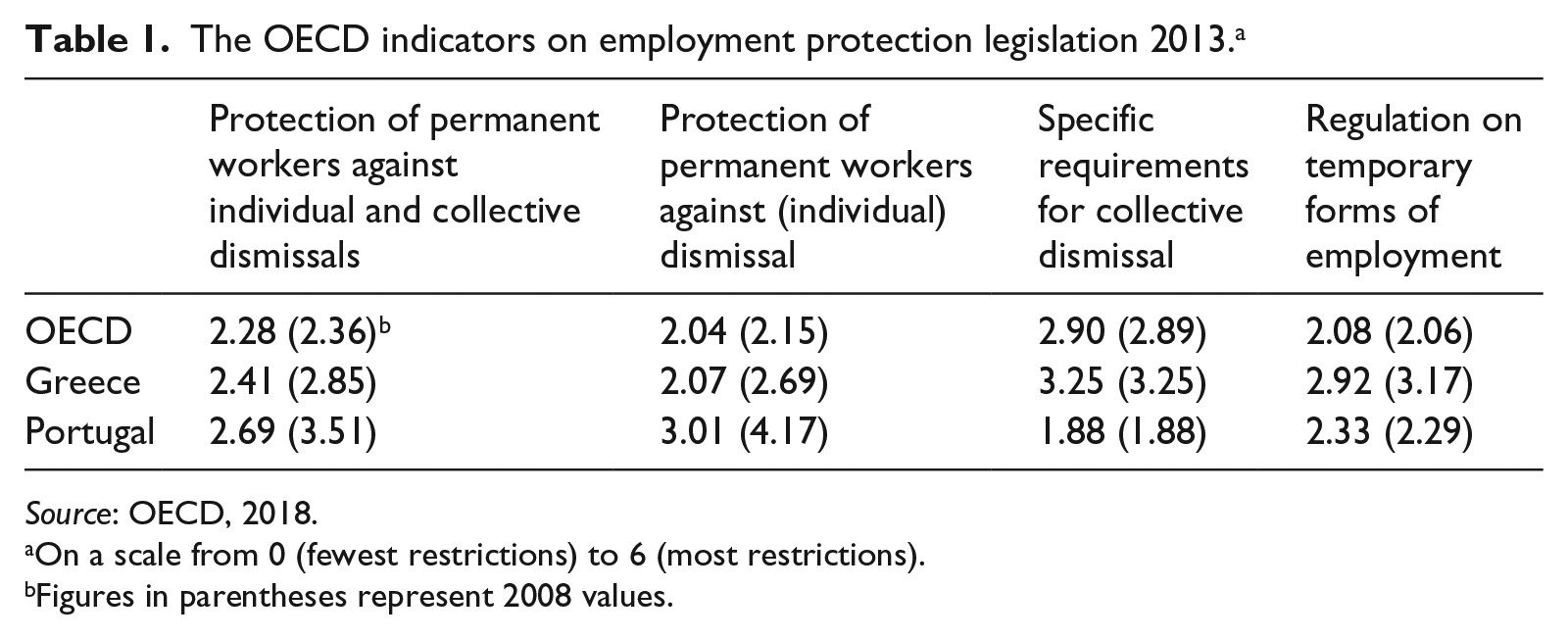
Source: OECD, 2018.
On a scale from 0 (fewest restrictions) to 6 (most restrictions).
Figures in parentheses represent 2008 values.
Unemployment benefits
These were reformed by reducing the duration of unemployment insurance benefits to a maximum of 18 months, by capping unemployment benefits at 2.5 times the Social Support index (IAS – amounting to €421.32), and by introducing a declining profile of benefits over the unemployment spell after six months of unemployment. However, effective from 31 May 2017 the reduction applies only to benefits higher than the value that corresponds to the IAS and provided that the application of the reduction cannot result in unemployment benefit lower than the IAS (Eurofound, 2017). In order to strengthen the social safety net, the programme entailed reducing the necessary contributory period to access unemployment insurance from 15 to 12 months, and extending eligibility for unemployment insurance to clearly defined categories of self-employed workers who provide their services to just one firm on a regular basis (Escaria, 2015).
Working time
Following the example of other European countries such as Germany, Italy and Austria (OECD, 2010) firms were given additional flexibility to manage employment fluctuations over the economic cycle. It was decided to implement an action plan, including: the facility to permit the adoption of a ‘bank of hours’; the implementation of commitments regarding working time arrangements and part-time working schemes in cases of industrial crisis; the revision of minimum overtime pay, by means of (1) a reduction to a maximum of 50% (from the current 50% for the first overtime hour worked, 75% for additional hours and 100% for overtime during holidays), and (2) the elimination of compensatory time-off equal to 25% of overtime hours worked (Escaria, 2015). To this we should add the revision of the provisions on lay-offs during periods of industrial crisis (Ramalho, 2013: 9).
Wages
The MoU established the need to index wage developments to competitiveness and productivity. To this end, there was a commitment that no increases in the minimum wage should take place over the entire programme period unless justified by economic and labour market developments and only in agreement with the framework of the programme review. The minimum wage was €485 during the whole programme period, and it was raised to €530 in October 2016 (Eurofound, 2016). It is quite indicative that in 2014, 19.6% of employees earned the minimum wage in Portugal compared to 11.3% in 2011 (Escaria, 2015: 9).
Collective bargaining
In line with the proposals of the MoU, the Portuguese government adopted among others a series of measures targeting the promotion of decentralized collective bargaining, by allowing workers’ councils to negotiate at plant level in firms with a minimum number of 150 employees. Moreover, the Labour Relations Centre (Centro das Relações Laborais) was established, intended to provide information and technical assistance to the parties involved in collective bargaining (Ramalho, 2013: 10).
Labour market activation policies
Measures intended to promote professional training and the creation of self-employment (under the EU-supported programmes Impulso Jovem, Passaporte Emprego, Vida Ativa and the programme Estímulo 2012, 2013, 2014) were adopted. While these programmes were focused primarily on youth, the low-skilled and the long-term unemployed, their coverage changed and broadened over time. Incentives were also built in to encourage employers to offer participants permanent employment contracts. The subsidies awarded were relatively important in size (OECD, 2017a: 50). Moreover, an action plan was adopted to promote improvements in ALMPs including the role of public employment services (Escaria, 2015).
In addition, a series of measures were put in place to stimulate the economy. The measures aimed at the facilitation of recapitalization and access of enterprises to credit; support of investment; and the promotion of entrepreneurship and innovation.
Greece
In 2010 the Greek authorities, the EFSF and the IMF representatives signed the first MoU for a loan agreement of €110 billion to Greece, which had become necessary as Greece had proven unable to manage its soaring public debt (129% of GDP in 2009) and by then almost chronic budget deficit (reaching 14.9% of GDP in 2008). The MoU committed the government to sweeping spending cuts and steep tax increases, aiming to reduce the country’s public deficit to below 3% of GDP by 2014. Shortly afterwards two other bailout programmes were signed in 2012 and 2015 of €130 and €86 billion respectively as the situation proved to be economically unsustainable. According to the third adjustment programme the ‘adventures’ of Greece are expected to end in August of 2018.
However, the Greek crisis did not ‘come out of the blue’ with the first bailout in 2010. Before the crisis, incomplete reforms in employment and social policy were partly the cause of fiscal problems (Tinios, 2015: 9). The socio-economic integration in Greece after the collapse of the dictatorship in 1974 had developed through a system of clientelism, statism and corporatism that created vertical networks in which the political parties had the leading role, promising government jobs, social security perks and loss-making regional projects. The recalibration of the welfare state towards an inclusive and flexible labour market had stalled in the late 1990s, while cheap money due to Euro membership encouraged further delays in the decade of the 2000s (Tinios, 2015: 9).
On the eve of the crisis the Greek labour market was characterized by a high degree of segmentation due to highly restrictive employment protection legislation, low mobility, low employment protection for the young and self-employed, constraints in the introduction of flexible forms of employment and high non-wage labour costs (premiums, taxes), which encouraged informal employment. Unemployment benefits were very limited and offered income protection mainly to seasonal workers in the tourist sector, and to workers in construction, education and local authorities (Dimoulas, 2014: 52). The overall system was oriented to protect jobs, chiefly of insiders, but not people (Tinios, 2015: 18). Employment policy costs were minor, absorbing less than 1% of annual GDP (0.7% of GDP was spent on benefits and less than 0.25% of GDP was spent on ALMP measures), while the number of beneficiaries was less than one-fifth of the registered unemployed population (Dimoulas, 2014). As a result, the crisis found Greece halfway along an incomplete structural reform trajectory and unprepared for what would follow.
The MoU was based on the idea of internal devaluation, and the Greek government to increase competitiveness moved towards the adoption of measures which were inspired by the spirit of labour cost reduction. However, the MoU reforms were introduced when the Greek economy was already two years into recession, and that made the latter deeper and more complicated. The Greek labour market’s institutional and regulatory framework has been drastically reformed. Apart from freezing new recruitment in public services, the policy reforms have focused primarily on promoting a ‘unilateral’ version of flexicurity. More specifically, the following measures were pursued.
Employment protection legislation
The reforms in EPL were concentrated on reducing firing costs (both financial and legal). Redundancy compensation levels decreased by 50% and the legal levels of collective dismissals for a firm increased from 2% to 5% of the workforce per month (Kougias, 2017). The legislation reduces the notice period for individual dismissals and increases the number of redundancies allowed for in collective dismissals. In early 2014, collective dismissals in large firms were freed from restrictions, and Hellenic Steelworks was the first Greek firm to fire 50 of its 75 employees in one day (Gialis and Herod, 2014). The legislation allows dismissals of open-ended contract employees with no notice or severance payment in the first 12 months. On these grounds, more than 100,000 temporary and part-time employees were removed from the public sector by early 2013. The new legislation simplifies further the collective dismissals procedure by abolishing the need for administrative/political approval of collective redundancies. According to the OECD indicators, the legislation is now just as ‘flexible’ as it is in Austria or Denmark for permanent jobs (OECD, 2013: 90), and the EPL indicator for Greece has approached the OECD average (Table 1).
Unemployment benefits
Unemployment benefits were reformed in terms of the duration and the levels of replacement. The reduction in the minimum wage led to similar reductions to unemployment benefits as the amount of unemployment benefit was reduced from €464 in 2009 to €360. To counterbalance this, the maximum length of unemployment benefit was increased to 12 months. In addition, conditions linking eligibility with job search were introduced to limit the abuse of the system as a seasonal jobs subsidy. New conditions for the granting of ‘long-term unemployed people benefit’ of €200 were introduced to expand the age class of beneficiaries. However, the benefit is given out after a strict means testing. According to the latest available data only 12% of those registered at the public employment services receive any kind of benefits from Employment Services.
Working time flexibility
This was introduced through the increasing utilization of rotational work and fixed-term contracts. The maximum duration of temporary work was extended from 12 to 36 months and fixed-term contracts were extended from 24 to 36 months. The probation period, giving the option for the employer to terminate a contract without compensation, increased from 2 to 12 months. Legislation permits employers to substitute permanent employees with part-timers or apply job-sharing practices to face falling demand. The legal work week of 40 hours has been converted to an annual basis, and can now fluctuate more widely, depending on the economic situation (OECD, 2013: 88).
Wage moderation
A new minimum wage system was introduced. Previously, the minimum wage was the outcome of a bargaining process between the social partners. Following the changes, the minimum wage was set by law after consultation with social partners. The minimum wage was cut by 32% to €511 per month for full-time employees under 25 years of age, and by 22% to €586 for the over 25s.
Collective bargaining
Changes deregulating the collective bargaining system were introduced in 2011 and 2012. Measures aimed at restricting the role of sectoral collective bargaining and further decentralizing the system to company level. The main changes relate to the suspension of the process for extension of sectoral and occupational collective bargaining agreements (CBAs) during the adjustment programme, the reduction in the ‘after effect’ of expiring CBAs and changes in arbitration rules (Koukiadaki et al., 2016).
Labour market activation framework
The labour market activation framework was strengthened in order to assist the unemployed. A series of programmes that aim to help the unemployed and the long-term unemployed in particular were implemented, including job-search assistance, counselling, employment subsidies, aid for self-employment, and the employment in not for profit agencies and public services through fixed-term employment contracts. In addition, training vouchers co-financed by the EC’s European Social Fund were introduced, but the clientelistic approach undermined the efficiency of these schemes (Dimoulas, 2014).
Same recipe but diverse outcomes
During the implementation of the Economic Adjustment Programme (2011–2013) the Portuguese GDP registered a 6.7% cumulative decline; the downward trend has been reversed since and the country has returned to positive growth rates. In Greece, the measures focused on the rapid reduction of salaries in the public sector which were transmitted to the private sector (Dimoulas, 2014). The recession resulted in a cumulative negative growth of GDP from 2008 to 2016 of over 26% (Table 2). On average, about one-third of income has been lost, and the available real household income from work has been decreased by €41 billion (2011–2013), bringing domestic demand back to the level of 1990 (−32.4% 2009–2016).

GDP: gross domestic product.
Source: Eurostat, http://ec.europa.eu/eurostat.
Percentage; negative figures in italics.
Percentage of GDP.
Both countries suffered unprecedented job losses. In Portugal, employment fell by 767,000 (−11%) between mid-2008 and 2013; however since then employment has recovered and from the low of 65.4% increased to 73.4% in 2017. In Greece, both austerity and recession have had a devastating impact on employment. More than 1 million jobs were lost between 2008 and 2013. The employment rate of people aged 20–64 decreased by 20% during the period 2008–2013 and reached 52.9%, before starting to recover at a slower pace than that of Portugal as it stood at 57.8% for 2017, eight percentage points away from the rate of 2008 (Figure 1). Employment in the private sector fell by 20% through redundancies, while it fell in the public sector by 17%, through early retirement (Tinios, 2015: 28). The reductions of the nominal value of the minimum wage affected the minimum-to-median wage ratio. In Greece the ratio fell to 48%, below the OECD average of 50%, while for Portugal the rate was 58% in 2016 (OECD, 2018).
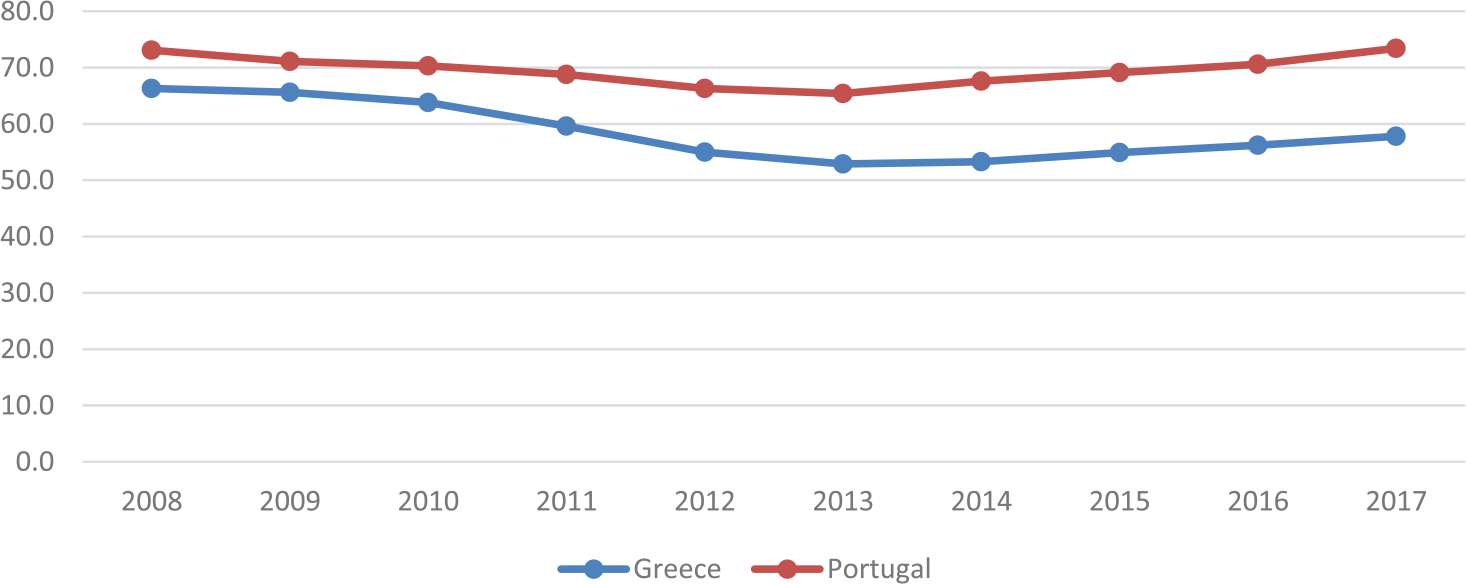
Employment rates in Greece and Portugal among those aged 20–64, 2008–2017.
At its peak, the unemployment rate in Portugal stood at 16.4% in 2013 (up from 8.8% at the beginning of 2008) and since then it has de-escalated to a single digit rate (7.4% in April 2018). In Greece, the unemployment rate skyrocketed from 7.8% to 27.5% in the period 2008–2013 before falling; even so it is still over 20% (20.1% in March 2018) (Figure 2). The long-term unemployment rate for the population aged 20–64 in Portugal more than doubled, from 3.6% in 2008 to 9.7% in 2013; however during the last four years it has returned close to its pre-crisis level at 4.3%, while in Greece it reached 20% in 2014 from 3.7% in 2008 and only in the last two years has it showed signs of improvement as it decreased to 15.3% in 2017. However, the rate is still high, with adverse implications for growth, public finances and the persons concerned.

Unemployment rates in Greece and Portugal among those aged 20–64, 2008–2017.
While the crisis hit all segments of the labour force, its negative impact has been felt most by youth and precarious workers. At the peak of the crisis in 2013 youth unemployment skyrocketed to 40.2% in Portugal and 63.8% in Greece, while since then it has fallen at very different rates: 22.1% and 45.4% respectively (February 2018). In line with the above observations the number of those below 25 years of age not in employment, education, or training (NEET) in Portugal stood at 9.9% while in Greece it was at 15.1% for 2017. The proportion of temporary employees in Portugal accounted for 22% of the total number of employees aged 15–64 years in 2017 and those in part-time jobs accounted for 8.9% of total employment, while in Greece the rates were 11.4% and 9.7% respectively (Figures 3 and 4). Even though the respective rates have not changed significantly in the period 2008–2017 in either country, temporary employment fell between 2008 and 2017 for young people (13.3% and 45% respectively) indicating worsening access to employment for outsiders.
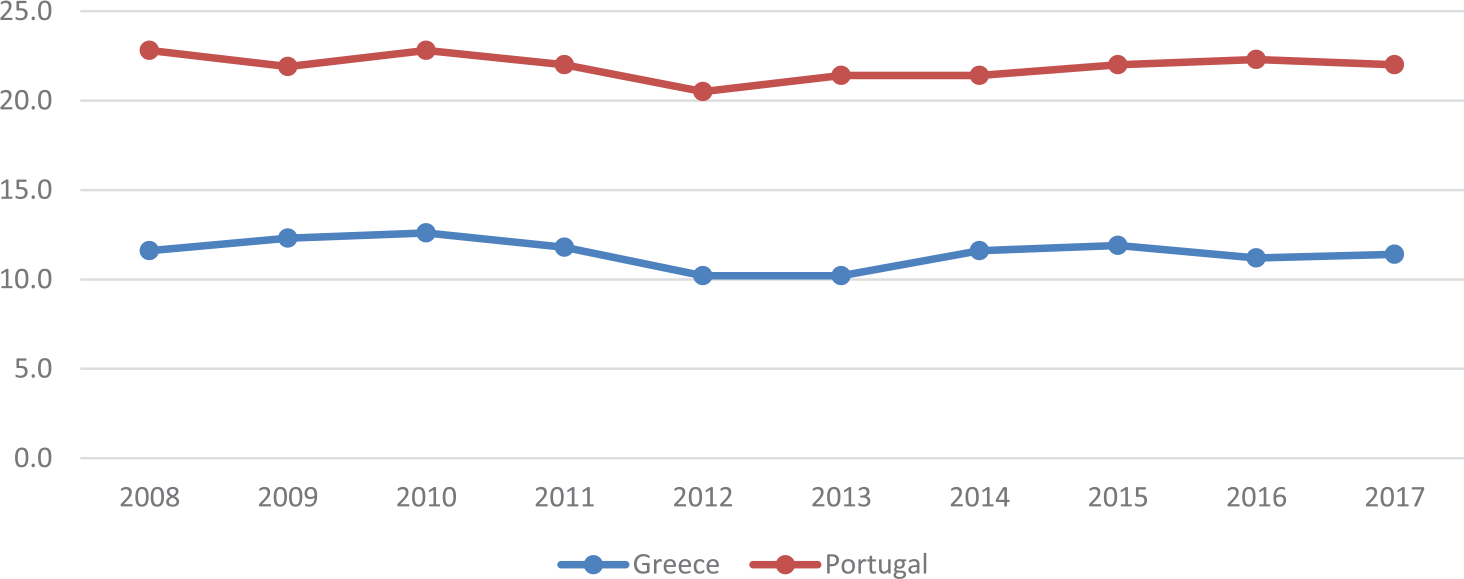
Temporary employees as percentage of total employment in Greece and Portugal, 2008–2017.

Part-time employment as percentage of total employment in Greece and Portugal, 2008–2017.
Evidence of the ‘resilience’ of self-employment to the crisis, compared with paid employment, is found in both countries. Traditionally, the economies of Southern Europe have the greatest share of self-employed workers, due to the prominence of agricultural, service-based and informal work in these countries (Hatfield, 2015: 8). Over the years of the crisis this trend continued as the relative employment decline in the self-employment sector has been more moderate in comparison with paid work, especially for own-account workers (Figure 5). In Greece, the two main categories of the self-employed (employers and own-account workers) together declined during the period 2008–2017 by 202,000, however the country occupied first place in self-employment among the EU28 countries (29.5%) in 2016 followed by Italy (21.5%). In Portugal, the decrease was larger (by 310,000 people) and the country was placed in 11th place (14%). Even though a large number of pseudo self-employed workers were included in most of the cases, both countries consider self-employment as an important driver of entrepreneurship and job creation. To that end, in Portugal the SIMPLEX programme has been adopted aiming at reducing bureaucracy and simplifying procedures associated with setting up a business, while in Greece, the reduction of administrative burdens has been high on the political agenda.

Own-account self-employed workers aged 15–64 in Greece and Portugal, 2008–2017.
In order to improve the employability of the unemployed while ensuring optimal effectiveness of the resources allocated, both countries have shifted to ALMPs. Over the period 2011–2015, Portugal took several steps to strengthen its labour market activation framework, while in Greece the amounts dedicated to ALMP policies were particularly low in absolute value and in comparative terms with passive measures casting doubt whether – given the massive increases in unemployment, and the tight budget constraints – sufficient support for those who had lost their jobs was being provided. Even though there is generally very little evaluation of the effectiveness of ALMPs in either country (Karantinos, 2014: 19; OECD, 2017a: 16), Portugal has invested more in these programmes. In 2015 Portugal spent 0.482% of GDP on ALMPs while the corresponding figure for Greece was only 0.243%.
The above remarks are reflected in the countries’ capacity to provide protection to the categories most needed (women, unemployed, younger workers) as well as on poverty levels. In Greece, austerity obliterated further resources for social protection especially for new labour market entrants, while traditional (family) providers were less able to help because of pay and pension cuts (Papadopoulos, 2016: 420). In Portugal, more targeted programmes offered better protection. For the period 2008–2016 the share of people at risk of poverty after social transfers increased from 18.5% to 19%, while in Greece the corresponding figures were 20.1% and 21.2%. Regarding cumulative differences, in 2016 in Portugal there were 163,000 fewer people at risk of poverty compared with 2008, while in Greece there were 743,000 more people. Between 2008 and 2016, the Gini index of income inequality in Portugal decreased from 35.8% to 33.9%, while in Greece the index increased from 33.4% in 2008 to 34.3%.
The overall better situation for Portugal’s labour market is displayed on the OECD comparative scoreboard of labour market performance. Portugal scores better than many other Southern European countries, like Spain and Italy. Greece scores below the OECD average on all nine indicators of labour market performance, demonstrating the high negative impact of the economic crisis (OECD, 2017b: 38–39).
Discussion
Unlike what other studies had envisaged (Thelen, 2012), the IMF’s engagement with the Euro area and the subsequent support programmes did not leave sufficient scope for policy diversity. Under the recommendations of the MoUs, both countries implemented similar neoliberal policy reforms inspired by the imperatives of the ‘Going for Growth’ recommendations of the OECD (2012) and EU employment strategy and directives (Clauwaert and Schömann, 2012).
In both countries, we can observe that some aspects of their labour markets are moving in the same direction, especially in terms of increased flexibility in labour law, wage cuts, diminished welfare protection and weakening of collective bargaining. These changes resulted in increased precariousness especially for low-wage workers and youth as involuntary part-time work increased and unemployment spells became longer.
However, we should not confuse movement in the same direction with convergence (Papadopoulos, 2016: 420). Even though both countries followed the same neoliberal remedies, Greece and Portugal exhibited disparity in reform implementation. The degree and the manner of implementation in the countries concerned are determined by a combination of factors: the perceptions adopted by domestic political forces and the subsequent differentiation in the ‘ownership’ of the reform programme and the respective implementation rates; the role of social partners; public policy choices; and faults in the design of the programmes.
More specifically, perceptions by domestic political forces regarding the character of the programme have influenced the ownership and progress of reforms. Portugal had already implemented the Programa de Estabilidade e Crescimento and its revised versions under the mechanisms of EU mutual budget surveillance in 2010 before signing the loan agreement with its creditors in 2011. The cash-for-reform programme was negotiated by the outgoing Socialist government and left to be fully implemented by its successor – the centre-right coalition. Neither public opinion nor social dialogue was hostile to these developments as long as the coalition was able to reach agreements through social dialogue (Pedroso, 2014: 3). In stark contrast, in Greece two austerity programmes had been adopted only three months before the country requested an international bailout. Throughout the implementation of the programmes the political process had been marked by strong turmoil including votes of confidence, changes of government and a referendum. Since the first bailout agreement in 2010 and until June 2018, five governments under four different prime ministers have been formed. Inadequate programme implementation was a problem throughout 2011 and even until the autumn of 2012 due to political instability, electoral volatility and public discontent amid fears that the country might face the possibility of leaving the Euro area. Some measures that were adopted by the parliament were not implemented by the administration, because the government was either unable or unwilling to act (IMF, 2016b: 35). The successive governments showed reluctance to implement and share the burden of adjustment equally across different strata of the society (IMF, 2016b: 37) and this fuelled social discontent. As the government displayed political unwillingness to reduce tax evasion, public support for reforms declined further, giving rise to anti-austerity parties, and discouraged politicians from risking the full electoral cost. As a result, disruptions in implementation stalled the progress of the programme and the country’s programme ownership was limited (IMF, 2016b: 9; OECD, 2016: 37–39).
Second, in Portugal the social partners were involved from the outset (Távora and González, 2016: 255) and this facilitated a consensual pattern. Although social partnership collapsed in 2012–2013, between 2008 and 2012, three social pacts were signed between the Portuguese government, the General Workers’ Union (União Geral de Trabalhadores – UGT) and all the employers’ confederations. All these social pacts facilitated structural adjustment in fundamental issues on social and employment regulations (Valente and Marques, 2014: 12). During the negotiation of the MoU, the Troika consulted the union and employers’ confederations; the employers and UGT pressed for the integration of the measures proposed in a tripartite agreement concluded two months earlier (Campos Lima, 2011). The MoU integrated many of these proposals, while its implementation by the right-wing coalition government involved renewed, albeit tense, consultations with the social partners. Távora and González (2016: 263) observe that despite significant erosion, the system may be at a lower risk of collapse due to the greater input of the social partners, which allowed some continuity with the previous path of reform and a more incremental change process. As many of the MoU recommendations were already on the social dialogue table in Portugal the implementation was less contested.
On the contrary, Greece has little tradition in social dialogue procedures and this has been strongly reflected during the crisis. Since the start of the crisis, the government has not pursued any real social dialogue (Karantinos, 2014: 13) and reforms triggered widespread discontent and dissatisfaction among trade unions and left-wing parties. Trade unions took a militant stance, mobilizing workers and expressing public discontent (Papadopoulos, 2016: 416), while they have repeatedly submitted complaints to both national and international judicial authorities, questioning whether the imposed measures were compatible with the Greek constitution and international labour agreements (European Commission, 2016). Even in the middle of the crisis when the social partners called for a trilateral dialogue to tackle the tax wedge and structural competitiveness with legally binding conclusions, no overall agreement was reached. As a result, the government unilaterally imposed a decrease to the minimum wage (Karantinos, 2014: 13), which is still in force. Minimum wage cuts became the subject of harsh criticism from trade unions and some employers’ associations, predominantly GSEVEE and ESΕET (Koukiadaki and Grimshaw, 2016: 19). However, the lack of any real and substantial social dialogue deprived stakeholders of the possibility of examining more acceptable solutions and measures.
Third, while perceptions and participation influenced the smooth implementation of reforms, public policy choices affected the reforms’ potential. The two countries have followed different pathways in order to achieve productivity growth and transform their economies towards high value-added production. Greece has opted for heavy taxation (Parliamentary Budget Office, 2017: 10), and high social contributions which burden entrepreneurship in addressing the increased need for revenues. Conversely, Portugal has opted for lower corporation tax (21% compared with 29% in Greece), cuts in public expenditures instead of taxation and strengthening of exports. While the contribution of exports to economic growth more than doubled in Portugal, it fell slightly on average in Greece, where the positive trade balance was instead brought about by the collapse of imports (Domnick and Schoenwald, 2016: 3). At the same time, although unit labour costs in the Euro area rose by 5% between 2010 and 2015, they actually fell by 5% in Portugal and by as much as 10% in Greece. However Greek exports of goods and services responded only sluggishly to these changes (Domnick and Schoenwald, 2016: 3). A large part of this gap can be explained by the relatively weak institutional factors as well as by omissions in the planning of associated policies such as the developments in productivity and the structure of the export sector (Passas and Pierros, 2017). According to the OECD (2016: 2), Greece is clearly below the Euro area average with respect to product market regulation thus preventing new, dynamic and export-oriented enterprises from entering the market.
However, while the internal differences can explain the range of the observed divergence, external differences seem to determine the depth of it. Greece has experienced a disastrous GDP decline outrageous for any country not in wartime, but this was not the case for Portugal. The budgetary austerity imposed on Greece especially in the first two MoUs caused severe pain with very little gain, while the cost of internal devaluation was underestimated. More specifically, in trying to get the Greek economy and public debt back on track, the programme experienced three key weaknesses. First, it envisaged an unusually strong and front-loaded fiscal effort and adopted a number of overoptimistic assumptions about market access prospects: fiscal multipliers, policies, the growth dividends of structural reforms and privatization receipts (IMF, 2016b: viii). The austerity policy in Greece affected economic growth more strongly as stricter austerity targets were imposed. The fiscal multiplier, which correlates public demand with economic growth, was higher – and was underestimated by the forecasters (Domnick and Schoenwald, 2016: 2). Second, the strategy of internal devaluation failed to address the actual problem of competitiveness of the Greek economy which is mainly structural (Passas and Pierros, 2017), while it had only a small effect on price competitiveness. As measures that promote the even adjustment of costs and prices were not pursued, internal devaluation did not do much to improve the trade balance at a higher level of output, failing thus to spur higher growth and lower unemployment (Theodoropoulou, 2016: 55). The programme failed to estimate the real impact of internal devaluation. Internal devaluation has created perverse effects for domestic demand while the dismal macro-economic conditions were further aggravated due to the lack of investment which slowed down the transformation of the Greek economy (Theodoropoulou, 2016). Third, the programme did not pay special attention to the correct sequencing of policies and the side-effects of such a large number of simultaneous reforms (Ladi, 2014). The type of labour market reforms that increase wage flexibility come with side-effects in terms of employment and income security and greater inequality, all of which become further magnified at times of recession (Theodoropoulou, 2016: 26). The programme for Portugal experienced the same mistakes especially those associated with the trade-off in setting its targets (IMF, 2016a), however in a softer version.
The failure of Greek labour market policies to rise to the challenges raised by the crisis and the massive increase in unemployment it brought, underlines the need to reverse the trend of labour insecurity. At the time of the writing the Greek government is preparing a new development plan for the post-MoU era. It is more than a necessity that the new growth plan adopts labour policies that are well-designed, truly protect development and inclusive growth and respect the right of workers to a living wage and decent working conditions and the right of all people to adequate social protection.
Rather than considering path dependency and convergence as mutually exclusive I argue that the concepts exist at different levels and interact with each other to produce particular policy outcomes. Looking through the lens of a ‘contingent divergence’, I contend that while the MoUs suggest a common policy trajectory as neoliberal ideas determine the content of policies, these two country cases diverged in terms of their labour market situations. Policy outcomes are manifold and are contingent upon the interplay between implementation capacities, institutional legacies, the culture of social dialogue, programme design, political stability and continuity and the selected growth model. Empirical evidence undermines thus the assumption that policy formation and implementation in the view of strong external conditionality, as bailout agreements suggest, is only an exogenous imposition. In this perspective, path dependence pressures account for divergence while the common direction of the reforms defines the field within which the former takes place.
In this article, I have attempted to complement the key conclusion of studies that place emphasis on the causes and consequences of the crisis (Karamessini and Rubbery, 2014; Vaughan-Whitehead, 2015) and the existence of a common direction in the content of reforms during the crisis, but do not however adequately consider that common pressures do not necessarily lead to similar outcomes.
Conclusion
The study has investigated the crisis responses in two welfare states which faced the same external pressures stemming from bailout agreements. Although both cash-for-reform programmes were characterized by a similar neoliberal-inspired trajectory, their respective outcomes differed substantially. The main emphasis has been on labour market reforms, and the empirical evidence questioned the hypothesis in which common neoliberal trajectories lead to similar policy outcomes.
In Greece, after eight years and three bailout agreements unemployment persists and the overall labour market situation is far from being satisfactory. Labour market deregulation, welfare retrenchment and the absence of effective solutions have contributed to precariousness and uncertainty, especially for the most vulnerable groups, testing the resilience of social cohesion. On the other hand, Portugal completed successfully a series of structural reforms within three years, its economy is back on track and this has allowed labour market indicators to recover. Of course, the challenges for both countries remain as the exit from the programme is only the first step to a return to business as usual. The return to normality should pay attention to job quality, the provision of adequate social protection and inclusive growth. A well-functioning and confident society is a critical prerequisite for progress and modernization.
The results of my analysis indicate that path dependencies and convergence pressures interact in the process of implementation that mediated between the content of policies and the outcome producing particular policy impacts. A broader application of this approach could enrich comparative welfare state research in the era of multiple external constraints and the continuing importance of institutional legacies as well.
Footnotes
Declaration of conflicting interests
The author declared no potential conflicts of interest with respect to the research, authorship, and/or publication of this article.
Funding
The author received no financial support for the research, authorship, and/or publication of this article.