




Abstract
Earlier studies established that perceived job insecurity is more strongly related to the experiences of permanent employees, and conversely that perceived employability is more strongly related to the experiences of temporary employees. This article challenges these results against the background of the 2008/2009 crisis using samples from the 2010 European Social Survey with employees from Continental and Mediterranean Europe. First, the authors argue that job insecurity has become a structural phenomenon that associates with temporary and permanent employees’ satisfaction in the same fashion, which found overall support. Second, they argue that employability may have become important for all employees, regardless of contract type, which was largely supported. A cause for concern is that the relationship between perceived job insecurity and satisfaction was comparatively stronger than the relationship between perceived employability and satisfaction. This may suggest that employees have not yet fully embraced ideas about employability as the new form of security.
Introduction
Previous studies in the realm of temporary work research have invested heavily in probing potential differences between temporary and permanent employees, often successfully so (Guest et al., 2010). The underlying idea is that temporary employees are involved in a non-standard employment relationship with fairly loose connection to the employing organization, and permanent employees in a standard employment relationship with close connection to the employing organization (Bernhard-Oettel et al., 2017), and these shape employees’ expectations and ultimately also how satisfied they are.
A case in point is the fairly robust finding that temporary employees feel more insecure than permanent employees, yet this insecurity does not seem to have a strong relationship with how they feel and behave (for a review, see De Cuyper and De Witte, 2008). The explanation typically advanced is that perceived job insecurity is part of the deal temporary employees have with their employer, yet a ‘deal breaker’ for permanent employees, and such deal-breaking evokes dissatisfaction. Taking this line one step further, some scholars have drawn the parallel to perceived employability. They suggest that employability is more strongly related to satisfaction among temporary compared with permanent employees (e.g. Chambel and Sobral, 2011; Kinnunen et al., 2011): temporary employees anticipate that security is to be found across jobs and organizations and therefore appreciate employability and related investments on the part of the employer more than permanent employees.
Yet, the question arises whether the focus upon ‘differences’ between temporary and permanent employees is still pertinent in the aftermath of the economic crisis or instead whether temporary work research needs to be reinvented to fit a new era. Coming back to the example of perceived job insecurity, the 2008/2009 crisis brought about more intense and widespread feelings of job insecurity that are less manageable by the organization (Chung and Van Oorschot, 2011). The implication is that perceived job insecurity may no longer or not to the same extent be afflicted with the notion of psychological contract breach. Instead, perceived job insecurity may cause dissatisfaction among all employees, temporary and permanent alike, because such feelings are rooted in the larger economic environment that is by definition uncontrollable. Similarly, the feeling of being employable may acquire resonance for permanent employees as well in a context of added instability due to the economic crisis (De Cuyper et al., 2010).
In response, our aim is to challenge the well-established finding that perceived job insecurity is less strongly and perceived employability more strongly related to satisfaction among temporary compared with permanent employees against the background of the latest economic crisis in Europe. Two aspects deserve more comment. First, we focus upon satisfaction because this signals employee well-being and at the same time drives employee performance (Rode, 2004; Saari and Judge, 2004), thus serving the interests of both employees and employers. We focus upon job and life satisfaction in particular because of the reciprocal spillover between work and life (Rode, 2004; Saari and Judge, 2004): or else, a focus upon employee well-being should account for different domains. Second, we probe the crisis in more detail by studying the relationships separately in Continental (Belgium, France and Germany) and Mediterranean (Greece, Portugal and Spain) European countries, with the Mediterranean European countries representing the more extreme case. Indeed, the crisis has hit the Mediterranean European countries particularly hard (see e.g. Gialis and Tsampra, 2015 on the Greek case). By way of illustration, unemployment rates in 2010, during the crisis, ranged from 7.0% to 9.3% in the countries representing Continental Europe, and from 12.0% to 19.9% in the countries representing Mediterranean Europe (Eurostat, 2011). The crisis is still being felt today, for example in terms of the number of available jobs, unemployment rates, and the actual value of salaries and unemployment benefits (Eurostat, 2016a, 2016b; Stovicek and Turrini, 2012).
We achieve our aim using data from the European Social Survey 2010 (Round 5). An advantage of the European Social Survey (2015) data is that data are comparable across countries and not bound to a specific organizational setting or contract type (e.g. fixed-term employment, temporary agency workers), as was the case in many earlier studies on the topic. This is a first important step towards obtaining more representative and heterogeneous samples.
Perceived job insecurity and employability: A conceptual debate
Perceived job insecurity and employability may appear variations on the more general idea of ‘subjective employment insecurity’, namely the employees’ perceptions about the risk of losing their jobs in the near future and being unable to find another position with relative ease (Chung and Van Oorschot, 2011). Rather than variations on an underlying theme, we believe they represent a related yet distinct outlook on the labour market. Perceived job insecurity is defined as the employee’s perception and/or concern about potential involuntary job loss (Vander Elst et al., 2014a). Perceived employability refers to the individual’s perceptions about alternative job opportunities that are readily available (Vanhercke et al., 2014).
Perceived job insecurity and employability provide a related outlook on the labour market in the sense that they are both based on individual appraisal, and that both contextual factors and factors tied to the person contribute to those appraisals. They are distinct in the sense that perceived job insecurity concerns the future of the present job in the current organization, and perceived employability potential other jobs in the future, often with implicit or explicit reference to the external labour market (Wittekind et al., 2010). A further difference is that perceived job insecurity is advanced as a job demand causing dissatisfaction and perceived employability as a personal resource causing higher levels of satisfaction (Lu et al., 2015). This argument has attracted considerable support in the realm of perceived job insecurity research (for meta-analyses, see Cheng and Chan, 2008; Sverke et al., 2002; for a review, see De Witte et al., 2016). The evidence for perceived employability is comparatively modest in number of studies, though promising (for an overview, see Vanhercke et al., 2016).
Perceived job insecurity and (dis)satisfaction among permanent and temporary employees
A particular stream within the temporary work literature has revisited well-established theories that were developed in the context of permanent work to evaluate their relevance for non-standard work (Gallagher and Sverke, 2005; see e.g. Van den Toren and De Jong, 2014). This has inspired the idea that dissatisfaction associated with perceived job insecurity may be tied to permanent work, based on the notion of the psychological contract. The psychological contract refers to ‘the idiosyncratic set of reciprocal expectations held by employees concerning their obligations and their entitlements’ (McLean Parks et al., 1998: 698). Permanent employees typically develop a predominantly relational psychological contract with their employer (Guest et al., 2010; McLean Parks et al., 1998) that includes an exchange of job security on the part of the employer for loyalty on the part of the employee. This mutual commitment in the long term results in ‘a job for life’. Feelings of job insecurity, then, present a fundamental change (Bernhard-Oettel et al., 2005; Virtanen et al., 2002) and a breach of one of the most critical aspects in the deal between permanent employee and employer. Such breaches induce dissatisfaction, particularly since permanent employees have much to lose (Klandermans et al., 2010). By way of contrast, temporary employees typically develop a predominantly transactional psychological contract that is more economic in nature (Guest et al., 2010; McLean Parks et al., 1998), also in the sense that job continuity with the same employer is not what temporary employees typically expect (Hartley and Jacobson, 1991). Rather to the contrary, job insecurity is inherently part of the deal, and hence not a cause for breach and associated dissatisfaction (De Cuyper and De Witte, 2008; Klandermans et al., 2010). This has led to the hypothesis that the negative relationship between perceived job insecurity and satisfaction is stronger among permanent compared with temporary employees.
This hypothesis has received considerable support in diverse employment settings and across countries. The evidence for job satisfaction is quite strong. For example, De Cuyper and De Witte (2005, 2006, 2007) demonstrated that the negative relationship between perceived job insecurity and job satisfaction was stronger among permanent than among temporary Belgian employees from diverse sectors, including industry, retail, service and non-profit. Mauno et al. (2005) replicated these findings in the socio-profit sector among a sample of Finnish employees. Van den Toren and De Jong (2014) reported a similar pattern of results in a seven-country sample, including employees from Belgium, Germany, the Netherlands, Spain, Sweden, the UK and Israel, as did De Witte and Näswall (2003) in a sample of Belgian and Swedish employees. Life satisfaction has attracted comparatively little research attention, but existing studies seem to support the hypothesized interaction effect (De Cuyper and De Witte, 2006). Further evidence comes from related indicators tapping into general health and well-being, such as psychological symptoms (Kirves et al., 2011), mental distress (Bernhard-Oettel et al., 2005) and self-rated health (De Cuyper et al., 2010; Sverke et al., 2000; Van den Toren and De Jong, 2014; Virtanen et al., 2002).
Yet, most evidence comes from data collected before the economic crisis, in particular the period 2002–2008 leading up to the crisis (De Cuyper and De Witte, 2005, 2006, 2007; De Cuyper et al., 2010; Kirves et al., 2011; Mauno et al., 2005; Van den Toren and De Jong, 2014) or earlier (De Witte and Näswall, 2003; Sverke et al., 2000; Virtanen et al., 2002). There are reasons, both theory- and evidence-driven, to challenge the idea that the relationship between perceived job insecurity and satisfaction remains stronger among permanent compared with temporary employees in times of economic crisis.
Theoretical reasons concern the idea that temporary and permanent employees’ appraisals and attributions of job insecurity may have become more similar during and in the aftermath of the economic crisis. Job insecurity has become a structural labour market characteristic (Eurostat, 2016a; Gallie et al., 2016; Lubke and Erlinghagen, 2014): employers can no longer guarantee a job for life, and hence job security may no longer be part of the psychological contract that exists between employer and permanent employee. The implication is that permanent employees, like temporary employees, may no longer appraise feelings of job insecurity as a psychological contract breach on the part of the employer. This should not be read as implying that feelings of job insecurity are no longer a cause for dissatisfaction owing to a process of gradual habituation: feelings of job insecurity as ‘part of life’. On the contrary, the idea that felt job insecurity is attributed to the general economic climate implies that such feelings are uncontrollable and hence stressful and dissatisfying (Vander Elst et al., 2014b), and this to the same extent for permanent and temporary employees. The result could be that perceived job insecurity affects temporary and permanent employees in the same negative fashion.
Data-driven reasons can be found in the pattern of results from studies based on more recent samples, collected after the economic crisis. These studies could not consistently replicate the interaction effect. One example concerns the study by Callea et al. (2016) on a sample of Italian employees collected in 2011. They found the interaction effect for intrinsic but not extrinsic job satisfaction. Another example comes from Lozza et al. (2012), using 2009 data from Italian employees, who found no interaction effect between contract type and perceived job insecurity in relation to everyday consumption and life projects.
In sum, we challenge the following hypothesis:
H1: The relationship between perceived job insecurity and both (a) job and (b) life satisfaction is stronger among permanent compared with temporary employees.
This challenge attests to the idea that job insecurity has become a structural labour market feature as a consequence of the economic crisis, with equally negative outcomes for all employees, both temporary and permanent.
Perceived employability and satisfaction among permanent and temporary employees
Another stream within the realm of temporary work literature has progressed from identifying risks associated with temporary employment to potential opportunities and their impact (De Cuyper et al., 2011, 2014; Keuskamp et al., 2013; Nunez and Livanos, 2015). This more optimistic view is built on the observation that temporary employment aligns with new and typically US career paradigms, such as the boundaryless career or the free agent perspective (Forrier et al., 2009; Kunda et al., 2002; Nunez and Livanos, 2015), and with the flexicurity model that has gained momentum in Europe (Wilthagen et al., 2003; Zhang et al., 2015). These paradigms emphasize employability as the new security mechanism: security can be found across jobs and organizations (Direnzo and Greenhaus, 2011). Temporary employees are seen as exemplary of this idea of boundarylessness, which has induced the idea that the feeling of being employable is more important to temporary employees and thus more closely associated with their attitudes (Chambel and Sobral, 2011; Chambel et al., 2015; Espada and Chambel, 2013; De Cuyper et al., 2010; Kinnunen et al., 2011; Kirves et al., 2011): perceived employability provides temporary employees with a sense of control over their career, which then promotes positive work attitudes and satisfaction in particular. Perceived employability is less important to the experience of permanent employees as they typically seek security in their current job and with the current employer rather than in the external labour market (Chambel et al., 2015; Kirves et al., 2011).
Yet, there are reasons for doubt, and those doubts may be exacerbated in times of economic recession. From a theoretical point of view, De Cuyper et al. (2010) argue that perceived employability may be a critical resource for optimal functioning and satisfaction for all employees, temporary and permanent alike. The high levels of structural job insecurity in times of economic recession urge all employees to seek security and satisfaction across organizational boundaries, and hence associations between perceived employability and satisfaction may be similar and not conditional upon contract type.
A further reason for doubt can be found in the evidence to date. Few studies have addressed the relationship between perceived employability and satisfaction or, for that matter, other outcomes such as more general attitudes or well-being among temporary and permanent employees. The existing studies provide a mixed pattern: the relationship between perceived employability and outcomes is stronger for temporary employees in some studies (Kinnunen et al., 2011 for voluntary temporary employees) and equally strong for temporary and permanent employees in other studies (De Cuyper et al., 2010; Kirves et al., 2011). Therefore, we challenge the following hypothesis:
H2: The relationship between perceived employability and both (a) job and (b) life satisfaction is stronger among temporary compared with permanent employees.
This challenge attests to the idea that perceived employability has become the new form of employment security for both temporary and permanent employees in times of economic crisis, and it ties in with doubts about the accuracy of the assumption of differential effects based on earlier empirical evidence.
The 2008/2009 financial crisis in Continental and Mediterranean European countries
The 2008/2009 financial crisis led to a period of economic recession which had resonance all over the world. Europe was strongly impacted, and Mediterranean countries were more heavily affected than Central (Continental) and Northern (Scandinavian) countries. In this article, our focus is on Portugal, Spain and Greece as exemplifying the situation of Mediterranean Europe, and on Belgium, France and Germany as exemplifying the situation of Continental Europe. We focused upon countries from Continental and Mediterranean Europe for two reasons. First, the distinction between Continental and Mediterranean countries has a basis in social policy models (Boeri, 2002; Sapir, 2006; Ward-Warmedinger and Macchiarelli, 2014), with demonstrated relevance for perceptions of job insecurity and employability (e.g. Anderson and Pontusson, 2007; Chung and Mau, 2014; Marx, 2014). Second, the distinction ties in with varieties of capitalism within Western Europe (Hall and Soskice, 2001), with the chosen Continental European countries being good examples of coordinated market economies and the Mediterranean European countries being good examples of mixed market economies. Other Western European countries were not included in the analysis, as they are associated with different sub-varieties of capitalism: in particular, Denmark, Sweden, Finland and Norway are classified as Nordic coordinated economies, while the United Kingdom and Ireland are traditionally associated with liberal market economies (Hall, 2015). We focused upon Portugal, Spain and Greece – and not other countries, for example Cyprus, that were also heavily affected by the crisis – due to their stronger similarities regarding culture and political responses to the crisis. The choice for Belgium, France and Germany was also based on relative homogeneity.
The governmental responses to the debt crisis involved austerity measures, which negatively affected welfare (Petmesidou and Guillén, 2014) and employment, especially youth (un)employment (Peiró et al., 2012). The impact of these measures was particularly striking in Mediterranean Europe, with fewer available jobs in the labour market, in relation to unemployment rates, lower salaries and more reduced unemployment benefits (Eurostat, 2016a, 2016b; Stovicek and Turrini, 2012), and comparatively milder in Continental Europe, despite comparable ratings of employment protection legislation (e.g. protection of permanent employees against individual and collective dismissal, regulation of temporary employment; European Commission, 2015; Nunez and Livanos, 2015). Accordingly, we test our hypotheses separately for countries from Continental and Mediterranean Europe, and we approach them as two distinct cases varying in the impact of the economic crisis.
Note that we are well aware that interpretations in terms of the impact of the economic crisis are highly tentative. In the reasoning above, the distinction between Continental and Mediterranean Europe is intended as a proxy for the severity of the crisis. However, we know also that there are many other factors underlying differences between Continental and Mediterranean labour markets, for example income or unemployment, as well as regional differences within each country. In this respect, the north–south divide is well-documented with data from the European Social Survey (Gallie, 2013; Georgellis et al., 2009).
Method
Respondents
Data came from the 2010 European Social Survey (Round 5). The European Social Survey has been run biennially since 2001 in over 30 countries, and consists of face-to-face interviews on key attitudes and values with the aim of monitoring the quality of life across nations and time (www.europeansocialsurvey.org). Sampling in the European Social Survey is guided by four key principles, namely (1) samples must be representative of all persons aged 15 or above and resident within private households in each country; (2) individuals are selected by strict random probability methods at each stage; (3) all countries must aim at a minimum ‘effective achieved sample size’ of 1500 (800 in countries with ESS populations below 2 million); and (4) all countries must aim at a response rate of at least 70%. Much effort goes into enhancing response rate and minimizing non-response bias (see e.g. Stoop et al., 2010).
For this study, we included the responses of 8506 employees in paid employment from six countries: Belgium (n = 1239), France (n = 1327) and Germany (n = 2367) as representing Continental Europe (total N = 4933), and Greece (n = 1007), Portugal (n = 1355) and Spain (n = 1231) as representing Mediterranean Europe (total N = 3573).
Continental Europe
Most respondents worked for private (65.4%) or public (32.3%) organizations, while a minority did not specify the type of organization they worked for (2.3%). About half of the respondents were male (49.2%). Mean age was 48.7 years (SD = 16.9), and mean years in full-time education was 13.05 (SD = 3.6). The majority had a permanent open-ended contract (n = 4161; 84.4%) and a significant minority had a temporary contract of limited duration (n = 772; 15.6%).
Mediterranean Europe
Most respondents worked for private organizations (69.7%). Other respondents worked in the public sector (27.3%) or did not specify the type of organization they worked for (3.0%). Somewhat fewer than half of the respondents were male (44.1%). Mean age was 48.4 years (SD = 16.8), and mean years in full-time education was 11.2 (SD = 5.4). About three in four employees were employed on a permanent open-ended contract (n = 2748; 76.9%) and one in four on a temporary contract (n = 825; 23.1%).
Measures
The European Social Survey mostly uses single-item measures. The measures used follow the TRAPD (Translation – Review – Adjudication – Pretesting – Documentation) methodology for translation with additional expert input to ensure optimal comparability of measures across countries (Saris and Gallhofer, 2007).
Contract type was coded as 1 for permanent employees and 2 for temporary employees.
Perceived job insecurity was measured with the following item: ‘My job is insecure’ (1 = not at all true; 4 = very true). Perceived employability was measured with the following item: ‘How difficult or easy would it be for you to get a similar or better job with another employer if you had to leave your current job?’ (0 = extremely difficult; 10 = extremely easy).
Job satisfaction and life satisfaction were measured with one item each, namely ‘How satisfied are you in your main job?’ and ‘How satisfied are you with your life as a whole nowadays?’ (0 = extremely dissatisfied; 10 = extremely satisfied).
Control variables
Gender (1 = male; 2 = female), age (in years) and education (in years attended) were included as control variables. The reason is that these variables could potentially influence perceived job insecurity and employability (e.g. Näswall and De Witte, 2003), and job and life satisfaction (Brush et al., 1987).
Analyses
Analyses were performed using the SPSS-macro PROCESS developed by Hayes (2013). This macro (1) computes the interaction term automatically; (2) provides simple slope analyses with one standard deviation above and below the mean value of the moderator; and (3) calculates the increment in R² associated with the interaction term in order to evaluate the effect size associated with moderation. We standardize all variables prior to the analysis in PROCESS, in order to get the standardized beta coefficients in our results.
Analyses were performed separately (1) for job and life satisfaction, (2) for the interaction term between contract type and perceived job insecurity and between contract type and perceived employability, and (3) for the Continental and Mediterranean European sample. Concerning (2), we performed analyses separately for perceived job insecurity and employability based on three considerations: namely, in view of the conceptual overlap between perceived job insecurity and employability (see the conceptual debate), in view of the methodological difficulty of detecting two-way interaction effects in field studies (McClelland and Judd, 1993), and in view of the possibility of comparing our studies with earlier studies in the field which also isolated perceived job insecurity and employability (for an exception, see De Cuyper et al., 2010). Concerning (3), we performed analyses separately for the sample of respondents from Continental and Mediterranean Europe for two reasons. First, the separate set of analyses ties in with the idea of two distinct cases. Second, the methodological difficulty of detecting interaction effects in field studies is exacerbated in testing higher order interactions.
Results
Descriptive statistics
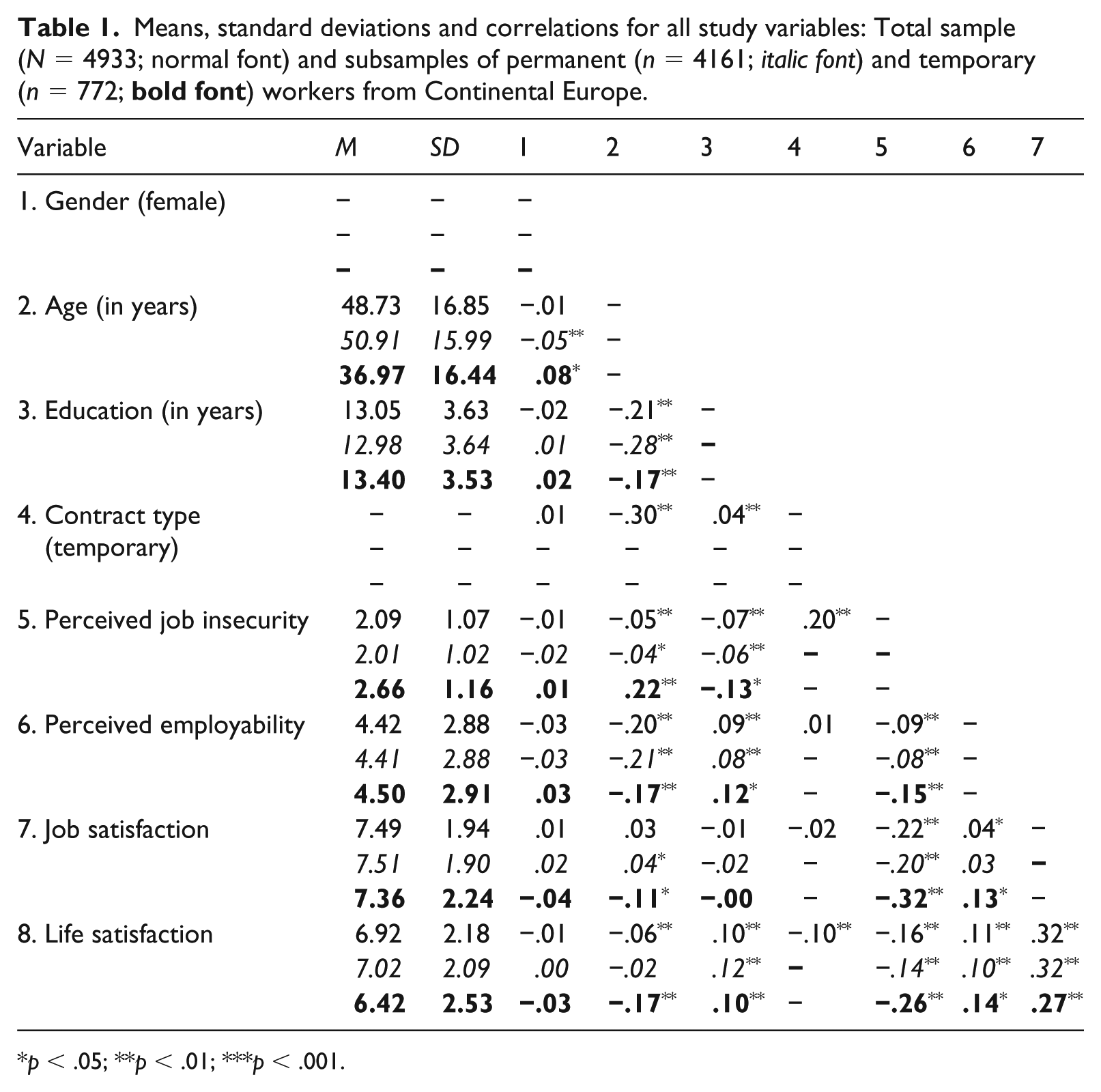
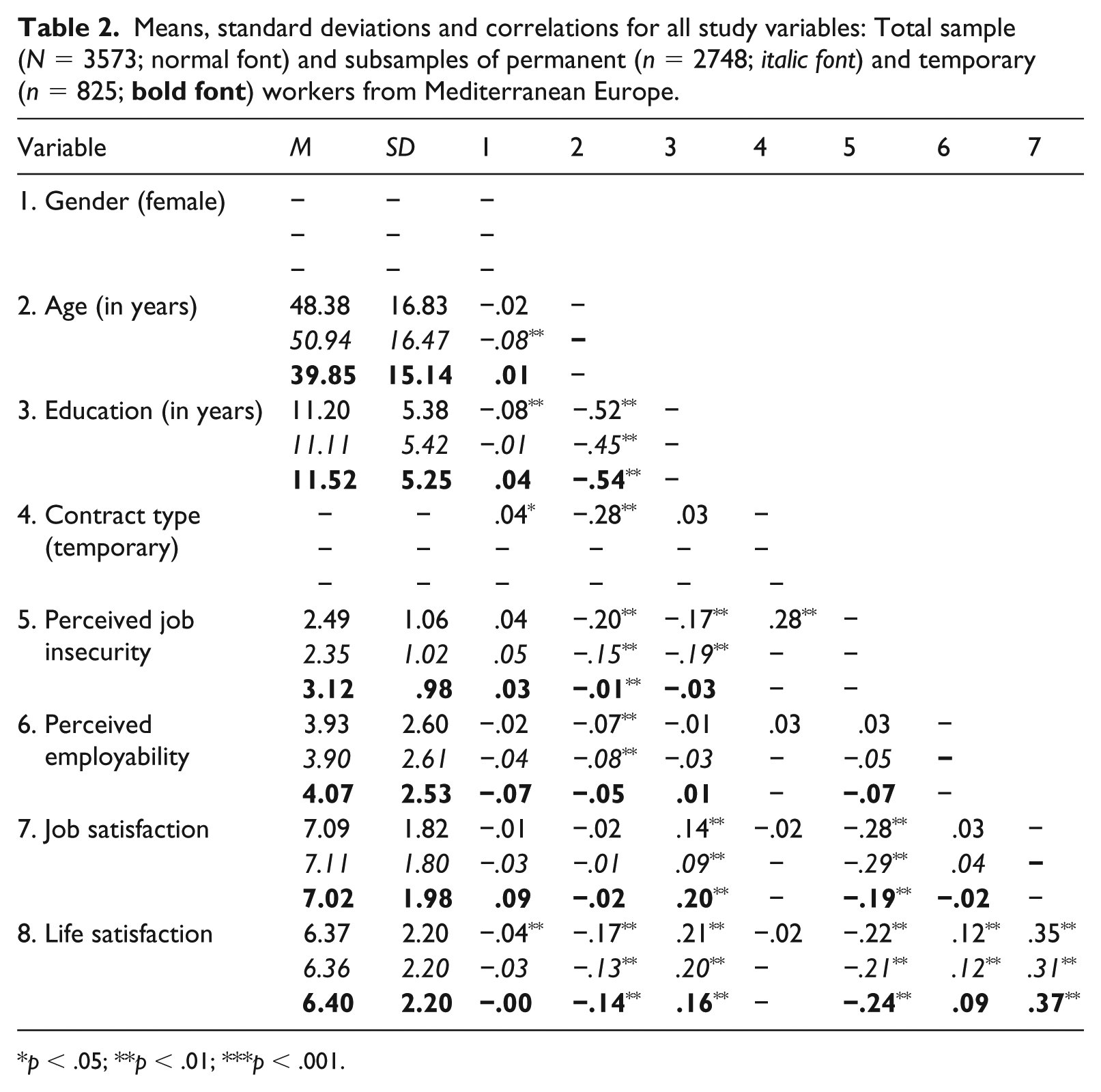
The means, standard deviations and correlations for the study variables are shown in Table 1 for the Continental Europe sample and in Table 2 for the Mediterranean Europe sample, and separately for the total, permanent and temporary sample. We discuss correlations with particular meaning for this study below.
Means, standard deviations and correlations for all study variables: Total sample (N = 4933; normal font) and subsamples of permanent (n = 4161; italic font) and temporary (n = 772;
p < .05; **p < .01; ***p < .001.
Means, standard deviations and correlations for all study variables: Total sample (N = 3573; normal font) and subsamples of permanent (n = 2748; italic font) and temporary (n = 825;
p < .05; **p < .01; ***p < .001.
Continental Europe
Perceived job insecurity related negatively and perceived employability positively to job and life satisfaction in the total sample and in the samples of permanent and temporary employees. One exception was the non-significant correlation between perceived employability and job satisfaction in the sample of permanent employees. Contract type correlated positively with perceived job insecurity and negatively with life satisfaction, so that temporary employees felt more insecure and less satisfied with their lives than permanent employees. Correlations between contract type and both perceived employability and job satisfaction were non-significant. From the control variables, particularly age but also education were significantly correlated with most of the core study variables.
Mediterranean Europe
Perceived job insecurity correlated negatively with job and life satisfaction in the total sample and the subsamples of permanent and temporary employees. Perceived employability correlated positively with life satisfaction in the total sample and in the sample of permanent employees, however not in the sample of temporary employees. No significant correlations were found between perceived employability and job satisfaction. Contract type correlated positively with perceived job insecurity: temporary employees felt more insecure than permanent employees did. Correlations between contract type and the outcomes were not significant. From the control variables, age and education were correlated significantly with most of the core study variables.
Regression analyses
Continental Europe
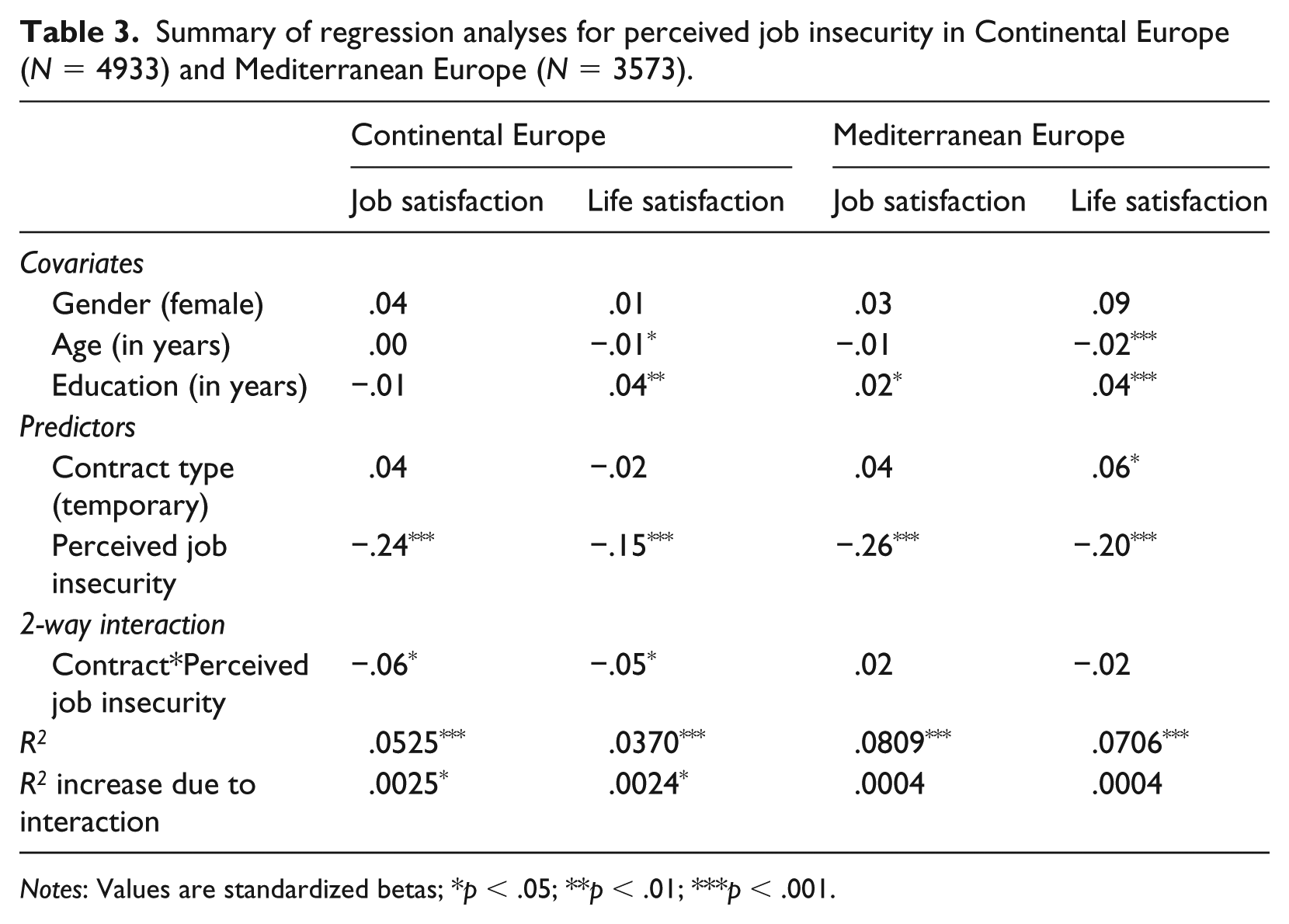
Table 3 (on the left) presents the results related to Hypothesis 1. The interaction term composed of perceived job insecurity and contract type was significantly related to both job and life satisfaction, though admittedly the effect was weak relative to sample size. The simple slope analyses for both job satisfaction (β = −.36; −.47 < 95% CI < −.24, p ⩽ .001 for temporary employees; and β = −.21; −.25 < 95% CI < −.16, p ⩽ .001 for permanent employees) and life satisfaction (β = −.24; −.34 < 95% CI < −.13, p ⩽ .001 for temporary employees; and β = −.13; −.17 < 95% CI < −.09, p ⩽ .001 for permanent employees) showed overlapping confidence intervals. In concert, this implies that the interaction effect should be interpreted with considerable caution. The safest conclusion is perhaps that there is a negative relationship between perceived job insecurity and both job satisfaction and life satisfaction in Continental Europe. If the relationship between perceived job insecurity and the outcomes is different at all for temporary and permanent employees, those differences are minimal and against the dominant assumption that perceived job insecurity associates more strongly with satisfaction of permanent compared with temporary employees. In any case, the pattern of results in Continental Europe does not support Hypothesis 1.
Summary of regression analyses for perceived job insecurity in Continental Europe (N = 4933) and Mediterranean Europe (N = 3573).
Notes: Values are standardized betas; *p < .05; **p < .01; ***p < .001.
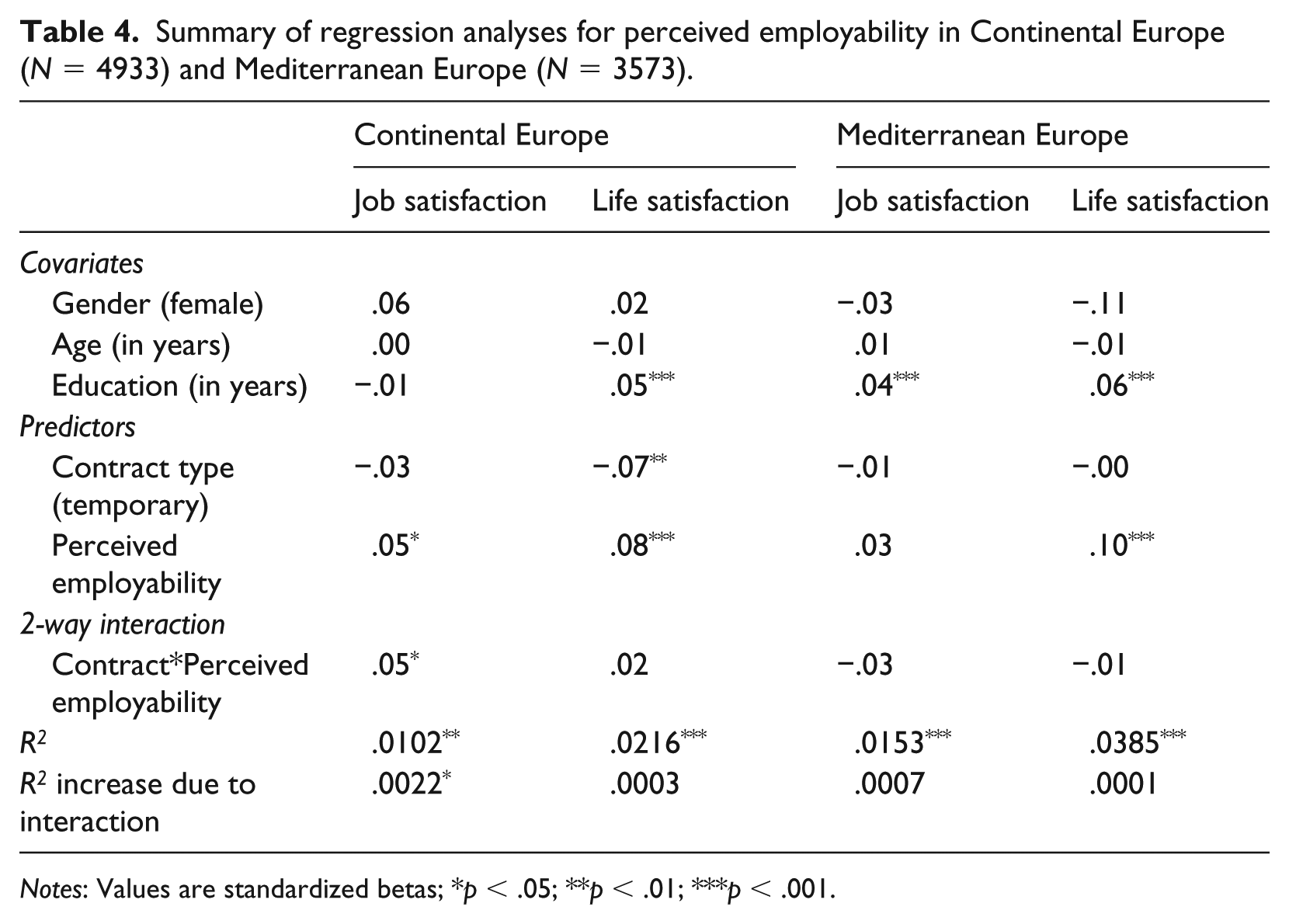
Table 4 (on the left) presents the results related to Hypothesis 2. The interaction term composed of perceived employability and contract type related significantly to job satisfaction, though the effect was again weak and confidence intervals derived from simple slope analyses overlapping (β = .16; .03 < 95% CI < −.28, p ⩽ .001 for temporary employees; and β = .03; −.01 < 95% CI < .07, p = .19 for permanent employees). To be on the safe side, we conclude that potential differential relationships between perceived employability and job satisfaction are minimal. If meaningful at all, the relationship is somewhat stronger for temporary than for permanent employees. No significant interaction between perceived employability and contract type was established in relation to life satisfaction. Instead, main effects showed a negative relationship between contract type and life satisfaction, so that temporary employees feel less satisfied with their lives, and a positive relationship between perceived employability and life satisfaction. Altogether, this picture seems to suggest the dominant assumption that perceived employability is more strongly related to satisfaction among temporary compared with permanent employees (H2) is tentative at best.
Summary of regression analyses for perceived employability in Continental Europe (N = 4933) and Mediterranean Europe (N = 3573).
Notes: Values are standardized betas; *p < .05; **p < .01; ***p < .001.
Mediterranean Europe
Results related to Hypothesis 1 are shown on the right in Table 3. The interaction term between perceived job insecurity and contract type was not significantly related to job and life satisfaction. Instead, we established significant main effects for perceived job insecurity and contract type. Perceived job insecurity was negatively related to job and life satisfaction. Contract type was not significantly related to job satisfaction, and positively related to life satisfaction, so that temporary employees felt more satisfied with their lives than permanent employees did. In all, these results suggest that perceived job insecurity relates negatively to job satisfaction and among temporary and permanent employees alike, unlike the dominant assumption formulated in Hypothesis 1.
Results related Hypothesis 2 are shown on the right in Table 4. Perceived employability in interaction with contract type did not relate to job and life satisfaction. In terms of main effects, contract type was not related to job satisfaction and life satisfaction, and perceived employability was positively related to life satisfaction, but not to job satisfaction. This pattern of results did not align with Hypothesis 2.
Discussion
This article built on earlier work showing that perceived job insecurity related negatively to satisfaction and more strongly so among permanent compared with temporary employees. The explanation typically advanced is that feelings of job insecurity signal to permanent employees that their psychological contract is breached and such breaches are highly dissatisfying. This is not the case among temporary employees, who have embraced job insecurity as a structural feature of their working lives (for an overview, see De Cuyper and De Witte, 2008). Instead, the argument is that temporary employees may seek security in being employable, and thus that feelings of being employable are more satisfying to temporary compared with permanent employees (e.g. Chambel and Sobral, 2011).
Though this observation is quite robust for perceived job insecurity (see the empirical results discussed earlier) and the extended interpretation for perceived employability is appealing, most of the evidence comes from samples collected in times of relative prosperity. There are reasons to assume that the 2008/2009 crisis may have had a strong impact on employees, including their reactions to felt job insecurity and their need to become employable. The general picture of results seems to support our call for recontextualization in time.
First, we argued that perceived job insecurity has become a structural feature of the labour market (Gallie et al., 2016). Permanent employees, too, then may attribute feelings of insecurity to the overall economy rather than to the employer’s failure to provide a job for life. The implication is that permanent and temporary employees’ reactions vis-a-vis perceived job insecurity may be quite similar and likely negative because the economic crisis induces a sense of uncontrollability. Our results largely supported this view: the relationships between perceived job insecurity and both job and life satisfaction were negative, fairly strong, and differences between permanent and temporary employees, if they exist at all, were unlikely to be meaningful. These results do not support the earlier and dominant view that perceived job insecurity would be particularly problematic for permanent compared with temporary employees (see Hypothesis 1).
Second, a further argument was that all employees, temporary and permanent alike, may seek to replace job security with alternative forms of security, in particular employability. The perception of being employable may provide employees with a sense of control over their career which then may promote satisfaction. The pattern of results obtained in the sample of employees from both Continental and Mediterranean Europe supported this view. Perceived employability related positively to job and life satisfaction, and this relationship was not significantly different for temporary and permanent employees or unlikely to be meaningful. This is in contrast to the dominant assumption that perceived employability is more predictive for the attitudes of temporary employees (see Hypothesis 2).
In addition to the observations closely connected to the aims of the study, two further observations deserve comment and explanation. First, the explained variance was generally low. This is perhaps not surprising since job and life satisfaction are the result of many different factors, at micro, meso (e.g. HR policies, differences between sectors) and macro (e.g. regional and national unemployment rate, unemployment protection) level. In times of economic crisis, more structural boundaries at the meso and macro level may have a strong impact on employees’ perceptions. This reiterates the importance of analysing multiple levels, but does not downplay the significance of our results. Perceived job insecurity and, to a lesser extent, also perceived employability were significantly related to the outcomes, which attests to the importance of micro-level factors, even in times where structural factors are felt most heavily. Second, relationships between perceived employability and the outcomes were relatively weak, particularly in comparison to the relationships found for perceived job insecurity. Furthermore, the relationship between perceived employability and job satisfaction was not significant in the sample of Mediterranean Europe. This seems to suggest that employees have not yet embraced perceived employability as the dominant security mechanism or as critical to their work and life experiences.
Limitations
The European Social Survey brings many benefits, including rigorous cross-national sampling with high methodological standards and the focus upon key attitudes and values (Saris and Gallhofer, 2007). Yet, the use of secondary data also carries some limitations, in particular regarding sampling, measures and design.
Regarding sampling, the European Social Survey was not designed to probe differences between temporary and permanent employees, and hence no information regarding the large heterogeneity within the temporary workforce is available. Regarding measures, all measures in this study are single items and self-reported. Yet, single-item measures are cost-effective, in most cases legitimate and valid and in many cases have high face validity (Dolbier et al., 2005). The most obvious risk relating to self-reports is inflated relationships owing to common method variance. Note, however, that common method bias rather attenuates than strengthens interaction effects (Siemsen et al., 2010). Regarding design issues, this study was cross-sectional, but backed up by earlier longitudinal studies (for job insecurity, see De Witte et al., 2016; for perceived employability, see Vanhercke et al., 2016).
Besides the use of secondary data, we would like to draw attention to a potential suppressor effect: the correlation between contract type and life satisfaction in the Mediterranean European countries was not significant, and yet it was positive in the regression analysis involving perceived job insecurity (Table 3). A potential explanation is that job insecurity is inherent to the experiences of temporary employees (De Cuyper and De Witte, 2008). When perceived job insecurity is held constant, the experiences of temporary employees may become less negative and sometimes more positive than the experiences of permanent employees, perhaps because temporary employment for some employees provides some advantages in terms of work–life balance that underlie ratings of life satisfaction.
Conclusion
Our study attests to the toll of the economic crisis on employees in both Continental and Mediterranean Europe. The actual contract type does not seem to matter that much anymore, because felt job insecurity is so widespread in society and employment relations, and employability is a prerequisite for all. A particular cause for concern is that the positive effects associated with perceived employability are relatively modest and weak compared with the negative effects associated with felt job insecurity. This suggests that a transition to an era of employment security (vs job security) has not yet occurred.
Footnotes
Declaration of conflicting interests
The authors declared no potential conflicts of interest with respect to the research, authorship, and/or publication of this article.
Funding
The second author’s work was supported by the European Union’s Horizon 2020 research and innovation programme under the Marie Sklodowska-Curie grant agreement No. 661739.