




Abstract
This study is based on a survey and interviews in six Icelandic firms in which share purchases by employees have transpired. The focus is on employees’ characteristics and motives in becoming shareowners as well as the reasons for non-participation. The article’s contribution is to add to the theory and empirical evidence regarding the individual-level antecedents to employee ownership across both majority and minority variants. The results reveal that income, tenure and age influence ownership status. There is some support for expectations that employees place greater emphasis on stakeholder goals and collective goals in majority employee-owned firms and on financial goals in minority employee-owned firms. Employees were hindered from becoming owners due to a lack of funds or internal exclusionary barriers.
Introduction
Firms can be owned by at least one of several of their stakeholder groups, be they investors, suppliers, customers or employees (Dow and Putterman, 2000; Hansmann, 2013; Mygind, 2009). Ownership by employee stakeholders includes the professional services sector. Professionals group together to own firms in fields such as law, engineering, consulting and medicine. Non-professionals engaged in lower-skilled services and manufacturing tasks have also been observed to perform dual functions, as both workers and owners. Going by industry, firms that are majority-owned by their employees are a diverse group. Ownership can be available to all who desire it and can afford to purchase a stake, or it may operate on an invitation-only basis. At the opposite end of the spectrum is the ownership of smaller proportions of stock by employees.
Research on the antecedents to, or determinants of, employee ownership can be connected to three interrelated levels of analysis: societal, firm and individual (Mygind, 2012). The institutional framework for the company set by the surrounding society provides important preconditions for employee ownership. These institutional rules of the game (North, 1990) may include specific options and restrictions concerning employee ownership such as favourable tax advantages in the US ESOP system (Employee Stock Ownership Plans) (Kruse et al., 2010b) or the UK-based Save-As-You-Earn (SAYE) scheme (Pendleton, 2010). These institutions make up important determinants for the incidence of different categories of employee ownership in firms which can vary by size, industry, technology and capital intensity. However, to understand discrepancies in the incidence of employee ownership, it is also important to look more closely at the individual level of analysis with job-related personal characteristics such as income, position and tenure interacting with other personal characteristics such as age, gender and family situation. These variables further interact with individual attitudes in terms of the factors considered in choosing whether or not to become an employee-owner. It is the individual level of analysis which is the focal point of the present study.
Research on the drivers of, and barriers to, employee ownership at the societal and firm levels is quite comprehensive (Machado, 2016; Poutsma and Nijs, 2003), while there is comparatively less research at the individual level of analysis with regard to direct empirical insights into why some employees participate in ownership while others do not (Jackson and Morgan, 2011; Kaarsemaker et al., 2010; Kalmi, 2004; Pendleton, 2010; Poutsma et al., 2012). The individual-level literature spans countries with specific schemes promoting employee ownership. Iceland offers an opportunity to fill a gap in the literature by analysing individual drivers and barriers where such schemes promoting employee ownership are not available. A novel conceptual framework and a set of hypotheses combining three dimensions – personal characteristics, motives and type of employee ownership – are presented. The article’s main contribution is to add to what is known concerning the individual-level antecedents to employee ownership with the case evidence spanning both majority and minority ownership categories.
The research questions to be answered are: Which personal characteristics are the main drivers of individual employees’ share purchases? Which motives are behind the choice to participate in employee ownership? How do these motives vary according to ownership category, be it minority or majority employee ownership? What are the main reasons some employees do not purchase shares? To answer these questions, existing literature on the individual antecedents to employee ownership is first reviewed. This is to show how the article can add to it. At the same time, results from the studies included inform hypothesis development. In the methodology section, the data collection process is described including a presentation of the six case companies. This section also covers how the variables are measured and the strategy for the quantitative and qualitative analysis. This is followed by a presentation of the results obtained, before a conclusion and proposals for future research.
Literature review
In this section we review the literature covering the individual-level antecedents to employee ownership, beginning with studies combining the societal, firm and individual levels. Thereafter, the coverage is on individual-level studies of single countries where specific schemes favour employees becoming shareowners either through tax advantages or through favourable purchasing prices often connected to privatization.
Welz and Fernández-Macías (2008) utilize individual employee data from the European Working Conditions Survey (EWCS) from 2005. This dataset covers individual employee variables in different sizes of private companies across sectors and across the 27 EU member countries. The dataset is based on a representative sample of 16,000 employees. However, the financial participation variable is defined very broadly as employees’ remuneration including profit sharing, group performance, bonuses and income from employee shares. It embraces more than employee ownership and at the same time it covers only that part of employee ownership where dividends are paid out. It does not include retained earnings and widespread savings schemes, such as in the UK. It also does not distinguish between minority and majority ownership. The results show that managers and professionals are more likely to be involved in financial participation schemes than manual workers. Financial participation increases with educational attainment and seniority. It is more common among males and lower for the youngest group below 25 years of age.
Lowitzsch and Hashi (2012) summarize some of the conclusions of the PEPPER III reports about the development of employee ownership in the 27 EU countries. Based on EWCS 2000, 2005 and 2010, they find that being female decreases the probability of participating in employee ownership. However, based on the European Company Survey (ECS) from 2009, they find that gender has no significant effect. A greater share of highly educated employees increases the probability of employee share ownership. Again, employee ownership is quite vaguely defined and there is no distinction made between minority and majority ownership.
Bryson and Freeman (2010) conducted their investigation of ‘to join or not to join?’ in one minority employee-owned multinational company. Their survey covers 3360 employees in subsidiaries across Australia, New Zealand, South Africa, the UK, Ireland and the US. Each subsidiary features specific share schemes. These are mostly similar albeit with some variation in the subsidy involved from tax exemptions and directly through the price of shares. The rate of joining the share plan is highest for Australia, with the highest subsidy. Participation increases with age up until workers arrive at their mid-fifties before falling. It is greater among males, those who are educated to university level, married with children, and among senior managers and those in sales as compared with operational workers. For surveyed employees, the main reason for joining a share plan is reported as ‘good investment’ followed by ‘felt good about the company’. The main reason for not joining is reported as ‘can’t afford it’.
When it comes to a single-country study with an individual-level focus, the most comprehensive is the National Bureau of Economic Research (NBER) study presented in Kruse et al. (2010b). It includes more than 40,000 individual responses covering 90% of employees in five listed minority employee-owned companies and nine unlisted majority employee-owned companies. Ownership is mainly based on ESOPs but in some cases it is combined with the US 401(k) pension saving plan. An ESOP is an all-employee scheme and does not include a basic choice for the individual employee in terms of needing to contribute upfront. The employee ownership schemes include quite favourable tax incentives both for the company and the employees. Selected results are that employee stock increases with wealth and the main individual-level drivers behind employee ownership are tenure and job category, with share incidence greater among managers and professionals (Buchele et al., 2010; Kruse et al., 2010a). What the NBER study does not focus on are the employee motives behind share acquisition. It also does not look into differences in employee participation in ownership with regard to majority and minority types.
Pendleton (2010) researches the individual antecedents to employee ownership based on responses from 2600 employees in three large UK firms with minority employee ownership through SAYE plans, a widespread share option saving scheme introduced in the 1970s. SAYE includes tax-free bonuses, a tax-exempt discount on the option grant and a generous capital gains tax regime. The author finds that income, age and gender (being female) have positive influences on participation. Instrumental investor rather than participative motives behind participation are also revealed. These results confirm earlier results by Dewe et al. (1988) and are in line with the results by Jackson and Morgan (2011) who researched three large UK retail chains. Based on company data on more than 100,000 employees, the latter authors find evidence that participation in a share savings programme increases with higher pay, older age, length of service and full-time employment, while gender has no influence. Jackson and Morgan also perform a series of face-to-face interviews with a group of younger employees and find that the main reason for not participating in the plan is that they do not expect to stay long in the company.
Brown et al. (2008) pose the question: ‘Why do employees participate in employee share plans?’ Their research is based on 12 qualitative interviews in nine minority employee-owned Australian publicly listed companies (nine HR managers and three union representatives). The interviewees point to tax concessions and performance as important company-level determinants of participation, while income and age are identified as the main individual-level participation determinants. None of the interviewees mentions gender. Participation is lowest among shop floor workers. In a follow-up study, Brown et al. (2012) performed an employee survey of 354 employee-owners and 199 non-owners in two large listed minority employee-owned Australian companies. The individual employee could decide whether to participate in the scheme through tax-exempted wage contributions. While there were no reported results on characteristics, a main conclusion was that the employee-owners had a financial rather than a control orientation.
In terms of majority employee ownership, an important touchstone for the present study is work on the motives of US supermarket chain workers who pledged funds to take control of several closing stores. The study was based on survey answers from 943 workers with a response rate of around 50%. (Granrose, 1986; Granrose and Hochner, 1985; Hochner and Granrose, 1985). Both individual motives of job saving and financial returns, as well as more collective-oriented motives, including participation in workplace decision-making, were confirmed to be important. The job-saving motive was weaker for workers who were close to retiring. Women were no less motivated to participate than men but low income was a more important barrier to ownership for woman than men. The research conducted links personal characteristics and motives but the specific situation of this defensive employee takeover of one supermarket chain may make the conclusions difficult to generalize.
The privatization process in Eastern Europe and China provided an opportunity for employees to take over shares in their employing companies and a few studies have analysed this process at the individual level. Dong et al. (2002a, 2002b) investigated the ownership change at the end of the 1990s in rural industries in China with a focus on the background to employee involvement in ownership. They surveyed around 800 employees in 39 privatized township village enterprises, of which 16 had introduced share ownership for non-managerial employees. Ten introduced minority employee ownership and six majority employee ownership but this distinction is not further analysed; 33% of the employees became shareholders. Of the non-owners, 74% responded that they had not received an offer, while lack of money was not found to be an important barrier to ownership. The privatization process was governed by local governments and enterprises were taken over by managers if they could afford to. It was difficult for managers to finance takeovers of the larger and more profitable enterprises themselves. Therefore, it was in these firms in which employees were able to purchase shares. The main motives for becoming shareowners were identified to be financial returns and job security and the personal characteristics driving employee-owners were income, gender (being male) and managerial position.
Kalmi (2004) investigated the determinants of individual ownership based on a survey of 162 employees in five middle-sized Estonian enterprises (100–200 employees), which, during the privatization process of the 1990s, established employee ownership. The main driver for becoming an employee-owner was identified as being an ‘insider’ at the time of privatization, closely related to tenure. Other individual drivers were higher education, gender (male) and job position as a manager/professional. Those not becoming owners at the time of privatization typically did not possess enough funds. In the years after privatization, most of the incoming new employees were not offered shares. At the start of the process, all five firms were majority employee-owned but changed toward minority ownership because newer workers did not become owners and ownership became concentrated in the hands of management.
In a non-transition context, Degeorge et al. (2004) studied the privatization of France Telecom, based on company files for around 200,000 employees. Around 2% of shares were reserved for employee purchase at beneficial prices. Those workers with greater financial wealth and higher salary, corresponding with job category in particular, were found to have purchased shares. The effect of firm-specific human capital was small. Older workers were found to refrain from share purchases and women were more likely to participate than men.
In terms of the aforementioned literature, it is a general concern that it is difficult to make generalizations because of quite specific conditions and institutions, whether in relation to the privatization process in transition countries with strong gift elements or the specific schemes in Anglo-American countries with favourable tax advantages. Nevertheless, and as outlined in the introduction, existing studies provide a solid base of reference and are drawn upon in developing testable hypotheses.
Hypotheses concerning employees acquiring shares in their firms
The three main dimensions chosen for this analysis are the category of employee ownership in relation to minority versus majority; the type of motives of the employees becoming owners; and the personal characteristics of employee-owners versus non-owners. These three dimensions are related. The motives for acquiring shares are expected to depend on whether employees as a group are gaining majority control of the company or only a minority share. The personal characteristics of the employees can be expected to influence their motives and their possibilities for acquiring shares within their employing companies. These links will be analysed in this theoretical section.
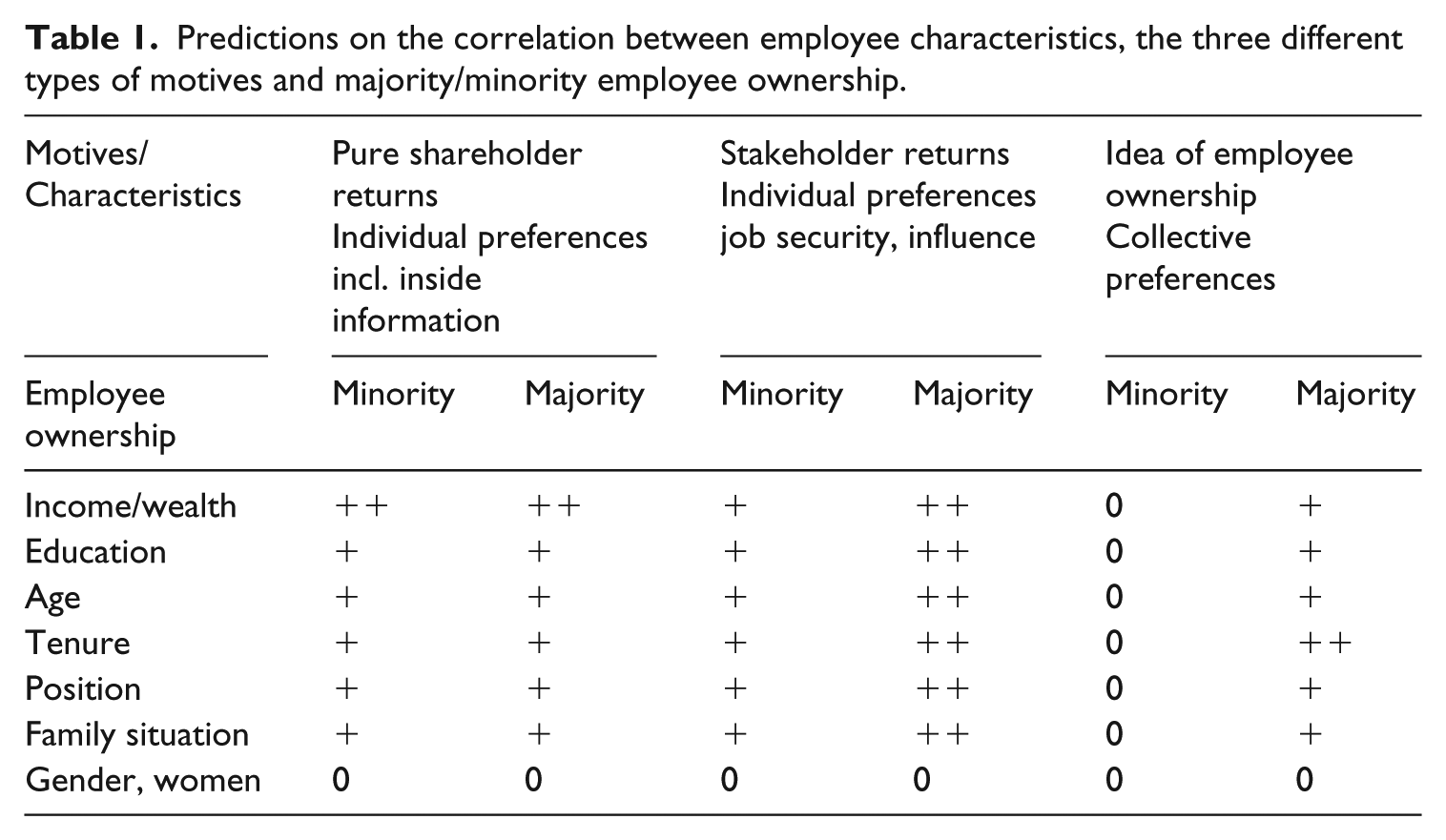
One can look at the purchase of employee shares from a pure shareholder point of view. However, shareholders are also stakeholders as employees within the company. Employee-owners may, on top of the financial returns for shareholders, receive additional benefits and be subject to additional risks connected to their position as employees (Mygind, 2009). Both types of returns belong to what in the literature has been termed instrumental motives (French, 1987; Klein, 1987). As both a pure shareholder and an employee stakeholder, an employee may seek the individually optimal solution. The literature review revealed that such instrumental motives appear to be more common. However, employee attitudes may also include collective preferences in relation to the company and the group of colleagues, meaning that the motive for acquiring shares goes beyond individual maximization (Mygind, 1992). The takeover process of some US supermarket shops revealed quite strong collective preferences among employees (Granrose and Hochner, 1985). Therefore, and as shown in Table 1, theoretical expectations for acquiring ownership are related to the three types of motives: (1) individual shareholder; (2) individual employee stakeholder; (3) collective-oriented employee-owner.
Predictions on the correlation between employee characteristics, the three different types of motives and majority/minority employee ownership.
Pure shareholder motives can be summarized as making a ‘good investment’ (Bryson and Freeman, 2010: 6), interpreted as a narrow financial focus on investment where traditional financial theory applies. Relevant concerns here are whether an investor has access to the necessary finance and if the expected return and risk profile adds value in relation to the rest of the portfolio held. However, the duality of financial risk and risk of losing one’s job must be included. This risk concentration of ‘putting all one’s eggs in one basket’ is identified as one of the classic barriers to employee ownership dating back to Vanek (1971) and Meade (1972).
In contrast, being an employee provides specific resources which may positively affect one’s position as a financial investor. Indeed, employees can be expected to gain some inside information about the financial situation of the company (Bajtelsmit and Van Derhei, 1997). This is especially relevant for positions at the upper level of the company hierarchy.
When the perspective of an employee stakeholder is included, additional returns and risks can be introduced. For employee-owners, company stock not only includes financial returns but also the possibility of gaining influence and protecting jobs and, relatedly, firm-specific skills. According to Guery and Pendleton (2016), the mutual hold-up problem between employee and employer can be mitigated by employee ownership. The employer, through issuing shares, can bond employees to the enterprise. At the same time, employees can secure human capital through such share acquisition. Similarly, Pendleton and Robinson (2011) show that employee ownership can complement human resource management (HRM) practices such as employee training in firm-specific skills by locking employees into the firm. Such mutual dependency between employee and company will be greatest when shareholder interests and employee stakeholder motives are combined with substantial employee control in a majority employee-owned company.
If employees’ collective preferences for the company and group of colleagues within it go beyond an individual focus, the motive for buying shares could be to ‘help the company’ and to promote ‘the idea of employees owning their place of work’. This type of collective preference can be an important element in majority employee-owned enterprises. The sentiment of being ‘part of the team’ may be profound. However, such collective preferences may overlap with individual employee stakeholder interests in terms of a belief in the idea of workplace ownership. Even if this belief is strongest in majority cases, employee-owners in minority cases could still support it.
The columns of Table 1 are first divided into the three types of motives. Each column is further divided into minority and majority employee ownership. The third dimension includes the personal characteristics (subsuming job-related characteristics) in terms of whether or not employees become owners while following the three motives in the minority and majority cases. In theory, it is possible to link the characteristics to the motives. The characteristics of each individual employee can be expected to influence their motives, returns and drivers, as well as their possibilities for investing in company shares. Corresponding signs illustrate the drivers of, and barriers to, ownership with regard to the different motives and in terms of expected positive or negative correlations. In most cases, the causality goes from the specific combination of ownership category, motives and personal characteristic to ownership but a positive correlation does not exclude the possibility of, for example, those within majority employee-owned firms developing stronger collective preferences over time.
From a pure investor perspective, it is relevant to look at employees’ financial resources. Following the literature, an investment in company stock can be expected to increase with income and wealth. From a lifecycle perspective, younger workers may need to use their savings for establishing families and, relatedly, prioritizing home ownership, leaving little room for investment in shares. Older workers’ accumulation of financial assets and greater total family incomes make the purchase more affordable. Thus, such investments can be expected to increase with age (Caramelli and Carberry, 2014). However, employees close to retirement may be reluctant to purchase shares because they have an increasing need to diversify investment portfolios when the time horizon for selling their shares becomes shorter (Degeorge et al., 2004; Granrose, 1986; Pendleton, 2010).
Employees’ position as investors may be strengthened by their access to inside information. This can be further improved by education, position and tenure. Inside information will likely be higher in a majority employee-owned company. Besides this prediction, the pure shareholder position is not expected to depend on whether there is minority or majority employee ownership. In both cases, the employee-investor focuses on financial returns. Therefore, columns 2 and 3 of minority and majority ownership have similar signs.
The marginal effect of being female is hypothesized by Pendleton (2010) to be positive because of a higher propensity to save at given income levels, as documented in the US 401(k) literature (Huberman et al., 2007). Gender may account for differences in investment decisions, linked to relative male self-confidence or female conservatism (Degeorge et al., 2004). However, the literature is ambiguous with regard to gender’s role in employee ownership. Therefore, there are zeroes at the bottom of columns 2 and 3.
In moving from the pure investor to the employee stakeholder position, personal characteristics related to one’s job – income, position and tenure – play a greater role. Share ownership may influence the chances of keeping one’s job if non-owners are more likely to be laid off. There may be a signalling effect whereby share ownership reflects a commitment to remaining with the firm (Pendleton, 2010). Securing specific human capital linked to the company provides employees with an additional return. These specific skills are likely to increase with tenure in the company (Lazear, 2000) as well as with education and position. For senior employees, shifting to another company may be more difficult than for younger colleagues. Therefore, a direct effect of age may also be expected (Jackson and Morgan, 2011).
Employees with spouse and/or children may be less mobile than single employees and have a greater need for securing employment (Bryson and Freeman, 2010). According to Granrose and Hochner (1985), the male in the household unit is likely to be the main salary earner and therefore being female may have a negative effect on ownership. However, this may be due to lower income because of gender discrimination and not actual gender status itself. The authors document that if the woman is the main or only income provider for the family, she will to the same degree as men try to save employment through ownership. Thus, in terms of the stakeholder motive, there is no a priori expectation as to whether women should be more or less likely to purchase shares in their places of employment than men. This is indicated by zeroes at the bottom of columns 4 and 5 in the table.
Increased influence can also be counted as part of the return on employee shares because it can be expected to increase job satisfaction. Influence can be expected to follow experience and human capital and therefore this stakeholder return to the employee-owner will be connected to the same characteristics as for securing employment and skills – tenure, education and job position – in line with the literature.
Employee influence is expected to be greater in majority cases. Therefore, employee stakeholder returns have greater weight in decision-making. This means that stakeholder goals such as securing jobs and personal careers will transpire in a majority rather than in a minority employee-owned company. This is illustrated with the double plus signs in column 5.
Collective preferences involving a belief in the idea of employees owning their place of work are especially relevant for majority employee-owned companies (Mygind, 1992). These can be expected to increase with tenure because collective ties increase with common experience. However, it is difficult to argue that such preferences follow income, education and specific skills in addition to what is already included under employee stakeholder interests. Therefore, collective preferences are only marked with one plus sign for these variables in Table 1. Granrose and Hochner (1985: 304) hypothesize that women have stronger collectivism expressed through the desire for employee participation: ‘Gaining power through contributing to a group or in a group context, however, has connotations of sociability and group service which are congruent with female sex-role norms, and are less likely to be condemned.’ However, this hypothesis is not supported by their empirical analysis. Therefore, columns 6 and 7 for collective motives also feature zeroes along the bottom row.
In summary and following the literature, the likelihood of being an employee-owner increases with income, education, tenure, position, established family – being married and having children – and age (at least up until close to retirement). There is no expected effect of gender. Income, position and tenure may be more important determinants in majority cases – where stakeholder interests are reflected in decision-making – however the direction of personal characteristics in relation to ownership will be the same. There are arguments for greater effects of personal (job) characteristics related to employee stakeholder motives but the expected correlations go in similar directions for the three types of motives. The first hypothesis linked to personal characteristics across both ownership types can be stated as follows:
H1: The probability of an individual becoming an employee-owner increases with income, education, tenure, position, established family and age, while there is not expected to be any effect of gender.
The expected relationship between the three motives and minority versus majority ownership can be summarized as follows. Minority employee ownership will most likely be seen for what it is: the chance to make an investment, absent the right to control. The signalling effect of owning shares may mean that job protection could be a consideration. Thus, the employee stakeholder position may also be relevant. Even a belief in the idea of employees owning their own companies may be uncovered but seeking influence cannot be expected to rank as highly. The investor motive with a focus on financial returns may also exist in majority employee ownership but it is expected that employee stakeholder motives will be stronger as compared to minority ownership. In majority employee-owned firms, collective motives are expected to be of greater importance with employee-owners emphasizing motives such as seeking greater influence and a belief in ownership. The theoretical discussion therefore leads to the following three hypotheses:
H2a: Pure investor motives are expected to exist in both majority and minority employee ownership but to have greater weight in minority ownership.
H2b: Employee stakeholder motives are expected to exist in both majority and minority employee ownership but to have greater weight in majority ownership.
H2c: Collective motives are expected to exist in both majority and minority employee ownership but to have greater weight in majority ownership.
The theoretical discussion on the drivers of employee ownership in relation to personal characteristics can also account for possible explanations regarding non-participation in ownership. Being younger and lacking experience can be expected to be reasons for not becoming an employee-owner. When the purchase involves a considerable cost, insufficient funds may be a decisive barrier. The financial barrier is relevant to all three ownership motives. Furthermore, from a pure investor perspective, an individual employee may find that purchasing shares is not a ‘good investment’ in relation to the risk involved. Opposition against employee ownership could be driven by a lack of collective goals and/or a stakeholder attitude which is against combining the dual roles of employee and owner. Finally, in narrow-based employee-owned firms, a decisive reason for not participating in share ownership may be that some employees are deemed ineligible to do so, in terms of not qualifying for ownership status by way of a formal invitation or not gaining access to information concerning the prevailing share scheme. These arguments can be summarized in the following two hypotheses:
H3a: The primary reasons employees do not become owners in firms featuring broad-based employee ownership are expected to be lack of funds, excessive risk and/or opposition to the idea of employee ownership.
H3b: For narrow-based employee-owned firms, non-eligibility is expected to be the most important reason for not participating in ownership.
Methodology
Data collection and the six cases
A case study research strategy was applied to analyse the determinants of ownership as well as to explore the motives behind share purchases and non-purchases. The six cases are of mixed method design, combining quantitative data survey analysis with qualitative interviews. The number of cases featured is in line with the firms investigated in related studies, such as Kalmi’s (2004) five cases, Pendleton’s (2010) three cases and Jackson and Morgan’s (2011) three cases.
Data collection was conducted during autumn-winter 2014. The process to get to this point began with the casual observation that employee ownership had begun to feature more prominently in Iceland over the preceding years. To ascertain the extent of the employee ownership phenomenon, the intention was to contact as many of the 300 largest Icelandic firms as possible, as measured by turnover in 2013. Excluding state ownership, the initial list was narrowed down to 275. Contact was established with 127 of these and responding firms were asked whether they had introduced employee ownership. Eleven such firms were identified. Out of these, access was granted to six, covering both minority and majority ownership.
There is no predefined legal format and no specific benefits for employee ownership in Iceland. Specific rules may be defined at the company level. The two case firms belonging to the majority category are both 100% employee-owned and they are both in knowledge-intensive industries. One is broad-based with more than 50% of the employees eligible for ownership following the definition by Torp (2016). In case ‘F’, one-third of the employees are eligible for ownership. Although narrow-based, the owners are not a select group of top employees: the one-third make up a group of around 100 employee-owners. Key information on the case study firms is presented in Table 2.
Case overview.

Taken together, the case firms are quite similar: all belong to the service sector and are of medium size, i.e. 100–450 employees (yet belonging to the largest enterprises in Iceland). This similarity is an advantage for the ensuing analysis, because the idea is not to analyse differences at the firm level but at the individual level. The analysis focuses on the differences between minority and majority employee ownership as well as the differences between broad-based and narrow-based ownership in the latter ownership category. Narrow-based minority employee ownership, typically dominated by a small management group, is not as relevant from an employee participation point of view.
The six case firms are briefly introduced below, with emphasis placed on recent ownership developments and details concerning the employee ownership format. This information is based on company files and semi-structured interviews conducted on site with the CEO of each firm plus one other employee from four of the firms. Limited permission was granted to interview a select number of employees due to sensitivity concerns. They were mid-level specialists with knowledge of their respective firms both prior to and after the change of ownership. Each of them were shareowners. The three first cases in Table 2 are minority-owned public listed companies with around 1% of equity owned by employees. The other three are unlisted. In case ‘D’, employees took over about 21% of the shares with the rest owned by the founder.
Case ‘A’ operates in the insurance industry. Prior to 2008, it was predominantly owned by holding companies and pension funds. It was delisted and initially taken over by the state as part of the nationalization of the banking sector. In 2012, it returned to listed status coinciding with employees being offered the chance to purchase shares. Between 5 and 10% did so and the total equity held by them is about 1%.
Case ‘B’ is also in insurance. Having been listed for a decade, it was taken over by an investment company (which subsequently went into liquidation) resulting in delisting in 2008. It was later sold on to an investor group. Prior to relisting in 2013, all employees were offered shares. The offered amount was divided into three levels, depending on hierarchy. Over half the employees participated but the total equity held by them is less than 1%.
Case ‘C’ is engaged in oil distribution and retail. Brought under public ownership during the 2008 crisis, a group of pension funds soon afterward acquired a large proportion of equity. The firm relisted in 2013 and a small amount of shares were set aside for employees, at market rates. The opportunity to purchase shares was open to all employees but the company did not release information about the participation rate.
Case ‘D’ operates in the computer and software industry. Having been sold to investors, it was bought back by its original founder in 2007 and then merged with a smaller start-up under the latter’s control. With the appeasement of existing staff in mind, sizeable equity in the firm was made available to employees in 2008. Around half acted on the offer, constituting 21% of equity. Employees can sell shares back to the firm if they wish to do so.
Case ‘E’ is in consulting. Unable to pay the debt it had accumulated by the end of 2008 as an investor-owned firm, management entered into negotiations with creditors to save the business, restructuring loans, reducing costs and selling off sub-units. Eventually put through bankruptcy, it started anew in 2010. Some existing assets were purchased and past employees were offered jobs. Starved of external equity sources, all employees were further offered the chance to purchase shares and approximately half did so. An individual’s stake is limited to 10% of total equity. Departing employees are required to sell their shares and an internal market operates to match sellers with buyers.
Case ‘F’ commenced in 1963 as a 100% employee-owned engineering firm. At the time of study, owners constituted one-third of the firm’s around 300 employees. This ratio has been maintained since the financial crisis. To attain ownership status, a minimum of three years’ service is required, as is a nomination from an annual promotions committee in recognition of work performance. Employees are required to contribute at least 15% of the cost of an ownership stake, equal to around four times a pre-tax annual salary, with the balance made up of a long-term low-interest loan from the firm. Shares have been distributed relatively equally, though the upper limit was scrapped in 2014. The company buys back the shares when an employee departs. The value is set by an external accountant according to company statutes.
Employee survey
A survey was sent to the employees of the six firms. It was placed online and a link to it was sent by email along with an introductory letter from the human resource manager, or a person of a comparable position. The introductory letter and survey questions were stated in both Icelandic and English. Anonymity of the respondents was assured. The survey was divided into five sections: (1) general questions about job characteristics, (2) education and training, (3) remuneration, (4) share acquisition and (5) current share status. The survey remained online between September and December 2014. Two reminder emails were sent to employees during this timeframe.
A total of 268 employees responded to the distributed survey. The total response rate was 21% but fluctuated between firms, from a low of 6% to a high of 52%. This reinforces the decision to handle the responses by grouping them into either majority or minority ownership categories or looking at them together for the purpose of a determinants regression. For the full sample, 109 (41%) report currently owning shares in their enterprise, 44 (16%) previously owned shares but have sold them and 115 (43%) are not, and have never been, shareowners. Of the survey’s participants, 53% are from minority employee-owned firms and 47% are from majority employee-owned firms.
Measurement
Individual employee characteristics are measured through the survey responses obtained. Wealth/income is only measured by average annual income received because responses on wealth were expected to be less reliable. A question on performance-related pay was included in the survey but as revealed by the interviews, generally remuneration was not dependent on the performance of the firm so this characteristic was not analysed further. Age, tenure, number of children are treated as continuous variables. Education is treated as a categorical variable, taking the value 1 if the respondent is university educated and 0 if not. For marital status, being married takes the value 1 and single the value 0. A job category variable is set to 1 for managerial-level personnel and 0 for non-managerial personnel. Similarly, a gender variable is set to 1 if the respondent is male.
Employment status is not included as a predictor of share ownership but is used to narrow the testable sample so that only permanent workers are included. In this context, the number of hours worked on average at the firm per week is included. A dummy variable is included for majority versus minority ownership to control for latent effects pertaining to ownership structure not specified in the independent variables.
While the case firms can be directly divided into minority and majority categories and personal characteristics are also directly measurable, employees often display elements of the three different types of motives outlined (yet with differing weights). Survey respondents were asked to mark all of the listed motives that applied to them in becoming shareowners, before being asked to rank these by importance. Of the possible listed motives to choose from, the first three listed in Table 5 are considered to be collective motives. Still, it may be argued that the first motive of ‘influence on decisions’ is also an employee stakeholder motive. It could also be argued that the motive ‘to help the company’ is a stakeholder concern connected to job protection and even to long-term financial returns. However, since this goes beyond individual maximization, it is interpreted as a motive for the benefit of the collective group of employees. Clear-cut individual stakeholder motives refer to the response options ‘protect my skills’ and ‘reduce the risk of being laid off’. The response ‘an investment’ is interpreted as a pure shareholder investor motive.
Strategy for the quantitative and qualitative analysis
Ideally, the dependent variable representing ownership status should be related simultaneously to ownership type, the three motives and the different personal characteristics. However, a limited number of survey responses were collected and the respondents cannot be divided into three distinguishable groups according to motives. Therefore, the quantitative strategy to test hypothesis 1 involves collating the responses and analysing the effects of the various personal characteristics on ownership within a regression framework. To analyse the motives behind share ownership acquisition and the reasons for non-purchase, with regard to the second and third set of hypotheses, a descriptive analysis of the frequencies and rankings given to the relevant survey response options is conducted. Whether or not there are significant differences according to ownership category are reported. The qualitative interviews with managers and key employees are utilized in order to add nuance to the quantitative results.
Results
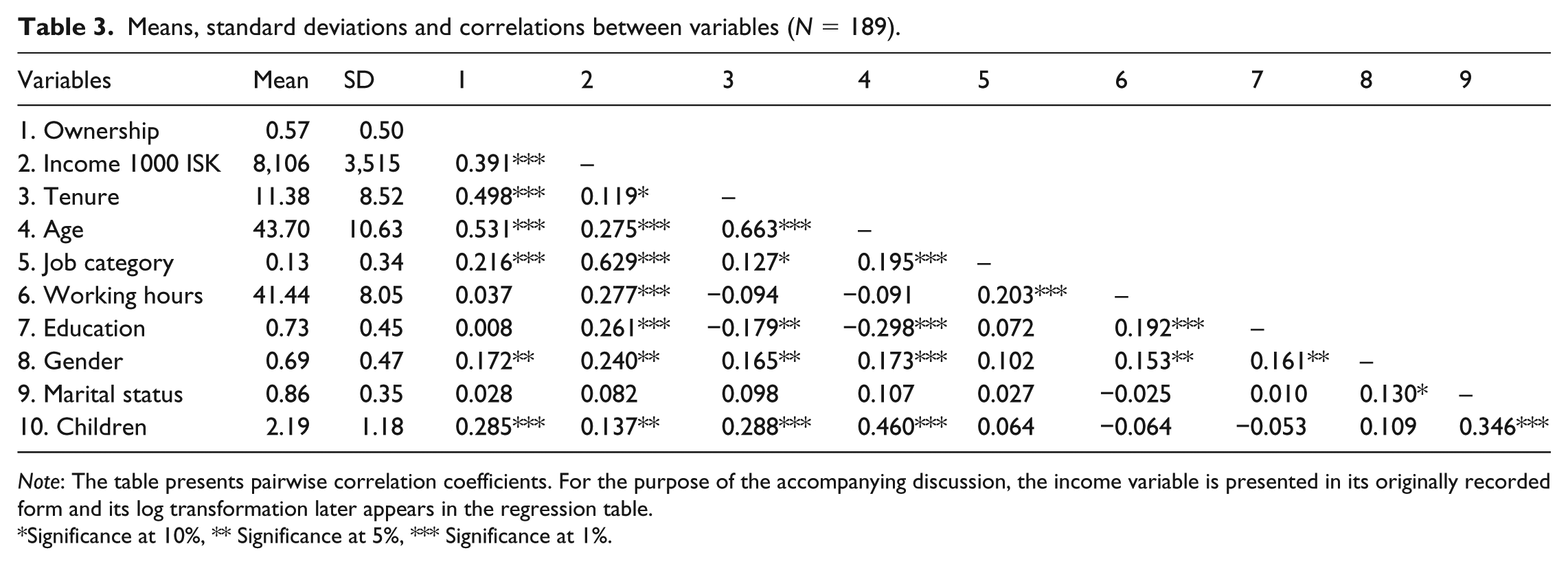
Descriptive statistics are presented in Table 3 (after standardization and removal of outliers pertaining to annual income, as well as taking out temporary workers). The typical annual salary is around 8 million Icelandic kronur (€57,000) before tax. On average, the responding employees are 44 years old and have been employed in their respective firms for 11 years. The majority are male, have a university education and are married. Managers make up 13% of the sample.
Means, standard deviations and correlations between variables (N = 189).
Note: The table presents pairwise correlation coefficients. For the purpose of the accompanying discussion, the income variable is presented in its originally recorded form and its log transformation later appears in the regression table.
Significance at 10%, ** Significance at 5%, *** Significance at 1%.
As can be seen in Table 3, at a 95% significance level, share ownership is significantly correlated with annual income, tenure, managerial status, gender (male), age and number of children. Although age and tenure are significantly correlated (r = 0.663, p < 0.01), both are included as independent variables in the subsequent regression. This is in line with the approach of Dong et al. (2002a) and is necessary since the average number of years of employment is considerably less than average age, suggesting that many survey participants have been employed elsewhere prior. Income is significantly correlated with several variables, including age (r = 0.275, p < 0.01), education (r = 0.261, p < 0.01) and job category (r = 0.629, p < 0.01). Given these correlations, variance inflation factors for the covariates are obtained by way of multiple linear regression. The variance inflation factors are all less than 2.6 and the tolerance factors are all above 0.1, suggesting that there is not an excessive degree of collinearity among the variables.
With share ownership modelled as a dichotomous dependent variable and the presence of a series of independent variables to explain its incidence, the following (full) equation is estimated:

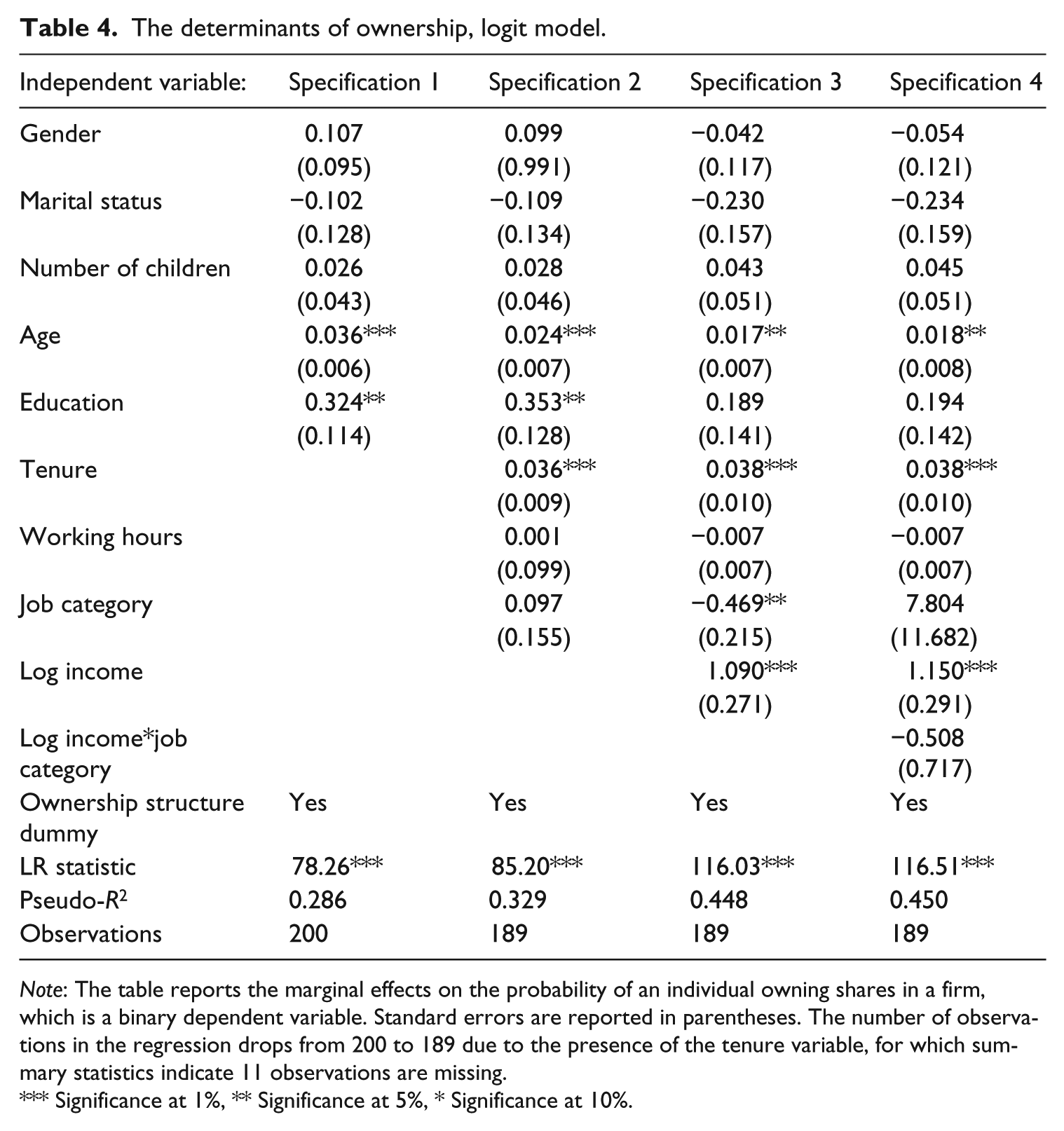
The equation is estimated using a logit regression model, applicable for a dependent variable with a binomial distribution. Maximum likelihood estimates (marginal effects) are reported in Table 4, according to a series of specifications of the independent variables. Marginal effects are changes in the probability of an individual owning shares when an independent variable increases by one unit, all independent variables set to their mean values.
The determinants of ownership, logit model.
Note: The table reports the marginal effects on the probability of an individual owning shares in a firm, which is a binary dependent variable. Standard errors are reported in parentheses. The number of observations in the regression drops from 200 to 189 due to the presence of the tenure variable, for which summary statistics indicate 11 observations are missing.
Significance at 1%, ** Significance at 5%, * Significance at 10%.
Specification 1 contains the regression estimates for a limited set of independent variables, specifically those pertaining to the personal characteristics gender, marital status, number of children, age and education. According to this specification, a one-year increase in age raises the probability of shareholding by 3.6%. Individuals in possession of a university degree are 32% more likely to own shares. The remaining variables have statistically insignificant effects on ownership.
Adding job characteristics variables for individuals in specification 2 – tenure, working hours and job category – reduces the marginal effect of age on ownership to 2.4% and increases the marginal effect of education on ownership to 35%. Both remain statistically significant. Of the added variables, a one-year increase in tenure raises the probability of owning shares, as does being a manager but the latter result is insignificant at the 5% level.
Income is added to specification 3, so that it contains all the explanatory variables of equation 1. Because the distribution of the income variable is skewed, its natural logarithm is used. Quantitatively, a 1% increase in annual income raises the probability of shareholding by 1.1%. With the inclusion of this variable, one-year increases in tenure and age raise the probability of shareholding by 3.8% and 1.7%, respectively. This is a further reduction in the marginal effect of age on ownership but the effect of tenure is almost unchanged.
As a consequence of introducing income, the marginal effect of education on ownership status becomes statistically insignificant (but keeps the same sign) while the movement to a higher job category surprisingly reduces the probability of shareholding. There appears to be a powerful income effect at play in the sample: both university-educated workers and managerial staff belong to a comparatively higher income group on average. These variables proxy for income differences in specification 2. When the effect of higher income is taken away, what is left for the job category variable in particular may be accounted for by latent personal considerations such as risk. To assess the effect of becoming a manager – a unit change from 0 (the non-manager group) to 1 (the manager group) – at a fixed level of income, rather than at a lower mean value for all employees in the sample, an income*job category interaction term is brought into specification 4. The result for this variable is statistically insignificant, indicating that the marginal effect of income on ownership does not differ between managers and non-managers.
Taking specification 4 as the base regression, the likelihood ratio rejects the hypothesis that the joint impact of the independent variables on the dependent variable is zero. The probability of share ownership taking the value 1 is 63% when the independent variables are at their means. The logit model then has a pseudo-R2 of 0.45.
The initial analysis indicated positive correlations between ownership and each of managerial position, number of children and gender (male). This initial result for gender is in line with some of the cited studies but is different from what is uncovered in Degeorge et al. (2004) and Pendleton (2010). Yet, the logit model does not produce significant results for the abovementioned variables. In terms of the regression results uncovered, a positive statistically significant influence of income on ownership status conforms to expectations, in line with the literature. The result for age is consistent with the related theoretical discussion and the results obtained by Pendleton (2010) and Bryson and Freeman (2010) but differs in direction from the finding of Degeorge et al. (2004). That an increase in tenure raises the probability of shareholding also matches results across relevant preceding studies. The results confirm hypothesis 1 in relation to income, age and tenure.
The interview data have been incorporated below to arrive at a deeper understanding of the personal characteristics as determinants for employees becoming shareholders. The share purchase cost the equivalent of three to five months’ gross salary, regardless of ownership structure, which could be viewed as a substantial amount for some to pay. With access to external finance having been more challenging in the period under consideration, dipping into personal savings has usually been required.
It was difficult … to get loan at that time … I think they [some employees] didn’t have the savings or access to some quick cash. (Employee, majority-firm E) It’s not common, I think, that you just go to your bank and borrow money to buy shares. (CEO, minority-firm B)
With regard to the influence of age, experience and income on the likelihood of share take-up, it was generally perceived that older and tenured employees were prime candidates for ownership in both minority- and majority-owned firms.
I think most of us, the ones who are more experienced … were all going to buy and I think most of them bought if not everybody. (Employee, majority-firm E) Our senior people, they bought shares but not the youngest. (CEO, majority-firm E) Looking at the employees that acted on the offer, it was more the older ones, the ones that had worked here for quite a while … the more experienced, the more senior employees have been engaged in the market in Iceland for quite a while and they’ve managed to kind of read the tea leaves about which companies are the best ones, so that was, you know, kind of easier to sell to them than the younger ones. (CEO, minority-firm D) The younger ones here at that point of time, they were around 30 years old … owning their … you know, households … and really in a crappy situation. The older ones around 50, they already were around kind of the safe side. (CEO, minority-firm D)
In terms of the examined interview data, income and wealth appear to be the main drivers of ownership but age and family situation also have an influence. There is no mention of gender as a purchase factor in the interview data. As in the quantitative data, the gender effect is probably overshadowed by the income effect.
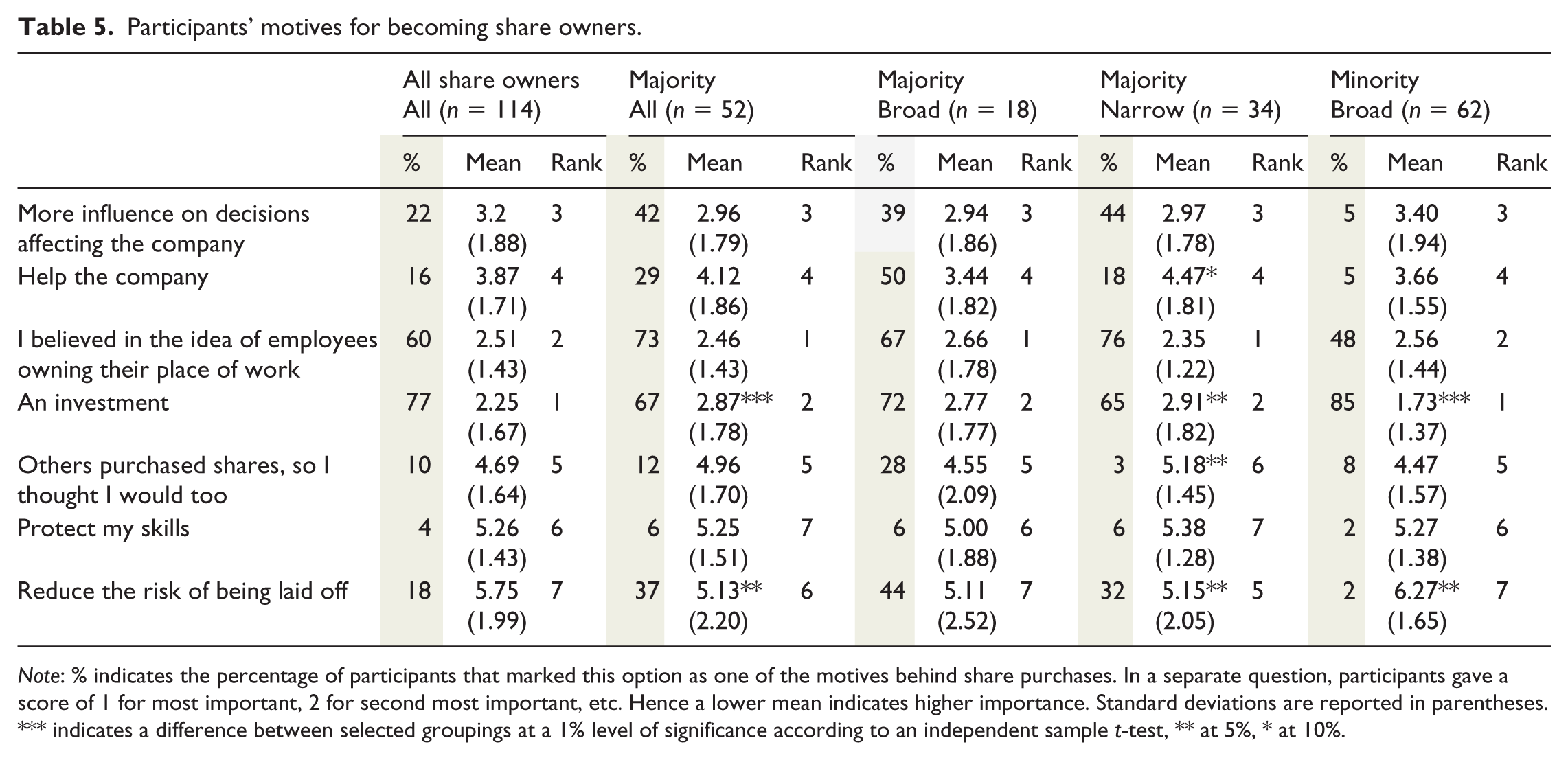
Table 5 presents the survey results for share ownership motives, using the same sample as in the regression. Respondents first marked the listed motives that applied to them in becoming shareowners. They then awarded a grade of 1 for the most important and 7 for the least important of the listed motives. Hence, lower numbers indicate greater importance.
Participants’ motives for becoming share owners.
Note: % indicates the percentage of participants that marked this option as one of the motives behind share purchases. In a separate question, participants gave a score of 1 for most important, 2 for second most important, etc. Hence a lower mean indicates higher importance. Standard deviations are reported in parentheses.
indicates a difference between selected groupings at a 1% level of significance according to an independent sample t-test, ** at 5%, * at 10%.
Overall, the most frequently stated motive behind ownership was financial: shares were seen as ‘an investment’. This was the most important motive for participants from minority employee-owned firms and the second most important motive for participants from majority employee-owned firms. An independent sample t-test indicated a significant difference between the importance of investment as a motive between the two groups (t(112) = 3.857; p < 0.01). These results provide some support for hypothesis 2a.
Of the responding employee-owners in the majority firms, 37% followed a stakeholder motive by selecting the option: ‘reduce the risk of being laid off’ as a motive in becoming shareowners, yet only 2% of employee-owners in the minority firms selected this option. An independent sample t-test indicated a significant difference in the importance of this motive between the majority- and the minority-based employee-owners (t(112) = 3.158; p < 0.05). Nonetheless, this motive was not ranked highly in either ownership category. Taken together, these results provide some support for hypothesis 2b.
The most important motive behind share ownership for participants from majority employee-owned firms was ‘I believed in the idea of employees owning their place of work’. However, this collective motive was also frequently selected by participants from minority employee-owned firms. The additional collective motives ‘more influence on decisions’ and ‘help the company’ were much more frequently selected among majority employee-owned firm participants. These two motives were each selected by only 5% of employee-owners in minority-owned firms. No significant difference in the ranking of these motives between majority- and minority-owned firms was found. Respondents from the broad-based and narrow-based majority-owned firms, when viewed independently, follow the same order in prioritizing purchase motives. However, ‘help the company’ was mentioned more frequently in case ‘E’ (50%), probably because it was a defensive takeover. By definition, a takeover is connected to majority ownership and, in this way, the causality goes from collective preferences for firm survival to establishing majority employee ownership. Regarding case ‘F’, individuals with collective motives may have been attracted to it given the eventual possibility of gaining an ownership stake. Thus, the causality could go from majority employee ownership to a biased selection of employees favouring a collective idea of employee ownership. Leaving aside the direction of causality, the survey results lend some support to the first part of hypothesis 2c in terms of collective motives existing within both majority and minority employee-owned firms. There is weaker support for the second part of the hypothesis regarding the greater weight of collective motives in majority-owned firms because of the abovementioned specifics of the two majority firms and because the difference in ranking values between majority and minority ownership is not significant.
The interview data provide some support for the descriptive analysis of employee motives. Employee-owners in minority-owned firms purchased shares primarily due to the individual investor motive but this was often combined with collective concerns for their respective companies and fellow workers.
I wanted to combine my interests with the company’s interests, that if the company was doing well, I would be doing well … I thought it was a good buy and also thought that it would strengthen how people looked at the company … I actually bought but because I had very strong belief that the company would do well on the stock market when it floated, I bought as much as I possibly could … I was just thinking of my own finances and making money. (Employee, minority-firm B) Judging from the vibe at the company at the time, I think there was some … there was a level of I guess you can say pride in owning shares of the company but I would say that I’ve felt more strong, a more strong vibe that people thought that this was going to be a very good deal and that they would make money. So, out of those two, the money-making incentive was stronger but I also felt that there was some sort of camaraderie in being a shareholder in the company where we worked. (Employee, minority-firm A) First of all, I felt it was a good investment. Second part I decided was that it sent out a good signal. (Employee, minority-firm B)
With respect to majority employee ownership, the investment motive is important but collective goals are even more apparent.
I was really happy to get the chance to become an owner and that is why it was never a, it was not even a matter of, of getting interest on my money or anything like that. It is more like being a part of the team. That was the thing for me but luckily, the stocks have gone up so I actually have cashed out on a little bit of it, just for buying a house earlier this year … so I got to cash out even though it wasn’t initially the idea. (Employee, majority-firm E) They [the employee-owners] wanted to keep working together towards the goals that we had already set and all my colleagues, they seem to like working in this company and they didn’t want to break up. So I think that was the … my feeling was that was the main motivation, not that they were looking at this to sell [or a] good way to earn a little money necessarily. (Employee, majority-firm E)
For the CEO of the majority employee-owned firm ‘E’, all three motives play a role: There were all kinds of motives. For some, it was a financial motive and belief that this was a bargain … for others, there was the motive of keeping the company together and put your effort into that as a team member … for some people, it was probably you want to keep your job. That was being part of … the team and you know, chip in … some money to keep your job.
Turning to the reasons for non-participation, Table 6 presents the findings for non-shareowners in their places of employment.
Employees’ reasons for not becoming share owners.

Note: % indicates the percentage of participants that marked this option as one of the reasons for not purchasing shares In a separate question, participants gave a score of 1 for most important, 2 for second most important, etc. Hence a lower mean indicates higher importance. Standard deviations are reported in parentheses. *** indicates a difference between selected groupings at a 1% level of significance according to an independent sample t-test, ** at 5%, * at 10%.
One missing observation in the category of majority employee ownership.
Overall, the most frequently stated reason for not having acquired shares was a lack of funds. In total, 80% of non-shareowners in minority employee-owned firms cited this as a constraint on ownership. The corresponding number for the majority ownership cases is only 22% of non-shareowners. This appears to be largely due to the responses obtained from the narrow-based majority case ‘F’, where insufficient funds only ranks third among the response options. In contrast, in case ‘E’, this is the primary reason share purchases were not made, albeit with a limited number of responses to examine. The most frequently stated reason for non-participation among respondents from the five broad-based firms grouped together is insufficient funds. This is ranked by them as the most important barrier to ownership. An independent sample t-test indicated a significant difference in the importance of this reason for non-participation between the broad-based firms and the narrow-based firm (t(83) = 4.531; p < 0.01).
Not being informed about a share offer and not having an opportunity to purchase shares were frequently reported as reasons for non-participation in the two majority employee-owned firms when grouped together. However, most of these responses came from the narrow-based majority employee-owned case ‘F’ where the abovementioned reasons for non-participation, both linked to ineligibility, also rank first and second in terms of importance. This lends some support to hypothesis 3b.
With regard to the interview data, limited access to finance and the cost involved in purchasing shares were frequently brought up in discussions with both CEOs and employees as potential explanations for purchases not transpiring.
One of the major responses we got back on why people chose not to purchase shares [is] they say they couldn’t afford it. (CEO, minority-firm B) [The] biggest reason was due to economic factors. A lot of our employees had families that were suffering big time in the aftermath of the crisis. So they simply needed to put all the money that they had in some other areas than investing in a company that was technically bankrupt. (CEO, minority-firm D)
It was intimated by some employees that a climate of negativity had pervaded in the aftermath of the financial crisis. Some employees had previously lost money in the share market or run into personal financial trouble, limiting the enthusiasm for investing anew. One of the CEOs echoed this viewpoint. No interviewees indicated that listed status played an essential role in the choice to acquire an ownership stake. It was also not conveyed that employees were against ownership as a concept, either because it entailed additional responsibility or involved greater risk. This is in line with the survey results concerning non-participation in broad-based firms. Only 9% of non-owners selected the option pertaining to excessive risk and only 11% marked the option ‘I don’t believe that employees need to own their place of work’. In sum, there is some support for the first part of hypothesis 3a. Insufficient funds was one of the main reasons individuals did not participate in ownership within broad-based employee-owned firms. Excessive risk or opposition to the idea of employee ownership seems to have played a lesser role.
Conclusion
The focus of this article has been on the antecedents to employee ownership at the individual level of analysis according to three dimensions: the personal characteristics influencing ownership status, the motives behind share purchases/reasons for non-purchases, and ownership category.
Original data consisting of a survey and personal interviews were collected from six Icelandic case firms differentiated by minority or majority equity held by employees. Both quantitative and qualitative methods were employed. Literature on the antecedents to employee ownership at the individual level of analysis is quite scarce. The few existing cross-country studies use vague definitions of employee ownership and the studies of single countries based on cases with individual employee surveys are quite dependent on specific schemes with strong gift elements connected to privatization in transition countries or with notable tax advantages such as in the US and the UK. Our study can confirm if the individual-level determinants are similar when no specific schemes and tax advantages are involved. At the same time, our study goes deeper into investigating the three types of motives driving the employee-owners analysed in relation to whether the firms are majority or minority employee-owned.
Initial correlations indicated positive effects of becoming an employee-owner due to income, tenure, age and number of children, as well as from being male and being a manager. However, in the logit regression model only the first three mentioned independent variables turned out to have significant marginal effects. Therefore, hypothesis 1 was only supported in relation to income, tenure and age.
The theoretical discussion connected minority ownership most closely with the investor motive and majority ownership most closely with the stakeholder and collective motives. Some overlap was also predicted, especially concerning the stakeholder motive. The survey results revealed that ‘[a belief] in the idea of employees owning their place of work’ and ‘an investment’ were the most important motives behind ownership. These ranked 1 and 2, respectively, for majority employee-owned participants and swapped ranking positions for minority employee-owned participants. The descriptive analysis pointed to a significant difference in rankings concerning the pure investor motive. Despite being relatively low-ranked, the stakeholder motive behind ownership ‘reduce the risk of being laid off’ was more frequently selected among majority employee-owned respondents. Collective motives, while uncovered in both ownership types, were not found to be significantly different in terms of importance. Overall, therefore, some support was found for the second set of hypotheses.
Concerning the third set of hypotheses, some support was uncovered for insufficient funds being the main reason for non-purchase in broad-based employee-owned firms while other concerns such as excessive risk played a minor role. Not surprisingly, non-eligibility was the main reason for non-participation in the narrow-based majority employee-owned firm.
This study has contributed to the scarce research on the individual-level antecedents to employee ownership. The cases included are notable for spanning both majority and minority ownership categories – the former includes both open and restricted share access – and for its defining feature: shares have had to be purchased rather than being distributed free of charge. The latter feature enables comparisons to be made between owners and non-owners. Analysis of the results from the case firms uncovers similar drivers related to personal characteristics as in most existing research performed in countries with substantial gift elements or tax advantages. However, excluding tax advantages, the results imply that financial obstacles have prevented many Icelandic employees from purchasing shares in their firms. From this perspective, policies introducing favourable taxation laws such as in the US and UK and/or introduction of a US-type ESOP scheme not demanding cash upfront from individual employees can encourage more inclusion in company ownership.
Compared to the existing literature, this study goes deeper into the motives behind employees purchasing shares in their respective companies and the different weights of such motives in relation to majority and minority types of ownership. At the company level, increased knowledge on the employer’s side regarding individual employee stakeholder motives and collective-oriented motives may be helpful for achieving goals such as increased labour productivity, organizational commitment or employment stability. However, further research on the relationship between employee stakeholder motives, ownership and performance is needed. It would be useful to connect expressed motives behind ownership acquisition with actual behaviour in relation to both firm-level outcomes and individual-level indicators such as job turnover, development of human capital and career development.
The spread of employee ownership depends on individual actors’ willingness and ability to become owners, as well as societal- and firm-level conditions. This article has focused on the individual level of analysis. Future work involving more countries and analysing a greater number and variety of firms (and their employees) would help to further understand how employee ownership occurs and develop knowledge on the links between the different dimensions and the different levels of analysis. For Iceland, this could involve a broader study of the development of employee ownership in smaller companies.
Lastly, our conceptual framework combining the three dimensions of personal characteristics, employee motives and the categories of minority and majority employee ownership could not be fully exploited when based on the limited number of observations in the six firms. The framework leads to a number of hypotheses that could be further developed and tested on a larger dataset. This would make it possible to explore the specification and analysis of the three motives and to further examine, for instance, the role of gender, job position and education.
Footnotes
Declaration of conflicting interests
The authors declared no potential conflicts of interest with respect to the research, authorship, and/or publication of this article.
Funding
The authors received no financial support for the research, authorship, and/or publication of this article.
