




Abstract
Industrial relations and employment regulation are central elements of the national institutional framework shaping country-level differences in job quality. However, researchers are also interested in within-country variation by sector. International sector comparisons can shed light on the role of national institutions, individual employer approaches and workplace unions in shaping outcomes within a sector. This article uses qualitative data on pay and working time in the café industry in France, Norway and the UK to weigh the effects of institutions and employer differentiation on worker outcomes in a sector particularly challenging for union organisation. The findings identify the importance of national institutions for worker outcomes, and for shaping the scope at organisational level for employers and unions to make a difference.
Introduction
There is evidence of considerable variation in job quality indicators across advanced economies linked to differences in national institutional arrangements (Gallie, 2007; Holman and McLelland, 2011). The proportion of the workforce which is low paid, 1 to take one example, is above 20% in the US, UK and Germany compared with below 10% in Denmark, Norway and France (Eurostat, 2017a). The strength of trade unions, collective bargaining and labour market regulations have been identified as central in explaining differences in low pay, along with other aspects of job quality (Gautié and Schmitt, 2010). While these macro-level country comparisons help to identify average country differences, there are important questions concerning the extent to which societal institutions affect job quality across and within sectors.
Macro-level studies have been criticised for neglecting regional and sector differences and for overlooking relatively ‘new’ industries where key features of the national institutional framework may not apply (Crouch et al., 2009; Lloyd and Payne, 2016). Carré and Tilly (2012: 80) argue that more meso-level comparisons which ‘examine a single sector across countries’ are required particularly when examining low paid service sector jobs, given that the comparative capitalisms literature has focused mainly on unionised manufacturing. Such an approach allows a more nuanced assessment of the role played by national institutions, the relationship with sector dynamics, and the potential space for individual employer agency and workplace trade unions. Rich qualitative data, drawing upon workplace case studies and employee experiences, can be particularly helpful but remain rare.
This article explores two central questions. First are national institutions able to influence job quality outcomes in more or less all organisations in a ‘hard to organise’ sector, and second, in countries with weaker regulation, is there more scope for employer choice and/or union workplace organisation to make a significant difference? To explore these questions, a meso-level approach is used to compare pay and working time practices in the hospitality sector in France, Norway and the UK. At the core of the analysis is the role of social relations and power in shaping the interactions between national institutions, sector and the workplace. There are major country differences, for example, in the power of trade unions to influence national institutional frameworks. However, some features of the ‘national system’ may not apply or be difficult to enforce in ‘new’ or less organised sectors (Bosch and Lehndorff, 2005; Jaehrling and Méhaut, 2012), potentially leading to more similarities across countries (Bechter and Brandl, 2015). Furthermore, weak labour standards may allow for greater within-country variation, reflecting differences in employer approach or the ability of unions to organise some workplaces (Findlay et al., 2017; Simms, 2017).
The three countries in this study were selected as well-documented examples of highly contrasting national models. The UK is typically identified as a ‘liberal market’ or ‘neoliberal’ economy, with lightly regulated product, capital and labour markets, and weak trade unions and employer organisations. In such a case, individual employers might be thought to have considerable latitude in determining their organisational approach. However, unlike the US – the model’s quintessential archetype – UK unions have not declined to the same extent and there is stronger labour market regulation. Norway, variously referred to as a ‘coordinated’ or ‘neo-corporatist’ economy and ‘Scandinavian welfare state’, has a labour market model underpinned by strong trade unions and extensive multi-level collective bargaining. Again, it is somewhat distinctive among the Nordic countries, having rich oil revenues, lower union density, and a model of tripartite cooperation that has proven highly durable in the face of neoliberalism. France, often labelled as ‘state regulated’, is noted for its very low union density, extensive legal regulation of the labour market and near-universal collective bargaining. It provides a good test of whether state regulation can improve job quality in lower end service sectors, despite the absence of strong workplace unions.
Hospitality was chosen as a private service sector associated with low pay, precarious work and a low level of collective organisation (Jaehrling and Méhaut, 2012), where services have to be delivered close to the customer and jobs are ‘rooted’ within the ‘local’ economy. While, on one level, it is an unpromising sector for improving job quality, it does not face the same pressures as those subject to international competition. Job quality comprises multiple factors (Holman and McLelland, 2011) and, to allow for systematic comparison, we focus on pay and working time. In hospitality, it is useful to explore these two elements together, given widespread concerns around the growth in involuntary part-time work and zero and variable hours contracts, and their implications for security of income and work–life balance (Ilsøe et al., 2017; O’Sullivan et al., 2017).
The first section of this article examines existing approaches to the comparative study of pay and working time, and outlines a conceptual framework for integrating national institutions and sector dynamics with that of individual employer agency and workplace unions. A brief overview is then provided of existing research in the hospitality sector, followed by a discussion of the research method, which draws on over 100 interviews with managers and workers from 30 different organisations in the café sector. The data are used to undertake a comparative analysis of the influences on pay and working time, and the effects for workers across and within the three countries. The conclusion discusses the implications for comparative analysis and for improving job quality in the hospitality sector.
Integrating the national, sector and organisation
The comparative capitalisms literature, which has primarily focused on national distinctiveness, has been criticised for neglecting internal variation within countries and the role played by the sector (Crouch et al., 2009; Grimshaw and Lehndorff, 2010). Employers in a sector, it is argued, ‘face similar pressures and options in the organization of work and labour relations by virtue of common activities and constraints’ (Arrowsmith, 2010: 181). Consequently, industrial relations in a sector may have more commonalities across countries than with other sectors in the same country (Bechter and Brandl, 2015).
Although the sector has long been considered an important analytical category in industrial relations (Hollingsworth and Streeck, 1994), rather less attention has focused on the relationship between national institutions and the extent of internal country diversity. There is evidence that some countries may be more resilient to sector pressures (Refslund and Sørensen, 2016) retaining greater homogeneity in institutions. Bechter et al. (2012: 194) claim that for the Nordic countries and France, it would ‘appear legitimate to speak of national models’ of industrial relations, compared to other countries with more mixed patterns. In relation to pay, Gautié and Schmitt (2010) identify Denmark and France as possessing ‘inclusive’ pay-setting institutions whereby close to all workers are covered by collective bargaining. Not only are there more similarities in institutional arrangements across sectors, there are also positive outcomes in terms of relatively few low paid jobs, compared to more differentiated countries, such as Germany and the UK.
Few international comparative studies have examined differences in working time across sectors. Berg et al. (2014: 810) propose three national ‘configurations’ for how ‘working time practices are established or altered’, which have implications for variation within a country. The ‘mandated’ approach, represented by France, relies on universal state-legal regulation which substitutes for weak workplace unions, and is thought to deliver uniformity across sectors. The ‘negotiated’ model, exemplified by Sweden, is characterised by extensive collective bargaining as the main form of regulation. This approach offers the potential for more sector variation in outcomes than with the mandated configuration reflecting differences in trade union power across the economy. The US typifies the ‘unilateral’ approach, where the organisation of working time is said to be largely at the discretion of the employer due to limited collective bargaining and weak legal regulations. Consequently, we might expect more variable outcomes reflecting differences in the labour market power of groups of workers and/or the competitive strategies of employers.
The mandated and negotiated configurations of working time are held to provide better outcomes for workers in general, but with the potential for less adaptability to worker preferences in the former (Berg et al., 2014: 832–833). Evidence on the validity of these models is limited, although surveys suggest workers have more control over hours and work schedules in Scandinavia (Anttila et al., 2015; Lyness et al., 2012). While Berg et al.’s (2014) approach is helpful, questions remain over whether these ‘configurations’ apply to other countries and if they can account for sub-national variation. Indeed, they stress that these are ‘ideal types’, and that research is required to explore how ‘working-time practices in specific industries and occupations differ’ (2014: 833–834).
Studies of job quality, encompassing pay and working time, are increasingly emphasising the importance of integrating national institutional settings with specific sector dynamics. However, there is often an absence of the role played by individual organisations and the extent to which there is space for different approaches within a sector and under different national institutional arrangements. Carré and Tilly (2012: 89) are an exception, arguing that in low paying sectors, such as retail and hospitality, national institutions are more important than employer practices in explaining international differences in job quality. In contrast, employer strategies, and (to a lesser extent) union organisation, are more significant in accounting for within-country variation.
In relation to employer ‘choice’ of competitive strategy, Carré and Tilly (2012) follow a well-established view in distinguishing between the ‘high road’, based on high-quality goods and services, and the ‘low road’, centred on cost minimisation (Schuler and Jackson, 1987). The former is often held to be associated with higher skilled work and better wages and conditions, the latter with a predominantly low skilled, low paid, insecure workforce (Boxall and Purcell, 2015; Frenkel, 2005). The assumption is that organisations seeking to differentiate themselves through higher product or service quality require a more motivated and skilled workforce and, therefore, have greater incentive to provide workers with enhanced benefits, such as training opportunities, higher pay and better work–life balance. Profit margins are also expected to be higher, affording more scope to enhance job quality. The evidence, however, on the link between product market positioning and job quality in hospitality and retailing is mixed. Of the few studies available, some suggest quality-focused approaches may translate into better pay and conditions (Carré and Tilly, 2012; Knox and Warhurst, 2018), while others find that this is not necessarily the case (Bailey and Bernhardt, 1997; Gadrey and Jany-Catrice, 2000; Lloyd et al., 2013).
Furthermore, it has long been argued that the scope for ‘low road’ or ‘high road’ competitive approaches is partly shaped by national institutions (Finegold and Soskice, 1988; Streeck, 1987). In sectors such as hospitality, one might expect fewer opportunities to pursue a low cost competitive strategy in countries with high legal minimum standards for pay and working time. Organisations may converge in their practices if they feel they have little to gain from going beyond the minimum, while trade unions may find it difficult to mobilise workers to achieve only marginal benefits. In countries that rely primarily on strong national unions negotiating collective agreements rather than legal regulation, some employers in less organised sectors may be able to ‘opt out’ and pursue a ‘low road’ approach. Their ability to follow such a path is likely to depend on broader factors that shape the supply of labour at the lower end, such as the ‘type of welfare state’ (Bosch and Lehndorff, 2005: 10), the role of migrant labour and the student/youth labour market (Hauschildt et al., 2015). In a country with weak legal standards, employers might ‘race to the bottom’ reducing wages and conditions as far as possible or, alternatively, there might be greater diversity of approach. Some organisations may offer better pay and conditions as part of their competitive strategy (Sung and Ashton, 2015) or they may face pressure from recruitment difficulties or workplace trade unions where they exist.
The above discussion underlines the complexity of integrating the national, sector and organisation levels, with the potential for a range of influences and outcomes. It also shows major gaps in evidence and the importance of exploring variation in employees’ experiences within a sector. The next section draws on existing research to provide a brief overview of employment conditions in the hospitality sector, referring to specific data on France, Norway and the UK.
Pay and working time in the hospitality sector
The hospitality sector has a number of common features or ‘sector pressures’, such as low barriers to entry, limited capital investment and technology requirements, localised markets, temporal variability in consumer demand and large numbers of low skilled tasks (Eurostat, 2017b; Gerogiannis et al., 2012). The result is an environment often characterised by highly competitive markets, severe price pressure, high labour turnover and many poor quality jobs. While multinational corporations (MNCs) operate in certain segments, e.g. fast food and hotel chains, a myriad of national operators, franchises and small independents make it hard for employers to organise collectively. Union organisation is also rendered more difficult by such conditions, along with the small size of many workplaces (Jaehrling and Méhaut, 2012; Vanselow et al., 2010). Consequently, union density is low in all three countries in this study, ranging from 24% in Norway, to 3% in the UK and 4% in France, compared with national unionisation rates of 49, 23 and 11% respectively. 2
There are substantial differences in collective bargaining institutions and coverage in hospitality across the three countries. The French national model ensures all workers are covered by sector agreements as these are legally extended to all relevant workplaces. In Norway, only a third of the hospitality workforce are in workplaces where employers have signed the sector collective agreement and most of these are in accommodation rather than food services (Fellesforbundet, 2017). 3 It is estimated that a quarter of workers are paid less than the sector minimum. In the UK, just 4% of workers are covered by company-level collective bargaining (DBEIS, 2018). While 47% of hospitality workers are classified as low paid across the EU27, there are considerable country differences, ranging from 66% in the UK and 38% in Norway, to 14% in France (Eurostat, 2017a). 4 There is little research, however, on the extent of organisational differences. A study by Vanselow et al. (2010: 287) of hotel cleaners in five European countries found minimal variation in pay levels across workplaces within each country.
In many areas of hospitality, employers are faced with consumer demand that varies over the day, week and year. Matching staff more closely to business requirements is an important way in which labour costs can be reduced. Trade unions and campaign groups, particularly in the UK and US, have voiced major concerns over the growth in this sector of insecure working time arrangements (DePillis, 2015; TUC, 2015). Unpredictability and fluctuations in the number of hours and days worked may result in inadequate and insecure income as well as ‘time based’ and ‘strain-based’ work–life conflict (Henly and Lambert, 2014: 991–992). Notwithstanding a few studies of temporal flexibility in the retail sector (Wood, 2016), there is little research on hospitality. A rare US study by Lambert et al. (2012: 296) highlights growth in ‘practices that increase volatility and unpredictability in workers’ hours and schedules’ (see also Royle, 2010). A particular feature is the use of zero and variable hours contracts, where workers either have no guaranteed hours or are contracted for a minimum number, often with the ‘promise’ of more hours, business requirements permitting.
An organisation’s ability to pursue this type of temporal labour flexibility can be constrained by state-legal regulations of working time, any collective bargaining agreements and union influence at the workplace (Gautié and Schmitt, 2010). In the absence of workplace unions or works councils, relying on legal rights or collective agreements may be problematic as these still have to be enforced. Jaerhling and Méhaut (2012: 702) found that while collective bargaining has been relatively effective in Germany and France in improving pay in low waged service sector jobs, there is a ‘representative gap’ in respect of working time leading to a ‘flexibilization and intensification’ of work, whereby some employers ‘even go beyond what is legally permitted’. Compliance issues have also been evidenced in Norway. Labour inspectors found that 79% of their 3000 inspections in the hospitality sector during 2015–2016 breached the law, primarily in relation to working time (Tariffnemndas, 2017).
The hospitality sector is one of the most difficult for unions to organise. Even in ‘coordinated’ Norway, collective bargaining remains patchy and low pay is extensive. Although we know little about working time outcomes, the redistributional effect of strong unions at national level appears to be limited in parts of hospitality. In France, labour law is more significant in reducing low pay, but limited workplace union organisation places a question mark over how far employers abide by working time regulations. In the UK, there is a similar reliance on labour law, but with much weaker provision associated with endemic low pay and the potential for widespread insecurity in working time.
Research design
Cross-national sector comparisons present challenges for researchers, particularly when weighing the effects of national institutions, sector dynamics and individual employers and unions at the workplace (Carré and Tilly, 2012: 79). A useful approach is to look across a variety of workplaces, using data from managers and workers, and to triangulate this with other data sources, including industry stakeholders (Gautié and Schmitt, 2010). The café industry was selected as an under-researched sub-sector of hospitality that has expanded rapidly in all the three countries, and for the predominance of one occupational group in each outlet. In this study, a ‘café’ is an establishment providing non-alcoholic drinks and a variety of pre-prepared or quick-to-prepare food, such as sandwiches. Focusing on the pay and working time of café assistants ensures a level of consistency in the comparison, particularly as skill and task requirements are broadly similar (Lloyd and Payne, 2016).
The main approach involves moving beyond the national and sector institutional levels to focus on the experience of employees in the workplace. The study, therefore, predominantly draws on the views of managers, supervisors and café assistants at workplace level with some broader perspectives from industry-level informants. 5 Purposeful sampling was used to select the cafés. The aim was to reflect the industry profile of each country, for example the size of organisation and market segment related to quality and cost, which is critical to exploring differences across countries and variability within a sector. There are differences in the size of companies and the role of independents reflected in the spread of cafés selected. The UK is dominated by large chains producing standardised, mid-quality products; Norway by independents and small chains focusing on higher-quality products; and France by large chains and independents with a broader mix of market segments. The locations included medium and large cities in the Midlands in England, Oslo in Norway, and a southern city and Paris in France.
Adopting a multi-case study approach, the research draws primarily upon data collected through semi-structured interviews with café assistants, supervisors and managers. Access was occasionally arranged via head offices but mostly negotiated with local managers through ‘walk-in’ requests. The sample comprises 43 outlets from 30 organisations (Table 1). Interviews with managers typically lasted around one hour and focused on the level of and factors influencing pay, and the organisation of working time; those with café assistants took approximately 30 minutes and covered pay and bonuses, working hours and union organisation. Over 100 workplace interviews were conducted between 2010 and 2011. The next section outlines the main legal and regulatory structures relating to pay and working time in the café industry in the three countries.
Key features of the case study organisations.
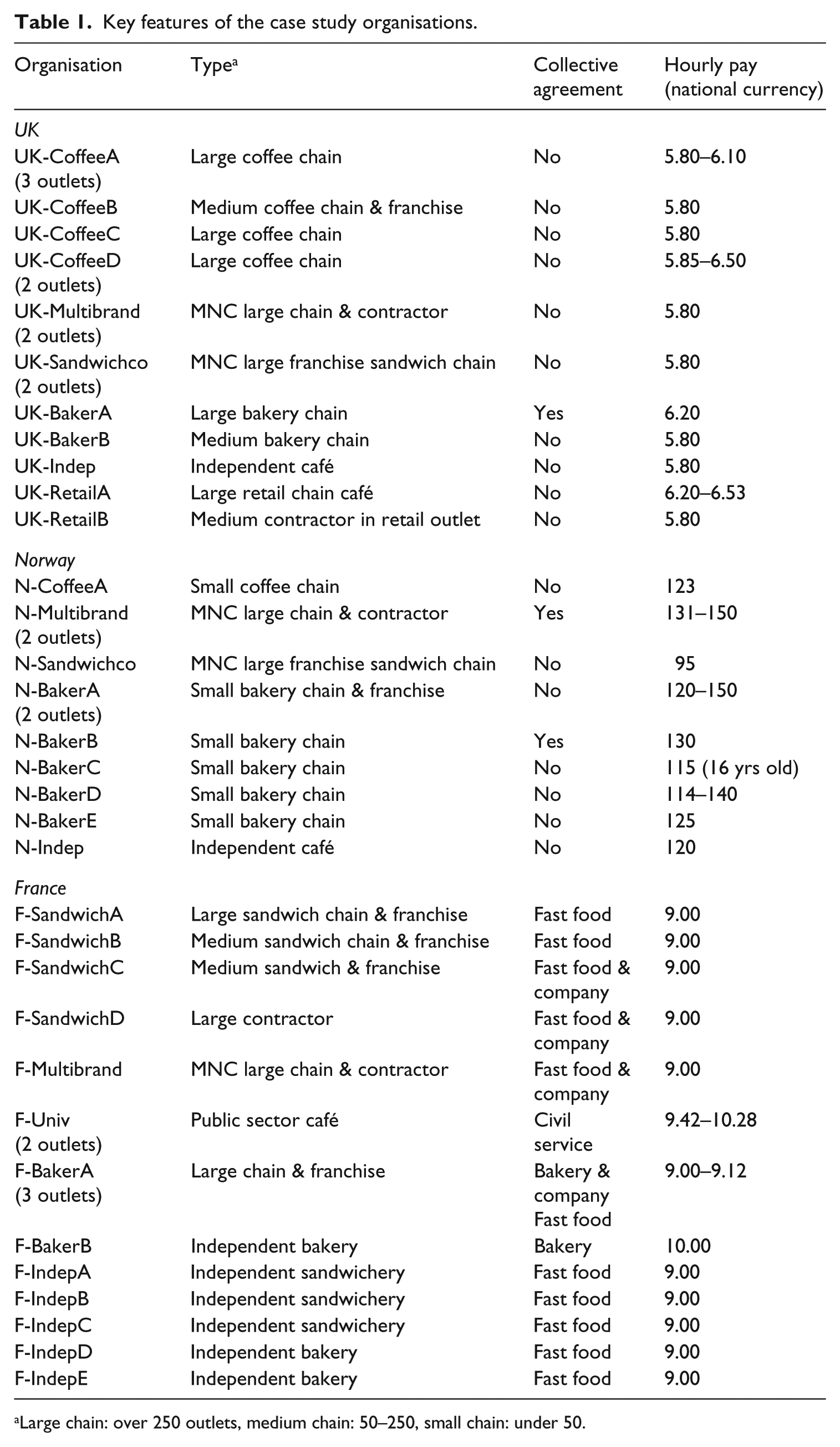
Large chain: over 250 outlets, medium chain: 50–250, small chain: under 50.
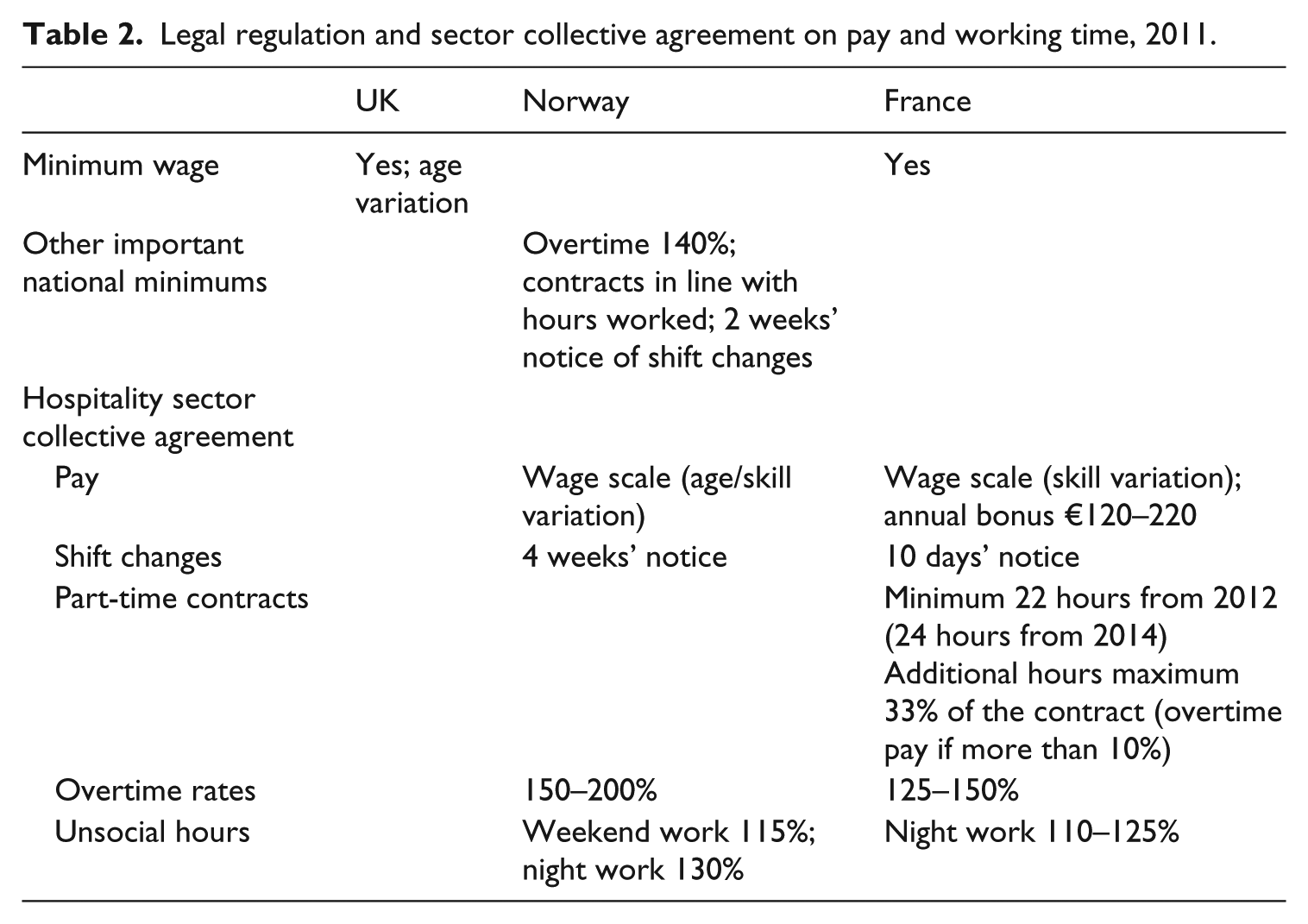
Pay and working time institutional structures
In the UK, there is no sector collective bargaining covering hospitality. Employees working in cafés may have their pay and conditions determined by company or workplace collective bargaining but this is extremely rare. As with hospitality in general, the overwhelming majority of workers rely on national legal rights for protection. For pay, this is the national minimum wage, which, since its introduction in 1999, has been set at a relatively low level. In relation to working time, there are no additional rights for unsocial hours payments or overtime, and no legal regulations specifying that an employment contract must reflect actual hours worked. The only legal constraint on scheduling is the European Working Time Directive, which covers rest periods and the maximum length of the working day.
In Norway, employment law derives primarily from the Work Environment Act (Arbeidsmiljøloven), which encodes the rights of individual employees, along with rules governing collective relationships. Collective bargaining is the main mechanism to determine pay and conditions. Consequently, the Act provides no statutory minimum wage and only limited rights in relation to working time; contracts of employment must nevertheless reflect hours worked and two weeks’ notice is required prior to scheduling changes. The hospitality collective agreement between Fellesforbundet/LO (Landsorganisasjonen i Norge) and NHO Reiseliv/NHO (Næringslivets Hovedor-ganisasjon), which covers the café industry, provides higher levels of protection but is only binding on companies that are signatories. 6 The agreement sets a minimum pay rate, or ‘tariff’, for an unskilled adult worker at 128.32 krone (2010–2012), a relatively low rate in Norway. It also establishes rates for overtime, unsocial hours and public holidays. Workers must be provided with their work schedule four weeks in advance and receive two months’ notice prior to changes.
In France, the Code du travail is the basis of employment law and provides minimum standards, with the sector agreements building upon them. Employment contracts must reflect hours worked, with restrictions on the number of additional hours part-timers can work. All cafés are covered by either the ‘fast food’ or the ‘bakery’ collective agreement. Most are in the ‘fast food’ sector where agreements are concluded between the employers’ body, SNARR (Syndicat National de l’Alimentation et de la Restauration Rapide), and the five main trade unions in the sector. 7 Legal extension mechanisms mean all workers are covered, with pay at entry level broadly in line with the national minimum wage (SMIC). Since 2011, the fast food agreement has provided additional pay for night work, and a small tenure-related annual bonus. Employers must provide at least 10 days’ notice for changes to schedules. Since 1998, contracts must be at least 20 hours a week unless a worker requests less, increased to 22 hours in 2012, and 24 hours in 2014. The bakery agreement is slightly more generous, particularly in relation to payment for unsocial hours. Table 2 provides an overview of the main regulations in the three countries.
Legal regulation and sector collective agreement on pay and working time, 2011.
Pay in the workplace
Café work is a low paid job in all three countries, although there are important national differences. In the UK and France, national minimum wages are central to pay determination, while in Norway, the sector collective agreement acts as a ‘going rate’. Comparing across the three countries, using purchasing power parity, the UK minimum wage is lowest, with the French minimum wage (SMIC) 30% higher and the Norwegian collective agreement minimum tariff 70% higher (see Table 3). France has one of the highest statutory minimum wage rates in Europe. Even with the introduction in 2015 of the ‘National Living Wage’ in the UK, in effect a higher minimum wage for the over-25s, the gap with France for this age group has only narrowed to 22% (WSI, 2017). These types of pay comparisons, however, take no account of non-wage benefits, such as pensions, sick pay and subsidised childcare. It is therefore useful to examine wages in relation to national pay structures. In 2011, the UK was in the worst position, with the minimum wage at 52% of median earnings, compared to the SMIC at 63% in France and the collective agreement at 62% in Norway. 8
Café worker pay in the case study organisations.
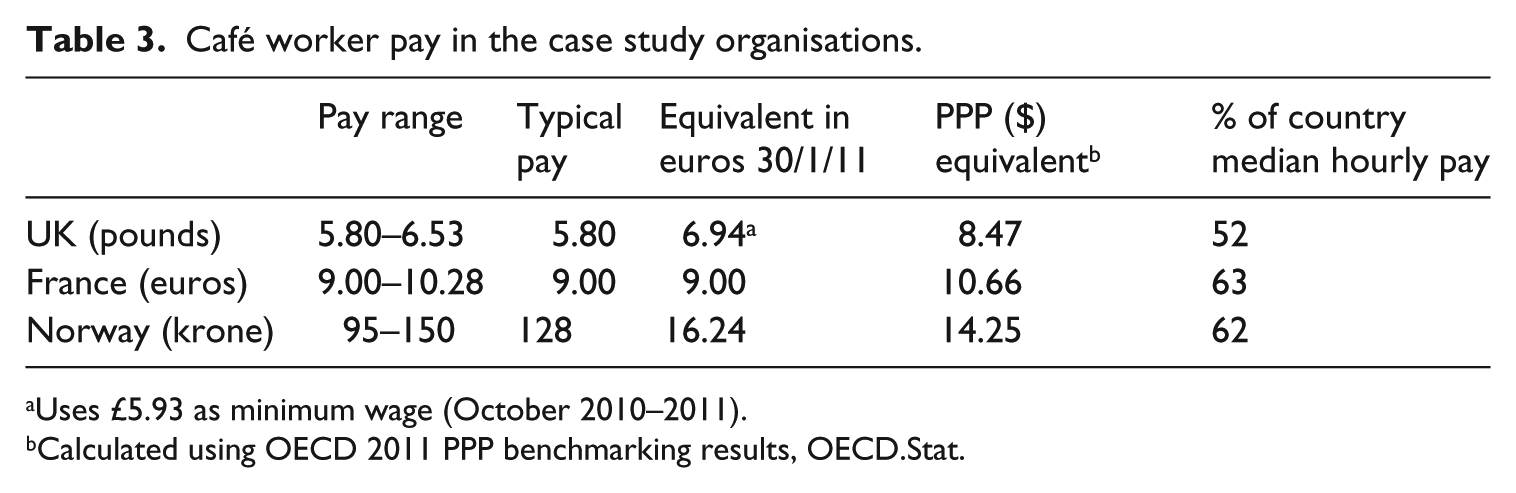
Uses £5.93 as minimum wage (October 2010–2011).
Calculated using OECD 2011 PPP benchmarking results, OECD.Stat.
Notwithstanding these national differences, how much variation is there in pay among café employers in each country? The expectation was that the UK would show the greatest variation and France would be the most standardised. Data for the highest paid café assistants found in each outlet are shown in Figure 1. In order to compare across the countries, pay is represented as a percentage of the national minimum wage in the UK and France, and of the sector minimum tariff in Norway. Although the data cannot be claimed to be representative of the industry, they provide an indication of the spread of pay across organisations.
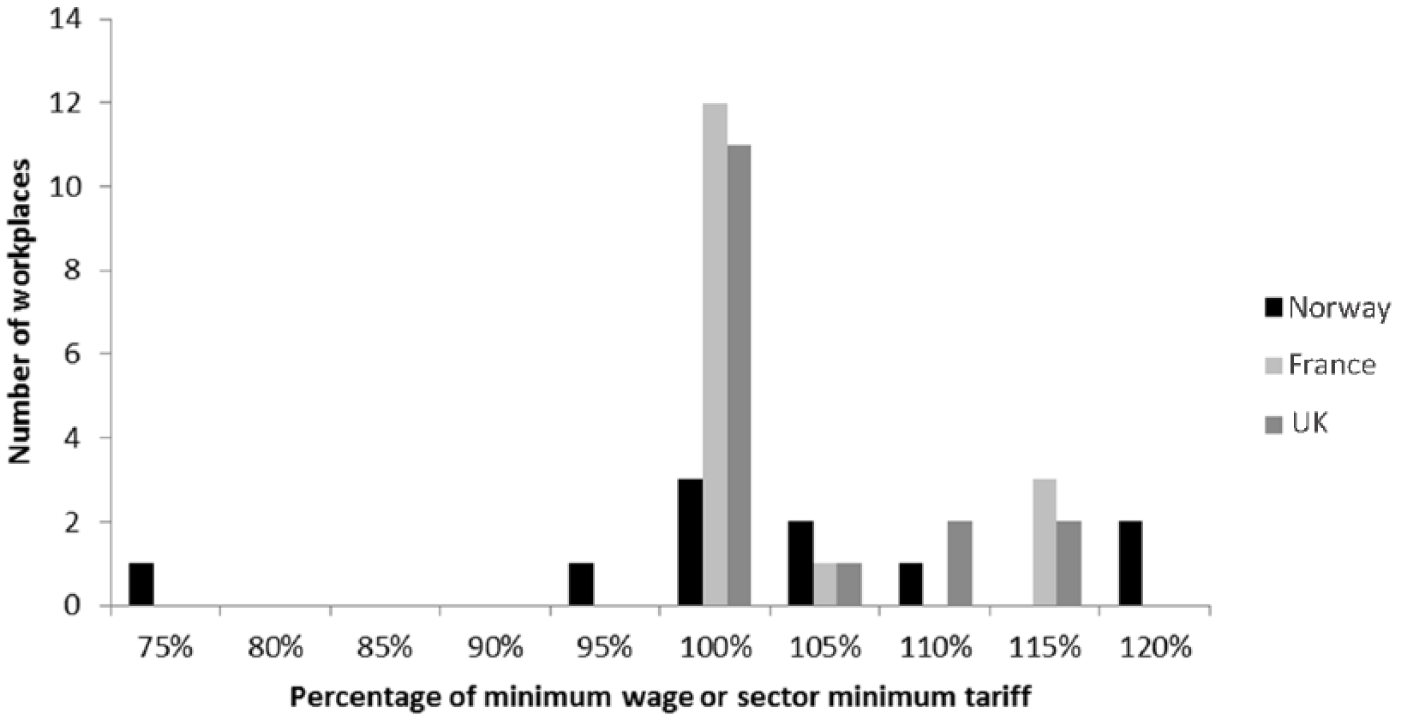
Pay distribution of highest paid café worker in each case study outlet by country.
In France, there is considerable uniformity across organisations. In all but one (an artisanal bakery where pay was 10% higher), pay was set at the level of the collective agreement (fast food, bakery) or the higher civil service pay scales. These findings indicate the importance of the sector collective agreement in establishing the ‘going rate’. In fast food, the minimum rate in the collective agreement tracks the SMIC, with unions having little success in increasing pay beyond this. High turnover and a preponderance of young workers and students present challenges for union organisation, as a CGT (Confédération Générale du Travail) union official acknowledged: There is a high turnover which is very hard. There is the fact that unions are not necessarily very comfortable with young people … [and] particularly in fast food, there is a lot of union repression, and as soon as we have a rep who is a bit efficient, in general, they are shown the door.
Although the SMIC is set close to the low pay threshold, many interviewees pointed out that the wage is still extremely difficult to live on, given the spiralling cost of rent and other bills. A café worker remarked: After 30 if you don’t get a higher position, you can’t have a life. Hours are demanding. Even if you like the job, you can’t make a family with it, the level of pay as well. (Thomas, F-SandwichC)
The only substantive pay differences, apart from the artisanal bakery, were in two of the larger organisations with company collective agreements where unions had secured annual profit-related bonuses and ‘13th month’ payments. 9
For the majority of workers in the UK, pay was set at the national minimum wage. Five outlets (four organisations) paid higher. One of these (UK-BakerA) was the only unionised organisation and collective bargaining at company level had raised wages to around 7% above the minimum wage. The higher pay in UK-RetailA reflects the pay levels that are more typical in the retail sector. The other two organisations saw UK-CoffeeA paying some workers in one outlet around 5% higher, although other outlets paid the minimum wage. These differences reflected the relative success of the specific outlet and a tight local labour market. UK-CoffeeD was the exception, paying up to 12% above the minimum wage. Its product market position was not significantly different from a number of the other organisations in the study but the company had a widely publicised strategy of paying above the statutory minimum.
None of the outlets found any difficulties in recruiting new staff at minimum wage levels. This was despite the minimum wage not providing a ‘living wage’ (Padley and Hirsch, 2017) and workers’ frequent complaints: It’s pretty rubbish. Yeah, it’s not good. I think we work harder than our pay indicates. (Karen, UK-RetailB) It’s disgusting. I’ve got two children and a mortgage and I have to work for minimum wage and it’s hard work … You are so undervalued. (Laura, UK-CoffeeC)
Only one organisation (UK-RetailA) provided any premium payments for unsocial hours (working on Sundays), a practice that has largely disappeared from the retail sector. Café assistants at UK-Multibrand, for example, worked nights for the minimum wage, a situation not legally permissible in Norway or France.
Contrary to expectation, the widest spread of pay was found not in the UK but in Norway, where there is no statutory minimum wage or legally enforced sector pay agreement. Of the nine companies in Norway, only two had signed collective agreements. The union found it difficult to recruit members partly due to the large number of small employers and a predominantly young and transient workforce: … one of our biggest problems with this group is our difficulty to get collective agreements because they are young … they are moving from one place to the other … It would be too much work to try to organise. (Union official, Handel og Kontor i Norge [HK])
At N-Multibrand, a large MNC, unions had been more successful with a company agreement providing hourly wages up to 20% above the sector tariff, enabling the highest paid café assistants to be above official definitions of low pay. Most other organisations paid around the level of the sector tariff. Several managers reported that they felt this was necessary to retain staff, as one from N-BakerA explained: Because I want to have this good feeling that I pay my employees for what they do, and I want them to be happy or else they may go somewhere else.
Union officials confirmed that retention was a problem but added that organisations also followed the tariff to avoid union organising drives. Having to make pension contributions and paying supplements for unsocial hours were cited as the main reasons why employers did not want to sign the collective agreement. Three out of seven non-signatories still made some additional payments for weekend working, albeit at a lower rate than the collective agreement. The one outlier in relation to pay was N-Sandwichco, a low cost, low quality franchised sandwich chain where pay was 75% of the sector tariff. According to the union, franchise organisations were the most difficult to organise. Recruitment was possible although the outlet only employed part-time student workers and, at the time, unlike other cafés, these were all from minority ethnic backgrounds or less developed overseas countries. There is evidence to indicate a substantial increase in workers with a foreign background in the hospitality sector, rising from 28% in 2008 to 43% in 2015, with these workers more likely to be paid below the collective agreement tariff (Tariffnemndas, 2017).
Pay was not considered a major issue for most workers in the café sector in Norway, primarily because the role was almost exclusively filled by a student or young person on a ‘gap year’. Interviews with those solely reliant upon the income suggest that even though pay is low, it provides a wage that is still possible to live on, if only modestly. One manager explained how the expectation was that pay would be higher for older workers because ‘when you are 30, you have like a home, maybe children’ (manager, N-BakerB). Café assistants pointed out that better pay rates were available in supermarkets, which, as larger employers, were more likely to be covered by collective agreements and offer additional pay for unsocial hours. A café worker, who was paid 15% above the sector tariff, noted that, ‘You can get the same as a janitor, actually you can get more! There’s nothing special about the pay’ (Abdella, N-Multibrand).
The evidence indicates that while national minimum wages provide a floor in France and the UK, it has become the standard industry rate. There are few variations, with the exception of some small-scale increases paid by a couple of employers, which suggests little pursuit of ‘high road’ approaches to pay. In Norway, although most employers were not formal signatories to the sector collective agreement, most workers in the study were paid within 10 krone of the hourly tariff. However, lack of inclusivity of pay-setting arrangements left some workers with pay well below 50% of the median. A key feature is that where unions are organised at company level they make some difference in all three countries.
Control over working time
As indicated in the earlier section, there are different national regulations in working time as well as sector collective agreements in Norway and France. In all three countries, cafés are subject to variation in customer numbers over the day and week. However, unlike other areas of hospitality, cafés outside of the transport sector typically open only during the day, although many open over the weekend. Given different national regulatory constraints, how much variation is there in the type of contracts offered and in stability and predictability of workers’ hours?
The lack of regulation in the UK was associated with the greatest diversity in approach from employers. Four companies provided relatively stable patterns of employment with full-time contracts or fixed part-time contracts and shift systems that were the same each week or rotated on a regular basis. These organisations tended to recruit a wider range of employees in terms of age, although most were women with school-aged children. Use was also made of students for weekend work and occasional overtime. Across the other seven organisations, full-time contracts for café assistants were rare. Instead, workers were typically employed on part-time contracts of between 12 and 20 hours, with managers offering additional hours according to business need. In several cases, employees were frequently working full-time even though their contracts specified part-time hours. Most of these organisations also adopted a system where rotas were completed weekly. The number of hours and shift patterns could vary each week, while there were also changes ‘as and when’.
These flexible employment practices were most apparent among the relatively new café chains which tended to recruit younger workers and students, including many male workers. UK-CoffeeD stood out in terms of paying a higher wage but provided little security in working time and had cut the length of shifts to remove breaks. Students tended to be relatively accepting of such practices, and most local managers were responsive to their individual scheduling requirements. However, for older workers, those with children or with no additional source of income, the fluctuation in the number of hours was problematic. At UK-Multibrand, as part of a cost-cutting exercise, all full-time café workers were moved onto part-time contracts, with the promise of additional hours when available. Malika had been forced to accept this change, explaining that she then faced volatility in weekly hours: ‘I wasn’t happy at all because you’ve got bills to pay and stuff like that.’
This ‘manager-controlled flexible scheduling’ (Wood, 2016: 1991) raised specific issues for workers who were required to work a minimum number of hours per week to qualify for certain statutory in-work benefits: … it makes me angry … I don’t enjoy the job because it’s not stable. I want a full-time job, I want to know what I get every week and I don’t. (Amber, UK-CoffeeC)
At UK-BakerB, UK-CoffeeA, UK-CoffeeC and UK-Sandwichco, managers responded in various ways to tight targets on budgets, including sending workers home early without paying to the end of the shift, requesting they remain after their shift had finished, calling them to come in early or on a day off or not to come in at all. As one manager explained: ‘if I’m not making that budget, I can send people home early … and if I’m exactly that budget I can call people in earlier’ (UK-CoffeeA).
In France, the study found greater similarity among employers’ working time practices. Interviews with the employers’ organisation SNARR and the CGT union agreed that the fast food sector was dominated by part-time working, which was ‘imposed on certain workers and wanted by others’ (CGT). Other studies (e.g. Nkuitchou Nkouatchet, 2005) indicate a relatively precarious experience in the fast food sector, and data show very high levels of involuntary part-time work across France (44% compared to 14% in the UK [Eurostat, 2018]). In 2014, the Hollande government introduced a national 24-hour minimum week for part-time contracts and a tightening up on ‘exclusions’. 10 The cafés in this study appear somewhat different. The interviews suggest companies use a mix of contracts, with full-time permanent work available in most outlets, alongside the use of students on part-time contracts and summer temporary contracts. A number of organisations also employed young workers without BAC-level (baccalauréat) qualifications on training contracts (contrats en alternance). Unlike the UK, there was little use of additional hours worked for part-timers.
Work schedules in France were relatively stable. The larger organisations that operated in the airports had to cover periods late into the night and, therefore, used rotating shift patterns. Most of the other organisations gave workers the same shifts each week. There was little evidence that employers made extensive use of flexible scheduling, with some workers instead complaining of being unable to modify hours and fix schedules to suit their preferences. As one explained: ‘I work the mornings … I haven’t a choice’ (Nicholas, F-SandwichA), although his manager was flexible when it came to ad hoc changes. Others commented that managers rotated shifts, but the schedule was ‘rigid and fixed’ (Elodie, F-SandwichD). Opportunities to negotiate individually improved the longer workers were in post. At F-Multibrand, Christelle had secured more preferable hours to fit around childcare arrangements and Emilie at F-IndepE commented that ‘with seniority, they more or less listened to what I could do’. Full-time work was the main core of the workforce in nearly all these organisations. Weekend work and additional shifts at peak periods were mainly covered by students or by organising overlapping shifts in the middle of the day.
In Norway, the data reveal two main approaches to employment contracts. One group of outlets employed both full-time and part-time workers, while others relied only on part-timers. The employers that only used part-time workers included the lowest paying organisation, which competed on cost, and two small, upmarket bakery chains that paid in line with the collective agreement. Product market strategy, therefore, does not appear to have any significant bearing on employers’ use of part-time working. Part-time workers were invariably school and university students, while full-timers were predominantly young workers (mostly female) taking time out from studying. A substantial proportion of these full-timers were from Sweden, attracted by higher wages. Some part-time workers took on additional hours but there was no evidence of pressure to work them or a desire for longer hours. A student working part-time at N-CoffeeA commented how her manager would ask her to do an extra shift: ‘I’m flexible with the time, and sometimes I want to earn more money … but if I do have much on at school … I just say sorry’.
Some students switch to working full-time during vacations without necessarily changing their contracts. One ex-student at N-Multibrand remained on a 0.2 contract despite working full-time hours. However, there was limited evidence of these practices across the companies. While some workers had fixed hours each day, others worked on rotating shift systems, normally scheduled four weeks in advance. The biggest contrast with the UK was that full-time workers typically worked Monday to Friday, with some working very occasionally at weekends or at most one weekend in four. Saturdays and Sundays were normally covered by part-time students. As one full-time worker explained: ‘I do step in if someone is sick or I need the extra money’ (Eva, N-BakerA). Overall, there were few complaints about hours worked or the organisation of rotas. As one worker noted: ‘When I was new I worked a lot of late shifts and I didn’t like that so now I have worked here for a long time I’ve been working more early shifts’ (Lisa, N-Multibrand).
In Norway, a national union officer with Fellesforbundet stated that many employers flout the regulations and evidence from the Labour Inspectorate supports these claims (Tariffnemndas, 2017). The main area where café workers asked for union assistance was said to be in obtaining ‘more hours’: … even though they don’t have a collective agreement … we force [the manager] to make a schedule … you will not be able to just send people on the break or send people home because you see that it is less people [customers] coming in that day. (Union official, Fellesforbundet)
There was no evidence from the cases of these type of practices, suggesting that they may be more common in other parts of hospitality.
In France and Norway, there is predictability in the scheduling of work and the number of working hours in each week. However, this did not mean all workers were on the same type of contract. Variability did exist, reflecting the needs of employers but also the availability in the local labour market of a student workforce in both countries and low qualified young people in France. The evidence indicates no systematic differences in approach due to product market position or organisations with active trade unions. In the UK, conditions were much more variable and some employers were making full use of their freedom to decide working time practices in their favour.
National, sector and organisation interactions
How do these findings from the café industry contribute to analysing the role of national institutions, sector and organisation in shaping pay and working time outcomes? Wages in all three countries are towards the bottom of the pay hierarchy, although national differences emerge in relation to the level of ‘the bottom’. Compared to the UK, French café assistants benefit from a higher-level minimum wage and a mechanism for up-rating indexed to inflation and average wages. Norwegian café workers receive the highest pay in real terms, with relative pay similar to France, as most employers conform to the collective agreement rates in the context of a tight labour market.
Some Norwegian café workers, however, were falling through the gaps, which reflects the problems of relying on collective agreements in a sector where union organisation remains difficult. Subsequent to this study, the main national union confederation, LO, submitted a case to the Tariffnemndasin (Tariff Commission), for the extension of collectively agreed minimum rates to all workers in the sector. Despite employer opposition, this became law in 2018, with a minimum rate of 157.18 krone (or 64% of the median) for adult workers. This indicates the power that unions can still exert in a sector such as hospitality where the national system is supportive of trade unions and provides effective channels for voice and influence.
There was also evidence of national institutional effects in relation to working time and scheduling. It seems that legislation in France and Norway has been the primary factor in ensuring the security and predictability of working hours. In France, the Code du travail and the legal extension of sectoral agreements provide an inclusive platform of rights, which employers in the café industry generally appear to follow. This may indicate a certain amount of ‘societal normality’ of the legislation (Lehndorff, 2014), although the recent introduction of further national restrictions on part-time working indicates broader problems of enforcement. These findings support Berg et al.’s (2014) categorisation of France as representing the ‘mandated’ model. However, the ‘negotiated’ configuration does not appear to apply to the Norwegian café sector, where many workers fall outside of the collective agreement and rely on weak provisions in the Work Environment Act and unilateral employer discretion. Although legal requirements seem to be followed by cafés in this study, there are many breaches in the wider hospitality sector. In the UK, evidence signals a ‘unilateral’ employer approach, with a shift towards more insecurity and variability in contracts, leading to workers having the most difficulty in securing adequate incomes and stability in work–life balance.
Given the weakness of national regulations and sector collective bargaining in the UK, we might have expected the organisational level to be more important in determining pay and working time outcomes than in Norway and France. Figure 2 offers a visual representation of the extent of variation in pay and working time outcomes among cafés in each country. In relation to pay on the vertical axis, differences are greatest in Norway. This reflects the success of trade unions, at the top end, achieving company collective agreements above the sector tariff, and at the bottom end, the ability of a ‘low road’ employer to pay below the ‘going rate’. The evidence indicates that there is room for these different types of employers in Norway, with little sign that the ‘low road’ employer – also a low cost competitor – was threatening the viability of other more quality-based organisations. The space for a range of service offerings may explain the unwillingness of the employer organisation in this sector to support the extension of the collective agreement. In comparison, in the cleaning sector, large employers were threatened by low paying contractors and supported extension (Torvatn, 2011).
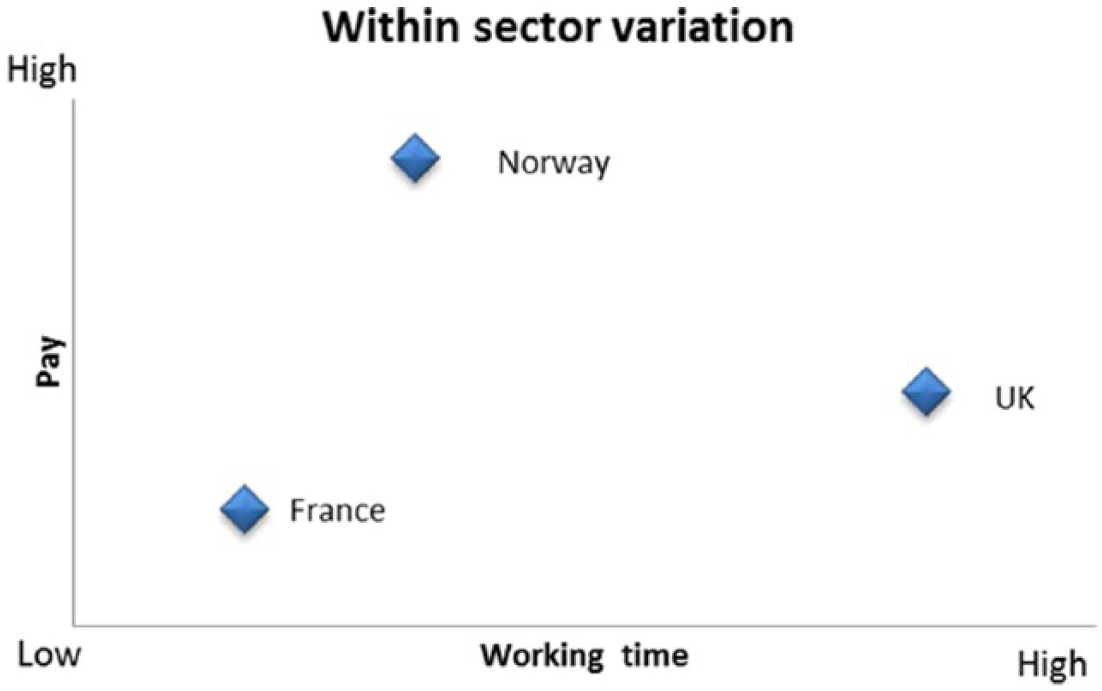
Variation within the café industry in pay and working time practices.
Pay variation among cafés was lowest in France, and fairly limited in the UK, reflecting the centrality of the national minimum wage to pay determination in both countries. There is little evidence that product market strategy makes a significant difference or that there are many employers pursuing ‘high road’ approaches to job quality. Trade unions appear to play a greater role than employer ‘strategy’ in accounting for differences in pay. The impact was primarily felt on basic pay in the UK (7% above the minimum wage) and on ‘13th month’ payments in France (adds over 8% to the minimum wage). Although no problems of enforcement were found in the case study organisations, there is other evidence of illegal underpayments in hospitality organisations in the UK (DBIS/DHSC, 2015).
Working time practices, shown on the horizontal axis of Figure 2, were relatively homogeneous in France where organisations conform to strong legal mandates. There was slightly more variation in Norway, related primarily to payments for unsocial hours working. Organisational differences were far greater in the UK, where weak legal regulations are consistent with a variety of employer approaches. More long-standing organisations still provide relative stability, while newer, rapidly expanding coffee shop chains adopt more insecure working time practices. These chains were generally operating in the mid-market and not competing on low prices. All but one organisation was performing well financially, indicating that their use of variable hour contracts and short-notice shift changes was more about maintaining profit margins than survival.
Conclusion
The findings from the café industry in France, Norway and the UK reveal that while the sector is an important analytical category, national institutions and regulations remain significant in shaping pay and working time outcomes. Even where the dominant national mode of regulation is lacking in a sector, the example of Norway shows how legal rights, social norms, welfare protections and a tight labour market can provide some compensation for gaps in collective bargaining arrangements. While the sector exerts many common pressures on organisations, the research indicates that they do not have to overwhelm the possibility for more progressive outcomes even in what is considered an unpromising environment.
Furthermore, the findings question any assumption that there might be greater scope for employer choice as a lever for significant improvement in countries where regulatory standards are weaker. Business strategy may make some difference within a country but for sectors where work is designed around relatively low skilled jobs, gains may prove marginal. In all three countries in this study, unions were more important for enhancing pay and, to a limited extent, improving working time practices. However, in most cases, trade unions are absent from these types of workplaces. Significant gains, therefore, rely predominantly on the power of trade unions and other groups to exert pressure at national level through state policy. Examples include the legal extension of collective agreements in Norway, which adds to, rather than departs from, the national approach to labour market regulation, and the tightening of legislation in relation to part-time work in France.
Indeed, progress is more likely when working with the grain of existing national institutions and traditions. In the UK, enhancing the level of the national minimum wage (building on the recent introduction of the ‘National Living Wage’) would face less employer opposition and not require any institutional or regulatory change, compared to legislation for sectoral collective bargaining. Nevertheless, the role of state regulation remains essential not just to improving pay but, perhaps more significantly, to working time arrangements in poorly organised sectors. Berg et al. (2014: 834) stress ‘the limitations of mandating working-time practices by the state when labor unions and other worker representatives are weak’. Although this argument has merit in emphasising the need for effective workplace enforcement, in some contexts there may be no other option.
These findings, however, only relate to one part of one sector. With the exception of one or two studies (e.g. Gautié and Schmitt, 2010), there is little systematic comparative research on pay and working time outcomes in the broader hospitality, retail and business service industries where some of the worst conditions have been reported. Problems with the enforcement of legal rights may be more prevalent in other sectors or occupations, where further research would be welcome. It is clear that improving job quality in these types of sectors is not easy and requires a greater focus on exploring effective ways of influencing state policy to support both progressive regulation and union organisation.
Footnotes
Declaration of conflicting interests
The authors declared no potential conflicts of interest with respect to the research, authorship, and/or publication of this article.
Funding
This research was funded by the Economic and Social Research Council (Grant / Award Number: ‘RES-557-28-5003’).
