



Abstract
This article analyses the function of temporary sponsored skilled migrants in Australian hospitality, an industry with acute difficulties attracting and retaining skilled workers. Drawing upon survey data, the findings indicate that rather than utilising temporary sponsored skilled migration to source hard skills, as assumed within the extant literature, employers’ recruitment practices are motivated by a desire to source soft skills and labour perceived as relatively controllable, productive and reliable. In explaining these findings, the article develops new insights regarding the dependence of temporary sponsored skilled migrants on their employer sponsors and the industry effects of hospitality. These factors make these workers a relatively more attractive source of labour and shape the nature of employer demand.
Introduction
Temporary labour migration schemes have become an established feature of labour and skills supply in many OECD countries, particularly in industries characterised by chronic recruitment challenges (Bauder, 2006). Scholarship on temporary labour migration mainly focuses on issues relating to: the drivers of migration including diasporas, personal networks and other factors motivating individual decisions to migrate (e.g. Boswell, 2003); its impact on the receiving country’s labour market (e.g. Simon, 1999); and the problems that temporary migrant workers often experience relating to labour market segmentation, mistreatment in the workplace and barriers to accessing labour rights (e.g. Anderson, 2010; Fudge, 2012). There is also a distinct literature examining employer motivations for recruiting temporary migrant workers, particularly in lower-skilled occupations and labour market segments characterised by weak labour standards enforcement and low occupational barriers to entry (e.g. Krings et al., 2011; Ruhs and Anderson, 2010; Waldinger and Lichter, 2003). A common finding of these studies is that employers are motivated to recruit migrant workers as a means of lowering their unit labour costs, either directly by underpaying migrants or indirectly because of their perceived high productivity.
With few exceptions (e.g. Baum, 2007; Lucas and Mansfield, 2010), this literature has not extended to hospitality, particularly outside of the European context where free mobility of labour gives workers greater agency to leave employers, which diminishes the incentives to tolerate exploitative employer behaviour (Dauvergne, 2016). Additionally, extant research on migrant labour in hospitality has focused predominantly on lower-skilled rather than higher-skilled migration (Baum, 2007). Higher-skilled migrants are those explicitly engaged to perform roles requiring tertiary or equivalent level ‘hard skills’ in the form of vocational qualifications (Howe, 2013). Moreover, aside from smaller scale studies (Velayutham, 2013), there has been little examination, both in hospitality research and more generally, of employer-sponsored visa schemes, despite them becoming a key focus of recent policy developments in many countries (Chen and Ward, 2013; Wright et al., 2017). Indeed, the paucity of empirical evidence has led researchers such as Bahn (2013: 54) to argue that further research related to the recruitment of temporary sponsored migrants in hospitality ‘should be a priority’.
The central research question of this article is: why have employers in the Australian hospitality industry extensively engaged temporary sponsored higher-skilled migrants to address perceived skill needs? In addressing this question, we make three key contributions. First, we address the research gap relating to the nature of demand for higher-skilled migrant workers in hospitality, given that the extant scholarship on this industry focuses mainly on migrant workers in lower-skilled occupations (e.g. Baum, 2012; Lucas and Mansfield, 2010).
Second, we critically examine the nature and extent of employer demand for both ‘hard’ and ‘soft’ skills (Hurrell et al., 2013; Nickson et al., 2012), which has received minimal scrutiny with respect to temporary migrant labour. Hard skills entail technical or craft-based competence and knowledge (Lloyd and Payne, 2009; Vallas, 1990), and are associated with ‘vocational shortages’ (Montague, 2013). By contrast, soft skills, which are associated with ‘capability shortages’ (Montague, 2013), entail non-technical interpersonal and intrapersonal abilities that facilitate performance desired in particular social contexts (Hurrell et al., 2013). Soft skills include emotional labour that demands social and interpersonal skills and aesthetic labour that demands looking, sounding and behaving in a manner that is appropriate or desirable to the job and the expectations of employers and customers (Hochschild, 1983).
Third, the article scrutinises employer motivations for using sponsored or tied visa schemes regulated according to employer demand. Several recent studies have found that immigration policies expanding the supply of labour can influence the strategies employers use to address their labour needs (e.g. Clibborn, 2018; Haakestad and Friberg, 2017; Refslund, 2016). However, the operation of employer sponsorship arrangements has received minimal scholarly attention despite being adopted widely in many OECD countries (Wright et al., 2017). Moreover, there has been no specific previous research on hospitality employers’ motivations for using temporary sponsored skilled visa schemes. Because these schemes tie workers to an employer sponsor, they potentially constrain a sponsored worker’s agency in ways likely to make them more attractive to prospective employers. This potentially influences employers’ strategies for addressing their skills needs and the nature of employer demand more generally.
The remainder of this article is structured as follows. The next section reviews literature related to skill shortages and temporary labour migration, with a particular focus on their relationship in hospitality. Context, methods and data are then outlined, followed by the research findings. Finally, we discuss the significance of our findings and explore their implications for scholarship and policy.
Literature review
Skill shortages and temporary labour migration
Training and immigration are the ‘only two ways for a nation to secure an adequate supply of skilled workers’, according to Toner and Woolley (2008: 48). Temporary sponsored migration in particular has become an increasingly important source of skills supply, especially in liberal market economies including Australia (Oliver and Wright, 2016). This reflects a wider trend among employers in these economies to ‘buy’ skills through external labour markets, including via work visa programmes, rather than ‘build’ them internally through formalised training and structured career pathways (Bosch and Charest, 2008; Keep and Mayhew, 2010; Krings et al., 2011). With employer-sponsored temporary migration schemes advocated as an efficient and reliable mechanism for matching labour supply to employers’ immediate needs (Papademetriou and Sumption, 2011), recruiting trained workers, including on skilled visas, can be seen as a rational strategy for addressing skills demand. In some cases, immigration policy reforms enabling growth of temporary sponsored visas have served to address deficiencies in vocational education and labour market policies for meeting skills needs (Afonso and Devitt, 2016; Wright, 2012).
In this context, there has been surprisingly little scrutiny among policymakers about the nature of the skills such policies are designed to address. This is despite the complex ways in which skills are ‘developed, recognised and valued’ (Bryson, 2017: 17). Traditionally, the development and recognition of skills focused on technical or ‘hard’ skills, reflecting certified abilities and knowhow, typically based on qualifications, accreditations and/or apprenticeships (Warhurst et al., 2017). However, a more recent trend involves greater focus on interpersonal, behavioural or ‘soft’ skills, which are commonly defined as personal capabilities and attributes that are often difficult to certify (Hurrell et al., 2013). These include workers’ ability to interact successfully with others, motivation, teamwork, problem solving, resilience and customer focus (Bolton, 2004; Grugulis et al., 2004). Some have argued that soft skills are not skills per se but rather personal traits, characteristics, attributes or competencies (Lloyd and Payne, 2016). Nevertheless, there appears to be growing scholarly consensus that soft skills are important (Bryson, 2017; Warhurst et al., 2017), particularly for allowing workers to utilise their qualifications or technical knowledge productively (Green et al., 1998). According to Warhurst et al. (2017), this increasing focus on soft skills is associated, at least in part, with a sectoral shift towards services.
In many countries, the definition of skills that underpins policies designed to address skills shortages relates to hard skills, that is, ‘vocational’ shortages of workers possessing qualifications, including formal higher education (Montague, 2013; Oliver and Wright, 2016). Vocational skill shortages are generally defined as an inability or difficulty to fill vacancies for an occupation, or specialised skills related to an occupation, at prevailing levels of remuneration and conditions in reasonably accessible locations (Healy et al., 2015). In comparison, ‘capability’ shortages exist when employers have difficulties recruiting for job vacancies that may or may not require qualifications or a specific level of skill or experience as a result of inadequate or insufficient soft skills (Hurrell et al., 2013).
Much of the scholarship on temporary labour migration has focused on migrants engaged in low-paid occupations that are typically defined as lower-skilled, in the sense that these occupations require minimal hard or vocational skills. Several studies have focused on employer motivations for recruiting temporary migrant workers for these positions. According to Piore (1979), these employers seek to recruit workers that they can control and dispense with easily, characteristics that are often associated with new temporary migrants due to their relative lack of knowledge of and social connections to the local labour market. Migrants from poorer countries have a dual frame of reference which means, because working conditions are generally superior to what these workers would receive in their home country, they are often more likely than non-migrants to tolerate lower wages and insecure employment, and to not complain if mistreated (Piore, 1979; see also Clibborn, 2018). These arguments are echoed in several other studies which find that the main motivation of employers for recruiting migrant workers is to increase control as a means of reducing or containing unit labour costs (Bauder, 2006; Castles and Kosack, 1973; McDowell et al., 2008).
Other studies have attributed employer demand for recruiting lower-skilled migrant labour to a desire to address capability shortages in the form of certain personal competencies and behavioural traits. For instance, in their study of the Irish construction sector, Moriarty et al. (2012) find that employers favour migrants who are seen to have a superior work ethic compared to local workers. Employer perceptions that migrant workers are more motivated, harder working and more willing to work long hours or in difficult conditions is also a common finding among studies of lower-skilled occupations in liberal market economies such as the US and the UK (e.g. MacKenzie and Forde, 2009; Ruhs and Anderson, 2010; Waldinger and Lichter, 2003), including those focusing on the hospitality industry (Lucas and Mansfield, 2010). While some studies associate these characteristics of migrant workers with ‘soft skills’ (e.g. Moriarty et al., 2012), Ruhs and Anderson argue that soft skills need to be distinguished from ‘attributes and characteristics that are related to employer control over the workforce’. While soft skills can allow hard skills to be utilised more effectively (Green et al., 1998; Mitchell and Quirk, 2005), they are distinct from behaviours, qualities and attributes that employers may find ‘desirable because they suggest workers will be compliant, easy to discipline and cooperative’ (Ruhs and Anderson, 2010: 20).
Aside from some exceptions (e.g. Collings et al., 2009; Guo and Al Ariss, 2015), there is a lack of research on employer motivations for recruiting higher-skilled migrant workers, especially in the hospitality industry. However, studies of the temporary sponsored skilled visa scheme in Australia operating in other industries are instructive, which find that hard skills shortages are the most significant motivating factor for employer sponsorship. One study of the mining industry identified a lack of specialised vocational skills and low geographical mobility among potential local candidates as the main reasons why employers recruit temporary sponsored skilled migrants (Bahn and Cameron, 2013). Similarly, two cross-industry studies found shortages of skilled and qualified workers to be the most common reasons for using the scheme (Cameron and Harrison, 2013; Khoo et al., 2007). Only a small minority of employers surveyed for these studies cited reasons relating to capability shortages, increasing control or reducing labour costs.
In sum, the findings of studies focused on employer motivations for recruiting lower-skilled migrant labour are distinct from those focused on higher-skilled migrant labour. The former find employers recruit lower-skilled migrants out of desire to increase control to reduce or contain unit labour costs or to source soft skills to address capability shortages. By contrast, the latter find that higher-skilled migrant workers are recruited primarily to source hard skills and address vocational shortages. Research from migration studies scholarship indicates the relative lack of agency of lower-skilled migrant workers as one reason why employers may see them as easier to control than higher-skilled migrant workers. While lower-skilled migrants tend to have limited options in the labour market and can therefore be expected to tolerate low pay or mistreatment, higher-skilled migrants tend to have scarcer hard skills and are better paid, which increases their bargaining power and capacity to seek better working conditions with another employer (Bauder, 2011; Dauvergne, 2016; Walsh, 2014).
However, this literature tends to overlook several other factors identified within wider migration studies and sociology scholarship that may influence employers’ motivations, particularly when considering employer-sponsored visas. First, the immigration status of migrant workers can influence the recruitment practices of employers (Anderson, 2010; Cangiano and Walsh, 2014). In particular, conditions of dependence that sponsorship arrangements create are important issues to consider, yet remain under-developed in existing research examining temporary sponsored skilled migration schemes, including for higher-skilled workers. The tethering of workers to a single employer under temporary sponsored skilled migration schemes can produce scenarios of ‘hyper-dependence’ (Zou, 2015) whereby the limited capacity for workers to express voice or switch employers can accentuate employer control and exploitation risks (Anderson, 2010; Fudge, 2012). This is particularly the case for migrants seeking transition to permanent residency and citizenship, a pathway provided under some temporary sponsored skilled visa schemes, including in Australia (Wright, 2015). Temporary migrants seeking an avenue to permanent residency are said to be more likely to comply with managerial instructions, to work harder, and to be less likely to speak up in the event of mistreatment (Bauder, 2006).
Second, there are certain industry effects that influence employers’ recruitment practices and motivations for recruiting temporary migrant workers. These relate to the dominant systems of production, the extent of industry skills investment and coordination, the role of social and immigration policies in increasing labour supply, and the strength of trade unions (Fudge and Tham, 2017; Scott, 2013; Wickham and Bruff, 2008). Strong unions can act as ‘beneficial constraints’ to mitigate the effects of skills shortage by putting pressure on employers to improve job quality through greater workforce investment and thereby improve retention (McLaughlin, 2009). In industries where unions are weak, employers may find it easier to recruit temporary migrant workers, and potentially mistreat or underpay them as part of low-cost and control-oriented business strategies (Afonso and Devitt, 2016; Zou, 2015).
Skills and temporary labour migration in hospitality
International literature examining the hospitality industry overwhelmingly reveals ‘bad’ jobs and poor employment experiences that make it difficult for employers to attract and retain workers. Typically, hospitality work entails substandard wages and working conditions, prevalence of non-standard employment contracts, minimal training and career development opportunities and unsafe working environments (e.g. Baum, 2007; EFILWC, 2012; Klein Hesselink et al., 2004; Lucas and Mansfield, 2010). Additionally, such work frequently demands irregular working hours and intensified working conditions (Knox et al., 2015). Other research reveals that even managerial jobs in hospitality involve low pay, routinisation and limited autonomy (Lloyd and Payne, 2016). Subsequently, the industry is widely characterised for its ‘poor’ job quality, which exacerbates recruitment and retention problems and contributes to high turnover (Nickson, 2013). Union representation in hospitality tends to be weak internationally, though there are exceptions to this in certain countries (Vanselow et al., 2010).
Research indicates that hospitality employers often attempt to redress recruitment and retention problems at minimal cost by hiring agency workers (Lai et al., 2008) and/or engaging migrant workers willing to work below prevailing wage rates (Campbell et al., 2016; Knox, 2010; McDowell et al., 2008). Employers’ cost minimisation strategies are associated with cheap mobile labour, over-supply of graduates, an emphasis on cost cutting and higher unemployment, especially among young workers. These strategies have become more prevalent as a result of ‘the shift in the balance of workplace power in favour of the employer’ (Baum, 2015: 209). Moreover, access to low-cost migrant labour, in European countries for example, is said to have exacerbated weak labour markets in hospitality, despite minimum wage rates (Lucas and Langlois, 2003).
Migrant labour has long been important to the hospitality workforce, with evidence of migrant participation dating back as far as the 13th century in Europe (Baum, 2007). Yet, contemporary migrant labour has received less attention within Europe’s hospitality industry and even less elsewhere, including Australia. As noted by Baum (2007), labour shortages and other changes impacting the labour market are leading firms to hire labour from less developed and transitional economies. Subsequently, extensive reliance on migrant labour may have: Acted to the detriment of real change within the [hospitality] sector’s workplace … [since] much of the industry operates on the basis of a labour economics model that depends on high turnover, low pay, poor conditions and minimal investment in training. (Baum, 2007: 1394)
Within this context, employers may be unwilling to consider strategies based on increasing labour productivity through training investment (Baum, 2007). In one of the few Australian studies of temporary sponsored skilled visa holders in hospitality, migrant workers reported a range of problems associated with low job quality, including excessive working hours, overwork, underpayment and physical and psychological intimidation (Velayutham, 2013). Other studies focused on hospitality find that a reliance on migrant workers to fill low-skilled vacancies deters employers from improving job quality and developing more productive business strategies, which in turn reinforces labour supply challenges (Campbell et al., 2016; Fudge and Tham, 2017).
Hospitality work has traditionally been categorised on the basis of its relative lack of hard or vocational skill requirements leading it to be characterised as low-skilled (Wood, 1997). Some challenge this assessment (Baum, 1996, 2007; Nickson et al., 2002) on the grounds that it reflects an emphasis on hard skills and particular political and social constructions of skill (Vallas, 1990). Soft skills traditionally have not been recognised or valued. Certain academics argue that soft skills devalue the concept of skill as they are more akin to personal, ‘natural’ attributes (Lloyd and Payne, 2009), whereas others demand recognition of soft skills through systematic analysis and established skills typologies (Bolton, 2004; Hampson and Junor, 2010; Hurrell et al., 2013). Nevertheless, soft skills, including emotional and aesthetic labour, are seen as integral to hospitality work (e.g. Hochschild, 1983; Warhurst and Nickson, 2007). Customer-facing employees are required to manage their emotions to enhance customer service experience. Indeed, Baum (2007: 1392) argues that ‘[m]aintaining this emotional façade in working conditions that are, often, anything but conducive to such behaviour takes its toll and requires skills and the outcome of extensive training in order to be maintained’. Even staff working behind the scenes require soft skills. The skills required of hotel room attendants, for example, are mainly concerned with personality, amenability to the required working hours, attention to detail and ability to work hard (Knox et al., 2015).
Additionally, aesthetic labour, including ‘looking good’, is often sought by hospitality employers. Typically, employers attempt to select the right staff rather than training them once employed and recognise it is easier to train hard or technical skills than soft skills. While aesthetic labour primarily relates to having ‘the right look’, it tends to be underpinned by a particular – ‘middle class’ – level of education and cultural exposure (Warhurst and Nickson, 2007). Thus, access to this type of skill has traditionally been beyond typical recruitment pools available for hospitality jobs and a significant mismatch remains in terms of education and training needs and provision (Baum, 2007).
Based on the scarcity of research examining employer motivations for using temporary sponsored skilled visa holders, combined with the poor understanding of specific types of skills sought in hospitality, this article addresses the following secondary questions:
What is the nature of the skills desired by hospitality employers engaging temporary sponsored skilled visa holders? To what extent do these reflect desire to increase control as a means of reducing or containing unit labour costs, to source soft skills in order to address capability shortages, or to source hard skills and address vocational shortages?
In what ways do the motivations and experiences of visa holders working in hospitality, including their dependence on employer sponsors, help to explain demand for temporary sponsored skilled migrants?
To what extent do industry effects pertaining to hospitality influence employers’ recruitment practices and motivations for recruiting temporary sponsored skilled migrant workers?
Answering these questions will help to address the central research question of why employers in the Australian hospitality industry have extensively engaged temporary sponsored higher-skilled migrants to meet perceived skill needs.
Context, methods and data
Skills shortages and skilled migrant labour in Australian hospitality
Australia’s hospitality industry (also known as ‘accommodation and food services’) employs approximately 881,500 persons, representing around 7.1% of the total workforce. Among the three largest occupations, approximately 94,000 chefs, 45,900 cooks and 65,800 cafe/restaurant managers are employed in the industry (ABS, 2018). These three occupations are consistently among those most frequently sponsored for temporary skilled visas across all industries in Australia, as discussed below (Department of Immigration and Border Protection, 2017b). While skilled workers in the hospitality industry face lower professional barriers to entry (Belardi, 2017) than skilled workers in sectors such as engineering and medicine (Groutsis, 2003), they are equally eligible for temporary sponsored skilled visas.
These occupations have also been linked to recruitment and retention difficulties along with skill shortages, which are associated with a lack of applicants, certifiable vocational skills and experience (Deloitte Access Economics, 2011). Moreover, retention difficulties are related to limited career development opportunities, employees being incapable of completing tasks and/or meeting physical demands, and employees moving into other industries. Given the link identified between low pay and recruitment difficulties in the wider literature (e.g. Healy et al., 2015), it is notable that hospitality in Australia (Belardi, 2017), as elsewhere (Vanselow et al., 2010), is characterised by low pay and poor working conditions. Unions in the industry are weak, with only 7% hospitality workers being union members, compared to 13% of all workers (Gahan et al., 2018). There is an established formal skills training system for certain hospitality occupations, particularly those characterised as higher-skilled such as chefs. However, there has been declining engagement and confidence among employers with this system, reflecting relatively weak industry coordination over training compared to other countries (Belardi, 2017), particularly coordinated market economies (Bamber et al., 2016; Bosch and Charest, 2008).
Similar to the schemes operating in other countries (OECD, 2009; Papademetriou and Sumption, 2011), the temporary sponsored skilled visa scheme in Australia enables migrants (and their immediate families) qualified for skilled occupations identified as being in shortage to work for an approved employer temporarily for a maximum period of four years. These visas allow entry only to those workers qualified to work in occupations classified as managerial, professional and technicians/trades, making it difficult for workers to be sponsored to perform an intermediate or lower-skilled occupation. The existence of a Temporary Skilled Migration Income Threshold and the requirement for temporary skilled sponsored migrants to be paid at ‘market rates’ is designed to prevent employers from paying visa holders less than the pay rates received by other workers in the same occupation (Wright, 2015).
From 1996 the Temporary Work (Skilled) (Subclass 457) visa was the main visa used to address proclaimed skill shortages. However, the scheme was criticised for allowing individual employers to attest whether shortages exist without assessing this claim independently (Howe, 2013). The Subclass 457 visa was abolished in March 2018 and replaced immediately by two other temporary employer-sponsored skilled visa categories, known collectively as the Temporary Skill Shortage programme. Except for some minor regulatory changes, the latter are very similar in their purpose and function to the Subclass 457 visa scheme, particularly in terms of their focus on addressing ‘hard skills’ shortages, i.e. workers with technical qualifications and experience necessary to perform specific higher-skilled occupations (Department of Immigration and Border Protection, 2017a).
The use of temporary sponsored skilled visas in Australia has increased substantially over the past decade (Wright and Clibborn, 2017). In the 2016–2017 financial year there were 87,580 visas granted. A high proportion of temporary sponsored skilled migrants become permanent residents: there were 50,420 successful applications for permanent or provisional visas in 2016–2017 (Department of Immigration and Border Protection, 2017b). The high extent of ‘multi-stage migration’ in Australia indicates that many skilled migrants use temporary sponsored skilled visas as a stepping stone towards permanent residency (Hawthorne, 2010; Scott, 2013). This reflects international research from other industries particularly health care where it is common for higher-skilled workers to use temporary migration as a pathway to citizenship (Bach, 2010). As mentioned above, studies have found temporary migrants to be more willing to tolerate poor employment and living conditions and a lack of rights if such a pathway to citizenship or permanent residency exists (e.g. Bauder, 2006; Zou, 2015).
Temporary sponsored skilled migrants are a critical source of skills for Australian hospitality. Of the stock of 86,666 primary visa holders in Australia at 30 September 2018, 12,545 (14.5%) were working in hospitality (Department of Home Affairs, 2018). Moreover, hospitality occupations – chef, cook and cafe/restaurant manager – accounted for three of the top 10 nominated occupations for all primary temporary sponsored skilled visa holders working in Australia in 2016–2017 (Department of Immigration and Border Protection, 2017b). Other schemes, such as working holiday and international student visas, channel substantial numbers of temporary migrants into lower-skilled hospitality occupations (Clibborn and Wright, 2018).
Apparent misuse of the temporary sponsored skilled visa scheme has been flagged as a potential problem by researchers. Kinnaird argues that employers can sponsor workers on the visa ‘without any reference to whether there is a skill shortage in the field or not’ (Kinnaird, 2006: 51; see also Howe, 2013). According to other studies, this potentially deters employers from investing in training (Toner and Woolley, 2008), raising wages or taking other measures to improve job quality to potentially increase local skilled labour supply (Junankar, 2009). A study of Indian immigrants hired on temporary sponsored skilled visas in Australian hospitality revealed breaches of minimum standards. Workers received ‘[l]ow, sporadic or sometimes entirely absent wages’ whilst working exceptionally long hours that often involved low skilled work (such as cleaning), with little time off. Allegedly, these workers were ‘lured to Australia under the false impression that they would be working in good, well-paid jobs’ (Velayutham, 2013: 352).
Methods and data
The analysis of the motivations of hospitality employers for recruiting temporary sponsored skilled visa holders draws on two surveys: one of employer sponsors and another of sponsored employees (primary visa holders). The surveys were conducted and designed by the Social Research Centre and commissioned by the Australian Government’s Department of Home Affairs, which made the data available for this study (see Wright and Constantin, 2015, for detailed cross-industry analysis). Evaluating the visa scheme’s effectiveness in addressing employers’ skill needs and understanding the experiences of temporary migrant workers were the surveys’ main objectives. Employer respondents were asked questions relating to: their recruitment difficulties and how they typically responded; the extent to which they used temporary sponsored skilled visas; the factors they used to select and recruit prospective sponsored migrant workers; how these workers performed once employed; and the perceived advantages and disadvantages of the scheme. Employee respondents were asked questions about: their working conditions and duties; their motivations for applying for the visa; their relationship with their employer sponsor; the selection and recruitment process; their intentions once the visa expired; their desired changes to existing visa arrangements; their settlement experience; and their family situation.
At the time of the survey, the national unemployment rate in Australia was 5.2%, which was comparatively low by historical standards although there was a high underutilisation rate. Nonetheless, the surveys were conducted in the context of a relatively tight labour market (Jefferson and Preston, 2013). The sample population of the first survey was 1602 employers who were current and previous sponsors of temporary sponsored skilled migrants, with 113 respondents from the hospitality industry or 7.1% of total respondents once post-stratification weights were applied (which ensured that the sample matched the relevant industry and state/territory population benchmarks). The overall response rate among employers surveyed was 90.3%. The sample population of the second survey was 3812 current primary temporary sponsored skilled visa holders, of whom hospitality employers sponsored 140. Our analyses compared subject responses from hospitality with those from all other industries, across both surveys. Chi-square and adjusted residuals tests were used to test for statistical differences between hospitality and all other industries and given the categorical nature of the variables.
The overall response rate among employees surveyed was 25.3%. Of these, 64% of respondents were aged 25–34 years, which closely aligned with the temporary sponsored skilled visa population at the time of the survey, and 67% were male compared to 33% female, which contrasted with 74% of the primary visa holder population who were male and 26% who were female at the time of the survey (Department of Immigration and Border Protection, 2014). The employer survey was conducted via telephone in May–June 2012 and the employee survey was conducted online in June 2012.
It is important to acknowledge potential limitations of the survey, including the secondary nature of the data, which stem from government-commissioned research, and the different data collection methods used for the two surveys. These methods, which as a result of the piloting process were judged to be the most effective ways for reaching the respective sample populations (i.e. phone for employers, email for employees), may explain the large discrepancies in the response rates as younger respondents more concentrated among the employee survey are more likely to answer an email survey. Thus, some caution needs to be taken in inferring findings based on these data.
Results
Based on the central and secondary research questions, hospitality employers’ use of temporary sponsored skilled visas, visa holders’ motivations and experiences and the influence of industry effects on these outcomes are analysed. The results indicate that rather than using temporary sponsored skilled migration to source hard skills, as assumed within the extant literature, employers’ recruitment practices are motivated by a desire to source soft skills and workers seen as relatively controllable, productive and reliable. These findings are explained by the dependence of temporary visa holders on their employer sponsors to fulfil aspirations of permanent residency, which likely motivates them to work harder than might otherwise be the case. Industry effects that encourage hospitality employers to adopt short-term cost minimisation-oriented rather than long-term investment-oriented strategies are another contributing factor.
The nature of skills desired by hospitality industry employers
In terms of skills desired, all employer respondents reported difficulties hiring workers from the Australian labour market. However, employers in the hospitality industry (95%) experienced significantly more problems recruiting local workers than those in all other industries (84%). In explaining the reasons for such difficulties (see Table 1), hospitality employers were much more likely than their all other industries counterparts to report insufficient numbers of local workers with the right skills along with uncompetitive wage rates and an inability to attract local workers to jobs that did not appeal to them. Moreover, hospitality employers were much more likely to attribute their recruitment problems to local workers’ motivations and attitudes, factors related to soft skills, and much less likely to cite factors associated with hard skills or vocational shortages. The acute recruitment challenges facing hospitality employers, and their desire to source soft skills that they perceive to be in shortage locally, may stem from the outcomes of prevailing employment relations and business strategies (e.g. poor wages and conditions) (Knox et al., 2015; Vanselow et al., 2010), as indicated in the following sections.
Main reasons cited by employer respondents for why they find it difficult to recruit employees in the local labour market.

Note: Respondents were asked the following question: ‘Why do you find it difficult to find employees in the local labour market?’ Multiple responses were allowed. Main responses reported above include those eliciting a total response rate (for all industries) of more than 5%.
Level of significance: *** p < .001; ** p < .01; * p < .05; + p < .1; ~ Adjusted residuals > 1.96 or < –1.96.
In assessing potential skilled migrants, hospitality employers were significantly less likely to cite the importance of factors relating to hard skills in the form of recognised qualifications, unique qualifications and unique industry experience than their counterparts in all other industries (see Table 2). In contrast, hospitality employers were significantly more likely to place importance on factors associated with soft skills, namely strong teamwork and people management skills, personality and values. Accordingly, when the proportion of employers nominating hard skills and soft skills was aggregated (based on averages of the individual variables relating to each category), hospitality employers were much more likely to value soft skills over hard skills.
The importance placed by employer respondents on various skills and attributes when assessing potential skilled migrants.

Note: Respondents were asked the following question: ‘Which of the following factors are important when assessing potential skilled migrants?’ Multiple responses were allowed. Figures do not include responses that elicited lower response rates and those that could not easily be classified as hard skills or other competencies.
Level of significance: *** p < .001; ** p < .01; * p < .05; + p < .1; ~ Adjusted residuals > 1.96 or < –1.96.
The main benefits of temporary sponsored skilled visa holders cited by employers also varied significantly (see Table 3). Hospitality employers were less inclined to nominate the role of the temporary sponsored skilled visa in addressing skilled vacancies as an advantage, despite this directly relating to the visa’s primary objective of addressing hard skills shortages. In contrast, hospitality industry employers were more than twice as likely as their counterparts in all other industries to see increased loyalty of temporary sponsored skilled visa holders as beneficial, a factor relating to a desire to exert control over the workforce, potentially to reduce or contain unit labour costs. On a related issue, hospitality employer respondents were significantly more likely to cite the better attitudes and hard work of temporary sponsored skilled visa holders as beneficial.
Main benefits cited by employer respondents of sponsoring temporary sponsored skilled visa workers (multiple responses allowed).
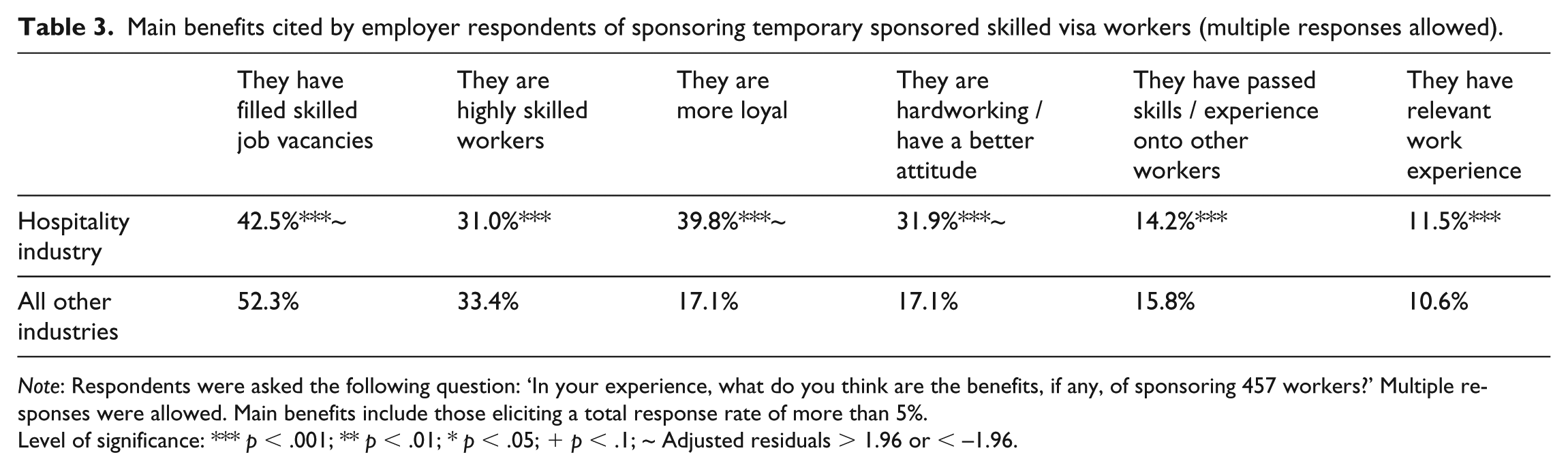
Note: Respondents were asked the following question: ‘In your experience, what do you think are the benefits, if any, of sponsoring 457 workers?’ Multiple responses were allowed. Main benefits include those eliciting a total response rate of more than 5%.
Level of significance: *** p < .001; ** p < .01; * p < .05; + p < .1; ~ Adjusted residuals > 1.96 or < –1.96.
Finally, when employers were asked about their satisfaction with temporary sponsored skilled visa holders in comparison to ‘similar Australian workers’, significant differences were evident. Two-thirds of employers in all other industries claimed to be equally satisfied with both categories. However, among the remainder, respondents were three times more likely to be satisfied with temporary sponsored skilled migrants compared to Australian workers. This gap was significantly larger among hospitality industry employers, who were 13 times more likely to be satisfied with their temporary sponsored skilled visa workers.
The motivations and experiences of temporary sponsored skilled migrants in hospitality
The findings presented above indicate that hospitality employers have a strong preference for temporary sponsored skilled visa holders over other groups of workers. The perceived advantages of temporary sponsored skilled visa holders in relation to soft skills, and factors that reflect a desire for control, such as the greater loyalty and attitudes of this group of workers compared to local workers, help to explain hospitality employers’ preferences. This confounds the findings of the extant literature, which asserts that addressing shortages of vocational or hard skills is the main reason why employers recruit temporary higher-skilled migrants. To explain the divergence of our findings from previous studies, we analyse factors relating to the motivations and experiences of visa holders sponsored to work in hospitality.
The findings reveal that employees on temporary sponsored skilled visas working in hospitality were substantially more likely (66%) than those working in all other industries (47%) to cite a desire to live in Australia and become a permanent resident as a motivation for applying for a visa. Indeed, visa holders in hospitality were also much more likely (91%) to claim that they would apply for permanent residency once their current visa expired than their counterparts in all other industries (76%). Using temporary sponsored skilled migration as a ‘stepping stone’ to permanent residency (Scott, 2013), by maintaining the employment relationship with their sponsor for a requisite period, may explain why visa holders have been willing to tolerate the relatively poor conditions that characterise hospitality. The dependence of temporary sponsored skilled migrants on their sponsoring employer to meet this qualifying period helps to explain this willingness.
Indeed, temporary sponsored skilled visa holders in hospitality were much more likely than their counterparts in all other industries to cite the inadequacies with existing employee protection arrangements as a problem of the scheme. When asked what changes they desired to existing visa regulations, 29% of hospitality industry employee respondents cited better protections for temporary sponsored skilled migrants (compared to 25% across all other industries); 24% desired more information about workers’ rights (compared to 15%); 20% desired an increase in the minimum salary level (compared to 14%); and 74% desired migrant workers to have the same rights and benefits as Australian workers (compared to 71%).
Very limited union representation also appears to explain the relatively greater desire among hospitality industry temporary sponsored skilled visa holders for stronger employee protections. Fewer than 1% of employee respondents in hospitality (compared to 8% of visa holders in all industries) claimed to be a union member. This is pronounced illustration of an industry effect, with weak unions characterising Australian hospitality (Gahan et al., 2018).
Using temporary sponsored skilled visas appears to be a critical part of hospitality employers’ skills and workforce development strategies, which is an additional industry effect explaining the strong preference of these employers for this particular group of workers. Not only have hospitality employers used these visas much more extensively than other industries (as noted above), but they were also significantly more likely to ask visa holders to train and develop other employees. Compared to 77% of visa holders in all other industries, 97% of employee respondents in hospitality claimed they trained and developed other workers at the company they worked for. This finding indicates that temporary sponsored skilled migration has become a de facto mechanism of workforce development for many hospitality employers.
Discussion and conclusions
The main objective of this article was to explain why employers in the Australian hospitality industry extensively engage temporary sponsored higher-skilled migrants to address perceived skill needs. Our findings reveal that these employers utilise this particular labour supply to source soft skills and workers perceived as more loyal and as such potentially easier to control. These findings echo previous studies on the recruitment of lower-skilled migrant labour, whereby soft skills can enable employers to address capability shortages (Lucas and Mansfield, 2010; MacKenzie and Forde, 2009; Moriarty et al., 2012) and access a controllable labour supply, which allows employers to reduce or contain unit labour costs (Bauder, 2006; Castles and Kosack, 1973; McDowell et al., 2008). The findings contrast with extant scholarship on employer motivations for recruiting higher-skilled migrant workers, which find addressing shortages of hard skills to be the most important factor (Bahn and Cameron, 2013; Cameron and Harrison, 2013; Khoo et al., 2007). While some hospitality employers do recruit temporary sponsored skilled migrants to source hard skills, they are much less likely to do so compared to employers in other industries, and place less importance on hard skills compared to soft skills.
We argue that two factors account for the confounding nature of these findings: the dependence of temporary sponsored skilled migrants on their employer sponsors and industry effects related to hospitality. First, the survey findings indicate a large overlap between hospitality employers engaging skilled migrants for reasons relating to soft skills and those relating to behavioural traits that can allow employers to exert significant control over sponsored migrant workers dependent on their employer to maintain residency rights. Indeed, compared to those working in all other industries, there is a higher proportion of temporary sponsored skilled migrants working in hospitality seeking permanent residency. This may explain their willingness to tolerate poor conditions, since visa holders need to maintain the relationship with their employer sponsor to qualify for permanent residency. This dependence of temporary sponsored skilled migrants due to immigration regulations that effectively tether visa holders to their employers is likely to mitigate these workers’ agency and accentuate employer perceptions of loyalty. Previous studies have identified the influence of lower-skilled migrant workers’ immigration status on employer recruitment practices (Anderson, 2010; Cangiano and Walsh, 2014). However, this is the first study to our knowledge to demonstrate how dependency created through sponsorship arrangements can produce similar outcomes for higher-skilled migrant workers – a group otherwise considered to have significant agency (Bauder, 2011; Dauvergne, 2016; Walsh, 2014).
Second, the finding that sourcing soft skills to address capability shortages is more important for hospitality employers than sourcing hard skills to address vocational shortages (Montague, 2013) reflects the nature of customer service work in the industry (Knox, 2016). Soft skills can be important for enhancing the capacity of workers to utilise their qualifications and formalised credentials productively and efficiently (Green et al., 1998; Mitchell and Quirk, 2005). However, the high degree of importance placed on soft skills among employer respondents is consistent with another hospitality industry effect of dominant low-wage, low-investment and control-oriented business strategies that fail to attract, retain and motivate workers (Lloyd and Payne, 2016). Furthermore, the very high proportion of temporary sponsored skilled visa holders working in hospitality who train and develop other employees as part of their job partly reflects a widespread hospitality industry practice of utilising on-the-job training (Knox et al., 2015). It also reflects the weakness of industry-wide coordination in Australia and other liberal market economies for addressing longer-term workforce needs (Belardi, 2017) – a finding that may not necessarily be replicated in coordinated market economies (Bamber et al., 2016; Bosch and Charest, 2008). It should be emphasised that these industry effects are specific to hospitality and may not reflect employer motivations for recruiting temporary sponsored skilled migrants in other industries. Nevertheless, in illuminating the role of industry effects in shaping recruitment practices, our findings represent an original contribution not previously identified in studies on employer demand for higher-skilled migration. More research is necessary to determine if specific industry effects exist elsewhere in order to adequately inform theory and practice.
Our findings also suggest important policy recommendations. The utilisation of temporary sponsored skilled migration to source soft skills and recruit workers perceived as having superior loyalty, work ethic and attitudes compared to other workers may be legitimate for employers when making decisions regarding new personnel. However, these objectives are inconsistent with the explicit focus of temporary sponsored skilled visa regulations for addressing shortages of hard skills (Howe, 2013), and could potentially lead other workers to be displaced. As such, while temporary sponsored skilled migration may be beneficial in the short term for governments and employers seeking to source skills efficiently, if these schemes are not regulated properly they can have potentially adverse long-term implications for skills investment and for career development, and also for employers seeking to transition to more productive business strategies (Knox, 2016; McLaughlin, 2009). Importantly, such schemes have the potential ‘to act as a dead hand with respect to change within the workplace economics of the [hospitality] industry sector’ (Baum, 2007: 1394).
Overall, the findings indicate that hospitality employers have two principal reasons for hiring temporary sponsored skilled migrants: to source soft skills to a greater extent than hard skills and to recruit a group of workers seen as relatively more controllable, productive and reliable. Such employer practices are inconsistent with the intended purpose of the visa scheme, designed to address technical or hard (vocational) skill shortages within the domestic labour market. These also confound the assumption that these workers have significant agency by virtue of possessing vocational skills in demand. Inadequate regulation of such schemes is likely to precipitate adverse long-term implications for skills investment, career development and workplace economics. While our findings point to the much neglected and maligned importance of soft skills (Bryson, 2017; Lloyd and Payne, 2016; Warhurst et al., 2017), they also illustrate how employers can misuse demand-driven immigration policies which enable them to exert significant control over sponsored migrant workers with limited mobility (Bauder, 2006; Woolfson et al., 2014; Zou, 2015). These findings contribute to existing academic and policy debates related to temporary sponsored migration and skills and provide vital new evidence related to the use, and potential abuse, of immigration policy to address workforce needs (Fudge, 2012; Krings et al., 2011; Montague, 2013; Warhurst et al., 2017).
While the focus has been on the sponsored temporary migration scheme of a single country, the characteristics of the hospitality industry across countries (Vanselow et al., 2010) and the growth of sponsored migration schemes internationally (Wright et al., 2017) indicate that the findings may have a wider application. There is potential for future research to further investigate the nature of employer demand for sponsored migration, and how this interacts with other labour market institutions such as skills development and wage determination systems, in other industries and countries.
Footnotes
Acknowledgements
The authors are grateful for the very helpful and constructive feedback provided by the two reviewers and to the Australian Government’s Department of Home Affairs for making the survey data available for this research.
Declaration of conflicting interests
The authors declared no potential conflicts of interest with respect to the research, authorship, and/or publication of this article.
Funding
The authors are grateful for financial support made available by the University of Sydney and the Australian Research Council (DE170101060) for the research underpinning of this article.