




Abstract
Through a comparative case study analysis of the restructuring practices of six large UK local authorities, this article finds that although macro-level fiscal pressures are a trigger for cutbacks clear differences can be found between local level restructuring ‘bundles’. These differences are explained by the local power dynamics between politicians, trade unions and management. A radical marketisation approach of outsourcing and hostility towards the trade unions at one Conservative-controlled council is contrasted to a political partnership approach at two Labour councils which delivered a living wage and minimised job losses and outsourcing. Two ‘hybrid’ models of incremental marketisation and pragmatic partnership saw the remaining councils trying to balance cost minimisation and stable employment relations by making more incremental changes. However, the cumulative effect of repeated cutbacks could yet prove to be transformative for the public sector.
Introduction
Austerity policies adopted in the wake of the 2008 global financial crisis have had widespread ramifications for the size, structure and guiding principles of the public sector. In many developed economies health, education and social care services have been restructured and reorganised, with labour cost savings achieved through a mixture of pay restraint, job losses and outsourcing (Peters, 2012). For some this has facilitated a resurgence of the New Public Management (NPM) principles of marketisation and managerialism (Bach, 2016; McCann, 2013), whereas others point to evidence of only incremental changes and pragmatic efficiency savings rather than transformation or a ‘paradigm shift’ (Kim and Warner, 2016; Lowndes and McCaughie, 2013). There is nevertheless the risk that repeated cutbacks (however gradual and pragmatic) may effectively ‘lock-in’ a stronger market-orientation at local level (Gardner, 2017; Meegan et al., 2014; Peck, 2012; Taylor Gooby, 2012). Furthermore, even if local decision-makers reject the philosophy of the NPM doctrine, sustained financial pressures may steadily erode over time key features of public sector employment such as job security, fair reward and collective representation through trade unions (Beszter et al., 2015; Fredman and Morris, 1989).
There has been little research, however, into the actual impact on public sector employment at a local level, where, at least in the case of UK local government, there is significant scope for variation for two reasons. First, although centralised collective bargaining remains in place, the institutions of bargaining have become increasingly ‘perforated’ over time, setting only minimum standards and broad procedural rules, thereby allowing for diverging standards at a local level (Grimshaw et al., 2017). Second, despite strong control by central government over budgets and taxation, local authorities are democratically accountable to local residents. Responses to budget cuts and national pressures towards more market-oriented employment arrangements may thus be shaped by local political goals, management objectives, labour market pressures and union strength (Kessler and Purcell, 1996).
Drawing on a comparative case study design of six diverse UK local authorities, this article investigates the impact of fiscal and policy pressures on local models of employment relations. By analysing the extent and nature of variations between councils, we find that councils, despite the severe financial pressures acting upon the sector as a whole, are not responding in a universal or deterministic way. Rather than simply embracing or rejecting NPM, councils follow a number of path dependent trajectories of change, driven by local political agendas, management capabilities and countervailing trade union power. The identification of diverse local models allows the analysis to go beyond broad debates about either the resilience or collapse of embedded models of public sector employment relations since the crisis.
The rest of the article is structured as follows. The next section explores the impact of national austerity policies in the aftermath of the crisis on public services, before setting out a framework for analysing local models of employment relations. The third section outlines the research design and methods, before the fourth presents findings from the six case studies. The final section draws out the taxonomy of local models of employment relations and concludes with the implications for research, practice and policy.
Public sector restructuring: A contested paradigm
The global financial crisis triggered a wave of austerity measures in many developed countries. Soaring budget deficits resulting from bank bailouts created sovereign debt crises in a number of European countries, and by 2009–2010 many national governments looked to reduce public sector labour costs as a means of macroeconomic adjustment (Peck, 2012; Peters, 2012). This commonly resulted in public sector job losses, pay freezes, privatisation and pension reforms along with welfare retrenchment (Bach and Stroleny, 2014; Glassner, 2010). As one of the largest areas of public expenditure in many developed economies, local council budgets have in effect been central to the delivery of central government’s macroeconomic policies; what has been described as ‘austerity urbanism’ (Meegan et al., 2014). For example, around a fifth of English councils were judged by the Audit Commission to be at risk of effectively going bankrupt, putting them in a position of having to close or outsource key services (Audit Commission, 2013). But despite these challenges, other studies point to a more general pattern of incremental cutbacks which has been attributed to the institutional resilience of the public sector and in particular the ability of local councils to find innovative ways to ‘weather’ tough times (Lowndes and McCaughie, 2013).
Rather than a simple picture of continuity or change, there is emerging evidence of national and local path dependent trajectories of change, described by Lodge and Hood (2012) as ‘multiple austerities’. For example, in local government responses to austerity are shaped by an array of institutional and contextual factors such as the financial resilience of individual councils (Barbera et al., 2017), the demands of citizens for services (Cepiku et al., 2016), local party political agendas (Hastings et al., 2015), and the countervailing power of the trade unions (Guillaume and Kirton, 2017; Kim and Warner, 2016). These institutional factors can be difficult to dislodge or override as they influence what responses are considered ‘legitimate’ by key stakeholders within a particular context (Boon et al., 2009; DiMaggio and Powell, 1983; Lange et al, 2015). This may lead to the incremental ‘layering’ of new strategies on top of existing institutional frameworks (Streeck and Thelen, 2005). For example, even after the global financial crisis that arguably ‘normalised’ staff cutbacks and other labour cost reductions (Cook et al., 2016; Rubery and Johnson, 2018; Santana et al., 2017), public sector employers continued to uphold a broadly egalitarian approach to employment relations by making job cuts through voluntary rather than compulsory redundancies, and typically consulting with local trade unions over proposed changes (Van Wanrooy et al., 2013). Although this suggests a rejection of wholesale private sector style cutbacks and outsourcing (Boyne, 2006), the repeated use of voluntary redundancies may, over time, produce transformative effects that undermine the historically collectivist and socially inclusive approach of local councils (Gardner, 2017; Taylor Gooby, 2012).
A framework for analysing local models of employment relations
Our core proposition is that although a key driver of change in UK local government is the national political and economic context, specific local responses depend on the dynamic interplay between local political agendas, local trade union capacities and local managerial strategies for reform (Figure 1). Our approach also highlights the influence of contextual factors, including the underlying financial position of the council, its reliance on external providers, and local labour market conditions. This framework is not only relevant for exploring divergent local patterns of change but also for guiding the sampling strategy for the research.

The dynamics of employment relations systems in local government.
Political agendas
Local government cannot be understood as simply a microcosm of national government, mirroring its attempts to balance the functions of accumulation and legitimisation (O’Connor, 1973); it has a distinct set of municipal responsibilities and explicit political autonomy which can at times fundamentally set it at odds with the priorities of the centre, particularly during a downturn (Saunders, 1982). Local political factors have been strongly linked with processes of policy formulation, service design and outsourcing (Hastings et al., 2015), and they also shape local-level systems of employment relations. For example, during the 1970s and 1980s Labour-controlled councils typically offered wages (particularly for male manual workers) that were ‘over the odds’ as a result of supplementary local bargaining over pay and bonuses (Ingham, 1987: 91). In contrast in the late 1980s and early 1990s a small number of Conservative-controlled councils opted out of national bargaining in order to instil a more performance-oriented culture where pay increases had to be ‘earned’ and individual staff were accountable for results (Bryson et al., 1993).
However, despite efforts to decentralise decision making, the gradual centralisation of funding and performance measurement systems in local government since the 1980s has made it increasingly difficult for councils to exercise their residual discretion. Cuts since 2010 have also disproportionately affected Labour-controlled councils in deprived parts of the north of England when compared with Conservative-controlled councils in the south, a factor further limiting the scope for preserving municipal control of services and inclusive notions of ‘local socialism’ (Taylor Gooby, 2012). Nevertheless, a number of Labour-controlled councils have sought to protect the lowest paid through the adoption of ‘living wages’ (Prowse and Fells, 2016). In contrast some Conservative-controlled councils have used the national context of austerity to pursue wholesale outsourcing often in the face of strong local opposition from citizens and trade unions (most notoriously Northamptonshire County Council that nearly bankrupted itself in the process).
To draw out the impact of these geographical and local political dynamics, our sample will contrast councils from different regions of England and with different local party political leadership.
Trade unions
High union membership density and the survival of centralised collective bargaining in local government (covering around 85% of all councils) have been argued to be a reflection of the sunk investments of managers and politicians in a broadly collectivist model of HRM and employment relations (Beszter et al., 2015). However, recent studies have suggested that the scope to resist downward pressure on labour costs in the public sector is increasingly reliant on the skill and fortitude of local union actors (Guillaume and Kirton, 2017; Scheuer et al., 2016). Similarly, councils may not want to risk undue local disruption and conflict with the unions by adopting strong NPM strategies such as market rates of pay and large-scale outsourcing, but weaker local union branches may face concessions on terms and conditions and working practices (Kessler, 1986).
Most councils continue to recognise at least one union for the purposes of negotiation and consultation, and these formalised arrangements can help to stabilise employment relations and contribute to shared problem solving. In the context of recession, the focus on long-term issues afforded by partnership may lead unions to trade off further employer control over working practices in return for protection of jobs and of hard-won terms and conditions. However, there are concerns that strong financial and policy constraints may prevent local partnerships from delivering tangible improvements for employees (Bacon and Samuel, 2009; Danford et al., 2002; Martinez Lucio and Stuart, 2005; Richardson et al., 2005) and that partnerships forged during periods of growth may become something of a ‘hollow shell’ during a recession (Roche and Teague, 2013), particularly if unresolved tensions and conflict rise to the surface (Walton et al., 1994). Indeed as Kelly (2004) notes, in industries marked by employment decline, those organisations that formally enter into social partnership deals with unions tend to make more rapid job cuts than ‘non-partnership’ organisations. In this context, management may simply be sharing the process of making cutbacks with unions rather than attempting to avoid cutbacks altogether.
In order to explore the continued relevance of the trade unions and centralised collective bargaining for local systems of employment relations, our research will contrast councils with varying levels of membership density and councils which remain within the sectoral pay setting framework and councils that have opted out.
Management strategy
Strategic choice models of HRM emphasise the ‘agency’ of managers in designing workforce policies that reflect organisational or market demands (e.g. Boselie et al., 2001; Guest, 1997). However, as Crossland and Hambrick (2007) note, institutional factors such as labour market regulation and collective bargaining may limit the freedoms of organisational leaders to pursue new performance improvement strategies. Boon et al. (2009) showed that, when faced with turbulent market conditions, some managers sought to maintain the status quo by ‘conforming’ with institutionally embedded practices such as collective bargaining, while others sought to ‘deviate’ by pursuing a radical cost-cutting model of HRM that emphasised external labour flexibility and lower pay. A third group of managers sought to ‘innovate’ within prevailing institutional norms, by focusing on staff cooperation and wellbeing, improving reward packages, and strengthening training opportunities.
The influence of such institutional and normative factors over public sector management approaches is worthy of closer attention. On the one hand, managers in the local government sector are expected to imitate notions of entrepreneurism, business acumen and continuous improvement while at the same time maintaining budgetary control and the cooperation of the workforce (Boyne, 2006; Martinez Lucio, 2007). For example, managers may seek to ‘innovate’ by adopting high-commitment HRM practices, such as team-working, increased worker autonomy and higher pay and conditions (Boxall and Purcell, 2008). Alternatively, in a period of financial decline managers may adopt more hard-nosed ‘corporate turnaround’ strategies, such as retrenchment, reorientation and reorganisation (Hofer, 1980), and staff layoffs, in order to cut costs (Datta et al., 2010). The relatively low level of employment protections in the UK arguably facilitates this kind of managerialism regardless of the sectoral context. The specific challenge for managers in local government is that they cannot increase their market share or easily diversify their revenue streams to fund workforce ‘innovations’. Conversely, ‘deviant’ cost cutting may provoke hostility from local union branches, while also undermining the recruitment, retention and motivation of staff (Atkinson and Lucas, 2013; Kessler and Purcell, 1996). In fact, some have argued that NPM reforms were only weakly implemented in local government in the past owing to a combination of union resistance and a lack of management appetite for fundamental change (Gill-McLure, 2014). This suggests a likely scenario of ‘incrementalism’ rather than deviant or radical change (Gardner, 2017).
Selecting multiple case studies from within the same sector allows the exploration of managerial innovation and deviance at a local level, while also permitting an assessment of the challenges arising from pressures to maintain conformity with the institutionally embedded systems of collective representation and work organisation.
Case selection and research methods
Our core research proposition is that despite the central financial and policy control over local authorities, there will be significant variations in the local responses to top-down budget cuts. We hypothesise that local models of restructuring and downsizing are shaped by differences in political agendas, union strength and management strategy. We also posit that the leeway available to local actors within local government is potentially enhanced by the relatively fragmented nature of employment relations institutions in this sector, something that previous research has tended to understate.
A comparative case study analysis was chosen as a means to explore similarities and differences between councils (Yin, 2003). Comparing cases from within a single sector allowed contextual factors such as the broad financial context, the complexity of service delivery and the principles of democratic accountability to be held broadly constant while exploring idiosyncratic processes of change across councils (Kessler and Purcell, 1996). Cases were sampled purposively (Eisenhardt, 1989) to provide contrast in the key areas identified in the previous section, such as party political control, formal mechanisms of pay setting and union membership density (Table 1). However, it was only once data collection began that the local contextual effects of local labour market conditions and management strategy revealed themselves, so it was not possible to identify differences on this dimension between councils a priori. Although the reduction in government funding was significant across all councils, reported cuts in the value of annual central government grants between 2010 and 2015 ranged from 11% at LA6 to 16% at LA2, with the remaining four experiencing cuts clustered around 12–12.5%. In addition, financial pressures arising from increased demand for services (particularly care for older people) and shrinking local revenue streams were layered on top of the cuts in central grants, which made financial pressures more acute in some areas.
The case study councils.
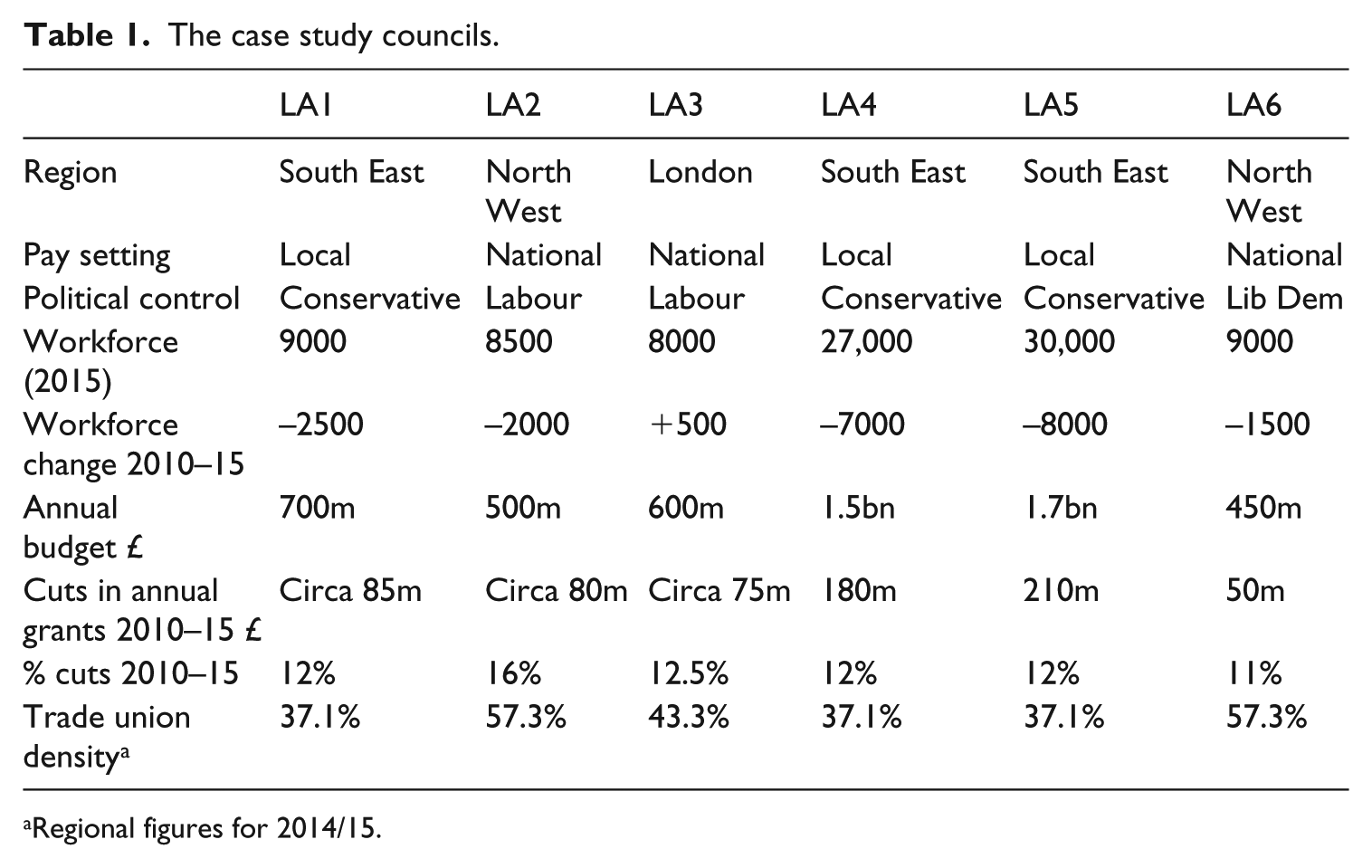
Regional figures for 2014/15.
The research draws on 32 semi-structured interviews (see Appendix 1 online) across the six councils, and triangulation (at least three interviews per case and an average of five) was an important means by which the interview data collected from different perspectives were corroborated. Key actors were interviewed including the director of HR and local UNISON trade union representatives in all six cases, together with at least one operational or procurement manager (usually in social care services where cuts have been particularly acute). Further snowball interviews were conducted with HR officers, departmental managers and politicians at LA2 and LA3. 1 Interviews with HR directors established the general effect of directly imposed budget cuts, such as the pressure to reduce staffing levels, hold down pay and conditions and outsource services. Further interviews with HR managers highlighted the challenges faced by each council in respect of trying to establish a ‘strategic narrative’ to guide processes of restructuring and retrenchment, such as straightforward cost cutting, or more complex forms of internal labour flexibility and service redesign. These narratives varied in line with the commitment of managers and politicians at each council to try and communicate to workers and citizens the rationale for specific changes and the efforts to militate against potential adverse outcomes (such as job losses and service closures). Subsequent interviews with operational managers and trade unions were critical to draw out the dynamics of implementing (often unpopular) turnaround strategies over a period of time, and the range of intended and unintended consequences associated with new workforce policies from different perspectives (Gioia et al., 2013; Smith, 2014).
Interviews lasted between 45 minutes and 120 minutes and were audio recorded and transcribed verbatim. The interview schedules were designed to first establish relevant baseline standards and ‘norms’ of HRM and employment relations at local level (as perceived by different actors) and to explore the impact of austerity on key dimensions of HRM including worker involvement in processes of downsizing, pay and reward systems, and outsourcing. This enabled us to tease out the extent to which specific practices either conformed to, deviated from or innovated within embedded ‘norms’. The interviews also sought to draw out the competing objectives and priorities of different actors in response to imposed conditions of austerity (such as protecting jobs, increasing flexibility, or improving performance), and to explore the tensions between these goals. The interview data were analysed thematically from direct readings of the transcripts, framed by the theoretical perspectives set out earlier, such as the interaction between political, financial, managerial and trade union priorities, and the process of reforming employment relations at a local level. This helped to structure the findings so that they illuminated both the process and outcomes of workforce restructuring at the organisational level, as well as reflecting the wider implications of austerity pressures across the UK public sector. Interview data were supplemented by an analysis of key strategy documents such as corporate strategic plans, annual accounts and workforce reports to identify political and corporate priorities, and to reveal trends and patterns in respect of financial and workforce change. This information helped to deepen and contextualise the understanding of the social phenomena and processes drawn from the thick descriptions established through interviews with knowledgeable agents (Gioia et al., 2013; Olsen, 2004; Smith, 2014).
Empirical findings
The research findings are organised around the three main dimensions of the analytical framework set out earlier in the article: politics, trade unions and management. The case study findings are presented under these three headings to establish both similarities and differences in local-level models of employment relations. For example, although all councils made headcount reductions and leveraged internal labour flexibility, there were clear differences in processes of staff engagement and consultation, the use of compulsory redundancies, the scale and pace of outsourcing, and changes to local pay rates (Table 2).
Summary of HRM policies and employment relations at the case study councils.

In respect of the drivers behind these divergent strategies, our findings show that although budget cuts imposed by central government were a trigger for change at all six councils, the scope and extent of localised cutbacks were not neatly correlated with the nominal or proportional size of grant reductions. Rather the divergent approaches observed were associated with budget cuts combined with other local dynamics of political leadership, management and union strategy, along with specific local contextual pressures.
The ‘new’ politics of employment relations
Party politics was a strong factor shaping local models of HRM and employment relations, and the extent to which local cutbacks were framed as ‘legitimate’ within a context of national austerity handed down by a Conservative-led central government. For example, leaders at the three Conservative-controlled councils (LA1, LA4 and LA5) were less openly critical of austerity than the three politically centre-left councils (LA2, LA3 and LA6). This may reflect a general ideological consensus within the Conservative Party but the level of cuts at these three Conservative-controlled councils was also relatively low within our sample. However, the decision of all three Conservative councils to freeze local taxation to reinforce the national government narrative that local councils had been profligate in the run up to the crisis resulted in further self-imposed cuts being layered on top of the ‘unavoidable’ cuts. This initially took the form of a reorientation away from ‘non-essential’ services such as youth and leisure services and towards electoral priorities such as highways and care for older people.
However, a change of political leader at the Conservative-led LA1 in 2011 led to a new approach that sought to actively disrupt residual custom and practice arrangements over substantive issues of service delivery and employment relations. The new Conservative leader brought a more ‘business like and cost minimising approach’ from his private sector background (LA1 HR Director), with a focus on efficiency, flexibility and increased performance. The aim was to deliver services ‘at the lowest possible cost’ by reducing the size of the workforce (with 30% of job cuts made compulsorily) in order to freeze council tax for residents (LA1 Corporate Performance Report 2011/12). Aside from the stress imposed on workers, this approach to staffing actually had negative consequences for cost minimisation: the unions and local press reported that following the loss of 2500 permanent staff over four years, spending on agency staff and interim managers actually increased by around £500,000 per annum.
LA1 also made some minor changes to terms and conditions locally and was the only council of the six studied not to pay a living wage to the lowest paid staff. However, the most significant ‘deviation’ was to replace collectively agreed pay and conditions with individual ‘contribution-based’ pay in 2014. LA1 withdrew from national collective bargaining in the late 1990s but an annual cost-of-living pay award was agreed with the locally recognised unions (UNISON and GMB), which in fact successfully continued to deliver small pay increases during austerity (2009 and 2010). The adoption of performance-related pay effectively ended local collective bargaining, and strengthened the direct link between managers and workers on an individual (rather than collective) basis. The HR Director argued that this was a clear sign of the council’s efforts to be at the vanguard on issues of pay and performance management within local government: ‘no other council has gone as far in replacing both incremental progression and cost-of-living for the whole workforce’ (LA1 HR Director].
In contrast with LA1, the two Labour-controlled councils in this study (LA2 and 3) responded to austerity by reaffirming their relationship with the trade unions locally, and actively attempting to innovate by raising pay at the bottom and engaging the workforce in the process of internal restructuring. The aim was to protect job opportunities for existing staff by offering training, job coaching and internal redeployment, and to retain services in-house where possible. As was the case with LA1, a change of political leader appeared to be a significant catalyst for ‘resetting’ the relationship with the workforce and the trade unions, and strengthening (rather than abandoning) the credentials of local government as a good employer (Fredman and Morris, 1989).
For example at LA2, the Labour Mayor who took office in 2012 made an election pledge to deliver a ‘living wage’ as part of an ‘employment standards charter’ for the city which included a workplace learning agreement and action to end union blacklisting (LA2 Mayor and Deputy Mayor). The council also reduced the salary of the chief executive role by nearly 15% which the Deputy Mayor argued was a fair reflection of the rate for senior jobs in a climate of ‘wage restraint’. The council offered voluntary severance in order to reduce staffing numbers (in preference to compulsory redundancies) and provided training and support for workers to move within internal labour markets.
At LA3 a change of political control from Liberal Democrat to Labour in 2010 led to the creation of a fairness commission to address income inequality across the borough, with an explicit ambition to reduce pay ratios within the council to less than 1:10. This was achieved by the introduction of a living wage combined with a reduction in the Chief Executive’s salary. A senior politician at LA3 made it clear that the active narrowing of pay dispersion was symbolic of the local Labour leadership’s commitment to social justice: …. when the chips are down that’s when your political mettle is tested. (LA3 Councillor)
Conservative-controlled LA4 and LA5 made broadly similar statements to LA1 about keeping council tax low and the need to reduce staffing levels but in contrast with LA1, political leadership at both councils remained stable throughout the period of the research, which resulted in a more incremental approach to the implementation of market principles, with cutbacks generally framed as ‘emergency responses’ to austerity, rather than a fundamental redesign of established HR practices.
For example, following a corporate review of departmental functions and managerial roles at LA4, in 2009–2010 it was announced to the trade unions by the HR Director that ‘job cuts could not be avoided’ (totalling around 800 over four years of which one third were compulsory). LA5 forecast the loss of around 1500 jobs (out of a total of nearly 10,000) between 2010 and 2014 (of which 40% were compulsory), and announced 100 job cuts within sports and youth services alone following a third successive year of a tax freeze in 2013 (LA5 HR Director). LA4 also imposed an emergency freeze on all local pay increases between 2011 and 2015. The unions were consulted over this proposal, and unsurprisingly did not support it, but they were able to negotiate substantial flat rate lump sums for low earners (up to £750 in some cases) which was enhanced by the introduction of a living wage for entry-level jobs This was seen as a ‘least worst’ outcome by the unions, who felt that local politicians and managers had agreed a short-term agenda ‘behind closed doors’ to hold down pay locally: … [the politicians] do it within negotiations with the officers [before speaking to the unions] and they gauge how much they think they can get away with. (LA4 UNISON)
Liberal Democrat-controlled LA6 was the smallest council in the sample, facing proportionally smaller budget cuts and was therefore in the (comparatively) fortunate position of having to make relatively few redundancies (LA6 HR Manager). At the same time, political leaders were somewhat ambivalent about the need to fully engage the unions in processes of downsizing and restructuring and the council actually made a small number of compulsory job cuts at senior levels (around 6% of the total). The unions maintained a legitimate role in scrutinising and contributing to processes of change through established mechanisms of consultation and negotiation, but this did not mean that cutbacks were without problems. For example, the council offered enhanced severance packages for those willing to leave or retire, but according to the unions this led to a ‘rush of applicants’ and skills shortages in some areas. The unions were also critical of the decision to allow around 10% of social workers to leave without being replaced, which increased work intensity for the remaining staff.
The key findings from these six councils are thus first that political factors appear central to understanding the choice of specific HRM strategies such as outsourcing and compulsory downsizing (more likely at the Conservative councils LA1, LA4 and LA5) and the living wage (more likely at the Labour and Liberal Democrat councils LA2, LA3 and LA6). The second key finding is that, irrespective of party politics, where political leadership remained stable (LA4, LA5 and LA6), councils appeared more likely to maintain existing relationships with the unions (albeit often at arm’s length). In contrast a change of political leadership created the opportunity to deviate from custom and practice arrangements at LA1, and conversely to innovate with new partnership arrangements at LA2 and LA3.
Trade union responses to austerity – resignation, resistance and resurgence?
The response of the unions to cutbacks was a mixture of resistance and resignation: local branches were not in a position to fundamentally reduce the severity of central government cuts but were determined to shield local workers from arbitrary or disproportionate cuts. The main objectives were to protect jobs and keep services in-house, while also seeking to preserve terms and conditions where possible.
Nevertheless, variable union density across the six councils combined with the strength of relationships with political leaders and managers shaped the capacity of individual branches to actually influence procedural and substantive issues. For example, LA1 was able to take advantage of low union density to implement staffing cutbacks and outsourcing and the new performance pay scheme served to further weaken the role of the local unions by individualising employment relations and sweeping away any remaining notions of ‘custom and practice’ or ‘felt fair’ comparisons when setting pay awards (LA1 UNISON). The council engaged in extensive direct communications over the new pay system and over 95% of staff accepted an individual £750 ‘buy-out’ from the collectively bargained pay system. This removed a key plank of the union’s collective opposition to performance pay and was a source of frustration as they had to accept that a strike ballot of members would ultimately fail.
At LA4 and LA5, there was no apparent anti-union agenda and, despite differences of opinion on certain issues (including the pay restraint policy at LA4), managers and unions both regarded the relationship as ‘mature’ and generally stable. The main issue, however, was that the unions were not sufficiently well represented across all parts of the councils to be able to resist multiple processes of retrenchment and restructuring. Union density across both councils was estimated by UNISON officials to be around 30%, but membership levels varied significantly across occupational groups and departments, which created the scope for management opportunism: Where the union hasn’t got the people or the time to do something I think management just gets away with what it wants. (LA5 UNISON)
In contrast, at LA2 and LA3 local partnership agreements set a positive tone for working relationships between politicians, officers and the unions and allowed for increased worker input into decision-making processes. For example, UNISON and the GMB were key members of the Fairness Commission at LA3 and UNISON, Unite and the GMB signed the Mayor’s employment standards charter at LA2. However, there was also a degree of pragmatism on the part of politicians and managers at both councils: union density at LA2 was around 60% and at LA3 around 50%. Therefore getting the support of the unions was seen as crucial to getting ‘buy-in’ from workers to processes of restructuring. The unions were sensitive to this tension for, although they welcomed the chance to formally strengthen relationships with the council, they also recognised that innovations such as a living wage were primarily political projects which did not give the unions any greater influence over pay setting overall. Similarly, the unions at both LA2 and LA3 viewed cuts to chief executive pay as opportunistic and largely ‘symbolic’, rather than reflecting a sincere desire to fundamentally rebalance wage structures and curb excesses among senior management. These examples underline the tensions and limitations of partnership deals agreed in adverse economic conditions where apparent gains in one area can be offset by concessions in another (Roche and Teague, 2013).
Union membership density at LA6 was over 50% and historically there were good relationships between senior trade unionists and senior managers which helped to stabilise corporate processes of communication and consultation, and head off any major disputes with the unions. UNISON worked closely with management over a back office ‘transformation’ programme in 2014–2015 and was able to prevent any compulsory job losses or pay reductions. Nevertheless, successive waves of internal restructuring and voluntary redundancies had depleted the energy and resources of the union, and the UNISON official noted that cuts were starting to shift from back office ‘efficiency gains’ to reductions in the front line services that vulnerable residents really needed.
To summarise, the trade unions clearly have less influence over local models of HRM and employment relations where membership density is low, but their influence is also shaped by the strength of the relationships with politicians and senior managers. Low union density at the three Conservative councils created greater scope for politically motivated changes and management opportunism, and conversely higher union density combined with a supportive (or at least pragmatic) political climate at the three remaining councils allowed for greater union input to processes of decision making. This resulted in fewer compulsory job cuts, lower levels of outsourcing, and greater protections for low wage workers. Nevertheless, the unions at all councils recognised that their preferences were often subordinate to the desire of politicians to pursue specific goals.
Management and managerialism: A question of capacity
Although the uncertain financial context and the vulnerable position of the unions in some areas could have been expected to create greater leeway for managers to transform HR strategies, there was surprisingly limited evidence of ‘managerialism’ across the six councils. This perhaps reflects the partial and contested implementation of ‘Taylorist’ management practices across local government (Gill-McLure, 2014), but it could also reflect declining management capacity within individual councils. For example, all councils targeted management posts for cutbacks which meant fewer larger departments and increased spans of control for individual managers. Similarly the increased use of direct ‘e-communications’ might be an outcome of the significant downsizing and partial outsourcing of HR services rather than evidence of a strategic decision to move from collective to individual forms of employment relations. More broadly, the trade unions consistently sounded a cautious note about the ability of managers to ‘act strategically’ while also reducing budgets sharply: … [Austerity] has hit Councils very much like a state of emergency … it’s crisis management there’s no transformation going on anywhere. (LA6 UNISON)
HR managers also often had to develop a ‘business case’ to justify and legitimise what were primarily political decisions. For example the introduction of the living wage at LA2 and LA3 increased costs by around £500,000 per year which managers hoped would be offset by increased morale and a reduction in turnover in lower graded roles. Nevertheless, the commitment to the annual uplift at a time of continued cutbacks was seen by HR as a potential threat to its viability over the long term: … that will be a challenge for us really if it suddenly goes to £8 an hour we’ve got to consider our position on that. (LA2 HR Director)
At LA1, it was difficult to disentangle the potential productivity gains of performance-related pay from the political determination to marginalise the unions and embed a new ‘business like’ mentality among staff. According to the HR Director, making an explicit link between pay and performance was not only a reflection of the desire to drive up performance levels, but also to reduce the financial liability for ‘unearned’ seniority-based pay rises. The new performance appraisal system was developed over a period of two years with a number of supporting mechanisms and processes designed to encourage staff to excel, but at the same time the new pay system was expected to return financial savings within three to five years. In this sense managers leveraged the local political context to take greater control over pay systems, which effectively meant a more distant relationship with the unions and workers themselves: We [HR] are not paternalistic we have to be rational … we are not here to provide tea and tissues for staff we are on the side of the employer. (LA1 HR Director)
The general context of wage restraint also created some issues with recruitment and retention which had to be addressed through the use of ad hoc ‘market supplements’ and relocation packages, particularly for children’s social workers (at all councils except LA6 where social worker posts were reduced). Outsourcing was another significant area where managers had to balance political and operational issues. LA1 claimed to be a ‘commissioning council in the mould of Barnet council’ (LA1 Procurement Manager), and residential care services were outsourced in 2013 followed by IT and transactional HR services which were transferred to a multinational ‘staff sourcing’ specialist in 2014. At LA4 HR services for schools were outsourced and external contractors were brought in to run a number of sports and leisure services. LA5 signed a five-year deal in 2014 with a private contractor to manage over 100 council facilities and around 350 council staff, but in 2015 the council abandoned plans to outsource back office functions such as HR, finance and IT. This followed pressure from the trade unions, and media scrutiny locally which raised concerns about spiralling costs.
At the two Labour-controlled councils the partnership approach with the unions appeared to limit the extent of outsourcing. For example, although external contractors were used by LA2 for large-scale building work, in order to avoid the wholesale privatisation of adult social care services the council established a not-for-profit company in 2015 and transferred across 400 staff. Under political instructions LA3 had actually brought services such as refuse collection and sports and leisure back in-house which was expected to save around £300,000 per year in management fees while also stabilising the quality and consistency of services (LA3 Facilities Manager). At the same time, the HR manager responsible for refuse collection noted that the council had also ‘insourced’ longstanding problems with sickness management and grievance handling procedures that the private contractor had failed to address.
In 2009 LA6 transferred care services to an arm’s length company (that also provided highways maintenance and school catering) in order to achieve efficiency savings (LA6 Care Director). However, financial and staff mismanagement led to the near collapse of the organisation, and in 2014 180 staff transferred back into the council. The arm’s length trading company was seen as an opportunity to increase contact hours (e.g. time spent with clients in their own homes), but the service became increasingly costly as sickness rates spiralled. This was blamed on a combination of poor communication and weak line management, which was expected to take some time to fully resolve even though the service was back under council control (LA6 Care Manager).
Our findings show that beyond national institutional constraints, local political and trade union strategies can also serve to impose additional limitations on HR managers. Although there was greater scope for managerialism at the three Conservative councils, managers still had to find a way to ‘operationalise’ the political vision of cost cutting without provoking undue hostility or resistance from workers (through the use of direct communications and staff consultation). Conversely, at the two Labour councils there was a clear political agenda to innovate with egalitarian HRM, but this in turn created financial and practical issues which managers had to resolve in the implementation process.
Discussion and conclusion
This study has explored how even when faced with intense pressures of austerity, local councils have pursued localised models of restructuring and employment relations. Variations between councils arise out of the challenges that both politicians and officers face in reconciling cost cutting with retaining workforce cooperation. Through a detailed consideration of specific dimensions of HRM and employment relations this article adds to previous literature by going beyond broad national and supra-national analyses of austerity (Bach, 2016; Bach and Stroleny, 2014; Glassner, 2010; McCann, 2013; Peck, 2012; Peters, 2012) in order to explore the nuanced interplay between organisational strategy and the changing institutional landscape as actors use their ‘leeway’ to pursue new approaches (Boon et al., 2009).
We propose that rather than a straightforward relationship between financial and performance pressures and turnaround strategies, as implied by the literature on private sector restructuring (Boyne, 2006; Hofer, 1980; Santana et al., 2017), localised workforce strategies in the public sector remain a contested and somewhat messy affair shaped by multiple competing ‘contingencies’. Although there are clearly significant pressures from the financial context towards market solutions and labour cost cutbacks, the specific institutional and normative constraints on the public sector limit the freedoms for local actors to pursue new business and workforce strategies. Nevertheless, across our sample we observe clear variation between councils in their use of internal or external labour flexibility, in the degree of exposure of workers to market pressures in respect of pay setting and outsourcing, and in the efforts of politicians and managers to engage trade unions and workers in processes of change. From our findings we are able to distinguish between four distinct models of employment relations that can be arranged in a spectrum from most to least market-oriented: radical marketisation, incremental marketisation, pragmatic partnership and political partnership (Table 3).
A taxonomy of localised models of employment relations at the six case study councils.
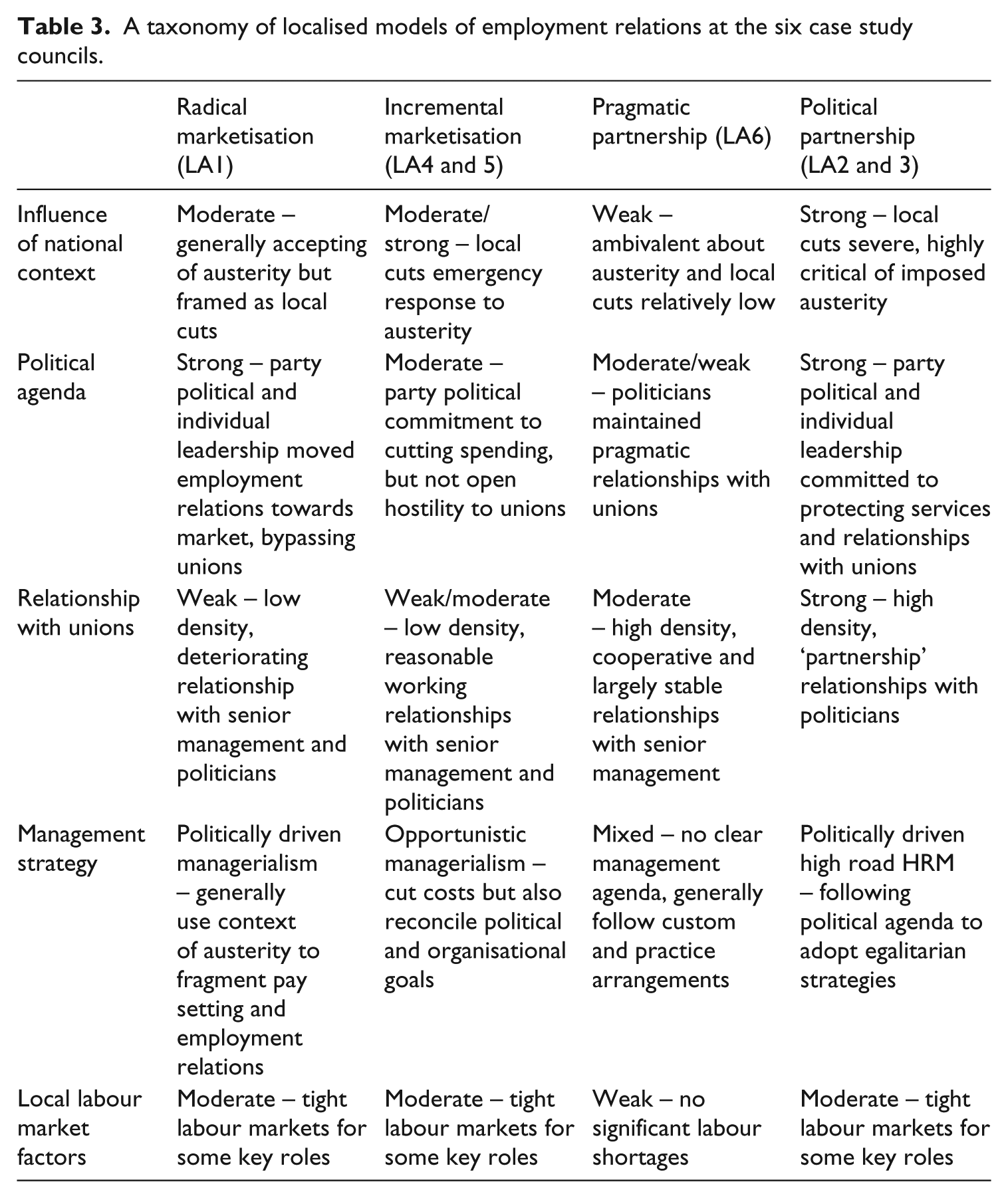
Radical marketisation captures the strong reorientation towards market principles in service delivery, in the approach to employment relations and changes to the HRM bundle. On the one hand, this most closely follows the broad NPM-style prescriptions of central government to reduce costs and increase efficiency by fragmenting and outsourcing services, holding down pay and conditions, and introducing greater flexibility in staffing systems. On the other hand, this ‘deviant’ approach potentially disrupts local custom and practice arrangements. At LA1 this model of radical marketisation was characterised by compulsory redundancies (rather than voluntary redundancies and early retirement), the use of contingent employment contracts, outsourcing and the individualisation of rewards through contribution-based pay. Interviews with senior managers suggested that the primary effects were to reduce operating costs and orient services towards delivering private sector style ‘business efficiencies’, while also emphasising the link between individual effort and rewards which the unions were in a weak position to resist.
Incremental marketisation reflects a more tentative restructuring of services and workforce strategies to cut costs and increase labour flexibility in response to imposed financial constraints, but without a strong ideological commitment to imposing a private sector management ethos. At LA4 and LA5 incremental marketisation was reflected in a mixture of compulsory and voluntary redundancies, and the partial outsourcing of services which managers rationalised as necessary and proportionate measures to reduce operating costs without provoking undue hostility from workers and the trade unions. Although the trade unions were opposed to many of the cutbacks, management were generally viewed as being largely opportunistic and guided by external pressures rather than openly hostile towards the workforce.
Pragmatic partnership reflects a similar somewhat hesitant dynamic in respect of reforming systems of employment relations in an incremental rather than radical manner, albeit with a primary orientation towards egalitarian rather than market-oriented strategies that broadly sustain (rather than undermine or strengthen) existing working relations with the trade unions. At LA6 this model of pragmatic partnership resulted in relatively minor job losses and internal reorganisation, and although some services had been outsourced, other services had been returned in-house. This approach of conformity to embedded collectivist systems of engagement through the unions had helped prevent major conflict but union officials expressed doubts about the ability of politicians and managers to maintain positive workforce standards while also delivering repeated short-term cost savings.
In contrast, political partnership reflects a clear emphasis on egalitarian rather than market principles, driven by the concerted efforts of politicians (and to a lesser extent management) to forge new, stronger relationships with locally recognised trade unions in order to promote cooperation at a time of significant financial pressure. Despite the severe financial pressures acting on LA2 and LA3, political partnership delivered a living wage and sought to minimise job losses and outsourcing by utilising voluntary redundancies and increased internal labour flexibility. The unions were positive towards this type of ‘new deal’ (given the wider context of austerity) but managers recognised some difficulties in delivering progressive and egalitarian workforce strategies within a tight financial settlement.
The taxonomy of employment relations presented in Table 3 is grounded in a rich and detailed analysis of the bundles of workforce policies adopted by individual councils, but its main contribution is to highlight potential broader ‘fissures’ in systems of public sector HRM at local level. It is clear from our research that party politics continue to have a strong effect on local workforce strategies, but it was the catalysing force of individual political leadership that proved decisive in the adoption of new models of employment relations. At LA1 an entrepreneurial Conservative political leader wanted to be a ‘leader’ in terms of business efficiency and performance by replicating a private sector style approach to pay setting and employment relations. Conversely at LA2 and 3, incoming Labour politicians appeared to want to ‘lead’ on egalitarian issues by articulating new partnership deals with the trade unions that contained a commitment to keeping services in house, protecting job opportunities for existing staff and adopting the living wage. Where political leadership remained stable (at LA4, 5 and 6), the approach to localised austerity reforms was more ‘conformist’ or path dependent with politicians, managers and (to a lesser extent) the unions seeking to balance competing pressures for cost, flexibility and cooperation in staffing arrangements.
Although it is not possible to extrapolate from six cases to a diverse sector of 350 individual councils, a number of propositions can be put forward with respect to both the likely incidence and the potential viability of the four models identified here. First of all, our findings suggest that a strategy of radical marketisation as seen at LA1 is likely to be relatively rare (despite the overall majority control of local authorities in England by the Conservative Party). It appears to be associated primarily with the election of entrepreneurial political leaders. Not only does this require a break with embedded norms of collectivism and union engagement but our findings also point to the difficulties managers face in making far reaching ‘strategic’ changes when dealing with short-term budget pressures. Moreover, the widely reported financial problems at the flagship example of radical marketisation, Northamptonshire County Council, may increase managers’ reluctance to follow a full radical reorganisation of council service provision even when championed by the council’s political leadership. Longitudinal studies are needed to explore whether a radical marketisation model as adopted at LA1 can be maintained. While leaders and managers may be willing to face down union hostility, the extent to which the changes lead to the types of consequences found at LA1, such as significant staff shortages, increased spend on temporary staffing, and a rapid deterioration in service quality in some critical areas such as children’s social care, may make this strategy too high risk to be fully followed through.
Conversely, under conditions of political partnership Labour political leaders appeared sincere in their desire to work closely with trade unions locally, but this agreement is likely to be tested by ongoing budget cuts, particularly where they fall heavily on Labour-controlled councils. This raises further questions about the depth and scope of ‘partnership’ arrangements (Bacon and Samuel, 2009; Danford et al., 2002; Martinez Lucio and Stuart, 2005), and underlines how the adaptation of partnership to conditions of recession and austerity brings new challenges and contradictions (Roche and Teague, 2013). At a local level unions remain the last pillar of resistance against unfettered managerial decision making (Guillaume and Kirton, 2017), but in the current context where financial pressures are acute and local politics play an increasingly significant role in determining the HRM restructuring bundle, they are severely restricted in their abilities to ‘set the agenda’ around workforce issues, or to utilise conditions of partnership to revitalise (Kelly, 2004).
These reflections suggest that the likelihood of either radical marketisation or political partnership becoming the dominant response to sustained austerity is low. In reality, most councils are likely to be found in the middle of the spectrum by pursuing incremental approaches to restructuring that largely conform to the local status quo (albeit with different degrees of orientation towards market or partnership principles). Such approaches enable a focus on short-term restructuring without either requiring a wholesale rethink of services and workforce structures as in the case of radical marketisation, or as in the case of political partnership, building in new costs in the form of the living wage and enhanced severance packages. However, we diverge slightly from the conclusion of Boon et al. (2009) that conformity equates largely to passivity; we find that although the status quo remained largely intact at LA4, 5 and 6, the two hybrid models we observed here (incremental marketisation and pragmatic partnership) involved a degree of experimentation ‘around the edges’ of existing custom and practice arrangements. The issue is rather that the ‘ease’ of implementation in the short term does not mean that incremental change will not be transformative over the long term and difficult to reverse (Streeck and Thelen, 2005). This is particularly true of local government where sustained top-down financial and policy pressures may further erode the power of local actors to maintain strong notions of municipal service delivery and egalitarianism (Gardner, 2017). Thus these local path dependent trajectories may begin to converge if austerity conditions are maintained by central government. But for now at least, the commitment to collectivism and egalitarianism observed at local level points to alternative political scenarios rooted in ‘place’ that uphold the principles of social inclusion and municipal service delivery that were historically the defining features of local government.
Supplemental Material
823699_supp_mat – Supplemental material for Public sector employment relations after the crisis: A comparative case study analysis of UK local authorities
Supplemental material, 823699_supp_mat for Public sector employment relations after the crisis: A comparative case study analysis of UK local authorities by Mathew Johnson, Jill Rubery and Damian Grimshaw in Economic and Industrial Democracy
Footnotes
Declaration of conflicting interests
The authors declared no potential conflicts of interest with respect to the research, authorship, and/or publication of this article.
Funding
The authors received no financial support for the research, authorship, and/or publication of this article.
Notes
Supplemental material
Supplemental material for this article is available online.

Author biographies
References
Supplementary Material
Please find the following supplemental material available below.
For Open Access articles published under a Creative Commons License, all supplemental material carries the same license as the article it is associated with.
For non-Open Access articles published, all supplemental material carries a non-exclusive license, and permission requests for re-use of supplemental material or any part of supplemental material shall be sent directly to the copyright owner as specified in the copyright notice associated with the article.
