



Abstract
From a theoretical viewpoint, there can be market failures and organizational failures resulting in an underprovision of occupational health and safety. Works councils may help mitigate these failures. Using establishment data from Germany, the empirical analysis in this article confirms that the incidence of a works council is significantly associated with an increased likelihood that the establishment provides more workplace health promotion than required by law. This result also holds in regressions accounting for the possible endogeneity of works council incidence. Furthermore, analysing potentially moderating factors such as collective bargaining coverage, industry, type of ownership, multi-establishment status and product market competition, the article finds a positive association between works councils and workplace health promotion for the various types of establishments examined. Finally, this study goes beyond the mere incidence of workplace health promotion and shows that works councils are positively associated with a series of different measures of workplace health promotion.
Keywords
Introduction
The workplace is undergoing fundamental transformations posing important challenges for the health and safety of employees. Demographic developments involve changes in the composition of the workforce. Specifically, an ageing workforce may require that employers increasingly account for health issues. Moreover, the last decades have witnessed both an intensification of work and an upward trend in work-related health problems (Askenazy and Caroli, 2010; Brenner et al., 2004; Cottini and Lucifora, 2013; Green, 2004; Green and McIntosh, 2001). While the computerization of the workplace, the decline of manufacturing jobs and the growth of service-oriented work may have made traditional sources of adverse physical and environmental working conditions less relevant, they have increased the importance of psychosocial job stressors (Capelli et al., 1997).
Work-related health problems involve considerable costs (Pouliakas and Theodossiou, 2013). The World Health Organization and the World Bank attribute 3% of lost life years to work-related health issues (Kreis and Bodeker, 2004). Estimates by the International Labour Organization suggest that work-related diseases and accidents account for economic losses as high as 4% of worldwide GDP (ILO, 2003). Furthermore, social insurance expenditures on work-related diseases and accidents (e.g. statutory sick pay, disability allowances, industrial injuries disablement and incapacity benefits) account for roughly 2–3% of GDP in many advanced economies. This exceeds by far what is typically spent on unemployment benefits (Adema and Ladaique, 2009).
Thus, it is crucial to understand the factors that induce employers to improve workplace health. A series of studies have shown that workplace health promotion (WHP) has the potential to improve the health of employees (Goetzel et al., 2014; Kaspin et al., 2013; Pelletier, 2001). Against this background, our study examines the role of works councils in WHP for Germany. Works councils provide a highly developed mechanism for codetermination at the establishment level. They are a key institution of non-union employee representation in many West European countries. Compared to their counterparts in most of the other countries, works councils in Germany have acquired quite extensive powers.
From a theoretical viewpoint, there exist a series of possible market and organizational failures resulting in an underprovision of WHP. Works councils may help mitigate these failures resulting in an increased provision of WHP. Healthy working conditions have properties of a workplace public good. A works council is a collective voice institution that helps employer and employees to negotiate over the provision of that public good. The works council can also help reduce information asymmetries. It provides employees with better information about unhealthy working conditions and communicates worker preferences to the employer. This allows the employer to implement more effective WHP measures. Moreover, a works council may help overcome commitment problems on the part of the employer. Employees may be not willing to make concessions if they fear that the employer does not undertake promised investments in improving workplace health. The works council can act as a contract enforcer by ensuring that the employer keeps the promises made. This allows negotiation over changes that otherwise cannot be implemented. Finally, codetermination rights increase the bargaining power of the workforce. Increased bargaining power allows the works council to push for a higher level of WHP and, hence, to reduce the negative external effects of unhealthy working conditions on employees and society.
Works councils in Germany are mandatory but not automatic. Their creation depends on the initiative of the establishment’s workforce. Hence, works councils are not present in all eligible establishments. This allows us to conduct a within-country study by comparing establishments with and without a works council. Using the 2012 wave of the IAB Establishment Panel, our empirical analysis confirms that the incidence of a works council is associated with a higher likelihood that the establishment provides more WHP than required by law. This result holds even when controlling for a rich set of other factors influencing WHP. It also holds in recursive bivariate probit and 2SLS linear probability regressions that account for potential endogeneity of works council incidence. Such endogeneity might result from unobserved factors influencing both the incidence of a works council and the use of WHP.
We also examine whether the relationship between works councils and WHP depends on circumstances and type of firm. Previous research on the productivity effects of works councils has shown that the functioning of establishment-level codetermination can depend on moderating factors (Jirjahn and Smith, 2018a). However, usually only one single factor is considered whereby the moderating factor analysed varies across studies. By contrast, in our study on WHP, we provide a more systematic analysis of moderating factors by performing separate estimates for a series of different types of establishments: establishments with and without collective bargaining status, establishments with and without alternative forms of worker representation, establishments in East and West Germany, foreign-owned and domestically owned establishments, establishments with and without owner-managers, establishments in the manufacturing and in the service sector, establishments with and without shift work, establishments belonging and not belonging to multi-establishment firms, and establishments facing different degrees of product market competition. We find a positive relationship between works council incidence and WHP for almost every type of establishment. The relationship appears to be particularly strong in establishments with a foreign owner, establishments located in West Germany and establishments being part of a multi-establishment firm.
Finally, we go beyond the incidence of WHP and examine the role of works councils in a series of detailed WHP measures. We find that works councils impact two broad classes of WHP activities. On the one hand, our results show that works councils are positively associated with measures improving the information flow on work-related health issues. Establishments with a works council have a higher likelihood of using sickness absence analysis, health circles and employee surveys about health issues. On the other hand, our results show that works councils are positively associated with direct measures to promote workplace health. This holds for measures undertaken within the establishment. Establishments with a works council have a higher likelihood of using in-house activities (e.g. health checks and physiotherapy) and providing health-related training or advisory services (e.g. regarding mental problems or nutrition issues). It also holds for measures undertaken outside the establishment. Establishments with a works council are more likely to provide financial support to their employees for health promotion activities outside the workplace. Moreover, we find that works council incidence is positively associated with the establishment’s participation in cross-company networks on health promotion.
Economists have shown strong interest in German works councils. This is documented by a rapidly growing literature of econometric studies on the consequences of this institution (see Addison [2009] and Jirjahn and Smith [2018a] for surveys). The econometric studies have examined the influence of works councils on outcome variables such as wages, personnel turnover, job satisfaction, productivity, profitability and innovation. Surprisingly, the influence of works councils on WHP has received very little attention. Thus, research on works councils and WHP has so far remained in its infancy.
Hollederer and Wießner (2015) provide a very exploratory study that is also based on the IAB Establishment Panel. They confirm a positive association between works councils and WHP provision. However, Hollederer and Wießner do not account for potential endogeneity of works council incidence. Thus, their analysis cannot answer the question of whether the association between works councils and WHP provision reflects a causal effect or just the influence of unobserved factors associated with works council incidence. The issue of omitted variable bias is likely to be particularly problematic in Hollederer and Wießner’s study as they use a bare-bones specification controlling only for a few other establishment characteristics. 1 Moreover, from a policy viewpoint it is important to know whether the influence of works councils is rather general or only holds for a small subset of establishments. Hollederer and Wießner do not examine whether the association between works councils and WHP depends on circumstances and type of establishment. Finally, they do not distinguish between different measures of WHP. Considering different WHP measures is also important from a policy viewpoint. This gives an answer to the question of whether works councils have only a limited influence on specific measures or a broad influence on various measures to improve workplace health.
Furthermore, our analysis is related to a study by Askildsen et al. (2006), which examines the relationship between works councils and environmental investments undertaken by establishments. To the extent environmental investments such as those in purification technologies have a direct influence on the workplace, they can have immediate consequences for workplace health. Using data from manufacturing firms in the 1990s, Askildsen et al.’s study finds that works councils are positively associated with various types of environmental investment such as the introduction of environmentally-friendly production processes or down-the-line technologies.
On a broader scale, our study also contributes to the international discussion on non-union employee representation. In the US, the interest in non-union representation has been spurred by a sharp decline in union density and the growth of a ‘representation gap’ (Freeman and Rogers, 1999). Much of the political discussion in the US has centred on the idea of mandating German-style works councils. In Britain, the government has recently published a Green Paper that discusses proposals for non-union employee representation (Department for Business, Energy, and Industrial Strategy, 2016). In both countries, unions usually play a role in occupational health and safety (e.g. Boal, 2009; Bryson, 2016; Donado, 2015; Fenn and Ashby, 2004). However, it has been recognized that non-union representation through health and safety committees may be a supplement to unions (Reilly et al., 1995; Weil, 1999). Our study on works councils in Germany shows that non-union employee representation can indeed play an important role in workplace health promotion.
The remainder of this article is organized as follows. The institutional framework is described in the next section. The third section provides discussion on the theoretical background to the study. The fourth section presents the data and variables. In the fifth, we discuss the results from the empirical analysis. The sixth section offers our conclusions.
Institutional framework
The dual structure of employee representation in Germany involves both works councils and unions (Keller and Kirsch, 2015; Mueller-Jentsch, 1995; Nienhüser, 2014). Collective bargaining agreements are usually negotiated between unions and employers’ associations on a broad industrial level. They regulate wage rates and general aspects of the employment contract. Establishments are covered by a collective bargaining agreement if they are members of an employers’ association. The share of establishments covered by firm-level agreements is very small.
Works councils provide a highly developed mechanism for establishment-level codetermination. Their rights are defined in the Works Constitution Act (WCA). The WCA mandates that works councils be elected by the workforce of establishments with five or more employees. However, while works councils are mandatory, they are not automatic. Their creation depends on the initiative of the establishment’s workforce. Thus, works councils are not present in all eligible establishments.
Works councils have functions that are distinct from those of unions. They are designed to increase joint establishment surplus rather than to redistribute the surplus. The WCA does not allow wage negotiations. Works council and employer are obliged by law to cooperate ‘in a spirit of mutual trust . . . for the good of the employees and of the establishment’. The WCA stipulates that they collaborate in the serious attempt to reach an agreement and to set aside differences. If council and management fail to reach an agreement, they may appeal to an internal arbitration board or to the labour court. Works councils and employers are not allowed to engage in activities that interfere with the peace within the establishment. The works council does not have the right to strike and the employer is barred from obstructing the activities of the works council.
Works councils negotiate over a bundle of interrelated establishment policies. On some issues they have the right to information and consultation, on others a veto power over management initiatives, and on others the right to coequal participation in the design and implementation of policy. Their rights are strongest in social and personnel matters such as the introduction of new payment methods, the allocation of working hours and the introduction of technical devices designed to monitor employee performance.
Most salient to our topic, works councils have comprehensive rights in matters of health and safety. They not only have the right to full information and consultation on these matters and monitor that employers comply with the laws on occupational safety and accident prevention. They also have the right of codetermination regarding occupational health and safety. This means that decisions on occupational health and safety matters cannot go against a works council’s stated preferences. A works council can even conclude company agreements (Betriebsvereinbarungen) with the employer on these matters.
Note that the behaviour of employers and works councils is not completely determined by the letter of the law (Jirjahn and Smith, 2006). Thus, the functioning of codetermination cannot be immediately derived from a reading of legislation. In particular, a works council may use its codetermination rights on social and personnel matters to obtain employer concessions on issues where it has no legal powers. For example, the works council may engage in informal wage negotiations with the employer. If employer and works council fail to reach an agreement in these informal negotiations, the council can threaten to hinder decisions in areas where its consent is necessary. Moreover, the cooperativeness of the employer can influence the functioning of codetermination. On the one hand, the employer may informally try to hinder the works council even though this is prohibited by law. On the other hand, the employer may choose to involve the works council even in issues that are not covered by the WCA. In the end, only empirical research can reveal the functioning of codetermination in practice.
Theoretical background
Employers may to some extent voluntarily invest in WHP in order to reduce sickness absence and increase productivity. If employees prefer a higher level, they may pay for increased WHP through lower wages or higher effort. However, from a theoretical viewpoint, there are a series of possible market failures and organizational failures resulting in an underprovision of WHP. Worker representation has the potential to solve or at least mitigate these failures. As a consequence worker representation should be associated with increased investment in WHP.
WHP as a workplace public good
If employees are willing to trade off wages for increased WHP, they could bargain with the employer over wages and improvements in workplace health. However, WHP may have properties of a workplace public good. This implies that there is a free rider problem making the individual-voice mechanism ineffective. That is, employees have little incentive to individually bargain with the employer over WHP (Askildsen et al., 2006; Freeman, 1976; Freeman and Medoff, 1979; Vanek, 1970; Weil, 1999). While the individual employee bears the costs of monitoring WHP practices and enforcing changes in these practices, other employees gain from the individually negotiated improvements in working conditions. Therefore, a collective voice institution may in general be necessary to effectively bargain with the employer over WHP measures. A collective voice institution can also reduce transaction costs of firm-level bargaining and helps overcome coordination problems among workers. In Germany, works councils exert this collective voice role.
Information disadvantage of the employees
Information asymmetries are a further source of inefficiencies in the provision of WHP. Employees will only demand improvements in workplace health if they are aware of unhealthy working conditions. However, they may suffer from an informational disadvantage relative to the employer with respect to these working conditions (Pouliakas and Theodossiou, 2013). The free rider problem discussed above implies that employees have little incentive to individually gather information about unhealthy working conditions. Employees may also lack the expertise to judge to what extent certain working conditions affect their health. Moreover, the employer may be unwilling to voluntarily reveal information about unhealthy working conditions if investment in improved working conditions is costly and there is only a low probability that employees will compensate the firm for this investment.
Employee representation can help overcome these difficulties. It offers a solution to the free rider problem and provides economies of scale in the acquisition and processing of information about unhealthy working conditions (Donado and Wälde, 2012; Gegax et al., 1991; Nichols et al., 1995; Viscusi, 1979, 1983). Moreover, the comprehensive information rights of works councils give employees better access to relevant information about working conditions in the establishment. A works council may even increase the willingness of the employer to reveal such information as it provides an opportunity to negotiate mutually beneficial changes that otherwise would not have been possible. 2
Information disadvantage of the employer
Not only information disadvantages on the employees’ side, but also information disadvantages on the employer’s side can result in a suboptimal provision of WHP. Even if managers are interested in improving working conditions to reduce absenteeism or increase employee motivation, they may not be able to provide a suitable improvement if they lack sufficient information about employees’ preferences.
Employees who are not satisfied with the working conditions may ‘exit’ (i.e. quit). However, the employer learns little from employees’ exit. The employer may recognize that employees are dissatisfied and that this has negative consequences for retention while the reasons for this remain unclear. This is particularly salient when the preferences of employees who exit differ from the preferences of those who remain with the firm.
Individual voice is also likely to provide insufficient information about employees’ preferences. The workplace public good problem discussed above implies that each single employee has to bear the costs of bargaining with the employer while fellow workers gain from improvements in working conditions. Each employee would have to collect data to support his or her views and incur costs of verifying any claims made by the employer. In this context, employees may also face the problem of employer sanctions (e.g. reduced career opportunities or outright dismissal) if expressing their preferences for WHP measures entails that the employer perceives them as excessive users or individuals with a poor health status. Specifically, without coordination, it is difficult for an individual employee to know the extent to which his or her preferences are shared by other employees. This reduces the incentive to exert individual voice. Thus, a collective voice institution may be necessary to aggregate employee preferences and to communicate these preferences to the employer (Askildsen et al., 2006; Freeman, 1976; Freeman and Medoff, 1979; Heywood and Jirjahn, 2009; Smith, 1993).
The employer’s commitment problem
Commitment problems can also imply that the employer does not provide optimal working conditions (Askildsen et al., 2006; Freeman and Lazear, 1995; Heywood and Jirjahn, 2009; Jirjahn, 2009; Kaufman and Levine, 2000; Smith, 1991). Incomplete labour contracts can entail ex post opportunism on the part of the employer. If employees make wage concessions, they may fear that the employer does not undertake the agreed investment in WHP. As a consequence, they are not willing to make such concessions and to bargain over better working conditions. Relatedly, if employees provided information about unhealthy working conditions, they may fear that the employer uses this information against their interests for a restructuring of work entailing job loss. Thus, they tend to refuse sharing their information with the employer.
A works council helps solve the employer’s commitment problem. The information rights of the works council allow employees to monitor the employer’s behaviour and provide an opportunity to assess the employer’s credibility. Moreover, the codetermination rights of the works council protect the interests of the employees and help ensure that promises made about improved working conditions are kept. Thus, the works council can act as a contract enforcer allowing the employer to make promises that would otherwise not be believed. This increases employees’ willingness to make concessions to obtain better working conditions.
Increased bargaining power of employees
Codetermination does not only provide a mechanism for negotiating work practices that otherwise cannot be implemented. It also increases employees’ bargaining power in those negotiations. A works council may not only use its codetermination rights in matters of occupational health and safety to improve working conditions. The council can also leverage its codetermination rights in other decision areas. The council can threaten to withhold consent in another field covered by the WCA (e.g. overtime), in order to obtain employer concessions on WHP. The increased bargaining power allows the works council to push for a higher level of WHP. This may not simply mean a redistribution in favour of employees. It rather can imply an increase in social welfare as the negative external effects of unhealthy working conditions on employees and society are to a larger degree reduced.
The broader industrial relations environment
As discussed in the earlier section, works councils are part of a broader industrial relations system in Germany. Another important feature of that system is collective bargaining of unions and employers’ associations. Collective agreements not only regulate wage rates, but also general working conditions. To the extent this also involves WHP, establishments covered by collective agreements should have a higher likelihood of engaging in WHP. However, collective agreements are usually negotiated on a broad industrial level. Thus, they do not provide establishment-specific solutions. Works councils provide a mechanism for negotiations at the establishment level allowing to take into account establishment-specific circumstances.
In Germany, alternative forms of employee representation such as staff spokespersons and round tables may also be a way to find establishment-specific solutions (Ertelt et al., 2017; Stettes, 2008). While the WCA gives employees the right to implement a works council, alternative forms of employee representation are voluntarily implemented by the employer and, hence, depend on the discretion of the employer. Similar to works councils, they provide channels for improved communication and information sharing between management and workers. However, they have no legally defined rights and are far less powerful than works councils. Thus, from a theoretical viewpoint, it is an open question if alternative forms of employee representation can play a role similar to that of works councils and if they can act as substitutes or complements (Jirjahn and Mohrenweiser, 2020). In particular, it is not clear whether they can increase employees’ bargaining power and help solve the employer’s commitment problems.
Data and variables
The data set
We draw data from the IAB Establishment Panel of the Institute for Employment Research (Ellguth et al., 2014). The IAB Establishment Panel is a representative sample of establishments (with at least one employee covered by social insurance) from all sectors in the German economy. The sample is stratified according to establishment size, industry and federal state. Note that we include variables for the stratification characteristics in the estimations so that we do not need to use weighted regressions (Winship and Radbill, 1994).
The IAB is the research institute of the German Federal Employment Agency. The institute contracts with Infratest Sozialforschung, a professional survey and opinion research institute, to conduct the interviews. The data are collected on the basis of a questionnaire and follow-up personal interviews with the owner or top manager of the establishment. Each year since 1993 (1996), the IAB Establishment Panel has surveyed several thousand establishments in Western (Eastern) Germany. Basic information on the establishment and a core set of questions are asked annually. Additional topics are introduced in specific waves. The IAB Establishment Panel shows a high response rate of over 70–80% for establishments that have participated more than once in the survey. New establishments are included in subsequent waves to address panel mortality due to exits and non-response.
For our analysis, we use the 2012 wave of the IAB Establishment Panel. This wave provides detailed information on various measures of WHP. We exclude non-profit organizations and the public sector. Furthermore, as the WCA only applies to establishments with at least five employees, the analysis is restricted to establishments that meet this minimum size.
Dependent variables
The survey asks: ‘Do you use or financially support WHP measures which go beyond the provisions stipulated by law?’ The survey lists a series of detailed items. Each of these items can be answered with ‘Yes’ or ‘No’. The items and their descriptive statistics are shown in Table 1. Sickness absence analysis, employee surveys about health issues at the workplace, and health circles are measures to gain systematic information about health-related problems within the establishment and to find solutions to these problems. In-house activities (e.g. health checks or physiotherapy), and health-related training and advisory services for employees (e.g. concerning mental problems or nutrition) refer to concrete measures improving employees’ health. The survey provides also information on whether or not the employer provides financial support to employees for health promotion activities outside the establishment or participates in a cross-company network on health promotion (e.g. a network organized by a health insurance company). Finally there is an item ‘other measures’.
Definitions and descriptive statistics of dependent variables.
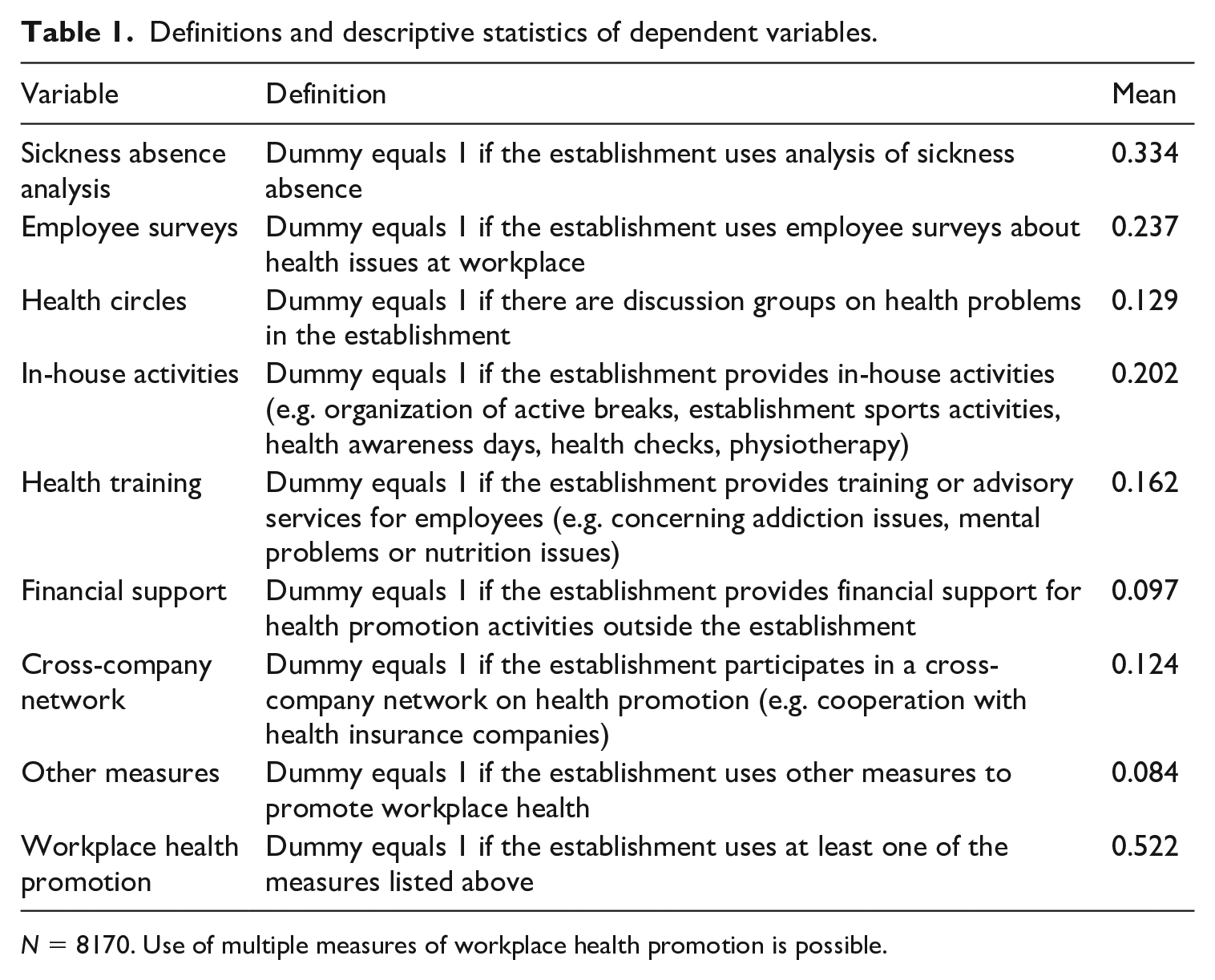
N = 8170. Use of multiple measures of workplace health promotion is possible.
In our empirical analysis, we use a general dummy for WHP. This dummy equals 1 if the establishment uses at least one of the measures; 52% of the establishments use at least one of the health promotion measures listed in the table. Additionally, we use specific dummy variables for the each health promotion measure listed in the table. A dummy is equal to 1 if the establishment uses the respective health promotion measure.
Explanatory variables
The definitions and descriptive statistics of the explanatory variables are shown in Table 2. Our key explanatory variable is a dummy equal to 1 if a works council is present in the establishment. As discussed earlier, the creation of a works council depends on the initiative of the establishment’s workforce. Thus, works councils are not present in all eligible establishments so we can compare establishments with and without works councils. In order to isolate the role of works councils from other industrial relations factors, we also include variables for the coverage by a collective agreement and for the use of alternative forms of employee representation.
Definitions and descriptive statistics of explanatory variables.
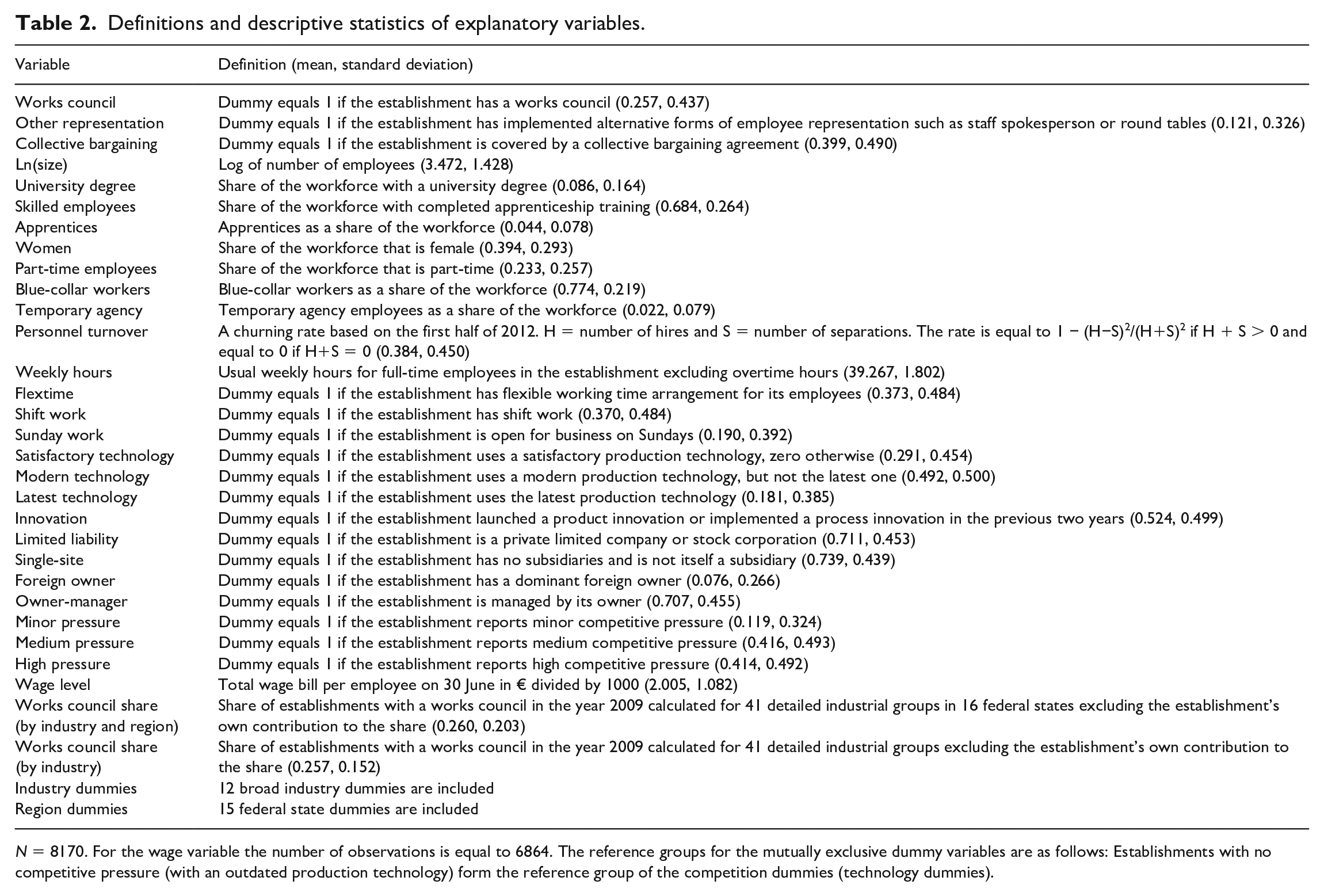
N = 8170. For the wage variable the number of observations is equal to 6864. The reference groups for the mutually exclusive dummy variables are as follows: Establishments with no competitive pressure (with an outdated production technology) form the reference group of the competition dummies (technology dummies).
Employers may to some extent invest in WHP with or without employee representation in order to reduce sickness absence and to improve productivity. The costs and benefits of this investment depend on a series of circumstances. The structure of the workforce is one factor influencing the tradeoff between the costs and benefits of WHP. We control for the shares of skilled and highly skilled employees, blue-collar workers, apprentices, females, part-timers and temporary agency employees. Skilled and highly skilled employees are particularly important for the establishment’s competitiveness. Thus, employers with a skilled or highly skilled workforce should have an increased incentive to invest in the employees’ health (Nuñez and Prieto, 2019). Blue-collar workers are directly involved in production and, hence, are exposed to harmful working conditions such as noise, vibrations, dangerous machines and chemical or organic substances. Employers may invest in WHP to reduce the resulting sickness absence. Apprentices are often retained by employers after they have completed their training so young people use the apprenticeship to enter internal labour markets (Heywood and Jirjahn, 2016). Internal labour markets bind employees and firms and may make it more profitable to invest in the long-term health of the workforce. The influence of females, part-timers and temporary agency employees is ambiguous from a theoretical viewpoint. On the one hand, these employees have usually a shorter employment horizon reducing the employer’s incentive to invest in WHP. On the other hand, they are often peripheral employees ensuring stable employment of primary employees (Heywood and Jirjahn, 2009). A stable core workforce increases the employer’s willingness to invest in WHP.
We also control for personnel fluctuation. On the one hand, high personnel fluctuation may discourage an employer from investing in WHP as employees have a low attachment to the firm. On the other hand, a high fluctuation of employees can indicate personnel problems inducing the employer to improve working conditions.
Working time issues are captured by weekly hours, flexible working time arrangements, shift work and Sunday work. Longer working hours can entail excessive work contributing to health problems such as irregular heartbeat and an increased risk of stroke (Kivimäki et al., 2017). Shift work and Sunday work reflect working at unusual times. Shift work has been shown to cause troublesome health problems such as stress, anxiety, sleeping problems and irritability (Cottini and Lucifora, 2013; Finn, 1981). Employers using shift work may invest in WHP in order to reduce these problems. Flexible working time arrangements involve two opposing influences. On the one hand, if employees can decide about their starting and finishing times, flexible working time arrangements contribute to improved work–life balance reducing the need to invest in WHP. On the other hand, these arrangements can involve increased stress if the employer varies starting and finishing times to adjust production to market fluctuations.
The nature of production is accounted for by dummies for innovative activities and the vintage of production technology. Technological change appears to entail an intensification of work as new technologies allow management to monitor the pace of work and to determine workflows (Green, 2004). Moreover, technological change and innovativeness are accompanied by a reorganization of work toward greater flexibility and multitasking (Campaner et al., 2018; Jirjahn and Mohrenweiser, 2019). Such reorganization of work additionally contributes to the intensification of work involving an increase in mental health problems (Askenazy and Caroli, 2010; Brenner et al., 2004; Cottini and Lucifora, 2013). Altogether, this suggests that innovativeness and a technology of a more recent vintage should be associated with an increased incentive to invest in WHP.
The managerial environment is taken into account by variables for foreign owners and owner-managers. Because foreign owners tend to implement new management practices and can more easily shift production abroad, employees in foreign-owned establishments perceive higher job insecurity than employees in domestically owned ones (Dill and Jirjahn, 2016; Scheve and Slaughter, 2004). Perceived job loss fears affect mental health (Burchell, 1994). Thus, foreign-owned establishments may have a higher need for investing in WHP than their domestically owned counterparts. Owner-managers typically have more personal and informal relationships with their employees (Limborg et al., 2003). The implications for WHP are ambiguous. On the one hand, paternalistic owner-managers may specifically take care of the health of the employees. On the other hand, employees in owner-managed establishments tend to abstain from open criticism (Marlow, 2002). This implies that owner-managers have less information about employees’ preferences and view health issues as being the responsibility of the employees (Hasle et al., 2011).
We also control for establishment size and multi-establishment status. Establishment size should be positively associated with WHP. Implementing WHP may involve a fixed cost, and the fixed cost per employee diminishes with the number of employees receiving WHP. This in turn increases the net benefit of WHP. Similarly, the incentive to invest in WHP should be higher if the fixed cost can be spread across the establishments of a multi-establishment firm.
The legal form of the establishment is taken into account by a dummy for private limited companies and stock corporations. In these firms, owners are only liable up to their individual shares. Owners are more willing to support risky projects if they are protected by limited liability. Thus, to the extent the returns of the investments in WHP are uncertain, these investments are more likely to be undertaken by limited companies and stock corporations. Moreover, we control for the competitive pressure establishments are facing at their product markets. Finally, we include 12 industry dummies and 15 federal state dummies.
Results
Basic estimations
Table 3 shows the basic estimations. The determinants of providing more WHP than required by law are estimated by using the probit procedure. Column (1) shows the initial regression results. A series of control variables take significant coefficients. Larger establishments and establishments that are limited liability companies or stock corporations are more likely to provide WHP. Single-site establishments are less likely to provide WHP. Ownership also plays a role. The presence of an owner-manager emerges as a negative determinant of WHP. Turning to the variables for the structure of the workforce, the shares of apprentices, blue-collar workers and temporary agency workers are positively associated with WHP. Personnel turnover is a positive covariate of WHP, too. The results on technology and innovativeness also conform to expectations. Innovative establishments and establishments with a production technology of a more recent vintage are more likely to provide WHP. Furthermore, working time arrangements have an influence. Shift work and flexible working time arrangements are positive determinants of WHP, while Sunday work is a negative determinant.
Determinants of workplace health promotion.
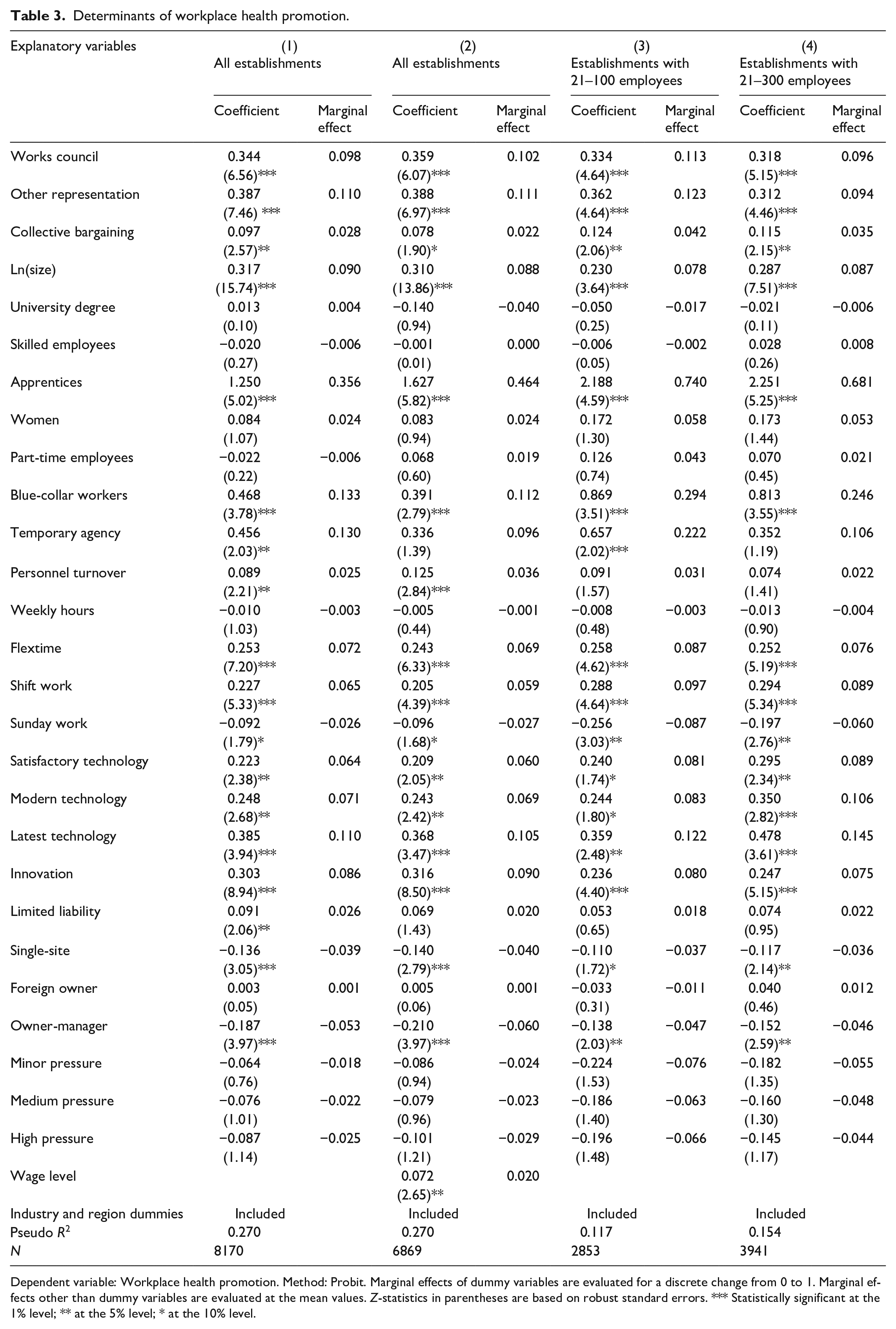
Dependent variable: Workplace health promotion. Method: Probit. Marginal effects of dummy variables are evaluated for a discrete change from 0 to 1. Marginal effects other than dummy variables are evaluated at the mean values. Z-statistics in parentheses are based on robust standard errors. *** Statistically significant at the 1% level; ** at the 5% level; * at the 10% level.
Most salient to our topic, the incidence of a works council is positively associated with the provision of WHP. This conforms to the theoretical expectation that works councils help mitigate market and organizational failures in the provision of workplace health. The positive association is not only statistically significant, but also economically meaningful. Establishments with a works council have a 9.8 percentage point higher probability of providing more WHP than required by law. Given that the mean of the WHP variable equals 52.2%, this implies an increase in the probability of WHP provision of 18.8%.
However, not only the works council variable, but also the variable capturing other types of employee representation emerges as a significantly positive determinant of WHP. Alternative forms of non-union employee representation voluntarily implemented by the employer have a slightly stronger influence than works councils. The use of alternative forms of employee representation is associated with an 11 percentage point higher likelihood that the establishment provides WHP. Union employee representation is captured by the variable for collective bargaining coverage. The influence of this type of employee representation is smaller than the influence of a works council. Collective bargaining coverage is associated with a 2.8 percentage point higher probability of providing WHP. The finding that also other types of employee representation are significant determinants of WHP gives rise to the question of whether the influence of these types is simply additive to that of works councils or whether collective bargaining coverage and alternative employee representation are complementary or substitutive to works councils. We will address this question when examining if the relationship between works councils and WHP depends on circumstances and type of establishment.
While the positive link between works councils and WHP is consistent with the notion that employee representation helps mitigate market and organizational failures in the provision of workplace health, there may be an alternative interpretation of this link. The link might simply reflect an income effect. A series of studies have shown that the wage level is higher in establishments with a works council (see Jirjahn [2017] for a survey). Thus, if workplace health is a normal good, the influence of works councils on WHP might reflect the higher wage level associated with works council incidence. In order to test this alternative explanation, we include the wage per employee in regression (2). The wage variable takes a significantly positive coefficient. This conforms to the notion that employees earning higher wages demand more workplace health. However most importantly, including the wage variable does not change our key result. Works council incidence remains a significant determinant of WHP and the estimated influence is similar to that obtained by regression (1). 3 Thus, we do not find evidence that the link between works councils and WHP is driven by an income effect. In what follows we no longer include the wage variable in the regressions as it has a larger number of missing values reducing the number of observations.
We recognize that works council incidence is correlated with establishment size. Very small establishments usually do not have a works council while works councils are present in almost all large establishments. Hence following previous studies on works councils (Addison et al., 2001; Mueller, 2012), we check the robustness of results by excluding small and large establishments from the analysis. In regression (3), we provide an estimation for medium sized establishments with between 21 and 100 employees. In regression (4), the estimation sample is restricted to establishments with between 21 and 300 employees. Both estimations confirm our key finding. The works council variable takes a significantly positive coefficient and the magnitude of the estimated influence is similar to that obtained for the full estimation sample.
Using information from the 2011 wave of the IAB Establishment Panel, we also included variables for the age structure of the workforce to check the robustness of results. 4 As shown in column (3) of Appendix Table A1, the variables for the share of employees older than 50 and the share of employees aged between 30 and 50 did not emerge with significant coefficients. Thus, our robustness check does not provide evidence that employers so far have recognized the need to the respond to an ageing workforce with increased investments in workplace health. Most importantly in our context, this robustness check confirms a positive influence of works councils on WHP. As the variables for the age structure substantially reduces sample size, we do not include them in the following regressions.
Moderating factors
A series of previous studies have shown that the consequences of works councils can depend on circumstances and type of establishment. This gives rise to the question of whether the link between works councils and WHP only holds for specific types of establishments or can be considered as rather general. Thus, in what follows, we examine whether moderating factors play a role in the relationship between works councils and WHP. Table 4 provides the results on our key explanatory variable. In order to save space, we suppress the results on the control variables. 5
Separate regressions.
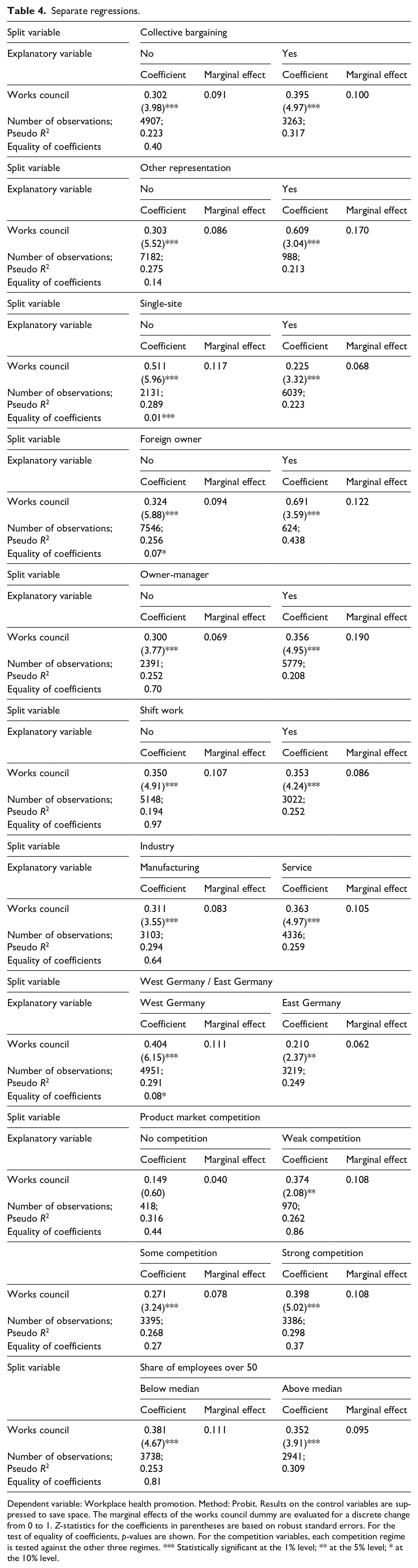
Dependent variable: Workplace health promotion. Method: Probit. Results on the control variables are suppressed to save space. The marginal effects of the works council dummy are evaluated for a discrete change from 0 to 1. Z-statistics for the coefficients in parentheses are based on robust standard errors. For the test of equality of coefficients, p-values are shown. For the competition variables, each competition regime is tested against the other three regimes. *** Statistically significant at the 1% level; ** at the 5% level; * at the 10% level.
Previous research suggests that works councils have a stronger influence on innovativeness, productivity and profitability if establishments are covered by collective bargaining agreements (Heywood and Jirjahn, 2002; Huebler and Jirjahn, 2003; Jirjahn, 2017). These findings fit the hypothesis that, in covered establishments, works councils are less involved in distributional issues and have a stronger focus on performance-enhancing activities. Against this background, we run separate regressions for covered and uncovered establishments. The estimates show a positive influence of works councils on WHP for both types of establishments with the influence being slightly stronger in covered than in uncovered establishments. However, the difference in the estimated coefficients is not statistically significant.
Our initial estimations have shown that not only works councils, but also alternative forms of non-union employee representation voluntarily implemented by employers are positively associated with WHP. Similar to works councils, alternative forms of employee representation may improve information sharing between employer and employees. This gives rise to the question of whether alternative forms of non-union representation are substitutes to mandated works councils (Jirjahn and Mohrenweiser, 2020). In order to answer this question we perform separate estimations for establishments with and without such alternative forms. The estimations show a positive influence of works councils on WHP for both types of establishments. Interestingly, the positive influence is about twice as large in establishments with the alternative forms of non-union representation. This suggests that the relationship between alternative forms of non-union representation and works councils is not substitutive, but quite the contrary, complementary. However, the difference in these estimated coefficients is not statistically significant. Thus, we have to conclude that the influences of works councils and alternative forms of non-union representation appear to be additive. Altogether, the basic point is that our estimates provide no evidence of a substitutive relationship. An explanation for the non-substitutive relationship may be that works councils play a role beyond simple information sharing. Legally defined codetermination rights of works councils imply that works councils have stronger bargaining power and are more effective in protecting employees from employer opportunism than alternative forms of employee representation.
The functioning of works councils can also depend on whether the establishment is a single-establishment firm or belongs to a multi-establishment organization (Jirjahn, 2012). In multi-establishment firms there is a network of works councils coordinated by a central council (Gesamtbetriebsrat) that is composed of delegates from the establishment-level works councils. Thus, the power of an establishment’s works council to influence decisions is likely to be stronger if the establishment belongs to a multi-establishment firm. Works councils may be more effective in negotiating WHP practices and in protecting employees from employer opportunism. This implies that the link between works councils and WHP should be stronger in establishments belonging to a multi-establishment firm. Our estimations conform to this expectation. We find a positive influence of works councils on WHP for both single-establishment firms and establishments belonging to a multi-establishment firm with the influence being significantly stronger in the latter type of establishment.
Previous research indicates that works councils are less likely to play a trust-building and performance-enhancing role in foreign-owned than in domestically owned establishments (Dill and Jirjahn, 2017; Heywood and Jirjahn, 2014; Jirjahn and Mueller, 2014). Against this background one might expect that the link between works councils and WHP should also be weaker in foreign-owned establishments. Our results do not conform to this expectation. While we find a positive link between works councils and WHP for both establishments with foreign owners and establishments with domestic owners, the link is significantly stronger in foreign-owned establishments. One explanation for this finding could be that employees in foreign-owned establishments experience more stressful working conditions including higher perceived job insecurity (Dill and Jirjahn, 2016). Thus, works councils in foreign-owned establishments may specialize to a larger extent in activities that improve workplace health.
Owner-managers might play a moderating role, too. Owner-managers appear to be more likely to oppose works councils than hired managers (Jirjahn and Mohrenweiser, 2016). This might suggest that works councils may be less effective in promoting workplace health when an owner-manager is present. However, the estimates show no significant difference in the influence of works councils between establishments with owner-managers and establishments with hired managers.
Furthermore, we provide separate estimates for establishments with and without shift work. Shift work causes troublesome problems for health and on-the-job safety of employees. Works councils can help design shift work schedules that take health issues to a larger degree into account (Jirjahn, 2008). Against this background, we examine whether works councils play a specific role in WHP if establishments use shift work. The separate estimates confirm a positive link between works councils and WHP for establishments with and without shift work. They do not indicate that the role of works councils significantly differs between these types of establishments.
Industry and region may also play a moderating role in the functioning of works councils (Frick and Moeller, 2003). To examine the role of industry we focus on the manufacturing and the service sector and run separate regressions for the two sectors. The separate regressions confirm a positive link between works councils and WHP for both the manufacturing and the service sector and show no significant difference between the two sectors.
While separate estimations for East and West Germany show a positive influence of works councils on WHP in both parts of the country, the influence is significantly stronger in West Germany. This finding conforms to the notion that workplace partners in West and East Germany do not have the same history so that the functioning of industrial relations to some degree still differs between the two parts of the country (Hyman, 1996).
Moreover, we examine whether product market competition plays a moderating role to take into account that the economic situation of the establishment can influence the functioning of works councils (Jirjahn, 2009). With the exception of establishments reporting no competitive pressure, the estimates show a similar influence of works councils on WHP for the various degrees of product market competition. We recognize that the number of establishments facing no competitive pressure is relatively small so that the coefficient on works council incidence is likely to be imprecisely estimated for these establishments.
Finally, we examine if the age structure of the workforce plays a moderating role. Using the information on age structure from the 2011 wave of data, we perform separate estimations for establishments below and above the median of the share of older employees in our sample. The regressions show a similar influence of works councils on WHP in both types of establishments.
Altogether, our analysis of potentially moderating influences shows a remarkably robust relationship between works councils and an increased probability of WHP provision for the various types of establishments examined. While the link between works councils and WHP is rather general, it appears to be specifically strong for establishments with foreign owners, establishments belonging to a multi-establishment firm and establishments located in West Germany.
Detailed WHP measures
So far we have used a broad dichotomous variable for the provision of WHP. At issue is now whether works councils have an influence on specific WHP measures. Thus, in what follows, we analyse the link between works councils and the various WHP measures listed in the survey of the IAB Establishment Panel. Table 5 provides the results on our key explanatory variable.
Measures of workplace health promotion.
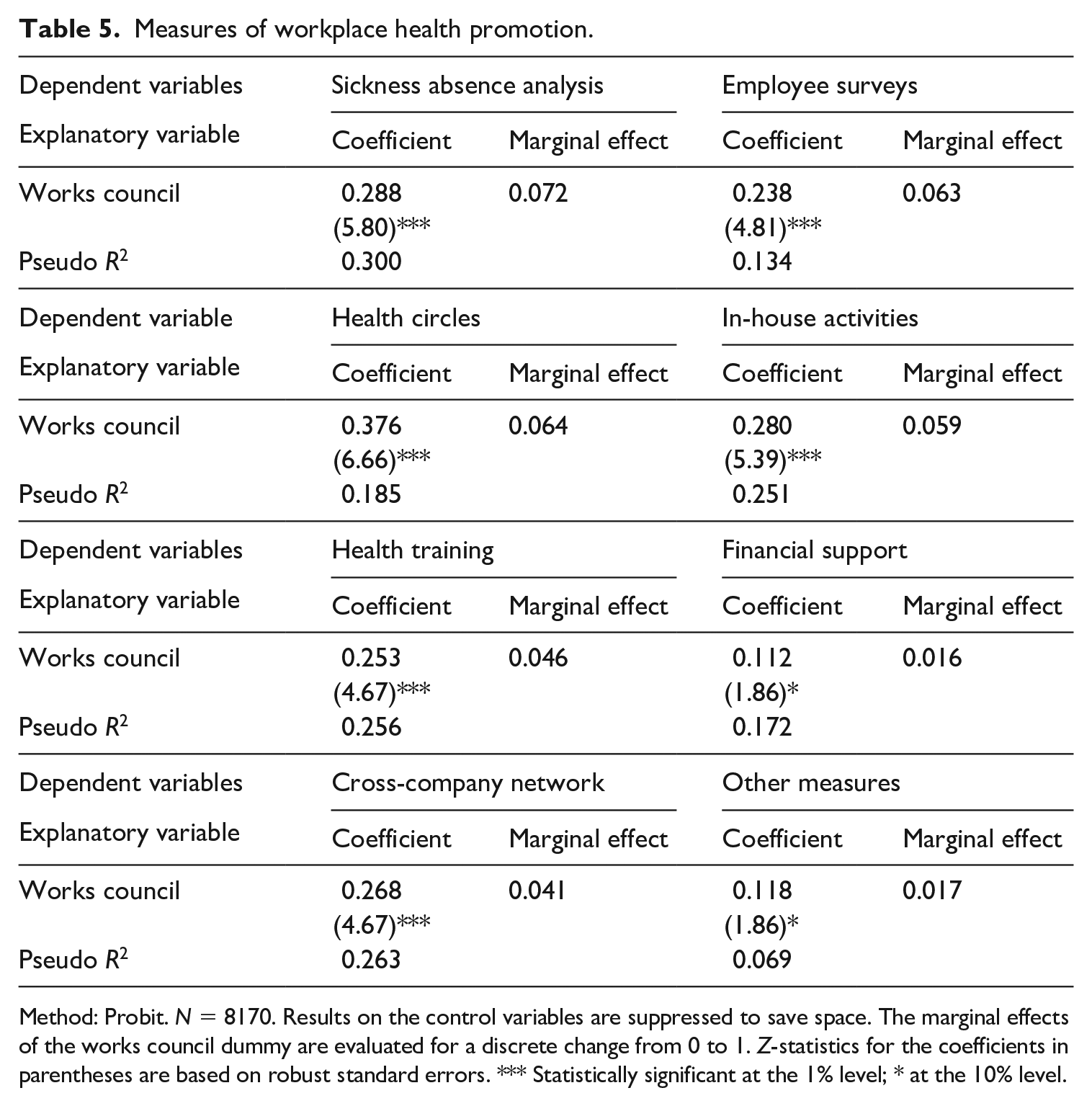
Method: Probit. N = 8170. Results on the control variables are suppressed to save space. The marginal effects of the works council dummy are evaluated for a discrete change from 0 to 1. Z-statistics for the coefficients in parentheses are based on robust standard errors. *** Statistically significant at the 1% level; * at the 10% level.
The estimations show that works councils are associated with various measures improving information exchange on health-related issues within the establishment. Establishments with a works council have a significantly higher likelihood of using health circles, sickness absence analysis and employee surveys on health-related questions. A works council can ensure that employees’ interests are taken into account when employees and employer share information on health-related issues. This increases the effectiveness of measures fostering information exchange and, hence, makes their use more likely.
Moreover the estimations provide evidence that works councils are associated with direct measures to promote workplace health. This holds for measures undertaken within the establishment. Establishments with a works council have a significantly higher likelihood of using in-house activities (e.g. health awareness days, health checks and physiotherapy) and providing health-related training and advisory services (e.g. addiction issues, regarding mental problems and nutrition issues). It also holds for measures undertaken outside the establishment. Establishments with a works council are significantly more likely to provide financial support to their employees for health promotion activities outside the establishment. This also supports the notion that works councils foster the use of WHP measures by ensuring that employees’ interests are taken into account and providing information that increases the effectiveness of the measures.
Finally, establishments with a works council have a significantly higher likelihood of using ‘other measures’ and participating in cross-company networks on health promotion. Altogether, our regressions suggest that the influence of works councils is not confined to a small set of particular WHP measures. Rather, works councils appear to foster a broad range of various WHP measures.
The issue of endogeneity
We recognize the possibility that our results might suffer from potential endogeneity of the variable for works council incidence. There might be unobserved factors correlated with both works council incidence and WHP. These unobserved factors could result in an omitted variable bias. From a theoretical viewpoint, this bias could result in an overestimation or underestimation of the influence of works councils on WHP.
If there were unobserved factors positively influencing both the incidence of a works council and the provision of WHP, the effect of works councils on WHP would be overestimated. For example, our controls may only incompletely account for the managerial environment. Supportive managers may encourage employees to adopt a works council so they can signal that the establishment is a good employer (Backes-Gellner and Tuor, 2010). At the same time, they may also tend to invest in WHP to provide good working conditions. In this case, the estimated coefficient on the works council variable would not only capture the works council effect, but also the positive influence of the supportive managerial environment on WHP.
By contrast, if there were unobserved factors positively influencing the incidence of a works council and negatively influencing WHP, the effect of works councils on WHP would be underestimated. For example, incompetent managers may be not able to build trustful relationships with the workforce leading employees to implement a works council to protect their interests. 6 These incompetent managers may also not provide measures to improve workplace health. In that case, the estimated coefficient on the works council variable would also capture the influence of the incompetent managers.
In order to examine the possible endogeneity of the works council variable, we return to our broad WHP dummy and estimate a recursive bivariate probit model (Greene, 1998; Kassouf and Hoffmann, 2006).
7
Let us denote the dummy variable for WHP in establishment i by


where


where
In our context, the coefficients in equation (3) are of primary interest. Assuming that
In principle, identification of the recursive bivariate probit model is ensured by its inherent nonlinearity (Wilde, 2000). However, to avoid that identification relies solely on the functional form, exclusion restrictions are usually imposed to improve identification. Finding convincing exclusion restrictions is always a matter of debate. Just-identifying exclusion restrictions are based on assumptions that cannot be formally tested (Heckman, 2000; Keane, 2010). They can only be justified by reasoning and an appeal to intuition. Hence, attempts to account for endogeneity should be largely viewed as exploratory.
Here we use the share of establishments with works councils calculated for 41 detailed industrial sectors in 16 federal states. 8 We use the share of establishments with works councils in the year 2009 as an instrument for works council incidence in the individual establishment in the year 2012. When calculating the share of establishments with works councils for each establishment, we exclude the own contribution of the respective establishment to that share. The share of establishments with works councils reflects the general propensity within a region and narrowly defined industry that works councils are present. Hence, it should have a positive influence on the individual establishment’s probability of having a works council.
The validity of the instrument requires that the share of establishments with works councils in the industry and region has no direct effect on the WHP of the individual establishment, but influences WHP only indirectly through the incidence of a works council. Of course, one could imagine that the share of establishments with a works council might reflect industry-specific working conditions or regional factors that are also present in the individual establishment. This might suggest a direct link between the instrument and the individual establishment’s WHP. However, to the extent that our dataset allows to control for relevant working conditions at the establishment level, there should be no direct effect of the instrument. In the regressions, we control among others for innovations, vintage of technology, shift work, establishment size, blue-collar work, part-time, temporary contracts, skills, apprenticeship, collective bargaining and type of ownership. Moreover, note that our instrument allows us to still include the 12 broadly defined industry dummies and the 15 federal state dummies in the regressions. Altogether, our control variables should capture important aspects of the working conditions within the establishment, increasing our confidence in the validity of the instrument. The basic point is that the validity of an instrument can depend on the control variables included (Angrist and Pischke, 2009: Ch. 4.5.2). An instrument may be not valid per se, but may be valid only after conditioning on covariates. Thus, to the extent that we control for critical establishment characteristics, we do not expect a direct effect of the share of establishments with a works council. We assume that this share influences WHP only indirectly through the incidence of a works council, but not directly and independently of the incidence of the works council.
Table 6 provides the key results of the recursive bivariate probit regression. The determinants of WHP provision are jointly estimated with the determinants of works council incidence. The share of establishments with works councils in the industry and region is a significant determinant of the individual establishment’s probability of having a works council. A Wald test weakly rejects (at the 10% significance level) the hypothesis that the incidence of a works council is exogenous. The correlation between the error terms of the WHP equation and the works council equation is negative. This conforms to the notion that, for example, incompetent managers induce employees to implement a works council and do not provide WHP. The negative correlation between the error terms implies that the estimated effect of works councils on WHP in the recursive bivariate probit regression is stronger than in the simple probit regressions of Table 3. 9 The regression suggests that works council incidence is associated with a 20.4 percentage point higher likelihood of WHP. Altogether, even when taking the potential endogeneity of works council incidence into account, the estimates confirm our key finding of a positive influence of works councils on WHP. The recursive bivariate probit provides some (weak) evidence that the positive effect of works councils on WHP provision is underestimated in the simple probit regressions.
The issue of endogeneity.
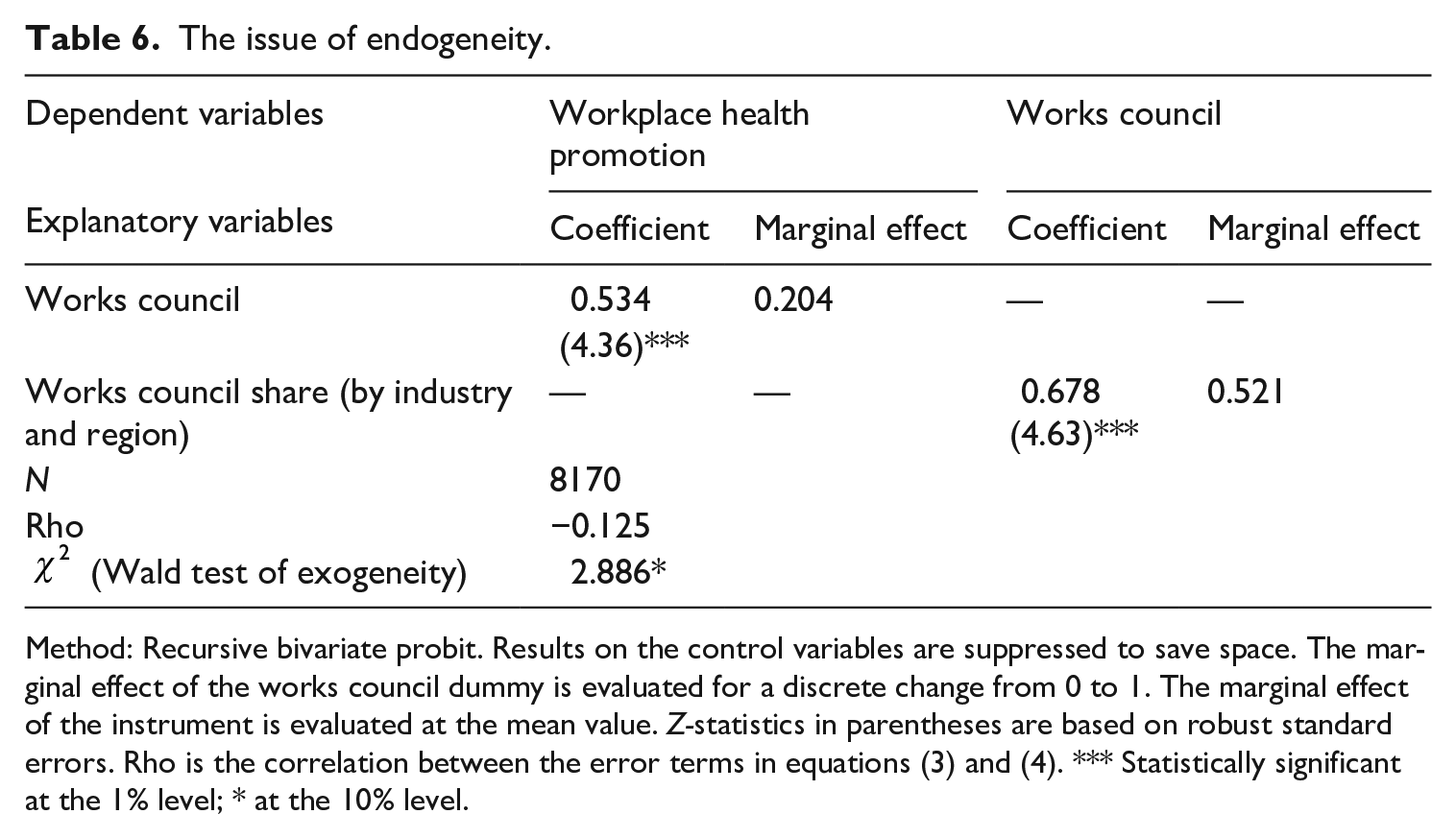
Method: Recursive bivariate probit. Results on the control variables are suppressed to save space. The marginal effect of the works council dummy is evaluated for a discrete change from 0 to 1. The marginal effect of the instrument is evaluated at the mean value. Z-statistics in parentheses are based on robust standard errors. Rho is the correlation between the error terms in equations (3) and (4). *** Statistically significant at the 1% level; * at the 10% level.
So far, we have used the share of establishments with works councils within an industry and region as our instrument. In Appendix Table A2, we use only the share of works councils within an industry (without differentiating by region) as an alternative instrument. This robustness check confirms our key results. The share of works councils within the industry has a positive influence on the probability that a works council is present in the establishment. Moreover, the correlation between the error terms is negative implying a higher estimated influence of works councils on WHP in the recursive bivariate probit regression than in the simple probit regression. However, the Wald test cannot reject the hypothesis of exogeneity. One reason might be that we have much lower variation in the instrumental variable when using the share of works councils only within the industry. This might make it more difficult to reveal endogeneity.
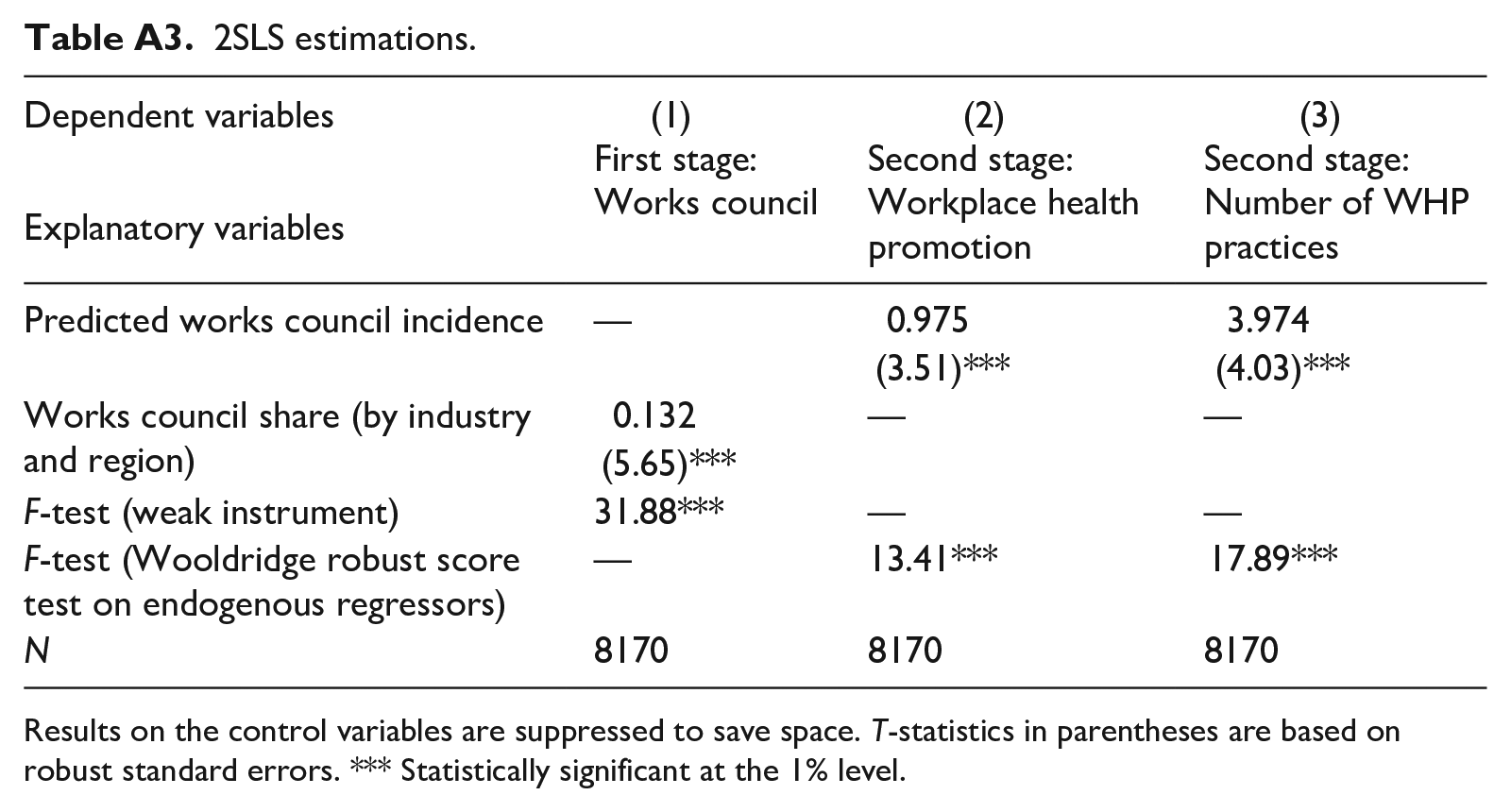
As a further check of robustness, Appendix Table A3 provides the results of 2SLS regressions. In these regressions, identification is solely ensured through the exclusion restriction, but not through distributional assumptions. In the first step, the determinants of works council incidence are estimated by a linear probability model. First-stage regression (1) confirms that the share of establishments with works councils in the industry and region is a positive determinant of the individual establishment’s propensity of having a works council. An F-statistic of 31.88 shows that the instrument is highly correlated with works council incidence. As suggested by Bound et al. (1995), an F-statistic of at least 10 is the rule of thumb for a sufficiently strong correlation between the instrument and the endogenous explanatory variable. In the second step, the predicted value of council incidence is included in a linear probability regression explaining the provision of WHP. As shown by regression (2), this step confirms a positive influence of works councils on WHP provision. In regression (3), we use an alternative definition of the dependent variable for the second stage. Here we use the number of WHP practices by adding up the practices listed in Table 1. The regression shows a positive influence of works councils on the number of WHP practices. In both regression (2) and regression (3), the Wooldridge robust score test on endogenous regressors rejects the hypothesis of exogeneity.
Conclusions
From a theoretical point of view, there exist a series of possible market and organizational failures resulting in an underprovision of WHP. Works councils may help overcome or at least mitigate these failures resulting in an increased use of WHP within establishments. Based on German data from the IAB Establishment Panel, our empirical analysis confirms that establishments with a works council have a higher likelihood of providing more WHP than required by law. This result also holds when accounting for the potential endogeneity of the incidence of a works council.
Furthermore, our analysis shows that the link between works councils and WHP is rather general and holds for various circumstances and types of establishments. However, the strength of the link appears to depend on the type of establishment. It is particularly strong for establishments located in West Germany, foreign-owned establishments, and establishments being part of a multi-establishment firm. Moreover, we find that the influence of works councils is not confined to specific measures, but rather applies to a broad range of various WHP measures.
Finally, our estimates suggest that not only works councils, but also alternative forms of non-union representation voluntarily implemented by employers have a positive influence on WHP. Yet, these alternative forms of employee representation do not appear to be substitutes for works councils. This finding can be interpreted in light of the transmission channels discussed in our theoretical background discussion. Similar to works councils, alternative forms of employee representation may improve information sharing between employees and employer. If works councils solely had an influence on WHP through information sharing, we would have observed that their influence is less strong in establishments with alternative forms of employee representation. In these establishments, information sharing is already achieved through the alternative forms of employee representation so that works councils would play a less important role. Our empirical results do not conform to that notion. Albeit the difference is not statistically significant, separate estimations show that works councils have an even stronger influence on WHP in establishments with than in establishments without alternative forms of employee representation. An explanation for the non-substitutive relationship is that the role of works council goes beyond simple information sharing. Because of their codetermination rights works councils increase employees’ bargaining power and help solve commitment problems of the employer. By contrast, alternative forms of employee representation have no legally defined codetermination rights and, thus, are less powerful. This implies that their ability to negotiate over WHP practices and protect employees from employer opportunism is much weaker.
We end this study with recommendations for future research. First, it would be interesting to extend our analysis for Germany to other countries. This would be particularly interesting as issues of occupational health and safety play an important role in works council legislation in many other countries (Jirjahn and Smith, 2018b). Second, now that the role of works councils in the use of WHP has been examined in detail, it would be interesting to analyse whether works councils also have an influence on the outcomes of WHP measures. This applies to both the economic performance of establishments and the health and wellbeing of employees.
Footnotes
Appendix
2SLS estimations.
| Dependent variables |
(1) |
(2) |
(3) |
|---|---|---|---|
| Predicted works council incidence | — | 0.975 | 3.974 |
| (3.51)*** | (4.03)*** | ||
| Works council share (by industry and region) | 0.132 | — | — |
| (5.65)*** | |||
| F-test (weak instrument) | 31.88*** | — | — |
| F-test (Wooldridge robust score test on endogenous regressors) | — | 13.41*** | 17.89*** |
| N | 8170 | 8170 | 8170 |
Results on the control variables are suppressed to save space. T-statistics in parentheses are based on robust standard errors. *** Statistically significant at the 1% level.
Declaration of conflicting interests
The authors declared no potential conflicts of interest with respect to the research, authorship, and/or publication of this article.
Funding
The authors received no financial support for the research, authorship, and/or publication of this article.
