




Abstract
This qualitative research explores the psychological contract (PC) of a sample of self-initiated expatriates (SIEs) working in the French hospitality sector, focusing on PC evaluation as well as reactions to PC breach and feelings of violation. The authors found evidence of a psychological contract type not discussed before in empirical studies. The employer in this research intentionally disrupts the exchange relationship, creating a destructive PC. In these cases, it is assumed that employees would exit such an employment relationship, but instead the study found a mix of dysfunctional behavior in the form of neglect, workplace deviance and revenge cognitions. Accounting for the limitations of the study the authors highlight the implications of the findings for theory, practice and future research.
Keywords
Introduction
Improved open border policies in many countries have led to an increase in self-initiated expatriates (SIEs), who ‘decide on their own initiative to expatriate to search for a job abroad, self-fund their expatriation without organisational support, for a temporary but undefined time, likely from over a year up to a decade, for career, professional, lifestyle, cultural and personal reasons, and usually employed on a host country-contract once there’ (Tharenou, 2015: 162). Whilst research on SIEs is increasing (Reiche and Pudelko, 2016), we still know little about SIE employment relationships (Kraak et al., 2018). Employment relationships are often studied through the lens of the psychological contract (PC), which is anchored in Social Exchange Theory (Blau, 1964) and assesses the quality of the continuous exchange relationship between employers and employees (Freese and Schalk, 2008; Rousseau, 1995). Social Exchange Theory (Blau, 1964) assumes that both parties come through on their exchange agreement and according to the reciprocity principle (Gouldner, 1960), the other party will respond in kind in order to maintain an exchange balance. This means that employees are expected to show positive attitudes and behavior if the employer fulfils the PC (positive norm of reciprocity; Cropanzano and Mitchell, 2005), but these attitudes and behaviors are likely to change (negative norm of reciprocity; Cropanzano and Mitchell, 2005) if the employer does not deliver on explicit or assumed expectations, also referred to as PC breach (Morrison and Robinson, 1997). Despite the recent increase in the use of terms like sustainable HR and sustainable employment, suggesting that PCs are generally fulfilled, several authors have stated that this is not the case for large groups of employees working in precarious employment contexts such as menial jobs (e.g., Bal and Brookes, 2022; Griep et al., 2019). This is evidenced by numerous recent press articles that have discussed problematic employment conditions in supermarkets (Harounyan, 2017), logistics (Kellogg et al., 2020), the travel industry (Hansen and Vugts, 2022), and the hospitality industry (Bresson, 2021). The consequences of these problems are manifold. At a personal level, employees working in precarious jobs often report low perceived wellbeing (e.g., Kallenberg, 2021). At an organizational level we see astronomical high turnover rates, sometimes up to 144% for American fast-food restaurants, and a creeping shortage in job applications (Dodds, 2021). The situation is no different in France, where the hospitality sector has expressed a need to hire approximately 200,000 seasonal employees for 2023 (Pascual, 2022). The press has coined this situation ‘the great resignation’ (e.g., Cohen and Roeske-Zummer, 2021). However, these trends are not new and are actually a continuation of long-term issues regarding employment (Fuller and Kerr, 2022). Despite the coverage that these topics get in the press, there is currently a paucity of research that has explored these destructive employment relationships (for a rare exception, see Zoghbi Manrique-de-Lara et al., 2021).
So why did we not identify this gap in our understanding of (SIE) employment relationships earlier? One of the obvious reasons is that the overwhelming majority of PC research focuses on high skilled labor (e.g., O’Leary-Kelly et al., 2014). And the same problem exists in the SIE literature. In an overview of 49 studies on SIEs between 1996 and 2011 (Doherty, 2013) not one paper studied menial jobs. Granted, SIEs work in different jobs, many of them at professional and managerial levels in academia and industry (Cerdin and Selmer, 2014). However, there is also a large population of SIEs working in menial jobs (Clark and Altman, 2015) and this group has been largely overlooked until now. We want to address this important gap in the SIE and PC literature by exploring the PC of a group of SIEs working in menial jobs in the French hospitality industry. This industry is particularly suited for our exploration given its high intake of foreign workers as well as its characteristics such as long working hours, cumbersome rota planning, low wages, poor career opportunities, high turnover, and difficulties with hiring new staff (Barron, 2008; Ghiselli et al., 2001; Lub et al., 2012). In France, where our enquiry is based, 58.60% of all permanent contracts in the hospitality sector are broken within their first year (Dares, 2015) and the proportion of foreigners in this sector is significant: and estimated 10–20% of employees (Jolly et al., 2012). Furthermore, the French government is supportive of the participation of foreign workers in this sector as evidenced in the working permits for non-EU citizens, which have multiplied 10-fold since 2012 (Pascual, 2022). This sector thus seems ideal for an in-depth exploration into the PC of SIEs working in menial jobs.
In one of France’s largest cities we came across a number of pub-restaurants, almost exclusively comprising SIE staff. We opted to concentrate on one local chain of three pub-restaurants, in line with recommendations for high impact case study research (Taylor and Søndergaard, 2017) when focusing on the PC of SIEs in menial jobs. Our main objective was to establish how these individuals perceive and evaluate their PC and how they react to any instances of PC breach. Judging from literature and reports (e.g., Barron, 2008; Dares, 2015; Ghiselli et al., 2001; Lub et al., 2012; Pascual, 2022) we anticipated that we would have a high likelihood of running into difficult employment circumstances, yet not wishing to prejudge perceptions we wanted participants to naturally account for their PC as they believe it to be. We therefore considered that posing two broad exploratory research questions would be the right way forward: (RQ1) How do SIEs in menial jobs in the hospitality sector evaluate their PC? (RQ2) What is their reaction to PC breach?
Apart from providing general insights regarding the content of the PC of SIEs working in menial jobs in the hospitality sector, this study makes two main contributions to the PC literature. First, we provide insights into how PC evaluations by SIEs influence their reactions to PC breach. Our results show that in line with the negative norm of reciprocity (Cropanzano and Mitchell, 2005), participants resorted to disruptive and deviant behaviors in order to get back at management after PC breach. However, most of them did not opt for, or considered, leaving their employment. Second, we uncover a hitherto undocumented type of PC behavior, whereby an employer deliberately withholds investment in the employment relationship for the majority of their staff, effectively pushing these individuals to resort to counterproductive workplace behavior. We labeled this attitude towards the employment relationship, a destructive PC.
The remainder of this article will present the reader with a theoretical background from the relevant literature before explaining the empirical study, the analysis and our findings. We conclude with a discussion section that includes theoretical and practical contributions as well as the study’s limitations and avenues for future research.
Theoretical background
The psychological contract
Rousseau (1989: 123) defined the PC as ‘individual beliefs, shaped by the organisation, regarding terms of an exchange agreement between individuals and their organisation’. These individual beliefs are about perceptions of promised and delivered inducements that generally originate from perceived implicit or explicit promises made by the employer (Robinson, 1996). There are many potential inducements that can be included in a PC (Kotter, 1973). Researchers therefore regularly use specific features to characterize different types of PCs (Rousseau and Tijoriwala, 1998). The most common distinction is between transactional and relational PCs (Conway and Briner, 2005). Transactional PCs include specific monetizable exchanges, are narrow in scope, often short-term and finite in nature (i.e., a relationship that is based on a series of ongoing straightforward exchanges with no real emotional investment from parties), whereas relational PCs are open-ended, include fewer specific exchanges, and are aimed at establishing and maintaining a rich relationship between parties that persist over time (Rousseau and McLean Parks, 1993; Robinson et al., 1994). Other examples of PC characterizations are transitional PCs (i.e., PCs with inducements that change over time; Rousseau and Wade-Benzoni, 1994), safety PCs (i.e., safety-related PC inducements; Walker and Hutton, 2006), and ideological PCs (i.e., inducements that are related to purpose, values, and mission; Thompson and Bunderson (2003).
Psychological contract fulfillment and breach
If employers deliver on their obligations, the term PC fulfillment is used. Fulfillment is typically linked to positive outcomes (i.e., positive reciprocity norm; Cropanzano and Mitchell, 2005). Although research on the outcomes of PC fulfillment is less developed than research on the outcomes of PC breach (Coyle-Shapiro et al., 2019), PC fulfillment is reported to energize employees (Parzefall and Hakanen, 2010). However, the evaluation of the PC is typically assessed by measuring PC breach (Coyle-Shapiro et al., 2019). Breach occurs when an employee cognitively appraises that the employer has failed to meet their obligations (Morrison and Robinson, 1997) by comparing promised conduct with what was actually delivered. PC breach typically leads to negative reactions when employees decide to lower their own obligations in return (i.e., negative reciprocity norm; Cropanzano and Mitchell, 2005). The employees’ evaluation of how acceptable the instance of PC breach is will determine the type of reaction (Rigotti, 2009). That is, employees may not always notice discrepancies between an obligation and the actual fulfillment of this obligation (Rousseau, 1995) until the discrepancy surpasses a certain threshold, at which time it constitutes a PC breach (Rigotti, 2009). Specifically, Schalk and Roe (2007) propose two thresholds or boundaries for PC breach: acceptable and tolerable. According to Schalk and Roe (2007), employees will (1) attempt to balance the mutual exchange relationship by lowering the extent to which they fulfill their own contributions when they deem PC breach to be acceptable; (2) revise the PC terms and exhibit attitudinal and/or behavioral changes if they deem a PC breach to be beyond what is considered acceptable; and/or (3) desert the PC altogether if the PC breach is deemed to be intolerable. This sensemaking process following PC breach can thus result in various employee reactions, ranging from small to big negative changes in perceptions, emotions and behavior, as well as an intense negative emotional state, referred to as violation feelings (Morrison and Robinson, 1997). Breach and violation feelings are related to a variety of negative attitudinal, emotional and behavioral outcomes (for an overview see Zhao et al., 2007) such as decreased job satisfaction (Kickul et al., 2002), decreased trust in the organization (Robinson and Morrison 2000), and decreased organizational commitment (Coyle-Shapiro and Kessler, 2002), increased absenteeism (Deery et al., 2006), increased workplace deviance (Bordia et al., 2008), increased intention to quit (Turnley and Feldman, 2000) and actual turnover (Bunderson, 2001).
The psychological contract of SIEs
Turning to SIEs, these individuals are recruited locally, employed on a local contract and their PC will presumably be narrower in scope than the PC of corporate-sent expatriates. However, this does not imply that SIEs will have the same PC perceptions as local employees because these perceptions are influenced by a multitude of issues (Conway and Briner, 2009), including education, previous employment experiences, societal values and laws (Clark and Altman, 2015; O’Donohue and Nelson, 2009; Rousseau, 1995; Rousseau and Schalk, 2000). SIEs have accrued experiences in both their country of origin and their host country (Lo et al., 2012) and may therefore hold PC perceptions that are shaped by their home country culture, host country culture or perhaps both.
To date only a handful of papers have empirically examined SIE PCs (Kraak et al., 2018; Lapointe et al., 2022; Lee, 2005; Zhang and Rienties, 2017). Kraak et al. (2018) studied the organizational context and found that perceived role differentiation and perceived restrictions from the social unit determined how SIEs construed their PCs. Lapointe and colleagues (2022) compared SIEs and company-sent expatriates, working in education, in China and Malaysia and found that SIEs perceive more organizational cynicism following breach than company-sent expatriates. Lee (2005) used a fulfillment scale in a study on SIE underemployment and found that SIEs who experience PC breach show an increased perception of having an inferior type of employment. Finally, Zhang and Rienties (2017) compared the PCs of company-sent expatriates with SIEs and reported that SIEs perceive their PCs to be more negative. Altogether what is not known much exceeds what we do know about the PC of SIEs. We therefore considered that broad exploratory research questions – focusing on how SIEs in menial jobs evaluate their PC (RQ1) and what their reactions are to PC breach (RQ2) – would be the right way forward.
Method
Sample and research setting
Employing case study methodology (Stake, 1995) we conducted our study in a chain of three British pub-restaurants (hereafter: pubs) in a large French city. These establishments resemble pubs that one can find anywhere in Britain or Ireland with wall-to-wall carpeting, dimmed lighting, brewery sponsored glasses, taps and mirrors, television screens for sports matches, a wooden bar, and a well-stocked liquor cabinet. They serve typical British/Irish pub food and drinks and an unmistaken familiar smell from the kitchen welcomes the guests as soon as they walk in the door. The pubs are staffed almost exclusively by British, Irish and other English-speaking foreign employees. Our sample comprises 17 subjects: 15 current employees and two former employees. All were engaged on a local French permanent contract (article L1242-2 of the French labor law only allows temporary employment contracts under highly restrictive conditions such as the replacement of employees on maternity leave [Legifrance, 2017]). Although a number of workers refused to take part in the study for various reasons (e.g., ‘don’t want to be associated with anything that could be perceived as negative by management’), we managed to engage over half of the total population of employees in these establishments as well as two former employees – this compares favorably with recommendations for case study research (Strumińska-Kutra and Koładkiewicz, 2018).
In line with established criteria for classifying SIEs (e.g., Cerdin and Selmer, 2014; Tharenou, 2015), subjects initiated their temporary move to France without organizational support and did not move to France with a clear timeline in mind, having found their employment after they had arrived in the country. The social networks of the majority of our participants were placed within the surroundings of the pubs or in the wider, yet still restricted, social networks of the English/Irish establishments in the city. Apart from two people, who referred to their peers as ‘colleagues’, all others used the word ‘friends’ or even ‘family’ to describe the people they work with. They shared many aspects of their lives together, from doing sports, going to pub quizzes, meeting up for parties, helping each other out, to sharing housing, and spending birthdays and bank holidays together.
The sample, six women and 11 men, included bartenders, waiters, kitchen staff (n = 14), and (assistant) pub managers (n = 3), who came from Albania (1), Colombia (1), Czech Republic (1), Great Britain (5), Ireland (5), Poland (3) and Romania (1). Each pub had a manager who was in charge of daily affairs, overseen by a general manager who reported to the owner. Employees regularly rotated between the three establishments. Eleven participants had previously lived abroad: four of them for less than a year, and seven of them had spent between one and 16 years in another country before coming to France. Thirteen had completed a Bachelor’s or Master’s degree and four of them were planning on continuing their studies, although only one was actively pursuing that intention over the course of this research (see Table 1).
Sample characteristics at time of interview.

We opted for a qualitative study, in line with previous studies focusing on employees’ perceptions of their PC (e.g., De Vos et al., 2003; Payne et al., 2015; Tekleab et al., 2013). We conducted focused observations and had in-depth semi-structured interviews and follow-ups outside of the workplace. The observations and follow-ups allowed for a better understanding of the employment relationships described in the interviews by this group of SIEs.
Data collection
We conducted a purposeful sampling strategy using snowball sampling (Patton, 1990). We informed SIEs that we were studying expatriates’ working lives in British pubs and participants agreed to be formally interviewed as well as to informal follow-ups. Then we frequented all three pubs for observations, exchanges with staff and conversations with customers, totaling over 34 visits over a 30-month period. We visited pubs on different occasions throughout the day, witnessing numerous events, ranging from the celebratory mood of a packed pub to an acrimonious exchange between the general manager and pub staff; ultimately witnessing everyday life in these establishments unfold itself as a narrative. Following principal data collection, we maintained contact with all participants, including those who left their employment.
The one-to-one interviews with 15 current employees and two former employees were conducted in English by the first author, lasting between one hour and one hour 45 minutes. The interviews were structured around several topics such as the place of work, the employment relationship, career issues and future plans. With regard to the employment relationship we discussed PC contents, evaluation and SIE reactions. We employed critical incidents (Flanagan, 1954) to explore instances of perceived PC breach and its accompanying violation feelings. To maintain standardization and for comparison purposes we borrowed items from the PC breach and violation feelings scale by Robinson and Morrison (2000). An example question is ‘Do you feel or have you ever felt a great deal of anger towards your current employer?’ These questions elicited participants to provide specific information and allowed for precise follow-up questions about the context and perceptions of events. All interviews were recorded with participants’ consent. We also talked to two former employees, which provided us with additional data.
Data analysis
Interview recordings were transcribed. To protect participants’ anonymity, they were assigned random names. Carl, Doug and Henri worked in a managerial (supervisory) position. Other participants referred to here were operative staff. As there were only two people above the shopfloor level, participants often referred to the owner and general manager interchangeably as management, the organization and the employer. We therefore use these terms similarly, except when participants pointed out that an event specifically involved the general manager or owner.
The transcripts were analyzed using thematic/template analysis (King, 1998, 2004). We defined a provisional template a priori, using our interview guide, to lend sufficient structure to the analysis, while staying flexible enough to capture emerging themes (Aldrich et al., 2015). The insights gained through our observations and field notes were helpful in understanding the context and identifying the relationships between actors in participants’ accounts of specific situations.
Before we discussed the research questions, we wanted to chart the PC content for this specific group of SIEs so as to have a better understanding of the specific exchange agreement in this context. A total of 143 perceived employer obligations were identified from the transcripts. Similar obligations were placed in representative higher-order themes (King, 2004): (1) salary, (2) working hours, (3) workload, (4) management, (5) legal, rules and regulations, (6) general and (7) relational elements. After deleting duplicate inducements, we retained a final list of 47 employer obligations. The majority of the employer obligations focused on specific and narrow aspects of the employment relationship such as remuneration, working hours and rules and regulations. All subjects mentioned salary-related items, with eight of them pointing out that they perceived the employer owed them performance-based pay or bonuses for the effort that they had put in. There is a clear absence of PC inducements reflecting any aspects related to a long-term view such as training and development (i.e., the relational PC). Only one subject talked about job opportunities.
The same approach was used to analyze 63 statements on what participants felt that management expected from them, resulting in 20 in- and extra-role obligations. Half of the in-role obligations were about the interactions with customers, such as ‘provide good service to customers’, and half of the extra-role items were about being flexible, such as ‘put in overtime when asked’ or ‘always be available for work’. Table 2 provides an overview of these employer and employee PC obligations.
Overview of employer and employee PC obligations.

RQ1 explored how participants evaluated their PCs. Following Freese and Schalk (2008) we let participants indicate whether they perceived PC breach or not by matching breach accounts with the previously determined content (see Table 2). Only when participants qualified an event as PC breach did we take it into account as such. RQ2 aimed to study how participants reacted to PC breach. Identical to the procedure we employed to define the contents of the PC, outcomes of breach were grouped together and attributed with a higher order theme: (1) emotions, (2) neglect behavior, (3) deviance behavior, (4) revenge behavior and (5) other. Our levels of hierarchical coding (two or three) adhere to King’s (1998) recommendations so as to preserve clarity in organizing and interpreting the data.
Findings
RQ1: Evaluating the PC
Seven of the 15 currently employed participants were overall positive about their PC with their employer. Three of them had a good personal relationship with the owner, two of them (both managers) also were acquainted with him socially. Carl gave the following account of his interactions with the owner and his family: I really like him [the owner]. I drink with him, I drink with his family, I spend New Year with the family. Their daughter is one of my best friends. So I’m really close to them, and because of that I care about this place.
However, eight of the 15 participants were overall negative in their accounts in relation to their PC. Instances of PC breach regarding salary and working hours were present in almost each of those accounts. Most participants never received a pay raise, even if they had taken on additional responsibilities, and there was no performance-based pay or bonus system for exceptional performance. There were also instances of PC breach regarding promises on facilities, equipment and the level of supplies in stock. The general manager was the person referred to in many accounts of PC breach. Gill described an exchange with the general manager, which left her disgruntled. She was putting in a lot of overtime and wanted to discuss the rota as she thought that it was not normal, or legal to be working so many hours: He told me that I was lucky that I don’t work down a mine and that I have to, like, work really hard in life [. . .] And I said, it’s not necessarily that I cannot do it. It’s the principle that I should not have to do it because it’s not fair. And he just told me that I should not have any principles because they don’t want us to have principles.
An underlying current in the negative accounts was a lack of respect, ‘not being taken seriously by management’ (Abby) and ‘shamelessness’. Doug recalled two troubling instances: I did 60 and 70-hour weeks to help out when people were sick, ’cause they were dropping like flies. Two pretty high-up members of staff, plus a casual, all sick at the same time. And we would have been really in trouble if I hadn’t been there, and then not to get paid for it, that’s pretty much a slap in the face. If they [owner and general manager] are annoyed with me, they’ll phone me at nine in the morning, knowing I finished at three. . . Or they will ignore my messages. [. . .] It’s quite childish. It’s not nice; it’s quite stressful.
As found in previous studies (e.g., Griep and Bankins, 2022; Robinson, 1996; Zhao et al., 2007), the said employees showed mistrust towards the organization following PC breach. They portrayed management negatively, using terms such as: arrogant, intolerable, unsupportive, disrespectful, incompetent, untrustworthy and dishonest. In line with a study by Payne et al. (2015), participants lowered their expectations following PC breach, which resulted in a great deal of skepticism (e.g., regarding employer promises to renovate a kitchen). Participants also shared this skepticism with each other at or outside of work.
Accounts of violation feelings were mixed. Unsurprisingly, most of the participants who indicated their PCs were not breached did not identify with the four violation questions developed by Robinson and Morrison (2000). Still, three out of these seven participants indicated that they had felt a great deal of anger towards their organization at one point. The eight participants who did report PC breach identified much more strongly with the feeling of violation questions. Asking participants to provide contextual information about the violation events allowed us to identify specific behavior from management that appeared to be destructive with regard to maintaining a healthy employment relationship. Two participants felt betrayed by the organization and six participants perceived that the organization had violated its obligations towards them, whereas all eight participants in this group said that they experienced a great deal of anger towards the organization, and all participants felt extremely frustrated about how they were treated. As for PC breach, most violation accounts were blamed on management behavior. Three interviewees gave the same incident as an example. One evening two customers left without paying their tab. John was working that night and was told to come to a staff meeting following the incident: I remember the [general] manager coming, sitting down with all us guys. Kind of a little bit of casual meeting and saying, ‘Listen, the owner wants to penalize the guys who worked that night for the money that the guys ran away with’. . . Everyone was boiling, like, ‘You cannot. You have to change the system.’ Like it’s your risk or insurance should cover whatever theft has been done to our place. Or change the way we function and what we have been told to do because we are a restaurant. We have been told, ‘Oh, you can keep tabs. You can give people tabs.’ (John)
The reaction of everybody present at the meeting was so intense that management decided not to bring it up again, but this behavior on the part of the owner and general manager was no different from their usual way of treating most of their personnel. Unsurprisingly, the general manager was openly disliked. On several occasions we observed him coming into the pub at night in order to check up on something or other (such as the daily intake or the rota planning). He would often be completely ignored by the waiting and bartending staff and if addressed by him, staff often did not reply in a cordial manner. Commonly his departure would be followed by staff uttering swear words (in English). Although the general manager was the focal person, the interviewees were convinced that he acted on the owner’s instructions. Most participants thought that the owner was mean. Others added that the owner did not care about his employees because they would not stay for long anyway. Some participants even thought that the owner did not want employees to stay too long in order to prevent them from developing a better understanding of their employee rights in France.
Our data thus show an attribute of the employment relationships that is not mentioned in the extant PC literature. Where literature has focused on coping strategies and repairing the PC after a breach (e.g., Bankins, 2015; DiFonzo et al., 2020; Solinger et al., 2016; Tomprou et al., 2015) the employer here seemed to use PC breach as a means to push people to leave the organization. According to participants, the employer’s take on the employment relationship was deliberately destructive, trying to encourage people to leave. We tried to visualize the process that emerged from our data in Figure 1.
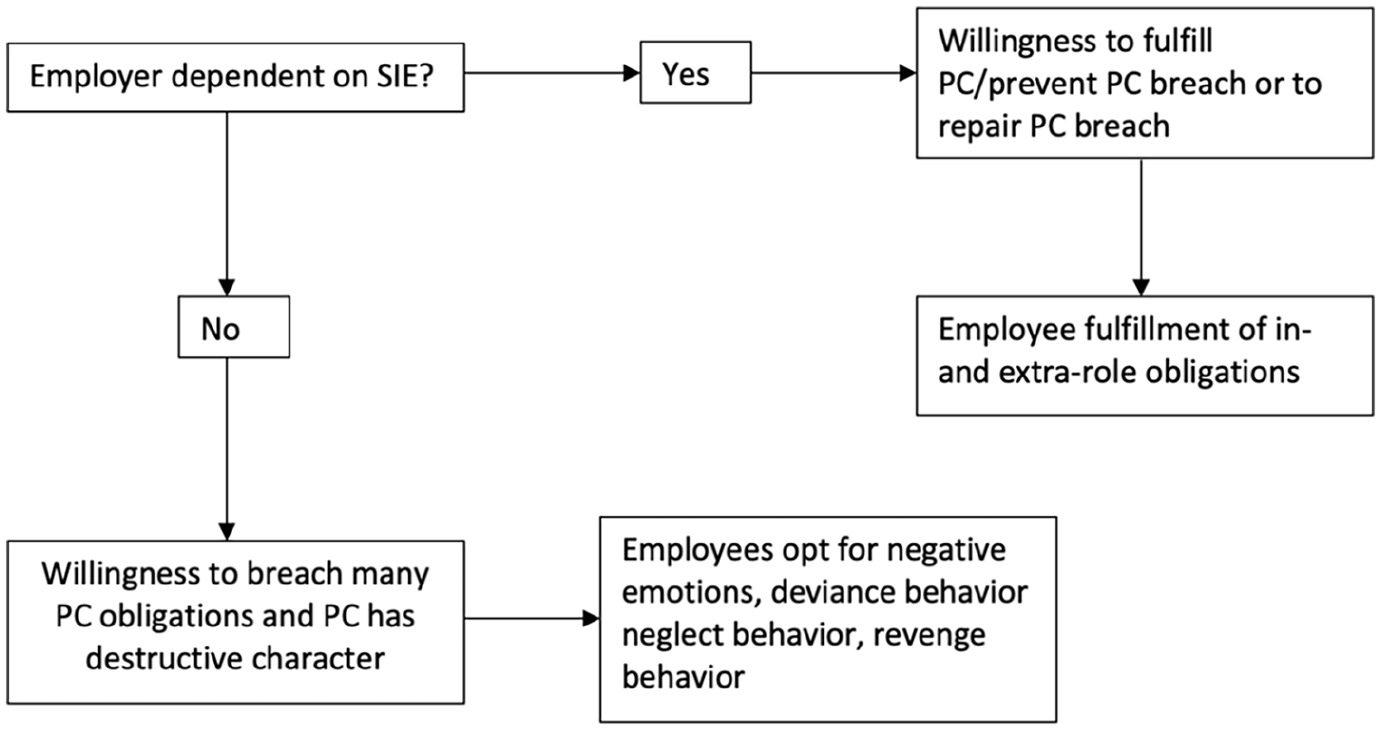
Visual representation of (destructive) psychological contract.
Doug explained: They’re all vulnerable people, and he can take advantage. Plus, he has a pile of CVs as long as your arm every week, people wanting work. . . In fact, he once said to me that he’ll push people till they break and they can go and he’ll just get the next one in.
Thus, there was no willingness to prevent and/or repair PC breach or to renegotiate PC terms (e.g., salary increase for assuming more responsibilities or any kind of recognition after a record-breaking number of meals served during a service); the approach was punitive (e.g., deducting from pay any breakages or shortages, taking away hours to keep people on edge) and the overall employer’s attitude was ‘take as much you can get away with’ according to one source. The employer usually hired staff on a part-time contract, but made them work longer hours, as Kyle explained: The hours we work are listed in the contract but they are just complete and utter rubbish. We sign a piece of paper every week, which is complete and utter rubbish, saying what our fake hours are. Yeah, that’s a disaster.
The maximum amount of hours and days worked consecutively, the minimum resting times between shifts, the required notice for rotas – none was respected. The employer also demanded that people attend staff meetings, in their spare time, which is against French law.
Wishing to establish whether employees’ PC depiction may have been contingent on temporary, exceptional circumstances, we approached two former employees who agreed to share their past experience. Jim and Gerald (pseudonyms) worked in the pubs for a duration of one and one-and-a-half years respectively and left the organization during the first few months of our data collection. Both shared a similar experience. They spoke of an employer who doesn’t seem to care about his employees, who hired people on 10-hour contracts and then expected them to work 30+ hours (the extra hours paid ‘under the counter’); and after several months the extra hours were withdrawn as a way to push them to leave. Thus Gerald: Q: How do you describe how it was like? A: Just being not appreciated; having no consideration for your employees. For what their lives are or what they are interested in. Just using people basically to make money on the cheap.
RQ2: Reactions to breach
The second research question aimed to explore how participants react to PC breach. Among those who experienced PC breach, most seemed lost in a foreign environment without adequate understanding about how things work. The instances of PC breach and feelings of violation triggered multiple responses. Table 3 provides an overview of these reactions. Besides perceptions of negative emotions, the most frequent response was ‘neglect behavior’ (Hirschman, 1970), which refers to letting things deteriorate at work as a result of passive behavior such as losing interest, putting in less effort, paying less attention to quality (Rusbult et al., 1988; Turnley and Feldman, 1999). Participants opted for ‘working to contract’ as stipulated in their job description or contract. They stopped taking on extra work, stopped caring about making improvements, only worked the hours stated in their contracts, or did the ‘strict minimum’ (Kyle).
Breakdown of reactions to breach.
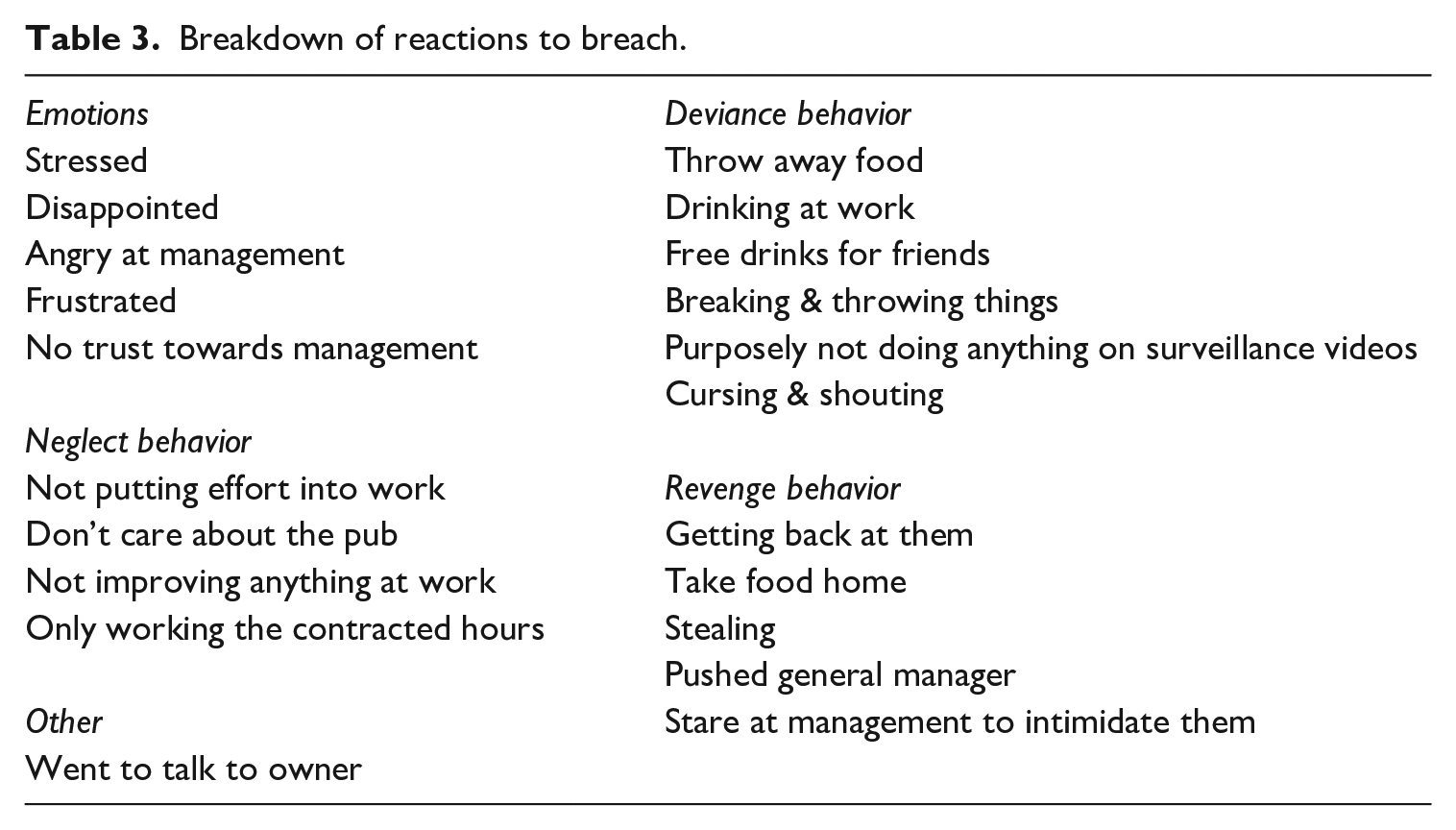
A second line of responses to PC breach and violation feelings was in line with the negative norm of reciprocity (Cropanzano and Mitchell, 2005) and manifested through counterproductive and deviant workplace behavior, which was perceived as actively compensating or getting back at the employer. Our accounts match incidents of workplace deviance in the hospitality sector that were identified by Restubog and colleagues (2015). One took food home, others had a few drinks during working hours or after their shift is over; some gave free drinks to friends and regular customers. This behavior was usually hidden from outsiders and non-regular customers but we witnessed this behavior first-hand. After closing time the shutters would come down and staff, together with one or two regulars, would have a few free drinks. Abby adds: We even stay until seven o’clock [in the morning] at the pub. . . drinking and just doing nothing.
We witnessed this type of behavior when we visited the pub the day after the meeting that was called when two customers had walked out the door without paying. Most staff were openly venting their emotions and discussed it with the regulars that were sitting at the bar. One of the bartenders gave away several free drinks during the evening, explaining ‘we are not allowed to keep tabs so here you go, it’s on the house’ (Mike).
Here were evident revenge cognitions (Bordia et al., 2008) – the third kind of response we encountered. Apart from compensatory behavior, in some accounts participants considered it retribution. Subjects talked about intimidating people or not greeting the general manager and the owner. During one of the follow-up conversations Leo talked about retaliation against his employers: ‘No one talks about it. . . but there are people who steal. Everybody drinks and a couple of the guys take things home.’
Discussion
This case study provides us valuable insights into PC evaluations and reactions to PC breach and violation feelings for a sample of SIE employees working in menial jobs in the hospitality sector. Employee reactions seemed to be different from the grand resignation narrative, as participants were more likely to opt for neglect and counterproductive workplace behavior than to leave the organization altogether, despite the employer purposely pushing a destructive PC agenda for those very same individuals.
Contributions to theory
This research makes several contributions to theory. First, we contribute to theory by providing evidence of an employer behavior that O’Donohue and Nelson (2009) named in their theoretical categorization of the ethical climate types developed by Victor and Cullen (1987), applied to the PC, as self-interest (profits driven). Our case study provides a first-hand account of specific ‘egoistic’ (their term) employer behavior. The employer in this study consciously and deliberately does not invest in the employment relationship with a large part of his staff. This absence of commitment is reflected in the PC evaluation by participants; none of them reported exchange terms pertaining to training and development and only one talked about job opportunities (i.e., relational PC inducement focused on long-term commitment). In addition, the employer was aiming to let the employment relationship deteriorate to the point of having employees leave the organization altogether by resorting to pressuring, bullying and misrepresentation of evidence. That perception was common to all but three participants, who were also the three employees the employer relies on to keep his business up and running and who had a good relationship with the owner. Although creating and maintaining a negative and destructive employment relationship or forcing employees out of the company by giving them no other choice but to resign is well-established in disciplines such as labor law (i.e., constructive dismissal; UK Government, 2022), we have not yet seen any evidence of a purposely-disrupted employment relationship by means of PC breach and violation feelings in the PC literature. Incorporating these destructive intentions for parties in the PC literature could therefore further expand our understanding of PC processes and context in a more complete assessment of why parties in an exchange agreement act in the way that they do. We agree that the goal should be to have a healthy and thriving PC, which should be repaired whenever possible. However, the implicit assumption that employers act with the best of intentions is found wanting in this study.
Second, following calls by Griep and colleagues (2019), we provide contextual insights into the PCs of a group of employees in a more precarious work setting. Our study confirms findings in the extant literature that PC breach and violation feelings bear a negative impact on employee behavior (e.g., Bordia et al., 2008; Restubog et al., 2015), even when employees may have few external employment opportunities. Participants’ overwhelming perception was that management was cutting corners, investing as little as possible in facilities, and mistreating staff because they conceive them as temporary hands. Yet, despite the wide consensus that they had to endure what might be seen as a destructive PC, over half of our sample stayed in their jobs for quite some time. This is in line with Kraak and colleagues’ (2020) findings that individuals do not always react to PC breach in the expected way. As participants stated in the interviews, the employer was actively seeking to push people out and replace them with new employees. In this case study participants resorted to negative behavior in line with the negative norm of reciprocity (Cropanzano and Mitchell, 2005) but most of them did not leave immediately. Instead, these individuals have become disillusioned after repeated instances of PC breach and violation feelings, resulting in deviant behaviors such as purposely throwing away perishables, drinking (for free) during their shift, drinking (for free) after their shift or after closing time, and pilfering goods too. Indeed, this cluster of behaviors amount to sabotage, including self-sabotage (e.g., one of our subjects commented that she would drink herself into oblivion, not in order to enjoy herself but to get back at the pub management). All negative consequences of the destructive PC notwithstanding, it seems that management still ‘came off easy’ in this particular case, as openly deviant behavior was limited by the restricted social networks and the role that their colleagues play in their social lives. It limited neglect and workplace deviance behavior because they did not want colleagues to inadvertently suffer for their actions. The study therefore builds on Kraak and colleagues (2020) by demonstrating that people in menial jobs can also have atypical expectations towards PC breach and that it is not something that is reserved for highly competitive environments in which participants accept breach in order to fulfill their professional goals.
Contributions to practice
The outcomes of our study bear practical relevance too. First, our findings demonstrate that SIEs in destructive employment relationships, who perceive their options to go somewhere else with better conditions as highly restricted, do not necessarily exit that negative employment setting. Official bodies would do well to be aware of the vulnerability of SIEs in menial jobs in general (Weishaar, 2008) and of exploitation in particular; and may wish to provide them with relevant support. Health and safety inspectors could target companies with high numbers of SIE employees working in menial jobs (for instance SIEs working in agriculture, construction or hospitality) in order to actively force employers to provide better employment settings. As not all of these individuals can easily find a job elsewhere, it is likely that these destructive employment relationships can go on for quite a while, with potentially very negative consequences for their personal wellbeing (Kallenberg, 2021). Most countries have appropriate legal frameworks that offer protection from destructive employer behavior but authorities must first assess what is going on before they can act. Knowledge of destructive PCs might provide health and safety inspectors and other services with a relevant framework and appropriate vocabulary to identify destructive employment relationships and take action. This would likely have a signaling function to other employers maintaining destructive PCs as visibility will mean that they are more likely to get caught and be liable for charges, as well as be subject to the backlash from potential exposure in the press (e.g., Puncheva-Michelotti et al., 2018).
Second, our findings show that even though SIEs in menial jobs might feel vulnerable, they still resort to withdrawal behavior in the form of neglect and potentially retaliate and sabotage their workplace through counterproductive and deviant workplace behavior. These types of behavior can have very high economic costs for organizations; the estimated global annual cost for counterproductive workplace behavior was estimated at approximately $200 billion 30 years ago (Govoni, 1992) – employee theft alone costs US businesses $50 billion per year (Verensics, 2021). It is therefore very important for employers to be aware that destructive PCs can exist within their company, especially in larger organizational settings where it might be a manager or head of a distant subsidiary who maintains a destructive PC with their employees. The costs of such destructive PCs could potentially be stellar as the company might lose large amounts of money due to increased absenteeism, counterproductive workplace behavior, as well as the potential legal and publicity issues described earlier. Although individual behavior by specific managers can go overlooked, organizations could set up a system in which it would be much harder for managers to dissimulate destructive PCs. Possible hands-on actions for the HR department could be to include a section on the PC in the annual performance appraisal in order to stimulate discussions to be included in formal communication. The organization could also create a platform that allows employees to anonymously provide feedback on the behavior of their manager, much like the direct communication lines in safety organizations. HR could also train HR professionals to be well-versed in the principles underlying a PC and send them out into the company to investigate as to the quality of the exchange relationship. HR can use available data such as high absenteeism, turnover or number of complaints and drops in productivity, new customers or profitability to identify departments where more destructive PCs exist and PC breach and violation feelings are common. If HR is able to identify problems in the exchange relationship, the company can start to address the problems. Finally, companies can also anticipate the emergence of any potential destructive PCs by actively training existing and future managers about the PC, consequences of PC breach and violation feelings, as well as provide managers tools on how they can develop and maintain high quality PCs.
Limitations and future research
Necessarily, this case study is limited in scope. Although our case study is an in-depth grounded investigation, allowing for the careful probing of data, it is but one case of the many French hospitality sector establishments employing SIEs and indeed of SIEs working in menial jobs. A larger and wider sample using a different methodology would expand knowledge on (SIE) PCs in menial jobs. If the exposure that the great resignation is receiving in the press is an indication of the breadth of problems that people in menial jobs are facing, it is likely that studies in other sectors will be in line with our findings. Our findings suggest multiple avenues for further research. Future studies could examine employer non-investment and potentially exploitative or destructive behavior in more depth as well as across sectors. Given the evidence from ongoing press coverage on the great resignation, it is likely that destructive PCs are not uncommon for menial jobs in the hospitality sector – for SIEs or migrants in particular (Janta et al., 2012; Lugosi et al., 2016). Recent scandals in French supermarket chains seem to confirm the existence of these types of very negative PCs in other sectors as well (e.g., Harounyan, 2017; Maligorne, 2017). Indeed, destructive PCs may well be an aspect of precarious work and the gig economy (Gandini, 2018; Van Doorn, 2017) and given that these are speedily gaining momentum, it would be important to follow up and compare with previous periods of economic upheaval (Greenberg, 1990) and in differing institutional frameworks, from total institutions (Sundberg, 2019) to free agent contracting.
In line with calls by Griep and colleagues (2019), studying the effects of prolonged employment in such a destructive exchange relationship would therefore be another trajectory to follow. Incorporating time could add additional insights to these processes, especially regarding the changes in perceptions and behavior over time. Does a destructive PC develop overnight, from day one, or does it develop over time, orchestrated by the employer according to a specific schema? Longitudinal studies could provide valuable answers to these questions.
Furthermore, it would be very interesting to be able to explore employer attitudes and motivations to engage in this form of employment relationship and their associated justification and rationalization. It is likely that the employer acts with the belief that their moral self-image is implacable. The inclusion of moral licensing theory (Merritt et al., 2010; Miller and Effron, 2010) might offer insights as to how employers justify destructive behavior in the exchange relationship to themselves and others. It may also be the case that a destructive PC is an employer’s instrumental response to restrictive employment legislation on the one hand, requiring an employment contract that cannot be easily broken; while on the other hand a deficiency in legal enforcement, facilitating a push towards voluntary exit (resignation).
Conclusion
In line with suggestions to contextualize PC research (e.g., Griep et al., 2019), we have carried out this exploratory study with a sample of SIEs working in menial jobs in the French hospitality sector. The context allowed us to find evidence of a PC type that has not yet been discussed in the PC literature: the destructive PC, which is characterized by intentional employer disruptions of the exchange relationship. Following the extant literature, one would assume that such a PC would become intolerable to employees, instigating them to leave the organization (Schalk and Roe, 2007). However, instead we found a mix of disruptive behavior in the form of neglect, workplace deviance and revenge cognitions that is more in line with the PC breach being perceived as unacceptable but not intolerable (Rigotti, 2009; Schalk and Roe, 2007). Our findings show that said destructive PCs have far stretching consequences for the employees (i.e., negative emotions, feelings of distrust towards management, triggering of deviant behavior and revenge cognitions towards the employer) as well as the organization (missed income due to neglect behavior, theft, drinking on the job, handing out drinks for free and throwing away products that could have been served to customers). The destructive PC therefore seems to be a double-edged sword with negative consequences for both parties in a PC exchange.
Footnotes
Declaration of conflicting interests
The authors declared no potential conflicts of interest with respect to the research, authorship, and/or publication of this article.
Funding
The authors received no financial support for the research, authorship, and/or publication of this article.
