




Abstract
Phase change materials (PCMs) for cold energy storage provide an effective means of improving energy efficiency in refrigeration, cold chain logistics, building cooling, and pharmaceutical storage. However, a quantitative overview of the evolution of this research field over time remains limited. This study presents a bibliometric analysis of global research on PCM-based cold energy storage published between 1994 and 2024. A total of 769 peer-reviewed documents were retrieved from the Scopus database and analysed using the Bibliometrix package in R and VOSviewer. The results show a growth in publications after 2015, with annual output increasing from fewer than 20 papers per year before 2012 to over 120 papers in 2024. China dominates the field, accounting for approximately 43% of total publications, followed by India and several European countries. Contributions from African countries, on the other hand, remain below 2%. Keyword co-occurrence and network analyses identified ten major thematic clusters, with strong emphasis on thermal conductivity enhancement, nanocomposite PCMs, system optimisation, ice storage integration, and cold chain applications. Despite these advances, persistent research gaps were observed in subcooling control, long-term thermal stability, large-scale system integration, and region-specific applications in developing economies. This study provides a quantitative mapping of research trends, collaboration patterns, and thematic evolution in PCM-based cold energy storage. The findings provide evidence-based guidance for researchers, funding bodies, and policymakers, highlighting the need for targeted investment and collaborative research to accelerate the deployment of reliable, scalable, and low-carbon cooling technologies.
Keywords
Introduction
Globally, the energy sector faces interrelated challenges, including rapidly rising energy demand, climate change driven by carbon dioxide emissions (J. Zhang, 2024), and the urgent need for a transition toward more sustainable energy systems (Kwilinski et al., 2024). Energy demand is projected to increase further due to population growth, urbanisation, and industrialisation (Mathumitha et al., 2024; Oteng-Abayie and Mensah, 2024). This accelerating demand emphasises the need for efficient energy-storage solutions that can balance energy generation and consumption, especially in sectors where effective thermal management is essential.
Thermal energy storage (TES) systems can address energy supply-demand imbalances by storing energy in the form of heat or cold for later use (F. Li et al., 2025). TES materials can be categorised into sensible heat, latent heat, and thermochemical storage. Sensible heat storage stores energy by raising the temperature of a medium such as water, rocks, sand, molten salts, or thermal oils without a phase change (Seyitini et al., 2023). Latent heat storage relies on phase change materials (PCMs), such as paraffin waxes, salt hydrates, or eutectic mixtures, which absorb or release energy during melting or solidification at constant temperatures (Low et al., 2024). On the other hand, thermochemical storage uses reversible chemical reactions or sorption processes involving materials such as zeolites, silica gel, or metal oxides to store and release heat, providing high energy density and long-duration storage potential (Singh et al., 2023). These materials can be used in TES systems in various sectors, including solar thermal systems, industrial waste heat recovery, building heating and cooling, and cold chain logistics (Alam et al., 2025; Ali et al., 2024; Hassan et al., 2022). However, each type has distinct advantages and is selected based on temperature range, storage duration, application, and cost.
Among various TES applications, cold energy storage systems are pivotal for food preservation (Ajour et al., 2024; Yenare et al., 2024), pharmaceutical storage (Ferraioli et al., 2025), and building climate control. Globally, cooling appliances account for nearly 20% of a building's electricity consumption (Falchetta et al., 2024). The refrigeration sector, including air conditioning, accounts for around 17% of global electricity consumption (International Institute of Refrigeration, 2019). In the food industry, cold storage accounts for approximately 35–45% of electricity consumption (Arteconi and Polonra, 2017). Cold energy storage systems are designed to maintain temperatures below ambient conditions through TES and controlled release. The ability to store cold energy during periods of low energy demand and release it when needed provides opportunities for reducing energy costs, stabilising the grid, and improving system efficiency.
PCMs leverage the fundamental thermodynamic principle of latent heat absorption and release during phase transitions. PCMs store and release substantial amounts of energy at nearly constant temperatures during melting and solidification processes compared to conventional sensible heat storage methods that rely on temperature changes in storage media (Shukla et al., 2022). This unique characteristic permits PCMs to achieve higher energy storage densities and maintain precise temperature control, making them well suited for cold energy storage applications (Masood et al., 2023). For instance, PCMs can provide energy storage densities 5 to 14 times higher than conventional sensible heat storage materials (Hua et al., 2023). In addition, the isothermal nature of phase change processes provides higher temperature stability, which is crucial for applications requiring precise temperature control, such as pharmaceutical storage or the preservation of high-value foods (Sharma et al., 2009).
Despite their significant potential, PCM technologies face several challenges that limit widespread commercial adoption in cold energy storage applications. For example, subcooling phenomena, in which PCMs remain liquid below their crystallisation temperature, can reduce system efficiency and reliability (Bruno et al., 2015; J. Shao et al., 2015). In addition, low thermal conductivity is another critical limitation, as most PCMs demonstrate one to two orders of magnitude lower thermal conductivity than conventional heat transfer fluids (HTFs), resulting in prolonged charging and discharging cycles that may not meet application requirements (Mitra et al., 2022; S. Wu et al., 2020).
Several studies have reviewed the performance of PCM in cold storage applications. For instance, Yenare et al. (2024) comprehensively reviewed portable cold storage technologies, focusing on their types, applications, and future trends, with particular attention to integrating PCMs and emerging innovations such as renewable energy and smart technologies for enhancing the storage of perishable goods. M. Li et al. (2024a) reviewed the application of phase change cold storage technology in cold chain logistics for fresh products. Z. Li et al. (2024b) reviewed phase change cold storage materials and explored their innovative applications and future trends in air conditioning systems. In the work of Borri et al. (2024), the authors assessed recent advances in composite materials for thermally driven and storage-integrated cooling technologies using renewable energy sources.
Other notable studies include Y. Chen and Zhang (2024), who reviewed energy-saving technologies in cold storage systems, focusing on applications with and without PCMs in China's dual-carbon strategy. The work of Ouaouja et al. (2025) critically reviewed conventional PCMs and explored the potential of bio-based alternatives for cold TES applications. Bahrami and Sablani (2025) reviewed using PCMs in food packaging to enhance temperature regulation and food safety and reduce post-harvest and transport losses. Marques et al. (2025) examined the potential of PCMs in domestic refrigeration systems for storing renewable energy, enhancing efficiency, and enabling demand-side management.
Furthermore, H. Wang et al. (2025) examined PCM-integrated cold TES integration and operation control strategies in cooling systems to enhance performance, reliability, and economic efficiency. Hua et al. (2025) analysed research progress on PCM energy storage in cold stores as a low-carbon solution to reduce energy consumption and enhance cold chain sustainability. The work of Alam et al. (2025) reviewed recent advances in renewable energy-assisted PCM cold TES air conditioning systems.
Despite the extensive traditional reviews conducted by various researchers on PCM applications in cold storage systems, a significant research gap exists in the form of a bibliometric analysis that systematically maps the global research trends, identifies emerging themes, visualises collaboration networks, and predicts future research directions in the field of PCMs for cold storage applications. Bibliometric analysis is a quantitative method used to evaluate and analyse scientific literature, typically based on publications, citations, authorship, and other bibliographic data (Lim and Kumar, 2024). It helps researchers identify trends, patterns, research hotspots, influential authors, journals, institutions, and collaborations within a specific field or topic (Odoi-Yorke et al., 2025). Globally, researchers have employed this approach to map several research domains, including sand-based TES (Odoi-Yorke et al., 2024b), clean cooking (Afrane et al., 2022; Odoi-Yorke, 2024; Yadav et al., 2024), nuclear energy acceptance (Agyekum et al., 2025), energy storage technologies (Odoi-Yorke et al., 2024a), wind power systems (C.-H. Chen and Su, 2022), and hydropower development (M. Y. Han et al., 2014). Therefore, employing the same approach to examine the PCM cold energy storage research domain systematically is crucial for understanding publication trends and identifying knowledge gaps that can guide future research directions and strategic investments in this specialised field.
The primary objective of this study is to identify trends and advancements in PCM cold energy storage research. The following research questions guide the study's aim: (RQ1) What are the publication trends and key growth periods for PCM cold energy storage research? (RQ2) Which countries are the leading contributors to research on this topic, and how are they collaborating globally? (RQ3) What are the most prominent research themes, and how have they evolved over time? (RQ4) What are the dominant conceptual clusters and thematic structures revealed through keyword co-occurrence networks and bibliometric network visualisation? (RQ5) Which publications have been most influential in shaping the development of this research field? The study’s findings provide evidence-based insights for funding agencies and policymakers to inform their decisions about research priorities in sustainable cooling technologies. Also, it will assist new researchers entering the field by providing a roadmap of the research area and identifying promising areas for future investigation. The remaining sections of this paper are as follows:
Research methodology
Figure 1 displays the methodological approach adopted. The study adhered to the Preferred Reporting Items for Systematic Reviews and Meta-Analyses (PRISMA) guidelines to ensure methodological rigour, transparency, and reproducibility in the data collection process (Abbey et al., 2025; Page et al., 2022). The Scopus database was selected as the sole data source due to its comprehensive and reliable coverage of science, engineering, and energy-related literature, including extensive indexing of international journals and conference proceedings. This choice aligns with established practice in bibliometric research, where Scopus is frequently preferred over alternatives such as Web of Science and Google Scholar for comprehensive and consistent data retrieval (Adeyemi-Kayode et al., 2023; Geng et al., 2017; Md Khudzari et al., 2018; Mehraj et al., 2024; Odoi-Yorke, 2025; Uliasz-Misiak et al., 2024).
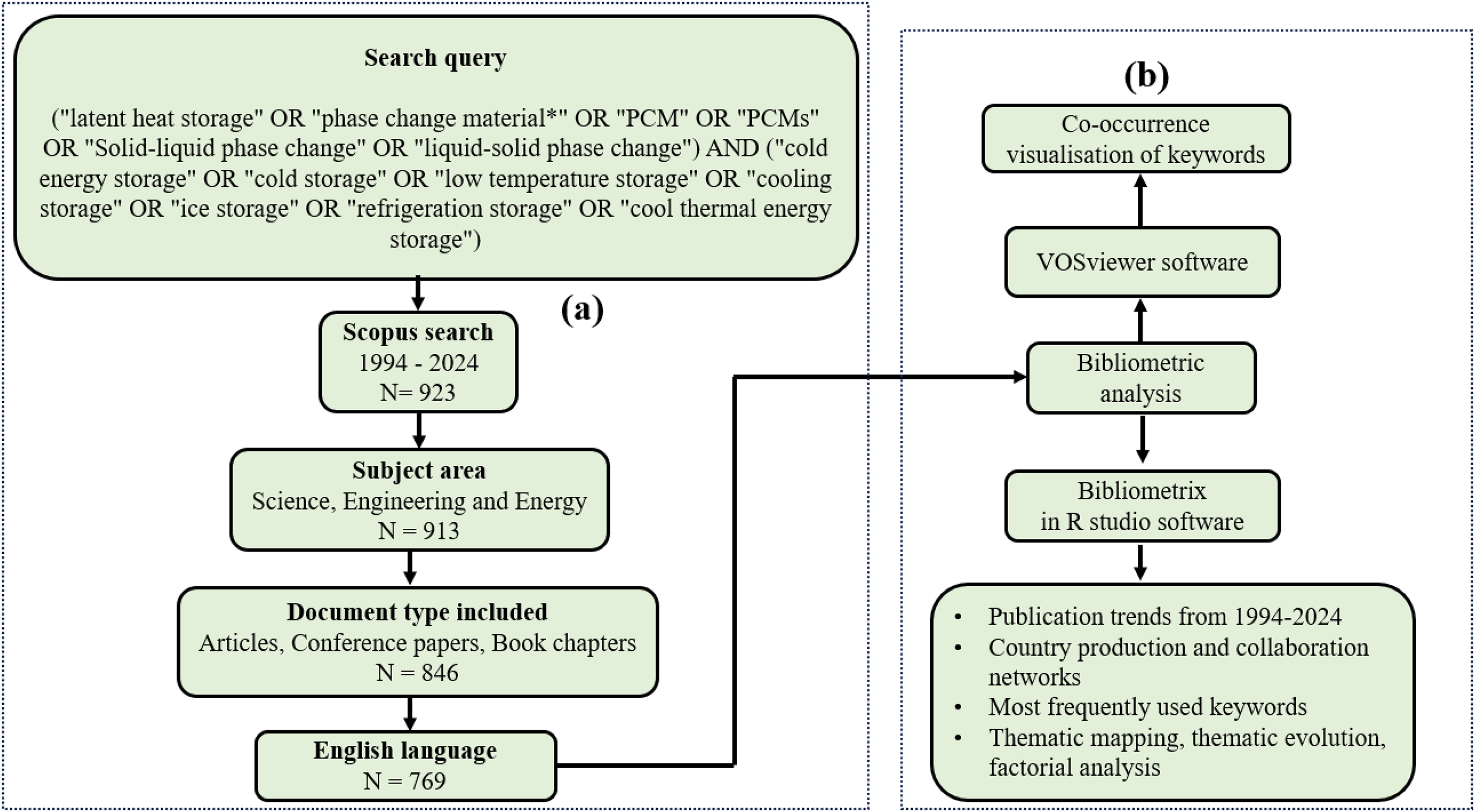
Methodological framework adopted in this study: (a) data search strategy, screening, and inclusion criteria applied to the Scopus database; (b) bibliometric and network analysis workflow using the Bibliometrix package in R for quantitative indicators and VOSviewer for keyword co-occurrence network visualisation.
The systematic search strategy employed a constructed query combining multiple relevant terminologies related to PCM and cold energy storage: (‘latent heat storage’ OR ‘phase change material*’ OR ‘PCM’ OR ‘PCMs’ OR ‘Solid-liquid phase change’ OR ‘liquid–solid phase change’) AND (‘cold energy storage’ OR ‘cold storage’ OR ‘low-temperature storage’ OR ‘cooling storage’ OR ‘ice storage’ OR ‘refrigeration storage’ OR ‘cool thermal energy storage’ OR ‘cool energy storage’). This search string was designed to capture all terminology used in the field, incorporating specific technical terms and commonly used abbreviations. It also ensured that the PCM aspect and the cold storage application were represented in the titles, abstracts, or keywords of the retrieved documents. It is worth noting that the Boolean operators were strategically used to maximise recall and maintain precision, utilising the asterisk wildcard to capture plural forms and variations.
It can be observed in Figure 1 that the initial search executed on May 26, 2025, yielded 923 documents across all subject areas, demonstrating the broad interdisciplinary nature of PCMs-based cold energy storage research. To enhance the relevance and focus of the dataset, systematic filtering was applied through a series of sequential refinement stages. The first refinement limited the scope to energy, science, and engineering-related subjects, reducing the dataset to 913 documents. This process eliminated publications from unrelated fields that might incidentally mention PCMs in different contexts. Consequently, document type filtering was limited to articles, conference papers, and book chapters, excluding review papers, errata, editorial notes, and complete books, resulting in 843 documents. This filtering strategy focused on original research contributions rather than secondary sources, ensuring the study captured actual research output rather than synthesised knowledge.
The final filtering criterion limited the dataset to publications in English, resulting in a dataset of 769 documents. This refined set of documents constitutes the final dataset used for analysis. This language restriction was justified by the dominance of English as the international language of scientific communication in science, engineering, and energy fields, thereby ensuring the accessibility and comprehensibility of the analysed literature while acknowledging potential limitations in capturing non-English research contributions. The extracted bibliographic data were cleaned to address common issues, including inconsistent author name formats, variations in institutional affiliations, journal name abbreviations, and inconsistencies in keywords. Potential duplicate records resulting from overlapping indexing of conference and journal versions were identified using document DOIs and verified through manual checks of titles and authors, ensuring that each document was counted only once in the final dataset.
The cleaned dataset was analysed using quantitative bibliometric analysis through the Bibliometrix package in RStudio and network visualisation analysis using VOSviewer software. The Bibliometrix package, selected for its comprehensive suite of bibliometric analysis functions and robust statistical capabilities (Aria and Cuccurullo, 2017), was employed to conduct the following: (i) scientific publication trends analysis to identify research growth patterns and emerging periods of interest, (ii) country-wise production analysis to determine geographical distribution of research activities and identify leading nations in the field, (iii) collaboration network analysis to map international partnerships and research cooperation patterns, (iv) keyword frequency analysis to identify the most dominant research topics and technical focuses, and (v) conceptual analysis comprising thematic mapping to visualise the conceptual structure of the research field, thematic evolution analysis to track how research themes have developed over time, and factorial analysis to identify underlying dimensions and relationships within the research domain, and (vi) analysis of the most cited documents to identify influential works.
Complementing the Bibliometrix analysis, the VOSviewer software was utilised for network visualisation purposes (Sood et al., 2021). It was used to perform cluster analyses of keywords that revealed thematic relationships and research topic groupings through advanced algorithms that identify co-occurrence patterns and semantic relationships. The network visualisations generated through VOSviewer yielded a graphical representation of the knowledge structure, enabling the identification of research clusters, emerging topics, and thematic connections that might not be apparent through traditional statistical analysis alone. This approach was further validated and contextualised through qualitative examination of existing studies in the literature. In view of this, the relevant literature from each identified cluster was manually reviewed to confirm the semantic coherence of the automatically generated groupings and to provide a detailed interpretation of the research themes. It is worth mentioning that this mixed-methods approach, combining quantitative bibliometric indicators with qualitative thematic analysis, ensured comprehensive coverage of the research field's structural characteristics and the knowledge base's substantive content.
Results and discussion
Trend in annual scientific publications
Figure 2 shows the trend in annual scientific publications over the three decades. The regression equation (y = 2.9056x − 5812.6, R2 = 0.71) indicates a positive correlation between year and publication output. Between 1994 and 2005, the number of publications was low, ranging from 0 to 6 articles per year. This period can be viewed as the early stage of PCM research for cold energy applications, characterised by foundational studies, limited awareness, and possibly limited funding opportunities. The slow pace also suggests technological immaturity and a lack of commercial drive to push intensive research. However, a noticeable upward trend is evident from 2006 onwards. Publications increased to 9 in 2006, dipped slightly, and increased again around 2009. This coincides with global interest in energy efficiency, renewable energy integration, and climate change mitigation. The number of publications doubled from 2008 (7 articles) to 2009 (16 articles), indicating a turning point in the research domain.
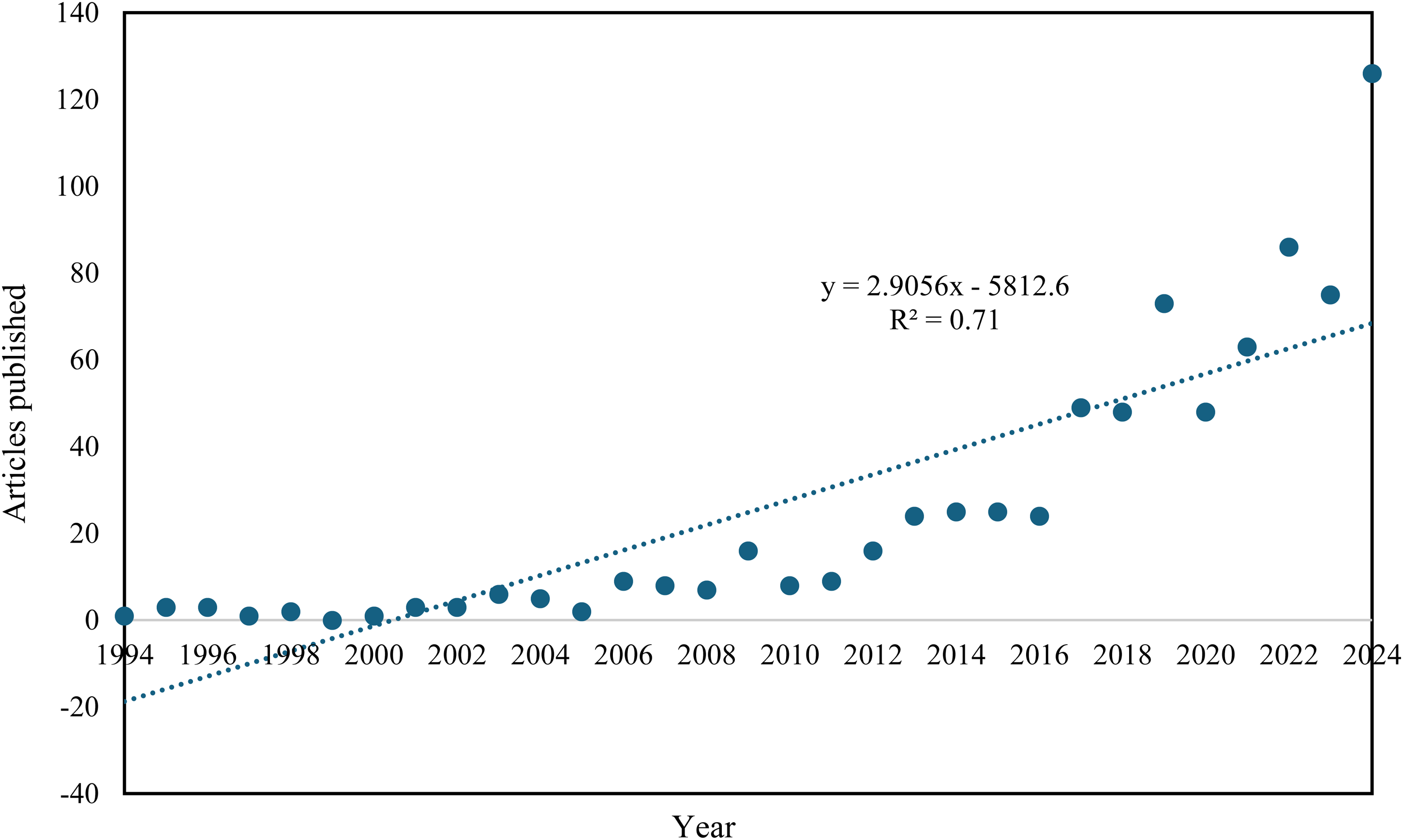
Annual scientific publications on PCM-based cold storage research.
From 2012, the research output surged, with the number of annual articles increasing from 16 in 2012 to 25 in 2014 and 2015, marking a phase of rapid expansion. This period could have benefited from broader academic and industrial awareness of the critical role that cold energy storage can play in reducing peak power demands, especially for refrigeration and air conditioning, which are major energy consumers globally. In addition, advances in materials science, improved simulation tools, and increased collaboration between academia and industry may have contributed to this surge. Between 2017 and 2020, there was a significant increase in publications, peaking at 73 in 2019, which may indicate growth in the research field, possibly due to increased funding opportunities, international collaborations, and the entry of new researchers. The period coincides with international efforts to combat climate change, including the lead-up to the Paris Agreement in 2025 (Berrich et al., 2024). However, the dip to 48 in 2020 might be partially attributed to the disruptions caused by the COVID-19 pandemic, which affected research productivity worldwide.
Post-pandemic recovery is evident in the 2021 figure (63 articles), followed by a sharp surge to 86 in 2022. This surge could be attributed to a rebound in research activities and a renewed global emphasis on clean energy technologies following major international climate agreements and national commitments to net-zero targets. The increase from 75 publications in 2023 to 126 in 2024 highlights a keen interest in PCM technologies for cold storage applications. This surge can be attributed to multiple factors, including the growing demand for sustainable cold chain solutions in the food and pharmaceutical sectors (e.g. vaccine preservation), the increasing deployment of intermittent renewable energy sources (which necessitate flexible energy storage solutions), and policy incentives or funding programmes aimed at climate-resilient infrastructure.
Geographical distribution of research publications and international collaboration network
The countries contributing to PCM for cold energy storage research are displayed in Figure 3. The figure shows a concentration of research activities in a select few countries. China is the leading country with 1334 publications, representing about 43% of the total research output in this critical field. India is the second-highest contributor, with 382 publications, creating a significant gap before the next tier of countries. These include Germany, France, and Spain, with 107, 105, and 104 publications, respectively. The contributions of the remaining nations are lower, with the vast majority producing fewer than 50 publications each.
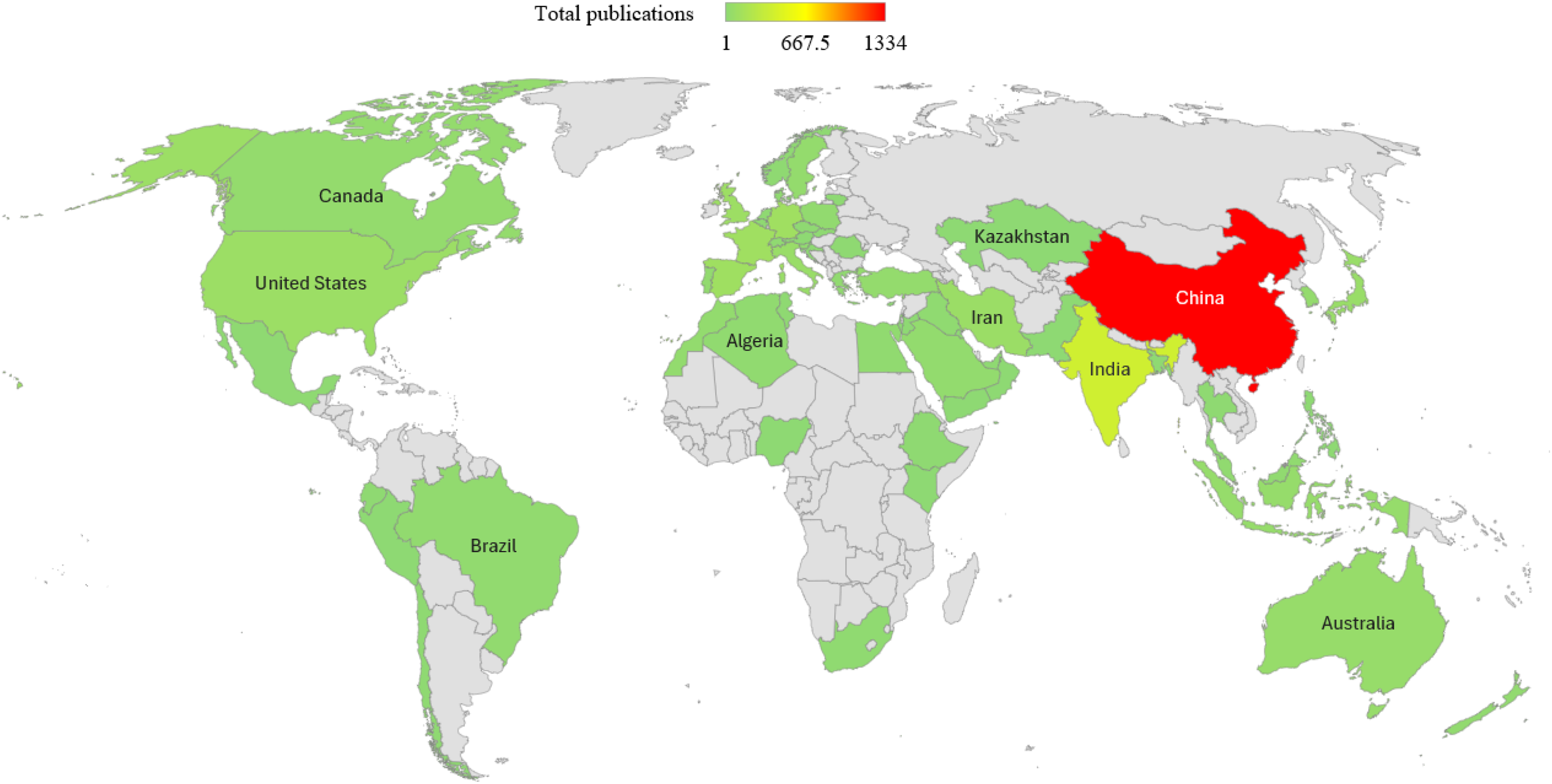
Geographic distribution of scientific publications on PCM for cold storage research.
China's contributions could be driven by several key policy frameworks that position energy storage as crucial for the nation's carbon neutrality goals by 2060. For instance, the 14th Five-Year Plan for New Energy Storage Development (2021–2025) emphasises the importance of energy storage in decarbonising the energy sector and ensuring energy security in China. It emphasises advancing large-scale, high-quality development of new energy storage technologies to help build a clean, low-carbon, safe, and efficient energy system (F. Wang and Xue, 2025). In addition, the Ministry of Science and Technology in China allocates $4–6 billion annually for clean energy research and development. Energy storage is among the five energy fields prioritised for innovation alongside technologies supporting a modern electricity system in China (Oxford Institute for Energy Studies, 2022).
Likewise, India's contribution, although lower than China's, demonstrates its emphasis on sustainable technologies, driven by massive urbanisation and increasing energy demands. Similarly, the research contributions from European nations reveal the region's continued commitment to advanced materials research and energy efficiency technologies, supported by research infrastructure and collaborative frameworks. However, the contributions of African nations to this vital research domain are limited. For example, among the 54 African countries, only eight countries, including South Africa, Algeria, Egypt, Morocco, Tunisia, Ethiopia, Kenya, and Nigeria, have made contributions, with their combined contribution representing less than 2% of global publications.
The continent's participation in this research domain is concerning due to Africa's unique position regarding cold energy storage needs and renewable energy potential. This implies that research contributions in PCM for cold energy storage research from African nations are urgent. This is because Africa faces challenges in food security, with post-harvest losses estimated at 20–40% of total production due to inadequate cold chain infrastructure (Adesina, 2024). In sub-Saharan Africa, where over 60% of the population are smallholder farmers, the lack of sufficient cold storage facilities and refrigerated transport aggravates food wastage. For example, Nigeria reportedly operates at less than 4% of its cold chain capacity requirement, resulting in annual losses of up to 40% of total food production, with fruits and vegetables suffering losses of up to 70% (African Marketing Confederation, 2025).
Similar issues affect other countries, such as Kenya, where poor roads and a lack of refrigerated transport cause maize farmers to lose 30–40% of their produce during transportation (Adesina, 2024). However, the continent's population, projected to reach 2.5 billion by 2050 (Statista Research Department, 2024), will worsen these challenges significantly. In view of this, utilising PCMs as sustainable solutions for off-grid refrigeration systems, agricultural cold storage, and building thermal management is a critical need across African nations. In addition, many African countries possess abundant solar resources that could power PCM-based cooling systems, creating synergistic opportunities for integrating renewable energy.
The limited contribution from African countries can be attributed to several interrelated factors, including constrained research funding, limited laboratory infrastructure for characterising advanced materials, and weaker integration between academia and cold-chain-intensive industries. This implies that challenges related to cold energy storage are addressed through the importation of technologies rather than locally driven research and development, resulting in reduced publication output despite high practical demand. Hence, addressing these structural constraints is critical if PCM-based cold storage technologies are to be adapted to African climatic conditions, decentralised energy systems, and off-grid cold chain applications.
It is worth noting that the research contribution gap in Africa represents not only a statistical disparity but also a fundamental barrier to technological sovereignty and sustainable development. Without local research capabilities in PCM technologies, African nations remain dependent on imported solutions that may not be optimally designed for local climatic conditions, economic constraints, or infrastructure limitations. Local research could drive innovations in low-cost PCM formulations using locally available materials, passive cooling systems suitable for rural applications, and hybrid renewable energy-PCM storage systems optimised for African conditions. The significance of this gap extends beyond immediate technological needs to comprise broader implications for scientific capacity building and economic development. Investment in PCM research would catalyse the development of materials science programmes, enhance university-industry collaborations, and create pathways for technology transfer and commercialisation. Such investments could position African nations as contributors rather than consumers of global cooling technologies.
Moreover, coordinated efforts involving international partnerships, targeted funding mechanisms, and capacity-building initiatives are essential to address this disparity. African governments, international development organisations, and global research institutions must collaborate to establish research centres focused on TES, provide training opportunities for African researchers, and create an enabling environment for innovation in sustainable cooling technologies. The urgency of climate change and growing energy demands makes the development of indigenous PCM research capabilities beneficial and imperative for Africa's sustainable future.
Figure 4 illustrates cold energy storage research using PCM collaboration among countries. The figure utilises an encoding scheme where both colours and connecting lines serve as quantitative indicators of international research cooperation intensity. The colour gradient, progressing from light blue through medium blue to dark navy, represents each country's relative level of research contribution. The darker shades indicate nations that are primary collaboration hubs, characterised by the highest frequencies of international research partnerships. These colours indicate composite metrics, including the number of collaborative publications, joint research projects, shared funding initiatives, and cross-border researcher exchanges in PCMs for cold energy storage. The connecting lines between countries indicate direct bilateral or multilateral research relationships, where line thickness corresponds to the strength and productivity of these collaborative partnerships.
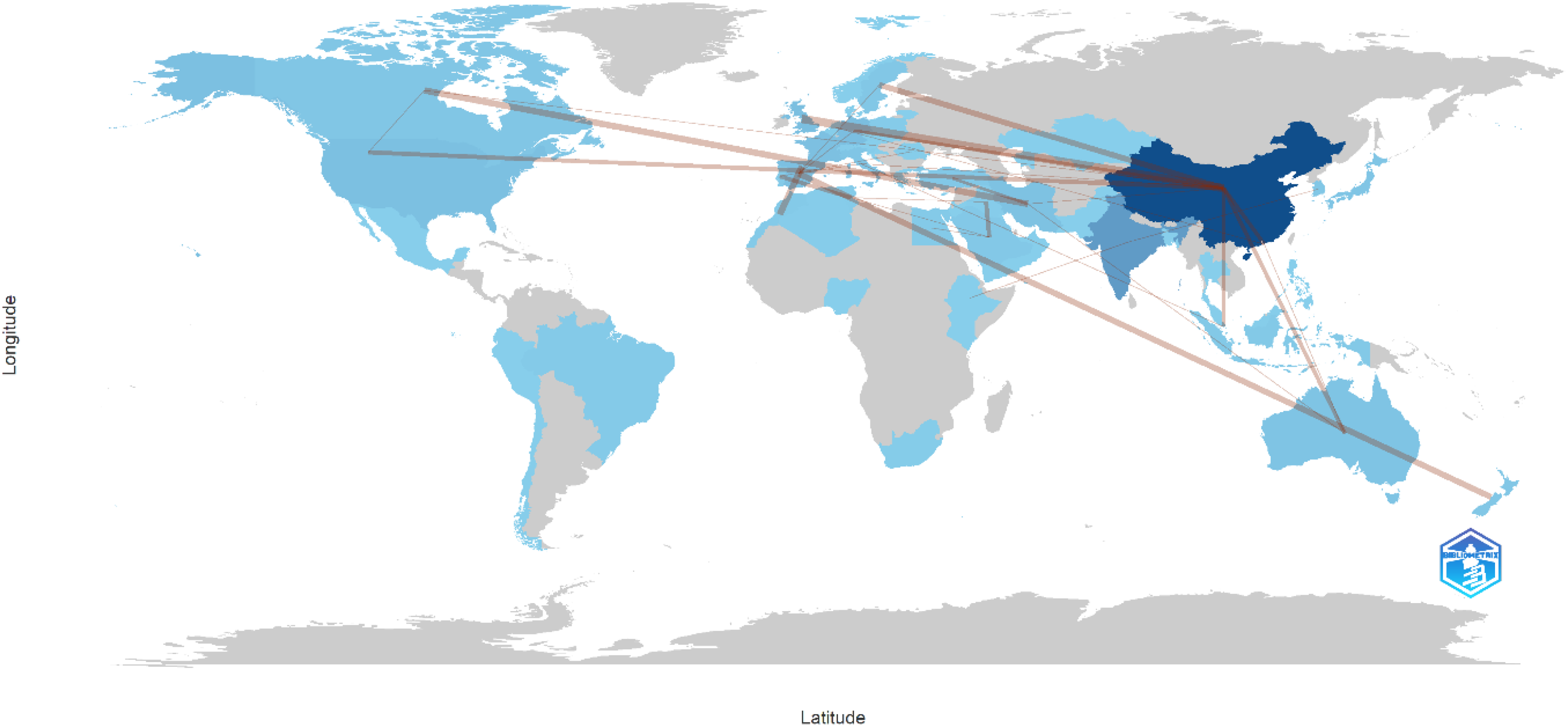
PCM for cold energy storage research collaboration network.
It can be observed that China is the leading collaboration hub in this research domain, as evidenced by the darkest dark navy blue node with the highest density of radiating connection lines. The extensive lines connecting China to North America, Europe, Australia, and multiple Asian countries indicate a comprehensive approach to accessing various expertise and research capabilities. The research collaboration with the United States and European nations suggests high-value partnerships where Chinese manufacturing capabilities and large-scale research funding combine with Western expertise in fundamental materials science, characterisation techniques, and system integration methodologies. The European collaboration network exhibits a more distributed yet internally connected structure, characterised by strong intra-regional partnerships complemented by strategic connections to Asia-Pacific collaborators. The lines connecting European countries to Australia and New Zealand suggest specialised partnerships focused on cold climate applications and renewable energy integration, where both regions possess complementary expertise.
However, the relative absence of connecting lines in Sub-Saharan Africa, much of South America, and parts of the Middle East reveals significant global disparities in research participation. This indicates that PCM innovations emerge from a concentrated network of technologically advanced nations. This pattern has critical implications for global technology transfer and equitable access to cold energy storage solutions, potentially creating technological dependencies and limiting the adaptation of these innovations to diverse geographical, climatic, and economic contexts worldwide.
Analysis of frequently used keywords
The word cloud in Figure 5 displays the most frequently occurring keywords extracted from the analysed literature. It is worth highlighting that the size of each word indicates its frequency of occurrence in the dataset. This implies that larger words in the figure, such as ‘cold storage’, ‘phase change materials’, ‘thermal energy storage’, and ‘PCM’, are the most frequently occurring keywords used by researchers. Terms including ‘phase change material’, ‘cold storage’, ‘TES’, and ‘PCM’ demonstrate the field's growth around standardised nomenclature while simultaneously indicating the centrality of these core concepts in driving the research domain. The frequent occurrence of singular and plural forms of key terms, alongside abbreviated variants, suggests the evolution of scientific vocabulary and the need for precise technical communication within specialised research communities.
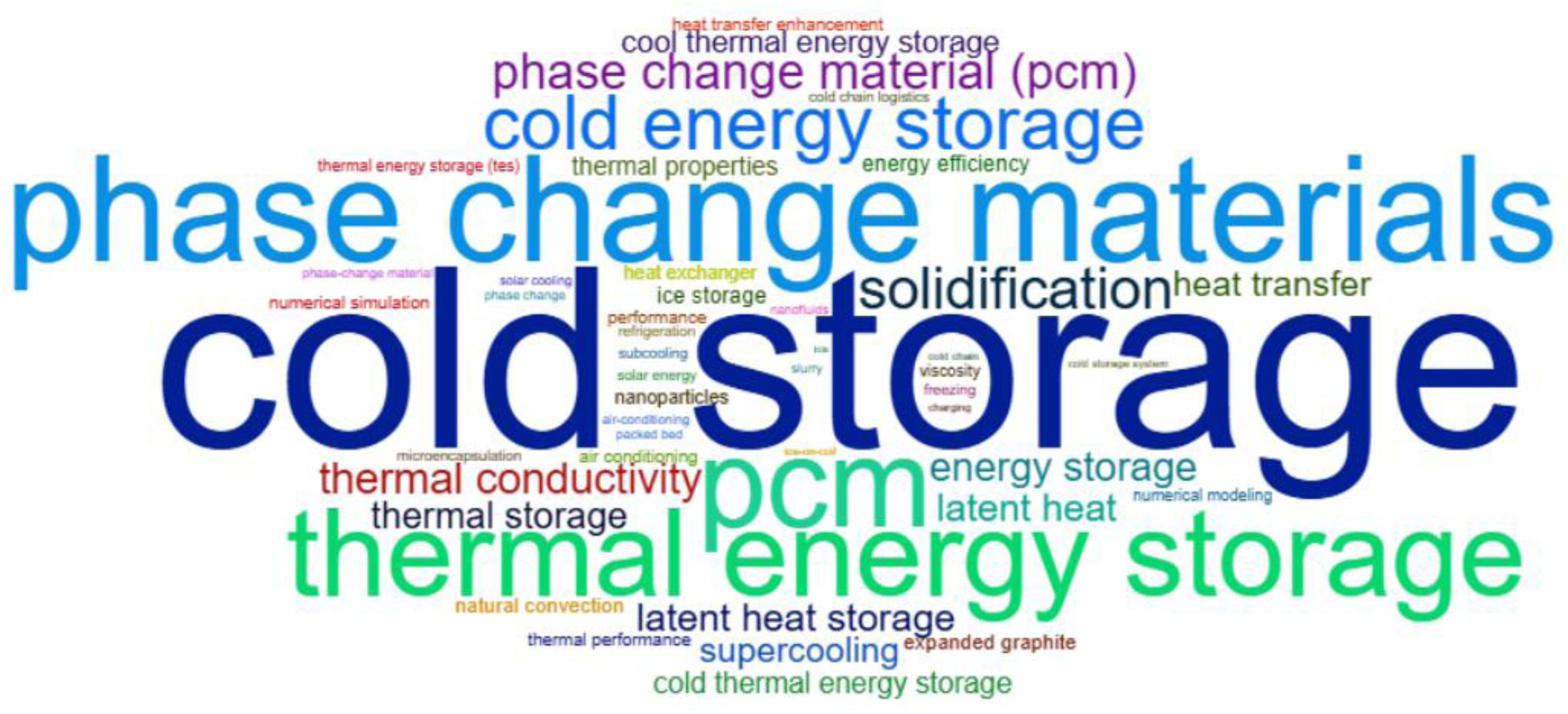
Word cloud of most frequently occurring keywords.
The thermal-physical property keywords, including ‘thermal conductivity’, ‘latent heat’, ‘thermal properties’, ‘viscosity’, and ‘supercooling’, underline the fundamental materials science challenges that continue to drive research innovation in this field. The emphasis on thermal conductivity enhancement suggests a critical research priority, as low thermal conductivity remains one of the primary limitations hindering the practical implementation of PCMs in cold storage applications (Al-Shannaq et al., 2019). The appearance of ‘supercooling’ and ‘subcooling’ indicates ongoing efforts to understand and control the crystallisation behaviour of PCMs, which directly impact storage capacity, cycling stability, and system reliability (Beaupere et al., 2018). These property-focused keywords reveal that materials optimisation remains at the forefront of research activities, with scientists working to develop PCMs with enhanced thermophysical properties explicitly tailored for cold storage applications.
Likewise, the inclusion of heat transfer-related terminology, including ‘heat transfer’, ‘heat transfer enhancement’, ‘natural convection’, and ‘heat exchanger’, shows the significant emphasis placed on thermal management and system-level optimisation. This focus indicates that research has evolved beyond fundamental materials characterisation to comprehensively understand heat and mass transfer phenomena within practical storage systems. The presence of ‘numerical simulation’, ‘numerical modelling’, and ‘performance’ keywords demonstrates the field's reliance on computational methods for system design, optimisation, and performance prediction. This computational emphasis emphasises the complexity of phase change phenomena and the need for modelling approaches to capture the coupled heat and mass transfer processes occurring during solidification and melting cycles.
Similarly, the application-oriented keywords in the word cloud highlight the field's practical directions and market drivers. For example, terms like ‘air conditioning’, ‘refrigeration’, ‘cold chain logistics’, and ‘cold chain’ indicate strong industrial relevance and commercial potential, mainly in sectors requiring precise temperature control and energy-efficient cooling solutions. The appearance of ‘ice storage’ and ‘ice-on-coil’ suggests continued research interest in traditional PCMs and also indicates efforts to improve conventional cold storage technologies. The inclusion of ‘solar cooling’ and ‘solar energy’ signifies the field's alignment with renewable energy integration strategies, highlighting the potential for PCMs to enable sustainable cooling solutions by coupling solar energy with cold storage systems.
Additionally, the materials enhancement keywords, including ‘expanded graphite’, ‘nanoparticles’, ‘nanofluids’, and ‘micro-encapsulation’, reveal approaches to addressing the fundamental limitations of PCMs. Terms like ‘expanded graphite’ indicate its established role as a thermal conductivity enhancer, while ‘nanoparticles’ and ‘nanofluids’ suggest ongoing exploration of nanotechnology-based solutions for improving heat transfer characteristics. The presence of ‘micro-encapsulation’ suggests materials engineering approaches aimed at preventing leakage, improving thermal cycling stability, and enabling integration into various system configurations. It is worth mentioning that these enhancement strategies demonstrate the field's commitment to overcoming traditional PCM limitations through innovative materials science approaches.
Furthermore, the figure shows system-level keywords, including ‘packed bed’, ‘charging’, ‘cold storage system’, and ‘energy efficiency’, indicating that the research focuses on practical implementation challenges and system integration considerations. Researchers’ use of ‘packed bed’ suggests investigating granular PCM systems for large-scale applications. In contrast, ‘charging’ refers to the attention given to operational aspects of TES systems. The term ‘energy efficiency’ means the field's contribution to broader sustainability goals and the importance of energy performance metrics in evaluating cold storage technologies.
It is worth mentioning that the implications of these keyword distributions extend beyond academic interest. This suggests a research community that has bridged the gap between fundamental materials science and practical engineering applications. The balanced use of materials properties, heat transfer phenomena, enhancement strategies, and applications indicates a developed field capable of addressing complex, multidisciplinary challenges. The significance of these research directions lies in their potential to enable more efficient, sustainable, and cost-effective cold storage solutions across multiple sectors, including food preservation and pharmaceutical storage, as well as building cooling and renewable energy integration, thereby contributing to global energy sustainability and efforts to mitigate climate change.
Network visualisation of keywords into clusters
Figure 6 illustrates the network visualisation of keywords into clusters, providing a framework for analysing keyword relationships and thematic structures within the research domain. The network visualisation process in VOSviewer software involves several key steps and parameters. Firstly, a minimum threshold of five occurrences was set for keyword inclusion, resulting in 82 keywords meeting this criterion from a total of 1676 keywords in the dataset. The visualisation was configured using association-based normalisation methods, with layout parameters set to an attraction value of 2 and a repulsion value of 0, and utilised default values for optimal positioning. The clustering analysis was performed with a resolution of 1 and a minimum cluster size of 1, with the option to merge small clusters enabled to ensure meaningful groupings. The final network visualisation comprises 82 items organised into 10 distinct clusters, connected by 594 links with a total link strength of 1283 (Figure 6). The colours in the figure represent the thematic clusters or research domains. Each colour group represents keywords that frequently co-occur in the literature and indicate related research areas. The interconnecting lines illustrate the strength of relationships between keywords, with thicker lines indicating stronger co-occurrence patterns. This visual representation illustrates how various research themes intersect and interact with one another in this interdisciplinary field. In the following paragraphs, each keyword cluster is analysed in relation to relevant literature.
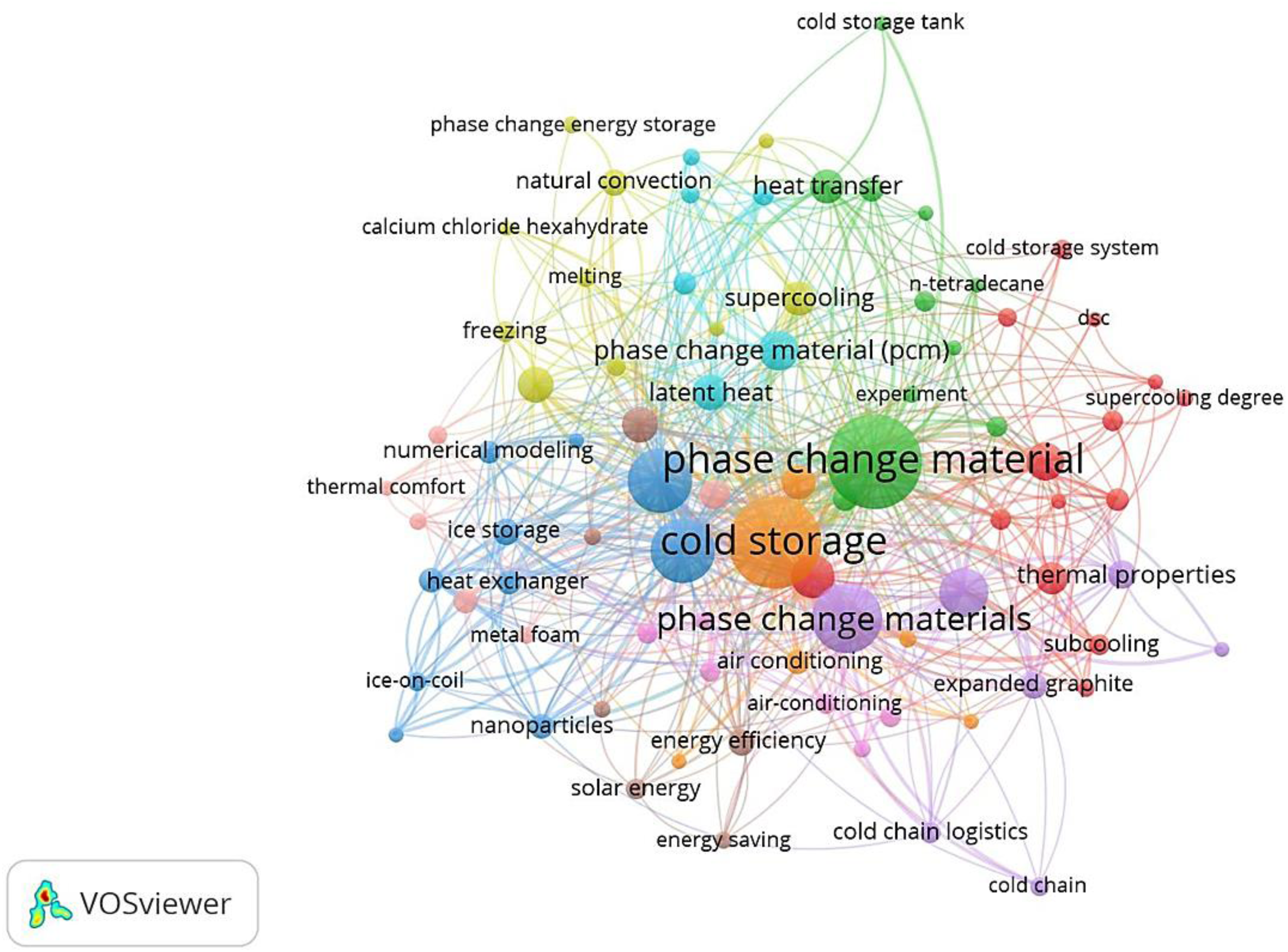
Network visualisation of keywords into clusters.
Thermophysical properties and material enhancement of PCMs
Cluster 1 comprises terms including charging, cold storage system, cool TES, nanofluids, nucleating agent, nucleation, PCM, solidification, stability, subcooling, supercooling degree, thermal conductivity, and viscosity. It can be seen that this cluster comprises the fundamental thermal science and materials engineering principles that govern PCM cold storage systems, with research demonstrating how critical thermophysical properties determine system performance and efficiency. The presence of thermal conductivity in this cluster indicates a primary factor in heat transfer efficiency, with multiple studies showing significant enhancements through nanoparticle additions. For example, Sathishkumar et al. (2016) found that graphene nanoplatelets increased thermal conductivity by 12% in liquid and 56% in solid for water-based nanofluids. Similarly, Kumaresan et al. (2021a) achieved a 36% enhancement in thermal conductivity using graphitised mesoporous carbon, while Sathishkumar and Cheralathan (2022) reported a 53.15% improvement at −10°C with functionalised multi-walled carbon nanotubes. Furthermore, Sundaram et al. (2023) observed a thermal conductivity enhancement of up to 59.1% with graphene nanoplatelets, and Srinivasan and Ponnusamy (2024b) achieved a 30.75% improvement in solid-state properties using hybrid nanofluid formulations.
Viscosity in this cluster influences fluid flow characteristics and thermal performance, with Sundaram et al. (2023) noting that higher nanoparticle concentrations increase viscosity, subsequently reducing energy storage density and solidification rates. Nanofluids emerge as advanced heat transfer enhancement techniques throughout the literature, with water-based formulations outperforming pure PCM systems. Chandrasekaran et al. (2014b) prepared nanofluids using multi-wall carbon nanotubes and achieved a 25% reduction in freezing duration compared to pure deionised water. In another study, Chandrasekaran et al. (2014a) utilised copper oxide nanoparticles in a water-based nanofluid PCM, as shown in Figure 7. The authors demonstrated a 35% reduction in solidification time due to enhanced heat transport properties. Nanda Kumar and Chandrasekaran (2021) investigated Al2O3 nanofluid PCMs, demonstrating enhanced thermal properties for faster heat dissipation and higher operating temperatures.
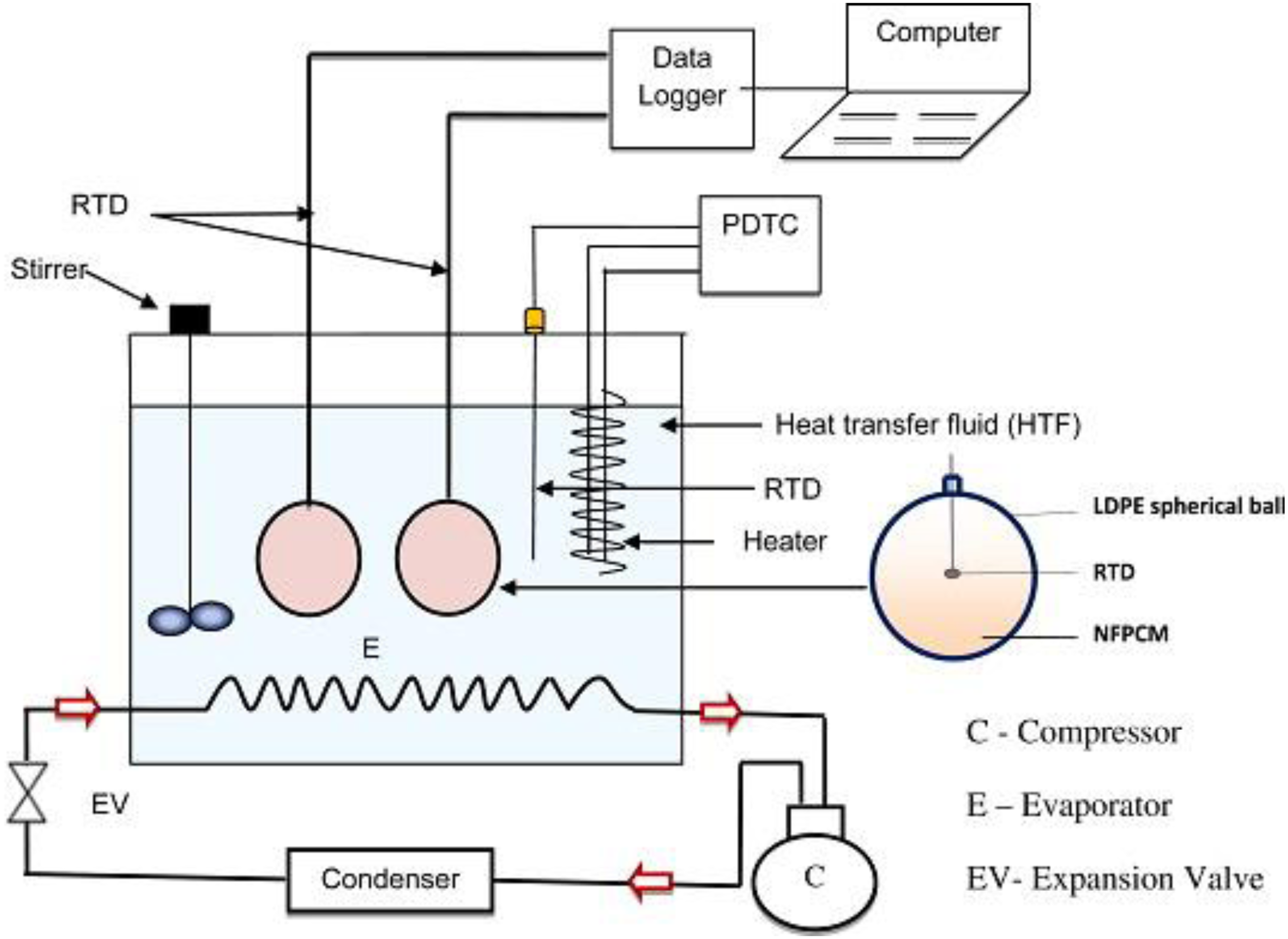
Experimental setup for studying heat transfer characteristics of CuO nanofluid PCM in a spherical capsule during solidification (Chandrasekaran et al., 2014a) (Reproduced with permission from Elsevier, License number: 6038410516783).
Nucleation and nucleating agents play a pivotal role in controlling crystallisation behaviour and mitigating problematic subcooling phenomena across multiple investigations. Vikram et al. (2019) used sodium chloride and D-sorbitol as nucleating agents, reducing subcooling from −5.4°C to −2.8°C in deionised water systems. Chandrasekaran et al. (2014b) employed Pseudomonas as a nucleating agent, eliminating subcooling in nanofluid PCMs and improving phase change reliability. Chandrasekaran et al. (2014a) further proved that nucleating agents eliminated subcooling problems, allowing evaporators to operate at higher temperatures in chiller systems.
Solidification processes in Cluster 1 exhibit central phase change behaviours that determine energy storage efficiency and system performance characteristics. For instance, Sathishkumar et al. (2016) found that graphene nanoplatelets reduced solidification time by 25% due to their enhanced thermal conductivity and increased specific surface area. (C. Chen et al., 2022a) numerically analysed the solidification behaviour, reporting a 30.1% reduction in solidification time at a 1.2 wt% graphene nanoplatelet concentration. In addition, Jeevarathinam et al. (2024) achieved a 40% reduction in solidification duration using 5 wt% natural graphite flakes in deionised water.
Subcooling and supercooling degrees indicate critical temperature control challenges that affect system reliability and operational efficiency. Sathishkumar et al. (2016) reduced subcooling from −7°C to −2.5°C by adding graphene nanoplatelets, enabling more predictable phase change behaviour. (Mulawarman et al., 2018) effectively reduced water supercooling using glycerol and propylene glycol as nucleating agents, allowing faster and more reliable freezing processes. Sundaram et al. (2023) achieved a reduction of up to 47.6% in supercooling using gum Arabic-stabilised graphene nanoplatelet formulations, thereby improving the predictability of phase change.
Charging represents the energy storage phase during which PCM systems accumulate thermal energy for subsequent release during discharge cycles. Sathishkumar et al. (2016) observed accelerated energy charging during 78% of the total solidification time, with the innermost 9% of the volume solidifying over a duration of 22%. Kumaresan et al. (2021b) demonstrated that micro-particle enhanced PCM stored roughly 94% of cool energy in a shorter time than base PCM formulations. Kumaresan et al. (2021a) showed that nanofluids achieved 96% cool energy storage in accelerated charging mode, improving system efficiency. Cool TES systems benefit from enhanced PCM formulations that address fundamental thermophysical property limitations in conventional materials. Rakkappan et al. (2021) investigated the 1-decanol/expanded graphite composite PCM as a superior alternative to ice for cold TES applications, as shown in Figure 8. Their composite PCM stored latent heat at relatively higher wall temperatures than ice, requiring much lower temperatures for solidification. In the work of Bharathi et al. (2024), the authors developed a nanocomposite-enhanced fatty acid eutectic PCM using coconut shell-activated carbon cobalt oxide, achieving 73% thermal conductivity enhancement at 0.1 wt%.
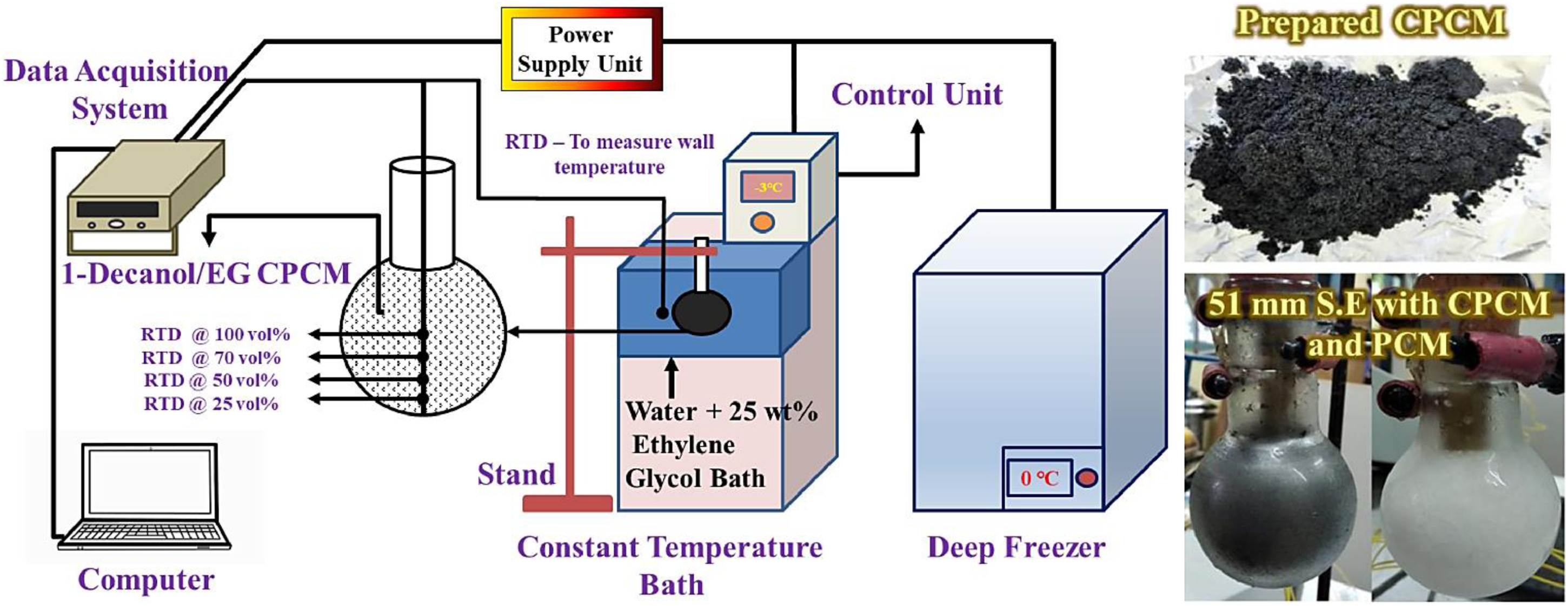
An experimental setup for investigating the energy storage characteristics of spherically encapsulated 1-decanol/expanded graphite composite PCM (Rakkappan et al., 2021) (Reproduced with permission from Elsevier, License number: 6042120070184).
Cold storage systems utilise advanced PCM formulations to overcome traditional ice-based limitations, thereby enhancing thermal performance and operational flexibility. Ajour et al. (2024) simulated unsteady solidification processes in advanced cold energy storage systems using alumina nanoparticle-enhanced water-based PCM formulations. The analysis revealed that increasing the nanoparticle concentration improved the cold storage rate by 36.37%, while the effects of nanoparticle size were found to be nonlinear and complex. Stability in cluster 1 comprises thermal cycling durability and chemical compatibility, ensuring long-term system performance and material integrity under repeated operational cycles. Sundaram et al. (2023) investigated stability using different surfactants and found that gum Arabic-stabilised formulations demonstrated the highest stability and thermal performance characteristics. (Srinivasan and Ponnusamy, 2024a) achieved the highest stability with sodium dodecylbenzene sulphonate, characterised by a −42.7 mV zeta potential and an average particle size of 212.6 nm. In another study, Srinivasan and Ponnusamy (2025) found that a hybrid nanofluid PCM using the anionic surfactant SDBS exhibited the greatest stability, with the smallest particle size and the highest zeta potential.
Experimental validation and performance assessment of PCM cold storage systems
Cluster 2 comprises cold storage tank, cool storage, experiment, heat transfer, micro-encapsulation, n-tetradecane, paraffin, performance, phase change, PCM, and thermal performance. The cluster focuses on experimental validation and performance assessment of PCM cold storage systems. The emphasis on experimental methodology indicates the critical importance of empirical validation in PCM research. Cold storage tanks represent practical implementation scales, and micro-encapsulation addresses advanced PCM packaging techniques for enhanced durability and containment. Specific materials like n-tetradecane and paraffin are commonly studied organic PCMs with suitable melting points for cold storage applications. Heat transfer and thermal performance metrics are central to system evaluation. This cluster highlights the transition from theoretical understanding to practical implementation, emphasising the need for experimental characterisation to validate system performance, optimise operating parameters, and demonstrate the commercial viability of cold energy storage technologies.
The experimental methodology forms the basis of this research domain, as demonstrated by multiple studies that emphasise empirical validation over theoretical modelling alone. Torregrosa-Jaime et al. (2013) conducted an extensive experimental analysis of a paraffin-based cold storage tank containing 1450 kg of paraffin with 18 spiral-shaped coils. Their experimental approach revealed that natural convection influences the melting process during phase change operations. The study identified that roughly 31% of the paraffin remains unutilised due to poor coil contact with the storage medium. The study achieved optimal performance in terms of system efficiency at the lowest HTF supply temperatures and mass flow rates.
n-Tetradecane, an organic PCM, has been used across multiple experimental studies due to its suitable thermophysical properties for cold storage applications. For instance, H. Zhang et al. (2022) enhanced n-tetradecane thermal conductivity by developing tetradecane/expanded graphite composite PCMs for high-power cold storage applications. The study composite achieved a thermal conductivity of 21.0 W/m·K, representing nearly a 100-fold improvement over the raw n-tetradecane’s performance characteristics. The innovative spiral wave plate cold storage tank, utilising composite materials, improves power and energy density, reaching a 40 kWh/m3 capacity. In addition, the predictive models for maximum paraffin loading and thermal conductivity yielded errors of only 1.7% and less than 10%, respectively. S. Wu et al. (2010) developed thermal performance simulations of a packed bed cool TES system utilising n-tetradecane as the primary PCM. The authors examined the temperatures of PCM and HTF, as well as variations in solid and liquid fractions, and the rates of cooling and heating during storage and release throughout operational cycles. S.-M. Wu and Fang (2012) further investigated the dynamic charging performance of cool energy storage systems with coil pipes using n-tetradecane and aqueous ethylene glycol solution. The findings revealed that increasing or decreasing the flow rate and inlet temperature enhances cool storage rates and reduces charging time requirements. According to their findings, the system achieved a cool storage capacity of approximately 103 MJ in about 5 h under optimised operational parameters.
Paraffin-based systems dominate experimental cold storage research due to their favourable phase change characteristics and commercial availability for practical applications. The work of D. Li et al. (2019) examined the thermal control performance of tube-fin cool storage heat exchangers filled with paraffin PCM. The experimental study incorporated graphene powder enhancement to improve solidification rates and thermal management capabilities for electronic device applications. Graphene powder improved solidification rates, increasing thermal control time by 114.8% at 800 W heating power. Under maximum heat flux of 1000 W, heat control times were 40, 29, and 25 min for 0%, 2.5%, and 5% graphene mass fractions, respectively. X. Wu et al. (2019) enhanced pure paraffin (RT4) thermal conductivity by preparing composite PCMs with varying carbon nanotube mass fractions. The experimental evaluation achieved thermal conductivity improvements of 30.3% in solid and 28.5% in liquid at 3% carbon nanotube concentration. In addition, when applied in vertical open-type refrigerated display cabinets, composite PCMs reduced internal temperature fluctuations during defrosting, with 3%-carbon nanotube composites decreasing temperature differences by 92.0% and 12.2%, respectively.
Micro-encapsulation represents an advanced PCM packaging technique that addresses durability, containment, and enhanced performance requirements in practical cold storage applications, as investigated across several studies. For example, Fang et al. (2013) synthesised polystyrene/n-tetradecane composite nanoencapsulated PCMs using ultrasonic-assisted mini-emulsion in situ polymerisation techniques. The nanoencapsulated PCM formed uniform spherical capsules with an average diameter of 132 nm, achieving melting and freezing points of 4.04°C and −3.43 °C, respectively. The materials yielded corresponding latent heat of 98.71 J/g and 91.27 J/g with a maximum specific heat of 4.822 J/g K. In addition, the good mechanical stability demonstrated through freeze-thaw cycling indicated a strong potential for cool energy storage applications, as indicated by their experimental characterisation. Moinuddin et al. (2021) micro-encapsulated ester-based non-paraffin PCMs into organic shells using in situ polymerisation techniques. The authors’ micro-encapsulated PCM showed good morphology and chemical stability, with a latent heat of 65.32 kJ/kg and an onset melting temperature of 8.57°C.
Likewise, heat transfer mechanisms and thermal performance metrics constitute central evaluation criteria for experimental validation of cold storage system effectiveness and operational efficiency. H. Zheng et al. (2024) utilised computational fluid dynamics to analyse the performance of carbon nanotube composite phase change cold storage spheres with annular fins. The study addressed the challenges of low thermal conductivity, high shell thermal resistance, and overall system inefficiencies through enhanced heat transfer mechanisms. Incorporating carbon nanotubes into annular-finned paraffin cold storage spheres reduced cooling time by 48 min and increased efficiency by 61.7% compared to traditional systems. Carbon nanotube additions outperformed fin enhancements in isolation, and optimal fin geometry and refrigerating medium flow rates further enhanced convective heat transfer. In the work of Dogkas et al. (2020), the authors experimentally investigated cold TES systems using organic PCMs (A9 and A14) for building cooling applications. The A9 organic PCM yielded efficient fan coil unit operation, maintaining a water temperature difference exceeding 5°C for over half of the tank capacity. The system achieved heat transfer rates exceeding 5 kW for 32 min with A9 and 24 min with A14.
Phase change behaviour and system performance optimisation are critical aspects of experimental validation that determine the commercial viability of cold energy storage technologies. In this context, Yedmel et al. (2024) developed a novel cold storage system combining TES using paraffin-based PCMs with thermosiphon loops. The thermosiphon-assisted TES system delivered 97% of stored cold energy to display cabinets, prolonging acceptable temperature maintenance during compressor shutdowns. With a cold accumulator, the air temperature remained within an acceptable range for 72 min, compared to only 3 min without accumulation capability. C. Yao et al. (2018) developed shape-stabilised PCM-wallboards (PCMW) using paraffin and expanded perlite to enhance building thermal inertia. The paraffin-based PCMW exhibited latent heat values of approximately 67 J/g, with melting and freezing points of 27.6°C and 23.6°C, respectively. Experimentally, PCMW reduced indoor temperature by up to 2.53 K under typical northern China weather conditions, with numerical simulations demonstrating average temperature reductions of 9.22 K during summer office hours.
Commercial viability assessment through experimental characterisation facilitates the optimisation of operating parameters and demonstrates the practical implementation potential for widespread adoption. Y. L. Shao et al. (2020) compared encapsulated ice thermal storage (EITS) systems with theoretical encapsulated organic PCM systems utilising paraffin waxes. The system achieved three times the cold energy storage capacity of conventional chilled water tanks and 9.37% higher capacity than EITS systems. This improvement resulted from greater solidification in encapsulated organic PCM systems, with HTF flow rate impacting the solidification ratio and energy storage. Yuan et al. (2024) investigated the physical hardening effects of wax-based materials, including paraffin characteristics, on low-temperature properties after extended cold storage periods. F-T waxes and Montan waxes with typical paraffin characteristics deteriorated in their low-temperature rheological performance after 72 h of cold conditioning, with grade losses of up to 6.2°C and increased thermal stress, confirming the physical hardening impacts on long-term system performance and operational reliability.
Heat exchange technologies and PCM-based ice storage system integration
Cluster 3 contains terms including charging rate, heat exchanger, heat transfer enhancement, ice storage, ice storage system, ice-on-coil, nanoparticles, numerical modelling, PCM, and TES. This cluster represents advanced heat exchange technologies and system integration approaches that have been extensively investigated in multiple research studies. Heat exchangers are critical components determining overall system efficiency, as demonstrated by Abdelrahman et al. (2020), who experimentally evaluated a twin concentric helical coil configuration immersed in distilled water as a PCM (Figure 9). The core component is an insulated acrylic tank containing two concentric helical coils, where ice formation occurs during the charging process and melts during discharge. The entire system is monitored through a laptop-based data acquisition system, which is connected to temperature sensors and controllers distributed throughout the circuit. The HTF circulation is managed by a pump and regulated through multiple valves, with flow rates measured by dedicated flow metres to ensure precise control of experimental conditions. The system operates with separate charging and discharging reservoirs, each equipped with electric heaters for temperature control. A bypass pipe enables flexible flow management across various operational modes. The refrigeration circuit comprises a complete vapour compression cycle, including a compressor, condenser, evaporator (a tube-in-tube heat exchanger), and expansion valve, all housed in an outdoor unit. This setup enables controlled cooling of the HTF, facilitating the formation of ice on the helical coils. The study revealed that approximately 90% of the energy storage capacity was achieved within 59–74% of the total charging time under the tested conditions.
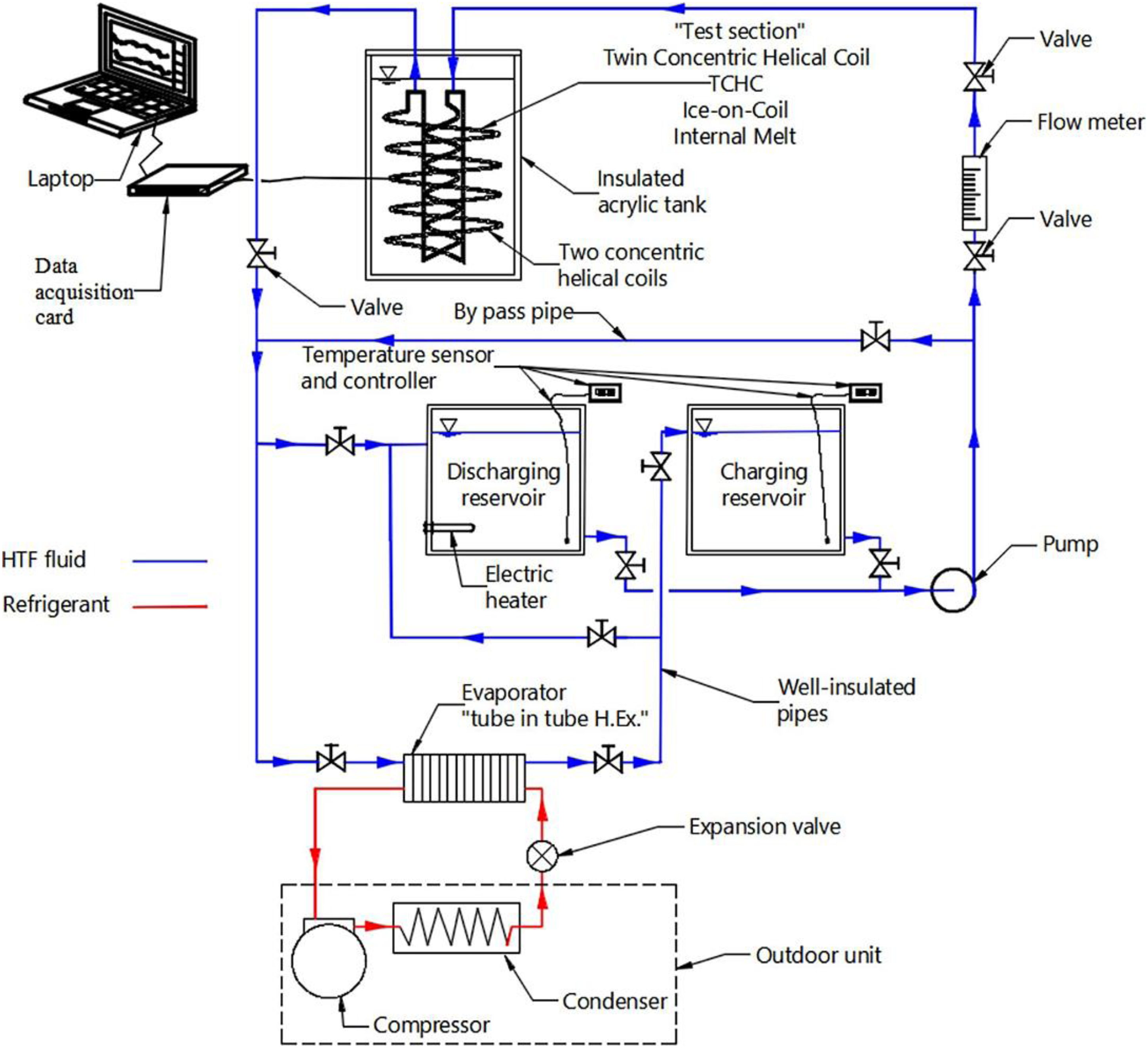
Experimental set-up for ice storage system using twin concentric helical coil (Abdelrahman et al., 2020) (Reproduced with permission from Elsevier, License number: 6042120287984).
Additionally, heat transfer enhancement techniques, such as the use of nanoparticles, improve thermal performance. Chandrasekaran et al. (2024) reported that iron oxide nanoparticles in deionised water achieved a 50% mass frozen state with an enhanced surface heat flux of up to 200% at −6°C. The addition of these nanoparticles reduced chiller operational time by 75% through optimised container design and partial charging. Afsharpanah et al. (2022) further revealed that copper foam occupying 3% of the container volume accelerated the phase change rate by 84.6%, outperforming the 24.3% improvement achieved by equivalent CuO nanomaterials alone. When copper foam was combined with high-porosity and CuO nanomaterials at a concentration of 0.03, the phase change rate increased by 92.5%.
Likewise, ice storage systems indicate an established cold energy storage technology with proven commercial viability and reliability. Al-Shannaq et al. (2019) enhanced thermal conductivity by encapsulating water within high-thermal-conductivity graphite spheres, achieving a 12-fold increase in effective thermal conductivity. This enhancement reduced freezing and melting times by 53.7% and 44.4%, respectively, compared to non-graphite spheres. The graphite matrix minimised supercooling by acting as a nucleating agent, addressing a key challenge in ice storage applications. Ice-on-coil configurations indicate common implementations that have been extensively studied for optimisation. Mousavi Ajarostaghi et al. (2023) investigated solidification processes in ice-on-coil systems using combined experimental and numerical approaches. The study modified the evaporator design, featuring four connected horizontal coils, which enhanced the ice thickness by up to 14.71% after 180 min, particularly at the bottom sections of the coils. Q. Lin et al. (2019) applied lattice Boltzmann modelling to simulate transient solid-liquid phase change in ice-on-coil tanks containing nine horizontally aligned pipes. The study identified three distinct melting stages and found that high-temperature pipe placement in upper tank sections maximised melting rates.
The charging rate in this cluster emphasises the dynamic performance characteristics crucial for practical applications and system responsiveness. In view of this, Almeshaal and Sakr (2023) numerically investigated packed-bed ice storage systems with Al2O3 nanoparticles dispersed in water capsules. The findings indicated that 90% of stored cool energy could be charged in 12–77% of total charging time, depending on coolant conditions. In addition, increasing the coolant flow rate reduced full charging time by up to 69.2% at double the flow rate. Ding et al. (2022) proposed foam freezing as a high-performance charging method, identifying an optimal foam bubble radius of 0.6 mm, which achieved a cold energy charging coefficient of 237.1 W/m2 K. This approach outperformed traditional ice ball and ice-on-coil methods in charging efficiency. Yan et al. (2023a) experimentally set up an ice-on-coil TES system designed to study dynamic melting processes, as shown in Figure 10. The system centres on an ice-storage tank containing serpentine coils, where ice formation and melting occur, monitored by strategically placed thermocouples that measure temperature distributions throughout the melting process. A thermostatic bath (Alpha RA 24) provides precise temperature control for the HTF, which circulates through the system via a circulation pump. Both float-type and turbine flow metres measure flow rates to ensure accurate monitoring of fluid dynamics. The fluid flow is regulated by ball valves and bypass valves, allowing for controlled experimental conditions. A nozzle system facilitates proper fluid distribution within the storage tank. Temperature and flow data are continuously collected through a data logger system connected to a computer for real-time monitoring and analysis of the melting characteristics. The authors revealed that dynamic circulation systems improved average discharge rates by 60.7–89.2% while reducing ice melting duration by 45.3–54.3% compared to static systems. In the work of Laouer et al. (2024), the authors employed lattice Boltzmann methods to analyse the partial melting of ice embedded with copper and alumina nanoparticles. The simulations revealed that a 6% concentration of copper nanoparticles reduced the melting time by 12.4%, with copper particles proving slightly more effective than alumina. The modelling approach captured the complex interactions between Rayleigh numbers and nanoparticle volume fractions that affect energy storage efficiency.
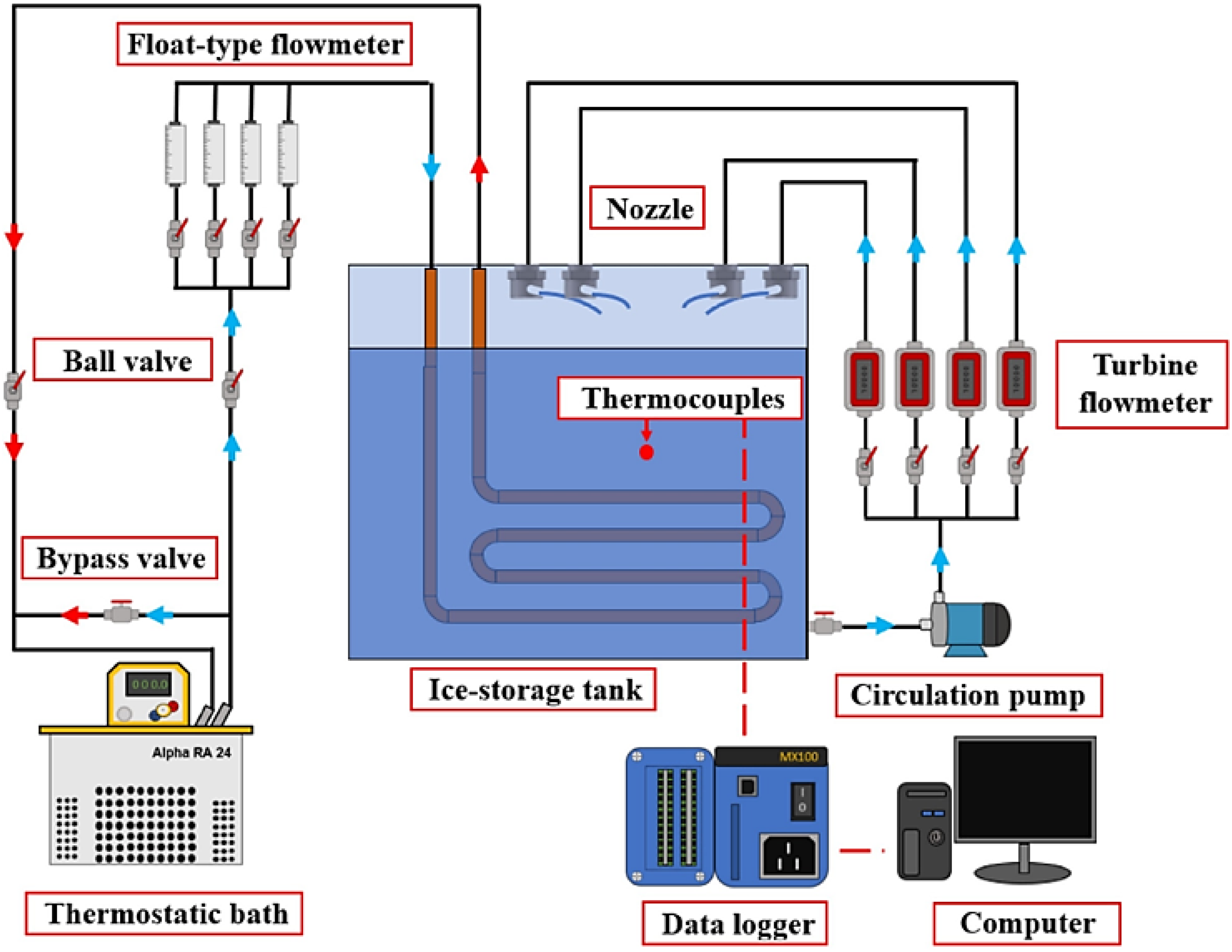
(a) Experimental setup of dynamic melting process in an ice-on-coil storage system (Yan et al., 2023a) (Reproduced with permission from Elsevier, License number: 6042120531367).
Integrating PCMs with conventional ice storage systems signifies a hybrid approach, maximising energy density and reliability. For example, Niu and Zhang (2009) investigated the performance of micro-encapsulated paraffin slurry for building cooling applications in temperate temperature ranges. Full latent heat storage was achievable at 5°C due to supercooling effects, and an effective cooling storage capacity existed between 5 °C and 18 °C. This demonstrates the potential for PCM integration with passive cooling methods for diurnal storage applications. Yan et al. (2023b) explored alumina nanofluid as PCM in ice-on-coil systems, finding reduced freezing times but negative impacts on melting performance. However, implementing spiral finned coils improved system performance by reducing the melting time by 24% and increasing the average discharge rate by 74.4%.
Calcium chloride hexahydrate systems and micro-encapsulated PCM slurries
Cluster 4 comprises terms such as calcium chloride hexahydrate, crystallisation, energy storage, freezing, ice, melting, mpcm (micro-encapsulated PCM) slurry, natural convection, phase change energy storage, and supercooling. Calcium chloride hexahydrate (CaCl2·6H2O) has attracted significant attention due to its favourable thermophysical properties for cold storage applications. For instance, Cao et al. (2022) developed a composite PCM using calcium chloride hexahydrate with glycerol as a temperature regulator and achieved a melting temperature of 11.8°C and phase change enthalpy of 112.86 J/g. X. Han et al. (2022) optimised the calcium chloride hexahydrate system by incorporating methanol and glycerol, resulting in a material with a phase transition temperature of 10.4 °C and a latent heat capacity of 120.75 J/g. Zou et al. (2018) enhanced the performance of calcium chloride hexahydrate by incorporating urea and ethanol, achieving a phase change temperature of 11.62 °C and an enthalpy of 127.2 J/g·C. Li et al. (2022) developed a tailored calcium chloride hexahydrate composite (CCH-UNSC4) with an optimised composition, achieving a phase change temperature of 9.51 °C and a latent heat of 99.08 J/g. The work of M. Li et al. (2023) created a gel-like PCM from calcium chloride hexahydrate with an 8.15°C melting temperature and 93.80 J/g latent heat capacity.
The crystallisation process in these calcium chloride hexahydrate systems indicates a fundamental aspect of phase change energy storage mechanisms. Crystallisation behaviour directly influences the energy storage capacity and thermal performance of PCMs during solidification. The controlled crystallisation of calcium chloride hexahydrate enables efficient energy storage through the release of latent heat during phase transitions. C. Li et al. (2022) demonstrated that proper crystallisation control in their composite system resulted in thermal cycling stability over fifty cycles. Allouche et al. (2015) found that MPCM slurry could store 53% more energy than water in equivalent tank volumes. Yu et al. (2018) found that MPCM slurries yield higher cold energy storage capacity than traditional packed pebble bed systems. L. Zheng et al. (2017) confirmed that MPCM provides higher energy transport effectiveness for cold storage applications.
The energy storage enhancement achieved through PCMs signifies a critical advancement in thermal energy management systems. Freezing processes are crucial to PCM performance, primarily affecting energy storage efficiency and heat transfer characteristics. S. Zhang and Niu (2010) investigated the freezing behaviour of micro-encapsulated paraffin slurry systems for building cooling applications in temperate temperature ranges. H. Xu et al. (2018) demonstrated that MPCM slurry enhanced temperature differences during freezing processes compared to pure water systems. The freezing characteristics directly influence the effectiveness of PCMs in practical cold storage systems. Ice formation and behaviour in this cluster characterise the fundamental PCM development considerations for cold storage applications operating near water-freezing temperatures. The interaction between ice formation and PCMs affects system performance and energy storage capacity. In addition, melting characteristics determine the energy release patterns and thermal performance of PCMs during discharge cycles in cold storage systems. Cao et al. (2022) achieved controlled melting behaviour through the incorporation of glycerol, resulting in an optimised melting temperature suitable for air conditioning applications. X. Han et al. (2022) concluded that the addition of methanol influenced the melting characteristics, achieving the desired phase transition temperatures for cold energy storage.
Supercooling is a critical challenge in PCM development, affecting energy storage reliability and system performance predictability. S. Zhang and Niu (2010) found that full latent heat storage required temperatures around 7°C due to supercooling effects in micro-encapsulated paraffin systems. Cao et al. (2022) reduced supercooling to 1.22°C by adding barium hydroxide octahydrate as a nucleating agent to calcium chloride hexahydrate systems. X. Han et al. (2022) demonstrated effective supercooling reduction through barium carbonate incorporation, facilitating easier nucleation in composite PCMs. Zou et al. (2018) achieved a 0.95°C reduction in supercooling by adding strontium chloride hexahydrate to calcium chloride hexahydrate composite systems. C. Li et al. (2022) achieved an ultra-low supercooling degree of 0.39°C through an optimised composite formulation in their tailored calcium chloride hexahydrate system. Luo et al. (2023) reduced undercooling to 1.75°C by integrating expanded graphite into shape-stabilised PCM systems. The supercooling mitigation strategies represent essential developments for reliable PCM performance in practical cold storage applications.
Expanded graphite enhancement and cold chain logistics applications
Cluster 5 comprises cold chain, cold chain logistics, cold energy storage, expanded graphite, modified expanded graphite, PCMs, and thermal properties. This cluster bridges materials science with practical cold chain applications through comprehensive research initiatives. Cold chain logistics is the primary market driver for cold energy storage technologies, encompassing food preservation, pharmaceutical distribution, and the transportation of temperature-sensitive cargo across various operational environments. Therefore, integrating PCMs within cold chain systems improves temperature control and energy efficiency. For instance, Liu et al. (2024b) reported that glycine-based water composites reduced the pre-cooling time for strawberries by 56.60% compared to conventional ice. Their research enabled adequate refrigeration for up to 17.86 h within the critical temperature range of 1.54 °C to 3.39 °C. This advancement illustrates how enhanced PCMs can improve logistics efficiency and maintain product quality during transportation. The pharmaceutical sector benefits from these innovations, as demonstrated by G. Zhang et al. (2023), who showed that tetradecane-dodecanol-decanoic acid/expanded graphite composites extended the cold preservation time for vaccines by 50.4 times.
Expanded graphite and its modifications are thermal conductivity enhancers and structural supports for PCMs, addressing the typically low thermal conductivity limitation. X. Chen et al. (2024) achieved thermal conductivity improvements eight times higher than pure PCM through SiO2-coated expanded graphite incorporation. The authors’ composite material achieved a thermal conductivity of 5.183 W/m·K and demonstrated thermal cyclic stability over 200 cycles. Zhou et al. (2024) reported even more substantial enhancements, achieving a 22.52-fold increase in thermal conductivity to 5.18 W/m·K with their dodecane–hexadecane/expanded graphite composite. These improvements address fundamental limitations that previously restricted PCM applications in demanding cold chain environments. The structural support function proves equally critical, as demonstrated by Y. Chen et al. (2022b), who achieved high adsorption rates of 92 wt.% in expanded graphite matrices. This capability prevents material leakage and maintains phase change functionality throughout operational cycles.
In addition, modified expanded graphite suggests an advanced approach to optimising PCM performance through surface chemistry manipulation and enhanced compatibility in this cluster. For example, Liu et al. (2024c) employed Triton X-100 surfactant modification to improve compatibility between expanded graphite and glycine water-based materials. The modified expanded graphite increased the adsorption capacity to 82.87% and achieved a thermal conductivity 4.08 times higher than that of pure glycine water-based PCM. Liu et al. (2024a) utilised cetyltrimethylammonium bromide modification to enhance the adsorption capacity from 73.96% to 84.05%. This modification approach demonstrates systematic material optimisation for specific application requirements. W. Wu et al. (2025a) further advanced this concept through hydrogen bond-enhanced hydrophilic modification of expanded graphite with cationic surfactants. The authors’ approach increased thermal conductivity by 80.85% and achieved cycle stability with only 17.0% latent heat attenuation after 1000 cycles.
The focus on thermal properties highlights the critical importance of material characterisation for optimising applications across various temperature ranges. X. Xu et al. (2023) developed materials with phase transition temperatures of −0.7 °C and latent heat values of 170.4 J/g. Their research focused on the 0–8 °C range, which is crucial for cold chain logistics applications. J. Tang et al. (2024a) optimised octanoic acid–tetradecanol mixtures, achieving phase-transition temperatures of 11.4 °C with latent heat between 150 and 155 J/g. This temperature range is suitable for building air conditioning and intermediate cold storage applications. Zhou et al. (2024) achieved a sub-zero phase change temperature of −12.09 °C with a high melting enthalpy of 178.75 kJ/kg. These diverse temperature ranges demonstrate the material's adaptability to specific operational requirements.
Cold energy storage applications benefit from enhanced PCM formulations that combine high latent heat capacity with improved thermal conductivity characteristics. L. Tang et al. (2024b) developed composite materials with a thermal conductivity of 5.64 W/m·K and a latent heat of 263.1 J/g. The material maintained insulation box temperatures below 8 °C for 1124.1 min. Liu et al. (2024d) achieved thermal conductivity increases of 510% compared to base materials and maintained a latent heat of 144 J/g. The study approach reduced temperature differences inside the cold storage apparatus from 6.7 °C to approximately 1 °C. The work of T. Wu et al. (2025b) established that incorporating expanded graphite enhanced thermal conductivity more than tenfold without affecting the phase change enthalpy. This optimisation enabled cold storage densities exceeding 100 kWh/m3 and maximum power densities exceeding 200 kW/m3. X. Xu et al. (2023) revealed that cold storage panels with built-in charge cold coils achieved 58.1% shorter charging times compared to conventional charging methods. This improvement directly translates to operational efficiency gains in cold-chain transportation systems. The materials also reduced energy consumption through improved thermal management and reduced temperature fluctuations during storage and transport operations.
Numerical modelling, packed bed systems, and renewable energy integration
Cluster 6 includes the following terms: latent heat, numerical modelling, packed bed, PCM, renewable energy, and TES. This cluster comprises the critical intersection of latent heat storage technology and sustainable energy integration, utilising numerical modelling and practical implementation strategies. Latent heat storage fundamentally distinguishes PCMs from conventional sensible heat storage systems by providing higher energy density capabilities. This advantage is demonstrated through multiple research initiatives that have systematically investigated the thermal performance characteristics of PCM-based cold storage systems. Numerical modelling is the foundation for advancing PCM cold storage technology, allowing precise system design optimisation and performance prediction across various operating conditions. The modelling approaches that researchers have developed to facilitate an understanding of complex thermal dynamics within packed bed configurations allow for a systematic evaluation of design parameters and operational strategies. Packed bed configurations are the most practical and scalable implementation approach for large-scale TES systems in industrial and commercial applications. These configurations offer efficient heat transfer characteristics and maintain structural integrity and operational reliability under varying thermal loads.
Integrating PCM cold storage systems with renewable energy sources addresses fundamental sustainability concerns and simultaneously provides essential grid stabilisation capabilities for modern energy networks. This integration strategy facilitates effective load shifting and energy management, particularly in accommodating the intermittent nature of renewable energy generation. In view of this, Cheng and Zhai (2018) highlighted the effectiveness of cascaded packed bed cool TES units using multiple PCMs, achieving optimal thermal performance with a 24-stage configuration that reduced charging time by 15.1% compared to single-stage units. The research established that strategic temperature difference management (6°C) between phases enhances solidification heat transfer characteristics without compromising the quantity or quality of cold energy stored. The cascaded approach applies numerical modelling principles to optimise system performance through a systematic arrangement of PCM. Muthaiyan et al. (2021) advanced the practical application of packed-bed cool storage units by integrating residential air conditioning systems with rooftop solar PV power generation systems. The study revealed that latent heat storage systems can effectively support the integration of renewable energy and maintain reliable cooling performance for residential applications. The study yielded average coefficient of performance values of 1.0, 0.93, and 0.89 for HTF setpoint temperatures of −6°C, −9°C, and −12°C, respectively, highlighting the relationship between operating temperature and system efficiency. The cooling load delivery capabilities ranged from 2.25 kW during initial operation to 0.3 kW during the sixth cycle, highlighting the importance of thermal resistance management in maintaining consistent performance throughout discharge cycles.
The work of J. Wang et al. (2023) contributed to the advancement of numerical modelling techniques through their investigation of multi-stage cold storage packed beds utilising modified sodium sulphate decahydrate-based PCMs. The authors achieved a 7.3% increase in cold storage density compared to single-stage systems through strategic PCM modification and optimal filling ratio implementation (4:2:4). The enhanced thermal stability and storage performance revealed the effectiveness of combining advanced material modification with system design for air conditioning applications. The study validated the feasibility of multi-stage PCM systems for emergency cooling applications, providing one hour of reliable cooling capacity through optimised TES management. In the work of Tafone and Romagnoli (2023), the authors expanded the application scope of PCM cold storage by investigating liquid air energy storage systems integrated with cascaded latent heat cold TES. The numerical investigation revealed higher performance characteristics of cascaded PCM-based high-grade cold storage compared to conventional single PCM configurations. The cascaded system achieved enhanced charge phase capacity ratio (0.87 versus 0.81) and improved discharge phase utilisation factor (0.87 versus 0.80), resulting in a 6% improvement in liquefaction performance with specific energy consumption of 0.27 kWhe/kgLA. This research exemplifies the potential for integrating renewable energy through advanced PCM cold storage technologies, which enhance overall system efficiency and operational sustainability.
X. Li et al. (2018) investigated the dynamic characteristics of TES units incorporating multiple PCMs in spherical capsules for conventional air conditioning applications. The authors established that multi-PCM TES units offer a higher charging capacity than conventional single-PCM systems, with a 4:2:2 proportion yielding optimal performance characteristics. The study found that lowering the HTF inlet temperature reduces charging time, facilitating operational optimisation in practical applications. Additionally, the dynamic characteristics analysis highlighted the importance of systematic PCM selection and arrangement in maximising TES efficiency in packed bed configurations. In the work of Al-Shannaq et al. (2019), the authors addressed thermal conductivity limitations by developing a novel graphite-water composite sphere for cold energy storage applications. The experimental investigation discovered that encapsulating water within high thermal conductivity graphite spheres increased the effective thermal conductivity by a factor of twelve, reducing freezing and melting times by 53.7% and 44.4%, respectively. The graphite nucleating effect minimised supercooling phenomena and maintain consistent phase change behaviour throughout operational cycles. The study established that HTF inlet temperature and flow rate adjustments influence freezing time and melting rate, demonstrating system adaptability for various cooling applications and renewable energy integration scenarios.
In other studies, Grabo et al. (2021) developed an advanced packed-bed TES system using a non-spherical super-ellipsoidal macro-encapsulated latent heat storage capsule designed to enhance packing density and heat transfer characteristics. The capsule design increased storage capacity by over 20% compared to conventional spherical capsules, thereby boosting energy density from 51.5 kWh/m3 to 64.1 kWh/m3. The system delivered a thermal power output of about 4 kW during phase change processes, indicating practical applicability for large-scale TES applications. The numerical modelling approach accurately predicted charging and discharging behaviour within ±0.82 K of the experimental data, validating the effectiveness of advanced modelling techniques for system design optimisation. Khattari et al. (2021) provided a detailed analysis of positive latent cold storage systems for industrial applications through numerical modelling of their dynamic and thermal behaviour during discharge periods. The findings indicate that maintaining the HTF temperature near the PCM melting point leads to quasi-stabilisation of the outlet temperature, while reducing the fluid flow rate extends the energy discharge duration. For multi-PCM systems, the amount of latent energy released depends on PCM placement order, HTF flow rate, and inlet temperature, highlighting critical design considerations for industrial cold storage applications and renewable energy integration strategies. The work of Tafone et al. (2021) emphasised the practical application of cryogenic PCMs in liquid air energy storage systems through innovative cold TES solutions. The experimental and numerical investigation of packed bed units revealed improved thermal performance by reducing thermocline effects and extending discharge duration through the thermal buffering effects of PCM. The research achieved a 17% reduction in liquefaction-specific consumption (0.272 kWhe/kg LA) compared to 0.330 kWhe/kg LA, thereby enhancing both thermodynamic efficiency and economic viability. The economic analysis revealed payback periods of less than 3 years, establishing PCM integration as a cost-effective advancement for renewable energy storage technology that supports grid stabilisation and sustainable energy management objectives.
Economic viability and phase change slurry applications in air conditioning
Cluster 7 comprises terms such as air conditioning, cold storage, cooling, economic analysis, phase change slurry, and thermal storage. This cluster focuses on the practical applications and economic viability of PCM cold storage systems. The term ‘air conditioning’ refers to a major application area where cold energy storage can help shift peak load and reduce energy costs. For example, Sao et al. (2024) reported that integrating cylindrical PCM containers with air conditioning units resulted in coefficient of performance (COP) improvements of up to 94.49%. The enhanced performance resulted from optimised airflow rates, which reduced PCM discharging time and increased power savings. Y.-X. Huang et al. (2025a) provided clear evidence of economic viability through their evaluation of an integrated active-passive cooling system. The authors proposed that the system reduced HVAC operation time by 22.4% and lowered total energy consumption by 26.1%. The most significant finding was the 118.6% reduction in electricity costs compared to traditional active cooling systems. This economic performance was achieved through effective load balancing via peak shaving and valley-filling strategies.
The phase change slurries offer an implementation method that combines the benefits of PCMs with fluid handling capabilities. Ma et al. (2009) investigated micro-encapsulated PCM slurry based on Rubitherm RT6 for secondary cooling applications. The authors identified optimal concentration levels that maximised energy transportation capability and system effectiveness. The study confirmed the feasibility of direct micro-encapsulated PCM slurry implementation in air handling units for improved energy continuity. Vorbeck et al. (2013) further validated phase change slurry applications through pilot-scale testing in a 5 m3 storage tank and found that phase change slurry could store more than twice the heat compared to water systems. However, the higher viscosity resulted in approximately five times greater pumping energy requirements, illustrating the trade-off between thermal efficiency and energy input. The emphasis on cooling applications highlights the primary market focus for cold energy storage technologies. Jia and Qi (2025) investigated phase-change cold storage systems using aluminium rods with PCM at a 6°C phase-change temperature. The study's comparative analysis revealed the differential impacts between water-based and phase-change composite systems for thermal storage and release applications. F. Yang et al. (2025) advanced cooling technology through flat micro-heat pipe arrays in simultaneous charging and discharging modes. The optimisation efforts resulted in a 28.62% reduction in steady-state time and a 30.63% increase in cold storage capacity. This cluster demonstrates the practical implementation perspective, emphasising that technical performance must be balanced with economic considerations.
Energy efficiency, solar energy integration, and sustainability
Cluster 8 comprises terms including energy efficiency, energy saving, latent heat storage, PCMs, sensible heat storage, and solar energy. This cluster focuses on energy conservation and the integration of solar energy across various cooling applications. Energy efficiency and energy saving are the primary drivers for PCM adoption, primarily in reducing peak energy demand and improving system performance. The thermal properties of PCMs show significant energy efficiency improvements across multiple applications. For example, Y. Xu et al. (2024) achieved a 9.7% increase in COP and a 24.5% increase in heating COP for their solar-heat-driven ejection-compression hybrid cooling system with subcooling storage. Y. Zhang et al. (2025) reported a 19.4% improvement in cooling performance through the integration of hydrate-based latent heat storage with carbon dioxide water-source heat pump systems. These findings highlight the substantial energy efficiency gains that can be achieved through the implementation of PCM in advanced cooling technologies.
The comparison between latent heat storage and sensible heat storage highlights the fundamental advantages of PCMs in terms of energy density and temperature stability. Latent heat storage through PCMs has a higher TES capacity than conventional sensible heat storage systems. Roy et al. (2023) found that PCM-based heat exchangers maintain stable temperatures for 55 min during compressor shutdown at high ambient temperatures. The results revealed that PCM integration reduces compressor on-off cycles from six to one per hour, decreases compressor run time by 31%, and achieves overall energy savings of approximately 40%. Energy-saving achievements through PCM implementation extend beyond basic thermal management to system optimisation. Natarajan et al. (2023) developed a hybrid portable solar cold storage system, which achieved a 17.9% reduction in energy consumption compared to conventional cold storage systems. The PCM-based solar cold storage system maintained chamber temperatures within permissible ranges and consumed less energy than traditional systems. The work of Reddy et al. (2023) found that bio-based PCM systems, combined with air washers, achieve a 7–17% reduction in overall electrical energy consumption during the peak summer months. In addition, the system shifts 5–10% of energy demand from peak hours to off-peak hours under tropical climate conditions. Liang et al. (2024) optimised PCM-based cold energy storage tanks by reducing the plate height from 50 mm to 10 mm, achieving reductions of 84.6% and 87.9% in charging and discharging times, respectively. Rivera and Moraga (2024) found that PlusIce E-10 improved freezer energy efficiency by 11.4% while reducing temperature fluctuations in food products and PCM plates.
Solar energy integration is a sustainable cooling solution, primarily relevant to solar-driven cooling systems and thermal energy management. Combining PCMs with solar energy systems creates synergistic effects that enhance energy efficiency and environmental sustainability. For example, Y. Xu et al. (2024) developed a novel solar-assisted ejector-compressor hybrid refrigeration system incorporating subcooling storage at intermediate temperatures. The system demonstrated reduced energy storage volume, thermal leakage, and overall system size, while maintaining higher performance characteristics. In the work of J. Gao et al. (2025), the authors analysed the active heat storage and release characteristics of embedded capillary dual-effect PCM plates, focusing on solar thermal energy and sky radiation cooling. The dual-effect PCM system effectively meets seasonal indoor energy demands for both summer cooling and winter heating applications. The system reduces primary energy consumption by 185.7–282.1 MJ/m2/year compared to concrete roof systems and achieves 22.6% energy savings compared to single-effect PCM systems.
Similarly, integrating solar energy with PCM cold storage systems is also applicable to remote agricultural applications with limited grid connectivity. In view of this, Natarajan et al. (2023) developed a 5 kW, 2-ton prototype solar cold storage system equipped with multiple sensors and a microcontroller system for remote monitoring and temperature control. The system operates continuously for 24 h, sustaining banana fruit preservation quality within acceptable parameters. In the work of Abbassi et al. (2022), the authors developed mathematical models for encapsulated PCM TES tanks within TRNSYS software, enabling the simulation and performance investigation of latent heat energy storage systems integrated with solar energy applications. The model validation achieved errors less than 2% for one-dimensional simulations and 10% for two-dimensional simulations compared to experimental data.
It is worth noting that cluster 8 further demonstrates the environmental and efficiency benefits of PCM cold storage systems, emphasising their role in sustainable energy systems. The environmental advantages extend beyond energy efficiency, including substantial reductions in carbon emissions and enhanced system sustainability. Peng and Lo (2024) conducted an economic analysis, demonstrating that the adoption of PCM leads to a 32% reduction in electricity costs, annual energy savings of 118,411 kWh, and a reduction in carbon emissions of 60,272 tons per year. (Y. Zhang et al., 2025) aligned their research with the objectives of carbon neutrality and the Kigali Amendment, demonstrating how PCM integration supports global environmental sustainability goals. The average COP during cold storage reached 2.54 at gas cooler inlet water temperatures of 32°C, indicating efficient thermal management under varying operational conditions. Combining high-efficiency thermal storage with renewable energy sources marks a significant step toward environmentally responsible cooling technologies that reduce energy consumption while maintaining performance standards. Abbassi et al. (2022) found that PCM tanks effectively track solar irradiation variations and minimise building cooling and heating loads by 22.5% and 18%, respectively. Seasonal cooling storage with PCM tanks achieves approximately 7% savings in total energy consumption, highlighting the long-term benefits of integrating TES.
Refrigeration systems and solar-powered cold storage applications
Cluster 9 comprises the following terms: air-conditioning, cold thermal storage, refrigeration, slurry, solar cooling, and storage. This cluster represents established cooling and refrigeration applications where PCMs demonstrate operational advantages. Air-conditioning applications benefit substantially from PCM integration, as demonstrated by W. Lin et al. (2014), who developed a ceiling ventilation system enhanced by solar PV thermal collectors and PCMs, which achieved maximum air temperature rises of 23.1°C in winter and substantially increased thermal comfort coefficients to values as high as 0.9921. The system utilised solar radiation in winter and sky radiative cooling in summer, demonstrating the versatility of PCM-enhanced air conditioning solutions. (Riffat et al., 2022) further advanced air-conditioning applications through their experimental study of a novel PCM chilled ceiling panel incorporating transparent membrane covers integrated with solar photovoltaic-driven vapour-compression cooling systems. The findings revealed that the PCM chilled ceiling system effectively stored excess cooling energy for night-time use and prevented moisture condensation through infrared-transparent membrane barriers. The work of L. Zheng et al. (2019) revealed the effectiveness of micro-encapsulated PCM cooling storage in solar air conditioning systems, achieving energy-saving rates of 30.5%. It also maintained indoor temperatures between 18°C and 22°C, with transient thermal efficiency showing consistent variation trends with solar radiation intensity.
Likewise, cold thermal storage in this cluster highlights the fundamental application where PCMs offer temporal energy management capabilities for peak load reduction and energy cost optimisation. Zhai et al. (2014) conducted experimental investigations of phase change cold storage tanks integrated into solar air-conditioning systems, signifying good feasibility and stability with charging and discharging processes completed within 230 and 220 min under steady conditions, respectively. The system achieved charging and discharging capacities of 1016.1 kJ and 942.8 kJ, respectively, highlighting the substantial energy storage potential of cold thermal storage applications. MONSALVE et al. (2018) assessed integrated household refrigerators with eutectic PCMs, indicating that PCM decreased compressor cycling periods and reduced energy consumption significantly. The study's thermal characterisation of two different eutectic PCMs (PLUSICE E-10 and 19.5 wt.% NH4Cl) provided essential data for optimising cold thermal storage performance in domestic applications.
Similarly, refrigeration applications indicate the primary market areas where cold thermal storage provides significant operational benefits through enhanced temperature stability and reduced energy consumption. In view of this, Jilte et al. (2023) designed and evaluated a novel milk chiller latent storage system based on PCMs for storing coolness and keeping milk at safe storage temperatures around 4–5°C over 12 to 24 h. The system reduced the milk temperature from udder temperature (∼35°C) to storage temperature within 60 min and maintained chilled conditions for up to 12 h without requiring continuous refrigeration. The integrated portable design supported switching between solar PV and grid power sources, revealing the feasibility of overcoming power availability challenges in remote locations. Maiorino et al. (2025) developed a compact autonomous solar-powered refrigerator prototype that integrates solar PV systems, batteries, and PCMs to preserve perishable goods in off-grid areas, as shown in Figure 11. The authors’ prototype maintained internal temperatures ranging from +4°C to −20°C while incorporating 22 l of water-based PCM to stabilise internal temperatures and mitigate battery size limitations. The system maintained medical samples at −21°C within a ± 1°C range during simulated conditions, demonstrating robustness for field deployment and vaccine preservation applications.
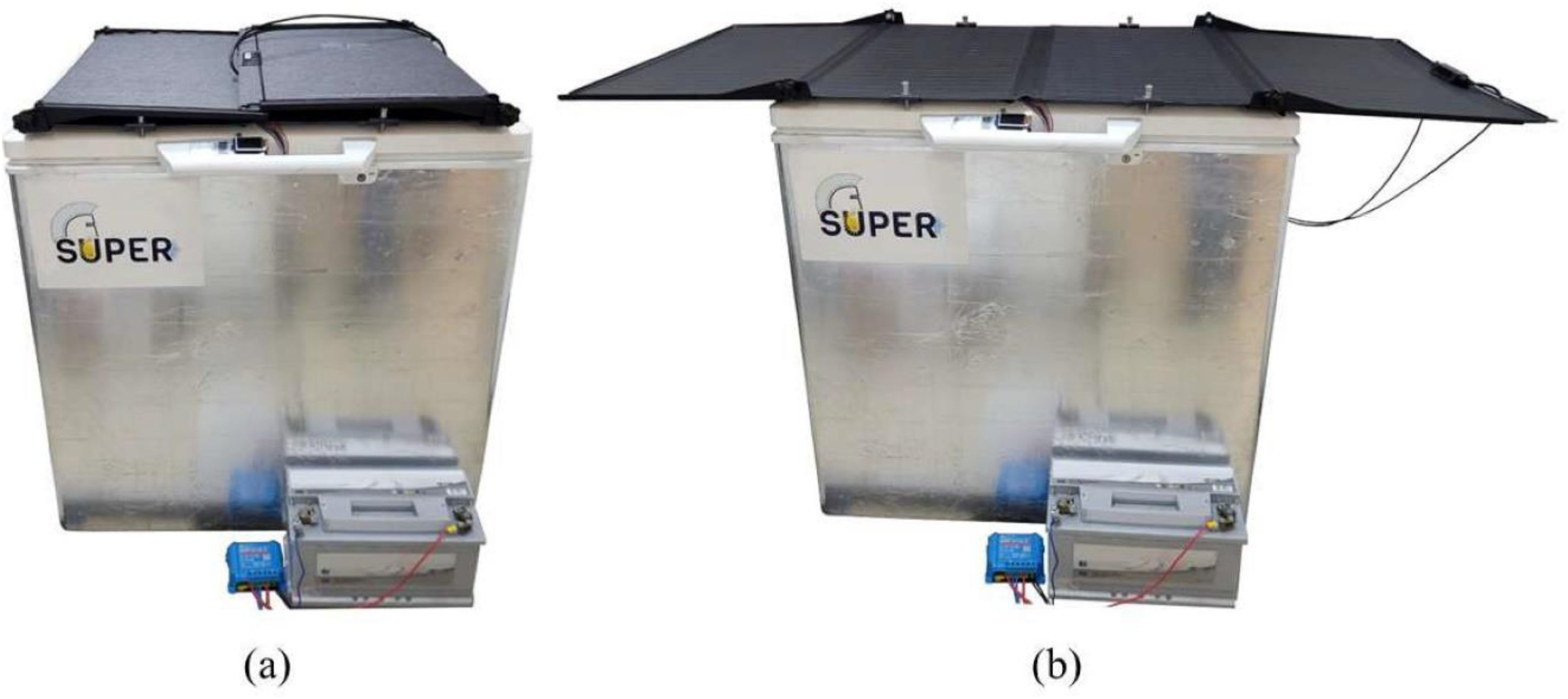
Solar-powered vapour compression refrigerator prototype showing (a) closed configuration with folded solar panel lid and (b) open configuration with deployed solar panel for maximum solar energy collection (Maiorino et al., 2025) (Published under open access with permission from Elsevier).
Slurry systems in this cluster permit enhanced heat transfer characteristics and improved pump ability for large-scale cold thermal storage applications where conventional solid PCMs face transport limitations. The improved heat transfer properties of slurry systems facilitate more efficient thermal energy exchange, thereby maintaining the fundamental energy storage benefits of PCMs. Integrating slurry systems with conventional refrigeration equipment enables scalable implementations suitable for industrial and commercial applications that require substantial cooling capacities. Solar cooling is a sustainable solution that integrates renewable energy sources with thermal storage capabilities. For instance, the work of Jarimi et al. (2024) developed solar PV-assisted DC vapour compression systems with low-cost ice gel thermal batteries for off-grid building cooling applications, as shown in Figure 12. The solar panels power a DC compressor that circulates refrigerant through the cycle, where it absorbs heat at the evaporator (T6–T7), gets compressed and heated (T1–T2), and then releases heat through the condenser (T3–T4). The ice gel thermal battery stores excess cooling capacity during peak solar generation, maintaining consistent operation when solar input is insufficient. The expansion valve controls refrigerant flow between the high and low-pressure sides. At the same time, the fan coil unit distributes conditioned air throughout the building (T8–T10), providing sustainable cooling without grid dependency through the integration of TES. The system achieved at least 50% better performance than grid-reliant systems, with lower levelised cooling costs of $0.06/ kWh. J. Yao et al. (2020) analysed solar-assisted heat pump systems coupled with built-in PCM heat storage based on PV/T panels for stable residential heating in high-latitude regions. The system achieved heating COP up to 5.79, representing 70% improvements over conventional air conditioning systems while delivering electrical, thermal, and overall efficiencies of 17.77%, 55.76%, and 75.49%, respectively. The system maintained underfloor heating temperatures between 22°C and 31°C after 39 h of operation.
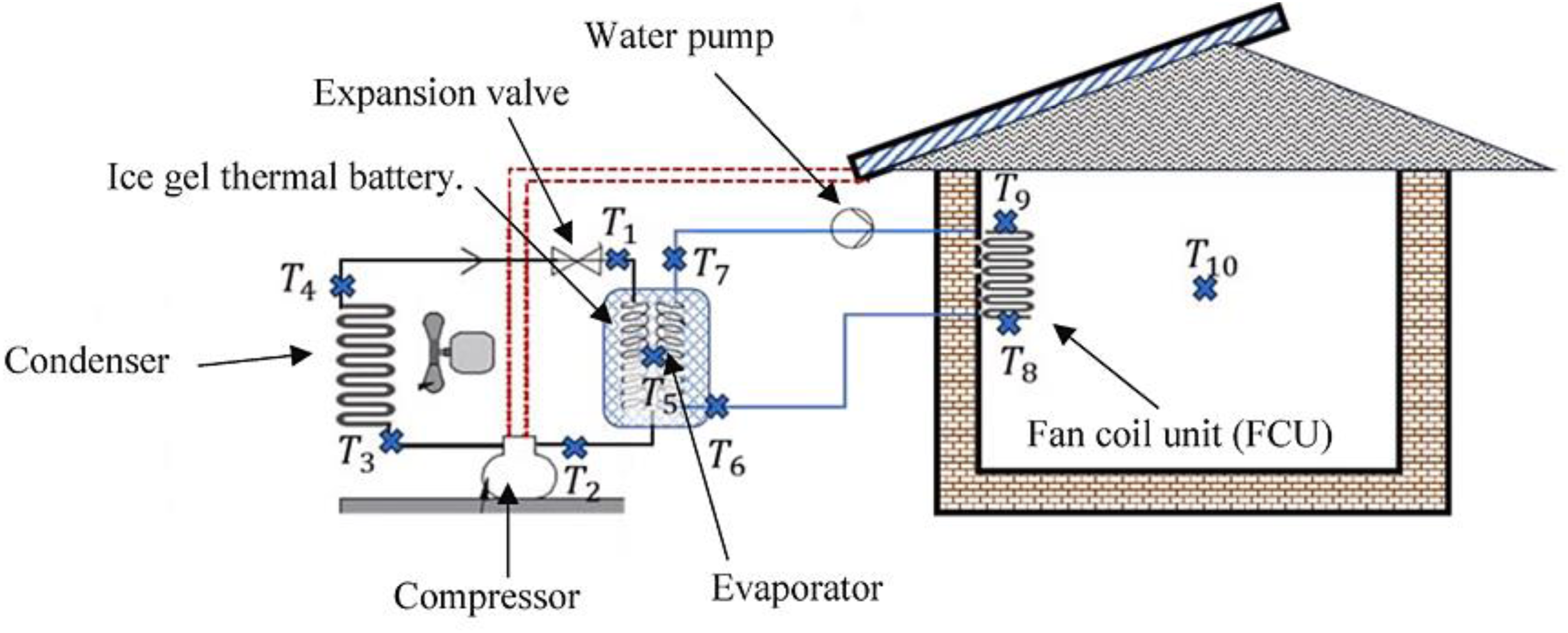
(a) Layout of solar PV cooling system (Jarimi et al., 2024) (Reproduced with permission from Elsevier, License number: 6042120973508).
The storage systems in this cluster underscore the fundamental role of PCM technology in temporal energy management, where cooling demands fluctuate throughout operational cycles. Rahimpour et al. (2022) evaluated PCMs in building insulation to improve the self-consumption of residential rooftop solar systems in Australian conditions. The findings indicate that PCM integration reduced annual electricity costs by 10.6% in Brisbane to 19% in Adelaide and unexpectedly led to slight decreases in solar PV self-consumption, ranging from 1.5% in Brisbane to 2.7% in Perth. Mandal and Saxena (2023) assessed latent energy storage systems for thermal management applications in hot and dry climatic conditions, finding that incorporating PCMs in building elements reduced heat transfer by up to 50% and increased energy storage capacity by 22%. The research discovered that using PCMs in solar PV panels passively improved efficiency by 0.5–3% without requiring auxiliary power input.
Building-integrated TES and thermal comfort enhancement
Cluster 10 comprises terms such as buildings, cold TES, metal foams, numerical simulations, PCMs, and thermal comfort. This cluster focuses on building-integrated cold storage systems and advanced heat transfer enhancement technologies that optimise architectural thermal management applications. For example, Yeşilata et al. (2025) investigated the integration of capric acid-based PCMs into 3D-printed polylactic acid plates with varying geometries of cavities to enhance TES and improve building energy efficiency through passive thermal regulation. The results indicate that spherical cavity geometries yielded improved thermal performance, reducing heat loss by 5.35% to 11.03%, enhancing heat retention by 2.69% to 4.77%, and sustaining stable phase-change temperature windows of 29.7°C to 30.3°C. Philip et al. (2020) explored novel eutectic PCMs composed of lauryl alcohol and stearyl alcohol for cold TES applications to enhance thermal comfort in buildings. The developed eutectic PCM exhibited a melting point of 22.93°C and a latent heat of fusion of 205.79 J/g, demonstrating favourable thermophysical properties, thermal stability, and cycling reliability for indoor temperature regulation applications. In the work of Abhijith and Sreekumar (2023), the authors developed a binary eutectic of palmitic acid and lauryl alcohol for latent heat TES, aiming to enhance indoor thermal comfort in buildings. It was observed that the eutectic PCM achieved phase transition temperatures of 20.25°C with a latent heat of 155.59 J/g, exhibiting favourable thermophysical properties and corrosion resistance suitable for integration with conventional cooling systems.
Sun et al. (2020) explored double-layer radiant floor systems incorporating two different inorganic PCM layers with distinct melting points to regulate indoor thermal comfort effectively across seasonal variations. The double-layer radiant floor system extended thermal comfort duration, achieving 2.2 times longer comfort in winter and 1.7 times longer in summer compared to reference rooms. The system enhanced energy savings by reducing active system operation time, thereby enabling peak load shifting and economic cost reductions through optimised thermal conductivity of PCM composites. M. J. Huang et al. (2025b) developed sustainable radiant floor heating systems integrating composite PCMs enhanced with expanded graphite powered by air source heat pumps to reduce power consumption and improve thermal comfort. The PCM-expanded graphite system enhanced heat retention capacity by 37% compared to systems using metal mesh, while maintaining 0.7°C higher floor surface temperatures when combined with copper powder. The integration of PCMs in building applications leverages their inherent ability to absorb and release substantial quantities of thermal energy during phase transitions while maintaining relatively constant temperatures. X. Gao et al. (2018) proposed coupled cooling systems that combine phase-change chairs (PCC) and phase-change plates (PCP) to enhance temperature control and thermal comfort in isolated, high-temperature environments. Their combined PCC and PCP cooling system outperformed individual PCP systems, reducing room temperature by 1.4°C within the first 50 h and decreasing the occupied system volume by 31.4%, thereby demonstrating enhanced thermal comfort and space efficiency.
Key insights from the 20 most highly cited publications
Table 1 displays the top 20 most highly cited publications on PCM for cold storage research. It is worth noting that the most cited papers were selected for qualitative review as they represent the most influential and foundational research contributions in PCM cold storage
Top 20 most cited research papers on PCM for cold energy storage applications via Scopus database.
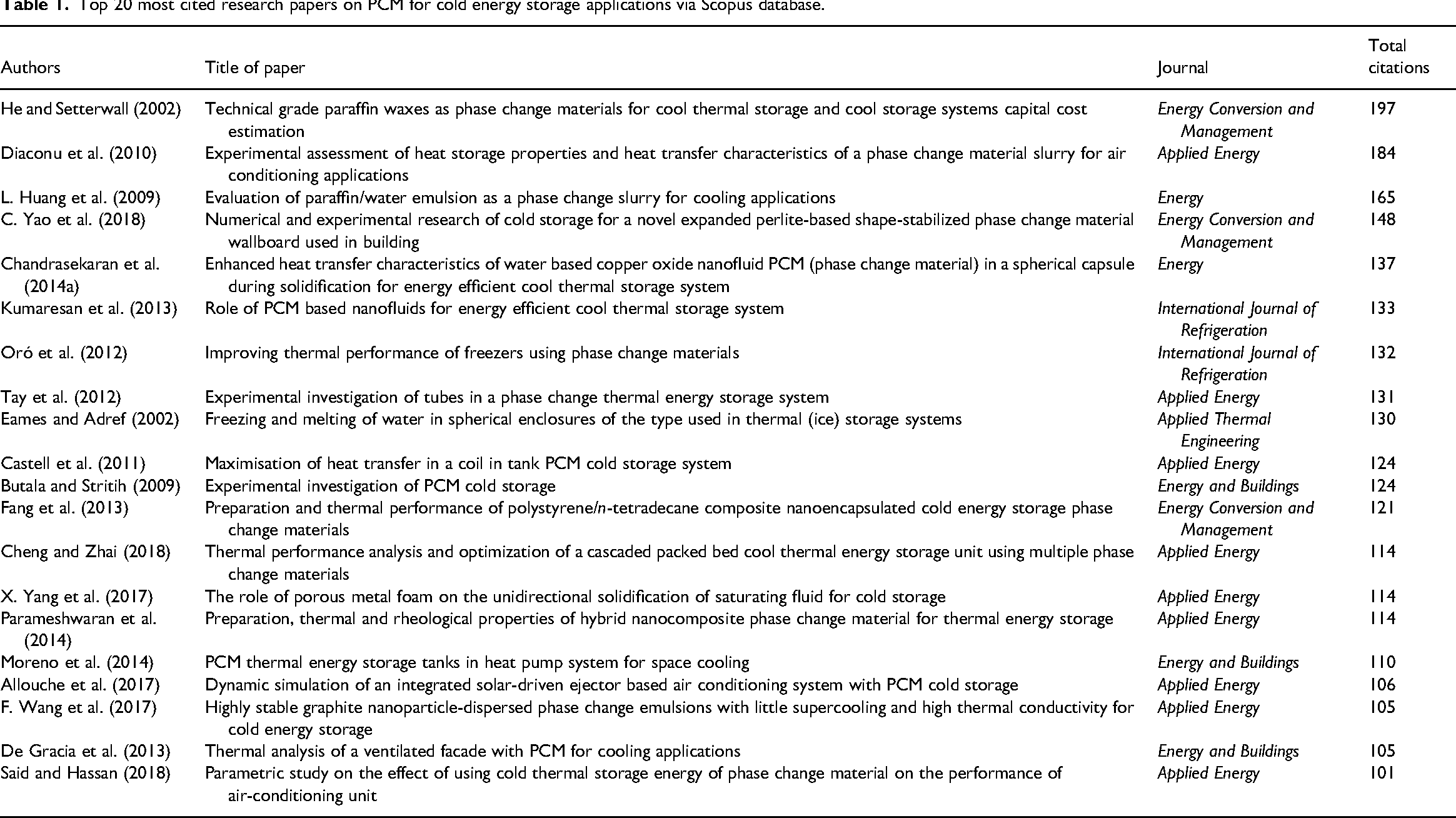
Building upon paraffin-based investigations, Diaconu et al. (2010), published in Applied Energy with 184 citations, advanced the field through experimental assessment of micro-encapsulated PCM slurries. The researchers concentrated on high-concentration (45% w/w) micro-encapsulated Rubitherm RT6 slurry for solar air conditioning applications. The findings revealed that the micro-encapsulated PCM exhibited a narrow phase change interval of approximately 3°C, accompanied by notable hysteresis in its enthalpy behaviour. In addition, the results showed enhanced heat transfer coefficients compared to water within the phase change temperature range, confirming higher thermal performance for cold storage applications and demonstrating the viability of slurry-based PCM systems. L. Huang et al. (2009), whose work was published in Energy with 165 citations, explored paraffin/water emulsions as phase change slurries for comfort cooling applications within a 0–20°C temperature range. The study evaluation suggests that paraffin/water emulsions with 30–50 wt.% paraffin concentration yielded favourable properties for cold storage and distribution systems. The authors revealed that these emulsions demonstrated high energy density due to their combined sensible and latent heat capacities. They maintained stability under storage conditions and mechanical-thermal stresses, establishing their prospect as TES media for cooling systems. C. Yao et al. (2018) published a study in Energy Conversion and Management that contributed to the development of building-integrated PCM applications by creating expanded perlite-based shape-stabilised PCM wallboards. The authors’ innovative approach utilised paraffin and expanded perlite to create wallboards, melting at 27.60°C and freezing at 23.56°C, achieving a latent heat of approximately 67 J/g. The authors observed a maximum indoor temperature reduction of 2.53 K in container tests. Numerical simulations indicated an average temperature reduction of 9.22 K during daytime building operation over the summer, demonstrating the practical potential for building thermal management.
In the work of Chandrasekaran et al. (2014a), the authors investigated the solidification characteristics of a water-based copper oxide nanofluid in spherical capsules. The researchers prepared a nanofluid PCM by dispersing copper oxide nanoparticles with nucleating agents in the base PCM, resulting in a reduction in solidification time of approximately 35% due to enhanced heat transport properties. The results indicate that 50% of the total mass solidified during 25% of the total solidification time in both conventional PCM and nanofluid PCM, and the nucleating agents eliminated subcooling problems, enabling evaporator operation at higher temperatures in chiller systems. The work of Kumaresan et al. (2013), published in the International Journal of Refrigeration, expanded nanofluid PCM research by incorporating multi-wall carbon nanotubes (MWCNTs) into their studies. This study involved dispersing MWCNT at various volume fractions (0.15%, 0.3%, 0.45%, and 0.6%) in de-ionised water as the base PCM, achieving maximum solidification time reductions of 14% and 20.1% at surrounding bath temperatures of −9°C and −12°C, respectively. The results showed that MWCNT presence acted as nucleating agents, causing appreciable subcooling reduction and enabling cool TES system operation at higher secondary refrigerant temperatures, with predicted energy savings of nearly 6–9%.
Similarly, freezer applications received attention from Oró et al. (2012), who investigated the integration of PCM for improving thermal performance during power outages and frequent door openings. The authors incorporated Climsel-18 PCM panels with a melting temperature of −18°C, indicating that internal temperatures remained 4–6°C lower during 3-h power failures, thereby extending the acceptable temperature ranges for frozen products. The authors reported thermal stability improvements under frequent door openings, particularly when cabinet temperatures approached the PCM melting points. In the work of Tay et al. (2012), the authors advanced the understanding of tube-in-tank PCM systems through an experimental investigation of their thermal performance for cold storage applications. Their research utilised salt hydrate PCM with −27°C phase change temperature and water. The results showed the development of characteristic design curves as functions of the average number of transfer units, providing practical tools for designing PCM-based cold storage systems without extensive computational requirements.
Other notable studies include Eames and Adref (2002), who contributed a fundamental understanding of water freezing and melting behaviour in spherical enclosures used in thermal ice storage systems. The experimental characterisation indicates that 90% of the stored cold could be discharged within 70% of the total discharge time. In contrast, semi-empirical equations derived from experimental data permitted the accurate prediction of cold charge and discharge rates for various sphere diameters and HTF temperatures. The authors established an enhanced understanding of water-ice phase change processes in spherical elements, which supports the dynamic modelling and performance optimisation of ice thermal storage systems. In the work of Castell et al. (2011), the authors investigated the maximisation of heat transfer in coil-in-tank PCM cold storage systems through experimental evaluation of different configurations and HTF flow rates. Their findings revealed that heat exchange effectiveness remained constant over time, decreased with higher flow rates, and increased with a greater heat transfer area, depending solely on the area-to-volume ratio.
Butala and Stritih (2009) explored free-cooling principles using night-time cold accumulation in PCMs for building cooling applications, especially during summer. The experimental investigation utilised paraffin with a melting point of 22 °C, effectively storing cold during night-time and releasing it during the daytime for warm air cooling. The study found that cooling efficiency depended on air velocity, inlet temperature, and the proper selection of PCM based on local climatic conditions, emphasising that incomplete PCM melting or solidification resulted in system underperformance. Fang et al. (2013) advanced nanoencapsulated PCM technology through the synthesis of polystyrene/n-tetradecane composites using ultrasonic-assisted mini-emulsion in situ polymerisation. The authors reported that the synthesised nanoencapsulated PCM exhibited a uniform spherical morphology with an average diameter of 132 nm, melting and freezing points of 4.04°C and −3.43°C, respectively, and latent heats of 98.71 J/g and 91.27 J/g. The results showed a high specific heat of 4.822 J/g·K and sustained mechanical stability after freeze-thaw cycling, indicating strong potential for cold TES applications. The study of Cheng and Zhai (2018) proposed cascaded packed bed cool TES units using multiple PCMs to improve solidification heat transfer and overall thermal performance compared to single-stage units. The researchers found that 24-stage cascaded systems with a 6°C phase change temperature difference between the highest and lowest stages achieved optimal thermal performance, reducing charging time by 15.1% while maintaining an equivalent cold storage quantity and quality. In addition, the authors revealed that 3–5 stages provided balanced thermal performance with results approaching optimal 24-stage configurations.
X. Yang et al. (2017) investigated the solidification behaviour of PCMs saturated in highly porous open-cell metal foams through analytical, numerical, and experimental approaches. Their study proved that analytical extensions of Neumann's solution, supported by 3D direct numerical simulations and experimental validation, accurately predicted phase change heat transfer in PCM-foam composites. Additionally, the results indicate macroscopically flat but microscopically irregular phase interfaces, with negligible temperature differences between the PCM and metal ligaments, confirming local thermal equilibrium and the suitability of the one-equation model at low Stefan numbers. Parameshwaran et al. (2014) investigated the thermal properties and viscosity of organic ester PCM embedded with silver-titania hybrid nanocomposites at varying mass proportions for cool TES in buildings. The authors found that surface-functionalised silver-titania hybrid nanocomposites enhanced thermal conductivity from 0.286 W/m·K to 0.538 W/m·K, while maintaining a congruent phase change temperature of 6.8°C and a high latent heat capacity of 90.81 kJ/kg. In addition, the study revealed notable supercooling reduction (1.82°C), good thermal and chemical stability, and reduced freezing and melting times by 23.9% and 8.5% respectively.
In the work of Moreno et al. (2014), the researchers experimentally evaluated the performance of TES tanks using macro-encapsulated salt hydrate PCM at 10°C when coupled with heat pump systems for space cooling, compared to conventional water-based systems. The results indicate that PCM-based systems delivered 14.5% more cooling energy and extended indoor comfort temperature maintenance by 20.65% compared to water tanks, requiring 4.55 times longer charging periods. The findings highlighted the potential of PCM-enhanced systems for improved cooling efficiency and thermal comfort despite longer charging durations. (Allouche et al., 2017) developed dynamic TRNSYS models in their study to evaluate the performance of solar-driven air conditioning systems with integrated PCM cold storage for 140 m3 spaces during summer conditions in Tunisia. The simulation results revealed that relatively small hot storage tanks (700 L) yielded the highest solar fractions, at 92%, while collector areas of 80 m2 achieved 70% solar fractions with minimal gains from area increases. The authors confirmed that PCM cold storage integration improved thermal comfort, reducing indoor temperature exceedance durations from over 26% to just 5% of operational time.
F. Wang et al. (2017) addressed the elimination of supercooling and enhancement of thermal conductivity in phase change emulsions containing 30 wt% OP10E by dispersing graphite nanoparticles. It was found that dispersing 2 wt% graphite nanoparticles eliminated supercooling (reducing from 9.9°C to nearly 0°C) and increased thermal conductivity by 88.9% to 0.578 W/m·K without affecting latent heat. The results also showed that optimised emulsions remained stable, with a low viscosity (<11.5 mPa·s), good dispersion, and thermal reliability, after 30 days of storage and 300 thermal cycles. In their study, De Gracia et al. (2013) experimentally evaluated the thermal performance of a ventilated facade with macro-encapsulated PCM integrated into air cavities, aiming to reduce summer cooling loads in Continental Mediterranean climates. The results indicate a potential for reducing cooling demand, primarily through night-free cooling modes that inject air below the indoor setpoint temperature, thereby reducing cooling loads by up to 42.8 MJ/day. The study further revealed that effective operation required full PCM solidification overnight, improved outer skin thermal resistance, and programmable control systems. In the work of Said and Hassan (2018), the authors investigated the enhancement of conventional air-conditioning unit performance through the integration of PCM plates with condensers, utilising night-time cold storage to improve daytime cooling efficiency via theoretical modelling and experimental validation. The study achieved maximum COP increases of 14% at a 35°C inlet air temperature and a velocity of 0.96 m/s. Thinner and longer PCM plate configurations, however, resulted in shorter charging and discharging times. The results showed maximum cooling power per kg of PCM reached 67 W, with power savings per ton of refrigeration per kg PCM achieving 11.6%, 6.7%, and 5.4% at inlet air temperatures of 45°C, 40°C, and 35°C respectively for 0.96 m/s air velocity.
Thematic mapping of keywords
Figure 13 illustrates the thematic mapping of keywords. The thematic mapping is grouped into four quadrants, each representing different stages of thematic development and centrality within the research domain. The size of the circles in this figure corresponds to the frequency of research associated with each theme. Larger circles indicate themes that have attracted substantial research attention, measured by keyword occurrence. The motor themes quadrant (upper right), characterised by high centrality and high development degree, indicates the most mature and well-established research areas driving the entire field. Several key themes emerge within this quadrant as central pillars of cold energy storage research. The presence of ‘slurry’, ‘cold thermal storage’, ‘charging’, ‘adhesion’, and ‘cold storage system’ indicates that these represent core technological concepts that have achieved research maturity and sustained strong connections to other research areas. The positioning of ‘numerical simulation’ and ‘metal foam’ in this quadrant suggests that computational modelling approaches and advanced material structures have become fundamental tools for advancing cold energy storage technologies. These motor themes suggest areas where significant research investment has occurred and practical applications are being successfully developed and implemented.
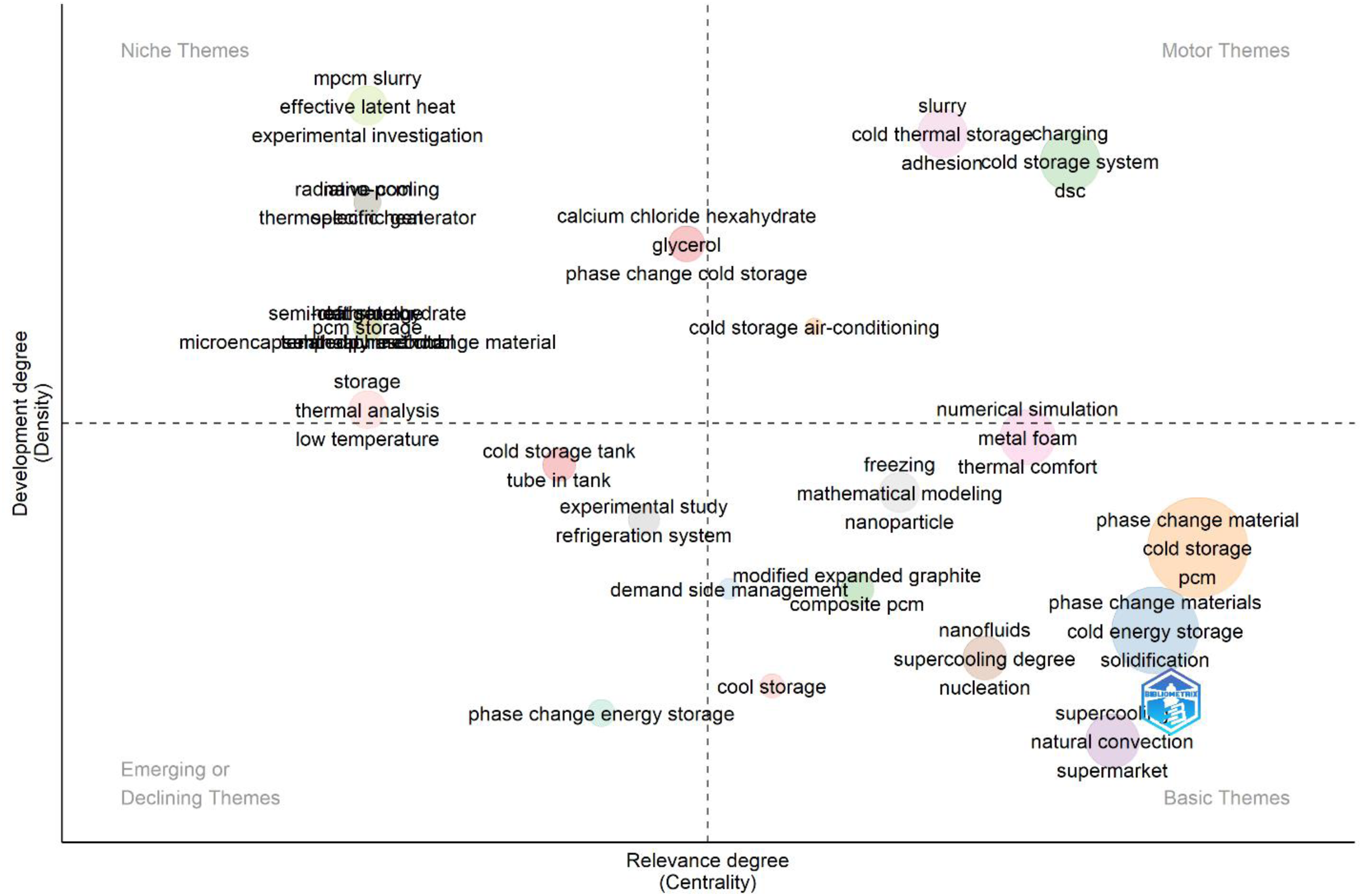
Thematic mapping of author keywords.
Likewise, the basic themes quadrant (lower right), displaying high centrality but a lower degree of development, comprises fundamental research areas that form the foundation of the field but may not yet have reached full maturity. The clustering of terms such as ‘supercooling’, ‘natural convection’, ‘supermarket’, ‘nucleation’, ‘solidification’, and ‘cold energy storage’ within this quadrant suggests that these represent core concepts widely recognised and studied across the research community. The presence of ‘phase change materials’ and ‘nanofluids’ in this region suggests that while these are central to the field's identity, substantial room remains for further development and exploration.
Similarly, the niche themes quadrant (upper left), characterised by low centrality but high development degree, contains specialised research areas with significant depth within narrow domains. The presence of terms such as ‘mpcm slurry’, ‘effective latent heat’, ‘experimental investigation’, ‘radiative cooling’, ‘thermoplastic generator’, and various storage-related terms suggests highly specialised research directions that may serve specific applications or represent emerging technological approaches. These themes indicate areas where researchers have developed expertise and methodologies, even though these topics may not yet have broad connectivity across the entire research domain. The specialised nature of these themes suggests they may represent promising avenues for future expansion or precise solutions to particular technical challenges.
Furthermore, the emerging or declining themes quadrant (lower left) represents the most intriguing aspects of the thematic domain, as it contains research areas with low centrality and low development levels. The positioning of ‘phase change energy storage’ and ‘cool storage’ in this quadrant suggests that these are mature areas experiencing reduced research interest. Compared to others, the sparse population of this quadrant suggests that the field of cold energy storage research is generally characterised by active development rather than decline, with most research themes exhibiting either strong centrality, high development, or both.
The thematic mapping has several implications. For example, the representation in the motor themes quadrant suggests that the field has achieved substantial maturity in core areas, indicating readiness for practical implementation and commercialisation. The robust basic themes quadrant suggests a solid foundation for continued research expansion, while the diverse niche themes suggest specialisation and innovation at the research frontier. The relatively sparse emerging/declining quadrant indicates that the field maintains vitality without significant areas of research abandonment, suggesting continued growth potential and research sustainability. This analysis provides key guidance for researchers, funding agencies, and technology developers in identifying areas of established strength, emerging opportunities, and potential gaps in the research domain of PCMs for cold energy storage applications.
Study period keywords thematic evolution
The thematic evolution in Figure 14 illustrates the dynamic progression of research keywords across three periods: 1994–2010, 2011–2020, and 2021–2024. The figure employs Sankey-style flow connections between time periods, with bar widths representing the relative frequency of each keyword within their respective timeframes and the connecting lines demonstrating the conceptual continuity and transformation of research themes over time. It can be observed that during the foundational period (1994–2010), the research domain was characterised by fundamental concepts, with ‘slurry’ and ‘refrigeration’ emerging as dominant themes, indicating an early focus on basic applications and traditional cooling systems. The presence of keywords such as ‘heat storage’, ‘phase change material’, ‘cold storage’, ‘supercooling’, and ‘phase change materials’ suggests that researchers were establishing core theoretical frameworks and exploring primary applications in TES systems. The relatively limited keyword diversity during this period suggests that the field was in its early stages of growth, where researchers were primarily concerned with understanding fundamental mechanisms and basic applications.
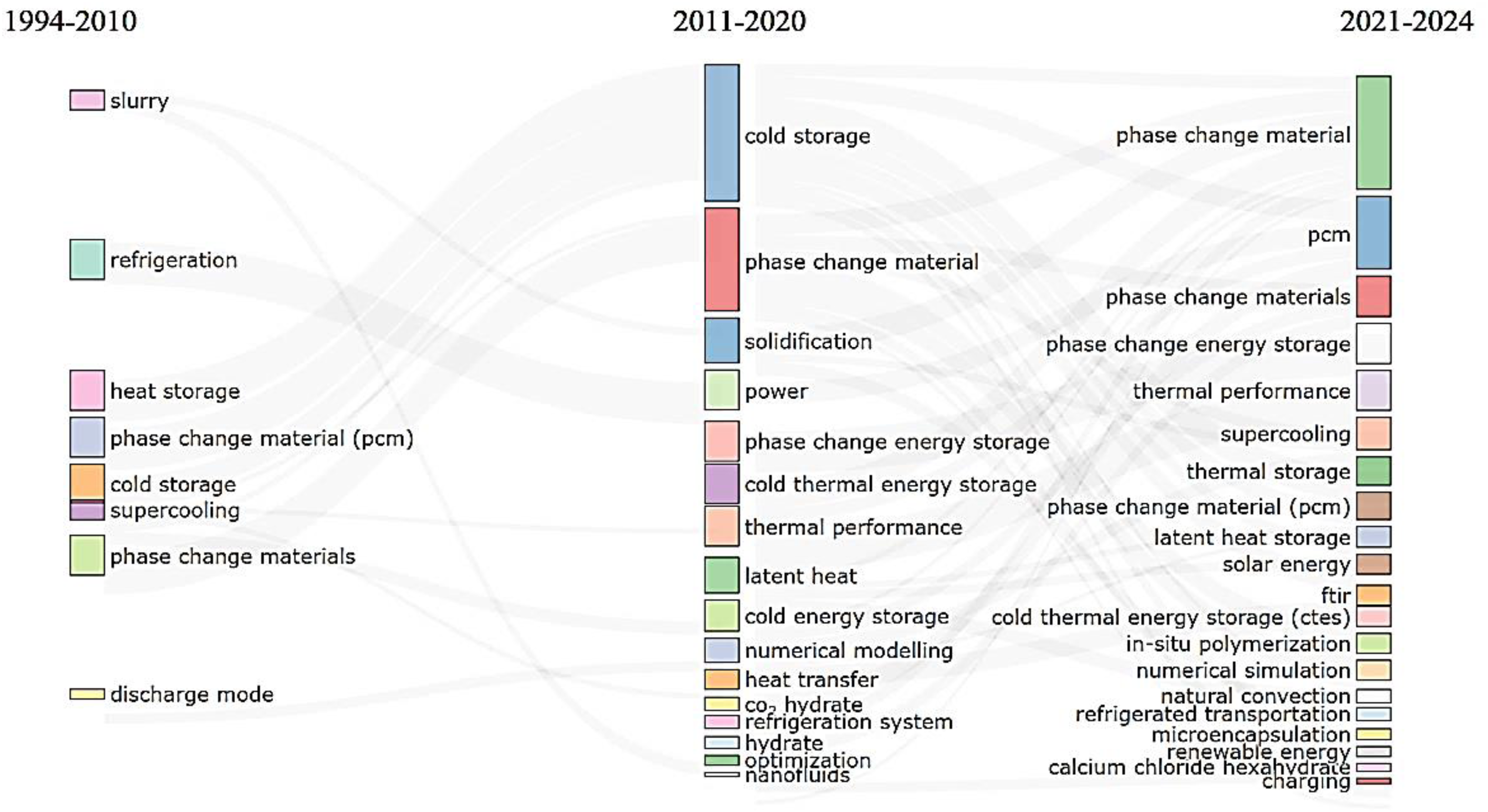
Thematic evolution analysis keywords.
The intermediate period (2011–2020) reveals significant expansion and diversification of research themes, evidenced by the increase in keyword variety and complexity. The emergence of ‘cold storage’, ‘phase change material’, ‘solidification’, ‘power’, ‘phase change energy storage’, ‘cold thermal energy storage’, ‘thermal performance’, ‘latent heat’, ‘cold energy storage’, ‘numerical modelling’, ‘heat transfer’, ‘CO2 hydrate’, ‘refrigeration system’, ‘hydrate’, ‘adsorption’, and ‘aqueous’ indicates a growth of the research domain with increased focus on practical applications, system integration, and advanced modelling techniques. This period exhibits a clear evolution from the basic concepts of the previous era, with connecting lines indicating how foundational themes, such as ‘refrigeration’ and ‘phase change materials’, evolved into more specialised applications and technical considerations.
The most recent period (2021–2024) reveals further specialisation and technological advancement, with keywords such as ‘phase change material’, ‘PCM’, ‘phase change materials’, ‘phase change energy storage’, ‘thermal performance’, ‘supercooling’, ‘thermal storage’, ‘latent heat storage’, ‘solar energy’, ‘cold thermal energy storage’, ‘in-situ polymerisation’, ‘numerical simulation’, ‘natural convection’, ‘refrigerated transportation’, ‘micro-encapsulation’, ‘renewable energy’, ‘calcium chloride hexahydrate’, and ‘charging’ dominating the research domain. The appearance of terms like ‘solar energy’ and ‘renewable energy’ indicates a shift toward sustainable energy applications. In contrast, technical terms such as ‘micro-encapsulation’ and ‘in-situ polymerisation’ suggest advancement in material engineering and fabrication techniques.
Factorial analysis of keywords
Figure 15 presents the factorial analysis of keywords via multiple correspondence analysis. The analysis reveals distinct thematic clusters, represented by different coloured regions, each corresponding to a specific research domain.
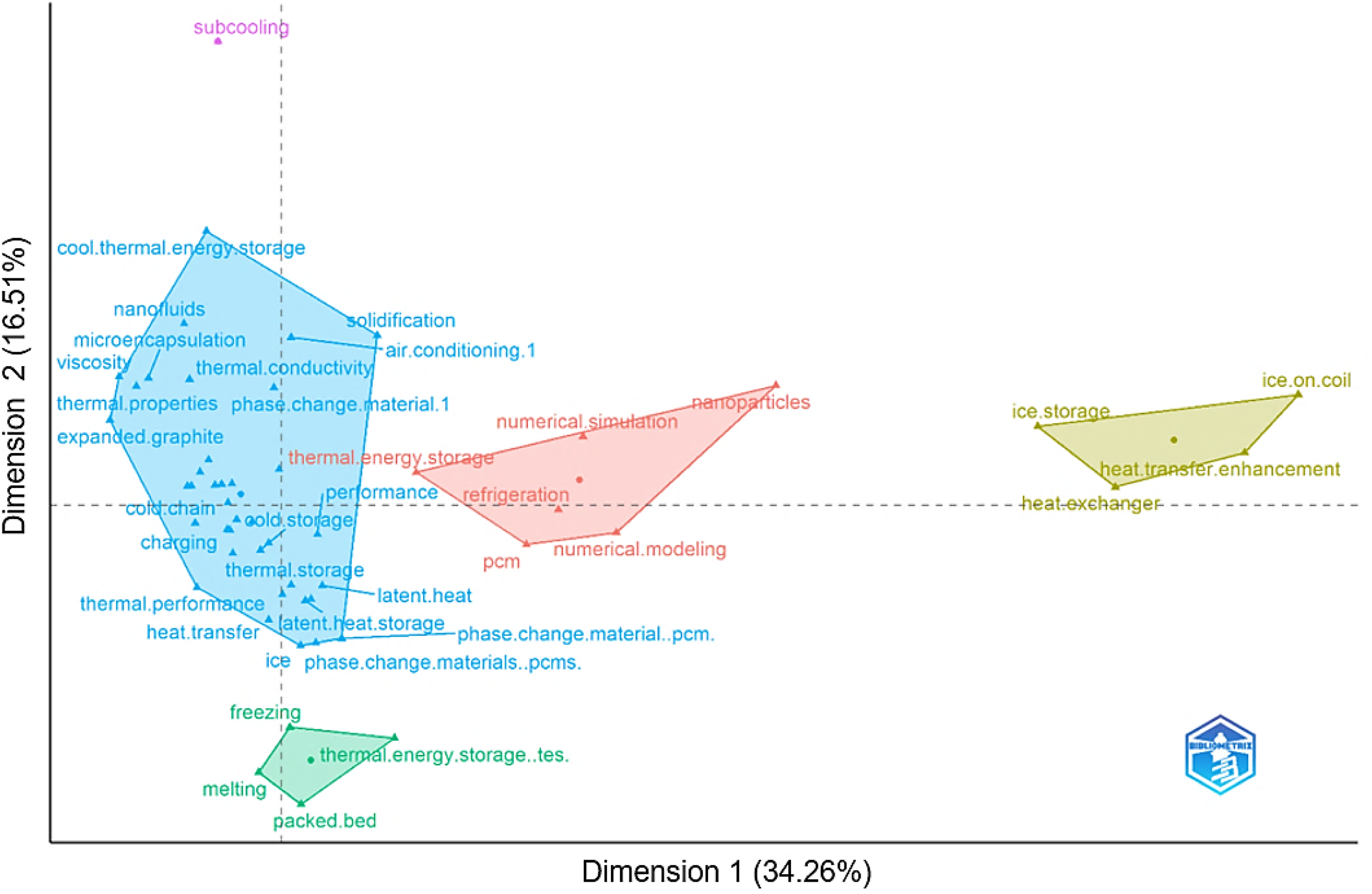
Factorial analysis of author keywords.
The blue cluster, positioned in the left portion of the figure, comprises fundamental thermal properties and material characterisation aspects. This region includes keywords such as ‘thermal conductivity’, ‘thermal properties’, ‘nanofluids’, ‘micro-encapsulation’, and ‘viscosity’, indicating a focus on the intrinsic characteristics of PCMs and enhancement strategies at the material level. The presence of terms like ‘expanded graphite’ and ‘cold storage’ within this cluster suggests that researchers investigating fundamental properties are simultaneously concerned with practical cold storage applications, highlighting the translational nature of this research domain.
Likewise, the red cluster occupies the central-right region and represents computational and modelling approaches to PCM research. Keywords such as ‘numerical simulation’, ‘numerical modelling’, and ‘PCM’ dominate this area, indicating the role of computational fluid dynamics and heat transfer modelling in understanding PCM behaviour. The positioning of ‘refrigeration’ and ‘nanoparticles’ within this cluster suggests that numerical methods are vital for optimising refrigeration systems and understanding the complex behaviour of nano-enhanced PCMs.
Similarly, the yellow cluster in the upper right quadrant focuses on practical applications and system integration, with terms including ‘ice storage’, ‘heat exchanger’, and ‘heat transfer enhancement’. This positioning suggests that applied research in PCM-based cold energy storage systems represents a distinct research trajectory that builds upon, yet is separate from, fundamental material studies. The presence of ‘ice on coil’ technology within this cluster indicates the practical deployment of PCM concepts in cooling systems. The isolated positioning of ‘subcooling’ in the upper region suggests this phenomenon represents a specialised area of investigation that intersects with but remains distinct from the main research clusters. Subcooling effects are crucial in PCM applications, as they can significantly impact the efficiency and reliability of TES systems.
Furthermore, the lower green cluster, containing terms like ‘thermal energy storage’, ‘freezing’, ‘melting’, and ‘packed bed’, indicates the core phase change phenomena and storage system configurations. Positioning these fundamental concepts in a distinct cluster emphasises their central importance and shows their connection to material properties and practical applications. This factorial analysis has revealed that PCM research for cold energy storage is characterised by a multi-dimensional approach that integrates materials science, thermal engineering, and computational modelling. The separation of clusters indicates that while these research areas are interconnected, they maintain distinct methodological and conceptual identities. The implications suggest that future research breakthroughs will likely emerge from interdisciplinary approaches that bridge these clusters, particularly in areas where computational modelling can inform material design and a fundamental understanding of thermal properties can enhance the practical performance of systems. The positioning of numerical methods as a central bridge between fundamental properties and applications highlights the critical role of computational tools in advancing this field toward more efficient and reliable cold energy storage solutions. To consolidate the bibliometric findings and clearly link them to the study's research questions, Table 2 summarises the core research questions, key findings derived from the analysis, and the major knowledge gaps identified in the literature.
Linkage of research questions, key findings, and identified gaps.
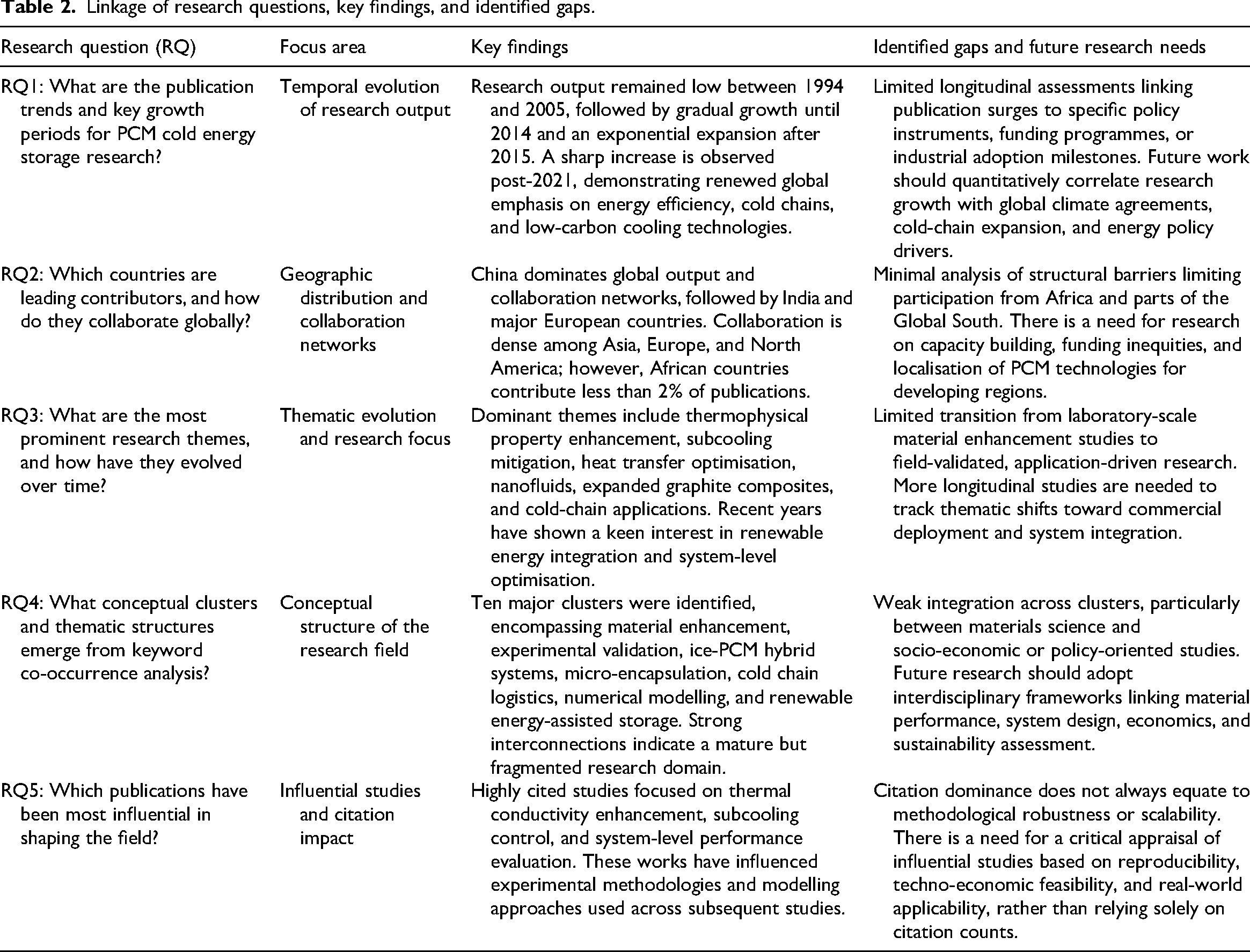
Conclusions and potential areas identified for future research
This review systematically analysed global research trends and advancements in PCMs for cold energy storage applications from 1994 to 2024. The analysis covered 769 documents extracted from the Scopus database, and Bibliometrix (in R Studio) and VOSviewer were utilised for performance evaluation and science mapping. The findings provide a comprehensive understanding of the research development, influential contributors, research hotspots, and knowledge gaps in the field. The results revealed that research in PCM-based cold energy storage has experienced significant growth over the past three decades. The research domain is geographically dominated by a few countries, primarily China and India, which contribute over 50% of the total publications. In contrast, African countries account for less than 2% of the global market, despite the region's acute need for cold storage solutions to address post-harvest losses, inadequate cold chain infrastructure, and high rates of food spoilage. This highlights a critical regional research capacity and investment gap, especially in resource-constrained and climate-vulnerable settings.
The keyword co-occurrence and clustering analyses identified several core research themes. These include thermal conductivity enhancement using nanomaterials, mitigation of subcooling effects, micro-encapsulation techniques, performance evaluation of PCM-integrated systems, and applications in cold chain logistics, air conditioning, and solar-assisted cooling. Expanded graphite, nanoparticles, and phase change slurries are salient in addressing the intrinsic limitations of PCMs, such as low thermal conductivity and leakage during phase transition. Moreover, the application-oriented clusters emphasise the keen interest in integrating PCMs with renewable energy systems and optimising system configurations through numerical modelling and experimental validation. The review also found a focus on hybrid systems, which combine PCMs with ice storage or solar PV systems, to enhance energy efficiency, reduce environmental impacts, and expand the application scope.
Despite notable advances, several challenges persist. These include (i) the lack of standardised testing methods for PCM thermal properties and long-term stability, (ii) limited field-scale implementation studies, (iii) high costs of advanced PCM formulations, and (iv) insufficient exploration of bio-based and low-cost alternatives. Furthermore, the complexity of integrating PCM into diverse cooling applications necessitates further investigation into system-level optimisation, economic feasibility, and policy frameworks to accelerate deployment.
To bridge these gaps and guide future research, the following directions are proposed: (1) Future research should focus on identifying and developing PCMs using locally available, environmentally friendly materials, especially for regions such as Africa and South Asia, where cost and availability are key barriers to adoption; (2) establishing universally accepted methods for measuring thermal properties, cycling stability, and performance under realistic operational conditions will ensure data consistency, allow better material comparison, and facilitate industrial-scale adoption; (3) greater emphasis should be placed on optimising the coupling of PCMs with solar PV, thermal collectors, and other intermittent renewable energy sources to enhance reliability and extend off-grid cold storage solutions; (4) more robust numerical models and pilot-scale demonstrations are needed to evaluate performance under dynamic operating conditions, support techno-economic assessments, and guide commercial design and deployment strategies; (4) research should target underserved sectors such as decentralised agricultural storage, last-mile vaccine delivery, and passive building cooling in hot climates, where PCMs can have a substantial social and economic impact and (5) policies and funding mechanisms should encourage joint research initiatives between developed and developing countries to promote knowledge transfer, skill development, and local innovation tailored to regional needs.
Footnotes

Funding
The authors received no financial support for the research, authorship, and/or publication of this article.
Declaration of conflicting interests
The authors declared no potential conflicts of interest with respect to the research, authorship, and/or publication of this article.
Data availability statement
Data will be made available on request from the authors.