



Abstract
Using qualitative methods, this study analysed the process of training needs assessment in the Botswana public service, with special focus on five state sector ministries. It is evident from the research findings that there is little and an unsystematic approach to the needs assessment prior to training. The research further revealed that the seniority principle is a major determination of training needs in the public service which seemingly gives little regard to the manpower training needs. The study has also revealed that public service training is not strategic. Thus, public service training is not directed towards the realization of the public service strategic goals, mission, vision and development plans. This inadvertently compromises the relevance of training and fails to inculcate and nurture those skills that could help enhance performance and productivity. In an attempt to solve the problems identified in public service training needs assessment, the study recommends that a thorough needs assessment should be conducted at organizational, task and individual levels. The seniority principle does not justify training needs and need to be done away with. Finally, the combined use of different needs assessment methods and data sources is crucial to ensure proper needs identification.
Introduction
This study sought to analyse the process of training needs assessment (TNA) in the Botswana public service. TNA is the process of determining if a training need exists and if it does, what training is required to fill the gap (Cole, 2004). For example, a training need exists when there is a gap between what is required of a person to perform their work competently and what they actual know. The primary purpose of TNA is to identify performance gaps and considers if the problem can be solved by training. That is, needs assessment helps determine when training is the answer and when it is not the answer to performance problems. Five state sector ministries have been selected for the study. These include Ministry of Local Government, Ministry of Labour and Home Affairs, Ministry of Health, Ministry of Education and the Ministry of Finance and Development Planning (MFDP). Data was also collected from the Directorate of Public Service Management (DPSM) and the Public Sector Training Advisory Committee (PSTAC) because of their strategic importance in this study. It is worth noting that Botswana is a unitary state, hence some policies are standard across all public service organizations, and the manner in which public organizations execute those policies is similar, although there are exceptions. For instance Botswana public sector organizations use the DPSM training and development policy as their framework for training and developing their employees. The standardization of policies has provided a reason for choosing only five ministries. The process of TNA in selected ministries will provide a general picture of the manner in which other ministries in the public service conduct needs assessment.
Background
The public service in Botswana is the principal actor in macro socio-economic policy making infrastructure and an architect of an enabling environment for national development. The public service in Botswana consists of civil servants, all disciplined forces, local authority staff, judiciary, ombudsman, teaching service management and parliamentary staff. The Botswana public service vision reads ‘We, the Botswana Public Service, will provide a world class service that is efficient, effective, caring and responsive to local and global challenges’, and the mission statement reads:
The Botswana Public Service exists to provide efficient and cost effective service for its customers and stakeholders through the formulation and management of government policies. The Public Service will implement sustainable performance improvement programmes; provide essential services that are not otherwise accessible to the public; and create a sustainable and conducive environment for quality service delivery. The delivery of services will be provided in a caring, transparent, politically neutral, reliable, responsive, proactive and accountable manner and in partnership with all stakeholders. This Public Service will have a supportive culture that is customer and stakeholder focused; that rewards performance and empowers all. It will be supported and driven by up-to-date Technology. (Directorate of Public Service Management (DPSM), 1999)
In order to achieve its mission, vision and to respond to the challenges of globalization the Botswana Government introduced a number of reform initiatives in the public service. These include performance management system (PMS), work improvement teams (WITS), computerized personnel management system (CPMS), organization and methods (O&M), privatization, performance-based reward system (PBRS), parallel progression, scarce skills, job evaluation, localization and decentralization (Republic of Botswana, 2003: 366). The primary purpose of these new initiatives was to create an enabling environment aimed at strengthening public-sector-wide institutional capacity. Further, the reform initiatives are meant to improve individual and organizational performance in a systematic way, to enable government to improve performance and enhance its capacity to provide efficient service delivery to Batswana. In addition, these new initiatives are essential in driving the public service towards the successful implementation of projects, policies and programmes as outlined in National Development Plans (NDPs) and the Botswana national Vision 2016. Vision 2016 is Botswana’s strategy to propel its socio-economic and political development into a competitive, winning and prosperous nation. In addition to the above reform initiatives, the government has realized that the effectiveness of the public service is, among other things (other things include financial resources, adequate manpower and appropriate technology), dependent on training public servants to equip them with the necessary skills, knowledge and understanding towards the realization of the public service mission, vision and goals. Hence public service training is yet another reform initiative that is critical in enhancing performance in public service delivery.
The Government of Botswana has since developed a Training Management Handbook to provide clear guidelines for planning, implementation, monitoring and evaluation of the public sector training (Directorate of Public Service Management, 1999). The Government of Botswana public sector reform initiative is timely and innovative. It depends upon a thorough culture of change in the public service and therefore, it is incumbent on all public service employees to embrace the vision and play their part in effecting such change.
Purpose of the study
The overall purpose of the study is to analyse the process of TNA in Botswana public service in order to find out whether the public service conduct TNA prior to training.
Theoretical framework
Systematic approach to training (SAT)
This is an orderly, logical step-by-step approach to training that includes needs assessment, design, implementation and evaluation of training (Gibbs, 2002). All phases are typically necessary and critically to the success of this approach.
TNA
TNA is the method of determining if a training need exists and if it does, what training is required to fill the gap (Cole, 2004). A training need exists when there is a gap between what is required of a person to perform their work competently and what they actual know. Thus, the needs assessment serves to identify performance gaps and considers if the problem can be solved by training. Some performance problems can be addressed by training while some performance problems cannot be fixed by training. The needs assessment process typically involves three major levels. That is, organizational analysis, person analysis and task analysis (Noe, 2008; Werner and DeSimone, 2006). The organizational analysis determines where training is needed and in what conditions the training will be conducted. Task analysis determines what must be done to perform the job effectively and the person analysis determines who should be trained and what kind of training do they need. A needs assessment avoids misdiagnosing a non-training problem as a training problem. A TNA done correctly will ensure the solution addresses the real issues and effectively focuses the appropriate resources, time and effort toward targeted solutions.
Designing training activities
It involves designing a training system that learners and trainers can implement to meet the learning goals; typically includes identifying learning objectives, needed facilities, necessary funding, selecting the trainer, developing a lesson plan, selecting programme methods and techniques, course content, lessons and sequence of lessons (Harrison, 2002).
Implementation of training
This is the stage where the training delivery takes place. Training usually takes place both on the job and off the job. Effective training will need the trainer to employ relevant training methods of learning. It can also be formal or informal.
Evaluation of training
Training evaluation refers to the process of collecting the outcomes needed to determine whether training is effective (Harrison, 2000). Effectiveness is measured by how many training participants successfully apply their learning on the job (penetration); how long training participants continue to apply the learning on the job (sustainability); and how quickly the organization will realize the benefits for the entire target audience (speed) (Werner & DeSimone, 2006). Evaluation is usually listed last. However, evaluation is done throughout the SAT process. It is done before, during and after implementation of training.
Methodology used
This is a cross-sectional study that employs both qualitative and quantitative methodology. Targeted institutions and individuals were identified and interviewed once. The data was collected from five state sector ministries: the Ministry of Local Government, Ministry of Labour and Home Affairs, Ministry of Health, Ministry of Education and the MFDP. Data was also collected from the DPSM and the PSTAC because of the strategic importance of the two in this research. The PSTAC plays a significant role in formulating training policy and establishing government-wide training policies. Data was mainly collected from the Department of Ministry Management in each ministry. Three sets of data collection methods were used; in-depth interviews, questionnaires and documentary sources. In-depth interviews and self-administered questionnaires were conducted with the senior management team, which included Permanent Secretaries and their deputies, Directors – Ministry Management, Assistant Directors – Human Resources, Training Coordinators, Performance Improvement Coordinators, Staff Training and Development Officers as well as Administration Officers-Training and Development. Documentary sources such as the DPSM Training Management Handbook, national vision 2016 handbook, the national development plan handbooks and training manuals were examined. Data presented here was collected from 47 respondents, 45 from five state sector ministries (seven respondents from each ministry) and two from the DPSM. The two respondents from DPSM are also members of the Public Service Training Advisory Committee (PSTAC). Using qualitative methods, data collected was then subjected to content analysis of themes and sub-themes with regard to the research objectives. However, the research also used quantitative data analysis methods, though it formed a minor part of the data analysis.
Findings and discussion
This section presents and analyses data on TNA in the Botswana public service. Special focus is on the following areas; TNA in the public service, methods used in needs assessment and the process of TNA in the public service. Key major issues emerging from the findings are discussed.
TNA in the public service
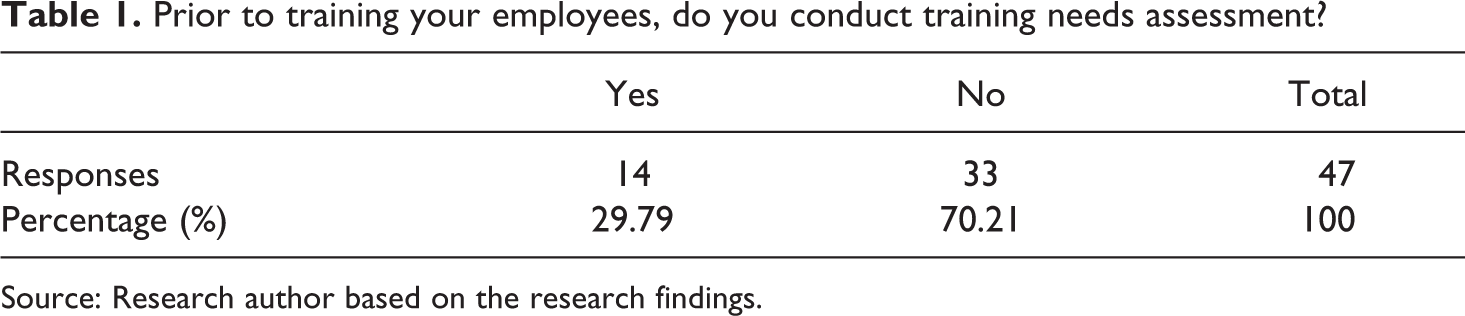
The research findings revealed that most of the government ministries do not conduct TNA prior to training their employees. For example, when asked to explain how they conduct needs assessment, the Training Coordinator in the Ministry of Local Government responded by saying ‘at the moment we do not conduct TNA but efforts are underway to send officers after assessing their needs in the future’. Table 1 and Figure 1 below show the results of the responses. The respondents were asked if TNA is conducted before employees are considered for training. A total of 47 respondents were asked.
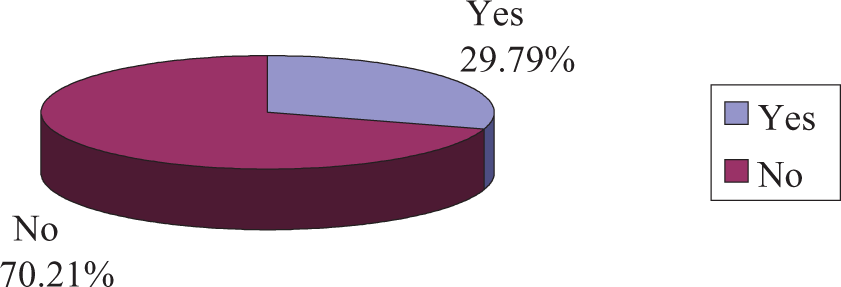
Prior to training your employees, do you conduct training needs assessment?
Prior to training your employees, do you conduct training needs assessment?
Source: Research author based on the research findings.
The results presented in both Figure 1 and Table 1 indicate that there is little or no emphasis on needs assessment in the public service. Figure 1 shows that 70% of the respondents indicated that there is no needs assessment in the public service. From the five ministries visited during data collection, respondents from the MFDP revealed that they conduct needs assessment with the help of performance and development plans (PDPs), the use of localization plans, questionnaires, interviews and observations. The DPSM conduct needs assessment for the whole public service by conducting skills surveys. Respondents from the other four ministries that do not conduct TNA indicated that they rely on the seniority principle to determine employees who are due for training.
PDPs
PDPs are the major instruments used in needs identification in the public service, especially in the ministries that claimed they conduct needs assessment. In particular, this instrument was found to be used by the MFDP as well as the Ministry of Labour and Home Affairs. From these two ministries, the majority of the respondents cited the use of PDPs when conducting needs assessment. PDPs objectively assess the officer’s performance on the agreed objectives for a given year. The accurate assessment provides vital information for management decision making. More specifically, the assessment will influence decisions regarding: the officers performance rating; award of reward; specific training and development needs of the officer to improve performance and productivity; and the suitability of the officer for appointment to permanent service or potential advancement to higher grade.
PDPs indicate individual employee development objectives as well as performance objectives. PDPs also include the assessment for personal attributes, such as time management, knowledge of the work, output (accuracy, reliability and speed), teamwork, customer care and supervisory abilities. The PDPs are generally part of the PBRS and the performance appraisal system in the public sector. Basically, according to the research findings, PDPs are a major instrument that ministries heavily rely on in their efforts to conduct needs assessment. Although PDPs are used to identify individual training needs, they do not indicate the skills, knowledge and abilities required for successfully achieving the performance and development objectives as indicated in the PDPs. This has been found to be the major omission in the PDPs, especially as instruments used in conducting needs assessment. The inclusion of skills, knowledge and abilities required will assist in identifying training needs where performance discrepancies exist. Further, indicating the skills, knowledge and abilities needed for each performance and development objective demonstrates the acknowledgement that not every performance problem can be addressed by training.
Localization plans
Besides the PDPs, the MFDP cited the use of localization plans to identify public sector employee training needs. Training coordinators and heads of departments closely monitor the localization plan to identify what training is needed for staff understudying the expatriate officer. The localization policy stipulates that expatriates are understudied by citizen staff members, occupying ‘shadow’ positions who are expected to assume or localize the expatriate’s position at the end of the expatriate contract. Further, the localization policy states that the presence of expatriate officers in significant numbers, especially in government positions, is a temporary phenomenon and should be perceived in the context of human resource development and training.
The ‘Thomas International’ personal profile analysis
The ‘Thomas International’ personal profile analysis is also used in needs assessment. Personal profile analysis is an assessment tool used for recruitment and selection purposes. Recruitment officers are able to use this tool to compare skills, knowledge and competencies possessed by the candidate with those required for successful job performance and the identified gap will constitute a training need. This is to say, by using the ‘Thomas International’ personal profile analysis, the recruitment officers can determine the training need of an individual at the recruitment and selection level. This tool was found to be used in the Ministry of Labour and Home Affairs.
Public service skills survey
For the general public service training needs, the DPSM sometimes conducts a public service skills survey. The public service skills survey is conducted in the whole country and the surveyors visit each government ministry, considering the job families and putting much emphasis on generic public service skills and job-specific skills. The DPSM conducts the training needs survey to detect where there are performance gaps, and how such gaps can be bridged so as to enable the public service to provide a world class service. The main objective of the survey is to gather preliminary data with a view to developing training needs for the public service. The public service skills survey findings will determine were public officers need to be trained and will also find out where the country is experiencing human resource scarcity. The DPSM also do research to find out the public sector human capital readiness. That is, researching to find out the extent to which government ministries are ready to execute their mandate and strategic plans. The readiness in this sense is determined by the extent to which public service employees possess the necessary skills, knowledge and competencies that can lead to satisfactory performance.
Methods used in needs assessment in the public service
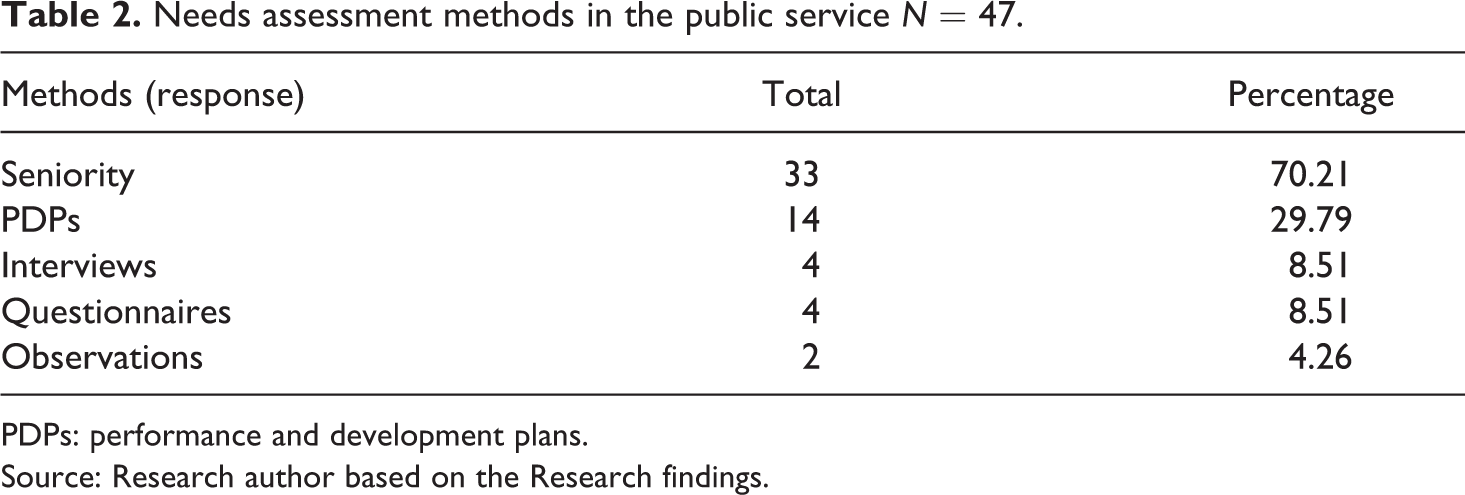
The research findings revealed that the following methods are used in conducting needs assessment in the public service: the seniority principle, observations, interviews questionnaires and the staff performance records. Table 2 and Figure 2 show the results of the needs assessment methods used in the public service.
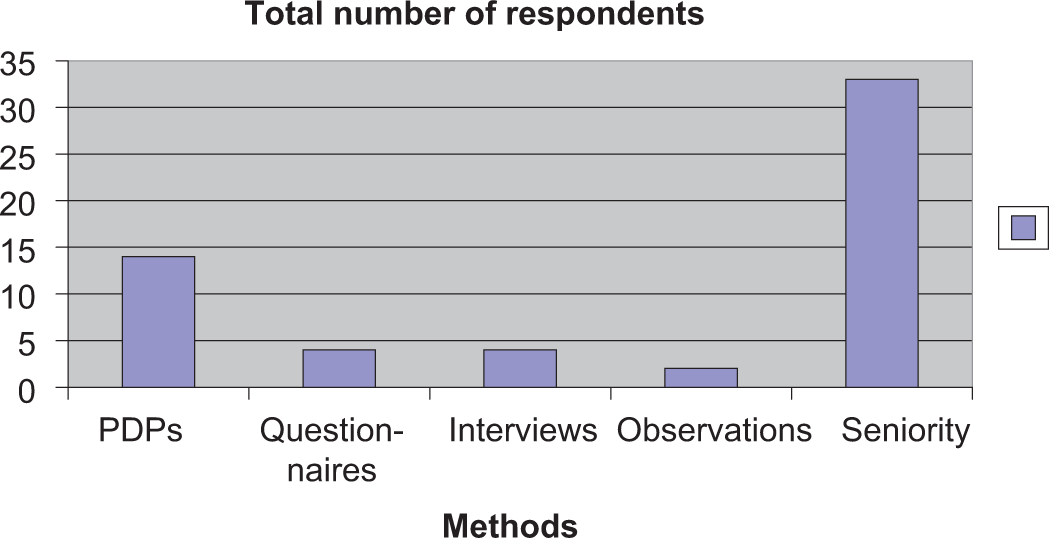
Needs assessment methods in the public service.
Needs assessment methods in the public service N = 47.
PDPs: performance and development plans.
Source: Research author based on the Research findings.
From Figure 2 and Table 2 the results indicate that majority of respondents cited the seniority principle (70.21%) as the method used in needs assessment in the public service. The analysis of the needs identification methods in the public service is as follows.
Seniority
The seniority principle, whereby public officers are trained to satisfy bureaucratic regulations or to motivate employees, has actually taken precedence in the public service training. As mentioned earlier this principle does not involve a thorough needs assessment. Training officers and regional officers provide a list of candidates in different professions. The training coordinators in the ministry management division will then consolidate the list from different ministry departments and using the seniority principle, the coordinators are in a position to select candidates for further training. This method undermines the relevance of training because it does not determine where training is needed. Furthermore, it does not determine the content and scope of training, nor does it determines the desired training outcomes. Second, it is apparent that the needs assessment is carried out haphazardly and lacks clear selection criterion. This inadvertently compromises the relevance of training and fails to inculcate and nurture those skills that could help enhance performance and productivity. This conventional selection criterion of ‘first come’ seemingly gives little regard to the manpower training needs. ‘This method is sometimes used for self-aggrandizement and at times for punitive purposes to deny some employees promotions by “ostracizing” them’, said one of the respondents in the public service. The respondent went on and said ‘such incidences do happen in the public service’, citing an example were two employees were due for promotion and it was decided that one be sent for further training and such training does not guarantee promotion when the candidate comes back.
Questionnaires
Line managers, supervisors and training officers distribute questionnaires to individual officers and ask them to complete the questionnaires. Training officers would then analyse the completed questionnaires to determine where employees need to be trained. The sample questionnaire that was obtained during data collection comprised questions like; what type of skills do you require to perform your job successfully? What type of knowledge do you require to complete your tasks effectively? Which skills do you think should be given priority when addressing your training needs? What training programmes are needed to improve your performance? These questions seem convenient when addressing training needs of individual employees. However, a careful analysis of these questions suggests that the public service believes that every performance gap can be addressed by training. This is because all the above questions seek to find out the skills and knowledge that the employees need to enhance their performance, or to bridge their performance gaps. Further, this is compounded by the fact that the public service heavily relies on performance appraisals to identify employee training needs. It is worth noting that not every performance gap constitutes a training need. Hence a careful diagnosis of factors that leads to poor performance is very important. In addition to the questions above, employees can be asked to outline the major factors and/or constraints that hinder their performance. Answers to this question will assist in determining factors that lead to performance problems.
Interviews
Training officers interview individual officers and their supervisors. The inclusion of the supervisor is to verify the information given by the jobholder. They do also interview other job holders whose jobs are closely related. The interview questions are mainly targeted to find out the skills and competencies that the jobholders possess against those specified for successful execution of their duties. With the help of the interview instrument, training officers are able to identify skills gaps of the interviewees. The data obtained is mainly used by the departmental training coordinators to come up with training plans. The training plans will then be submitted to ministerial training coordinators for consolidation and approval.
Observations
Line managers and supervisors also determine training needs of their subordinates by studying the jobholder actually performing the job. That is, working close to jobholders, observing performance gaps and determining the appropriate training required to bridge them. Respondents argued that it is very easy to identify where employees need to be trained when working closely with them. However, this method is limited in that it is usually only appropriate for relatively simple manual tasks that can be easily observed and it is less suitable for jobs that incorporate a number of interrelated tasks or jobs requiring mental activity.
Staff performance records
The use of staff performance records is widely used in the public service to conduct needs assessment. Line managers, supervisors and training officers use staff performance records to assess performance gaps and recommend specific training for officers to overcome performance deficiencies. Heads of departments also compare profiles of their staff members with the requirements specified in job descriptions and schemes of service to ascertain training necessary for their staff and include this in their departmental training plans.
The process of TNA in the public service
From all the five state sector ministries visited, the research results indicate that only the individual employees are assessed to determine training needs in the public service. There is neither organizational analysis nor task analysis in the public service TNA process. For example, when asked to describe the needs identification process in the public service, the Assistant Director-Human Resources in the MFDP said ‘we are lacking behind here, of the three analyses (organizational, person and task analysis) we only conduct needs assessment at the individual level’. The Assistant Director cited lack of capacity in their human resources to conduct organizational and task analysis as the major problem hindering them to conduct needs assessment at all levels. Another respondent from the Ministry of Local Government (Staff Training and Development Coordinator) said ‘at the moment we do not conduct needs assessment but we are in the process of outsourcing the service to private consultants to conduct the analysis for us’. Respondents from other ministries who included senior and middle management staff also admitted that they lag behind in the needs identification process. These findings have indicated a serious limitation in public service needs assessment. Generally, the results of the study, in particular on the process of needs assessment, show that public service training is not strategic. This problem is compounded by the public service adherence to TNA methods such as the seniority principle. Such methods lead to the public service training individuals in programmes that are not targeted to meet organizational performance needs. It is against this backdrop that a summation is made that training in the public service does not assist in the realization of its strategic goals.
Challenges faced when conducting needs assessment in the public service
When asked what are the challenges/problems encountered when conducting needs assessment in the public service, the majority of the respondents cited a serious backlog of employees due for training. Respondents in the MFDP cited lack of expertise, skills and competencies required to conduct a comprehensive needs assessment and lack of adequate resources to reach all the employees across government departments as they are all over the country. In addition, respondents cited misleading information from the jobholders especially when using questionnaires to identify training needs. Misleading information leads to training that is not intended. When analysing the overall results of the research findings, this research noted that a serious backlog of employees due for training as a problem, is mainly caused by the seniority principle of determining training needs. The public service in Botswana is very large, government ministries comprise many departments and it means if needs assessment is not properly conducted, the problem of backlog of employees due for training shall persist. Hence the need to abandon the seniority principle at all costs.
Discussion
The seniority principle
It is clear from the research findings that the seniority principle is a major determination of training needs in the public service. The public service has resorted to a ‘first come first served bases’ in determining officers to be trained. That is, public service training is bureaucratic. Officers are mainly trained to satisfy bureaucratic regulations and for motivational purposes. This practice reveals that public service training is not mainly geared towards performance enhancement and/or increased levels of productivity. This is because the seniority principle does not justify training needs. Junior or newly appointed staff may need more training than senior staff members. Hence it is important to conduct a needs assessment rather than to resort to the seniority principle. Despite the provision in the Training Management Handbook (Directorate of Public Service Management, 1999) that a thorough needs assessment be conducted prior to training, the research results have indicated that there is little emphasis in needs assessment in the public service.
Where needs assessment is not carried out the relevance of training is compromised. If needs assessment is not carried out, training programmes may have the wrong content, objectives or methods, and this means money is spent on training programmes that are unnecessary. Training of this nature may prove to be counter productive. Gupta (1999) argued that needs assessments help determine when training is the answer – and when it is not. Assessment insures that training programmes have relevance to the people being trained. Noe (2008) argued that if needs assessment is not carried out, training will not deliver the expected learning, behaviour change or performance outcomes that the organization expects. A TNA done correctly will ensure the training solution addresses the real issues and effectively focuses the appropriate resources, time and effort toward targeted solutions. Werner and DeSimone, (2006) asserted that the results of training needs analysis will highlight the subject matter needed to be covered during the training course. The knowledge and skills gained during the training will increase abilities and allow participants to perform their jobs at an acceptable level. According to Truelove (1997) and Harrison (2002) needs assessment is important because it helps determine whether training is needed, causes of poor performance, content and scope of training, desired training outcomes, provide a basis of measurement and to gain management support for the intended training.
Besides the use of the seniority principle, the research results indicate that there are some ministries (MFDP and the Ministry of Labour and Home Affairs) that conduct needs assessment. However, when asked to describe how they conduct needs assessment, their responses indicated that they do not conduct needs assessment in a proper manner. The research results showed that all the ministries that conduct needs assessment mainly rely on PDPs to identify their training needs. PDPs are generally the performance appraisal system that is widely used in the public service. Individual performance ratings are provided for in the PDPs. By relying on this instrument to identify training needs, the public service considers performance gaps as the only justification for training. Besides poor performance, the need for training may also result from changes in the job, new technology, new products, customer complaints and for purposes of succession planning. This article seeks to draw the attention of the public service, by pointing out that a deficiency in staff performance does not always denote lack of skills or knowledge. Other factors, such as low morale, commitment level, management style, management policies, lack of resources and willingness levels may also lead to poor performance.
Werner and DeSimone (2006) argued that focusing only on performance deficiency in needs analysis is too restrictive. They advocated for other ways of looking at training needs that include diagnostic and analytical needs. Diagnostic needs focus on the factors that lead to effective performance and prevent performance problems, rather than emphasizing existing problems. Diagnostic needs are identified by studying the different factors that may impact performance. Analytical needs identify new, better ways to perform tasks (Harrison, 2002; Blunt and Jones, 1992; Werner and DeSimone, 2006). Sometimes another Human Resource Management (HRM) strategy, such as improving compensation or changing staffing practices, or another management action like replacing the machinery or negotiating new work rules with the union, may be more appropriate solutions. Therefore, it is important to stress that not every need identified can or should be addressed by training. The above argument shows that the reliance of the public service on PDPs for needs assessment is a serious limitation and does not constitute a thorough needs assessment. The way the PDPs are designed does not provide the basis for needs assessment. For instance, Part B of PDPs does not include knowledge or skills that are required by the employee to successfully fulfil the performance objectives. There is need to include the skills and knowledge necessary for the attainment of performance objectives.
The inclusion of skills and knowledge in the PDPs will help when there is a performance gap, because needs assessment can identify discrepancies or gaps between current skills and the skills needed to perform the job successfully in the future. Beside the PDPs the public service can use job analysis instruments, such as job descriptions and job specifications, to identify training needs. Job analysis helps establish whether there is any gap between the demands of an individual’s job and the individuals existing abilities. The gap is the current need of that individual. Job analysis involves determining tasks that comprise the job and specific skills, knowledge, abilities and responsibilities required from a job holder to perform a task successfully (Armstrong, 2006; Decenzo & Robbins, 2002; Harrison, 2002).
The end results of a job analysis are job description, job specification and job evaluation of the actual job requirements. Training needs are usually identified with the help of job descriptions, which are produced by a process of job analysis, describing in precise terms the purpose, authority, responsibilities, duties and relationships for every job in the organization (Noe, 2008) and job specifications, specifying precisely the capabilities needed by the job holder for every job in the organization. By comparing the two documents (job description and specification) in relation to a job holder, one can establish objectively whether a training need exists and what the job holder needs to learn.
The process of TNA in the public service
There is a serious limitation on the process of TNA in the public service. The research results on this matter reveal that only person analysis is considered when assessing training needs in the public service. The other stages, like organizational analysis and task analysis, are seriously neglected. This has shown that training in the public service is not considered a strategic investment. That is, training is not linked with, or directed towards, the accomplishment of the public service vision, mission and the individual ministries strategy maps. While it is not important to conduct organizational analysis, task analysis and person analysis in any order, it is imperative to conduct all three analyses, because information from the three analyses informs the decision to devote money and time for training. It is also important to conduct analysis at all the three levels to ensure that training is directly linked to the organizations strategy map.
Organizational analysis is a process used to better understand the characteristics of the organization to determine where training and Human Resource Development (HRD) efforts are needed and the conditions within which they will be conducted (Werner and DeSimone, 2006: 132). It involves identifying whether training supports the organization’s strategic direction, whether managers, peers and employees support training activity and what training resources are available. This type of analysis is referred to as strategic analysis (Noe, 2008). Strategic organizational needs analysis requires a broad view of the organization and what it is trying to accomplish. Organizational analysis reveals where HRD is needed and the organizational and environmental conditions that may affect the HRD effort. Knowledge of these issues ensures that all HRD programmes are tied to an organization’s strategy and mission, which is crucial to its success (Armstrong, 2006; Werner & DeSimone, 2006).
Communicating the link between HRD activities and the organizations strategic plan to operating managers and employees makes the importance of HRD programmes clear. Task analysis is a description of work activities, including tasks performed by the employee and the knowledge, skills and abilities required to complete the tasks (Noe, 2008). Task analysis is used to determine what an employee should be taught to achieve optimal performance. Results of task analysis typically include the appropriate standards of performance, how tasks should be performed to meet these standards and the knowledge, skills, abilities and other characteristics that employees need to possess in order to meet acceptable standards (Moore & Dutton, 1978). Information from task analysis and organizational analysis gives a clear picture of the organization and the jobs that are performed within it, and the knowledge of the two provides a sound foundation for planning and developing HRD efforts (Industry Report, 2003: 34). Conducting organizational, task and person analysis ensures that training is linked to an organizational strategic plan.
Methods used in needs assessment
The research results indicate that ministries that conduct needs assessment use various needs assessment methods that are highly commendable because no one method of conducting needs assessment is superior to the others. In particular, the data revealed that needs assessment in the public service involves the use of interview instruments, questionnaires, observations and the use of staff performance records to identify tasks and knowledge, skills, abilities and other characteristics required for successfully execution of tasks in a job. It is also worth noting that needs assessment methods have both advantages and disadvantages and the methods vary in the type of information as well as the level of detail of the information. For example, the advantage of questionnaires is that information can be collected from a large number of persons. Questionnaires also allow many employees to participate in the needs assessment process (Noe, 2008). However, Gibb (2002) argued that when using questionnaires it is difficult to collect detailed information regarding training needs. Other disadvantages of questionnaires include possible low return rates and inappropriate responses.
Face to face interviews are time consuming, but more detailed information regarding training needs can be collected. For instance, the data collection exercise in this research was mainly conducted using the interview instrument and the author was able to get much detailed information concerning the objectives of the study. On the other hand, Dessler (2005) argued that observation generates data relevant to the work environment and also minimizes the interruption of work. Some of the respondents in this research also commended the observation method as the best in identifying training needs. However, Noe (2008) asserted that the observation method need skilled observers and that employee’s behaviour may be affected by being observed. The use of the seniority principle to determine training possesses serious limitations and needs to be changed. The seniority principle does not justify a training need and reliance on such a method compromises the relevance of training.
Who is involved in needs assessment?
Public service needs assessment involves a wide range of cadres, for instance, line managers, immediate supervisors, permanent secretaries and their deputies, ministry directors, assistant directors – human resources, training coordinators, training officers and the individual officers. The inclusion of such cadres in Botswana public service needs assessment is a commendable development. Harrison (2000), Werner and DeSimone, (2006), and Noe (2008) argued that the goal of needs assessment is to determine whether a training need exists, who it exists for and what tasks need to be trained, hence it is important to include managers and employees in the needs assessment process. As training increasingly becomes used to help the organization achieve its strategic goals, both the upper level and top level managers need to be involved in the needs assessment process.
However, the research results indicate that public service TNA is not strategic and the participation of the top management in needs assessment is minimal or non-existent. This problem is exacerbated by a lack of organizational analysis in public service needs identification. The main role of top management as per the research findings is to endorse the training plans that were prepared by the middle management. Line managers, supervisors and training officers help determine who should be trained by using needs assessment methods explained earlier. Top management should also take an active role in needs assessment, especially in organizational analysis, to determine whether training is important to achieve their business objectives.
Conclusion
This study attempted to analyse the process of TNA in Botswana public service. Key major issues emerging from the research findings are that there is little or no emphasis in conducting needs assessment in the public service, the seniority principle is a major determination of training needs and that there are some ministries that do conduct needs assessment although they do so in a haphazard manner. The seniority principle has taken precedence in determining training needs in the public service. However, it is worth noting that the seniority principle does not constitute training needs and it compromises the relevance of training. Further, research results indicated that the need assessment process in the public service is limited to the individual analysis and there is neither organizational analysis nor task analysis. It is against this backdrop that, in the discussion this study purported, the seniority principle does not help in identifying training needs and that a thorough needs assessment involves organizational analysis, person analysis and task analysis. In addition, this study contends that a careful diagnosis of individual performance should be considered before declaring performance deficiency a training need, because training is not a panacea for all the performance problems. A thorough needs assessment will help in determining: whether training is needed; causes of poor performance; content and scope of training; desired training outcomes; a basis of measurement and gain management support. There is a need to train training officers on how to conduct needs assessment and produce a strategy-focused training consequently reforming the seniority principle.
Recommendations
Having identified gaps in public service needs assessment, the following recommendations are made.
Thorough needs assessment
The research recommends that a thorough needs assessment should be carried out in the public service. The seniority principle should be done away with if training is performance oriented. Efforts should be made to build the capacity of training officers to enable them to conduct a proper needs assessment. The engagement of consultancy services to conduct needs assessment is also advisable. The public service can also engage the services of Assessment and Development Centres, or such centres can be established to serve the public service in needs assessment and other development activities.
Thorough needs assessment process
A thorough needs assessment process includes organizational analysis, person analysis and task analysis. This will help determine the strategic importance of intended training and gain management support. The top management should actively participate in the needs assessment process, in particular top management emphasis should be in organizational analysis. The research recommends that efforts should be made to carry out the analysis in the mentioned three named categories to ensure proper needs identification and to ensure that training is guided by the organizational strategy map and training priorities.
Needs assessment methods
The combined use of staff performance records, observations, questionnaires, interviews and focus groups in needs assessment is highly commendable. The use of other important data sources for needs assessment is also advisable. For instance, job analysis, job descriptions, job specifications and employee job profiles. These data sources are crucial in training needs identification. The reliance on performance records only in needs assessment is a limitation because poor performance does not always translate to a training need. Other factors that lead to poor performance may be non-training needs.