



Abstract
It is becoming apparent that the environment in which Executive Masters in Public Administration programmes operate has changed dramatically in the wake of economic crisis and subsequent cuts in public spending. Changes in the funding of public sector organisations has been compounded by a broader “crisis” in the wider public sector which has seen job losses, resources pressures, and the questioning of who delivers public services.
Despite arguing for the need for public management education in the face of adversity and austerity, the reality is that the demand for traditional university based courses is falling and despite the proven success of XMPA courses, public sector employers are just not funding or releasing their staff in the way that they did to attend these courses. Arguably, they may have justifiable “business” arguments such as loss of funding and staff and increasing demands on resources, ironically some of the senior managers who are saying no to their staff are the very ones who benefitted from more generous employer support themselves. However what this means for the development and continuance of public management programmes is that public management educators have to seriously think how to continue to develop and sustain XMPA programmes and show that they are not a burden to the organization and the sector but are of great value and benefit.
This paper argues for the need for public management courses, and in particular XMPAs, during a period of questioning and uncertainty in a changing public sector. It suggests some of the changes to courses and course delivery that are needed and uses the example of the XMPA, public management education programme at London South Bank University.
Such suggestions include: Delivering “Bite size XMPA”, portfolio of course accumulation, a Ladders and Bridges Framework, and Continuing Professional Development (CPD). Changes to course curriculum and content, a flexible approach to course timing and delivering courses off site to organizations. Further developing Learning Communities to respond to specific workplace managerial challenges, creating a safe learning environment and developing case studies from students own professional and practical experiences.
The aim of this paper is to consider ways in which public management educators can continue to provide relevant courses and skills and argues that despite the cuts in the public sector and the deprioritization of education and training, Executive Masters in Public Administration (XMPA) are much needed to enable managers to deal effectively with the managerial challenges and dilemmas in service provision, not least citizen’s expectations and demands for improved services at lower cost, brought about as a consequence of the fiscal crisis and resulting public service cuts.
The emphasis is on external training in the form of post graduate academic degrees and CPD (which are outside mandatory clinical and essential professional minimum training requirements), and specifically XMPA programmes.
Context and articulation of the problem
The Public sector in the UK seems continually to be under a state of reform as changing governments seek to impose their political stamp. Managers, HR departments and employees are worn down and cynical about continual restructuring, downsizing and for those remaining increasing work intensification. Today the situation is critical as the attempt to reduce the public debt has resulted in a further significant attack on the public sector, and public sector workers have been made redundant in unprecedented numbers and manner. Public sector mangers are having to develop new skills to manage staff and cope with rising stakeholder expectations in time of austerity and in a new climate of managing and leading with reduced budgets and resources and declining staff morale.
There is little doubt that the economic recession is creating turbulent times for higher education which poses challenges for higher education providers, and in particular in promoting relevant required academic programmes. In one very real sense, the need for XMPAs has become more pronounced as “public servants” and new public managers are required to manage across sectors and unfamiliar and a-typical workforces, and where the expectation for quality services is still paramount.
Public sector leaders are facing a combination of challenges from the tough financial crisis and its aftermath, and in a period of economic restraint there is the questioning of the cost of public management education and even more scrutiny of course content and the relevance of external academic programmes. Traditional XMPA education in the UK is under threat not least because the public sector as we once knew it is has changed.
There is a difference between public and private sector organizations. The public sector is largely publically funded through taxation, and public sector organizations are subject to more political control through direct interference and budgetary control and fluctuations. It is generally accepted that the public sector traditionally provides more training than the private sector. One explanation for this is that of the notion of the model employer (Oldfield, 2012) and employee motivation and rewards, within the context of public service ethos, whilst private sector employees are more interested in pay (John and Johnson, 2008). It is also recognized that the public sector employs more women and it is argued that the impact of the austerity measures and job losses is falling harder on women.
The recent Coalition Government’s response to the country’s fiscal deficit in the UK, was to institute a dramatic reduction in public expenditure, and as such, the environment in which XMPAs are taught to public managers is very different from the pre-credit crunch world. The reality of the economic crisis and the subsequent cuts in public sector funding in the UK means that the context for public management education is significantly changing, and being held to account. It is of little surprise therefore that in a period of economic constraint, there will be the obvious questioning of the cost of public management education programmes and even more of their relevance and academic content. As a consequence it is likely, that as the austerity climate and cuts in public sector budgets have taken effect this will effect demand for public-sector training and it is suggested that training is an early casualty in times of economic downturn and public expenditure cuts. Further, that organizational support for training in the public sector has been weakened as a result of public sector expenditure cuts. Whereas once it was relatively common for the employer to fund the full cost of an academic programme, at best this is now reduced to partial funding or paid time off, and increasingly students are self-funding. The opportunity to undertake public management education courses and to be able to continue on these programmes is affected not only by cost but also the uncertain changing external environment. The question of employer financial support or the ability to self-fund is made more difficult where education, training and Continuing Professional Development (CPD) become early and easy casualties of the economy and individuals themselves are under threat of redundancy, and are reluctant to invest in their own education if they have to finance it themselves (Oldfield and Barber, 2013).
Recognizing the challenges facing current public sector managers and potential funders of courses in times of crisis and change, academic public management programmes have to be able to meet the demands and needs of our new style managers as well as those of the potential course suppliers. At a time of the questioning of public service and the traditional welfare provision model, public management educators need to show the worth of academic programmes and that the academic experience and learning gained more than meets the requirements of the new service sector and represents value for an increasing financially restricted sector.
The changes to Higher Education in UK have resulted in the shift from students as learners to students also as customers/clients. This, coupled with impact of austerity measures, is changing the relationship between student and lecturer and also between the academic institution and the funder of courses (see Table 1).
Funding and gender of course participants on XMPA, London South Bank University 2008–2014.
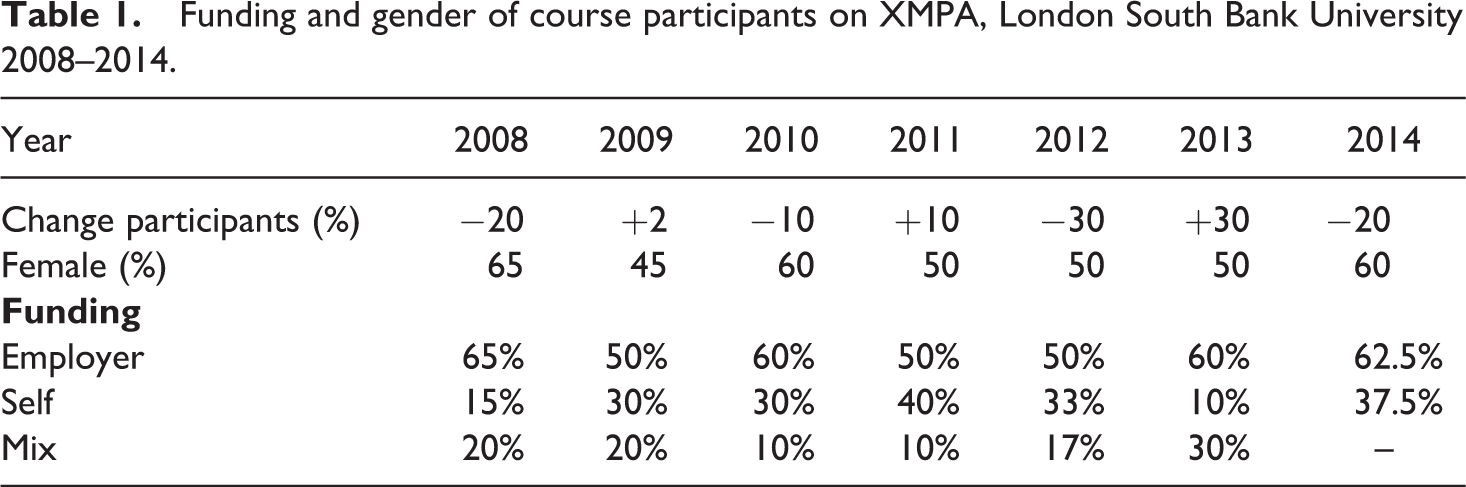
The opportunity to undertake courses and to continue on course programmes is affected by cost, the question of employer support and the ability of the individual to self-fund. This is made more difficult in this current climate when education and training becomes an early casualty of organizational economies, and individuals are under threat of redundancy and public services and benefits are being cut.
It is notable that reasons given by XMPA participants, at London South Bank University (LSBU) for enrolling on the part time masters programmes are becoming increasingly of a defensive nature (see Table 2).
London South Bank University XMPA participants’ responses to course funding difficulties.

Context to austerity
The UK has suffered two recent immediate economic crises, that of 2008–2009 and 2010–2011, and arguably we are still experiencing the effects of this second austerity crisis, and have not seen the full impact of job losses in the public sector. Austerity denotes a general reduction in Government spending. It is defined as a fiscal procedure, an economic policy deficit, resulting in specific budgetary reductions and general cuts in expenditure leading to cuts in services and resources. The crisis in the UK was evident at an early stage with the banking collapse, and even redundancy realities in the private sector. However, in the UK, there has been a significant impact between the origins of the crisis in the financial and banking sector and the disproportionate impact of the burden on the public sector, which resulted in pay bill reductions, large scale job losses and redundancies, pay freezes, worsening working conditions, longer working hours and tighter performance management measures for those who stayed in their jobs.
The Tory-led Coalition Government in office since May 2010 (until the 2015 General Election when a Conservative Government was returned) pursued an aggressive policy of fiscal consolidation. The Coalition Government agreement stated that “deficit reduction and continuing to ensure economic recovery is the most urgent facing Britain” (HM Government, 2010). Their early emergency budget of June 2010 set out the Government’s intention that all areas of departmental Government spending excluding health and international development would be subject to an average of 19% budget cuts and a two-year pay freeze for public sector workers earning over £21,000 (HM Treasury, 2010a). This pay freeze affected around 28% of the total public sector workforce. The Government anticipated this would save £3.3bn by 2015 (HM Treasury, 2010a, 2010b)
The Comprehensive Spending Review, which followed in the autumn 2010, aimed to reduce the deficit with 75% of this deficit reduction coming from public spending cuts. It anticipated that by 2015, £80.5 bn cuts in public expenditure would be achieved (HM Treasury, 2010a, 2010b) The CSR set out the detail for further cuts and required Government departments to secure 33% efficiency savings, with Local Government to reduce spending by 27% between 2010–2011 and 2014–2015. In general, the 2010 spending review focused on quantitative reductions in wages and pensions and additional workforce reforms because in the Government’s view, “the overall value of public sector reward package including pension provision has been generous in recent years” (HM Treasury, 2010a).
The extent of the loss in jobs in the UK public sector are unprecedented in severity. To begin with, they were mostly on a voluntary basis and with the use of early retirement schemes, but increasingly, compulsory redundancies, traditionally a rarity in the public sector, have been imposed. The Government created Office for Budgetary Reform (OBR) predicted in June 2010 (Office Budget Responsibility, 2010) that public sector employment would decline by 490,000 jobs by 2015. But since then, this forecast has been increased and reviewed several times, expressing that 13% of general public sector employment would be lost by 2017, that is in excess of 730,000 jobs, with Local Government and the Civil Service losing around 14% of jobs. More recent figures from Office Budget Responsibility (2012) estimated that a total of 929,000 jobs will be lost in the public sector by 2018 as a result of the cuts to public spending.
The process of implementing austerity measures in the UK has been mainly by way of employment reduction, mostly in the civil service and local government as well as pay freezes, and reviewing incremental pay progression for remaining staff and general cuts in resources. The reality, as shown by a succession of National Audit Office and Audit Commission reports (June 2011 and February 2012) shows an ongoing programme of cuts in budgets and a shrinking of the public sector (National Audit Office, 2011, 2012a, 2012b). This has resulted in massive reorganization and restructuring, job losses and inevitable cutting back in public services.
Impact on training
The impact actual and anticipated of the funding cuts and the Government’s policies for public sector employment have been considerable (Oldfield and Barber, 2012; Oldfield and van den Berg, 2013) Findings by Jewson et al. (2015) show that training remained relatively strong in the public sector during the period of economic recession 2008, but that by late 2011 and early 2012, the effect of public expenditure cuts were impacting on training programmes. The effect of the 2010 Comprehensive Spending Review was significant. Given these realities, the employers’ ability or even willingness to pay for academic courses is significantly affected. Funding for external academic programmes is generally not seen as priority, and job insecurity and employment uncertainty mean that potential students’ abilities and likelihood of paying for their own courses are compromised. Employers are being forced to focus on tightly defined “business and professional” training needs as opposed to “nice to have” courses and more generalized Continuing Professional Development.
Evidence from Heather Wakefield National Secretary for Local Government at Unison (public sector trade union) highlights the effect of austerity measures on training in Local Government “in the current local government climate with a downward push on wages and cuts to services and jobs, there is simply no money in the training budget” (Ward, 2012).
The question of funding for external academic courses which may be viewed as non-essential or even an indulgence is compromised where education and CPD become indirect early and easy victims of the austerity measures. This poses serious questions for public management educators about the direction, content and process of management programmes for public service professionals (Ahmad et al., 2013) and even their very existence, in an underfunded and under resourced sector.
Greater impact on women
In the UK, around a quarter of all employees work in the public sector; 22% of all working women work in the public sector and women comprise 65% of public sector employees (Office for National Statistics, 2013). There is therefore a high concentration of women workers in the public sector with the highest concentration being in local government, education and health. There is also a high representation of higher educated women in the public sector in general and a high concentration of women graduates in nursing and teaching.
Both men and women were hit by the 2008–2009 recession in terms of job losses, but women were harder hit by the 2010 recession and women’s unemployment has continued to rise. Research by the Fawcett Society and others shows that in the UK, progress on women’s economic advancement has stalled since the 2010–2011 recession hit. Findings by the Fawcett Society (2013) highlight the detrimental effect of the austerity measures on women’s equality, showing that women will be disproportionately affected by job losses in the public sector. Added to this, cuts to public sector services and benefits in general have a disproportionate effect on women as women shoulder the greater amount of household and domestic labour particularly in the form of caring responsibilities.
Evidence by Unison (Trade Union Congress, 2012) shows that cuts in Local Administration funding has resulted in freezes in incremental progression and that women are not reaching the top of their grade. Even more worryingly, the full impact of the loss of public sector jobs has still to come. The number of women out of work is expected to rise further as local councils and other public sector employers cut jobs over the next few years. OBR predictions suggest further job losses are still expected, including Local Government workers, public administration, health teachers and lower graded council workers and school meals workers – largely jobs done by women. Figures from Office for National Statistics (2013) show that two of the largest public sector employers, and two of the largest employers of women, namely Public Administration and the NHS, have seen dramatic loss of jobs since 2010, 131,000 and 43,000, respectively.
As Theresa May, Home Secretary, said: “if the skills and qualifications of women who are currently out of work were fully utilized the UK could deliver economic benefits of £15–21 bn per year” (speech by Theresa May on Women and the Economy, November 2011; Home Office, 2011)
Not only has the impact of austerity measures resulted in severe job losses for women but austerity “undermine women’s rights, perpetuates existing gender inequalities and create new ones” (European Women’s Lobby, 2012: 4). The wider impact of the austerity measures in UK public sector; has resulted in high level redundancies, high childcare costs, cuts to services affecting women, increased work intensity and pay freezes for those remaining in work and has also meant the loss of training budgets and the deprioritization of training and workplace support for external courses. This is especially affecting for women given the high proportion of women who work in the public sector, and who rely on public services. It also has consequences for Higher Education opportunities. The effect of shouldering most of the impact of job losses and pay freezes as well as loss of services and child care has a disproportionate effect on women’s opportunity for post graduate study. Their ability to study, the time and access to funding for courses and other resources are seriously affected. For providers of public management education programmes like XMPA, this is of concern. It has a potentially discriminatory effect, as it will have a direct impact on women’s opportunity to continue their CPD and to undertake traditional postgraduate courses, and to secure employment or advance their careers in an already threatened sector. As Page et al. (2008) argue, there is a need to promote diversity and the arguments for combatting inequalities in education and employment, and the types of jobs people do and the nature of those in positions of decision-making and policy innovation. These should be central to public management education programmes (Page). Arguably, XMPA courses which bring diversity and equality to the centre of public policy teaching are even more needed to help confront the disproportionate effect austerity policies and practices can bring.
Why the need for XMPA is one of the answers and not the problem
Training was once central to the public service ethos and in the past, the public sector recognized the need for, and benefit of training, valuing and motivating staff.
Within the context of growing pressures coming from the cutbacks to public and welfare services, significant crises and challenges confront public sector organizations and those managing and leading them. In such circumstances, the contribution of XMPA programmes can be very beneficial in respect of contributing to managerial requirements and their ability to manage in increasingly challenging and changing times. In times of economic hardship however, the value and benefit of these courses is being seriously questioned. In a period of economic restraint there is obvious questioning of the cost of public management education programmes and their relevance (Oldfield and van den Berg, 2013). However it can be shown that there is an increased need for XMPA-type programmes, not only to increase students’ potential employability, career development and job security at a time of on-going employment vulnerability (Oldfield and van den Berg, 2013), but also to update and increase their skills and knowledge. The impact of the recession has in many cases shown not only the need for quick solutions and service reliability, but also the need for better-educated and skilled managers. But, in attempting to deal with the demands of austerity climate, many public organizations have neglected the skill-development of their managers working in a much changed public sector environment where the need for better-trained public leaders is clearly identifiable.
In understanding the challenges currently facing public sector managers and potential funders of courses in this time of change and uncertainty, academic public management programmes have be able to meet the demands and needs of the new-style managers as well as those of the potential course suppliers. Austerity brings unemployment, disenchanted and disaffected students and former employees who lose their positions or fail to get more senior or more secure ones, and it is important to maintain morale in a period of economic constraint and encouraging a continued sense of achievement and optimism. It is easy to forget the effect economic austerity can have on students’ life chances – even mature part time students in terms of employment opportunities, job security, career development and of course in the case of mature students their home life responsibilities.
So, it can be argued that at such times the need for MPA-type programmes for helping to transform public management practices and behaviour is essential. The need for public sector managers to deliver high quality services on time and on budgets is all-consuming, and effective public sector management and leadership in both implementing spending cuts and leading organizations as they deliver more for less is central for the Government’s political agenda. Arguably, the time has come to look to and invest in XMPA programmes.
A key to this is the transformation of approaches to “teaching” and learning (Ahmad et al., 2013) on public management programmes, in order to transform practices and organizational behaviour of the leaders of public sector workers, and those deliver public services, particularly in the ever changing and challenging environment. This is evidenced by what students are saying, see Table 3.
What are students saying: Student views; London South Bank University XMPA.

How to make our XMPA work and be relevant
Examples from London South Bank University
In order for our public management education courses to retain credibility and relevance in the new public sector world, and in a sector badly hit by the effects of austerity measures and limited resources, XMPA courses have to reflect the changed public sector environment. If public management educators are committed to continuing such programmes, they must be prepared to change and adapt (Oldfield and van den Berg, 2013).
Developing new approaches to the delivery and content of XMPA programmes is therefore needed in order for them to be relevant and sought after. From the experiences of XMPA course development at LSBU, these approaches include: Delivering “Bite size XMPA”, including a portfolio of course accumulation, a Ladders and Bridges Framework, CPD, and using CPE/CPD as a tool to achieve greater professional standing. Changes to course curriculum and content, developing new skills, a flexible approach to course timing and delivering courses off site to organizations. Furthermore developing Learning Communities to respond to specific workplace managerial challenges, creating a safe learning environment and developing case studies from students own professional and practical experiences.
Bite-size XMPAs
The aim is to develop a more targeted condensed XMPA to give a more manageable programme suitable for public management education in times of crisis and regeneration, and reflecting the changing needs of both the manager/student and the employer. Bite size XMPAs can take the following forms:
Modular portfolio accumulation, in- house courses delivered off site and continuing CPD, and a Ladders and Bridges framework to public management education.
Modular portfolio
The objective is to offer affordable educational opportunities by developing a portfolio approach to management education. This may include a series of customized learning events, such as leading to a certificate of learning, which eventually can be used as credits towards the XMPA; delivering specific modules in-house to an organization where there is enough demand; or encouraging managers to attend individual contemporary modules being delivered in the university, which are specific to a new issue or new policy. In this way, participants could accumulate modular credit towards a degree or certificate by a portfolio approach. The initial interest in a particular module may well be because it is currently very relevant to a change in workplace practice, policy development or service delivery. This would therefore be attractive to the individual manager for professional and managerial reasons and would be taken in a small bite size and at a time suitable to the individual and their workplace. A further advantage would be there would be no long continuous periods of absence from the workplace. Further progression to the full XMPA would be possible.
XMPAs linked to continuing professional development
It is important to recognize the value of continuing staff development. In times of financial cutbacks this can be delivered in bite size approaches as discussed, or it can be developed through customized XMPA in house programmes linked to staff development and continuing ongoing educational opportunities. The XMPA actually take place in the workplace. The advantage of this is that the employer is more amenable to giving employees time off, and the context of the course is adapted for the particular workplace. As for the manager/student, they do not have to travel to the university and are more likely to attend the programme, especially as it takes place in work time as well as work premises. It is more likely that employer support as well as funding will be provided, particularly if the employer has been involved in the practical organization of the course and in the recruitment of the course participants.
Ladders and bridges
A further approach being pursued at LSBU is the adoption of a so-called “ladders and bridges” (Oldfield & Barber, 2013) approach to public management education. The aim of the ladders and bridges framework is to create a series of ladders and bridges for course participants to complete a course of study at their own pace and to be able to acquire an academic qualification and to further their own professional and work experience, thereby enhancing their own personal development at their own pace. The objective also is to encourage wider participation and greater opportunity for academic attainment and career progression for non-traditional students who might not have had the opportunity to study for a first degree, or entered Higher Education in the traditional way, but who have the required workplace or managerial experience. In creating this framework, it provides ease of access and familiarity of teaching and learning provided by the same academic institution.
The ladders and bridges approach is to develop public management education and career enhancement where by designing appropriate educational routes in such a way that would-be students can adopt a particular route (ladder or bridge) and ultimately reach the top, that is, the XMPA, but at a time which suits them personally, academically and professionally. Access to continuing education in this way opens the opportunity to both public management education and a career in public management to a more diverse group of students and managers and enables people to achieve their potential.
Content and curriculum and developing skills and flexible approach
Given the pool of actual and potential students on public management programmes, the style of delivery, mode of delivery and timing of delivery is important in understanding the reality of the life and work styles of course participants, particularly women students. In most instances, course participants on XMPA programmes are not typical of younger post-graduate students who have relatively freer lifestyles and less personal and work responsibilities. Most XMPA students are mature managers with responsibilities at home as well as work. It is important to encourage more flexible approaches to teaching and learning and to try to be more supportive of both the potential participant and the employing organizations’ situations. The way in which programmes are constructed in respect of facilitating learning can enable a more diverse population of would be course participants. In designing and promoting public management programmes, it is necessary to take account of the characteristics of the manager-learners and their need to balance workloads and work responsibilities with the responsibilities of home and family life, and to which they are now adding the demands of academic study. This is not a new approach; in designing programmes, providers have long tried to take into account the needs and requirements of busy mature students/professionals and to understand their approach to learning (Baldwin and Salby, 2003), and further to recognize that learning and performance are also affected by such things as age, gender and the environment (Quinn, 2004). Block delivery, e-learning and a combination of e-learning and flexible contact are useful particularly for women students with both high workplace demands and childcare pressures. E-learning can be cost saving because it cuts down on concentrated periods of absence from work and might be even more attractive in an austerity climate.
Developing new and appropriate skills, redefining course curriculum to reflect changes in the public sector, making courses relevant to current workplace issues are necessary. Helping course participants to develop the skills and confidence to challenging ways of doing things, reflecting on organizational culture and practices, supporting staff, understanding emotional reactions being more open minded and the ability to listen also become key.
Course curriculum and content should continue to develop to enhance the currency and relevance of our programmes, thereby keeping them attractive and sought for, which is particularly relevant in times of austerity (Oldfield and van den Berg, 2013)
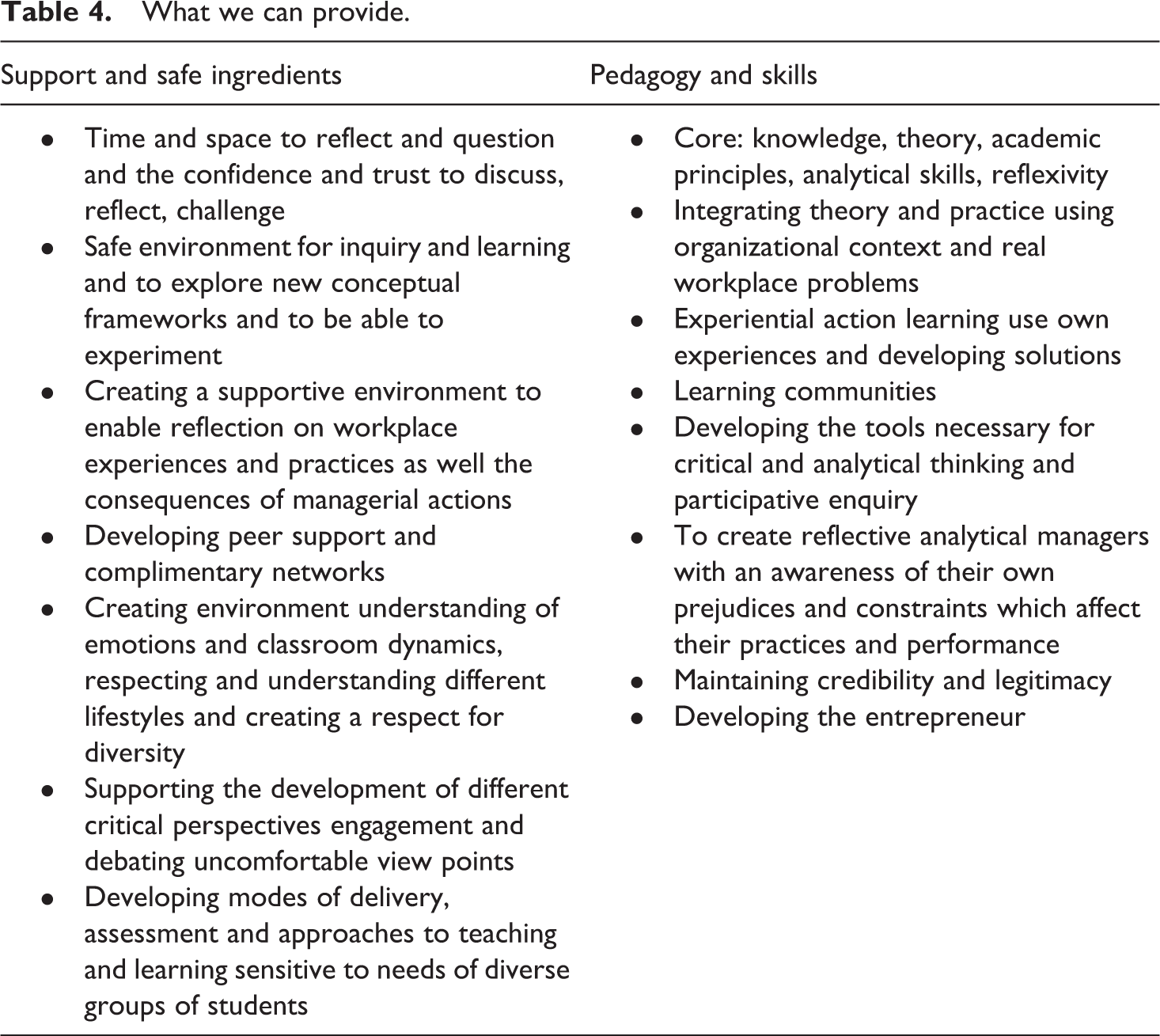
This may not only include changes to course content, but may require gaining more business-orientated skills and commercial knowledge, as well as understanding the difficulties of managing indirect labour, and managing across and through networks where organizational objectives and culture are likely to be different (see Table 4).
What we can provide.
Learning communities
The aim of the learning community is to enhance learning and reflection through the group process whereby participants in the learning community articulate workplace problems and try to reach solutions within the trust and safety of the learning community, which is supportive. (Pedersen and Tangkjær, 2013). It is a collaborative process, and the tutor is part of the process, and the success of the process is dependent on joint mutuality of participation and the safety of the classroom learning environment (Oldfield, 2015). The objective is to strengthen and develop course participants own skills and competencies to manage in a challenging public sector and to facilitate discussion on solutions to workplace issues and consider proposals for change and strategies on how to deliver. This is done by using the experiences of others in the learning community. The students on Executive Masters in Public Administration explain the context of their individual organizations and then set out the questions and issues facing them. This can be challenging for the participant articulating the problem. Transforming management practice is difficult. The focus of this approach is on creating a different method to student–practitioner learning by directly using the student/manager’s considerable professional experience of workplace issues and developing case studies which will be examined in an established safe and trusting classroom experiment (Oldfield, 2015). The Learning Community also provides the safe space to articulate different critical perspectives and take people out of their natural comfort zone if necessary, whilst still providing a supportive environment. One of the significances of the Learning Community approach is that it becomes really relevant to current public management practice and it puts student experiential learning at the centre.
Some concluding comments
Times are changing for providers of Executive Masters in Public Administration (XMPA) degrees. Understanding the nature of these changes and the implications for the public sector is crucial in ensuring professional executive masters degrees can continue to recruit and be relevant and valued, during what is a harsh spending environment. The period of austerity has changed the environment in which public managers are educated, meaning that XMPAs must adapt to remain relevant and counter the threat to their survival. At the end of the day, XMPA courses cannot solve all the problems and challenges facing public organizations, nor are they intended to do so, but they can create the safe environment for discussion and analysis and they can develop more skilled, knowledgeable and informed future public sector managers (Oldfield, 2015)
Finally, always look on the bright side – XMPA s have a proven track record and arguably the requirement for and demand for “new style” XMPA is still here, and even more relevant for the new style public sector.
Footnotes
Declaration of conflicting interests
The author(s) declared no potential conflicts of interest with respect to the research, authorship, and/or publication of this article.
Funding
The author(s) received no financial support for the research, authorship, and/or publication of this article.