



Abstract
Many scholars have suggested that public service motivation (PSM) is a defining characteristic of public and non-profit employees. However, interest and motivation alone are not the sole determinates of success in any organization. Employees must also possess the knowledge and skills that will help them accomplish the difficult tasks that arise in their chosen occupation. This study explored the relationship that PSM has to student satisfaction in MPA programs, taking into consideration program climate and number of years of government experience. The findings confirmed that while PSM is related to student satisfaction, this relationship was completely mediated by program climate. The implications of the study are discussed, in particular in terms of the contributions that an environment of support and PSM make on the attitudes of students in MPA programs.
Introduction
There are those who are particularly attracted to opportunities that contribute to the well-being of society and, we can reasonably presume, make employment decisions on the basis of these interests (Clerkin and Coggburn, 2012; Liu et al., 2011; Perry and Hondeghem, 2008; Perry and Wise, 1990; Rose, 2012; Vandenabeele, 2008). Scholars have labeled this phenomenon public service motivation (PSM); and many of them suggest that PSM is a defining characteristic of public and non-profit employees. However, interest and motivation alone are not the only determinates of success in any organization. Employees must also possess the knowledge and skills that will help them accomplish the difficult tasks that occur in their chosen occupation. Given the importance of PSM in the field of public service it was therefore considered worthwhile to develop an understanding of the educational experiences of individuals with high levels of PSM.
There are degree programs that have been developed specifically to train individuals for careers in government and non-profit organizations. In the USA these public administration degree programs are available at various educational sources: from private online degree programs to multifaceted state flagship universities. They are also grounded in a variety of disciplinary homes such as political science, business, law, health, criminal justice and social work. In this highly competitive educational environment, the success and growth of degree programs requires a clear understanding of the needs and desires of their prospective students. It would not be unreasonable to expect that potential students with high levels of PSM would be satisfied with degree programs that mirror their interest in and motivations for public service. The problem is that no published research has been found that has investigated and confirmed this relationship. The purpose of this study, therefore, is to fill this gap in the literature by exploring whether PSM is a meaningful predictor of the level of satisfaction of students in MPA (Master’s in Public Administration) degree programs.
Public service motivation
Public service motivation has been defined in many different ways (Bozeman and Su, 2014). Perry and Wise defined PSM as ‘an individual’s predisposition to respond to motives grounded primarily or uniquely in public institutions and organizations’ (Perry and Wise, 1990: 368). Others have defined PSM in terms of motivation or altruistic intention to contribute to the well-being of the community, society or the public interest (Bright, 2008; Liu et al., 2008; Vandenabeele, 2007). Scholars have suggested that PSM offers many direct and indirect benefits to organizations, particularly in terms of performance, commitment and satisfaction (Alonso and Lewis, 2001; Andersen et al., 2014; Bright, 2007, 2008; Naff and Crum, 1999; Ritz, 2009). That is, the greater an individual level of PSM the more likely it is that the person concerned will have beneficial levels of job satisfaction, commitment, performance, and fit in public service organizations. Given the benefits that PSM offers to the public and non-profit sectors, the question then is to what extent PSM is a determinate of the satisfaction of students in degree programs that prepare them for public service.
Student satisfaction
Student satisfaction can be regarded as a pleasurable or positive emotional state resulting from the appraisal of one’s experiences (Locke, 1976). It is a consequence of the extent of congruence between the needs of individuals and available opportunities. When this congruence increases, satisfaction levels are likely to increase as well. Thus individuals who are enrolled in degree programs that provide opportunities that are congruent with their needs are likely to express high levels of satisfaction. These attitudes are important given their link to various important educational outcomes. Students who are satisfied with their experiences in their degree programs have been found to be significantly more likely to complete their degrees, perform highly in their course work, and recommend their program to others (Aitken, 1982; Alves and Raposo, 2007; Schreiner, 2009; Suhre et al., 2007). As a result, it is important to understand the nature of satisfaction among students in graduate public administration programs, as well as the predictors of these attitudes.
Early research on student satisfaction in MPA programs found that students were satisfied and/or would recommend their degree programs to their friends (Light, 1999; Roberts, 2001). However, in a recent study, Bright and Graham (2016) explored the relationship that a range of factors, such as age, gender, minority status, number of years of experience in government and non-profit organizations, and program climate, had with these attitudes. They found that not only were students satisfied with their experiences in MPA programs but also that the significant predictors of these attitudes were program climate and years of government experience. Students who reported experiencing supportive program climates or had fewer years of experience in government were significantly more likely to report high levels of satisfaction with their graduate degree program.
While this body of research identifies many of the factors that are important for understanding the causes and consequences of student satisfaction in MPA programs, unfortunately it does not address the extent to which PSM is a predictor of these attitudes. This is an important consideration because it is possible that PSM might be one reason why many individuals enter degree programs in public administration. While some individuals may seek public administration training primarily for the opportunity to gain a promotion or higher-paying job, others may enter for the opportunity to contribute to the well-being of society. As a result, it would be useful to clarify whether PSM is a major determinate of student satisfaction in MPA: are students with high levels of PSM more satisfied in MPA programs than their counterparts with lower levels of PSM?
There are at least two obvious reasons why a strong connection may exist between PSM and student satisfaction in MPA programs. The first reason relates to the values and principles that are taught in these degree programs. Public administration programs emphasize the values and ethics of public service: the Network of Schools of Public Policy, Affairs and Administration (NASPAA), the major accrediting body for graduate degrees in public administration, states that its mission is to promote the ideal and values of public service. Some of these values include pursuing the public interest, respect, and equity and fairness in dealings with citizens and fellow public servants (NASPAA, 2014). These values are very similar to those that it is argued are the main source of motivation for individuals with high levels of PSM (Perry and Wise, 1990).
The second reason why a meaningful relationship could be expected to exist between PSM and student satisfaction in MPA programs is that these programs can lead to careers in public service (NASPAA, 2012). Scholars have found that MPA degree holders represented about 4% of the federal workforce in 2003 (Lewis and Oh, 2008) and were more likely to hold positions of authority in the federal govenrment when compared to MBAs (Lewis and Oh, 2008; Lewis, 1987). This is important given the evidence that PSM enhances the attractiveness of public service occupations among individuals (Brewer and Selden, 1998; Perry and Hondeghem, 2008; Perry and Wise, 1990), including students (Clerkin and Coggburn, 2012; Liu et al., 2011; Pedersen, 2013; Rose, 2012; Vandenabeele, 2008).
Other competing explanations
In addition to the potential relationship that PSM has to student satisfaction, there are other factors that should be taken into account. Existing research suggests that the most important predictors of students’ satisfaction levels in MPA programs are the climate of their degree programs and students’ numbers of years of experience. Elliott and Healy (2001), Nwenyi and Baghurst (2013), and Sinclaire (2013) all found that the levels of interaction and support that students received from their peers and professors were among the most important predictors of satisfaction in college. Similar trends were found among students in MPA programs (Bright and Graham, 2016). That is, as MPA students’ perceptions of support increased, their levels of satisfaction with the characteristics of their degree program also increased.
Similarly, existing research has demonstrated that the number of years of government experience is also a very important predictor of student satisfaction, especially among students in public administration programs. For instance, Ashmore et al. (1981) found that students with many years of work experience believed that their training in MPA programs was less effective with regard to their preparation for public service. More recently, Bright and Graham (2016) confirmed that time spent in government was negatively related to student satisfaction: students with many years of work experience were significantly less satisfied in MPA programs than those who had fewer years of government work experience.
Given the findings of existing published research, the aim of this study was to confirm the relative importance that PSM has to student satisfaction when compared to program climate and number of years of work experience.
Methodology
The data for this study were drawn from a national study of MPA programs conducted in 2013. One hundred universities and schools of public affairs were randomly selected from a list obtained from the NASPAA and were asked to participate in the study. Twenty-six schools agreed to participate: they were asked to forward a link to an online survey to their public affairs and administration graduate students. The survey advised the students that their participation in the study was completely voluntary; that their individual answers would be kept confidential; that they could refuse to answer any question that made them uncomfortable; and that they could end the survey at any time with no penalty or loss. Five hundred and fifty-two students responded to the survey.
A measure of the level of student satisfaction was obtained from a single-item survey question that asked the respondents to indicate their level of overall satisfaction with their degree program on a Likert-style scale of 1 (‘very dissatisfied’) to 6 (‘very satisfied’). The independent variables included in this study focused on PSM, program climate and number of years of government experience. PSM was collected using a Kim (2009) 12-item scale revision of Perry’s (1993) 24-item PSM scale, which had a Cronbach’s alpha of 0.83. The responses to the multi-item survey were summed into one score. The extent of government experience was obtained from a question that asked the respondents to indicate the number of years they had been working in government organizations. Program climate was determined using Springer et al.’s (2009) 10-item climate scale which had a Cronbach’s alpha of 0.95. This scale measured the respondents’ perceptions of the quality of support they received from their professors and peers. The responses to these multi-item questions were summed into one score. Further information regarding the survey questions and variable coding is presented in Table 1.
Description of study variables.

The findings of this study were analyzed using a three-stage hierarchical regression analysis. This method is useful for at least three major reasons. First, it provides a better understanding of the relationship of the independent variable to the dependent variable, while controlling the effects of each of the other independent variables. Second, this method allows scholars to understand better the explanatory power that each stage of variables adds to the regression model in terms of the R-square statistic. Third, this method can provide a test of whether any stage of variables is moderating the relationships of previous stages of variables. In addition, a scatter plot of the standardized residuals was used to test the assumptions of normality in the data. This analysis revealed that the data conformed satisfactorily to the conditions of normality.
Findings
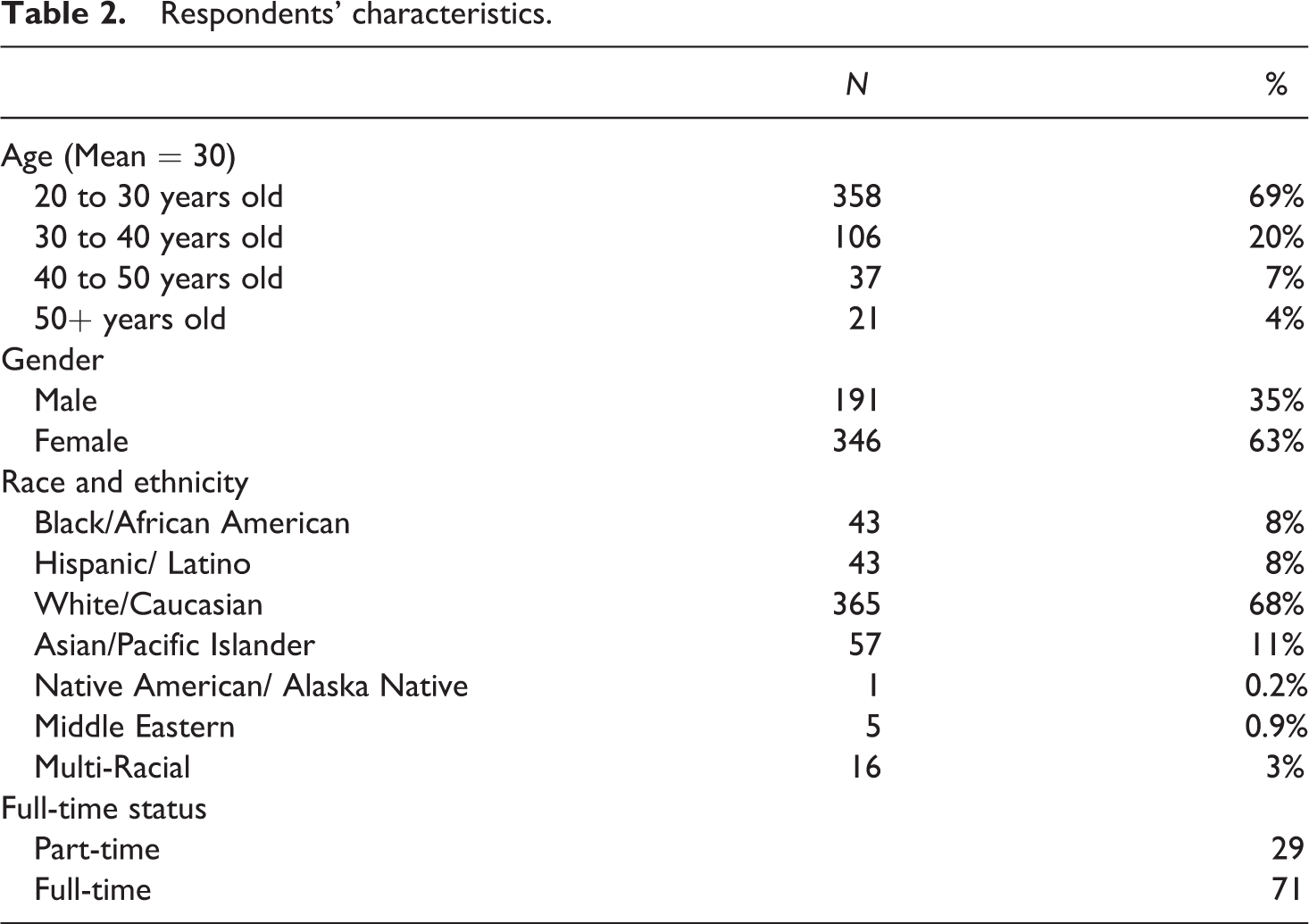
As shown in Table 2, the majority of the respondents of this sample were approximately 30 years old, female, non-minority, and US citizens; and most had approximately eight years of overall work experience, with fewer than three years of experience in government or the non-profit sector. In addition, the majority of the respondents were full-time students. These characteristics are consistent with the demographic profile of MPA programs nationwide, according to the NASPAA 2013 Data Center.
Respondents’ characteristics.
In terms of climate, the mean scores indicate that the greater majority of the respondents experienced supportive climates in their degree programs, even though there was variation among the respondents. As shown in Table 3, there were three survey responses that fell below the overall mean. These responses centered on whether the respondents felt close to professors and whether they felt close to other people in the program. Nearly 22% of the respondents indicated that, at the very least, they disagreed somewhat with these two statements.
Program climate results by Springer et al. (2009) survey items.

Taken as a whole, most of the students reported high levels of PSM. However, as with the descriptive results for climate, there was variation among the respondents’ levels of PSM. As shown in Table 4, when asked if they agreed that ‘meaningful public service is important’ and that ‘public service is their civic duty’, the greater majority of the respondents indicated that they agreed or strongly agreed. However, there were responses to one item that were uncharacteristically low: when asked if they agreed that it was difficult to contain their feelings when they saw someone in distress, nearly 40% of the respondents strongly disagreed or somewhat disagreed.
Public service motivation results by Kim’s (2009) survey items.

The central issue of this study is the satisfaction level of students and the predictors of these attitudes. The greater majority (81%) of the respondents indicated that they were, at the very minimum, satisfied with the characteristics of their degree programs. Table 5 summarizes the findings of this study with regard to the relationship that PSM, number of years of experience, and program climate have to these attitudes.
Hierarchical regression of predictors regressed on student satisfaction.

**Significant at the 0.01 level (2-tailed).
*Significant at the 0.05 level (2-tailed).
In the first and second stage of the analysis, PSM is directly related to student satisfaction, even when the number of years of government experience is considered. The respondents with high levels of PSM were significantly more likely to report higher levels of satisfaction in degree programs than their counterparts with lower levels of PSM, even when considering their numbers of years of government experience. However, in the third stage, the relationship that PSM had with student satisfaction diminishes when program climate is considered. Furthermore, the R-square statistics indicated that the number of years of experience, and program climate, provided an explanation for a significant level of variance in satisfaction over and above the influence of PSM in both stage 2 and stage 3.
Conclusions and discussion
This study sought to investigate whether PSM is a meaningful predictor of student satisfaction in MPA degree programs, and whether it was a primary predictor when compared to the influences of number of years of government experience and program climate. It was found that PSM had no direct relationship with student satisfaction, when program climate is considered. As a result, it is not considered to be a primary or direct predictor of student satisfaction in this study.
There are several implications of this finding. The first is that the climate that students experience in their degree programs is a significantly better explanation of student satisfaction when compared to their level of PSM and number of years of government experience. This supports existing research which has argued that program climate is one of the most important factors that affects student satisfaction (Elliott and Healy, 2001; Nwenyi and Baghurst, 2013; Sinclaire, 2013). MPA programs that foster educational environments which promote interaction among students and faculty, and build a network of support, will generate high levels of satisfaction among the student body. The results from this present study suggest that students who experienced supportive educational environments were significantly more likely to report higher levels of satisfaction, regardless of their levels of PSM.
Given the importance of a climate of support, it is argued that degree programs should focus directly on providing opportunities that help in achieving this goal. For example, it is not unreasonable to expect that a supportive climate would be enhanced by opportunities to attend conferences in the field, network with public and non-profit officials, and participate in service learning opportunities. In fact, existing research has suggested that opportunities such as these do have a positive influence on students’ attitudes, especially in terms of their career choices (Bright and Graham, 2015). Future research should build on this finding and provide greater clarity regarding the characteristics of degree programs that enhance students’ perceptions of support in MPA programs.
The second implication of this research is that PSM may be a predictor of program climate. While PSM had no direct relationship with student satisfaction, bivariate correlations revealed that it was positively related to program climate. The respondents with high levels of PSM reported experiencing program climates that were significantly more supportive than their counterparts with lower levels of PSM. However, the causal direction of this relationship is unclear; that is, while PSM and climate are positively related, it is not clear as to whether individuals with high levels of PSM are attracted to supportive climates or if a supportive climate is what generates high levels of PSM. In addition, a bivariate analysis does not explore these relationships while considering the impact of other factors. Thus the relationship found between PSM and climate in this study could be an aberration, involving more powerful factors, or a product of this particular sample of respondents. More research on this topic will bring greater clarity to this issue.
Nonetheless, the positive relationship between PSM and climate is consistent with the view that MPA programs are inherently better able to foster public service values (Henry et al., 2009; NASPAA, 2012). For this reason, MPA programs may have a competitive advantage over other degree programs when it comes to attracting individuals with an ethic of community service. However, this finding has a major drawback. It is also apparent that there are students seeking MPA degrees who do not have a strong public service ethicwho are . While it is reasonable that students enter degree programs for a variety of reasons, it is clear that students with lower levels of PSM believe that their needs for support are not being equally met when compared to their counterparts.
This does not mean that MPA degree programs should close their doors to these students. It is, however, an indication that these individuals are significantly more likely to report that their degree programs are not supportive, which will have negative consequences on their attitudes and behaviors in these programs. Hence I would argue that MPA programs should not de-emphasize their public service characteristics during the recruitment process, for the purpose of increasing enrollments. Statements that suggest that MPAs are designed for private sector careers maybe misleading. It is important that potential students gain an accurate view of the characteristics of their degree program which will help them make better assessments of their fit in these programs.
Above all, this study helps improve the field of public administration understanding of the process and factors that affect student satisfaction in MPA programs. It confirms that a climate of support cannot be understated: program climate is a primary driver of the attitudes of students in MPA programs. Furthermore, the findings suggest that PSM is an important contributor to student satisfaction, insomuch as degree programs provide supportive environments. If this is the case, a supportive climate can be used as a recruitment tool for attracting students, especially those with high levels of PSM. This will help increase the supply of educated individuals who embody an ethic for public service and will be more likely to maintain high levels of performance, satisfaction, and commitment in public service organizations.
Footnotes
Declaration of conflicting interests
The author declares that no potential conflicts of interest exist with respect to the research, authorship, and/or publication of this article.
Funding
The author received no financial support for the research, authorship, and/or publication of this article.