




Abstract
Current world events demand public affairs leadership training that generates among professionals a sense of capability, agency, and responsibility to engage in complex public problems. In this paper, we describe a unique course operated in the US focused on achieving these learning outcomes. It uses an unconventional schedule and course design that leverages information communication technologies to support learning. Its integrated model combines conventionally distinct courses with a pedagogical approach stressing experiential learning, personal reflection, and critical thinking. The paper describes the teaching practices used in the course, as well as offers three sources of evidence about what results from its implementation.
Keywords
Attempts around the world to realize democracy’s potential amidst racial and ethnic diversity and economic inequities have created many pressing political and social problems. Easy access to global information magnifies the struggles of people to define their rights and achieve democratic representation. These social, economic, and political realities create new urgency for effective public affairs leadership. Rather than outdated notions that individuals in formal roles bear responsibility for solving these challenges, leadership in 21st-century public affairs must come from individuals who occupy diverse vantage points in relation to public challenges (Crosby and Bryson, 2010; Parks, 2005; Wheatley and Frieze, 2011). People from many positions – community organizers, non-governmental organization (NGO) program directors, clergy, elected officials, public bureau managers, business people – are all potential leaders who may find themselves in positions where they can influence change on public problems. The reality of this diversity, though, creates challenges for higher education instructors responsible for building and nurturing the types of leadership skills required in the public arena.
Current events demand leadership training that generates a sense of capability, agency, and responsibility to engage in complex public problems. This requires skill development across a very broad spectrum of competencies: reflection upon public events that increase the urgency for action; technical, analytical training that focuses on defining problems, evaluating evidence, and making recommendations; exposure to social science methodology that enables critical assessment of published research and more systematic exploration of issues; theoretical explorations of leadership, public value, and ethics; and pragmatic discussions of strategies to improve how people work together in work teams, community settings, organizations, and networks. Seizing personal agency and recognizing responsibility for engagement also requires deep, personal work: learning how to reflect-in-action and reflect-on action (Schon, 1987); engaging with others’ perspectives across diverse backgrounds; communicating effectively across these differences; and, perhaps most significantly, cultivating the ability to hold tensions when there is a gap between current conditions and desired ends.
In this paper, we describe a course that focuses on these ambitious and diverse learning outcomes through delivery of a 12-credit course that integrates four previous distinct courses into a cohort in which student study leadership development, policy analysis, and social science research. It is delivered at a public affairs school of a large public university in the US. It uses an unconventional schedule and leverages information communication technologies to support learning across geography and diverse content topics. As a program at the state’s “land grant institution,” the mid-career Master’s in Public Affairs (MPA) reflects the university’s well-established commitment to offering rigorous and relevant training to a broad array of the public. The course design and implementation draws upon the science of both adult learning and technology-enhanced education to nurture the public leadership needed in these times. Instructors’ teaching practices concentrate on developing and using processes focused on creating an authentic learning community.
We begin this paper by more completely explaining the context and design of the course, and then describe in some detail both our pedagogical approach and teaching practices used with a diverse student body. We then look at three sources of evidence about the consequences of our activities: student satisfaction surveys completed immediately after the course, a survey completed to document longer-term learning outcomes, and student reflection papers completed during a capstone experience at the end of the whole degree. Overall, this account describes a model where adult students gain greater competence and confidence in service as a public affairs leader. Though students may not initially perceive themselves as public affairs leaders, they report that the 12-credit course equips them with the competencies and skills that enable them to no longer accept the status quo of public life. We conclude by considering its implications for other educators.
The context for the course design and implementation
As a public affairs school in the US, the Humphrey School at the University of Minnesota focuses its scholarship and educational programs on professionals interested in advancing the common good through work in the public, nonprofit and private sectors. The multi-sector orientation tends to appeal to both faculty and students interested in making progress in an array of public problems, from social welfare to international development practice, sustainable energy production to effective urban development. The students who enroll in one of the schools’ six master’s degrees are seeking education that provides diverse analytical and practical approaches.
Among these options, the mid-career degree, a master’s in public affairs, draws upon a more diverse array of students in terms of age and ethnicity. Students are required to have ten or more years of post-baccalaureate professional experience before applying, and many have considerably more. The average students’ age is forty-two. Many continue to work full-time as lawyers, elected officials, nonprofit program directors, graphic designers, corporate marketing directors, or tribal executives, while they pursue the degree. Most are parents, and many have young children at home. Ethnic diversity is high in the course. In the current offering, 34 percent are racial minorities, including 10 percent international students. These international students have come from India, Liberia, Korea and China for the year to complete the mid-career program; most other students, the white, Native Americans, African Americans, Asian Americans and new Americans (from Egypt, Zimbabwe, and Somalia) live within the surrounding states and commute to the program during its monthly meetings. Though some students are eligible for university-sponsored merit-based scholarships or employer tuition assistance, all are responsible for paying for the costs associated with the program.
Interactions with prospective students during information sessions reveal that all have experienced some level of success in their chosen profession, are balancing multiple responsibilities at work, in community, and family responsibilities; however, they are troubled by public problems and want to make a difference. This context directly informs our course design, pedagogical approach, and teaching practices, whose research documents are all essential elements in learning (Bransford et al., 2000).
Course design
It is imperative that course design both maintains the school’s expectation of rigorous instruction and accommodates accomplished professionals’ schedules and responsibilities. The 30-credit degree requirement includes the 12 required credits completed through the course discussed in this article, 14 credits (usually between four to five additional courses) in a self-designed concentration, and a four-credit capstone seminar completed in the final semester. The self-designed concentration allows students to focus on topics important to their professional ambitions, from political leadership to environmental policy, social program delivery to urban planning. While the core requirements for the degree were originally separate courses offered in a traditional schedule (once per week, often in the evening), we developed a “cohort” model in 2010, which combined them into one integrated course. Inspired by research that shows the importance of social context in adult learning (Bransford et al., 2000; Caine and Caine, 2011). the model enables students to study with the same group of 25 students throughout the year, investigating the diverse topics of public leadership development, social science research, and policy analysis. To support learning across these disparate subjects, the course is carried out through a hybrid design that utilizes both face-to-face sessions and technologically enhanced learning with an unconventional schedule. This approach was built upon growing knowledge of how technology enhanced learning can create positive learning outcomes for professionals through creating a community of learners (Babb et al., 2010; Dillon, 1996; Tamim et al., 2011; Mean et al., 2009).
The course begins with a week of face-to-face meetings during a time of the year in which many professionals take a holiday break. This program launch is followed by two full-day sessions per month for nine consecutive months; in total contact hours, these sessions actually exceed the university’s required contact hours for the credits earned. But, significantly, these in-person sessions are supplemented with content such as lectures, multimedia learning objects (cases and videos), and written analyses that are accessed virtually. 1 This, and other course design elements are built upon a focus on experiential learning (Dewey, 1938; Kolb and Kolb, 2013). This approach to learning science privileges peoples’ experiences as a source of valuable information that, when combined with structured stimuli and reflective or integrative assignments, can enable significant professional learning.
While it is easiest here to describe the content of the course by topic, students enrolled in the cohort model experience it in an integrated way; the initial week and weekend meetings move between topics in an unpredictable schedule. Some weekends begin with leadership content, others begin with policy analysis or research. This variation introduces dynamism in the course, which helps keep the learning authentic and responsive. While there is a set syllabus and specific learning objectives for each of the three main topics, instructors design the monthly agenda in response to the groups’ needs in a particular month, for example by covering a particular topic in more detail if students are struggling to master it. Additionally, instead of experiencing each core course as stand-alone topics, the integrated schedule builds upon previous content. For example, analytics lectures and assignments may use data associated with the policy analysis case study. Or the application of leadership theory may be presented in the context of a policy case. As such, each year, the course draws upon formative surveys to customize it to the needs of the specific group of students.
The mid-career program necessarily focuses on leadership development. But unlike some executive education programs, the Humphrey MPA does not presume that students will necessarily begin the course identifying themselves as leaders. In fact, in the current day and age, when critiques of public affairs leaders are rampant (and almost instantaneous), many students resist identifying themselves as such. One important learning objective is to generate an identity in students of themselves as a leader, an agent capable of exerting energy and engaging others to solve public problems. To achieve this ambitious objective, monthly assigned books, activities, and assignments walk people through a process of skill development as an individual, looking at how they operate within organizations, in community settings, and in policy systems and networks. Throughout, students are invited to grapple with fundamental questions: “whose am I?”, “how do we define leadership success in the face of competing values?”, “how do I engage with disparate and diverse community groups?”, “how do I use sources of power to influence others and make progress on collective problems?” This course topic is designed to raise uncomfortable questions about their own passions and capacities for public affairs leadership.
The topic focused on social science research uses a similarly layered design to achieve its core objective – enabling students to understand the strengths and limitations of qualitative and quantitative data to inform decision making. Students learn basic knowledge about research methods and data analysis for qualitative and quantitative information. They design a research study, conduct a literature review, collect or assemble data, analyze it, and communicate the essential findings. They learn about these procedures by reviewing virtual lectures and, when attending the in-person class sessions, apply the general concepts through activities with classmates.
This focus on application also appears in the third topic of the cohort, public policy analysis. In this element, they learn a basic foundation of policy analysis (Bardach, 2012), program evaluation (Wholey et al., 2010), and implementation analysis (Sandfort and Moulton, 2015). Students work again to identify a topic of interest and then define the policy problem and consider alternatives for policy intervention by consulting available evidence. They consider existing program evaluations and articulate logic models underlying interventions, making recommendations for programmatic improvement in that topical area. Finally, they explore the institutional context of policy implementation, exploring how organizational interests and power involved in the policy field shape what is feasible within the context.
Pedagogical approach
The design of these three topics draws heavily on the science of experiential learning. The specific pedagogical practices within that broad approach, though, align with our desired learning outcome for each topic. For leadership development, we utilize the Action Learning approach (Raelin and Coghlan 2006; Revan, 1980; Weinstein, 1995). Based on the premise that one’s own experience is the best laboratory for leadership development (Parks, 2005; Wheatley and Frieze, 2011), students are asked to identify real work they are engaged in that requires leadership. It may focus on their current work, volunteer work with religious or civil society groups, or even family issues with larger societal implications. We begin with fairly conventional self-assessments to support self-discovery of core values, personality traits, and social skills. However, these insights are applied in relation to how they “show up” in their Action Learning project. Each student is assigned a faculty member coach, who acts as a resource throughout the year and a peer support group.
To provide additional external stimuli to this process, students read a required book each month that offer pictures of leadership across diverse settings and situations, complete asynchronous written analysis about the reading, and engage in classroom discussion of the themes. These structured activities reflect the elements of Action Learning: within structured programming, students apply the general concepts to specific contexts and interrogate tacit knowledge (Raelin and Coghlan, 2006). They learn to experiment with solutions, recognize constraints, and develop alternative resolutions. The faculty coaching sessions and peer circle process (Palmer, 2009) provides support in interpreting events in relation to larger concepts. They make professional presentations and complete written reports to document the behavioral change occurring throughout the project. In short, they learn not only what leadership looks like, generally, but how leadership looks in their particular action context.
In teaching the social science research and public policy analysis topics, we draw upon another pedagogical approach – project-based learning (Krajcik and Blumenfeld, 2006). In this technique, learners identify a specific topic or problem they want to explore throughout the course. Then, they systematically apply the analytical tools covered to a particular subject they choose. Thus, their effort focuses on applying course concepts to something for which they have inherent motivation and interest. For social science research, individuals select a topic, often aligned with their leadership project, and apply the analytical tools covered to conduct preliminary research. For public policy analysis, students work in teams to select a project topic of mutual interest – youth development, income inequality, sustainable rural development – and throughout the year apply the analysis techniques to it and write short memos or briefing reports. This achieves three important results: students deepen their research policy knowledge of a topic they are interested in; they learn basic analytical tools; and they hone professional written communication appropriate in public affairs.
In fact, the cohort model uses a variety of communications mediums across the course. In leadership development, monthly written reflection assignments draw upon a student’s previous experience while integrating new insights from readings and discussions. Storytelling is deliberately developed in assignments and encouraged in their public affairs practice. Extensive use of online blogging begins important conversations about required readings in a virtual setting where classmates challenge each other’s analysis and begin a critical dialogue continued during the monthly face-to-face sessions. For social science research, students prepare a research proposal, as well as reports and posters that communicate their collection methods and analytical findings. In policy analysis, in addition to learning how to write short policy memos and briefs, they also make verbal presentations to their peers highlighting their analysis and recommendations for action.
As is implied in this description, our teaching approach across these topics is informed by an awareness of the uniqueness of adult learning, particularly in relation to development of a professional identity and skills (Knowles, 1980; Pratt, 1988, 1993; Schon, 1987). Pratt summarizes two foundational principles in working with adult learners consistent with our epistemological assumptions, “…[K]nowledge is assumed to be actively constructed by the learner, not passively received from the environment; and, second, learning is an interactive process of interpretation, integration, and transformation of one’s experiential world” (Pratt, 1993: 17). It is important to acknowledge that our use of use of technology to improve student access increases the risks of implementation failure (Andresen, 2009; Hokanson and Miller, 2009; Miller and Miller, 2000; Segrave and Holt, 2003). For this reason alone, it is important to have a clear pedagogical approach. However, it is also important to use very particular teaching practices aligned with the outcomes we desire.
Teaching practices
As instructors, our intent is to build a trusting community of praxis that provides a positive experience of democracy, with all of its complexity. While these aspirations are laudable, we must use specific practices with intention and regularly reflect ourselves on what is occurring both in the classroom and virtual course experiences to realize this ambition. We must create a “teaching presence” that models what we are trying to teach – engagement with others, mastery of content, openness to the unexpected, and reflective practice – engaging ourselves in a learning process of action and reflection (Caine and Caine, 2011; Shea et al., 2005). We use a number of specific techniques essential to helping us achieve our desired goals.
First, we pay particular attention to forming the community before and during the first week-long meeting of the course. Enrolled students receive a “welcome packet” that communicates important information about the sessions, requirements, and immediate assignments to prepare for the first face-to-face sessions. During the first days in the week, we help orient people to the group, co-create norms of interaction, provide introductions to the major course topics and assignments, and familiarize them with the breadth of information communication technologies we will use. We learn about their backgrounds and share relevant stories from our own professional journeys, communicating implicitly about the range of topics that are acceptable in the context of this learning community.
Second, we are particularly mindful of the various roles we play, alternately positioning ourselves as content experts, facilitators, or peer learners based on the topic or student needs. Certainly, we are aware of our positional authority and conscious of the vulnerability that even the most seasoned mid-career professional can feel when they are back in the classroom receiving grades. While we provide lectures (in person and virtually), we also regularly ask students to step up into leadership positions, running an exercise or sharing their knowledge about current topics such as social media, through informal workshop sessions. Fundamentally, we see ourselves hosting authentic engagement around important questions and community needs (Sandfort, 2013), allowing students an opportunity to develop confidence in giving voice to their concerns. For example, our face-to-face sessions begin and end with an engagement technique, Peer Circle (Baldwin and Linnea, 2010), led by student volunteers. Through adhering to simple ground rules that assure confidentiality and safety, we experience together the significance of sharing perspectives around a powerful reflection question or integrative gesture. While, as faculty, we begin by role modeling and teaching the Peer Circle technique, students are asked early in the course to volunteer to host it in subsequent sessions. This practice becomes a touchstone for the course, communicating clearly the responsibility for shared leadership and providing a mechanism for building a learning community (Baldwin and Linnea, 2010). Other participatory engagement techniques, such as Open Space Technology and World Café (Brown and Issacs, 2005; Owen, 1997) are used to enable maximum engagement and integration in relation to various reading and written assignments completed before the face-to-face session. In this way, we leverage the important role of social interaction to challenge and cement individuals’ ideas (Bransford et al., 2000; Caine and Caine, 2011).
Thirdly, we rely heavily upon student work group aligned with the different course topics. In the leadership topic, students are formed into diverse groups and instructed to carry out a discernment process that creates an “Action Learning circle” (Palmer, 2009). Rather than “fixing,” or problem solving, the intent of the group is to provide a safe space where individuals can bring their successes and challenges in their Action Learning projects. These circles meet monthly during the face-to-face sessions and students are required to provide virtual updates throughout the rest of the monthly cycle. This helps them develop deep relationships of care and connection. For social science research, each student is assigned to a working group that offers reinforcement throughout the development of technical research skills. Finally, in the policy analysis topic, students operate as a team, focusing their attention on a topic decided by the group and completing joint assignments. Through varying the process and products of each grouping, participants form different types of professional relationships with their peers.
Our final pedagogical practice builds upon these experiences. As instructors, we must practice what we are teaching – just-in-time reflection on unfolding events. While various members hold distinct content knowledge about leadership development, research methodology or policy analytics, we also share a commitment to getting to know our students and both encouraging them and holding them accountable for this rigorous learning experience. At regular meetings, we share information about students, their successes and struggles related to their course participation. Before face-to-face sessions, we do check-in to assure seamless delivery and transition between activities. We share responsibilities for student assessment, within the bounds of our expertise. We regularly consult the formative data from each session and year-end student evaluations to make adjustments.
These four specific teaching practices are essential to our success in implementing this complex course design. As mentioned above, our ambition is to achieve a number of formally articulated learning outcomes: expand personal leadership capacity; strengthen capacity for adaptive problem solving through reflective analysis; cultivate ability to hold contradictions by deepening theoretical understanding and practical experience; improve students’ abilities to collect, evaluate and use data and published research and evaluations; enhance communication skills across various mediums; engage with diverse perspectives and develop new relationships; and create a trusting learning community of praxis. We look now at what we know about the results of our efforts.
Exploring what results
To investigate how well we realize these ambitions, we assess them here in relation to three sources of data. Our first data source is end-of-year satisfaction surveys, which measure the cohort students’ immediate satisfaction with the quality of learning process they just experienced. The faculty team collects these anonymous surveys after each monthly face-to-face session and uses this data formatively, to modify the program as it unfolds each year. Here we report analysis of three satisfaction surveys administered at the end of spring semesters from 61 student respondents participating in the cohort program in one of three years (a response rate of 82 percent). 2
The second source of data is in student written reflections about how they engage with program objectives as a result of their participation in the MPA program. Twenty students submitted these reflection papers as an assignment in their capstone course. We used Nvivo software to code narratives and identify important themes that emerged. This inductive analysis of their papers provided greater insight into the experiences of the participants and deeper understanding of the program’s effectiveness.
The third data source also captured students’ self-assessment of long-term learning outcomes through an anonymous survey taken within three years after graduating from the cohort. Analysis of this survey captured participants’ change in knowledge and attitudes regarding their own competencies in the key course areas. The survey was completed by 60 participants (a response rate of 81 percent). We used a retrospective pre-post survey design (Howard et al., 1979) to isolate the reported change coming from the mid-career program. This allows one to ask about a participant’s self-assessment of his or her own growth and professional development because of an educational intervention.
While these sources of information are not an impact program evaluation, they provide some evidence about the consequence of the model in practice.
End-of-year satisfaction surveys
These surveys reported strong participant satisfaction regarding the overall program and individual sessions. Participants rated their level of competency in understanding and applying each of the three core elements of the program (leadership, policy analysis, and analytics). When asked if they experienced a deeper understanding of the specific core competencies, their mean score was 4.42, between the responses of “agree” (4) or “strongly agree” (5). Students consistently rated “deeper understanding of practicing public affairs leadership” as the area of greatest strength, while “a deeper understanding of statistical analytics” received the lowest average rating. Though statistical analytics received the lowest self-assessed competence rating in the first two years, it increased dramatically in 2015, becoming one of the highest ranked competencies. While not conclusive, this dramatic turnaround might well be a result of a significant modification made to the curriculum, instructor, and delivery of this core course in that year.
Additionally, the ongoing analysis of monthly cohort satisfaction surveys has reinforced the added benefit of curriculum integration in the cohort model. The cohort setting creates opportunities for the faculty team to reinforce, for instance, leadership concepts and data analysis methods while presenting policy analysis case studies. This integrated approach helps students recognize the inter-connectedness of these activities that were previously addressed in separate, independent courses offered in the traditional model.
Finally, these surveys reveal a high level of satisfaction with the course structure, methodology, and activities that contribute to mid-career student learning. This statement is representative of the theme: “This was the first time I ever have experienced this type of learning and teaching style and I think I prefer it now vs. the traditional style of classroom instruction.” Another’s comments emphasized the value in learning from their professional colleagues: “I have taken several classes, and among them cohort is the most exciting and effective class. Here we not only learn the concepts of leadership, analysis, and analytics delivered by instructors, we learned from the thoughts of each and every colleague.” Students’ immediate feedback also touches upon their personal transformation: “The cohort program changed me as a person and my ability to gain internal strength as a person and as a leader.” Another eloquently noted: “Life-changing. Beautiful. Inspirational. A learning process like I have never experienced.”
Student written reflection
Another source of information about cohort learning outcomes is found in our analysis of reflection papers. Students completed these papers as they neared the end of their degree study and provide a more nuanced representation of their sense of the cohort’s impact. Overall, student narratives revealed improved confidence and capability in applying competencies developed in the cohort to their capstone projects and daily life. As noted above, most began the program with an innate desire to make a difference in advancing the common good in a society filled with complex problems. However, in this conception, “common good” is more than a personal leadership philosophy; it is a commitment that requires action by individuals in local settings and more effective institutional practices to engage with citizens and collaborate with other public and private partners. In the paper, students expressed this motivation.
Students reflected upon their increased capacity for exercising leadership to advance programs and policies that help the powerless. This expanded definition of leadership moved beyond formal position and individual skills to encompass a broader approach for integrative leadership that seeks greater inclusion and collaboration with diverse individuals and organizations. As one white female student with previous experience in the private sector wrote, “The grand challenges and wicked problems inherent in changing age demographics and other areas need to take priority…. By ignoring these things or continuing to work as individuals, our democracy is threatened.”
Students also noted the significant learning they experienced in small-group assignments where micro-level interactions prepared them to engage more effectively at the macro levels of organization, community, and systems. They shared challenges experienced with group assignments when they needed to overcome language or cultural differences or confront conflicts from competing interests. Paradoxically, they also recognized the benefits of this group work in gaining diverse perspectives on complex issues. They described how they learned the art of negotiation, increased empathy, and the importance of sharing power. Many commented on the value of sharing responsibilities according to each team member’s strengths, which greatly contributed to the overall team success. Though teamwork could be frustrating and inefficient, they also recognized its value in contributing to their leadership growth.
Thirdly, students described new insights about the complexity of adaptive problems and increased confidence in applying analytical skills. Many of the mid-career students had not experienced higher education for decades and entered the program lacking confidence and proficiency, particularly in social science research methods. Recognizing that they do not need to be a specialist to fix the problem, students’ statements reflect increasing comfort in defining problems iteratively, producing evidence, and proposing solutions that have evaluated tradeoffs. They also reported learning to set aside their own biases and become more critical thinkers. As one white male respondent, who has worked in the education field said, “I’m astonished how much leaders act without proceeding through thoughtful decision-making processes. I came to [the program] for easy skills (public speaking, social media, number-crunching, etc.), but the deeper-level stuff (cognitive skills, policy formation, data interpretation and methodology) is what I’m most thankful for.”
The topic of diversity was one of the most prevalent themes articulated in these reflection papers. Students revealed new awareness of their own bias and the danger that accompanies teams with “sameness” or like-mindedness. They overwhelmingly reported an expanded openness to the ideas and values of others, and appreciation for inclusiveness to inform both leadership and policy interventions. This increased understanding of “others” was noted to be both professionally and personally enriching to their careers and lives. As one white male shared his honest reflection on this topic: “Despite our differing cultures and communities, we communicated and interacted productively [in our team]. Working with [an International student]) for a couple academic terms, I think his radically different background was an asset…. His skills and insights helped in ways that I couldn’t contribute alone to our collective work.”
Finally, student written reflections also revealed how the classroom became a safe place, where deep relationships were built. A first-generation refugee woman expressed this well: “Before my [program] experience, I knew there were people who wanted to do good for the world. I knew people at my church, I knew friends and family here and there who did nonprofit work; however, it does not compare to the spirit and camaraderie of the [program] experience.” She and others documented a level of trust that contributed to their growth as leaders and provided a cornerstone for effective communications.
Longer-term learning outcome survey
The final source of evidence we present is a survey. During Fall 2015, we contacted all students who had graduated from the cohort program over the previous three years with a request to participate in a survey. Our analysis of this data source revealed positive student growth in understanding and applying the core competencies associated with the MPA program.
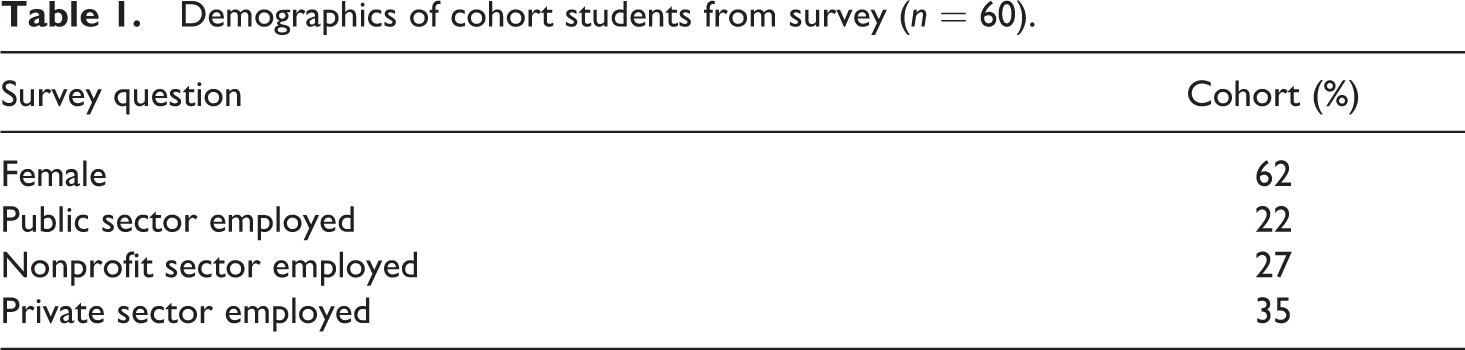
Demographic information presented in Table 1 about the sample indicates a greater percentage of female participants and a surprising finding that the private sector is the most common employer, with the nonprofit and public sectors not far behind.
Demographics of cohort students from survey (n = 60).
To better understand how the program influenced their professional development, the survey asked respondents to assess their own confidence in a number of competencies directly related to the course learning objectives, considering their levels before the course and after completion. They rated themselves on a five-point scale, where 1 denotes “none,” 3 denoted “average,” and 5 denoted “excellent.” The results are found on Table 2. Using this self-reported information, our analysis reveals strong program impacts. On all items surveyed, there was a statistically different change, with some items – notably qualitative and quantitative analysis – receiving an average change in more than one point. The next highest average change was in another technical competency – evaluating policy options. In the more “soft skills” of communication, engagement with others, and professional connectedness, students came in feeling more confident; yet, in those areas, there was also reported positive change, although of a smaller magnitude. These findings suggest that content and process in the course design and implementation had its intended effect.
Change in cohort students’ professional competencies (n = 60).

Paired t test p value:*p < .05; **p < .01; ***p < .001.
The survey also provided evidence about other types of change. Half of the respondents reported significant job responsibility changes since entering the program. Of those experiencing job responsibility changes, 71 percent indicated that learning from the program was helpful in achieving these changes. Salaries also increased for 52 percent of program participants, with one-third reporting earnings increases of more than US$10,000 per year after entering the MPA degree. Additionally, 75 percent of those surveyed reported experiencing greater meaning in their work since entering the program.
The course design and implementation attempts to create settings where participants can develop deep relationships with fellow classmates and faculty from diverse backgrounds as they are learning technical and leadership skills. When asked in the survey about their level of comfort in sharing personal emotions, 82 percent reported either “comfortable” or “extremely comfortable;” none of the 60 respondents reported feeling “extremely uncomfortable”.
Thus, our analysis of the three sources of data provide some sources of information about how the cohort program expanded students’ capacity to more effectively engage in its core learning objectives. Participants developed an enhanced array of technical skills relevant to building an evidence-based case for policy change. They learned to evaluate policy options and collaborate with diverse stakeholders. They also developed a richer understanding of connectedness across demographic diversity. As their awareness and expanded appreciation of diverse perspectives grew, they built a more robust professional network of colleagues who have roles in the private, nonprofit, and public sectors.
Conclusions
In this paper, we have described and assessed one model of professional education designed to build capability, agency, and responsibility among public affairs professionals in the US. While the evidence we gathered suggests our approach is impactful to our students, this special issue also has a more ambitious aim – to promote international sharing of knowledge about those who teach public affairs. In this regard, we would like to highlight three implications for other educators in our conclusion.
First, while there is increasing use of information technology in public affairs courses around the world (Ginn and Hammond, 2012; Ho et al., 2006), we hope this account is taken as further evidence that technology is merely the means to an end, not the end in-and-of-itself. Use of hybrid or fully online courses will be hampered without careful attention to course design, pedagogical approach, and teaching practices. Of these, the nuanced judgments of teaching practice are, to us, the most important toward enabling transformational change in students. While a course design or pedagogy might reflect “best practices” from the science of teaching and learning, the little encouraging interactions that instructors have with students, affirming their efforts and pushing them to achieve more excellence, seem particularly impactful. Purposeful implementation of course design is essential.
Second, it is essential to build formative evaluation into course delivery. In this example, we report information gathered from students at multiple points in time to emphasize how feedback is essential in making modifications and improvements during every course offering. This flexibility mirrors what we are asking our students to demonstrate in their leadership practice. And, although we have carefully designed each course session and student assignment, regular feedback mechanisms are essential to assuring that we are hitting the intended mark or providing information so we can make adjustments. Practice is never perfect. But regular information allows us to deliver a high quality program.
Finally, teaching professional education in public affairs is significant work, which demands our attention and care. Today’s public problems emerge with regularity, through news accounts of crises and assaults, increased public cynicism, and widespread despair about institutional capacity. Only human action and ingenuity will change the course of these events. Higher education has a unique role in helping to encourage, enable, and shape adult learners so they can step into the fray and help co-create solutions. Working to enhance our own skill in course design and implementation is one important way that we can support positive change. In writing this paper, we hoped to provide some inspiration and encouragement to other educators charged with doing this important work in the world.
Footnotes
Acknowledgements
We would like to thank Angela Fertig and Gary DeCramer for their collegiality in developing and refining this model. We also benefit deeply from the hundreds of mid-career students who have engaged in this program with their hearts, minds and souls.
Declaration of conflicting interests
The authors declared no potential conflicts of interest with respect to the research, authorship, and/or publication of this article.
Funding
The author(s) declared no potential conflicts of interest with respect to the research, authorship, and/or publication of this article.