



Abstract
This paper focuses on Denmark’s Master of Public Governance and its assessments and lessons learned. Denmark is seen to have an efficient economy and public sector, a digitalized public service delivery system, and an advanced work–life balance. The Danish government invested substantial resources into developing a Master of Public Governance program – a flexible and modular program for public managers to take over a period of up to six years. The paper focuses on the Copenhagen version of the Master of Public Governance program. More than 1000 public managers from central, regional and local government are now active in pursuing an executive public management education through this program. The development, structure, content and the innovative teaching ideas are presented. The available data, including an official evaluation of the MPG program, is used to assess the program and present some lessons learned. The program has achieved its goals as public managers express satisfaction with the content and the flexible structure of the program, which suited more governance-oriented public managers with a need for strategic-thinking public managers, and has provided them with an opportunity to try out innovative teaching ideas. Lessons learned include the necessity of securing back-up from the government for a program of this considerable size, offering a flexible array of accessible and up-to-date courses and ensuring collaboration between universities offering the program.
Keywords
Introduction
Carsten Greve was the first Academic Director of the Master of Public Governance program and Anne Reff Pedersen is the current Academic Director of the Master of Public Governance program. Public management executive education has been under siege in many countries. Cutback management, lack of trust of the public sector and more wicked public problems are challenges that executive education in public management face around the world. However, there are some countries where governments have gone against the grain and have helped establish a foundation for a solid executive education program for public management. The ambitious ANZSOG (Australian and New Zealand School of Government) program in Australia and New Zealand springs to mind. Another example of a systematic government effort to improve executive education for public management has developed in Denmark.
This paper focuses on the Master of Public Governance (MPG) executive program for public managers in Denmark and offers an assessment and some lessons learned. Denmark is generally seen to have an efficient economy and public sector, a digitalized public service delivery system, and an advanced work–life balance (OECD, 2014; World Bank, 2014). The Danish government invested substantial resources (75 million DKK or circa €9m) in developing a flexible program at the executive master level for Danish public managers in central, regional and local government (Danish Government, 2007, 2008; Greve, 2013). This program has sparked off a more systematic interest for public management education among public managers and their employers. Public managers are engaged and encouraged to write about their own management challenges and to suggest action-oriented activities to solve public policy and administration challenges. Approximately 1000 public managers from central, regional and local government are currently involved at programs at the master level at both consortia and then there is the diploma level which attracts even more people.
The research questions in this paper are as follows. (1) How did the Danish executive education program called Master of Public Governance develop and how is it structured? (2) What have been the teaching innovations in the Master of Public Governance program? (3) What are the effects of the Master of Public Governance program and the lessons learned for other countries?
It is a remarkable case because of the size of the program and the exclusive focus on the Danish public manager. This paper examines the MPG program in several steps: first the paper sketches a theoretical framework that considers the wider reform development that made a program of the flexible Master of Public Governance program relevant. The focus is on the movement from traditional public administration to a governance agenda. Second, the development of MPG program is analysed in more detail. Third, a discussion follows assessing the Danish experience and its relevance and implications for public management executive education. This also includes a focus on lessons learned. Fourth, a short conclusion is provided.
Theoretical framework: The change from traditional public administration to public governance
The public sector has changed considerably in the last decades due to a cascade of public management reforms internationally (Pollitt and Bouckaert, 2011). Following Salamon (2002: 9) the Traditional (or classical) Public Administration focused on program and agency, hierarchy, public versus private (sectors seen as adversaries), command and control and classical administration and management skills while the New Public Governance model (Osborne, 2010; Salamon, 2002) focused on tools, networks, public plus private (sectors seen as complimentary to each other), negotiation and persuasion, and enablement skills. In the era of New Public Management, the focus was specifically on results-based management and markets. The more dramatic versions of NPM in New Zealand and the UK was soon challenged in many countries, and since the late 2000s a debate has raged on the impact and fate of NPM and whether a ‘post-NPM’ period had set in (Christensen and Lægreid, 2011). The changed focus toward the New Public Governance made it clear that public organizations operated in an open-system environment and had to collaborate with other actors, improve communication efforts and be sure to create results together with partners. The move toward the New Public Governance is also called various terms such as ‘Collaborative Governance’ (Donahue and Zeckhauser, 2011). OECD (2011) notes how organizations ‘together can create better public services’, meaning in collaboration across organizational boundaries. Kettl (2002) is one of a number of scholars who has identified ‘the transformation of governance’ where ‘the challenge facing government administrators in the twenty-first century is that they can do their jobs by the book and still not get the job done’ (Kettl, 2002: 22). ‘Governance is a way of describing the links between government and its broader environment – political, social, administrative. It is also a way of capturing the initiatives that governments around the world have deployed to shrink their size while struggling to meet their citizens’ demands’ (Kettl, 2002: 119). And Kettl continues: ‘Governance describes the processes and institutions through which social action occurs, which might or might not be governmental’. Setting the executive programs in this broader context of governance means that public managers need to be educated in being more than good bureaucrats, they need to understand how to be public managers in a public governance field situation where they are many actors and not just superior authorities. Other researchers have recently discussed if governance and collaboration is still the most widely dispersed trend, or whether a return to hierarchy and the state is occurring (see Pollitt and Bouckaert’s concept of a Neo-Weberian State (NWS) or Dunleavy et al.’s (2006) characterization of Digital Era Governance (DEG) where digitization is the main driver for reform in the public sector). All these reform developments have put high pressure on all public managers to be innovative, and the innovation challenge has been institutionalized by, for example, OECD, in their recent establishment of an OECD Observatory on Public Sector Innovation (OECD, 2016).
The persistent and encompassing inclination to make public management reforms has meant that public managers are increasingly under pressure (Kettl, 2015). The tasks and challenges of public managers are widely seen now to be different from that under the Traditional Public Administration framework described by Salamon (2002). Regardless of whether the present situation for the public sector is labeled ‘post-NPM’, the New Public Governance or the era of collaboration, the job of the public manager calls for changed skills from the old and known bureaucrat to a different public manager in a governance context. The movement toward results-based management has also had as a consequence that public managers must continuously demonstrate that they produce results that can be used and valued by citizens, companies and politicians, not to mention a number of regulators, overseers and evaluators both nationally and internationally.
While managers in the private sector create private value for shareholders, it has been suggested that public managers create value for citizens, politicians and other stakeholders. The concept of ‘creating public value’ was launched by Harvard scholar Mark Moore (1995), and the concept has not caught on in public management scholarship and practice in recent years. The creating public value framework was initiated by Moore (1995, 2000, 2014) and therefore puts the executive programs in public management into the broader context of changes in public governance. There are three components in Moore’s original conception of the ‘strategic triangle’ that captures his creating public value approach: legitimacy, organizing and value creation. Moore’s framework is used in some modules in the executive programs, but here it is used to inspire a theoretical framework for understanding executive education. (1) Legitimacy concerns those who inhabit ‘the authorizing environment’ of a program. In this case, it is very much the public sector organizations that purchase executive education and also the organizations in charge with public sector training development more broadly. Moore’s point was the legitimacy is not something set in stone, but that legitimacy has to be earned all the time, and that organizations must have a responsibility for making sure that legitimacy is there. Also, legitimacy can come from different parties other than just official overseer authorities. (2) The operational environment focuses on the organizing part of creating public value. There are many ways the organizing for public value can take place, and the whole set of different governance forms – hierarchy, market, networks – can be used in many shapes and ways. There is no best way to organize activities so managers would have to find out what combination suits them best. (3) Public value creation: in Moore’s theoretical framework all activities are directed toward the end goal of producing public value. Public value is in some ways equal to the output, outcome and results that are the chosen vocabulary in the performance management literature. Moore notes that public value ‘directs managerial attention to the value proposition that guides the organization. For an enterprise to succeed in producing value, the leaders of the enterprise have to have a story, or an account, of what value or purposes that the organization is pursuing’ (Moore, 2000: 197). This could in some respect be thought of as goal accomplishment. Moore (1995) has always insisted that the public is final arbiter of what public value is produced. In his recent work, Moore (2014) has been preoccupied more with finding out how organizations account for the value they have produced. Moore’s framework has gradually gotten more traction in the public management and governance literature and is now being discussed as a possible overarching new framework after traditional public administration and NPM (Bryson et al., 2014). It is certainly so that the strategic public value framework has received followers also outside the United States, and is very much informing executive education in places like the Netherlands, Australia and New Zealand. The implication for executive education in public management is that finding ways to support or improve public managers’ way to think, strategize, reflect and produce public value is a key challenge for universities and business schools.
The Executive Master of Public Governance program: Development, structure and innovation
How did the Master of Public Governance develop and how is it structured?
The history of MPG is a different story than for most other executive master programmes. MPG was not born from Copenhagen Business School (CBS) or Copenhagen University, but was born out of a compromise between the Danish labour market and the government. The structure of MPG is presented in the follow sections, by describing the student population, the strategy of the program and the placement of courses
The reform context behind the Master of Public Governance
In 2007 the Danish government agreed on a ‘Quality Reform’ of the public sector. One cornerstone of the program was to educate public sector managers through new executive master programs that should be delivered jointly by Danish universities. The three parties – the labour market representatives, the government and the employer associations of Danish Regions and Local Government Denmark – together designed the MPG program to focus on individual leadership and governance (Danish Government, 2007, 2008). Another cornerstone was the design of the program: it had to be a flexible program that allowed public managers to take individual courses and finish the program (60 ECTS) after six years. This was a break with earlier traditions where universities had designed their own executive master programs and launched their program on a free market and a new challenge for the existing MPA programs. The reason why it was called MPG was that two-year cohort MPA and MPM programs already existed and to distinguish the program in the market, the term MPG was used.
MPG was launched in 2009 with the collaboration of Copenhagen Business School and the University of Copenhagen, with all administration and teaching responsibility at CBS. Aalborg University also offered the program through a separate agreement (Aalborg University, 2015). In the other part of the country, Aarhus University and Odense University also launched their MPG (they called it by its full name: the flexible master in public governance and used the Danish words ‘fleksibel master i offentlig ledelse’ or ‘FMOL’ in their marketing of the program) (see more at SDU, 2015). This current article concerns primarily the Copenhagen MPG program. For the first three years MPG was subsidized through reimbursing government agencies that sent their staff. The last two years the education program has been financed by the workplace of the individual participant. The cost of the MPG degree is around 28000 EUR and a single course is about 1400 EUR.
The Master of Public Governance student population 1
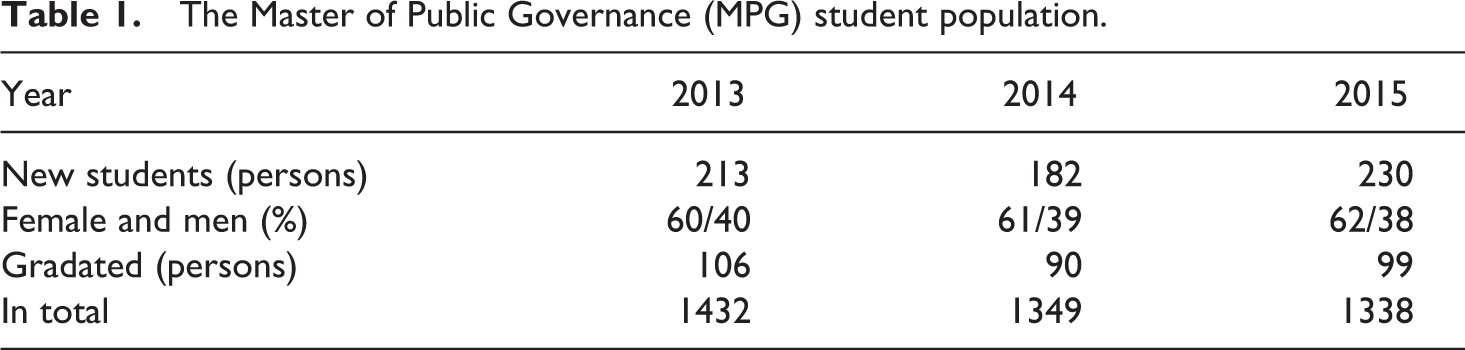
Today MPG has existed in seven years and in 2015 had 1338 active public managers as students that participate in the program (referred to as students in the remainder of the paper) (Table 1). The average age is 45 years for the public managers as students. There are two intakes to the program per year, with about 200 new enrolments per year. Around 100 public managers are graduating per year. This intake has been stable even when state reimbursement was reduced. This makes the CBS and University of Copenhagen MPG program one of the largest public mangers program in the Western world. Most of the students have between two and five years of leader experience, in spring 2016 a total of 60 students enrolled, 49 of them had less than 10 years of leadership experience. In fall 2015 the number of new students to enrol was 138, in total in the educational program 397 were female, and 249 were men. In 2015 in total 99 students graduated.
The Master of Public Governance (MPG) student population.
Some 34% of the students come from the state (ministries, police, security etc.), 19% of the students are from the regions (health, education) and 40% of the students are from municipality (schools, day-care, elderly care.), and 7% of the students come from private or voluntary organizations.
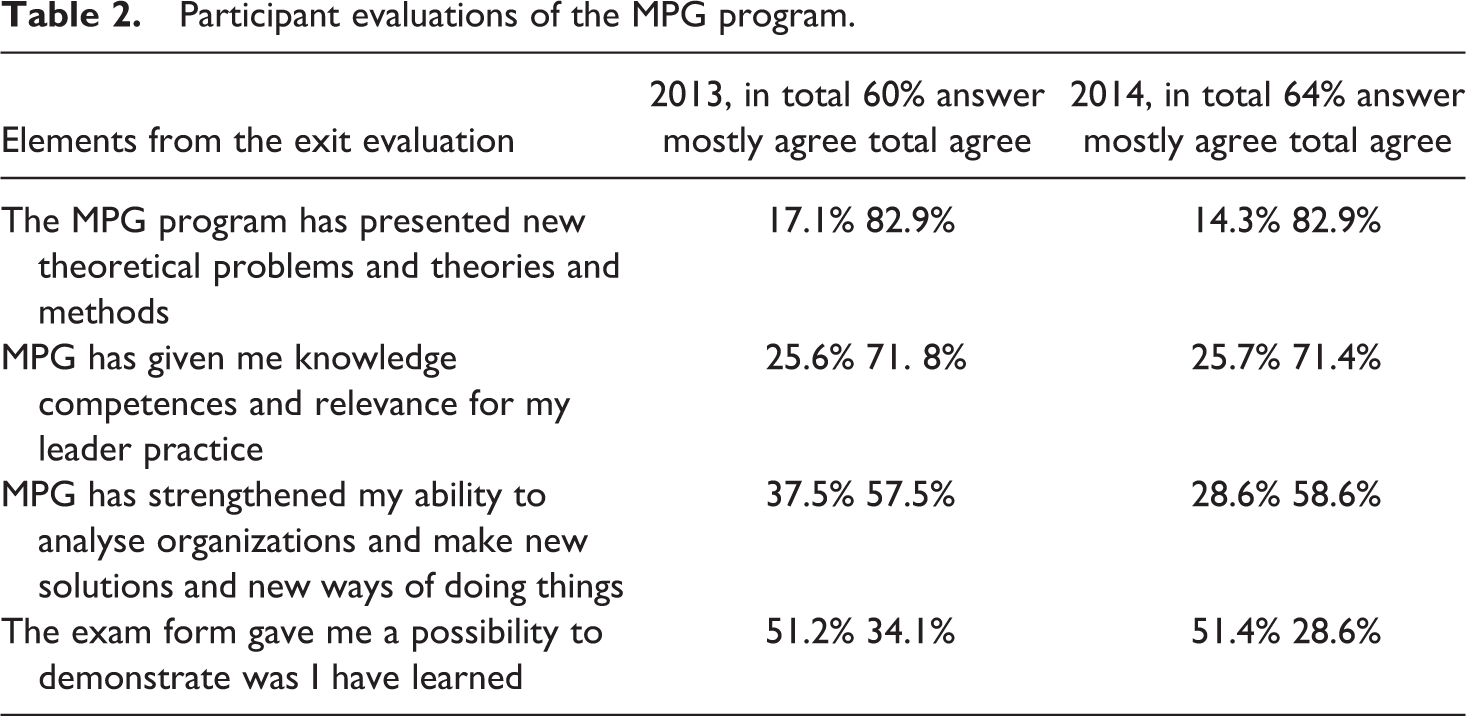
Overall the students have very positive evaluations of the program. Each course is evaluated and every year the graduated students are invited to an alumni lunch to make more personal reflections of the program with the program directors. Table 2 demonstrates how new learning has a high score while the exams forms have the lowest score.
Participant evaluations of the MPG program.
The overall strategy and learning strategy of the Master of Public Governance program
The philosophy of the MPG is based on three pillars: it is research-based which means that every course is based on academic research on public governance in a broad sense; it focuses on personal leadership which means it contains reflection on what it means to be a leader in the public sector; and it is flexible in its structure. The first pillar is the research-based principle which means that 95% of all teachers are current high-profile researchers in public governance, management, strategy, organization or leadership and their course curriculum is based on international research papers and Danish textbooks. The research debate is reflected in the classrooms with a two-teacher system and the students like the rigorous academic debate and papers as a certain university tradition that also appeals to public managers. The second pillar builds on an understanding that each course should involve leadership or management problems from the students own everyday life as leaders and also should include courses in personal leadership development. The third and last pillar is what makes MPG unique in a Danish context as it is a very flexible and modular programme.
The MPG learning strategy is based on five principles: a personal element, an organizational element (contextual factors), problem-driven (practical) element, an analytical (academic) and reflexive (critical) element. These five elements are framed by the overarching normative question of what is good management. Every course within the MPG touches upon each of these elements but in every course practice there are few learning standards. The MPG knowledge transfer is not only narrowly interpreted as making ideas work in practice, but also as expanding space of possible actions in practice. In other words, it is about extending managers’ horizon and providing them with opportunities to act differently. Being relevant means also seeing as contingent what was perceived as given beforehand. In this sense, knowledge transfer is problematization of what it is that management should concern itself with.
The structure of the Master of Public Governance program
The MPG program consists of an introducing leadership course and a personal developing course in two semesters; these two courses are obligatory. A central part of the program is the obligatory leadership module that is designed together with private sector consultants and reflects the borderland between research in leadership and personal development (this was also a requirement from the Ministry of Finance, Danish Regions and Local Government because the idea was that consultants would make the program more practice-oriented). The exams of this course are in groups and builds on relational and personal reflected leadership styles in an organizational context.
Then there are six core modules: strategy, communications, HRM, leadership and coaching, public governance, leading reform and organizational change. Out of these students have to choose four. These modules are complemented by a host of electives clustered in different themes: governance, leadership, policy issues (police management), organization and new trends, etc. Popular electives are rhetorics for leaders, trust and leadership, public service motivation, methods and public–private partnerships. Exam formats differ; but usually MPG exams ask students to write a longer project or a shorter synopsis, which forms the basis for the oral exam. Students are ranked on a scale from 12 (A), 10, 7, 4, 2 (pass), and 00, –3 (not pass). The exam form is quite formalistic. Whilst the project is also a knowledge transfer tool, the oral exam is academic in that it focuses on the content the course covered, and marks the student in relation to their ability to reflect upon that content, by following the academic rules of day studies. The program ends by the students writing an academic master’s thesis with the individual supervision of a master supervisor. A master program could look like the one shown in Table 3.
An example of a progressive MPG program for a student.
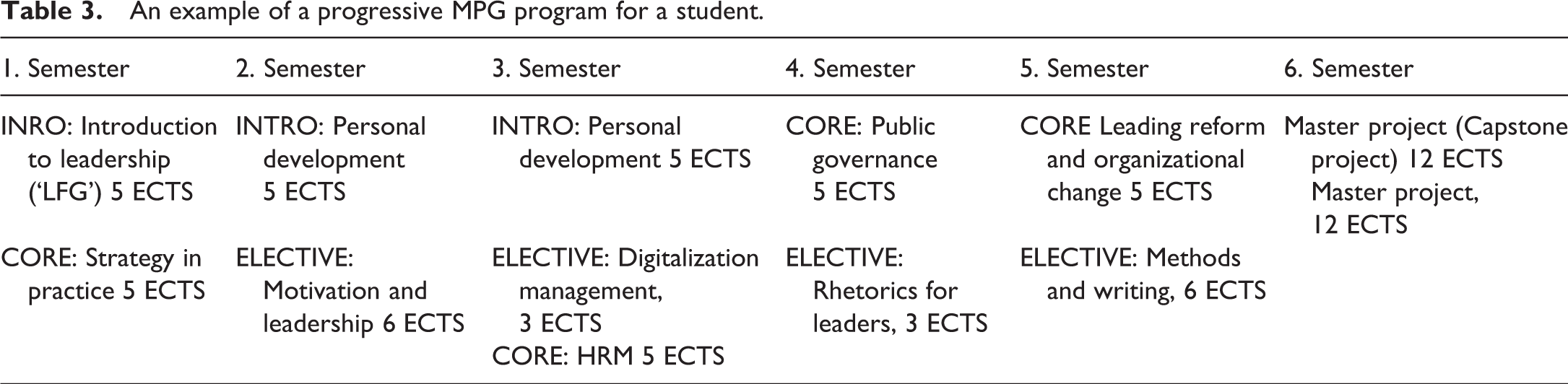
Table 3 demonstrates that MPG can be done in the order and time that suits the individual student. As opposed to a cohort model, students can do one or several courses, depending on their actual workload and other commitments. Also, their financial investment is modular: they pay for the courses they enrol on, not for the entire programme. This flexibility means that the budgeting of MPG has to be flexible too: each module has its own budget and can be adjusted according to the financial requirements. Overall, the flexible structure of the MPG is seen as one of the key features of the programme and highly appreciated by students.
As this part has illustrated, the MPG program is a distinct public management program, with its flexible structure. But also with the aim of research-based teaching and training in personal leadership development. The program meets the needs of students for flexible education and at the same time offers research-based teaching courses in areas students feel is necessary for further development.
What have been the innovations in the Master of Public Governance program?
The MPG program has been innovative in many ways in the Danish educational sector. One way is by teaching development.
The development of innovative teaching ideas in the Master of Public Governance program
CBS and University of Copenhagen faculty who teach on the MPG have developed their own distinct ways of delivering content and do not follow a ‘one best way’ approach, but rather a common element in many courses is the involvement of the managers’ own managerial practice and drawing upon the managerial problems of the students into the courses. Thereby the courses are introducing new theories of management or governance and involving the actual problems of the managers, making a synthesis of these two elements in the courses and aligning theory and practice. The main part of the teachers are researchers in public management or governance and organization and the rigorous academic focus includes relatively high-level, even theoretical, discussions in classrooms that reflect not only the content, but also on what this content means for the role of a public manager within an organization. Critical thinking and reflection are core values of the program, shared by teachers and students alike. Knowledge transfer takes place on various places. Most notably the master thesis tackles a practical problem experienced by the students. The idea here is that the thesis becomes an opportunity for reflection and an instrument to instigate change. Otherwise the different courses use different ideas to make students reflect on practice. Some examples of innovative teaching practices are mentioned below:
In the core strategy module a ‘strategy translator’ has been developed: this translator is an A3 ‘map’ in which students are asked to translate ideas from the course into their own practice. The personal leadership module (PUF) is working with the concept of a ‘micro ethnography blog’ where they are visiting each other’s organizations and observing one another to reflect on the daily leadership practices. The core module on reform and organizational change is developing mini cases and larger cases build on former student exam projects, some are by video and are include the former student cases. The core module on communication module has developed a MPG research paper, which describes the central theories and perspectives of the course. A former English elective module (in collaboration with Hertie School of Governance) used site visits to an innovation lab to make the students more actively reflects on the methods and theories of the module.
There are many more individual examples of how each module is working with optimizing teaching and the dialectic relations with the students, so training, reflections and analytical capabilities are built into the program.
The Master of Public Governance program and the ability to create public value
One of the biggest successes of the MPG program is that the student has a very high degree of satisfaction of their courses and the teachers love to teach in this program. The high number of students is also a surprise. Another of the potential issues of this large public management program is the ability to focus on the problems on the public managers and discuss them in a more general view and try to address new ways of thinking of problems and solutions. Creativity and the ability to reflect in new ways are opening new doors to make the mangers more open for new ideas and the flexible structure are make them meet a lot of other public mangers from state, region and municipalities and even the voluntary sector, which allows them to learning from each other and also learn about the board perspectives on the public sector in the society. Here are some examples from the students’ exam for the core module reform and organizational change module in the spring of 2016.
A director for all elderly care services in a large municipality north of Copenhagen was using her exam project to examine how she could make her nurses and therapists become more economical responsible and at the same time create meaning and trust in her organization. The head of police of Copenhagen used his exam project to investigate how his staff can create new meanings and new public value in this organization even when the policemen’s work task and criminal cases are doubled up after the terror attack. The leader of the maritime accident commission was using his exam project to investigate the formal organization in changing from a juridical-oriented commission to a learning-oriented commission. A medical doctor was using his exam to explore how a new government initiative on appointing a ‘Patient responsible doctor’ (a doctor who would be a main medical contact person for a patient coming to a hospital) was possible to implement in practice. This medical doctor had worked with more responsive doctor–patient relationships for a long time and had many ideas on how to institutionalize such a system on a nationwide basis.
These examples are just four out of many that demonstrate how the students are using the MPG program to create new public value. In these examples some of the new ideas were also inspired by the theories of the module-like reform theory and change theory (Pollitt and Bouckaert, 2011) on public management reform, and Weick and Quinn (1999) on organizational change. These exam projects illustrate how the students are not afraid to use themselves and to try new methods and theories in practice. Sometimes the teachers are surprised by the direct use of social science theories in everyday problems of public managers, but the students are facing the global problems of Western welfare society and have to deal in everyday practice with increased elderly populations, with more pressure on social and health care services, requirements of new solutions for societal security and immigrant integration and pressure on cost, efficiency, but also on better work life, user satisfaction and co-creation.
Even if this situation of innovative capacity from both teachers and students are remarkable, MPG is also facing some challenges: one challenge is to make a partnership and collaboration between two different university traditions at the business school and at the university. Another challenge is to create progressive learning between the single research departments and institutions and to maintain a strong focus on research-based teaching in national educational environments with current public cutbacks. A third challenge is to support public managers as students’ ability to learn and develop further in order to reach greater potential.
Discussion: Assessment and lessons learned for executive education programs
This section discusses how the MPG program has made an impact on the Danish executive education system. So far, there only exists one official evaluation. This evaluation was made by the Ministry of Finance (2012) and their related partners (Local Government Denmark, Danish Regions) in 2012. A survey was issued which 893 public managers answered (the survey covered all MPG students in the whole of Denmark). It therefore makes sense to refer to the official evaluation first. An internal evaluation was recently conducted by Copenhagen Business School (2016). A research project called LEAP (Ladegaard et al., 2014; LEAP, 2016) led by researchers from Aarhus University is using experimental methods to examine the relationship between leadership training and performance. This study concerns students in the Aarhus/Southern Denmark program and is not yet concluded and will therefore not be referred to further in this paper.
The official Ministry of Finance report from 2012 started out by stating some facts about the participants: 60% are women, 50% are over 45 years old, 49% already have a higher education degree, 45% come from local government, 22% are from the regions, 25% from central government, 50% come from three dominant sectors – the social sector, the health sector and the education sector. This corresponds very well with the extensive Danish welfare state.
Participants chose the MPG program for three primary reasons according to the report: the expectation about flexibility, the relevance of the topics related specifically to public sector management, and the possibility of attending a personal leadership oriented program.
Evaluation of the quality of the education took several forms. Participants rated the overall quality of the teaching at 3.9 on a five-point scale (Ministry of Finance, 2012: 24, table 4). Some 78% of participants were of the opinion that the flexibility to put together your own program in a time period of up to six years was most valuable (Ministry of Finance, 2012: 27, figure 21). When asked if the education had any effect of their daily management practice, 65% of the participant answered ‘to a very high degree’ or ‘to a high degree’ while 29% of participants said ‘to some degree’ (Ministry of Finance, 2012: 33, figure 25). When asked what competencies were strengthened by the education, the three high scoring themes among participants were: improved competency in management theory and analytical capacity, reflexive competency, and personal leadership development (Ministry of Finance, 2012: 26, figure 5). When asked if their new education had improved their possibilities in changing to a new job, 47% said ‘to a very high degree’ or ‘to a high degree’, but there was also a group of 36% who said ‘to some degree’ (Ministry of Finance, 2012: 35, figure 27).
A very small sample of organizations’ leaders (N = 7) and managers’ colleagues (N = 13) were asked what they thought the executive education had meant for their managers. One question was formulated about the degree to which managers became better at change management. Five colleagues and one CEO thought ‘to a high degree’ while five colleagues and four CEOs though ‘to some degree’. These numbers are not very impressive, but they are also a very small sample.
The reform of executive education through the MPG executive education program has been designed partly in order to help Danish public management reforms to be implemented. Denmark reformed its public sector dramatically in the years from the mid-2000s. An effort to modernize had gone on since the early 1980s. Denmark followed the path of many countries in reforming the NPM mode of introduction management techniques from the private sector. From the mid-2000s, Denmark embarked on a series of structural reforms where organizational boundaries were changed and where organizational units got bigger. In 2007, a structural reform of local governments changed the number of municipalities from 271 to 98 and the number of regions (then called counties) from 13 to 5. Also in 2007, the police and courts were reformed as the number of police districts was reduced from 54 to 12 and the number of primary courts was reduced from 82 to 22. The number of universities was reduced from 12 to 8. Later reforms have included a primary school reform which reformed the way of teaching and the working conditions of teachers, but also meant that the number of schools have been reduced, primarily in the country side. All in all, the recent reforms have put public organizations under pressure in order to show results and be efficient. That in turn has put pressure on the public managers who have to be on top on their managerial game.
The advent of the MPG executive education program has unfolded at the same time as these reforms began to be implemented. The government and its partners in local government and regions have acknowledged that public managers must possess adequate managerial competencies to be able to manage public organizations in a time of reform.
Additionally, the ‘market value’ of the participants on the job market might become better, although this perspective does not translate as easy as in the US into increased salaries (which is the usual benchmark for MBA students). Summarizing creating public value, public managers taking the executive programs for the public sector improve their chances of becoming better at making strategic interventions, strengthening their capacity for change, and seeing a strategic perspective to advantage their organization’s goals and contribution to society and ultimately to citizens. The current way alumni are followed are via the LinkedIn-group for MPG-students and alumni that has been established. The LinkedIn group is fine, but there is still a lack of systematic data on the career patterns of MPG graduates. There is increasing anecdotal evidence that that MPG-degree (or another executive master) is becoming the required norm for receiving promotion, but no hard evidence of this trend exists yet.
The following lessons have been learned. First, there was a government push for making executive programs for the public sector. The push was born out of a political process that happened just before the global financial crisis. The Danish government wanted to secure its ‘Quality Reform’ and to ensure support and especially trade union support, the government agreed to fund a large initiative for improved executive programs for the public sector. The government pushed both the diploma level management education and the executive flexible master’s programs of which this paper has dealt with the latter. So it was an act of politics that helped shape the historical push for reform in this area. Reform activity had been high in the Danish public sector, and it was therefore sensible to invest in better training so that the competency level of managers could be heightened. It will mean that Danish public managers are better able to cope with reforms. Second, the program has been flexible and has been able to deliver top-class research-based teaching. Public managers as participants in the course express satisfaction with the received education, both in terms of the flexible format and in terms of the content. The universities have responded by creating flexible programs that allow for public managers to take courses when they want to and with content that suit their needs. The public managers and the Ministry of Finance have stated that they are satisfied with the content of the program. The main challenge is to keep the content lively and updated and researchers teaching in the programs must therefore constantly present cutting-edge teaching material that public managers can benefit from.
A key challenge in the future is to explore the causal relations between the competency level of Danish public managers after they have been on executive programs and the performance of the Danish public sector. That would be the real test of how well the executive programs are doing. Some reflections on the future: there is a positive feeling about the Master of Public Governance program as it seems suited to the general development described in the theory section where Traditional Public Administration is being followed by various strands of the New Public Governance, and where public managers have to act in both a robust and an innovative manner to deal with the number of stakeholders influencing the production of public services. The central funding support for the program has now ended, but individual government organizations keep on funding public managers to go on the program. It was expected that there would be a sizeable downfall in the number of applicants. But this has not happened, and public managers continue to apply to enter the Master of Public Governance program. Health Care and the Police are examples of sectors that still sending many of their public managers to the MPG program. This leads to the likely conclusion that the program has become an institutionalized part of the Danish public sector executive education offering. The initiative for the flexible master’s in public governance has turned out to be sustainable for the future.
Conclusions
The main argument in this paper has been that there has been substantial and remarkable development with the Danish Master of Public Governance program in Denmark. The program allows for public managers to take the modules in a flexible manner over the course of several years. The MPG program has brought innovative teaching ideas forward. MPG helps public managers to create public value in a variety of was. The MPG program is being assessed favourably by the public managers that participate and in official evaluations in Denmark. Lessons learned are that a government intervention for a program of this magnitude to work is important, and that continuous improvement among the universities involved remains essential. There are some challenges. For the universities involved, the challenge is this: a business school and a university must work together collaboratively and it does take time to get used to each other’s wishes. For the documentation issue, the challenge is this: there is a need for even more hard evidence on the public value the public managers produce. Current research efforts through the mentioned LEAP project notwithstanding, more official evaluations and independent assessments of the results achieved are clearly needed.
Assessing the Danish development with the MPG program is relevant because other countries might entertain the idea of building similar last scale public management education programs. If countries embark on such an effort, the main lesson is that both governments and the educational institutions must be fully committed to the program. The main achievement of the Danish program is that within a time span of seven years now, more than 1500 public managers have followed the Copenhagen program (and similar numbers in the other part of Denmark in Aarhus and Southern Denmark). All of these public managers have been educated to seek a better public value production opportunities. The achievement will be all the greater if the Danish public sector overall benefit by being more effective, open and responsive to the citizens.
Footnotes
Declaration of conflicting interests
The author(s) declared no potential conflicts of interest with respect to the research, authorship, and/or publication of this article.
Funding
The author(s) received no financial support for the research, authorship, and/or publication of this article.