




Abstract
Doctoral education is increasingly of interest to higher education researchers and policy-makers as the qualification’s diversity, governance, reach and policy outcomes come under growing scrutiny. In the context of these changes, the paper adopts for the first time since Cumming’s seminal study, a practice-based exploration of the social, material, textual, and professional learning of doctoral candidates in an Australian university. The exploration, drawing on empirical data and practice-based analyses of the university as ‘organisation’, examines divergent and growing pressures on the qualification. Data indicate that current arrangements privilege sociomaterial (disciplinary) learning. Textual practices, central to accomplishing the dissertation, develop over time and in irregular fashion across disciplines, as candidates learn new rhetorical and publication practices. New practices aimed at reimagining the doctoral qualification as a vocational/professional formation program are unlikely to succeed given the prevailing nature of practices and practice-based conceptualisations of situated learning.
Introduction
This paper is set against a raft of changes taking place in doctoral education, including dramatic shifts in the role and shape of doctoral qualifications in the past two decades internationally and in Australia (Brabazon, 2016; Guerin et al., 2015). Changes signal a discernible shift in seeking to align research education with vocational/professional outcomes, societal impacts and instrumental research goals.
This paper begins by outlining emerging influences on doctoral education to reveal diverging trends in ways the qualification is increasingly being conceptualised. One trend is the focus on instrumental purposes and outcomes of the qualification, predominantly from industry and government. A contrasting trend is the emergence of scholarly concerns seeking to address the quality of supervision and access and equity concerns arising from the increasing internationalisation and diversity of PhD candidates. With these trends in mind, the paper then introduces the theoretical and methodological approaches drawn on to explore learning in the contemporary PhD. The qualification’s current form is set against its origins in mediaeval times, presaging the more instrumental visions for its future.
This paper examines the organisation of learning in the PhD from a practice-oriented perspective: specifically, how the sociomaterial, textual and vocational practices of the qualification are currently ‘bundled’ (Schatzki, 2006), that is how they link to/unfold alongside each other. The paper concludes that sociomaterial and textual practices are likely to persist given the prevailing nature of practices and practice-based conceptualisations of situated learning (Gherardi and Strati, 2012; Ronnerman and Kemmis, 2016; Schatzki, 2001). Consequently, the paper argues that aspirations of industry and government to shift the focus and purpose of the PhD radically to vocational ends are unlikely to succeed, at least in the short term.
Current developments in doctoral education
Doctoral education is increasingly of interest to higher education (HE) researchers and policy-makers as the qualification’s diversity, governance, reach and policy outcomes come under growing scrutiny (Bengtsen, 2016; DIISRTE, 2012; McGagh et al., 2016). Doctoral education is also receiving considerable attention from HE researchers interested in the scholarship, access and equity aspects of the qualification. These two trends have divergent priorities.
The first trend focuses on strengthening the nexus between doctoral outcomes and economic growth initiatives (DET, 2016; DIISRTE, 2012; McGagh et al., 2016) taking the lead from the Bologna Process Reform initiatives (EHEA, 2010) in which candidates are beginning to undertake focused programs aimed at research(er) skill development. In Australia, policy initiatives intend the doctoral qualification to advance knowledge and develop a ‘researcher’ – a graduate with entrepreneurial skills and professional and workplace-ready attributes (DIISRTE, 2012). These developments have come about as the qualification has increasingly attracted the attention of governments worldwide, with many seeing research outcomes intimately connected to increased economic achievements of national agendas.
The Chief Scientist of Australia has recently expressed concern at the fact that only 10% of Science, Technology Engineering and Mathematics (STEM) PhDs own a business compared to 23% of non-STEM PhDs (Baranyai et al., 2016). This is framed as a shortcoming of PhD training which is not enabling candidates to become entrepreneurs (Baranyai et al., 2016). Attempts to encourage candidates to become entrepreneurs, or at the very least entrepreneurial are set to be strengthened through the future research funding formula from 2017 (DET, 2016: 6), based on the number of PhD completions and the amount of research income generated by universities themselves.
In a parallel development, there is a renewed focus on improving access for different cohorts of candidates and for disadvantaged groups wishing to undertake a PhD. There is also a growing awareness of the internationalisation and cultural diversity of PhD candidates (Manathunga, 2014). Figures show the increasing spread of candidates enrolling in PhDs – including older and more culturally-diverse candidates (Norton and Cherastidtham, 2014). This diversity and priorities to improve access and tuition have led to greater scrutiny of the quality and nature of supervision (Bengtsen, 2016; Guerin et al., 2015; McCulloch et al., 2016; Robertson, 2016) of PhD candidates, including a call for supervisors to be aware of (and modify) their own cultural biases and culturally-dominant pedagogies (Manathunga, 2014).
The nature and quality of the social relationships defining a candidature – particularly the candidate–supervisor one – are very significant for the continuation of knowledge production into future generations (Manidis, In press; Brabazon, 2016; Cumming, 2010; Jones, 2013; Marginson et al., 2010; Ombudsman NSW, 2016). Recent interest in supervision quality, modes of supervision (Robertson, 2016) and the responsiveness of supervisory practices to the uniqueness of each candidate, their circumstances and topics (Guerin et al., 2015) attest to the importance of this relationship in the continuing production of knowledge.
These trends signal a desired shift in PhD education emphasising the social, entrepreneurial and demographic profiles of candidates before, during and after the candidature incorporating curricula that address broader dimensions of knowing beyond one-dimensional epistemic knowledge production. These trends diverge however in practice. Despite the external emphasis on broadening researcher skills to include professional and entrepreneurial capabilities as outlined above, the eligibility and entry requirements for most Australian universities still tend to favour candidates with productive research and academic achievement profiles. This selection process favours research and written textual excellence over professional experience sought by those outside the university.
These competing priorities raise questions about the very nature, standard and purpose of a doctoral qualification. Agreement on what constitutes the qualification, and what it is preparing, or should prepare candidates for, are increasingly in flux: The perspectives of students, employers, universities, PhD supervisors and others can be very different because they each have a different view about the purpose and value of a PhD. (Group of Eight, 2013: 30)
Introducing the theoretical approach and research methodology
This paper extends research into doctoral learning in Australia based on theorisations of the learning of social practice(s) (Cumming, 2007) and epistemic learning (Green, 2009; Maton, 2010; Paltridge and Woodrow, 2012), situating these practices in the context of a changing paradigm.
The research examines the university as a complex organisation, one in which many different participants carry out varied actions and activities, ‘nested’ in practices (Green, 2009: 47), the value-based, collective ways of doing, seeing, saying and relating. Actions and activities are examined as they happen in space and time, occurring in relation to equipment, materials, computers, things and other people. When viewed from this perspective, the university as an organisation comprises ‘bundles of practices and material arrangements’ (Schatzki, 2006: p1863).
A Schatzkian view of organisation sees what transpires there as based on past traditions and practices. The longevity of a practice is evidently complex, but is partly explained by Schatzki’s (2006) framing of work and social undertakings as teleological, that is, sustained by long-term motivations as people work towards certain ends or goals in which they are invested and to which they are attached. These adherences to work and social practices are similarly explained by other theorists as ‘attachments’ arising from discursive practices that refine and perpetuate what people do through collective appraisal, mutual values and aesthetics (Gherardi, 2009, 2012). The university as an organisation is thus a place of learning in its teleology and in its essence: its practices are learned and perpetuated in situ (Schatzki, 2006).
Academics, students, research candidates and others in the academy may be motivated in different ways, but predominantly they work towards the production of knowledge in epistemic contexts. The doing of this work, begun long ago as a mediaeval tradition, shares many of its early practices today. The doctoral qualification evolved from a master–apprentice relationship of practical, discipline-specific learning in preparation for a life in academia. The title of ‘doctor’ itself dates back to the Middle Ages, the term meaning ‘teacher’ (Group of Eight, 2013). A relational pairing with a supervisor (still largely discipline-specific) emerged in the nineteenth century, with Germany leading the way towards the modern PhD. This qualification required the production of a written dissertation with a supervisor, and a successful oral defence of the work.
Today a supervisory–candidate relationship prevails and the qualification is still mediated through means of a specified textual artefact (Bastalich et al., 2013) – the dissertation – combined in some instances with an oral component, known historically as the Viva Voce Manidis and Addo, 2017. Disciplinary doings, sayings and relatings and the textual (dissertation) practices of the qualification are thus historical, and have prevailed largely intact in preparing candidates for their organisational lives in academia. The endurance of these two dimensions and their associated actions and activities confirm what extensive research into organisations as unique sites of change, learning and work has shown: change is slow and practices tend to persist and prevail (Czarniawska, 2004; Gherardi, 2012; Price, 2013; Schatzki, 2013).
Situated learning and the perpetuation of practices in organisational settings inform the analysis and argument of this paper (Gherardi, 2006; Kemmis et al., 2014). From this perspective, ‘knowledge…is a product of the activity, context, and culture in which it is developed and used’ (Blakeslee, 1997: 126). Knowledge reflects what occurs amidst a collection of people in a site and its tangible materialities and arrangements. This melange of people and material arrangements is considered as the ‘sociomaterial’ setting and is central to learning in that context (Fenwick et al., 2011; Schatzki, 2010).
Kemmis (2013) has made explicit the ‘nexuses of practices’ (Schatzki, 2006) beyond the immediate ‘social and material’ arrangements of a site by identifying broader governance frameworks. These include cultural–discursive, social–political and material–economic arrangements, as shown in Figure 1. For example, the cultural–discursive arrangements of the doctoral site of practice both shape and are shaped by the communication practices (sayings – including writings) of the participants, and prefigure what can be said and thought within that site of practice. Arrangements include the discourses of a specific discipline, as well as the discourses of novice and expert researchers.

Practice architectures (adapted from Kemmis, 2013: 3).
Figure 1 illustrates the relationship between practices and practice architectures, showing how the practice architectures, or arrangements, hold the practices in place, if only for now. The elements of a practice are represented by the circular arrows within the diagram (doings, sayings, and relatings) held in place by practice architectures, represented by the circles of the diagram (the arrangements). All of these interact with one another to enact the project (in this case the completion of the PhD), represented by the large horizontal arrow, which is the intended outcome of the practice. This paper adds ‘seeing’ as a key action to doings, sayings and relatings, following Nicolini et al. (2003). Seeing is significant for learning, based on Bourdieu’s notions of learning in institutions through imitating (Sieweke, 2014) and Knorr Cetina’s (1999) work on the role of seeing in the production of scientific knowledge. Practice architectures, like practices themselves, can change and are more open to doing so given that they comprise larger (and more volatile) political, economic and social arrangements, as outlined above.
The empirical data in this paper come from two studies: a structured precursor evaluation survey of International Higher Degree Research (IHDR) candidates; 1 and an extensive in-depth ethnographic study of IHDR candidates’ in situ learning. 2 In the former, carried out in July and August 2014, 11 supervisors and 26 IHDR candidates in focus groups and one-on-one interviews responded to questions on candidates’ early learning experiences. Questions sought to establish how candidates had settled into their research degrees and had experienced logistical, procedural, pedagogical, informational, cultural and linguistic orientations to the university in their early days. Supervisors were canvassed similarly about ways in which they (or their faculties) had supported candidates in those areas. Issues identified in this pilot led to two outcomes: the design of an orientation program (only briefly addressed in this paper); and an in-depth focused and linguistic ethnographic research project, whose findings are under discussion here.
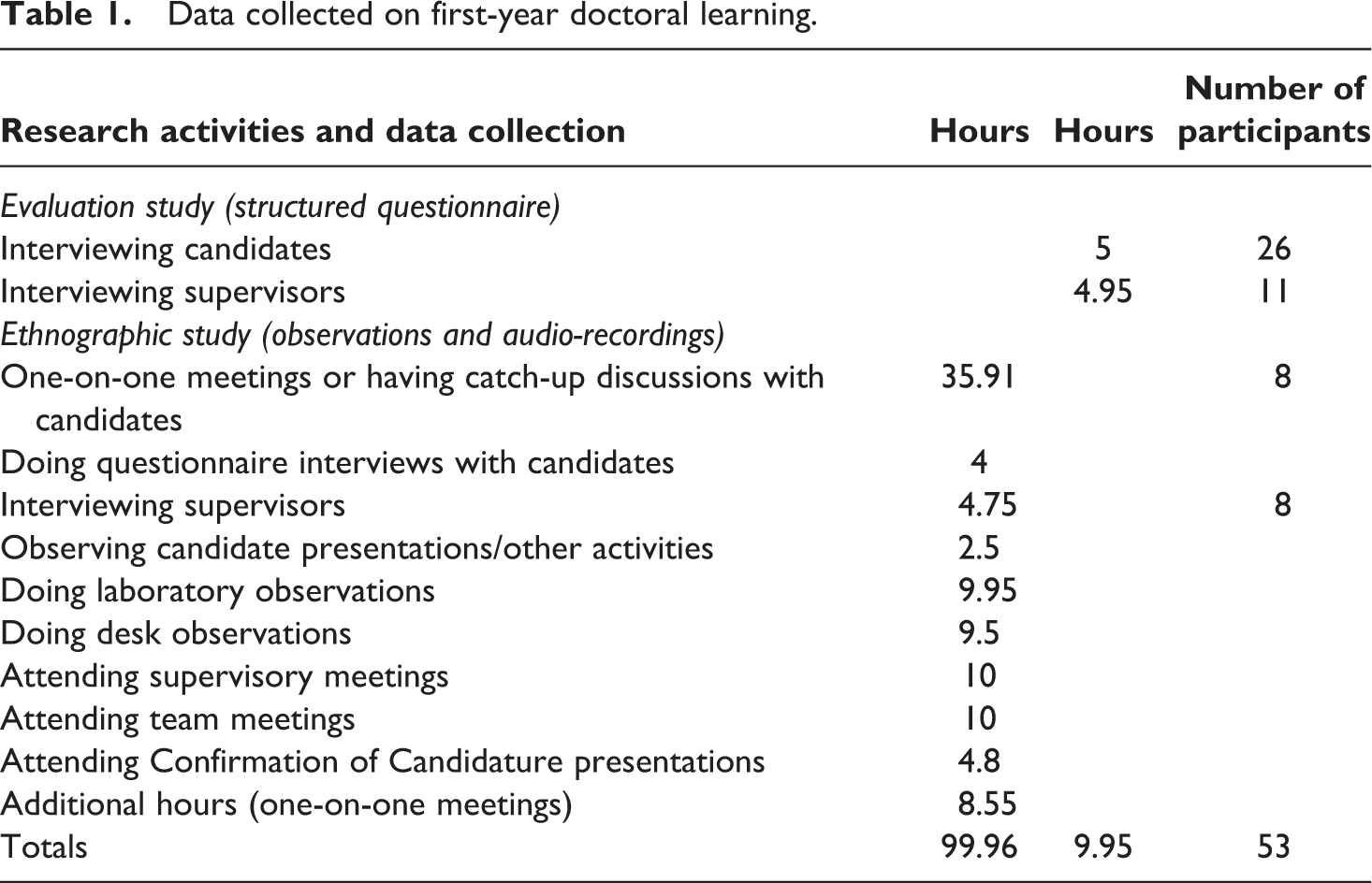
This in-depth ethnographic study, undertaken between April 2015 and September 2016, recruited a further eight IHDR candidates and their supervisors from a range of disciplines. Candidates nominated to participate in a project that would closely follow them in their first year and explore their learning and participatory experiences in the university. Observations and audio-recordings of candidates in supervisory meetings, in seminars, in laboratories, at their desks and at the Confirmation of Candidature presentation and interviews with candidates and supervisors formed the basis of the data, using focused and linguistic ethnographic methodologies (Knoblauch, 2005; Rampton et al., 2015). Over 100 hours of in-depth observational and audio-recorded data were collected from the two studies, outlined in Table 1. In total, fifty-three participants from five faculties were directly involved in the research with many more as bystanders, when present at team meetings and/or seminars.
Data collected on first-year doctoral learning.
Limitations of the data
The cohort of the ethnographic study is relatively small and the investigation of solely first-year learning appears restrictive. However, the focus on a limited number of individual candidates within this period of a PhD candidature was intentional. The design of the study sought to conduct an in-depth investigation of candidates’ initiation into disciplinary, textual and/or vocational practices in a period characterised as one of intense institutional, disciplinary and research learning (Brown, 2014). These restricted parameters have provided, despite their apparent limitations, rich data whose findings resonate with other studies in academic and/or doctoral contexts (Casanave and Li, 2008; Cumming, 2007; Fenwick et al., 2011; Nerland, 2012; Paltridge et al., 2016; Parry, 2007; Perrotta, 2015).
The following section discusses findings on the sociomaterial, textual and vocational practices of IHDR candidates.
Examining sociomaterial practices in the PhD
The eight PhD candidates entered an existing epistemic ‘timespace’ (Schatzki, 2010), made up of practices and material arrangements that had been in that space for a time already, would remain for now and would be likely to continue in that place into the future.
Candidates were immediately initiated into the local practices of their faculty sites. Socially, they connected to faculty staff, to other candidates, to librarians, to teachers, to the graduate research school personnel, to each other, to information networks such as the library, to the Internet, to postdocs, to (new) friends and to professional research staff. Materially they engaged with the technologies, spaces and artefacts that surrounded them. As they undertook laboratory supervising, delivering of presentations, writing, liaising, reading, listening, sample analysing, data collecting, socialising, participating in meetings, and attending of seminars, they were learning (and being initiated into) the doing of these practices.
Following Kemmis (2013), the sayings, doings and relatings of their practices, were held in place by practice architectures. These architectures held in place practices unfolding in situ as candidates produced their knowledge, focusing extensively on observations of natural phenomena and drawing on visual practices in their work. In science, for example, candidates were learning to read graphs and figures as well as multimodal data and computerised images. A supervisor pointed out to a candidate what to ‘see’ as they jointly viewed graphs and figures on a data screen: …in the optical when you cut back the optical properties you should see a transition from there to there…so what I’m expecting….and the main transitions will be across the band gap…so you’ll see….[…] go up there…but there’ll also be a peak down here somewhere…(Science supervisor) [The candidate learns] how to interpret stuff…graphs and data…that’s just the way we [scientists] work…that’s the main skill we are trying to transfer is the ability to be able to interrogate data and see the important bits (Science supervisor)
In Humanities Arts and Social Sciences (HASS), candidates were initiated into rhetorical perspectives on their topics, learning how to develop a ‘gaze’ (Maton, 2014) from a particular theoretical standpoint. Creative arts and education candidates engaged with texts, installations, cameras, things and artefacts in their learning from varied perspectives. One supervisor initiated her candidate into ‘seeing’ that ‘knowers’ on her topic – climate change – would have different perspectives. Her comment demonstrates how the candidate is inducted into developing the ‘trained gaze[]’ (Maton, 2010: 165). It would be useful to think about who the theorists are – educationalists, sociologists, psychologists, etc. Establish clearly and early your orientation and perspective…establish where you’re coming from, your epistemological position…
As candidates connected to the people and materialities in their candidature, learning was understood as a predominantly sociomaterial accomplishment (Manidis, In press; Parry, 2007). While the empirical data analysis covered all/many aspects of first-year research learning, the focus was predominantly on their initial sociomaterial learning. However, it was recognised that at some point in their candidature, usually towards the latter part, the dissertation would emerge as a unique product of each candidate, their supervisor, the discipline and the multiple social and material experiences they each would be drawing on to fashion its textual representation.
Examining textual practices in the PhD
This section partly draws on empirical data referencing some practices in the university regarding the assessment criteria of the dissertation and the delivery of spoken presentations. This section also draws on extant literature and pursues a parallel theoretical exposition alongside analysis of the empirical data.
In this paper ‘textual’ refers primarily to the primary written and spoken texts used by candidates to share their knowledge publicly as part of their candidature. As candidates in the University of Technology Sydney, they are required to deliver three spoken presentations – Stage 1, 2 and 3 – alongside three written papers, which they are required to conduct and submit in English. The ethnographic study followed candidates to the end of their Stage 1 (Confirmation of Candidature) presentation and submission of the Stage 1 paper, which took place approximately 12 months after their enrolment.
Textual in the context of this paper also includes the preparatory initiation into reading, speaking and writing practices producing a textual artefact – the dissertation in this university. Here, as in most other universities, candidates are required to prepare a dissertation written either alone or in combination with an oral component. Variations on the text might range from a single dissertation to a portfolio or in some cases an exegesis binding together a number of shorter related papers or reports (Paltridge et al., 2016). Variations on the dissertation include professional doctorates, creative practice doctorates, online doctorates and doctorates by publication to name a few. Professional doctorates for example, initiate arts/business/education/legal practitioners into the practices of research, as candidates seek to either augment their professional practice with evidence-based research or enter academia. If practitioners opt to remain practising in their fields, it could be argued that the ideal academic/vocational hybrid candidate, now desired, is formed. However, not everyone sees this as an ideal with some regarding the professional doctorate as potentially diminishing ‘the epistemic foundations of doctoral study’ (Parry, 2007: 144). In any event, these variations reflect very different formats of the qualification often with little parity (Brabazon, 2016; Smith, 2006).
The academy governs textual production in a number of ways. Firstly, candidates who ultimately succeed in their candidatures will need to accomplish a set of very specific textual practices in English. In the University of Technology Sydney, the final dissertation criteria for the written thesis stipulate mastery of a range of directly textual features such as cohesion, coherence, spelling, punctuation, grammar, structuring and the worthiness (or otherwise) of material in the thesis for publication. In addition, aspects of logical and clear thinking, argumentation, understandings and knowledge of the disciplinary field, the mastery of techniques of analysis, the presentation of ideas in succinct and cogent fashion are all expected to be realised textually. Whether the dissertation is a review, a critique or an original investigation, it is through the written text that the standard of quality is judged and the qualification is attained or not. In the technical disciplines, research candidates are expected to publish throughout their candidature (a minimum of three papers in highly regarded journals is seen as appropriate), and the publications record is part of the PhD progress report.
Textual accomplishment also applies to those already in the academy, with academic measures of success regulated textually based on the number of publications produced by academics – described as their ‘publishing behaviour’ (ARC, 2016: 5). In the most recent consultation paper on research funding for universities in Australia, the pressure to publish is maintained (DET, 2016: 6). Thus, for those seeking to ‘become doctor’ and for those established in the academy, measures of attainment remain predominantly textual.
Despite this reliance on the textual, the teaching of disciplinary writing in most disciplines is largely invisible, even though there is an abundance of publications (and workshops) that promise to guide research candidates to successful thesis completion. Candidates are initiated into textual practices in differing ways, reflecting disciplinary and individual capabilities and preferences of their supervisors. The situated nature of learning the rhetorical moves of the discipline varies. From the beginning of their undergraduate studies, candidates in HASS degree programmes are explicitly required to critique authors, ideas, theories and texts, whereas this is not practised in many STEM disciplines until possibly postgraduate coursework and perhaps not even then.
One HASS supervisor participating in the research had a background in teaching literacy as a social practice. She understood that a PhD in education or sociology for example would require sophisticated argumentation and rhetoric to convey a topical perspective. She initiated her inter-disciplinary candidate into this understanding very early on by suggesting that the student ‘locate’ the authors she would be citing in terms of their knowledge and authority. A science supervisor explained his faculty’s approach to developing writing practices: …for us, we’ve tried to set up a system where we have open discussions about scientific work…within our group – in that group there’s probably four or five academics and probably 20 PhD students, and in that group we try [to] get them to see how to communicat[e] that research to the broader audience – which is really hard and really, really important – how to write a paper, and construct a scientific paper that is going to get in the absolutely top journals…
Science, Technology Engineering and Mathematics supervisors were better at the strategic management of publishing than teaching actual writing practices. This included advice on where to publish: ‘There’s a journal ‘Advanced Energy Materials’ see if they have reviews’. In some cases, this was framed as a joint supervisor–candidate problem to be solved: ‘With the [literature] review we’ve decided what it’s going to be so that’s already a huge step forward, the next challenge strategically is where are we going to send it…that’s the difficult question’. Another approach was to focus on where to locate information: ‘There’s an idea, do you know how to search the various patent databases?’.
Academic literacy scholars have long understood that disciplinary knowledge is ‘represented’ through different genres (Bastalich et al., 2013; Basturkmen, 2014; Lea and Street, 2006), but the intricacy of how generic texts are linguistically realised is not necessarily common knowledge for discipline-based academics. ‘In science, for example, [scientists] seldom receive explicit instruction in writing or, of greatest importance here, in the teaching of writing’ (Blakeslee, 1997: 155). Moreover, many supervisors actively reject the role of providing guidance for research candidates’ writing, as Kranov (2009) points out in her study on international research students in the USA: ‘It’s not my job to teach them how to write’.
Learning to write in a particular disciplinary setting can be difficult because candidates are unfamiliar with the tasks they need to carry out. They struggle with the kind of feedback they receive on their writing and how its ‘conceptual complexity’ relates to their learning (Blakeslee, 1997: 148). These and other struggles are identified by Casanave and Li who point out that many local and international research candidates face challenges in acquiring the literacy practices of their doctoral programmes: ‘Patterns of and possibilities for participation cannot be taught in preparatory classes because they are locally contingent, including the specifics of reading and writing’ (Casanave and Li, 2008: 27). One candidate experienced one such generic academic literacy programme as problematic for this reason: I went to one [a workshop on writing], but those – there’s a problem when you – there’s so many different disciplines and fields and ways of writing…(Candidate in Focus Group 3)
Spoken presentations are also textual and constitute a major part of a PhD candidate’s candidature. Outlined earlier, three progress milestones in a PhD require candidates to give a spoken presentation and deliver a written Stage 1, 2 and 3 paper. In some faculties, candidates are assessed on the coherence, cohesion and responses they give to questions on their Stage oral presentations, but this is not a university-wide practice. Giving the presentation is a learning crucible for almost all doctoral candidates.
Candidates observed delivering their Stage 1 presentations showed similarities in how they went about their talks. They had learned to produce a spoken text of a specific kind in their disciplinary setting. They followed a similar spoken script, their talk endured for an agreed timeline, the presentation contained stipulated content, the delivery was multimodal and each candidate stood or sat in front of a number of faculty members and other PhD candidates. Candidates used delivery materials familiar to all – PowerPoint® slides and hand-outs Manidis and Addo, 2017.
Written textual accomplishment in the academy is the basis of how academics share their knowledge, but its teaching is largely invisible. The ability to write for publication is vital for the career success of academic researchers. However most ‘will not an any stage…be directly taught how to write for publication in refereed literature’ (McGrail et al., 2006: 14 cited in Paltridge et al., 2016: 131).
Examining emerging vocational/professional practices in the PhD
Research outcomes have been progressing towards being more (globally) competitive, more important and more industry-focused (Cumming, 2007; DIISRTE, 2012; Felt et al., 2013; Nerland, 2012). By aligning with the Bologna Process Reform initiatives (EHEA, 2010) the PhD in Australia is now incorporating focused programmes and internships aimed at researcher skill development. In the University of Technology Sydney, industry doctorates are now available for the first time and there are ten ‘real’ candidates enrolling in 2017.
The University of Technology Sydney has an established history of addressing real-world problems, arising from its origin as a place of technical learning. It also has in place strategies, personnel, recruitment guidelines aimed at achieving the objectives of its own, as well as national and global, research goals. At the heart of this endeavour are the researchers, being selected and groomed to author their own presents and futures.
The University of Technology Sydney’s Doctoral Study Framework identifies learning objectives for all doctoral candidates, including industry-oriented objectives. Achievements in the early part of their study include becoming ‘familiar with…resources for identifying funding opportunities…potential sources and…strategies for funding’. Achievements in the latter part of their study include completing a Graduate Certificate in Research Commercialisation. These initiatives, including input from the orientation programme mentioned earlier, in addition to academic outcomes, are seeking to construct a researcher identity that is externally-focused, producing a candidate with an eye on strategies for increasing their own research impact.
There is limited data available in relation to actual practices of vocational alignment of the PhD in the University of Technology Sydney or other universities to date. Cumming adopted a practice-based approach to talking about what doctoral candidates did, providing a seminal framework for practices in four categories, Curricular, Pedagogical, Research and Work (Cumming, 2007: 116). In ‘Work’, Cumming listed publishing, teaching, producing, volunteering and contributing but no vocational/professional practices. This paper extends Cumming’s list and draws on what is already known about the practice architectures of universities shaping practices in this setting and experiences elsewhere. While this shift began a long time ago, identified as ‘the triple helix’ (Etzkowitz, 1983, 2003) of government–industry(science)–university, changes in the practice architectures are only just beginning to surface in Australia.
Many higher education educators are aware of the shortcomings of expecting the PhD to produce business-ready graduates. They recognise that ‘the leadership, management and even communication demands on a research candidate can be very different from those faced even by a junior researcher in business’ (Group of Eight, 2013: 38). Nevertheless, businesses and governments continue demands for the qualification to develop broad-based attributes (Brabazon, 2016). In particular, attributes such as leadership, entrepreneurship and communication are highly desirable. For several reasons, these expectations are problematic.
Firstly, even when research candidates are working in collaboration with industry, the emphasis of their research activities is on fulfilling the requirements of their academic degree, as reported by Thune: ‘their [PhD students’] day-to-day work activities are rarely influenced by industrial demands and their work is mainly carried out in the universities’ (Thune, 2010: 478). Participants in local sites of practice model the practices of these sites. Prevailing practices enshrine the researcher academic as the model or the embodiment of research practices, which differ greatly from research practices outside the academy, as documented by Hayes and Fitzgerald: One researcher described working in a publicly funded institution as travelling in an armoured tank, compared to which commercialisation work in a hybrid industry-research organisation was riding a moped through busy traffic, without a helmet (Hayes and Fitzgerald, 2007: p. 2).
Some actions and activities may disperse across different professional contexts, but the practices they underpin in these different contexts – that is, the values, rules, protocols and social relations – differ. Each ‘industry’ and subsequently each workplace in that industry will have different practice requirements. From a practice theory perspective, ‘skills’ are not considered as decontextualised or seen as generic doings, sayings, seeings and relatings. Rather they reflect capabilities that are site-specific ‘know-hows’ and ‘know-thats’. Each context, each setting, each rendition of a practice will call upon situated knowing-how and situated knowing-that. Situated knowing-how and situated knowing-that are learned as workers or candidates assemble knowledges and information in a specific site and enact these appropriately in recognised ways carrying out practices that are germane to each setting.
In a similar way, communicating successfully in a particular environment is something that relies on very specific contextual parameters of who is talking or writing, who is interacting with the speaker or writer and what is being said or written. It is customary to speak about ‘communication’ in generic terms, but treating it as a collective capability is neither useful nor accurate, given the advances in linguistics and language theory over several decades which have revealed each spoken or written text to be a highly contextualised and customised accomplishment (Halliday and Matthiessen, 2004: 2).
Discussion
Data and extant research indicate candidates are learning ways of doing, seeing, saying and relating in their PhD that are specific to the university and particularly to their disciplinary academic setting. Current practice architectures governing PhD candidates privilege disciplinary (sociomaterial) arrangements. Epistemic knowledge is paramount, mediated secondarily through textual practices and through assessment criteria for dissertations and publication outputs. The cultural–discursive, material–economic and social–political arrangements of the PhD candidature hold in place practices that valorise epistemic knowing and the production of scholarly texts above vocational or professional practices (see also position adverts for academics in this regard in Pitt and Mewburn, 2016).
If learning and knowing are situated and if sociomaterial outcomes are privileged in the current configuration of the PhD, then it follows that candidates are ‘becoming’ disciplinary scholars and (ultimately) writers, not necessarily consummate workers across a range of very diverse occupational settings. This focus of learning does not mean a candidate might not learn ‘dispersed practices’ (Schatzki, 1996: 92) understood as more generalised practices that exist across work settings and contexts. However broader professional skill sets, while desirable and articulated at policy and faculty levels, are not yet central in the qualification’s current configuration. Candidates will not be initiated into these practices by supervisors who are unfamiliar with or do not have corporate attributes themselves, as the practice architectures of their faculty or school might not have enabled the learning of such practices.
Current arrangements in a ‘traditional’ PhD in many universities which provide work ready programmes on team building, entrepreneurship and communication will remain as in vacuo preparation (content only) until and unless candidates arrive in a real workplace setting. If the desire by policy-makers and funding bodies is to engender work-ready skills in PhD candidates, it will be essential for candidates to undertake internships in real work settings, where these candidates’ in situ learnings will at least be those of an authentic workplace setting.
The claim that the new Research Training Program ‘will ensure that research graduates have the appropriate skills to gain employment in academia, industry, government and the not-for-profit sector’ (DET, 2016: 13), is a misunderstanding of how knowledge is produced and how learning happens in situ (Boud and Hager, 2012; Gherardi, 2012).
Concluding comments
Practices and practice architectures within the university continue to privilege the sociomaterial followed by the textual in PhD candidatures. These each fulfil a notion of scholarship and learning. Because of their enduring functions, these two dimensions of the qualification are likely to prevail. Together they form the raison d’être of the PhD and academia more generally, and persist through practices which, importantly, people, are attached to and value. The ‘teleoaffective’ underpinnings of practices incorporating motivations and goals related to the practice (Schatzki, 2006) – of being an academic, of being a scientist – are professionally collective and enduring.
As the university comes under increasing educational, social and economic pressures, different priorities are competing for prominence. Many beyond the academy and entrepreneurs adhere to the container view of professional formation – one in which the candidate is filled with the information and content of a discipline, which they can ‘reapply’ in another context. While this is to some extent ‘true’ and ‘possible’, academic settings and businesses comprise very different social practices and material arrangements. Even though lessons in HE can be learnt from the workplace (Boud and Rooney, 2015), and presumably vice versa, work and educational cultures are intrinsically different from each other. Seeking to blend them into a single ‘timespace’ (Schatzki, 2009) ignores the reality that ways of relating, doing, seeing and saying will always be specific to each site. What PhD candidates do, see, say and how they relate every day is what they ‘become’ – in embodied, recognisable ways – in their disciplines, in their faculties (Manidis, In press).
The situated nature of doctoral learning is disciplinary – occasionally inter- trans- or cross-disciplinary – involving researching, conceptualising, reading, and writing (recursively) in or across these contexts. If policy-makers desire other outcomes of the qualification, such as entrepreneurship or innovation, universities must find new ways of designing these in, either in the delivery, or in the assessment of the qualification. These outcomes should match reward frameworks for academics as well. Against this however, many are warning against the dilution of scholarship in the neoliberal university (Brabazon, 2016) as external, largely managerial, pressures escalate.
The historical, current and future demands on the qualification are consequently in competition with each other. A gap in the current educational arrangements remains the irregular development of textual practices in the PhD, which at the same time relies on the production of a text as the essence of its outcome. Calls for better ways to address this deficit, especially for culturally and linguistically diverse candidates are increasing. The legacy of the dissertation (and knowledge) as textual stretches back to the Middle Ages, where writing was an elite social practice, limited to scholars and the clergy and it remains as a similarly rarefied accomplishment today. In a similar way, the legacy of knowledge production has always been and remains a sociomaterial accomplishment, produced as it is in a specific site and context.
A ‘practice account [of the PhD should be] driven by what happens in the social and material world [of the PhD]. It [should] privilege[] what occurs rather than what some party believes should occur’ (Boud et al., 2016: 9). If knowledge production continues to be realised in discipline-specific or cross-disciplinary contexts, the PhD’s pretensions as a training programme ensuring that ‘research graduates have the appropriate skills to gain employment in academia, industry, government and the not-for-profit sector’ (DET, 2016: 13) must be more closely examined. These areas of potential employment are very divergent in scope and underpinned by very different employment practices, histories and spatiotemporal realities.
The focus of the PhD is seeking to shift towards more professional applications as science becomes increasingly important in everyday life (Nerland, 2012) and as stakeholders seek more advanced knowledge to address social and economic problems. Despite these trends however, the PhD is likely to remain a predominantly social and material accomplishment built on and perpetuated through a significant knowledge relationship. Empirical data and practice theory analyses have shown that academic practices are likely to prevail and persist situated as they are in particular sociomaterial settings. This tendency for practices to prevail in situ throws into question the desires of the neoliberal and industry–government aspirations for the qualification.
While the practice architectures are shifting, with changes to personnel and newer arrangements in the university, such as the appointment of ‘managers’ rather than academics to senior positions (Brabazon, 2016), there are potential pitfalls in fully effecting the transition of knowledge production and scholarly pursuits to instrumental/ economic outcomes. It is already established that knowledge produced in an industrial setting is different from that produced in an academic setting; there may be better ways of combining these different knowledges than changing one to suit the other (Thune, 2010).
Given the prevailing nature of practices and conceptualisations of how learning is always situated, it is unlikely that the incorporation of a new economic/industrial instrumental agenda for the PhD will fully establish itself in the short term; unless there is a seismic shift in ways the qualification is both conceived and enacted.
Footnotes
Declaration of conflicting interests
The authors declared no potential conflicts of interest with respect to the research, authorship, and/or publication of this article.
Funding
The authors received no financial support for the research, authorship, and/or publication of this article.