




Abstract
Scholars have long suggested that the degree orientations of public administration programs were related to the attitudes and behaviors of students, even though empirical research had failed to confirm this relationship. The purpose of this study was to re-examine this question from the standpoint of perceptions of fit. Using a sample of approximately 500 students enrolled in 26 master’s degree programs across the country, this study confirmed that the degree orientations of graduate programs were indirectly related to career preferences, through perceptions of fit in government organizations. Students who were enrolled in degree programs that required fewer core method related courses were associated with positive perceptions of their fit in government organizations, which subsequently was associated with a greater likelihood of seeking employment in local, state, or federal levels of government. The implications of this study for public administration programs and government service are discussed.
Keywords
Introduction
Government organizations are tasked with addressing some of the most difficult wicked problems and are judged on a plethora of goals. These organizations need individuals who understand this reality, but are ready to make a positive impact. Unfortunately, the individuals who are best suited in terms of their training and preferences are in short supply for several reasons. For example, from one perspective, the individuals who are most needed by government organizations are those who are also highly valuable to other non-governmental organizations and sectors (NASPAA, 2012). Non-profit and business organizations also need individuals who have the knowledge and skills to implement public service goods, especially given the fact that many are also involved in public service activities (Osborne and Gaebler, 1992; Rhodes, 1994; Salamon, 1995). These trends have increased the competition among the sectors for the best and brightest students.
From another perspective, the desire to work in the public sector is not widespread in the general population. Most individuals do not view public organizations as ideal or rewarding places to work. National surveys consistently reveal that the young and old hold many negative perspectives about government work (Adams et al., 2000; Jacobsen and Kjeldsen, 2011; Partnership for Public Service, 2012; Pedersen, 2013). As a result, most individuals rarely consider employment in government as their primary option. Even worse, interest in government employment even suffers among students who are pursuing degrees in public administration (Adams, 2000; Bright and Graham, 2015; Chetkovich, 2003; Infeld and Adams, 2011; Light, 1999). The reasons for these trends are not fully understood.
Some have suggested that the declining interest of students in government employment may be the result of the characteristics of their degree programs that ineffectively promote the value of government organizations at best, or inadvertently confirm anti-government sentiments at worst (Chetkovich, 2003; Elmore, 1986). However, there is no evidence of a direct connection between the characteristics of degree programs and career preferences (De Soto et al., 1999; Hur and Hackbart, 2009; Infeld and Adams, 2011; King et al., 1996). This study seeks to re-explore this question from the standpoint of perception of fit in government organizations.
Existing research has demonstrated that individuals’ perceptions of fit in their work environments are strong determinants of their attitudes and behaviors (Bright, 2007, 2008; Liu et al., 2015; Mostafa, 2016; Steijn, 2008). The greater the fit between the characteristics of individuals and their work environment the higher their levels of satisfaction, commitment, and performance. This study will use the theory of fit to test whether the characteristics of degree programs are related to the declining interest in government careers. The purpose of this paper will be accomplished in several stages. First, existing research on the predictors of individuals’ career preferences, and its relationship to degree program orientation and perceptions of fit, will be reviewed. Second, the methodology that was used to collect the data for this study will be presented. Finally, the paper will conclude with a review of the findings and a discussion of their implications for the field of public administration and government service.
Career preferences and public service education
Adams (2000) once asked, what motivates students to enter graduate programs in public administration and public affairs, as opposed to degrees in non-profit and business management? Is it fair to assume that these students enter primarily to obtain careers in government? It is the belief of the author that many students enroll in public administration programs from a belief that the public sector is the best means of contributing to the well-being of their community. However, some studies suggest that once students enter into these programs these beliefs are challenged. Interest in government careers tends to decline over the course of students’ academic training in public administration and affairs (Bright and Graham, 2015; Chetkovich, 2003; Infeld and Adams, 2011; Light, 1999). However, some may argue that it is not necessarily undesirable for public administration students to learn that government employment is not for them. From this perspective, public administration degree programs are doing the field a service by helping students select out of government careers and into other careers that are better suited to their interest. If this is the goal, many public administration programs may be too successful in this regard. Empirical research suggest that students graduating from graduate public affairs programs are indeed less interested in government careers than when they began their academic training (Bright and Graham, 2015; Chetkovich, 2003; Infeld and Adams, 2011; Light, 1999). A significant number of students tend to shift their career focus from government to non-profit careers, and even to business sector careers.
Predictors of career preferences
This study seeks to illuminate the characteristics of degree programs and other factors that work to enhance interest in government careers. There are studies that have investigated the factors that are contributing to the declining interest in government careers, such as gender, age, minority status, and work experience. For instance, scholars have investigated the extent to which career preferences are related to gender and age. The findings of this research suggest that females are significantly less interested in government employment than their male counterparts (Bright and Graham, 2015; Doverspike et al., 2011; LeRoux and Feeney, 2013; Mirvis and Hackett, 1983; Rose, 2012; Themudo, 2009). While most studies have not found a relationship between age and career preferences (Holland, 1959; Kjeldsen, 2012; Lee and Wilkins, 2011; Tschirhart et al., 2008), a few studies have found that younger individuals preferred non-profit organizations (Lewis and Frank, 2002; Ng and Gossett, 2013). Similar, existing research suggests that years of government experience is one of the strongest determinants of students’ interest in government careers (Bright and Graham, 2015; Henderson and Chetkovich, 2014; Light, 1999; Tschirhart et al., 2008).
The findings of existing research on the connection between minority status and career preferences are mixed. Some studies have found no meaningful relationship between minority status and career preferences (Bright and Graham, 2015; Rose, 2012), others have found that racial minorities were significantly less likely to prefer government occupations (Ng and Gossett, 2013), and still others have found that minorities were more likely to prefer government occupations (Doverspike et al., 2011; Lewis and Frank, 2002). However, one of the strongest indicators of career preferences is prior work experience. The longer an individual worked in a particular employment sector the more likely they preferred that sector (Bright and Graham, 2015; Henderson and Chetkovich, 2014; Light, 1999; Tschirhart et al., 2008).
In addition, the connection between public service motivation (PSM) and career preferences has also been the focus of research. PSM theory originally asserted that a cadre of individuals existed in society who were highly interested in opportunities to contribute to the well-being of society. Many assumed that these individuals would be attracted to government employment specifically because of the likelihood of engaging in public service work activities. As a matter of fact, scholars have found that individuals with high levels of PSM were indeed more interested in government occupations when compared with business opportunities (Carpenter et al., 2012; Ko and Jun, 2015; Lee and Wilkins, 2011; Liu et al., 2011; Ritz and Waldner, 2011; Vandenabeele, 2008; Winter and Thaler, 2015). However, when comparisons were made with careers in the non-profit sector, the findings took a different turn. When given the choice, students with high levels of PSM were significantly more likely to prefer non-profit careers over those in government (Bright and Graham, 2015; Clerkin and Coggburn, 2012; Rose, 2012). These findings appear to be consistent with the suggestion of Light (1999) that the shifting interests of students is a reflection of the changing nature of public service work and the importance of meaningful work. Students with high levels of PSM may now understand that meaningful public service opportunities are not government centered and are present in other non-governmental organizations.
Degree program orientation
To what extent do the characteristics of degree programs influence the career preferences of individuals? In light of the blurring governance boundaries, many public administration graduate programs have expanded their curriculums to include education in non-profit and business management, and they have increased their focus on the economic and policy analysis. Some believe that these strategies have contributed to the declining interest that students have in government careers (Chetkovich, 2003; Henry et al., 2009). For example, White (2007: 16), former President of the American Society of Public Administration, suggested that public administration education was pushing “towards academic obfuscation and an increasing propensity to subvert MPA Programs and prepare students for almost anything except careers in public administration”.
In an effort to explore this issue empirically, previous research has focused on the relationship that the degree orientations of public administration programs have to career preferences. For instance, there are basically two orientations of public affairs graduate degree programs: Institutional/Management and Analytical/Economic (Averch and Dluhy, 1992; Elmore, 1986; Roeder and Whitaker, 1993; Stokes, 1986). These orientations differ in terms of the emphasis placed on topics such as management, economics, and quantitative analysis. For example, programs with an institutional/management orientation tend to emphasize topics such as management, organizational theory, and budgeting, whereas the analytical/economic orientated programs emphasize topics such as economics, statistics, and policy analysis (Elmore, 1986; Hur and Hackbart, 2009; Koven et al., 2008; Roeder and Whitaker, 1993; Stokes, 1986). The study seeks to address whether these degree orientations have consequences for the career preferences of students.
A limited body of research suggests that a connection does exist between the orientations of degree programs and career preferences. For example, Chetkovich (2003: 670–671) found a connection between government careers and economic courses. She concluded that “the policy training process does little to promote a stronger public-sector orientation in students, and may even confirm misgivings about government among those who enter with ambivalent attitudes”. However, most studies have failed to find a widespread connection between the degree orientations of public affairs graduate programs and the career preferences of students. Most suggest that the differences among the orientations of masters of public policy (MPP) and masters of public administration (MPA) programs have very little meaningful influence on the attitudes and behaviors of students (De Soto et al., 1999; Hur and Hackbart, 2009; Infeld and Adams, 2011; King et al., 1996). Hence, based on existing research, it can be hypothesized that program orientation has no direct relationship with career preferences.
Perceptions of fit
An area of research that has not received much attention in the field centers on students’ perceptions of fit in government work environments. The perceptions that individuals have regarding their compatibility with any given work environment should have important consequences for career preferences from at least two major angles. From the first angle, scholars have long suggested that individuals are in search of environments they are compatible with their characteristics (Schneider, 1987). Scholars in the field of public administration have confirmed that environments that are compatible with the characteristics of individuals are beneficial to a range of workplace attitudes and behaviors, such as higher levels of satisfaction, performance and commitment, and lower levels of stress and goal ambiguity (Bright, 2007, 2008; Liu et al., 2015; Mostafa, 2016; Steijn, 2008).
From the second angle, the importance of compatibility has also been captured indirectly in the public administration education literature in terms of the theory practice gap. For example, Holmer and Adams (1995: 4) define the practice gap as “the difference between what individuals know and advocate as theoretically good practice for given organizational situations and what they actually do in those situations”. Several strategies aimed at reducing the practice gap have been offered in the literature. For example, the gap could be reduced by addressing the emotional, interpersonal, and political contexts in which students must practice what they learn in the classroom (Holmer and Adams, 1995). Others strategies include employing practitioners, field work, case studies, and simulations (Bright et al., 2007; Broadnax, 1997; Golensky, 1997; Irvin, 2003; Letzmann et al., 2010; Newell and Durst, 1997). These strategies provide students with a real-world context in which to work out public service solutions.
Above all, the existing research suggests that students who fail to see the connection between their academic course work and the realities of the public administration work environment will perceive themselves as being less congruent with this work environment. This is noteworthy, especially in light of Tschirhart and colleagues’ (2008) conclusion that sector preference is influenced by students’ perceived sector competence. Hence, based on the literature, it can be hypothesized that preferences for government work would improve among students as their perceptions of fit with this work environment improve.
Degree orientation and perceptions of fit
Unfortunately, no studies were found to date that have directly explored the connection between the degree orientation of degree programs and perception of fit in government work environments. Are students’ perceptions of fit enhanced or diminished on the basis of the characteristics of their degree program? It has been argued that the degree orientations of degree programs are influential on the attitudes of students (Chetkovich, 2003; Elmore, 1986; White, 2007). Elmore (1986) provided one of the most interesting perspectives on this issue in his research on the rise of the economic and policy analysis orientation in the field of public management. He asserted that the distinctiveness of the economic/analysis perspective is centered on its emphasis on a rigorous and applicable approach to public decision making. However, he asserted that this approach to public management has a distinctive bias against government intervention by prioritizing private market solutions to solve public problems. To the extent that this is true, one could expect that degree programs that embody an analytical/economic degree orientation would produce students who would more than likely believe that government work environments are less congruent with their characteristics than other work environments.
Methodology
The data for this study was drawn from a national survey of students in public affairs master’s degree programs in the United States that was conducted in 2013. One hundred universities and schools of public affairs were randomly selected from a list obtained from the National Association of Schools of Public Affairs and Administration (NASPAA) and were asked to participate in the study. Twenty-six schools agreed to participate in this study. These schools were located in eighteen US states. The researchers asked each school to forward a link to an online survey to their public affairs and administration graduate students 1 . The survey instructed the students that their participation in the study was completely voluntary; their individual answers would be kept confidential; they could refuse to answer any question that made them uncomfortable; and they could end the survey at any time with no penalty or loss. Five hundred and sixty-two students (35%) who were enrolled in the 26 degree programs participated in this study 2 .
Study variables
Three major variables were collected in this study: government career preferences, degree orientation, and perception of fit in government work environments. First, preferences for government careers were collected using a multi-item scale. Using a six point scale from 1 (very likely) to 6 (very unlikely) the respondents were asked the following question: How likely are you to seek employment in the following organizations after graduation? The response categories included Local Government, State Government, or Federal Government. The responses were summed by each response category and used as three observed indicators of government career preferences. The fit indices suggest that this scale has a good fit to the data (Normed Fit Index (NFI) = .999, Comparative Fit Index (CFI) = .999).
Second, following the techniques of Averch and Dluhy (1992) , Cleary (1990) and Roeder and Whitaker (1993), the degree orientation of the degree programs in this study were collected from the number of methods related core courses that were required in the students’ master degree programs. This information was obtained from the degree programs’ websites, student handbooks, and/or NASPAA’s database. Consistent with existing research, programs that have an analytical/economic orientation were more likely to require more method related core courses than those with an institutional/management orientation (Averch and Dluhy, 1992; Elmore, 1986; Koven et al., 2008; Roeder and Whitaker, 1993; Stokes, 1986). As shown in Table 1, the degree programs in this study required their students to take approximately three methods related core courses, on average.
Description of study variables.
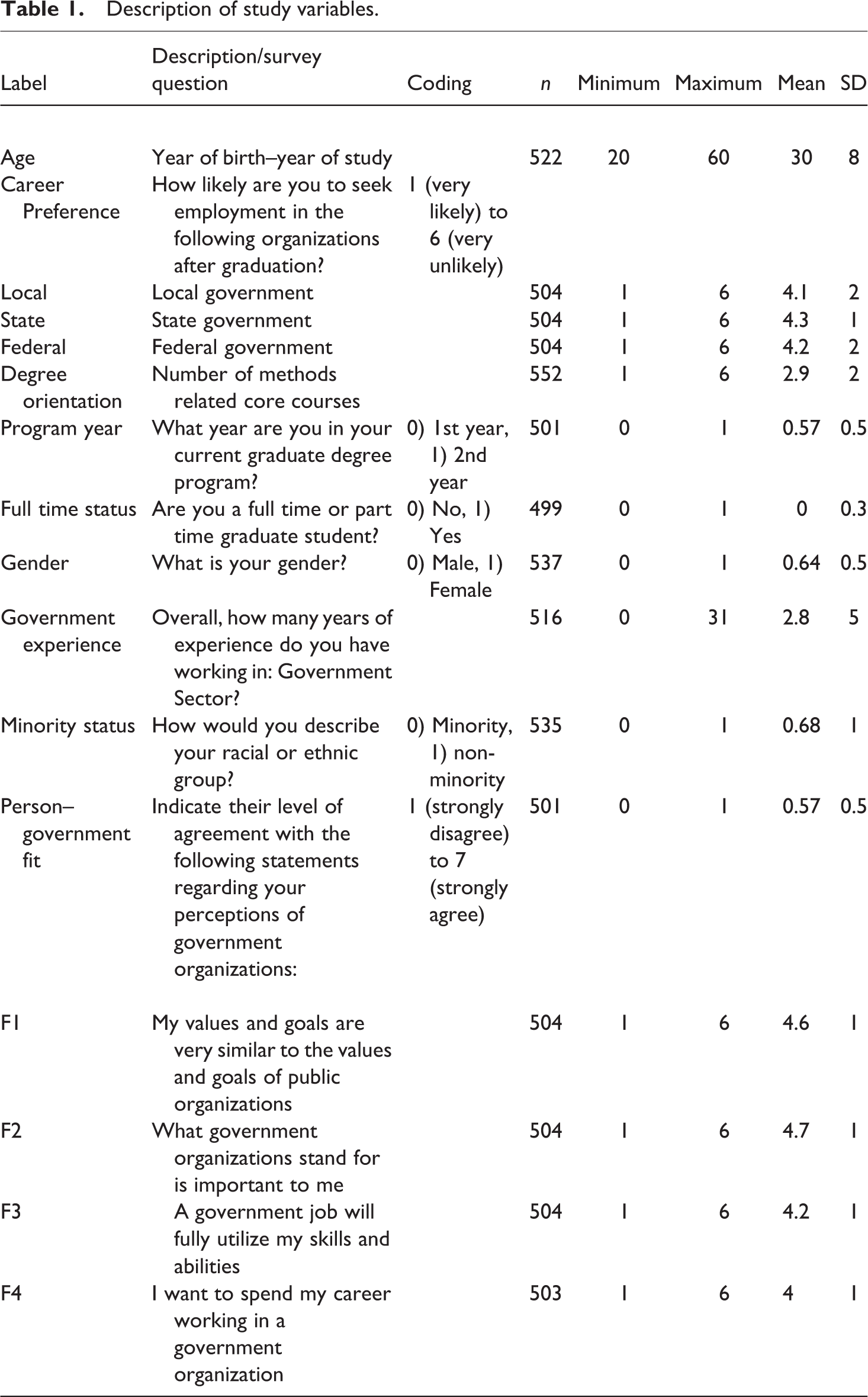
Third, person–government fit was collected using a multi-item scale. The participants in this study were asked to indicate their level of agreement with the four statements regarding their perceptions of government organizations from 1 (strongly disagree) to 7 (strongly agree): My values and goals are very similar to the values and goals public organizations, a government job will fully utilize my skills and abilities, what government organizations stand for is important to me, and I want to spend my career working in a government organization. The responses were summed by each statement and used as four observed indicators of perception of fit in government work environments. The fit indices suggest that this scale has a good fit to the data (NFI = .971, CFI = .975).
Analysis strategies
Last, the data was analyzed using structuring equation modeling. Figure 1 displays the conceptual model that was tested in this study. This model tested the relationships among Degree Orientation, Government Career Preferences, and Person–Government fit in two stages. In the first analysis, the relationships among the study and the control variables were investigated. The analysis revealed that age, years of government experience, gender, minority status, full time status and program year of the respondents were not meaningfully related to the respondents’ likelihood of seeking employment in government organizations 3 . As a result, a second analysis was conducted without these control variables. The fit indices indicate that this model has a good fit to the data (NFI = .897, CFI = .911; root mean square error of approximation = .097). The results of this study are displayed in Figure 2 and in Table 5; these will be discussed later. Statistical significance was set at .05, two-tailed. All regression weights are standardized maximum likelihood estimates.
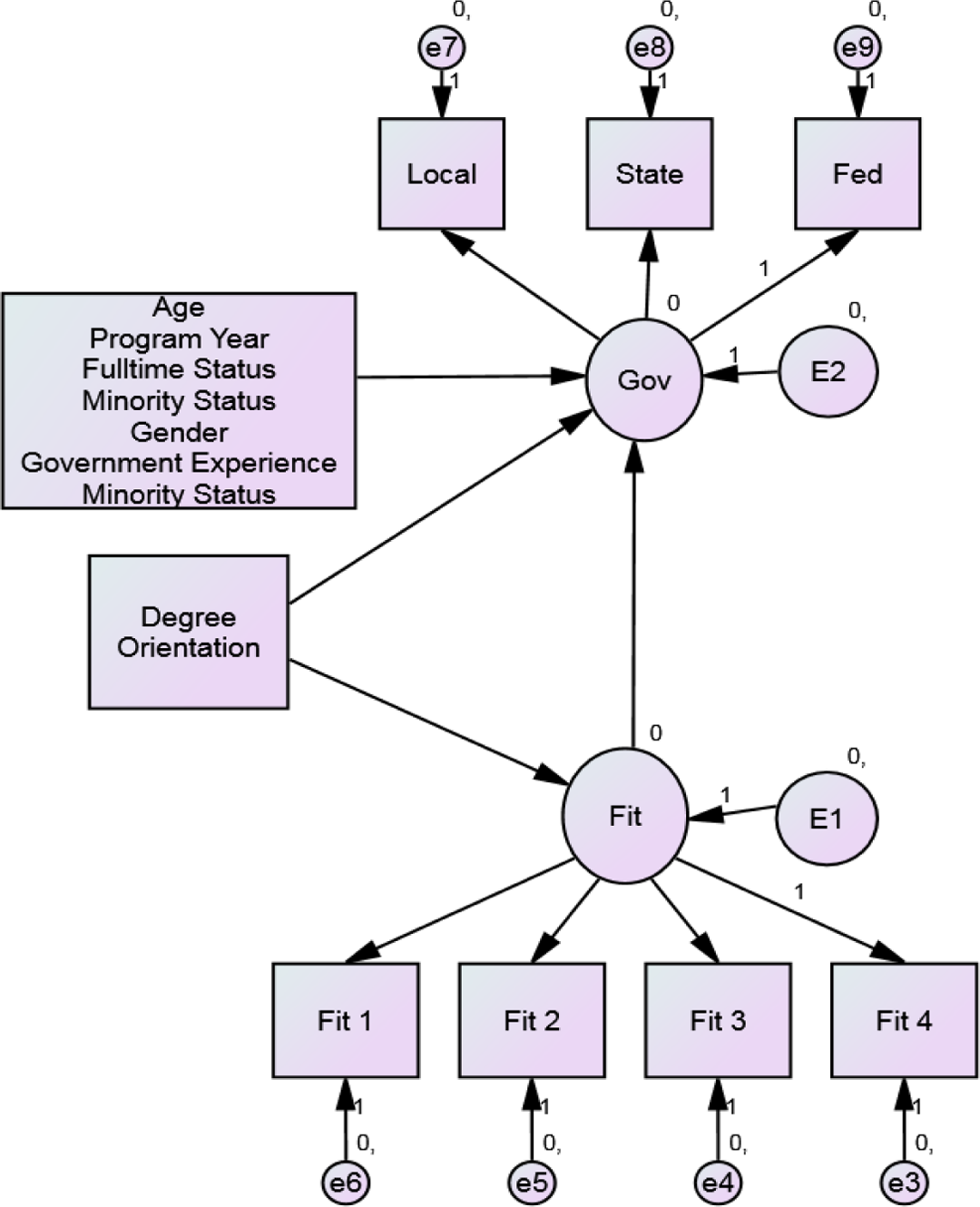
Conceptual model.

Statistical model.
Findings
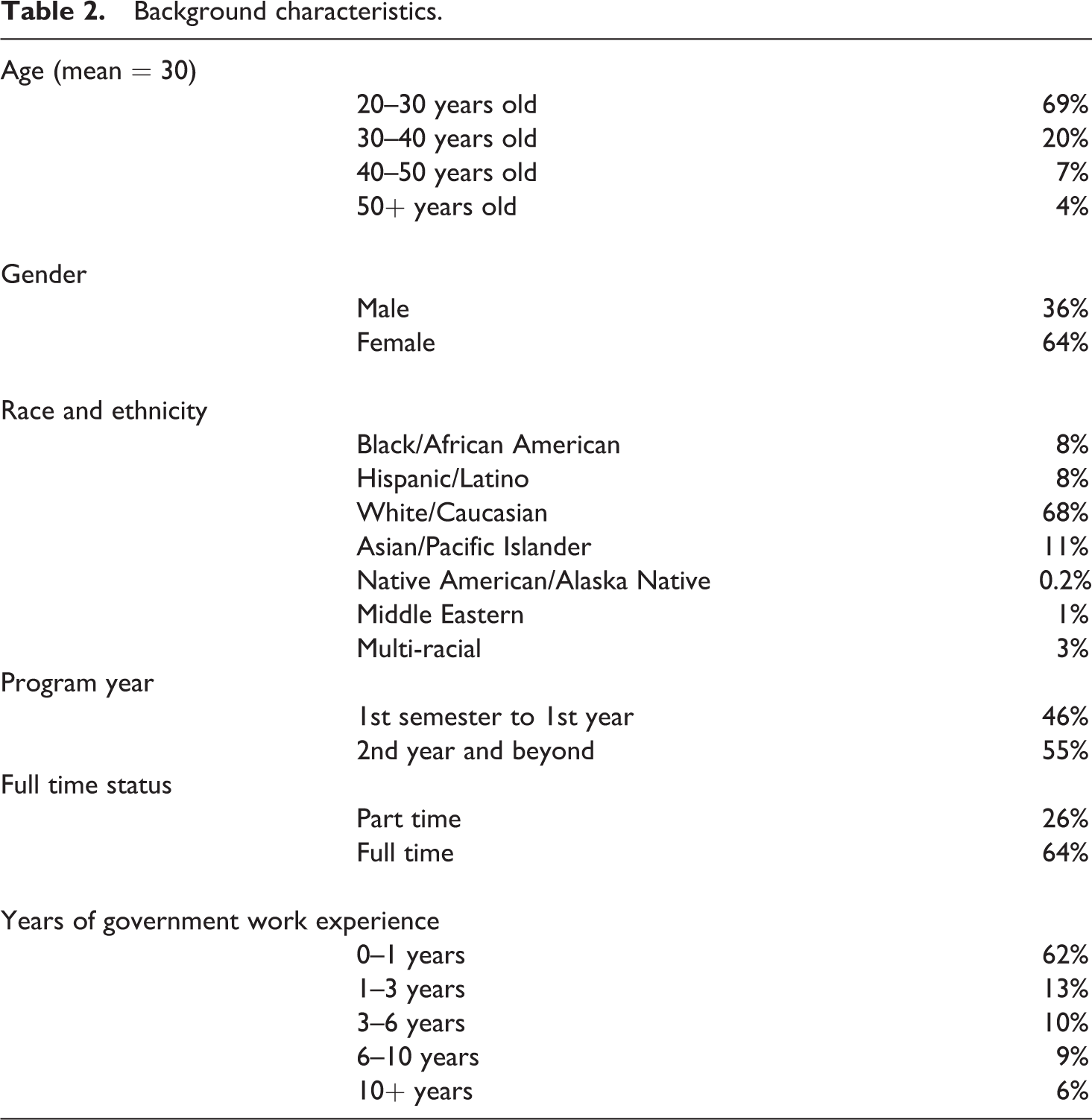
As shown in Table 2, the majority of the respondents of this study identified themselves as being between 20 and 30 years old (69%), female (64%), and White (68%). Also, most were in their second year of their degree program and were attending on a full time basis. In terms of work experience, while most of the respondents (62%) indicated that they had one to zero years of experience in government, a sizeable number of students (15%) indicated that they had six or more years of work experience in government. As shown in Table 3, the majority of the respondents (70%) indicated that they were likely to seek employment in government, albeit at the local, state, and federal levels. However, the respondents appeared to have clear employment preferences among these government levels. Based on the mean responses by employment category, the respondents indicated that they were most likely to seek employment in state government. They were least likely to seek employment in local government by comparison.
Background characteristics.
Government career preferences work environments survey responses by percentage.

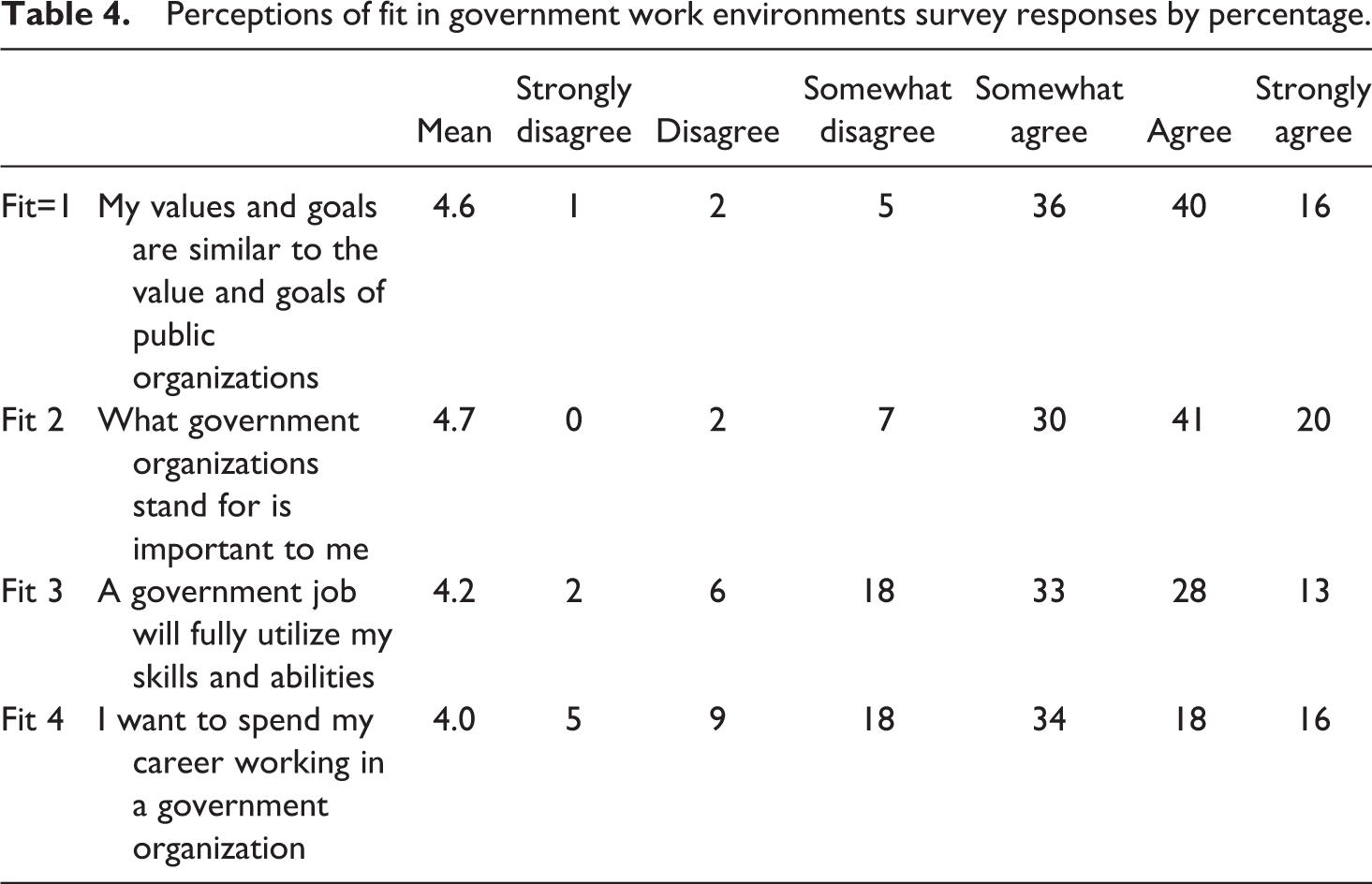
Similarly, as shown in Table 4, the majority of the respondents indicated that they had positive perceptions of fit in government work environments. Yet, their responses to the survey questions were not uniformly positive. For example, over 90% of the respondents indicated that they somewhat to strongly agreed with the statements that My values and goals are similar to the value and goals of public organizations and What government organization stands for is important to me. However, the respondents appeared to have slightly more disagreement with the statements that I want to spend my career working in a government organization and A government job will fully utilize my skills and abilities. Thirty-two percent and 26% of the respondents strongly disagreed to somewhat disagreed with these statements, respectively.
Perceptions of fit in government work environments survey responses by percentage.
In addition, this study advanced several hypotheses concerning the relationships among degree orientations, perceptions of fit in government organizations, and government employment preferences. Table 5 and Figure 2 present the findings of this study. For example, it was hypothesized that the degree orientation of degree programs has no direct relationship to the career preferences of students. The results of this study confirmed this hypothesis. The likelihood of the respondents seeking employment in government organizations was not directly or significantly related to the number of core courses that were required in their degree program.
Study variables estimates by model paths.

Next, it was hypothesized that a positive relationship will be found between students’ perceptions of their fit in government organizations and their preferences of government careers. As expected, the findings of this study confirmed this hypothesis. As the respondents’ perceptions of fit with government organizations increased, they were significantly more likely to seek employment in government organizations. Last, it was hypothesized that a relationship would be found between the degree orientation of students’ degree program and their perceptions of fit. The findings of this study support this hypothesis. As the number of required method related core courses increased, the respondents of this study reported having significantly lower levels of fit with government organizations.
Conclusion
The purpose of this study was to explore the connections among degree orientations, perceptions of fit, and government employment preferences. This study found meaningful relationships among these variables. Specifically, it was found that the orientations of degree programs were related to their perceptions of fit in government organizations. Even more, it was found that students’ perceptions of fit influenced their likelihood of seeking employment in government organizations, albeit at the local, state, or federal levels. These findings support at least three major implications.
The first implication of this study is centered on the relationships between perceptions of fit and government career interest. In this study, perception of fit was found to be a major determinant of the respondents’ likelihood of seeking employment in government organizations. The participants in this study who saw a meaningful connection between their characteristics and those of government organizations were significantly more likely to seek employment in government organizations. Given the importance of perception of fit, more research should focus on understanding the characteristics of public administration degree programs that enhance or diminish these attitudes. For example, a number of strategies have been offered in the public administration education literature aimed at narrowing this gap, such as the integration and use of simulation, case studies, and practitioners. Are some strategies better than others in terms of enhancing fit in government work environments? Providing answers to this question may help inform the strategies that public administration degree programs employ to socialize students toward careers in government.
The second implication of this study is that the characteristics of degree programs may influence the attitudes of individuals, especially in terms of their perceptions of fit. The respondents who were enrolled in degree programs that have a lower number of required methods core courses reported more positive perceptions of their fit in government organizations. This is the first known study to confirm this relationship. Still, the results do not suggest that degree programs should ditch their method courses for the purpose of enhancing perceptions of government fit. Given the design of this study, the reasons for this finding are not entirely clear. Based on existing research (Adams, 2000; Bright and Graham, 2015; Chetkovich, 2003; Infeld and Adams, 2011; Light, 1999), an underlying assumption of this study is that the career preferences of graduate students are influenced by their course work in degree programs. However, it could be the case that students select degree programs on the basis of stable career interest. For example, students with an interest in careers in policy think tanks may be more likely to enroll in economic oriented degree programs. Future research should utilize a longitudinal study that can disentangle these effects.
Also, there may not be a clear connection between the number of courses required by the degree program and the actual courses that students have taken. Some students may have waived out of some of the courses or have not yet taken others, particularly if they have just started their program. Still, these arguments do not invalidate the finding that the course characteristics of degree programs are related in some way to the perceptions that students hold regarding their fit in government organizations. Whatever the reasons, students who are enrolled in programs that emphasize methodological/analytical orientation are associated with lower fit with government organizations.
The strong correlation that was found between the orientation of degree programs and career interest supports the argument that the methods/analytical oriented degrees enhance the skepticism that students have toward government organizations, which is subsequently reflected in their lower perceptions of fit in government work environments. If this is the case, degree programs must counteract and/or balance the importance of both critical analysis and government value. In other words, the field must use productive ways to encourage critical examinations of government organizations without undermining the value of these organizations.
The last implication of this study is that it confirms that the characteristics of degree programs are not directly related to employment choices. Taking methods courses alone does not cause an individual to be more or less interested in government careers. However, the influence of program characteristics on career interest is indirectly related through perceptions of fit. The characteristics of degree programs may lower or enhance interest in government careers by influencing the perceptions students hold regarding their fit in the public sector. In this study, as the number of required method courses increases, students were significantly more likely to have lower levels of perceptions of fit in government organizations. However, degree programs and courses that enhance these perceptions are likely to produce students who are significantly more likely to pursue careers in either local, state, or federal government.
In conclusion, government organizations are facing increasing competition for the best and brightest employees. The problem is that interest in government work is not high among the general population of citizens and not even among the very students who are seeking degrees in the field. Still, it is important to keep in mind that the development of career interest is complex and is influenced by many factors that were not examined in this study, such as financial considerations and the job market. Similarly, even if perceptions of fit and program orientation are related to the career interest of students in general, there is a need for future research to establish whether these variables are the most influential when compared with other variables, especially from a generational perspective. With the majority of the participants in this study being Millennials, it would be interesting to compare the factors that impact their perceptions of fit with those of older generations of students. Nonetheless, the findings of this study suggest that perception of fit is yet another factor that may have meaningful consequences for the attitudes and behaviors of students in public administration programs. This brings attention to the fact that faculty and administrators have an important role to design degree programs that positively develop the interest of students and illuminate their place in public service, and government service specifically.
Footnotes
Declaration of conflicting interests
The author declares that there is no conflict of interest.
Funding
This research received no specific grant from any funding agency in the public, commercial, or not-for-profit sectors.