




Abstract
Public administrators are deeply affected by the global crisis in public finances. As public sector revenues remain weak and demand increases for spending and debt reduction, as well as tax reform, the newest cadre of public administration students must learn how to face the challenge of substantial uncertainty in public finances, regardless of whether they serve at the national, regional, or local level. Simulations offer an effective and powerful tool within a safe classroom environment for teaching students about the process and challenges of public budgeting. This article examines two free web-based simulations that can be quickly incorporated into an introductory public administration course. It further addresses differences in using the simulations as role-thinking or role-playing exercises. Observations from students and the instructor provide insight into the advantages and disadvantages of isolated role-thinking versus collaborative role-playing. The procedures included can be adapted for any online budgeting simulation without requiring the instructor to create a great deal of content on their own.
Public administrators are deeply affected by the global crisis in public finances. As public sector revenues remain weak and demand increases for spending and debt reduction, as well as tax reform, the newest cadre of public administration students must learn how to face the challenge of substantial uncertainty in public finances, regardless of whether they serve at the national, regional, or local level. Not only are administrators the target of rhetorical ire against “big government” and resulting austerity politics, but the public sector is also shedding jobs. For example, between 2009 and 2012, the US states eliminated 137,000 positions (2.6%) and local governments eliminated 437,000 (3.3%). The percentage of the overall US workforce employed by federal, state, and local governments is the same today as the early 1960s (Bump, 2015). Furthermore, administers will be on the front lines of dealing with mounting obligations from pensions, entitlements, and debts, which draw resources from other priorities, as well as slow economic growth that constrains revenue. Simulations allow students to wrestle with these challenges in the relative safety of the classroom.
Role-playing simulation is a powerful tool for placing students into a “real world” context for the purpose of reinforcing class content and improving learning outcomes (Wedig, 2010). Giving students agency to make decisions within the realistic constraints faced by governments affords them the opportunity to make practical and difficult decisions regarding budget allocation. Doing so within the classroom gives students the opportunity to explore the challenges of budgeting in a safe and low-stakes environment. Furthermore, using a realistic context helps students build a bridge between budgeting theory and the real-world decisions that they will have to make as administrators.
In this article, I examine methods for incorporating budgeting role-thinking (Green and Armstrong, 2011) and role-playing in the classroom (Schafer, 2016). Specifically, I evaluate the implementation of two computer-based budget simulations in introductory courses in public administration at a public university. Both simulations are set within the context of the United States of America, which is thus the main focus of the article. That being said, there are web-based simulations available in some other countries and public administration faculty may wish to draw on these lessons in implementing web applications in their own country.
I further argue that a web-based approach would be useful in introductory courses at the graduate level. Each simulation introduces students to the economic and political aspects of the budgeting task. I begin by briefly reviewing the benefit of using simulations as a bridge between theory and praxis in the public administration classroom. Two methods of implementation for budget simulations—solitary role-thinking and collaborative role-playing—are then presented, as are the advantages and disadvantages of each design. These evaluations draw from my observations as the instructor, as well as student feedback. I further leverage the student feedback to offer a critical evaluation of the use of such web-based budgeting simulations in the classroom. Finally, alternative simulations will be briefly addressed, including those available to public administration classrooms outside of the context of the United States of America. While my evaluation is not exhaustive of all web-based simulations, it provides public administration instructors options for introducing budget simulations in their classroom.
Using simulation to teach budgeting
The integration of theory and practice is essential to the study of public administration (Godwin and Meek, 2016; Lynn, 1996). Regardless of whether courses are offered at the undergraduate, masters, or doctoral level, students need to make connections between theories of administration and real world practices that they will encounter on the job. Masters in Public Administrations programs, in particular, provide important professional training for government administrators. Instructors are constantly faced, however, with bridging the tensions that arise from the demands of the discipline and students. As a discipline, motivated by a long-standing “intellectual crisis” (Ostrom, 1989), academics strive to develop new knowledge and establish a theoretical basis for an administrative science. Students, on the other hand, often demand to know how their learning applies to the “real world.”
Anyone that teaches introductory public administration courses and/or courses in public budgeting knows that students find this subject dry and boring. 1 Simulations provide a sense of realism that is often demanded by students (Silvia, 2012), while also reinforcing theoretical principals developed by scholars. Experiential learning through simulations and role-playing offers students the opportunity to enhance program competency, while also developing practical and analytical skills that help them make the connection between theory and practice (Godwin and Meek, 2016; Figueroa, 2014). Furthermore, bridging theory and practice helps students develop competencies in skills, knowledge, and attitudes that are necessary as public sector professionals (Stout and Holmes 2013). Simulations have been defined as “concentrated learning exercises specifically designed to represent important real life activities by providing the learners with the essence or essential elements of the real situation without the hazards, costs or time constraints” (Wittich and Schuller, 1973: 578). They are well suited to the social sciences (Queen, 1984)—including political science, public policy, and public administration—and have become the subject of much pedagogical research within these disciplines (Chetkovich and Henderson, 2014; Goodman, 2008; McCarthy and Anderson, 2000; Schafer, 2016). Simulations increase student motivation to learn, enhance information retention, and can be used to learn both content and process (Auerbach, 2013; Dekkers and Donatti, 1981; Smith and Boyer, 1996)
Though role-playing tends to be more effective, both role-playing and role-thinking serve important functions. In role-thinking, students are asked to take on another mindset and reason through decisions that they would make given a specific scenario. Role-thinking is likely done in isolation; for example, through a writing prompt. This can require little to no in-class time and less preparation than a role-play exercise, thus making role-thinking exercises easier to implement in a course. While this helps students to get into the mindset of an administrator in order to learn about budgeting, such role-thinking can lead participants to make unrealistic, and at times absurd, decisions shaped by the role they are assigned (Green and Armstrong, 2011; Rothbart and Hallmark, 1988). When tasked with a forecasting decision, role-thinkers performed no better than simple guessing, regardless of whether they were novices or experts (Green and Armstrong 2011). An example of this approach would be a budget making exercise that I used in one introductory course drawn from Dennis L. Dresang’s (2017) Public Administration Workbook. The exercise taught students the principles of line-item budgeting by placing them in the role of Deputy Budget Director who is creating a new budget for a recently consolidated county library system. The students read about budgeting theory, are given a memo outlining the rules that they need to follow in creating the budget and the preferences of different stakeholders (e.g., staffing reductions and union-negotiated salary changes), and then unilaterally work out a budget. Expanding the role-thinking aspect of the assignment would include defining and describing other roles relevant to the budget’s preparation and approval (e.g., a county board of commissioners) and having the students think through the potential outcomes based on the groups’ preferences. My implementation of this exercise illustrated to students the challenges of line-item budgeting, especially with assigned constraints, but students did not always produce realistic budgets, in line with the more systematic findings from Green and Armstrong (2011).
Role-playing, on the other hand, creates an environment where students are assigned a specific character/role and then must interact with other students in different roles to complete a task. Building on the example above, a role-play version of the budgeting simulation would assign each student one of the roles within the budgeting process. For example, students could fill the roles of union leadership, budget director and assistant director, county commissioners, and perhaps even library staff. The instructor would also have to establish the structure of interactions between the roles. For example, it is not that each of these roles is at the same table negotiating a budget. The union leadership could negotiate with commissioners and communicate their negotiated preferences to the budget director. Library staff could then communicate their preferences to the director and assistant director. The staff would also likely have the opportunity to communicate with commissioners, as would students playing the roles of taxpayers and community groups. The budget would ultimately be presented to the commissioners, where they, based on the information they have received from various interested parties, could accept or send it back to the budget office. Instead of requiring non-expert students to think through all of the potential scenarios and arrive at a realistic outcome, they would experience how a realistic outcome unfolds through the simulation. In fact, in contrast to role-thinking, participating in a role-playing simulation can improve students’ ability to properly understand how roles shape behavior and then better predict future decisions (Green and Armstrong 2011). This means that when instructors ask students to put themselves in someone else’s shoes, it is not as effective as asking them to actually try on those shoes. Of course, such simulations can take a great deal of class time, relative to role-thinking exercises.
Simulations can be in-person or computer based, though each has advantages and disadvantages relative to the other. There is evidence that computer-based simulations are effective (Hu et al., 2012; Leonard and Leonard, 1995; Vogel et al., 2006), whereas recent criticism suggests that classroom-based simulations in public administration are less well-studied (Figueroa, 2014). On the contrary, several models for in-class public budgeting simulations exist and have been assessed (Grummel, 2003; Kanner, 2004; Milam, 2003; Taylor, 2011; Wakelee and Itkonen, 2013; Wallin, 2005). All of these examples are in-class role-playing simulations designed by the instructor. Many of them take several days to implement in the classroom. To the best of my knowledge, pedagogical research in political science and public administration has not addressed the use of publicly available web-based budgeting simulations in the classroom. In one previous comparison of online and in-person problem-based learning in a public health course, online simulation resulted in higher exam scores and outperformance in understanding theory, but lower self-ratings of learning (Spinello and Fischbach, 2008). Meaning, students performed better after completing a web-based simulation, but felt they learned more in the in-class exercise. The remainder of this article evaluates how role-thinking and collaborative role-play, with a web-based component, can be used to teach public budgeting.
Federal and State Budget Simulations
Two web-based budgeting applications were utilized for this study. The first, EconEdLink’s National Budget Simulation, focuses on the US federal budget. The second, Next 10’s California Budget Challenge, tasks citizens with balancing the budget of the state of California.
National Budget Simulation
EconEdLink’s resources were designed for a K-12 audience. However, the National Budget Simulation provides a useful interface for introducing introductory public administration students to the national budget. 2 While basic, the simulation scenario is beneficial for helping students wrestle with both the political and economic considerations of budgeting (Key, 1940; Thurmaier, 1995). Furthermore, the simplicity of the simulation allows instructors at the undergraduate and graduate level to tailor additional simulation components in order to achieve their specific learning outcomes.
The National Budget Simulation places students in the role of economic advisor to the President. The provided scenario offers students the following constraints: The President promised during his recent election campaign to limit the deficit and not raise taxes, but also to not cut the large social programs of Social Security and Medicare He also made a promise to interest groups to not cut the Department of Commerce The USA has a legal obligation to pay interest on its debt The USA recently experienced a military attack, which prompted Congress to increase Defense budget by 20%, fixing their budget outlay There is a lingering recession which results in increased outlays for unemployment benefits, welfare, food stamps, and more
While this scenario may sound like too much to consider at once, it is similar to the situation faced by the Bush Administration in 2000. The pro-business Administration made promises to cut taxes, while reforming (but preserving) Medicare. The attacks of September 11, 2001, resulted in an immediate war in Afghanistan. Finally, the US experienced a shallow recession during 2001 (Kliesen, 2003) and a subsequent “jobless recovery” with unemployment persistently above 5% (Bernstein, 2003).
After reading this context, students are presented with 20 major budget functions ranging from national defense to undistributed offsetting receipts. Each category provides a very short explanation about programs represented in the category, but little else in the way of context. The budget numbers in the simulation are dated, but are based on the actual 2012 federal budget. Students then have the choice of raising, lowering, or leaving the spending in each category, except for those that are fixed due to the scenario (e.g., defense spending). For simplicity sake, discrete increments of change are provided ranging from +20% to –20%. The amounts for the national defense, commerce and housing, net interest, allowances, and undistributed offsetting receipts categories, however, are fixed due to the constraints of the context presented above. Total revenue is also fixed; meaning students cannot raise taxes to reduce the deficit. They are provided some sense, however, of where revenues come from. Finally, the simulation does not require the students to eliminate the entire $1225 billion deficit, but to bring it below an $1130 billion threshold that is acceptable to the President.
After reducing the deficit, students can complete a worksheet where they reflect on the practical outcomes of their budget choices. This includes weighing the individual, political, and social implications of their cuts. It also asks them whether they would raise taxes, if allowed. The space for reflection in this worksheet is brief, however, so an additional reflective writing assignment proves useful.
California budget challenge
Considering the fact that there are pressing fiscal issues in all 50 states (Kiewiet and McCubbins, 2014), the California Budget Challenge provides a budgeting context applicable to future administrators from most states and municipalities (Mallinson, 2018). It also introduces students to budgeting in an environment where income and expenses must be balanced. Next10, a non-partisan group whose aim is to educate Californians on pressing public issues, launched the California Budget Challenge in 2005. 3 Originally, the simulation tasked citizens with eliminating a real $25 billion budget deficit. The purpose was to raise public awareness budget challenges in California and the effects of proposed solutions. Next10 has worked over the past decade to keep the simulation up-to-date with California’s present fiscal situation. For example, the original simulation was created in a time of large budget deficits, leaving participants with little choice but to make large cuts to the budget. In 2016, students start from the place of having a large surplus (approximately $6.4 billion) and thus make decisions about where to restore previously cut funding and/or cut taxes. Thus, context for the California Challenge changes as the state’s finances evolve.
The simulation begins with providing users the breakdown of revenue sources and broad categories of spending. These data come from both the executive (Department of Finance) and legislature (state Legislative Analyst). It also explains important popular initiatives that constrain budgetary decision-making. For example, Proposition 98 (1988) requires that 50% or more of the General Fund be devoted to education. This is a substantial, but not debilitating, constraint on budget allocation (Matsusaka, 2005; Matsusaka, 2010) that further introduces students to ways in which state budgeting differs from the federal government. At each stage of the simulation, students can click on links that take them to additional information about proposals, pro and con arguments, data, and more. Additionally, many screens include videos and background information right below the policy choices. Thus, students receive a great deal more context regarding their budgetary decisions, and their implications, than in the National Budget Simulation. Additionally, students have control over not just spending, but also revenue and the state’s Rainy Day Budget Stabilization Fund. At the end of the simulation, students can view a summary page (printable, for potential submission as an assignment) where their overall budget is compared to the average participant’s and the status quo. This is useful for generating classroom discussion about why their choices differ.
Two methods of implementation
The following evaluation of these simulation methods is not just about the online programs themselves, but also about variation in implementation methods in the classroom. Over the course of two semesters, undergraduate students at a medium-sized public university participated in two different approaches. The first, a role-thinking approach, required students to complete one of the two simulations on their own, with a subsequent guided discussion in class. The second approach included a collaborative role-play that introduced students to procedural aspects of the federal budgetary process.
Individual role-thinking
Both the California and National simulations were implemented as stand-alone role-thinking exercises. Students received the following instructions for the stand-alone national simulation: For our class on March 31, I will be asking you to balance the federal government’s budget using the Council for Economic Education’s National Budget Simulation. Write two to three pages justifying the way in which you balanced the federal budget. Did you increase any spending categories? Did you choose to cut and/or eliminate certain categories? Explain why. Bring a printout of your balanced budget and justification to class.
In the stand-alone California challenge, students received the following instructions: As you complete the California Budget Challenge, I want you to read all of the pros and cons for each choice and jot notes about why you were persuaded to make the choices that you did. After completing the simulation, I would like you to write two to three pages on your decisions and why you made them. Then, I would like a one-page section reflecting on the challenges you faced in completing the simulation. Bring the write up to class.
Process role-play
The third implementation was intended to blend role-thinking with role-playing for the purpose of introducing students to a simplified version of the budget process. Using the two-part simulation structure thus incorporates learning on both budgeting content and process (Asal and Blake, 2006). Utilizing the National Budget Simulation, students were instructed to complete the simulation task of reducing the deficit, but they were also assigned to be the director of one specific budget function. Although these functions do not all directly map onto a single federal department, students are told to think like a department head making a case for their budget request. The functions over which students have the ability to alter spending include: international affairs; general science, space, and technology; energy; natural resources and environment; agriculture; transportation; community and regional development; education, training, employment, and social services; health; income security; veterans’ benefits and services; administration of justice; and general government. Students were randomly assigned to a particular budget function, with one additional student assigned as President of the United States of America. Students were required to not only complete the simulation, but to also develop a justification for the change in budget requested for their particular “agency.” This justification was delivered in writing to the instructor and verbally to the class. The president was then able to ask each director questions about their justification and was thereafter required to submit a completed budget during the next class session. After the President gave a verbal address to the class, students took on a new role of legislator and were able to ask their own questions regarding the President’s presented budget.
Merging the online simulation and the in-class role-playing is meant to introduce students to aspects of the budget process. Namely, that directors need to be aware of the President’s preferences, political concerns, and economic realities when presenting their budgets and the President needs to consider the position of Congress when producing a budget. All are strategic actors (Kiewiet and McCubbins, 1985; LeLoup and Moreland, 1978). Student feedback provides insight into whether this objective was met.
Student feedback
The following provides general themes, as well as specific feedback, for the National Budget Simulation and California Budget Challenge. Students in the fall 2016 upper-level public administration elective were asked to complete a survey with qualitative responses to a series of questions about the success of each simulation at achieving learning outcomes and challenges they faced in completing the budgeting task. 4
California budget challenge
Overall, students were very supportive of this simulation. Of the completed surveys (n = 13), all but one student were supportive of offering the simulation in future classes. One student, when asked about offering the simulation again, said: “Yes, it helps the students understand the importance of budgeting decisions and the stress of their jobs.” Several noted how the simulation gave them a better appreciation of the challenges present in balancing a budget. Specific challenges included balancing their personal beliefs with a consideration of what is best for the public, recognizing that each decision will be unpopular with some, and making decisions without being confident of future outcomes. In the words of one student, “It was very successful because it made me see that every decision had weight. There were no decisions that were unimportant.” Thus, the simulation met one learning outcome, introducing students to the challenges of public budgeting.
In terms of providing a bridge between theory and practice, the stand-alone simulation approach had mixed results. Students were split regarding the extent to which classroom material on theories of budgeting informed their decision-making. To some extent, this disconnect makes sense because the simulation did not task students with creating a budget from scratch or modifying an existing line-item budget. Instead, participants were presented with specific spending proposals and the financial impact of those proposals. Therefore, students did not commonly indicate using incremental, zero-based, program, or other, budgeting theories as guides for their choices. Students did report that the classroom preparation provided some background and vocabulary necessary to complete the simulation.
In terms of the California Challenge itself, students greatly appreciated the amount of information provided in the form of pro-con arguments, supplementary links, a constantly updated surplus/deficit tracker, and polling data for some choices. As one student noted, “the choices were clear and there was a provided list of various pros and cons to your decisions. This helped a lot because there were a few topics I was slightly unfamiliar with and the information provided was sufficient enough to help me make a decision.” The student’s quote demonstrates that the simulation was well organized and easy to understand. The drawback to this more structured approach, however, is that students felt limited in the options they could choose to balance the budget.
National budget simulation
The availability of supporting information was a particular challenge with this simulation. When implementing any simulation, careful thought needs to be put into the decision of when to give additional information and how much (Wakelee and Itkonen, 2013). One of the most consistent themes across the student surveys (n = 13) was the need for more detailed instructions and context for budget decision-making in the National simulation. Students were still supportive of using the simulation in the future (two no’s), but they were challenged by the lack of explanation regarding specific programs/agencies represented by each budget function. They found it particularly difficult to perform their own research due to the fact that the functions did not match directly with major federal departments and agencies. Finally, students expressed a lack of clarity regarding the real repercussions of their choices, something the California simulation provided. Thus, the instructor will need to consider what additional information to provide when implementing this simulation.
As for the role-playing component, students generally enjoyed the experience of justifying their budgets and answering questions from peers. One said “I think it’s good for us to make decision and defend them, mirroring the real process.” One student felt that the in-class portion was “more successful than the simulation itself because we were able to discuss, which highlighted the isolating experience of completing only the online simulation. Thus, the in-class component added to the depth of the experience. One advantage of this simulation was that it gave students more latitude in making changes to the budget. Instead of following specific proposals with fixed costs, they could increase or decrease a budget function by a range of amounts.
The combination of the two components appears to have helped the students grasp the strategic interactions between bureaucrats, the President, and Congress. Some found difficulty in the fact that their function was more likely to face cuts, given the simulation scenario and political perspective of the president. In light of this, several students were strategic in their requests, recognizing the necessity of cuts, but asking for smaller reductions. The depth of cuts made by the President ultimately frustrated other students, but the Congressional questioning portion allowed them an opportunity to ask about those cuts.
Instructor evaluation
From the instructor’s perspective, each simulation implementation had certain advantages and disadvantages relative to the teaching objectives of the assignment. Table 1 presents the instructor’s view of the trade-offs of each approach. The least desirable approach, for which there is not student feedback, is the isolated National Budget Challenge. While the national challenge’s simplicity and similarity to a line-item budget is useful for introducing budgeting to new public administration students, completing the assignment with little added context is an isolating experience that only allows for brief post-hoc reflection in the classroom. That being said, the line-item nature of the simulation allows instructors to foster a discussion of how students can use different budgeting theories (e.g. incrementalism, zero-based budgeting, etc.) when they complete the budget. Thus it has the potential to build bridges between theory and practice.
Advantages and disadvantages of three role-playing approaches.
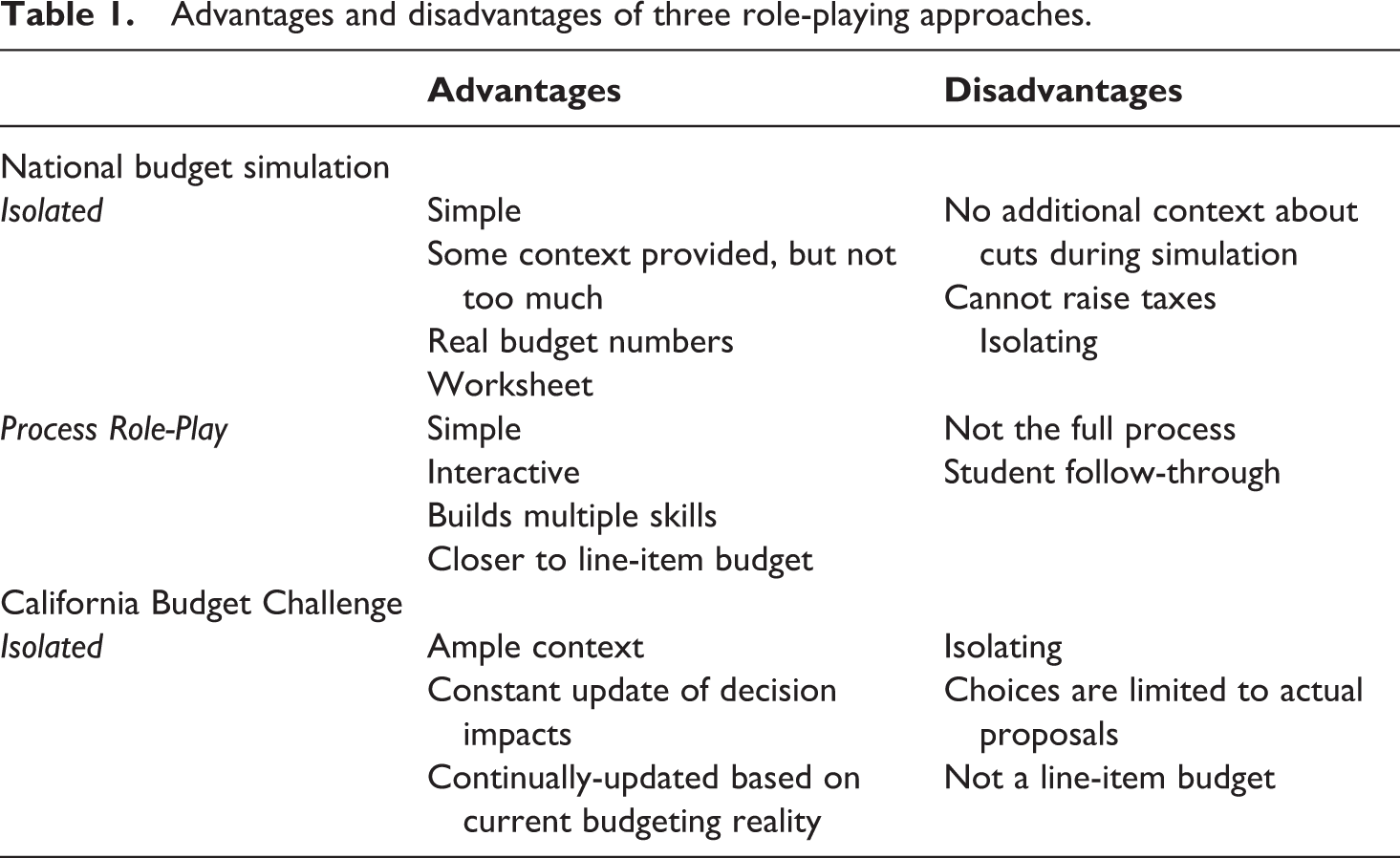
To some extent, the California Budget Challenge shares the isolation problem, but it also provides ample context and additional resources such that students have a more successful experience. These resources include pro-con arguments for each specific proposal, videos and descriptions of the major budget categories, and links to additional information outside the simulation environment. This makes for a stronger stand-alone experience, as evidenced by the positive feedback received by students. This type of simulation could be used as a culminating experience, after teaching students about budgeting theory and state and local finances. Additionally, the California Challenge could include the same in-class role-play and would provide as better base of information for students to research the proposed changes to their assigned budget function.
The role-play experience was more successful in several respects. First, it gave the students a clearer role for the role-thinking component of the simulation. In past implementations where students just completed the isolated national challenge, students were in the role of economic advisor and were thus trying to make sense of all spending categories. In the role-play exercise, students took on the role of championing one specific budget function, placing them in the role of an agency head. They still needed to complete the budgeting exercise, but they could be more focused on justifying their own function, while also justifying cuts they made to other functions. They get to see the trade-offs necessary in budgeting, while also learning how to support their own division.
Second, the students built multiple skills. Not only are they introduced to the challenges of balancing a budget given prevailing economic and political constraints, but they also have to justify their budgets to their peers in writing and verbally. In addition, implementation in a larger class (say 35 students) would offer the opportunity to allow students to work in pairs or groups, thus enhancing the collaborative nature of the two-part simulation. One valid criticism of this approach is that it does not fully simulate the federal budget process. While this is true, the combination of a free ready-to-use online simulation and a shorter in-class portion frees time in class for coverage of other topics. The approach presented is especially useful in an introductory public administration course that introduces students to a broad array of topics. An extended simulation that more fully captures the budget process would be useful for courses focused specifically on public budgeting. Even for these experiences, the National Budget Challenge provides a useful foundation for a larger simulation that walks students through the federal budgeting process.
Critical evaluation of using web-based simulations in the classroom
The experiences of the students and the instructor also offer insight into the effectiveness of using web-based simulations in the public administration classroom. As noted above, web-based simulations have proven effective in multiple educational contexts. In the context of a public budgeting exercise, however, I am skeptical of the effectiveness of a stand-alone web-based program that does not provide any interaction with other actors. Both discussed simulation platforms introduced students to the difficulties of budgeting, with the California simulation’s expanded contextual content providing the superior experience. Students were forced to not only consider their own personal beliefs about programs and spending, but to also consider the practical effects of budgeting decisions on program beneficiaries.
What is missing from a stand-alone implementation is the interactive reality of public budgeting. Executives must craft budgets, but they need to consider the policy positions of other actors who have a say in the final product (e.g., legislators). Furthermore, executives do not sit in a room and put together a budget by themselves. The executive budget is first the result of requests and negotiations between the executive and their agency heads. This complexity and negotiation skill building are lost if a computer simulation is left to teach students about budgeting. As I found with the three implementations above, even though the federal simulation was of poorer pedagogical quality as a stand-alone experience, pairing it with an in-class portion exposed students to a simplified form of the budgeting process.
The use of a web-based simulation to build theoretical knowledge and practical skills in the public administration classroom is a compromise of time and content. This is particularly the case for implementation in an introductory course that surveys the field. In such a course, instructors may not have the space to spend weeks introducing students to a full budgetary process. Simply offering a web simulation alone may in fact be too much of a compromise, and may instead limit students’ understanding of the budgeting process. Thus, a mixture of the two offers a middle path that leaves the full process simulation to an upper-level course devoted to public budgeting. Of course, this evaluation only offers preliminary insights into the effectiveness of pairing web and class simulations. More rigorous evaluation, including expanded pre- and post-intervention surveys, is still required to flesh out where the trade-offs lie and how to maximize the pedagogical value of the compromise.
Other simulation options
Importantly for public administration instructors within the US and abroad, the above implementations are not restricted to the National and California platforms. The herein described approaches can employ any other web-based simulation that has its own advantages and disadvantages. Furthermore, these simulations are not restricted to the USA. Table 2 presents a list of other possible budget simulators. It starts with alternative US federal and state-specific simulations and then expands to simulations for other countries. This list is not exhaustive, especially for simulations outside of the USA. Finding relevant simulations requires native language expertise not held by the author. Table 2 does, however, provide instructors with a starting point for evaluating other possible simulations and implementing them in their own classrooms.
Alternative simulations.
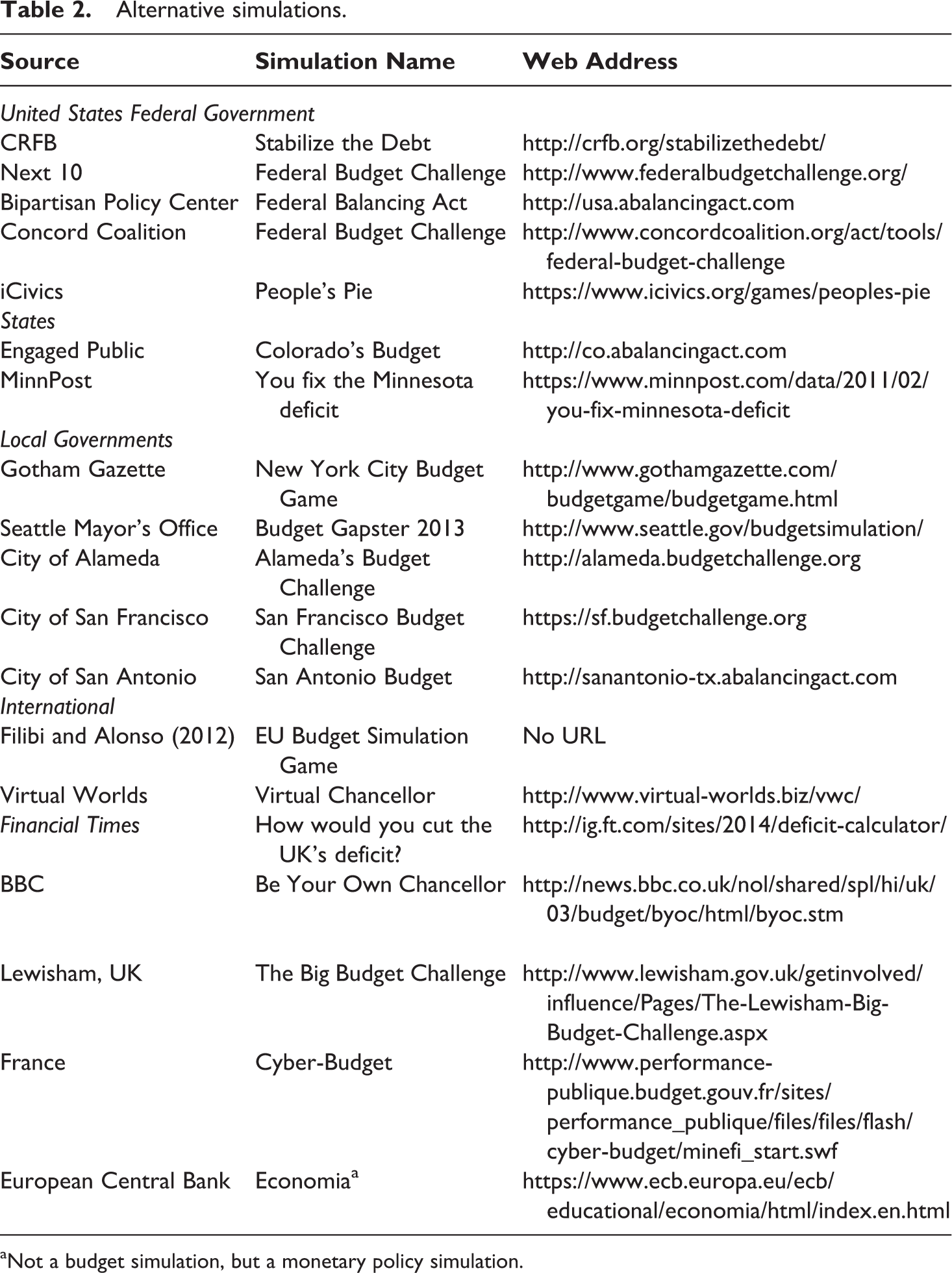
aNot a budget simulation, but a monetary policy simulation.
Conclusion
With administrators facing increased public scrutiny over budgetary decisions, fiscal pressures from the economy, mounting public and pension debts, the utilization of active learning to train future public managers has never been more important. Budget allocation is one of the most important political and administrative decisions of a government. In the famous words of Howard D. Lasswell (1936), politics is defined as who gets what, when, and how. In-class role-playing simulations are beneficial for placing students directly in the shoes of decision makers; however, they can also require a great deal of preparation and class time. Web-based simulations, on the other hand, vary in their success as an alternative stand-alone option that requires little class time. These experiences can be isolating and students may not fully appreciate how much they learn in a web simulation. Combining the two, with a simplified in-class portion, can help students achieve learning outcomes without requiring substantial in-class time. This approach is most useful in broad introductory public administration courses at the undergraduate and graduate level, whereas more in-depth simulations play an important role in courses specifically addressing public budgeting. Additional research can help us better understand the trade-offs in learning between long-form in-class simulations that introduce students to process, stand-alone web simulations that offer little to no interactive component, and a compromise implementation that leverages both, while also reducing the amount of in-class time needed to operate the simulation.
Footnotes
Acknowledgements
The author would like to thank Aleksondra Hultquist, the Stockton University Writing Circle, participants of the Subfield Strategies track of the 2017 American Political Science Association Teaching and Learning Conference, the editors and anonymous reviewer for their feedback on this manuscript. Any errors or omissions are the author’s alone.
Declaration of conflicting interests
The author declared no potential conflicts of interest with respect to the research, authorship, and/or publication of this article.
Funding
The author received no financial support for the research, authorship, and/or publication of this article.
