



Abstract
The article analyses ministerial staff of the Czech Republic 25 years after the Velvet Revolution. It characterizes ministerial employees during the period of the communist regime in former Czechoslovakia (1948–1989) and following the anti-communist coup. In order to analyse the present-day situation, it uses our own survey of the staff working at ministries in the Czech Republic. Within the survey (conducted April–June 2013) all 14 ministries of the Czech Republic were contacted. In total, 1351 respondents (ministerial employees of the Czech Republic) participated in the survey. The research aimed to examine the gender structure, age, education, acquired experience and performed activities of ministerial staff. The results of the research also signal that in some areas (e.g. within the so-called systematized employment positions and the prescribed level of education at some ministries) the residual effects of the previous regime still manifest themselves. The results of this research may be an inspiration for similar research projects in other countries of the former Soviet bloc.
Keywords
Introduction and theoretical background
By the end of 2014, it had been almost one-quarter of a century since the fall of the Berlin Wall (see e.g. Banac, 2014) and 25 years since the fall of socialist governments in the former Soviet bloc (see e.g. Tismaneanu, 2014). This is the example of the Czech Republic, where the Velvet Revolution took place in 1989. The socialist government was replaced by a democratic one. In connection with the revolutionary changes in post-communist countries, a series of reform changes – for example, privatization or decentralization (Nemec et al., 2008) – were also initiated. These changes also affected the domain of the operation of ministries and their employees with the main objective being to build a professional and efficient civil service.
Our research addresses the following main research question: What are the personal characteristics of the current ministerial staffs and can persisting effects of the communist past be found? This research question has been conceptualized in the spirit of the theory of path dependence (Nelson and Winter, 1982) and the theory of evolutionary institutional changes. The socialist regime left its ‘historical footprint’ on the new society. It is a series of ‘embedded’ factors that influence the development of contemporary society. Ministries, as organizations and institutions, are connected with their own history and unable to ‘shake off’ the effects of the past. The past leaves the ministry with a ‘historical footprint’, and this footprint creates regressive behaviour within the organization. Efforts to introduce change are hampered by the barrier of past remnants. Overcoming these gradually is a complex process, as is illustrated by the case of evolution of the ministerial staff of the Czech Republic 25 years after the Velvet Revolution. Residue and a ‘recessed history’ from the past do affect the behaviour of the ministerial staff of the Czech Republic. This ‘historical imprint’ is reflected in their behaviour, especially in the fact that the development of organizations is ‘locked-in’ within the framework of certain (explicit and implicit) rules that affect their current and future behaviour (Blackmore, 2000; Koning, 2016; Ongaro, 2006). Understanding institutional changes, which is often influenced by the heterogeneity of individual institutions and individual settings, is the key to understanding economic development (Dimova and Savoia, 2016).
The influence of past dependence can be traced in many public policies implemented in the Czech Republic, such as in tourism (Williams and Baláž, 2002), social policy (Saxonberg et al., 2015) and the policy of cultural heritage protection (Plaček et al., 2018). This article contributes to this discussion by examining the impact of the path dependence on ministerial officials.
A comprehensively correct answer to these questions would require undertaking an empirical investigation and making a comparison with the previous status of ministerial officials. Unfortunately, from the period of communist Czechoslovakia there are no empirical studies and no empirical data which are available and would allow an empirical comparison of the ministerial employees at the time of the communist era and could be carried out today. Moreover, during the socialist era, all social research was undertaken at the initiative of the Central Committee of the Communist Party of Czechoslovakia. Research studies were also awarded only to designated institutions approved by the central bodies of the Communist Party of Czechoslovakia (hereinafter KSČ) while research results related to social issues were kept strictly confidential.
To achieve the goals set, a mix of qualitative methods and structured interviews with former employees who had experience within the ministries at the time of the socialist government have been utilized. These interviews serve to reconstruct personnel experience in communist ministries.
The current staffing situation in ministries, with the help of large-scale qualitative research that has been carried out on an extremely large sample of current ministry employees (workers who can be called policy workers) is described. This research aims to answer the following research questions.
How is the gender structure of the ministries defined?
How old are the staff?
What is their education?
What is their current experience?
Which tasks do they perform during their working day?
This research is essential for both general theory and practical real politics. Regarding its contribution to current theory, this opens another important area where one can trace the elements of path dependence and which fundamentally influences the functioning of the public sector. These results can be generalized for the whole of Central Europe as the Czech Republic is a typical post-communist country of the former Soviet bloc. The results of this research can therefore contribute to the scientific discussion of the problem of ministerial staff in Central and Eastern European (CEE) countries.
The second area, which has not been explored yet, is real public policy, where there is no critical academic assessment of the current state. Compared with other CEE countries, there are a large number of studies dealing with different perspectives on the examination of civil servants, such as the studies by O’Faircheallaigh et al. (1999), Pollit and Bouckaert (2004), Bakvis (1997), Halligan (1995), Howlett (2009), Wellstead et al. (2011), and Howlett and Wellstead (2012), as well as a number of official reports from audit authorities or government advisory bodies (e.g., in the United Kingdom (National Audit Office, 2013; Institute for Government, 2014)). These topics have been neglected in the Czech Republic. Only a few relevant studies in this area, such as Bouchal and Janský (2014), which deals with the numbers and salaries of ministerial officials, are known, while further studies (Kohoutek and Nekola, 2016) analyze perceptions of the nature and extent of politicization by officials at 11 ministries of the Czech Republic. Unlike the conclusions of previous, largely expert or qualitative, inquiries, the officials’ perceptions generally point towards rather moderate politicization of the Czech ministries (Kohoutek and Nekola, 2016). Ochrana et al. (2016) investigate policy workers’ job descriptions in terms of strategic management activities. In their study, they claim that policy workers are more likely to be used for routine official acts, or in extreme cases for ‘extinguishing fires’. On the contrary, analytical activity and activities related to strategic decision-making are largely absent. In another study (Plaček and Ochrana, 2018), the authors compare policy workers in the Czech Republic with the senior civil service in Great Britain. Czech policy workers do not possess significantly different characteristics in terms of experience, age and education. In the areas of their work, they are even more connected than their counterparts in the UK. However, they lack career plans and opportunities for further education. The weak interdependence of education in the area of public administration in CEE as well as the real needs have been pointed out by Nemec et al. (2012). This has been confirmed by further studies (Nemec and Pompura, 2018), which compare job training of tax officials. The most visible gap is the very limited link between tax administration training and university level training in the Czech Republic.
Our research describes a group of officials who act as policy workers, that is, they act as the creators and analysts of public policies. Information regarding this group has been totally disregarded from the point of view of their characteristics. The results of the research are therefore also beneficial from the point of view of the design of training programmes and further vocational training.
Methods
Structured interview
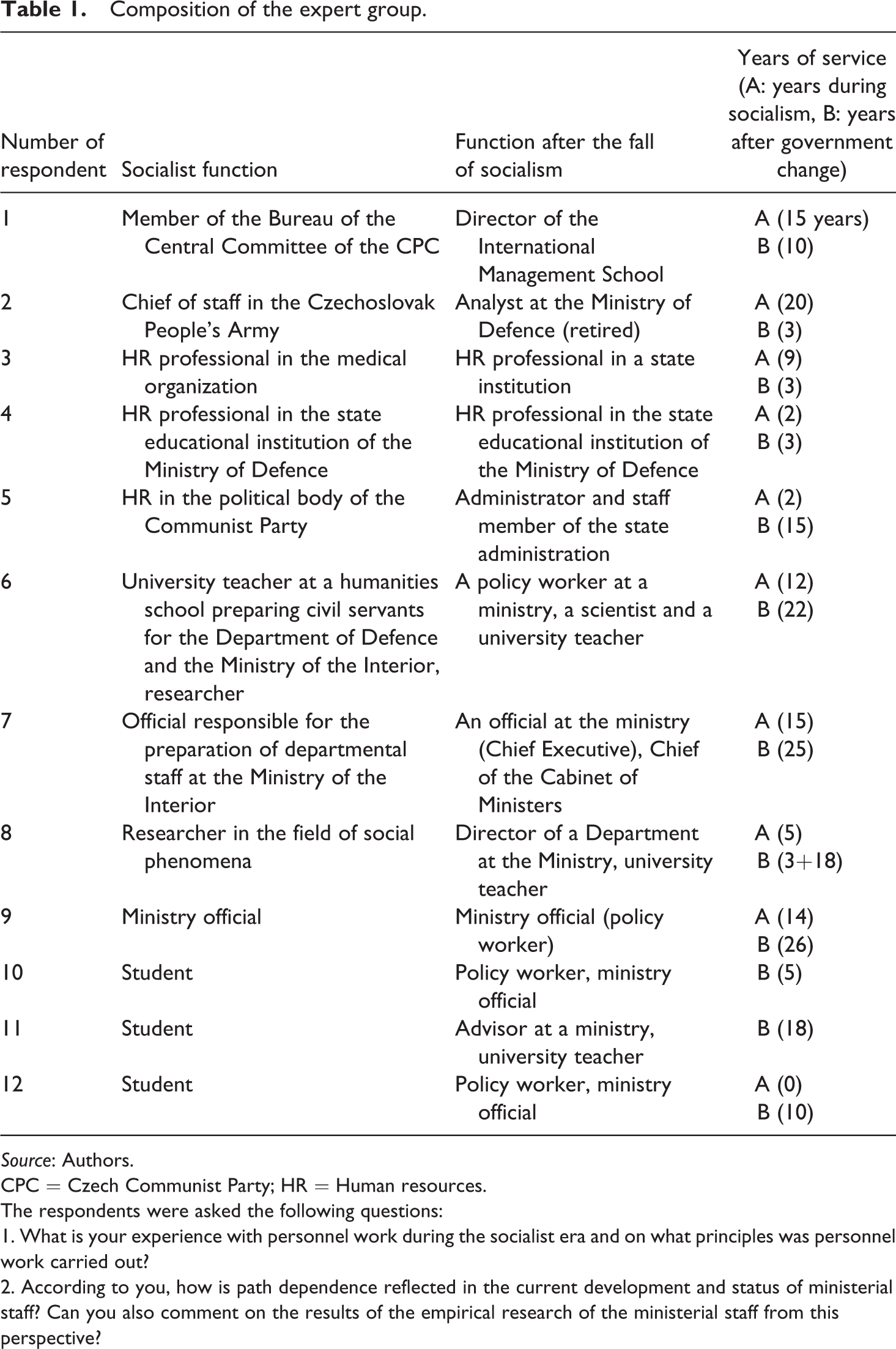
As was stated in the introductory part of the study, it was very difficult to obtain data on the personnel composition of ministries during the socialist era. That is why a structured interview was used with the staff of the ministries who had had work experience within a ministry during the socialist era, a majority of whom continued to work in the ministry in a leading position or in the position of policy worker. Added to this group of experts were young experts who, due to their age, did not experience the socialist government. The results of our empirical research are evaluated and contained in the section titled Questionnaire survey, below. The composition of the expert group is shown in Table 1.
Composition of the expert group.
Source: Authors.
CPC = Czech Communist Party; HR = Human resources.
The respondents were asked the following questions:
1. What is your experience with personnel work during the socialist era and on what principles was personnel work carried out?
2. According to you, how is path dependence reflected in the current development and status of ministerial staff? Can you also comment on the results of the empirical research of the ministerial staff from this perspective?
Structured interviews were also used to obtain opinions from those employees who are currently working in the ministry in a leading position, as well as policy workers, on the results of our empirical research (see next section, ‘Questionnaire survey’). This was in order to find out whether the state of the ministerial staff has also been affected by path dependence. Several respondents (respondents 10–12) were included in the group of respondents who, due to their age, did not have personal work experience with the socialist government. This was carried out in order to strengthen the objectivity of the results of our research.
Questionnaire survey
In order to find an answer to research questions 1–5, we have resorted to carrying out our own empirical research. It was a part of the solution related to the project launched by the Grant Agency of the Czech Republic ‘Analysts of policy in central state administration of the Czech Republic: practices, professional values and identity (P404/12/0725)’. In our research, we have focused on the section of ministerial employees who deal with analytical, conceptual, strategic, planning, project, programming and managerial activities. Those ministerial employees who are involved in explicitly administratively supporting activities, such as maintenance, running of secretariats, the records office and administratively organizational activities were not included in this research. Respondents were selected randomly. Through a series of random selections (sampling) all the units included in the database of individual ministries were approached. A random selection has thus become factually exhaustive. Within the first research step all 14 ministries of the Czech Republic were contacted. Three of the ministries opted not to participate based on their own decisions – the Ministry of Interior, the Ministry of Regional Development and the Ministry of Agriculture. The ministries were asked to draw up a list of potential respondents. This list became the basis of a random selection (sampling) of respondents. For eight ministries the questioning was conducted through personal interviews with precisely prescribed questions (filled in on paper-based questionnaires or using a laptop, respectively). For two ministries a makeshift form of online questionnaire was used where respondents completed the questionnaire without the participation of an interviewer. In one case a combination of both methods was adopted. In total, 1351 respondents were surveyed. Most of the questionnaires were filled out by the PAPI method, which means in the form of a personal interview, that is, an interview with a respondent based on a pre-prepared questionnaire form with prescribed questions using a laptop (992 questionnaires). Fourteen questionnaires were filled out utilizing the CAPI method, that is, in the form of a personal interview with the respondent based on a pre-prepared paper questionnaire with prescribed questions, and 235 questionnaires were obtained using the CAWI method by filling in the online questionnaire without the interviewer’s participation. The survey was launched in April 2013 and concluded in June 2013. The number of respondents from the individual ministries ranged from 69 to 226. The overall return rate of questionnaires was 29.4%. The analysis showed no systemic bias of data. In terms of the research design, sample size and sampling method this was unique (for the time being the first of its kind) research with sufficiently robust data that provided valuable information regarding the ministerial officials of the Czech Republic in terms of their gender, age, education, work experience, performed activities and other characteristics.
Standard statistical tests, such as Pearson’s chi-square test and a binomial test of the ratio, were utilized for processing the results of the questionnaire survey.
Results
Ministerial staff during the reign of the socialist regime (1948–1989)
The purpose of the first question in the structured interview was to examine the features of the system of personnel work under the socialist government, the principles underlying it and its implications for the work of ministerial officials. Respondent 1 did not directly work at a ministry, but was a member of the top political body (member of the Bureau of the Central Committee of the Communist Party). All important party and government documents were discussed within this party body. The respondent confirmed that personnel work was one of the key issues of Communist Party policy and that much attention was paid to staff. It was led by Lenin’s motto: ‘cadres decide everything’.
Expert 2 pointed out that the key principles of personnel work were contained in the document of the Presidium of the Central Committee of the Communist Party of Czechoslovakia, titled Principles for the implementation of comprehensive evaluation of bodies in state and economic administration and workers of the organization of social organizations (Bureau of the Central Committee of the Communist Party of Czechoslovakia, 1972). The principles set out in this document were applied in all establishments. Respondent 5 noted that ‘staffing had a strict order’. This meant that if one wanted to be a civil servant, one had to meet the criteria contained in the document Principles of conducting a comprehensive assessment of cadres in the state and economic administration and workers of the apparatus of social organizations. These were the criteria: ‘the political maturity and class awareness of a worker, his professional level, work performance and organizational skills, his characteristics, his medical and psychological capability’ (p. 2).
The key criterion was ‘political maturity and worker awareness’ (respondent 4). Therefore, this principle is also listed first in the document of the Bureau of the Central Committee of the Communist Party. This principle was favoured, in particular, after the Communist political take over in February 1948. ‘Then its intensity was not so strong. It began to “mellow” before the fall of the communist regime’ (respondent 5). However, until the fall of the communist regime, the document remained in force. It contained procedures for evaluation and promotion. A regular evaluation of the workers belonging to the so-called nomenclature 1 was carried out. This assessment had a binding structure: (a) conclusions of the last evaluation, (b) overall political commitment, (c) working ability and the results of the work, (d) character and personal qualities, state of health of the worker ‘and workers of the apparatus of social organizations’ (see Bureau of the Central Committee of the Communist Party of Czechoslovakia, 1972: 2).
The same document stated that ‘the assessment is made for all management and professional staff up to the position of minister and cadres of all grades in the cadre nomenclature’ (p. 6). The evaluation was carried out every two years. The evaluation contained conclusions and recommendations on the person being assessed. The evaluated signed the rating record, unless they disagreed, stating their objections in writing. For nomenclature cadres where ministers included ministers, communist party authorities expressed their opinions. The evaluation was then carried out by staff bodies (respondents 2, 3, 4, 5). The correctness of the testimony, for which it was the responsibility of the cadre departments to process the evaluation, is also confirmed by the document Principles for the implementation of a comprehensive assessment of cadres in state and economic administration and workers of the apparatus of social organizations. On the basis of the evaluation, the cadre and human resources department prepared proposals for cadre changes, a plan of cadre reserves, proposals for the next leaves and education, or proposals for dismissals from the state administration organization. The drafts were always expressed and signed by the corresponding body of the Communist Party. This document was included in the cadre (personal) file reviewed (see, The Bureau of the Central Committee of the Communist Party of Czechoslovakia, 1972: 10–12).
Respondent 6 summarizes the entire system of personnel work and its principles. The key was that in 1960 the new Constitution of the Czechoslovak Socialist Republic was adopted by the legislature, which codified the leading role of the Communist Party in society. This communist party monopoly was reflected in the work and the principles of selection and promotion of civil servants. However, it should be noted that the socialist government did not know the category “civil servants”, as was commonly used in western sociology at that time. Under the socialist government, the civil servant was a state administration employee who was subject to the Labor Code [Act No. 65/1965 Coll., Labour Code]. All other employees also had the same exact law, the Labor Code. It applied to a minister, a ministry official, a cleaner, a teacher, a bus driver, a scientist or any other employee. Selected categories of people referred to as “nomenclature cadres” were then subjected to a comprehensive assessment, according to a document by the Presidium of the Central Committee of the Communist Party [Principles for the Implementation of a Comprehensive Assessment of Cadres in State and Economic Governance and Workers of the Organs of Social Organizations]. True, there were some exceptions to the scope of the Labor Code: they were professional soldiers, members of the Public Security [secret police] and guards [prison service]. The Labor Code did not apply to them. They were subject to specific laws. However, all regular staff assessments were carried out, as set out in the “Principles for the Implementation of Comprehensive Evaluation of Staff in State and Economic Governance and Workers of the Institutions of Social Organizations”. It is also worth pointing out that the lay public used the term “state official” or “state employee” for the following types of professions under the socialist government: professional soldiers, police, prison service and political workers. It was unofficial, but the public understood it. As can be seen, it is difficult to want to compare the civil servants of the communist regime to those of the present day.
Current characteristics
Gender structure (research question 1)
The results of the evaluation of gender structure of the ministries are shown in Figure 1.

Gender structure of the ministerial staff of the Czech Republic.
Among individual ministries it is (rather predictably) possible to discern clear differences. This fact was also confirmed by the binomial test of ratios (p value of 0.000). The largest degree of variability is represented primarily by the Ministry of Defence, where male employees dominate. This can be explained by the fact that the staff of analytical employees is to a substantial degree made up of former soldiers who after their retirement into the reserves become civilian employees of the ministry. The fact that defence is still traditionally perceived as a male profession in the public’s eyes substantially contributes to the domination of men in the defence sector. It can also be expected that, in the future, men will maintain a dominant position in the activities directly related to the performance of combat operations, but over the next 10 to 20 years it may be more likely that staff posts at the Ministry of Defence will also be increasingly filled by women. One can assume so based on the fact that study at military schools is currently (compared with the past) more open to women and also because at civilian universities and colleges in the Czech Republic new study specializations in the field of state security are being set up which are also being studied by female students. These female graduates of civilian schools may also get job placements at the Ministry of Defence.
Provided we remove the Ministry of Defence from our sample, as an extreme value, the gender structure of ministries is still unbalanced (binomial test of the ratio, p value 9.895E 013). Using the Pearson’s chi-square test we demonstrated that the individual type of ministry affects the gender composition of its staff (the critical value of chi-square 78.495).
Regarding the analysis of the gender structure of the ministerial staff in general, the issue remains, on the theoretical level, rather marginalized. We have found a reference to the gender structure of central state administrative bodies in the work of Howlett and Newman (2010), who in their examination of civil servants assume that more men than women work in this field. The authors in question, however, fail to provide any reasons for such a formulated hypothesis.
Age structure of the ministerial staff (research question 2)
The results of the evaluation of age structure of the ministries are shown in Figure 2.
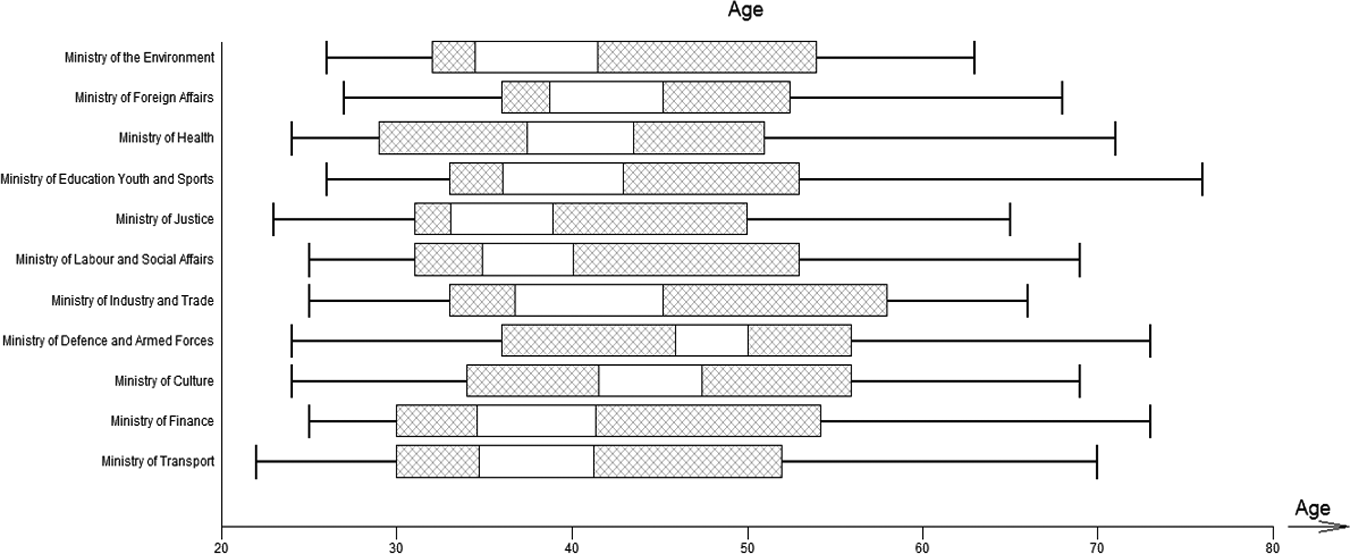
Comparison of the age structure of ministries.
The median age for all the ministries is 42 years. This means that one-half of the sampled ministerial staff is younger than 42 years of age and the other half is older than 42 years of age. The research results have thus confirmed the assumption that ministries are differentiated by age. As expected, it turned out that the oldest ministry is the Ministry of Defence which of all the ministries has the highest median age (50 years). On the other hand, the Ministry of Labour and Social Affairs, the Ministry of Finance and the Ministry of Justice (all with the median age of 35 years) are the youngest ministries. The low median age of these ministries may be explained by the fact that the given ministries employ full-time students, who upon graduation remain at the respective ministry.
The research has also confirmed the assumption that the age group of employees between 45 and 59 years of age is strongly represented at the Ministry of Defence. In total, 61% of surveyed employees at the Ministry of Defence belong to this age group. This confirms the hypothesis regarding the departure of former military officers into the reserves and on their stay at the Ministry of Defence as civilian employees. Within the data analysis, a very interesting fact was uncovered. Although the Ministry of Defence (measured by the median age) ranks among the oldest ministries, it has only 8% of employees in the age group over 60. (This is the age at which former officers leave for their old-age pension and when their service allowance is terminated.)
This is a very interesting find compared with the Ministry of Finance where one-fifth of the employees are over the age of 60, while overall the ministry has the lowest median age (35 years). We explain this fact by the effect of the ascending young age group of officials who, after graduating from universities, continue with their employment contract at the ministry. The fact that the respective type of ministry influences the age composition of its staff was successfully proven using the Pearson’s chi-square test (p value of 0.000).
Another interesting finding was that male-dominated ministries also have higher ages than ministries where women are prevalent. This fact we explain by the reality that men, unlike women, go into retirement comparatively later, ‘putting off’ their departure. That is to say men have a different structure of values and interests from women and thus remain at work even after meeting the retirement age. They do not have such rich interests as women for whom work is succeeded by their care for grandchildren or other recreational activities.
Education (research question 3)
The level of education attained by the examined sample of ministerial staff was monitored under the following categories: (a) apprenticeship/high school without A-levels (diploma), (b) secondary education with A-levels (diploma), (c) higher professional education, (d) university undergraduate (bachelor’s degree), (e) university graduate (master’s degree) and (f) university doctoral education. Results of the empirical research are shown in Figure 3.
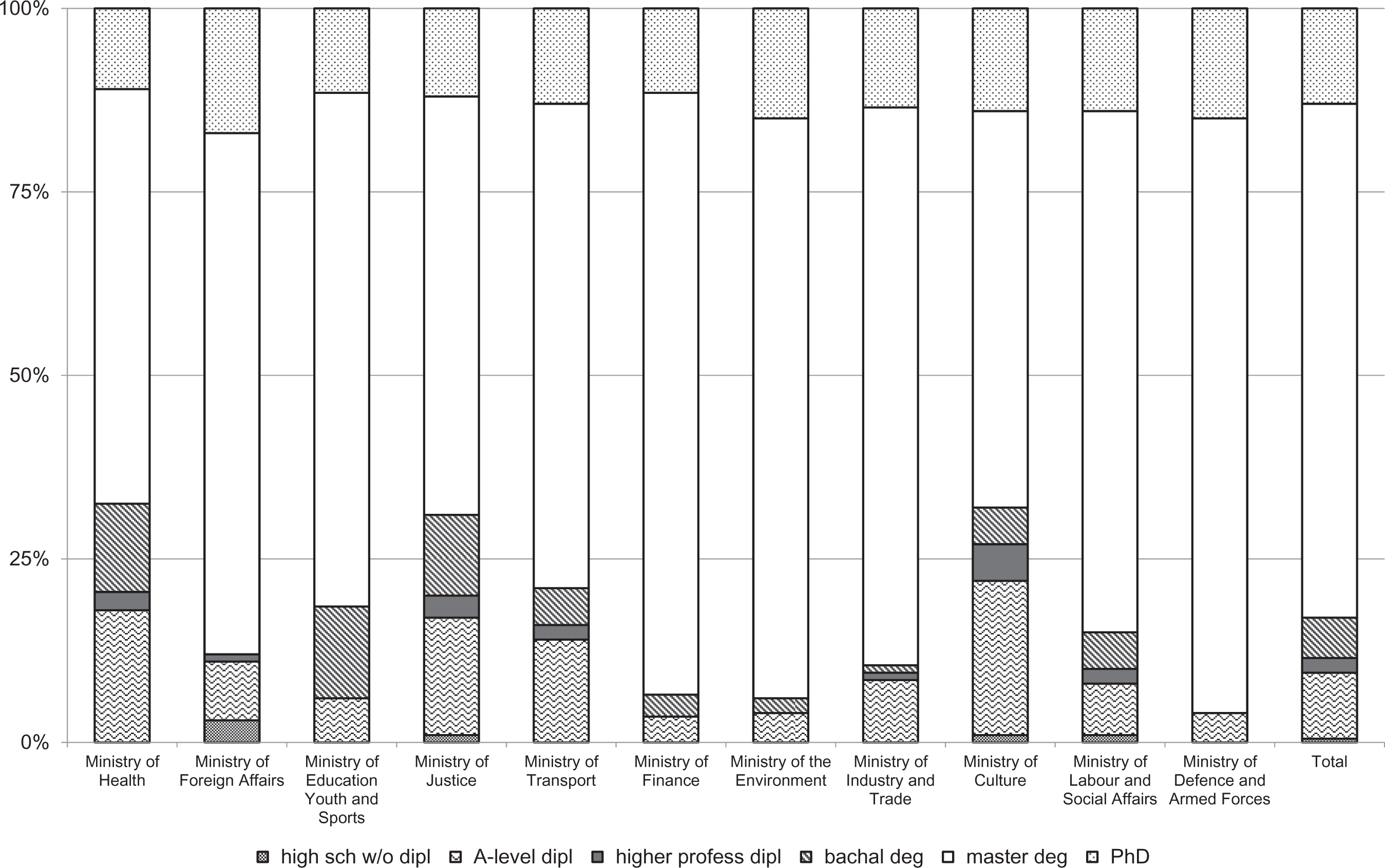
Educational structure per ministries.
Figure 3 shows the alignment of the ministries according to the largest share of employees with university-degree education up to the ministry with the lowest proportion of university-educated employees. From the perspective of education, all the ministries have an average of 89% university-educated employees, which is a relatively high proportion. However, at the same time, our research shows that, among individual ministries, there are obvious differences. In this context we asked whether there is a correlation between the type of ministry and the educational level of its employees. Since we did not anticipate a linear dependence, we calculated using Spearman’s correlation coefficient which amounted to 0.305. This value may be interpreted as a weak dependency.
The highest proportion of university-educated employees (including completed doctoral studies) was achieved by the Ministry of Defence, which has within the examined group 96% of its employees having a university degree. A similarly high proportion of university graduates in the examined group (95%) was achieved by the Ministry of the Environment. On the other hand, there is a group of ministries (such as the Ministry of Justice, Ministry of Transport, Ministry of Health and Ministry of Culture) with 75 to 80% university-educated employees overall.
It turns out that there are ministries where dealing with certain tasks requires (i.e. it is sufficient to possess) only a secondary-level education with A-levels (diploma). Such cases are typical for the Ministry of Health and the Ministry of Culture, where a number of tasks related to policy analysis are performed by employees with only a secondary-level education. Legislation rules permit such procedures and outcomes. That is, individual ministries on their own submit their proposals to the Government Office related to the staff number and the required qualifications. Therefore, for this reason, there also may emerge differences in the education structures within individual ministries.
Work experience (research question 4)
The Pearson’s chi-square test proved statistically significant differences in the prior practice between individual ministries. It turned out that a relatively high number of the surveyed ministerial employees (on average 38% of the surveyed employees for all the ministries) have previous work-related experience from the commercial sector. The results of the evaluation of the previous working experience of ministries are shown in Figure 4.
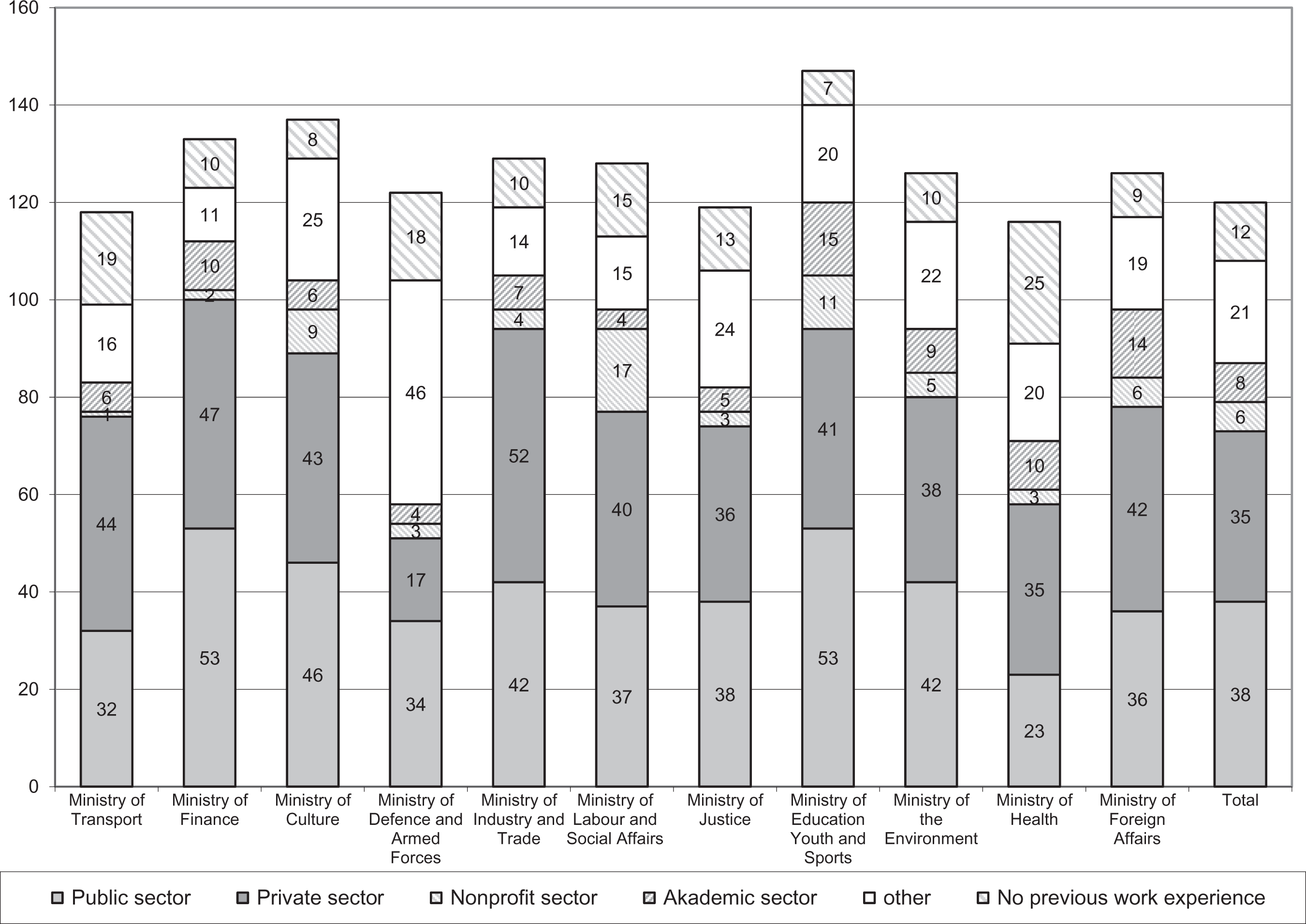
What percentage of respondents from individual ministries has previous work experience and from which sectors.
An interesting (but less surprising) finding is that only about one-tenth of the interviewed respondents have work experience from the non-profit sector (NGOs) and academia. Workers from non-profit organizations and the academic sphere obviously prefer the relatively free working regime against the strictly set working hours which dominate at the ministries. To the extent that these workers come to the ministries, they do so probably for a temporary period and choose a ministry which corresponds to their previous job. This assertion we support from our own experience. Therefore, it is not surprising that those with the most experience (approx. 15% of respondents) from academia are employed by the Ministry of Education, Youth and Sports. Some (usually managerial) posts of this ministry are in fact occupied by former academics that in some cases still retain part-time jobs at universities. A similar situation applies in the case of the Ministry of Labour and Social Affairs where nearly one-fifth of the surveyed employees have previous experience from the non-profit sector.
An interesting finding is that one-tenth of the surveyed employees are without any previous work experience. These are probably employees who, as fresh graduates, have just started their careers. Where an opportunity to accept full-time students is limited by the particular activity of the given ministry, it is not previous work experience which is required but rather a specific education path in, for example, the Ministry of Foreign Affairs which has a higher proportion of graduates with no previous work experience. In the case of the aforementioned Ministry of Foreign Affairs this represents one-quarter of those surveyed. The results have shown that public allegations that ministerial employees stay for long periods of time in their positions are not true. Almost half of all the surveyed ministerial employees have worked in their posts for less than three years, one-quarter of those surveyed for 3–5 years and only about one-tenth of the surveyed employees have worked in their positions for more than 11 years.
The research results have shown that half of the surveyed employees have worked at ministries for more than five years, but only one-tenth of those surveyed have worked there for more than 21 years.
Which types of activities do ministerial employees perform (research question 5)
Another research question was directed at determining what activities are performed by the ministerial officials. Within the analysis of the activity of ministerial officials we were inspired by the studies of Colebatch et al. (2010), Veselý et al. (2014) and Veselý (2013). We have designed, in total, five categories of activities that we gave the interviewed subjects to choose from: (a) official, (b) manager, (c) lawyer, (d) analyst, (e) economist, and (f) other.
The ministerial employees were asked to express which category reflects most accurately the work they perform as ministerial employees. The resulting answers are shown in Figure 5.

What type of work is performed by ministerial officials.
The category ‘official’ (43%) received the most responses. Managerial functions were held by 15% of the respondents. The following categories in order of their frequency were: other (15%), lawyer (13%), analyst (8%) and economist (5%). Analysis of the organizational structure of individual ministries showed that where ministries have explicitly listed strategic, analytical and conceptual workplaces (sections, departments) in their organizational structures, respondents, to a lesser extent, deem themselves as officials. This is confirmed by the case of the Ministry of Finance where only one-third of respondents identified themselves as officials. To the contrary, those ministries where such analytical and conceptual workplaces are missing from the organizational structure (or they are present only to a lesser extent, see the Ministry of the Environment) have almost two-thirds of respondents deeming themselves as bureaucrats, though at this ministry employees with a university education were prevalent. While the role of an analyst was identified by an average of only 8% of respondents for all ministries, in the case of the aforementioned Ministry of Finance, approximately one-tenth of respondents deemed themselves as analysts (at the Ministry of the Environment it is a mere 1% of respondents).
From the research it is clear that although a relative majority of the respondents deem themselves officials, ministerial employees, however, do not perform only clerical work. Therefore, we were interested in the nature of the activities performed. Are these operational (routine) activities or rather activities aimed at solving complex problems? The research results revealed some interesting findings. Approximately two-fifths (43%) of the respondents indicated that they daily are devoted to routine tasks that have ‘one clear and relatively simple solution’. One-quarter of the surveyed employees said that they were devoted to these types of tasks several times a week while 16% responded that they engage in these activities several times a month. Others encountered such tasks several times per quarter (5%), several times a year (7%) or not at all (3%). At the same time, among individual ministries, there were no significant differences. As evident from this data, ministerial officials are far from carrying out only routine activities.
Assessment of the results of empirical research by the expert group
On the basis of comments on the results from the experts, the views will be summarized and comments on whether the features examined by the ministerial staff (i.e. gender structure, age structure, education or types of activities) are influenced by communism will be added.
Respondents with immediate experience of personnel work and the preparation of civil servants under the socialist government confirmed that the effects of the path dependence of the communist regime could be recorded with varying intensity, different ranges and at different time intervals in almost all areas.
If we monitor the effect of path dependence on gender structure, path dependence has a special (‘distorted’) effect. Above all, the respondents mentioned the odd attitude of the previous regime to this problem. Although the Communist Party leadership talked about the need to employ women in leadership positions, equality among women and men did not follow. This was related to Communist Party policy. Respondent 3 said, I have never seen a female health worker as a woman in a position above men. Under the communist regime, in the 1970s and 1980s, the role of a woman was seen as a mother. This was also the policy of “Husák’s Children” [this was a colloquial designation of the CPC policy in the 1970s and 1980s, which supported the baby boom by state intervention]. When maternity leave ended, the woman returned to work, or she looked for a job. However, the practical policy was not set up so that someone in the health service would “monitor” the equal representation of men and women. Even so, women had a majority in healthcare. Therefore, it is not surprising that women make up 71% of women of the health sector. Military service was considered a male occupation under the past regime. For the defense[sic] ministry, therefore, men were overwhelmingly in higher positions. They were mostly officers. Women only held special administrative functions, such as the head of the registry. This tradition has shifted to the present, as shown by research, with 86% of men in the surveyed group. It is estimated that under Communism, this share was significantly over 90%. But when one looks at the Ministry of the Environment, you will find complete gender balance. No influence on path dependence.
Additionally, in the ‘age structure’ field, the experts state there is some influence of path dependence. They mention that there are relatively large differences among ministries. This is shown by the results of the research. There are ministries (the Ministry of Labour and Social Affairs, the Ministry of Justice, the Ministry of Finance, the Ministry of Transport, the Ministry of Health and the Ministry of the Environment) where more than half of the employees are under 37 to 38 years of age, while half of the employees in the Ministry of Defence are over 50 (but only 8% over 60). The commentators believe that this is likely to be explained by a number of factors that are difficult to define clearly. One possible explanation is that the analysts of these ministries do not need to have (as opposed to the Ministry of Defence) specific knowledge supported by relatively longer practice in the field, as is the case with military theory and practice. However, it is also a consequence of the fact that the officers who leave for the reserves will continue to remain as employees of the ministry. ‘But it may also be the influence of other factors’, said a commentary expert from the Ministry of Finance (expert 10). Twenty per cent of the interviewed analysts older than 60 years were at the Ministry of Finance. Expert 10 said, This is a built-in influence from the past. In our work, we need a detailed knowledge of budget rules, legislation. When someone has been working for forty years, of course they has more knowledge than when I came to the ministry after graduating from college five years ago. Some influence of path dependence would have been seen, but we should be careful. We do not want to explain everything as a result of past times. The fact, however, is that past decisions leave traces in the current development. I was a member of several reform teams. Already in the early 1990s, organizational changes had been made to ministries. At that time, as an expert, initially working at the university, I was offered an offer to become a ministry official. I wanted to accept the offer. I became a policy worker directly at the ministry and an expert for the entire state administration. On one committee, we dealt with the organizational reform of the ministry. There was a new systemization [a chart of staff numbers in individual ministries, their planned functions with planned education and salary]. I was there and watched this “tragicomedy”. It has not been done systematically at all. My boss sent me to the committee saying, “You will defend our interests.” But they also wanted representatives from other posts. Thus, the pattern of systematization took precedence, we call it the “historical structure of the numbers of people” with their education and salary requirements. Then, after a while, I, disgusted, dragged myself back to university. But this practice of “copying the historical organizational structure” is still in place.
In the field of experience, the commentators see two opposing tendencies that have been articulated by comments from the Ministry of Finance (respondent 10). On the one hand, it is a positive influence when the accumulated work experience is used, but on the other, as far as changes are concerned, older workers do not want to [sic] anything changed there…there is a great reluctance to change.
Negative tendencies can manifest themselves even in an unwillingness to change anything in the context of new scientific knowledge. This is shown by respondent 11 whose expertise is in defence. I will give an example. I served under General Hrabalem and other generals who were operating under the principle that they do not read Czech Military Review [an expertly reviewed military journal]. That is, what is labeled as scientific is considered to be completely harmful from the point of view of those so-called practitioners.
The last area the commentators commented on was the area of ‘types of activities’. Ministerial officials were asked how they perceive their role in the ministry. They were selected from the following categories: (a) official, (b) manager, (c) lawyer, (d) analyst, (e) economist and (f) other. The largest representation was the ‘official’ category. This was chosen on average by 45% of respondents. The ministry officials from the Ministry of the Environment had the highest (63%), with the Ministry of Finance (about 28%) ranked the lowest. Those experts who have had experience at work at the ministry have indicated that it is logical that ministry workers are considered officials. This is illustrated by the following commentary from our ‘stalwarts’ among the interviewees: ‘Of course they are officials. I have always considered myself a ministry official’, said expert 11, who worked for the past regime for 14 years, and after the fall of the socialist government for another 26 years in the ministries.
Interesting commentary was provided by Expert 6. Please note that interviewees from the Ministry of the Environment consider themselves to be officials, whereas the Ministry of Finance interviewed regarded themselves as officials only in 28% of cases. I have two explanations. Officials from the Ministry of Finance have always considered themselves to be an elite
2
who perform a specific job. Therefore, they are “economists”, “lawyers”, “managers”, “analysts”. The influence here may also have a remnant from the past. Under the former regime, the term “official” was rather a mischievous word. It was usually understood as a “bureaucrat”, a person who fulfils communist party regulations. When looking at the age structure of the Ministry of Finance, approximately half of the respondents had work experience from the previous regime and one-fifth of respondents are older than 60 years. Employees of the Ministry of the Environment have no issue with the designation “clerk”.
Conclusion
The research has shown that ministerial employees are gender and age balanced and they are primarily university educated. However, the research has revealed some negative phenomena, including differences related to the actual access of men and women to further education and a relatively high share of uncreative work. The discovered negative effects likely indicate a systemic flaw in the management of the ministries of the Czech Republic.
The structured interviews also revealed that traces of the communist past can be found in the personnel structure of policy workers 25 years after the Velvet Revolution, which is reflected in the gender, age, education and other characteristics of the employees. This is confirmed by the conclusions of other authors who have dealt with this phenomenon in the post-communist countries (i.e. Sakovski et al., 2015), or authors who are sceptical about the results of reforms in the spirit of New Public Management implemented by these countries (Randma-Liiv and Drechsler, 2017), or authors who explore path dependence in the context of countries with a strong legalistic tradition. Bach et al. (2017) state that the individual characteristics of a country have a greater impact than the generic characteristics of the Rechtsstaat model.
The analysis of ministerial employees has brought some interesting findings. The willingness of ministries to participate in the research on ministerial employees has shown that in the Czech Republic, there are several ministries which deemed it unsuitable to share their activities and therefore keep their information on employees hidden from the general public. It is perhaps also one of the remnants of the communist era when the issue of ministerial activities and data on their employees had been kept secret from the public.
We would also like to make some recommendations for public policy. First of all, it is necessary for the State itself to carry out regular investigations into the personnel situation within the ministries. In this area in the Czech Republic the Ministry of the Interior has competence and the necessary basis for evidence-based government personnel policy.
An important factor in overcoming the ghosts of the past is cooperation in education. For university-level public administration programs, information on the activities carried out by ministry staff is absolutely necessary. In the Czech Republic, the economic and legal guidelines of the university prevail in this area. They are based on a classical economic or legal basis, with specialization in public administration (Plaček, 2014) such as programs focusing on public policy. The offerings of the university do not correspond to the actual needs of the modern public sector (Plaček, 2014), which leads to the preservation of the current state.
Footnotes
Authors’ Note
Michal Plaček and Michal Křápek are now affiliated with Vysoká škola regionálního rozvoje a Bankovní institut - Ambis, a.s.
Declaration of conflicting interests
The authors declared no potential conflicts of interest with respect to the research, authorship and/or publication of this article.
Funding
The authors received no financial support for the research, authorship, and/or publication of this article.