




Abstract
The use of applied labs has long been an established practice in the natural sciences as a means of stressing application of theoretical principles and fostering disciplinary excitement. The social sciences have seen an advent of similar problem-based approaches, but have not adopted a lab-based model. Labs offer an opportunity to use class time for purposes of application without moving fully to a flipped classroom model. This article presents the use of labs in three undergraduate public administration classes: Introduction to Public Administration, Research Design and Data Collection, and Statistics and Data Analysis. The labs are collaborative and feature both peer and instructor support. They utilized an established problem-based strategy to demonstrate the real-life applicability of academic topics (Kolb, 1984; Kramer and Schechter, 2011). Data collected from 10 sections of the courses before and after implementation show increased student satisfaction and greater self-reported learning, though the effect on academic performance is more moderated.
Introduction
There has been mounting evidence of the value of problem-based and other applied teaching techniques to student learning. The benefits of problem-based strategies on academic achievement are well founded, with studies showing success on such objective measures of student learning as standardized tests. In one British study, students who used a problem-based math curriculum where three times more likely to achieve the highest possible grade on national exams than those students in a comparable control group who received more traditional math instruction (Boaler, 1999). Likewise, a statewide study in Iowa found that schools that adopted a problem-based curriculum were successful in shifting their standardized test scores from “well below average” to “well above average” in three years (Thomas, 2000). Within the field of public administration, there has been a push to move from traditional lectures toward approaches that value critical thinking and problem-based pedagogies (Dunning, 2019).
Given empirical evidence on the value of problem-based learning and a recent call from the journal Teaching Public Administration to investigate different pedagogical approaches to the teaching of public administration, this study presents the results of a four-year trial in teaching public administration using classroom-based labs (Dunning, 2019). Labs refers to “any place, situation, set of conditions, or the like, conducive to experimentation, investigation, observation” (Dictionary, 2017). To this end, the use of public administration labs entails regular course meetings where students are asked to apply the tools of public administration and scientific inquiry to a problem, much as one would in a chemistry lab that accompanies an introduction to chemistry course. The labs are problem-based and maintain the characteristics of problem-based learning which are student-driven and teacher-facilitated. Students investigate questions relevant to the study of public administration and prepare solutions to these problems through the application of course material under the guidance and direction of faculty (Bell, 2010).
This paper seeks to investigate the question, “What is the effect of the use of labs in the public administration classroom on student satisfaction and learning?” This paper will begin by exploring the scholarly and academic justification for the method. It will then proceed to explain in depth the application of labs in three undergraduate courses at a midsize, Midwestern public university in the USA: Introduction to Public Administration, Research Design and Data Collection, and Statistics and Data Analysis. The impact of this approach will be tested using student projects to measure learning and course evaluations to assess student satisfaction. This paper will conclude with results and implications for the use of labs in public administration.
Literature review
Pedagogical approaches in the natural sciences have seen an evolution to a model that integrates classroom and laboratory inquiry to stress the meaningful application of course material. Recent research on the use of labs in the natural sciences is so confident that these applied activities increase learning that the empirical focus is on how labs are structured to improve the learning experience (Brownell et al., 2012). Labs have been shown to increase student learning, increase the likelihood of attaining a PhD, and have an equalizing effect in the sciences as they show greater impact on student learning for black and Hispanic students relative to other students (Weaver et al., 2008). Moreover, they have had a profound effect on student retention (Makarevitch et al., 2015).
Labs in the natural sciences have tended to distinguish between standard or confirmatory labs and inquiry labs (Deters, 2005). Standard or confirmatory labs provide opportunities for students to apply knowledge and skills to highly structured problems. Their goal is generally to reinforce lecture content by demonstrating the reality of scientific principles. This is in contrast to inquiry labs which more realistically mirror the scientific process, with students identifying problems and methods appropriate to address the questions or concerns (Deters, 2005). Students who participated in inquiry-based labs as opposed to step-by-step labs reported 10–20% higher scores on their labs. Follow-up surveys of their instructors report 84% believe that the students learned more using inquiry-based labs (Booth, 2001).
Each method has its own strengths and weaknesses, but in general, the natural sciences have moved toward inquiry-based instruction, citing the benefits of increased scientific mastery, greater communication, increased interest, and an enhanced ability to identify and improve mistakes (Deters, 2005). However, this must be balanced against instructional challenges that arise with loss of control and the increased time demands in the classroom. Moreover, when students are first exposed to inquiry-based labs, they express frustration with the lack of structure and the difficulty of critical thinking (Brown et al., 2006; Deters, 2005). Evidence suggests that upper-level science majors do better with inquiry-based approaches than introductory or non-science majors (Brown et al., 2006). That is not to say that labs are only relevant for upper-level students. Evidence has shown that early inquiry-based lab experiences, and lab experiences throughout the curriculum, can impact student learning, retention, and success (Makarevitch et al., 2015). To this end, the use of labs in the public administration classroom is scaffolded to maximize learning.
The theory behind the use of labs is predicated on the work of Dewey and others, who advocate applied pedagogy (Dewey, 1923). In particular, it is based on the work of David Kolb (1984; Kolb and Kolb, 2012). Kolb’s learning theory suggests that information is best retained when reinforced through a cycle of abstract conceptualization, active experimentation, concrete experience, and reflective observation. Through thinking, trying, and reflecting, deeper learning occurs. In this way, problem-based learning in general, and public administration labs in particular, give students a chance to apply and reflect on their learning in a problem-based way.
Problem-based learning
While the use of labs has a very limited tradition in the social sciences (outside of economics and psychology), there is certainly a precedent for similar approaches that use problem-based techniques (Sandfort and Gerdes, 2017). In 2001, Nancy Boyer called for an increase in problem-based learning in public administration, and significant steps have been taken since that time (Boyer, 2001). For professional programs like public administration that bridge the connection between theory and practice, problem-based strategies provide a valuable tool. Professional skills are best learned by crafting solutions to real-life problems. This type of learning happens naturally in internships and on the job, but can be facilitated by creating a learning environment where students apply skills (Cohen et al., 1995).
Problem-based learning is more than just completing projects (Markham, 2011). Likewise, it differs from other teaching methods such as the case study approach, where the problems confronted are brief, current, complex, and ill-structured (Stinson and Milter, 1996). This complexity and ambiguity make them more like real-world problems. Moreover, problem-based learning differs from other projects in that knowing and doing are not separated, but rather problem-based learning requires clear application with mastery of the required material (Markham, 2011). Problem-based learning involves the application of tools to problems of interest so that students are motivated to learn. As one recent study of public administration discovered, the problem-based curriculum had the effect that, “students deepen their research policy knowledge of a topic they are interested in; they learn basic analytical tools; and they hone professional written communication appropriate in public affairs” (Sandfort and Gerdes, 2017: 55).
To this end, problem-based learning is characterized by three attributes (Markham, 2011). First, problem-based learning integrates knowing and doing. Students are exposed to intellectual content and then apply that content to solve authentic problems faced in the real world. When done well, the divide between knowing and doing is diminished. Second, problem-based learning involves a carefully crafted assessment that includes ongoing feedback on the desired skills. It is an active process that includes ongoing instruction, observation, and the measurement of new skills and knowledge. Third, the method focuses on the education of the student and not the curriculum or the coverage of material (Markham, 2011).
There are multiple examples of problem-based learning used in the public administration classroom (Goodman, 2008; Miller-Millesen and Mould, 2004; Spoormans and Vanhoonacker, 2005). In one study of problem-based learning in public administration, the problem-based curriculum was shown to make students aware of the key problems in the profession, select relevant and reliable information, and foster improved problem-solving skills. Additionally, students within the problem-based curriculum were also shown to have significant job market success upon graduation (Spoormans and Vanhoonacker, 2005).
That said, the use of problem-based learning in public administration is not without its challenges. One of the biggest obstacles is identifying problems for students that are sufficiently real world, but also manageable in the context of a single class. Consequently, faculty are often required to develop their own problems to ensure that they are holistic, contemporary, and tied to course objectives (Goodman, 2008).
Flipped classroom model
Another approach to fostering student application of course content that has received increasing attention in recent years is the flipped classroom model (Gunyou, 2015; Dunning, 2019). Under the flipped classroom model, the conventional framework, with instruction taking place in the classroom and application taking place afterwards at home, is flipped. Instead, content delivery is moved outside of the classroom and application takes place in the face-to-face setting (Sandort and Gerdes, 2017). Conventionally, students learn through readings and prerecorded video lectures (often delivered online). Once students are exposed to the needed material, they come to class and engage in active, group-based problem-solving activities. Faculty serve as consultants during this time rather than providing direct instruction (Bishop and Verleger, 2013). In this way, a flipped classroom requires self-directed learning but provides a supportive in-class environment to explore applications (Peters, 2014).
A recent survey of published articles on flipped classrooms provides promising results. Students were shown to increase their performance on the final exam by 21% when content was introduced outside of class with videos. This is likely the result of students coming to class more prepared than when they had been given traditional textbook readings. Moreover, students’ satisfaction of the flipped classroom tended to be positive, with the exception of a sizable minority of students who felt that they were not being taught given the unconventional method (Bishop and Verleger, 2013).
Empirical research on the use of the flipped classroom in public administration is elusive, but first-hand accounts are positive. A recent published testimony identifies several advantages for public administration, including greater learning from informal mentoring, pedagogical outcomes are more reflective of the real world, and greater peer learning (Gunyou, 2015). While the public administration lab structure explored in this paper is not a pure flipped classroom, it shares these benefits with this model.
The course design discussed below reflects elements of both problem-based learning and the flipped classroom. Like traditional problem-based learning, it relies on some in-class content delivery and the use of loosely structured problems to foster application and critical thinking. Like the flipped classroom, the approach uses some class sessions for application with faculty guidance and collaborative learning (much as one would in a science-based lab). However, it avoids the hesitancy that many faculties feel about taking all of the content delivery outside the classroom. In this way, the use of public administration labs threads the needle between traditional lectures, problem-based learning, and the flipped classroom.
Course design
This concept of labs is not new to the social sciences, as they have been used in psychology (Anderson, 1977) and economics (Lage et al., 2000) for decades. However, the use of labs in public administration is not well documented in the literature. Consequently, as this literature review suggests, our understanding of labs is informed by the longstanding use of problem-based curriculum and the emerging research on flipped classrooms.
The use of labs in the public administration classroom is certainly part of the problem-based curriculum tradition and shares many of its theoretical foundations, such as the application of knowledge to practical problems, assessment with a focus on feedback and skill improvement, and a preference for prioritizing skills and knowledge over coverage of material (Markham, 2011). The term “lab” is used so as to not confine the technique to any one pedagogical approach. To this end, labs include complex case studies, applied policy problems, managerial tasks, or other authentic techniques. As can be seen in the examples provided below, Box 2 demonstrates an example of a condensed case used as part of a lab. However, Box 1 and 3 demonstrate that not all labs are case-based. The overarching goal is the use of class time to address authentic problems in whatever problem-based format is most conducive to the learning outcomes.
Sample lab from research methods course
Lab 5: Designing Ethical Experiments
There is a significant consensus that immigration is changing the political landscape for both Democrats and Republicans. Both parties are trying to determine how their policy positions can be crafted to attract immigrants. In order to determine this, they are seeking to study both legal and undocumented immigrants. Develop a study to inform their decisions. How would you select participants? What types of questions would you ask? How would you ask them? What are the limitations to this approach? In answering these questions, provide sufficient detail as to make your study replicable. How will you ensure strong ethical standards in your research? In answering this last question, directly apply the Belmont criteria.
Learning objectives: Use the Belmont principles to guide research method design. Develop an ethically appropriate research design. Identify a sampling technique appropriate for sensitive populations. Evaluate the strengths and weaknesses of a research design.
Sample lab from public administrations course
Lab 3: Columbia Accident
NASA seems to be plagued by one accident after another. First there was the Challenger explosion and then the Columbia. This is an embarrassment to the program and to the president. The president has asked you to make a recommendation to reform accountability mechanisms at NASA. Please prepare a memo for the president. Your memo should feature four sections. First, describe the problem. What is occurring at NASA that makes it so resistant to accountability? Second, describe what options exist to hold the agency accountable. The president is a big fan of the five accountability mechanisms discussed in class, so be sure to use them to explain why they are or are not accountable. Be very specific in this section. Third, make a recommendation about which of these should be the focus of his reform initiative. Fourth, explain the implications of your recommendation for other types of bureaucratic organizations.
Learning objectives: Identify policy-relevant strategies for accountability to guide public organizations. Evaluate the fit of accountability mechanisms based on organizational cultural factors and the political environment. Anticipate the effect of policy interventions on bureaucratic behavior.
Sample Lab from Data Analysis Course
Lab 8: Regression
We will use the ESS data on immigration attitudes again to practice multiple regression and recoding. Attached you will find two tables showing the dependent variables (attitudes about immigration) and potential independent and control variables. Don’t feel constrained exclusively by the variables in this table. Develop the best model possible to explain support for immigration. Include at least one dummy term. Interpret your findings including the coefficients, R2 and any other important conclusions. You should also do something else outside of normal regression such as converting a nominal variable to dummy variable or creating an interaction term. Explain any recoding that you did. Make sure you have a causal theory to justify your choice of variables. Produce a table for the descriptive statistics and inferential statistics. Report any relevant statistics and interpret through a narrative.
Learning objectives: Interpret the meaning of numbers of a regression table. Evaluate the policy-relevant impact of a statistical coefficient. Develop appropriate statistical models to explain policy effects. Evaluate the quality of a regression model.
However, the lab approach doesn’t require fully investing in a flipped classroom where the clear majority of instruction is moved outside of the scheduled class meeting time. At the same time, labs have a flipped classroom feel to them in that the environment fosters creation, collaboration, and application. Additionally, some meetings of the course are flipped in that class time is spent in application. Labs maintain characteristics of the flipped classroom and problem-based learning in that they are a student-centered pedagogy where the student bears a significant responsibility for his or her learning and the direction of the lab project.
At its core, the lab method is characterized by three features: repetition in learning, support in application, and the use of loosely structured problems. Consequently, the use of labs can be employed in different disciplinary contexts with public administration. The results presented below outline the use of labs in three undergraduate courses: Research Methods for Political Science and Public Administration, Introduction to Public Administration, and Data Analysis for Political Science and Public Administration. All three courses are multi-level and are enrolled with freshman through seniors. However, Introduction to Public Administration tends to be primarily for students in their second year, while Research Methods and Data Analysis tend to be enrolled with a mix of second- and third-year students. The class size for each course is around 18–20 students.
Repetition in learning
A primary feature of the use of labs in the public administration classroom is the repetition of learning. For each major course topic, the material was addressed three times. First the instructor would present the material to the students using a combination of lecture, micro-activities, and facilitated small and large group discussions. Second, the students would participate in a “lab” activity where they were asked to apply the material to an instructor-identified problem. The labs would occupy one course meeting of 75 minutes. During this time, students would work to solve a problem or make a recommendation by applying the course material learned from that course topic. The number of lab meetings per course ranged from five to nine out of a total of 32 course meetings, depending on the course. The third coverage of the material would take place outside of class in the form of an independent homework assignment. The students also complete a final project for each class which gives them the opportunity to use some of the concepts a fourth time in a more summative form. This approach is consistent with the dominant view of learning in which learning is maximized by goal-directed practice coupled with detailed feedback on where mistakes are occurring and how they can be improved (Ambrose et al., 2010). For each iteration of the topic, the students receive detailed feedback on their performance with the opportunity to practice the goal-directed outcome.
Support in application
While the labs are graded, their primary goal is learning and not assessment. Consequently, their contribution to the final grade is no more than 40% in the case of the course with nine labs and 30% in the case of the course with five labs. Moreover, all labs are collaborative. Students are encouraged to work together to maximize peer learning and the instructor is active in walking around the classroom and serving as a consultant as questions arise. When it becomes clear that multiple students are struggling with the same topic, the instructor will pause the lab and provide supplemental instruction to the whole class. Consequently, student curiosity helps drive the learning.
Loosely structured
While the problems differ greatly depending upon the topic of the course, the labs are designed to be loosely structured in order to maximize the opportunity for application and critical thinking. Much like the flipped classroom model, the labs are complex, like real-life situations, and thus foster interest and professional relevance.
However, the labs are not equally complex. The labs are scaffolded to maximize learning with earlier labs designed to accustom the students to the method of inquiry. Scaffolding refers to an approach to learning in which early learning is characterized by simple learning within constrained situations, but which over time come into increasing complexity (Pea, 2004). Similarly, the use of labs in these courses are structured so that early-term labs are highly structured with clear instruction and lots of guiding questions, whereas later labs are more ambiguous and require more assumptions and critical thinking to complete. Examples of the labs can be found in Boxes 1–3, along with the lab-specific learning objectives.
Methods
The subjects for this study include 198 students in 11 course sections taught over a four-year period. The courses were always taught by the same instructor with the same textbooks. There were minor variations in content from semester to semester, but the most significant change is that in five of the sections, the classes were taught with the use of labs. In six of sections the classes were taught without the use of labs. Students were enrolled at a midsized, Midwest comprehensive university and were working to earn a degree with a major or minor in public administration, political science, or pre-law.
The analysis is based on four assessment measures. The first three are self-reported Likert-style responses on an anonymous student course evaluation using a normed university-wide instrument. The response options are a five-point scale, with 5 indicating strong agreement (the desirable outcome) and 1 indicating strong disagreement. These measures are: “The instructor clearly communicated the subject matter,” “The instructor’s teaching style was effective for me,” and “I learned a lot in this course.” The fourth measure is the student’s grade on the final course paper. Each of the three courses analyzed in this study (Introduction to Public Administration, Research Methods in Political Science and Public Administration, and Data Analysis in Political Science and Public Administration) features a semester-long paper. The paper assignment differs by class, but in each instance the paper is iterative, allowing students to revise past work toward a final submission that is reflective of course learning.
For Introduction to Public Administration, the students select an administratively made rule and seek to understand the history of that rule and its place in the context of a community’s public administrative structure. They examine the accountability structures in place to control the bureaucratic actor responsible for overseeing that rule and develop a strategy to improve the rule through the policy process. Students who complete the assignment should be able to (1) describe how history has influenced the evaluation of public administration in the United States, (2) apply the mechanisms of accountability to influence the bureaucracy, and (3) craft interventions to influence bureaucratic policymaking.
The final projects for Research Methods in Political Science and Public Administration and Data Analysis in Political Science and Public Administration are both full research papers. The papers are approximately 30 pages and include the standard elements of a research paper (introduction, literature review, methods, results, and conclusions). The difference between the two courses is that the first course places greater demands on data collection and the second course requires more sophisticated statistical analysis. The learning outcomes for each are the same. Namely, students will be able to (a) develop social science research questions, (b) identify and summarize appropriate supporting literature and theory, (c) develop methods appropriate to the research question, (d) analyze quantitative results, and (e) apply the quantitative results to inform public policy and research.
The number of students in any particular analysis varies depending on the response rate to the measurement item, with response rates ranging from a high of 100% for the final paper evaluation to a low of 56% for the student evaluation question on clear communication.
Student satisfaction
As one looks at applied student-centered approaches to education more broadly, one might evaluate them in terms of both student satisfaction and student learning. Faculty reports associate student-centered learning with greater levels of engagement and increased participation in reading and non-graded activities (Gunyou, 2015). This is further reflected in student evaluations. One study using a pre-/post-test found that students initially expressed a 50% level of support for the flipped classroom, but that increased to 75% by the end of the semester, suggesting advantages to student satisfaction once the novelty wears off (Butt, 2014). This is consistent with past studies that show an approximately 20–30% level of persistent resistance to student-driven classrooms (Bates and Galloway, 2012; Schullery et al., 2011). When students were asked what aspects of the problem-based course were most beneficial to their learning, they identified the top three aspects as thinking of solutions to issues, case studies, and group work (Goodman, 2008). Thus, we hypothesized a positive effect on self-reported clarity and effect instruction.
Student learning
However, student satisfaction doesn’t necessarily lead to student learning. In fact, the research on learning outcomes of problem-based learning strategies in public affairs is somewhat mixed. Gunyou (2015) found that while graded assignment scores increased as a result of flipping the classroom, exams showed only moderate improvement. Likewise, a study that examined the difference between teaching public administration research with traditional pedagogy versus a community-driven problem-based approach found no difference in achievement of learning outcomes, though students did report much greater professional benefit (Witesman, 2012). In contrast, a study of graduate students found increased academic performance based on all measures (Tune et al., 2013). The differences between these two studies are likely the result of alignment between the course objectives, problem strategies, and examination. If the course design and problem-based strategies are ill aligned with the course objectives as measured by the exams, one would not expect for them to have a direct relationship. Consequently, we would expect that the use of labs will have a positive effect on learning.
Results
The results of this analysis are largely but not universally supportive of the hypotheses advanced in this study. When considering the effect of the labs on student satisfaction, the independent sample t-tests suggest a positive and substantive effect (Table 1). The results are over 95% confident that there is a statistically significant improvement in instructor clarity and are 99% confident that there is a statistically significant improvement in effective teaching style, thus supporting hypotheses 1 and 2 that use of the lab technique is associated with clear instruction and an effective teaching style as demonstrated on a self-reported teaching evaluation. Moreover, the average level of support rose from 4.0 to 4.3 on a five-point scale for clarity, and from 4.48 to 4.6 on effective teaching style. This is somewhat in contrast with past qualitative research in public administration that found some level of resistance to moving away from course-based content delivery (Peters, 2014).
Evaluation results for student satisfaction.

The results on student learning were mixed. While both were statistically significant at over a 95% level of statistical confidence, the effect was not always in the hypothesized direction (Table 2). Students’ self-reported learning did increase considerably from 4.26 to 4.52 on a five-point scale, suggesting improved learning as was suggested in the hypothesis. However, this was inconsistent with hypothesis 4, which projected that academic performance as measured by the final papers would increase. In fact, the average final project grade decreased by almost 5% from a mean final grade of 84.3% to 79.4%. Consequently, while statistically significant, the fact that it is in a negative direction is contradictory to the original hypothesis. While these scores were based on the percentile score and GPA ranking used within the American system of education, one would expect similar effects in other grading systems.
Evaluation results for student learning 2 .

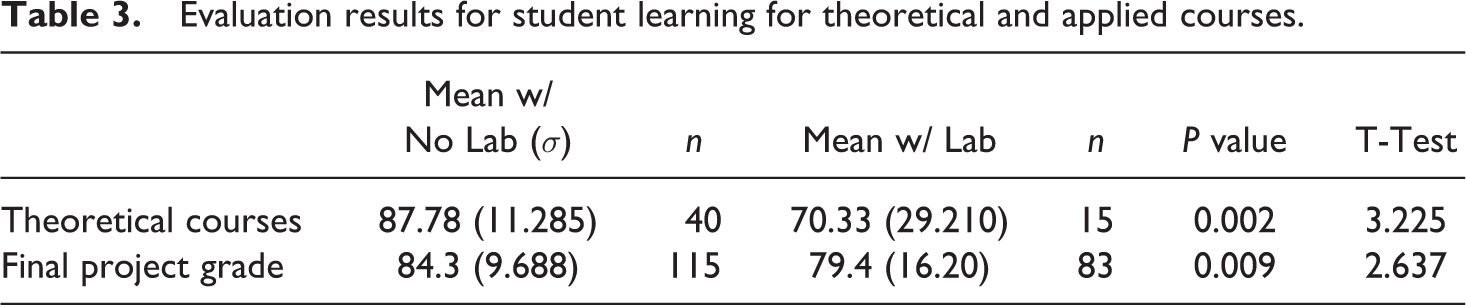
It should be noted that these differences differ by the nature of the course. The loss of learning associated with the labs was greater for the more theoretical courses than for the applied courses. Keeping in mind some issues associated with sample size for the theoretical comparison, those students who were exposed to labs in the statistical and research design courses were only 5 percentage points lower on their final grade than those who took the class without labs. By comparison, the students in the more theoretical public administration course were 17 percentage points lower than their classmates in the course without labs (Table 3).
Evaluation results for student learning for theoretical and applied courses.
In order to control for cohort effects and to determine whether the learning is the result of measurement validity on the part of the researcher, the lab and non-lab cohorts were compared on their GPA and subsequent performance in future courses. There appears to be no cohort effects, as the average GPA of the lab courses is 3.118 and the average GPA of the non-lab courses is 3.112. The question of instrument validity is probably more concerning. In order to test long-term learning, the average grade for the senior seminar in political science was compared between those who took the lab-based class and the non-lab-based class, with the non-lab-based class earning an average grade of 3.4 (where an A is assigned 4 points, B+ equals 3.5, B equals 3…) and the lab-based class coming in lower with an average grade of 3.35. This is consistent with the measure of performance based on the final grade, but not the self-reported performance.
Conclusions
These results suggest that the use of labs for the purpose of student learning has a positive impact on all self-reported measures of student achievement. This is true of both student satisfaction in their course experience and the students’ evaluation of their own learning. These findings are consistent with past research on both flipped classroom and problem-based learning (Butt, 2014; Gunyou, 2015).
These results also support and are supported by a significant theoretical perspective in the Kolb Learning Model. David Kolb’s (1984) model suggests that experience is the primary driver of learning and that traditional educational techniques which encourage information acquisition, manipulation, and recall often fail to produce lasting changes in knowledge and ability. Like those who came before him, most significantly Lewin and Dewey, Kolb argues that the process of learning requires the resolution of conflicts (Kolb, 1984). This is best achieved in an educational environment where individuals transact with their environment to test ideas and assumptions. In this way, “learning is the process of creating knowledge” where individuals use their environment to test the hypotheses to which they have been exposed (Kolb, 1984: 36). To this end learners move through a repeating cycle of concrete experience, reflection on that experience, the development of abstract concepts, and active experimentation of their newfound knowledge (Kolb, 1984). Consequently, as this study finds, the labs offer students an opportunity to experiment with ideas and techniques that encourage a feeling of mastery.
The troubles with these findings are that they are not consistent with the findings of demonstrated learning as measured by the course paper. While the students report greater satisfaction and improved learning with the introduction of course labs, the instructors’ quantitative evaluation of student work suggests otherwise. 1 There are a number of potential interpretations to this data. First, the measures of student papers are reflective of declining learning and the students are self-reporting learning that doesn’t exist. This would be the case in such a situation as when a halo effect encourages students to assign greater learning because they associate other positive attributes with the class (e.g. engaging material, interesting assignments). Second, the students may be reporting enhanced learning if their baseline for comparison is not their level of knowledge at the beginning of class but rather the amount of expected learning relative to other classes. Third, the measure of student learning as demonstrated by the papers may not be reflective of actual learning. This would likely be the case if instructor expectations increased given the new pedagogy. While the quality of papers may improve, their evaluation and grade would decline if the instructor’s expectations were higher.
The lack of controls in this study make the results far from definitive, but they do suggest that labs hold the potential minimally to foster student engagement. Since the study considers only 11 sections and the adoption of labs was not randomly assigned, it is difficult to demonstrate that improvements in satisfaction were not merely the result of cohort-related effects. Nonetheless, the adoption of labs over time and in different increments for different courses suggests that there is some causative effective. Additionally, the rather subjective nature of final papers calls into question the findings associated with student project performance. Future research on labs should consider a more objective content assessment to understand the true effect on student learning. Finally, one might expect to find a lack of learning as measured by papers if the learning objectives for the labs are ill-matched to the labs’ learning objectives.
Lastly, while not demonstrated in the quantitative data above, faculty reflection on the process resulted in some qualitative evaluations of the effects of labs on student learning. The labs were most effective in the vocational courses (research methods and statistics) and less effective in the public administration theory course, where students saw more of a disconnect between lab assignments and course lecture. The courses’ use of labs also resulted in greater disciplinary interest based on the number of students who have gone on to take special topics courses in related issues after participating in lab-based courses. Perhaps most significantly, faculty report higher passage levels and better preparation in subsequent courses. Consequently, labs seem to hold promise for improving learning, engagement, and professional interest.
Footnotes
Declaration of conflicting interests
The author(s) declared no potential conflicts of interest with respect to the research, authorship, and/or publication of this article.
Funding
The author(s) received no financial support for the research, authorship, and/or publication of this article.
