



Abstract
The research explores why some public affairs graduate programs choose to develop fully online degree offerings while others do not. The study attempts to address questions surrounding how different institutions and programs are pursuing degree offerings and the potential influence of faculty workload. The research utilizes a quantitative, cross-sectional design analyzing results from a survey on institutional and programmatic practices in workload, hiring, and degree offerings administered to primary points of contact within public affairs academic units from all institutions found in the US News World Report Graduate Programs in Public Affairs Rankings from 2019. Survey data is paired with program information from the accrediting body institutional member database. Findings indicate differences from both institutional and programmatic groupings do demonstrate workload measures have unique characteristics depending upon the type of institution and rank of the program. Further analysis discusses the influence of the COVID-19 pandemic on future public affairs programming.
Introduction
As remote and online education increases in presence for institutions and academic programming, questions arise about how and why some programs choose to develop fully online degree offerings while others do not. Could it be location, support structures, faculty reluctance, or issues of capacity? Or is there something more? Due to the changing landscape of higher education, and particularly within the context of public affairs education, this research seeks to probe the dynamics of decisions on offering fully online degrees. Specifically, attempting to address questions surrounding how different institutions and programs are pursuing, or not pursuing, online degree offerings and the potential influence of one major factor, faculty workload.
Although workload is defined and varies, units are forced to work within institutional parameters to offer the most effective programming possible. Such variability can present obstacles for faculty understanding the range of tasks and expectations for different programs and institutions. The study addresses workload in the context of teaching expectations and a breakdown of the traditional roles of academic tasks: teaching, research, and service.
Workload, often defined at the institutional level, is not attended to in the scholarly literature when examining program outcomes. In particular, the link between workload and online programs is limited to the attention on teaching (Bolliger and Wasilik, 2009; Tomei, 2006; Williams, 2006). Additional considerations on workload at the programmatic level could include the scope of the program, size of the student population, and reputation that program has within the national audience. With the advent of ranking systems for academic programs, stakeholders are able to give judgment to the effectiveness of program delivery and potential quality of the education.
The programmatic-level assessment, solely based upon reputation, differs from the recognition of the institution where the program is housed. Institutional recognition is a long-term association of scholastic quality and achievement. Having institutional prestige and program reputation doubles the opportunity for success, despite any changes to the landscape of higher education (see Williams et al., 2020). Conversely, having reputation or prestige might provide greater difficulty in adapting to emergent shifts in the landscape of education.
Turning to public affairs, faculty are faced with the added factor of program accreditation when considering how program reputation and institutional prestige play into the decision on how to offer programs and in determination of faculty treatment and assessments. Given the shifts already caused from the COVID-19 pandemic (Blankenberger and Williams, 2020), factors are converging that could potentially create scenarios forcing public affairs programs into long-term viability decisions. Economic shifts were requiring institutions to act with regard to sustainability, but now programs must also consider long-term adaptions caused by the public health crisis. One such area where transitions for sustainability are becoming clearer is in the offering of fully online programs.
In order to assess potential relationships across various programs offering graduate degrees in public affairs, this study attempts to address three primary questions:
Each of the questions are addressed through analyses on surveys sent to program points of contact (exs. Directors, Chairs, or School Directors). The survey examined programmatic offerings, hiring preferences, and faculty workload expectations. New data from the Network of Schools of Public Policy, Affairs, and Administration (NASPAA), the accrediting body for the programs, were also collected to compare and analyze proportions of fully online master’s degrees in public affairs. Analyses focused on the differences and impact prior to undertaking a discussion on the implications of these findings, along with an incorporation of discussion and recommendations reflective of the changing landscape resulting from the COVID-19 pandemic. Brammer and Clark (2020) summarized the need for the discussion by stating the pandemic has “necessitated the largest and quickest transformation of pedagogic and assessment practice ever seen in contemporary universities [and created] pressures on institutional systems of quality assurance and governance as well as increasing workload for faculty and professional staff” (p. 434). The recommendations generated reflect on how forced remote learning taking place across the United States could serve as a critical point in time for programs still reluctant to offer fully online degrees.
Literature
The question of why some programs choose to pursue online learning opportunities while others do not has increased over time due to the growth of programs offering online programming. Of all students enrolled in academic year 2003/2004 courses, 15.6% were enrolled in at least one online course (NCES, 2020). That percentage increased to 33% by academic year 2015/2016 (NCES, 2020). A similar growth in online learning is also present in public affairs programs (Ginn and Hammond, 2012). Reasoning for the increase in online learning over time includes expanding educational opportunities to underserved populations, managing space and financial concerns, and institutional changes that increased the rationality and preferences of online learning (Allen and Seaman, 2007; Austin, 2009).
Despite the benefits of online education, there are concerns for online education programs and modalities that may have potentially prevented some programs from expanding course offerings to fully online (Bach et al., 2007; Hoffman, 2018; Schiffman et al., 2007). The literature has noted concerns over the technology involved in online education; specifically, whether it limits communication (Austin, 2009; Williams, 2006) and whether technology and various support services are readily available for students and teachers alike (Perreault et al., 2002; Vernon et al., 2009). Slagle and Williams (2019) noted that online, for-profit institutions produced statistically significant differences in research output by subject for doctoral dissertations for subjects of public affairs, administration, and policy. Faculty and program directors have expressed fear that a shift to online course offerings may impact the type of students and faculty that their department can recruit and student outcomes (Dupin-Bryant, 2004; Fortune et al. 2006). Recent research indicated that public affairs graduates from online institutions are not as “hireable” for academic positions as those from traditional institutions with face-to-face instruction (Slagle, Blankenberger, and Williams, 2021a). Lastly, there are concerns over whether faculty will accept shifts to online course offerings and whether students will be as studious when compared to traditional in-person course offerings (Barth, 2004; Bocchi et al., 2004; Dupin-Bryant, 2004; Fortune et al. 2006).
While there are concerns with shifts to online education, there are noted benefits as well. If institutions can find a way to adjust workloads in addition to promotion and tenure requirements as a result of the increased time it takes to teach an online course, faculty support and buy-in could increase (Bolliger and Wasilik, 2009; Williams, 2006). In addition, as faculty and students become more accustomed to online education through forced implementation as a result of the global COVID-19 pandemic, concerns over access, use, and support technology may start to fade. Lastly, some public affairs programs primarily recruit non-traditional students such as adult learners and professional students, which may be better suited to online education (Williams, 2006). The benefits of online education are something program directors may need to consider. As previously mentioned, institutional, technological, and preference-related problems are present and need to be considered. For the purposes of the research article, the focus is on one specific actor, faculty, and how variances in workload impact online offerings. In addition, the study is grounded on the assumptions that decision-making and action for higher education administrators are based upon survivability (i.e. Deming et al., 2018; Folkers, 2005).
Tomei (2006) was one of the first to systematically study the impact of online teaching on faculty workload and determined that when compared to traditional online instruction, online instruction demanded 14% more time. While the 14% finding should be not considered accurate for all online instruction, it should be noted simply as an indicator that it takes more time to prepare, present, and assess online courses than it does for traditional in-person courses. Tomei (2006) even went as far as suggesting that in order to make the workload to online courses more equitable for faculty, class size should be capped at lower levels than traditional in-person courses. While this possible solution to the workload problem is not likely to elicit much fanfare from program directors and administrators fighting to decrease the cost of per-student education, it does indicate a possible understanding of why some programs offer online education opportunities while others do not.
Time invested in a course is not the only element of faculty workload, but it is an important element and one that, up until this point, has been the main focus of online education studies. To meet institutional requirements and standards, faculty must adequately allocate or manage time given to teaching, research, and service (Griffith and Altinay, 2020). Given that most tenure and promotion requirements include some mix of research, teaching, and service, we need to first increase our understanding of the distribution of these requirements based upon variances in types of institutions. Lastly, we will need to then understand how variances in workload correlates with acceptance of online programing.
Methodology
Design and variables
This study utilizes a quantitative, cross-sectional design analyzing survey results from a survey on institutional and programmatic practices in workload, hiring, and degree offerings administered to primary points of contact (exs. Program Directors, Unit Chairs, or School Directors) within public affairs academic units from all institutions found in the US News World Report Graduate Programs in Public Affairs Rankings from 2019. The survey, distributed over the Summer in 2018, sought responses from 279 institutional units, with 63 viable responses collected.
From within the survey, questions pertaining to the presence of degree offerings, faculty teaching expectations, and breakdowns of the percentages of teaching, research, and service expectations relating to workload are assessed to provide answers to the three primary research questions. The degree offering of interest is the master’s degree in public affairs, with particular focus on the presence of a fully online degree. No specific title to the degree is given due to the variations across different programs. This variable, a dichotomous variable indicating the offering or not and labeled as Fully Online Master’s, serves the dependent variable in Questions 1 and 3. Faculty teaching expectations (or Teaching Load) reflects the number of courses a faculty member is expected to teach in a given academic year by an ordinal measure (1–3, 4–6, or 7+). This variable seeks to account for slight variations with the use of quarter, semester, and minimesters (ex. Executive programs using 8-week courses). Lastly, workload is provided as a percentage variable (scalar) with three categories (Teaching, Research, and Service) totaling a value of 100, or 100%.
Grouping variables represent institutional and programmatic differences. Three grouping variables are utilized to categorize these differences. For institutions, two variables are provided—Research Classification and University Type. Research Classification reflects the status of the institution through six categories of institutional mission (Very High Research, High Research, Research, Comprehensive, Regional, or Liberal Arts). The Regional and Liberal Arts categories are grouped for this study as only two respondents represented the Liberal Arts category and these two are often combined when examining identification systems. Second, the University Type variable offers three groups (Public, Nonprofit/Private, and Private/For-Profit). These identify funding differences and also imply differences in the demand side of higher education. From the responses, no representation is provided in the Private, For-Profit group leaving only Public and Nonprofit, Private universities to be compared in this study. Lastly, the programmatic variable, US News World Ranking, reflects the 2019 rankings for Graduate Programs in Public Affairs. These rankings are grouped as Top 50, 51–100, 101–50th Percentile, and Below the 50th Percentile. Ranking groups are to identify program reputation within the discipline.
Finally, data are collected from the NASPAA institutional member database with respect to the programs offering online degrees. Of the 279 institutions surveyed, 275 are present both in the NASPAA database and the US News & World Rankings. Those 275 institutions are present for analysis in this study.
Analytical techniques
In order to analyze the three primary research questions, four sets of analyses are conducted—Chi-Squared Tests of Independence, t-test, Analysis of Variance, and a Binomial Logistic Regression. Each of these are discussed with respect to the corresponding research question they assess.
First, a series of Chi-Squared Tests of Independence are conducted using institutional (Research Classification and University Type) and programmatic (US News World Ranking) grouping variables as independent categories with Fully Online Master’s and Teaching Load as dependent based on frequencies. NASPAA data are utilized to assess the Fully Online Master’s variable and differences, while the survey results assess Teaching Load. The Test of Independence examines the between group frequencies for significant differences (Privitera, 2017). A level of significance, alpha = 0.05, is set for these and all subsequent statistical tests. Each Chi-Squared test is conducted for the grouping variables as a whole and between each individual set of categories (e.g. Research Classification as a whole and Very High Research v. High Research and all other combinations). Frequencies and percentage distributions for the dependent categories are provided for comparison as well. Tests also analyze the individual group differences for the proportions against the expected proportional values. These tests serve to assess Research Question 1 and part of Question 2.
The second analytical technique is the use of hypothesis testing, specifically a t-test, for the University Type variable and differences of the means for Teaching, Research, and Service variables for workload. The use of the t-test is necessary due to only having two categories present within the University Type variable (Privitera, 2017). A third analytical technique is the use of Analysis of Variance to test differences in Teaching, Research, and Service for Research Classification and US News World Ranking grouping variable. Because these two variables have more than two categories, they require an Analysis of Variance instead of a t-test (Krieg, 2019). Subsequent tests for homogeneity of variances (Leven Test) and robustness tests for means (Welch and Brown-Forsythe tests) are also conducted to assess reliability and validity of the findings (Krieg, 2019; Privitera, 2017). Post hoc tests use the Least Significant Difference analysis to evaluate specific differences between categories within the grouping variables. These tests further analyze Research Question 2.
Finally, the use of a binary logistic regression assessed Research Question 3 through the use of Fully Online Master’s as the dependent variable and Teaching Load, Teaching, Research, and Service as independent variables. Due to the dichotomous nature of the Fully Online Master’s variable, a binary logistic regression is most appropriate (Hilbe, 2015). An additional step prior to running the regression involved dichotomizing the Teaching Load categories into three separate variables (1–3 Courses, 4–6 Courses, and 7+ Courses). The resulting equation is as follows:

where Yi is the presence of an online master’s degree and xi are the observations of independent predictors
Use of both the Cox & Snell R-squared and Nagelkerke R-squared present a conservative and standard estimation variation present (Hilbe, 2015) while the Hosmer and Lemeshow Test is used to assess the goodness of fit (Hosmer Jr et al., 2013). Analysis for the regression will examine the fit of the model as well as the individual predictors and their impact on a program’s choice to offer a master’s degree in public affairs fully online.
Results/discussion
Data collected from program points of contact resulted in 63 viable responses from a population of 279. The resulting sample provides a 22.6% response rate. From these respondents, 62 provided data on their degree offerings for master’s programs in public affairs. Of those respondents, 91.9% offer fully on campus degree options, 59.7% provide hybrid degree completion options, and 50.0% stated the degree could be fully completed online. This represents a higher response from those offering fully online options from the complete list from NASPAA. According to NASPAA program data from institutions within the US News & World Report rankings, only 21.8% (60 programs) offer a fully online experience or experience with a minimal visit to campus. Furthermore, 67 programs, or 24.4% of programs, do not offer any form of online completion (NASPAA, 2020).
Fully online master’s
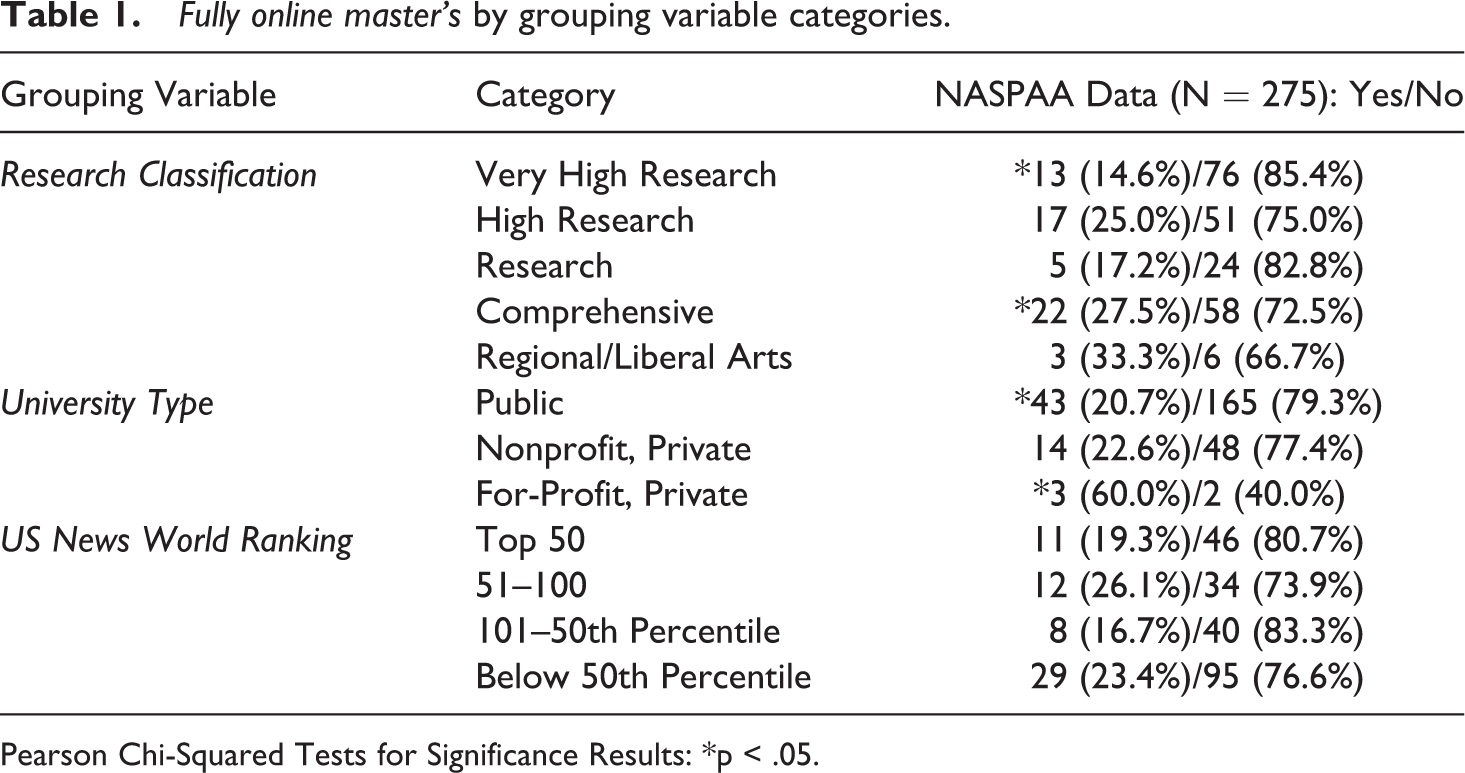
Since NASPAA shows 21.8% of programs offering fully online experience, the expectation for those data are proportions of each grouping variable having 21.8% of the group with fully online master’s degrees (ex. there are 208 public universities, making the expected value 45.3). As Table 1 displays, two statistically significant difference exists for the programs offering fully online master’s programs in public affairs within the institutional grouping variables. Specifically, there is a difference between the proportions within the Very High Research institutions and Comprehensive institutions. The results for NASPAA data demonstrate Very High Research institutions actually drastically underperform in providing fully online master’s degrees in public affairs and those in the Comprehensive category overrepresent.
Fully online master’s by grouping variable categories.
Pearson Chi-Squared Tests for Significance Results: *p < .05.
Secondly, private, for-profit institutions show a greater proportion offering fully online programs, but this is expected given their mission, despite a sample of only five programs. As is typically the goal of these types of institutions, their modality of instruction is commonly the online platform to maximize student enrollments and profit margins. Still, it is interesting that public universities slightly underprovide these fully online programs.
With respect to the programmatic groups (US News World Ranking), the NASPAA results do not show any of these program groups overperforming or underperforming at a statistically significant level compared to the collective 21.8% for all programs. It is noteworthy that the second 50 (51–100) do have a slightly higher percentage than the rest of the groups, particularly the third 50 (101–50th percentile). This is interesting due to the reputational nature of the rankings and added marketing, student base, and span of alumni networks associated with the presence of a fully online program.
Accordingly, it seems that there is a relationship with the institutional variables and the willingness of a program to offer fully online programming at the master’s level in public affairs. Although conventional wisdom would say those with a greater set of resources (i.e. those higher in research classification) would be more likely to have these degrees present, this does not display itself in the results. Rather, it is the Comprehensive (Master’s-focused) institutions that are more willing to provide this programming. Given this, the discussion on workload will provide more depth into the potential reasons. It stands that these institutions are often more teaching-focused, which may manifest itself in an inverse relationship.
Faculty workload
In an effort to assess faculty workload, three separate analyses are conducted on the survey data. Chi-squared tests explore frequencies across the different grouping variables and the ordinal measure of courses taught in a year. Furthermore, t-testing and ANOVAs examine the grouping variables against the percentages of Teaching, Research, and Service requirements.
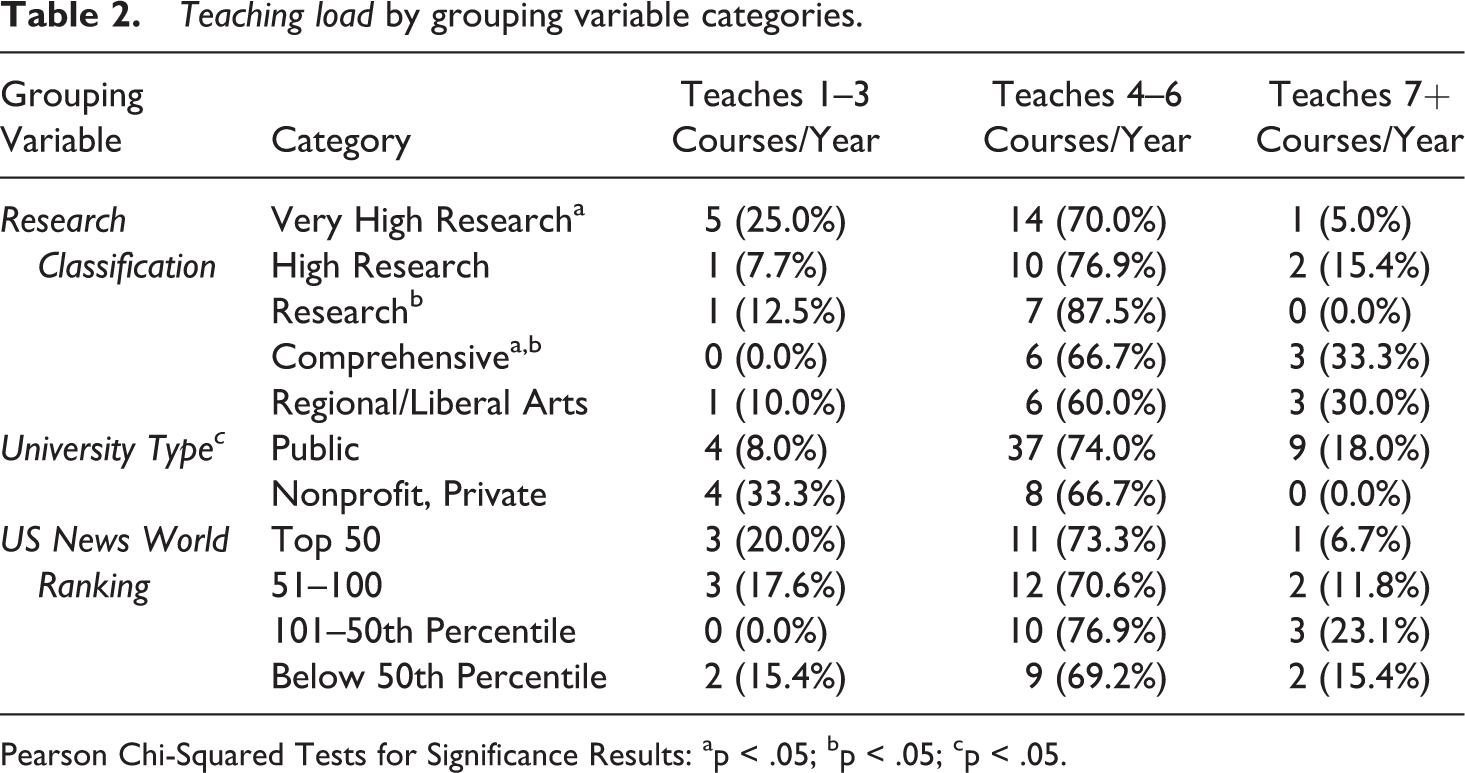
As Table 2 displays, only the institutional grouping variables display any form of statistical significance when examining the expected and observed frequencies. In particular, the expected frequencies in the Comprehensive category are far lower than the observed. Those institutions seem to require far greater teaching loads—courses taught by a tenure-track faculty member in a given academic year (excluding extra terms like Summer or minimesters). Three of the nine respondents noted teaching seven or more courses in a year. This equates to a 4/3 or higher in semester formats and 3/2/2 or more in a quarter or trimester system. Likewise, Very High Research and Research institutions show smaller teaching loads than expected at a statistically significant level. High Research institutions also seem to have lower teaching requirements, but there are two respondents with seven or more courses in a year, likely taking away from being statistically significant. Overall, this demonstrates that research-focused institutions (Very High Research, High Research, or Research) predominantly have teaching loads of 3/3 or less in the semester system and 2/2/2 or less in the quarter or trimester systems. One other interesting result is the percentage of Very High Research institutions requiring 3 or fewer courses taught by a faculty member in a given year.
Teaching load by grouping variable categories.
Pearson Chi-Squared Tests for Significance Results: ap < .05; bp < .05; cp < .05.
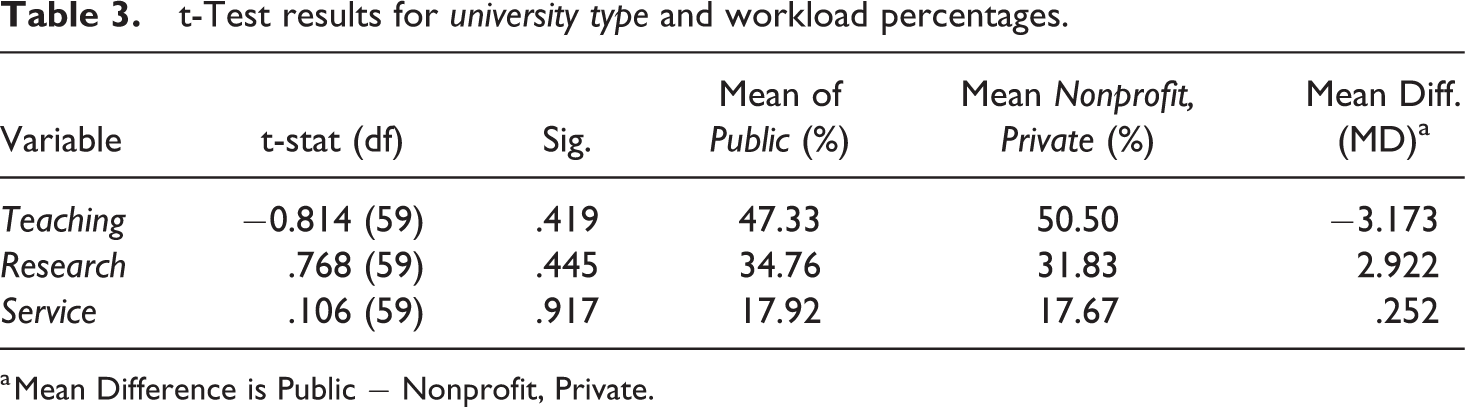
In terms of the University Type grouping variable, workload is examined in both Tables 2 and 3. Table 2 demonstrates that the expected values of the courses taught per year differ between public institutions and private, non-for-profit institutions. Specifically, the nonprofit institutions offer reduced teaching loads in the form of courses taught per year. All of those institutions show a teaching load of 3/3 or less for semester systems or 2/2/2 or less in the quarter or trimester systems, with one-third only requiring 1–3 courses per year in total. Public university responses show a larger proportion having similar loads, but also 18.0% of those institutions require teaching 7 or more courses in a given year. Table 3 displays the workload breakdowns in percentages and assesses if there are differences between these two groups (Public and Nonprofit, Private). None of the percentages are statistically significant in terms of their mean differences.
t-Test results for university type and workload percentages.
a Mean Difference is Public − Nonprofit, Private.
This shows that University Type is not significantly different in terms of expectation breakdowns commonly associated with promotion and tenure decisions. However, they are with respect to what the teaching load actually entails. Strangely, despite that difference in courses taught per year, the percentage of teaching workload only differs by about 3% and is still viewed as greater in the Nonprofit, Private institutions. Research and Service differ even less and are less in Nonprofit, Private institutions.
Tables 2 and 3 display the expectations associated with Public institutions and Nonprofit, Private institutions. Strangely, Public institutions have higher expectations in terms of teaching load for courses per year, but the percentages breakdown shows that the evaluation criteria are lower in how that teaching is viewed for workload. These breakdowns do demonstrate very similar approaches from the University Type grouping variable in terms of how Teaching, Research, and Service is balanced within the different institutions. Further testing on Research Classification and US News World Rank might display clarity on those differences in workload percentage breakdown.
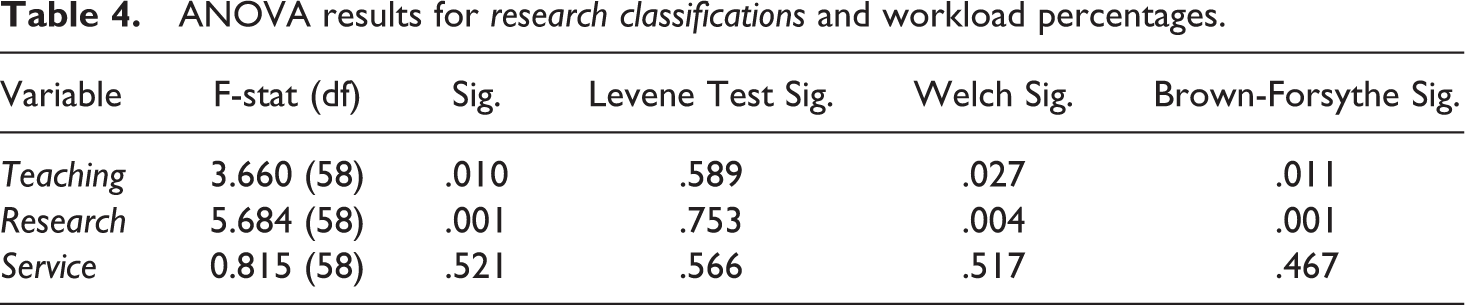
The second institutional grouping variable, Research Classification, is examined for workload breakdowns with results displayed in Tables 4 and 5. Table 4 shows that both the Teaching and Research variables are statistically significant in their differences across the various research groups. Robustness tests (Levene Test, Welch Test, and Brown-Forsythe Test) also demonstrate support for this finding. Table 5 provides specific difference results and the means for Teaching, Research, and Service variables across the different groups.
ANOVA results for research classifications and workload percentages.
Means (in Percent) for workload variables by research classification.
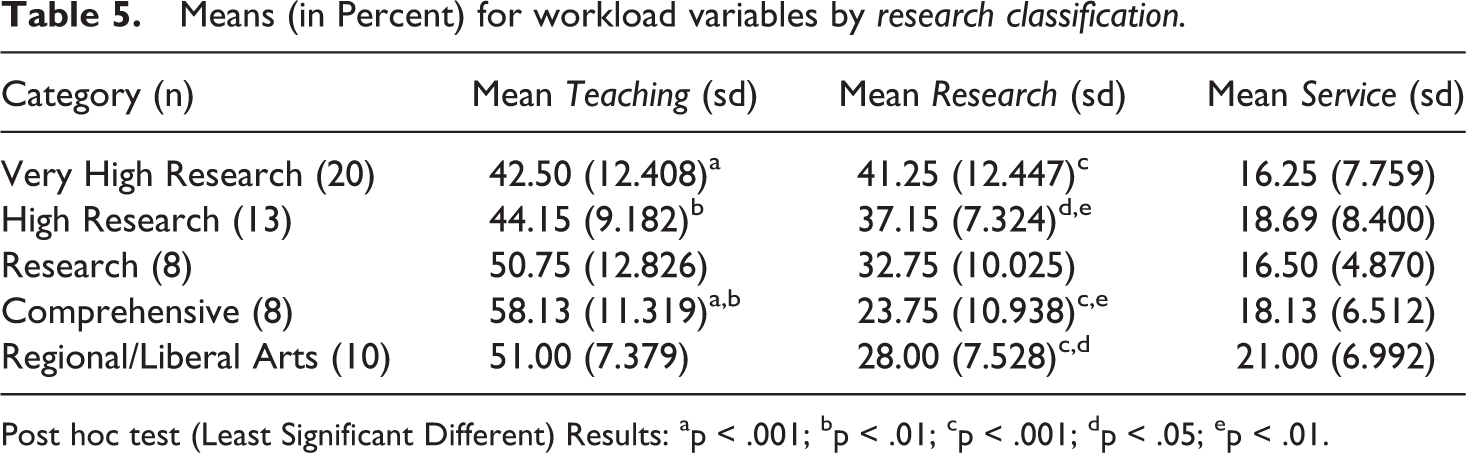
Post hoc test (Least Significant Different) Results: ap < .001; bp < .01; cp < .001; dp < .05; ep < .01.
As is displayed, there are a number of specific statistically significant differences between the various Research Classification groups and the Teaching and Research percentages. Similar to what would be expected based upon the teaching expectations found in Table 2, the Teaching variable has statistically significant differences between Very High Research (42.5%) and Comprehensive (58.13%) institutions and High Research (44.15%) and Comprehensive institutions. This demonstrates that institutions classified as Comprehensive have a heavier evaluation of teaching in their assessment of faculty workload toward tenure and promotion. With an average of 58.13% of the workload percentage, these Comprehensive institutions clearly expect a level of excellence in teaching that is even greater than a combination of both Research and Service categories. Likewise, similar differences are found in the Research category where statistically significant differences exist between the following groups: Very High Research (41.25%) and Comprehensive (23.75%), Very High Research and Regional, Liberal Arts (28.00%), High Research (37.15%) and Comprehensive, and High Research and Regional, Liberal Arts. These findings show, as would be expected in a Research Classification breakdown, that institutions highly valuing research have a far greater weight on the expectations associated with research in faculty workload.
The implications of the Teaching and Research differences vary in their importance. As mentioned, the Research variable performs as one would expect—moving up in Research Classification increases the expectations and evaluation of a faculty member’s research. The difference in that evaluation is what is perhaps staggering. A faculty member from a Very High Research institution has a workload that place 17.5% more weight on research than a colleague at a Comprehensive institution. Likewise, this relationship is inverted for Teaching. This is not a strong deviation from the stereotypes associated with the teaching and research expectations at different institutions, but the added value here is the focus on public affairs education. Those institutional norms are still present within these programs despite the applied nature of the discipline. However, this study does not identify the specifics related to how teaching and research are evaluated. A study with such focus could inform the application of these institutional norms in public affairs.
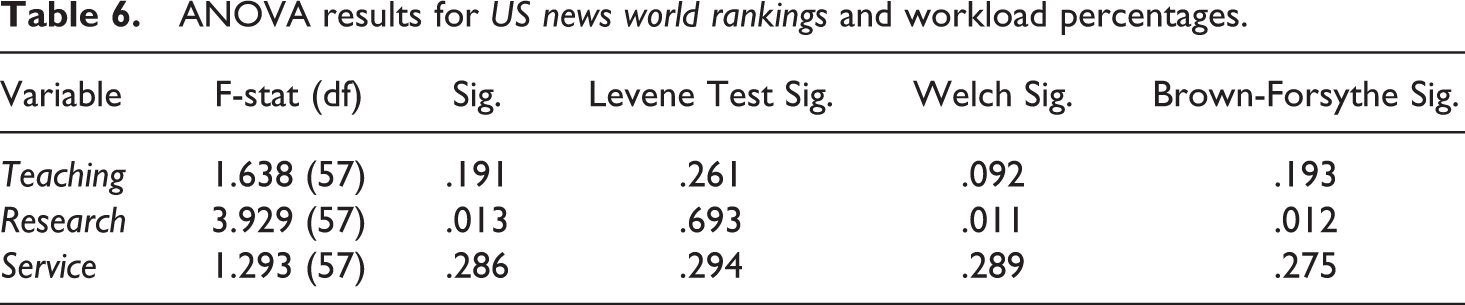
Further exploring the workload variables, Tables 6 and 7 detail the breakdown when evaluating the program variable—US News World Rankings. This variable identifies the placement of the program within relation to its peers in public affairs education. As Table 6 demonstrates, only the Research expectations differ across these program groups. Robustness tests also support this finding. Likewise, the finding of no statistically significant difference with respect to Teaching supports previous findings in Table 2 that there are not differences across these groups pertaining to courses taught.
ANOVA results for US news world rankings and workload percentages.
Means (in Percent) for workload variables by US news world ranking.
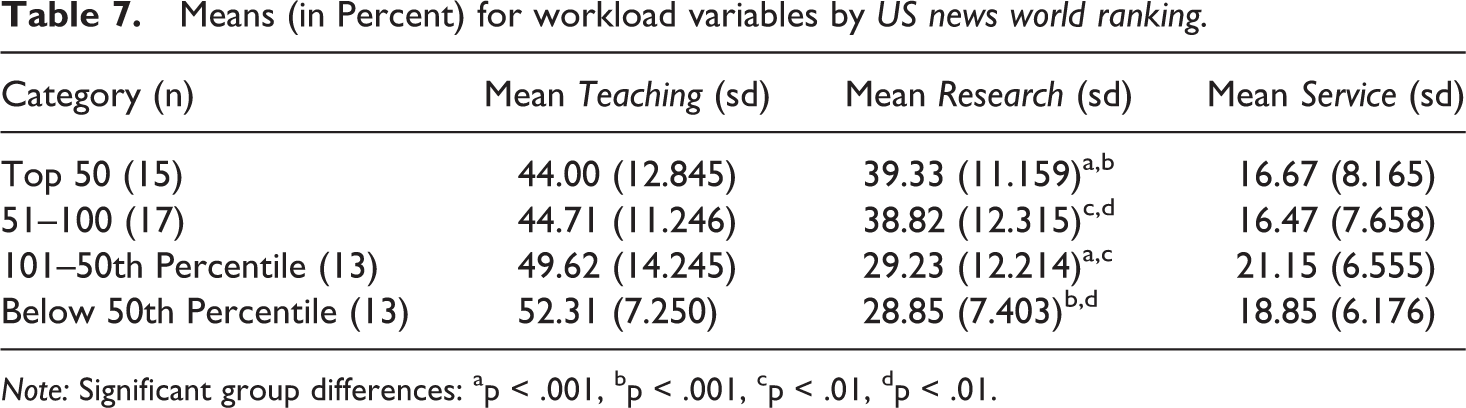
Note: Significant group differences: ap < .001, bp < .001, cp < .01, dp < .01.
Specific differences in Research are found in Table 7. The Top 50 programs (39.33%) and second 50 (51–100) programs (38.82%) are both statistically greater than the third 50 (101–50th percentile) programs (29.23%) and programs below the 50th percentile (28.85%) in their expectation of research productivity. Therefore, those programs in the Top 100 give greater weight to research output for their faculty compared to those outside of the Top 100. This find raises a major question about the validity of the US News & World Report rankings for Graduate Programs in Public Affairs. The apparent relationship between higher ranking and faculty research expectation gives credence to speculation on these rankings being based in the perceptions of faculty for scholarly quality and productivity rather than the actual quality of the graduate program itself. Such a finding is alarming and further exploration of this relationship in public affairs should be taken to determine the validity of such an argument.
In terms of the findings related to workload, institutional norms associated with differences in both teaching and research expectations hold for public affairs programs. There appears to be an inverse relationship between those two and it is closely associated with the Research Classification of an institution. This also relates to the actual frequency of instruction, not just the percentage of workload related to instruction. Therefore, institutions that classify higher in research categories are both likely to provide faculty with a reduced number of courses to teach and a reduction in the overall expectation and evaluation of that teaching. This study does not attempt to assess the research expectations beyond workload percentage, but the findings do suggest an examination of those different institutional types in public affairs would provide added value for faculty and potential faculty in the understanding of how those norms would manifest themselves.
Programmatic findings display a slightly different story from the institutional breakdown. Only Research appears to differ in the expectations depending upon a program’s placement in the US News World Rankings groups. This means that research outputs should also reside heavily in the programs found within the Top 100. Practically, if someone examines major journal publications, they should expect to find scholars from programs within that Top 100 ranking. Likewise, the overall outputs of those individuals should be greater. One thing this study is limited is in the determination of the quality measures within each program. While programs clearly differentiate in what their workload percentage for research is, this does not examine how that percentage is measured for promotion and tenure purposes. A follow up would shed light on the importance of different publication outlets and the quantitative and qualitative expectations of scholars within the different programs.
Workload’s impact on fully online master’s
The differences from both institutional and programmatic groupings do demonstrate that these workload measures have unique characteristics depending upon the type of institution and rank of the program. Continuing with these differences, the final question pertaining to whether these workload measures play any role in a program’s decision to offer a fully online master’s degree in public affairs is analyzed. Table 8 displays the results of a binary, logistic regression. The findings show no real relationship between the variables and such a decision.
Binary logistic regression statistics for workload on fully online master’s.
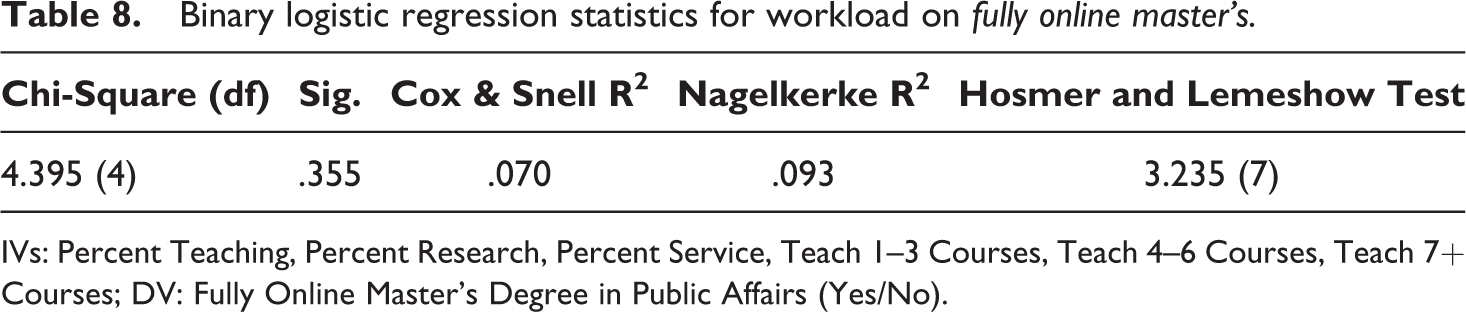
IVs: Percent Teaching, Percent Research, Percent Service, Teach 1–3 Courses, Teach 4–6 Courses, Teach 7+ Courses; DV: Fully Online Master’s Degree in Public Affairs (Yes/No).
This finding simply means that a program’s choice of offering this degree fully online is outside of the scope of faculty workload. Coupling this with the findings from Table 2, one could speculate there are institutional factors at play that would lend themselves to explaining more of the reason for certain programs providing that fully online experience rather than the expectations of a faculty member. Further discussion will follow to address these findings along with the potential implications of the COVID-19 pandemic on how institutional and programmatic behavior in public affairs education might be impacted, with specific attention given to the offering of fully online master’s degrees.
Future implications and recommendations
When it comes to understanding decision-making by higher education institutions, we assume that institutions have to compete with one another in a marketplace for students, faculty, and funding. The best program directors keep this in mind as they strategically manage their programs (Gigliotti, 2021). One possible strategic design that program directors make is whether or not to offer online educational opportunities in a limited or full capacity. One instance when this decision-making becomes apparent is in response to significant events like budget crises and nation/world-wide natural, health, and/or man-made disasters. In other words, the COVID-19 global pandemic presents a unique opportunity for program directors to strategically impact the future of their programs.
One difference between programs, which impacts choices program directors have, is their reputation as represented by programmatic rankings. Programs that are ranked higher than others can compete with lower ranked programs simply based upon their ranking and their perceived status as the “better” program. These programs have a lower need to be responsive to changing trends when it comes to their programmatic offerings because their ability to attract students, faculty, and funding is more sustainable and is not limited in the short-run. Instead of changing their programmatic offerings, they simply can present their US News and Reports ranking, their alumni network, and their placement history. But that does not mean that they can withstand the growing tide of change toward programmatic modifications, like online courses.
We showed that programs ranked in the second 50 seem to have the lead on offering fully online programs. Will this trend continue in the post-COVID-19 era? Our view is that it will not for two reasons relating to prestige. First, programs ranked outside of the top 100 have refrained from offering online courses due to institutional resources, workload, and faculty preference problems. Secondly, the COVID-19 global pandemic shifted perceptions and experience concerning online education. Meaning, even those programs in the top 50 will find it beneficial to make the shift, if only partially.
Programs outside the top 100 are most likely smaller programs with limited financial and technological resources. Given the increased workload, demonstrated from this study, these are programs where faculty are less likely to have the available time to craft online courses. The COVID-19 pandemic thrusted on all programs the immediacy of online instruction. This forces these programs to invest workload and institutional resources to provide online instruction during a time when meeting in a traditional manner was not possible. This switch to online education lessened the cost of future innovation because it helped developed these resources for immediate use and highlights the importance of adjusting workload requirements, if online instruction is the future for these programs.
Programs ranked in the top 50 are more likely to have the resources to invest in the institutional and technological innovation necessary to make the switch to online education. In addition, these programs tend to have lower instruction workloads than programs outside the top 50. Because of this, the increased workload of online education is less impactful than programs that have a higher teaching workload. The difficulties with programs that have a higher prestige is the rationale behind increasing online instruction. These programs can potentially rely on their prestige to compete for students without having to innovate further. The “high prestige” programs can also presumably sustain themselves for a period of time during economic downturns, which again does not necessitate innovation in delivery of course content. The impact of the sudden influx of online instruction due to the COVID-19 pandemic is uncertain with these institutions. Despite this, these institutions will have to innovate at some point due to shifting student preferences and the movement of more technologically inclined faculty members moving into the field.
Prestige is also an element of difference between programs that can produce variances in adopting online education. Universities classified as Very High Research and High Research by the Carnegie classification system may be buffered from economic shifts. These programs tend to have higher levels of funding not based upon tuition (e.g., endowments, grants, etc.) and can sustain their programs better than programs specifically relying upon tuition monies. Grant funds can not only finance faculty research but can also be used to provide funding for students during economic downturns. On the one hand, professionals have traditionally returned to school to increase their education during times when their professional aspirations may be limited due to unemployment and/or hiring/promotion freezes. But on the other, programs relying mostly on tuition monies have to rescind or decrease graduate funding offers. This allows Very High and High research programs to survive, but only for so long.
Research funding is also impacted by the economy. If an economic downturn continues for an extended period of time, research funding may also be impacted leading to top programs reconsidering their means of competing, especially among other Very High and High research institutions. If they decide that they need to consider online education as a competition strategy, then they should be ideally set up because of inherent competitive advantages. They traditionally have more monetary resources and more support staff to invest and allocate in online education programs and support. This should help to increase faculty acceptance, but there is still the issue of workload. Very High research and High research institutions tend to have tenure and promotion requirements that preference research well more than teaching and service. For this reason, and the fact that online teaching has traditionally been viewed as a teaching method that takes more time than traditional in-person teaching, balancing workload will be key if these programs decide to offer fully online programs.
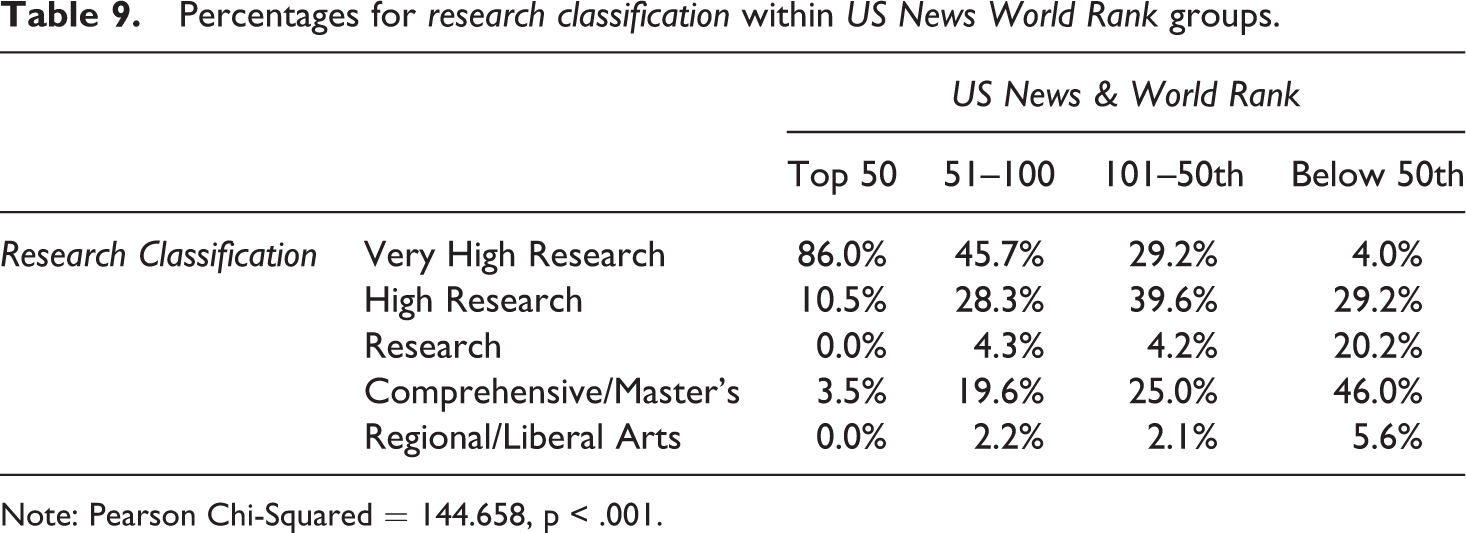
Previously the article discussed programs based solely upon their ranking or their research classification and then inferred their capability and rationale for moving to online education. However, programs are not solely identified by their reputation or prestige. Rather, there are high correlations among the categories as indicated in Table 9. Combining the two different areas allows us to discuss further implications of the sudden movement to online education due to the COVID-19 pandemic and long-term program management of public affairs programs.
Percentages for research classification within US News World Rank groups.
Note: Pearson Chi-Squared = 144.658, p < .001.
The majority, 86%, of Top 50 public affairs programs are at Very High Research classified universities. These universities, as previously discussed, have the most resources to handle the COVID-19 pandemic and to adjust their programs to compete in whatever world exists for higher education post-COVID-19. The highly ranked, Very High Research institutions have delayed providing online educational opportunities throughout the years for various reasons. Now that these Top 50 Very High Research classified universities have invested resources into online education, the questions remain, will these programs rethink previous rationale behind not providing online educational opportunities and what impact will this have on those programs beyond Top 50 rankings?
The running assumption has been that programs move to online education if they feel that it will help them sustain, survive, or grow including, but not limited to, recruiting and retaining students and faculty. This logic leads to the belief that the prevalence of online education in programs ranked in the second 50 is an attempt to recruit and keep students and faculty but may prove to also be an attempt at competing with the more resource-rich programs in the Top 50. The online course offering allows these programs to recruit more working professional students that require the flexibility of online education. If some of the Top 50 programs were to transition to a completely online program or to offer such a program concurrently, public affairs programs outside of the Top 50 may experience decreased enrollments and find it more difficult to sustain their current faculty, especially given the nationally known reputation of the Top 50 and Very High Research institutions.
The more immediate nature of the COVID-19 pandemic is the pending economic recession and exponentially high unemployment rates, which has created “stacked crises” for institutions of higher education (Slagle et al., 2021b). Historically, enrollment rates are inversely related to unemployment rates. A decrease of currently employed professionals may lead to a decreased recruitment pool for these non-Top 50 public affairs programs given changes that may drive them toward more traditional graduate programs. There is no way to know what will happen under this new normal, but these are some questions that thoughtful program directors may need to reconcile.
Another issue program directors should consider are how increases for fully online programs will impact their program or similarly ranked programs. There are numerous factors that similarly ranked programs can use to compete with one another (ex. geographic proximity to students and faculty). Not all students can go to a program anywhere in the U.S., and as such, students frequently choose a program based upon beneficial geographic locations. Stack (2021) argued that changes caused by the COVID-19 pandemic can lead to inequities in higher education as the pandemic has generated new political economies and constructed a “new geopolitics of knowledge dissemination.” If some of the Top 50 programs were to transition to a completely online academic program, thusly coupling nationally recognized prestige with the ability to take classes anywhere in the world with a decent internet connection, this could disrupt competition among similarly ranked programs and those already expending added efforts to sustain programs (i.e. those outside the top 50) in the midst of stacked economic and public health crises.
Footnotes
Declaration of conflicting interests
The author(s) declared no potential conflicts of interest with respect to the research, authorship, and/or publication of this article.
Funding
The author(s) received no financial support for the research, authorship, and/or publication of this article.
