



Abstract
The article tackles the question, how to provide students with a comparative orientation to public administration. We eschew the older tradition of comparing major systems such British parliamentary system or French bureaucratic approaches to organizations’ structure. Rather, we seek to understand public administration in countries with different cultures, histories, and political regimes by focusing on international development. Our students are drawn from the Master of Public Administration degree program and the Master of International Affairs degree program. What unites them is an interest in international affairs and the desire to work internationally; international students take what they learn and apply it in their home countries. We ground the course on a model of international development with a strong focus on development in governance. We spend the first third of the class creating a development lens for understanding global practices in public management in which they use what they learned in the first part of the course to analyze a range of public management issues within governmental institutions and/or in working in the nongovernmental organizations and intergovernmental organization sectors. We use detailed case studies drawn from several case data banks to apply some of the core concepts of public administration such as leadership, stakeholder analysis, complexity, and implementation to development challenges such as fiscal issues, poverty alleviation, interorganizational collaboration, and human rights. We do this with a range of in-class exercises and assignments that students do out of class. One goal we have is to provide students with knowledge and skills to enhance their ability to work internationally since many have gone on to work for donor and various implementing organizations in international development. We believe that this is a reasonable measure of success of the approach we have taken to comparative public administration.
Teaching international comparative public management through a development lens
In teaching any type of international comparative studies, one of the great challenges for an instructor is how to establish a common ground for the students who enter the course with diverse interests and experiences. There was a period in the teaching of comparative public administration where instructors thought it useful to teach about the bureaucratic politics of highly developed countries or to use simple classical categories such as French administration systems and British parliamentary systems. This is obvious when scanning some of the textbooks on international comparative public administration (Heady, 1966). The approach taken then assumed that public management programs were perfectible and transferable, what is also known as best practices or good governance. This approach, in turn, privileged students from the developed world and assumed that the viewpoint that they brought to class was fundamentally neutral. These ideas are now widely criticized (e.g., Andrews, 2008; Grindle, 2010, 2016.) This is also reflected in modern textbooks on comparative public administration where there is a strong emphasis on taking into account the national, environmental, and organizational contexts in which the public administration practice exists (e.g.,Meier et al., 2017)
In order to provide students with a new common ground for study that also emphasizes the importance of identifying and recognizing the significant impacts of different cultures, histories, and political regimes on public management practices, we ground the course on the model of international development with a strong focus on development in governance. By encouraging them to think of themselves as international development practitioners, they are both forced to recognize themselves as “outsiders” to the public management practice under study and their need to find ways to gain a proper understanding of the local context in order to comprehend how that practice works within that country. This in turn allows them to develop the analytic skills to both honestly critique the practice and suggest possible reforms. As an added benefit, it introduces the students to a possible career in international development, an area many express interest in.
As we will describe in further detail below, we spend the first third of the class introducing the students to the practice of international development and its management to develop their understanding of necessary skills and tools of management and engrain those skills in their analytic practice. This creates a development lens for understanding global practices in public management in which they use what they learned in the first part of the course to analyze a range of other public management issues within governments and governmental institutions and/or in working in the nongovernmental organizations (NGOs) and intergovernmental organization sectors.
The course objectives are to: Provide an understanding of the theory and practice of public management in settings beyond the shores of the United States. Appreciate the role of international nongovernmental organizations (INGOs) and bi-lateral organizations in the shaping of governance and civil society around the world. Learn about the complex cross-sector arrangements in the design and implementation of public programs and policies. Explore the role of international development in promoting improved public management and how development management can inform public administration practices. Develop professional skills of analysis, presentation, mutual learning, and collaboration.
Given that the Master of Public Administration and Master of International Affairs are professional practice degrees, we teach using a mix of lectures, discussions, and case studies, drawn from several case banks to prepare them as professional practitioners in public management.
International development and the development lens
Using the model of international development governance to create a lens for understanding other areas of international public management offers several virtues: it allows us to start the students with fundamental questions about the nature of government and management, it is inherently cross cultural, it offers a wide range of management strategies and tools, and illustrates how values can be translated into management practices.
To start this process, we provide an overview of international development and the many stakeholders involved.
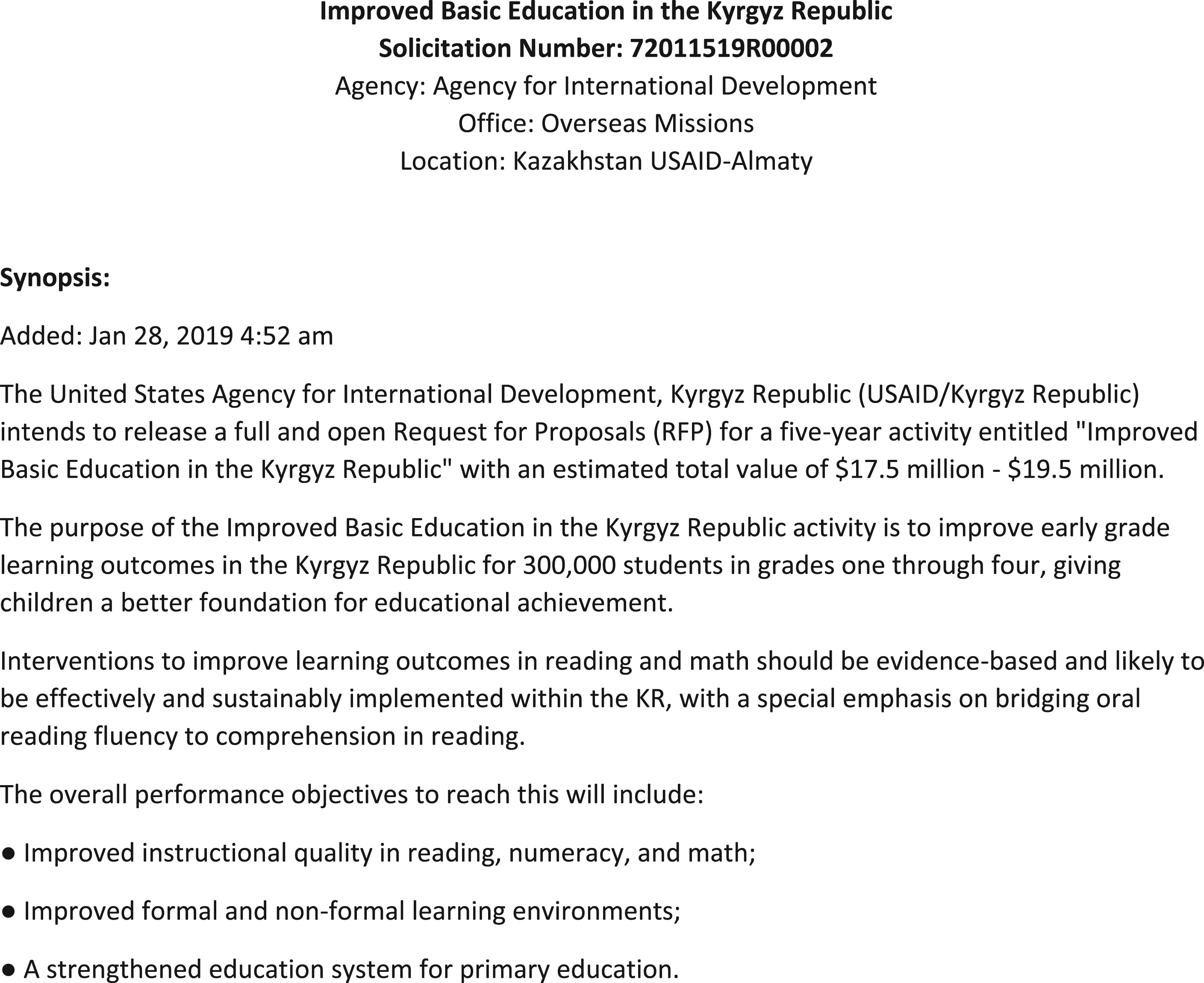
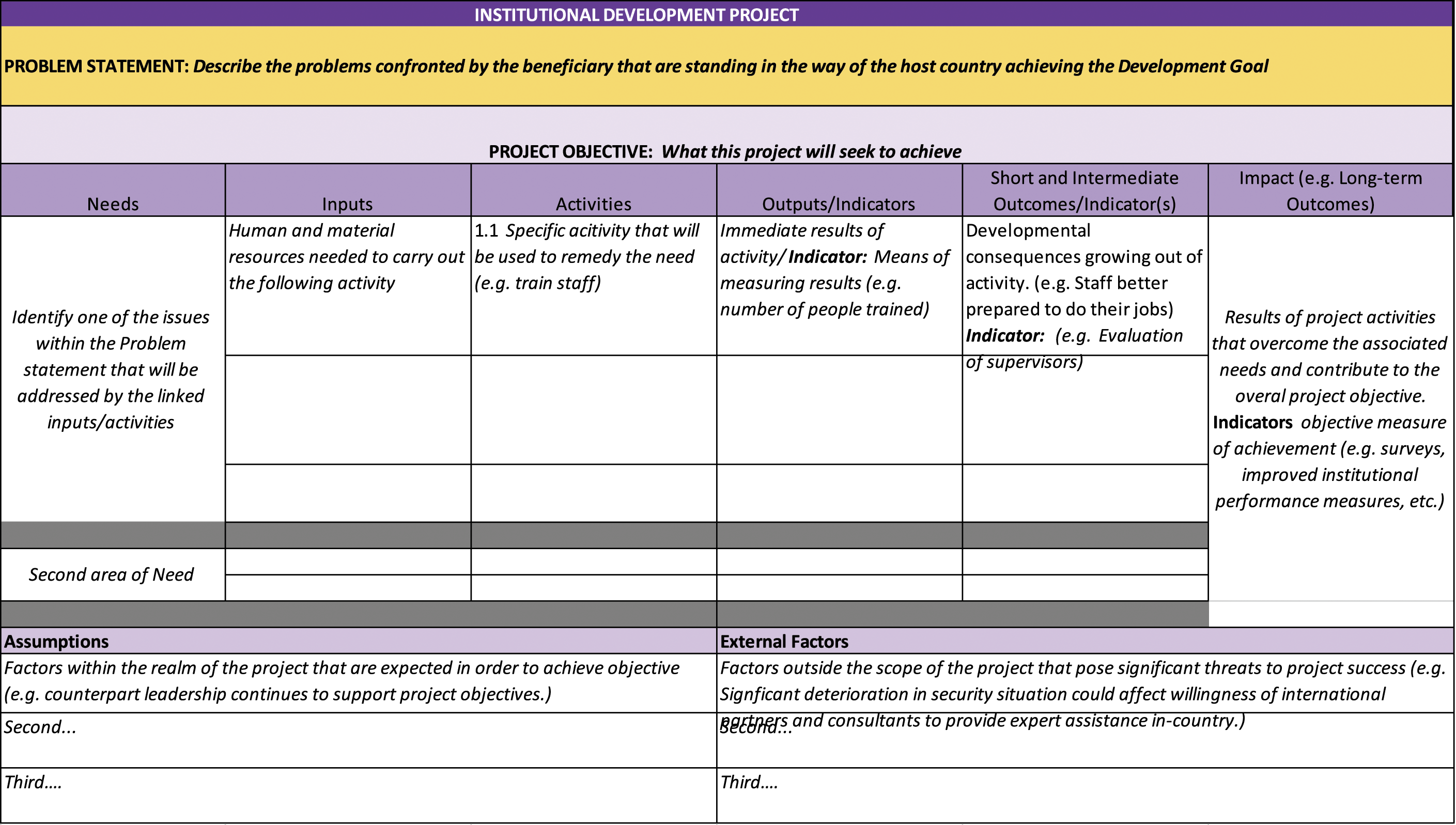
We note that donors can include bi-lateral aid agencies of donor countries such as the United States Agencies for International Development (USAID); multilateral funds administered by intergovernmental organizations (IGOs) like the United Nations Development Program (UNDP) or the World Bank; or foundations, such as the Bill and Melinda Gates Foundation which is very active in the international arena funding projects especially in the areas of health and poverty alleviation. We then ask them to Google other countries’ aid organizations by other developed countries. This in-class exercise reinforces the development lens and makes figure one come alive (Figures 1–3). Donor-funded development. USAID RFP program description. Improved basic education in the Kyrgyz Republic solicitation number: 72011519R00002 agency: Agency for International Development Office: Overseas Missions Location: Kazakhstan USAID—Almaty. Logical framework.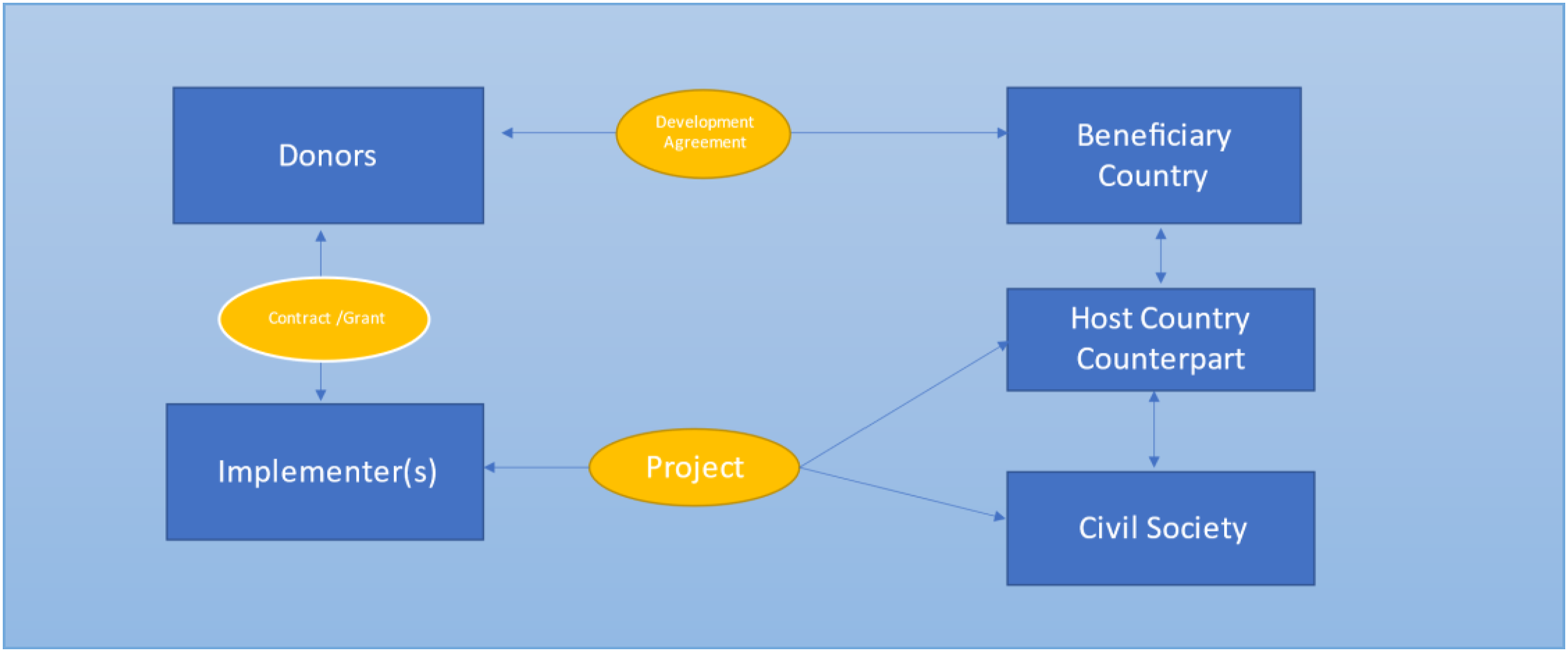
We further explain that donors achieve their objectives using contracts or grant programs to implementors who are ultimately tasked with managing the donor-funded programs. To put it differently, the students learn about the fiscal instruments available to donors in international development. There are a wide range of implementors active in international development. They include for profit firms that specialize in international development work, such as Chemonics and Development Alternatives International; NGOs, such as National Democratic Institute or Mercy Corp; and IGOs such as UNDP and the World Food Program.
In class, we do an exercise where every student is given an implementor to look up and to find their mission, areas of specialization, countries where they operate, and an example of a project. This exercise also gives students a sense of employment opportunities in international development.
Finally, we note that international development involves cooperation and collaboration between the donors, and implementors, and the beneficiary countries involved. This allows us to transition to a deeper exploration of governance and cross-cultural analysis critical in creating the developmental lens.
Governance and good governance
While international development covers a wide range of issues, from economic development and anti-corruption to health and food support, we start with the issue of governance. This positions the students as an outsider from the countries we are looking at and forces them to consider what we mean by the term governance (as illustrated by the reading Fukuyama, “What is governance?” (2013)) and more importantly, what do we mean by “good” governance? Answers to these questions are central to identifying the developmental problem that a donor might be interested in helping the host country to work on resolving (though they are also helpful for anyone working within government to understand as well.)
We then turn to some of the operational efforts to measure governance both in terms of trying to understand its effectiveness and how we might be able to measure change. We have the students explore data using the World Bank data set and the USAID Journey to Self-Reliance Country Roadmap Portal in class, asking them to select a poor country. We introduce other online data sources such as Ibrahim Index of African Governance.
Cross-cultural perspectives
From the moment we ask the question what is good governance, we must also ask from whose perspective? The donors or the host countries? (e.g., Andrews et al., 2018; Grindle, 2016) And even if the two can agree on the general nature of governance, can they agree on the specific problem or concern about governance that they believe most deserving of attention?
From this conversation, students learn to distinguish the motivations of the donor and the host country, the necessity of working closely with local stakeholders to develop a fuller understanding of their interests and understanding of the facts on the ground and as a means of cultivating a positive working relationship. The students are also exposed to the question of whether international development benefits or harms beneficiary countries (e.g., Moyo, 2009.)
Problem identification and setting goals
In development, as in any form of public management, before initiating a project, it is crucial to carefully identify exactly what the problem to be addressed is and the goals and objectives of the specific effort intended to do so (e.g., Andrews et al., 2018.) Here again, the international development model encourages students to seriously engage with both the cross-cultural elements of discerning and identifying the problem and in avoiding preconceived notions that they might hold if simply trying to work within their own national context.
To help students work through this process, we divide the class up into small work groups and using a USAID Request for Proposals description of work, have the students fill out a logical framework (Log Frame) that traces out the logical connections between a problem, the objective, specific needs, the actions to address those needs, and the outcomes and results emerging from those interventions (e.g., USAID, 2019.) Further, they are individually given a writing assignment in which they are a governance program officer in the USAID mission in Southeast Asia supporting Myanmar, tasked with preparing a five-to-seven-page memorandum (plus tables, figures, and references) to the Regional Mission Director of USAID recommending a course of action. How should USAID assist Myanmar to improve its governance processes? They are also expected to present an oral briefing of no more than 5 min and including no more than five slides. These exercises on Myanmar get the students to assume an important role as a donor agent and practice the meaning of governance. 1
Management strategies and methods
For students who may or may not have significant prior education or experience in the theories, practices, and tools of management, international development offers an excellent study of practices. Because development ranges from the management of discrete projects (such as building construction or the distribution of humanitarian supplies) to complex efforts to support institutional development (such as improving the legal system or strengthening a parliament), we can build a comprehensive range of management practices that follow the evolving approaches to management. These extend from basic management strategies to result-based management to the most contemporary forms of adaptive management such as USAID’s Collaborative Learning and Adaptation, Thinking and Working Politically and Problem-Driven Iterative Adaptation (e.g., Guinn and Straussman, 2018.)
Here again, the students are broken up into smaller work groups and tasked with developing management plans for several illustrative case studies.
Managing according to values
Finally, we use the issue of human rights to illustrate how values can be consciously integrated into development programming, both where those rights are the direct objective of programming, such as a rule of law programming promoting respect for the rights of defendants, and as a contextual concern where considerations of how programming can advance or inhibit human rights needs to be taken into consideration during program design and development (e.g., Broberg and Sano, 2018; Pact, 2018.) Here again, this requires the students to grapple with potential cross-cultural conflicts and the fact that development, like all public management, is laden with values that public administrators and policy makers are seeking to advance.
Transitioning to a wider range of public management
After providing this in-depth introduction of international development and management that hopefully provides them with a development lens through which to study and analyze other international practices, we expand our focus to a broader range of issues and organizational settings. While these issues and organizations may also be of interest to donors and implementors working in development, they are also the purview of public administrators working in governments or in governance related to civil society.
For example, in one class, we study the development of public policy and how governments seek to obtain the compliance of those that are the target of that policy (e.g., Soman, 2015; Weaver, 2009.) In doing so, we note the similarities between various formulations of the public policy–making process and development program management for the identification of the problem and the establishment of goals and objectives through monitoring the effectiveness of the policies once promulgated.
Other substantive infrastructure financing, privatization, public–private partnerships, corruption—all of which can be approached as the subject of an international development effort or from the perspective of a public administrator and are taught using case studies to help the students work through the practicalities of managing these types of challenges.
Finally, we end the class with several studies focusing on different organizational contexts, including NGOs, INGOs, and IGOs. These classes include issues such as the challenges increasingly faced by NGOs as authoritarian-leaning governments seek to close the civic space (e.g., Brechemacher and Carothers, 2017; USAID, 2017) and the role of INGOs and IGOs in humanitarian disaster and relief (though disaster management strategies are equally applicable to public administrators in the affected countries as well) (e.g., Heyse, 2013; Straussman and Tiwari, 2016). In the case of humanitarian disasters, we also divide the class in half and have half of the students adopt the role of a senior staff person with Doctors without Borders and half to adopt the role of a senior staff person with the World Health Organization. Each student is to then write a five-page memorandum to senior leadership in their organization, analyzing their organization’s response to the Ebola outbreak in West Africa 2013–2016 in which they describe the problems encountered by their organization and the lessons learned for better meeting the next humanitarian disaster. The students then share their findings in class. Again, this exercise gives students further insight into employment possibilities in international development.
Conclusion
While international development is a worthy subject of study, we have found it extremely helpful in providing all students with a common perspective through which to study and compare a wide range of issues in international public management. Major concepts from public management are explored through what we called a development lens. The comparative focus comes across through the assigned reading, and the case studies, and the in-class exercises. Several of our students have entered the field of international development by working for implementors or NGOs that work in the development space.
Footnotes
Declaration of conflicting interests
The author(s) declared no potential conflicts of interest with respect to the research, authorship, and/or publication of this article.
Funding
The author(s) received no financial support for the research, authorship, and/or publication of this article.
