




Abstract
The purpose of the study was to identify how the updated refresher course influences the civil servants’ readiness to promote or restore the reputation of Ukraine in the setting of crisis communication. The study used qualitative methods and tools for baseline analysis of the currently delivered refresher courses for civil servants and quantitative methods for quasi-experimental research. It was found that there was a need for updating the curriculum to concentrate more on training civil servants in promoting the reputation of the country in the context of crisis communication. The main outcome of the intervention was the student-designed and presented projects. These were as follows: “Consolidation of the world through the “soft power” of the state,” “Transparency: See, Invest, Gain,” “Handwriting of Consolidation: Books and Journals,” “Welcome to Our Club,” “Great Citizens: Footprints in History,” “Fight Fakes: Learn how,” “From Heart to Heart via Facebook,” and “Did you ever know that …? You’ll be surprised!.” Using the researcher-designed awareness and readiness for promoting the nation’s reputation scale (ARPNRS), it was found that the updated refresher course for the civil servants improved the attendees’ brand management awareness and skills, crisis communication awareness, and skills, awareness, and skills in measuring a nation’s image and reputation, and motivational components. The ANCOVA test identified that there was a shift from knowledge readiness level (71.23%) to readiness-to-perform level (62.50%) in the participants of the updated course (EG). Further research is needed to identify the effectiveness of student-designed projects in real-life settings.
Keywords
Introduction
The key civil servants’ functions and historical mission are related to building the country’s reputation and representing its image through their behaviour and communication (Ingenhoff et al., 2018; Zuo, 2013). The civil servants regularly take refresher courses to attune to the tasks of extraordinary nature such as restoring the country’s image and reputation in crisis communication using international best practices. Training of this kind has recently become a high priority and a challenge for civil servants in the context of ongoing crisis communication of the state government bodies of Ukraine with their counterparts from some post-soviet states. That training is also essential because the properly built image and reputation of the country influence its international economic activities, investment attractiveness, international relations, domestic labour market, and system of education. Image and reputation not only ensure a competitive advantage for the country internationally and they also influence the citizens’ self-respect, self-esteem, and self-identification (Bhargava, 2017; Buhmann, 2016). Being intangible assets, the country’s image and reputation are established, promoted, and managed via communication. The above context enhanced the role of institutionalised communication management practices for image-building and promotion in many countries (Buhmann, 2016; Wang, 2006). The exanimation of the publicly available syllabuses for the refresher courses for civil servants in Ukraine showed that the courses offered by the key in-service training institutions such as the National Agency of Ukraine for Civil Service, Training Centre for Prosecutors of Ukraine, Andrii Meleshevich Kyiv-Mohyla School of Governance, and Volyn Regional Centre for Professional Development covered neither country’s branding or image and reputation building, managing or restoring nor managing crisis communication (National Agency of Ukraine for Civil Service, 2022a; National Agency of Ukraine for Civil Service, 2022b; Training Centre for Prosecutors of Ukraine, 2021; Andrii Meleshevich Kyiv-Mohyla School of Governance, 2022; Volyn Regional Centre for Professional Development, 2022). The examination of the above curriculums showed that updating the refresher courses for civil servants so that these could provide training in restoring the image and reputation of the country in the crisis communication settings specifically was relevant. The absence of content on restoring the image and reputation of the country specifically in crisis communication settings within the current curriculum design underscores the relevance of updating refresher courses for civil servants. Addressing this oversight through comprehensive training programs that encompass crisis communication and the restoration of the country’s image and reputation is imperative. The identification of this gap in the existing curriculum design forms the basis for this study and underscores its importance. By investigating the training programmes provided to civil servants in Ukraine and identifying the gaps in their syllabuses, this study will contribute to the existing body of knowledge on civil service training, crisis communication, and image and reputation management. The findings will have practical implications for the development of comprehensive and effective training programs that equip civil servants with the necessary skills to handle crisis communication situations and restore the country's image and reputation effectively.
Literature review
Theory and Methods of Civil Servants’ Postgraduate Professional Development
The theoretical literature reveals the training system of civil servants from two perspectives such as managerial and instructional. The managerial perspective suggests that the system of the civil servants’ postgraduate professional development which is a part of human resources management (HRM) relies on the career development theory (Daud, 2019). Several career development theories are deemed to be those that encompass and integrate the HRM processes. These theories are as follows: the social learning theory of career development (SLTCD) by Krumboltz and Mitchell (Truyens, 2019a), the theory of Super’s lifespan, life space (Career Research, 2022; Letlape, 2020), trait-factor theory (Atli, 2016; Arthur and McMahon, 2018), and John Holland’s theory of career typology (BusinessEssay, 2022). Admittedly that HRM seemingly contradicts career development theories in terms of the difference in focus, specifically, HRM’s goal is to develop the employee so that they fit into the organisation system while the career development theories give priority to the development of a personality (Upton, 2006). The above implies that there is a need for the convergence of HRM tools and personalised career development to make civil servants’ postgraduate professional development system more efficient (Daud, 2019; Burger, 2021).
The theory of cognitive information processing (Arthur and McMahon, 2018) and the constructivist model/theory of career management and development (Arthur and McMahon, 2018; Pāvulēns, 2015), as well as constructivist learning theory (Kurt, 2021), lay the background for the instructional perspective on the professional training system of civil servants. The theory of cognitive information processing theory focuses on problem-solving and decision-making which are important skills for civil servants to train (Truyens, 2019b). The constructivist model/theory of career management and development suggests that a person constantly self-builds themself through self-reflection of their goals, expectations, decisions, and actions (Swanson and Fouad, 2014). The constructivist learning theory states that the enhancement of new learning experiences looks like an upward spiral in which the lower-level experiences serve as a background for the succeeding ones (Mcleod, 2019a).
The examination of the literature on the instructional methods used to train civil servants or to update them professionally found that the commonly-used methods were the training sessions that included role-plays, simulations, case studies, brainstorming, and minding activities delivered either online or offline (Bodyk et al., 2022; Kalyuzhna, 2019). The review also found the courses that were commonly delivered to civil servants within the refresher courses. These were as follows: change and conflict management, leadership, state policy evaluation, and critical thinking (Lytvynenko, 2018). The review findings suggest that the in-service training system needed an update in terms of instructional methods and professional skills needed to meet the current political challenges by public administrators.
Crisis communication
Crisis communication has been widely studied in the field of communication and public relations, given its significance in managing and mitigating the negative effects of crises on distinct geographic and political entities, organisations, and individuals (Fearn-Banks, 2016; Ulmer et al., 2017). Scholars have emphasised the importance of effective crisis communication strategies and practices in building organisational resilience and maintaining public trust. Crisis communication involves the timely and strategic dissemination of information, as well as the management of public perceptions and emotions during a crisis event. Various theoretical frameworks, such as the situational crisis communication theory (SCCT) and the image restoration theory, have been developed to understand and guide crisis communication efforts (Benoit, 2015; Coombs, 2022). Research has explored a range of topics within crisis communication, including crisis response strategies, crisis message design, crisis leadership, and the role of social media in crisis communication. The literature underscores the crucial role of effective crisis communication in protecting organisational (institutional) reputation and fostering public confidence during times of crisis.
In the face of the military invasion by the Russian Federation, Ukraine has a critical role to play in promoting and restoring its image and reputation through effective crisis communication. Ukraine can harness its resilience, unity, and determination in the face of adversity to demonstrate strength and resilience to the international community. By promptly and transparently sharing accurate information about the situation, Ukraine can counter disinformation campaigns and shape a narrative that highlights its commitment to democracy, sovereignty, and human rights. Engaging with key stakeholders, including international organisations, governments, and civil society, Ukraine can garner support and solidarity in condemning the invasion and advocating for a peaceful resolution. Demonstrating strong leadership, empathy towards affected communities, and a focus on humanitarian efforts can further enhance Ukraine’s image as a responsible and resilient nation. Through strategic crisis communication efforts, Ukraine can highlight its values, mobilise support, and work towards restoring its image and reputation on the global stage. Given the ongoing Russia-Ukraine military conflict, the Ukrainian case presents a notable gap in the existing literature, thereby highlighting the relevance and significance of this research.
Building, promoting, and restoring the image and reputation of the country
These days, scholars still debate the concept of building the country’s image and reputation (Foroudi et al., 2016; Mariutti and De Moura Engracia Giraldi, 2020; Mariutti and Giraldi, 2019). As can be noted in Figure 1, the literature discusses those concepts in the context of globalisation and from several perspectives such as managing, communicating, and measuring a nation's image and reputation (Kalicharan, 2014). The concepts of restoring the image and reputation of the country are discussed within reputation risk management (Ingenhoff et al., 2018; Linsley et al., 2014). Figure 1 provides a summary of the international literature discussion on managing/restoring a nation’s brand, image, and reputation. As can be seen in Figure 1, the management studies discuss the country’s brand, image, and reputation from three key perspectives such as (a) creating, developing/restoring a nation’s/country’s brand, image, and reputation; (b) communicating and (c) measuring it. The analyses of the relevant literature on restoring the image and reputation of the country in the context of crisis communication run by governmental institutions or civil servants showed that this perspective of the nation’s image and reputation building and managing is studied limitedly. Summary of literature discussion on managing/restoring a nation’s brand, image, and reputation.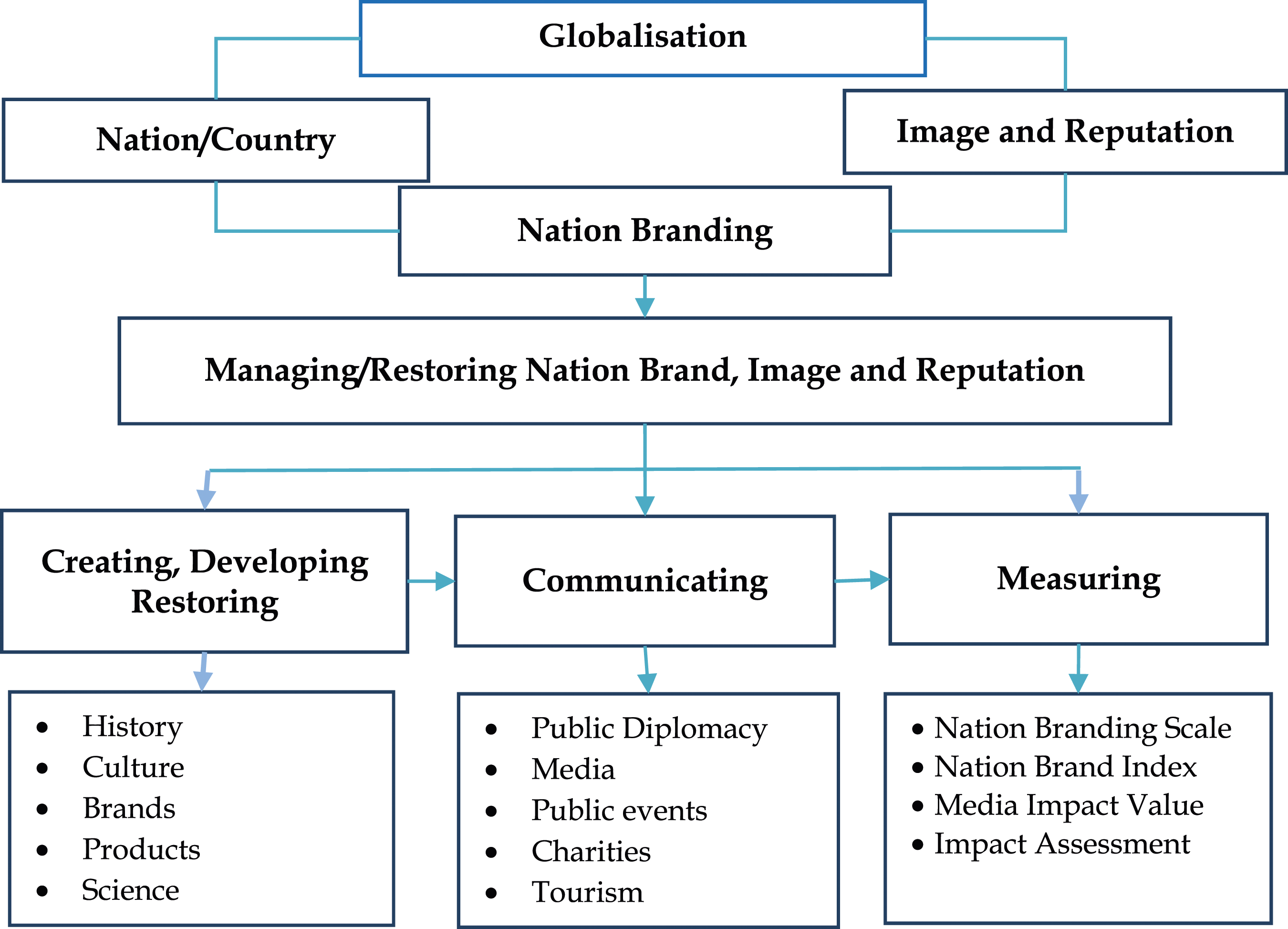
The examination of the publicly available syllabuses of training programmes for civil servants from Ukraine found that awareness and skills of branding or rebuilding the image and reputation of the country in the setting of crisis communication are left behind in the scope of those programmes. The above created a scientific and instructional gap in the in-service training of civil servants in Ukraine. Thus, the study seeks to identify how the updated refresher course influences the civil servants’ readiness to promote or restore the reputation of Ukraine in the setting of crisis communication. The research questions were as below: (1) Do the currently delivered refresher courses for Ukrainian civil servants address their awareness and skills associated with promoting Ukraine’s reputation in the setting of the ongoing international conflict? (2) How does the updated refresher course for civil servants influence the course attendees’ brand management awareness and skills, crisis communication awareness and skills, awareness and skills in measuring a nation’s image and reputation, and motivational factors that comprised the participants’ awareness and readiness for restoring the nation’s image and reputation?
Methodology
The study used quantitative methods and tools. It was split up into two phases such as baseline analysis of the currently delivered refresher courses for civil servants and the intervention which was quasi-experimental research of a non-equivalent group pretest-posttest design (McKinley and Rose, 2020; Price et al., 2017). The purpose of the baseline phase was to identify how the currently delivered refresher courses for civil servants address the risks associated with Ukraine’s national brand in the setting of the ongoing international conflict. In the above context, Ukraine’s national brand (image) can be described as a diverse and culturally rich country, blending historical heritage with natural beauty and a vibrant, resilient spirit. In the setting of the ongoing Russia-Ukraine military conflict, which has resulted in a communication crisis, Ukraine’s national brand needs to be portrayed internationally as a resilient nation with a strong determination for peace, standing up against aggression, and fostering unity among its diverse population.
It was also intended to identify whether making changes to the course structure and content is worth undertaking and what modules could be integrated into the curriculum to upgrade the professional training system for civil servants so that they could be ready for restoring the image and reputation of Ukraine in crisis communication settings. This phase of the study relied on the checklist-based analysis (see Appendix A) of the publicly available syllabuses of training programmes for civil servants from several randomly selected institutions.
The intervention phase was based on the updated refresher course that was delivered online and lasted from October 2021 to March 2022 at the Training Institute of the State Employment Service of Ukraine and Volyn Regional Centre for Professional Development. The intervention was used to identify how the updated refresher course influenced the civil servants’ readiness – which was considered a variable - to promote or restore the reputation of Ukraine and crisis communication and measurement of a nation’s image and reputation.
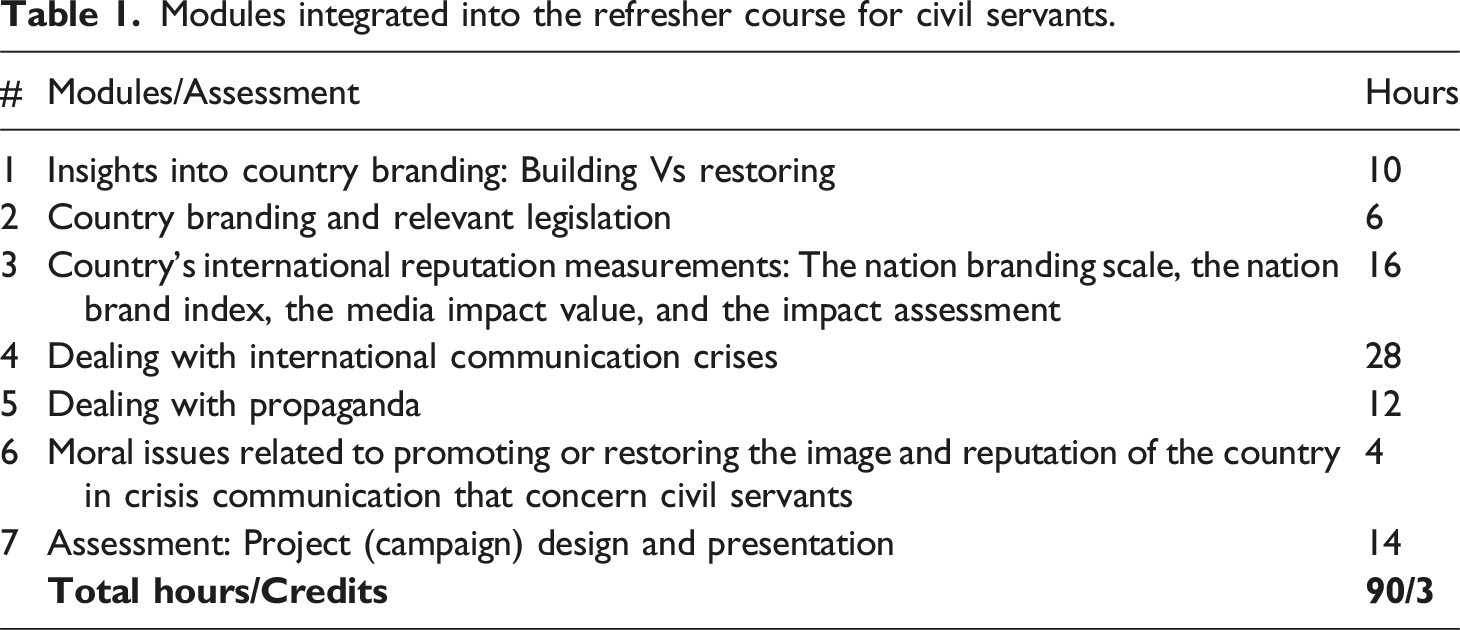
The updated refresher course for civil servants utilised a learning-by-doing approach to training them in the use of the nation branding hexagon by Simon Anholt, planning measures for various crisis communication scenarios, and effectively utilising social media tools.
Modules integrated into the refresher course for civil servants.
Visualised flow of the process of project design and assessment
The project was supposed to be performed by eight project teams each consisting of eight people. Project fulfillment flow was as follows: (a) measuring the current status of the image and reputation of Ukraine using several tools; (b) designing and presenting the strategy of restoring the image and reputation of Ukraine in the setting of a crisis communication; (c) developing a communication campaign aimed at restoring the image and reputation of Ukraine in the setting of a crisis using predesigned guidelines; (d) presenting the campaign to the board of experts and peers, and (e) expert voting for the best campaign (assessment) Figure 2. Visualised flow of the process of project design and completion by the attendees of the updated refresher course.
The presentations of the projects were supposed to reveal the purpose(s) of a national branding campaign, the target audience the campaign was intended to make Ukraine change their perception of image and reputation or at least, make these visible through, and operationalisation of building/restoring the country’s reputation and image.
Sample
Demographic characteristics of the sample.
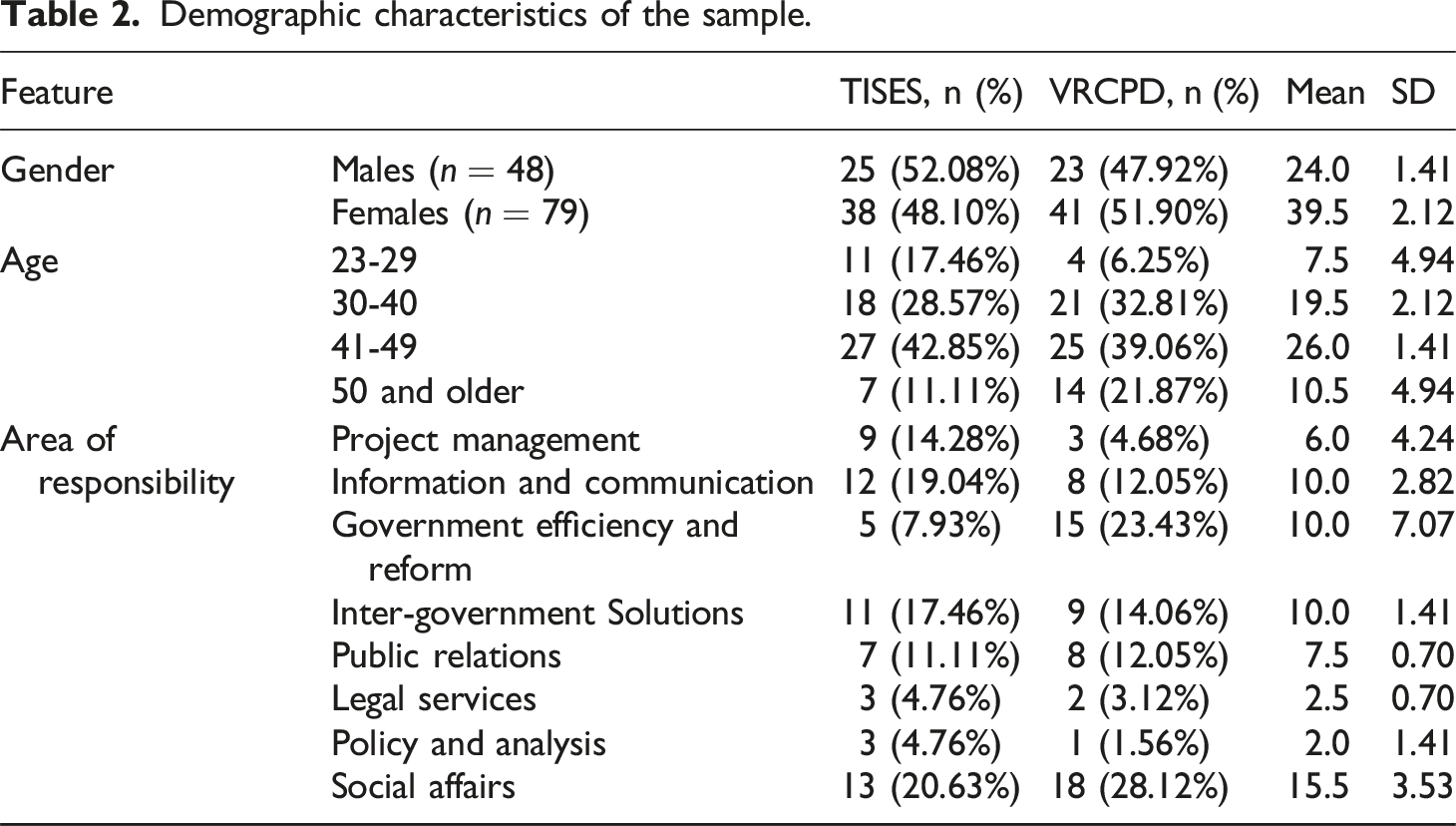
The population of 127 people was used to form a control group (CG) and an experimental group (EG). The CG consisted of 63 students of the refresher course run by TISES and the EG comprised 64 attendees of the course run by VRCPD.
Ethical considerations
The refresher course participants were asked to provide informed consent before taking the Awareness and Readiness for Promoting the Nation’s Reputation Scale (ARPNRS) for Civil Servants (with a focus on Crisis Communication). The course attendees were also informed that the research team would only use their personal data for research purposes and they would give utmost importance to the anonymity of the data they provided.
Instruments
Two instruments such as a Checklist for Analysis of the Publicly Available Syllabuses of Training Programmes for Civil Servants (see Appendix A) and Awareness and Readiness for Restoring the Nation’s Reputation Scale (ARRNRS) for Civil Servants (with a focus on Crisis Communication) (see Appendix B) were designed by the research team in Ukrainian language and validated by the involved volunteer experts be used as instruments in the study. Both instruments were translated into English to be provided and reported in this paper.
Checklist for analysis of the publicly available syllabuses of training programmes for civil servants
The draft of the checklist was designed by the research team. It consisted of eight questions that were split up into six domains of training such as branding in general, related legislation, crisis communication, communication channels, reputation and reputational risks measuring tools, and civil servants’ moral standards. The instrument used a 6-point Likert Agreement Scale so that the experts could indicate their judgements. The values were as follows: 1 – “Strongly disagree”; 2 – “Disagree”; 3 – “Neither agree nor disagree”; 4 – “Agree”; 5 – “Strongly agree”; 0 – “Not applicable”. The content validity, face validity, and construct validity of the checklist were evaluated by five voluntary expert colleagues who held Ph.D. degrees in social studies and psychometrics. The experts found that the above indicators showed the appropriateness of the questions for the study purpose. The obtained value for the item-level content validity index (IL-CVI) was 0.95. According to Taherdoost (2016), it indicated “sufficient agreement” among the experts. Following that, the inter-rater reliability of the checklist that was based on the calculation of Fleiss’s Kappa coefficient was also identified (Rodrigues et al., 2017). It was 0.845 which indicated “considerable agreement” among the experts according to Polit and Beck, 2006. Overall, the obtained values confirmed that the checklist could be used as a relevant statistical instrument for the study.
Awareness and readiness for promoting the nation’s reputation scale (ARPNRS) for civil servants (with a focus on Crisis Communication)
An ARPNRS for Civil Servants (with a focus on Crisis Communication) was designed by researchers. The instrument was validated by six experts with Ph.D. in Public Administration, Social Communications, Professional Education, and Marketing from the State University of Trade and Economics (Ukraine), the National Academy of State Administration of the President of Ukraine, and Borys Grinchenko Kyiv University. The content validity, face validity, and construct validity measurements showed that the value for the item-level content validity index (IL-CVI) was 0.976 and the value for Fleiss’s Kappa coefficient was 0.865 – both indicated “substantial agreement”. That agreement indicated that the scale could be used as a valid tool to monitor the variable and collect data for the research. There were specified four levels of readiness of civil servants from Ukraine for performing branding of Ukraine through communication. The scale attempted to assess the civil servants’ awareness and maturity of efforts in the functions that follow: (a) create the image and reputation of the country; (b) communicate them to the public locally and internationally; (c) monitor the perception of the country’s image locally and internationally, along with motivation-related readiness of the civil servants. In the design phase, the pool of items was compiled to cover brand management awareness and skills, crisis communication awareness and skills, and awareness and skills in measuring a nation’s image and reputation. The motivational factors were considered as well. The scale content validity, face validity, and construct validity were identified by the above five voluntary expert colleagues. They used the Delphi technique to identify the construct validity and internal consistency of the items in a bank. The evaluation relied on a 5-point Likert agreement scale with a value of one denoted ‘strongly disagree’, two standing for “disagree”, three meaning “neither agree nor disagree”, four indicating “agree”, and five signifying “strongly agree”. Those levels were as follows: (1) awareness readiness level; (2) knowledge readiness level; (3) readiness-for-performance level, and (4) mastery readiness level.
Data analysis
Both the checklist and the scale were used to collect the quantitate data from the programme analysis and intervention. The checklist was rather used for screening the programmes than performing an in-depth analysis of them. Six experts with Ph.D. in Public Administration, Social Communications, Professional Education, and Marketing from the State University of Trade and Economics (Ukraine), the National Academy of State Administration of the President of Ukraine, and Borys Grinchenko Kyiv University performed the above analysis. They analysed the curriculums from the National Agency of Ukraine for Civil Service (2022a; 2022b), Training Centre for Prosecutors of Ukraine (2021), Andrii Meleshevich Kyiv-Mohyla School of Governance (2022), and Volyn Regional Centre for Professional Development (2022).
Readiness levels of the participants, the corresponding score ranges, and descriptive explanations of each level.

Results
The results of the study are laid out in the way the research questions are set. The first part of this section reveals the analysis of five currently delivered refresher courses for Ukrainian civil servants in terms of how those courses cover their awareness and skills associated with promoting Ukraine’s reputation in the setting of the ongoing international conflict. The second part of this section presents the data drawn from the findings on the influences of the updated refresher course for the civil servants on the course attendees’ brand management awareness and skills, crisis communication awareness and skills, awareness and skills in measuring a nation’s reputation, and their motivation. The student-designed and presented projects were as follows: “Consolidation of the world through the “soft power” of the state”, “Transparency: See, Invest, Gain”, “Handwriting of Consolidation: Books and Journals”, “Welcome to Our Club”, “Great Citizens: Footprints in History”, “Fight Fakes: Learn how”, “From Heart to Heart via Facebook”, and “Did you ever know that …? You’ll be surprised!”.
Analysis of the syllabuses of training programmes for civil servants
The superficial examination of five publicly available syllabuses of training programmes for civil servants from leading civil servants training institutions in Ukraine found that the mode of delivery of those programmes is either fully online or blended (National Agency of Ukraine for Civil Service, 2022a; National Agency of Ukraine for Civil Service, 2022b; Training Centre for Prosecutors of Ukraine, 2021; Andrii Meleshevich Kyiv-Mohyla School of Governance, 2022; Volyn Regional Centre for Professional Development, 2022). Each programme included three mandatory modules such as “Strategic communications,” “Interaction between government, business, civil society, and policy advocacy,” and “Digital democracy, technology, and data security in communications”. There were also the elective modules which are as follows: “Social and cultural diplomacy”, “Transformation of conflicts, mediation, and dialogue,” “Use of social media for strategic communications,” “Data visualisation and graphic design,” “Communication campaigns,” “Transformation and mediation of a conflict to establish rapport,” and “Access to information”. No module was found to cover managing/restoring a nation’s brand, image, and reputation. The modules on communication limitedly covered crisis communication.
Data drawn from the checklist-based analysis of the refresher courses for civil servants.

Note abbreviations for programmes: NAUCSa = National Agency of Ukraine for Civil Service, (2022a); NAUCSb = National Agency of Ukraine for Civil Service (2022b); TCPU = Training Centre for Prosecutors of Ukraine (2021); AMKMSG = Andrii Meleshevich Kyiv-Mohyla School of Governance (2022); VRCPD = Volyn Regional Centre for Professional Development (2022).
As can be noted in Table 4, the Mean values and the values for the Median mostly correspond to the negative judgements of the experts such as “Not applicable”, “Strongly disagree”, and “Disagree’ (between
Intervention
Results of the ANCOVA Test obtained from the ARPNRS Administered Before and After the Intervention, EG (

As can be noted in Table 5, the
As can be noted in Figure 3, there was a shift from knowledge readiness level (71.23%) to readiness-to-perform level (62.50%) in the participants of the updated course (EG). There was also an increase in the proportion of the EG attendees who moved to the mastery readiness level of their readiness under study. However, there was no remarkable change in the readiness levels of the CG attendees. Shifts in levels of awareness and readiness of civil servants for restoring the Nation’s image and reputation before and after the intervention.
Discussion
This study sought to establish whether the currently delivered refresher courses for civil servants addressed their skills associated with building up and promoting Ukraine’s reputation in the setting of the ongoing international conflict. The study also attempted to address the problem of fostering the readiness of the civil servants to restore the image and reputation of Ukraine in the setting of crisis communication through the updated professional refresher course and identify how the course influenced the attendees’ brand management awareness and skills, crisis communication awareness and skills, awareness and skills in measuring a nation’s image and reputation, and their motivation for contributing to the image and reputation of Ukraine. The key outcome of the intervention was the implementation of student-designed and presented projects, which included titles such as “Consolidation of the world through the ‘soft power’ of the state” and “Transparency: See, Invest, Gain.”
The originality of the study lies in updating the refresher course for civil servants, designing the checklist for analysis of the publicly available syllabuses of training programmes under study, and designing the awareness and readiness for promoting the nation’s reputation scale (ARPNRS) for civil servants (with a focus on crisis communication). Another advantage of the study is, as far as we are aware, this has been the first attempt to cover the problem of comprehensive training of civil servants in building and restoring the country’s image and reputation through the specifically reshaped refresher course in Ukraine.
The examination of several refresher courses syllabuses from the institutions in Ukraine found that those courses focused on general aspects of in-service training of civil servants rather than training them in restoring and promoting the country’s brand, image, and reputation in the setting of the recent world crises driven by the military conflict in Europe. These findings underscored the need for updating the curriculum to place greater focus on training civil servants in promoting the country’s reputation during crisis communication. The checklist-based analysis of the training programmes found that the experts’ judgements were mainly negative with values for
The ANCOVA test showed that the updated refresher course for civil servants influenced the course attendees’ brand management awareness and skills, crisis communication awareness and skills, awareness and skills in measuring a nation’s image and reputation, and motivational components. This finding was supported by the
The findings of this study make significant contributions to crisis communication theory by examining the practices of restoring a nation's image and reputation in the context of military conflict. These findings will serve as a basis for further exploration and dissemination by both Ukrainian and international scholars. Moreover, this study contributes to the theory of civil servants’ career development (Daud, 2019) by enhancing instructional approaches that specifically focus on nurturing skills in nation branding and public diplomacy. Additionally, it enriches the best practices of professional development training for civil servants (Ingenhoff et al., 2018; Linsley et al., 2014; Truyens, 2019b). The outcomes of this research align with the recommendations put forth by the National Agency of Ukraine on Civil Service (2022c) regarding the promotion of values that foster cohesion within Ukrainian society. Thus, this study advances our understanding of crisis communication and offers practical implications for the professional growth of civil servants.
Conclusion and recommendations
The examination of the refresher courses for civil servants found that they limitedly fostered the attendees’ skills associated with promoting or restoring Ukraine’s reputation in the setting of the ongoing international conflict. The results of the examination proved that there was a need for updating the curriculum to concentrate more on training civil servants in promoting the reputation of the country in the context of crisis communication. The main outcome of the intervention was the student-designed and presented projects. These were as follows: “Consolidation of the world through the “soft power” of the state”, “Transparency: See, Invest, Gain”, “Handwriting of Consolidation: Books and Journals”, “Welcome to Our Club”, “Great Citizens: Footprints in History”, “Fight Fakes: Learn how”, “From Heart to Heart via Facebook”, and “Did you ever know that …? You’ll be surprised!”. Using the researcher-designed awareness and readiness for promoting the nation’s reputation scale (ARPNRS), it was found that the updated refresher course for the civil servants improved the attendees’ brand management awareness and skills, crisis communication awareness, and skills, awareness, and skills in measuring a nation’s image and reputation, and motivational components. The ANCOVA test identified that there was a shift from knowledge readiness level (71.23%) to readiness-to-perform level (62.50%) in the participants of the updated course (EG). There was also an increase in the proportion of the EG attendees who moved to the mastery readiness level of their readiness under study. However, there was no remarkable change in the readiness levels of the CG attendees. The scientists are recommended to investigate how the reported updates to the refresher course could impact the instructors and how the practitioners could be trained to be able to use multiple media as branding tools. There are still gaps to cover in our knowledge around the effectiveness of student-designed projects in real-life settings. Further in-depth research is needed to identify how those designed reputation-promoting campaigns could be reported in the media to different age, gender, and occupation groups.
Limitations
The quasi-experimental research design might be considered the main limitation of this study.
Footnotes
Acknowledgements
The authors are cordially grateful to the experts for their valuable recommendations and to hosting institutions for providing a venue for this experiment.
Declaration of Conflicting Interests
After reasonable diligence has been performed, the authors confirm that they have no conflict of interest of any nature in the subject matter or materials provided in this manuscript. The authors confirm that this manuscript is their original work, and is not under review in any other journal. This statement is also to confirm that every author on the title page has contributed to the study. They also confirm that the data and interpretations provided in the study are valid, legitimate, and comply with the requirements of ethical considerations.
Funding
The author(s) received no financial support for the research, authorship, and/or publication of this article.

Appendix
Checklist for analysis of the publicly available syllabuses of training programmes for civil servants. Note Scale Values: 0 – Not applicable; 1 – Strongly disagree; 2 – Disagree; 3 – Neither agree nor disagree; 4 – Agree; 5 – Strongly agree.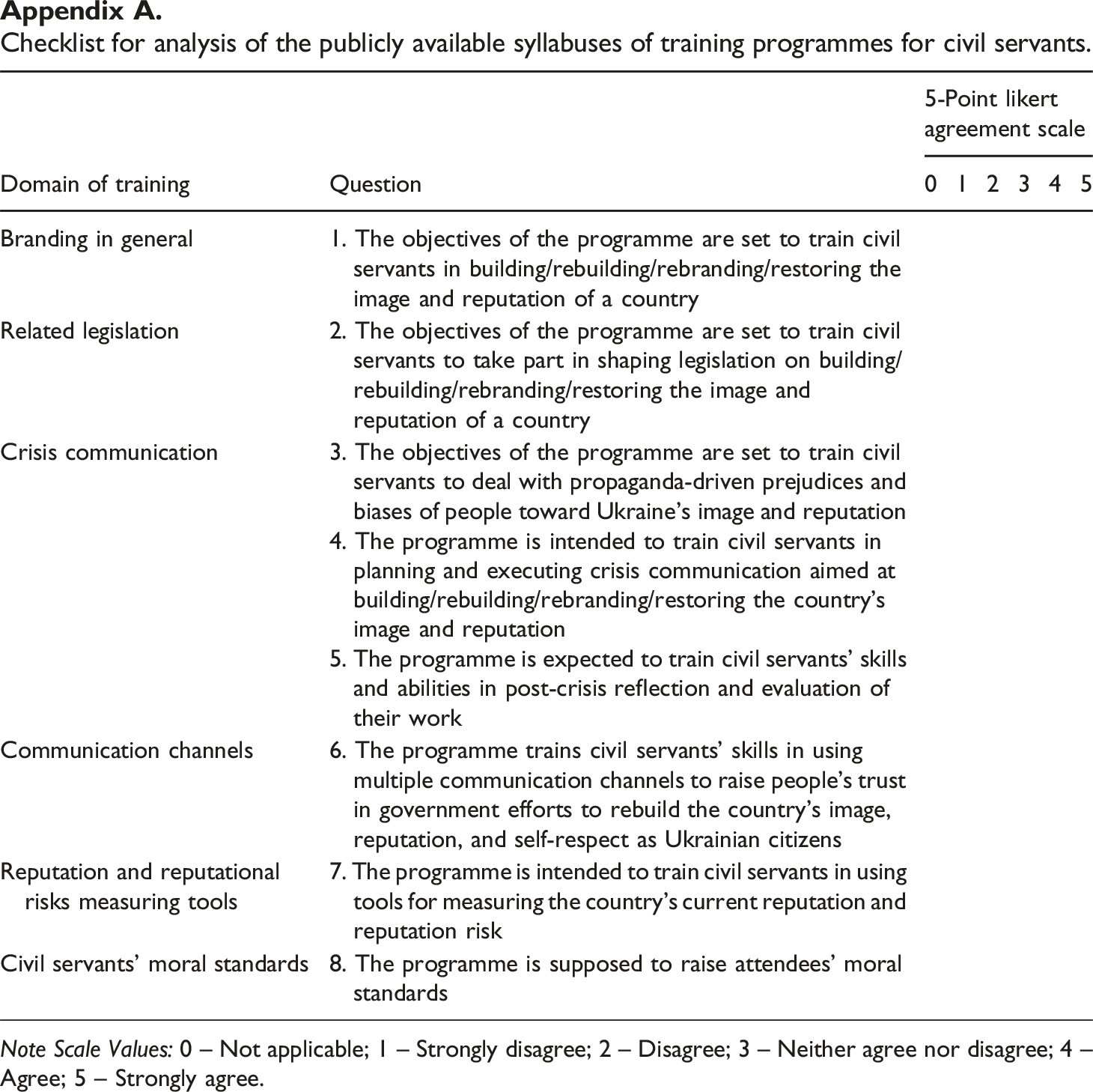
Domain of training
Question
5-Point likert agreement scale
0
1
2
3
4
5
Branding in general
1. The objectives of the programme are set to train civil servants in building/rebuilding/rebranding/restoring the image and reputation of a country
Related legislation
2. The objectives of the programme are set to train civil servants to take part in shaping legislation on building/rebuilding/rebranding/restoring the image and reputation of a country
Crisis communication
3. The objectives of the programme are set to train civil servants to deal with propaganda-driven prejudices and biases of people toward Ukraine’s image and reputation
4. The programme is intended to train civil servants in planning and executing crisis communication aimed at building/rebuilding/rebranding/restoring the country’s image and reputation
5. The programme is expected to train civil servants’ skills and abilities in post-crisis reflection and evaluation of their work
Communication channels
6. The programme trains civil servants’ skills in using multiple communication channels to raise people’s trust in government efforts to rebuild the country’s image, reputation, and self-respect as Ukrainian citizens
Reputation and reputational risks measuring tools
7. The programme is intended to train civil servants in using tools for measuring the country’s current reputation and reputation risk
Civil servants’ moral standards
8. The programme is supposed to raise attendees’ moral standards
Awareness and readiness for promoting the Nation’s reputation scale (ARPNRS) for civil servants (with a focus on crisis communication). By providing your responses to the questions that follow, you express your agreement to participate in the updated refresher course for civil servants and research. The course is intended to train you to rebuild Ukraine's reputation in crisis communication. The research is aimed at monitoring changes in your readiness for developing, managing, and promoting the country’s brand and reputation. Please respond to the questions as truthfully as possible. (1) Your age _________ (2) Your gender_______ (3) Your Area of Responsibility _________________________________________________ Note the Scale Values: 1 – “very untrue of me”, 2 – “untrue of me”, 3 – “somewhat true of me”, 4 – “neutral”, 5 – “somewhat true of me”, 6 – “true of me”, and 7 – “very true of me”.

Group of skills and awareness
Item
Scale
1
2
3
4
5
6
7
Brand management awareness and skills
1. I Have good skills and sufficient knowledge to develop my country’s brand promise
2. I Have a clear idea of Ukraine’s brand strategy
3. I Can be trusted to visually reinforce my country’s brand identity through the media
4. I Am able to initiate legislative amendments to address the issues or to reshape the governmental policy on building/rebuilding/rebranding/restoring Ukraine’s image and reputation
5. I Am aware of how to raise funds to recover/rebuild the image of my country or how to rebrand it
6. My personal expectations from participatory democracy are high
7. I Am able to use the nation branding hexagon by Simon anholt to address the imposed-by-propaganda prejudices and biases of people toward Ukraine’s reputation
Crisis communication awareness and skills
8. I Am aware of developing a plan for responding to different crisis communication scenarios related to Ukraine’s reputation
9. I Am able to execute measures to reduce or eliminate the impact of crisis communication on Ukraine’s reputation
10. I Am able to mediate and help to forge political compromises, launch initiatives, and act as an advocate for my country
11. I Am confident in my ability to critically evaluate and control my narrative about my country and other countries
12. I Am ready to use multiple communication channels to raise Ukraine’s people’s trust in government efforts to rebuild the country’s image, reputation, and self-respect as Ukrainian citizens
13. I Am aware and skillful in using social media as a tool for crisis communication
14. I Am able to manage post-crisis communication
Awareness and skills in measuring a nation’s image and reputation
15. I Am able to use a four-point reputational matrix technique to measure the country’s reputation risk
16. I Am aware of using and analysing the results of the nation branding scale
17. I Am aware of using and analysing the results of the nation brand index
18. I Am aware of identifying the media impact value
19. I Am able to perform and interpret the results of the impact assessment
20. I Always perform the post-crisis reflection and evaluation of the work I have done
Motivational components
21. I Constantly raise my personal standards for my moral authority as a Ukrainian citizen to be revered by my colleagues from other countries
22. I Am not driven by the financial benefits that might be gained via promoting Ukraine’s reputation internationally
23. I Am motivated to be associated with Ukraine’s image and reputation
24. I Am enthusiastic about creatively innovating the brand of Ukraine
25. I Am committed to looking for or creating new opportunities for the brand of Ukraine