



Abstract
The 4 years that Michel Hersen spent at the University of Mississippi Medical Center (1970-1974) are described in this article from the viewpoint of his place in the history of the development of behavior analysis and therapy. The Department of Psychiatry at the University of Mississippi Medical Center became a leader in enhancing the role of psychologists as clinician researchers within psychiatry and applying basic findings from psychology to the bedside. A vigorous research program involving psychology residents and postdoctoral students, and psychology and psychiatry faculty emerged from this integration of science and practice. Many of the faculty members, including Michel Hersen, became leaders in the field of behavior therapy. Much of what was groundbreaking at the time is now commonplace within many medical schools.
Introduction
This article, a tribute to the contributions of Michel Hersen to the fields of behavior analysis and behavior therapy, psychological research, and education, focuses on a particular period in the development both of the field and of Michel’s work. This period spanned the late 1960s and early 1970s when Michel was a faculty member in the Department of Psychiatry at the University of Mississippi Medical Center in Jackson Mississippi. Although behavior therapy was in the initial phase of becoming established, at the time it was controversial because it challenged the theories underlying the predominant model of therapy, namely, psychoanalysis and its briefer form, psychodynamic psychotherapy, and also presented a challenge to the practice of psychotherapy. However, an emerging field also presents an ideal opportunity for innovative work, and Michel took full advantage of this opportunity.
A prelude to Mississippi was the time I spent as a faculty member at the University of Vermont College of Medicine from 1961 to 1969. The main developments underlying behavior therapy at the time can be traced to at least three separate elements. First, Eysenck at the Institute of Psychiatry in London had detailed the lack of evidence for the effectiveness of psychotherapy and defined behavior therapy as the application of modern learning theory to clinical disorders (Eysenck, 1952) and would later expand his views in an influential book (Eysenck, 1966). The second element was operant conditioning in the United States, and the application of these principles and procedures to clinical problems catalyzed by Skinner’s (1953) book titled Science and Human Behavior and the early applications to humans of Fuller (1949), Lindsley (1956), and Bijou (1955). A third influence was Wolpe’s book based on conditioning principles and experimental work with animals formulating a therapy for phobias that could be applied to other conditions (Wolpe, 1958). However, in 1961, there were no behavior therapy journals, and there were only a few behavior therapy studies reported in the literature, most of which were case reports (Eysenck, 1964).
I became interested in behavior therapy after reading Wolpe’s (1958) book, which led me to read widely in the psychology literature. During a visit with Wolpe at the University of Virginia, I observed Wolpe’s practice at the time, which involved both imagined and direct exposure to feared situations. I wondered whether direct exposure to the feared situation might be the key procedure in dealing with phobias. This led to a series of experiments with my colleagues delineating the effects of some of the therapeutic procedures involved in treating phobias such as therapeutic instructions, reinforcement, feedback, and exposure (Leitenberg et al., 1968, 1969, 1970). I worked closely with Harold Leitenberg from 1965 when he was appointed assistant professor of psychology until 1969. Harold was a graduate of City College New York and had obtained his PhD at the University of Indiana, one of the strongholds of operant conditioning. He was interested in applying operant methods to clinical problems, and I was interested in learning the method-ology of psychology as a basic science. We considered psychology to be the basic science for psychotherapy, leading to treatment research using single-case experimental methods to investigate behavior change in phobias (Agras et al., 1968), anorexia nervosa (Agras et al., 1974), schizophrenia (Agras, 1967), and other conditions. This was exciting groundbreaking work involving a number of graduate students in psychology, including David Barlow. It is important to remember that, at the time, clinical psychologists within the departments of psychiatry were largely occupied with psychological testing. Yet it was clear that psychology had much more to offer psychiatry than testing and needed to be an equal partner to achieve this.
The offer of the position as chair of the Department of Psychiatry at the University of Mississippi Medical Center by a forward-looking and supportive dean of the Medical School, Dr. Robert Carter, led me to Mississippi. David Barlow who had obtained his PhD in clinical psychology from the University of Vermont in 1969, and with whom I had worked closely, decided to accompany me on this venture. He would found the psychology residency program at Mississippi and as chief psychologist would be involved in the recruitment of psychologists to the faculty of the department, including Michel Hersen. In 1970, an article in the Journal of Behavior Therapy and Experimental Psychiatry (Edwards, 1970) listed training programs in behavior therapy in the United States. Psychiatry programs at Temple University, the University of Pennsylvania, Hahnemann Medical College, the University of Southern California, and the University of Vermont all gave seminars and provided some clinical experience in behavior therapy to psychiatric residents. The psychiatry department at Mississippi also provided seminars and some clinical experience to residents; however, the psychology internship at Mississippi focusing on behavior therapy was the only one in the country at the time.
Michel Hersen, like Harold Leitenberg, had graduated from City College New York. He then went on to obtain his PhD in clinical psychology from the State University of New York at Buffalo in 1966. In many ways, he was typical of the faculty member who would join the department—young and already publishing research papers, with expertise in operant and classical conditioning and behavior therapy. He became associate director of the psychology residency program and chief of psychology at the Veterans Administration Hospital (VA) on the same campus as the University Medical Center, denoting the important affiliation between the two entities. At the VA, he led and expanded both the psychology divisions, enhanced the teaching program, and developed the research program.
The operating principle that psychology was an equal partner with psychiatry turned out to be attractive to both incoming faculty and graduate students in psychology seeking an internship or postdoctoral training. The following advertisement that appeared in Behavior Therapy (1973) ex-presses the philosophy clearly:
The Psychiatry Department of the University of Mississippi Medical Center offers an approved predoctoral internship in clinical psychology. The focus is on a behavioral analysis-behavior modification approach to the variety of clinical problems found in community settings, outpatient and inpatient settings, experimental preschools, and a general hospital emergency room. Diagnostic testing requirements are minimal. Applied clinical research using single-case experimental designs is encouraged and taught in most clinical settings. (p. 627)
As noted in the advertisement, the department had an active community outreach program to day care centers, preschools, and other community entities.
During the first 2 years, the department grew to more than 25 faculty, many of whom would become leaders in their respective fields. These, besides David Barlow and Michel Hersen, included Ed Blanchard, Dick Eisler, Peter Miller, and Gene Abel. Others would come from the psychology residency program, such as Len Epstein and Gary Alford, and the department continued to attract outstanding individuals such as Ron Drabman. Once established, the research activities of the department grew exponentially. Research rounds were held twice each week at which the design, assessments, and results of the various projects were discussed. Collaboration between faculty members, and between institutions (the University and the VA), were strongly encouraged. This culture based on the work of the incoming faculty also affected their careers in a positive manner. Michel is an excellent example of this. Figure 1 shows the impact of Mississippi on his research productivity. Clearly, the environment was very conducive to research and led Michel, as it did other faculty, to new endeavors. A sample of topics that Michel worked on during this time included systematic desensitization, behavioral milieu therapy, token economy, assertive training, school phobia, torticollis, conversion reaction, marital interactions, alcoholism (with Peter Miller), a list that is not exhaustive. The range of topics reflected the widespread clinical research interests of many of the faculty and the interest in testing the boundaries of the still-evolving field of behavior therapy. Specialization in behavior therapy for particular disorders was in its infancy at the time, and few researchers limited themselves to one clinical syndrome. In 1975, as a consequence of his growing national and international reputation for his research, Michel was appointed to the editorial boards of Behavior Therapy and the Journal of Behavior Therapy and Experimental Psychiatry, and was associate editor of Addictive Behaviors (Editor Peter Miller); he was also consultant to the National Institute of Alcoholism and Alcohol Abuse. His long career in editing journals and important academic collections and series had begun the previous year when he was appointed editor in chief of Progress in Behavior Modification. From a handful of papers a year before 1969, the department was now publishing nearly 100 papers each year. Like many faculty members, Michel also contributed to the broader professional community; for example, he was appointed to the Mississippi State Licensing Board for Psychologists.
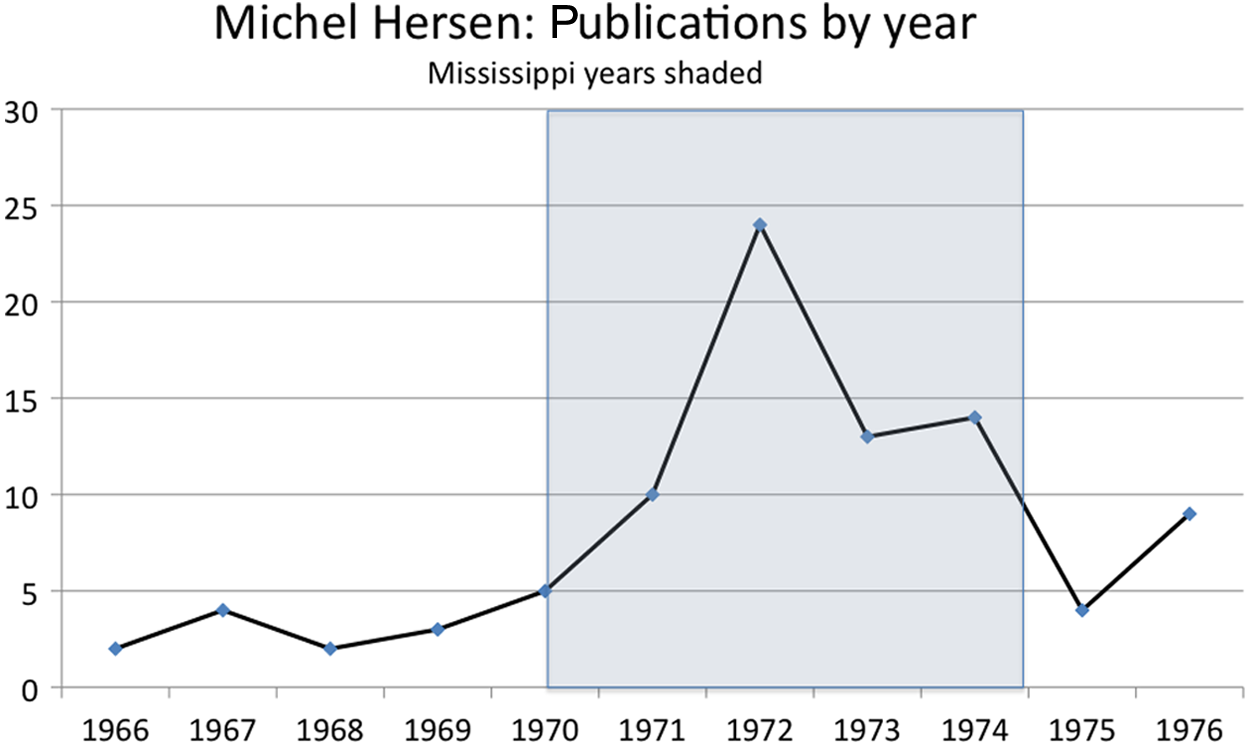
Publications by Michel Hersen during his time at the Department of Psychiatry, University of Mississippi Medical Center
The department had an existing highly sophisticated audiovisual facility, which allowed for experimentation with the use of videotapes to teach medical students to recognize the objective behaviors associated with psychiatric diagnostic entities and to be tested on their knowledge and observation skills. Using this facility, Michel became interested in the use of video feedback in behavior therapy, in particular applying it in the context of marital counseling. In addition, he was one of the early developers of social skills training, leading to later applications in major depression.
In addition to enhancing the research endeavors of the department, the clinical and teaching programs needed reorganizing at the University Hospital and at the VA. Michel played an important role in developing the teaching program at the VA and in recruiting faculty psychologists, for example—Dick Eisler—to expand the teaching, clinical, and research activities at that institution. With these changes, the department became well known for its training activities, for the new role of psychologists within a Department of Psychiatry, and for research. Indeed, over the years, psychologists have become well integrated into most departments of psychiatry with therapeutic and research roles. For most of the faculty, these were very productive years. So how did it end?
One factor was that the changes in the department’s research and clinical activities had been very fast and had unsettled some of Jackson’s community psychiatrists. This inevitably led to questions being raised about the ethics of the use of behavior therapy rather than psychoanalytically oriented psychotherapy. However, the main reason involved the Jackson Mental Health Center. When St. Dominic’s Hospital, a Catholic institution, located near the University, applied for mental health funds under the Community Mental Health Services Act, an affiliation agreement had been drawn up between the University and St. Dominic’s. The purpose of the agreement was to allow the Department of Psychiatry access to St. Dominic’s for teaching purposes. However, in December 1971, the St. Dominic’s Board appointed a director of the Mental Health Center without consultation with the University Medical Center as required in the agreement. In a letter dated May 24, 1972, the director of the University Medical Center noted that the director of the Jackson Mental Health Center “did not possess the academic qualifications or training for appointment to the Medical School faculty.” In July 1972, the head of St. Dominic’s hospital wrote to the director of the University Medical Center canceling the agreement citing “basic differences in philosophy” between the two institutions. One of these philosophical differences was that the Department of Psychiatry espoused the use of behavior therapy, and it was this modality that was again the issue. It is interesting to note that the Mississippi Council on Human Relations (in a letter dated December 29, 1972) advised St. Dominic’s to separate the Jackson Mental Health Center from St. Dominic’s hospital, to appoint an independent Board of Directors with “at least one-third blacks” and “to integrate the staff of the Center.”
It is clear that there were a number of problematic issues concerning the affiliation agreement. This led to the issue becoming very heated and quite personal with much press coverage locally, nationally, and internationally. It became clear that I could no longer function well in that atmosphere, so I accepted a professorship at Stanford in 1973. In the following years, other faculty members left: Michel to the Department of Psychiatry at the University of Pittsburg where he continued his research, his leadership in training psychologists; David Barlow to Brown University where he established a new psychology training program and continued his research in anxiety disorders; and Peter Miller to head the weight control clinic at Hilton Head.
The cornerstones of Michel’s contributions to behavior therapy in particular and psychology in more general terms were laid down during his years in Mississippi. Two major contributions were his clinical research and editorial work. The importance of editing journals and book series is often overlooked. It is these endeavors that catalyze research through dissemination of information and also contribute to maintaining and enhancing the standards of research. Michel has been a major figure in this regard. Among other publications, he has edited Progress in Behavior Modification, Behavior Modification, Clinical Psychology Review, Journal of Anxiety Disorders, and Comprehensive Clinical Psychology. Moreover, he has edited these journals for many years, an example of the enormous energy and creativity that he contributes to the field in so many ways. In the last 15 years or so, while continuing all these editorial duties, his interests turned to academic administration and program development in psychology. For example, Michel was the founding dean of the College of Health Professions at Pacific University Oregon, and has been dean of the School of Professional Psychology at the same University for many years. Like many artists, he has been painting with a broader brush as his stellar career has matured.
Footnotes
Declaration of Conflicting Interests
The author(s) declared no potential conflicts of interest with respect to the research, authorship, and/or publication of this article.
Funding
The author(s) received no financial support for the research, authorship, and/or publication of this article.