



Abstract
The present study sought to evaluate the efficacy of group contingency procedures via meta-analysis. A total of 182 studies published between 1980 and 2010 were identified via PsychInfo that included group contingency as a keyword. Studies that met inclusion criteria (e.g., single-subject design, school-aged children; N = 50), were coded and effect sizes were calculated. Results strongly support the efficacy of group contingencies with an overall effect size of 3.41. Types of group contingencies were also evaluated for dependent group contingencies (ES = 3.75, n = 11), independent group contingencies (ES = 3.27, n = 8), and interdependent group contingencies (ES = 2.88, n = 35). These results clearly establish all varieties of group contingencies as efficacious for a wide range of target behaviors with school-aged children. Results are discussed with regard to practical implications.
Keywords
One class of interventions that have met with a high degree of success in stimulating behavior change with a wide range of populations is group contingencies. Group contingency interventions have been used successfully with both adults (e.g., Meredith, Grabinski, & Dallery, 2011) and children (e.g., Kamps et al., 2011); and with behaviors as diverse as cigarette smoking in adults (Meredith et al., 2011) to verbal interactions between severely withdrawn, autistic preschool children (Lefebvre & Strain, 1989). Group contingency systems have been documented to be cost-effective, time efficient, easily implemented, and highly acceptable to teachers and students (Heering & Wilder, 2006; Moore, Waguespack, Wickstrom, Witt, & Gaydos, 1994; Skinner, Skinner, & Burton, 2009). In spite of the documented success of group interventions as illustrated by individual studies, no comprehensive meta-analytic studies have been conducted on group contingencies. It is therefore the intent of this study to systematically examine the literature on group contingency interventions with children and adolescents via meta-analysis.
Group Contingencies
A group contingency is one in which a common consequence (usually a reward) is contingent upon the behavior of all or a select portion of a group of people (e.g., classroom; Litow & Pumroy, 1975). Litow and Pumroy classified group contingency systems into one of three categories: dependent, independent, and interdependent. Although all group contingency systems share a basis in operant conditioning principles and have been found to be effective, some significant differences exist between the three different types.
Dependent Group Contingencies
Litow and Pumroy (1975) defined a dependent group contingency system as one in which the performance of a selected group member or members determines the consequence for the remainder of the group members. In a dependent group contingency system, only the selected group member or members must meet criteria for the group to receive a consequence. The performance of non-selected group members is irrelevant in determining if the contingency was met. All group members, however, may receive a consequence based on the behavior of the select few. Although this intervention may not target the behavior of all individuals within a group, its use may be beneficial in decreasing externalizing behaviors or increasing prosocial behaviors in select individuals within a classroom or other group setting (Hansen & Lignugaris/Kraft, 2005).
Although a dependent group contingency system may be an effective behavior modification tool, some researchers have argued against its use. For example, Romeo (1998) noted that use of dependent group contingencies is inherently unfair to students and may create hostility within the classroom. He further stated that those students who are exhibiting the target behavior may in effect be punished, losing the opportunity for reinforcement, based upon the actions of others. In addition, target students may feel singled out, and perceive the reinforcement system as a punishment, rather than as an opportunity to assist themselves and their classmates in earning a reward. Finally, although they employ group consequences, dependent group contingencies are essentially designed to target the behavior of a select individual or subset of individuals. This design makes it impossible to simultaneously target the behavior of all the individuals within the group utilizing a dependent group contingency system.
Hansen and Lignugaris/Kraft (2005) provided a good example of the successful implementation of a dependent group contingency. They used a dependent group contingency system to increase positive and decrease negative verbal statements with nine male students with an emotional disturbance enrolled in a self-contained, special education classroom. The study consisted of four conditions: baseline, social skills training, dependent group contingency, and faded dependent group contingency. In the dependent group contingency condition, two students were selected randomly as the dependent peers for the day. If the target students met the criteria of four positive statements for the day, all students were given the opportunity to select a reward from a grab bag at the end of the day. Results indicated that social skills training had little effect on the rate of students’ negative or positive statements. When the dependent group contingency was implemented, however, the quality and quantity of positive statements improved for all students while the rate of negative statements decreased. When the group contingency was faded, level of both positive and negative interactions was maintained.
Independent Group Contingencies
Litow and Pumroy (1975) defined an independent group contingency system as one in which each individual within the group receives reinforcement based on his or her individual performance in satisfying the contingency set for the group. Similar to an individual contingency system, each individual receives a consequence based on his or her own performance. However, unlike an individual contingency system, the same target behaviors, contingencies, and reinforcers are applied across all group members, making an independent group contingency system more practical than individual contingencies for application within a group. Unlike dependent group contingencies, independent group contingencies can be used to target all of the individuals within a group, as opposed to a single individual or subset of individuals.
Despite the advantages noted above, independent group contingencies have several disadvantages when compared with dependent and interdependent group contingencies. Because reinforcement is determined based on individual performance rather than on some aspect of group performance, independent group contingencies fail to promote cooperation between group members (Swanson, 1985; Williamson, Williamson, Watkins, & Hughes, 1992). This is a notable drawback of utilizing individual contingency systems within a classroom, where promotion of cooperation and socialization may aid the development of social skills among students.
For example, Winn (2006) implemented an independent group contingency to investigate the effects of known and unknown criteria on journal writing performance in two fourth-grade classrooms. Each day, participants were provided a story starter and asked to write for 5 min. Participants were informed that they would be rewarded if they met a daily criterion for number of words written. During the known criterion condition, participants knew the reward criterion prior to the assignment. During the unknown criterion condition, participants were not informed of the criterion until after the journal writing activity was completed. Although no differences were observed between the known and unknown criterion conditions with both high and low performing students, both conditions increased the mean number of words written with an overall effect size of 2.23.
Interdependent Group Contingencies
The final type of group contingency system described by Litow and Pumroy (1975) is the interdependent group contingency. Interdependent group contingency systems combine several aspects of dependent and independent group contingency systems while eliminating some of the disadvantages associated with these systems. An interdependent group contingency system is established when the same response contingencies are in effect simultaneously for all group members but are applied to a level of group performance. In other words, interdependent group contingencies reinforce the entire class based on the class as a whole meeting a specified criterion (Litow & Pumroy, 1975). A cooperative group effort is required to meet the collective goal, with individual performance contributing to the achievement of the larger group performance goal.
Skinner, Cashwell, and Dunn (1996) discussed advantages of using interdependent group contingencies. Because delivery of consequences is based on group performance as a whole, the responsibility for meeting criterion is shared among all group members. Therefore, the likelihood of loss of reinforcement being associated with a single individual or subset of individuals is decreased. In addition, interdependent group contingency systems are capable of targeting all the individuals within the group, creating an efficient approach for impacting the behavior of all class members. Interdependent group contingencies may also have some potential disadvantages that have deterred their widespread use in the classroom setting. These difficulties include unequal reinforcer strength among group members and difficulties arising from unequal contributions of group members to the group goal (Litow & Pumroy, 1975; Skinner, Williams, & Neddenriep, 2004). Perhaps the largest drawback to utilizing interdependent group contingencies is one shared with dependent group contingency systems. As with dependent group contingency systems, those students who meet behavioral expectations may fail to obtain reinforcement based on the behavior of other group members. This may create the perception among well-behaved students that they are being unfairly punished for the failures of others.
A good example of the implementation of an interdependent group contingency can be found in Christ and Christ (2006). Using a digital scoreboard to mediate the implementation of the interdependent group contingency in three high school classrooms, Christ and Christ used a multiple baseline design in examining the effect of the intervention in reducing classroom disruptions. Results indicated the intervention “effectively and efficiently improved classroom behavior across three settings with minimal support from the consulting school psychologist” (Christ & Christ, 2006, p. 86; ES = 2.08).
Studies Comparing Type of Group Contingency
Three studies have compared the three types of group contingencies in discrete studies. Gresham and Gresham (1982) compared interdependent, dependent, and independent group contingency systems using a reversal design in controlling disruptive behavior of students with an Intellectual Disability in a self-contained class. Although all three systems reduced the rate of disruptive behavior in the classroom, interdependent and dependent were more effective than independent. Using an alternating treatment design, Theodore, Bray, and Kehle (2004) compared the effectiveness of independent, interdependent, and dependent group contingencies in reducing disruptive behavior in adolescent males with serious emotional disturbance. Results indicated that all three contingency systems were successful in reducing disruptive behavior (ES ≥ 1.6) with no clear superiority of any one system. Finally, Lynch, Theodore, Bray, and Kehle (2009) compared all three group contingency systems with six 10- to 11-year-old students in a self-contained class. Results indicated all three group contingencies improved homework completion for all participants, with the exception of one student in the dependent condition. To date, however, no meta-analysis has been conducted to compare the efficacy of independent, interdependent, and dependent group contingencies.
Modifications to Group Contingencies
In an attempt to minimize limitations and maximize the efficacy of group contingency systems, a number of researchers have made modifications. Campbell and Skinner (2004) combined explicit timing along with an interdependent group contingency to reduce class to class transition time in a sixth-grade classroom. As previously discussed, Christ and Christ (2006) used a digital scoreboard to facilitate the implementation of an interdependent group contingency system in reducing classroom disruptions. It is clear that modifications and additions may facilitate the implementation of group contingency systems but the magnitude of any effect these adjuncts may add is not clear.
Randomizing the type of reinforcer has been suggested as a technique to decrease the probability of reinforcer satiation. The potential effects of unequal reinforcer strength are also addressed using this technique, as class members remain unaware of which reinforcer they are receiving until after they have already met the required criteria. By randomizing the reinforcer, participants are effectively working toward the chance of receiving a preferred reinforcer, rather than the specific reinforcer itself. Interdependent group contingency systems employing randomized reinforcement have been applied to disruptive and inappropriate classroom behavior (Kelshaw-Levering, Sterling-Turner, Henry, & Skinner, 2000; Theodore, Bray, Kehle, & Jenson, 2001). The results of the studies by both Kelshaw-Levering et al. and Theodore et al. suggest that interdependent group contingencies with reinforcement randomization can be successful in decreasing inappropriate classroom behavior. However, Little, Akin-Little, and Newman-Eig (2010), in contrast to most prior research, found constant reinforcement to be more efficacious than varied reinforcement in increasing homework completion.
Group contingencies appear to be particularly helpful when there is a general problem in the classroom; be it in homework completion and accuracy, class work completion and accuracy, or a wide range of behavioral considerations. And, as Skinner and colleagues (2009) have pointed out, interdependent group-oriented contingencies can be layered on top of independent group-oriented contingencies, which allows the focus on the enhancement of specific students’ performance and learning to increase effectiveness. Overall, group contingency systems appear to have strong support in the literature. To date, however, no one has systematically evaluated group contingencies via meta-analysis. Therefore, the intent of the current study is to review, combine, and analyze empirical research on group contingencies over a three-decade period from 1980 to 2010.
Method
In an attempt to gather a fairly complete review of empirical literature on group contingency interventions, studies within a three-decade period of time from 1980 to 2010 were collected and evaluated. Several search methods were used to identify the final list of studies. The first step was to search two electronic databases (PsychInfo and ERIC) using combinations of the following search terms: group contingencies, group interventions, children, classroom, and school. In addition, to get as complete a selection as possible, Proquest Dissertation database was also searched using the same search terms. Dissertation studies that were also identified in the published literature were eliminated. Finally, ancestral searches on important review studies were then conducted to locate additional studies for possible inclusion in the study. This resulted in a list of 182 publications. We then performed a title and abstract analysis on these 182 studies to identify those studies that were intervention studies. Intervention studies were then reviewed for the following selection criteria: (a) empirical, (b) involved school-aged children and/or adolescents, (c) single-subject design (e.g., AB, ABAB, multiple baseline), and (d) enough data to calculate effect size (i.e., baseline mean and standard deviation, treatment mean). All identified studies were examined by the third author and either the first or second author. Any disagreement or uncertainty was discussed and agreement was reached as to inclusion in all cases. Out of the 182 studies, only 50 met final inclusion criteria. Of the excluded studies, the majority were excluded on the basis of failing to implement an intervention, because the sample consisted of adults, or the authors did not provide sufficient data for computing effect sizes.
Coding Scheme
Participants
Each study was coded for the number of participants, gender of participants, and whether the participants were categorized as regular education or special education. If the study compared various types of group contingencies, the information was compared for each intervention. When special education students were included, the exceptionality of the participants was recorded if provided.
Setting
Studies were coded as to whether they were conducted in a school, residential facility, or in another location.
Type of group contingency
The type of group contingency was coded as dependent, independent, or interdependent. The majority of studies self-identified the type of group contingency used. Some studies, usually from the beginning of the time period examined, identified the intervention as only a “Group Contingency.” Using the criteria identified by Litow and Pumroy (1975) and described earlier, these interventions were grouped into one of the three categories mentioned above. This determination was made via consultation of at least two of the coauthors. When a study involved more than one type of group contingency, an effect size was calculated individually for each type. No studies examined combined two or more types of group contingency in a single intervention phase.
Dependent variable
The specific dependent variable used was written out and later coded into one of seven categories. These were (a) academic performance, (b) behavior (positive), (c) behavior (negative), (d) homework, (e) noise level, (f) exercise, or (g) other. Academic performance was operationally defined as a quantitative measure of performance in an academic subject (e.g., oral reading fluency, spelling accuracy). Behavior (positive) was defined as any overt behavior for which the intent of the intervention was to increase its frequency (e.g., on-task behavior, prosocial behavior; Goldman, 2004). Behavior (negative) was defined as any overt behavior for which the intent of the intervention was to decrease its frequency (e.g., disruptive behavior, rule violation; Cihak, Kirk, & Boon, 2009). Homework was defined as involving a permanent product that was completed outside of regular class time. Both homework completion and accuracy were included in this category (e.g., Aloisio, 2007; Little et al., 2010). Noise level was defined as magnitude of sound, measured in decibels (e.g., Davey, Alexander, Edmonson, Stenhoff, & West, 2001). Exercise was defined as the percentage of time participating in exercise, number of exercises completed, or duration of time spent exercising (e.g., Allen & Iwata, 1980; Foote, 2010). Any study that did not fit into one of the above categories was coded as other.
Data Analytic Strategy
To provide a quantitative index of the magnitude of the effect produced by each intervention, we extracted baseline mean and standard deviation and treatment mean from tables or text. If only figures were provided without the reporting of these statistics, the study was eliminated from the analysis. All individual study statistics were then converted into effect size estimates. Specifically, to quantify the magnitude of the change in level of performance (effect size), we used a variation of Cohen’s (1988) d statistic as calculated by Busk and Serlin (1992) and recommended by Beeson and Robey (2006). Using this method, Effect Size equals the Treatment mean minus the Baseline mean divided by Baseline standard deviation. Although Cohen’s d is widely used and represents an improvement over using p values (Wilcox, 2006), there are some possible problems with its use. Wilcox (2006) noted that “arbitrarily small changes in the tail of a distribution can have a very large effect on the variance, which can in turn substantially alter Cohen’s d, resulting in large effects, from a graphical perspective, to be missed” (p. 355).
Results and Discussion
Results of the 50 studies are depicted in Table 1. As one can see, across the studies, a total of 3,222 participants (52% male, 48% female) were exposed to a group contingency intervention. Sample sizes range from 2 to 700 with a mean of 64.48 (SD = 148.65). The distribution was skewed with 78% (n = 39) of the studies having sample sizes (usually a classroom or portion of a classroom) of 30 or less. At the other extreme, there were 3 studies with a sample size greater than 400, which all involved cafeteria/lunchroom behavior (Fabiano et al., 2008, N = 700; LaRowe, Tucker, & McGuire, 1980, N = 487; McCurdy, Lannie, & Barnabas, 2009, N = 615). A school or classroom was the setting for all but two of the studies with one (Allen & Iwata, 1980) occurring in a residential facility for individuals with an intellectual disability and the other (Goldman, 2004) occurring in a residential treatment center for juvenile delinquents. Twenty-seven studies (54%) involved participants who were in regular education whereas 23 studies (46%) involved participants in special education. With regard to ages of participants, most of the studies involved elementary school-aged children (Grades K-6) roughly age 5 to 11 years (37 out of 50; 74%). The other studies involved preschoolers (n = 2, 4%), middle or high school students (n = 10, 20%), or adults with (age 20-56) an intellectual disability (n = 1, 2%).
Characteristics of Studies on Group Contingency Interventions From 1980 to 2010.
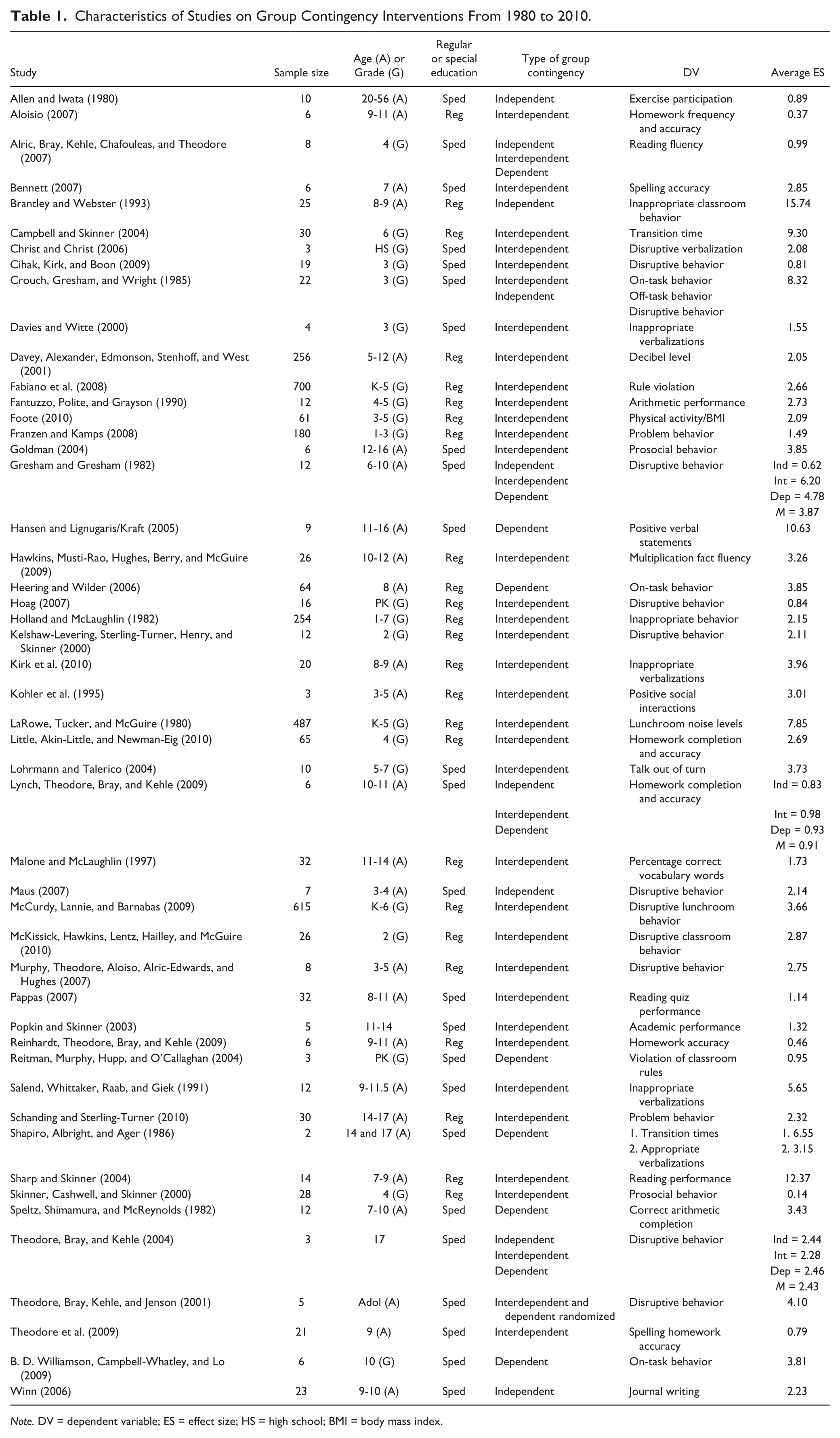
Note. DV = dependent variable; ES = effect size; HS = high school; BMI = body mass index.
Effect Size Results
Examination of the individual study effect sizes revealed that there was considerable variability across the studies (d [range: minimum = 0.14 and maximum = 15.74, SD = 3.16]) with an overall effect size of 3.41. Of the 50 studies coded, 10 had an effect size from 0 to 0.99; 5 between 1 and 1.99; 15 between 2 and 2.99; 11 between 3 and 3.99; and 1 each between 4 and 4.99, 5 and 5.99, 6 and 6.99, 7 and 7.77, 8 and 8.99, 10 and 10.99, 12 and 12.99, and 15 and 15.99. Caution is recommended in interpreting comparisons using the largest effect sizes. Scruggs and Mastropieri (1998) argued that when you have a d of greater than 2, differences between effect sizes become less meaningful. In general, the studies with the lowest effect sizes tended to have either ceiling effects (e.g., Aloisio, 2007) or a good deal of variability during baseline (e.g., Skinner, Cashwell, & Skinner, 2000). In contrast, the studies with the highest effect sizes tended to have floor effects during baseline, which resulted in a low baseline standard deviation and a large range for possible improvement. When evaluated by the type of group contingency administered, the largest effect size was found for dependent group contingencies (ES = 3.75, n = 11), independent group contingencies (ES = 3.27, n = 8), and interdependent group contingencies (ES = 2.88, n = 35).
When examined by dependent variable, the largest number of studies fell into the behavior–negative category (n = 22). This was followed by academic performance (n = 9), behavior–positive (n = 7), homework (n = 5), other (n = 3), and noise level and exercise (n = 2 each). The largest effect size was in the other category (ES = 6.03), followed by noise level (ES = 4.95), behavior–positive (ES = 4.06), behavior–negative (ES = 3.46), academic performance (ES = 3.31), exercise (ES = 1.49), and homework (ES = 1.04).
It is clear from these data that the efficacy of all three forms of group contingencies is supported. Although the study focused only on group contingency interventions with children, data included results from 50 studies across 30 years, with both exceptional and non-exceptional children in a variety of environments. The results do not, however, imply a rank order either between types of group contingency or behavior category.
Treatment Integrity
The vast majority of the studies (40 out of 50, 80%) reported data on the integrity of intervention implementation. Although some of these studies did not refer to the data as a measure of treatment integrity, from what we could discern, comparable data were collected. Of the 10 studies that failed to include a clear measure of treatment integrity, 8 of those were published in the 1980s before the reporting of such data became common. Without treatment integrity data, it is difficult to make decisions about the evidence-based status of group contingency interventions. As the majority of the studies reported in this meta-analysis included this measure, the confidence in the efficacy of group contingency interventions is strengthened.
Social Validity
Twenty-eight of the 50 studies (56%) reported assessing either or both child or teacher/adult acceptability of the intervention implemented. All of these studies reported relatively high levels of treatment acceptability indicating that consumers liked and/or were satisfied with the intervention (Kazdin, 2000; Lewis, Hudson, Richter, & Johnson, 2004). As with treatment integrity, more recent studies were more likely to include a measure of social validity.
The primary aim of this study was to conduct an evidence-based analysis of the literature on the efficacy of group contingency interventions. The results of this meta-analysis clearly support the efficacy of group contingency interventions in a variety of forms (i.e., dependent, independent, interdependent), behaviors, ages, and populations. Regardless of the type of group contingency employed (interdependent, independent, or dependent), a large effect size was observed. It should be noted, however, that 70% of the studies utilized an interdependent group contingency. Although the results would suggest that interdependent group contingencies may be less effective than either independent or dependent group contingencies, the larger N in the interdependent sample may have contributed to that outcome. In addition, when median effect sizes (instead of mean effect sizes) are examined, the ranking would be dependent (Med ES = 3.43), interdependent (Med ES = 2.28), and independent (Med ES = 1.63). The best conclusion that can be made is that group contingencies are an effective intervention with children, particularly in the classroom, for a wide variety of academic behaviors, problem behaviors, and prosocial behaviors.
Footnotes
Declaration of Conflicting Interests
The author(s) declared no potential conflicts of interest with respect to the research, authorship, and/or publication of this article.
Funding
The author(s) received no financial support for the research, authorship, and/or publication of this article.