



Abstract
A behavioral cusp has been defined as a behavior change that produces contact with new contingencies with important and far-reaching consequences. The concept of behavioral cusps has most frequently been used to select target skills taught to learners and to evaluate the importance of those skills; however, the concept is equally applicable to behavior changes that bring about important and far-reaching negative consequences. Although it has been acknowledged that socially undesirable behavior change can also qualify as a behavioral cusp, this area of the cusp concept has been under-examined. In this article, an undesirable behavior change, the acquisition of problem behavior in individuals with developmental disabilities, is compared with criteria for behavioral cusps previously identified in the literature. The advantages of viewing problem behavior as a behavioral cusp are outlined, and implications for practice and research from a behavioral cusp approach to problem behavior are provided.
In their seminal article introducing the concept of behavioral cusps, Rosales-Ruiz and Baer (1997) defined a behavioral cusp as “ . . . any behavior change that brings the organism’s behavior into contact with new contingencies that have even more far-reaching consequences” (p. 533). A behavioral cusp is a specific type of behavior change that causes an individual to experience new contingencies and environments which lead to further expansions in his or her behavioral repertoire. If these changes are considered important, the initial response may meet criteria for a behavioral cusp. An example of a behavioral cusp provided by Rosales-Ruiz and Baer is that of a baby learning to crawl. By learning this response, a child can now explore environments on his or her own, seek out and escape from family members, bump into things, find toys, and in general have a variety of novel experiences that will further shape behavior and development in important ways that would not have occurred had the child never learned to crawl.
Rosales-Ruiz and Baer (1997) raised the concept of behavioral cusps to explain aspects of human development from a behavior analytic perspective. As opposed to other fields of psychology in which human development is treated as a prescribed sequence of self-organizing behaviors, Rosales-Ruiz and Baer described how important behaviors considered developmental milestones are shaped over time through behavior–environment interactions. The most important of these behaviors are considered behavioral cusps because they make important future developments available for an individual. Specifically, behavior changes that are behavioral cusps bring the individual’s repertoire into contact with new environments, reinforcers, punishers, contingencies, responses, stimulus controls, or communities of maintaining or destructive contingencies. A cusp may result in only some or all of these new events, but the new events produced by a cusp must result in further expansions in the individual’s repertoire that are differentially maintained over past repertoires, such as learning to walk being maintained over the previous response of crawling. In addition, the new events and expansions in the individual’s repertoire must be considered important to the individual in question, people who hold important roles in his or her life, or society in general.
The behavioral cusp concept has most often been conceptualized as relevant to desirable changes in behavior and has been used to identify target skills for teaching. Along these lines, Bosch and Fuqua (2001) proposed a set of cusp criteria based on the previously discussed criteria described by Rosales-Ruiz and Baer (1997) for the a priori selection of target skills representing behavioral cusps to be taught to learners. To apply these criteria, one considers the broader impact of the target skill on the individual and important people in his or her life. These criteria are (a) access to new reinforcers, contingencies, or environments; (b) generativeness; (c) competition with inappropriate responses; (d) number and relative importance of people affected; and (e) social validity. The application of this set of criteria to potential behavior-change goals may allow one to select and prioritize the changes most likely to have the greatest impact on the learner’s development. Using these criteria, Smith, McDougall, and Edelen-Smith (2006) and Stokes, Cameron, Dorsey, and Fleming (2004) evaluated participant behavior change and determined that the skills participants learned were behavioral cusps. Smith et al. reported that improved table manners in a young woman with developmental disabilities (DD) allowed her previously isolated guardian grandparents to have friends over for dinner, meeting the criteria of number and importance of people affected. Stokes et al. found that teaching personal hygiene skills to a young man with DD led to him obtaining a higher paying job in a more inclusive work environment, meeting the criteria of accessing new reinforcers, contingencies, or environments. The behavioral cusp concept is similarly represented in Pivotal Response Treatment, in which children with autism spectrum disorder (ASD) are taught specific skills deemed pivotal because “they appear to result in widespread positive changes in a number of areas” (Koegel, Carter, & Koegel, 2003, p. 134). For example, Koegel et al. (2003) taught two children with ASD to use self-initiated queries, which was associated with concomitant increases in other types of question-asking, mean length of utterance, and verb acquisition, meeting the criteria of generativeness. Finally, both Rosales-Ruiz and Baer and Bosch and Fuqua indicated that a behavior change did not have to meet all criteria to be considered a cusp; however, the greater number of criteria met and the more profoundly criteria are met may differentiate more important cusps from less important cusps.
Although behavioral cusps have typically been discussed in terms of positive behavior changes, the concept is equally applicable to behavior changes that bring about important and far-reaching negative consequences. Rosales-Ruiz and Baer (1997) discussed potential negative cusps, stating,
Introducing a child to an addiction is an obvious example of a terrible cusp . . . teaching a child that the correct first response to any new problem is to seek help rather than to persist in independent tries is a more subtle example. (p. 536)
Although Rosales-Ruiz and Baer and others (Bosch & Hixson, 2004; Hixson, 2004) have acknowledged that socially undesirable behavior change can also qualify as a behavioral cusp, this area of the cusp concept has been under-examined. The purpose of this article is to present the acquisition of problem behavior in individuals with DD as a behavioral cusp and describe how it might be useful to conceptualize problem behavior in this way. First, problem behavior in individuals with DD is compared with the criteria for behavioral cusps proposed by Bosch and Fuqua (2001) and Rosales-Ruiz and Baer. Then, potential benefits to practice of viewing problem behavior as a behavioral cusp are outlined, and relevant research implications are discussed.
Access to New Reinforcers, Contingencies, or Environments
The first cusp criterion proposed by Bosch and Fuqua (2001) is access to new reinforcers, contingencies, or environments. As discussed by both Bosch and Fuqua and Rosales-Ruiz and Baer (1997), a primary feature of a cusp is that it produces access to new reinforcers or punishers, new contingencies, new environments, or new communities of maintaining or destructive contingencies. Although all operant behavior accesses reinforcement, what distinguishes a behavior change representing a cusp is that it produces access to new reinforcers, schedules, or contingencies of reinforcement that would not have occurred without the cusp and differentially maintain the cusp response over previous responses. Furthermore, the new contingencies maintaining the cusp response further shape behavior in far-reaching and important ways. Bosch and Fuqua presented this criterion as a way of targeting responses that will access new reinforcement and shape further development; however, this criterion may also be met inadvertently through the acquisition of problem behavior.
Difficult behavior such as aggression and self-injurious behavior (SIB) is frequently referred to as maladaptive due to both the immediate problems it poses for the individual and others, such as threats to safety and loss of instructional time, and the deleterious long-term consequences it may incur, such as decreased access to mainstream environments. However, from a behavior analytic perspective, it is understood that these behaviors are often demonstrated because they are in fact adaptive for an individual in his or her environmental circumstances (Carr & Durand, 1985; Iwata, Dorsey, Slifer, Bauman, & Richman, 1994). In a given context, problem behavior may serve one or more important social functions for a person with DD and be the most efficient method he or she has to obtain attention, preferred materials, or escape from aversive people or tasks (Hall & Oliver, 1992; Oliver & Head, 1990). For this reason, it is likely that once an individual with DD acquires socially maintained problem behavior, he or she gains access to new reinforcers, or a new schedule of reinforcement, that present a more favorable immediate situation for the individual (Oliver, Hall, & Murphy, 2005). For example, often the response that most effectively stops problem behavior in the short term reinforces it in the long term, such as providing reprimands for attention-maintained behavior or a break from a task for escape-maintained behavior (Hastings & Remington, 1994; Taylor & Carr, 1992). Because caregiver, teacher, and other stakeholder behavior may be negatively reinforced by the temporary cessation of problem behavior, these people may be likely to repeat these strategies that are actually reinforcing problem behavior (Hall & Oliver, 1992; Oliver & Head, 1990). Over time, these new contingencies may lead to the escalation of problem behavior (Guess & Carr, 1991). Therefore, the acquisition of problem behavior in individuals with DD is likely to alter the interactions they experience with others in the environment and introduce new, potentially mutually reinforcing contingencies as others try to stop, avoid, or prevent the occurrence of problem behavior through attention, physical intervention, tangibles, lessening of demands, and other activities that may inadvertently reinforce problem behavior (Oliver, 1995). Again, what makes the acquisition of problem behavior a cusp in this situation are the novel contingencies of reinforcement it produces, which maintain and further shape behavior in important ways that would not have happened if problem behavior had never developed.
In addition, the acquisition of problem behavior often results in new environments for a person with DD. As an immediate response to problem behavior, an individual may be removed to a secluded room and restrained or isolated—both responses that have been shown to inadvertently reinforce problem behavior in some individuals with DD. In the long term, individuals with DD and problem behavior are often excluded from mainstream educational, residential, and employment environments (Emerson, 1995). For example, individuals with DD and problem behavior are significantly more likely to be placed in self-contained educational (Parmenter, Einfeld, Tonge, & Dempster, 1998; Yianni-Coudurier et al., 2008) and restrictive residential (Allen, Lowe, Moore, & Brophy, 2007) settings than are those with DD alone. Furthermore, within restrictive residences individuals with DD and problem behavior may experience different social environments as they are more likely to receive low levels of positive attention and high levels of negative attention from staff (Grant & Moores, 1977), be restrained and medicated (Emerson, 1995), and be victims of abusive practices by staff (Maurice & Trudel, 1982; Rusch, Hall, & Griffin, 1986). Overall, the acquisition of problem behavior in some individuals with DD may produce access to new reinforcers, contingencies, and environments that may serve to further escalate problem behavior, resulting in highly important and far-reaching negative outcomes.
Generativeness
The second cusp criterion proposed by Bosch and Fuqua (2001) is generativeness. This criterion refers to the role of a behavior change in facilitating subsequent learning due to its being a prerequisite for, or a component of, more complex responses. In other words, does the behavior change produce collateral changes in behavior? And, does this behavior change allow for new important changes in behavior that would not have occurred without the initial cusp response (Rosales-Ruiz & Baer, 1997)? This criterion in particular relates to the positive cusps taught through Pivotal Response Treatment (Koegel et al., 2003), which are targeted specifically because they have been found to lead to collateral improvements in other important untargeted behaviors.
There is evidence that the acquisition of problem behavior may result in increases in important negative collateral behaviors as well. For an individual with DD who has learned to use problem behavior to access new reinforcers, the initially emerging topography rarely appears to be the only topography ever acquired; instead, over time he or she often learns other forms of problem behavior, likely shaped and selected because they are more efficient at obtaining social reinforcement (Guess & Carr, 1991). It is possible that minor forms of problem behavior (such as pushing) are often a prerequisite for, or a component of, more severe problem behavior (such as hitting). Indeed, Emerson and Robertson (1996) found that 10% of their participants with serious aggression evidenced only one form of aggression, whereas 82% showed three or more forms. Similarly, Emerson et al. (2001) found that most individuals with DD and severe problem behavior showed both aggression and SIB rather than demonstrating either aggression or SIB alone. Furthermore, a problem behavior topography that initially serves only one function, such as attention, may take on other functions over time, such as escape, thereby becoming multiply-maintained, more complex, and more difficult to treat (Lerman, Iwata, Smith, Zarcone, & Vollmer, 1994). In general, it appears that for some individuals with DD, acquiring an initial form of socially maintained problem behavior may lead to the emergence of new forms and functions later on, which are likely to include their own important social consequences. The development of further problem behavior topographies and functions that would not have occurred without the initial emergence of the first may be said to demonstrate generativeness or an increase in collateral behaviors stemming from the acquisition of a cusp.
Competition With Appropriate Responses
The third cusp criterion identified by Bosch and Fuqua (2001) is competition with inappropriate responses, in which the authors argued that a skill representing a cusp will compete with inappropriate responses and therefore have a broader impact on the individual’s repertoire. Although Rosales-Ruiz and Baer (1997) did not explicitly include this criterion in their discussion of cusps, it is in line with their requirements that cusps access new reinforcers that enable important or widespread future developments in behavior. An example of this criterion described by Bosch and Fuqua is that of teaching mands, or communicative requests for reinforcers, to access reinforcers previously accessed through problem behavior.
As the topic of discussion here is an undesirable cusp, this criterion may still be applied by changing competition with
Number and Importance of People Affected
The fourth cusp criterion as described by Bosch and Fuqua (2001) asks whether the behavior change benefits others, particularly those who control important reinforcers and punishers in the individual’s environment. The rationale for this criterion is that teaching an individual a response that will benefit important people in his or her life will positively impact a greater number of people than a response that does not benefit others and pave the way for further benefit for the individual through improved relations with the people who influence his or her future experiences. For example, a child who has learned to speak politely to adults may receive more instruction, praise, and rewards from teachers than one who has not, resulting in further learning in the future.
This criterion can be applied to the acquisition of problem behavior by asking not whether this behavior change benefits others but whether it impacts and affects important others, particularly those who control the individual’s reinforcers, and how many important others and to what degree. The acquisition of problem behavior in individuals with DD clearly affects both the individual and many important people in his or her life, such as parents, siblings, peers, teachers, and residential staff. As discussed, the person with DD who has problem behavior is at heightened risk of a number of poor outcomes, such as medical problems and exclusion from mainstream settings (Emerson, 1995). Parents attempting to manage both their child’s DD and problem behavior may also experience associated hardships, such as increased stress (Baker et al., 2003) and lower marital satisfaction (Brobst, Clopton, & Hendrick, 2009). Hastings (2007) found that behavior problems in children with DD also predicted sibling adjustment for more than 2 years, whereas typical peers have cited problem behavior as an obstacle in maintaining friendships with children with DD (Lee, Yoo, & Bak, 2003). Problem behavior has also been found to increase teacher stress (Lecavalier, Leone, & Wiltz, 2006) and alter teachers’ instructional practices (Carr et al., 1991). In residential staff members, problem behavior may increase staff stress, absenteeism, and turnover (Hastings, 2002) and lead to fewer positive staff interactions with consumers (Lawson & O’Brien, 1994). Because parents, siblings, peers, teachers, and residential staff are likely to control many reinforcers and punishers in the individual’s immediate environment, coercive interactions with these people due to problem behavior could contribute not only to hardships for others but also to poorer outcomes and quality of life for the individual with DD.
Social Validity
The fifth cusp criterion proposed by Bosch and Fuqua (2001) is social validity. Wolf introduced the concept of social validity in 1978 and described its importance in asking stakeholders as well as general members of society to evaluate the social significance of a program or intervention’s goals, the social appropriateness of its procedures, and the social importance of its effects. Rosales-Ruiz and Baer (1997) related the concept of social validity to behavioral cusps by emphasizing that a cusp must be important to the individual or people close to him or her, stating,
. . . the criteria for importance are usually situational. Most often they hinge on what the behavior changes are and on what their consequences are for that organism, not in their own right, but relative to what that organism wants, what its caretakers, advocates, and teachers want for it, and what a disinterested audience sees as significant for that organism, or for any organism in their society or species. (p. 537)
Bosch and Fuqua (2001) explicitly listed social validity as their final criterion for determining a cusp, stating that the behavior must have social validity “in that the response meets the demands of the social community of which the learner is a member” (p. 125). Furthermore, Bosch and Fuqua and Rosales-Ruiz and Baer argued that this criterion was most important of all and that if a response met other cusp criteria but did not have social validity, it was unlikely to be a cusp.
In terms of the acquisition of problem behavior, its social validity may most accurately be related to Rosales-Ruiz and Baer’s (1997) assertion that social importance of behavior change can be judged by what the individual, those close to him or her, and general members of society want for him or her or for humans in general and whether the acquisition of problem behavior and its consequences interferes with these wishes. In fact, there is a large body of evidence indicating that problem behavior in individuals with DD often interferes with such social goals. Specifically, the presence of problem behavior may interfere with learning adaptive skills (Carr et al., 1991) and living independently (Allen et al., 2007), accessing mainstream environments (Yianni-Coudurier et al., 2008), positive relationships with others (Hastings, 2002; Lee et al., 2003), good health (Emerson, 1995), and the happiness of families (Baker et al., 2003; Brobst et al., 2009; Hastings, 2007; Lecavalier et al., 2006). When problem behavior interferes with the social goals of an individual, his or her family, and other community members, its acquisition meets this most important criterion for behavioral cusps.
Illustration of the Acquisition of Problem Behavior as a Behavioral Cusp
Rosales-Ruiz and Baer (1997) used the image of tree branches to illustrate the cusp concept: “Perhaps more often (cusps) are like the branches of a tree: They stem from an earlier branch or trunk, and new branches may stem from them, where their structure in conjunction with the environment allows for that” (p. 541). Following this metaphor, the tree diagram in Figure 1 depicts the hypothetical acquisition of aggression in an individual with DD as a behavioral cusp and the far-reaching and important changes that may result in his or her behavioral repertoire and social experience. This illustration is not meant to comprehensively depict all cusps and responses acquired by the individual but to focus on cusps related to problem behavior and potential competing responses.
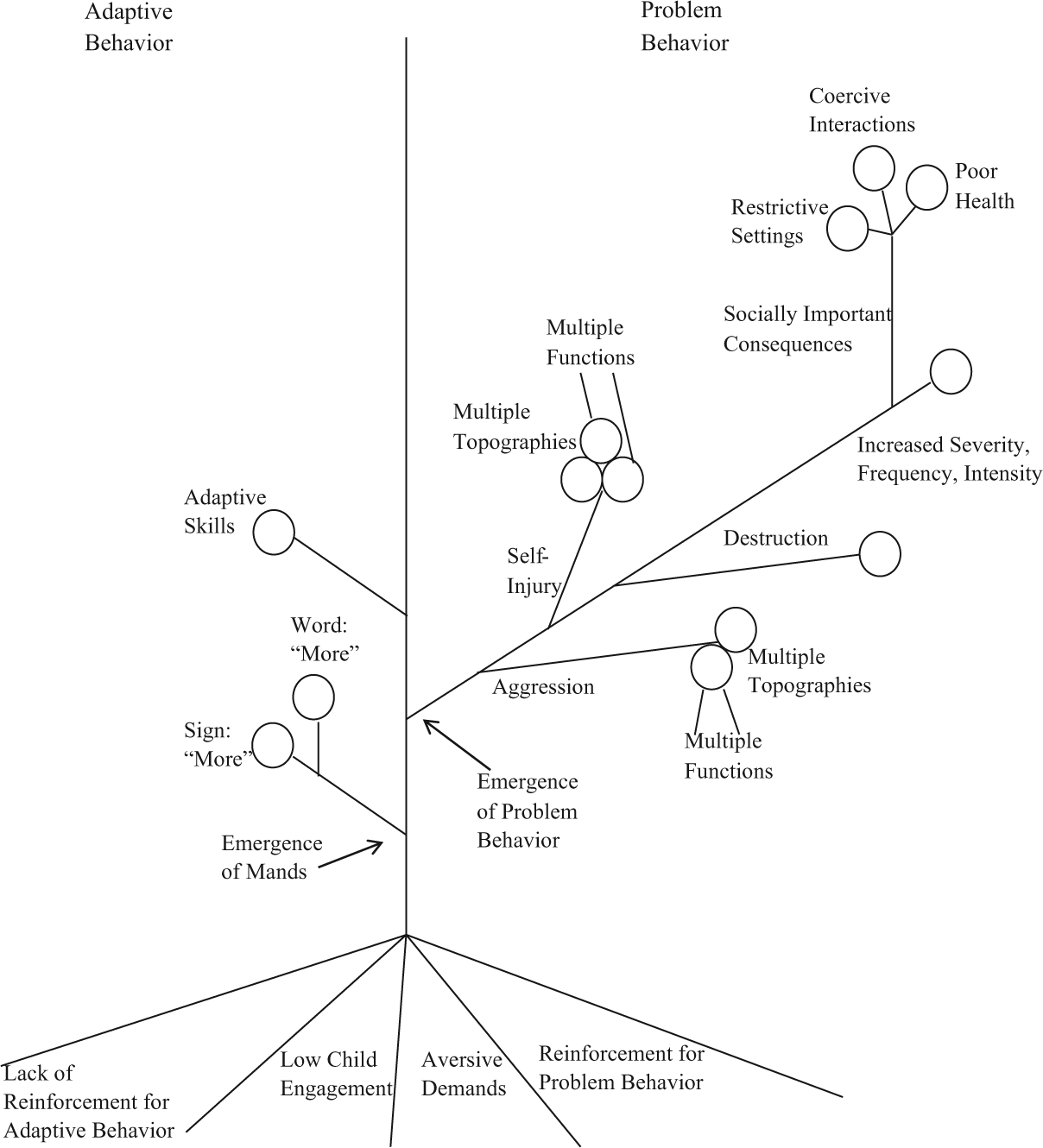
Hypothetical acquisition of aggression in an individual with developmental disabilities and the far-reaching and important changes that may result in his behavioral repertoire and social experience.
This tree illustration depicts the myriad ways in which the development of problem behavior meets cusp criteria. Using problem behavior allows the child to have frequent and consistent access to valuable reinforcers, triggers new contingencies, and results in changes to his educational and residential environments; his initial topography of problem behavior, hitting, soon “generates” further forms of aggression and SIB, multiple functions, and increased rates and intensities of problem behaviors; his use of problem behavior is so effective at producing reinforcement in his home and school environments that it actively competes with and becomes preferred over the more adaptive responses and cusps in his repertoire; parents, teachers, siblings, and peers are affected by his problem behavior in ways that increase the strain placed on these people; and finally his problem behavior has an enormous impact on his own experience and that of important people in his life, indicating its social validity.
Why Might It Be Useful to View Problem Behavior as a Behavioral Cusp?
Problem behavior may be considered a behavioral cusp in cases in which the acquisition of problem behavior contacts new reinforcers and environments that maintain its use over previous repertoires and shape behavior in further detrimental ways, triggering their own problematic consequences that would not have occurred had the individual never begun using problem behavior. Problem behavior is also likely to be a cusp when it competes with and becomes preferred over functionally equivalent adaptive responses and when the consequences and future behaviors it brings interfere with the goals of the individual with DD, his or her family, other important people who control many of his or her reinforcers, or society in general. Ultimately, for individuals for whom the acquisition of problem behavior is a cusp, this cusp brings danger to self and others; interferes with treatment, learning, and relationships; decreases access to mainstream environments; and, when left unsuccessfully treated, all of these factors interact to produce a worsening of quality of life over time for the individual with DD and important others. Although the development of problem behavior may not be a cusp for every individual with DD, its potential to meet these criteria and the grave consequences they bring suggest a cautious approach to problem behavior in which its acquisition should be considered a potential cusp for any individual with DD. Doing so possesses a number of benefits to practice. Specifically, viewing problem behavior in this way highlights the importance of (a) environments as behavioral traps for problem behavior, (b) prevention of problem behavior, (c) early intervention in the development of problem behavior, and (d) designing interventions that successfully compete with repertoires of problem behavior.
A Focus on the Environment as a Behavioral Trap
Rosales-Ruiz and Baer (1997) described how behavioral traps relate to behavioral cusps:
A behavioral trap is a community of reinforcement in the natural environment that could maintain and potentially shape much new behavior of its members. To the extent that these traps shape behavior beyond the entry responses, and to the extent that those behaviors are important to someone at some time, the entry responses are cusps. (p. 536)
In other words, hitting may be an entry response that could be shaped into more frequent and severe aggression if it occurs in an environment that is a behavioral trap for problem behavior. In such an environment, the emergence of hitting would be a cusp. In an environment that is not a behavioral trap for this response, hitting may emerge temporarily but eventually disappear because the response is not needed and not well-reinforced.
Some classrooms and homes may represent behavioral traps that increase the likelihood of the emergence and escalation of problem behavior. Classrooms and homes in which children are frequently unengaged in developmentally appropriate activities (Passey & Feldman, 2004), receive low levels of attention while engaged in appropriate behavior and high levels of attention during inappropriate behavior (Van Acker, Grant, & Henry, 1996), or are often made to engage in interactions and activities that are aversive to them may create establishing operations that increase the likelihood that problem behavior will emerge. If adults and other children in the environment are also likely to reinforce problem behavior, the home or classroom environment may represent a behavioral trap for problem behavior. For example, Van Acker et al. (1996) found that for students at high risk of developing aggression, appropriate behavior did not result in teacher praise at any more than chance levels, whereas students’ inappropriate behaviors were highly predictive of teacher reprimands. Further classroom studies have found that aggressive students were engaged in fewer instructional interactions with teachers than less aggressive students (Carr et al., 1991; Wehby, Symons, Canale, & Go, 1998), creating an environment in which teacher–student interaction rarely occurred other than in response to student problem behavior. Similarly, in a descriptive analysis of child–parent interactions at home, Passey and Feldman (2004) found that children with or at risk for developmental delay were most likely to engage in dangerous behavior when they were alone or not receiving attention and that dangerous problem behavior was most likely to be followed by parent attention or provision of tangibles, potentially strengthening child problem behavior. Rosales-Ruiz and Baer (1997) recommended a focus on identification and remediation of such behavioral trap environments, which might include increasing student engagement and teacher reinforcement of appropriate student behavior (Partin, Robertson, Maggin, Oliver, & Wehby, 2010) and decreasing reinforcement for problem behavior (Lalli, Browder, Mace, & Brown, 1993). These changes may lessen the environment’s ability to promote and trap problem behavior and decrease the likelihood that problem behavior will emerge as a behavioral cusp.
A Focus on Prevention
Clearly, the best approach to addressing an undesirable cusp would be preventing it from occurring in the first place. Because a behavioral cusp is a response that is particularly effective at accessing reinforcement and differentially maintained in its environment over previous functionally equivalent responses (Rosales-Ruiz & Baer, 1997), cusps may be especially difficult to disrupt once acquired (Hixson, 2004), making prevention less demanding and more effective than intervening upon already existing behavior. Indeed, although typical children often temporarily demonstrate problem behavior between the ages of 2 and 3, problem behavior in individuals with DD can be extremely persistent. For example, Emerson and Robertson (1996) found that 94% of 12-year-old children with severe aggression still had aggression after 3 years of treatment. Unfortunately, practice and research targeting the prevention of problem behavior are less common and cohesive than that targeting intervention once it has become well established in a person’s repertoire (Emerson, 1995). The lack of research in this area is likely due to the difficulties in researching prevention of undesirable behavioral cusps (Hixson, 2004; Rosales-Ruiz & Baer, 1997), which may require longitudinal methods without the opportunity for experimental control and observing a participant before and after the cusp develops. In addition, prospective research involving the development of problem behavior may present ethical issues, in which case retrospective studies with caregivers or teachers may be necessary to gain information on early development of problem behavior and guide prevention efforts. Unlike the development of antisocial behavior and delinquency in otherwise typical children, which has also been described as a behavioral cusp (Bosch & Hixson, 2004), there is little research into how problem behavior first emerges and develops in individuals with DD, making it difficult to know how best to prevent it (Richman & Lindauer, 2005). However, viewing problem behavior as a behavioral cusp and recognizing the profoundly damaging and persistent effects it can have highlight the need for more research and practice to be devoted to its prevention. Strategies to prevent problem behavior could include previously discussed changes to the environment to make it less likely to trap problem behavior, as well as training parents to use effective behavior management strategies and teaching individuals with DD competing communicative and adaptive responses before problem behavior develops (Reeve & Carr, 2000).
A Focus on Early Intervention
Conceptualizing problem behavior as a behavioral cusp emphasizes the need for urgency in the early identification and intervention in problem behavior for people with DD. Because many typical children may temporarily exhibit problem behavior in early childhood, some parents and teachers may not initially see problem behavior in young children with DD as a major cause for concern. On the contrary, some caregivers may be less alarmed by problem behavior in children with DD than by problem behavior in typical children, as it may seem only natural for a child with a disability to engage in difficult behavior. Unfortunately, problem behavior in children with DD is far less transient than in typical children (Baker et al., 2003) and more likely to result in poor outcomes (Emerson, 1995). Viewing the emergence of problem behavior as a cusp for individuals with DD emphasizes its seriousness and potential to negatively affect life outcomes and places greater importance on early intervention in emerging problem behavior. One particular advantage of focusing on the acquisition of problem behavior as a cusp is that the emergence of problem behavior is a noticeable behavior that is readily recognizable to almost any practitioner. When this cusp emerges, practitioners aware of its potential for far-reaching negative consequences can raise the alarm that interventions need to be focused on a particular student.
Once the emergence of problem behavior has been identified, disrupting the contingencies surrounding problem behavior early, before it has become firmly established in the repertoire of a person with DD, may produce more effective long-term outcomes than waiting until the behavior has escalated and become a serious problem for others (Richman & Lindauer, 2005). In addition, research into problem behavior has found that topographies of problem behavior often exist in response class hierarchies in which milder problem behavior is engaged in prior to more severe problem behavior (Lalli, Mace, Wohn, & Livezey, 1995). Intervening early in the development of problem behavior may allow one to target minor problem behavior and prevent the acquisition of more severe forms. To illustrate, Reeve and Carr (2000) provided early intervention for children with disabilities engaging in minor problem behaviors by implementing functional communication training (FCT) to teach appropriate ways of accessing social reinforcers. Compared with a group of children with disabilities and minor problem behavior in a separate treatment group targeting expressive language skills, the FCT group’s problem behavior did not escalate over time. As in the area of prevention of problem behavior, there is relatively little research and practice pertaining to early intervention into recently emerged problem behavior in individuals with DD. Conceptualizing problem behavior as a behavioral cusp stresses the need for further work in this area.
A Focus on the Importance of Competition in Intervention
Choosing between alternative responses has been shown to operate in accordance with the matching law (Hernstein, 1970), in which an organism allocates responding in ways that match the dimensions of reinforcement and effort associated with each response. Therefore, two functionally equivalent alternative responses are often described as competing responses, where the response with the most favorable dimensions of reinforcement that requires the least effort is most likely to “win” or be engaged in by the organism to produce the relevant reinforcer. In an individual with DD and an advanced repertoire of problem behavior, such as the repertoire represented in the tree diagram in Figure 1, it is unlikely that teaching one replacement adaptive response, such as a functionally equivalent request or mand, will compete with the full problematic repertoire. To successfully compete with a behavioral cusp, interventions and the adaptive responses they produce may need to share many of the cusp’s features, such as affecting multiple important people in the individual’s life, targeting multiple responses, and contacting natural contingencies in the environment.
For example, for the individual in Figure 1, we have stated that the acquisition of problem behavior has provided the individual with high rates of reinforcement, taken multiple forms and functions, altered how others interact with him or her, decreased use of alternative communicative and adaptive behavior, and resulted in decreased access to mainstream environments. Viewing problem behavior as a behavioral cusp, and therefore as a powerful and persistent response that greatly impacts the individual’s social experience and the behavior of those around him or her, draws attention to its complexity and intractability and indicates the need for powerful, multicomponent interventions to compete with well-developed repertoires of problem behavior. Carr and Carlson (1993) provided such an intervention package involving FCT, choice making, schedule thinning, and high-probability requests to improve problem behavior and task completion by adolescents with DD in a community grocery store. Procedures were implemented by participants’ residential care staff, and both care staff and grocery store employees completed measures of social validity. At least 25 maintenance sessions were conducted per participant to examine durability of effects, which were successfully maintained by care staff without prompting or feedback. To truly compete with established repertoires of problem behavior, successful interventions may need to similarly target multiple responses, contact a variety of natural contingencies, and recruit many groups of people in their implementation and maintenance.
Conclusion
The concept of behavioral cusps introduced by Rosales-Ruiz and Baer (1997) has positively impacted instruction for individuals with DD, providing a model by which important target skills can be selected and their impact evaluated (Koegel et al., 2003; Smith et al., 2006; Stokes et al., 2004); however, its implications for problematic cusps have yet to be fully explored through research or practice. In this article, it is argued that the acquisition of problem behavior in individuals with DD should be considered a behavioral cusp and that doing so has important implications. A behavioral cusp approach to problem behavior highlights the intransigence and severity of these behaviors as well as the devastating impact they can have on individual and family outcomes and indicates the urgent need for more practice and research efforts to be devoted to the prevention and early disruption of problem behavior. A cusp approach directs prevention and early intervention strategies to be aimed at both skill building in individuals with DD and remediation of home and school environments likely to serve as behavioral traps for problem behavior. In the context of prevention, early intervention, and intervention into problem behavior, a cusp approach highlights the importance of competition between cusps of problem behavior and cusps of appropriate alternatives and demands that we develop alternatives that produce greater reinforcement, require less response effort, and contact more natural contingencies than problem behavior.
The ultimate implications of viewing problem behavior in individuals with DD as a cusp involve a shift in focus from discrete interventions aimed at decreasing established problem behavior topographies to a focus on multicomponent attempts to prevent and disrupt the early development of problem behavior with an emphasis on the contexts and environments in which problem behavior might emerge. Such an approach implies that the most effective time to engage in efforts to change problem behavior is before it actually begins and to avert the acquisition of this behavioral cusp whenever possible. There are likely many obstacles to such a shift, including the methodological constraints inherent in studying cusps that cannot be taught (Rosales-Ruiz & Baer, 1997), and establishing operations for practitioners and researchers (why intervene if nothing is wrong?). Regarding the first point, there are certainly a number of potential obstacles to conducting methodologically sound research on problem behavior as cusps, including the necessarily correlational and longitudinal nature of the research as well as the difficulties in identifying causal variables in preventive and multicomponent interventions. That said, Vollmer (2011) and others have described the difficulties involved in studying many socially significant behavior problems, particularly low-frequency/high-severity behavior problems, and firmly concluded that efforts should be made to not allow our methods to constrain our research questions. In other words, if prevention, emergence, and early intervention in problem behavior are the things that will be most useful to society for us to examine, then we should not avoid them but should try to find ways to study them effectively. Regarding the second point, there are models of preventive care in other fields (e.g., Cohen, Littenberg, Wetzel, & Neuhauser, 1982; Lyles, Crepaz, Herbst, & Kay, 2006), and perhaps they could serve as guides in building systems of motivation for engaging in practice and research that will help prevent the development of problem behavior and its consequences for individuals with DD even when signs of it are not yet present.
Footnotes
Acknowledgements
The author would like to thank Dr. Joseph Wehby for his helpful feedback on previous versions of this article.
Declaration of Conflicting Interests
The author(s) declared no potential conflicts of interest with respect to the research, authorship, and/or publication of this article.
Funding
The author(s) disclosed receipt of the following financial support for the research, authorship, and/or publication of this article: Preparation of this manuscript was funded in part by the Office of Special Education Programs Leadership Training Grants (H325D020022; H325D070083). The opinions expressed in this article are those of the author and do not necessarily reflect those of the funding agency.