




Abstract
Risky sexual behavior among adolescents is common and results in many negative consequences. The present study investigated longitudinal predictors of adolescents’ likelihood of engaging in unprotected sexual intercourse. Parental knowledge, or the extent to which parents know about their children’s activities, whereabouts, and friendships, is a robust predictor of youth risk behavior, including risky sexual behavior. However, parenting practices are typically less potent as predictors of subsequent behavior among youth with high levels of callous-unemotional (CU) traits. We conducted three logistic regression models, each of which examined parental knowledge in a different way (through child report, parent report, and a discrepancy score), allowing us to examine parental knowledge, CU traits, and their interaction as predictors of adolescents’ subsequent engagement in sex without a condom. Results indicated that adolescents who perceived their parents to possess greater knowledge were less likely to engage in unprotected sex. Higher parent report of parental knowledge was also related to decreased likelihood of engaging in unprotected sex, but only for adolescents with high levels of CU traits. In addition, greater discrepancy between parent and adolescent reports of parental knowledge was related to increased likelihood of engaging in unprotected sex, but only for adolescents with low levels of CU traits. Results highlight the importance of considering both parent and adolescent perceptions of parental knowledge and have important implications for prevention and intervention efforts.
Adolescence is an important developmental period marked by many significant changes, often including the initiation of sexual activity. Data from several longitudinal studies suggest that while approximately 6% of U.S. youth have had sex prior to beginning high school (measured at age 13), approximately 47% of all high school students report engaging in sexual activity, indicating that the initiation of sexual activity occurs for many youth during the high school years (Centers for Disease Control and Prevention [CDC], 2013). For some, adolescence is also associated with risky sexual behavior, often operationalized in research studies as a greater number of sexual partners or condom non-use during intercourse (Schuster, Mermelstein, & Wakschlag, 2013). Indeed, teenagers are more likely than other groups to engage in sex without a condom (CDC, 2013). Among adolescents, predictors of engaging in sex without a condom include low condom use self-efficacy, a lack of condom use goals, and alcohol use, among others (Black, Sun, Rohrbach, & Sussman, 2011; Haley, Puskar, Terhorst, Terry, & Charron-Prochownik, 2013; Khan, Berger, Wells, & Cleland, 2012). Although rates of unprotected sex have been declining in recent decades, the percentage of high school students who engage in sex without a condom is still high, with estimates as high as 41% of sexually active teenagers reporting that they did not use a condom the last time they had sex (CDC, 2013).
Given the frequency of unprotected sexual intercourse, rates of sexually transmitted infections (STIs) are high among adolescents. Although estimates vary widely, the CDC (2013) reported that nearly 10,000 adolescents (ages 13-24) are diagnosed with an HIV infection, and nearly half of the 20 million new STIs each year are among young people ages 15 to 24. The lifetime cost of treating eight of the most common STIs contracted in just 1 year is US$16 billion, with STIs that require lifelong treatment and care (such as HIV) being the most costly (CDC, 2013).
In addition to being at risk of STIs, adolescents who engage in unprotected sex are more likely to experience unplanned pregnancies. Although rates of teenage pregnancies have been declining over recent decades, they are still relatively high (126.6 pregnancies per 1,000 for sexually active women between 15 and 19 years of age in 2010; Kost & Henshaw, 2014). Furthermore, adolescents ages 15 to 19 have the highest rates of unplanned pregnancies as compared with other age groups when these rates are calculated to only include sexually active people (Finer, 2010). In 2013, the abortion rate among women ages 15 to 19 in the United States was 14.7 abortions per 1,000 women (Kost & Henshaw, 2014), and approximately 273,000 babies were born to teenage girls ages 15 to 19 (CDC, 2013). Thus, risky sexual behavior among adolescents, such as engaging in unprotected sexual intercourse, can have serious negative consequences at the individual level and, more broadly, is a serious public health concern.
Parenting Behavior and Adolescent Risky Sexual Activity
The parenting context is a unique predictor of adolescent risk behavior and plays a key role in predicting risky sexual behavior among adolescents (see Kincaid, Jones, Sterrett, & McKee, 2012, for a review). Specifically, positive parenting behaviors, increased social and emotional support, and high parent–child relationship quality serve to protect youth from drug use and risky sexual activity, whereas poor parental monitoring, low supervision, and low parental knowledge are associated with higher rates of substance use, more externalizing behaviors, and risky sex among youth (e.g., Barnes, Reifman, Farrell, & Dintcheff, 2000; Ellickson, Perlman, & Klein, 2003; Kalina et al., 2013; Killoren & Deutsch, 2014; Kincaid et al., 2012; Li, Stanton, & Feigelman, 2000; Reynolds, MacPherson, Matusiewicz, Schreiber, & Lejuez, 2011; Wills, Resko, Ainette, & Mendoza, 2004). Reviews of the literature on parenting and risky sexual activity among adolescents have identified many parenting-related constructs that show consistent associations with youth sexual risk behavior (for such reviews, see Kincaid et al., 2012; Kotchick, Shaffer, Forehand, & Miller, 2001). One parenting construct that is an especially robust and often-studied predictor of youth risk behavior outcomes is parental knowledge, which can be characterized as the extent to which parents know about their children’s activities, whereabouts, and peer friendships (Reynolds et al., 2011; Stattin & Kerr, 2000; Tebes et al., 2011). Low levels of parental knowledge are generally associated with increased risky behaviors among youth, including risky sexual behavior (e.g., Sneed, Strachman, Nguyen, & Morisky, 2009).
The effect of parental knowledge on youth risk behavior is more nuanced, however, contingent on whether knowledge is assessed via parent versus child/adolescent perspectives (e.g., Cottrell et al., 2003). Indeed, parental knowledge has typically been measured both by parent and adolescent report, which serves to capture the unique individual perceptions of parental knowledge from each observer’s point of view. Findings suggest that, on average, adolescents report lower levels of parental knowledge than do their parents (Kerr, Stattin, & Burk, 2010). There is great value in these different perceptions of knowledge that are each uniquely related to adolescent outcomes and behavior. Often, parent and adolescent reports of parental knowledge (as well as related parenting constructs such as family functioning) differ significantly, and larger discrepancies between parent and adolescent report are associated with increased risk-taking behavior among youth, including drug use and risky sexual behavior (Cordova, Huang, Lally, Estrada, & Prado, 2014; Reynolds et al., 2011). Notably, the significant differences in parent versus adolescent report are not seen as poor measurement or error in reporting, but rather capture meaningful information about the parenting construct from both perspectives and may also indirectly reflect information about the parent–adolescent relationship and parental involvement (Reynolds et al., 2011). Thus, there is important predictive utility in incorporating both reports separately (parent and adolescent), as well as the discrepancy between parent and adolescent scores, in predicting youth outcomes and risk behaviors.
Callous-Unemotional (CU) Traits and Adolescent Risky Sexual Activity
In addition to parental knowledge and discrepant parent–child views about parental knowledge, temperamental characteristics of the child are important to consider as predictors of engagement in risky behavior. Children with a callous and unemotional interpersonal style or elevated levels of CU traits (i.e., callous use of others, absence of empathy or guilt, constricted emotions) have been identified as an important subgroup of children who over time are more likely to display a chronic pattern of antisocial and delinquent behavior in adolescence (Frick, Blair, & Castellanos, 2013; Frick, Cornell, Barry, Bodin, & Dane, 2003; Frick, Ray, Thornton, & Kahn, 2014; Frick, Stickle, Dandreaux, Farrell, & Kimonis, 2005; Frick & White, 2008; Loney, Taylor, Butler, & Iacono, 2007). In addition to antisocial behavior, CU traits are also associated with substance-related delinquency (Taylor & Lang, 2006) as well as aggression and violent sexual offending (Caputo, Frick, & Brodsky, 1999; Frick & White, 2008). Children with elevated CU traits also show a greater sensitivity to rewards than punishments (O’Brien & Frick, 1996), prefer thrill-seeking activities (Frick, O’Brien, Wootton, & McBurnett, 1994), and show less anxiety related to their own behavioral difficulties than their peers (Frick, Lilienfeld, Ellis, Loney, & Silverthorn, 1999; see Frick & White, 2008, for a review). Importantly, research has also supported that CU traits are relatively stable across childhood and adolescence (Frick & White, 2008; Muñoz & Frick, 2007).
Callous and unemotional traits are also often found to moderate the effects of parenting (both adaptive and maladaptive parenting behaviors) on various delinquent behavior outcomes, and children high in CU traits seem to be less amenable to behavioral or parenting interventions than their peers. For example, in a study on the relationship between parenting and conduct problems among children, Wootton, Frick, Shelton, and Silverthorn (1997) found that among children without significant levels of CU traits, less effective parenting (including low levels of parental involvement and positive reinforcement, and high levels of inconsistent discipline, poor monitoring, and corporal punishment) was associated with greater conduct problems, whereas these youth were less likely to exhibit conduct problems if their parents did not display negative parenting behaviors. However, regardless of the quality of parenting, children with high levels of CU traits displayed high rates of conduct problems. In a partial replication and extension of this study, Oxford, Cavell, and Hughes (2003) found that ineffective parenting was unrelated to problem behavior in children with relatively high scores on a continuous measure of CU traits. Similarly, in a juvenile offender sample, inconsistent and harsh discipline from parents predicted antisocial behavior among adolescents, but only among those with low levels of CU traits (Edens, Skopp, & Cahill, 2008). Elevated CU traits among children are also associated with poorer post-treatment outcomes following parent training interventions for conduct problems (Hawes & Dadds, 2005).
Despite a wealth of research supporting the relation between CU traits and conduct problems, less research has examined relations between CU traits and engagement in risky sex. In one study which evaluated the main effect of CU traits on adolescent risky sexual behavior, Ručević (2010) found a small but significant positive relationship between CU traits and risky sexual behavior (measured as the frequency with which adolescents reported engaging in behaviors such as having a one-night stand, maintaining more than one sexual relationship at a time, providing sexual favors for money or drugs, etc.) for both girls and boys in a community sample. However, the majority of the research examining CU traits and sexual behavior among adolescents has been conducted with adolescent sex offenders, rather than with community samples (e.g., Lawing, Frick, & Cruise, 2010; White, Cruise, & Frick, 2009). Furthermore, while several research studies have found that parenting practices are a more robust predictor of child and adolescent conduct problems for those low in CU traits as compared with those with elevated CU traits, CU traits have not yet been examined as a moderator of the relation between parental knowledge and adolescent risky sexual behavior.
The Current Study
The aim of the current study was to use a longitudinal design to examine whether adolescent CU traits moderated the effect of parental knowledge on the likelihood of adolescents engaging in sexual intercourse without a condom. Consistent with findings from previous research studies which have found that parenting is a more robust predictor of conduct problems among children and adolescents with low CU traits than those with high CU traits, we hypothesized that adolescent CU traits would moderate the relationship between parental knowledge and adolescents’ likelihood of engaging in unprotected sexual intercourse. Specifically, we hypothesized that the protective effect of parental knowledge on risky sexual behavior would be greater for those adolescents with lower levels of CU traits, whereas parenting would not affect risky sexual behavior among youth with high CU traits. In addition, given the importance of both parent and child reports of parental knowledge in predicting adolescent behavior, as well as the meaningful information captured in the discrepancies between these reports (e.g., Cordova et al., 2014; Cottrell et al., 2003; Reynolds et al., 2011), a second aim of this study was to examine these hypothesized conditional effects using adolescent-reported parental knowledge, parent-reported parental knowledge, and informant discrepancy scores as predictors.
Method
Participants and Procedures
Participants in the current study include a subset from a larger sample of children and their caregivers (88% mothers and 12% fathers in the original sample of N = 277 youth), who were initially recruited from a metropolitan area as part of an ongoing longitudinal study examining the development of adolescent risk behaviors. Families were recruited through media outreach and through postings and fliers at community centers, area schools, libraries, and Boys and Girls clubs. Interested families were screened for proficiency in English and their ability to take part in annual assessments. All caregivers provided written informed consent to participate in the study, and their children provided assent. Adolescents and caregivers completed annual assessments at the university campus and completed computerized questionnaires in separate, private participant rooms. Study procedures were approved by the university Institutional Review Board.
Participants were included in the current set of analyses if they completed all annual assessments at Years 2, 5, and 6 of the ongoing longitudinal study. These specific waves of data were included because CU traits were only assessed at Year 2, and we included the assessment of risky sexual behavior later in adolescence (Year 6) to maximize variability in our outcome of interest (i.e., risky sexual behavior). We included parental knowledge at Year 5 to predict risky sexual behavior prospectively 1 year later. In addition, because significantly more mothers than fathers participated in the study, we only included maternal reports to minimize potential confounds. One hundred thirty-five adolescents (43% female) and their mothers completed all the measures required for the current analyses and thus comprise our final sample. At Year 2 (baseline year), participants were 12.05 years old on average (SD = 0.94, range = 10-14), and at Year 6 (final year), participants were 16.04 years old on average (SD = 0.92, range = 14-18). Fifty-two percent of the children in our sample identified as White, 34% as Black, 4% as Hispanic/Latino, and 10% as “Other.”
Measures
Demographic variables
At the baseline assessment, caregivers reported on adolescent demographic information, including adolescent age, gender, and race/ethnicity.
Inventory of CU Traits—Youth self-report
At Year 2, adolescents completed the Inventory of Callous and Unemotional Traits (ICU; Frick, 2004), which is a 24-item self-report assessment of callous-unemotional (CU) traits in youth. For each item, participants rated how well a statement describes them from 0 = not at all true to 3 = definitely true. Total scores were obtained by summing all ICU items. Example items from the ICU include, “I feel bad or guilty when I do something wrong” (reverse coded), “The feelings of others are unimportant to me,” and “I hide my feelings from others.” The ICU has three factors (Uncaring, Callousness, and Unemotional), which all load onto one higher-order CU factor (Essau, Sasagawa, & Frick, 2006). Total scores on the ICU have been shown to be related to antisocial behavior, aggression, and delinquency (Kimonis et al., 2008). The ICU showed acceptable internal consistency in the current sample (α = .78).
Parental Monitoring Scale (PMS)
At Year 5, parents and adolescents both completed the PMS (Stattin & Kerr, 2000). “Parental monitoring” was initially the accepted phrase for the construct assessed by the PMS; however, the authors of the measure report that unless active monitoring on the part of the parents (e.g., active tracking of adolescent behavior and whereabouts) is measured in addition to parental knowledge, the construct of “parental knowledge” is in fact the most appropriate terminology (Stattin & Kerr, 2000). Thus, the current study refers to the PMS as a measure of parental knowledge.
The PMS includes both a parent- and child-report version, in which parents are asked to report on their knowledge of their child’s activities, whereabouts, and peer friendships, and children report on their perception of what their parents know in the same content areas. We used a shortened version of Stattin and Kerr’s (2000) measure, comprised of five selected items, which were chosen based on previous studies, which have utilized a set of similar items considered to be most relevant for adolescents and which are associated with adolescent risk behavior (e.g., Barber, 1996; Brown, Mounts, Lamborn, & Steinberg, 1993; Jacobson & Crockett, 2000; Roche & Leventhal, 2009; Wang, Simons-Morton, Farhart, & Luk, 2009). The five PMS items utilized in the current study are identical to those used in past research by Reynolds and colleagues (2011). Mothers and adolescents completed the PMS separately and were asked to rate each item according to the extent to which it accurately described their experience. Responses were reported using a 5-point Likert-type scale (0 = never, 4 = always). Responses were summed to create a total parental knowledge score both for parent report and for child report. Sample items for the child measure include, “Do your parent(s) know what you do during your free time?” and “Do your parent(s) know who you have as friends during your free time?” Mothers answered the same questions, with appropriate changes to the wording (e.g., “Do you know what your child does during his or her free time?”). Internal consistencies for the current sample were acceptable to good for both parent report (α = .77) and adolescent report (α = .83).
Total scores for both parent report and adolescent report on the PMS were utilized in analyses. In addition, to examine the discrepancy between parent and adolescent reports of parental knowledge, we created a standardized difference score (SDS) based on the methods of De Los Reyes and Kazdin (2004). To create the SDS, each adolescent- and parent-rating of parental knowledge at Year 5 was converted into a z score, and the adolescent’s z score was subtracted from the parent’s z score. As described by De Los Reyes and Kazdin (2004), advantages of the SDS (i.e., the difference between one reporter’s standardized rating and another reporter’s standardized rating) include that it correlates equally with each individual informant’s ratings, yet it is statistically distinguishable from the original informant’s ratings, which are used to create it.
Youth Risk Behavior Survey (YRBS)
Unprotected sexual intercourse was measured at Year 6 using an item from the YRBS (CDC, 2001) that assessed how often the youth had engaged in unprotected sex in the last year. Youth were asked, “In the past year, how many times have you had intercourse with no condom?” and were instructed to choose between the following responses: zero, once, a few times, 1 to 3 times per month, 1 to 3 times per week, and almost every day or more. At Year 6 (Mage = 16.05 years, SD = .92), 15.6% of participants reported that they had engaged in sex without a condom in the past year, and 84.4% of participants reported that they had not. Examination of the distribution of scores indicated that the variability was quite low, and this item was essentially performing more like a dichotomous variable in our sample. Therefore, responses for this item were dichotomized into either 0 = no unprotected sex in the past year or 1 = yes unprotected sex in the past year. Of note, 32.8% of our sample reported engaging in sexual intercourse over the past year, and 67.2% reported no sexual intercourse over the past year. The YRBS has been used widely in research to capture a range of risky behaviors among youth and has demonstrated good validity and test–retest reliability (for a summary of methodological studies conducted to date on the YRBS, see Brener et al., 2013).
Data Analytic Plan
The goal of the analyses in the present study was to examine the effect of parental knowledge on adolescents’ likelihood of engaging in sexual intercourse without a condom and to assess the extent to which the effect of parental knowledge on risky sexual behavior was moderated by adolescent CU traits. To test our hypotheses, we conducted three different logistic regression models to incorporate multiple informants’ perspectives as well as the discrepancy between these reports. Thus, measurement of parental knowledge varied across each regression model, with Model 1 examining the effect of adolescent-reported parental knowledge (controlling for parent-reported parental knowledge), Model 2 examining the effect of parent-reported parental knowledge (controlling for adolescent-reported parental knowledge), and Model 3 examining the effect of parent–adolescent reporter discrepancies by using an SDS (De Los Reyes & Kazdin, 2004) between parent and adolescent reports. The consideration of parent and adolescent perspectives as well as discrepancies allows for a more comprehensive picture than would be provided by individual reports alone. In all three models, study variables were entered hierarchically, with covariates entered in Step 1, the predictor and moderator entered in Step 2, and the interaction term entered in Step 3. All estimates presented are from the final complete model, with all predictors entered simultaneously.
The MODPROBE Macro Version 2.0 (Hayes, 2015) for SPSS Version 22 (IBM, 2013) was used to conduct all logistic regression analyses. MODPROBE is an aid for estimating and probing two-way interactions in logistic regression models (Hayes & Matthes, 2009). This Macro estimates unstandardized model coefficients and standard errors for all model variables, including the primary predictor variable, the moderating variable, and covariates. It also produces tests of the conditional effect of the primary predictor variable on the dependent variable at different conditional values of the moderating variable, and can estimate regions of significance for the effect of the primary predictor variable on the outcome variable as a function of the moderating variable by using the Johnson–Neyman technique (Hayes & Matthes, 2009; Johnson & Fay, 1950). Logistic regression was used for all three models, with whether the adolescent reported engaging in sexual intercourse without a condom in the past year as the dependent variable. In all three models, parental knowledge (as captured by adolescent report, parent report, or the SDS) was the primary predictor variable and CU traits was the moderating variable. Predictor and moderator variables were mean-centered to ease with interpretation and probing of interactions. In the case of significant interaction effects, we used the Johnson–Neyman technique in the MODPROBE Macro to estimate the region of significance for the effect and to plot the results along conditional values of the moderator.
Results
Preliminary Analyses
Means, standard deviations, and correlations between all continuous study variables are presented in Table 1. Of note, the correlation between adolescent and parent report of parental knowledge on the PMS was statistically significant, but small (per effect size conventions; Cohen, 1988), indicating that parents and their children had notable differences in their perceptions of parental knowledge. This is consistent with previous studies that have found that parent and child reports of knowledge are often discrepant, and that the child often perceives the parent to have less knowledge than the parent reports having (Cottrell et al., 2003; Kerr et al., 2010; Yu et al., 2006). In addition, preliminary results showed that adolescents who reported higher levels of CU traits on the ICU reported that their parents had less parental knowledge, as did their parents. Adolescent report of parental knowledge was negatively correlated with adolescent age.
Correlations, Means, and Standard Deviations of Study Variables.

Note. PMS = Parental Monitoring Scale; SDS = Standardized Difference Score; ICU = Inventory of Callous-Unemotional Traits.
p < .05. **p < .01.
To examine associations between predictor variables and risky sexual behavior, we ran three independent means t tests to determine whether mother-reported parental knowledge scores, adolescent-reported parental knowledge scores, and ICU scores were significantly different for those adolescents who did not engage in unprotected sex and those who did. There were no significant differences across groups on mother-reported parental knowledge, t(133) = 1.65, p = .10. However, there were significant differences across groups on adolescent-reported parental knowledge, t(133) = 2.96, p = .004, and CU traits, t(133) = −2.02, p = .046, in the expected directions based on the extant literature. Specifically, adolescents who did not engage in unprotected sex reported more parental knowledge (M = 14.37, SD = 3.58) than those who did (M = 11.81, SD = 4.06). Adolescents who did not engage in unprotected sex also had lower levels of CU traits (M = 21.51, SD = 8.29) than those who did (M = 25.41, SD = 7.29).
Primary Analyses
Model 1: Effects of adolescent-reported parental knowledge and CU traits
The first logistic regression model examined the effects of adolescent-reported parental knowledge and CU traits on adolescents’ likelihood of engaging in sex without a condom. Covariates included adolescent age, gender, and ethnicity, and we also controlled for the effect of parent-reported parental knowledge. Results for Model 1 are shown in Table 2. Results revealed a significant main effect of gender, such that girls reported more unprotected sex (B = −1.24, p = .02). There was also a significant main effect of adolescent-reported parental knowledge on likelihood of engaging in sex without a condom, such that adolescents who reported that their parents had greater parental knowledge were less likely to engage in sex without a condom in the following year (B = −0.17, p = .03). However, there were no significant effects of CU traits or the interaction between adolescent-reported parental knowledge and CU traits.
Summary of Logistic Regression Results From Model 1.
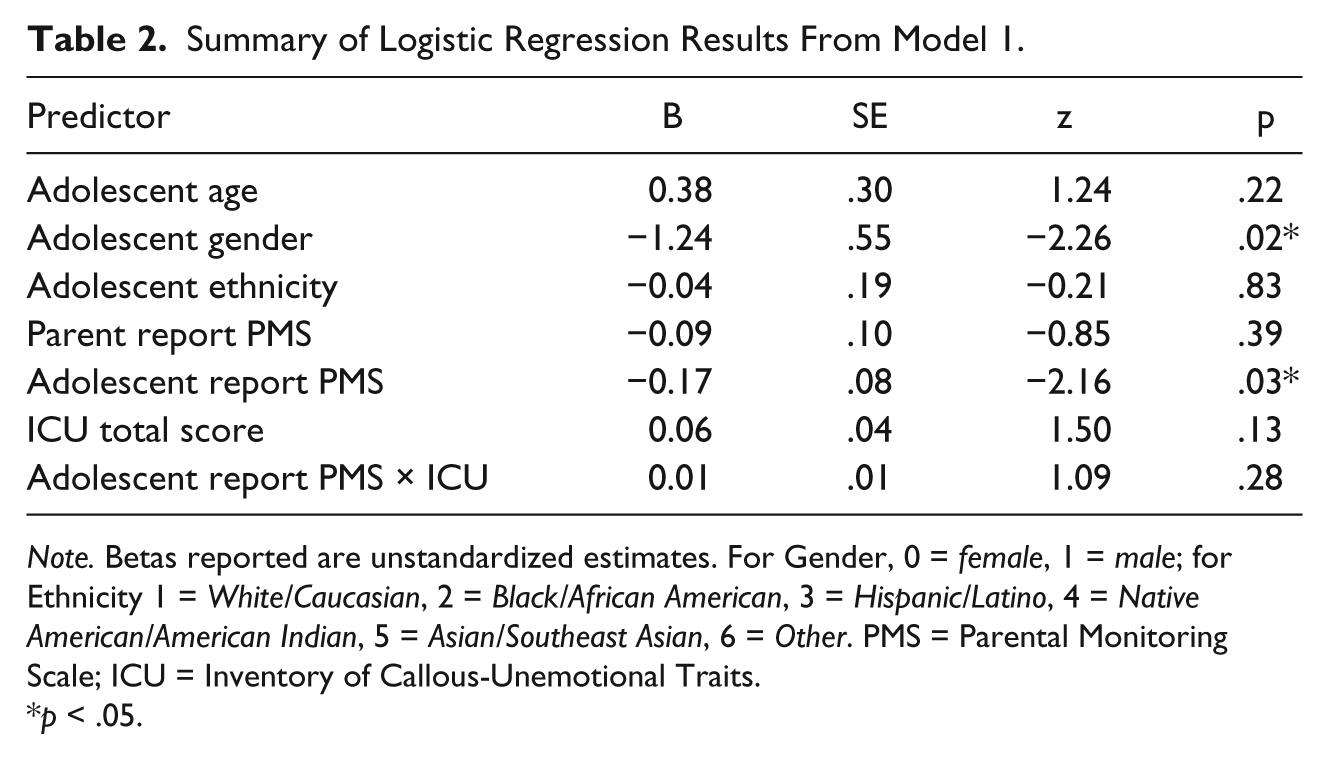
Note. Betas reported are unstandardized estimates. For Gender, 0 = female, 1 = male; for Ethnicity 1 = White/Caucasian, 2 = Black/African American, 3 = Hispanic/Latino, 4 = Native American/American Indian, 5 = Asian/Southeast Asian, 6 = Other. PMS = Parental Monitoring Scale; ICU = Inventory of Callous-Unemotional Traits.
p < .05.
Model 2: Effects of parent-reported parental knowledge and CU traits
The second logistic regression model examined the effects of parent-reported parental knowledge and CU traits on adolescents’ likelihood of engaging in sex without a condom. Covariates included adolescent age, gender, and ethnicity, and we also controlled for adolescent-reported parental knowledge. Results for Model 2 are shown in Table 3. We found a marginally significant main effect of gender, such that girls were more likely to report engaging in unprotected sex, which is consistent with results from Model 1 (B = −0.94, p = .09). Also consistent with Model 1, we found a marginally significant effect of adolescent-reported parental knowledge (B = −0.15, p = .05), such that adolescents who reported that their parents know more about their activities and peers were less likely to engage in sex without a condom. There was also a significant interaction between parent-reported parental knowledge and adolescents’ CU traits (B = −0.04, p = .04). This interaction is displayed graphically in Figure 1, with the y-axis representing estimated log odds of having sex without a condom. We probed this interaction utilizing the Johnson–Neyman technique to determine the region of significance for the effect of parenting on risky sex at various levels of CU traits. These analyses revealed that greater parent-reported parental knowledge was a significant predictor of lower likelihood of engaging in sex without a condom only for adolescents with ICU scores (mean-centered) at or above 4.37 (70.37% of participants scored below this value, 29.63% scored above this value).
Summary of Logistic Regression Results From Model 2.

Note. Betas reported are unstandardized estimates. For Gender, 0 = female, 1 = male; for Ethnicity 1 = White/Caucasian, 2 = Black/African American, 3 = Hispanic/Latino, 4 = Native American/American Indian, 5 = Asian/Southeast Asian, 6 = Other. PMS = Parental Monitoring Scale; ICU = Inventory of Callous-Unemotional Traits.
p < .10. *p < .05.
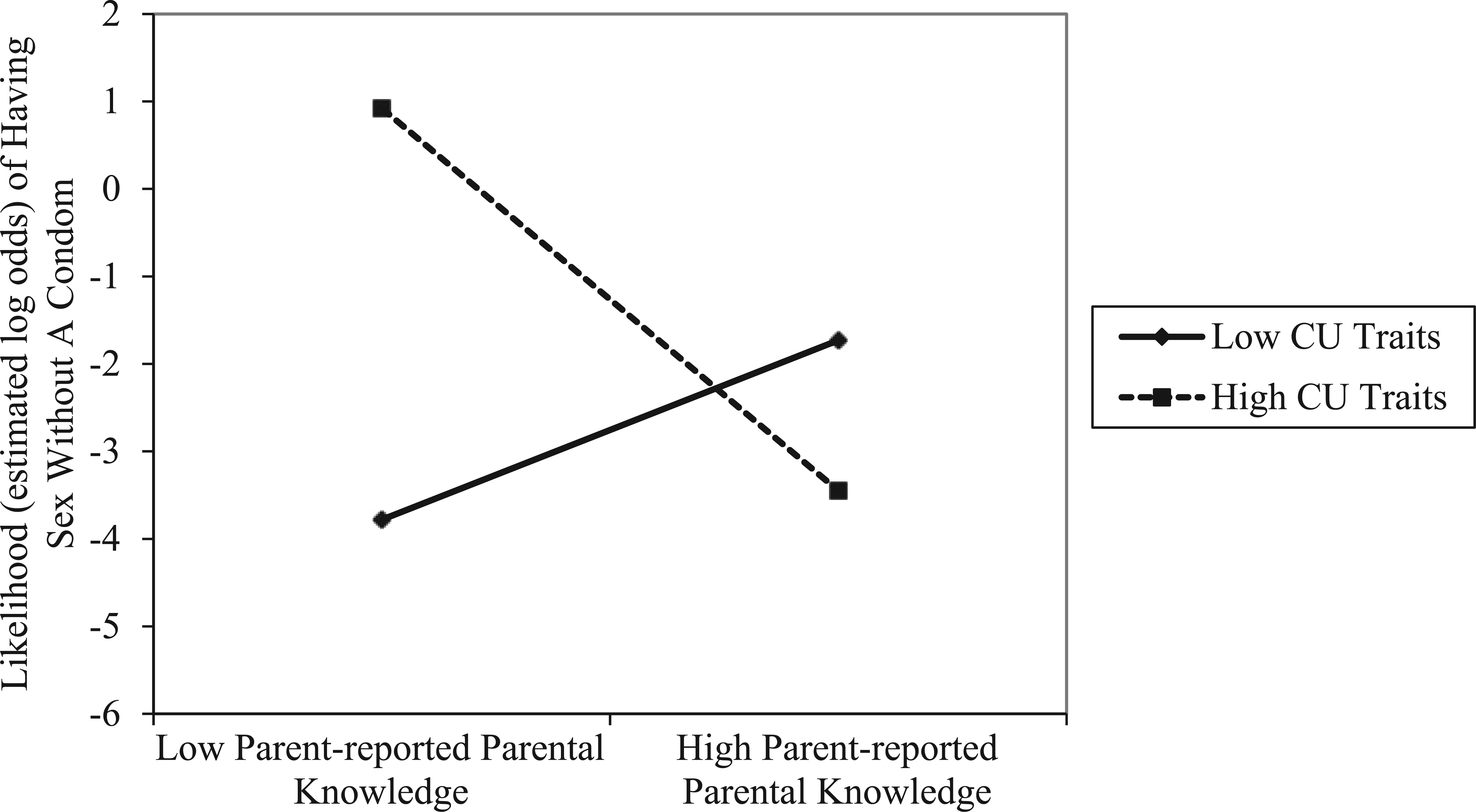
Graph of significant interaction between parent-reported parental knowledge and adolescent-reported CU traits as a predictor of adolescents’ likelihood of engaging in sex without a condom.
Model 3: Effects of parental knowledge SDS and CU traits
The final logistic regression model examined the effects of the discrepancy between parent and adolescent reports of parental knowledge (as indicated by the SDS score) and CU traits on adolescents’ likelihood of engaging in sex without a condom. Covariates included adolescent age, gender, and ethnicity. Because the SDS is derived directly from the adolescent and parent reports, including the original scores into the model would create a linear dependency; thus, only the SDS was included as a predictor. Results for Model 3 are shown in Table 4. In this model, there were significant main effects of age (B = 0.70, p = .03) and gender (B = −1.09, p = .04), such that older adolescents and girls were more likely to report engaging in unprotected sex. There was also a significant main effect of CU traits such that adolescents with higher levels of CU traits were more likely to engage in unprotected sex (B = 0.09, p = .01). There was also a significant interaction between parental knowledge (SDS) and adolescents’ CU traits (B = −0.07, p = .04). This interaction is displayed graphically in Figure 2, with the y-axis representing estimated log odds of having sex without a condom. We probed the significant interaction utilizing the Johnson–Neyman technique to determine the region of significance for the effect of parenting on risky sex at various levels of CU traits. These analyses revealed that a greater discrepancy score for parental knowledge was a significant predictor of a higher likelihood of engaging in unprotected sex in the following year only for adolescents with ICU scores (mean-centered) at or below −3.69 (34.07% of participants scored below this value, 65.93% scored above this value).
Summary of Logistic Regression Results From Model 3.
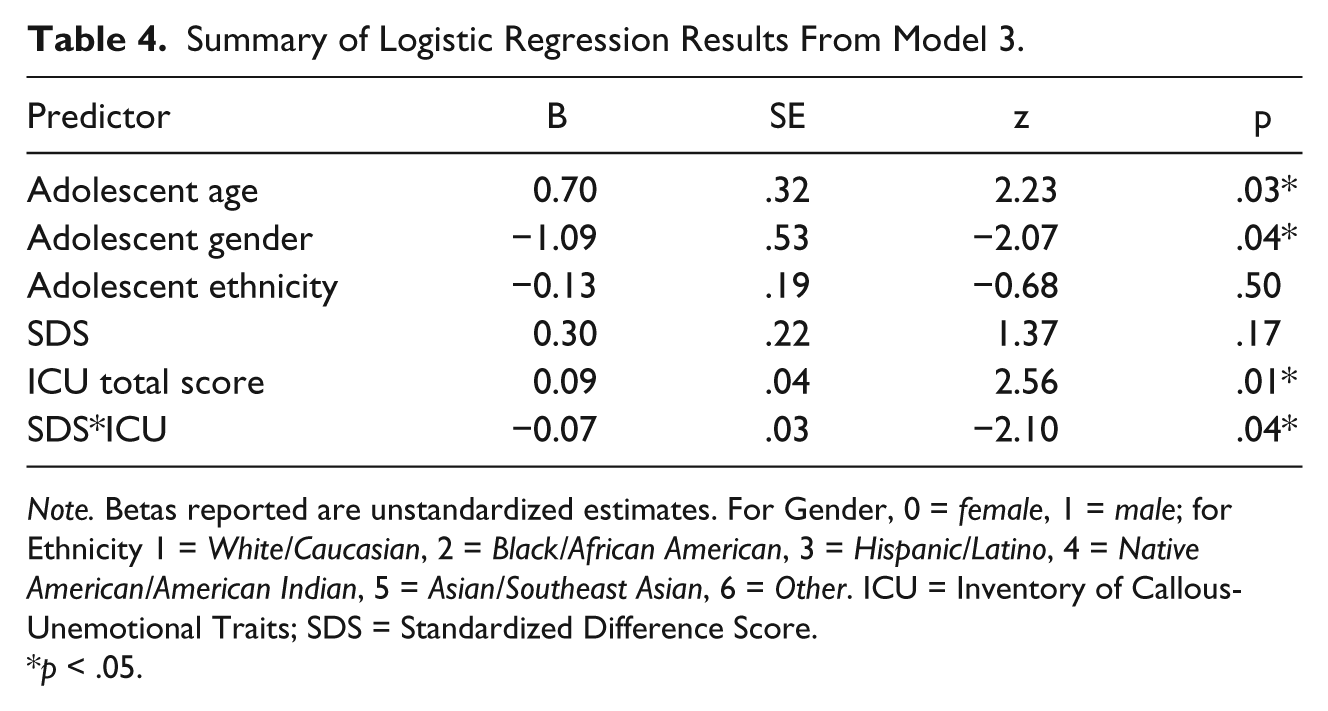
Note. Betas reported are unstandardized estimates. For Gender, 0 = female, 1 = male; for Ethnicity 1 = White/Caucasian, 2 = Black/African American, 3 = Hispanic/Latino, 4 = Native American/American Indian, 5 = Asian/Southeast Asian, 6 = Other. ICU = Inventory of Callous-Unemotional Traits; SDS = Standardized Difference Score.
p < .05.
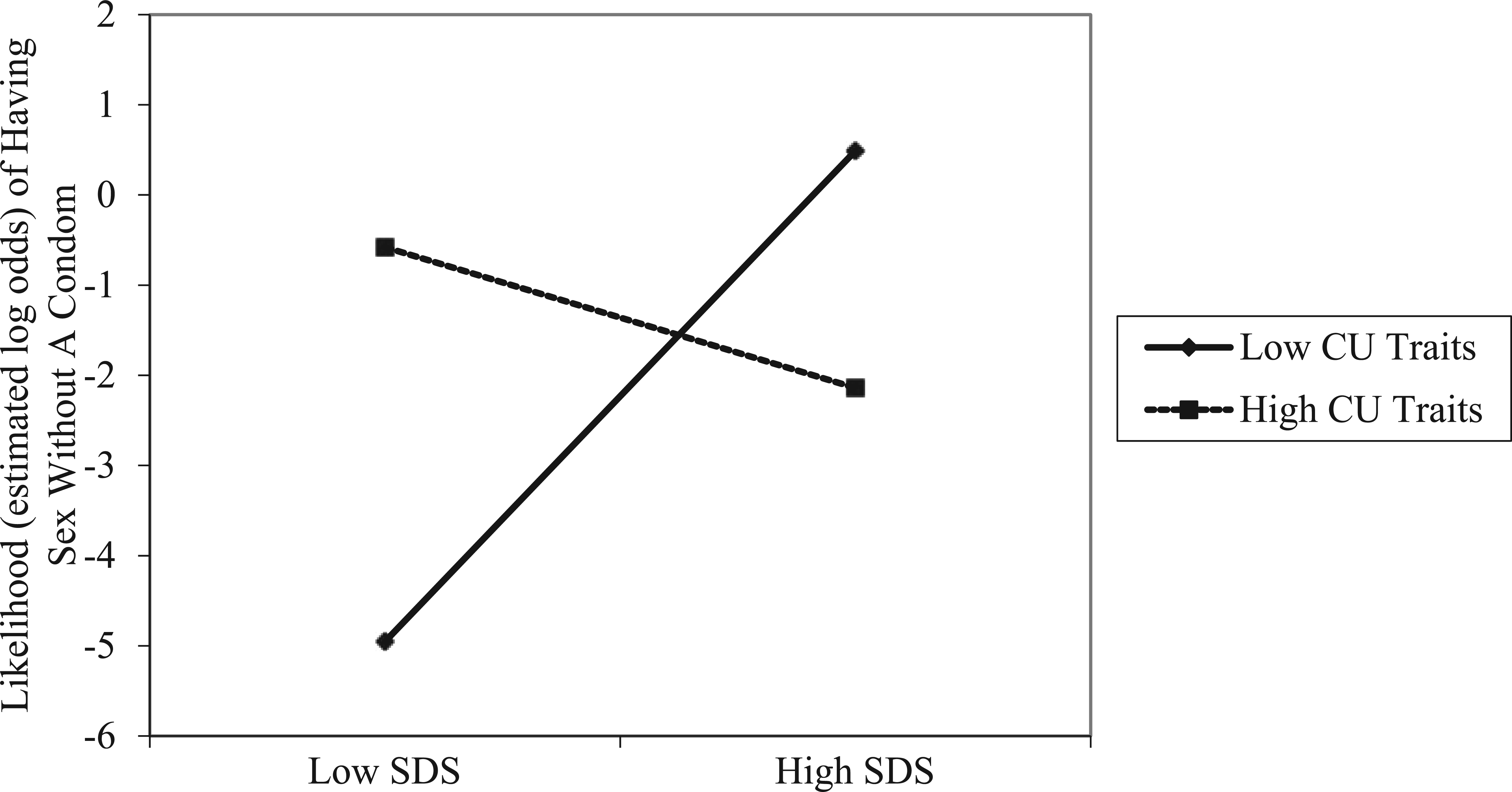
Graph of significant interaction between SDS for adolescent and parent reports of parental knowledge and adolescent-reported CU traits as a predictor of adolescents’ likelihood of engaging in sex without a condom.
Discussion
The aim of the current study was to examine the longitudinal effect of the interaction between parental knowledge and adolescent CU traits on the likelihood of adolescents engaging in sexual intercourse without a condom. We hypothesized that adolescent CU traits would moderate the relationship between parental knowledge and adolescents’ likelihood of engaging in unprotected sexual intercourse such that the protective effect of parental knowledge on risky sexual behavior would be greater for those adolescents with lower levels of CU traits. In contrast, we hypothesized that parenting would not significantly affect risky sexual behavior among youth with high CU traits. An important additional aim of this study was to evaluate the unique effects of both parent and adolescent perceptions of parental knowledge as well as the discrepancies between these reports (e.g., Cordova et al., 2014; Cottrell et al., 2003; Reynolds et al., 2011). Overall, our pattern of findings shows that the relationship between parental knowledge and risky sexual behavior does in fact depend on CU traits, but this relationship is much more nuanced than initially hypothesized and depends on how parental knowledge is assessed. We interpret and discuss the implications of our findings below.
The Importance of Multiple Reporters
Our findings clearly indicate the importance of obtaining multiple perspectives (i.e., parent and adolescent) on parental knowledge, to best predict adolescents’ likelihood of engaging in unprotected sex. Results from three models differed based on the specific reporter of parental knowledge, suggesting that adolescents and their parents do not always perceive or tell the same story about the extent to which parents are aware of what is happening in their teenagers’ lives, and these perspectives uniquely predict different risk behavior outcomes. Indeed, all three indicators of parental knowledge (adolescent report, parent report, and the discrepancy between the two) were significant predictors of engaging in risky sexual behavior for adolescents, either as a main effect for all youth (as with adolescent report), or through their interactions with adolescent CU traits (as with parent report and the discrepancy score). In sum, the effect of parental knowledge on adolescent risky sexual behavior is quite nuanced and depends, in part, on both the reporter of parental knowledge as well as child-specific personality traits. These results are consistent with at least one other study in which researchers found that parent and adolescent views on parental knowledge differentially predict adolescent risky behaviors (Cottrell et al., 2003).
Although many research studies to date have assessed parental knowledge with only one reporter (e.g., Yang et al., 2007), recent work has increasingly focused on the importance of discrepancies between informants on reports of constructs such as parental knowledge, family quality, and family functioning (e.g., De Los Reyes, Henry, Tolan, & Wakschlag, 2009; Reynolds et al., 2011). Such discrepancies are found to be stable over time, predict psychological outcomes beyond what can be explained by individual reports alone, and predict response to treatment programs (De Los Reyes, 2011). Findings from this study provide further support for obtaining multiple reports of parental knowledge and incorporating the discrepancy between reporters as an important predictor of risky sexual behavior among youth.
The Conditional Effect of Parental Knowledge on Adolescent Risky Sexual Behavior
Results revealed that adolescents’ perception of what their parents know has important implications for predicting risk behavior for all youth, regardless of adolescent CU traits. Youth who perceived their parents to have greater knowledge about their activities, peers, and whereabouts were less likely to engage in unprotected sex in the following year. This is consistent with previous research which has found that adolescent-reported parental knowledge is associated with more consistent condom use in adolescent boys (Borawski, Ievers-Landis, Lovegreen, & Trapl, 2003) and that lower adolescent perceptions of parental knowledge are associated with risky sexual behaviors among urban, low-income, African American adolescents (Li, Feigelman, & Stanton, 2000).
Parents’ perception of their own knowledge of youths’ activities and whereabouts, however, seems to matter most for predicting risky behavior among youth who are high on CU traits. Specifically, only for adolescents high in CU traits, having parents who reported high levels of knowledge about their child’s whereabouts and activities was protective against engaging in sex without a condom. This finding was counter to our hypothesis, as we expected that the impact of parental knowledge would be greatest for adolescents low in CU traits, consistent with previous research showing that parent-reported parenting practices are a weaker predictor of conduct problems in youth with high levels of CU traits (e.g., Oxford et al., 2003; Wootton et al., 1997). Although the interaction between parental knowledge and adolescent CU traits on risky sexual behavior has not been examined elsewhere (to our knowledge), our findings are still inconsistent with previous patterns found in the literature.
One plausible explanation for this counterintuitive finding is that increased parental knowledge perhaps changes other parenting behaviors (e.g., parental monitoring), and that this is particularly salient for parents of adolescents who are at risk of or who are already engaging in risky or problematic behavior. Adolescents with high CU traits tend to have early emerging conduct and behavior problems (Frick & White, 2008), and parents who have high parental knowledge of such risky and problematic behaviors may subsequently increase their monitoring and limit-setting, or decrease teens’ privileges and freedoms, which could in turn reduce the likelihood of engaging in unprotected sex over time. Indeed, some research has found an association between parent-directed behavior change strategies (e.g., seeking treatment from a psychologist or counselor, enhancing discipline strategies, establishing more routine and structure) implemented due to parental knowledge of conduct problems and a subsequent decrease in child conduct problems (Pettit, Keiley, Laird, Bates, & Dodge, 2007). For lower-risk adolescents with lower levels of CU traits, parental knowledge may do less to change parenting behavior if the information that parents know about their teens’ activities and peers does not present a cause for concern.
Finally, a greater discrepancy between adolescent and parent report increased risk for unprotected sex only among youth who are low on CU traits. In other words, the more parents and youth disagree about parental knowledge, the greater the risk of unprotected sex among low CU youth, whereas for adolescents high on CU traits, the discrepancy in parent and adolescent reports does not predict risk behavior. Discrepancies between parent and adolescent reports of parental knowledge could exist due to a lack of parental monitoring and/or a lack of open communication from the adolescent. Indeed, others have found that mother–child discrepancies in perceived child behavior problems are positively related to mother–child conflict (De Los Reyes & Kazdin, 2006), and parent–child relationship quality is also a significant predictor of discrepancies between parent and child reporting on children’s behavior (Treutler & Epkins, 2003). As greater discrepancies between parent and adolescent reports can be an indication of greater parent–adolescent dysfunction, this could explain why a greater discrepancy score was a risk factor for engaging in sex without a condom for adolescents with low CU traits. For these youth, who may be more likely than those with high CU traits to want parental support and connection, the lack of this close relationship could be a risk factor for engagement in risky sex, consistent with research that has found that adolescents’ perceptions of the parent–child relationship significantly predict risky sexual behavior (Kerpelman, McElwain, Pittman, & Adler-Baeder, 2013). In contrast, for adolescents with high levels of CU traits, the parent–child relationship may not serve as a protective factor against engagement in risky behavior.
Strengths, Limitations, and Future Directions
This study makes an important contribution to the literature on parental knowledge, CU traits, and risky sexual behavior, presenting results from three models examining main effects and interactions between parental knowledge and CU traits as predictors of adolescents’ engagement in unprotected sex. Notable strengths of this research include a longitudinal study design, the incorporation of both parent- and adolescent reports, and consideration of parent–adolescent discrepancies in reporting. Through the use of three different conceptualizations of “parental knowledge,” we have helped distinguish which aspects of parental knowledge matter for whom when predicting future risky sexual behavior. In addition, this study focused on the importance of CU traits for predicting risky sexual behavior in a community sample, rather than only among adolescent sexual offenders, as is often the case in much previous research (e.g., Lawing et al., 2010; White et al., 2009). Results highlight the importance of obtaining these different reports and also have the potential to inform the development of intervention and prevention efforts targeting adolescent risky sexual behavior.
Despite the strengths and contributions of this work, the current study is marked by several limitations which could be addressed in future research. First, CU traits were only assessed at Year 2 of data collection and only assessed through child, and not parent, report. While research has supported the stability of CU traits across adolescence (see Frick & White, 2008, for a review), longitudinal assessment of CU traits over time and concurrently with parental knowledge would allow for an examination of how these processes unfold over time as predictors of risk behavior among youth. Second, this community sample of adolescents reported relatively low rates of unprotected sex, with 84.4% of adolescents reporting no unprotected sex in the past year. It is unclear if the same patterns would emerge within a more high-risk sample, and thus replication with an at-risk group of adolescents is an important future direction. A third potential limitation of the current research concerns the use of the SDS to capture the discrepancy between reporters. While this approach is useful and consistent with previous research, one limitation is that although the SDS captures the magnitude of the difference between reports, it does not allow for an understanding of where along the continuum the discrepancy occurs (Reynolds et al., 2011). The SDS does not distinguish between discrepancies in which the magnitude of the difference between reports is equal but the overall amount of knowledge reported is not. Laird and De Los Reyes (2011) provide a full discussion on SDS scores and alternative approaches for measuring reporter discrepancies, which provides useful considerations for future research.
Future work should also consider the possible bidirectional relationship between adolescent CU traits and parenting practices over time, as such a transactional effect may help explain risky sexual behavior among youth. It will be important to consider the bidirectional relationships between CU traits and related conduct problems, risky sex, and parenting behaviors over time, and further examination of these bidirectional influences among adolescents with and without high levels of CU traits represents another important direction for future research.
Last, future research with larger samples may also consider whether gender moderates the interaction between CU traits and parental knowledge in predicting likelihood of non-condom use. In the current study, we did find a pattern of results showing that girls were more likely than boys to report engaging in sex without a condom (consistent with others, Eaton et al., 2011), suggesting that gender differences are likely an important consideration for future work.
Conclusion and Clinical Implications
Findings from the current study hold important implications for understanding the nuanced relationship between parental knowledge and adolescent risky sexual behavior. To our knowledge, this is the first study to examine CU traits as a moderator of the relationship between parental knowledge and adolescent engagement in unprotected sex. Furthermore, while much research has examined the role of parenting practices in predicting conduct problems and delinquency among youth both high and low on CU traits (e.g., Edens et al., 2008; Oxford et al., 2003; Wootton et al., 1997), much less research has examined the effects of parenting and adolescent CU traits as predictors of risky sexual behavior.
Results indicate that adolescent perceptions of parental knowledge, parental perceptions of parental knowledge, and the discrepancy between these reports are all uniquely important predictors of adolescent engagement in sexual intercourse without a condom. Indeed, for all adolescents, perceiving that their parents have higher parental knowledge is protective against engaging in unprotected sex, suggesting that increasing adolescents’ perceptions of how much their parents know about their peers and activities may be an appropriate target for preventive interventions that aim to reduce risky sexual behavior among adolescents. Such interventions may have success through teaching parents to make their monitoring and surveillance efforts more apparent to their children.
For adolescents high on CU traits, greater parental perception of parental knowledge reduced adolescents’ likelihood of engaging in sex without a condom. Investigating whether parents’ perceptions of their own knowledge changes behavior among parents of adolescents with high CU traits and whether this behavior change in turn reduces sexual risk taking is an important direction for future research with key clinical implications.
Finally, for adolescents low on CU traits, greater discrepancies between parent and adolescent perceptions of parental knowledge was a risk factor for engaging in unprotected sex. This finding provides preliminary support indicating that for adolescents with low levels of CU traits, interventions that target reducing parent–adolescent discrepancies by increasing adolescent self-disclosure and parental surveillance, as well as fostering the parent–adolescent relationship, may have promise for reducing risky sexual behavior. However, use of the SDS to capture parent–adolescent discrepancies limits our ability to determine whether the direction of the discrepancy (i.e., whether the adolescent or the parent reports greater parental knowledge) matters for predicting engagement in unprotected sex (Reynolds et al., 2011), a clear direction for future research.
Taken together, results from this study highlight the importance of assessing parental knowledge across informants and ultimately suggest that increasing both adolescent and parental perceptions of parental knowledge as well as reducing the discrepancy between these perceptions could be protective in preventing risky sexual practices for particular youth (i.e., depending on CU status), and may thus be important targets for preventive interventions.
Footnotes
Declaration of Conflicting Interests
The author(s) declared no potential conflicts of interest with respect to the research, authorship, and/or publication of this article.
Funding
The author(s) disclosed receipt of the following financial support for the research, authorship, and/or publication of this article: Funding for this research was provided by NIDA grant R01 DA19405 awarded to C. W. Lejuez.