




Abstract
We conducted a series of studies on multiple forms of repetitive behavior displayed by four children with autism spectrum disorder. Study 1 showed that each participant’s highest probability repetitive behavior persisted in the absence of social consequences, thereby meeting the functional definition of stereotypy. Study 2 showed that preferred, structurally matched stimulation decreased each participant’s targeted (highest probability) stereotypy, as well as their non-targeted (lower probability) stereotypy. Study 3 showed that for three participants, non-contingent access to preferred stimulation decreased immediate and, to some extent, subsequent engagement in targeted and non-targeted stereotypy. For the fourth participant, non-contingent access to preferred stimulation decreased immediate engagement in the targeted stereotypy, but increased subsequent engagement in non-targeted stereotypy; this subsequent increase was attenuated by reducing the duration of access to the preferred stimulus. Study 4 showed that a trial-based differential reinforcement of other behavior (DRO) procedure systematically increased the period of time for which the targeted stereotypy was not displayed for three of three participants. In addition, results showed that the participants’ non-targeted stereotypy either decreased or was unchanged when DRO was provided for the targeted stereotypy.
Many individuals who are diagnosed with autism spectrum disorder (ASD) and related intellectual disabilities engage in stereotypy (DiGennaro Reed, Hirst, & Hyman, 2012). Although there is not necessarily general agreement on a definition of stereotypy (Wunderlich & Vollmer, 2015), Rapp and Vollmer (2005) defined motor stereotypy as repetitive, invariant behavior (excluding self-injurious behavior), which persists in the absence of social consequences. As indicated by Rapp and Lanovaz (2014), Lanovaz and Sladeczek (2012) expanded that definition to explicitly include vocal stereotypy, which they defined “as any repetitive sounds or words produced by an individual’s vocal apparatus that are maintained by nonsocial reinforcement” (p. 148). Some studies suggest that engagement in either vocal or motor stereotypy competes with engagement in functional play (Koegel, Firestone, Kramme, & Dunlap, 1974), acquisition of new academic or vocational skills (Morrison & Rosales-Ruiz, 1997), or engagement in appropriate social interactions (e.g., Jones, Wint, & Ellis, 1989); however, no specific behavioral intervention has been universally effective for all participants across various contexts (DiGennaro Reed et al., 2012; Rapp & Lanovaz, 2016; Rapp & Vollmer, 2005).
Rapp and Lanovaz (2016) reviewed the literature on behavioral interventions for stereotypy using the evidence standards outlined by Kratochwill et al. (2010) for single-case experimental design studies. In general, these standards suggest that there is strong empirical support for an intervention when there are five or more positive studies authored by three or more independent research groups containing 20 or more demonstrations of experimental control with the intervention in question. Rapp and Lanovaz concluded that there was strong empirical support for non-contingent reinforcement (NCR) with structurally matched stimulation during leisure periods; however, they noted that NCR was limited insofar as engagement with preferred items can compete with academic activity in the same manner as engagement in stereotypy. In terms of treatments that may be suitable for instructional periods (i.e., interventions that do not include continuous access to alternative stimulation), Rapp and Lanovaz also found strong support for overcorrection and moderate support for response interruption and redirection (RIRD); however, positive punishment procedures such as overcorrection may not be acceptable in some instructional settings, and studies by Carroll and Kodak (2014) and Wunderlich and Vollmer (2015) found that the effects of RIRD may be overstated in some studies.
From a practical standpoint, DRO with larger intervals (e.g., 5 to 10 min) may be an ideal intervention for instructional periods, particularly if the consequence for not engaging in stereotypy is functionally similar to the stimulation generated by engaging in stereotypy (e.g., Rapp, 2007). Procedurally, treating stereotypy with DRO involves a therapist delivering an empirically identified preferred item, which may or may not be functionally similar to the consequence produced by stereotypy, contingent on the omission of the target stereotypy for a specified period of time (Vollmer & Iwata, 1992).
Nearly a dozen studies have shown that DRO with preferred items decreases motor or vocal stereotypy (Fritz, Iwata, Rolider, Camp, & Neidert, 2012; Lanovaz & Argumedes, 2010; Lanovaz et al., 2014; Lustig et al., 2013; Nuernberger, Vargo, & Ringdahl, 2013; Patel, Carr, Kim, Robles, & Eastridge, 2000; Repp, Dietz, & Speir, 1974; Ringdahl et al., 2002; Rozenblat, Brown, Brown, Reeve, & Reeve, 2009; Shabani, Wilder, & Flood, 2001; Taylor, Hoch, & Weissman, 2005, but see Lanovaz & Argumedes, 2009). Nevertheless, Rapp and Lanovaz (2016) have suggested that these studies are limited in two general ways. First, a third of the studies included a self-monitoring component. As demonstrated by Fritz et al. (2012), when DRO is implemented with self-monitoring, it is likely that the decrease in stereotypy is attributable, at least in part, to differential consequences for engaging in self-monitoring. Therefore, it is not clear whether DRO is equally effective for individuals who cannot monitor their own engagement in stereotypy (Rapp & Lanovaz, 2016; Tiger, Fisher, & Bouxsein, 2009). Second, approximately half of the studies did not thin the DRO schedule to a practical variation. In fact, multiple studies ended with an interval size of 30 s, which would be of limited practical utility in most treatment settings. Thus, additional research on treating stereotypy with thinner terminal DRO schedules is warranted.
Another consideration when treating stereotypy is the subsequent effects of the intervention, which may be conceptualized within the motivating operations (MO) framework. Briefly, MOs can be subcategorized as establishing operations (EOs) and abolishing operations (AOs), both of which simultaneously but independently exert value- and behavior-altering effects, which influence reinforcement and punishment processes (Laraway, Snycerski, Michael, & Poling, 2003; Laraway, Snycerski, Olson, Becker, & Poling, 2014). As these concepts are applied specifically to stereotypy, EOs are stimulus events that evoke stereotypy and increase the value of stimulation generated by engagement in stereotypy. By contrast, AOs for stereotypy are stimulus events that abate stereotypy and decrease the value of stimulation generated by engagement in stereotypy.
Lanovaz, Rapp, and Fletcher (2010) proposed a model to evaluate automatically reinforced behavior during and after intervention. In part, the purpose of this model was to determine if the treatment was functionally matched to the automatically reinforced behavior based on the participant’s engagement in said behavior after the intervention was removed (hereafter denoted subsequent effects). This model involves a no-interaction (NI) control sequence and a test (treatment) sequence that are conducted in an alternating fashion across separate days. Both sequences are comprised of three contiguous components each of which are typically 5 min to 10 min in duration. During all three components of the NI sequence, the therapist withholds social consequences. During the test sequence, the therapist implements the intervention during only the second component; the first and third components are conducted in the same manner as the components in the NI control sequence. Using what Lanovaz et al. referred to as a between-sequence analysis, the results from the first, second, and third components of both sequences are compared in multi-element graphs to determine the immediate and subsequent effects of the intervention on the target behavior.
Conceptually, Rapp (2007) suggested a functionally matched intervention may briefly serve as an AO for subsequent engagement in stereotypy. Specifically, this functional match should be reflected in decreased or unchanged levels of stereotypy in the third component of the test sequence relative to the third component of the NI control sequence (Lanovaz et al., 2010). By contrast, a functionally unmatched intervention may decrease the level of stereotypy during the second component of the test sequence relative to the second component of the NI control sequence, but simultaneously produce an EO for stimulation generated by engagement in stereotypy. The subsequent EO would be indicated by an increased level of stereotypy during the third component of the test sequence relative to the third component of the NI control sequence (Lanovaz et al., 2010). To be optimal for practitioners, Lanovaz et al. (2010) argued that interventions for stereotypy should decrease engagement in the targeted behavior without increasing subsequent engagement in that behavior. In addition, others have suggested that interventions should not increase immediate or subsequent engagement in non-targeted problem behavior (Enloe & Rapp, 2014; Rapp et al., 2013).
The purpose of this series of studies was to develop interventions for decreasing multiple forms of stereotypy during leisure and instructional periods for four children diagnosed with ASD. In Study 1, we conducted consecutive NI conditions to verify that the participants’ repetitive behaviors were maintained by non-social sources of reinforcement. In Study 2, we evaluated the extent to which empirically identified preferred items decreased each participant’s targeted and non-targeted stereotypy. In Study 3, we evaluated the immediate and subsequent effects of preferred stimulation on each participant’s targeted and non-targeted stereotypy. These results were used to demonstrate that the preferred stimulation (a) was functionally matched to each participant’s highest probability stereotypy, (b) could be used to treat stereotypy during leisure periods, and (c) did not increase engagement in non-targeted stereotypy. Finally, in Study 4 we treated three participants’ targeted stereotypy using trial-based DRO procedures, which could be applied to instructional periods, with functionally matched stimulation. We also evaluated the effects on their non-targeted stereotypy.
Study 1: Verifying a Non-Social Function
Querim et al. (2013) found that the persistence of repetitive behavior across three or more consecutive alone sessions correctly predicted that the respective individual’s behavior was automatically reinforced for all but one of 22 cases. The use of consecutive NI sessions to verify the persistence of repetitive behavior in the absence of social consequences has also been illustrated in several recent studies (Carroll & Kodak, 2014; Enloe & Rapp, 2014; Frewing, Rapp, & Pastrana, 2015; Lanovaz et al., 2014). The purpose of this experiment was to verify that the participants’ repetitive behaviors persisted in the absence of social consequences.
Method
Participants, setting, and response definitions
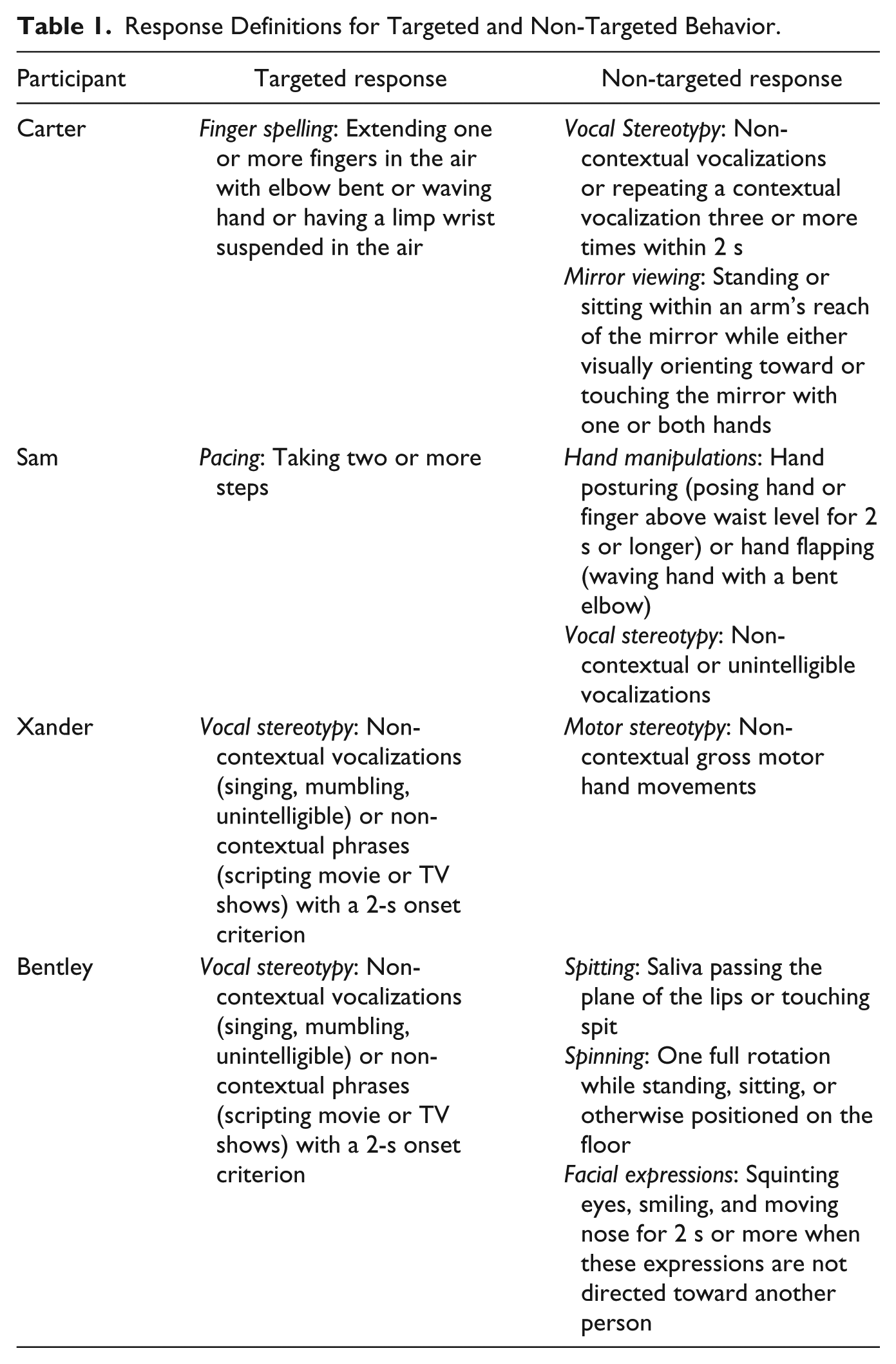
Four male children who were diagnosed with ASD participated in this study. Carter was 3 years old, Sam was 7 years old, Xander was 4 years old, and Bentley was 5 years old. Each participant engaged in two or more repetitive behaviors. Each participant attended a day center that provided behavior-analytic treatment services. Carter attended the center for 20 hr each week, Sam attended for 35 hr per week, Xander attended for 10 hr per week, and Bentley attended for 30 hr per week. Prior to this study, Sam’s stereotypy had been treated with limited success using various antecedent- and consequent-based behavioral interventions including contingent verbal reprimands (see Cook, Rapp, Gomes, Frazer, & Lindblad, 2014). Therapists conducted all sessions in the same 2.9 m × 2.3 m therapy rooms within the treatment center. The room was devoid of material apart from what was described for each condition. Table 1 contains the definitions for each participant’s targeted and non-targeted behaviors.
Response Definitions for Targeted and Non-Targeted Behavior.
Procedures
Carter and Sam each participated in six consecutive 5-min NI sessions. Xander and Bentley each participated in five consecutive 5-min NI sessions. We conducted sessions until the high-probability response form was relatively stable for at least three sessions (i.e., we did not conduct additional sessions based on the patterns for each participant’s low probability behaviors). During each session, a therapist was present but she did not provide consequences for any behavior and no alternative stimulation was available to the participant. Sessions were separated by at least 10 min and were typically conducted across 2 or 3 days.
Data collection and reliability
Trained observers collected data on each target behavior from video using continuous duration recording. We converted data for each target behavior into a percentage of time measure for each session by dividing the total number of seconds engaged in the target behavior by the total number of seconds in the session (300) and multiplying by 100%. A secondary observer scored at least 33% of sessions for each participant. We calculated interobserver agreement (IOA) scores using the block-by-block (with 10-s bins) method (e.g., Mudford, Taylor, & Martin, 2009). Mean IOA scores for both Carter’s finger spelling and vocal stereotypy were 100%. Mean IOA scores for Sam’s pacing, mirror viewing, hand manipulations, and vocal stereotypy were 95%, 84%, 79%, and 90%, respectively. Mean IOA scores for Xander’s vocal stereotypy and motor stereotypy were 85% and 93%, respectively. Mean IOA scores for Bentley’s vocal stereotypy, spitting, spinning, and facial expressions were 73%, 97%, 92%, and 91%, respectively. The low IOA score for some of Sam’s and Bentley’s behaviors were likely a function of scoring multiple behaviors using a continuous measure.
Results and Discussion
Figure 1 shows that Carter (first panel) engaged in moderate levels of finger spelling (M = 45%) and variable levels of vocal stereotypy (M = 19.5%) across NI sessions. The second panel shows that Sam engaged in moderate to high levels of pacing (M = 53.8%), moderate levels of hand manipulations (M = 25.3%) and mirror viewing (M = 28.3%), and variable levels of vocal stereotypy (M = 49.1%) across sessions. The third panel shows that Xander engaged in moderate levels of vocal stereotypy (M = 47%) and low levels of motor stereotypy (M = 15.6%) across sessions. Finally, the fourth panel shows that Bentley engaged in moderate levels of vocal stereotypy (M = 28.2%) and facial expressions (M = 22.8%), and low levels of spinning (M = 12.2%) and spitting (M = 5.8%) across sessions.

Percentage of time engaged in stereotypy by Carter (first panel), Sam (second panel), Xander (third panel), and Bentley (fourth panel) during consecutive no-interaction sessions.
Results for all four participants show that their highest probability repetitive behavior persisted across sessions without social consequences, thereby meeting the definition of stereotypy (Rapp & Vollmer, 2005). In addition, other repetitive behaviors persisted at lower or variable levels for each participant. By contrast, Bentley’s spitting decreased to zero across sessions, suggesting this behavior was maintained by social consequences (e.g., attention from caregivers).
Study 2: Evaluating the Extent to Which Preferred Stimulation Competes With Targeted and Non-Targeted Stereotypy
The purpose of Study 2 was to evaluate the immediate effect (i.e., when the intervention is being implemented) of each participant’s preferred stimulation on his targeted and non-targeted stereotypy. Prior studies have shown that preferred items identified with a free-operant stimulus preference assessment (FOSPA; Roane, Vollmer, Ringdahl, & Marcus, 1998) decreased one or more forms of stereotypy when the preferred item was presented non-contingently (e.g., Lanovaz, Fletcher, & Rapp, 2009; Rapp, 2007; but see also Rapp et al., 2013). For the purposes of this study, we used the descriptor “targeted” to connote the high-probability form of stereotypy for which the behavioral intervention was developed (Rapp et al., 2013). Assuming that each participant’s preferred stimulus decreased his immediate engagement in the targeted stereotypy without increasing immediate engagement in non-targeted (lower probability) stereotypy, the ensuing step would involve an evaluation of the subsequent effects of the preferred stimulus.
Method
Participants, setting, and target behavior
The participants, setting, and target behaviors were the same as described for Study 1.
Data collection and reliability
An observer scored each session for each form of stereotypy using momentary time sampling (MTS) with 10-s intervals. All sessions were scored in vivo and were video recorded for additional coding. Several studies have found that data collected during relatively brief observation periods with 10-s MTS were sensitive to a wide range of changes in duration events such as stereotypical behavior (e.g., Devine, Rapp, Testa, Henrickson, & Schnerch, 2011; Rapp, Colby-Dirksen, Michalski, Carroll, & Lindenberg, 2008). Within each 10-s interval, observers scored one behavior at the fifth second and another behavior at the 10th second; both intervals were signaled by an auditory stimulus and a textual stimulus from an iPhone application. In this way, one primary observer scored Carter’s and Xander’s sessions and two primary observers (or one primary observer who scored a session twice [once from the video recording]) scored Sam’s and Bentley’s sessions.
We converted data for each target behavior into a percentage of 10-s intervals measure by dividing the number of scored intervals by the total number of intervals in the session and multiplying by 100%. Interobserver agreement scores were calculated on an interval-by-interval basis by dividing agreements by agreements plus disagreements, and multiplying by 100% (e.g., Mudford et al., 2009). For the preference assessments, a secondary observer scored 40% or more of the sessions for each participant. Mean IOA scores for item and response allocation (all variables combined) were 96% or higher for each participant. For the competing stimulus assessment, a secondary observer scored 38% or more of sessions for each participant. Mean IOA scores for each participant’s behaviors were 90% or higher with one exception; the IOA score for Sam’s vocal stereotypy was 88%.
Procedures and design
For each participant, we first conducted multiple, 10-min FOSPA sessions (Roane et al., 1998). Based on the definition of a matched stimulus that was provided in the Rapp et al. (2013) study, we defined a matched stimulus as an item that (a) produced stimulation that matched the overt stimulation produced by the respective participant’s engagement with the targeted (highest probability) stereotypy and (b) was in the top half of the hierarchy in terms of total time allocation across the three or more preference-assessment sessions. Because Sam displayed high levels of stereotypy and low levels of item engagement across the FOSPA sessions, he also participated in a response-restriction analysis during multiple FOSPA sessions. Subsequently, after identifying one or more items to which the participants allocated at least a moderate level of time (i.e., mean of 40% of intervals or more across sessions; this was modified for Sam), we conducted a competing stimulus assessment with each participant’s most-preferred item.
Preference assessments
We collected data on item engagement and stereotypy using 10-s MTS as described above. Engagement with an item was defined as a participant touching the item with any part of his body excluding his mouth. For each participant, the stereotypy definitions were the same as described in Study 1. For Carter, we conducted three FOSPA sessions across three separate days (data available from the first author). We hypothesized that Carter’s finger spelling was maintained by visual stimulation. As such, the stimulus array included three structurally matched items (Leap Frog ABC Pad™, ABC-123 Teddy Bear™, and chalk and an easel chalkboard) and three non-matched items (a racetrack, Tickle Me Elmo™, and Sesame Street Store™). Across the three sessions, Carter allocated the most time to the chalk and chalkboard (M = 62.6%), followed by the Leap Frog ABA Pad (M = 40%). Thus, we evaluated the extent to which non-contingent access to chalk and chalkboard decreased Carter’s engagement in finger spelling and vocal stereotypy. After the chalk and chalkboard produced inconsistent changes in Carter’s behavior, we evaluated the effects of the Leap Frog ABA Pad (hereafter referred to as the Leap pad) on Carter’s stereotypy.
For Sam, we conducted 22 free- and restricted-operant preference-assessment sessions across 12 days (data available from the first author). Typically, we conducted two sessions per day and each session was separated by at least 3 hr. We hypothesized that Sam’s pacing was maintained by visual stimulation because he typically stopped and started pacing in patterns that aligned with the angles of floors and walls. Thus, his stimulus array, which was based on therapists’ informal observations of Sam’s engagement with items during leisure time, included two structurally matched items (iPad™ and whirly tube) and three non-matched items (yoga ball, Koosh Ball™, and scooter). During the first four FOSPA sessions, Sam engaged in high levels of pacing and vocal stereotypy while manipulating the Koosh Ball. The next four sessions, wherein pacing was restricted (a therapist blocked Sam’s attempts to stand unless he was engaged with an item), yielded high levels of vocal stereotypy and engagement with the Koosh Ball, which Sam manipulated in a stereotypical manner. Thereafter, we conducted seven sessions wherein both pacing and the Koosh Ball were restricted for Sam (i.e., the Koosh Ball was absent), resulting in high levels of iPad engagement and low levels of vocal stereotypy. We conducted three additional sessions wherein the Koosh Ball was restricted, but pacing was not; however, we started each session by prompting Sam to sit in a chair (additional prompts were not typically required to keep Sam seated in the chair). These sessions produced high levels of vocal stereotypy and engagement with the yoga ball. Finally, we conducted four additional sessions wherein the Koosh Ball was restricted and no chair was available (i.e., pacing was not restricted). During the final two sessions, Sam did not engage in pacing and, instead, engaged with the iPad for at least 50% of each session; however, he also engaged in moderate levels of vocal stereotypy. Based on the results of this analysis, we opted to use the iPad in the competing stimulus assessment for Sam.
For Xander, we conducted three FOSPA sessions across three separate days. We hypothesized that his vocal stereotypy was maintained by auditory stimulation. As such, the stimulus array included three structurally matched items (iPad™, ABC-Phonics™, and a racetrack, which produced racing sounds, with cars) and two non-matched items (large blocks and a rice box). Across the three sessions, Xander allocated the most time to the iPad (M = 55.3%), followed by the rice box (M = 26.7%). Thus, we evaluated the extent to which non-contingent access to the iPad decreased Xander’s vocal stereotypy.
For Bentley, we also conducted three FOSPA sessions across three separate days. As with Xander, we hypothesized that Bentley’s vocal stereotypy was maintained by auditory stimulation. To address this hypothesis, his stimulus array included three structurally matched items (iPad™, a robot dog, and a Lightening McQueen car™) and three non-matched items (Playdoh™, Legos™, and cars). Across the three sessions, Bentley allocated the most time to the iPad (M = 72%), followed by the legos (M = 50%). Thus, we evaluated the extent to which non-contingent access to the iPad decreased Bentley’s vocal stereotypy.
Competing stimulus assessment
We conducted three or four sessions per day, 2 or 3 days per week with each participant. Sessions were separated by at least 5 min. We used a reversal design to evaluate the separate effects of the chalkboard and Leap Pad on Carter’s engagement in finger spelling and vocal stereotypy. For this analysis, we considered Carter’s finger spelling to be the targeted stereotypy. Each session was 5 min in duration. During sessions in the NI phases, a therapist was present, but she did not provide consequences for any behavior and no alternative stimulation was available to Carter. This phase served as a baseline against which we evaluated the effects of Carter’s preferred items. Sessions in the chalkboard access (CA) phase were conducted in the same manner as in the NI phase, except that the therapist provided Carter continuous access to the chalkboard. Due to the inconsistent effects of the chalkboard on Carter’s finger spelling and vocal stereotypy, we evaluated the effects of Carter’s second most-preferred item, the Leap Pad. Sessions in the Leap Pad access (LA) phase were conducted in the same manner as in the NI phase, except that the therapist provided continuous access to the Leap Pad.
We used a pairwise multi-element design to evaluate the effects of the iPad on Sam’s, Xander’s, and Bentley’s targeted and non-targeted stereotypy. For this analysis, the targeted stereotypy was Sam’s pacing, Xander’s vocal stereotypy, and Bentley’s vocal stereotypy. Each session was 5 min in duration. Sessions with the NI condition were conducted in the same manner as described for Carter. Sessions with the iPad condition were the same as those in the NI condition, except that the therapist provided continuous access to the iPad. We conducted three to four sessions with each condition for each participant.
Results and Discussion
Figure 2 shows the results of the competing stimulus assessment for Carter (upper panel), Sam (center four panels), and Xander (lower two panels). In the first CA phase, Carter engaged in low levels of finger spelling (M = 0% of intervals) and vocal stereotypy (M = 5.1% of intervals). In the first NI phase, Carter emitted high levels of finger spelling (M = 42.8%) and moderate levels of vocal stereotypy (M = 18.9%). In the second CA phase, Carter engaged in lower level of finger spelling (M = 9.8%) and slightly higher levels of vocal stereotypy (M = 29.4%); however, he engaged in high levels of finger spelling during four of the first five sessions in this phase. During the second NI phase, Carter engaged in high levels of finger spelling (M = 59.5%) and vocal stereotypy (M = 56.1%). In the third CA phase, Carter emitted slightly lower levels of vocal stereotypy (M = 23.3%) and he did not engage in finger spelling (M = 0%). In the third NI phase, finger spelling increased (M = 67%) and vocal stereotypy remained at moderate levels (M = 24.3%). In the first LA phase, Carter did not engage in either finger spelling or vocal stereotypy. In the fourth NI phase, Carter engaged in high, but decreasing levels of finger spelling (M = 76.7%) and vocal stereotypy (M = 48%).
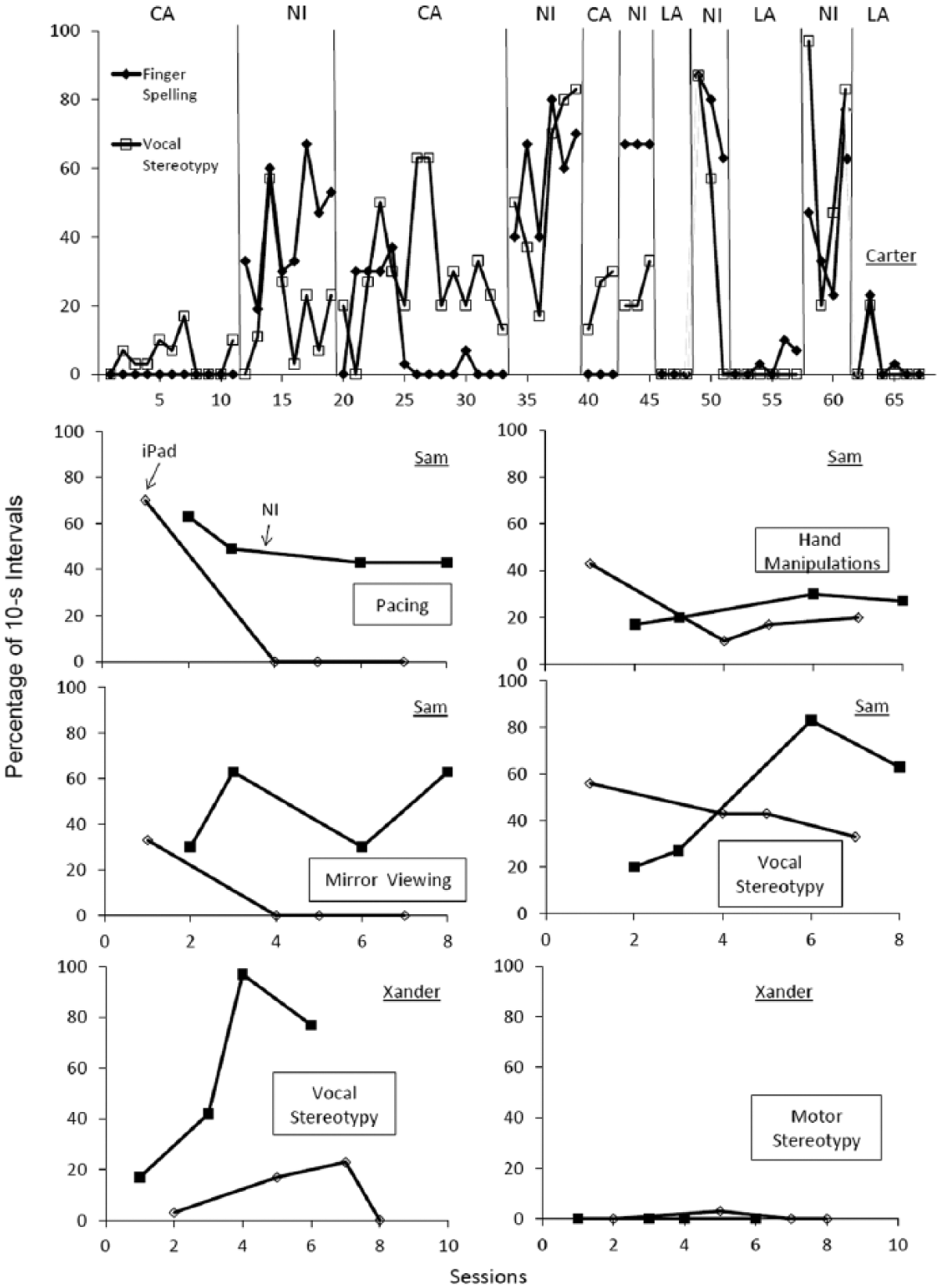
Percentage of 10-s intervals Carter engaged in finger spelling and vocal stereotypy across CA, NI, and LA phases (upper panel); percentage of 10-s intervals Sam engaged pacing, hand manipulations, mirror viewing, and vocal stereotypy (four left and right center panels) across NI and iPad conditions; percentage of 10-s intervals Xander engaged in vocal stereotypy (left, lower panel) and motor stereotypy (right, lower panel) across NI and iPad conditions.
Due to an initial calculation error in Session 51, the fourth NI phase was erroneously discontinued when data paths for both finger spelling and vocal stereotypy depicted decreasing trends. To address this problem, we conducted a fifth NI phase. In the second LA phase, Carter engaged in lower levels of finger spelling (M = 3.3%) and vocal stereotypy (M = 0%). In the fifth NI phase, Carter engaged in high levels of finger spelling (M = 45%) and vocal stereotypy (M = 61.8%). In the third LA phase, Carter again displayed low levels of finger spelling (M = 4.3%) and vocal stereotypy (M = 3.3%). Thus, the Leap Pad decreased both finger spelling and vocal stereotypy, whereas the chalkboard only decreased finger spelling. Based on the findings from this assessment, we opted to use the Leap Pad in the treatment evaluation for Carter.
The four center panels of Figure 2 show that during the NI condition, Sam emitted high levels of pacing (M = 49.5% of intervals), mirror viewing (M = 46.5%), and vocal stereotypy (M = 48.2%), and moderate levels of hand manipulations (M = 23.5%). During the iPad condition, Sam engaged in low levels of pacing (M = 17.5%) and mirror viewing (M = 8.25%), moderate levels of hand manipulations (M = 22.5%), and high levels of vocal stereotypy (M = 43.8%). Based on the reductions produced for pacing (targeted) and mirror viewing (non-targeted), without increasing other non-targeted behavior, we opted to include the iPad in the treatment evaluation for Sam.
The lower panels of Figure 2 show that during the NI condition, Xander emitted high levels of vocal stereotypy (M = 58.2%) and zero levels of motor stereotypy. During the iPad condition, Bentley engaged in lower levels of vocal stereotypy (M = 10.8%) and near-zero levels of motor stereotypy (M = 0.8%) Based on the reductions produced for vocal stereotypy (targeted) without appreciably increasing non-targeted motor stereotypy, we included the iPad in Study 3 for Xander.
Figure 3 shows the results for Bentley. During the NI condition, Bentley emitted moderate levels of vocal stereotypy (upper left panel; M = 28.3%) and facial expressions (lower right panel; M = 25.8%), low levels of spitting (lower left panel; M = 12.5%), and zero levels of spinning (upper right panel). During the iPad condition, Bentley engaged in near-zero levels of vocal stereotypy (M = 3%) and facial expressions (M = 4.3%), and zero levels of spinning and spitting. Although Study 1 showed that Bentley’s spitting decreased to zero levels during NI session (suggesting that it was maintained by a social consequence), this study showed that his spitting (a) persisted at low levels without social consequences and (b) decreased to zero levels when the iPad was present. Based on the reductions produced for vocal stereotypy (targeted) and spitting (non-targeted), without increasing other non-targeted behavior, we used the iPad in the treatment evaluation for Bentley.

Percentage of 10-s intervals Bentley engaged vocal stereotypy (upper left panel), spinning (upper right panel), spitting (lower left panel), and facial expressions (lower right panel) across NI and iPad conditions.
Study 3: Evaluating the Immediate and Subsequent Effects of Preferred Stimulation on Targeted and Non-Targeted Stereotypy
The purpose of this study was to evaluate the subsequent effects of the preferred stimulation on targeted and non-targeted stereotypy. To address this purpose, we used the procedures described by Lanovaz et al. (2010) to conduct a between-sequence analysis involving (a) a NI baseline sequence with three contiguous 5-min components (15 min total) of no social consequences and (b) a test sequence wherein in the preferred stimulus was delivered only during the second component and the first and third components were procedurally identical to the NI sequence. Specifically, we evaluated the subsequent effects of preferred stimulation on each participant’s targeted and non-targeted stereotypy. If the preferred stimulus produced a subsequent increase in the participant’s targeted or non-targeted stereotypy, that item may not be appropriate for use in either NCR or DRO procedures. By contrast, interventions that decrease subsequent engagement in the targeted stereotypy, untargeted stereotypy, or both may produce clinically meaningful changes when implemented on a broader basis (Enloe & Rapp, 2014; Rapp et al., 2013).
Method
Participants, setting, and target behavior
The participants, setting, and target behaviors were the same as described for Study 2.
Data collection and reliability
We collected data on each participant’s behavior and calculated IOA scores in the same manner as described in Study 2. A secondary observer scored 33% or more of the sessions for each participant. Mean IOA scores were 90% or higher for each participant’s behaviors with two exceptions; the IOA scores for Xander’s vocal stereotypy and Bentley’s facial expressions were 88% and 86%, respectively.
Procedures and design
We used multi-element designs combined with three-component multiple schedules (TCMS; Lanovaz et al., 2010) to evaluate the effects of the Leap Pad on Carter’s targeted and non-targeted stereotypy and the iPad on Sam’s, Xander’s, and Bentley’s targeted and non-targeted stereotypy. For the treatment evaluation, an experimenter conducted one sequence (i.e., session), comprised of three 5-min (unless otherwise noted) components per day, twice per week for Bentley; three times per week for Carter and Xander; and five times per week for Sam (due to their availabilities). We conducted a minimum of three sessions with each sequence (described below) for each participant. Sessions continued until either the data paths for the second component (i.e., the immediate effect of the preferred stimulus) of the two sequences were clearly differentiated for the targeted stereotypy for at least three sessions or a maximum of five sessions were conducted with each sequence (this termination criterion was never applied). Sessions were conducted at approximately the same time each day for each participant. Data for each participant were analyzed via visual inspection using the between-sequence analysis described by Lanovaz et al. (2010). Subsequent to completing this analysis with sequences containing 5-min components, we evaluated the extent to which increases in Carter’s subsequent engagement in non-targeted vocal stereotypy could be attenuated using a 2.5-min treatment component (while keeping other components at 5 min).
No interaction (NI) sequence
This sequence consisted of three contiguous 5-min components containing no social interaction. These components were conducted in the same manner as the NI condition in Study 2.
Test sequence
During this sequence, an experimenter conducted the first and third components in the same manner as in the NI sequence. During the second component, the therapist provided Carter with the Leap Pad and Sam, Xander, and Bentley the iPad for the duration of the component. At the end of the second component, the item was removed and the third component immediately commenced.
Results and Discussion
Figure 4 shows the immediate and subsequent effects of the Leap Pad on Carter’s targeted finger spelling and vocal stereotypy during NI and LP sequences containing 5-min second components (upper two rows of panels). During the first components, Carter’s finger spelling was undifferentiated in the NI (M = 53.6%) and LP (M = 58%) sequences. At the same time, Carter’s vocal stereotypy was low and undifferentiated in NI (M = 4.3%) and LP (M = 4.6%) sequences. During the second components, Carter’s finger spelling decreased in the LP sequence (M = 0%) such that it became differentiated from the NI sequence (M = 46.6%). Likewise, his vocal stereotypy was low in the LP (M = 0%) and NI (M = 7%) sequences. During the third components, his finger spelling was again undifferentiated in the NI (M = 43.6%) and LP (M = 46.6%) sequences. By contrast, Carter’s vocal stereotypy differentiated such that it was higher in the LP sequence (M = 62.3%) than in the NI sequence (M = 14.3%). Results of this analysis indicated that the Leap Pad (a) decreased Carter’s immediate engagement in finger spelling without increasing his subsequent engagement in finger spelling and (b) did not increase Carter’s immediate engagement in vocal stereotypy, but did increase his subsequent engagement in vocal stereotypy.
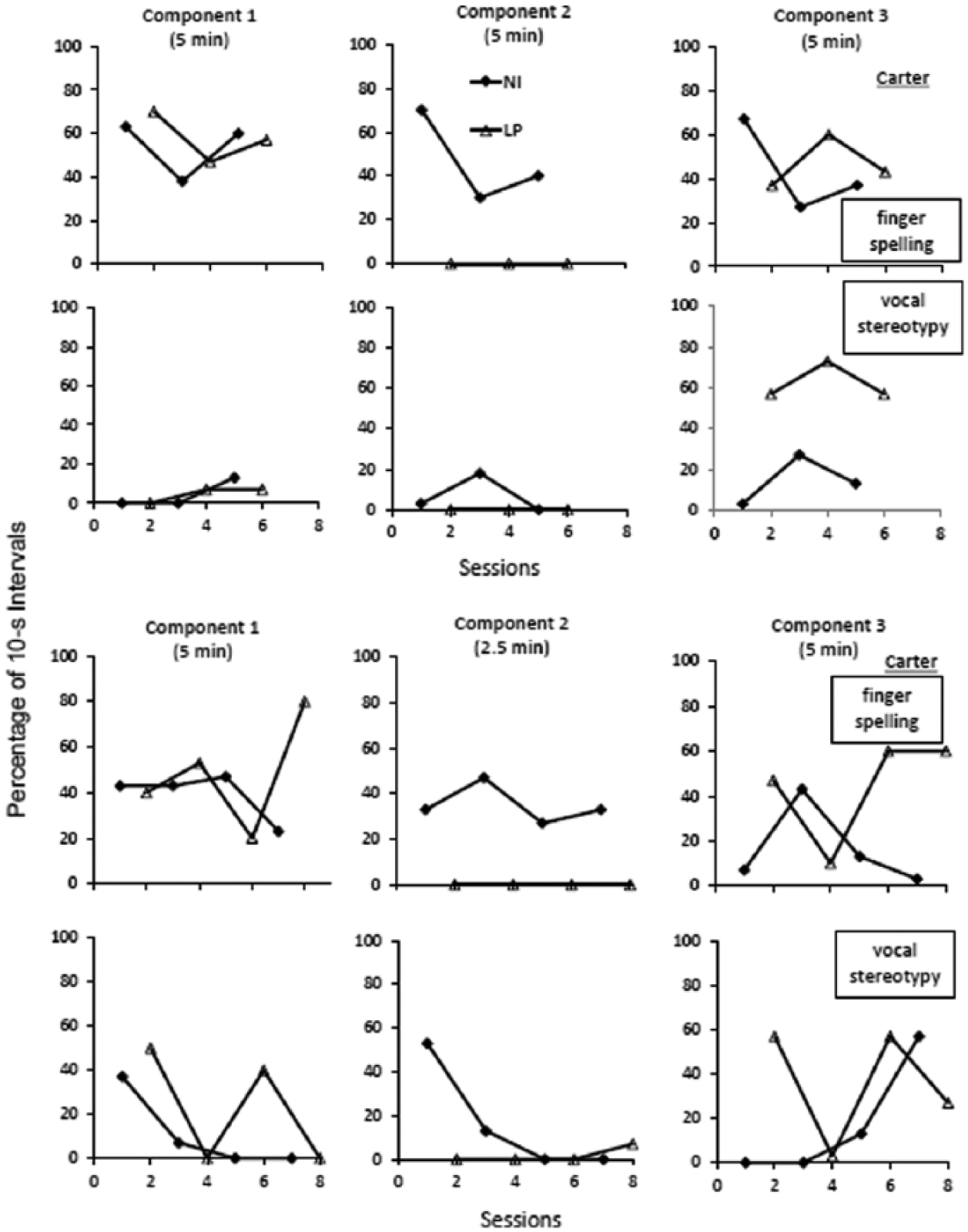
Percentage of 10-s intervals Carter engaged in finger spelling (first row of panels) and vocal stereotypy (second row of panels) across the NI and LP sequences with three 5-min components. Percentage of 10-s intervals Carter engaged in finger spelling (third row of panels) and vocal stereotypy (fourth row of panels) across the NI and LP sequences with a 2.5-min second component and 5-min first and third components.
We conducted another analysis with Carter using 2.5-min second components (Figure 4; lower two rows of panels) to determine if providing him briefer access to the Leap Pad would attenuate the subsequent increase in his vocal stereotypy. As before, Carter’s finger spelling was undifferentiated in the first components of the NI (M = 39%) and LP (M = 48.3%) sequences and his vocal stereotypy was low and also undifferentiated in the NI (M = 11%) and LP (M = 22.5%) sequences. Consistent with the initial analysis, Carter’s finger spelling was differentiated during the second components such that it was absent in the LP sequence (M = 0%) and moderate in the NI sequence (M = 35%), and his vocal stereotypy was low in the LP sequence (M = 1.8%) and decreasing across sessions in the NI sequence (M = 16.5%). During the third components, his finger spelling was variable but undifferentiated across in the NI (M = 16.5%) and LP (M = 44.3%) sequences. Of central interest to this analysis, Carter’s vocal stereotypy was also undifferentiated across the LP (M = 36%) and NI sequence (M = 17.5%) sequences. Results of this analysis suggested that briefer access to the Leap Pad attenuated the subsequent increase in Carter’s vocal stereotypy. Together, the results of both analyses predicted that the Leap Pad could be provided non-contingently (for brief periods) to decrease Carter’s targeted finger spelling without increasing his vocal stereotypy.
Figure 5 shows the immediate and subsequent effects of the iPad on Sam’s targeted pacing (first row of panels), vocal stereotypy (second row of panels), hand manipulations (third row of panels), and mirror viewing (fourth row of panels) during NI and iPad sequences. During the first components, Sam’s pacing, vocal stereotypy, hand manipulations, and mirror viewing were undifferentiated in the NI (Ms = 38.7%, 73.3%, 40%, and 36.7%, respectively) and iPad (Ms = 51%, 60%, 35.3%, and 23%, respectively) sequences. During the second components, levels of Sam’s pacing, vocal stereotypy, hand manipulations, and mirror viewing were lower in the iPad sequence (Ms = 0%, 24.7%, 10%, and 1%, respectively) than in the NI sequence (Ms = 63.3%, 68.7%, 62.3%, and 60%, respectively). During the third components, levels of Sam’s pacing, vocal stereotypy, hand manipulations, and mirror viewing were again generally lower in the iPad sequence (Ms = 12.3%, 49%, 17.7%, and 8%, respectively) than in the NI sequence (Ms = 67%, 72%, 56.7%, and 50%, respectively). Results of this analysis indicated that the iPad (a) decreased Sam’s immediate and subsequent engagement in targeted pacing and (b) decreased Sam’s immediate and subsequent engagement in non-targeted vocal stereotypy, hand manipulations, and mirror viewing to varying extents. These results predicted that the iPad could be provided non-contingently to decrease Sam’s targeted pacing without increasing his immediate or subsequent engagement in non-targeted stereotypy.

Percentage of 10-s intervals Sam engaged in pacing (first row of panels), vocal stereotypy (second row of panels), hand manipulations (third row of panels), and mirror viewing (fourth row of panels) across the NI and iPad sequences with three 5-min components.
Figure 6 shows the immediate and subsequent effects of the iPad on Xander’s targeted vocal stereotypy (upper row of panels) and non-targeted motor stereotypy (lower row of panels) during NI and iPad sequences. During the first components, Xander’s vocal stereotypy was undifferentiated in the NI (M = 54.3%) and iPad (M = 64.7%) sequences. At the same time, Xander’s motor stereotypy was low and undifferentiated in NI (M = 8%) and iPad sequences (M = 3.3%). During the second components, Carter’s vocal stereotypy decreased in the iPad sequence (M = 9.7%) and became differentiated from the NI sequence (M = 71.3%). Similarly, his motor stereotypy remained low in the iPad (M = 1%) and NI (M = 5.7%) sequences. During the third components, his vocal stereotypy increased but was again undifferentiated in the NI (M = 76.7%) and iPad (M = 59%) sequences. As before, his motor stereotypy remained low and undifferentiated across the iPad (M = 9%) and NI (M = 5.7%) sequences. Results of this analysis indicate that the iPad (a) decreased Xander’s immediate engagement in vocal stereotypy without increasing his subsequent engagement in vocal stereotypy and (b) did not increase his immediate or subsequent engagement in motor stereotypy. These results predicted that the iPad could be provided non-contingently to decrease Xander’s targeted vocal stereotypy without increasing non-targeted behavior.
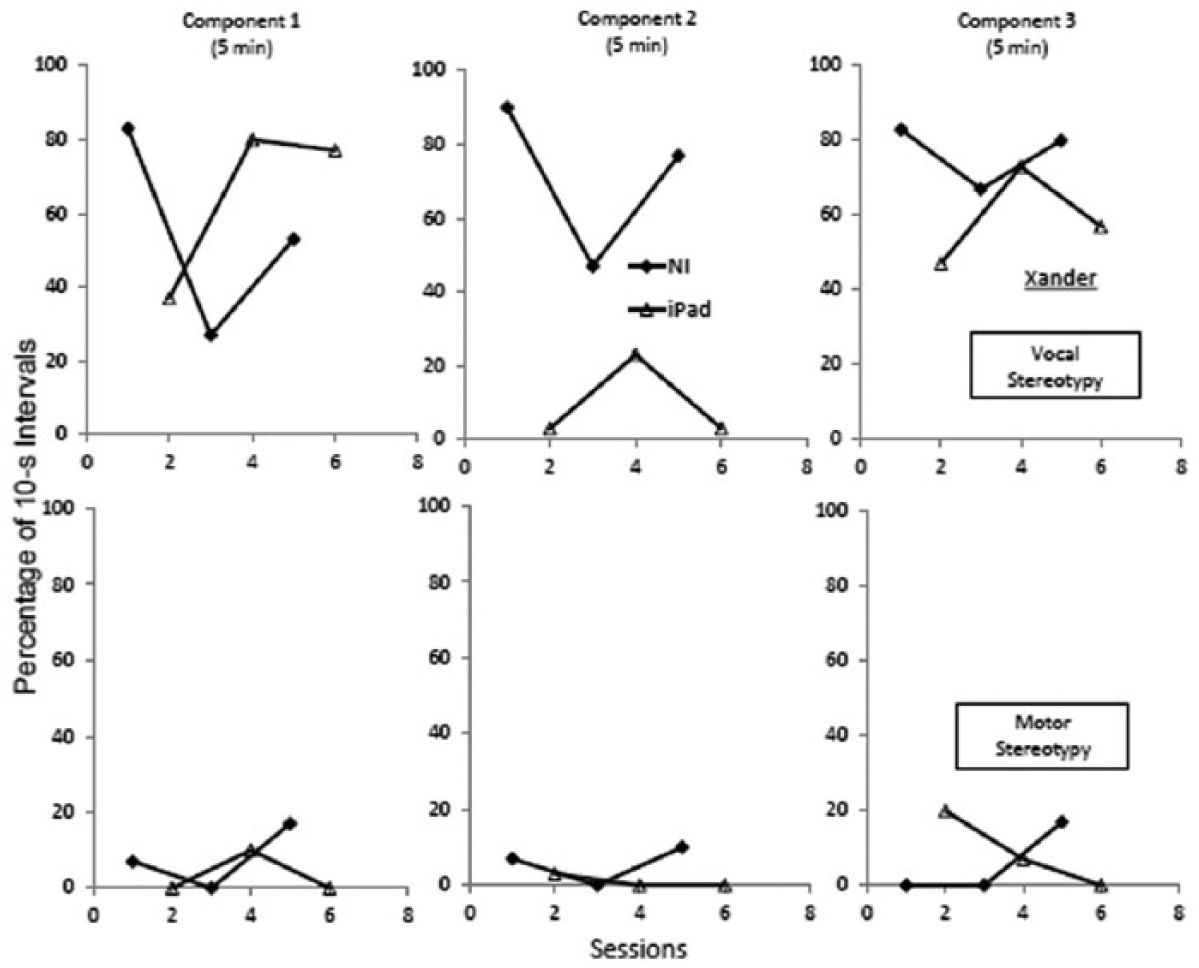
Percentage of 10-s intervals Xander engaged in vocal stereotypy (upper row of panels) and motor stereotypy (lower row of panels) across the NI and iPad sequences with three 5-min components.
Figure 7 shows the immediate and subsequent effects of the iPad on Bentley’s targeted vocal stereotypy (first row of panels), spitting (second row of panels), spinning (third row of panels), and facial expressions (fourth row of panels) during NI and iPad sequences. During the first components, Bentley’s vocal stereotypy, spitting, spinning, and facial expressions were undifferentiated in the NI (Ms = 15%, 6.5%, 0%, and 32.3%, respectively) and iPad (Ms = 11%, 13.3%, 4.3%, and 49%, respectively) sequences. During the second components, levels of Bentley’s vocal stereotypy, spitting, spinning, and facial expressions were lower in the iPad sequence (Ms = 11%, 0%, 0%, and 13.3%, respectively) than in the NI sequence (Ms = 34.3%, 12.5%, 10%, and 33.3%, respectively). During the third components, levels of Bentley’s vocal stereotypy, spitting, spinning, and facial expressions were again generally lower in the iPad sequence (Ms = 11.3%, 2%, 0%, and 28%, respectively) than in the NI sequence (Ms = 20.8%, 9%, 12.5%, and 30%, respectively); however, none of the data paths was clearly differentiated. Results of this analysis indicated that the iPad (a) decreased Bentley’s immediate and subsequent engagement in targeted vocal stereotypy and (b) decreased Bentley’s immediate engagement, without increasing subsequent engagement, in non-targeted spitting, spinning, and facial expressions. These results predicted that the iPad could be provided non-contingently to decrease Bentley’s targeted vocal stereotypy without increasing non-targeted behavior.

Percentage of 10-s intervals Bentley engaged in vocal stereotypy (first row of panels), spitting (second row of panels), spinning (third row of panels), and facial expressions (fourth row of panels) across the NI and iPad sequences with three 5-min components.
Study 4: Decreasing Targeted and Non-Targeted Stereotypy With Functionally Matched Stimulation Using Trial-Based DRO Procedures
As an alternative to sessions with fixed durations of 5 or 10 min, Cook, Rapp, and Schulze (2015) described the application of a trial-based differential negative reinforcement of other behavior (DNRO) procedure for increasing compliance with wearing a medical bracelet for a child with autism. Specifically, the DNRO procedure involved removal of the bracelet contingent on the omission of problem behavior during the pre-specified interval duration. Following a baseline phase, the authors began DNRO with a 5-s interval and gradually thinned the DNRO schedule to several hours.
Similarly, the purpose of this study was to systematically increase the DRO interval, wherein the functionally matched stimulus identified in Study 3 was delivered contingent on the omission of the targeted stereotypy, to a practical variation for each participant. We used either the latency to engagement in targeted stereotypy (a negative trial) or the omission of the targeted stereotypy (a positive trial) as the primary dependent variable for each trial. Thomasson-Sassi, Iwata, Neidert, and Roscoe (2011) found an inverse relation between response rate and response latency such that a longer latency to the onset of problem behavior generally predicted lower rates of problem behavior. This finding suggests that latency may be used as an index of response rate or duration. In this way, we were also able to evaluate the effects of increasing the DRO intervals on non-targeted stereotypy.
Method
Participants, setting, and target behavior
Carter, Sam, and Xander participated in this study. The setting and target behaviors were the same as described for Study 3. For Xander, we also scored problem behavior, which was defined as crying or shouting (talking above conversational volume), throwing items, striking a therapist with his hands or feet, or contact of Xander’s back with the floor (i.e., flopping).
Data collection and reliability
We collected data on the latency to the participants’ engagement in targeted stereotypy, non-targeted stereotypy, and problem behavior (Xander only). Observers began to score latency for each trial immediately after providing the initial instruction and starting the timer (which the participant could also view). A secondary observer collected data on the latency to engagement in each behavior for at least 69% of trials for each participant. An agreement was scored when the total latency duration for each trial recorded by the primary and secondary observers was within 3 s. For each target behavior, the IOA score for latency was calculated by dividing the number of agreements across trials by the number of agreements plus disagreements and multiplying by 100%. Mean IOA scores were 87% or higher for each participant with one exception; the mean IOA score for Sam’s hand manipulations was 83%.
Procedures and design
We used a changing criterion design to evaluate the effects of a DRO procedure with progressively longer intervals on each participant’s targeted and non-targeted behavior. The initial DRO criterion was based on the mean latency to engagement in the targeted stereotypy during the baseline phase. Although there was some variability in the manner we thinned the DRO schedule across participants (see Xander below), we applied three general rules to the DRO trials. First, we based the initial DRO criterion (i.e., subphase) on the mean interresponse time (IRT) from the baseline trials. Second, to establish a history of accessing the preferred item for omitting the target behavior, we set the second criterion so that it was a modest increase from the first criterion, but still lower than the mean IRT from baseline trials. Third, to reach the terminal criterion with approximately eight subphases, we either doubled (in early subphases) or added 60 s to (in later subphases) the most recently achieved criterion. When participants had met the performance criterion for five consecutive trials, we implemented the next DRO subphase. The terminal DRO interval was set at 600 s for Carter, 300 s for Sam, and 120 s for Xander. When Xander failed to meet a criterion for 10 or more consecutive trials, we returned to the previously successful criterion. When Xander again failed to meet criterion for 10 or more consecutive trials, we modified one or more antecedents (described below) to increase the probability that he would meet the criterion.
Baseline
Trials in this phase were identical to the NI condition that was used in Studies 1, 2, and 3. Each trial began when the therapist entered the room with the participant. Therapists conducted baseline trials during 10-min blocks across 1 day for Carter and Xander and 2 days for Sam. Each trial ended either (a) when the participant emitted the targeted stereotypy or (b) 10 min elapsed for Carter, 5 min elapsed for Sam, and 2 min elapsed for Xander. Once the participant’s bout of targeted stereotypy ceased, the therapist initiated the next trial. This process continued until the latency to engagement in the participant’s targeted stereotypy was stable for at least five consecutive trials.
Baseline plus chair (BL + chair) (Sam only)
Trials in this phase were identical to trials in the baseline phase except that a chair was available for Sam (to address his targeted pacing).
Differential reinforcement of other behavior plus response interruption (DRO + RI)
Each trial in this phase began with a therapist providing the instructions “If you keep your hands down for X seconds, you can have the Leap Pad” for Carter, “If you sit nicely for X seconds, you can have the iPad” for Sam, and “No silly talk for X seconds, you can have the iPad” for Xander. In addition, each trial for Sam began after he was seated in a chair. Thereafter, the therapist set the timer for the predetermined interval and placed it in clear view of the participant. If the participant did not display the targeted stereotypy (finger spelling for Carter, pacing for Sam, and vocal stereotypy for Xander), the therapist provided access to the functionally matched preferred item (Leap Pad for Carter and iPad for Sam and Xander).
The duration of access to the preferred item varied as a function of the duration of the DRO subphase for Carter and Sam. Specifically, the therapist provided Carter with 20 s of access for DRO 25 s to DRO 120 s, 30 s of access for DRO 180 s to DRO 300 s, and 60 s of access for DRO 420 s to DRO 600 s. For Sam, the therapist provided 20 s of access for DRO 4 s to DRO 32 s, 30 s of access for DRO 60 s to the first five trials of DRO 300 s, and 60 s of access for the last 10 trials of DRO 300 s. The therapist inadvertently terminated session 99 after 297 s; this was considered as a positive trial. For Xander, the therapist always provided 60-s access to the iPad for a positive trial. In part, we used the longer access to attenuate Xander’s problem behavior that was typically evoked by removal of the iPad during early trials with briefer access. If the participant displayed the targeted stereotypy before the time elapsed, the therapist verbally interrupted the targeted stereotypy (for Sam, the therapist also gave a verbal prompt to sit in the chair), reset the timer, and re-issued the instruction (e.g., “Remember, keep your hands down for 1 min, and you can have the Leap Pad”). The therapist then immediately began the next trial. The purpose of interrupting instances of the target stereotypy was to (a) decrease the amount of time required to train each participant and (b) prevent the production of the stimulation that supported the target stereotypy. There were no programmed consequences for engaging in non-targeted stereotypy. Xander did not reach his terminal DRO interval during this treatment phase. Thus, we evaluated the effects of additional procedures for him.
NCR (Xander only)
After 156 trials, Xander was not able to advance beyond DRO 30 s. As Xander consistently engaged in relatively short latencies to engagement in vocal stereotypy, we evaluated the extent to which Xander could abstain from engaging in vocal stereotypy under ideal conditions. Thus, during this phase the therapist provided Xander continuous access to the iPad. Each trial in this phase was 60 s in duration. Xander never engaged in vocal stereotypy during trials in this phase; however, if Xander had engaged in vocal stereotypy before the 60-s trial elapsed, the observer would have scored the latency to the first instance of vocal stereotypy and allowed Xander to retain the iPad for the remainder of the 60-s trial.
DRO plus tokens or demands (Xander only)
Based on Xander’s consistent engagement in problem behavior when the iPad was restricted (e.g., after the access period for a positive trial elapsed) and after the initial instructions were provided, we hypothesized that Xander also displayed problem behavior to gain access to the iPad. Thus, the therapist did not provide verbal instructions to Xander at the beginning of each trial. In addition, Xander was required to omit both the targeted stereotypy and problem behavior 1 for the stated interval to meet the DRO criteria. As before, Xander’s engagement in non-targeted motor stereotypy did not affect the DRO contingency. After we re-established baseline at trial 170, a therapist provided one token for every 5 s (DRO 5 s to 25 s) or 7 s (DRO 35 s) to serve as conditioned reinforcers, which were exchangeable for iPad access when the DRO interval was achieved. After Xander failed to achieve DRO 35 s, we removed the token component and inserted academic demands. Specifically, to increase the probability that Xander would not engage in problem behavior during the trials, we superimposed the DRO schedule on Xander’s regular academic instruction. During academic demands (tacting of common objects and receptive object identification), therapists used verbal prompts with a 5-s constant time delay and provided brief praise for both prompted and independent correct responses.
Results and Discussion
Figure 8 shows the results of the trial-based DRO + RI procedures for Carter’s targeted finger spelling (upper panel) and non-targeted vocal stereotypy (lower panel). We conducted 13 trials in one day in the baseline phase. Thereafter, therapists introduced DRO + RI with a 25-s criterion, and gradually increased the criterion to 600 s during 104 trials conducted over 8 non-consecutive days. During the baseline phase, the mean latency to Carter’s engagement in finger spelling and vocal stereotypy were 49.7 s and 19 s, respectively. During the 600-s DRO + RI subphase, the mean latencies to his engagement finger spelling and vocal stereotypy increased to 575.3 s and 471 s, respectively. These results indicate that 10-min DRO decreased Carter’s targeted finger spelling and non-targeted vocal stereotypy. This outcome was predicted by the results in Studies 2 and 3 for Carter.

Latency in seconds to Carter’s engagement in finger spelling (targeted; upper panel) and vocal stereotypy (non-targeted; lower panel) across baseline and differential of other behavior plus response interruption (DRO + RI) trials.
Figure 9 shows the results of the trial-based DRO + RI procedures for Sam’s targeted pacing (upper panel) and non-targeted hand manipulations, mirror viewing, and vocal stereotypy (lower panel). Therapists conducted 26 trials in the baseline phase across two non-consecutive days. Next, therapists conducted five trials in the BL + Chair phase on 1 day. Thereafter, therapist introduced DRO + RI with a 4-s criterion and systematically increased the criterion to 300 s during 69 trials conducted over 5 non-consecutive days. During the baseline phase, the mean latency to Sam’s engagement in pacing, hand manipulations, mirror viewing, and vocal stereotypy were 10.1 s, 8.6 s, 4.2 s, and 3.7 s, respectively. During the BL + Chair phase, the latencies to Sam’s targeted and non-targeted stereotypy were unchanged. During the 300-s DRO + RI subphase, the mean latency to his engagement in pacing, hand manipulations, mirror viewing, and vocal stereotypy increased to 218 s, 55.2 s, 218 s, and 13.4 s, respectively. The results indicate that 5-min DRO decreased Sam’s targeted pacing and non-targeted mirror viewing and hand manipulations (vocal stereotypy was unchanged). Specifically, results from the last five trials at the terminal criterion show consistently increased latencies for mirror viewing and hand manipulations. As with Carter, the outcome for Sam’s behavior was predicted by the results of Studies 2 and 3.

Latency in seconds to Sam’s engagement in pacing (targeted; upper panel) and hand manipulations, mirror viewing, and vocal stereotypy (non-targeted; lower panel) across BL, BL plus chair, and differential of other behavior plus response interruption (DRO + RI) trials.
Figure 10 shows the results of the trial-based DRO procedures for Xander’s targeted vocal stereotypy (upper panel), targeted problem behavior (lower panel), and non-targeted motor stereotypy (lower panel). After neither the initial intervention nor a slightly modified intervention was successful for increasing the latency of Xander’s vocal stereotypy (results for Trials 1 through 169 are available from the first author), we re-established the baseline phase (10 trials in one day; the mean latency to vocal stereotypy was 8.8 s). During the first NCR 60-s phase, Xander met the criterion for five consecutive 60-s trials. During the DRO 40-s phase (this criterion was set to be 5 s higher than Xander’s most success trial duration), he failed to meet the criterion after ten 40-s trials. During the second NCR 60-s phase, Xander again met the criterion for five consecutive 60-s trials. Results from these trials confirmed that Xander could abstain from engaging in vocal stereotypy when the functionally matched preferred stimulus was continuously available. During the DRO (vocal stereotypy and problem behavior) plus token phase, Xander progressed up to 25-s; however, he failed to achieve that 35-s criterion after 20 trials. Subsequently, we implemented the DRO (vocal stereotypy and problem behavior) plus Demand phase wherein Xander rapidly progressed from DRO 25 s to 120 s (we deliberately conducted additional trials at the 80-s criterion). Xander failed eight trials (primarily between sessions 170 and 176) due to problem behavior; the other failed trials were due to vocal stereotypy. The last eight trials were conducted using DRO 120 s in Xander’s therapy room during his typical instructional periods. During these trials, therapist delivered an average of 14 demands per min. The lower panel shows that Xander’s non-targeted motor stereotypy did not increase during DRO for vocal stereotypy and problem behavior. Consistent with Carter and Sam, the outcome for Xander’s behavior was predicted by the results from Studies 2 and 3.
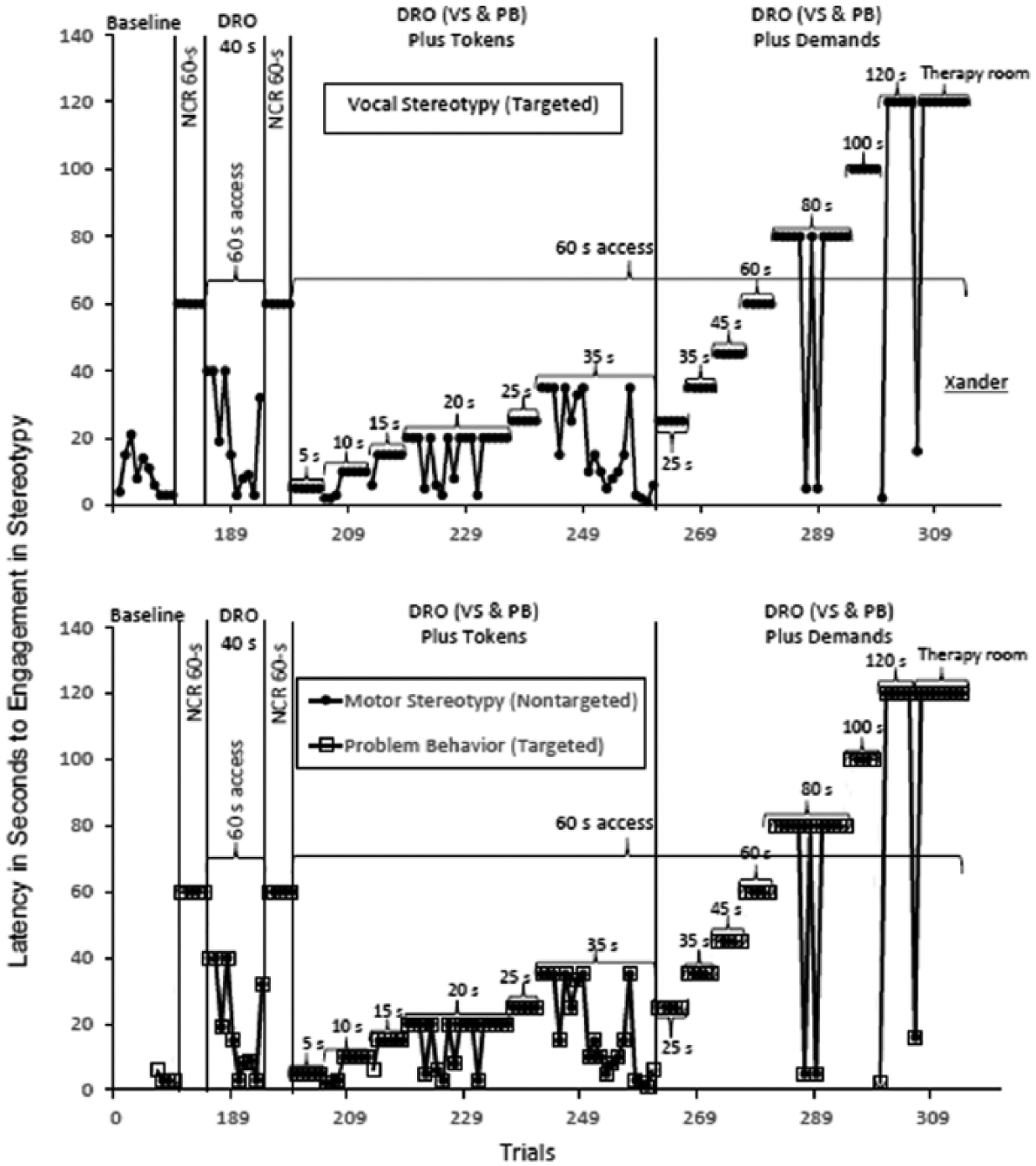
Latency in seconds to Xander’s engagement in VS (targeted; upper panel) and PB (targeted; lower panel) and motor stereotypy (non-targeted; lower panel) across BL, NCR, and DRO, DRO plus tokens, and DRO plus demands trials.
General Discussion
Study 1 showed that each of the four participants’ highest probability repetitive behavior persisted in the absence of social consequences, thereby meeting the structural and functional definition of stereotypy. Study 2 showed that preferred, structurally matched stimulation decreased each participant’s targeted and non-targeted stereotypy and provides additional support for decreasing multiple forms of stereotypy during leisure periods using non-contingent, structurally matched preferred stimulation. Study 3 showed that for Sam, Xander, and Bentley, non-contingent access to preferred stimulation decreased immediate and subsequent engagement in their targeted and non-targeted stereotypy. For Carter, non-contingent access to preferred stimulation decreased immediate engagement in the targeted pacing, but increased subsequent engagement in non-targeted vocal stereotypy. The subsequent increase in Carter’s vocal stereotypy was attenuated when the duration of the second component was reduced from 5 min to 2.5 min. The results of Study 3 provide additional support for the clinical utility of the procedures described by Lanovaz et al. (2010) for detecting changes in MOs after an intervention has been removed. Study 4 showed that a trial-based DRO procedure systematically increased the period of time for which the targeted and non-targeted stereotypy was not displayed to 2 min for Xander, 5 min for Sam, and to 10 min for Carter. For all three participants, the effects of DRO on targeted and non-targeted stereotypy in Study 4 were correctly predicted by the results of Studies 2 and 3. To our knowledge, this is one of only a handful of studies to successfully employ a trial-based DRO or DNRO procedure. Tiger et al. (2009) suggested that the published use of DRO for treating problem behavior “has decreased greatly in recent years” (p. 315). Study 4 provides a unique methodology for increasing the DRO interval that may help reverse this trend.
From a clinical perspective, we recommend that practitioners who endeavor to decrease stereotypy during either leisure or instructional period utilize the procedures that were described in each of the four studies. To conserve time, practitioners could forgo the competing stimulus assessment (the second part of Study 2), which evaluated only the immediate effects of the preferred item, and proceed to the TCMS analysis (Study 3), which evaluated both immediate and subsequent effects. To this end, it is likely that the DRO procedure was ultimately effective because the preferred stimulus was functionally matched to the product of the targeted stereotypy.
The effects of the DRO procedure on the participants’ non-targeted stereotypy are particularly noteworthy given that (a) prior studies of stereotypy with children with ASD have shown that behavioral interventions often decrease one form of stereotypy but simultaneously increase other forms of stereotypy (e.g., Cook et al., 2014; Rapp et al., 2013; Rapp, Vollmer, Dozier, St. Peter, & Cotnoir, 2004; for a review, see Lanovaz, Robertson, Soerono, & Watkins, 2013) and (b) a basic study with humans by Jessel, Borrero, and Becraft (2015) and an applied study with horses by Fox, Bailey, Hall, and St. Peter (2012) found that non-targeted behavior often increased during DRO procedures.
Although Study 4 was not designed to isolate a specific behavioral mechanism to account for the covarying behavior decreases that were produced with DRO for Sam and Carter, at least three broad accounts are plausible. First, decreases in non-targeted stereotypy are a direct function of altering the stimulation that was provided for the targeted stereotypy. That is, the sensory stimulation that was produced by engaging in the targeted and non-targeted forms of stereotypy functioned as complementary reinforcers (e.g., Rapp et al., 2004). Thus, withholding or otherwise preventing the production of reinforcing stimulation contingent on engagement in the high-probability targeted stereotypy functioned as an AO for engagement in less probable response forms during the DRO interval. Second, it is possible that response interruption provided contingent on the targeted stereotypy was temporally proximal to non-targeted stereotypy (e.g., Lerman, Kelley, Vorndran, & Van Camp, 2003). In this way, response interruption may have simultaneously punished the targeted and non-targeted stereotypy. Third, the participants may have followed a simple rule or their behavior was under the stimulus control of the timer. Nevertheless, the fact all three participants continued to emit non-targeted stereotypy (though infrequently) during lengthier DRO intervals suggests that neither punishment via response interruption nor instructional control accounts for the indirect behavior changes produced with DRO.
In general, the purpose of using the TCMS is to determine whether the preferred items generate stimulation that is functionally similar to the stimulation generated by engaging in stereotypy. Using this method, researchers and practitioners may be able to approximate the same outcome that is produced with behavioral interventions for socially reinforced behavior. In Study 4, the functional reinforcer for non-socially reinforced problem behavior (in this case, stereotypy) was no longer available contingent on said behavior (due to response interruption) but, instead, was provided following the omission of behavior (via engagement with the functionally matched preferred stimulus). In this way, the DRO procedure arguably included a conjoint differential reinforcement of alternative behavior component because the consequence for completing the DRO requirement was access to either the Leap pad (Carter) or iPad (Sam and Xander) for a pre-specified period of time. Thereafter, participants needed to manipulate their device to generate stimulation that was functionally similar to their stereotypy. Given this response requirement, it is possible that this intervention was successful because the participants controlled the non-social consequence of their appropriate behavior in a manner that was similar to how they produced non-social consequences when they engaged in stereotypy. Put differently, we suspect that simply watching or listening as another individual played with the Leap Pad and iPad would not have produced the same reductions in targeted stereotypy for these participants. Based on the results for these four participants, we recommend that practitioners who are treating stereotypy with non-contingent or contingent access to electronic devices (such as iPads) allow the respective individuals to have free access to numerous programs and applications.
Using a concurrent operants design, Stangeland, Smith, and Rapp (2012) found that three of four individuals with autism preferred to engage in object stereotypy (e.g., object twirling) as opposed to watching an experimenter engage in the same behavior at a rate that was yoked to the participant’s behavior. Future research could employ similar procedures to determine if (a) individuals prefer to control the stimulation that is provided as an alternative to stereotypy as opposed to receiving it passively (without a response requirement) and (b) treatment effects for targeted and non-targeted stereotypy are different when participants are or are not permitted to control the alternative stimulation.
Some limitations from this series of studies should be noted. First, it is possible that the same outcome could have been produced using DRO with preferred stimulation that was not functionally matched to the targeted stereotypy. Future research should determine the extent to which functionally matched preferred stimuli produce better outcomes than arbitrary preferred stimuli in DRO procedures for automatically reinforced behavior. Second, in Study 3 our experimental design did not unequivocally demonstrate that the elimination of the subsequent increase in Carter’s vocal stereotypy was attributable to the duration of the second component. Such a demonstration would have required another series of three to five sessions with each sequence. Nevertheless, the results of Study 4 showed that the 10-min DRO with brief (1-min) contingent access to the Leap Pad decreased Carter’s finger spelling and vocal stereotypy. Third, we did not directly evaluate the extent to which academic instructions could be included during the DRO intervention for either Sam or Carter; however, their therapists reported that they successfully used the procedures (in conjunction with contingent praise and edibles for correct responding) while implementing academic instructions with each participant. In addition, therapists reported that they gradually extended the DRO interval beyond 15 min with the consultation of the second author. Relatedly, it is possible that therapists’ demands alone, without the DRO procedures, would have decreased Xander’s stereotypy. Nevertheless, Xander’s failed trials at the 80-s and 120-s criteria, followed by consecutive positive trials, suggest that the DRO procedures contributed to the observed reductions in his targeted stereotypy.
Future research should evaluate the extent to which the trial-based DRO procedure leads to more rapid behavior changes than typical session-based DRO procedures. Producing more rapid behavior change may increase the practical utility of DRO by decreasing practitioners’ effort (Tiger et al., 2009). Likewise, the decreases in non-targeted stereotypy that we observed in Study 4 could make DRO a more practical intervention to implement; however, it is not clear if this effect is specific to when treatment is provided for the highest probability stereotypy. Thus, future research should also address this question.
Footnotes
Declaration of Conflicting Interests
The author(s) declared no potential conflicts of interest with respect to the research, authorship, and/or publication of this article.
Funding
The author(s) received no financial support for the research, authorship, and/or publication of this article.