



Abstract
One potential limitation of functional communication training (FCT) is that after the functional communication response (FCR) is taught, the response may be emitted at high rates or inappropriate times. Thus, schedule thinning is often necessary. Previous research has demonstrated that multiple schedules can facilitate schedule thinning by establishing discriminative control of the communication response while maintaining low rates of problem behavior. To date, most applied research evaluating the clinical utility of multiple schedules has done so in the context of behavior maintained by positive reinforcement (e.g., attention or tangible items). This study examined the use of a multiple schedule with alternating Fixed Ratio (FR 1)/extinction (EXT) components for two individuals with developmental disabilities who emitted escape-maintained problem behavior. Although problem behavior remained low during all FCT and multiple schedule phases, the use of the multiple schedule alone did not result in discriminated manding.
Functional analysis of problem behavior is considered to be the gold standard in assessment of severe behavior disorders (Carr & Fox, 2009). When functional analysis results indicate behavioral maintenance by way of a social function, functional communication training (FCT; Carr & Durand, 1985) is commonly used. FCT typically involves differential reinforcement of an alternative (DRA), communication response and extinction for problem behavior. FCT is one of the most experimentally evaluated and commonly used interventions in clinical practice (Tiger, Hanley, & Bruzek, 2008). Moreover, FCT meets and exceeds the American Psychological Association recommendations to be designated as a well-established treatment for problem behavior emitted by children diagnosed with an intellectual or developmental disability (Kurtz, Boelter, Jarmolowicz, Chin, & Hagopian, 2011). Although the effectiveness of FCT has been widely documented, one potential limitation of FCT is that once the alternative response is taught, individuals may emit the alternative response at excessive rates (e.g., request a break after every demand) or at inappropriate times (e.g., request attention during a medical visit). Therefore, schedule thinning is often necessary. One method of schedule thinning that has proven to be effective is the use of a multiple schedule to establish discriminative control of the communication response. For example, Hanley, Iwata, and Thompson (2001) evaluated the use of a multiple schedule to thin the schedule of positive reinforcement during treatment for three individuals who engaged in self-injurious behavior (SIB) maintained by tangible items, food, or attention. The multiple schedule was composed of a Fixed Ratio 1 (FR 1) and an extinction (EXT) component each with a distinct schedule-correlated stimulus. Sessions were 10 to 12 min and the duration of the EXT component was gradually increased until a terminal goal of FR 1 60 s/EXT 240 s was reached. SIB remained low across both FR 1 and EXT components. Furthermore, the alternative response occurred at a moderate, steady rate during the reinforcement component and at near-zero rates during the EXT component.
In a more recent investigation, Betz, Fisher, Roane, Mintz, and Owen (2013) used a multiple schedule to decrease excessive mands for tangible items emitted by four children diagnosed with a developmental disability. The experimenters compared rates of a functional communication response (FCR) and problem behavior under mixed and multiple schedule arrangements. The multiple schedule consisted of two components (SD and SΔ) that alternated rapidly. Each component was 60 s in duration, presented with a specific schedule-correlated stimulus, and components were introduced in a semi-random order. The mixed schedule was similar, except there were no schedule-correlated stimuli. The multiple schedule produced decreases in problem behavior and discriminated manding up to the terminal schedule of 240 s EXT. However, problem behavior persisted at baseline levels and discriminated manding did not emerge during the mixed schedule arrangement.
Although multiple schedules have been demonstrated to be an effective method of schedule thinning across a variety of applied contexts (Hagopian, Fisher, Sullivan, Acquisto, & LeBlanc, 1998; Shirley, Iwata, Kahng, Mazaleski, & Lerman, 1997; Tiger & Hanley, 2004), much of the previous research has involved a positive reinforcement contingency during the reinforcement component. In a recent review, Hagopian, Boelter, and Jarmolowicz (2011) reported on five studies that evaluated eight applications of multiple schedules. Of the eight applications, seven involved a positive reinforcement contingency in the form of an attention or tangible function for problem behavior. The other study involved treatment of problem behavior maintained by an idiosyncratic function (i.e., termination of “do” requests). One notable exception is a recent study by Fisher, Greer, Querim, and DeRosa (2014). Fisher et al. evaluated a multiple schedule consisting of FR 1 and EXT components with four children with developmental disabilities who engaged in escape-maintained problem behavior. Reinforcement and EXT components were 60 s in duration for all participants with the exception of one participant for whom EXT was 30 s. Furthermore, each component was signaled with a distinct stimulus (e.g., wristband), and contingency rules were provided for three of the participants. The multiple schedule did not produce discriminated manding for any of the four participants and problem behavior remained high. Therefore, the experimenters implemented response restriction (RR) FCT schedule thinning. The RR FCT condition was similar to the multiple schedule FCT condition in that periods of reinforcement-available and reinforcement-unavailable were alternated within a session. However, during the RR FCT reinforcement-unavailable condition, the FCT card was not present; thus, the FCR could not occur. In addition, there were no schedule-correlated stimuli. Results of Fisher et al. demonstrated that RR FCT was successful in establishing discriminated manding and reducing problem behavior, which the multiple schedule failed to produce for those participants.
Given the prevalence of negatively reinforced problem behavior (Iwata et al., 1994) and the strong support for the use of multiple schedules to thin the schedule of reinforcement during FCT (Hagopian et al., 2011), further research is warranted on the application of multiple schedules in this context. Previous research has demonstrated that when FCT alone is not effective in reducing the target problem behavior, FCT can be supplemented with alternative reinforcement or punishment procedures to produce clinically significant treatment effects not observed with FCT alone (Rooker, Jessel, Kurtz, & Hagopian, 2013). For example, Harding, Wacker, Cooper, Millard, and Jensen-Kovalan (1994) evaluated a treatment package involving DRA for compliance and FCT for requests for assistance during an academic context and found that the combined treatment components produced decreases in problem behavior. Although additional treatment components have been widely evaluated in previous FCT research, little is known about the extent to which these treatment components influence other members of the response class (e.g., mands for the functional reinforcer). In a recent case series analysis, Rooker et al. (2013) reported that alternative reinforcement was used in the context of a multiple schedule for two of the 58 cases evaluated. However, data were not reported on the alternative response. Therefore, the purpose of this study was to (a) further evaluate the use of a multiple schedule with alternating FR 1/EXT components to thin the schedule of negative reinforcement during discrete trial sessions and (b) evaluate if additional treatment components (i.e., reinforcement for compliance) would facilitate schedule thinning in this context.
Method
Participants and Setting
Mike was an 11-year-old male diagnosed with autism spectrum disorder, and Bruno was a 22-year-old male diagnosed with an intellectual disability and autism spectrum disorder. Both participants were referred for assessment and treatment of problem behavior (i.e., aggression, disruption, and self-biting). Sessions took place at the university-based clinic or at the participant’s home. Session rooms contained one table, one couch, two chairs, and session materials (i.e., break card, red card for Mike, dual color light box for Bruno, colored blocks, colored buckets, small colored bears, matching cards, papers, and crayons). Rooms were equipped with one-way mirrors. Sessions were 10 min in duration and were conducted two to six times daily, 1 to 3 days per week for Mike and 4 to 5 days per week for Bruno.
Response Measurement, Interobserver Agreement, and Independent Variable Integrity
Trained observers collected data on iPads® and iPhones® using ABC data pro®, a data collection system designed to score behavioral data in real time. We collected data on the frequency of problem behavior, the FCR, and compliance. Mike’s problem behavior was (a) aggression, defined as kicking or hitting others, and (b) disruption, defined as throwing items not within 2 feet of a person or breaking items. Bruno’s problem behavior was self-biting, defined as closure of his teeth on any part of his hand, arm, or fingers. The FCR for both participants was an exchange response and consisted of placing a card that read, “break” in the experimenter’s hand. Both attempts and successes were scored. For Mike, the break card was placed on the table within arm’s reach. For Bruno, due to some fine-motor difficulties, the break card was affixed to a lanyard around his waist that allowed him to use both hands to exchange it. Every time Bruno provided the card to the experimenter, the experimenter received the card and placed it back on his lanyard. Last, compliance was defined as completing the experimenter’s request following a verbal or model prompt. The frequency of compliance was divided by the frequency of experimenter prompts and was converted to a percentage of trials with compliance. In addition to participant behavior, we collected data on delivery of breaks as a measure of independent variable integrity. Interobserver agreement was assessed by having a second observer independently collect data either simultaneously or via video recording of the session. Observers’ records were compared on an interval-by-interval basis (Mudford, Taylor, & Martin, 2009). Intervals were 10 s. Intervals in which both observers scored the exact same number of responses (including zero) were assigned a value of 1. Intervals for which both observers scored at least one response but the numbers differed, agreement was calculated by diving the smaller number of responses in each interval by the larger number of responses. Intervals for which only one observer scored a response were assigned a value of 0. The values were then summed, divided by the total number of intervals and multiplied by 100%. Agreement data were collected for Mike during 34.62% of sessions and Bruno during 34.15% of sessions. For Mike, mean interobserver agreement for FCR during functional communication (FC) phase was 95.17% (range = 88.33%-100%), during treatment FCR S+ 96.78% (range = 86.66%-100%) and FCR S− 97.65% (range = 86.66%-100%). For Bruno, mean interobserver agreement for FCR during FC phase was 95.3% (range = 90.83%-100%), during treatment FCR S+ 96.34% (range = 85%-100%) and FCR S− 96.15% (range = 85%-100%). Treatment integrity was assessed for breaks following the FCR during all phases. We scored the number of opportunities implemented correctly (i.e., a break was provided after the FCR during the S+, a break was not provided after the FCR during the S−), divided by the total number of opportunities (total number of FCR) and multiplied by 100%. For Mike, treatment integrity was scored for 35.13% of all the sessions. During the FC phase, mean treatment integrity was 98% (range = 92%-100%), during the SD component of the multiple schedule phase, mean treatment integrity was 98% (range = 80%-100%) and during the SΔ component of the multiple schedule phase, treatment integrity was 100%. For Bruno, treatment integrity was scored for 35.36% of all sessions. Treatment integrity during the FC and SΔ component of the multiple schedule was 100%. Mean treatment integrity during the SD component of the multiple schedule was 98% (range = 86%-100%).
Functional Analysis
We conducted functional analyses based on the procedure described by Iwata, Dorsey, Slifer, Bauman, and Richman (1982/1994) to evaluate the environmental variables responsible for the behavioral maintenance of each participant’s problem behavior. The following five conditions were assessed in a multielement design: play, attention, demand, ignore (Mike), and alone (Bruno). In the play condition, the participants received access to preferred toys and experimenter attention on a 30-s fixed time schedule. No demands were delivered, and there were no programmed consequences for problem behavior. During the attention condition, the participants had non-contingent, continuous access to moderately preferred toys. The experimenter delivered brief attention in the form of a reprimand (e.g., “No, do not do bite yourself”) contingent on problem behavior on an FR 1 schedule. During the demand condition, the experimenter issued academic and gross motor demands using sequential verbal, gestural, and physical prompts. In the demand condition, problem behavior produced a 30-s break from demands on an FR 1 schedule. For Mike, in the ignore condition, the participant and experimenter were in the room with no preferred materials, no demands were placed on the participant, and problem behavior produced no programmed consequences. For Bruno, the alone condition consisted of leaving the participant in the room alone and observed via the one-way mirror. There were no programmed consequences for SIB.
Functional Communication Training
Following completion of the functional analysis, participants were taught to exchange a card to produce a 30-s break from demands. Sessions were five trials. A least-to-most prompting sequence was used consisting of sequential verbal, gestural, and physical prompts. Card exchanges at any level of prompting produced a 30-s break. The mastery criterion was two consecutive sessions with 80% independent card exchanges. The FCR was mastered for Mike after five sessions and for Bruno after 52 sessions. Data available upon request.
Multiple Schedule Treatment Evaluation
Following mastery of the card-exchange response, we began the multiple schedule treatment evaluation based on procedures described by Betz et al. (2013). The demand condition of the functional analyses served as the baseline for this evaluation. During this phase, the card-exchange response was not available, and problem behavior produced a 30-s break from demands. In the FC phase, card exchanges produced a 30-s break from demands on an FR 1 schedule. Problem behavior during this and all subsequent phases was placed on extinction. The multiple schedule consisted of the following two stimuli components, which were of equal duration and alternated throughout the session: SD = 60 s and SΔ = 60 s.
Multiple schedule
The SD was signaled with a green card for Mike and a green light for Bruno, and the SΔ was signaled with red card for Mike and a red light for Bruno. Card exchanges during the SD produced a 30-s break from demands on an FR 1 schedule. Card exchanges during the SΔ were placed on extinction. A 10-s change-over-delay (Herrnstein, 1961) was implemented for mands and problem behavior during the SΔ for both participants to reduce the likelihood that mands or problem behavior during the change of components from SΔ to SD would be reinforced with presentation of the SD stimulus. This is consistent with previous FCT research. For example, Volkert, Lerman, Call, and Trosclair-Lasserre (2009) implemented a change-over-delay during FCT to avoid adventitious reinforcement of problem behavior in situations in which problem behavior and FCRs occurred in close temporal contiguity.
Multiple schedule plus reinforcement for compliance during SΔ
This condition was identical to the previous condition except that participants earned a highly preferred item (one piece of a food item for Mike, 10 s of a toy for Bruno) contingent on compliance during the SΔ. After establishing discriminated manding under this arrangement for Mike, we increased the duration of the SΔ condition in 30 s increments. The criterion to increase the duration of the SΔ was two consecutive sessions with problem behavior at or below an 80% reduction from baseline and rate of manding in the SΔ below 0.4 responses per minute. The terminal goal was EXT 540 s.
Multiple schedule plus response blocking
For Bruno, due to persistent manding in the SΔ, response blocking was added. That is, when Bruno attempted to exchange the break card during the SΔ component of the multiple schedule, the experimenter continued to present demands and blocked the card-exchange responses. Card exchange attempts during the SΔ were scored.
We used a multiple baseline across participants with an embedded reversal design to evaluate the effect of the various treatment components on manding and problem behavior.
Results
Functional Analysis
Results of the functional analyses are depicted in Figure 1. The rate of problem behavior was highest during the demand condition relative to other conditions and the control, Mike (M = 1.93) and Bruno (M = .58). Therefore, results of the functional analyses suggest that the problem behavior of both participants was maintained by negative reinforcement in the form of task removal.
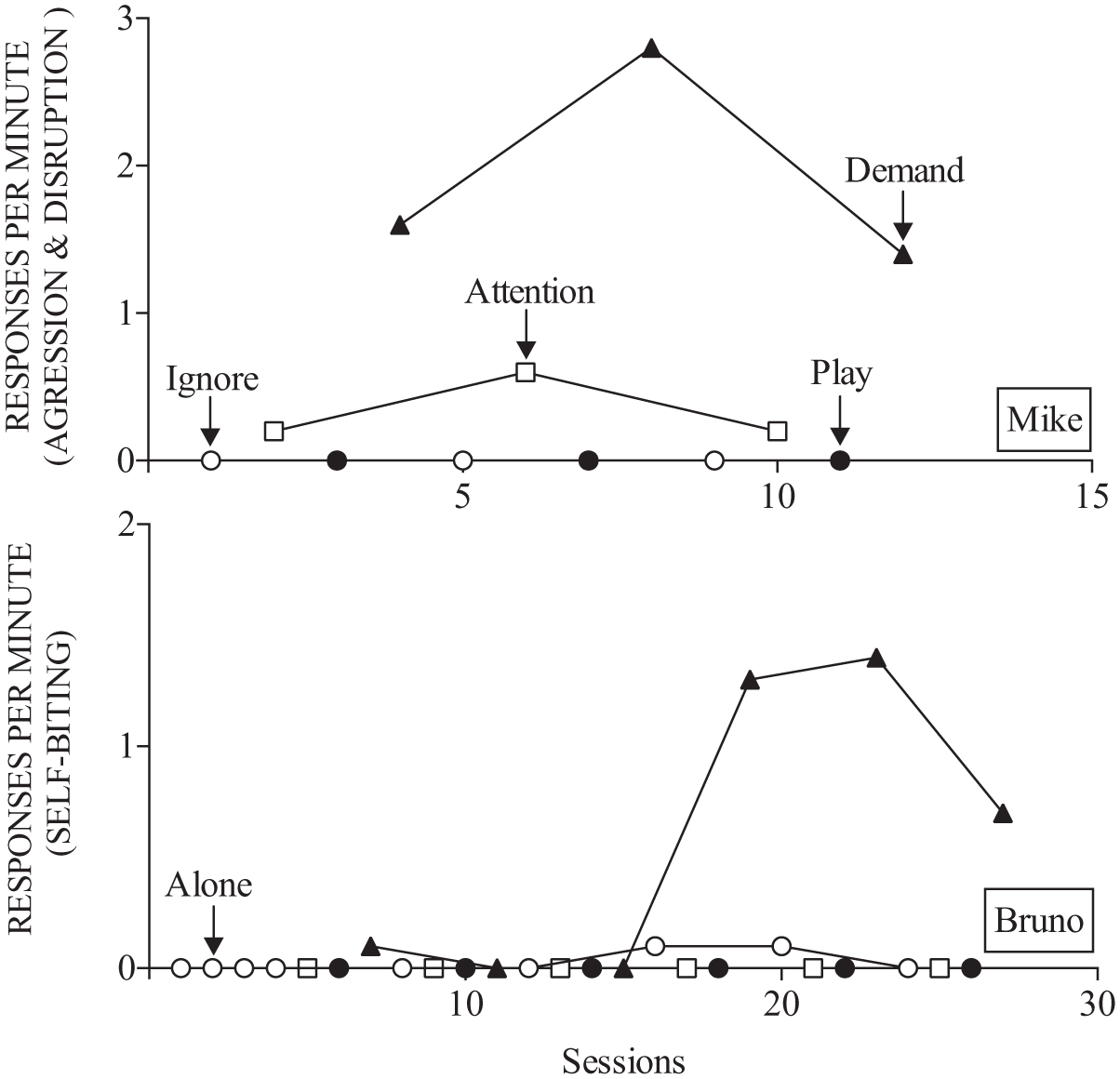
Rate of problem behavior (responses per minute) during the functional analyses.
Multiple Schedule Treatment Evaluation
Results of the multiple schedule treatment evaluation are depicted in Figure 2 (mands) and Figure 3 (problem behavior). Recall that the demand condition of the functional analyses served as the baseline. The FC card was not present during baseline; thus, no card exchanges occurred. In addition, problem behavior occurred at a high, steady rate for Mike (M = 1.93) and Bruno (M = .58). During the FC phase, mands for break occurred at a high, steady rate for Mike (M = .95) and Bruno (M = 1.33) and persisted across all SD components across phases. In the FC phase, problem behavior decreased to near-zero levels and remained low in all subsequent phases. During the multiple schedule phase, the rate of mands during the SD remained steady; however, the rate of mands during the SΔ was inappropriately high and did not decrease after 15 sessions for Mike and 13 sessions for Bruno. In this phase, problem behavior remained at low levels for both participants.
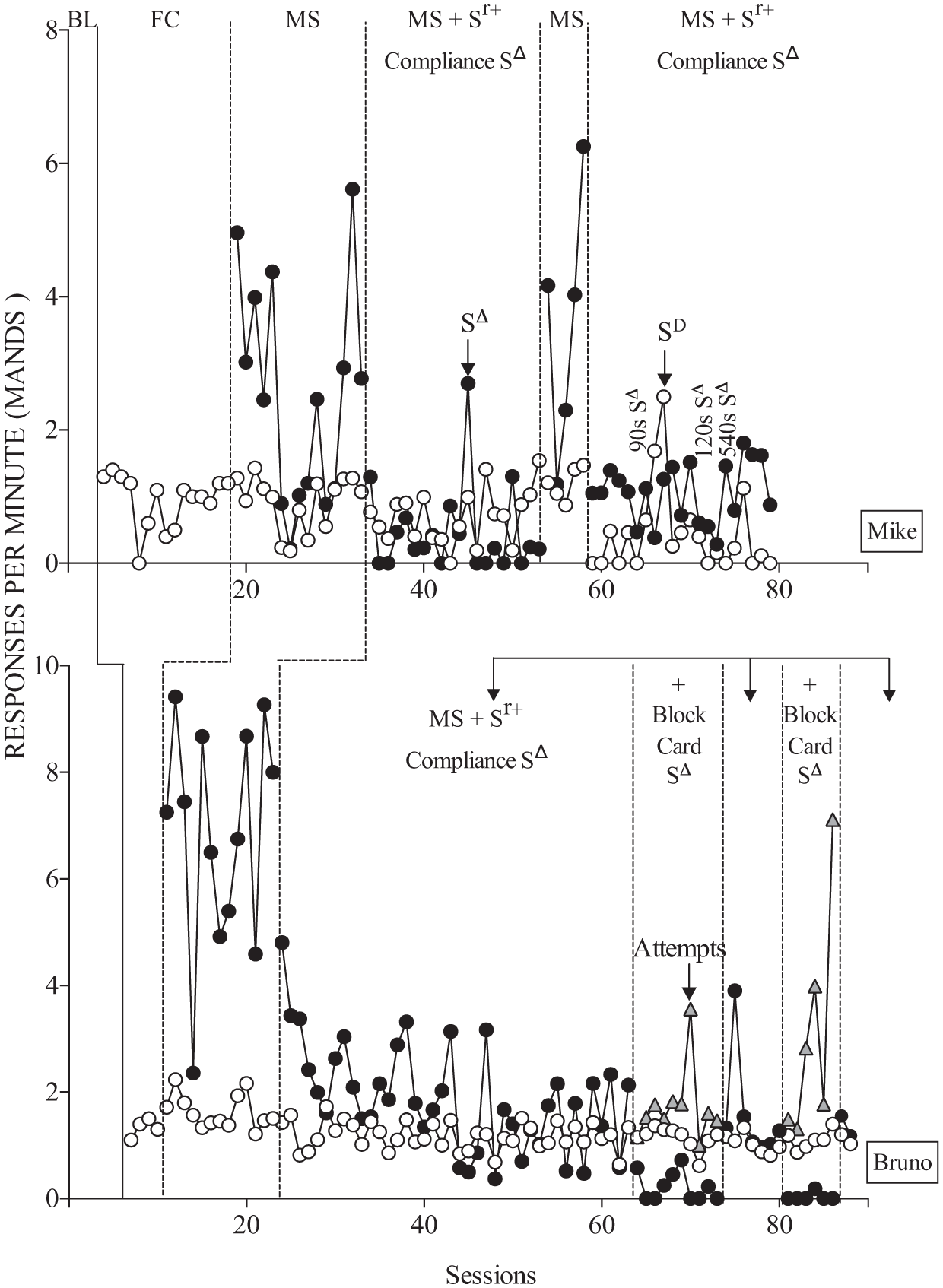
Rate of mands (responses per minute) during baseline, functional communication phase, multiple schedule, and added treatment components (i.e., reinforcement for compliance for Mike and Bruno and response blocking for Bruno).

Rate of problem behavior (responses per minute) during baseline, functional communication phase, multiple schedule, and added treatment components (i.e., reinforcement for compliance for Mike and Bruno and response blocking for Bruno).
Upon implementation of reinforcement for compliance during SΔ, Mike’s rate of mands during the SΔ decreased to near zero while the rate of mands during the SD remained consistent. After establishing discriminated manding under this arrangement, we increased the duration of the SΔ component. We initially increased SΔ components by 30 s. Following EXT 120 s, we probed the terminal goal of 540 s. During the terminal goal, mands remained stable during the SD and low in the SΔ during the last six sessions and problem behavior remained at zero levels. For Bruno, reinforcing compliance during SΔ component produced a moderate decrease in mands relative to the previous condition; however, mands were still occurring at an inappropriately high rate. Therefore, we introduced response blocking for mands during SΔ component. During this phase, mands persisted at moderate levels during the SD. In addition, SIB remained low. However, attempts to exchange the card during the SΔ were within the range of the previous phase.
Figure 4 depicts the percentage of trials with compliance for Mike and Bruno. Compliance was low during the initial FC phase for Mike (M = 51%) and Bruno (M = < 1%) and remained low during the initial multiple schedule phase during both the SD for Mike (M = 38%) and Bruno (M = 0%) and SΔ for Mike (M = 51%) and Bruno (M = < 1%). For both participants, the introduction of reinforcement for compliance during the SΔ component resulted in increased levels of compliance during both the SD for Mike (M = 60%) and Bruno (M = 50%) and SΔ components for Mike (M = 69%) and Bruno (M = 62%). 1

Rate of compliance (responses per minute) during functional communication phase, multiple schedule, and added treatment components (i.e., reinforcement for compliance for Mike and Bruno and response blocking for Bruno).
Discussion
We extended previous research by evaluating the use of a multiple schedule to thin the schedule of reinforcement within the context of FCT when the problem behavior was maintained by negative reinforcement rather than positive reinforcement. Results of this study are similar to those reported by Fisher et al. (2014) in that discriminated manding was not established during the multiple schedule for negatively reinforced mands. However, results differed in that problem behavior remained low during the initial multiple schedule phases for both participants, even though they involved periods of extinction for manding. Furthermore, the supplemental DRA treatment component produced discriminated manding for one participant, and response blocking was used to decrease manding during the SΔ for the second participant. Thus, this study adds to the literature on schedule thinning of FCT by demonstrating that additional treatment components (i.e., DRA for compliance) not only produce clinically significant changes to the target problem behavior, but also influence the occurrence of collateral behavior (i.e., functionally equivalent mands).
To date, no study has demonstrated discriminated manding within the context of a multiple schedule when problem behavior is maintained by negative reinforcement. There are several potential explanations for this. First, procedural differences between the delivery of a positive reinforcer (e.g., food) and a negative reinforcer (e.g., break) may make the differences between FR 1 and EXT in a multiple schedule, more salient during a positive reinforcement contingency. For example, it is possible that the time it took the experimenter to accept the break card and place it back on Bruno’s lanyard during EXT, although short and not a programmed break (i.e., less than 5 s), may have functioned to negatively reinforce the response. Second, for both participants in this study and the participants in Fisher et al. (2014), the FCR was a card-exchange response. It is possible that the presence of the card itself, regardless of the programmed schedule-correlated stimuli (i.e., colored cards), functioned as an SD for break. Previous researchers have suggested that stimulus materials used during exchange-based communication programs may exert stimulus control over functional responses (Barlow, Tiger, Slocum, & Miller, 2013). That is, it is possible that the topography of the FCR (i.e., topography-based vs. selection-based) influences the effectiveness of the selected method of schedule thinning. Topography-based verbal behavior (e.g., speaking, signing) involves topographically different responses for items. For example, the manual sign for apple is topographically different than the manual sign for water. Similarly, the spoken word apple is topographically different than the spoken word water. However, selection-based verbal behavior (e.g., picture cards) involves topographically similar responses for items (i.e., a card-exchange response). That is, requesting apple or water using a selection-based response involves topographically similar behavior (i.e., selecting and exchanging a card). Selection-based verbal behavior requires that individuals make discriminations among relevant stimuli (Sundberg & Sundberg, 1990). Therefore, it is possible that features of the stimuli themselves exert stronger stimulus control than supplemental stimuli (i.e., a stimulus used as an SΔ), and thus may influence the extent to which programmed SDs and SΔs come to control responding during a multiple schedule arrangement.
A third contributing factor involves the implementation schedule. The multiple schedule method we implemented involved rapid alternation between SD and SΔ components (Betz et al., 2013). It is possible that discriminated responding would have emerged without additional treatment components, if we used a method that gradually increased the duration of the SΔ relative to the SD (e.g., Hanley et al., 2001). Moreover, it is noteworthy that neither of the two participants frequently contacted the change-over-delay contingency. Thus, the extent to which a change-over-delay is necessary to produce discriminated manding in this context is unclear given our results. Future applied researchers should evaluate the extent to which a change-over-delay facilitates discrimination during a multiple schedule arrangement.
In the current study, reinforcement for compliance produced a decrease in manding during the SΔ for Mike, but not for Bruno. It is possible that introducing reinforcement for compliance altered the behavior’s controlling variables or motivating operations (MOs; Laraway, Snycerski, Michael, & Poling, 2003) for Mike. MOs are environmental antecedent events or conditions that momentarily alter the effectiveness of a consequence as a reinforcer (or punisher) and alter (i.e., increase or decrease) the probability of behavior that in the past has produced contingent access to that consequence. MOs are composed of (a) establishing and (b) abolishing operations (AOs). Establishing operations (EOs) increase the effectiveness of a consequence and evoke behavior that has previously resulted in contingent access to that consequence. However, AOs decrease the effectiveness of a consequence and decrease the probability of the occurrence of behavior that has previously resulted in contingent access to that consequence (Laraway et al., 2003). In this study, reinforcement for compliance may have produced decreased manding in the SΔ by way of an AO. That is, access to positive reinforcement (for compliance) may have decreased the overall value of escape as a reinforcer for manding. These results are consistent with those reported by Lalli, Casey, and Kates (1995). Lalli et al. combined FCT with response chaining during which breaks were contingent not only on the FCRs but also on task completion. Results of Lalli et al. suggested that procedures to strength compliance might decrease the EO of escape-maintained behavior. The results of this study suggest that the abative effects of the supplemental reinforcement contingency may have extended to all members of the response class (i.e., manding and problem behavior). Last, we observed an increase in compliance in both schedule components for both participants even though reinforcement was only programmed in the SΔ component. Future research should continue to evaluate direct and indirect effects of positive reinforcement on behavior maintained by negative reinforcement.
Footnotes
Authors’ Note
This study was completed in partial fulfillment of the requirements of the master of science degree by the first author.
Declaration of Conflicting Interests
The author(s) declared no potential conflicts of interest with respect to the research, authorship, and/or publication of this article.
Funding
The author(s) received no financial support for the research, authorship, and/or publication of this article.