




Abstract
Providing noncontingent access to a stimulus until an individual displays behavioral indicators of satiation has been used to determine when an abolishing operation is in effect, but there has been variation in its application in the literature. Four males diagnosed with autism spectrum disorder with tangibly maintained challenging behavior participated in this study. Individualized behavioral indicators were identified and verified to determine when each participant was finished playing with his/her preferred item. Three presession conditions were manipulated including restricted access to the tangible stimulus for 30 min, access to the tangible stimulus until the display of one behavioral indicator, and access to the tangible stimulus until the display of three behavioral indicators. Each presession condition was followed by a tangible condition of the functional analysis to measure challenging behavior. Results indicated that presession access to a tangible stimulus until the display of three behavioral indicators produced a greater abative effect on challenging behavior than one behavioral indicator.
Motivating operations are variables that modify the temporary effectiveness of a stimulus as a reinforcer, consisting of both establishing operations (EO) that increase the effectiveness of a stimulus as a reinforcer and abolishing operations (AO) that decrease the effectiveness of a stimulus as a reinforcer. EOs and AOs also have effects on behavior previously associated with the particular stimulus. Specifically, an AO not only decreases the effectiveness of a stimulus as a reinforcer, but it decreases the frequency of behaviors previously reinforced with that stimulus, which is referred to as an abative effect.
Given the utility of decreasing the value of a reinforcer as well as abative effects on behaviors, procedures to manipulate motivating operations have grown extensively in the applied literature in recent years. Specifically, it has been demonstrated that challenging behavior is sensitive to AO manipulations, particularly challenging behavior maintained by access to a tangible stimulus (e.g., Lang et al., 2010; Rispoli et al., 2014). For example, one way to alter the AO effects on challenging behavior is to provide access to a stimulus until the individual displays a behavioral indicator of satiation (O’Reilly et al., 2009). Prior to 2009, researchers utilized timed presession access to a tangible stimulus to produce an AO effect; however, this was unsystematic given individual differences in terms of preference, learning history, and the like. Providing stimulus access until the demonstration of a behavioral indicator of satiation offers a method for researchers and clinicians to identify response topographies used by individuals to reject a tangible stimulus and thereby systematically evaluate when an AO is in effect.
In the study conducted by O’Reilly and colleagues (2009), item rejection response topographies were identified through parent and teacher report before being empirically verified through an item rejection analysis. Each participant was then exposed to three presession conditions in a multielement design. In the no access condition, the participant had been restricted from access to the item for at least 8 hr prior to the session. In brief access, the participant was allowed 5 min of access to the item. In the satiation condition, the participant was given continuous access to the preferred item until the identified item rejection behavior occurred 3 times (e.g., setting down the reinforcer). Following each presession condition, a tangible condition of the functional analysis was conducted. Challenging behavior was determined to be lowest in the satiation condition, wherein it was hypothesized that this condition acted as an AO.
The procedure developed by O’Reilly et al. (2009) is a rigorous way of evaluating abative effects as it involves an observable and measureable behavioral indicator rather than assuming an abative effect after an arbitrary timed duration of access. This has been further validated by several studies replicating these procedures (e.g., Lang et al., 2009; Neely, Rispoli, Gerow, & Ninci, 2014; O’Reilly et al., 2012); however, there is some discrepancy in the number of item rejection behaviors used in the literature. For example, Lang et al., (2009) ended presession access after the first occurrence of item rejection behavior whereas others (e.g., Fragale et al., 2012; Rispoli et al., 2014) included three measures of item rejection behavior as described in the O’Reilly et al. (2009) study. It was evident that the number of item rejection behaviors was arbitrary rather than systematically associated with abative effects on behavior; therefore, a parametric analysis was warranted. This study sought to compare the effects of (a) access to the tangible stimulus until the display of one item rejection behavior and (b) access to the tangible stimulus until the display of three item rejection behaviors on challenging behavior maintained by access to tangibles. These two conditions were compared with a restricted access control condition.
Method
Participants
Four boys diagnosed with autism spectrum disorder who engaged in tangibly maintained challenging behavior participated in this research. All participants were previously diagnosed by an outside qualified physician, which was supported by scores on the Gilliam Autism Rating Scale–3 (GARS-3; Gilliam, 2014). In addition, all participants received special education services in public schools and 1 hr of applied behavior analysis (ABA) therapy at a university-based clinic twice weekly. Pertinent characteristics of the participants and operational definitions of challenging behavior and item rejection behavior are available in Table 1.
Participant Characteristics and Operational Definitions.
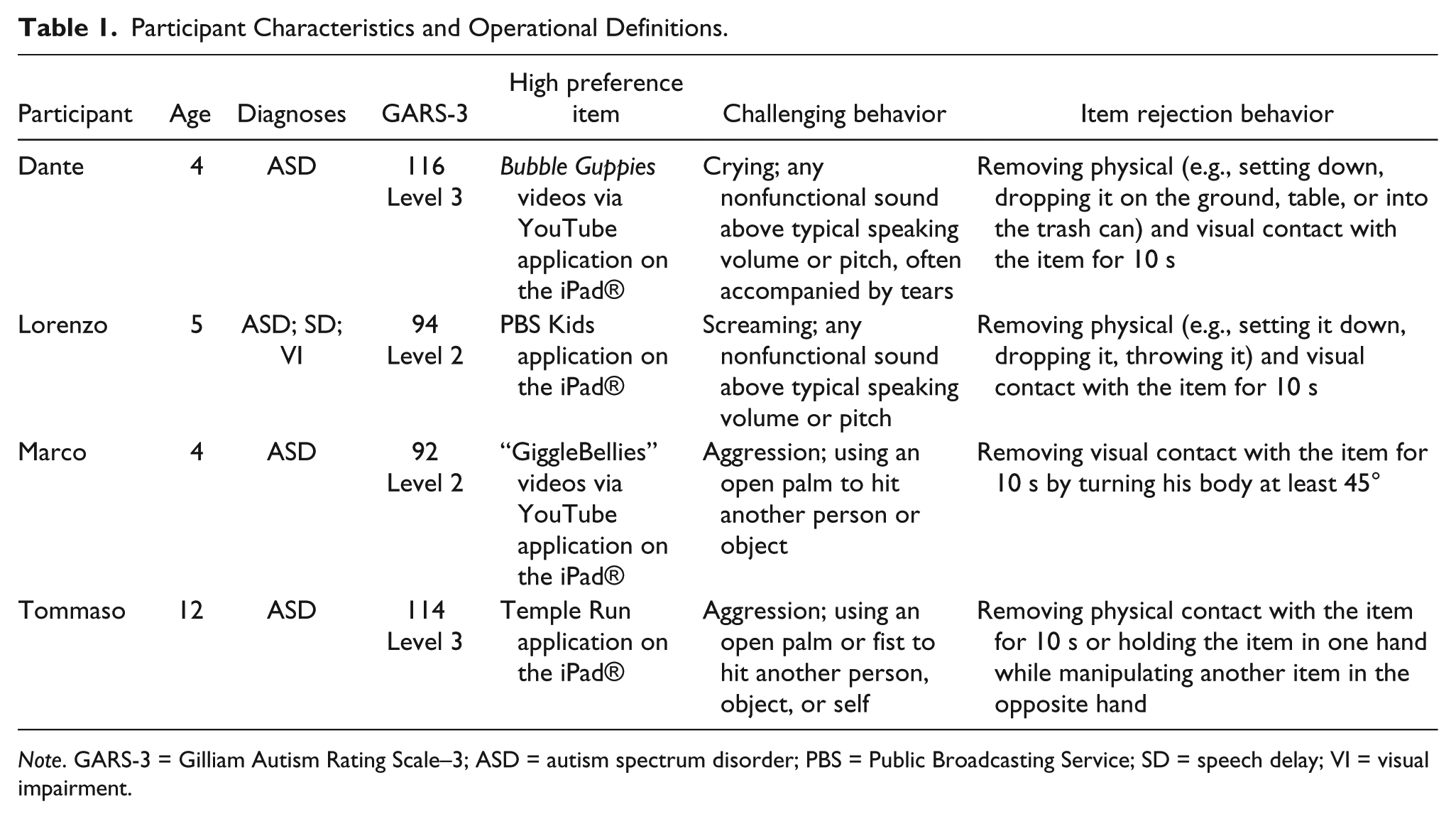
Note. GARS-3 = Gilliam Autism Rating Scale–3; ASD = autism spectrum disorder; PBS = Public Broadcasting Service; SD = speech delay; VI = visual impairment.
Setting and Materials
All sessions were conducted at a university-based ABA clinic in therapy rooms that consisted of a child-sized table and chair. In addition, experiment-specific materials were available, including an iPad®, timer, and data collection forms. All participants were administered a paired stimulus preference assessment with five items identified through parent and therapist report (Fisher et al., 1992). For all participants, the iPad® was determined to be the most highly preferred item. Guided Access was enabled on the iPad® so that only one application could be accessed. This application was held constant across all phases of the study.
Target Behaviors and Data Collection
Functional behavior assessment
To identify the function of participants’ challenging behavior, a functional behavior assessment was conducted. At least one parent of each participant was interviewed using the Functional Assessment Interview (FAI; O’Neill, Albin, Storey, Horner, & Sprague, 2015) for information related to their child’s challenging behavior. Following this, a functional analysis was conducted using procedures similar to Iwata, Dorsey, Slifer, Bauman, and Richman (1982/1994) to further verify the function maintaining challenging behavior. Conditions included attention, demand, play, and tangible. Each participant’s FAI and functional analysis results indicated challenging behavior was maintained by access to a tangible stimulus (i.e., the iPad®).
Item rejection analysis
One item rejection behavior was identified through parent and therapist reports as well as observations of the participant interacting with high-preference and low-preference items in a free operant setting. An operational definition of the item rejection behavior was developed based on parent and therapist input and observations of the participant rejecting items. These definitions were systematically analyzed through an item rejection analysis by replicating the procedures developed by O’Reilly and colleagues (2009) wherein two conditions were manipulated, one with a high-preference item and one with a low-preference item. During a 10-min session, the participant was presented either one high-preference or one low-preference item. If the item was rejected, the participant was presented the same item and told by the experimenter, “Remember, you can play with this.” Three sessions of each condition were conducted. In the high-preference item condition, the item was rejected less than in the low-preference item condition across participations. This analysis verified item rejection behaviors for each participant.
Interobserver agreement (IOA)
Data were collected on item rejection behavior and challenging behavior during the item rejection analyses as well as across presession and tangible conditions using a 10-s partial interval procedure by graduate students specializing in ABA. Data collectors were trained regarding the operational definitions of item rejection behavior and challenging behavior for each participant.
IOA was calculated using the interval-by-interval method. The number of intervals in which both observers agreed (occurrence + nonoccurrence) was divided by the total number of intervals (agreements + disagreements) and multiplied by 100%. IOA was conducted on 100% of presession and tangible conditions across participants. Mean IOA was 99.8% (range = 99%-100%).
AO Conditions
A multielement research design was implemented of which the following conditions were evaluated across participants: (a) restricted access, (b) one item rejection behavior, and (c) three item rejection behaviors. Each condition was implemented 3 times during the study. The order of the conditions was randomly determined prior to the implementation of the study; however, each participant was exposed to the same order of conditions. The implementation time for one item rejection behavior and three item rejection behaviors varied within and across participants. Only one presession and tangible condition was conducted per day.
Presession conditions
To evaluate different parameters, three presession conditions were implemented followed by a tangible condition of the functional analysis. The first condition was restricted access, wherein the participants did not have access to their highest preferred item for at least 30 min prior to the implementation of the tangible condition. restricted access was selected for inclusion as a control condition.
In the one rejection behavior presession condition, the participant was allowed access to the high-preference item and given the discriminative stimulus, “You can play with this.” The researcher had no interaction with the participant while he was playing with one application on the iPad®. Once an item rejection behavior occurred, the researcher removed access to the item by holding onto it. There was no interaction with the participant during this exchange. The tangible condition of the functional analysis then began immediately.
In the three rejection behaviors presession condition, the participant was allowed access to the high-preference item and was given the discriminative stimulus, “You can play with this.” The researcher had no interaction with the participant while he was playing with one application on the iPad®. After the first and second item rejection behaviors, the iPad® was re-presented, and the participant was given the discriminative stimulus, “Don’t forget, you can play with this.” After the third item rejection behavior, the researcher removed access to the iPad® by holding onto it. There was no interaction with the participant during this exchange. The tangible condition then began immediately.
Tangible conditions
The tangible condition was conducted in a manner similar to the tangible condition of the functional analysis wherein the participant was given access to the iPad® for 30 s at the start of the 5-min session, after which access was removed. Access to the iPad® was given contingent on the occurrence of the target challenging behavior. This access was 10 s in duration before being removed.
Treatment Fidelity
Treatment fidelity data were collected for 56% of sessions for each participant using a procedural task analysis for presession and tangible conditions wherein it was marked if the experimenter adhered to the research procedures identified for each condition. This included removing the preferred item after the condition-specific number of item rejection behavior(s) as well as prompting the participant to play with the preferred stimulus after the display of one and two item rejection behaviors in the three item rejection behaviors condition. Treatment fidelity was calculated by dividing the number of procedural steps completed correctly by the total number of procedural steps and then multiplying by 100%. Mean treatment fidelity was 99% (range = 98%-100%).
Results
The latency to each item rejection behavior as well as challenging behavior was measured during presession conditions. Table 2 summarizes the mean latency in conditions as well as the difference between item rejection conditions for all participants. Across participants, no challenging behavior occurred during presession conditions. Results from the parametric analysis indicated challenging behavior was lowest across participants in the tangible condition following the three item rejection behaviors condition and highest in the restricted access condition.
Mean Latency Differences Between Item Rejection Behavior Conditions.
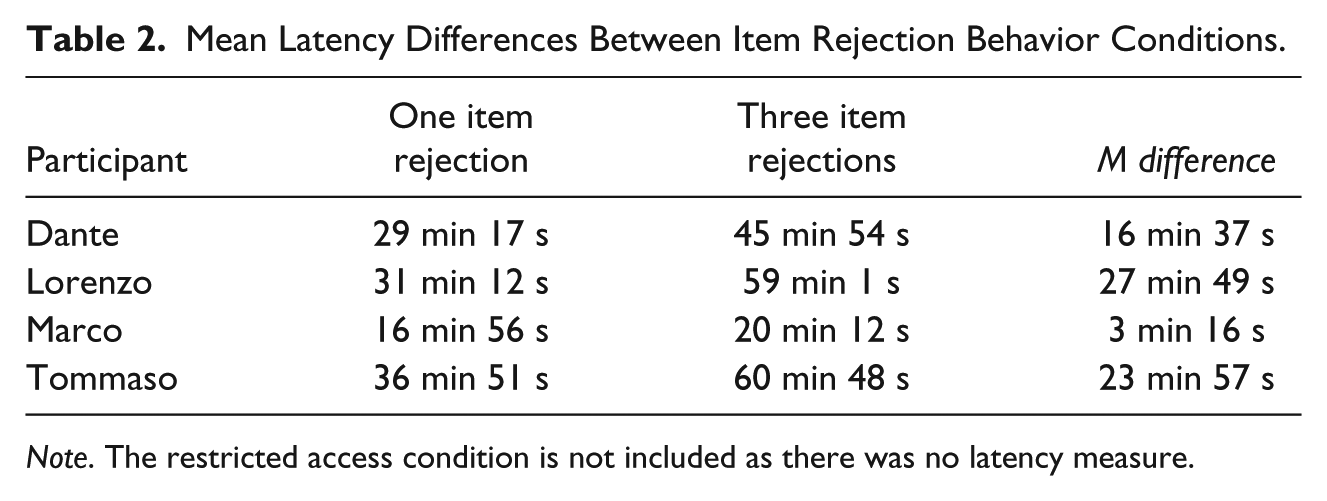
Note. The restricted access condition is not included as there was no latency measure.
For Dante, crying was highest after the restricted access condition (M = 58%, range = 57%-60%). In the one item rejection behavior condition, challenging behavior was lower than in the Restricted Access condition (M = 47.7%, range = 37%-53%) with a mean latency of 29 min 17 s. However, challenging behavior was lowest in the tangible condition following the three item rejection behaviors condition (M = 13.3%, range = 0%-23%) with a mean latency of 45 min 54 s. Dante’s challenging behavior across conditions is available in Figure 1.

Challenging behavior across conditions.
For Lorenzo, screaming was highest after the restricted access condition (M = 52%, range = 43%-60%). In the one item rejection behavior condition, challenging behavior was lower than in the Restricted Access condition (M = 21%, range = 20%-23%) with a mean latency of 31 min 12 s. However, challenging behavior was lowest in the tangible condition following the three item rejection behaviors condition (M = 16.7%, range = 13%-20%) with a mean latency of 59 min 1 s. Lorenzo’s challenging behavior across conditions is available in Figure 1.
For Marco, aggression was highest after the restricted access condition (M = 38%, range = 30%-47%). In the one item rejection behavior condition, challenging behavior was lower than in the Restricted Access condition (M = 11.3%, range = 0%-17%) with a mean latency of 16 min 56 s. However, challenging behavior was lowest in the tangible condition following the three item rejection behaviors condition (M = 0%) with a mean latency of 20 min 12 s. Marco’s challenging behavior across conditions is available in Figure 1.
For Tommaso, aggression was highest after the restricted access condition (M = 94.7%, range = 90%-97%). In the one item rejection behavior condition, challenging behavior was lower than in the restricted access condition (M = 75.7%, range = 70%-80%) with a mean latency of 36 min 51 s. However, challenging behavior was lowest in the tangible condition following the three item rejection behaviors condition (M = 47.7%, range = 40%-56%) with a mean latency of 60 min 48 s. Tommaso’s challenging behavior across conditions is available in Figure 1.
Discussion
Across the four participants in this study, challenging behavior occurred at lower levels following the display of three item rejection behaviors as compared with one item rejection behavior. This research provides evidence as to the number item rejection behaviors that should be considered a behavioral indicator of satiation and has the potential to enhance the utility of both clinical and research practices related to AO effects. Of the studies using behavioral indicators, the vast majority used three item rejection behaviors to end presession access (Davis, Fuentes, & Durand, 2014; Fragale et al., 2012; Neely, Rispoli, Gerow, & Ninci, 2015; O’Reilly et al., 2012; O’Reilly et al., 2009; Rispoli et al., 2014; Rispoli, O’Reilly, Lang, et al., 2011; Rispoli, O’Reilly, Sigafoos, et al., 2011) with just two studies using one item rejection behavior as a behavioral indicator to terminate presession access (i.e., Lang et al., 2009; Lang et al., 2010).
Although it would be most parsimonious to end access after the display of one item rejection behavior, especially for practitioners with limited time available for teaching due to scheduling constraints, reimbursement, and a variety of other factors, this study notes the substantial difference in challenging behavior between these conditions, with three item rejection behaviors representing the best measure of abative effects for tangibly maintained challenging behavior. There was roughly a 22% decrease in challenging behavior between restricted access and one item rejection behavior conditions across participants and a 42% decrease between restricted access and three item rejection behaviors across participants. Thus, there was about a 20% decrease between one item rejection behavior and three item rejection behaviors conditions in challenging behavior. Again, there are some abative effects in place following the display of one item rejection behavior, but less value associated with the reinforcer and therefore less challenging behavior is displayed after three item rejection behaviors.
The specific mechanisms influencing the results of this study are still unknown. One theory is that prolonged exposure provided during Three Item Rejection Behaviors condition provided a stronger AO, thus, a strong abative effect. Dante and Tommaso’s data support this theory in that both had notable mean latencies differences between the first and third item rejection behaviors, 16 min 37 s and 23 min 57 s, respectively. Similarly, both Dante and Tommaso displayed markedly lower levels of challenging behavior after displaying three item rejection behaviors; in other words, the abative effect was stronger after prolonged exposure to the iPad®. Marco’s data also support this theory. Marco displayed a slight mean latency difference between the first and third item rejection behaviors (i.e., 3 min 16 s). Similarly, challenging behavior was only slightly decreased after the display of three item rejection behaviors compared with the display or one item rejection behavior. In other words, slightly longer access to the iPad® resulted in a slightly stronger abative effect. Lorenzo’s data do not support this theory as he displayed notable differences in mean latency to the first item rejection behavior (27 min 49 s) but only slight decreases in challenging behavior after the display of three item rejection behaviors, relative to one item rejection behavior. In other words, prolonged exposure did not result in a comparable increase in the AO and abative effect.
These preliminary data suggest a spectrum of reinforcer value with item rejection behaviors noting the current value of a tangible stimulus, which has not been demonstrated empirically prior to this study. To the authors’ knowledge, there is no research in the AO literature identifying systematic durations of access to support fluctuations in reinforcer value and abative effects, yet clinically this is suggested and supported by the findings of this work.
Although the display of three item rejection behaviors appears to be a more accurate indicator of an abative effect on challenging behavior, there may be times when the termination of presession access after one item rejection behavior is more appropriate for use. For example, if the iPad® is used as a reinforcer during instructional sessions, presession access until the display of one item rejection behavior may decrease challenging behavior without eliminating the value of the iPad® in its entirety. In this case, the iPad® continues to act as a reinforcer for appropriate behaviors and when access is ended, challenging behavior may occur at lower, more manageable levels. However, presession access to the iPad® until the display of three item rejection behaviors may be more appropriate if an instructional session is taking place in the natural environment, like the mall, where an iPad® could be in sight when walking by a technology store, but not available. The AO is in effect, and little or no challenging behavior would occur as a result. Similarly, it is possible that the display of four or more item rejection behaviors would be better suited to consistently indicate an AO and related abative effects. In fact, three of the four participants continued to demonstrate some levels of challenging behavior after the third item rejection behavior suggesting that additional exposure to the item could have further reduced subsequent challenging behavior. However, caution should be exercised in the manipulation of additional item rejection behaviors as a potent reinforcer may become aversive at some point.
There is tremendous applied value in utilizing different parameters of presession access; however, little is known about this specifically. It may be that certain parameters to end presession access are a better indicator of reinforcer value for some individuals based on characteristics like level of functioning, history of reinforcement associated with a particular tangible stimulus, or topography of item rejection behavior. It may also be pertinent to utilize different parameters based on the instructional goals following presession access, keeping in mind the associated value of the reinforcer.
Certainly, there are practical and ethical considerations to factor into the decision to provide stimulus access until the demonstration of behavioral indicators of satiation. For some participants, prolonged durations of access were needed before three item rejection behaviors were displayed. For example, Tommaso’s mean latency to three item rejection behaviors was 60 min 48 s. In comparison, Marco’s mean latency to three item rejection behaviors was 20 min 12 s. There is nearly a 40-min difference between latency to the third item rejection behavior between participants. When Marco had indicated he was done watching the iPad® and working on ABA therapy goals, Tommaso was still playing on the iPad®. During presession access time, Tommaso could have been working on academic tasks or functional skills, and an alternative intervention could have been used to address challenging behavior.
Not only could prolonged presession access interfere with access to other activities, such as instructional time, it may not be feasible in some settings. Providing presession tangible stimulus access to a child would require adult supervision. As a result, prolonged presession access associated with the demonstration of three item rejection behaviors may not be practical in settings in which one-to-one adult supervision is not readily available (e.g., public schools). Although, there is the potential that other interventions aimed at reducing challenging behavior could be less effective than stimulus access until the display of behavioral indicators of satiation, the issue of adequate instructional time cannot be overstated. Clearly, there is the possibility of lost learning opportunities given longer durations of access for children whose perseverative, fixated interests are more pronounced, like Tommaso.
Should practitioners decide to provide access to a stimulus until the display of one or more behavioral indicator of satiation, to reduce challenging behavior prior to instruction, session time would need to be built into schedules that allow for extended periods of access to preferred tangible stimuli. It may be that this procedure is most beneficial when used strategically during specific times of day, such as prior to the school day beginning or before teaching a particularly difficult skill. Discerning the appropriate time to provide stimulus access could be a critical factor in its successful implementation and reduction in challenging behavior. Using this procedure followed by a teaching environment with access to other forms of reinforcement, such as attention, may extend the AO effect beyond several minutes, making the process more palatable to stakeholders and perhaps mitigate ethical concerns related to lost learning opportunities.
Limitations
Although many efforts were taken to adhere to high-quality research standards and control for any potential confounding issues in this study, some limitations have become apparent. Although the iPad® was the high-preference item as determined by the paired stimulus preference assessment (Fisher et al., 1992), the participants’ parent and therapist were asked which application the participant appeared to prefer rather than conducting a separate preference assessment based solely on iPad® applications. Given the functioning of participants and the lack of a standardized procedure to conduct this type of preference assessment, parent and therapist reports were relied upon to identify the applications the participant preferred.
In addition, Guided Access was enabled on the iPad® so that each participant was only allowed access to one application throughout phases of this study. The iPad® is a multisensory, interactive device, which is likely to sustain engagement for significant durations if free access is allowed to material that is developmentally and socially appropriate. Even with contrived access to iPad® applications the latency to item rejection behaviors was considerable, so free access may result in an even longer period of duration given the variety of games, videos, and Internet accessibility available to users. The range of interests an individual may have in relation to potential uses of the iPad® was not accounted for prior to the implementation of procedures. Therefore, both the selection of iPad® applications used and the restriction used limit the findings of this study.
Future Research
Based on the findings of this study as well as the limitations presented, several areas of future investigation in relation to the use of behavioral indicators of satiation are evident. First, an examination of other parameters to end presession access using behavioral indicators outside of one and three item rejection behaviors is warranted. For example, it may be pertinent to examine four and five item rejection behaviors as it could minimize challenging behavior even further for some participants. However, there may be the potential of making a reinforcer aversive after extensive access as well as extend the duration of free access periods. Often children with developmental disabilities have fewer items that function as reinforcers in comparison with typically developing children and it has been demonstrated empirically that multiple reinforcers are more effective than a single reinforcer (Alberto & Troutman, 2008); therefore, extended exposure may produce unwanted consequences, such as making a reinforcer aversive. Nonetheless, the potential of this phenomenon has yet to be evaluated. Future research should continue to explore the effects of reinforcer access on challenging behavior. In addition, an examination of an enriched environment on challenging behavior following presession access needs to be assessed. Systematically evaluating these areas will improve the use of behavioral indicators procedure for clinical purposes.
Conclusion
This research sought to identify the behavioral indicator parameter most associated with an abative effect on tangibly maintained challenging behavior. It was demonstrated that presession access to a stimulus until the display of three item rejection behaviors reduced challenging behavior to a greater extent than presession access to the stimulus until the display of one item rejection behavior. Although several limitations were apparent in terms of the similarity of participants, use of the tangible condition to measure challenging behavior following presession conditions, and contrived access to the iPad®, these are all areas for future research as well as the identification of other parameters to end presession access.
Footnotes
Declaration of Conflicting Interests
The author(s) declared no potential conflicts of interest with respect to the research, authorship, and/or publication of this article.
Funding
The author(s) received no financial support for the research, authorship, and/or publication of this article.