




Abstract
Picture activity schedules consist of a sequence of images representing the order of tasks for a person to complete. Although, picture activity schedules have traditionally been presented in a book format, recently picture activity schedules have been evaluated on technological devices such as an iPod™ touch. The present study compared the efficiency of picture activity schedule acquisition on book- and tablet-based modalities. In addition, participant preference for each modality was assessed. Three boys aged below 5 years with a diagnosis of autism participated. Participants were taught to follow the schedules using both modalities. Following mastery of each modality of picture activity schedule, a concurrent-chains preference assessment was conducted to evaluate participant preference for each modality. Differences in acquisition rates across the two modalities were marginal. Preference for book- or tablet-based schedules was idiosyncratic across participants.
Keywords
Picture activity schedules consist of a sequence of images that represent tasks or activities for a person to complete (McClannahan & Krantz, 1999). Individuals with developmental disabilities increased independent task engagement following training on picture activity schedules (Banda & Grimmett, 2008; MacDuff, Krantz, & McClannahan, 1993). Picture activity schedules have been used to help teach children and adults with developmental disabilities to transition between a range of tasks: leisure and play activities (e.g., Betz, Higbee, & Reagon, 2008), vocational tasks (e.g., Carson, Gast, & Ayres, 2008), academic tasks (e.g., Bryan & Gast, 2000), and self-help tasks (e.g., Irvine, Erickson, Singer, & Stahlberg, 1992). The use of activity schedules may increase on-task behavior in educational settings (e.g., Spriggs, Gast, & Ayres, 2007), and support reduced supervision in vocational settings (e.g., Carson et al., 2008).
In contrast to other strategies that teach functional skills, picture activity schedules do not depend upon the presence of an adult to deliver prompts (MacDuff et al., 1993). Individuals with developmental disabilities and autism may become dependent on external cues such as verbal instructions to complete daily tasks (Koyama & Wang, 2011). Dependency on external prompts may inhibit the learner from responding independently to cues in their natural environment (MacDuff et al., 1993). Furthermore, dependency on adult supervision may restrict access to education, vocational, and leisure opportunities. Picture activity schedules have been used as a strategy to reduce dependence on external prompts (e.g., verbal instructions) and increase independent responding on day-to-day tasks.
Traditionally, picture activity schedules have been presented in a book format (e.g., Bryan & Gast, 2000; MacDuff et al., 1993). In this format, the schedule may incorporate photographs, line drawings, and written words (Koyama & Wang, 2011). The activity schedule used by MacDuff et al. (1993) was a ring binder with photographs of the activities mounted on white paper. The participants were taught to follow the sequence of homework and leisure activities in the picture activity schedule using graduated guidance. Bryan and Gast (2000) replicated MacDuff et al. (1993) and evaluated student on-task behavior when the picture activity schedule was implemented compared to when it was absent. The schedule differed from MacDuff et al. (1993) in that the book was a photo album with line drawings of the activity. Participants independently followed the schedule-following training, and on-task behavior was higher when the book was present compared to when it was absent.
There are benefits to using a book-based picture activity schedule. They are inexpensive, easy to set up and use, and may not require extensive training for staff to implement. However, one potential drawback associated with this modality is that books are not always portable (Carlile, Reeve, Reeve, & DeBar, 2013). For example, the person would need to remember to take their schedule to the different settings where it may be needed (e.g., a work or education-based setting). In addition, book-based picture activity schedules may be more stigmatizing. The individual may stand out more from peers when using a book to complete day-to-tasks in a setting where no one else is using a book.
Picture activity schedules have also been presented on technological devices. For example, picture activity schedules have been presented on a palm-top computer (Davies, Stock, & Wehmeyer, 2002), a personal digital assistant (Mechling, Gast, & Seid, 2009), a touch-screen computer (Cihak, 2011), and an iPod touch™ (Carlile et al., 2013). Carlile et al. (2013) taught four boys to follow an activity schedule on an iPod touch™ using a time delay to fade out adult prompts. The participants had a history of following a picture activity schedule using a book format and the skill transferred to the technology-based modality.
There may be several potential benefits to using a technology-based modality. For example, it may be less stigmatizing compared to a ring-binder (Blum, Dimaya, Reeve, Reeve, & Hoch, 2010; Carlile et al., 2013). Carlile et al. (2013) evaluated the social validity of the iPod touch™ picture activity schedule with peers (aged between 8 and 12 years) of the participants. The majority of the same-age peers rated the use of an iPod touch™ as an acceptable teaching modality and were supportive of their peers using one (Carlile et al., 2013). A second potential benefit of using technology-based modalities is that many individuals with autism and developmental disabilities may already be using tablet-based devices as a communication aid (Flores et al., 2012). Technological devices may be more portable (Davies et al., 2002), and have the potential for additional features such as audio prompts (Stromer, Kimball, Kinney, & Taylor, 2006). Children with developmental disabilities may also find using technological devices more reinforcing and may prefer to be taught via computer-based technologies (Stromer et al., 2006).
Although, using technological devices during picture schedules may present advantages. There are also several potential disadvantages to consider. First, using a technological device for an activity schedule would be significantly more expensive to purchase or replace if lost or stolen compared to a ring-binder. Second, there would also be a degree of expertise required to set up and use the schedule. Third, tablets require careful maintenance to function properly (e.g., charged frequently) and are easy broken if thrown or dropped. However, even with these limitations, technology-based instructional tools are increasingly prevalent with individuals with autism spectrum disorders (Goldsmith & LeBlanc, 2004).
Given the different benefits and drawbacks of both the traditional notebook and technology-based picture activity schedules, clinicians have several factors to consider when selecting a suitable modality for their client. A technology-based picture activity schedule may not automatically be the best option. One consideration may be whether the client would learn faster on one modality over another. A second consideration may be the client’s preference for which modality they use. Carlile et al. (2013) evaluated their learner’s preference by offering a choice between the two schedule modalities. The participants were four boys with autism aged between 8 and 12 years who were able to speak in sentences ranging from two to eight words. When given a choice of which modality they wanted to use, participants chose the iPod touch™ in the majority of cases. However, although participants had a history of using a book-based schedule, they were not exposed to this modality prior to the preference assessments. As participants had recently been taught on the iPod touch, there may have been a bias toward this modality due to recent exposure to this modality.
Evaluating client preference may be more challenging with individuals who cannot vocally communicate their preferred interventions. In these situations, clinicians may make decisions on behalf of the client without direct evidence of their client’s preference. One way to directly assess preference for different interventions and increase the autonomy of individuals with limited communication is to use a concurrent-chains preference assessment (Hanley, 2010). During this assessment, each intervention is paired with a salient stimulus cue (e.g., a colored card). The client chooses between the previously paired stimuli and is then exposed to the treatment conditions associated with that stimulus. Preference is determined by how frequently the client chooses one intervention over another (Hanley, 2010). Concurrent-chains arrangements have been used to assess client preference for a range of interventions. For example, client preference for instructional procedures (e.g., Heal & Hanley, 2007; Layer, Hanley, Heal, & Tiger, 2008) and behavior reduction interventions (e.g., Hanley, Piazza, Fisher, & Maglieri, 2005; Giles, St Peter, Pence, & Gibson, 2012). However, concurrent-chains preference assessments have not yet been used to evaluate client preferences for modality of picture activity schedule.
Picture activity schedules have been used successfully across a range of modalities to promote independence. Recently, there has been an increased focus on technology-based picture activity schedules (e.g., Carlile et al., 2013; Cihak, 2011; Davies et al., 2002). However, given the cost and potential limitations of technology-based picture activity schedules, it is worth considering if these are the best option. Currently, it is unclear if individuals with developmental disabilities acquire schedule-following behavior at the same rate across different picture activity schedule modalities. There is also limited research on the social acceptability of using technology-based devices as a teaching tool (Carlile et al., 2013). In addition, individual preference for different modalities has not been evaluated. The purpose of the present study was twofold. First, we compared the acquisition rates of book and tablet-based picture activity schedules with participants who had no history of following a picture-based schedule. Second, we evaluated which modality of picture activity schedule participants preferred to use.
Method
Participants and Setting
Three boys with a diagnosis of autism participated. They all attended a university-based clinic providing behavior analytic intervention. Richard (aged 4 years) attended the clinic for 6 hr a week in addition to a mainstream preschool. He spoke in three-word sentences, could follow simple directions, and had independent play skills. Johnathan (aged 4 years) received 9 hr of clinical provision per week and also attended a specialized preschool for children with autism spectrum disorders. He spoke in one- or two-word sentences, had limited play interests, and did not reliably follow instructions. William (aged 3 years) attended the clinic provision for 18 hr per week. He did not attend preschool. He spoke in two- or three-word sentences and engaged in a range of play-based activities. William engaged in aggressive behaviors on a daily basis during instruction. None of the participants had used a picture activity schedule before. Research sessions were conducted in a partitioned-off area of the clinic and embedded into their regular clinic schedule.
Prerequisite Skills and Activity Selection
Prior to commencing training, several prerequisite skills were assessed. First, we assessed that participants could accurately complete picture-to-object matching activities. In addition, we identified two leisure activities with a discrete beginning and end that the participants could already complete independently for inclusion in the activity schedule. The leisure activities were different for each participant. Richard had an inset puzzle and a Duplo™ set which formed an ice-cream. Johnathan had stringing beads and a play food set which he would cut into halves. William had two different puzzles.
We also conducted a multiple stimulus without replacement (MSWO) preference assessment (DeLeon & Iwata, 1996) to identify colors that were neither high nor low preference to include in the concurrent-chains preference assessment. During the MSWO assessment, the participant was asked to choose between six colored cards (blue, green, red, yellow, pink, and purple). The cards were placed in an array equidistant from each other and the participant. Following a selection of one of the cards, the experimenter removed that card from the array. The participant was then asked to make another selection with the remaining cards. These trials continued until all cards were selected or the participant stopped making a selection. The experimenter selected red and blue to form the basis of the concurrent-chains preference assessments as these were mid-ranking colors for all three participants.
Materials and Task Analyses
For the book-based picture activity schedule, we used a two-ring binder consisting of two A4 pages. On each page was a photograph of the leisure activity on a white background. A red colored table cloth was associated with this condition and was present across all sessions. In the tablet-based picture activity schedule condition, we used an iPad mini™ with a photo album depicting the activities to complete. Similar to the book-based schedule, photos were arranged as one activity per page. A blue table cloth was associated with this condition and was present across all sessions. The leisure activities (e.g., inset puzzles, stringing beads, and block constructions) were presented in clear plastic containers (20cm × 30cm × 14cm). A divider was used to section off an area within the work area which contained a table and chairs.
For the concurrent-chains preference assessment, two pictures were created on A4 paper (i.e., 21 × 29.7 cm) for the participant to choose from. One was a picture of the tablet (20 × 12.5 cm) on a blue background, and the other was a picture of the notebook (21.5 × 12 cm) on a red background. During the concurrent-chains preference assessment, these pictures were hung on the divider outside the session area.
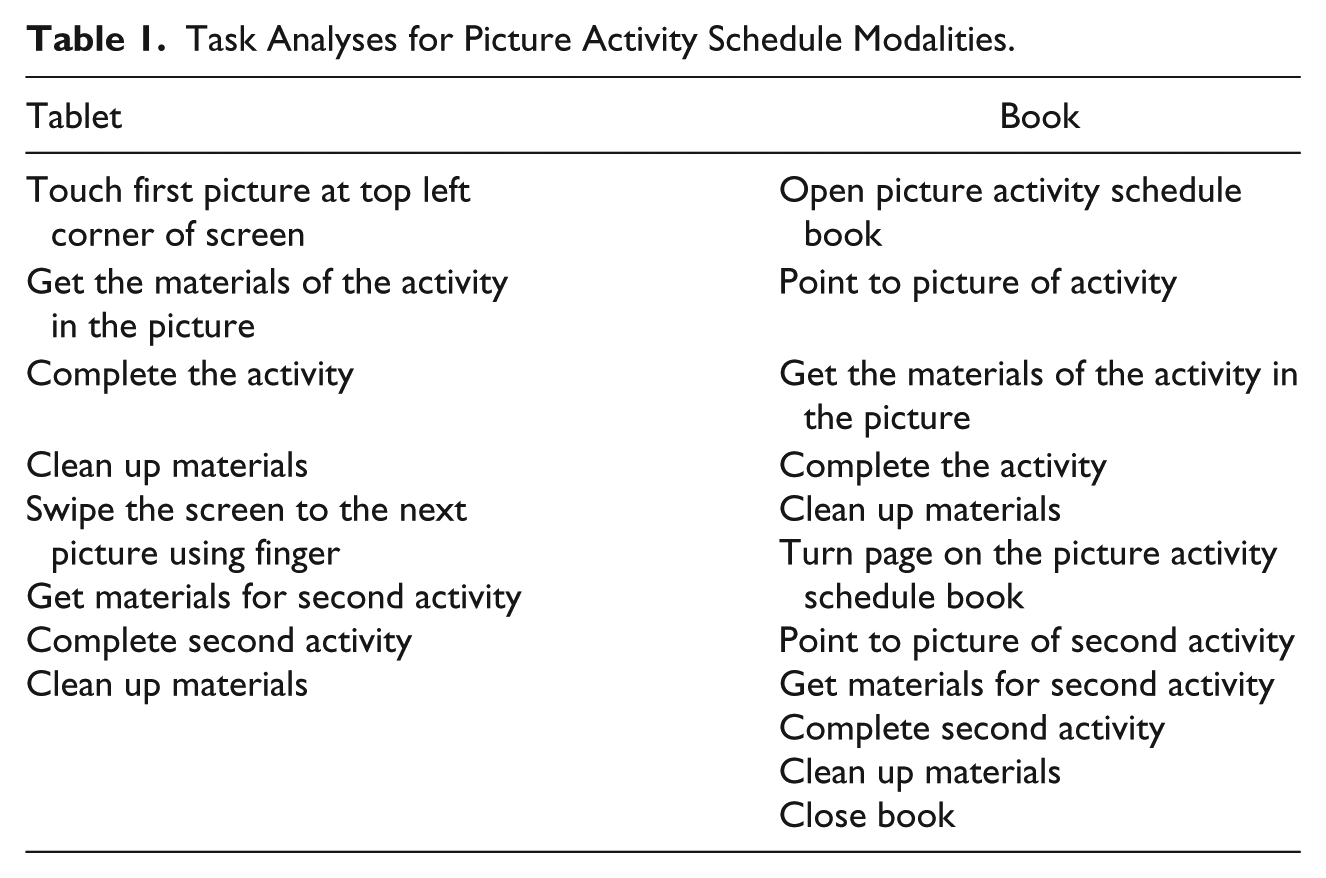
Both modalities of picture activity schedule were task analyzed by having the experimenters complete each schedule and recording the necessary steps. Following the task analysis, there were 11 steps in the book-based schedule and eight steps in the tablet-based schedule (see Table 1 for task analyses for both modalities).
Task Analyses for Picture Activity Schedule Modalities.
Response Measurement
During training, the primary dependent variable was the percentage of steps in the task analysis completed independently and accurately. For each step in the task analysis, observers recorded whether the participant completed a step accurately or made an error. They also recorded if the participant responded independently or the prompt required for the experimenter to occasion a response. An independent and accurate step was defined as the participant completing a step correctly without any prompts. This percentage of independent and accurate steps was calculated by dividing the number of steps completed independently and accurately by the total number of steps in the chain (11 for book and eight for tablet) and multiplying by 100%. The secondary dependent variable was the number of sessions to reach the mastery criterion. A session was defined as completing all the steps in the task analysis. The dependent measure of the concurrent-chains preference assessment was the cumulative number of selections of each modality.
Interobserver Agreement (IOA) and Treatment Integrity
IOA measures were collected for a minimum of 33% of all sessions across all conditions. Agreement data were collected by having two independent observers collect data on participant responding in person or from video-recorded sessions. Trial-by-trial IOA was calculated by comparing the observers’ data recorded for each step and dividing the number of steps with agreement by the number of steps with agreement plus disagreement then multiplying by 100. An agreement was defined as both observers independently recording the same response for a step (e.g., both observers recording that the participant completed a step accurately with partial manual guidance). Interobserver agreement data were taken for 38% of Richard’s sessions and averaged 95% (range, 82%-100%). Agreement data were taken for 33% of Johnathan’s sessions and averaged 96% (range, 88%-100%). For William, IOA data were taken for 33% of sessions and averaged 96% (range, 82%-100%).
Treatment integrity data were collected for a minimum of 33% of all sessions, and treatment integrity IOA was taken for 33% of treatment integrity sessions. Treatment integrity was measured on a component-by-component basis using an experimenter-made data sheet components included whether the experimenter used the correct prompt for each step, the presence of all required materials (e.g., associated table cloth and activities for the schedule), if the error-correction procedure was implemented accurately, and whether reinforcement was delivered at the end of the chained task. Treatment integrity IOA was calculated on a component-by-component basis. For Richard, treatment integrity averaged 96% (range, 80%-100%) and treatment integrity IOA averaged 100%. For Johnathan, treatment integrity averaged 98% (range, 87%-100%) and treatment integrity IOA averaged 100%. For William, treatment integrity averaged 97% (range, 82%-100%) and treatment integrity IOA averaged 98% (range, 86%-100%).
Experimental Design
Experimental control was determined using a combination of a multiple baseline across participants and an adapted alternating treatments design (Sindelar, Rosenburg, & Wilson, 1985). The two conditions (book-based and tablet-based picture activity schedule) were quasi-randomly alternated to control for order effects.
Procedure
Baseline
During baseline, the participants were provided with the book- or tablet-based schedule dependent on the condition. The leisure activities were presented in clear plastic containers within arms-reach, and the table cloth associated with that condition was on the table. The therapist presented the discriminative stimulus (SD), “Do your activity schedule.” No additional prompts were provided. The session was terminated when the participant had not responded for 30 s or once they had completed all the steps in the task analysis.
Training
Both modalities of picture activity schedule were taught using a combination of total-task chaining and most-to-least prompting. The prompt levels were hand-over-hand guidance, partial manual guidance at the forearm, a light touch at the elbow, and no prompts. During the first two sessions, following delivery of the SD, all steps were taught using hand-over-hand guidance. As training progressed, different prompts were used for each step depending on how the participant performed. The therapist would decrease the prompt level for a step when the participant completed that step correctly for two consecutive sessions. If an error occurred for two consecutive sessions on a step, a more intrusive prompt was used on the subsequent training session. The mastery criterion for each modality of picture activity schedule was completing all steps in the task analysis with 100% accuracy and independence across two consecutive sessions. If a participant mastered in one condition, first, we continued to run additional sessions of both conditions until they reached mastery in the other condition as well.
Additional training was required for all participants for using the tablet-based modality. Specifically, participants were taught how to tap the picture of the activity and then how to swipe across. The therapist would provide a model of how to tap the picture (i.e., she would say “do this” and show the participant how to tap the icon). If the participant did not respond or made an error, she would provide hand-over-hand guidance. Once the participant had responded independently, the session would commence.
Maintenance
Following the summer holiday, maintenance probes were conducted with all participants for the modalities that had been mastered during the previous school term. Maintenance probes were conducted in the same way as a baseline session (i.e., the experimenter delivered the SD and provided no additional prompts or feedback
Concurrent-Chains Preference Assessment
Concurrent-chains preference assessments occurred following mastery of both modalities of picture activity schedule. During this assessment, the two pictures were hung side-by-side on the divider at eye-level of the participant. The therapist would ask the participant to “choose an activity schedule.” If the participant did not choose an option within 30 s, she would redeliver the SD and reorient him toward the two choices. The experimenter blocked any attempts to choose more than one option and would restart the trial. Once the participant had either touched or handed over the picture of their chosen modality, a second therapist would lay out the associated table cloth and the materials to complete the picture activity schedule. The participant was then led to the working area where they completed their schedule. Participants did not require prompts to complete the activity schedules during the concurrent-chains preference assessment.
Results
Figure 1 depicts the results of baseline, training, and maintenance of both book- and tablet-based picture activity schedules. Across all participants, few steps were completed independently during baseline. The only steps completed independently during baseline was opening the binder in the book condition (Richard and William) and touching the first picture in the top left corner of the screen in the tablet condition (Johnathan). During training, there was a gradual increase in the percentage of steps completed independently and accurately for Richard and William in both book and tablet conditions. For Johnathan, independent and accurate responding did not reliably increase until session 23. Richard mastered the book-based activity schedule first after eight training sessions. The tablet-based schedule was mastered following 10 training sessions. Johnathan mastered the book-based picture activity schedule after 12 training sessions. He mastered the tablet-based schedule after 15 training sessions. During maintenance probes following the summer break, both Richard and Johnathan maintained both skills with at least 80% accuracy and independence.

Percentage of correct and independent responding during book-based picture activity schedule (triangle) and tablet-based picture activity schedule (circle) sessions during baseline, training, and maintenance probes.
Immediately prior to the summer break, William met the mastery criterion for the tablet-based schedule after 14 training sessions. However, accuracy was below 80% in the tablet condition when probed following the break. Training in both the book- and tablet-based activity schedules continued and William subsequently mastered the tablet-based schedule after a further 19 training sessions (i.e., 33 training sessions in total) and the book-based schedule after a total of 35 training sessions
Figure 2 depicts the results of the concurrent-chains preference assessments. Richard initially alternated between the book and tablet-based picture activity schedule. From session 11, Richard chose the book-based modality exclusively for the remaining nine sessions. Johnathan also alternated between the book and tablet for the first 11 sessions. From session 12, Johnathan chose the tablet for seven of the remaining eight sessions. William alternated between book- and tablet-based modality until Session 12. From Sessions 13 to 22, the data paths start to differentiate as he made more tablet-based selections. From Session 22, he selected the tablet-based modality exclusively for nine consecutive sessions.

Cumulative number of selections of modality of picture activity schedule for Richard, Johnathan, and William.
Discussion
The present study compared the acquisition of picture activity schedules across book- and tablet-based modalities for three young boys with autism. After training, all three participants could follow an activity schedule using both modalities. Both Richard and Johnathan acquired the book-based modality marginally faster than the tablet-based modality. William initially acquired the tablet-based picture activity schedule prior to the summer break. However, the skill was not maintained and training recommenced for both modalities in the new school term. William mastered both the book and tablet-based picture activity schedules at approximately the same time. Across all three participants, there was no functional difference in the rate of acquisition for both modalities. These results replicate previous studies comparing the delivery of picture activity schedules through video modeling and static pictures where both modalities were effective at increasing on-task performance (e.g., Cihak, 2011).
In addition to measuring rates of acquisition, the present study also evaluated participant preference for the modality on which their picture activity schedule was presented. During the concurrent-chains preference assessments, Johnathan and William preferred using the tablet-based activity schedule and Richard preferred the book-based activity schedule. Preference did not necessarily match the modality that was acquired in fewer sessions. Despite all three participants having used a tablet as a leisure item prior to the study, one participant still indicated preference for the book-based schedule modality.
Social validity has been considered an important component in recent reviews of picture activity schedules (e.g., Banda & Grimmett, 2008; Knight, Sartini, & Spriggs, 2015). Examples of social validity measures include asking adults, teaching staff, and peers their perception of the most suitable modality, as well as asking participants their preference (e.g., Carlile et al., 2013). These results replicate those of Carlile et al. (2013) who also found that participants chose the technology-based modality over the book-based modality in the majority of cases. However, Carlile et al. (2013) only trained participants to use a technology-based modality, and the participants had no recent experience with the book-based modality. The present study is the first to evaluate client preference for modality of picture activity schedule with young children with autism using a concurrent-chains arrangement. The use of a concurrent-chains preference assessment was a relatively efficient means to evaluate client preference. As both modalities of picture activity schedule had been mastered, the concurrent-chains preference assessment only took an additional minute each day to set up before the participants completed their schedule.
The adoption of technology-based interventions has become widespread for professionals working with individuals with autism (Goldsmith & LeBlanc, 2004). Studies which have compared computer-based delivery of instruction to lower-tech or traditional methods have reported that participants were more on-task and motivated to work in the technology-based condition (e.g., Moore & Calvert, 2000; Williams, Wright, Callaghan, & Coughlan, 2002). However, despite greater motivation and attendance during computer-based delivery, acquisition rates are not always differentiated from a more traditional delivery of instruction (e.g., Chen, Bernard-Opitz, 1993; Cihak, 2011). The results of the present study reflect a similar finding in that although two of the three participants had a preference for following a picture activity schedule on a tablet, acquisition was not necessarily faster in this condition. Clinicians may consider these findings before introducing a possible modality for their client to use. For individuals unable to afford technological devices, a book-based modality may work just as effectively.
One possible limitation of the present study is that there were a different number of steps across both task analyses. However, we wanted to avoid artificially influencing the complexity of either task by equating the number of steps. Despite there being more steps in the book-based activity schedule, the rate of acquisition in this condition was marginally more efficient for two of the participants. In addition, despite all participants having a history of using a tablet as a leisure activity, they all required additional training in prerequisite tablet skills such as swiping and tapping. Given that acquisition for both modalities occurred within a similar number of sessions across participants, the complexity of the skills were potentially similar.
A second limitation of the present study is that only a two-part picture activity schedule was trained because none of the participants had previously followed a picture activity schedule. Research which has compared the efficacy of picture activity schedules presented in different formats has incorporated more than two activities. For example, Cihak (2011) had five activities in their schedules. Future research may consider how acquisition rates and preference differ when the schedule is lengthened. It is possible that acquisition or preference of a specific modality may change when schedules are longer and participants must maintain more contact with the schedule for a greater duration. A third limitation is that generalization probes were not conducted outside of the clinic setting. Participant’s parents and teachers were advised which modality was preferred by the participants. However, we did not systematically program for generalization and cannot confirm the extent to which visual prompting systems have been effective for these individuals outside of a clinical setting.
Clinicians may consider the prerequisite skills of their clients when selecting a modality for a picture activity schedule. For example, if they already use a tablet as a communication device, then this modality may be more suited for learning to follow visual schedules as opposed to a completely new modality. Technology-based schedules may also have the potential for additional features such as reminders of when to move onto the next activity, or the duration of time to spend on an activity (e.g., Coyle & Cole, 2004). Technology devices may also have the potential for incorporating interdependent schedules between individuals (e.g., Betz, Higbee, & Reagon, 2008). For example, a tablet may be programmed to provide a built-in prompt for when to take your turn during a game. These additional features may increase the likelihood of fading out adult supervision faster compared to a more traditional book–based format. The participants in the present study had limited experience with using a tablet, and additional training was required for them to open the relevant applications and transition from one activity to another. Despite having to include additional training for the participants to competently use the tablet, these prerequisite skills were relatively easy to learn. Carlile et al. (2013) argue that a limited history with a technological advice should not necessarily be a reason for not selecting this type of modality.
If prerequisite skills or existing communication skills do not guide the selection of modality, clinicians may look to using client preference. In the present study, preference was assessed following acquisition. However, clinicians may consider probing for preference at an earlier stage as opposed to following mastery of both modalities (i.e., assess preference during acquisition). Previous research which has assessed preference using concurrent-chains preference assessments during acquisition include strategies such as providing the participant with the opportunity to select the condition every third session (e.g., Leaf, Sheldon, & Sherman, 2010).
Future research may also consider how to incorporate aspects of a tablet-based modality into a book-based picture activity schedule. For example, easier portability may be evaluated by reducing the size of the pictures and the notebook. This may in turn make the book-based option potentially less stigmatizing than using a tablet or similar device. Previous research has reported clients are more engaged with technology-based devices and may find them more reinforcing to use (e.g., Goldsmith & LeBlanc, 2004). Future studies may consider how to build more reinforcement into a book-based modality. For example, it may be possible to provide access to reinforcers within the notebook or schedule activities that can be accessed contingent on completing the picture activity schedule.
Footnotes
Acknowledgements
The authors thank Asha Kanoujia and Harriet Lawes for their assistance with the study.
Declaration of Conflicting Interests
The author(s) declared no potential conflicts of interest with respect to the research, authorship, and/or publication of this article.
Funding
The author(s) received no financial support for the research, authorship, and/or publication of this article.