



Abstract
Recent work has highlighted that process–outcome relationships are likely to vary depending on the client, yet much work remains to be done in the area of tailoring interventions to a given client. This naturalistic single-case analysis provides an example of augmenting a treatment protocol with “off protocol” relaxation methods, based on routinely collected outcome information to guide shared decision making. Intensive case study analyses were applied to one client with principal generalized anxiety disorder and comorbid major depressive disorder receiving transdiagnostic cognitive-behavioral therapy. The client completed two routine anxiety and depression symptom and functioning scales prior to each session of naturalistic treatment. Time series analyses were applied to the two symptom measures. Among the results, (a) significant linear decreases in anxiety and depression from baseline to posttreatment were observed; and (b) the introduction of relaxation methods had a significant impact on the course of anxiety symptom change. In conclusion, routine outcome assessment can be used to inform intervention augmentation with individual clients. Furthermore, regular assessment is needed to determine if a client may benefit from an alternative set of specific intervention strategies.
Cognitive-behavioral therapies (CBTs) are effective for a range of anxiety and mood disorders (Hollon & Beck, 2013; Nathan & Gorman, 2015). The empirical support for CBT is derived from a diversity of research designs and methodologies, spanning single-case, efficacy, and effectiveness studies. On average, a patient with an anxiety disorder, for example, will experience significantly greater benefit with CBT compared with no-treatment or delayed treatment (Hofmann & Smits, 2008). In addition to what works, psychotherapy researchers are increasingly interested in the process of change and the tailoring of interventions to specific patients (Norcross & Wampold, 2011).
Unfortunately, although traditional between-subject designs provide useful information about average response rates, it is often difficult to predict the course of treatment for an individual patient based on these results (Molenaar & Campbell, 2009). In addition to concerns about the generalizability of results from traditional efficacy trials (Nathan, Stuart, & Dolan, 2000), this is, in part, due to the intra- and interindividual variability that is masked when comparing and relying on group averages. Behavioral and psychological processes typically vary among individuals and time (Fisher, Medaglia, & Jeronimus, 2018), which complicates the applicability of group-level information to a given new client. Research has shown that upward of approximately 50% of clients will fail to respond to a course of treatment, including “gold standard” interventions (Hansen, Lambert, & Forman, 2002; Lambert, 2013), while a nontrivial percentage will experience a worsening in their condition (Hansen et al., 2002).
Consider the decision-making process of a clinician with a new client. A clinician can and should begin by implementing a treatment plan that is based on the best available evidence, and evidence-based practice includes the flexible application of sound principles and techniques in context. Although research on nondiagnostic and transdiagnostic patient-level moderators (if a patient has X characteristic, then do Y) exists and is gaining more attention in the literature (Niles et al., 2017), the reality remains that these moderators are themselves derived from between-subject research and clinicians may still lack relevant information to guide treatment alterations or augmentations with a given client. For example, level of client reactance, defined as a tendency to oppose following directives and preference for maintaining control (Beutler, Harwood, Michelson, Song, & Holman, 2011), has been identified as an important aptitude by treatment interaction. Reactance is hypothesized to affect the types of therapy that may be most helpful for a client, in that clients who are high in reactance respond more favorably to interventions that are low in directiveness, whereas clients who are low in reactance respond better to interventions that are high in directiveness (such as CBT). A meta-analysis of 27 studies (N = 1,102 patients) reported a large mean effect size d = 0.76 in support of this hypothesis (Beutler et al., 2011). However, similar to the implications of the average treatment effect for a given client, the relevance of this moderator for a given client is difficult to ascertain. That is, some clients who are high in reactance respond quite favorably to CBT, even though on average clients with this characteristic may not.
The complexity of this issue extends to other treatment mechanism problems. One implication of work in the area of interindividual variability and its relevance to personalized intervention delivery (Chorpita & Daleiden, 2009; Fisher & Boswell, 2016) is that different clients can experience symptom change for different reasons (Boswell & Bugatti, 2016; DeRubeis, Gelfand, German, Fournier, & Forand, 2014). For some clients, specific interventions may be needed to affect specific changes. For example, a hypothetical patient with major depressive disorder (MDD) might only experience a decrease in negative automatic thoughts if treated with CBT. An alternative intervention, such as a different type of psychotherapy or medication, would not result in a similar response. For other clients, a decrease in negative automatic thoughts may occur if treated with any bona fide treatment. With this hypothetical client, the same result will be observed with medication or an alternative psychotherapy; CBT is not specifically required. Yet for other clients, little change in negative automatic thoughts will be observed regardless of the interventions delivered. This poses a problem for both researchers and clinicians. For example, clinicians may be naturally biased to attribute a given client’s outcome to the specific interventions delivered in the course of treatment, despite the possibility that other variables may have (or likely) influenced this change as well (Lilienfeld & Lynn, 2015), or that similar changes would have occurred in a different type of treatment. Clinicians also often hold inaccurate predictions about the outcomes of their clients, particularly for negative outcomes. In one study, Hannan et al. (2005) asked psychotherapists at the end of each session if that particular client would experience deterioration during treatment. This method of prediction was compared with a statistical algorithm derived from routinely collected outcome data. Participating therapists were initially informed of the base rate of deterioration in routine treatment. Yet, therapists predicted that less than 1% of all clients would deteriorate; in actuality, more than 7% evidenced deterioration.
The observed limits of clinical judgment alone with regard to personalized treatment implementation underscore the importance of routine outcome monitoring (ROM; Boswell, Kraus, Miller, & Lambert, 2015; Lambert, 2010). ROM can provide quantitative information to support a potentially more objective posttreatment assessment of a routine case, in addition to tracking progress (or lack thereof) to inform within-treatment decisions. Broadly, this involves collecting information from clients regarding symptoms and functioning, as well as a range of important variables such as the working alliance before and throughout the course of treatment. Importantly, the utility of routine clinical assessment is not limited to systems that utilize sophisticated predictive analytics. Relatively “low tech” standardized paper-pencil assessments of relevant treatment factors (e.g., symptoms) can be integrated to inform treatment decisions (Constantino, Boswell, Bernecker, & Castonguay, 2013). The use of routine monitoring with feedback to therapists and/or clients, specifically for clients who are at risk for a negative outcome, seems effective for increasing the rate at which clients improve, enhancing outcomes, and reducing treatment failures in short-term therapies (De Jong et al., 2014; Shimokawa, Lambert, & Smart, 2010). This area of work has been labeled “patient-focused” (Castonguay, Barkham, Lutz, & McAleavey, 2013), and translates well to single-case and related idiographic research and practice (Morgan & Morgan, 2001).
For example, in the instance of observing worsening weekly outcomes in a client, the therapist may consider changing course and augmenting a new skill, increasing the emphasis of a particular skill or concept already introduced, or increasing the frequency of sessions. These efforts can then be examined for the changes they produce because the appropriate response is likely to vary among clients. Indeed, as a complement to more commonly used between-subject designs where inferences are made by comparing aggregated data from groups of clients, idiographic and person-specific research strategies involve the study of intraindividual processes over time (Barlow, Nock, & Hersen, 2009). The client’s individual variance is the primary unit of measurement, rather than acting as noise or nuisance variability as it often does in a between-subject approach. These features are especially conducive to ROM procedures that involve repeated assessment over time.
Naturalistic within-subject designs using ROM are especially well suited for examining treatment augmentation in CBT. An idiographic, functional analytic approach is foundational to CBT practice (Schlichenmeyer, Roscoe, Rooker, Wheeler, & Dube, 2013). In fact, ROM is simply a complementary form of monitoring (e.g., antecedents, consequences, and mediating variables) based decision making that is a defining feature of the CBT orientation (Prochaska & Norcross, 2014). In line with Stricker and Trierweiler’s (1995) concept of the local clinical scientist, each new client is an N of 1 case study where clinical hypotheses are tested; if not supported, a clinician must respond differently and begin to formulate and test alternative hypotheses. The findings from this N of 1 may guide future decision making with a client under similar conditions. Although perhaps closer to routine clinical practice, this approach is not easily implemented or assessed with traditional between-subject designs.
General Case and Treatment Information
This article reports the results of a naturalistic single case of routine CBT that included a specific treatment augmentation that was prompted by the integration of weekly symptom assessments. The aim is to illustrate how the integration of quantitative data can inform personalized treatment implementation and the degree to which interventions move an identified target (e.g., anxiety symptoms). The foundational treatment approach was the Unified Protocol for Transdiagnostic Treatment of Emotional Disorders (UP; Barlow et al., 2011), which is a modular, transdiagnostic CBT treatment. Transdiagnostic, modular treatments such as the UP are well suited for naturalistic single-case research because the technical composition of modules is clearly defined and the timing of their introduction is relatively straightforward to identify observationally and through case notes. Results from randomized controlled trials (RCTs) have provided support for the efficacy of transdiagnostic approaches for anxiety disorders (Barlow et al., 2017; Farchione et al., 2012; Norton & Barrera, 2012). In samples of clients with principal anxiety and secondary depression diagnoses, significant reductions in depressive symptoms have also been observed in the UP (Barlow et al., 2017).
The specific augmentation in this case was the integration of relaxation methods, such as deep breathing and progressive muscle relaxation (PMR). Developed by E. Jacobson (1938), PMR is a method of muscle relaxation based on the idea that muscle tension is commonly associated with stress, anxiety, and fear. This tension may not only help our bodies prepare for potentially dangerous situations, but also causes unwanted tension when a true threat is not present. The technique involves learning to monitor tension by progressively tensing and releasing specific muscle groups and attending to the difference in sensation. The goal of PMR is to help individuals learn to become more aware of muscle tension and to have the skills to alleviate that tension and relieve stress. Similarly, shallow breaths may be helpful in situations of actual danger, but serve to exacerbate anxiety when no threat is present. Therefore, deep breathing skills help decrease sympathetic nervous system arousal and associated feelings of anxiety.
Although relaxation training is a behavioral intervention, such strategies are not included in the published UP manual and are, in fact, contraindicated in some broadly behavioral treatment approaches that conceptualize it as potentially reinforcing avoidance. Similar to variability in response to other specific interventions, relaxation methods are considered neither necessary nor sufficient for positive treatment response among all clients; however, these methods are a common component of evidence-based treatments for generalized anxiety disorder (GAD; Borkovec & Costello, 1993; Hayes-Skelton, Roemer, & Orsillo, 2013).
Specific Aims
This study adopted a naturalistic case study approach to explore intervention delivery and symptom change in a single, routinely presenting case. This case was chosen because it involved an identifiable intervention augmentation (relaxation) that was informed by the integration of routine progress assessment. The clinical assumption of interest was that the relaxation methods had an observable impact on the course of the client’s symptoms. Stated differently, clinicians naturally reflect on the factors that account for a given client’s outcome, as well as counterfactual thinking about how a different outcome might have been achieved with alternative strategies (Epstude & Roese, 2008). Importantly, this case was not intended to be part of an experimental design (e.g., randomizing a matched case to a treatment without a similar augmentation or systematically adding and removing relaxation methods). Rather, interrupted time series models were applied to the routinely collected symptom data. A real client cannot be simultaneously randomized to different psychotherapies; even an alternating treatment single-case design is ultimately subject to the same dilemma.
Method
Client
The client was a 38-year-old, married, White, heterosexual male. He was referred to an outpatient mental health center for routine psychotherapy by his primary care physician. He had no previous history of psychotherapy, yet at the time of his initial appointment he was taking several medications, including a benzodiazepine, an antidepressant, and an atypical antipsychotic. He initially completed a comprehensive semistructured assessment involving the Anxiety Disorders Interview Schedule (ADIS-5) for Diagnostic and Statistical Manual of Mental Disorders, Fifth Edition (DSM-5; American Psychiatric Association, 2013; Brown & Barlow, 2014) and was given a principal diagnosis (most severe and interfering) of GAD (clinical severity rating [CSR] = 6 [range = 0-8, with 8 being most severe and interfering]) and a secondary diagnosis of MDD (CSR = 5).
Measures
The client was administered two brief symptom self-report measures that are included in the client workbook of the UP (Barlow et al., 2011). The Overall Anxiety Severity and Impairment Scale (OASIS; Norman, Cissell, Means-Christensen, & Stein, 2006) is a five-item measure of anxiety frequency, severity, and related impairment. The item response range is 0 to 4, with higher scores indicating increased severity and impairment. The OASIS is unidimensional and possesses good reliability and validity (Campbell-Sills et al., 2009; Norman et al., 2006). The OASIS companion measure is the Overall Depression Severity and Impairment Scale (ODSIS; Bentley, Gallagher, Carl, & Barlow, 2014). It is a five-item measure of depression frequency, severity, and related impairment with the same item scaling and response options. The ODSIS is also unidimensional and possesses good reliability and validity (Bentley et al., 2014). Consistent with the protocol suggestions, these brief measures were completed by the patient on a weekly basis.
Procedure
At the time of the initial appointment, the client provided written and verbal consent to use his clinical information, including audio recordings, for training and research purposes. In addition, following the American Psychological Association (APA) Ethics Code Standard 4.07, Use of Confidential Information for Didactic or Other Purposes, aspects of the case material are disguised so that neither the subject nor third parties would be identifiable (APA, 2010). The therapist was a 33-year-old male. He was a licensed clinical psychologist with 9 years of experience and was research certified in the UP.
As part of his treatment, the client was asked to complete paper-pencil versions of the OASIS and ODSIS on a weekly basis, in the waiting area, prior to each psychotherapy session. At the beginning of each session, the patient and therapist reviewed, plotted, and discussed his anxiety and depression ratings. The plotting of the scores provided an additional method of tracking progress in symptoms and functioning. The client’s treatment included 50 weekly sessions before mutually agreed upon termination. He completed 52 separate assessments, including a baseline and posttreatment time point.
Treatment
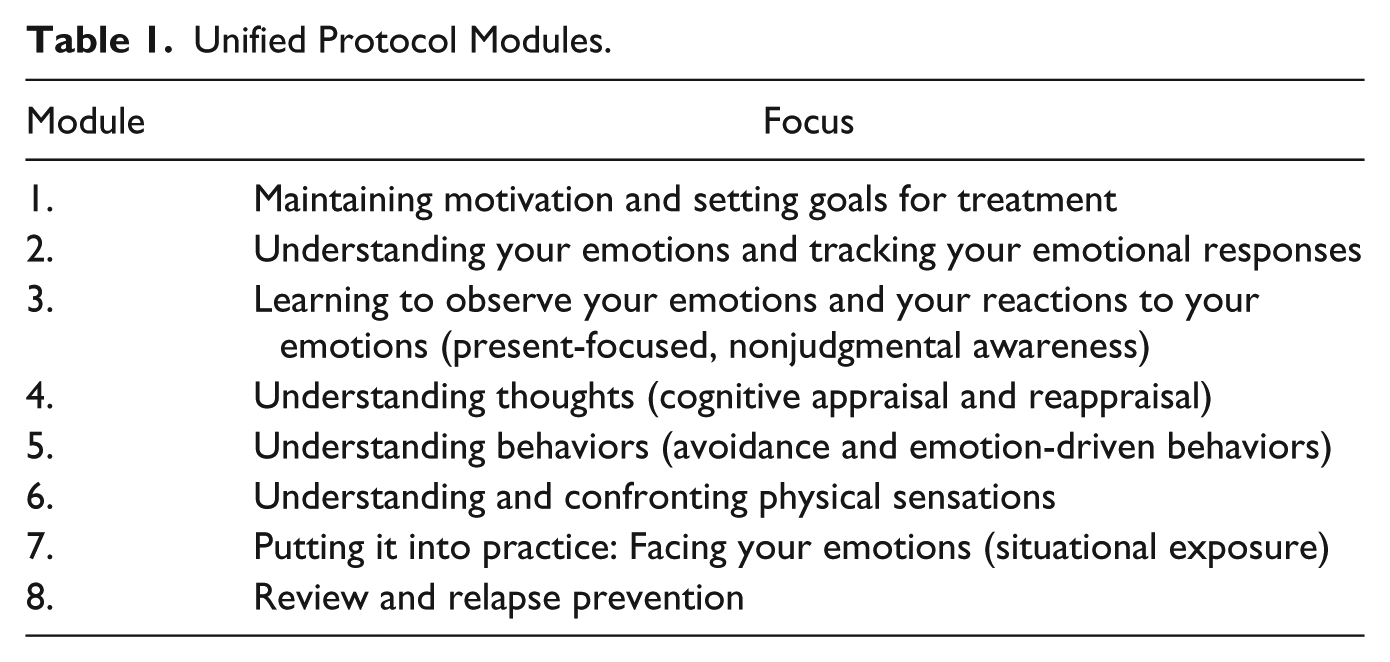
Treatment broadly followed the published UP manual (Barlow et al., 2011), including the sequencing of modules (see Table 1), with one key exception. The UP is a CBT-oriented approach developed to address all anxiety disorders and unipolar depression, as well as other related “emotional disorders” (Barlow et al., 2011). The overall aim of the UP is to target the factors that underlie all emotional disorders, rather than treating disorder-specific symptoms. Between the implementation of UP modules focused on present-focused awareness (Module 3) and cognitive reappraisal (Module 4), relaxation methods were introduced, following the procedures outlined by Borkovec, Newman, Pincus, and Lytle (2002) and Newman and Borkovec (2002). Relaxation methods included diaphragmatic breathing and PMR. A certified UP therapist and fidelity rater listened to the audiotaped sessions to confirm the introduction of specific UP modules, as well as verify adequate adherence and competence. Specifically, an independent evaluator used the same observer adherence and competence rating scale for the UP that is used in RCTs (e.g., Barlow et al., 2017). In order for a module to be labeled as “passing,” a therapist must receive an adherence score of at least 80% (from 0% to 100%), evidence no disallowed interventions, and receive an average competence item rating (e.g., quality of rapport; 3 on a scale from 0 to 5) of at least adequate. Based on this review, all UP modules were labeled passing and the timing/session of their introduction was confirmed. The UP does not include relaxation methods, so sessions involving such strategies would be considered nonadherent through this lens. The relaxation sessions were judged to have adequate fidelity based on independent ratings of adherence and competence, using methods described in the GAD trial conducted by Newman et al. (2011).
Unified Protocol Modules.
Data analytic approach
Exploratory time series models were tested to determine if the introduction of relaxation methods had a systematic impact on symptom change, on its own and relative to other intervention modules. This approach is particularly well suited for studying within-person change because it models within-person processes of interest over time, rather than estimating a single average score. Specifically, we tested interrupted time series models involving the introduction of multiple UP Modules. We adopted this approach for two reasons. First, demonstrating that the introduction of a module has a significant impact on postintroduction scores does not rule out the possibility that earlier modules also had a significant impact. Second, and relatedly, different interventions may serve similar or multiple therapeutic functions (Goldfried, 1980), including functions that are not as clearly conceptually linked. Excerpts of select session transcripts are also included below to provide additional context.
Data analysis was conducted in SPSS V 24.0 and SAS 9.4, and involved two steps. In the first step, the OASIS (anxiety) and ODSIS (depression) weekly scores were treated as separate univariate time series. The primary goals of this step were to (a) test for the presence of autocorrelation (the correlation among sequential scores at different time lags) and (b) ensure weak stationarity, which was a condition for the interrupted time series analysis in the second step. Similar to homogeneity assumptions in other statistical procedures, stationarity refers to the requirement that a process (i.e., time series) has a constant mean and variance-covariance over all time points (Tabachnick & Fidell, 2013); violation of this assumption can affect estimation of standard errors and significance tests.
The anxiety and depression data were then further examined in a set of exploratory analyses. Interrupted time series models (also known as intervention time series models) were tested in which the introduction of each UP module and relaxation was separately entered as a step function. This technique controls for autocorrelation and uses a t test to determine whether the uncorrelated postintervention scores differed significantly in slope or level from the uncorrelated preintervention scores (Crosbie, 1993). Therefore, the goal of this step was to test whether or not the introduction of a specific intervention module had particular influence on the trajectory of anxiety and/or depression symptoms. Unlike most between-subject designs, power for this type of analysis is determined by the accuracy of the model and the number of observations (N = 52 in the present case; Tabachnick & Fidell, 2013).
Excerpt From Session Transcript
Discussion of the anxiety and depression scores was a part of the agenda for each session. It is important to emphasize that self-report scores alone are not considered to be the one “objective truth” about progress or lack thereof. Ratings may or may not be consistent with the client’s verbal and nonverbal behavior in session, or his or her overall subjective experience. Multiple sources of information should be integrated. This client entered treatment in a high degree of distress and did evidence a reduction in anxiety and depression symptom ratings over the first 13 sessions. Although the absolute value of the reduction in anxiety scores, for example, was statistically reliable (score of 20 to a score of 10), there was variability week-to-week and this must be considered within the context of the client’s subjective experience. The following is an excerpt from the beginning of Session 14.
It looks like there was a slight decrease in your anxiety over the past week . . . your mood has still been pretty consistently down.
Yeah, it’s actually been a tough week. But I’m not sure it’s been that different from the usual.
It doesn’t feel like a meaningful difference, week-to-week?
Not really. I do think this is helping and I want to stay with it. But I was hoping for more at this point.
The process feels slow. I can understand that.
Yeah. I know that there’s no such thing as a quick fix. It’s been helpful. I do have a better understanding of my anxiety. I’ve learned some new things. But I still feel tense all the time. I can’t have a conversation with anyone without lashing out. I feel on edge and still can’t really relax. I realize that’s not necessarily good or bad . . . or unexpected at this point. I try to just be present with [anxious feeling and tension] when I remember to practice the mindfulness. It does help some. I don’t know. I still feel a bit helpless . . . need something more tangible.
OK. Tell me if I have any of this wrong. It sounds like a part of you believes that you’ve experienced some benefit from this work, and that includes being more aware of your emotions. At the same time, there is still a lot of suffering and tension, and there’s a pressure to find something else that you can latch onto.
Yes, exactly. I mean . . . I know that we still have a ways to go. I looked ahead in the workbook and it looks good and makes sense, but . . .
I think I’m hearing you, and I’m glad we’re having this conversation. My sense is that it will be useful to continue following our general plan . . . of course, we will probably need to discuss that more . . . but there are some other options that clients find helpful that aren’t explicitly covered in the workbook. It also isn’t a quick fix but it could help reduce some of your tension and it’s probably worth considering.
Mhmm . . .
If you’re OK with this, I’d like us to spend the rest of today’s session and probably the next few sessions on some more targeted relaxation strategies.
OK, that sounds fine.
In the following weeks, the client practiced PMR by playing a recording with prompts. In addition, he described practicing diaphragmatic breathing on the way to and from work on most days. The client subsequently remarked that the relaxation strategies not only reduced his perceived tension and irritability, but also increased his self-efficacy regarding his ability to actively cope with stress. The client did not attribute longer term or sustained treatment gains to relaxation methods alone; rather, he reflected on this as a turning point that facilitated his ability to remain engaged in and make use of other therapy components (e.g., cognitive reappraisal, present-focused awareness).
Results
The client received a maximum total score of 20 on both the OASIS and ODSIS at baseline, and a score of 5 on both scales at posttreatment. These postscores exceeded the respective reliable change indices (RCIs; N. S. Jacobson & Truax, 1991) for the OASIS and ODSIS, and were also in the nonclinical range (⩾7 OASIS, ⩾8 ODSIS). Time series plots for both symptom measures can be found in Figure 1. We also tested a preliminary multilevel model to determine if there were significant linear reductions in the respective symptoms over the course of the treatment. Multilevel modeling is indicated in this case due to the dependency of the data (Singer & Willet, 2003). For anxiety symptoms, there was a significant downward linear trend, B = –.04, SE = .01, t = −5.36, p < .01, 95% CI = [–0.05, –0.02]. A similar result was obtained for depression symptoms, which decreased significantly over the course of treatment, B = –.04, SE = .01, t = −13.45, p < .001, 95% CI = [–0.05, –0.03].

Plots of total scores on the OASIS and ODSIS.
Univariate Time Series
In time series analysis, the term lag is used to describe time periods between two observations. For example, Lag 1 is between Yt and Yt–1; Lag 2 is between Yt and Yt–2. Given the frequency of measurement in this study (weekly), a lag of 1 represented a time period of 7 days, a lag of 2 represented a time period of 14 days, and so forth. Autocorrelation (e.g., between observed scores or residuals) is the correlation among sequential scores at different lags. Model identification is largely concerned with characterizing the pattern of autocorrelation in a time series. The Lag 1 autocorrelation coefficient represents the correlation between pairs of scores at adjacent time points, while a Lag 2 autocorrelation coefficient represents the correlation between an observation and two previous observations. We used the auto-regressive integrated moving average model, PROC ARIMA, to examine the univariate time series, including whether or not there was sufficient within-person variability in scores across time to be modeled (Ram, Brose, & Molenaar, 2013).
Stationarity is often violated in intervention studies with symptom reduction trends, and the preliminary multilevel models tested indicated a significant linear trend in both the anxiety and depression time series. When significant trends are present, differencing can be applied to make a nonstationary mean stationary (Shumway & Stoffer, 2006; Tabachnick & Fidell, 2013). When differencing is applied, autocorrelation parameters represent the correlation among sequential change scores for a variable at different lags. Standardized scores were used in subsequently reported results. Both univariate models (OASIS and ODSIS) evidenced a significant autocorrelation test up to six time lags (ps > .001) and there was evidence of nonstationarity. A differencing factor of 1 was, therefore, applied to each time series. By differencing, the change in anxiety scores, for example, between adjacent time points was modeled. This model was used as the base time series model for both the anxiety (Akaike information criterion [AIC] = 47.32, estimate = −0.51, SE = .12, t = −4.17, p < .001) and depression scores (AIC = 63.25, estimate = −0.31, SE = .14, t = −2.24, p < .05).
Intervention Time Series
We then tested the impact of the introduction of specific intervention modules (UP specific and relaxation methods) on the anxiety and depression time series by adding an intervention variable (Module 1, Module 2, Module 3, Relaxation, Module 4, Module 5, Module, 6, and Module 7, respectively) to the models. This was done by coding a variable (e.g., Module 3) with a “0” for every point in the time series prior to the introduction of the intervention, and a “1” for every point thereafter. In addition to the statistical significance of the intervention parameter, the relative impacts of modules were compared using R2 values. These values were calculated to determine the proportion of systematic variance in the symptom time series explained by the intervention (one minus the sum of the squared residuals divided by the sum of squared OASIS t and ODSIS t values [score at time/observation t], respectively). We also examined AIC values to aid interpretation. Results are reported in Table 2.
Impact of Intervention Modules on Anxiety and Depression Ratings.

Note. AIC = Akaike information criterion; OASIS = Overall Anxiety Severity and Impairment Scale; ODSIS = Overall Depression Severity and Impairment Scale.
p < .05.
For the depression symptoms, intervention entry failed to have a significant effect. The intervention with the largest R2 value (.14, R2 change compared with baseline = .03) was emotion awareness and monitoring (Module 2). The intervention effects were more observable for the anxiety symptom time series, yet only one intervention effect was statistically significant. The introduction of relaxation methods had the biggest impact on changes in anxiety (p < .05, R2 = .34, R2 change compared with baseline = .07, AIC = 44.39). Although the effect was not statistically significant, the intervention with the second largest effect size was cognitive reappraisal (Module 4; R2 = .31, R2 change compared with baseline = .04, AIC = 45.95).
Discussion
It can be difficult to translate nomothetic research results to an individual client. Evidence-based practice begins by implementing evidence-based interventions and also involves the flexible application of theoretically grounded and empirically supported strategies in line with the evolving context and client characteristics. In the absence of multiple sources of feedback, it can be difficult to know when some form of intervention augmentation is indicated. Even when clinically useful moderators have been identified (e.g., high reactance clients are more likely to benefit from less directive approaches), clinicians need to be attuned to the individual client’s response. The integration of routine monitoring can help promote this attunement and decision making, and is highly consistent with the CBT model. The aim of this case analysis was to provide an example of how intervention augmentation can be facilitated with an individual client and how routinely collected data can then be used to examine the effects of such augmentation.
It is important to be clear about what this example and the reported results do and do not imply. The main implication of this case example is not that clinicians should always use relaxation with clients who meet criteria for GAD, or even with clients who meet criteria for GAD who are not responding in an expected (or hoped) way to treatment. Rather, a key implication, in our view, is that routinely collected information can be used to inform shared decision making and to more objectively assess the impact of specific intervention effects in routine psychotherapy. Of relevance to this specific example, it is important to highlight that relaxation strategies are a common component in evidence-based approaches for GAD (Newman, Llera, Erickson, Przeworski, & Castonguay, 2013). The therapist in this case did not haphazardly select an experimental intervention and hope for the best. The important distinction between ill-timed or inappropriately contextualized (e.g., not delivered with a coherent rationale and attention to therapy task expectancy violation) exogenous interventions and the competent exercising of flexibility has been highlighted in some previous research (e.g., Boswell, Castonguay, & Wasserman, 2010; Owen & Hilsenroth, 2014). These results rest on the assumption that clients receive a bona fide psychotherapy of adequate quality. Nevertheless, this did represent an augmentation to the treatment plan in that relaxation strategies were not explicitly included in the selected treatment protocol and companion client workbook. Relaxation methods are not novel and considered to be part of a CBT orientation; the use of these strategies is unlikely to appear controversial or foreign to most clinicians who work with clients who experience problematic anxiety. From a CBT principle perspective, this can be seen as a real-world example of flexibility within fidelity (Kendall, Gosch, Furr, & Sood, 2008).
Consistent with the UP manual and presenting complaints, this example involved brief, general measures of anxiety and depression symptoms/functioning. Many alternative measurement approaches exist and there are compelling arguments for focusing on the routine assessment of hypothesized psychological mechanisms (e.g., increases in cognitive flexibility) because these might be more directly informative for treatment planning than symptom tracking alone. Alternative or complementary assessment approaches and measures may be quite helpful in elucidating problem areas that the clinician was not originally aware of in the client. Certain problem areas may have originally been overlooked because they were less salient than the client’s primary presenting problem. Likewise, a new problem may have developed during the treatment process but gone unnoticed, as initial assessment had been completed weeks prior. It is commonplace that clients feel nervous or embarrassed when describing certain problems to clinicians, though they may feel more comfortable endorsing those issues on a self-report measure. Thus, measures may also encourage more client disclosure. If this new information were to arise, the clinician would be clued in to change or expand the focus of treatment, and possibly augment treatment with strategies outside of the original treatment plan/protocol.
It is also important to highlight that this was not an investigation of mediation or psychological mechanisms per se. Conceptually, the intervention effects in this case functioned as moderators. Unlike a more static participant characteristic, the intervention effect was tested as a within-treatment moderator of symptom process—Did this intervention delivered at this time affect the within-person symptom process in this individual client? Because additional variables were not assessed, the within-client change mechanism of the relaxation procedure–anxiety outcome, for example, cannot be examined in this case (Lorenzo-Luaces, German, & DeRubeis, 2015). Nevertheless, this example still targets a mechanism problem. In psychotherapy, the distinction between a process and an outcome is relative; when measured at multiple time points, the same variable can function as both a process and outcome variable (sometimes referred to as big “O” outcome vs. small “o” outcome; Greenberg & Pinsof, 1986). The term process is used in time series analysis for a reason. Furthermore, the relatively consistent association between baseline severity and posttreatment scores has led some to label baseline scores as the first mechanism (King et al., 2006). At least for anxiety, these results suggest that the introduction of relaxation strategies had a quantifiable impact on the anxiety symptom process within this individual. In contrast, significant effects were not observed on changes in depression (although adding the intervention variable to the model did account for a small amount of incremental variance).
As a complement to more commonly used alternative designs, single-case methods using more intensive measurement can provide valuable information about the process of change in psychotherapy in individual clients. Despite the call for increased attention to personalized psychotherapies, few studies have directly examined the impact of specific interventions in individual clients. Nevertheless, alternative explanations for this particular client’s observed improvement cannot be ruled out. It is possible that a similar change trajectory would have been observed with an alternative intervention or simply staying the course of the foundational treatment plan. The lack of an experimental design is a notable limitation; however, this case was a routine psychotherapy client and was not prospectively recruited to participate in a research manipulation.
If a client appears to be improving, it may be natural to attribute such improvement to specific intervention effects, yet this may not always be accurate. This attribution error may be less costly in the context of improvement, yet it highlights the importance of routine assessment of symptoms and functioning to track progress and outcome (Lambert, 2010). When a case is not on track for improvement in a course of bona fide treatment, this may be a marker of the need to adjust intervention delivery (Constantino et al., 2013). Measurement-based care (Boswell et al., 2015) may, therefore, be an effective approach for identifying nonresponding or more difficult clients for whom an alternative approach may be necessary.
Limitations
It is important to emphasize that the observed changes in this analysis are specific to time lags of 1 week. Had the case been assessed on a daily basis, it is possible that different results would have emerged because results can be dependent on a given lag (Gollob & Reichardt, 1987). More intensive time intervals could not be examined. Second, although rigorous in our case analysis approach, results from such case studies must be interpreted conservatively due to inherently limited generalizability. In studying transdiagnostic change processes within a single individual, the aim was not to establish generalizability in the traditional sense (Barlow et al., 2009); rather, the aim was to empirically explore functional relationships that may elucidate the process of change in the flexible delivery of transdiagnostic psychotherapy.
Additional limitations should be noted. For example, a large number of models were tested, which inflated the risk of Type 1 error. Given the number of tests and the exploratory nature of this approach, the results should be interpreted cautiously. The examination of the intervention effect sizes in this case may ultimately be more useful. In addition, each interrupted time series model was unique in that the number of observations prior to and after the introduction of a module differed across models. Practically speaking, this means that the interventions delivered in the beginning or toward the end of the treatment will have less power to demonstrate an effect than the interventions delivered closer to the midpoint of treatment (and, consequently, the observations). This asymmetry is important to note. Related to this, the analysis of the relative contribution of the modules to clinical change is partially confounded by early treatment gains due to the shrinking opportunity for improvement as treatment progresses (e.g., if a client experiences a 20% reduction in symptoms in the first few sessions, there is less room for improvement as additional components are delivered). Finally, the case in this study was not randomly sampled. Rather, he consented to the use of his clinical information and sessions recordings/transcripts for research and training purposes in the context of routine treatment. There was inherently a degree of selection bias.
Future Directions
Notwithstanding these limitations, we believe this case study is an important step in further elucidating intervention effects and evidence-based responsiveness in individual clients. The question of how psychotherapy works involves linking intraindividual change processes to specific intervention strategies (i.e., Do changes temporally coincide with the introduction of specific interventions?). A variety of methods can be used to address these questions (Kazdin, 2007). The modular structure of the UP lends itself to the study of within-person intervention effects, and the selected methods in this study are a complement to other research approaches aimed at discovering and testing change mechanisms within a personalized therapeutic framework. Truly personalized treatment delivery may be dependent on consistent measurement, feedback, and shared decision making.
In addition to regular, ongoing assessment to enhance responsiveness, future research should focus on identifying patient characteristics that are associated with different intervention response patterns, as well as the usefulness of adaptive interventions. To optimize such research, more intensive assessment and adaptive approaches will be needed. For example, sequential, multiple assignment randomized trials (SMARTs; Lei, Nahum-Shani, Lynch, Oslin, & Murphy, 2012) adaptively sequence interventions based on decision rules. This has potential not only to tailor interventions, but also to efficiently use treatment resources.
Footnotes
Declaration of Conflicting Interests
The author(s) declared no potential conflicts of interest with respect to the research, authorship, and/or publication of this article.
Funding
The author(s) received no financial support for the research, authorship, and/or publication of this article.