



Abstract
The recent Supreme Court decision in Endrew F. v. Douglas County School District focused attention on outcomes for students with disabilities. It is not just about participating; it is about the instruction and outcomes from those services. Co-teaching is a prevalent service delivery model for students with disabilities who access the general curriculum. Much has been written about co-teaching but not necessarily about the instruction that takes place in a co-taught classroom. In this case study, we present a preliminary investigation of a conceptual model for instruction in co-teaching. We report teacher and student behavior change as well as contextual variables that had an impact on implementation.
With the Endrew F. v. Douglas County School District (2017) decision, the Supreme Court came down squarely on the side of student outcomes over simple compliance to rules, documents, and timelines (Endrew F. v. Douglas County School District, 2017). By stating that the purpose of free appropriate public education (FAPE) for students with disabilities is to provide special education that guarantees more than de minimis progress, the justices focused attention on what is happening rather than simply where it is happening. This is critical for students with disabilities, particularly those who access the general curriculum in general education classrooms.
For some time, the emphasis in special education has been on gaining access to general education classrooms and, to this end, change is evident. In 2016, 62.7% of students with disabilities received education in the general education classroom for more than 80% of their day (U.S. Department of Education [USDOE], 2017), up from 49.88% reported in 2003 (USDOE, 2005). However, despite the progress made in providing students with disabilities greater access to general education classrooms, a requisite increase in achievement has not materialized. For example, in 2003, the average reading score on the National Assessment of Educational Progress (NAEP) for fourth grade students with disabilities was 36 points below peers; in eighth grade, it was 42 points below. By 2017, the differences in reading scores for students with disabilities compared to their peers without disabilities was 40 and 39 points, respectively, showing that the gap between them either remained stagnant or increased. Similar trends can be observed in NAEP math scores. In 2003, the average score for students with disabilities at fourth grade was 23 points below peers, and by eighth grade, 39 points. In 2017, students with disabilities were 29 and 41 points below their peers at fourth and eighth grades (National Center for Education Statistics, 2017). These are gross measures of achievement, no doubt; however, they point to the need to focus on services and instruction for students with disabilities and not simply access to general education classrooms.
Co-Teaching as a Service Delivery Model
Students with disabilities access the general education curriculum through a variety of service delivery models. One model that is frequently used is co-teaching, the combination of a special educator and a general educator in the same classroom delivering content to a diverse group of students (Friend & Cook, 2017). The purpose of co-teaching is to bring together the expertise of two teachers, one in general education and one in special education, to (a) deliver instruction accessible to all, including students with disabilities, and (b) provide specially designed instruction (SDI) to students with disabilities. Conceptually, the service delivery model has potential to do both; however, implementation has been an issue.
Several literature reviews have found that teachers often benefit from the professional collaboration of co-teaching (Scruggs, Mastropieri, & McDuffie, 2007; Weiss & Brigham, 2000), and an early meta-analysis of co-teaching found a moderate overall effect size of .4; however, only six studies met the inclusion criteria (Murawski & Swanson, 2001). Of the six approaches to co-teaching (e.g., station teaching, parallel teaching), the one teach–one assist approach is the most prevalent model used, often with the special educator doing the assisting (Scruggs et al., 2007; Weiss & Brigham, 2000). In this approach, one teacher is responsible for instruction and the other teacher monitors student behavior, assists with student questions, and seeks clarification about material as necessary. Unfortunately, the teacher who assists—often the special educator—does not contribute to the overall classroom instruction.
Individual studies have examined specific instructional behaviors of teachers in co-taught classrooms. Examples of these behaviors include presenting and mediating content (Boudah, Schumaker, & Deshler, 1997; Harbort et al., 2007), managing behavior (Harbort et al., 2007), and literacy instruction activities (Magiera & Zigmond, 2005; Wexler et al., 2018). In a study by Boudah et al. (1997), co-teachers were taught general strategies for co-teaching and results indicated that, though they increased their time mediating instruction (providing supports or strategies), student results on measures of engagement, strategy knowledge, and content knowledge did not change. In other studies, researchers cataloged the instructional behaviors of teachers under routine conditions without specific training (Magiera & Zigmond, 2005; Wexler et al., 2018). Findings across studies indicate that special educators did not spend a great deal of time involved in instruction, specific evidence-based practices (EBPs) from special education were not often incorporated into instruction, and little SDI was occurring.
However, in a study by Bottge, Cohen, and Choi (2018), teachers were trained on specific instructional behaviors to implement enhanced anchored instruction (EAI) in both resource and inclusive mathematics classrooms. After observation, inclusive classrooms were designated as high support (students with disabilities received a significant amount of individualized instructional support) or low support (students with disabilities received a small amount of individualized instructional support). When the researchers compared high support with low support inclusive classrooms, they found, Students with disabilities (SWD) who received more individualized instructional support from special education teachers in the inclusive classrooms improved their skills much more than SWD who received little support. In fact, the post-test scores showed no significant difference between the high-support SWD and students without disabilities overall. (p. 208)
This result, including training in specific instructional practices, needs to be further explored.
Using Opportunity to Learn as a Conceptual Framework for Instruction in Co-Teaching
Recently, Friend (2016) emphasized the fact that co-teaching is a special education service delivery model. That means, “educators focus on integrating into daily lessons the special education strategies and techniques that will enable students to achieve the goals of their [IEP]” (p. 18). Kurz and Elliott’s Opportunity to Learn (OTL) framework provides a useful tool for conceptualizing specific recommendations for instruction in co-taught classrooms (Kurz, 2011; Kurz et al., 2014; Kurz, Elliott, Wehby, & Smithson, 2010). They define OTL as “being concerned with students’ opportunity to learn the intended curriculum” (Kurz et al., 2014, p. 38). The OTL framework includes three levels of curriculum: (a) the intended and assessed curriculum; (b) the planned and enacted curriculum; and (c) the engaged, learned, and displayed curriculum.
For students with disabilities, the intended curriculum includes both the general curriculum and the individualized education program (IEP) curriculum, based on individual student need. The IEP curriculum may include social or behavioral goals that are not directly related to the general academic curriculum or academic goals that are not specifically addressed in the general curriculum for that grade level (Kurz, 2011). The enacted curriculum is “the content of instruction delivered by classroom teachers” (Kurz et al., 2010, p. 132). Time, content, and quality are the three major dimensions of teachers’ enacted curriculum. In a co-taught classroom, the time for instruction remains the same as in a traditional classroom. The content increases to include the general curriculum and the IEP curriculum for the student with disabilities.
For quality of instruction, Kurz et al. (2010) include three indices: cognitive processes, instructional practices, and grouping formats. All teachers are expected to include activities related to cognitive processing that require students to use a range of lower to higher cognitive skill (as described, for example, by Bloom’s Taxonomy; L. W. Anderson et al., 2001). The index of instructional practices focuses on the use of EBPs. In a co-taught class, this is the use of EBPs from both general and special education for the content area. For grouping formats, co-teachers have the ability to incorporate a wider range by virtue of there being two teachers available to work with different-sized or -focused groups. Given these differences from singly taught classes, co-taught classrooms require a specific and intentional instructional framework (Weiss & Rodgers, In press).
Quality Instruction in Co-Taught Classrooms Using an OTL Framework
Focusing on the OTL quality of instruction dimension, co-teaching can be conceptualized as including three basic elements: quality general education instruction, accessible general curriculum instruction, and SDI.
Element 1: Quality General Education Instruction
Element 1 for effective implementation of co-teaching is quality general education instruction. General instruction in classrooms exists along a continuum of quality and specialization. For a classroom to be effectively co-taught, general education teachers must first manage it in a way that maximizes engaged learning time. There must also be evidence of close alignment between the intended general curriculum (i.e., academic standards) and what is planned and enacted in the classroom. Finally, general education teachers must be using the EBPs of their discipline. If they are not enacting high-quality instruction in a singly taught class, it will be impossible to build an effective co-taught classroom, no matter the teacher relationship.
Element 2: Making the General Curriculum Accessible
Adding to Element 1, Element 2 involves co-teachers incorporating specific EBPs from special education into general instruction. Examples of EBPs may be the lesson structure of the Explicit Instruction approach, including gaining student attention, modeling, guided practice, and independent practice. These components include frequent student opportunities to respond (OTRs) and corrective feedback (Archer & Hughes, 2011). Another example may be the use of graphic organizers (Ellis & Howard, 2007), incorporation of learning strategies instruction (Krawec & Montague, 2012), and mnemonic devices (Brigham & Brigham, 2001). The key criterion for Element 2 is that the content of instruction is relatively the same for all students in the class; however, the markers of instructional quality change because the instructional practices now include EBPs from special education. Co-teachers intentionally plan when to incorporate these EBPs into the lesson and then determine how they will implement them, often by using different co-teaching approaches (i.e., station teaching, parallel teaching) as grouping strategies. Element 2 also includes accommodations made for students with disabilities.
Element 3: SDI
To provide instruction for an IEP curriculum, co-teachers must add Element 3, SDI, to Elements 1 and 2. SDI includes (a) smaller or individual grouping based on skill, (b) instruction on IEP goals and/or material that is a prerequisite or developmental skill related to but not identified as general curriculum for the student’s grade level, and (c) EBPs in special education to address that skill. In this Element, the special educator implements instruction that changes time allocation, learning environment, objectives, instructional delivery and/or content for the students with disabilities (Fuchs & Fuchs, 2015; Vaughn, Wanzek, Murray, & Roberts, 2012). Incorporating SDI requires teachers to intentionally provide different instruction for students based on individual needs and goals dictated by IEPs. When taken together, this three-element model operationalizes factors of instruction for co-taught classrooms. See Figure 1 for model graphic.
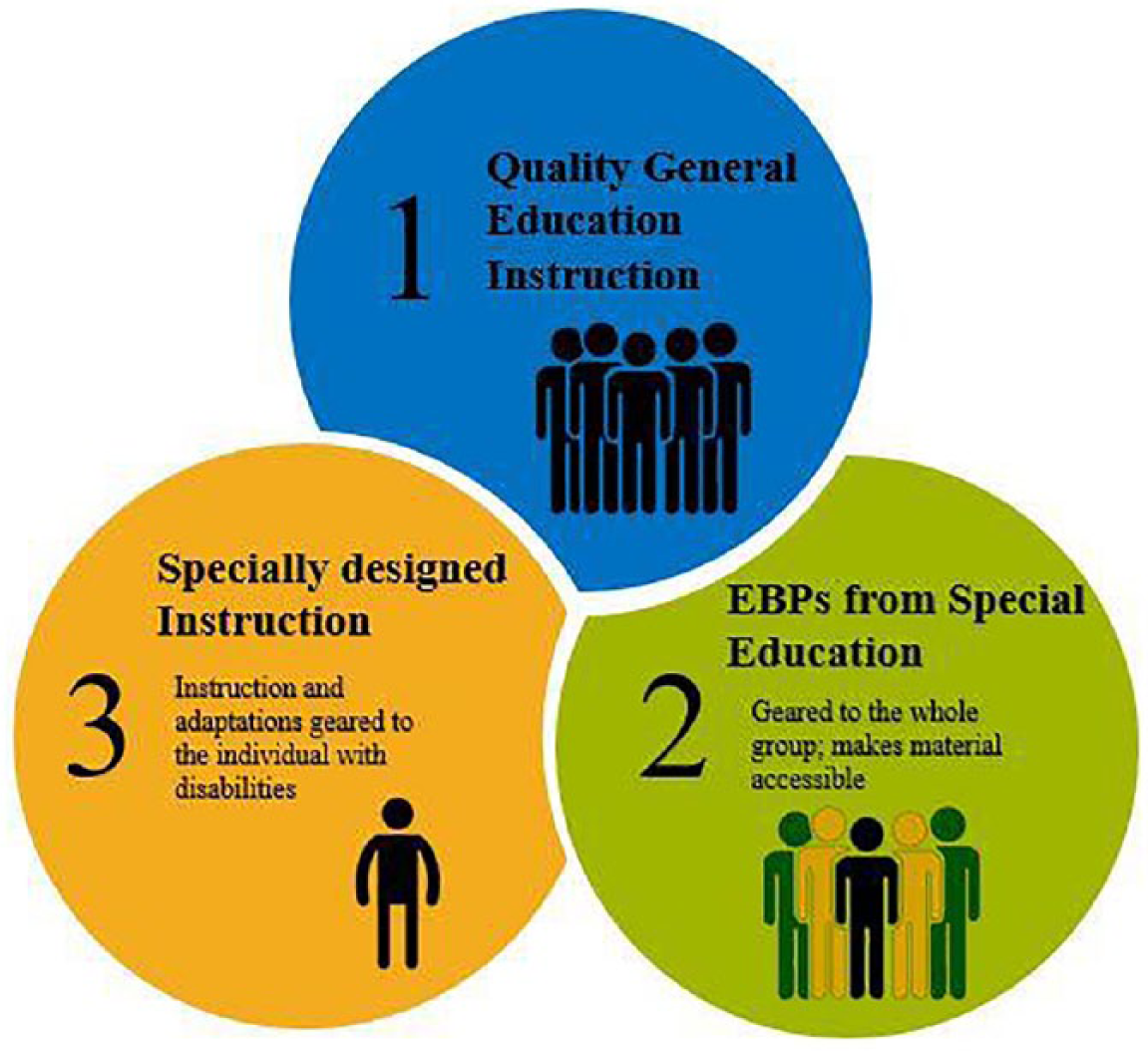
Three-element model.
Purpose of the Study
Using the principles of design-based research (DBR; Collins, Joseph, & Bielaczyc, 2004), we situated this three-element model in an applied setting by conducting a case study of a secondary co-taught classroom. Our theory of using an OTL framework to describe specific instructional practices that should be evident in all co-taught classrooms is useful to “delineate classes of phenomenon that are worthy of inquiry and specify how to look and what to see to understand them” (Collins et al., 2004, p. 79).
DBR focuses on studying the design, and subsequent redesign, of an intervention that addresses a problem of practice in a real educational context through partnerships between practitioners and researchers (T. Anderson & Shattuck, 2012). DBR is one method of addressing what Cho and Trent (2006) have called “transformational validity” which is defined as “judg[ing] work to be valid only if it signals that validity achieves an eventual ideal” (p. 320). In the context of this study, the ideal would be that teachers in a co-taught classroom provide quality instruction by addressing the three elements essential to co-teaching: quality general education instruction, making general curriculum accessible, and SDI. Therefore, this case study had three research aims:
to determine the feasibility of the three-element model,
to understand the factors relevant to implementation, and
to define measures of student outcomes.
Method
This case study took place in a rural high school in a mid-Atlantic state. The school was fully accredited by the state in the year before the study began. The high school spans Grades 9 to 12 and has a student population of approximately 1,300. Of the population, around 50% are female and 65% are White; Black and Hispanic students represent an additional 30%. Approximately 40% of the students are classified as economically disadvantaged. Students with disabilities comprise 16% of the student population, while English Learners make up approximately 10%. The student teacher ratio is approximately 12:1 (information taken from state report card; direct link not included to protect anonymity).
The school and the co-teaching team were selected as a convenience sample. The school was chosen for this initial study for two reasons: (a) it fit the desired profile of having co-taught classrooms, providing support for co-teachers in the form of common planning time and internal professional development, and there was no external involvement in the school’s program with competing ideas about how co-teaching should be implemented and (b) the administration volunteered to provide access and support to the project. In addition, a previous study by the authors of two sets of co-teaching pairs in this school in the prior year indicated few differences in instruction between singly taught and co-taught classrooms (Weiss & Glaser, 2017).
Participants
One co-teaching team from the school participated in this in-depth case study. This case study is part of a larger study that included three co-teaching teams. The team volunteered to participate in the in-depth case study after attending a brief overview session with the first author. Both teachers on this team were fully licensed in their respective areas, English and special education. The Assistant Principal, as supervisor of the team, reported that they had earned ratings of Highly Effective (independently and together), using the county-wide evaluation system. The English teacher had received ratings of Highly Effective for instruction before this study. Both teachers on the team were White women between 35 and 50 years old who had co-taught at least one course together for the four semesters before the study began. In the semester of the study, the co-teachers taught English 11 and English 12 together and no other courses. The special education teacher held a master’s degree; the English teacher was taking master’s coursework at the time of the study. They had both received training in co-teaching through professional development activities held at their school. In the state where the study was conducted, the English 11 course includes two standardized assessments for all students: a reading assessment and a writing assessment. To earn a verified credit toward graduation requirements, the students in this course were required to pass the course and earn a Proficient score on the two standardized assessments.
Class and Students
The teachers co-taught an English 11 course that included 24 students, six with IEPs. The students were either completing their junior or senior year in high school. Fifteen were male; two students were African American, six Hispanic, and 16 were White. The class session ran on a block schedule for approximately 80 to 90 minutes per session. At this high school, students attended four classes per semester, each of which met every day, thus completing a year-long course in one semester. Observations took place from September to December, thereby spanning an entire English 11 curriculum. However, the majority of the instruction from September through early November focused on writing in preparation for the state’s standardized writing assessment.
Two of the six students with IEPs were chosen as target students because the teachers were concerned about their performance, their IEPs included specific goals relevant to English, and their families gave consent for them to participate. Both students were classified as juniors at the time of the study and each had been identified as eligible for special education services in elementary school. The first student, Wanda, was identified by the school division as having a learning disability in the areas of working memory and processing speed. Her IEP goals focused on test-taking strategies, writing well-developed paragraphs, and using strategies to assist in memory tasks and organization. Teacher reports described Wanda as able to understand and use content presented in class; however, she had a difficult time translating her knowledge or ideas into writing.
The second student, Riley, was identified by the school division as having a learning disability in the areas of reading, writing, and working memory. Her IEP goals focused on improving reading fluency and reading comprehension, writing with correct sentence structure and grammar, and improving multistep problem-solving. Teacher reports described Riley as able to comprehend concrete information such as setting and character traits when reading independently but unable to make accurate inferences or connections in text. In addition, teachers reported that Riley was not able to consistently independently initiate and persevere on tasks when given directions for independent practice.
Data Sources
Data sources for this study included videos and field notes from classroom observations, teacher interviews, and student grade reports. See Table 1 for data sources and their alignment with research aims.
Data Sources and Research Aims.
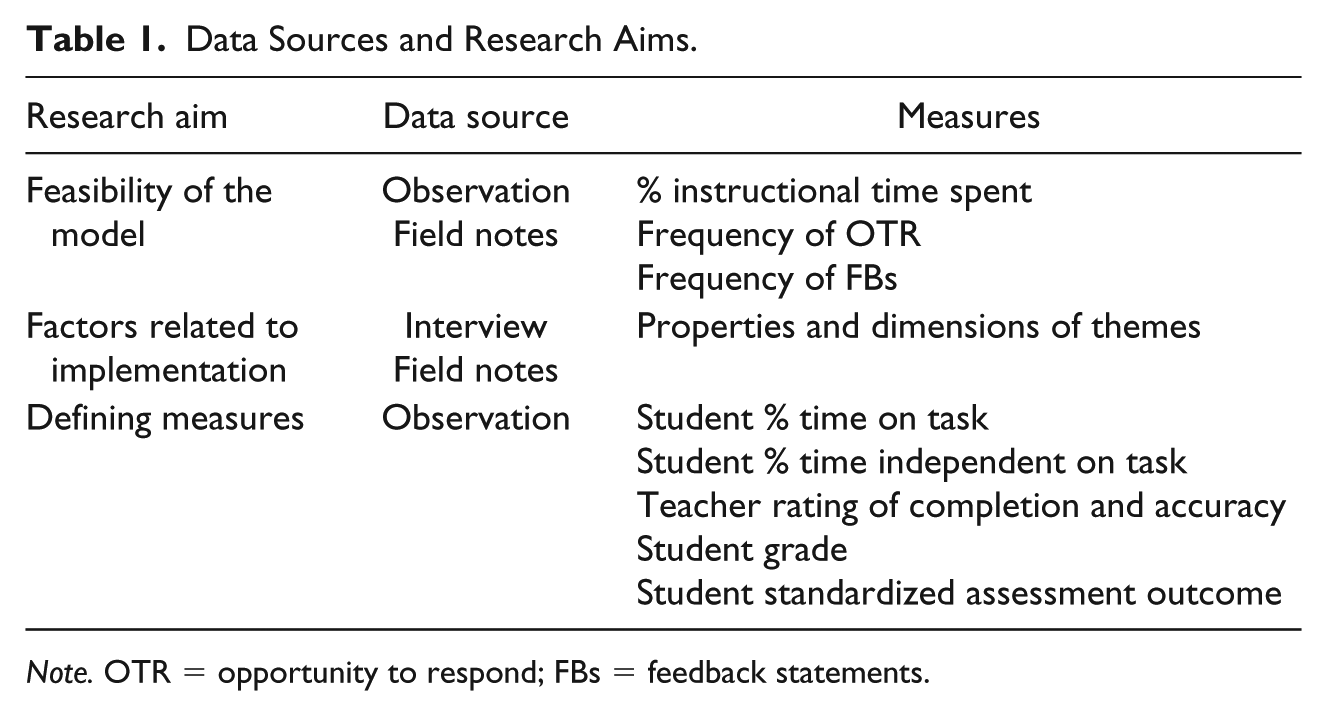
Note. OTR = opportunity to respond; FBs = feedback statements.
Classroom observations and field notes
The team identified one class section for the study: English 11. The first author observed the specific class sessions on 28 occasions across an entire semester. Class sessions lasted approximately 85 minutes (range = 78-90 min) and occurred every day. Each session was videotaped by the first author for later analysis. Files were kept on a secure server and accessed only by the data analysis team. During the observation, the first author kept field notes indicating the time, session’s goals, the students in the session, the general activities, and any items of note such as drills or pep rallies. The researcher was not involved in instruction in any way.
Teacher interviews
The teaching team met with the first author before the study began to describe their ideas about co-teaching and to identify areas of strength and weakness in their target class. Teachers also identified areas of interest for learning more about co-teaching. Notes from these sessions were taken, then cross-checked with the teaching team for accuracy and completeness. After the final observation, the second author conducted a semi-structured interview with the teaching team. Questions asked during this session included the following:
Have your ideas related to co-teaching changed during the study? If so, how?
Have you made any changes to instruction or planning related to participation in this study? If so, what were they?
Did these changes have any impact on student outcomes?
The interview was audiotaped and transcribed for inclusion in the analysis.
Student data
In addition to the classroom observations and interviews, data for each of the target students were also collected. Each day from October through December, teachers completed a rating scale asking them about task completion and on-task performance for each student. At each of the quarterly marking periods, as well as at the conclusion of the course, the teachers provided grades for each of the target students. In addition to grades, eight class observations were randomly selected to code for student on- and off-task behavior and interactions with teachers. Finally, performance on the state standardized writing test was provided for each of the students.
Procedures
After receiving institutional review board and local school division approval for the study, all co-teaching teams at the high school were invited by the assistant principal to participate in an information session led by the first author. A description of the study and participation requirements were presented. The English team volunteered to participate in the in-depth case study.
The first author scheduled meetings with the team to obtain information related to their co-taught classes, background and demographic information, areas of success and need, and logistical information (e.g., time of classes, what usually occurred during the week, basic classroom rules). In addition, the team identified a target class and provided information about content and students. The team identified a concern that students were often confused when given independent practice and this required the teachers to reteach or restate the directions for the task multiple times to individual students. After these meetings, the first author began to observe and videotape class sessions.
Study Phases
The study was conducted in three phases. Phase 1 included documentation of the instructional actions of the co-teaching team under routine conditions without information about the three-element model. The English team was observed 8 times before intervention. Phase 2 included the first intervention related to the three-element model and specific instruction and coaching on Element 2. This included a 1 and 1½ hr meeting with the team to describe the conceptual model of instruction in co-teaching, define Element 2 specific practices, and identify potential areas of use within the teams’ lessons. During this meeting, the team watched a short video with narration about the three elements and their distinguishing characteristics. The lesson structure of Explicit Instruction, including modeling, guided practice, and independent practice, was defined for the teachers as a target for Element 2 to transition to independent practice with greater student understanding of the assigned task. Videos from Archer and Hughes (2011) that provided examples of modeling and guided practice, as well as a variety of ways to provide students with OTRs, were reviewed together. The first author then showed two videos taken from the teams’ lessons to provide examples related to moving from modeling to independent practice without verifying student understanding. In the videos, the general educator provided a lecture on writing a topic sentence with multiple examples of “hooks” (initial sentences to engage the reader) but did not provide think aloud and guided practice in writing “hooks” before moving directly to independent practice. In the videos, once the students moved to independent practice, few were able to complete the assigned task of writing a “hook” successfully and the co-teachers then had to provide individual re-teaching to virtually every student in the class. These lessons were discussed and, with coaching from the first author, the teachers brainstormed how they could have included guided practice and OTRs to students to alleviate this issue, thus making the instruction more accessible for more students in the class. At the end of the meeting, the co-teachers and the first author planned the next 2 days’ lessons in which they modeled and used guided practice to provide instruction in editing paragraphs. Following observation of these lessons, the first author provided feedback and coaching on implementation to the teachers. The videos and materials from the session were stored in an online learning platform that the teachers could access at any time.
Following evidence of increased use of modeling, guided practice, and OTRs for Element 2, Phase 3 of the study began. The first author scheduled a meeting with the special educator to discuss implementation of Element 3: SDI. This meeting included review of IEP goals for target students with disabilities in the class, determination of instruction that could be provided to meet these goals, and determination of when and how this instruction could be implemented in the co-taught classroom. For example, one of the targeted students had IEP goals related to reading comprehension. The special educator identified determining the main idea as critical for student success and developed brief lessons to directly address this skill in a small group including the target student. In addition, times within the class session to deliver this instruction (e.g., during the warm up, in small groups) were identified. The planning meeting was held with the special educator only and she was responsible for discussing the ideas with the general educator in co-planning sessions.
Data Analysis
Classroom observations, student data, and interviews were analyzed to address the three research aims.
Classroom observations
Classroom observations were evaluated using the Classroom Teaching Scan (CT Scan; Kennedy, Rodgers, Romig, Lloyd, & Brownell, 2017). A team of three graduate research assistants (GRAs), including the second author, watched each observation video and tracked teachers’ instructional behaviors, as well as their use of OTRs and feedback statements (FBs) by logging this information into the CT Scan. The CT Scan is a software program that enables users to note one of the two different types of information about what is occurring: (a) how long it occurs (duration) and (b) how often it occurs (frequency). For the purposes of this study, an Explicit Instruction menu was created to track the components (e.g., modeling, guided practice, independent practice) used during a lesson, including their duration and their quality as measured by designated implementation markers. See Table 2 for a complete list of codes used, as well as their descriptions.
CT Scan Codes and Definitions.
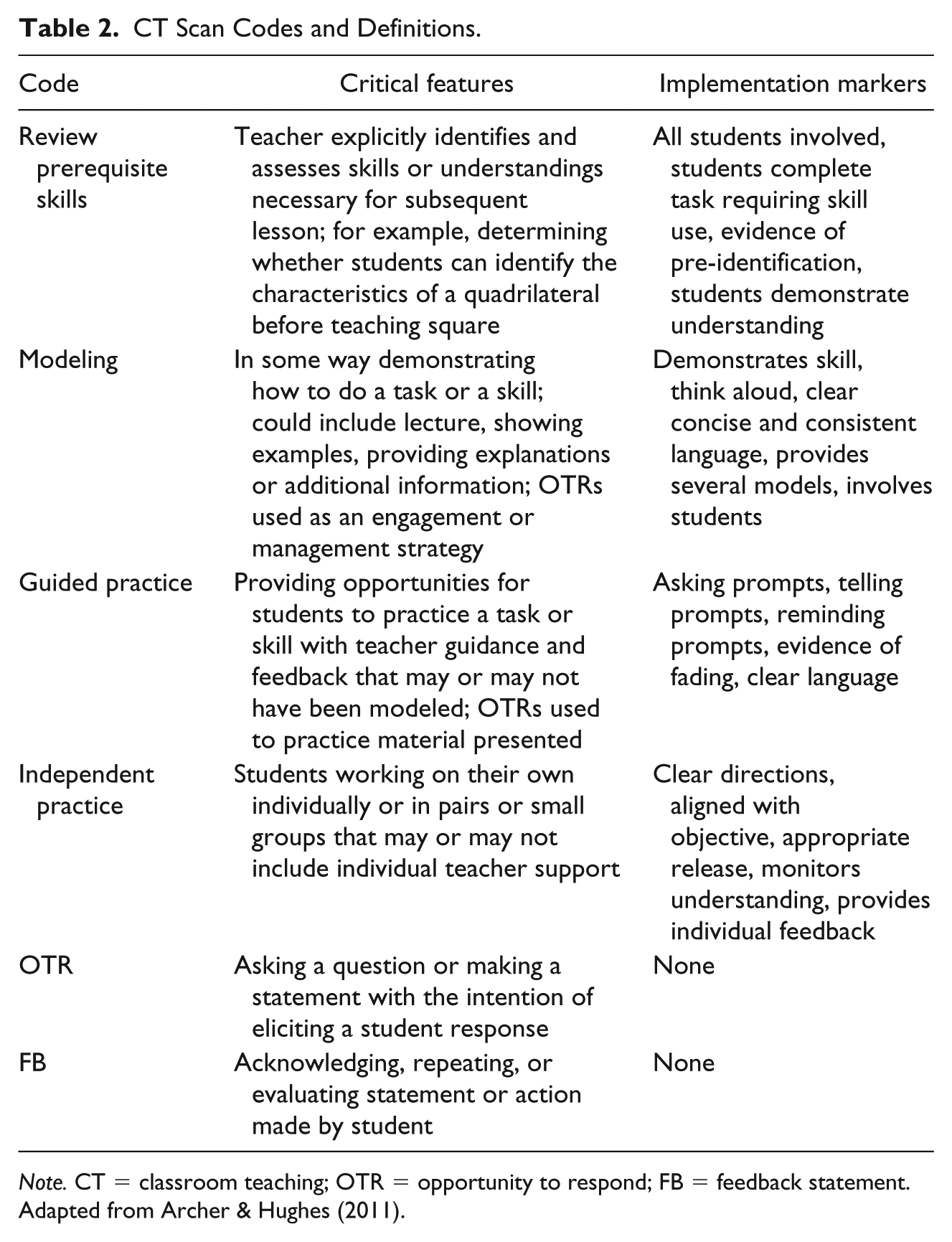
Note. CT = classroom teaching; OTR = opportunity to respond; FB = feedback statement.
Adapted from Archer & Hughes (2011).
As teachers moved through the lesson, each coder selected the instructional component currently in use; as new components were selected, the CT Scan created a notation in the output indicating the start/stop time and the duration spent in that particular component of the lesson. To indicate quality, implementation markers for each instructional component were developed from descriptions provided in Archer and Hughes (2011). As coders selected the instructional component being used in the lesson, the software program provided them a list of these implementation markers to log instructional quality. Markers exhibited by the teachers during that specific lesson component were checked; those markers which were unobserved were left blank.
In addition to logging duration and quality of the instructional components used, the three coders also used the CT Scan to keep count of the number (frequency) of OTRs and FBs throughout the course of the lesson. Each time that a teacher provided an OTR or FB statement, the coder would click that specific button on the CT Scan interface and the software program would log the time at which the button was pressed, as well as keep a running tally of total OTRs and FBs provided. At the conclusion of each coding session, the software program generated an Excel spreadsheet output detailing the start and stop time of each instructional component used, as well as its duration and quality, along with the timing and number of OTRs and FBs provided. Outputs were then compared to identify changes in instructional component quality and duration, in addition to OTR and FB frequency, over the course of the semester.
Prior to coding, the second author met with the two GRAs tasked with the project to train them on how to use the CT Scan program and to practice coding example videos together. After each coded two practice videos, the team met to discuss questions, concerns, and standards for selecting certain codes. A running “Coding Notes” document was created and shared with all three coders to indicate decisions made in these conversations, and was used by coders during observations to troubleshoot questions that arose throughout the course of coding. All 28 videos were double-coded to ensure reliability. Videos that did not achieve at least 80% reliability on practices (components), OTRs, and FBs were reviewed and discussed until all three coders were satisfied that the appropriate practice, OTR, and/or FB had been selected during a specific period of time. Overall, average reliability on practices was 91%, with a range spanning from 82% to 99%. Average reliability on OTRs was 94% (range = 81%-100%), with FB average reliability at 93% (range = 82%-100%).
Field notes
Coders used field notes to guide their understanding of what was happening in the classroom during an observation. The first author transcribed the notes into a Word document that was posted for coders to read before beginning their coding. In addition, field notes were used to identify session objectives and to describe lost time in observations (e.g., lockdown drill).
Student data
Eight total observations were randomly selected across the three phases for coding of student on- and off-task behavior using the BDC123 mobile application (Virginia Department of Education, 2015). Three observations were randomly selected from the baseline condition, two from Phase 2, and three from Phase 3, constituting 20% or more of the videos available for each phase. The BDC123 app allows users to create templates to collect data using an iPad while watching a live or taped classroom observation.
Student on-task behavior, teacher interaction with a student, and transition time were captured to determine the percentage of time students were on task during instructional time (defined as total time coded minus transition time), both independently and with teacher support. An additional category, “Out of View,” was included to account for time when students, and thus their behavior, were unobservable. Observable behaviors were defined as those occurring in view of the camera by a student whose face (specifically, at least one eye) could be partially observed so as to determine whether she was on- or off-task. On-task behaviors were defined as completing one of the following actions: (a) looking at seatwork, (b) looking at the teacher when she is instructing, or (c) looking at and/or talking with a peer as directed by the teacher to complete a task (e.g., if the task assigned was to be completed by a group rather than individually). Off-task behaviors were defined as looking elsewhere in the room, talking with peers, or using a cell phone without given direction to do so.
After the coding menu for the BDC123 was developed, both researchers double-coded two of the nine videos (22% of the total number) to ensure reliability. Average reliability for transition time was 89.5% (range = 82%-97%). For Wanda, average reliability for on-task behavior, time out-of-view, and time of teacher interaction was 96.5% (range = 94%-99%), 94.5% (range = 89%-100%), and 86.5% (range = 86%-87%), respectively. Reliability for Riley’s on-task behavior fell at 96% (range = 93%-99%), at 99% (range = 98%-100%) for time out-of-view, and at 90.5% (range = 84%-97%) for time of teacher interaction.
Teacher interviews
The second author conducted a semi-structured interview with the two English co-teachers after all observations were completed. The interview was audiotaped and transcribed. The first author read the interview line by line and coded statements related to the three themes of feasibility, instruction, and contextual factors. These codes were then used to identify the properties and dimensions of each theme (Corbin & Strauss, 2015).
Results
The three aims of this case study were to (a) determine the feasibility of implementation of the three-element model, (b) understand the factors relevant to fidelity of implementation, and (c) define measures of teacher and student outcomes.
Feasibility
To evaluate the feasibility of the model, we analyzed the instructional behaviors of the teachers in each phase to determine level of implementation. We identified the percentage of instructional time spent on modeling, guided practice, and independent practice across all three phases. In addition, we included data on OTRs and FB statements.
Explicit instruction components
In Phase 1 (baseline or instruction under routine conditions), modeling varied from 2% to 40% of the class period with an average of 19%. It occurred in every observed class session. In Phase 2, modeling occurred every day and ranged from 1% to 30% of the class period, with an average of 16%. In Phase 3, modeling occurred in seven of the nine sessions, ranging from 0% to 56% with an average of 14% of the instructional time (see Table 3).
Instructional Behavior Results.
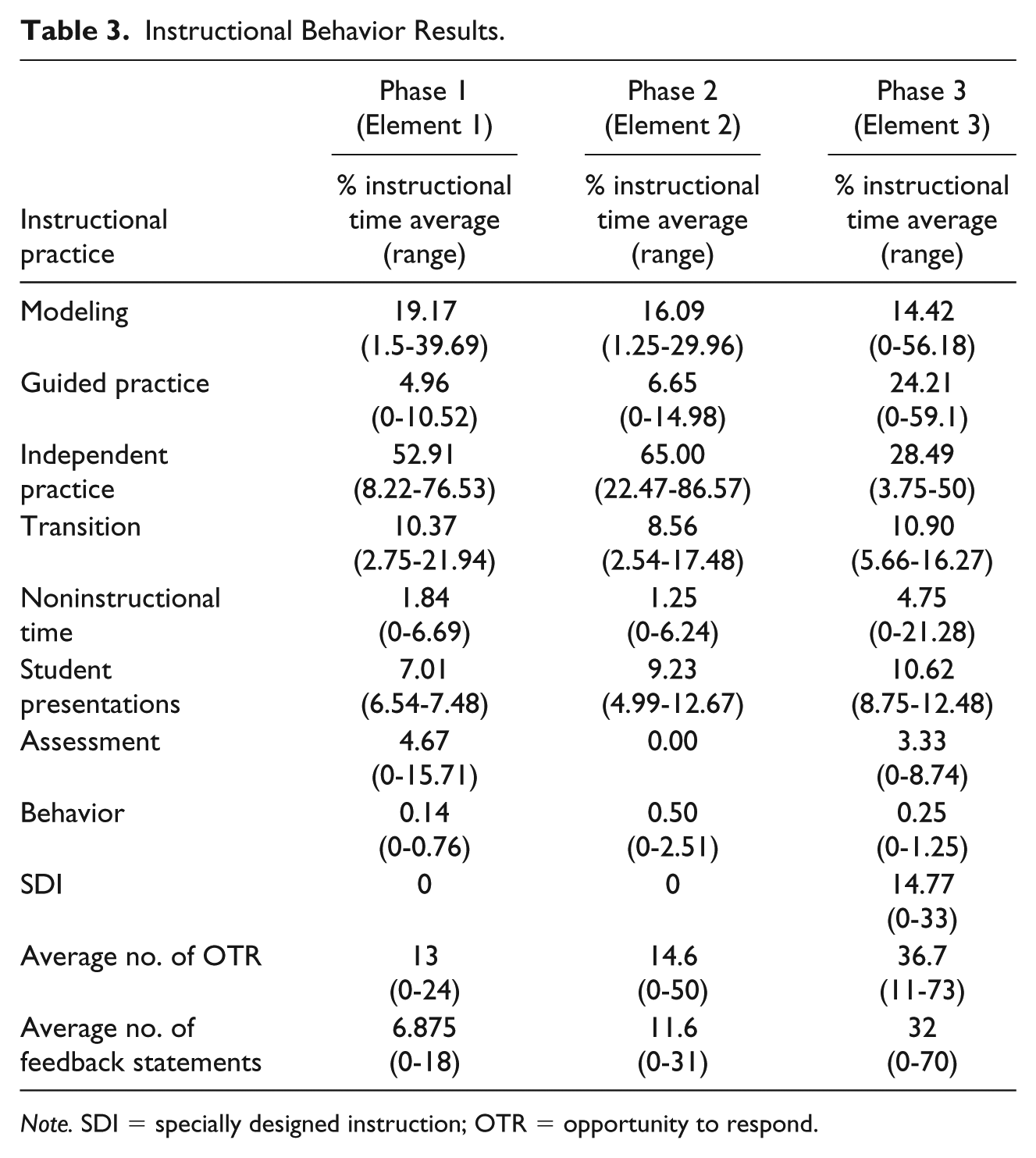
Note. SDI = specially designed instruction; OTR = opportunity to respond.
Guided practice, in Phase 1, varied from 0% to 11% with an average of 5%. It occurred in six of the eight observed sessions. In Phase 2, guided practice occurred on 6 of the 10 days, ranging from 0% to 15% of the class session, with an average of 6%. In Phase 3, guided practice occurred in nine of the 10 sessions, ranging from 0% to 59% with an average of 24% of the instructional time (see Table 3).
Independent practice, in Phase 1, ranged from 8% to 77% of the class period with an average of 53%. It also occurred every observed session. In Phase 2, independent practice occurred every observation and ranged from 22% of the class period to 87%, with an average of 65%. In Phase 3, independent practice occurred in every class period with a range of 4% to 50%, averaging 28% of the instructional time (see Table 3).
There was no evidence of SDI during Phases 1 and 2. In Phase 3, SDI occurred on five of the 10 sessions with a range of 1% to 33% (average = 17%) of instructional time. SDI included small group instruction of students with disabilities on target skills such as reading comprehension strategies (see Table 3).
OTRs and FBs
The average number of OTRs increased across phases, from an average of 13 in Phase 1 to 37 in Phase 3. The average number of FBs also increased across phases, from seven in Phase 1 to 32 in Phase 3 (see Table 3).
Factors Relevant to Implementation
After the final observations, the second author conducted a semi-structured interview with the teaching team. From their interview, we identified properties and dimensions of the themes of feasibility, instruction, and context.
Feasibility
The teachers indicated that the three-element model, with identified instructional practices, was feasible to implement. The general educator stated, “I really appreciated that [the first author’s] feedback and the things she wanted us to incorporate were real life, like, can work with anything.” She went on to say, “from the study, we’ve gotten some practical things that we can use. It hasn’t been a big production which I think I was expecting.” An unexpected dimension of their thoughts about feasibility was that the three-element model actually gave them more confidence in their roles and eased their anxiety related to planning. This was evident in the special educator’s comments such as “I feel more comfortable about co-teaching. It’s not always those stations that you have to do, like, I think [the first author] kind of reinforced that it was okay how we are doing it.” And the general educator added, “I feel like before, for me, I was always really worried about planning days without you [special educator] having some input, and now I don’t care.” The team indicated that this newly found calm in planning came from the assumption with the three-element model that the two teachers bring different expertise to the table and that is important to acknowledge. For example, the general educator stated, I think before the study, we were trying to all do the same thing, like, ok, but we need to parallel teach, you know we need to be doing this. Let’s make sure that we are both seen in this light, and I think we learned that it’s ok to be seen in a different light as long as we both are involved, and I think that would be true.
The special educator echoed this statement, saying, “So being okay with having the different, or I guess recognizing, honoring, that you each bring different expertise to the table, and it’s okay that what you’re doing does not look like the same thing.” This seemed to free the teachers up to thinking about instruction in a different, more concrete way and not in a way that forced specific approaches, such as station teaching, onto their lessons.
Instruction
Building on the dimension of honoring difference, the teachers talked about how they originally planned and implemented their instruction thinking that they needed to be the same or at least appear to be the same. The special educator stated, “Like, we’re looking at a lesson, okay now, how can we put you here, and how can we put me here. We are all teachers and nobody can know the difference between the two of us.” The general educator agreed, “I think before the study, we were trying to all do the same thing, like, okay, but we need to parallel teach, you know, we need to be doing this.” However, when given feedback, the teachers stated, We have incorporated strategies that [the first author] has suggested, and, you know, we looked at what we were doing and we kind of said, oh let’s change this part and do this now. We were pretty good about changing things pretty quickly.
The change in views of instruction was relatively easy to see in the teachers’ language. For example, the special educator said, “Because I’m pulling kids out to read and read aloud to them, and like I know what I’m doing and why I’m doing that.”
One property of the instruction theme was the teachers’ perception that using the Explicit Instruction lesson flow forced them to slow down. The general educator stated, “We were exhausted but we thought it was normal. So I think we thought we were doing what we needed to be doing . . . so when [the first author] suggested some things, it slowed us down curriculum-wise.” But as they incorporated the strategies within the three-element model, they began to see changes in their students. The general educator stated, One of our students, he was like, oh, I forgot to submit my paper. I’m, like, are you done? It’s due tomorrow and this is a kid who struggles and he goes, yeah, I didn’t submit it cause I need my quotes, but yeah.
The special educator continued, “Now, he seems pretty good. He is focused, and gets it done . . . it’s definitely a change. Now we’re getting somewhere. We’re finally getting somewhere.”
Contextual factors
The teachers identified several contextual factors that affected the implementation of the three-element model. First, the ideas about co-teaching that were presented at professional learning sessions at the school emphasized the six-model structure of co-teaching and the concept that the teachers should be similar. This led to the teachers forcing their collaboration to fit that external model, as described by the special educator: Yeah, ‘cause I feel like we were both trying to maybe artificially input and I don’t know if this is true or not but maybe you’re like, well, I’d better do something so let me stand here and I’m, like, all right but if you’re doing that, I’d better get kind of an English aspect, so rather than letting the lesson kind of develop as it should, we try to manipulate it based on sharing, the whole sharing responsibility thing.
Second, the teachers felt very threatened by the standardized assessment and the students’ schedules, making comments such as “SOLs made us rush along” and “that’s the danger of our schedule because now they’ll have next term with no English” (general educator). The special educator opined, “so if we had more time . . .” This standardized assessment also made them question how to judge student performance. They could see progress but they were not sure that it would show up on the standardized assessment, stating, I mean looking at Riley you know she would just sit and wait until [general educator] gave the instructions and then she would sit and wait and wait and then wait again. I would come over and help her and we got through it together. Now that is very minimum now. It’s more of she’s doing it, she’s getting it done. (special educator)
Finally, one of the factors that led to it being difficult for this team to implement Element 3 was the fact that the special educator was not the case manager of these students. Therefore, she received a one-page document that had copies of the students’ IEP goals with no indication of what the SDI should look like. The special educator explained, “So [first author] thought that I knew the students more than just a piece of paper that you get that shows what their goals are what their accommodations are, but I don’t.” Thus, this situation required the special educator and the first author to review the students’ psychoeducational evaluations and develop specific recommendations for SDI. Having the information necessary to implement SDI in Element 3 would be critical to its implementation.
Preliminary Measures of Student Outcomes
The two target students with disabilities in the class, Wanda and Riley, were observed for the percentage of time on task during class sessions. Both students increased their percent time on task across phases as seen in Table 4. There was also an increase in percent independent time on task, defined as time on task without teacher interaction, particularly in Riley’s case, the student mentioned by the special educator in her interview as perpetually waiting for teacher assistance during independent practice time.
Student Time on Task.
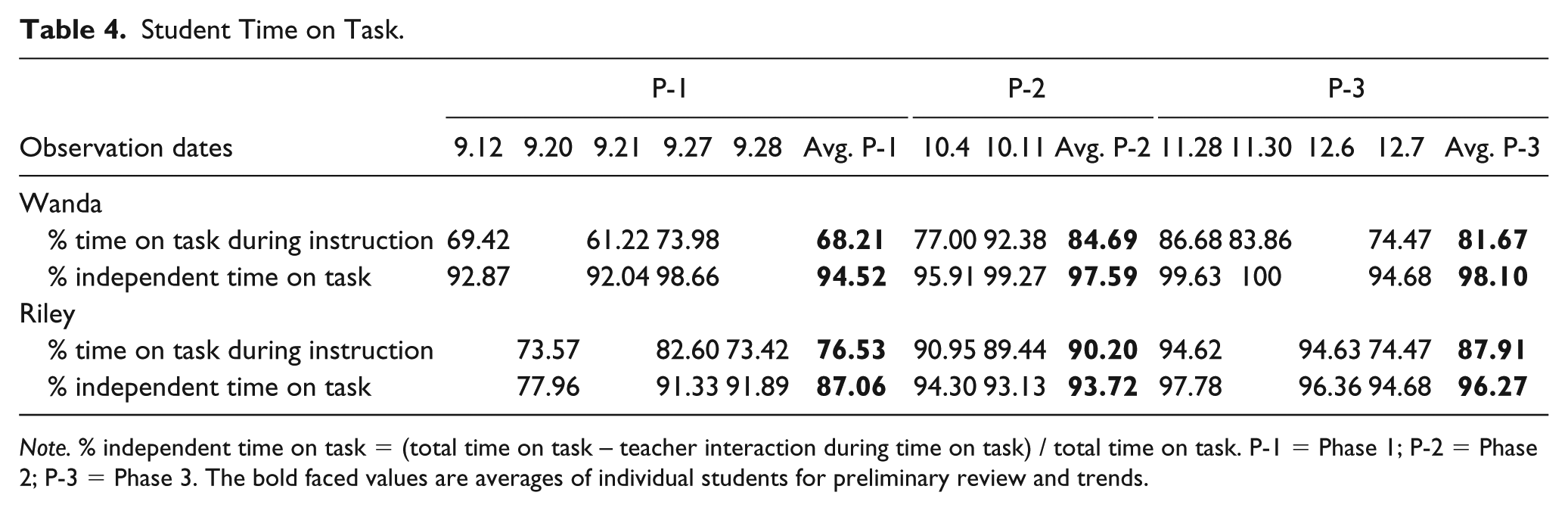
Note. % independent time on task = (total time on task – teacher interaction during time on task) / total time on task. P-1 = Phase 1; P-2 = Phase 2; P-3 = Phase 3. The bold faced values are averages of individual students for preliminary review and trends.
Teachers rated the two target students on their completion of tasks and the accuracy of those tasks. In Phase 2, both Riley and Wanda completed 100% of the tasks on 2 of the 5 days; 75% of tasks on the remaining 3. The accuracy of their completion ranged from 75% to 100%. In Phase 3, Riley had data for six sessions (absent for two), completing 100% of tasks for two sessions, 75% for three sessions, and 50% for one session. Across those sessions, teachers rated her as between 75% and 100% accurate. Wanda had data for 5 days (absent for 3), completing tasks at 100% for 3 days and 75% for 2. Her accuracy was rated at 100% for 4 of 5 days.
Teachers also reported target student grades and standardized test scores. Riley earned a 92% (A), 92% (A), 90% (A), and 80% (B) for quarter grades. Her midterm exam was an 82% (B) and her final grade was an 88% (B). She earned a 399 on the state standardized writing test (a 400 is deemed Proficient). Wanda earned an 86% (B), 88% (B), 90% (A), and 86% (B) on quarter grades. Her midterm exam grade was an 87% (B), as was her final grade. She earned a 379 on her state standardized writing test.
Discussion and Implications
Special education is defined as SDI to meet the unique needs of a student with a disability (Individuals With Disabilities Education Act, 2004). This SDI is meant to be focused on the IEP goals of the individual student. Given the move to include more and more students with disabilities into the general education classroom, special education services have had to adapt to new conditions and service delivery models. Co-teaching is one delivery model for special education services. The recent Endrew decision (Endrew F. v. Douglas County School District, 2017) has made it clear: special education services need to focus on student outcomes and progress in addition to placement. Students must make more than de minimis progress toward their IEP goals. This means that their instruction matters. The literature on co-teaching is replete with recommendations on models and roles. However, when instruction is described, it is clear that much of what is happening does not include EBPs from special education or SDI (Weiss & Glaser, 2017). When more individualized instruction occurs, outcomes for students change (Bottge et al., 2018).
The conceptual model introduced in this study identified three elements to address the quality of instruction in the enacted curriculum (Kurz et al., 2014). Using an incremental, DBR approach (Collins et al., 2004), the purpose of this case study was to examine the feasibility and outcomes of this three-element conceptual model for instruction in co-teaching. Unlike previous work in co-teaching, this model clearly describes the three elements that make it possible for teachers to include the general curriculum and the IEP curriculum in the enacted curriculum.
Element 1 is quality general education instruction which, in this case study, was secured by evidence from the English teacher’s previous ratings on evaluations and recommendation by school administration. Element 2, inclusion of EBPs from special education, was not evidenced in Phase 1 of the study, nor was Element 3, SDI. After professional learning that included video reflection and instructional coaching, the English team was able to increase the percentage of their instructional time spent on guided practice and the frequency of OTRs and FBs, all critical features of Explicit Instruction (Archer & Hughes, 2011) and evidence of Element 2. Although this began in Phase 2, it increased steadily in Phase 3, after completion of the standardized writing assessment. Finally, after additional professional learning and student data gathering, the team was able to include SDI, or Element 3, in instruction. In their interview, the teacher team reported that the three-element model had an impact on their planning and was feasible to implement when provided with the support and coaching available in the study. The dosage and level of coaching necessary is an area of further research.
Although the teachers felt like the instructional changes of Element 2 were relatively easy to include on a daily basis, it was more difficult to get at Element 3, SDI. There were several contextual factors related to this. First, the special educator did not have enough information from her colleagues to know what the SDI should be for each student. That had to be overcome through additional research and review of students’ performance on psychometric evaluations. From this information, the special educator was able to identify strategies in identifying main idea and writing well-developed paragraphs to teach during SDI. In addition, the teachers had a difficult time conceptualizing when SDI could happen and needed coaching on specific times during instruction when it could take place. Once these factors were addressed, the special educator was able to implement SDI consistently for a variety of students in the classroom.
Finally, and most importantly, data and teacher reflection indicated student behavior change. The teachers, who were initially exhausted by their need to reteach concepts during independent practice, described their independent practice in late Phase 2 and in Phase 3 as much more independent. Time on task and independent time on task for the target students with disabilities in the class increased. These were all important variables. The teacher ratings of completion and accuracy, as well as overall grades, did not provide much meaningful data because there was little variability.
It should be noted, however, that even with both teacher and student behavior change, the students were not successful in achieving Proficient scores on one of the standardized tests that is required to earn credit for graduation. Both Wanda and Riley eventually did receive more specialized instruction to meet their needs but, given the brief time that this instruction was implemented, it was difficult to recognize progress toward their IEP goals and change in outcomes related to the standardized tests. In addition to measuring this phenomenon for research purposes, it must be clear to all involved that some students with disabilities require more intensive instruction than can be provided in an effective co-taught classroom. Using data from progress monitoring measures is critical to determining the best service delivery model for each student.
Limitations and Future Directions
The research reported here is limited in scope due to its case study method and cannot be generalized. However, its purpose, as described in DBR, was to provide a foundation for future research in a systematic and iterative fashion (T. Anderson & Shattuck, 2012) related to the need to provide specific guidance to co-teachers about how to include both accessible and SDI in co-taught classrooms. Further delineation of instructional practices that fit within Elements 2 and 3, and the grouping strategies to use them, is warranted. Teachers must have a clear understanding of possibilities for each element to plan lessons that include them. In addition, further analysis of fidelity of implementation of practices and the level of impact that fidelity has on student outcomes is necessary. This is particularly important for Element 3: SDI. The impact of teacher expertise or knowledge of EBP is necessary to understand how professional development and instructional coaching must be structured. Determining an efficient way that special educators can share information about their students and their needs for SDI with one another, particularly at the secondary level where co-teachers may not be case managers, is clearly necessary for the success of this model. Finally, developing measures to examine progress on IEP goals for students with disabilities in these co-taught classrooms is critical to determining whether the instruction meets individual student needs.
Footnotes
Declaration of Conflicting Interests
The author(s) declared no potential conflicts of interest with respect to the research, authorship, and/or publication of this article.
Funding
The author(s) received no financial support for the research, authorship, and/or publication of this article.
